


Community hub
Recent from talks
Contribute something
Nothing was collected or created yet.
Avaris
View on Wikipedia
Key Information


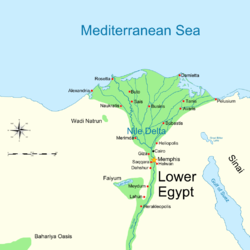
Avaris (Egyptian: ḥw.t wꜥr.t, sometimes hut-waret; Ancient Greek: Αὔαρις, romanized: Auaris; Greek: Άβαρις, romanized: Avaris; Egyptian Arabic: اڤاريس, romanized: Avaris)[5] was the Hyksos capital of Egypt located at the modern site of Tell el-Dab'a in the northeastern region of the Nile Delta.[6] As the main course of the Nile migrated eastward, its position at the hub of Egypt's delta emporia made it a major capital suitable for trade.[7] It was occupied from about the 18th century BC until its capture by Ahmose I.
Etymology
[edit]The name in the Egyptian language of the 2nd millennium BC was probably pronounced /*ḥaʔət-waʕrəʔ/ ('House of the Region') and denotes the capital of an administrative division of the land (wʕr.t). Alternatively, Clement of Alexandria referred to the name of this city as Athyria.[8]
Excavations
[edit]
In 1885, the Swiss Édouard Naville started the first excavations in the area around Tell-el-Daba. Between 1941 and 1942, Labib Habachi, an Egyptian Egyptologist first forwarded the idea that the site could be identified with Avaris. Between 1966 and 1969 and since 1975, the site has been excavated by the Austrian Archaeological Institute.[9] Using radar imaging technology, its scientists could identify in 2010 the outline of the city including streets, houses, a port, and a side arm of the River Nile passing through the city.[10]
The site at Tell el-Dab'a, covering an area of about 2 square kilometers, is in ruins today, but excavations have shown that, at one point, it was a well-developed center of trade with a busy harbour catering to over 300 ships during a trading season.[11] Artifacts excavated at a temple erected in the Hyksos period have produced goods from all over the Aegean world. The temple even has Minoan-like wall paintings that are similar to those found on Crete at the Palace of Knossos. A large mudbrick tomb has also been excavated to the west of the temple, where grave goods, such as copper swords, have been found.
History
[edit]Foundation
[edit]The site was originally founded by Amenemhat I on the eastern branch of the Nile in the Delta.[12] Its close proximity to Asia made it a popular town for Asiatic immigrants, most of whom were culturally Egyptianized, using Egyptian pottery, but also retained many aspects of their own culture, as can be seen from the various Asiatic burials including weapons of Levantine origin. One palatial district appears to have been abandoned as a result of an epidemic during the 13th dynasty.[13]
Hyksos conquest
[edit]In the 18th century BC, the Hyksos conquered Lower Egypt and set up Avaris as their capital. Kamose, the last pharaoh of the Seventeenth Dynasty, besieged Avaris but was unable to defeat the Hyksos there.
Recapture by Egyptians
[edit]Ahmose I captured Avaris and overran the Hyksos. Canaanite-style artifacts dated to the Tuthmosid or New Kingdom period suggest that a large part of the city's Semitic population remained in residence following its reconquest by the Egyptians.[14]
The pharaohs of the Eighteenth Dynasty set up a capital in Thebes and the palatial complex at Avaris was briefly abandoned, but areas such as the Temple of Seth and G6 region remained continuously occupied.[15] It appears as well, that the site of Avaris had gone through a hiatus ceasing to be a political centre, dated after the time of Amenhotep II and until the late 18th dynasty.[16][17]
Abandonment
[edit]After Ramesses II constructed the city of Pi-Ramesses roughly 2 km (1.2 mi) to the north, Avaris was superseded by Pi-Ramesses,[18] and thus finally abandoned during the Ramesside period.[19][20] Parts of the former site of Avaris were used by the inhabitants of Pi-Ramesses as a cemetery and burial ground,[21] and a large portion of it was used as a major navy base,[22] while the "Harbor of Avaris" toponym continued to be used for Avaris' harbor through the Ramesside period. The newly constructed city served as a key administrative and military seat of governance.[23][24]
The name "Avaris" is also referred to in Papyrus Sallier I in the late 13th century BC.[25] In addition, the "Avaris" toponym is also known to Manetho in the 3rd century BC, quoted by Josephus in his Against Apion 1.14.[26]
Urban chronology
[edit]- Stratigraphic layers M-N
Amenemhet I (12th dynasty) planned a settlement, called Hutwaret located in the 19th Nome, circa 1930 BC. It was a small Egyptian town until about 1830 BC when it began to grow by immigration of Canaanites (Levant Middle Bronze Age IIA) By 1800 BC it was a much larger trade colony under Egyptian control. Over the next 100 years immigration increased the size of the city.[27] Scarabs with the name "Retjenu" have been found in Avaris, also dating to the 12th Dynasty (1991-1802 BCE).[28]
- Stratigraphic layers G
At about 1780 a temple to Set was built. The Canaanites living at Avaris considered the Egyptian god Set to be the Canaanite god Hadad. Both were weather gods.[27]
- Stratigraphic layers F
Around 1700 BC a temple district to the Canaanite Asherah and the Egyptian Hathor was built in the eastern part of the city. From 1700 onward, social stratification begins and an elite arise.[27]
- Stratigraphic layers E
In 1650 the Hyksos arrive and the city grows to 250 ha. It is believed that Avaris was the largest city in the world from 1670 to 1557 BC. A large citadel was built around 1550.[27]
Minoan connection
[edit]
Avaris, along with Tel Kabri in Israel and Alalakh in Syria, also has a record of Minoan civilization, which is otherwise quite rare in the Levant. Manfred Bietak, an Austrian archaeologist and excavator of Tell Dab'a, has speculated that there was close contact between the rulers of Avaris and the Minoans, and that the large building featuring frescoes allowed the Minoans to maintain a ritual life in Egypt. French archaeologist Yves Duhoux proposed the existence of a Minoan 'colony' on an island in the Nile Delta.[29]
See also
[edit]References
[edit]- ^ Candelora, Danielle. "The Hyksos". www.arce.org. American Research Center in Egypt.
- ^ Roy, Jane (2011). The Politics of Trade: Egypt and Lower Nubia in the 4th Millennium BC. BRILL. pp. 291–292. ISBN 978-90-04-19610-0.
- ^ "A head from a statue of an official dating to the 12th or 13th Dynasty (1802–1640 B.C.) sports the mushroom-shaped hairstyle commonly worn by non-Egyptian immigrants from western Asia such as the Hyksos." in "The Rulers of Foreign Lands - Archaeology Magazine". www.archaeology.org.
- ^ Potts, Daniel T. (2012). A Companion to the Archaeology of the Ancient Near East. John Wiley & Sons. p. 841. ISBN 978-1-4443-6077-6.
- ^ Holladay, John S. Jr. (1997) "The Eastern Nile Delta During the Hyksos and Pre-Hyksos Periods: Toward a Systemic/Socioeconomic Understanding", in Eliezer D. Oren (1997). The Hyksos: new historical and archaeological perspectives. University Museum, University of Pennsylvania. pp. 183–252. ISBN 978-0-924171-46-8.
- ^ Baines and Malek "Atlas of Ancient Egypt" p 15 nome list and map, p 167 enlarged map of the delta.
- ^ Michael Grant (2005). The rise of the Greeks. Barnes & Noble Books. ISBN 978-0-7607-7000-9.
- ^ "And his remarks are to the following effect: Amosis, who lived in the time of the Argive Inachus, overthrew Athyria, as Ptolemy of Mendes [via Manetho] relates in his Chronology." – Clement of Alexandria 1.22
- ^ "Tell el-Dab'a - History". Tell el-Dab'a-Homepage. Archived from the original on 26 June 2010. Retrieved 2010-06-21.
- ^ "Ancient Egyptian city located in Nile Delta by radar". BBC News. 2010-06-21.
- ^ Booth, C. (2005). The Hyksos Period in Egypt. Shire. p. 40. ISBN 9780747806387. Retrieved 2016-02-03.
- ^ Aaron A. Burke, "Amorites in the Eastern Nile Delta: The Identity of Asiatics at Avaris during the Early Middle Kingdom", 2019, p. 69-71
- ^ Marc van de Mieroop, "A History of Ancient Egypt", 2021, p. 124-5
- ^ Bietak, Manfred. "The Aftermath of the Hyksos in Avaris." Culture Contacts and the Making of Cultures: Papers in Homage to Itamar Even Zohar, by Rakefet Sela-Sheffy and Gideon Toury, Tel Aviv University- Unit of Culture Research, 2011, pp.19-65.
- ^ Manfred Bietak and Irene Forstner-Muller. "The Topography of New Kingdom Avaris and Per-Ramesses", pp 27-28
- ^ Bietak, Manfred. "Manfred Bietak, "A THUTMOSID PALACE PRECINCT AT PERU-NEFER/TELL EL-Dab'a," in: M. Bietak & S. Prell (Eds.), Palaces in Ancient Egypt and the Ancient Near East vol. I: Egypt, Contributions to the Archaeology of Egypt, Nubia and the Levant V, Vienna 2018, 231-257".
- ^ "The harbour of Tell el-Dabʿa".
- ^ Marc van de Mieroop, "A History of Ancient Egypt", 2021, p. 125.
- ^ Manfred Bietak, The Palatial Precinct at the Nile Branch (Area H)
- ^ Manfred Bietak, Nicola Math, and Vera Müller, “Report on the excavations of a Hyksos Palace of Tell el Dabᶜa/Avaris.” Ägypten und Levante 22/23 (2013): 15-35.
- ^ Manfred Bietak, "Avaris/Tell el-Dab’a", p. 14.
- ^ Manfred Bietak, "From Where Came the Hyksos and Where Did they go". In M. Marée (ed.), The Second Intermediate Period (Thirteenth - Seventeenth Dynasties): Current Research, Future Prospects, OLA 192, Leuven 2010: Peeters, p. 139.
- ^ Manfred Bietak & Constance Van Ruden. "Contact Points: Avaris and Pi-Ramesse", pg 18
- ^ Timothy Pottis, "Beyond the Nile: Egypt and the Classical World", p. 20
- ^ James Pritchard, ANET, p. 231.
- ^ Manfred Bietak. "Hyksos" in The Encyclopedia of Ancient History, First Edition. Edited by Roger S. Bagnall, Kai Brodersen, Craige B. Champion, Andrew Erskine, and Sabine, p. 3356.
- ^ a b c d Bietak, M. "Tell-el-Daba - History". Tell el-Dabca. Retrieved 30 November 2019.
- ^ Martin, Geoffrey T. (1998). "The Toponym Retjenu on a Scarab from Tell el-Dabʿa". Ägypten und Levante / Egypt and the Levant. 8: 109–112. ISSN 1015-5104. JSTOR 23786957.
- ^ Duhoux, Yves (2003). Des minoens en Egypte? "Keftiou" et "les îles au milieu du Grand vert". Liège: Univ. Press. ISBN 90-429-1261-8.
Bibliography
[edit]- Carl Nicholas Reeves (2000). Ancient Egypt: the great discoveries : a year-by-year chronicle. Thames & Hudson. ISBN 978-0-500-05105-4.
- Manfred Bietak (1996). Avaris, the capital of the Hyksos: recent excavations at Tell el-Dabʻa. British Museum Press for the Trustees of the British Museum. ISBN 978-0-7141-0968-8.
- Bietak, Manfred (2022). "Avaris/Tell el-Dab'a". In Bagnall, Roger S.; et al. (eds.). The Encyclopedia of Ancient History. John Wiley & Sons. pp. 1–16. doi:10.1002/9781444338386.wbeah15052.pub2. ISBN 9781405179355.
External links
[edit]
- Tell el-Dabʿa Homepage - available in German and English
Avaris
View on GrokipediaLocation and Identification
Geographical Setting
Avaris was situated in the eastern Nile Delta of ancient Egypt, approximately 130 kilometers northeast of the city of Memphis, in a region now known as the modern village of Tell el-Dab'a.[4] This positioning placed it at the heart of the Nile's expansive floodplain, where the river's Pelusiac branch once flowed prominently, providing direct access to waterborne transportation and resources.[5] The site's location along this easternmost distributary of the Nile facilitated its role as a vital hub, bridging the fertile lowlands of the Delta with the arid expanses beyond. The environmental context of Avaris was shaped by the Nile Delta's characteristic alluvial soils, deposited through seasonal flooding that enriched the land with nutrient-rich silts over a Pleistocene substratum.[6] These floods, occurring annually, supported intensive agriculture on the surrounding geziras—elevated turtleback hills composed partly of aeolian sands—but also posed challenges through periodic silting of channels, which required human intervention to maintain navigability.[6] Over time, the progressive abandonment of the Pelusiac branch due to such silting altered the local hydrology, influencing patterns of settlement and economic activity at the site.[6] Strategically, Avaris occupied a pivotal position as a gateway between Egypt and Asia, lying at the interface of the Nile Valley and routes extending to the Levant and Mediterranean Sea.[5] Its proximity to the Pelusiac branch and connecting channels enabled efficient commerce and migration, with northwestern and southeastern access points linking it to overland paths across the Sinai Peninsula and maritime trade networks.[6] This connectivity underscored Avaris's importance as an economic and military nexus, where exchanges of goods, ideas, and populations flourished across regional boundaries.[5]Association with Tell el-Dab'a
The identification of the ancient city of Avaris with the archaeological site of Tell el-Dab'a in Egypt's eastern Nile Delta was initially proposed by scholars in the late 19th and early 20th centuries, including Flinders Petrie, who relied on references in ancient Egyptian texts—such as those from Manetho and the Turin King List—and the site's topographic features to pinpoint the location of the Hyksos capital.[7] Petrie's analysis of scarab seals and historical geography further supported placing Avaris in this region, distinguishing it from other Delta mounds based on descriptions of its role as a major Asiatic-influenced settlement.[8] This early hypothesis gained firm confirmation through direct epigraphic evidence uncovered at the site, notably a sealing impression naming a "mayor of Avaris" (Egyptian Ḥwt-wꜣrt, meaning "House of the Great Enclosure"), which explicitly links Tell el-Dab'a to the ancient toponym.[8] Additional inscriptions, including those from administrative contexts, reinforce this association, aligning the site's material culture—such as Levantine-style pottery and architecture—with historical accounts of Hyksos rule.[9] Later work by Labib Habachi in the 1940s built on these foundations, solidifying the identification through surface surveys that revealed dense occupation debris consistent with a major urban center.[10] The mound of Tell el-Dab'a spans approximately 2.5 square kilometers (250 hectares), encompassing a sprawling urban complex that expanded significantly under Hyksos control, with evidence of palaces, temples, and harbors indicating its status as a key economic hub.[11] Occupation layers at the site reach depths of up to 20 meters, documenting layered settlement from the Middle Kingdom through the New Kingdom, though the core Hyksos phases are marked by distinct foreign influences.[9] Tell el-Dab'a is clearly distinguished from nearby Tanis, located about 30 kilometers to the north, which did not serve as the Hyksos capital but rather rose to prominence in the Third Intermediate Period as a reuse of Ramesside monuments from the Avaris area.[8] While Tanis features later royal necropolises and Egyptian-style temples, Tell el-Dab'a's strata reveal the primary Hyksos administrative and cultural core, evidenced by Asiatic burials and imported goods absent at Tanis.[9] This differentiation underscores Avaris's unique role as the political heart of the 15th Dynasty.Names and Etymology
Ancient Designations
The primary ancient designation for the city was the Egyptian name Ḥwt-wꜥrt (often vocalized as Hutwaret), meaning "House of the Region" or "Mansion of the Great District" and referring to its role as an administrative center in the Nile Delta.[12][13] This toponym appears in Middle and Late Egyptian texts, emphasizing the city's role as a fortified domain or institutional center in the Nile Delta.[14] In the Hellenistic period, the Egyptian name was Hellenized as Avaris (Ancient Greek: Αὔαρις) by the Egyptian priest and historian Manetho in the 3rd century BCE, who preserved it in his chronological work Aegyptiaca as the capital of the Hyksos dynasty.[15] This rendering phonetically adapts the original Egyptian sounds, with "Au-" approximating Ḥwt- and "-aris" reflecting wꜥrt, facilitating its transmission into later Greco-Roman sources.[14] The name Ḥwt-wꜥrt is prominently referenced in Egyptian royal inscriptions as the Hyksos stronghold, notably in the stelae of Kamose (c. 1555–1550 BCE), where it denotes the northern capital under siege, symbolizing Asiatic dominance in the Delta.[15] These texts portray Avaris as a hub of foreign power, with phrases like "the mistresses of Avaris" underscoring its political and symbolic significance in Theban-Hyksos conflicts.[15] Modern scholarly terminology adopts "Avaris" directly from Manetho's Greek form for consistency with ancient literary traditions.[14]Modern and Scholarly Terms
In modern scholarship, Avaris has been associated with the biblical "Raamses" (or "Rameses") mentioned in Exodus 1:11 as a site of Israelite forced labor, with debates centering on whether this refers to the Hyksos capital rebuilt and expanded under Ramesses II as Pi-Ramesses, encompassing the Tell el-Dab'a area.[16] This identification posits Avaris as part of a larger Ramesside metropolitan complex including nearby Qantir, though some scholars argue the Exodus reference is an anachronism reflecting later New Kingdom nomenclature rather than the original Hyksos-era site. The connection remains contested, as no direct archaeological evidence links Israelite activity specifically to Avaris under Ramesses II, but the site's continuity from Hyksos to Ramesside periods supports the possibility of overlapping traditions.[16] During the 19th and 20th centuries, the term "Zoan"—derived from biblical references and Josephus's interpretation of Manetho—became prominent in discussions of Avaris, often conflating it with Tanis as the Hyksos capital.[17] Josephus, drawing on Manetho, described the Hyksos expulsion from Avaris and equated it with the biblical Zoan (Greek Tanis), portraying it as a fortified eastern Delta city from which foreign rulers were driven out, a narrative sometimes linked to the Exodus story. Early scholars like Heinrich Brugsch further intertwined these terms, identifying Zoan-Tanis as synonymous with Avaris based on geographical proximity and shared historical roles as Delta power centers, though later research clarified their sequential occupation of the same locale.[17] Scholarly transliterations of the site's name have varied, with ancient Greek sources via Manetho rendering it as "Auaris" (Αὔαρις), reflecting phonetic approximations of the Egyptian Ḥwt-wꜥrt, while modern usage predominantly favors "Avaris" for clarity and alignment with hieroglyphic readings. This shift from "Auaris" to "Avaris" emerged in 20th-century Egyptology to standardize nomenclature, avoiding the diphthong confusion in earlier European transcriptions, though both forms persist in comparative studies of classical and Egyptian texts.[1] Excavation reports increasingly employ "Tell el-Dab'a" alongside "Avaris" to denote the modern mound and ancient Hyksos phase, emphasizing stratigraphic distinctions.[1] Following the Austrian excavations at Tell el-Dab'a initiated in 1966 under Manfred Bietak, terminology evolved to firmly standardize "Avaris" for the Hyksos capital phase (15th Dynasty), distinguishing it from later Ramesside or Tanite overlays.[1] Bietak's work, including stratigraphic analysis revealing Asiatic influences, reinforced this usage in publications, supplanting earlier ambiguous references to "Auaris" or conflations with Tanis and promoting "Avaris" as the precise designation for the Second Intermediate Period settlement.[18] This standardization has become conventional in post-1960s scholarship, facilitating clearer discussions of the site's multicultural history.[1]Historical Periods
Pre-Hyksos Settlement
The site of Avaris, identified with Tell el-Dabʿa, saw its initial settlement during the early Middle Kingdom, around the beginning of the 12th Dynasty (c. 1991–1971 BCE), when planned Egyptian communities were established in areas such as F/I and ‘Ezbet Rushdi.[9] These early occupations included administrative structures, evidenced by a memorial temple dedicated to Amenemhat I built by Senwosret III, indicating official Egyptian oversight in the northeastern Nile Delta.[9] By the late 12th Dynasty (c. 1878–1840 BCE), seal impressions bearing the title of a mayor of Ḥw.t wʿr.t (the ancient name for Avaris) confirm its role as an Egyptian administrative outpost, managing regional affairs.[9] Avaris functioned primarily as a trading post for merchants from Canaan and the Levant during the late Middle Kingdom and into the Second Intermediate Period (c. 1800–1650 BCE), leveraging its strategic position near a harbor connected to the Nile and Pelusiac branch.[9] Archaeological evidence includes an increasing proportion of Middle Bronze Age Canaanite pottery, rising from 16% in earlier phases to 40% by Phase G/1-3, alongside scarabs inscribed with the title "Ruler of Retjenu" (a term for Canaanite rulers) from Phase G/4.[9] Cylinder seals, such as a 13th Dynasty hematite example depicting the god Hadad (Baʿal Zephon), further attest to the presence of Canaanite traders and cultural exchanges.[9] The pre-Hyksos phases reveal small-scale villages and tombs in stratigraphic layers G and H, reflecting gradual settlement buildup from the late 12th to 13th Dynasty (c. 1840–1700 BCE).[9] In Phase H, Canaanite-style houses emerged, accompanied by tombs containing donkey and goat burials as well as Near Eastern weapons, suggesting communities of foreign merchants integrated into the local landscape.[9] Phase G/4 yielded high-ranking Asiatic tombs and a statue of a Western Asiatic prince (now in the Munich Museum), indicating elite Canaanite presence amid modest village structures like sandy brick houses and storage facilities.[9] Around 1700 BCE, during the late 13th Dynasty, Avaris experienced a marked transition from predominant Egyptian control to a growing Asiatic influx, as seen in Phase F with the construction of temples and palaces incorporating Near Eastern elements.[9] This shift, evidenced by the proliferation of foreign-style architecture and artifacts, laid the groundwork for later Hyksos dominance without abrupt disruption to the existing trading networks.[9]Hyksos Capital Era
Avaris reached its zenith as the capital of the Hyksos during the Fifteenth Dynasty of Egypt's Second Intermediate Period, approximately 1650–1550 BCE, when rulers of Levantine origin established control over Lower and parts of Middle Egypt. The Hyksos, termed "rulers of foreign lands" in Egyptian, transformed the site from a modest settlement into a bustling metropolis spanning over a square mile and supporting around 25,000 inhabitants, serving as their political, administrative, and economic hub. According to ancient historian Manetho, the dynasty began with Salitis, who founded the capital at Avaris and fortified it against potential threats, while later kings like Apepi (also known as Apophis) extended Hyksos influence through diplomacy and military campaigns, as evidenced by scarabs and inscriptions bearing their names found at the site.[2][19][3] Under Hyksos rule, Avaris featured extensive fortifications, including a large enclosure wall detected through geophysical surveys and excavations at sites like 'Ezbet Helmy, which enclosed the urban core and protected against incursions. Palaces exemplified Semitic architectural styles, such as a sprawling 10,600 m² complex with a throne room, magazines for storage, and Mesopotamian-inspired layouts, contrasting with traditional Egyptian designs. Temples reflected Canaanite influences, including a broad-room Temple III (32.5 × 21.5 m) likely dedicated to the Syrian storm god Baal-Zephon, complete with a fire-altar, alongside bent-axis and Egyptian-style shrines, underscoring the blend of local and imported religious practices. These structures, uncovered in stratigraphic layers from Bietak's long-term digs at Tell el-Dab'a, highlight Avaris as a center of Hyksos innovation and cultural synthesis.[9][2] The city's economic prosperity stemmed from robust trade networks with the Levant and eastern Mediterranean, facilitated by its harbor with rectangular basins and channels for maritime access. Imports included luxury goods like lapis lazuli, turquoise, silver, and cedar wood, alongside practical items such as Cypriot pottery, oils, wine, and bronze battle-axes, as documented in contemporary Egyptian records like the Kamose Stela, which describe Hyksos wealth from these exchanges. Levantine-style bronze weapons and tools, found in abundance at Avaris, further attest to this commerce, which bolstered the Hyksos economy and military capabilities during their century-long dominance.[3][2][9] Tensions with Theban rulers in Upper Egypt escalated into open conflict, as the Hyksos restricted access to southern trade routes and Nubian resources, prompting military responses from kings like Seqenenre Tao and Kamose. These skirmishes culminated in the reign of Ahmose I (ca. 1550–1525 BCE), who launched a prolonged siege of Avaris, capturing the city after multiple assaults and expelling the Hyksos northward into Canaan, as recorded in the tomb autobiography of Ahmose son of Ebana and a daybook entry in the Rhind Mathematical Papyrus. Archaeological evidence, including a burned palace layer at Avaris, corroborates the violent end to Hyksos rule, marking the transition to the New Kingdom.[20][2]Post-Hyksos Decline
Following the conquest of Avaris by Ahmose I around 1550 BCE, the city experienced significant destruction and partial abandonment as the Hyksos were expelled from Egypt. The autobiography of Ahmose, son of Ebana, a soldier who participated in the campaigns, describes the siege of Avaris, intense fighting, and the subsequent despoiling of the city, where spoils including captives were taken, indicating widespread plundering and disruption of Hyksos structures.[21] This event marked the end of Hyksos rule, leading to a period of reduced occupation at the site during much of the Eighteenth Dynasty, though some continuity in settlement persisted in surrounding areas.[20] Avaris saw a notable revival during the Nineteenth Dynasty under Ramesses II (c. 1279–1213 BCE), when it was incorporated into the new capital of Pi-Ramesses at nearby Qantir, serving as a key military and administrative center. Excavations reveal that the site was repurposed with palaces, temples, and harbor facilities, integrating Avaris's topography into the broader urban complex of Pi-Ramesses, which emphasized its strategic location in the eastern Delta for trade and defense.[22] This phase transformed Avaris from a Hyksos stronghold into an Egyptian royal precinct, with evidence of workshops and elite residences supporting administrative functions.[2] By the Late Period, Avaris underwent gradual decline due to environmental factors, particularly the silting of the Pelusiac branch of the Nile, which disconnected its harbor channels and reduced accessibility. This led to the site's partial abandonment as a major urban center, overlaying it with rural settlements by the first millennium BCE.[6] During the Third Intermediate Period, activity at Avaris was limited, with a notable hiatus in occupation, as the region shifted focus to emerging sites like Tanis, where materials and statuary from Avaris and Pi-Ramesses were systematically reused in new constructions.[23][24]Archaeological Excavations
Early 20th-Century Discoveries
The archaeological exploration of Tell el-Dab'a, the site identified as ancient Avaris, commenced in the late 19th century with Swiss Egyptologist Édouard Naville's surveys and initial excavations in 1885, which revealed surface remains indicating a major ancient settlement in the eastern Nile Delta. Pioneering efforts in the early 20th century were limited, but significant progress occurred in the 1940s under Egyptian archaeologist Labib Habachi, who conducted digs for the Egyptian Antiquities Service from 1941 to 1942. Habachi's work uncovered numerous scarabs inscribed with Hyksos royal names, providing early evidence of the site's role as the Hyksos capital during the Second Intermediate Period.[2] These excavations also yielded two nearly life-sized seated statues, likely originating from elite or palace contexts, alongside other artifacts that hinted at Middle Bronze Age occupation layers. However, systematic trenching was constrained by resource shortages and disruptions from World War II, preventing more extensive uncovering of tombs and structures from this period.[25] Habachi's findings laid the groundwork for identifying Tell el-Dab'a as Avaris, a proposal he detailed in his seminal 1954 publication "Khata'na-Qantir: Importance," which analyzed the site's connections to Hyksos history and later Ramesside activity.[26][27]Modern Systematic Digs
The modern systematic excavations at Tell el-Dab'a, the site of ancient Avaris, were initiated in 1966 by Manfred Bietak under the auspices of the Austrian Archaeological Institute in Cairo, marking a shift to large-scale, stratified archaeological investigation following earlier exploratory work.[9] This long-term project, spanning over 75 campaigns until 2011 and resuming in select areas from 2010 onward, divided the expansive 225-hectare site into systematic areas labeled A through F to facilitate controlled, horizontal and vertical excavation strategies. Bietak's approach emphasized multi-disciplinary methods, including geophysical surveys such as magnetometry to detect subsurface structures like enclosure walls and palaces without extensive digging.[28] Complementing these techniques, the excavations employed pottery seriation for relative chronology and radiocarbon dating to establish absolute timelines, enabling the identification of more than 15 stratigraphic layers spanning approximately 1800 to 1100 BCE, from the late Middle Kingdom through the Hyksos period and into the early New Kingdom.[26] These methods revealed phased urban development, including planned 12th Dynasty settlements in areas like 'Ezbet Rushdi and Hyksos-era palatial districts in F/I, providing a detailed chronological framework for the site's evolution as a Hyksos capital.[9] In recent years, post-2020 efforts have incorporated advanced digital documentation to enhance analysis and preservation of legacy data from Bietak's campaigns. The Tell el-Dab'a Archaeological Information System (AIS), developed since around 2016, integrates analogue records into a GIS-based 4D platform using tools like ArcGIS and Harris Matrix Composer for spatio-temporal modeling of stratigraphic units, focusing on areas such as F/I from the 12th to 18th Dynasties.[29] Building on this, a 2018–2020 project led by Irmgard Hein employed 3D modeling via Structure from Motion and Autodesk software to reconstruct palaces (e.g., in platform F at 'Ezbet Helmi) and tombs, archiving data at the Austrian Centre for Digital Humanities for collaborative access.[30] Excavations face significant challenges, including a high groundwater table that limits depth in the Nile Delta's low-lying terrain and ongoing urban encroachment from the modern town of Tell el-Dab'a, which occupies parts of the ancient site and complicates access. Agricultural exploitation has also eroded upper strata and tombs, while the site's flat, cemetery-overlaid tell in Area A/II adds logistical hurdles.[9] Despite these, the Austrian Archaeological Institute continues fieldwork under co-director Irene Forstner-Müller, with recent seasons targeting Hyksos palaces and temple precincts to refine urban chronologies.[28]Urban Structure and Chronology
Stratigraphic Layers
The stratigraphic framework for Avaris, developed by Manfred Bietak through long-term excavations at Tell el-Dabʿa, consists of an 18-strata system that provides a detailed chronological phasing from the late Middle Kingdom to the Ramesside period. This system, denoted by letters and subphases (e.g., T, H, G/1–4, F, E/1–3, D/1–3, C/1–3, B/1–3, A/I–III), spans roughly 1950 BCE to 1300 BCE and reflects successive layers of occupation, cultural shifts, and architectural development. The earliest layer, Stratum T, dates to the early Twelfth Dynasty (circa 1960–1930 BCE) and represents a modest Egyptian settlement with local pottery and basic structures, establishing the site's initial role as a regional outpost.[11] Progressive strata illustrate increasing foreign influence, beginning with Stratum H in the late 12th Dynasty (circa 1850–1800 BCE), where Canaanite immigrants appear, marked by about 20% Canaanite-style pottery amid predominantly Egyptian wares. Stratum G, associated with the 13th Dynasty (circa 1800–1650 BCE), shows further expansion of this community, with Canaanite pottery comprising up to 40% of assemblages and evidence of an epidemic affecting the population. The pivotal transition to Hyksos dominance occurs in Stratum F around 1650 BCE, signaling their arrival through a sharp rise in Canaanite pottery, donkey burial rituals, and the erection of a large temple with blue-painted plaster, indicating elite Canaanite presence and cultural overlay on the existing Egyptian substrate. Recent research highlights a conflagration in phases F–E/2 marking a violent shift to Hyksos rule, with the town expanding significantly to about 250 hectares in phase E/1.[11][31][9] Subsequent layers in the Hyksos era, particularly Stratum E/1 (circa 1650–1600 BCE), feature significant palace expansions, including monumental complexes that blend Canaanite and Egyptian architectural motifs, underscoring the regime's consolidation and adoption of local administrative practices. Stratum D (circa 1600–1530 BCE), encompassing subphases D/3 to D/1, documents the late Hyksos period with fortified citadels, increased Cypriot imports in pottery, and clear destruction horizons—such as widespread fire marks and collapsed structures—attributed to the siege and conquest by Ahmose I, leading to temporary abandonment. The sequence culminates in Stratum A/II during the Ramesside era (circa 1300 BCE), marking reoccupation with new palatial builds and continuity from earlier New Kingdom layers.[11] Radiocarbon (C14) dating, based on accelerator mass spectrometry of short-lived plant remains from key strata like E/1 to D/3, supports alignment with the Second Intermediate Period, yielding calibrated ranges of approximately 1760–1630 BCE for Hyksos-related phases, though with a noted 100–120-year offset from conventional Egyptian historical chronology that remains under debate. These dates corroborate stratigraphic transitions, such as the onset in Stratum F and the D-layer destructions, enhancing the precision of the overall timeline.[32]Major Architectural Elements
The Great Palace complex in Area F represented a central feature of Avaris's urban layout during the Hyksos period, encompassing approximately 12,000 m² and serving as a multifaceted administrative and residential hub. This expansive structure included agglutinating room arrangements typical of Near Eastern palatial design, with colonnaded courts that facilitated ceremonial processions and audience halls. Recent excavations indicate that a new Hyksos palace was constructed over a burned pre-Hyksos structure, incorporating Near Eastern influences similar to Ebla’s Palace Q.[33][31] Surrounding the palace and other key structures were massive enclosure walls, reaching up to 6 m in thickness, constructed from mudbrick to provide robust defense against incursions from the south, where Egyptian forces posed a persistent threat to Hyksos rule. These walls enclosed strategic districts and were punctuated by fortified gates that controlled access and movement, reflecting a planned urban defense system adapted to the site's delta location. The design emphasized security while allowing for the integration of palatial and sacred spaces within protected perimeters.[34][3] Religious architecture at Avaris featured prominent temples dedicated to the Hyksos deity Seth, syncretized with a northern Syrian storm god, alongside shrines to traditional Egyptian gods, underscoring the blended cultic practices under Hyksos governance. A notable example is the broad-room Temple III, which originated in the Middle Kingdom and was reused throughout the Hyksos era, demonstrating continuity in sacred spaces despite political shifts. These temples, often positioned near the palace district, included altars and offering areas that supported ritual activities central to Hyksos legitimacy. In the 15th Dynasty, a Near Eastern bent-axis temple was replaced by an Egyptian-style temple precinct about 600 m to the west-north-west.[31][35] Beyond elite structures, Avaris's residential quarters comprised clusters of Canaanite-style houses characterized by central courtyards and broad-room layouts, accommodating a diverse population of Levantine immigrants and local Egyptians. These neighborhoods extended outward from the core citadel, with integrated industrial zones dedicated to pottery production and metallurgy, where workshops produced Canaanite-imported forms and bronze artifacts essential for trade and daily use. Such areas illustrate the city's evolution into a bustling economic center, with specialized crafts supporting its role as a Hyksos capital.[36][37]Cultural Influences and Artifacts
Minoan Trade Links
Excavations at Avaris have revealed significant evidence of Minoan cultural influence through wall paintings in the palace complex of Stratum D, dating to the early 18th Dynasty, approximately 1550–1450 BCE. These frescoes, discovered in Palace F, feature distinctive Aegean motifs such as bull-leaping scenes and griffins, executed in a style characteristic of Cretan artistry. Over 30 fragments of these paintings have been analyzed, showing the use of lime plaster and techniques identical to those employed at Minoan sites like Knossos, indicating they were likely painted by artists from Crete who were either visiting or temporarily resident at the site.[38][39] Further evidence of direct maritime trade between Avaris and the Aegean comes from imported artifacts, including Kamares ware pottery and seals originating from Crete and Thera (Santorini). Genuine examples of Kamares ware, a fine Minoan ceramic style with light-on-dark polychrome decoration, have been found in Hyksos-period contexts at Tell el-Dab'a, demonstrating active exchange networks rather than mere imitation. Minoan-style seals, depicting motifs like marine life and abstract designs, also appear in the archaeological record, underscoring connections to Cretan workshops and suggesting the importation of luxury goods via sea routes.[40][41] As a key Levantine port in the Nile Delta, Avaris served as an intermediary hub relaying Minoan commodities and cultural elements deeper into Egypt, facilitating broader interactions during the Second Intermediate Period. The presence of these Aegean imports and artworks highlights Avaris's role in trans-Mediterranean trade, where Minoan goods were distributed to Egyptian elites. Scholarly debate persists on the extent of this engagement, with some interpreting the frescoes as evidence of artistic influence through traveling craftsmen, while others propose a small resident Minoan community contributing to local production.[1][42]Hyksos Material Culture
The Hyksos material culture at Avaris prominently featured weapons that underscored their Levantine warrior heritage, setting them apart from native Egyptian traditions. Excavations have uncovered composite bows, a technological innovation characterized by laminated construction for greater power and range, which originated in the Near East and were integral to Hyksos military prowess.[43] Kohl tubes, slender vessels for eye cosmetics typically made of faience or bronze and decorated with Asiatic motifs, were also prevalent; these items, used by warriors to reduce sun glare during campaigns, reflect the Hyksos adoption of Canaanite personal equipment in their daily and martial routines.[3] Personal adornments and seals from elite tombs further illuminate the Hyksos' Semitic identity, with scarabs and jewelry incorporating distinct non-Egyptian iconography. Many scarabs bore inscriptions in Semitic languages or motifs depicting Baal-like storm deities wielding weapons, often syncretized with Egyptian gods like Seth, evidencing the rulers' Canaanite religious affiliations and elite status.[3] Gold and silver jewelry, including earrings and pendants with griffin or sphinx designs adapted from Levantine styles, accompanied these finds, suggesting a display of wealth tied to trade networks and cultural prestige among the Asiatic nobility.[44] Burial customs among the Hyksos elite at Avaris deviated markedly from Egyptian norms, emphasizing their Asiatic origins through equestrian and sacrificial elements. Horse burials, such as the interment of a complete mare skeleton adjacent to a high-status tomb, symbolized the Hyksos' reliance on equids for warfare and status, a practice rare in contemporary Egyptian contexts.[43] Donkey sacrifices, often in pairs at tomb entrances or palace courtyards, represented a Levantine funerary rite linked to journeys to the afterlife and expedition symbolism, with remains showing ritual slaughter and placement to accompany the deceased.[9] In everyday life, artifacts from Avaris households demonstrated a blending of Canaanite imports and local adaptations, fostering cultural hybridity. Canaanite jars, tall storage vessels with ovoid bodies and ring bases produced in the Levant, were widely used for oil and wine transport, evidencing sustained trade connections.[43] Complementary to these were Egyptianized pottery hybrids, where Levantine forms like dipper juglets were crafted in Nile clay with Egyptian firing techniques, illustrating how Hyksos artisans integrated foreign designs into domestic production for practical use in kitchens and workshops.[3]Historical Significance
Role in Egyptian Dynastic History
Avaris served as the capital of the Hyksos during the 15th Dynasty (c. 1650–1550 BCE), embodying foreign rule over northern Egypt and symbolizing a significant challenge to native Egyptian political unity.[45] The Hyksos, a West Asian dynasty known as "rulers of foreign lands," established Avaris (modern Tell el-Dabʿa) in the Nile Delta as their administrative and military center, blending Levantine and Egyptian elements while maintaining Semitic nomenclature and cultural practices that highlighted their outsider status.[2] This period of divided rule, with Theban kings of the 17th Dynasty controlling the south, underscored tensions that disrupted traditional pharaonic authority and fostered a narrative of foreign intrusion in Egyptian historical memory.[45] The Hyksos presence at Avaris acted as a catalyst for the militarization of the emerging New Kingdom, directly influencing the unification campaigns of pharaohs Kamose and Ahmose I. Kamose, the last ruler of the 17th Dynasty, initiated assaults on Hyksos territories, besieging Avaris with a Nile flotilla and capturing enemy resources, though he failed to fully conquer the city.[46] Ahmose I, founder of the 18th Dynasty (c. 1550 BCE), completed the expulsion through repeated sieges of Avaris, culminating in its sack according to Egyptian textual accounts, and the Hyksos retreat to Sharuhen, thereby ending the Second Intermediate Period and enabling Egypt's imperial expansion.[46] These conflicts prompted the development of a professional standing army, including chariotry and infantry, which became hallmarks of New Kingdom warfare.[2] Economically, Avaris facilitated the Hyksos' introduction of transformative technologies to Egypt, particularly the horse-drawn chariot, which native rulers swiftly adopted to enhance military mobility. Archaeological evidence from Avaris palaces, including horse remains, confirms the Hyksos' role in bringing these innovations from the Near East, revolutionizing Egyptian tactics and contributing to the empire's later conquests in Asia and Nubia.[2] This legacy extended beyond warfare, influencing broader economic exchanges in the Delta hub.[45] Avaris also marked a transitional site linking the Second Intermediate Period to the Ramesside era of the New Kingdom, evolving into the southern harbor component of Pi-Ramesses, the 19th Dynasty capital founded by Ramesses II (c. 1279–1213 BCE) at nearby Qantir. The site's strategic Pelusiac Nile basin, originally developed under Hyksos rule, continued as a key naval base through the 18th Dynasty's Peru-nefer phase and into the Ramesside period, supporting military logistics and trade as documented in texts like Papyrus Anastasi III.[47] This continuity underscored Avaris's enduring role in Egypt's eastern frontier dynamics.[6]Ongoing Scholarly Debates
One of the central ongoing debates in Hyksos studies concerns the ethnicity and origins of the population at Avaris, with scholars divided between interpretations emphasizing a predominantly Semitic (Levantine) identity and those highlighting a more mixed, multicultural composition. Bioarchaeological analyses, including strontium isotope ratios from tooth enamel of 75 individuals spanning the Middle Bronze Age to Hyksos periods, indicate that 53% were non-local to the Nile Delta, with diverse geographic signatures suggesting mobility from the Levant and beyond, rather than a singular invasive group.[48] Dental nonmetric trait studies further support strong biological affinities to Levantine populations, distinct from native Egyptians, aligning with onomastic evidence for western Semitic origins, yet revealing continuity from earlier Middle Kingdom settlers and an influx of non-local females (77% during the Hyksos era), pointing to patrilocal integration and a heterogeneous elite.[49] Post-2010 projects like the Hyksos Enigma initiative have reinforced this view of Avaris as a multicultural hub, challenging traditional invasion narratives and proposing an internal rise of foreign elements with mixed Hurrian or southern Levantine influences, though consensus leans toward predominant Semitic roots based on material and genetic proxies.[50] More recent research, including a 2024 study by Manfred Bietak, suggests that the Hyksos ruling population may have originated internally within Egypt, through migration of established Asiatic communities from the Memphite and Fayum regions, rather than a direct influx from the Levant, based on ceramic evidence and settlement patterns.[31] The nature of Avaris's fall under Ahmose I remains contested, particularly regarding whether the conquest involved widespread violence and destruction or a more gradual abandonment. Excavations at Tell el-Dab'a reveal no uniform destruction layers in key Hyksos strata like D/2, which ends with a settlement hiatus attributed to the campaign, but lacks evidence of burning or sacking in many areas, contrasting with textual accounts in the Autobiography of Ahmose, son of Ebana, describing naval assaults and plunder.[51] While some loci, such as Stratum F, show burnt layers and ash potentially linked to conflict, broader findings—including continued domestic structures in Stratum D/3 and soldier burials in D/1.1—suggest a phased transition rather than total obliteration, with silos leveled post-conquest indicating administrative repurposing.[52] Scholars like Manfred Bietak interpret isolated features, such as pits with severed hands near palaces, as trophies from military victory, yet others, including David Aston, argue for continuity in material culture and a lack of catastrophic fire evidence, proposing siege preparations or negotiated withdrawal amid chronological debates from radiocarbon dating (ca. 1688–1630 BCE).[51] This discrepancy fuels discussions on whether Ahmose's expulsion was a decisive purge or part of a protracted Delta reconquest. Correlations between Avaris and biblical narratives, especially the Exodus account of store cities like Rameses (Exodus 1:11), continue to provoke scholarly scrutiny, weighed against archaeological timelines that rarely align with a historical mass departure. Proponents of a Hyksos-Israelite link highlight Avaris's Semitic population, Asiatic-style housing, and its later renaming as Pi-Ramesses under Ramesses II, interpreting anachronistic biblical toponyms as retrospective references to the Hyksos capital where foreign laborers may have toiled on storage facilities.[53] However, excavations show no evidence of enslaved Semitic brick-making or sudden abandonment matching an Exodus-scale event around 1446 or 1250 BCE, with the site's Hyksos phase ending ca. 1550 BCE—centuries before Ramesside store cities—and gradual depopulation rather than catastrophe.[54] Critics, including Manfred Bietak, emphasize that while Avaris's multicultural Asiatic community echoes themes of foreign "shepherd kings" in Manetho, timelines preclude direct equivalence to Israelite bondage, viewing such parallels as folkloric rather than historical, though some integrate it with Shasu migrations in Egyptian texts.[26] Post-2020 research on Avaris has been limited by urban encroachment and funding constraints, resulting in few new fieldwork seasons at Tell el-Dab'a and highlighting gaps in integrating legacy data across Delta sites. Ongoing digital initiatives, such as the Tell el-Dab'a Archaeological Information System, employ 4D modeling to revisit stratigraphic puzzles from decades of digs, but scholars call for broader GIS applications to map paleolandscapes and connectivity among Hyksos-era settlements like Bubastis and Tell Ibrahim Awad.[29] The Ninth Delta Survey Conference in 2025 underscored these needs, advocating geospatial synthesis of remote sensing and legacy surveys to address environmental shifts and settlement patterns, amid debates over how modern development obscures potential Hyksos outliers.[55] Without such integrated approaches, interpretations of Avaris's regional role remain provisional, with calls for renewed multidisciplinary efforts to fill chronological voids.[56]References
- https://en.wiktionary.org/wiki/%25E1%25B8%25A5wt-w%25EA%259C%25A5rt