Hubbry Logo
AzrouAzrouMain
Open search
Azrou
Community hub
Azrou
logo
8 pages, 0 posts
0 subscribers
Be the first to start a discussion here.
Azrou
Azrou
from Wikipedia

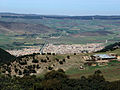
Azrou (Arabic: أزرو) is a town in Ifrane Province in the Fez-Meknes region of Morocco.

Key Information

Etymology

[edit]

Azrou is a geomorphological name taken from the landform of a large rock outcrop (Aẓro, ⴰⵥⵔⵓ, means "rock" or "stone" in the Berber language Tamazight) in the centre of the city.[2]

Demographics

[edit]

According to the 2024 Moroccan census, 86.1% of the population of Azrou speak Arabic as their mother tongue, whereas a minority of 13.8% natively speak Berber languages.[3]

History

[edit]
Azrou College

The first record of Azrou city in history in a letter sent by Fernão Taveira to king Manuel I of Portugal.[4]

Azrou is mostly known for hosting the first high school in the Berber region: the Berber high school of Azrou (now the Tarik Ibn Ziad School). It was built by the French colonial authorities in order to train Moroccans for the colonial administration.[5] It was one of the instruments for the implementation of a Berber Dhahir, which changed the justice system in areas where Amazigh languages were predominantly spoken, excluding these areas from Sharia and the authority of the Makhzen that applied to the rest of Morocco, and implementing a new legal system ostensibly in accordance with Amazigh laws and customs written in French.[6]

The college became an educational institution in the reference area, forming part of the political and military elites from 1956 to 1973, after independence, the college was renamed Azrou Tarik Ibn Ziad High School.

In 1952, 20 Benedictine monks arrived to establish near the town the monastery of Toumliline which hosted interfaith dialogues between Christians, Jews and Muslims of different nationalities between 1955 and 1964.[7] The monastery, which was closed in 1968 due to tensions within Morocco as well as global tensions,[8] served as film location to the movie Of Gods and Men around 2010.[9]

The town was long neglected by the Moroccan authorities since independence in 1956 to the detriment of the nearby town of Ifrane. Although it is the true capital of the Middle Atlas and a town that has given Morocco many leaders and intellectuals, the town still does not officially rank as provincial capital, although it is in practice.

The town has several hotels.

Geography

[edit]
Azrou market

The market town of Azrou is located about 89 kilometres (55 mi) south of Fez.

Azrou is at an altitude of 1250 m and surrounded by mountains covered with evergreen holm oak and cedar.[2]

The Cèdre Gouraud Forest is located to the south east, where one of the sub-populations of the Barbary macaque, Macaca sylvanus (called magots) lives and draws the attention of tourists.[10] In addition to its rich biodiversity symbolized by the famous cedar forest there are the butterflies which are unique in the world. The surroundings of Azrou are a centre of attraction for the residents, hikers, and picnickers of the large neighbouring towns. These surroundings are also home to the 'Cedre Gouraud' or 'Grand Cedar', a famous tourist attraction. Moreover, the Azrou forest provides an excellent hiking and exercising environment and also holds several summer camps for children. Azrou urban construction is in the European style (red tile roofs).

The region is also known for its cherry trees, apple trees, fish farms, and the abandoned sanatorium in the surrounding metropolitan area of Ben Smim.

Climate

[edit]

Generally, Azrou experiences a warmer climate than Ifrane, because the city is at a lower altitude. Under the Köppen system, Azrou features a hot-summer mediterranean climate (Csa), in spite of its cold winters, not cold enough to be classified as a continental mediterranean climate (Dsa). Thus, winters are moderately cold and snowy, but without substantial accumulation. Summers are hot and moderately dry, which are noticeably wetter than in Ifrane.

Climate data for Azrou, Morocco
Month Jan Feb Mar Apr May Jun Jul Aug Sep Oct Nov Dec Year
Record high °C (°F) 21.2
(70.2)
24.4
(75.9)
27.4
(81.3)
32.2
(90.0)
35.9
(96.6)
39.2
(102.6)
42.0
(107.6)
41.2
(106.2)
36.0
(96.8)
31.1
(88.0)
25.6
(78.1)
21.9
(71.4)
42.0
(107.6)
Mean daily maximum °C (°F) 10.3
(50.5)
11.6
(52.9)
13.8
(56.8)
17.7
(63.9)
21.4
(70.5)
26.8
(80.2)
32.0
(89.6)
31.4
(88.5)
26.3
(79.3)
21.6
(70.9)
13.5
(56.3)
10.7
(51.3)
19.8
(67.6)
Daily mean °C (°F) 4.4
(39.9)
5.6
(42.1)
8.3
(46.9)
11.6
(52.9)
14.6
(58.3)
19.7
(67.5)
23.3
(73.9)
22.8
(73.0)
19.4
(66.9)
15.1
(59.2)
8.4
(47.1)
4.9
(40.8)
13.2
(55.7)
Mean daily minimum °C (°F) −1.5
(29.3)
−0.4
(31.3)
2.8
(37.0)
5.5
(41.9)
7.8
(46.0)
12.6
(54.7)
14.6
(58.3)
14.2
(57.6)
12.5
(54.5)
8.6
(47.5)
3.3
(37.9)
−0.9
(30.4)
6.6
(43.9)
Record low °C (°F) −14.4
(6.1)
−16.5
(2.3)
−8.8
(16.2)
−4.6
(23.7)
−1.5
(29.3)
2.2
(36.0)
7.1
(44.8)
6.0
(42.8)
3.3
(37.9)
−1.1
(30.0)
−8.0
(17.6)
−14.1
(6.6)
−16.5
(2.3)
Average precipitation mm (inches) 156
(6.1)
133
(5.2)
111
(4.4)
92
(3.6)
54
(2.1)
40
(1.6)
24
(0.9)
36
(1.4)
53
(2.1)
75
(3.0)
121
(4.8)
172
(6.8)
1,067
(42)
Source: https://fr.climate-data.org/afrique/maroc/azrou/azrou-21511/

Transport

[edit]

Azrou is located at a strategic crossroads of the N13 and N8 roads towards the northern end of the Middle Atlas. The N13 road connects Azrou to Meknes in the north west and Midelt in the south east. The National Route N8 comes from Fez in the north east and continues to Khenifra and then Marrakesh in the south west.

[edit]

International relations

[edit]

Azrou signed a protocol of cooperation with Blois in July 2011.[11]

References

[edit]
Revisions and contributorsEdit on WikipediaRead on Wikipedia
from Grokipedia

Azrou (Berber: ⴰⵣⵔⵓ, Arabic: أزرو) is a town and commune in Province of the Fès-Meknès region in central , situated in the Middle Atlas mountain range at an elevation of approximately 1,330 meters above . As of the 2024 , its municipal stands at 57,630 inhabitants, predominantly of Amazigh (Berber) descent, making it a cultural and economic hub for surrounding rural communities. The town, whose name derives from the Tamazight word for "rock" referencing a prominent volcanic at its center, functions as a regional market center for , , and products, with the adjacent cedar forests providing timber and supporting activities such as viewing of Barbary macaques. Originally an ancient Berber settlement, Azrou was formalized as a during French colonial rule, which established the Collège Berbère d'Azrou in as part of efforts to cultivate a distinct Berber identity through education detached from Arab-Islamic frameworks. The local relies heavily on the exploitation of the Azrou Forest, though recent assessments indicate declining due to environmental pressures, underscoring challenges in sustainable . Its , featuring cold winters with snowfall and mild summers, distinguishes it from 's lowland arid zones.

Etymology and Naming

Origin and Linguistic Roots

The name Azrou originates from the Tamazight (Berber) term aẓru (ⴰⵥⵔⵓ), which translates to "rock" or "stone," directly referencing the large rock outcrop that dominates the town's landscape in the Middle . This etymology aligns with broader patterns in Amazigh toponymy, where place names often derive from prominent natural features, as documented in linguistic studies of Moroccan Berber dialects. In , the name appears as أزرو, a phonetic of the Berber original that preserves its indigenous roots without significant alteration, facilitating its use in regional -speaking contexts since at least the medieval period. Scholarly analyses confirm this derivation, emphasizing the geomorphological basis over any mythological or tribal attributions lacking primary evidence. The term's persistence underscores the enduring influence of Tamazight in naming conventions within Berber-majority areas of , distinct from Arabic or later colonial impositions.

Geography

Location and Topography


Azrou is positioned at coordinates 33°26′N 5°13′W in Ifrane Province within Morocco's Fès-Meknès region, approximately 89 kilometers south of Fez by road. The town's placement in the Middle Atlas Mountains places it amid a landscape of moderate plateaus and valleys, with an elevation of about 1,277 meters above sea level, fostering conditions suitable for coniferous woodlands.
The topography features rugged rocky outcrops interspersed with dense cedar forests of , which dominate the surrounding hills and contribute to soil stabilization and water retention in this highland area. Azrou lies adjacent to Ifrane National Park, encompassing extensive Atlas cedar groves that extend across elevations from 1,300 to 1,600 meters, serving as a natural corridor for ecological connectivity and historically shaping human habitation through resource availability. This configuration positions the town as a primary access point to the park's forested expanses, where the terrain's elevation gradients influence local microhabitats and distribution.

Climate and Natural Environment

Azrou, located at an elevation of approximately 1,250 meters in the Middle Atlas range, exhibits a influenced by its mountainous terrain, featuring cold winters with frequent snowfall and mild summers. Average annual temperatures range from lows near 0°C in to highs around 24°C in , with snowfall possible from to March due to the altitude's cooling effect. This elevational gradient creates microclimates cooler and wetter than Morocco's coastal or Saharan lowlands, where temperatures often exceed 30°C year-round and is scant. Precipitation in Azrou totals about 676 mm annually, concentrated in the from to , with typically the rainiest month at over 70 mm. Such patterns sustain the area's hydrological balance, feeding local aquifers and streams, in contrast to the arid conditions dominating lower elevations elsewhere in the country. accumulation at higher altitudes further moderates summer temperatures through effects and delayed release. The surrounding natural environment is dominated by cedar forests, primarily Atlas cedar (Cedrus atlantica), which thrive in the region's acidic soils and moderate humidity. These woodlands, extending into areas like the Cèdre Gouraud Forest southeast of the town, support biodiversity including the endemic (Macaca sylvanus), whose populations rely on the canopy for foraging and shelter. Elevation-driven fog and precipitation gradients enhance forest density here compared to drier Moroccan biomes.

History

Pre-Colonial and Medieval Eras

The Middle Atlas region, including the site of present-day Azrou, was settled by indigenous Berber (Amazigh) tribes engaged in , exploiting the mountainous terrain for livestock herding, seasonal , and defensive positioning against incursions. The area's , featuring prominent rock outcrops such as the large formation central to Azrou—known in Tamazight as signifying "great rock"—provided natural fortifications that facilitated semi-permanent tribal encampments and early market gatherings among Zenata-affiliated groups like the Aït Seghrouchen. These settlements predated organized urban centers, with human activity tied to resource extraction from cedar forests and highland pastures, as evidenced by longstanding patterns of Berber mobility in the Atlas chains. Prior to the 7th-century Arab invasions, Berber communities in the Middle Atlas adhered to animistic and polytheistic practices, with limited influences from Punic, Roman, and Byzantine contacts that introduced elements of trade but not wholesale cultural displacement. Archaeological indicators of metallurgical activities, including lead, , and processing linked to reduced , suggest sustained human impact from antiquity, aligning with Berber self-reliant economies resistant to lowland empires. Tribal dynamics emphasized kinship-based confederations for mutual defense of grazing lands and passes, eschewing centralized hierarchies in favor of adaptive suited to the rugged environment. During the medieval Islamic era, Azrou functioned as a peripheral tribal nexus rather than a fortified under caliphal control, serving as a convergence point for Aït Seghrouchen clans along intra-Atlas routes exchanging , timber, and pastoral products. Berber tribes in this zone recurrently defied overlords from the Almoravid (c. 1050–1147) and Almohad (c. 1121–1269) dynasties—both originating from other Berber factions—through guerrilla tactics and localized alliances that preserved autonomy over vital corridors. Chronicles of the period highlight such resistance as rooted in ecological imperatives, where control of highland resources trumped nominal fealty to distant rulers, fostering enduring patterns of decentralized authority amid intermittent raids on lowland outposts.

French Protectorate and Colonial Influences

The French Protectorate authorities established firmer control over Azrou in the Middle Atlas region following the pacification of Berber tribes during the 1920s and early 1930s, transforming the town into an administrative hub for surrounding tribal areas. This consolidation enabled targeted colonial policies, including the founding of the Collège Berbère d'Azrou in 1927, a designed to educate the sons of Berber notables and caids in French administrative, linguistic, and military disciplines. The institution operated under semi-militarized conditions with French oversight, emphasizing Berber dialects and customs alongside French instruction to cultivate a cadre of loyal intermediaries, which elevated local literacy and administrative capacity but drew accusations from Arab nationalists of fostering ethnic division by sidelining and Islamic legal norms. Central to French governance in Azrou was the Berber policy, formalized in part by the 1930 Berber Dahir, which upheld customary tribal law in Berber zones like the Middle Atlas while restricting the application of Sharia-based courts prevalent in urban Arab areas. In Azrou, this approach preserved indigenous mechanisms against encroaching from the Moroccan court and Salafist movements, enabling French officials to administer justice through reformed jawami' (tribal assemblies) that integrated colonial oversight with local practices. While nationalist critics, often aligned with urban Arab elites, portrayed this as a divide-and-rule stratagem to weaken unified resistance, empirical administration records indicate it stabilized rural governance by aligning with preexisting Berber autonomy traditions rather than imposing wholesale European legal transplants. Infrastructure initiatives under French rule linked Azrou more closely to broader Moroccan networks, with road construction—such as extensions from Fez facilitating military mobility and timber extraction from surrounding cedar forests—enhancing and . These developments, pursued amid ongoing tribal skirmishes, supported administrative efficiency and selective modernization, though local resistance from groups like the Zenaga confederation persisted until full pacification around 1933, underscoring the coercive undercurrents of colonial extension. Overall, such measures yielded tangible gains in connectivity and yields but prioritized strategic control over equitable local development.

Independence and Contemporary Developments

Following Morocco's on November 18, 1956, Azrou transitioned into the unified national administrative framework, with local governance structures realigned under central authority to promote state consolidation and across former zones. The town's predominantly Berber population participated in regional resistance movements in the Middle Atlas during the , including a 1960 revolt led by the caid of , Bashir ben Thami, protesting land collectivization and policies that marginalized Tamazight language and customary tribal systems. These efforts persisted into the 1970s and 1980s through cultural associations advocating Berber linguistic and identity rights, often facing state repression amid efforts to enforce as the primary medium of and administration. Local agency in Azrou emphasized preservation of oral traditions and communal land practices, countering central policies and fostering resilience in Berber heritage despite limited formal concessions until later constitutional reforms. Post-2000 infrastructure investments under national programs enhanced road networks linking Azrou to Fès and , reducing travel times and bolstering access to cedar forests and markets, as part of broader efforts that expanded Morocco's system by thousands of kilometers. growth, driven by reforms like the 2010 National Plan, positioned Azrou as a hub for , attracting visitors to its natural reserves and Berber artisan workshops, with the local economy demonstrating self-reliance through , , and crafts that minimized dependence on subsidies while sustaining cultural continuity.

Demographics

Population Dynamics

As of the 2024 General of and (RGPH), the urban commune of Azrou recorded a of 57,657 inhabitants. This marks a modest increase from 54,289 in the 2014 RGPH, reflecting an average annual growth rate of approximately 0.59% over the decade, driven primarily by natural increase and net migration from surrounding rural areas in the Province. Urban-rural dynamics in Azrou have shifted notably since the , with the town serving as a key attractor for rural populations seeking in administration, , and . Morocco's national rate rose from 60.4% in 2014 to 62.8% in , a trend mirrored locally as Azrou's urban core expanded through of peri-urban zones and development, reducing the rural share within the commune to near zero. This influx has sustained steady demographic expansion amid declining national fertility rates. The age structure in Azrou exhibits a skew characteristic of Morocco's demographics, where approximately 27% of the is under 15 years old, linked to birth rates exceeding the national average of 1.97 children per woman in rural-adjacent traditional communities. This distribution, with a median age around 29-30 years nationally, underscores pressures from high dependency ratios and supports ongoing natural despite overall decline from 2.2 in recent estimates.

Ethnic and Linguistic Composition

The ethnic composition of Azrou is overwhelmingly Amazigh, with genetic analyses of local populations showing phylogenetic clustering with other Berber-speaking groups in Morocco's , distinct from Arabized lowland populations. Studies of Y-chromosome and autosomal markers further affirm a predominant indigenous Berber ancestry, with limited historical admixture from migrations, preserving self-sustaining tribal structures like those of the Beni Mtir confederation in the Middle Atlas. Newcomer settlers (known locally as abarani), often Arabic-speaking migrants from other Moroccan regions, represent a minority influx primarily post-colonial, but do not alter the core Berber demographic dominance. Linguistically, Central Atlas Tamazight serves as the primary vernacular, used in daily household and community interactions among the majority, reflecting the town's embeddedness in Berber heartlands where mother-tongue transmission persists despite national pressures. (Darija) functions as a supplementary for inter-regional trade and administration, while French retains utility in and due to lingering Protectorate-era legacies, though its everyday prevalence wanes in rural Berber contexts. Empirical data from broader Moroccan linguistic patterns indicate that in Middle Atlas locales like Azrou, Tamazight usage exceeds 80% in informal domains, far outpacing official census aggregates that report only 24.8-28% national Tamazight speakers—figures critiqued by Amazigh advocates for undercounting due to methodological biases favoring self-reporting. Morocco's constitutional recognition of Tamazight as an since 2011 acknowledges this reality, yet Berber movements emphasize persistent de facto marginalization in media and , prioritizing empirical home-language surveys over state-promoted Arabic-centric unity narratives that overlook regional linguistic resilience. Such advocacy underscores resistance to assimilation, with local usage statistics validating Tamazight's vitality as a marker of distinct ethnic continuity rather than dilution into broader Moroccan arabophone identity.

Economy

Agriculture, Forestry, and Resources

in Azrou primarily revolves around fruit cultivation, with apple orchards dominating due to the region's temperate highland climate and fertile soils. Local orchards, such as those studied for 'Cherry Gala' varieties, employ traditional goblet training systems and face challenges from pests requiring frequent chemical treatments, averaging multiple applications annually from 2002 to 2013. While precise output figures for Azrou remain limited, the broader Fès-Meknès region, encompassing where Azrou is located, supports substantial apple yields, contributing to Morocco's national production of 922,820 tonnes in 2022. Forestry centers on Atlas cedar () stands in the surrounding Middle Atlas forests, which provide timber and services but suffer from regressive dynamics. The Azrou exhibits declining and a 12% reduction in cedar cover over monitored periods, driven by and land use changes. exacerbates degradation, with national natural loss reaching 1.97 thousand hectares in 2024, reflecting broader pressures on Moroccan cedar ecosystems. State-led initiatives, such as the Model Forest, aim to promote through protected areas and regeneration efforts, though challenges persist in balancing extraction with conservation. Pastoralism sustains local livelihoods through sheep and herding on rangelands, to the transhumant systems of the Middle Atlas. These activities leverage Morocco's 62 million hectares of pastures, contributing to national growth of 14% between 2000 and 2012, yet intensify risks in cedar zones. Local entrepreneurs, often smallholders, derive income from these resources amid state regulations on forest access and quotas, fostering tensions between customary practices and centralized controls.

Commerce, Markets, and Trade

Azrou's commerce centers on its weekly Tuesday souk, recognized as one of the largest in the Middle Atlas, where Berber traders from surrounding rural areas converge for direct exchanges of essential goods. This market prioritizes practical trade over souvenirs, featuring such as sheep and , alongside handicrafts like woven carpets, traditional attire, items, and second-hand wares including pots, pans, and . The souk attracts thousands of participants each week, enabling robust turnover through a mix of cash payments and systems that reflect longstanding Berber economic practices. These transactions foster economic for local producers, circumventing dependence on distant urban markets and elite intermediaries by facilitating immediate, deals. Informal networks at the souk demonstrate resilience against regulations, which often impose bureaucratic hurdles on formalized ; here, vendors operate under customary rules, sustaining cash flows and supply chains vital to the region's self-sufficiency. This decentralized model underscores the causal efficacy of tradition-bound markets in maintaining community-level prosperity amid broader economic pressures.

Tourism and Economic Opportunities

Tourism in Azrou centers on its cedar forests in the Middle Atlas, which draw eco-tourists for , including Barbary macaques, and natural tranquility, often as part of itineraries extending from nearby . The town's weekly souks, featuring Berber crafts, textiles, spices, and , attract visitors seeking authentic cultural experiences and provide direct sales opportunities for local producers. Artisanal workshops producing woodwork from cedar and traditional further support visitor engagement through demonstrations and purchases. Amid Morocco's broader resurgence, with 17.4 million international arrivals in 2024 marking a 20% increase from 2023 and generating 112 billion dirhams in revenue, Azrou experiences indirect benefits from regional traffic in the area, though town-specific visitor counts are not systematically tracked. This influx supports ancillary services like guiding and basic lodging, fostering job creation in and for a portion of the local population reliant on seasonal income. Economic opportunities lie in expanding eco-tourism infrastructure, such as community-based homestays and guided forest treks, leveraging Azrou's Berber heritage for sustainable ventures that could diversify beyond and . National trends indicate tourism's role in generating employment, with creating over 25,000 jobs in the sector in 2023 alone, suggesting potential for similar multipliers in smaller hubs like Azrou through targeted investments. Challenges include heavy seasonality, with peak visitation in summer for forests and winter for nearby , leading to income volatility for tourism-dependent workers. Over-reliance on visitors risks cultural , as intensified interactions may erode traditional Berber practices without community-led safeguards, underscoring the need for balanced development to mitigate these drawbacks.

Culture and Society

Berber Heritage and Traditions

Azrou's Berber population, predominantly Tamazight speakers from tribes such as the Ibeqqoyen, preserves an oral that includes epic tales, proverbs, and songs recounting historical migrations, tribal conflicts, and environmental adaptations. These narratives, transmitted intergenerationally without written records, emphasize communal solidarity and practical wisdom derived from lived experience in the Middle Atlas terrain. Ethnographic accounts highlight their role in maintaining amid external influences. Traditional crafts in Azrou reflect enduring artisanal skills, with women specializing in hand-weaving rugs featuring geometric motifs symbolizing and , often using natural dyes from local plants. Silver jewelry, crafted by male artisans, incorporates intricate and inlays representing tribal status and apotropaic functions. These practices, observed in local workshops, trace continuity to pre-Islamic Berber techniques, as detailed in cross-cultural ethnographic databases. Vernacular architecture in Azrou integrates local materials, employing schist stone for durable walls and Atlas cedar beams for roofs that provide thermal regulation in the variable . Flat-roofed houses cluster in villages, facilitating defense and resource sharing, with methods empirically refined over centuries to withstand seismic activity and heavy snowfall. This building style persists in rural outskirts, countering narratives of wholesale assimilation by demonstrating adaptive persistence. The agdal custom governs communal resource use around Azrou, imposing seasonal closures on pastures and forests to enable regeneration, thereby preventing through enforced collective rules. This Berber institution, rooted in causal understanding of ecological cycles, correlates with sustained in managed Atlas zones, as peer-reviewed analyses of vegetation cover and affirm its efficacy over open-access alternatives.

Religious and Social Practices

The population of Azrou predominantly adheres to of the , consistent with broader Moroccan Berber practices, where orthodox Islamic tenets integrate with localized customs such as the of marabouts— men whose shrines serve as sites for and . These marabout traditions, rooted in Sufi influences, persist despite formal Islamic discouragement of , reflecting a syncretic Berber-Islamic framework that emphasizes communal rituals around local saints' tombs for blessings on agriculture, health, and family welfare. In Azrou, mosques like the and Al-Nour Mosque facilitate daily prayers and Friday congregations, with Morocco's national mosque density averaging 15 per 5,000 residents in rural areas akin to Azrou's setting. Social practices in Azrou center on extended patriarchal families, where the father holds authority as provider and decision-maker, while mothers oversee domestic duties and child-rearing, aligning with traditional Berber structures that prioritize kinship ties and intergenerational cohabitation until . roles remain distinctly divided, with men engaging in public and economic spheres and women in household management, a pattern more rigidly observed in rural Berber communities like Azrou compared to urban centers undergoing liberalization through education and migration. observances reinforce these norms via Islamic lifecycle events, such as circumcisions and weddings, conducted within networks to maintain social cohesion and transmit cultural continuity.

Festivals, Souks, and Community Life

The weekly souk in Azrou, held every from approximately 10 a.m. to 3 p.m., serves as a central gathering point for the local Berber community, drawing thousands of residents from surrounding regions to exchange goods such as livestock, produce, and handicrafts while facilitating social interactions. Beyond commerce, the souk functions as a venue for informal and alliance-building among tribes, reflecting longstanding Amazigh traditions where markets reinforce communal bonds and cultural continuity. Attendance underscores its role in daily life, with vendors erecting temporary tents to sell essentials, enabling families to negotiate prices and share news in a setting that preserves oral traditions and seasonal rhythms tied to the . Annual festivals further enhance community cohesion in Azrou, particularly the Horse Moussem, a traditional Berber event featuring equestrian displays, music, and gatherings that blend religious observances with social festivities in the nearby cedar forests. This moussem, aligned with seasonal cycles, attracts locals for horseback competitions and cultural performances, promoting intertribal unity and the transmission of equestrian heritage central to Amazigh identity. Similarly, the Cherry Festival celebrates bounty with communal feasts and folk dances, drawing participation from Azrou's predominantly Berber population to honor agricultural cycles and reinforce familial ties. These events maintain verifiable cultural continuity, with the souk and festivals sustaining practices passed across generations amid the Middle Atlas's rural setting, where attendance figures in the thousands highlight their enduring appeal despite modernization pressures. Local traditions, including music and demonstrations at such gatherings, foster dispute through elder-led councils often convened on market peripheries, ensuring social harmony without formal institutions.

Education and Institutions

Historical Educational Efforts

The Collège Berbère d'Azrou was founded in 1927 by French Protectorate authorities in Morocco as a specialized institution to educate sons of Berber tribal leaders from the Middle Atlas region, emphasizing French language instruction, military discipline, and familiarity with local customs to cultivate a loyal administrative elite. This initiative aligned with broader French efforts to implement a policy of ethnic and legal separation, including the 1930 Berber Dahir, which exempted Berber tribes from certain Islamic legal codes in favor of customary law, aiming to weaken pan-Arab nationalist influences centered on classical Arabic and Sharia. Proponents of the policy argued it preserved Berber traditions against Arabization, enabling more effective colonial administration attuned to regional practices, though evidence of long-term cultural preservation remains mixed, as French cultural assimilation often superseded local elements. In 1942, the underwent reorganization into a semi-military , expanding its to include advanced akin to a Moroccan Saint-Cyr, with enrollment drawn exclusively from Berber backgrounds to reinforce the divide between Berber and Arab-Islamic educational tracks. This shift intensified focus on producing civil servants and officers capable of mediating between French authorities and tribal structures, with classes conducted primarily in French alongside limited Tamazight elements, sidelining to limit exposure to nationalist ideologies. Enrollment figures remained modest, typically numbering in the low hundreds annually, prioritizing quality over mass education to target influential families. The institution achieved measurable improvements among its graduates, fostering a Francophone Berber cadre that filled administrative roles in colonial , yet it faced for political co-optation, as the detachment it promoted alienated from broader Moroccan society and inadvertently fueled post-colonial resentments. In 1942, established the Association des Anciens Élèves du Collège d'Azrou, which facilitated networking but also highlighted fractures, with some members later contributing to movements despite initial French alignment. The policy's empirical legacy includes enhanced Berber access to formal skills in isolated regions, contrasting with criticisms that it exacerbated ethnolinguistic divisions without yielding proportional loyalty, as many graduates integrated into the post-1956 Moroccan state apparatus. The college operated until 1959, closing amid .

Modern Educational Landscape

Azrou's public education system aligns with Morocco's national framework, where primary and secondary schooling incorporates Tamazight language instruction following the 2001 royal speech by King Mohammed VI in Ajdir, which prompted the creation of the Royal Institute of Amazigh Culture (IRCAM) and the introduction of Tamazight as a subject in select primary schools starting in 2003. A 2011 constitutional amendment recognized Tamazight as an official language, and a 2019 law mandates its teaching for all students, though delivery remains confined primarily to primary levels with about three hours per week, including in local madrasas serving the Berber-majority population. Enrollment in compulsory education, extended to nine years by 2023, reflects national trends with over 56% secondary participation, bolstered in Azrou by proximity to regional institutions. Literacy rates in reached 77.35% for adults aged 15 and above in 2022, with youth (ages 15-24) at 98.52%, and Azrou's urban setting and educational focus yield rates exceeding the national average of approximately 75-80%. Local initiatives, including expanded access via the Ministry of National Education's programs, have driven improvements, though rural-adjacent areas face persistent gaps. Vocational training emphasizes and through institutions like the National Forestry School in Azrou, aligning with national efforts to enhance in resource-dependent economies by addressing skill shortages in these sectors. Such programs causally support local job retention by matching training to regional needs, contrasting with broader challenges like brain drain, where educated youth migrate to cities or abroad— loses around 6,000 skilled professionals annually, per official estimates, exacerbating talent shortages in areas like province. Ministry data highlight urban pull factors, with secondary graduates often pursuing opportunities beyond rural hubs like Azrou.

Governance and Infrastructure

Local Administration and Politics

Azrou functions as an urban commune within Ifrane Province in the Fès-Meknès region, governed by an elected communal council responsible for local affairs such as urban management and public services under Morocco's post-2011 constitutional framework emphasizing . The 2011 Constitution, particularly Articles 135–140, devolves powers to communes for decision-making on territorial development, with councils elected every six years to oversee budgets, infrastructure priorities, and community initiatives while remaining subject to oversight by the provincial appointed by the in . This structure aims to enhance local responsiveness, though empirical implementation reveals persistent central influence through budgetary approvals and administrative validations. In the September 8, 2021, communal elections, Azrou's council, comprising 31 members, saw the Parti de la Justice et du Développement (PJD), an Islamist party, secure leadership, with Ameur Ajbri elected as president shortly thereafter. PJD's victory reflected a vote share advantage in the constituency, aligning with national trends where the party emphasized and social welfare platforms amid a 51% overall turnout. Prior to 2021, PJD also held the presidency under Amor Jabbari from 2015, indicating sustained local support for its governance model focused on fiscal transparency and community aid, as evidenced by council contributions to national funds during crises like the 2020 response. Local in Azrou highlight tensions between Berber cultural and central Moroccan state , with the commune's predominantly Amazigh advocating for enhanced representation in decisions affecting heritage preservation and . While has enabled councils to address site-specific issues, such as coordinating with the governor on development priorities, critiques persist regarding Rabat's overreach in vetoing local initiatives, limiting empirical gains. PJD's dominance, despite its non-ethnic platform, underscores a pragmatic shift where religious-conservative appeals intersect with Berber interests, though data from provincial forums indicate ongoing debates over equitable power to mitigate urban-rural disparities in .

Transportation, Utilities, and Urban Development

Azrou's transportation infrastructure centers on road networks, with National Highway N13 serving as the primary artery linking the town northwest to Meknès (approximately 60 kilometers away, with a driving time of about 1 hour) and southeast toward , facilitating connections to the broader Middle Atlas region. Access to Fès, roughly 80 kilometers north, typically involves a 1-hour drive or via intermediate routes. Public transport options include buses and shared s (grands taxis) to these hubs, though no direct service exists in Azrou itself. Rail connectivity remains limited, requiring travel by road to the nearest stations in Meknès or Fès for services, which underscores reliance on automobiles and buses for regional mobility. Recent national initiatives, such as the 2025-launched preliminary studies for a 420-kilometer from Fès to Marrakech via Meknès and (passing near Azrou), aim to reduce travel times and boost accessibility, with an estimated cost of 28 billion dirhams. Utilities in Azrou benefit from Morocco's national grid advancements, with coverage approaching 100% in urban areas like the town through the Office National de l'Électricité et de l'Eau Potable (ONEE). Water supply draws from local mountain sources, including managed systems equipped with technologies for monitoring and distribution, addressing the region's variable patterns. Urban development emphasizes upgrades to accommodate growth, including enhancements tied to national expansions that indirectly support Azrou's connectivity. However, empirical on local sprawl remains sparse, with efforts prioritizing utility reliability over expansive to mitigate strains from influxes.

Challenges and Controversies

Environmental and

The cedar forests encircling Azrou in Morocco's Middle have undergone degradation primarily from by sheep and goats, as well as selective , which hinder natural regeneration and increase vulnerability to drought-induced dieback. densities in these forests peaked around 2002 before conservation interventions reduced pressures, contributing to localized annual losses estimated in the range of 1-2% in heavily grazed stands, though overall regional expanded by approximately 21% over the past half-century due to efforts. Conservation measures, including the delineation of protected zones within Ifrane National Park—which safeguards about 14,800 hectares of Atlas cedar () formations near Azrou—have focused on anti-poaching patrols, grazing restrictions, and silvopastoral initiatives to promote sustainable herd management and tree recruitment. These state-driven boundaries aim to mitigate human impacts while allowing controlled traditional , though enforcement challenges persist amid fluctuating numbers. Human-wildlife interactions in Azrou's forests center on the endemic (Macaca sylvanus), whose largest remaining populations inhabit cedar groves in the Azrou-Ifrane area, leading to conflicts such as crop raiding and bold approaches to human settlements or tourist sites. Documented incidents include macaques exploiting anthropogenic food sources, resulting in property damage and occasional injuries, with tourism-related feeding exacerbating and group incursions into peri-urban zones. Management responses emphasize community education over , recognizing macaques' role in despite localized tensions. Tensions in resource governance arise between local Berber communities' reliance on customary grazing rotations—rooted in practices akin to the agdal system of seasonal closures—and centralized state policies prioritizing strict quotas to prevent overexploitation. Proponents of integrating argue it fosters resilience through adaptive herd control, contrasting with top-down restrictions that sometimes overlook socioeconomic needs, as evidenced in model forest pilots like Ifrane's framework. Empirical assessments underscore that hybrid approaches, balancing local stewardship with monitoring, yield better outcomes for cedar vitality than unilateral state interventions.

Cultural Preservation versus Modernization

In Azrou, a stronghold of Amazigh (Berber) culture in Morocco's Middle Atlas, historical state policies of from the post-independence era onward systematically marginalized Tamazight, the , by prioritizing in , administration, and media, which suppressed Berber autonomy and contributed to linguistic erosion among younger generations. This approach, intended to foster national unity, resulted in high illiteracy rates in Berber-speaking areas, as children were often taught in a non-native language, exacerbating cultural disconnection. Surveys indicate ongoing , with urban influences and intermarriage accelerating the decline of daily Tamazight use in favor of Darija () and French, particularly in regions like the Middle Atlas encompassing Azrou. Advocacy by the Amazigh movement culminated in the 2011 constitutional amendment granting Tamazight official status alongside , a milestone credited with revitalizing cultural pride and prompting initiatives like the Amazigh Museum in Azrou, which documents indigenous heritage through artifacts and exhibits. However, implementation lags persist, with limited Tamazight integration in schools and public signage, fueling concerns over erosion from tourism-driven that introduces global consumer culture and seasonal migrant labor, potentially diluting traditional practices such as and artisanal crafts. Critics argue these modernization pressures, including expanded infrastructure like roads and utilities, risk homogenizing Azrou's distinct Berber identity, yet proponents highlight causal benefits: improved connectivity facilitates cultural exchange without wholesale loss, as evidenced by hybrid expressions where Tamazight media and festivals incorporate modern . Empirical cases in Azrou demonstrate successful , countering narratives of inevitable cultural dilution; for instance, local associations blend traditional music with digital platforms to reach communities, sustaining identity amid while leveraging modernization for economic gains in eco-tourism that emphasizes authentic Amazigh experiences. This balance is supported by data showing rising Tamazight enrollment in pilot programs and public recognition events, indicating resilience rather than decline, as hybrid models allow preservation through rather than isolation. Such outcomes underscore that while historically imposed costs, strategic modernization, when paired with policy reforms, enables causal pathways to cultural continuity.

References

Add your contribution
Related Hubs
User Avatar
No comments yet.