


Community hub
Recent from talks
Contribute something
Nothing was collected or created yet.
Basic oxygen steelmaking
View on Wikipedia
Basic oxygen steelmaking (BOS, BOP, BOF, or OSM), also known as Linz-Donawitz steelmaking or the oxygen converter process,[1] is a method of primary steelmaking in which carbon-rich molten pig iron is made into steel. Blowing oxygen through molten pig iron lowers the carbon content of the alloy and changes it into low-carbon steel. The process is known as basic because fluxes of calcium oxide or dolomite, which are chemical bases, are added to promote the removal of impurities and protect the lining of the converter.[2]
The process was invented in 1948 by Swiss engineer Robert Durrer and commercialized in 1952–1953 by the Austrian steelmaking company VOEST and ÖAMG. The LD converter, named after the Austrian towns Linz and Donawitz (a district of Leoben) is a refined version of the Bessemer converter which replaces blowing air with blowing oxygen. It reduced capital cost of the plants and smelting time, and increased labor productivity. Between 1920 and 2000, labor requirements in the industry decreased by a factor of 1,000, from more than 3 man-hours per metric ton to just 0.003.[3] By 2000 the basic oxygen furnace accounted for 60% of global steel output.[3]
Modern furnaces will take a charge of iron of up to 400 tons[4] and convert it into steel in less than 40 minutes, compared to 10–12 hours in an open hearth furnace.
History
[edit]The basic oxygen process developed outside of the traditional "big steel" environment. It was developed and refined by a single man, Swiss engineer Robert Durrer, and commercialized by two small steel companies in allied-occupied Austria, which had not yet recovered from the destruction of World War II.[5]
In 1856, Henry Bessemer had patented a steelmaking process involving oxygen blowing for decarbonizing molten iron (UK Patent No. 2207). For nearly 100 years commercial quantities of oxygen were not available or were too expensive, and steelmaking used air blowing. During WWII German (Karl Valerian Schwarz), Belgian (John Miles) and Swiss (Robert Durrer and Heinrich Heilbrugge) engineers proposed their versions of oxygen-blown steelmaking, but only Durrer and Heilbrugge brought it to mass-scale production.[5]
In 1943, Durrer, formerly a professor at the Technische Hochschule in Charlottenburg (now Technische Universität Berlin), returned to Switzerland and accepted a seat on the board of Roll AG, the country's largest steel mill. In 1947 he purchased the first small 2.5-ton experimental converter from the US, and on April 3, 1948 the new converter produced its first steel.[5] The new process could conveniently process large amounts of scrap metal with only a small proportion of primary metal necessary.[6] In the summer of 1948, Roll AG and two Austrian state-owned companies, VÖEST and ÖAMG, agreed to commercialize the Durrer process.[6]
By June 1949, VÖEST developed an adaptation of Durrer's process, known as the LD (Linz-Donawitz) process.[7][8] In December 1949, VÖEST and ÖAMG committed to building their first 30-ton oxygen converters.[8] They were put into operation in November 1952 (VÖEST in Linz) and May 1953 (ÖAMG, Donawitz)[8] and temporarily became the leading edge of the world's steelmaking, causing a surge in steel-related research.[9] Thirty-four thousand businesspeople and engineers visited the VÖEST converter by 1963.[9] The LD process reduced processing time and capital costs per ton of steel, contributing to the competitive advantage of Austrian steel.[7] VÖEST eventually acquired the rights to market the new technology.[8] Errors by the VÖEST and the ÖAMG management in licensing their technology made control over its adoption in Japan impossible. By the end of the 1950s, the Austrians lost their competitive edge.[7]
In the original LD process, oxygen was blown over the top of the molten iron through the water-cooled nozzle of a vertical lance. In the 1960s, steelmakers introduced bottom-blown converters and developed inert gas blowing for stirring the molten metal and removing phosphorus impurities.[3]
In the Soviet Union, some experimental production of steel using the process was done in 1934, but industrial use was hampered by lack of efficient technology to produce liquid oxygen. In 1939, the Russian physicist Pyotr Kapitsa perfected the design of the centrifugal turboexpander. The process was put to use in 1942–1944. Most turboexpanders in industrial use since then have been based on Kapitsa's design and centrifugal turboexpanders have taken over almost 100% of industrial gas liquefaction, and in particular the production of liquid oxygen for steelmaking.[10]
Big American steelmakers were late adopters of the new technology. The first oxygen converters in the US were launched at the end of 1954 by McLouth Steel in Trenton, Michigan, which accounted for less than 1% of the national steel market.[3] U.S. Steel and Bethlehem Steel introduced the oxygen process in 1964.[3] By 1970, half of the world's and 80% of Japan's steel output was produced in oxygen converters.[3]
In the last quarter of the 20th century, use of basic oxygen converters for steel production was gradually, partially replaced by the electric arc furnace using scrap steel and iron. In Japan the share of LD process decreased from 80% in 1970 to 70% in 2000; worldwide share of the basic oxygen process stabilized at 60%.[3]
Process
[edit]

.jpg)
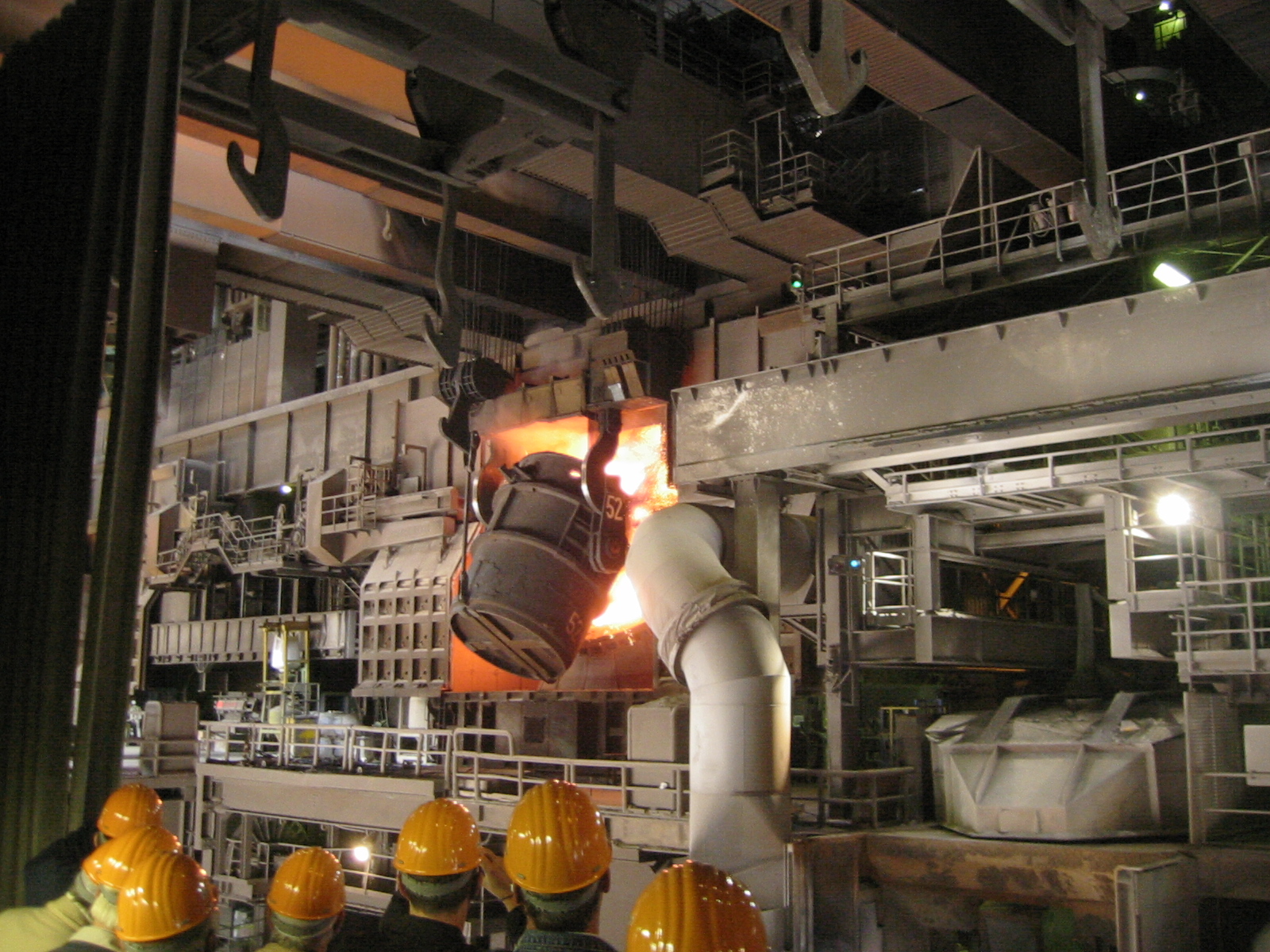
Basic oxygen steelmaking is a primary steelmaking process for converting molten pig iron into steel by blowing oxygen through a lance over the molten pig iron inside the converter. Exothermic heat is generated by the oxidation reactions during blowing.
The basic oxygen steel-making process is as follows:
- Molten pig iron (sometimes referred to as "hot metal") from a blast furnace is poured into a large refractory-lined container called a ladle.
- The metal in the ladle is sent directly for basic oxygen steelmaking or to a pretreatment stage where sulfur, silicon, and phosphorus are removed before charging the hot metal into the converter. In external desulfurizing pretreatment, a lance is lowered into the molten iron in the ladle and several hundred kilograms of powdered magnesium are added to reduce sulfur impurities to magnesium sulfide in a violent exothermic reaction. The sulfide is then raked off. Similar pretreatments are possible for external desiliconisation and external dephosphorisation using mill scale (iron oxide) and lime as fluxes. The decision to pretreat depends on the quality of the hot metal and the required final quality of the steel.
- Filling the furnace with the ingredients is called charging. The BOS process is autogenous, i.e. the required thermal energy is produced during the oxidation process. Maintaining the proper charge balance, the ratio of hot metal from melt to cold scrap is important. The BOS vessel can be tilted up to 360° and is tilted towards the deslagging side for charging scrap and hot metal. The BOS vessel is charged with steel or iron scrap (25–30%), if required. Molten iron from the ladle is added as required for the charge balance. A typical chemistry of hotmetal charged into the BOS vessel is: 4% C, 0.2–0.8% Si, 0.08%–0.18% P, and 0.01–0.04% S, all of which can be oxidised by the supplied oxygen except sulfur (which requires reducing conditions).
- The vessel is then set upright and a water-cooled, copper tipped lance with 3–7 nozzles is lowered into it to within a few feet of the surface of the bath and high-purity oxygen at a pressure of 700–1,000 kilopascals (100–150 psi) is introduced at supersonic speed. The lance "blows" 99% pure oxygen over the hot metal, igniting the carbon dissolved in the steel, raising the temperature to about 1700 °C as carbon monoxide and carbon dioxide are formed. This melts the scrap, lowers the carbon content of the molten iron and helps remove unwanted chemical elements. It is this use of pure oxygen (instead of air) that improves upon the Bessemer process, as the nitrogen (an undesirable element) and other gases in air do not react with the charge or decrease the efficiency of the furnace.[11]
- Fluxes (calcium oxide or dolomite) are fed into the vessel to form slag, to maintain basicity of the slag – the ratio of calcium oxide to silicon oxide – at a level to minimise refractory wear and absorb impurities during the steelmaking process. During "blowing", churning of metal and fluxes in the vessel forms an emulsion that facilitates the refining process. Near the end of the blowing cycle, which takes about 20 minutes, the temperature is measured and samples are taken. A typical chemistry of the blown metal is 0.3–0.9% C, 0.05–0.1% Mn, 0.001–0.003% Si, 0.01–0.03% S and 0.005–0.03% P.
- The BOS vessel is tilted towards the slagging side and the steel is poured through a tap hole into a steel ladle with basic refractory lining. This process is called tapping the steel. The steel is further refined in the ladle furnace, by adding alloying materials to impart special properties required by the customer. Sometimes argon or nitrogen is bubbled into the ladle to make the alloys mix correctly.
- After the steel is poured off from the BOS vessel, the slag is poured into the slag pots through the BOS vessel mouth and dumped.
Variants
[edit]Earlier converters, with a false bottom that can be detached and repaired, are still in use. Modern converters have a fixed bottom with plugs for argon purging. The energy optimization furnace (EOF) is a BOF variant associated with a scrap preheater where the sensible heat in the off-gas is used for preheating scrap, located above the furnace roof.
The lance used for blowing has undergone changes. Slagless lances, with a long tapering copper tip, have been employed to avoid jamming of the lance during blowing. Post-combustion lance tips burn the CO generated during blowing into CO2 and provide additional heat. For slag-free tapping, darts, refractory balls, and slag detectors are employed. Modern converters are fully automated with automatic blowing patterns and sophisticated control systems.[citation needed]
See also
[edit]- AJAX furnace, transitional oxygen-based open hearth technology
References
[edit]- ^ Brock and Elzinga, p. 50.
- ^ "Basic Oxygen Steelmaking Simulation User Guide version 2.00" (PDF). steeluniversity.org. Archived (PDF) from the original on 2021-04-27. Retrieved 2021-04-27.
- ^ a b c d e f g Smil, p. 99.
- ^ "Hot metal and crude steel production". stahl-online.de. Archived from the original on 2021-01-16.
- ^ a b c Smil, p. 97.
- ^ a b Smil, pp. 97–98.
- ^ a b c Tweraser, p. 313.
- ^ a b c d Smil, p. 98.
- ^ a b Brock and Elzinga, p. 39.
- ^ Ebbe Almqvist (2002). History of Industrial Gases (First ed.). Springer. p. 165. ISBN 0-306-47277-5.
- ^ McGannon, p 486
Bibliography
[edit]- McGannon, Harold E. editor (1971). The Making, Shaping and Treating of Steel: Ninth Edition. Pittsburgh, Pennsylvania: United States Steel Corporation.
- Smil, Vaclav (2006). Transforming the twentieth century: technical innovations and their consequences, Volume 2. Oxford University Press US. ISBN 0-19-516875-5.
- Brock, James W.; Elzinga, Kenneth G. (1991). Antitrust, the market, and the state: the contributions of Walter Adams. M. E. Sharpe. ISBN 0-87332-855-8.
- Tweraser, Kurt (2000). The Marshall Plan and the Reconstruction of the Austrian Steel Industry 1945–1953. in: Bischof, Gunther et al. (2000). The Marshall Plan in Austria. Transaction Publishers. ISBN 0-7658-0679-7. pp. 290–322.
External links
[edit]- Basic Oxygen Steelmaking module at steeluniversity.org, including a fully interactive simulation (archived)
- Basic Oxygen Steelmaking cost model showing typical cost structure for liquid steel
| Iron production (Ironworks) |
|  | |||||||
|---|---|---|---|---|---|---|---|---|---|
| Steelmaking (Steel mill) |
| ||||||||
| Heat treatment methods |
| ||||||||
| Production by country | |||||||||
| Authority control databases: National |
|---|

Basic oxygen steelmaking
View on GrokipediaOverview
Definition and principles
Basic oxygen steelmaking (BOS), also known as the basic oxygen process (BOP) or Linz-Donawitz process, is a primary method of steel production that refines molten pig iron from a blast furnace into steel by blowing high-purity oxygen at supersonic speeds onto the surface of the molten charge to oxidize and remove impurities such as carbon, silicon, phosphorus, and manganese.[6][1] The process typically involves a charge consisting of 70-80% hot metal (molten pig iron) and 20-30% scrap steel, processed in batches ranging from 100 to 400 tons, with most modern converters handling 100-250 tons per heat.[7] The core principles of BOS rely on exothermic oxidation reactions, similar to those in the thermite process, where the injected oxygen reacts vigorously with impurities in the molten bath, generating sufficient heat to maintain the liquid state without external energy input.[8][6] These reactions produce a basic slag—primarily calcium silicate—from added fluxes like lime, which absorbs and separates the oxidized impurities; the vessel is lined with basic refractories, such as magnesia, to withstand the alkaline slag and high temperatures exceeding 1600°C.[9] Oxygen, with purity greater than 99%, is delivered through a water-cooled lance positioned 1-2 meters above the bath surface, ensuring efficient mixing and reaction kinetics while minimizing excessive splashing.[10] Developed in the mid-20th century as a faster alternative to the labor-intensive open-hearth process, which required 10-12 hours per batch, BOS achieves a full heat in 30-40 minutes, enabling higher productivity and scalability in large-scale steel production.[11][9]Comparison to other steelmaking methods
Basic oxygen steelmaking (BOS) represents a significant advancement over the open-hearth furnace (OHF) process, primarily due to its superior efficiency in both time and energy consumption. While the OHF required 6-12 hours per batch to refine molten iron and scrap through prolonged heating and oxidation, BOS completes a heat in approximately 40-50 minutes by directing a high-velocity stream of pure oxygen onto the melt surface.[12][9] This rapid cycle enables much higher throughput, with BOS facilities producing up to 300-400 tons per heat compared to the OHF's slower output. Additionally, BOS is far less energy-intensive, consuming 0.7-1.0 GJ per tonne of steel versus 3.9-5.0 GJ per tonne for the OHF, largely because it relies on the exothermic oxidation reactions within the melt rather than external fuel combustion.[13] However, unlike the more versatile OHF that could accommodate higher scrap charges, BOS predominantly requires hot metal from a blast furnace as its primary input, limiting its flexibility in scrap utilization.[14] In contrast to electric arc furnace (EAF) steelmaking, BOS follows the primary route, converting pig iron or hot metal from blast furnaces into steel, which accounts for the majority of global production. As of 2023, BOS (integrated with blast furnace-basic oxygen furnace, or BF-BOF) comprised about 71% of worldwide crude steel output, enabling large-scale, continuous production suited for high-volume applications like construction and automotive sectors.[15] EAF, the secondary route, primarily melts scrap steel using electric arcs, offering greater flexibility for recycling and adaptation to fluctuating scrap availability, but it is more energy-intensive per tonne when relying solely on scrap due to the need for electrical melting.[16] While EAF's total primary energy use can be lower overall in scrap-based operations (around 8-12 GJ per tonne versus over 20 GJ per tonne for BF-BOF), the steelmaking step requires significant electrical input.[14][17] The EAF share is growing, projected to reach 36% by 2030, driven by increasing scrap recycling and decarbonization efforts.[15] Compared to the earlier Bessemer process, BOS addresses key limitations in impurity control and product quality. The Bessemer converter, which blew air through molten pig iron to oxidize carbon, introduced nitrogen from the air, resulting in brittle steel unsuitable for many structural uses, and struggled with phosphorus removal without specialized linings.[18] BOS, as a refined descendant, employs pure oxygen to avoid nitrogen pickup entirely, producing tougher, more ductile steel.[19] Furthermore, BOS utilizes a basic refractory lining (typically magnesia or dolomite) that facilitates effective phosphorus removal by forming stable phosphates in the slag, enabling the processing of high-phosphorus ores that challenged the original Bessemer method.[20] These improvements made BOS a dominant technology by the mid-20th century, supplanting the Bessemer process which had largely faded by the early 1900s due to its inefficiencies.[18]History
Invention and early development
The development of basic oxygen steelmaking (BOS), also known as the Linz-Donawitz (LD) process, originated in Austria during the 1940s amid efforts to modernize steel production following World War II. Swiss metallurgist Robert Durrer played a pivotal role in establishing the theoretical foundations, drawing on earlier experiments with oxygen blowing in small-scale converters conducted in Switzerland as early as 1948. These initial tests utilized high-purity oxygen supplied from nearby industrial plants, such as those operated by Linde, to refine pig iron by top-blowing oxygen into a basic-lined vessel. Durrer's work emphasized the potential for rapid oxidation and impurity removal, addressing limitations of traditional open-hearth methods.[21][22] In collaboration with Austrian steelmakers, Durrer advised Voestalpine (then VÖEST) in Linz and the steelworks in Donawitz on practical implementation, leading to pilot test runs from 1949 to 1952. These trials began with a 2-ton converter in June 1949 at Linz, scaling to a 15-ton unit by October 1949, where hundreds of heats demonstrated the process's viability despite early issues with oxygen penetration and lance positioning. The LD process had patents first applied for in 1950 by Voestalpine, with the key patent granted in 1953 amid inventor disputes involving key Austrian engineers like Theodor Suess, Hubert Hauttmann, Herbert Trenkler, and Rudolf Rinesch. A core innovation was the use of a water-cooled lance delivering 99% pure oxygen at controlled pressures for "soft blowing," enabling efficient decarburization without excessive refractory wear.[21][23][22] Early challenges centered on scaling from laboratory and pilot stages to industrial production, including optimizing oxygen flow to avoid splashing and ensuring consistent steel quality. The first commercial LD plant at Voestalpine's Linz works was commissioned on November 27, 1952, with official opening on January 5, 1953, featuring a 30-ton converter lined with basic refractories primarily composed of dolomite to withstand the alkaline slag environment, later expanded to additional units. A second plant followed in Donawitz by May 1953. Initially, the Linz facility achieved an annual production capacity of around 200,000 tons of steel, reaching 100,000 tons within its first seven months of operation. This marked the breakthrough for BOS, proving its speed and efficiency in industrial settings.[21][24][22]Global adoption and evolution
The basic oxygen steelmaking (BOS) process rapidly expanded beyond its Austrian origins in the mid-1950s, driven by its superior efficiency over traditional methods. The first adoptions in the UK occurred in the late 1950s. This was followed by installations in the US at McLouth Steel in Trenton, Michigan, in 1954 and in Japan at the Yawata Works in 1957, where two 30-ton LD converters were commissioned. By 1960, BOS accounted for approximately 10% of global steel production, reflecting its quick international uptake. Global licensing through companies like Brassert Oxygen Technik facilitated rapid spread to other European countries in the mid-1950s.[22][25][22] Post-World War II reconstruction demands in Europe and Asia, combined with advancements in large-scale air separation for inexpensive high-purity oxygen, fueled BOS growth. These factors enabled shorter cycle times—typically 30-40 minutes per heat compared to hours for open-hearth furnaces—and higher productivity, making BOS economically attractive for scaling steel output to support industrial recovery and urbanization. By the 1970s, BOS had surpassed the open-hearth process worldwide, producing over 50% of global steel as it became the standard for primary steelmaking.[1][26][3] Technological evolution further solidified BOS dominance through incremental innovations. In the 1970s and 1980s, computer-based automation systems were introduced for precise control of oxygen blowing, lance positioning, and endpoint carbon detection, reducing variability and operator intervention. The 1990s saw significant efficiency gains, with furnace capacities expanding to around 300 tons per heat, allowing larger batches and lower per-ton costs. Entering the 2020s, BOS maintains a share of about 70% of global crude steel production, though this is declining modestly relative to electric arc furnace (EAF) methods amid rising emphasis on scrap-based and low-carbon alternatives.[27][28][29] China's post-2000 surge in BOS adoption represents a pivotal milestone, with state-driven investments building hundreds of blast furnace-BOS facilities to meet explosive demand from infrastructure and manufacturing booms. This rapid scaling positioned China as the largest BOS producer, accounting for over 50% of worldwide steel output by the early 2020s and amplifying BOS's global footprint.[30]Process
Raw materials and charging
The primary raw materials for basic oxygen steelmaking (BOS) are molten pig iron, also known as hot metal, sourced from the blast furnace, and steel scrap. Hot metal constitutes the majority of the metallic charge, typically comprising 65% to 90% of the total input, and arrives at temperatures between 1300°C and 1350°C to provide the necessary heat for the process.[31][8] Its typical composition includes 3.8% to 4.5% carbon, 0.5% to 1.5% silicon, 0.25% to 1.5% manganese, 0.05% to 0.15% phosphorus, and 0.03% to 0.08% sulfur, which influences the efficiency of subsequent refining steps.[31][8] Steel scrap serves as a coolant and source of recycled iron, making up 10% to 35% of the metallic charge to balance the exothermic reactions during oxygen blowing.[31][9] Scrap types include light materials like sheet shearings and heavy items like mill scale, with cleanliness essential to minimize tramp elements such as copper or tin that could degrade steel quality.[31] Additives, primarily fluxes like burnt lime (CaO) and calcined dolomite, are introduced to form slag for impurity removal; lime addition is roughly six times the silicon content in the hot metal by weight.[31][7] Charging occurs in a refractory-lined vessel tilted at approximately 45 degrees, with a typical total charge weight of 100 to 250 tons per heat.[7] The sequence begins with loading scrap via a hopper or charging box to protect the furnace lining, followed by pouring the hot metal from a ladle.[31][8] Fluxes such as lime are added early in the sequence or during initial oxygen blowing to ensure rapid slag formation, while other fluxes like fluorspar are used sparingly for phosphorus control.[31] Quality control emphasizes selecting hot metal with consistent composition to optimize yield and scrap that is properly sized—large pieces are often baled—to promote complete melting.[31]Oxygen blowing and refining
The oxygen blowing phase in basic oxygen steelmaking begins immediately after charging the furnace with molten hot metal, scrap, and fluxes, with the water-cooled lance positioned approximately 1.5 to 1.8 meters above the bath surface to ensure effective jet penetration without excessive wear.[32] High-purity oxygen (≥99.5%) is then introduced through the lance at supersonic velocities, typically at flow rates of 600 to 800 normal cubic meters per minute for a standard furnace charge, sustaining the blow for 15 to 20 minutes to achieve the desired refinement.[7] This procedure generates intense mixing and reaction conditions within the melt, optimizing impurity removal while minimizing refractory damage. The blowing process is generally divided into two main stages: the initial carbon removal phase, which accounts for about 70% of the oxygen consumption, and the subsequent finishing phase. During the early stage, the oxygen jet induces violent boiling of the bath, primarily through the rapid oxidation of carbon and silicon, which releases large volumes of carbon monoxide gas and drives the exothermic reactions forward.[7] As the blow progresses into the finishing stage, the focus shifts to precise control of residual elements, ensuring the melt reaches the targeted composition without over-oxidation. Endpoint control is critical to halt the blow at the optimal moment, typically when the carbon content is reduced to below 0.1%, preventing excessive iron loss or temperature overshoot. This is achieved through sublance sampling, which allows for quick analysis of bath temperature and composition about two minutes before the end of the blow, or via real-time off-gas analysis monitoring the carbon monoxide to carbon dioxide ratio for reaction kinetics.[7] Advanced monitoring often incorporates optical emission spectrometers to track elemental changes dynamically during the process. The heat balance during blowing relies on the exothermic nature of the oxidation reactions, which elevate the bath temperature from an initial 1250–1300°C to 1650–1700°C, sufficient to fully melt the scrap charge and homogenize the alloy.[7] Gas evolution from the reactions, combined with the impinging oxygen jet, provides vigorous stirring of the bath, enhancing reaction efficiency and uniformity. Overall, the process yields 90–95% metal recovery, reflecting efficient conversion with minimal losses to slag or fumes.[7]Tapping and casting
Once refining is complete, the basic oxygen furnace (BOF) is tilted to tap the molten steel, which is poured through the tap hole into a waiting ladle below. This process achieves a steel yield of approximately 95%, reflecting the high efficiency of impurity removal while minimizing metal losses. To prevent slag carryover, a slag dam or stopper is employed to retain the floating slag layer, and any residual slag is skimmed off the surface of the steel in the ladle.[33][2] During tapping, alloying elements such as ferromanganese (FeMn) are added directly to the ladle to adjust the final steel composition, ensuring it meets specifications for carbon, manganese, and other elements. The slag, primarily composed of calcium silicates and oxides, is then separated and collected; it is commonly recycled as a raw material in cement production or as aggregate for road construction, promoting resource recovery and reducing waste.[2][34] The tapped molten steel, maintained at around 1600–1650°C, is transported to the casting stage, where it is either continuously cast into semifinished shapes like slabs, billets, or blooms, or poured into molds to form ingots. Temperature control is critical during this transfer and casting to avoid solidification defects such as cracks or inclusions, with adjustments made as needed to optimize quality. Secondary refining in the ladle may follow, but the primary shaping occurs here.[2] The entire BOF cycle, from charging to tapping, typically lasts 40–50 minutes, enabling modern furnaces to produce 10–12 heats per day and supporting high-throughput operations in steel plants.Chemistry and reactions
Oxidation reactions
The oxidation reactions in basic oxygen steelmaking (BOS) primarily target the removal of impurities from molten pig iron through exothermic processes that also generate the necessary heat for refining. The main reaction involves carbon oxidation, where dissolved carbon reacts with oxygen to form carbon monoxide:with an enthalpy change of approximately -110 kJ/mol, serving as the dominant heat source due to the high carbon content (typically 4-5%) in the charge.[35][36] Silicon and manganese, present at levels of 0.5-1% and 0.5-2% respectively, undergo rapid oxidation early in the process:
These reactions are highly exothermic, contributing significantly to the bath temperature rise, with silicon oxidation alone providing about 32 MJ per kg of Si oxidized.[8][36][37] Secondary oxidation involves phosphorus, which requires interaction with the basic slag for effective removal:
This process oxidizes phosphorus to P₂O₅ intermediate before incorporation into calcium phosphate, achieving low residual levels under basic conditions. Iron oxidation is intentionally minimized to less than 5% of the charge to avoid excessive metal loss, as the reaction forms temporary FeO that is later reduced back to metal.[8][36] The primary oxidation reactions produce substantial volumes of off-gas, predominantly CO, with typical evolution of 80-100 Nm³ of CO per tonne of steel, depending on charge composition and oxygen efficiency. Post-combustion of CO to CO₂ in the furnace space partially oxidizes the gas, yielding an off-gas CO₂/CO ratio that rises toward the blow endpoint (indicating carbon depletion) and is monitored for process control.[38][39] Thermodynamically, the feasibility and sequence of these oxidation reactions at the operating temperature of around 1600°C are governed by principles illustrated in Ellingham diagrams, which plot standard Gibbs free energy changes (ΔG⁰) against temperature for oxide formation. Lines for SiO₂, MnO, and FeO lie below that for 2C + O₂ → 2CO at this temperature, ensuring silicon and manganese oxidize preferentially over iron under typical oxygen partial pressures (>10⁻⁸ atm), while carbon oxidation to CO becomes favorable at lower partial pressures to minimize FeO formation. Phosphorus oxidation requires even more selective conditions due to its line position, emphasizing the role of slag basicity.[40]
Slag formation and impurities removal
In basic oxygen steelmaking, slag formation begins with the addition of lime (CaO) as the primary flux, which reacts with the oxidized impurities from the hot metal to create a basic slag characterized by a CaO/SiO₂ ratio typically ranging from 3 to 5. This high basicity ensures the slag's capacity to capture acidic oxides effectively. The resulting slag volume is approximately 100-150 kg per ton of steel produced, serving as a byproduct that encapsulates the removed impurities while facilitating their separation from the molten steel.[41][42] The primary impurities removed into the slag include silica (SiO₂) from silicon oxidation, phosphorus pentoxide (P₂O₅) from phosphorus oxidation, and manganese oxide (MnO) from manganese oxidation, which flux into the slag matrix to form stable compounds such as calcium silicates and phosphates. These oxidized species dissolve into the lime-based flux, preventing their re-entry into the steel bath and achieving high removal efficiencies, particularly for phosphorus through slag-metal interface reactions. Desulfurization, however, is not a primary function of the BOS process, as the oxidizing conditions limit sulfur transfer to the slag; instead, it is typically achieved post-BOF in the ladle via injection of reducing agents like calcium carbide or magnesium.[41][2][43] Slag control is essential for optimal impurity removal and operational efficiency, beginning with lime addition rates of 50-100 kg per ton of steel to achieve the desired basicity and slag volume. Viscosity is managed by adjusting the basicity and temperature, ensuring the slag remains fluid enough for effective impurity absorption and separation from the steel during tapping, typically at viscosities that allow for gravitational settling without excessive entrainment. Foaming slag techniques, induced by the CO and CO₂ gases from oxidation reactions, provide additional protection by cushioning the oxygen lance and furnace walls against erosion, with controlled foaming height monitored to avoid slopping.[43][41][44] Slag basicity is quantitatively analyzed using the V-ratio, defined as (wt% CaO + wt% MgO) / wt% SiO₂, which directly influences phosphorus partitioning between the slag and steel; higher V-ratios (typically 3-4 in BOS) enhance phosphorus transfer to the slag by promoting the formation of phosphate phases. This index guides flux adjustments during the blow to optimize dephosphorization without compromising slag fluidity or volume.[45][42]Equipment and technology
Basic oxygen furnace
The basic oxygen furnace (BOF) is a pear-shaped, refractory-lined vessel designed to withstand extreme temperatures and chemical reactions during steelmaking. Typically measuring 10 to 15 meters in height and 5 to 8 meters in diameter at the mouth, the vessel's conical shape facilitates efficient charging, oxygen blowing, and slag-metal separation while promoting structural integrity under thermal stress.[46][47] The interior is lined with basic refractory materials, primarily magnesia-carbon (MgO-C) bricks, which provide resistance to slag corrosion, thermal shock, and erosion due to their high melting point and chemical stability in alkaline environments.[48][49] BOF capacities range from 100 to 400 tons per heat, with most modern units operating between 200 and 300 tons to optimize production efficiency. The vessel is mounted on trunnions, enabling it to tilt up to 360 degrees for charging raw materials through the open mouth, oxygen injection, and tapping of molten steel and slag. This tilting mechanism ensures precise control over the process while minimizing mechanical wear on the structure.[7][50] The refractory lining typically endures 2,500 to 5,000 heats before relining, though advanced designs can achieve up to 10,000 heats through optimized brick compositions and maintenance practices. Cooling staves or panels integrated into the shell help dissipate heat, reducing thermal fatigue and extending lining life by maintaining lower shell temperatures.[51][52] Early BOF designs in the 1950s featured capacities around 100 tons, but evolution toward larger vessels, now commonly 300 to 350 tons, has improved economies of scale and throughput, with the oxygen lance integrated at the mouth for precise process control.[7][53]Oxygen lance and auxiliaries
The oxygen lance serves as the primary delivery mechanism for high-purity oxygen into the basic oxygen furnace (BOF), enabling precise control over the blowing process. Typically constructed from water-cooled copper for its high thermal conductivity, the lance features a barrel diameter of 150-200 mm and a multi-hole tip with 4-6 Laval-type nozzles designed for supersonic jet formation at Mach numbers around 2. [32] These nozzles incorporate a convergent-divergent geometry to accelerate oxygen flow, ensuring efficient penetration into the molten bath while the water-cooling system recirculates coolant at approximately 6 kg/cm² to maintain tip temperatures below 60-65°C. [32] The lance is mounted on a hoist system that allows vertical adjustment of its height—often optimized at around 1.8 m above the bath surface—to balance jet impingement and minimize skulling on the lance tip. [32] Supporting auxiliaries enhance the lance's functionality and process integration. Oxygen is supplied from on-site air separation units (ASUs) using cryogenic distillation to produce gaseous oxygen at ≥99.6% purity, with typical plant capacities ranging from 1,000 to 2,000 tons per day to meet BOF demands for continuous blowing rates of 300-600 Nm³/min. [54] [55] Powder injection systems, integrated into the lance, deliver fluxes such as lime or dolomite through auxiliary channels to accelerate slag formation and impurity removal during blowing. [32] Additionally, a sublance—a retractable probe inserted alongside or through the main lance—facilitates in-blow and end-point sampling to measure bath temperature, oxygen activity, carbon content, and slag properties, enabling dynamic process adjustments and reducing tap-to-tap times, for example by 17% in some installations. [56] Safety features are integral to lance operations to mitigate risks from high-pressure gases and thermal stresses. Emergency shutoff valves on oxygen and nitrogen supply lines allow rapid isolation in case of anomalies, while integrated sensors monitor lance position and coolant flow to prevent overheating or misalignment. [32] Off-gas from the blowing process is captured and routed to cleaning systems, achieving dust collection efficiencies exceeding 99% through venturi scrubbers or baghouses to minimize emissions and protect equipment. Advancements in lance technology focus on improving jet coherence and efficiency. Coherent jet lances employ shrouding gas flows around the central oxygen jet via annular nozzles, prolonging the jet core length and reducing attenuation for deeper bath penetration—up to 20-30% greater than conventional designs—while enhancing dephosphorization rates and metallic yield by 3-5 kg/t steel. [57] These designs, often with adjustable annular flow rates, have been validated in trials on 35-ton converters, demonstrating reduced phosphorus content from 0.024% to 0.016% at endpoint. [57] Recent innovations include swiveling sublances, which provide greater flexibility in sampling and process adjustments.[58]Advantages and limitations
Economic and efficiency benefits
Basic oxygen steelmaking (BOS) offers significant efficiency advantages over legacy methods like the open-hearth process, primarily through its rapid cycle times and high throughput capabilities. A typical BOS vessel processes 100-300 tons of steel per heat in 30-40 minutes, enabling plant capacities exceeding 300 tons per hour and supporting annual outputs in the millions of tons for integrated mills. This speed stems from the exothermic oxidation reactions that provide the necessary heat internally, making the process autogenous and reducing reliance on external fuel inputs. In comparison, open-hearth furnaces required 8-12 hours per batch, limiting productivity and increasing energy demands.[12][14] Energy efficiency is another key benefit, with BOS consuming approximately 0.8 million Btu per ton in fuel and 23 kWh per ton in electricity, equivalent to about 400-500 kWh per ton total when accounting for process heat recovery. This represents a 45% reduction in energy intensity compared to open-hearth operations, which exceeded 600 kWh per ton equivalent due to prolonged heating and fuel combustion. Steel yield in BOS typically ranges from 92-96%, minimizing material losses and enhancing overall resource utilization. Additionally, the process accommodates scrap ratios of 10-35%, allowing flexibility in raw material sourcing to balance costs and temperature control without compromising efficiency.[12][14][50] Economically, BOS provides lower capital and operating costs, facilitating retrofits and new installations at reduced expense. The capital cost for BOS facilities was approximately $17 per ton of capacity in the mid-20th century, half that of open-hearth plants at $35 per ton, enabling quicker adoption and scalability for large-scale production. Operating costs are offset by the process's speed, which reduces labor needs to under 4 man-hours per ton—often as low as 1 man-hour per ton in automated mills—and allows oxygen expenses to be recouped through higher output and energy savings. This scalability supports integrated steel mills processing millions of tons annually, while scrap flexibility up to 30% helps mitigate raw material price volatility, contributing to stable profitability.[59][14]Environmental and operational challenges
Basic oxygen steelmaking (BOS), as part of the blast furnace-basic oxygen furnace (BF-BOF) route, contributes to significant carbon dioxide emissions, with typical values of 2.0 to 2.2 tonnes of CO₂ per tonne of steel produced (as of 2022), primarily from the overall route including blast furnace operations.[60] Without effective capture, particulate matter and dust emissions from the process can reach 10-20 kg per tonne of steel, originating from the handling of raw materials, furnace operations, and off-gas streams.[61] Additionally, nitrogen oxide (NOx) emissions arise from the on-site air separation units used for oxygen production, contributing approximately 0.47 kg of NOx per tonne of crude steel in integrated facilities.[62] Operationally, BOS involves high levels of noise and vibration due to the intense oxygen blowing and turbulent reactions within the furnace, which can exceed 100 dB and pose health risks to workers while requiring robust structural reinforcements.[63] Refractory linings in the basic oxygen furnace experience wear from chemical corrosion, thermal shock, and mechanical erosion by molten slag and metal, typically lasting 4,000 to 6,000 heats between major relinings with gunning maintenance, which can contribute to ongoing costs.[48][64] The process's heavy reliance on hot metal from blast furnaces—typically 70-90% of the charge—limits scrap recycling to 10-30%, constraining the incorporation of recycled materials compared to electric arc furnace routes.[14] Further challenges include substantial water usage for cooling the furnace shell, lance, and off-gas systems, estimated at 25-30 m³ per tonne of steel in integrated facilities, which strains local resources in water-scarce regions. Slag production, approximately 100-150 kg per tonne of steel, presents disposal issues when reuse rates are low, leading to landfilling and potential leaching of heavy metals if not properly managed. Although pilot projects for carbon capture in BOS have emerged in the 2020s, such as those integrating capture with off-gas streams in integrated plants, widespread adoption remains limited by high costs and technical hurdles.[67] Mitigation efforts include top-gas recovery systems that capture and reuse off-gases from the furnace for energy generation, achieving efficiency gains of 20-30% by converting carbon monoxide into power and reducing fuel needs.[68] These systems, often involving turbines or boilers, help address emissions and operational energy demands, though their implementation varies by plant age and configuration.Variants and modern developments
Traditional variants
The LD-AC process represents an early modification to the standard top-blown basic oxygen steelmaking, incorporating the injection of fine quicklime powder through the oxygen lance alongside pure oxygen to accelerate slag formation and enhance refining efficiency.[69] Developed in the late 1950s, LD-AC converters, such as 80-ton vessels operational by 1962, enabled higher production rates and steel quality compared to earlier methods like the Thomas process.[3] The Q-BOP (Quiescent Basic Oxygen Process), a U.S.-developed variant from the late 1950s, introduced bottom-blown oxygen injection through multiple tuyeres located at the bottom of the furnace to achieve quieter operation by reducing surface agitation and splashing compared to top-blown systems.[2] This design allowed for effective refining in large furnaces up to 400 tons, with cycles typically lasting 25–45 minutes, but it incurred higher maintenance demands due to the need for frequent tuyere replacements and shorter refractory life in the bottom assembly.[70] Despite initial adoption for its potential in scrap-heavy charges, the Q-BOP saw limited long-term use and was largely phased out by the 1980s in favor of simpler top-blown configurations.[70] The OBM (Oxygen Bottom Maxhütte), also known as LD-OB, emerged in the 1970s as a German innovation in bottom-blown steelmaking, where oxygen and fluxes are injected simultaneously through bottom tuyeres to intensify bath stirring and promote rapid impurity removal.[3] This approach excels in desulfurization, routinely achieving sulfur contents below 0.005% through enhanced slag-metal contact and equilibrium, making it suitable for producing high-quality, low-sulfur steels required in applications like automotive and structural components. Unlike the Q-BOP, OBM gained sustained adoption for specialty steels, though its use remains niche compared to predominant top-blown processes.[3]Contemporary modifications and sustainability efforts
In the 21st century, basic oxygen steelmaking (BOS) has seen modifications aimed at enhancing process efficiency and control. Combined blowing, which integrates top oxygen lancing with bottom gas stirring, improves mixing and slag-metal interactions, resulting in lower iron losses in slag and reduced slag volumes compared to traditional top-blown processes.[71] This approach, now widely adopted in modern converters, allows for better impurity removal and uniform temperature distribution, contributing to higher productivity. Additionally, artificial intelligence (AI) and machine learning models have been integrated for endpoint prediction, forecasting parameters like carbon content, phosphorus levels, and temperature based on inputs such as hot metal composition, scrap mass, and blowing conditions.[72] These data-driven techniques, employing algorithms like CatBoost and XGBoost on large datasets from thousands of heats, enhance accuracy and reduce overblowing, thereby optimizing oxygen consumption and minimizing energy waste.[72] Sustainability efforts in BOS focus on reducing carbon emissions through technologies like carbon capture, utilization, and storage (CCUS) applied to off-gases and increased scrap utilization. CCUS integration in the blast furnace-basic oxygen furnace (BF-BOF) route captures CO₂ from flue gases and top-gas recovery, with potential capture rates exceeding 90% in advanced systems, enabling sequestration or reuse in chemical production.[73] For instance, post-combustion capture using amines or membranes targets the high-CO₂ streams from the BOS converter, addressing a significant portion of process emissions. Complementing this, efforts to boost scrap charging in BOS converters have raised rates from typical 10-20% to 30% or higher through preheating and optimized heat balances, displacing coke-based hot metal and cutting CO₂ emissions by up to 25% per ton of steel in hybrid configurations.[74] These modifications promote circular economy principles by recycling more ferrous scrap, though limited by scrap quality and availability. Contemporary developments include digital integration and hybrid processes to support green steel transitions. In China, the world's largest steel producer, 5G-enabled smart manufacturing has transformed BOS operations, with private networks at facilities like Wuhan Iron & Steel (WISCO) enabling real-time monitoring of equipment, predictive maintenance, and automated control in converters for improved safety and efficiency.[75] Globally, hybrid BOS-electric arc furnace (EAF) systems are emerging, where BOS handles primary reduction while EAF recycles higher scrap shares, facilitating a shift toward lower-emission production with up to 40% scrap in integrated setups.[74] Hydrogen injection pilots, primarily in the upstream blast furnace to partially replace coke, are also advancing the BF-BOS pathway, with demonstrations showing 20-30% CO₂ reductions by enhancing reduction efficiency; for example, a late 2024 test by Nippon Steel achieved a 43% reduction in a blast furnace.[76][77] Looking ahead, these modifications position BOS for net-zero emissions by 2050 through electrification, CCUS scaling, and green hydrogen integration, as outlined in industry roadmaps that emphasize hybrid routes and renewable energy sourcing to decarbonize over 70% of primary steel production.[67]References
- https://www.[mdpi](/page/MDPI).com/2073-4441/9/11/874
- https://www.[mdpi](/page/MDPI).com/2075-4701/15/5/537