


Community hub
Recent from talks
Contribute something
Nothing was collected or created yet.
Berane
View on WikipediaBerane (Cyrillic: Беране) is a town in Montenegro in the northern region. It is former administrative centre of the Ivangrad District. The town is located on the Lim river. From 1949 to 1992, it was named Ivangrad (Cyrillic: Иванград) in honour to people's hero Ivan Milutinović. According to the 2023 census, the town had a population of 9,923, whereas its municipality area had 25,162 people.
Key Information


During the medieval period the land of Berane was known as Budimlja (Будимља). It was of great holistic, political and economic importance in the medieval Serbian state and its rulers. Until 1455, when Turks took the city, Budimlja was part of the wider historical region of Raška, within the Medieval Serbia. Since the first Serbian Uprising until its final liberation, fights against Turks were constant. Famous battles occurred from 1825 to 1862 when the most important Rudes battle was fought on 7 April in which the Montenegrin rebels won. Berane was finally liberated in 1912. The town shared the destiny with its country being damaged in both World Wars. As Ivangrad, the town experienced prosperity and population growth, being one of the Yugoslav industrial centres. Although the Civil War in Yugoslavia did not reach Montenegro, the city suffered from it as the industry collapsed and the people started to leave it. Nowadays, Berane is one of the poorest settlements in Montenegro so most of the population lives in difficult conditions. Despite that, the town remains an important educational, medical, religious and sporting centre, having produced many successful individuals in those categories.
Berane is the administrative centre of the municipality of the same name. There are 13 elementary schools, four high schools and four institutions of higher education. Having a solid sport infrastructure, the most successful sport collectives in the town are handball club and table tennis club. Berane is connected with rest of the country by two-lane motorways. It also has an airport which hasn’t been used for a while. In 2012, Berane celebrated 150 years since its official foundation and 100 years of being part of Montenegro.
History
[edit]In the Middle Ages, the area surrounding Berane was known as Budimlja. It was of great holistic, political, and economic importance in Medieval Serbia. Saint Sava, the first Serbian archbishop, founded one of the first Serbian eparchies here in 1219. The Monastery Đurđevi stupovi was built by the end of the 12th century by Prvoslav, the son of Nemanja's brother Tihomir. Many monasteries and churches tell the story on the rich holistic life of Serbs in this area. There were seven bishops and nine metropolitans.[when?] Literary and painting schools existed in this Monastery. Apart from Đurđevi stupovi, the second most important monastery in this area was Šudikovo, which was destroyed and burned by the Turks in 1738. Archbishop's throne was vacant for more than 350 years. However, the Budimlja episcopate, known as the Budimlja-Nikšić eparchy has been restored in 2002 upon the appointment of bishop Joanikije. The area of Berane municipality and its wider neighbourhood, was part of the Medieval Serbian state until 1455, when Turks took the city of Bihor and Budimlja.
During the First Serbian Uprising (1804) and Karađorđe's march to Novi Pazar, the people of this area revolted and met the Serbian dukes Anto Bogićević and Hadži-Prodan Gligorijević. Then, Mojsije Zečević, prior of Đurđevi stupovi, had the leading role among the Orthodox people of Budimlja. He was one of the closest allies of Petar I Petrović-Njegoš and Petar II Petrović-Njegoš, the archbishops and political leaders of Montenegro. Since the First Serbian Uprising until its final liberation, fights against Turks were constant, especially during the second part of the 19th century. Famous battles occurred from 1825, until 1862, but the most important one was Rudes battle on 7 April 1862, in which the Serbian and Montenegrin rebels won. Berane was finally liberated from Turks in 1912 and it was incorporated in Montenegro.
During World War II, there was a civil war in the region between Partisans (communists) and Chetniks (royalists and nationalists). During the communists' reprisals in 1944 and 1945 thousands of people were killed. From July 1949 to March 1992, Berane was known as Ivangrad as a tribute to Ivan Milutinović, and developed as one of the most important industrial centers in Montenegro. However, the city was severely affected by the economic collapse of the Yugoslav state in the late 1980s.[1] Although its original name was restored in 1992, the town's economy didn't recover due to the sanctions imposed on Yugoslavia in the 1990s.[1]
Culture, education and science
[edit] |
The main impact for the development of culture of this area historically, and up to recent times, came from the Serbian Orthodox Church, or it monasteries in the area: Šudikova, Đurdjevi stupovi and other, as the cornerstones of spirituality of the Serb population. That part is later to a certain extent taken over by schools, and, more and more institutions dealing with culture.
A special role in that process was that of the Berane Gymnasium, founded in 1913. Its classrooms were a home to many prominent artists and scientists in various disciplines such as: Mihailo Lalić, Dušan Kostić, Radovan Zogović, Jovan Zonjić, Mišo Popović, Aleksandar Rafajlović, Luka Radojević and the others. The institutions in Berane that are still working in culture, there are: Cultural Centre (with the library), and Polimski Museum, with a very rich collection of valuable artefacts; and the House of the Duke Gavro Vuković, the first jurist with a university degree, a long term Minister of Foreign Affairs in the Principality of Montenegro, and the writer of famous “Memoirs” has been reconstructed, planned to be used for cultural events. Berane also has a school for primary musical education, and there are also few amateur clubs and societies in various disciplines of artistic creation.
There are 13 elementary schools, four secondary schools and one school for elementary musical education in municipality of Berane. Berane has four institutions of higher education: Faculty of management in transport and communications, Faculty of Teacher-training, Higher Medical School and Applied Computer engineering (study program of Faculty of Electrical Engineering, Podgorica). Berane, as is usually the case with small communities, does not have a specialised scientific institution, but in spite of that fact, many prominent scientists from various scientific disciplines come from here. A remarkable contribution to science was given by, among others, chemist Vukić Mićović, bacteriologist Milutin Đurišić, geographer Milisav Lutovac, and historian Miomir Dašić.
Economy, infrastructure and sports
[edit] |
The municipality of Berane is one of the poorest in Montenegro. The level of industrial production is very low, since a big number of companies have stopped working in the past 15 years due to the known crisis in former Yugoslavia. In the earlier period (1960s and 1970s) many village, agricultural households have moved to the town in the process of “industrialisation”, which decreased agricultural production, and industry later collapsed so most of the population lives in difficult conditions. Many small private companies have been started recently, mostly in the areas of commerce and catering industry. There is a very small number of companies that are creating new value. Workers in those new companies have no insurance or health service, so those companies do not have a bigger positive impact on the community. Total number of employed in the municipality is approximately 3,000. However, industry is starting to come back, a coal mine has started, and new commercial buildings are popping up. More residents are finally appearing. Berane is connected with rest of Montenegro by two-lane roads. Bijelo Polje is 35 km away, where there lies the major junction (railway and the road) towards Podgorica and the coast, and to Serbia. Serbia can also be reached eastwards via Rožaje (for Novi Pazar). Berane is on the corridor of the future Bar-Boljare motorway. Berane has an airport, which hasn't been used for commercial traffic since the 1980s, although there have been plans for its revitalisation and usage as a regional airport. Podgorica Airport is some 150 km (93 mi) away, and has regular flights to and from major European destinations.
Berane has solid sport infrastructure. The most successful sport collectives are: handball club Berane and table tennis club Budim. There are also football club Berane, basketball club Lim, boxing club Radnički Berane, athletic club, tennis club etc. The Sports Centre consists of many sport objects. City Stadium with capacity of 11,000 people is the second largest stadium in Montenegro. Just next to the stadium, a new modern city hall is under construction.
Demographics
[edit]Berane is administrative centre of Berane Municipality, which in 2023 had a population of 25,162. The town itself had a population of 9,923.[2]
| Year | Pop. | ±% |
|---|---|---|
| 1948 | 3,701 | — |
| 1953 | 4,513 | +21.9% |
| 1961 | 6,969 | +54.4% |
| 1971 | 11,164 | +60.2% |
| 1981 | 12,720 | +13.9% |
| 1991 | 12,267 | −3.6% |
| 2003 | 11,776 | −4.0% |
| 2011 | 11,073 | −6.0% |
| 2023 | 9,923 | −10.4% |
Demographics
[edit]According to the 2023 census, the municipality of Berane had a population of 24,645,[3] with the following ethnic composition:
Climate
[edit]| Climate data for Berane (1961–1990, extremes 1950–present) | |||||||||||||
|---|---|---|---|---|---|---|---|---|---|---|---|---|---|
| Month | Jan | Feb | Mar | Apr | May | Jun | Jul | Aug | Sep | Oct | Nov | Dec | Year |
| Record high °C (°F) | 18.8 (65.8) |
24.1 (75.4) |
26.5 (79.7) |
31.6 (88.9) |
33.9 (93.0) |
35.2 (95.4) |
38.4 (101.1) |
40.4 (104.7) |
36.8 (98.2) |
32.3 (90.1) |
24.1 (75.4) |
20.2 (68.4) |
40.4 (104.7) |
| Mean daily maximum °C (°F) | 2.7 (36.9) |
5.9 (42.6) |
10.6 (51.1) |
15.2 (59.4) |
20.4 (68.7) |
23.3 (73.9) |
25.9 (78.6) |
26.1 (79.0) |
22.4 (72.3) |
17.2 (63.0) |
10.2 (50.4) |
3.4 (38.1) |
15.3 (59.5) |
| Daily mean °C (°F) | −2.0 (28.4) |
0.7 (33.3) |
4.5 (40.1) |
8.7 (47.7) |
13.4 (56.1) |
16.4 (61.5) |
18.3 (64.9) |
17.7 (63.9) |
14.0 (57.2) |
9.2 (48.6) |
4.3 (39.7) |
−0.5 (31.1) |
8.7 (47.7) |
| Mean daily minimum °C (°F) | −5.9 (21.4) |
−3.9 (25.0) |
−0.9 (30.4) |
2.7 (36.9) |
6.4 (43.5) |
9.5 (49.1) |
10.9 (51.6) |
10.3 (50.5) |
7.5 (45.5) |
3.4 (38.1) |
0.0 (32.0) |
−4.2 (24.4) |
3.0 (37.4) |
| Record low °C (°F) | −28.3 (−18.9) |
−26 (−15) |
−18.6 (−1.5) |
−9.2 (15.4) |
−4.2 (24.4) |
0.2 (32.4) |
1.2 (34.2) |
2.2 (36.0) |
−6.1 (21.0) |
−7.7 (18.1) |
−19.8 (−3.6) |
−22.7 (−8.9) |
−28.3 (−18.9) |
| Average precipitation mm (inches) | 82.7 (3.26) |
65.5 (2.58) |
63.1 (2.48) |
81.9 (3.22) |
70.9 (2.79) |
71.6 (2.82) |
60.5 (2.38) |
60.6 (2.39) |
66.3 (2.61) |
74.9 (2.95) |
114.9 (4.52) |
100.4 (3.95) |
913.3 (35.95) |
| Average precipitation days (≥ 0.1 mm) | 12 | 11 | 12 | 13 | 13 | 13 | 10 | 9 | 9 | 9 | 14 | 14 | 139 |
| Average relative humidity (%) | 83 | 78 | 73 | 70 | 70 | 71 | 69 | 70 | 76 | 78 | 81 | 85 | 75 |
| Source: Hydrological and Meteorological Service of Montenegro[4][5] | |||||||||||||
Sports
[edit]The local football team is FK Berane, who have spent several seasons in the country's top tier. They share their Berane City Stadium with lower league side FK Napredak. The town's handball team is RK Berane.
Twin towns — sister cities
[edit]


Notable individuals
[edit]Despite all the problems, the town remains an important educational, medical, religional and sport centre having produced many successful individuals in those categories:
Artists
- Dejan Čukić, actor
- Boban Rajović, singer
- Ljubomir Bandović, actor
- Zvonko Lepetić,[a]
Athletes
- Dragoslav Jevrić, football goalkeeper[b]
- Stefan Babović, football player
- Ivan Đurković, handball player
- Sonja Barjaktarović, handball goalkeeper[c]
- Milonja Đukić, football player
- Igor Vušurović, volleyball player[d]
- Mijajlo Marsenić, handball player
- Maja Savić, handball player[e]
- Zoran Bojović, football player
- Vladan Savić, football player
- Dragan Popović, football coach
- Aleksandar Šćekić, football player
- Nemanja Šćekić, football player
- Siniša Dobrašinović, football player
- Elsad Zverotić, football player
Political, educational and historical figures
- Jevstatije I, Serbian Archbishop[f]
- Žarko Obradović, politician[g]
- Momčilo Cemović, politician
- Gavro Vuković, senator
- Fahrudin Radončić, politician
- Selmo Cikotić, politician[h]
- Šerbo Rastoder, historian
- Miomir Dašić, historian[i]
Others and related people
- Milovan Đilas, politician
- Pavle Đurišić, officer
- Radovan Zogović, poet
- Dragoslav Šekularac, football player
- Jelena Janković, tennis player
- Dragan Nikolić, actor
- Aleksandar Šapić, water polo player
- Miodrag Bulatović, novelist
Gallery
[edit]-
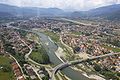 Panorama of Berane
 -
 Hotel Berane, one of the town's symbols, renovated in 2017
 -
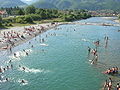 Beach at the Lim river
 -

-
 Šiš lake near Berane, Bjelasica mountain
 -
 Musical school in Berane
 -
 Jasikovac WWII monument
 -
 Forming of the Eight Montenegrin Brigade in 1944..


References
[edit]Footnotes
- ^ a b Morrison, Kenneth (2009). Montenegro: A Modern History. London: I.B. Tauris. pp. 158–159. ISBN 978-1-4416-2897-8.
- ^ "Preliminary results of the 2023 Census of Population, Households, and Dwellings". Monstat. Retrieved 25 January 2024.
- ^ a b "Population of Montenegro by National, i.e. Ethnical Affiliation, Religion, Mother Tongue, and Language a Person Usually Speaks" (PDF). monstat.org. 15 October 2024. Retrieved 25 October 2024.
- ^ "Climate: Berane" (in Montenegrin). Hydrological and Meteorological Service of Montenegro. Retrieved 7 March 2021.
- ^ "Dnevni prosjeci i ekstremi" (in Montenegrin). Hydrological and Meteorological Service of Montenegro. Retrieved 7 March 2021.
- ^ "Bratimljenje" (Press release) (in Serbo-Croatian). Retrieved 2019-09-04.
- ^ "Bratimljenje" (PDF). database.uom.me (in Montenegrin). Zajednica opština Crne Gore. January 2013. p. 29. Retrieved 2019-12-29.
Notes
[edit]Notes
- ^ Prominent Croatian and Yugoslavian actor. Starred in Balkan Spy.
- ^ Member of Serbia and Montenegro for the 2006 FIFA World Cup.
- ^ Member of 2012 European Women's Handball Championship winning-Montenegrin national team.
- ^ Member of winning-2000 Summer Olympics Yugoslavian Men's National Team.
- ^ Best Left Wing of the World in 2001.
- ^ The sixth Serbian Archbishop, holding the office from 1279 to 1286.
- ^ Minister of Education and Science in the Government of Serbia.
- ^ Minister of Defence of Bosnia and Herzegovina.
- ^ Member of Montenegrin Academy of Sciences and Arts.
External links
[edit]


Berane
View on GrokipediaGeography
Location and topography
Berane is situated in northeastern Montenegro, within the Polimlje valley along the course of the Lim River. The town occupies an elevation of approximately 800 meters above sea level and lies at coordinates 42°50′N 19°52′E.[11][12] The surrounding municipality borders Serbian territories to the north and northeast, with proximity to Kosovo regions further east contributing to its position near the tripoint of Montenegro, Serbia, and Kosovo.[13] The topography of Berane features a central river valley enclosed by rugged mountainous terrain, including the Bjelasica range, where Crna Glava peak rises to 2,139 meters. This elevates landscape has historically promoted regional isolation while supporting limited agriculture in the fertile valley floor. The municipality extends near Biogradska Gora National Park, whose forested highlands and peaks, such as those in the Black Mountain massif, further define the area's natural boundaries and ecological character.[12][14] Prior to boundary adjustments in 2013 that established the separate Petnjica Municipality from its eastern territories, Berane Municipality spanned 544 square kilometers, encompassing diverse settlements and terrain from valley lowlands to alpine heights. The urban center of Berane anchors this area, integrating riverine access with elevated surroundings that shape local hydrology and land use patterns.[15]Climate and environment
Berane features a humid continental climate (Köppen Dfb), with cold, snowy winters and warm, humid summers. Average high temperatures reach 26°C (79°F) in July, while January lows typically fall to -4°C (25°F), occasionally dropping below -10°C (14°F). Annual precipitation totals approximately 1,000–1,250 mm, concentrated in the cooler months from October to March, contributing to a snowy season lasting about five months from early November to early April, during which monthly snowfall can exceed 25 cm in peak periods like January and February.[16][17][18] The region's weather patterns exhibit variability influenced by its position in the Polimlje valley along the Lim River, which amplifies risks of seasonal flooding during intense spring thaws or heavy autumn rains due to the river's torrential flow regime and the steep terrain of surrounding karst mountains. Historical meteorological records indicate frequent winter frosts and occasional fog, with cold spells occasionally intensifying to sub-zero conditions for extended periods, impacting local agriculture and infrastructure resilience. Precipitation data from 1961–1990 show monthly averages peaking at 82.7 mm in January, underscoring the wet winter profile.[17][19][20] Environmentally, Berane's ecosystems are dominated by montane forests and alpine meadows, with forests covering roughly 45% of Montenegro's territory overall, though historical deforestation from agricultural expansion and logging has reduced woodland density in the Polimlje area. The Lim River basin supports riparian habitats but faces erosion and sedimentation challenges exacerbated by upstream land use, contributing to flood vulnerabilities that have prompted national-level monitoring under Montenegro's integrated water resource management frameworks. Conservation efforts include proximity to protected areas like the Prokletije massif, where biodiversity preservation initiatives aim to mitigate habitat loss, though private forest ownership shifts have complicated sustainable management. Climate projections indicate increasing frequency of extreme events such as floods and droughts, with recent national reports emphasizing nature-based solutions like reforestation to enhance ecological stability.[21][22][23]History
Early settlement and medieval period
Archaeological findings in Berane include a ceramic figurine estimated at over 5,000 years old and Bronze Age remains unearthed at shallow depths, indicating prehistoric human activity in the area.[24] The broader Montenegro region, encompassing Berane's location in the Dinaric Alps, preserves evidence of Mesolithic foragers transitioning to Neolithic farming communities around the Early Holocene, with sites reflecting early agricultural adaptation in mountainous terrains.[25] The Lim River valley's alluvial soils and moderate climate supported sustained agrarian settlement, enabling crop cultivation and livestock rearing that drew inhabitants to the fertile Polimlje basin.[26] Regional Illyrian tribes occupied the western Balkans prior to Roman incursions in the 1st century AD, leaving traces of pre-Slavic material culture, though specific Illyrian or Roman artifacts in Berane remain sparse.[27] South Slavic groups, migrating southward from the 6th century onward, established communities in the 7th–9th centuries across present-day Serbia and adjacent territories, including the Berane vicinity, where riverine positions facilitated trade and defense.[28] During the medieval era, the Berane area, designated as Budimlja, emerged as a key administrative and ecclesiastical district within the Serbian principality of Raška, benefiting from its strategic placement along inland routes linking the Adriatic to the Danube basin.[1] The Nemanjić dynasty, governing Serbia from circa 1166 to 1371, incorporated Budimlja into the expanding kingdom crowned in 1217, fostering Orthodox monastic foundations and fortified outposts to consolidate control.[29] Notable structures include the Đurđevi stupovi monastery, erected in the 12th century by Stefan Prvoslav—a Nemanjić descendant—as a spiritual hub amid the rugged landscape.[30] The Bihor fortress, situated nearby, exemplified defensive architecture safeguarding trade convoys and local populations until the mid-15th century.[31] These developments underscore Budimlja's role in medieval Serbian state-building, predicated on geographic advantages for sustenance and connectivity rather than isolated ethnic assertions.Ottoman era and uprisings
The Polimlje region, which includes Berane, was incorporated into the Ottoman Empire during the conquests of the 1450s and 1460s, as Ottoman forces dismantled the remnants of medieval Serbian principalities in Raska.[32][33] The area was administratively organized into nahiyas within the Sanjak of Scutari and later the Sanjak of Novi Pazar, with tax-farming and timar systems imposed on local settlements. Ottoman defters from the late 15th century, such as those recording Polimlje's households in 1455, 1485, and 1489, indicate a majority Slavic Orthodox population engaged primarily in agriculture and pastoralism, paying harac and other levies while subject to periodic pressures for conversion through incentives like tax exemptions for recent Muslim settlers.[34][35] The settlement of Berane itself emerges in records with the 1580 census, listing it amid Christian-dominated villages with emerging Muslim elites overseeing collection.[36] Population data from Ottoman censuses reveal gradual shifts, with Christian households outnumbering Muslim ones into the 17th century but declining due to warfare, migrations to autonomous highlands, and localized conversions; for instance, 19th-century registers in the Ipek Sanjak, including Berane, show around 620 Muslim and 640 non-Muslim male heads of household amid broader depopulation from conflicts.[37] These dynamics reflected systemic Ottoman policies favoring Islamization in frontier zones, though empirical records underscore persistent Orthodox majorities resisting full assimilation.[34] In the 19th century, economic burdens like intensified taxation under Tanzimat reforms and military conscription sparked uprisings among tribes in Polimlje and adjacent Brda regions, including the Vasojevići centered near Berane, who rebelled against Ottoman garrisons to assert de facto autonomy.[27] These revolts, often coordinated with Montenegrin principalities, were rooted in grievances over resource extraction and religious interference rather than coordinated nationalism, leading to punitive Ottoman campaigns that exacerbated depopulation—census figures post-1870s insurrections document reduced settlements from flight and destruction.[37][38] Local commemorations, such as monuments to 19th-century liberation struggles in Berane, highlight these events as pivotal resistance against imperial overreach, paving the way for the region's incorporation into Montenegro during the Balkan Wars of 1912–1913 despite formal Ottoman retention until then.[39]19th–20th century developments
Following the First Balkan War, Montenegrin forces under General Janko Vukotić captured Berane from Ottoman control on November 11, 1912, incorporating it into the Principality of Montenegro as part of the broader conquest of northeastern territories previously under the Sanjak of Novi Pazar.[40] This annexation positioned Berane as a strategic border settlement amid ongoing Sandžak disputes, where Montenegro secured the eastern portion—including Berane—while Serbia controlled the western areas around Novi Pazar, reflecting the opportunistic territorial expansions enabled by Ottoman decline rather than negotiated settlements like the 1878 Congress of Berlin, which had left the Sanjak demilitarized but intact.[41] During World War I, Berane experienced the broader Montenegrin campaign against Austria-Hungary, with local forces contributing to defenses until the Austro-Hungarian occupation of Montenegro in January 1916, which integrated the town into the invaded territories and led to economic strain from requisitions and displacement.[42] Post-war unification into the Kingdom of Serbs, Croats, and Slovenes in 1918 placed Berane under centralized Yugoslav administration, initially within the Zeta Oblast and later reorganized into the Zeta Banovina in 1929, fostering infrastructure development like roads linking it to Podgorica but also exposing ethnic tensions in the multi-confessional Sandžak region.[43] In World War II, Berane fell under Italian occupation following the Axis invasion of Yugoslavia in April 1941, with the area serving as a base for partisan uprisings that erupted across Montenegro in July 1941 against fascist rule, involving local communist-led detachments that disrupted supply lines and garnered support from Serb and Montenegrin populations amid reprisals.[44] Over 6,000 civilians and soldiers from the Berane vicinity perished in the conflict, commemorated postwar through monuments honoring resistance efforts that aligned with Tito's Partisans, ultimately contributing to communist victory through guerrilla warfare exploiting Axis overextension.[44] German forces later assumed control after Italy's 1943 capitulation, intensifying counterinsurgency operations in the Sandžak theater. After 1945, Berane underwent administrative consolidation under socialist Yugoslavia, with the town renamed Ivangrad on July 21, 1949, to honor Ivan Milutinović, a Montenegrin partisan commander killed in 1944, as part of broader communist efforts to valorize revolutionary figures and standardize nomenclature in line with ideological nation-building.[45] The name reverted to Berane in 1992 following Yugoslavia's disintegration, reflecting resurgent local preferences for historical continuity amid the Federal Republic's political shifts and the erosion of centralized communist authority.[46]Yugoslav period and post-independence
During the period of the Socialist Federal Republic of Yugoslavia (1945–1992), Berane, renamed Ivangrad in 1949 after a local Partisan hero, functioned as a regional industrial hub in northern Montenegro, with growth in manufacturing and population driven by socialist investment policies. However, the Yugoslav economy broadly stagnated in the 1980s amid mounting foreign debt exceeding $20 billion by 1989, hyperinflation reaching 2,500% annually, and inefficiencies in the self-management system, positioning peripheral areas like Berane as underdeveloped compared to coastal or Slovenian regions.[47][48] In the 1990s, as part of the Federal Republic of Yugoslavia, Berane experienced economic collapse due to UN sanctions imposed in 1992, which crippled industry and trade, leading to widespread unemployment and emigration. The Yugoslav wars had limited direct combat in Montenegro, but Berane absorbed refugees from conflicts in Bosnia and Croatia, including a UNHCR-established camp in 1995 housing displaced families.[49] Montenegro registered over 100,000 refugees and internally displaced persons by the mid-1990s, straining local resources in northern municipalities.[50] The 2006 referendum on Montenegrin independence from the Serbia and Montenegro union saw divided results in Berane, where Serb-leaning sentiments prevailed, with a majority voting to maintain the state union amid national approval of 55.5% for separation. Post-independence, Berane retained municipal status under the 2007 Constitution's framework for local self-government, emphasizing fiscal decentralization.[51] Administrative reforms in 2013 carved out the new Andrijevica municipality from eastern portions of Berane, reducing its area from approximately 550 km² to 499 km² to address local governance demands in rural sub-regions. The 2023 national census integrated Berane into Montenegro's population data, recording 24,645 residents in the municipality, reflecting ongoing demographic decline from post-Yugoslav emigration trends.[3]Demographics
Population dynamics
The population of Berane Municipality reached 35,068 according to the 2003 census, reflecting cumulative growth from earlier post-war expansions driven by natural increase and internal migration.[52] By the 2011 census, this figure had begun to contract to 33,772, signaling the onset of sustained demographic pressure.[3] The 2023 census recorded a further drop to 24,645, marking a net loss of over 10,000 residents since 2003 or approximately 1.7% annual average decline. This downturn stems chiefly from high emigration rates, exacerbated by the economic isolation and conflicts of the 1990s Yugoslav wars, including international sanctions and the 1999 NATO intervention, which prompted outflows to Western Europe and urban centers elsewhere in Montenegro.[53] Low fertility rates, consistently below replacement level at around 1.6-1.7 births per woman in recent years, compound the effect alongside modest mortality improvements insufficient to offset losses. Internal migration patterns show persistent negative balances for Berane, with residents relocating to coastal or Podgorica-area municipalities for opportunities, contributing to rural depopulation and urban concentration within the municipality. Projections from Montenegro's statistical office indicate continued shrinkage without policy interventions, as national trends project a 10-15% population reduction by 2040 under baseline fertility and migration assumptions, with northern municipalities like Berane facing steeper declines due to structural aging and youth exodus. Empirical data from Monstat's annual estimates confirm 4-5% decadal drops in recent inter-census periods for the region, underscoring the absence of reversing factors like immigration inflows.Ethnic and religious composition
According to the 2023 census conducted by Montenegro's Statistical Office (MONSTAT), the municipality of Berane had a population of approximately 24,645, with ethnic Serbs forming the largest group at 14,742 individuals (61.2%), followed by Montenegrins at 6,548 (27.2%). Bosniaks numbered 1,103 (4.6%), Albanians 28 (0.1%), and other or undeclared groups 1,668 (6.9%), reflecting a combined Serb-Montenegrin majority exceeding 88%.[3]| Ethnic Group | Number | Percentage |
|---|---|---|
| Serbs | 14,742 | 61.2% |
| Montenegrins | 6,548 | 27.2% |
| Bosniaks | 1,103 | 4.6% |
| Others | 1,668 | 6.9% |
| Albanians | 28 | 0.1% |