Hubbry Logo
Novi PazarNovi PazarMain
Open search
Novi Pazar
Community hub
Novi Pazar
logo
8 pages, 0 posts
0 subscribers
Be the first to start a discussion here.
Novi Pazar
Novi Pazar
from Wikipedia

Novi Pazar (Serbian Cyrillic: Нови Пазар) is a city located in the Raška District of southwestern Serbia. As of the 2022 census, the urban area has 71,462 inhabitants, while the city administrative area has 106,720 inhabitants.[4] The city is the cultural center of the Bosniaks in Serbia and of Sandžak.[5] A multicultural area of Muslims and Orthodox Christians, many monuments of both religions, like the Altun-Alem Mosque and the Church of the Holy Apostles Peter and Paul, are located in the region which has a total of 30 protected monuments of culture.[6]

Key Information

Name

[edit]

During the 14th century under the old Serbian fortress of Stari Ras, an important market-place named Trgovište started to develop. By the middle of the 15th century, in the time of the final Ottoman Empire conquest of Old Serbia, another market-place was developing some 11 km to the east. The older place became known as Staro Trgovište (Old Trgovište, Turkish: Eski Pazar) and the younger as Novo Trgovište (New Trgovište, Turkish: Yeni Pazar). The latter developed into the modern city of Novi Pazar.

The name "Novi Pazar" (meaning 'New Bazaar') was derived from the Serbian name Novo Trgovište, via the Turkish name Yeni Pazar, which is itself derived from bazaar (from Persian بازار (bāzār) 'market'; from Pahlavi بهاچار (bahā-chār) 'place of prices').[7] The city is known as Pazari i Ri or Tregu i Ri[8] in Albanian and simply Novi Pazar in Bosnian. Aside from that it is still known as Yeni Pazar in modern-day Turkey.

Geography

[edit]

Novi Pazar is located in the valleys of the Jošanica, Raška, Deževska, and Ljudska rivers. It lies at an elevation of 496m, in the southeast Raška region. The city is surrounded by the Golija and Rogozna mountains, and the Pešter plateau lies to the west. The total area of the city administrative area is 742 km2. It contains 100 settlements, mostly small and spread over hills and mountains surrounding the city. The largest village is Mur, with over 3000 residents.[citation needed]

Climate

[edit]

Novi Pazar has a humid continental climate (Köppen climate classification: Dfb) typical of the hilly Raška region. It is generally cooler than Serbia's other major cities, though still significantly warmer than the neighboring town of Sjenica.

Climate data for Novi Pazar
Month Jan Feb Mar Apr May Jun Jul Aug Sep Oct Nov Dec Year
Mean daily maximum °C (°F) 2.7
(36.9)
5.6
(42.1)
11.1
(52.0)
15.5
(59.9)
20.1
(68.2)
23.6
(74.5)
26.1
(79.0)
26.4
(79.5)
22.7
(72.9)
16.5
(61.7)
8.8
(47.8)
4.3
(39.7)
15.3
(59.5)
Daily mean °C (°F) −0.6
(30.9)
1.6
(34.9)
6.3
(43.3)
10.2
(50.4)
14.6
(58.3)
18.0
(64.4)
20.1
(68.2)
20.1
(68.2)
16.7
(62.1)
11.4
(52.5)
5.2
(41.4)
1.2
(34.2)
10.4
(50.7)
Mean daily minimum °C (°F) −3.9
(25.0)
−2.4
(27.7)
1.5
(34.7)
5.0
(41.0)
9.2
(48.6)
12.5
(54.5)
14.1
(57.4)
13.8
(56.8)
10.7
(51.3)
6.4
(43.5)
1.6
(34.9)
−1.8
(28.8)
5.6
(42.0)
Average precipitation mm (inches) 71
(2.8)
64
(2.5)
66
(2.6)
74
(2.9)
92
(3.6)
78
(3.1)
68
(2.7)
62
(2.4)
69
(2.7)
80
(3.1)
93
(3.7)
83
(3.3)
900
(35.4)
Source: [9]

History

[edit]
Church of the Holy Apostles Peter and Paul from the 9th century

One of the oldest monuments of the area is the Church of the Holy Apostles Peter and Paul first built in the Roman era and reconstructed in the 9th century. Over many centuries the city area of Stari Ras was a borderline contested by the First Bulgarian Empire, Serbian Principality and Byzantine Empire.

Since the late-12th century, the region of modern Novi Pazar served as the principal province of the Serbian realm. It was an administrative division, usually under the direct rule of the monarch and sometimes as an appanage. It was the crownland, seat or appanage of various Serbian states throughout the Middle Ages, including the Serbian Kingdom (1217–1345) and the Serbian Empire (1345–1371). In 1427, the region and the remnant of Ras, as part of the Serbian Despotate, was ruled by Serbian despot Đurađ Branković. One of the markets was called "despotov trg" (Despot's square).[10] In 1439, the region was captured by the Ottoman Empire, but was reconquered by the Serbian Despotate in 1444. In the summer of 1455, the Ottomans conquered the region again, and named the settlement of Trgovište Eski Bazar (Old Market). Novi Pazar was formally founded as a city in its own right in 1461 by Ottoman general Isa-Beg Ishaković, the Bosnian governor of the district (sanjak) who also founded Sarajevo.[11] Ishaković decided to establish a new town on the area of Trgovište as an urban center between Raška and Jošanica, where at first he built a mosque, a public bath, a marketplace, a hostel, and a compound.[citation needed]

The town was the capital of the Sanjak of Novi Pazar during Ottoman rule. From 1878 to 1908, it was controlled by Austria-Hungary, and from 1908 to 1913, it was again part of the Ottoman empire under the Kosovo vilayet. It became part of the Kingdom of Serbia during the First Balkan War in 1912, and then in 1918 the Kingdom of Yugoslavia.[12]

The area has traditionally had a large number of Albanians and Muslim Slavs with a different culture from the Orthodox Serbs.[13] In May 1901, Albanians pillaged and partially burned the cities of Novi Pazar, Sjenica and Priština, and massacred Serbs in the area of Ibar Kolašin.[14] A contemporary report stated that when the Serb forces entered the Sandjak of Novi Pazar, they "pacified" the Albanians.[15]

In the Battle for Novi Pazar, fought at the end of 1941 during the Second World War, the Chetniks, initially supported by the Partisans, unsuccessfully tried to capture the city.[citation needed] Following the overthrow of Slobodan Milošević on 5 October 2000, newly elected Prime Minister of Serbia Zoran Đinđić made considerable efforts to help economically the whole area of Novi Pazar. Also, with the help of Đinđić, the International University of Novi Pazar was founded in 2002. He made close relations with the leaders of Bosniaks, as part of his wider plan to reform Serbia.[16] Twelve years following his assassination, the Novi Pazar Assembly decided to rename one street in his name.[17]

Demographics

[edit]
Historical population
YearPop.±%
194811,992—    
195314,104+17.6%
196120,706+46.8%
197128,950+39.8%
198141,099+42.0%
199151,749+25.9%
200254,604+5.5%
201166,527+21.8%
202271,462+7.4%
Source: [18]

According to the 2022 census, the municipality of Novi Pazar has 106,720 inhabitants, while the city itself has 71,462 inhabitants.[4] A total of 68.4% of population live in urban area of the city. The population density is 135.32 inhabitants per square kilometer.[19] Novi Pazar has 23,022 households with 4,36 members on average; the number of homes is 28,688.[20]

Religion structure in the city of Novi Pazar is predominantly Muslim (82,710), with Serbian Orthodox (16,051), Atheists (71), Catholics (51), and other minority groups.[21] Most of the population speaks either Bosnian (74,501) or Serbian (23,406).[21]

The composition of population by sex and average age:[21]

  • Male - 49,984 (32.9 years) and
  • Female - 50,426 (34.1 years).

A total of 33,583 citizens (older than 15 years) have secondary education (44.4%), while the 7,351 citizens have higher education (9.7%). Of those with higher education, 5,005 (6.6%) have university education.[22]

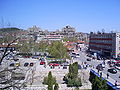
Prvomajska Street in Novi Pazar.

Ethnic composition

[edit]
Ethnic composition of Novi Pazar settlements (2002 census)

From the 15th century to the Balkan Wars, Novi Pazar was the capital of the sanjak of Novi Pazar. Typically, like other centres of the wider area, its composition was multiethnic, with Albanians, Serbs and Slavic-speaking Muslims as the largest ethnic groups of the city.[23] The Ottoman travel writer Evliya Çelebi noted that it was one of the most populated towns in the Balkans in the 17th century. Jews also lived in the city until World War II.[24] The entire Jewish population of Novi Pazar - 221 individuals, were imprisoned, sent to the concentration camp Staro Sajmište and killed during the rule of Aćif Hadžiahmetović.[25] The ethnic composition of the city administrative area:[26][27]

Ethnic group Population
1953[28]
Population
1961[29]
Population
1971[30]
Population
1981[31]
Population
1991[32]
Population
2002[33]
Population
2011[34]
Population

2022[35]

Bosniaks - - - - - 65,593 81,545 85,204
Serbs 25,177 27,933 25,076 21,834 19,064 17,599 16,234 14,142
Muslims - 23,250 37,140 49,769 64,251 1,599 - 1,851
Roma - 37 210 444 334 69 566 486
Gorani - - - - - 15 246 255
Albanians 144 126 307 233 209 129 202 200
Montenegrins 174 543 359 295 232 109 44 34
Yugoslavs 13,564 1,261 183 931 700 136 67 72
Turks 11,009 - - - - - - -
Others 263 5,627 1,057 494 459 747 4,476 161
Total 50,331 58,777 64,326 74,000 85,249 85,996 100,410 106,720

Ethnic composition of the urban area of the city:

Ethnic group Population
1948[36]
Population
1953[28]
Population
1981[31]
Population
1991[32]
Population
2002[33]
Population
2011[34]
Population

2022[37]

Bosniaks/Muslims 1,085 - 32,798 43,774 47,243 58,252 60,684
Serbs 10,678 3,466 6,689 6,698 6,724 6,576 6,067
Gorani - - - - - 240 235
Albanians - 134 208 172 120 162 158
Yugoslavs - 5,944 848 570 105 64 68
Turks - 4,280 - - - - -
Montenegrins - 145 246 190 93 39 34
Others 229 135 310 345 1,541 3,304 4,217
Total 11,992 14,104 41,099 51,749 54,604 68,749 71,462

Settlements

[edit]

Aside from the urban area of Novi Pazar (54,604), the city administrative area includes the following settlements, with population from the 2002 census:

Politics

[edit]

Novi Pazar is governed by a city assembly composed of 47 councillors, a mayor and vice-mayor. After the last legislative election held in 2020, the local assembly is composed of the following groups:[38]

  • SDP - European Novi Pazar - Rasim Ljajić (21)
  • SPP - Muamer Zukorlić (11)
  • SDA - Party of Democratic Action of Sandžak (9)
  • Aleksandar Vučić - SNS, SPS, SRS (6)

Economy

[edit]

Lying on crossroads between numerous old and new states, Novi Pazar has always been a strong trade center. Along with the trade, the city developed manufacturing tradition. During the 20th century, it became a center of textile industry.

Paradoxically, during the turbulent 1990s and, Novi Pazar prospered, even during the UN sanctions, boosted by the strong private initiative in textile industry. Jeans of Novi Pazar, first of forged trademarks, and later on its own labels, became famous throughout the region. However, during the relative economic prosperity in Serbia of the 2000s, the Novi Pazar economy collapsed, with demise of large textile combines in mismanaged privatization, and incoming competition from the import.

As of 2023, Novi Pazar was having around 23,000 unemployed inhabitants, making it one of the cities in Serbia with the highest unemployment rate (around 50%).[39] Some of the main reasons for this was unstable political situation during the 1990s and 2000s, and underdeveloped infrastructure (with no international airports, motorways and railways nearby).[39]

Economic figures

The following table gives a preview of total number of registered people employed in legal entities per their core activity (as of 2022):[40]

Activity Total
Agriculture, forestry and fishing 72
Mining and quarrying 13
Manufacturing 3,173
Electricity, gas, steam and air conditioning supply 144
Water supply; sewerage, waste management and remediation activities 497
Construction 1,957
Wholesale and retail trade, repair of motor vehicles and motorcycles 3,902
Transportation and storage 1,717
Accommodation and food services 924
Information and communication 198
Financial and insurance activities 216
Real estate activities 8
Professional, scientific and technical activities 634
Administrative and support service activities 186
Public administration and defense; compulsory social security 1,404
Education 2,741
Human health and social work activities 1,806
Arts, entertainment and recreation 276
Other service activities 633
Individual agricultural workers 441
Total 20,944

Society and culture

[edit]

Monuments

[edit]

The old Serbian Orthodox monastery of Sopoćani, the foundation of St King Uroš I, built in the second half of the 13th century and located west of Novi Pazar, is a World Heritage Site since 1979 accompanying with Stari Ras (Old Ras), a medieval capital of the Serbian great župan Stefan Nemanja.[41][42][43]

The city also houses the oldest intact church in Serbia and one of the oldest ones in the region which dates from the 9th-century, the Church of St Peter. The church's walls were defaced with graffiti on 6 April 2008. The police have not officially concluded why the incident occurred.[44]

On a hilltop overlooking Novi Pazar is the 12th century monastery of Đurđevi stupovi, long left in ruin, but recently restored and with a monastic community using it, with plate glass to keep out the weather and preserve the fine frescos. The main mosque of the city, the Altun-Alem Mosque, was built in the first half of the 16th century by architect Abdul Gani.[45][46]

There are various other historic Ottoman buildings, such as the 17th-century Amir-agin Han, a 15th-century Hammam, and the 15th-century Turkish fortress (all gone but the walls, the site of which is now a walled park in the city centre).[47][48]

Education

[edit]
Faculty for Islamic studies in Novi Pazar

Novi Pazar is home to two universities, the International University of Novi Pazar and the State University of Novi Pazar.

Sport

[edit]

The city's football club FK Novi Pazar was founded in 1928, under the name "FK Sandžak", which later changed to "FK Deževa". The club has played under its current name since 1962, when Deževa and another local football club, FK Ras, unified under this name. The club was a SFRJ amateur champion, and a member of the Yugoslav Second League. FK Novi Pazar qualified for a promotional play-off twice, but lost both times (to FK Sutjeska Nikšić in 1994, and to FK Sloboda Užice in 1995). FK Novi Pazar finally promoted to Serbian SuperLiga in 2011–12 season. FK Novi Pazar is the oldest second-league team in Serbia. Football is still an extremely popular sport in Novi Pazar and the city stadium is always full.

Volleyball clubs in the city are OK Novi Pazar (first league) and OK Koteks.

The Handball club is in the second league and used to have the name "Ras" but it was changed to RK Novi Pazar in 2004.

The Basketball club of the city is OKK Novi Pazar.

Famous athletes from the city include Turkish basketball national team player Mirsad Jahović Türkcan, former football player of Besiktas Sead Halilagić, handball-player Mirsad Terzić (who represents Bosnia and Herzegovina) and young football players Adem Ljajić, Ediz Bahtiyaroğlu, Armin Đerlek.

International cooperation

[edit]
[edit]

Notable people

[edit]

References

[edit]
[edit]
Revisions and contributorsEdit on WikipediaRead on Wikipedia
from Grokipedia
Novi Pazar is a in the of southwestern , situated in the Raška River valley and serving as the administrative, cultural, and economic hub of the surrounding area with an urban population of 71,462 according to the 2022 census. The , encompassing the city and rural settlements, has approximately 106,700 residents, over 80% of whom identify as , reflecting its role as the largest urban in the ethnically diverse region that spans . Founded in 1459–1461 by Ottoman noble Isa as a ("new bazaar"), it developed into a key trading and military outpost under Ottoman rule, blending —evident in landmarks like the Altun-Alem —with proximity to medieval Serbian Orthodox sites such as the UNESCO-listed fortress and Sopoćani Monastery, which highlight the area's layered historical significance from the era. Today, Novi Pazar remains a focal point for Bosniak cultural institutions in , including faculties, while navigating regional dynamics marked by religious diversity between Muslim and Orthodox Serbs, alongside ongoing economic development through government infrastructure investments.

Etymology

Name Origins and Usage

The name Novi Pazar derives from the Yeni Pazar, translating to "new " or "new ," denoting its founding as a commercial hub distinct from older trading sites in the vicinity. This nomenclature emerged following the Ottoman conquest of the region, with the settlement established by Isa-Beg Ishaković, a Bosnian governor under , who decreed its creation as Yeni Bazar around 1459 to serve as a fortified at the intersection of key trade routes in the Raška valley. The site's selection capitalized on its strategic position near the remnants of medieval Ras (ancient Rassia or Rashka), positioning Novi Pazar as the "new" counterpart to the "old" marketplace associated with Ras, which had declined after Serbian losses to the Ottomans in the mid-14th century. In linguistic adaptation, the name evolved from the Slavic Novo Trgovište ("new "), directly mirroring the Turkish while incorporating local phonetic and orthographic conventions during Ottoman administration. Historical records, such as those from archives dated to 1461, confirm early usage as a burgeoning Ottoman , with rapid development evidenced by tax registers showing a surge and construction by 1468. Under Ottoman rule, it functioned as the administrative center of the (or Yenipazar), a designation persisting into the 19th and early 20th centuries until the of 1912–1913 integrated the area into the Kingdom of . Contemporary usage retains Novi Pazar as the official for the city, reflecting its enduring role as a multicultural trading nexus with a Bosniak-majority population. In Turkish historical contexts, references to Yeni Pazar underscore its Ottoman heritage, while some Serbian nationalists invoke the pre-Ottoman regional toponym Raška—derived from the 9th– Serbian heartland—to emphasize ethnic continuity over the Turkish-influenced city name. This linguistic duality highlights ongoing cultural tensions in the region, where Novi Pazar symbolizes Ottoman commercial legacy amid Serbia's post-Yugoslav assertions of medieval patrimony.

Geography

Location and Physical Features

Novi Pazar lies in southwestern within the , at coordinates 43.1367° N, 20.5122° E. The city occupies a central position in the region, proximate to the borders with , , and , facilitating its role as a regional hub. The urban area is positioned in the Raška River valley amid hilly terrain, with an average of 511 meters above . Contributing to its physical setting are adjacent river valleys, including those of the Jošanica, Deževska, Ljudska, Moravica, and Studenica rivers, which emerge from mountain springs. Surrounding features rugged hills and medium-altitude mountains of the Dinaric , notably approximately 32 km southwest, with its highest point Jankov Kamen at 2,833 meters. Golija holds UNESCO World Heritage status due to its exceptional and natural features. To the north, Mount Rogozna rises, adding to the enclosed valley character that influences local microclimates and accessibility.

Climate and Environment

Novi Pazar lies in the Raška Valley at an elevation of approximately 529 meters, experiencing a temperate oceanic climate classified as Cfb under the Köppen-Geiger system, with mild, wet summers and cool, humid winters. The annual average temperature is 9.2 °C, with the coldest month, , averaging 4 °C for highs and often dipping below freezing at night, while , the warmest, sees average highs of 27 °C and lows around 13 °C. averages 921 mm annually, fairly evenly distributed but peaking in May and , with snowfall common from to , accumulating up to 50-100 cm in heavier winters due to the surrounding Golija and Rogozna mountains. The valley topography moderates extremes but promotes fog and temperature inversions, exacerbating winter cold snaps. The local environment encompasses karstic terrain, the Raška River, and forested uplands, fostering moderate biodiversity including endemic flora in nearby nature reserves like Golija-Studenica, a UNESCO biosphere reserve adjacent to the city. However, urban and industrial activities pose challenges; air pollution frequently exceeds safe levels, particularly PM10 and PM2.5 in winter, driven by household solid-fuel heating (coal and wood), traffic congestion, and emissions trapped by the basin's geography. In 2021, Novi Pazar recorded some of Serbia's highest PM10 concentrations, with similar exceedances noted in subsequent winters. Aquatic ecosystems face recurrent threats, exemplified by a 2025 incident causing mass die-offs in the Raška River due to unidentified pollutants, prompting investigations into industrial discharges. Efforts to mitigate include solar installations reducing use in local industries, as seen in a 2024 project cutting emissions at a textile firm. Overall, while the natural setting supports , pollution persistence underscores the need for sustained regulatory enforcement.

History

Medieval Serbian Foundations

The region encompassing modern Novi Pazar formed the core of the medieval Serbian principality known as Raška, with serving as its primary political and administrative center from the . Located near the confluence of the Raška and Sebečevo rivers, approximately 11 kilometers west of present-day Novi Pazar, emerged as a fortified settlement that anchored Serbian territorial consolidation amid interactions with Byzantine and Bulgarian powers. By the , it had become the capital under , founder of the , who expanded the principality's influence through military campaigns and efforts. Stefan Nemanja established Đurđevi stupovi Monastery, dedicated to Saint George, around 1170-1171 as an endowment reflecting the dynasty's commitment to Orthodox architecture and piety. Positioned strategically overlooking the Lim River valley near Novi Pazar, the monastery's church, elevated on stone pillars, symbolized resilience and spiritual authority, with its construction incorporating Romanesque elements adapted to local traditions. This site, part of the broader UNESCO-recognized complex, underscores the area's role in fostering Serbian cultural identity during the principality's formative expansion. In the mid-13th century, King Uroš I further enriched the region's monastic heritage by founding Sopoćani Monastery between 1263 and 1268, intended as his mausoleum and dedicated to the Holy Trinity. Situated near the Raška River's source, close to , the monastery is noted for its exceptional frescoes from the 1260s-1270s, which preserve vivid depictions of biblical narratives and royal figures, exemplifying the peak of Serbian medieval painting. These foundations, alongside , highlight the area's centrality to the Grand Principality of Serbia's political stability, economic activity via river trade routes, and religious consolidation before the 14th-century shifts toward more southern capitals like .

Ottoman Conquest and Development

The Ottoman conquest of the Raška region, encompassing the area of present-day Novi Pazar, progressed amid the broader subjugation of Serbian territories in the mid-15th century. Following initial incursions, Ottoman forces under Isa-Beg Ishaković, the Bosnian governor of Skopje, captured the southwestern parts of the region in 1455, marking the effective end of medieval Serbian control in the vicinity of Stari Ras. This conquest integrated the territory into the Ottoman Empire, with local fortifications like those at Ras falling without prolonged resistance after the decisive Ottoman victory at the Battle of Kosovo in 1389 had already weakened regional defenses. Novi Pazar itself emerged as a planned Ottoman settlement shortly thereafter, founded by Isa-Beg Ishaković between 1459 and 1461 as a new commercial hub to supplant the declining medieval market at Trgovište, which was redesignated Eski Pazar (Old Bazaar). Ishaković, drawing from his experience in establishing Sarajevo's Baščaršija, constructed essential infrastructure including a central , , , and marketplace, fostering rapid urbanization and trade along key Balkan routes connecting to the Adriatic. The town's strategic location near the Raška River and mountain passes facilitated its growth into a multicultural administrative and economic node, attracting Muslim settlers, merchants from Bosnia and , and serving as a base for Ottoman operations. Under Ottoman administration, Novi Pazar developed into the nucleus of the , an administrative division formalized in the that extended influence over parts of modern , , and Bosnia. The period saw the erection of prominent , such as the 16th-century Altun-Alem and Melajska mosques, reflecting sustained investment in religious and civic structures to solidify Ottoman cultural dominance. Economic vitality stemmed from its role in regional commerce, with guilds regulating crafts like leatherworking and metal smithing, though the town experienced periodic disruptions from uprisings and border skirmishes with Habsburg and Venetian forces. By the , travelogues described Novi Pazar as a bustling town with a diverse populace, underscoring its evolution from frontier outpost to integral Ottoman provincial center until the late .

19th-Century Decline and Serbian Liberation

During the early , Novi Pazar faced considerable instability under Ottoman rule, exacerbated by the of 1804–1813, which profoundly disrupted the region through incursions such as Karađorđe's aggressive offensive into the area in 1809. These events, part of broader Serbian resistance against Ottoman janissary abuses and central authority, led to local economic strain, population displacements, and weakened administrative control, marking the onset of the town's decline amid the empire's systemic territorial and fiscal erosion. By mid-century, Novi Pazar was incorporated into the newly formed Sanjak of Novi Pazar in 1865, an Ottoman administrative unit aimed at consolidating control over the Raška region, but this occurred against the backdrop of ongoing imperial decay, including failed Tanzimat reforms and rising Balkan nationalisms. The Congress of Berlin in 1878 further shaped its status by designating the sanjak as a neutral buffer zone between the Principality of Serbia and the Principality of Montenegro to avert their unification, granting Austria-Hungary occupation rights in adjacent Bosnia-Herzegovina and garrison privileges in the sanjak from 1879 to 1908. This arrangement provided temporary stability through Habsburg-Ottoman cooperation, suppressing local revolts like the 1875 Christian uprising in the vicinity, yet it underscored Ottoman dependency on European powers and failed to reverse underlying economic stagnation and ethnic tensions fueled by demographic shifts toward a Muslim majority. The sanjak's Ottoman tenure ended during the First Balkan War, initiated on October 8, 1912, when the Balkan League—comprising Serbia, Montenegro, Bulgaria, and Greece—declared war on the empire. Serbian forces advanced rapidly into the region, capturing key positions and leading to the sanjak's partition by late 1912, with Novi Pazar and its eastern territories annexed by Serbia as Ottoman resistance collapsed due to logistical overextension and internal Young Turk disarray. Formal incorporation into the Kingdom of Serbia followed the Treaty of London in May 1913, ending five centuries of direct Ottoman sovereignty and integrating the town into Serbian administration amid post-war ethnic realignments.

Yugoslav Era and Post-1990s Conflicts

During the post-World War II period, Novi Pazar was incorporated into the as part of the , with the former Novi Pazar district abolished in 1947 and its territories reorganized into regions administered from and other centers. The city's Muslim Slavic population benefited from the 1971 constitutional amendments recognizing "" as a distinct , enabling greater cultural and a surge in self-identification as such in subsequent censuses, which solidified Bosniak ethnic consciousness in the region. Economically, Novi Pazar functioned primarily as a regional and hub under Yugoslavia's socialist framework, though it lagged behind more industrialized areas due to its peripheral location and ethnic demographics. As Yugoslavia disintegrated in the early 1990s, Novi Pazar avoided the large-scale ethnic violence that engulfed Bosnia and Croatia, but the Sandžak region faced escalating political pressures from Belgrade under Slobodan Milošević. In the 1991 local elections, the Party of Democratic Action of Sandžak (SDA Sandžak), led by Sulejman Ugljanin, secured victory in Novi Pazar, with Ugljanin becoming mayor and pushing for regional autonomy through a non-binding referendum in October 1991 that favored self-rule. Serbian authorities responded aggressively, encircling the city with Yugoslav People's Army troops and tanks by 1992–1993 to quash perceived separatist threats, accompanied by arrests of Muslim activists and police intimidation tactics that heightened ethnic fears without provoking armed clashes. The 1999 NATO bombing campaign further strained the area when airstrikes targeted military barracks in Novi Pazar on May 31, killing at least 11 civilians and wounding over 30 in a strike that hit a nearby populated zone. Following Milošević's ouster in October 2000, overt military pressures subsided, allowing local governance to stabilize under Bosniak-led coalitions, though underlying ethnic divisions and economic isolation from sanctions persisted into the post-Yugoslav era without erupting into sustained conflict.

Demographics

The population of the City of Novi Pazar municipality has grown steadily since the early , diverging from Serbia's national depopulation trend, where the total population fell from approximately 7.5 million in 2002 to 6.7 million in 2022. Official data record 92,334 inhabitants in the municipality in 2002, increasing to 100,410 by 2011—a rise of about 8.7% over the decade—and reaching 106,663 by the 2022 estimate based on adjustments. The urban core similarly expanded from 54,604 residents in 2002 to 66,527 in 2011 and 71,462 in 2022. This upward trajectory stems primarily from a positive natural increase, driven by higher rates and a younger demographic profile compared to the national average, where births significantly outpace deaths. For instance, annual live births in the have consistently exceeded 1,500 in recent years, while deaths remain below 900, yielding a natural surplus that offsets losses. Demographers note no net in-migration contributes to this growth, as outbound migration for economic opportunities persists, but the surplus birth rate—among the highest in —sustains expansion. Between 2002 and 2011, Novi Pazar recorded 's highest municipal growth rate, reflecting these dynamics amid broader regional decline. Projections indicate continued modest increase through natural change, though sustained could temper it; the 2024 estimate stands at 108,535 for the . Age structure data underscore the trend, with a lower proportion of elderly (under 10% over 65 in recent censuses) versus the national figure exceeding 20%, supporting higher reproductive-age cohorts.

Ethnic Composition and Migration

According to the 2022 Serbian , the of Novi Pazar has a total population of 106,720, with ethnic forming the majority at 85,204 individuals (79.9%), followed by Serbs at 14,142 (13.3%), Roma at 486 (0.5%), at 200 (0.2%), and other groups totaling 2,470 (2.3%), including undeclared or unspecified. The city proper, with 71,462 residents, exhibits a higher concentration of , reflecting urban settlement patterns in the region where this group predominates. This ethnic structure stems from historical Ottoman-era settlement and post-World War II demographics, with maintaining demographic dominance through higher fertility rates compared to Serbs. Serbia-wide, constitute about 2.8% of the , but in Novi Pazar, their share far exceeds national averages due to regional clustering in southwestern . Migration trends in Novi Pazar contrast with Serbia's overall depopulation, showing positive natural increase driven by Bosniak birth rates, estimated at 4.4‰ in municipalities like Novi Pazar as of data. Net migration remains negative but less severe than in Serb-majority areas, with internal rural-to-urban flows bolstering the city; however, surveys indicate high potential among , predominantly Bosniaks (90.5% of potential migrants in local samples). Serb out-migration accelerated post-1990s Yugoslav conflicts, contributing to their relative decline from higher shares in earlier censuses. Between 2011 and 2022 censuses, the municipality recorded amid Serbia's national decline, attributed to sustained Bosniak family sizes and limited net loss to abroad, though economic opportunities drive some to urban centers like or . Regional stability post-Kosovo conflicts has minimized , unlike neighboring areas, preserving the Bosniak majority while Serb communities face assimilation pressures and lower retention.

Religious Affiliations

Novi Pazar maintains a Muslim majority, with dominant among the Bosniak population that constitutes the ethnic core of the city. According to 2011 census figures, Muslims numbered 82,710 in the municipality, representing 82% of the total 100,410 residents. This affiliation aligns with the broader region's historical Ottoman-era Islamization, where local converted en masse, forming the basis of contemporary Bosniak identity. The local Muslim community operates under the Islamic Community of Serbia's Muftiate, headquartered in Novi Pazar, overseeing mosques like the 16th-century Altun-Alem and Melajska structures that serve as centers for religious practice and community life. A Serbian Orthodox Christian minority, primarily ethnic Serbs, accounts for the second-largest religious group, with approximately 16,000 adherents recorded in the 2011 census. This presence reflects the city's medieval Serbian origins as the capital of Raška, evidenced by nearby UNESCO-listed monasteries such as Sopoćani (built 1258) and Đurđevi stupovi (), which preserve Orthodox heritage despite limited active congregations within urban Novi Pazar itself. Smaller groups include negligible numbers of Catholics (around 50), atheists (71), and undeclared or other affiliations, comprising less than 1% combined. Post-2011 trends show demographic stability in religious composition, with no significant shifts reported in the 2022 national aggregates, though municipal-level religion data remains aligned with ethnic distributions where exceed 80%. Interfaith relations have been generally peaceful in recent decades, punctuated by occasional tensions tied to regional ethnic rather than doctrinal conflicts.

Administration and Settlements

Municipal Structure

Novi Pazar operates as a (gradska opština) within Serbia's system of local self-government, integrating urban and rural administrative units under a unified city assembly and executive administration. The municipality covers an area of 742 km² and encompasses 99 settlements, ranging from the densely populated urban core to dispersed rural villages primarily along river valleys such as those of the Raška, Jošanica, Ljudska, Trnavica, Deževa, and Banjska rivers. Local administration in the is subdivided into 26 mesne zajednice (local communities or neighborhood units), which manage matters of immediate local significance, including community services, infrastructure maintenance, and citizen initiatives. These entities are established to fulfill needs specific to defined territories, such as neighborhoods or clusters of settlements, and operate as forms of self-management. Each zajednica is governed by a whose members serve four-year terms, with elections convened by the president of the assembly; the elects its own president to oversee operations. Examples include communities in areas like Ćukovac-Biševac, Jošanica, , and Lug, reflecting a structure tailored to the city's compact urban fabric amid surrounding mountainous terrain. The overarching city administration, led by a head and deputy, executes both original municipal powers (e.g., and local ) and delegated national competencies (e.g., and oversight), ensuring coordinated governance across the municipality's diverse settlements.

Key Settlements and Urban Layout

The urban core of Novi Pazar retains much of its Ottoman-era layout, originating from its founding as a in 1459 by Isa-Beg Ishaković, with a compact district featuring narrow, pedestrian-oriented streets radiating from central mosques and commercial nodes. The historic center, protected since 1988, centers on structures like the 16th-century Altun-Alem Mosque and adjacent , fostering a dense, low-rise fabric suited to and functions amid the Raška River valley. Post-World War II development introduced the city's first general urban plan in 1956, followed by a 1968 detailed plan for the center that balanced modernization—through wider avenues and residential expansions—with heritage preservation, resulting in peripheral high-density housing and industrial zones along riverbanks and hillsides. This layered structure accommodates a of approximately 125 inhabitants per km² in the , with ongoing challenges in integrating informal growth and seismic resilience given the mountainous terrain. The Novi Pazar municipality spans 742 km² and comprises the central urban settlement alongside roughly 57 rural villages, functioning as a regional hub for the surrounding Sandžak area. These peripheral settlements, predominantly agricultural and ethnically Bosniak, cluster in river valleys and foothills, supporting dispersed populations through subsistence farming and seasonal labor migration to the city. Notable examples include Bajevica and Banja, which feature traditional stone architecture and proximity to thermal springs, and larger villages like Batnjik and Deževa that serve as commuter satellites with populations exceeding 1,000 each in recent estimates. Urban-rural linkages emphasize Novi Pazar's role as the functional center, with infrastructure like the Raška River bridges and radial roads facilitating daily flows, though development tendencies show depopulation in remote hamlets and intensification near municipal boundaries.

Politics and Governance

Local Government and Elections

Novi Pazar functions as a within Serbia's system of self-government, where is vested in the City Assembly, a unicameral body consisting of 47 councillors elected for four-year terms via direct, elections governed by national legislation and the municipal statute. The assembly holds legislative powers, including adopting the municipal budget, enacting local regulations, and overseeing executive functions; it convenes in parliamentary groups aligned with or coalitions. The , elected by the assembly from among its members, serves as the executive head, representing the externally, proposing policy solutions for assembly approval, and managing day-to-day administration through a administration office. Local elections occur every four years alongside other Serbian municipalities, with the most recent held on June 21, 2020, under a proportional list system requiring a 3% threshold for representation, though lower thresholds apply for national minority lists to ensure ethnic participation. and outcomes in Novi Pazar reflect its demographic profile, dominated by Bosniak-majority parties such as the Sandžak Democratic Party (SDP), Party of Democratic Action of Sandžak (SDAS), and (SPPO), which field separate or coalition lists emphasizing regional issues like cultural preservation and . These parties collectively secure the assembly majority, enabling governance focused on under Serbia's constitutional protections for national communities. As of October 2025, Nihat Biševac of the SDP holds the mayoral position, having been selected post-2020 elections and continuing to lead a administration prioritizing infrastructure, transparency initiatives, and inter-municipal cooperation. No snap elections have been called for Novi Pazar since 2020, unlike in some other Serbian locales, maintaining term continuity amid national political shifts. Electoral processes incorporate safeguards for minority representation, including reserved mechanisms, though challenges like intra-ethnic party fragmentation persist, as evidenced by multiple Bosniak lists in 2020 contests.

Ethnic Politics and Autonomy Claims

Bosniaks constitute approximately 80% of Novi Pazar's population, enabling Bosniak-led parties to dominate local politics and advocate for enhanced regional rights within Serbia's Sandžak area. Key parties include the Party of Democratic Action of Sandžak (SDAS), led by Sulejman Ugljanin, and the Justice and Reconciliation Party (SPP), headed by Muamer Zukorlić, both of which have historically competed for influence while pushing Bosniak interests. These groups operate amid rivalries, such as the schism between Ugljanin and Zukorlić, which has fueled internal divisions but sustained demands for greater self-governance. Demands for territorial autonomy in Sandžak, encompassing Novi Pazar, emerged prominently during Yugoslavia's dissolution. In October 1991, the SDAS and Muslim National Council of Sandžak organized a referendum, claiming participation from about 185,000 voters—predominantly Bosniaks—with 98% endorsing political and territorial autonomy, including the right to potential secession or association with other entities. This initiative, boycotted by Serb authorities, highlighted ethnic tensions but yielded no formal recognition from Belgrade, which viewed it as unconstitutional. Subsequent efforts, such as the SDAS's 1991 "Memorandum on the Special Status of Sandžak," reiterated calls for autonomy alongside cultural emancipation, though these remained aspirational amid Serbia's centralist framework. In contemporary politics, autonomy advocacy persists through figures like Zukorlić, who in 2016 accused the Serbian government of pursuing "genocide in gloves" against Sandžak Bosniaks and explicitly demanded regional autonomy. Ugljanin's SDAS has similarly invoked the 1991 referendum results to press for full political and territorial self-rule, potentially including secession options, though such rhetoric has intensified post-Kosovo independence without advancing legal changes. Serbia has instead implemented non-territorial cultural autonomy via the Bosniak National Council, established to protect minority rights without devolving sovereign powers, a measure critics among Bosniak leaders deem insufficient for addressing perceived underrepresentation in local institutions like police and judiciary despite demographic majorities. By , politicians revived quests, framing them as responses to marginalization, yet consistently rejected territorial devolution, prioritizing national unity and citing precedents like Vojvodina's limited model, which excludes ethnic-based claims. In Novi Pazar, where mayoral positions have alternated between rival Bosniak factions—such as Zukorlić allies holding office amid ongoing feuds—these claims intersect with municipal governance, occasionally manifesting in protests or electoral platforms emphasizing -wide over purely local issues. No substantive has been achieved, with demands often dismissed by Serbian authorities as incompatible with constitutional integrity.

Recent Political Incidents

On July 29, 2025, masked individuals in black uniforms forcibly entered the State University in Novi Pazar, evicting student protesters who had occupied the building as part of Serbia's nationwide anti-corruption demonstrations. The action, described by observers as a pivotal escalation, prompted hundreds of local residents to clash with police outside the university, chanting anti-government slogans directed at President Aleksandar Vučić and demanding the students' release. Serbian officials, including Vučić, attributed the unrest to Bosniak political parties seeking financial gains from Belgrade while fostering division, though local leaders rejected these claims as attempts to stoke ethnic tensions in the Bosniak-majority city. The incident integrated Novi Pazar more deeply into the broader protest wave that began in November 2024 following the collapse of a railway station canopy in , which killed 16 people and exposed alleged in projects. Bosniak students from the city joined Serbian counterparts in blockades and rallies, marking a rare instance of cross-ethnic solidarity against the ruling (SNS), with support rallies emerging in majority-Serb cities. By early 2025, such collaboration was highlighted as a breakthrough in Serb-Bosniak relations, contrasting historical frictions over regional demands by Bosniak parties like the (SDA). Tensions persisted into October 2025, when on , a reporting team from the A1 news portal—consisting of two female journalists and a cameraman—faced sustained verbal and physical while covering a local , underscoring risks to media in the polarized environment. Additional skirmishes arose from opposition efforts to repaint public flags, leading to confrontations between pro-government and anti-government groups amid ongoing low-level ethnic and political friction. These events reflect Novi Pazar's role as a flashpoint in Serbia's 2024–2025 protests, where local Bosniak grievances intertwined with national calls for accountability, though has dismissed autonomy pushes as unfounded .

Economy

Primary Sectors and Industries

The economy of Novi Pazar features a mix of , trade, and limited , with the and sector serving as the cornerstone of industrial activity. The city hosts over 400 companies, making it Serbia's largest producer of , with approximately 70% of output directed toward . complements this, with firms modernizing facilities to produce around 300 pairs per day per operation, also emphasizing markets at rates up to 80%. These labor-intensive industries employ significant portions of the , supported by 80 registered manufacturers as of early 2025. Agriculture constitutes the primary sector, benefiting from favorable natural conditions, though it remains underdeveloped relative to . breeding stands out as the most prominent branch, contributing to production chains. , particularly healthy food items, emerges as a supporting industry, aligning with regional SME growth. ranks among the vital industries, focusing on like roads, water systems, and , with dedicated firms handling asphalt and building materials. Wood processing and furniture add to secondary output, with export shares reaching 60-70% in some cases. Overall, small and medium-sized enterprises dominate, numbering 747 and comprising 94.3% of local businesses, with accounting for 145 of these.

Economic Challenges and Recent Initiatives

Novi Pazar grapples with a stagnant local marked by limited diversification, high inactivity rates among the working-age , and deficiencies that hinder growth. A 2024 World Bank comparative analysis of ten Serbian cities identified Novi Pazar as having the lowest employment rate among its working-age residents at 21.2 percent, despite standing below the national average of 11 percent in 2021. These issues are compounded by severe water management problems, with losses reaching 61 percent—far exceeding efficient benchmarks and straining municipal resources. Broader regional neglect of the area, including underinvestment in industry and skills development, has perpetuated reliance on informal trade, remittances, and small-scale commerce rather than scalable sectors like or high-value services. Recent initiatives aim to address these gaps through targeted public and private investments. In September 2024, the Serbian government announced the impending opening of the city's first Innovation-Science-Technology Centre, intended to foster research, startups, and skilled employment in the underdeveloped Raška region. Infrastructure upgrades include a €25 million project for riverbed rehabilitation along the Trnavica and Jošanica rivers, initiated in 2025 to mitigate flooding risks and support urban expansion. Entrepreneurship support has materialized via programs like Reintegrate II, which enabled the launch of 10 new small businesses in October 2024, focusing on reintegration of vulnerable groups into the labor market. Private sector involvement signals growing and activity, exemplified by ALK Group's opening of its inaugural residential building in April 2025, potentially spurring related economic multipliers such as jobs in building and services. Strategic efforts, including the city's Territorial Strategy for the , emphasize sustainable regeneration of the historic to leverage UNESCO-listed heritage for , though implementation remains nascent amid ongoing capacity constraints. These measures, while promising, face skepticism regarding their scale relative to entrenched demographic outflows and skill mismatches in the local workforce.

Culture and Heritage

Architectural Monuments

Novi Pazar's architectural landscape reflects its historical position as a crossroads of Serbian medieval Christian heritage and Ottoman Islamic influence, with monuments spanning from the to the 16th century. The region features several sites designated as part of the World Heritage listing " and Sopoćani," inscribed in 1979, which encompasses medieval fortresses, churches, and monasteries illustrating early Serbian artistic and architectural development. These structures demonstrate a fusion of Byzantine, Romanesque, and local styles, often featuring intricate frescoes and stone masonry. Prominent among the pre-Ottoman monuments is the Peter and Paul, known as Petrova Crkva, located near Novi Pazar. Dating to the 9th or 10th century with possible earlier foundations from the 4th century Roman period, it served as the ecclesiastical seat of Raška, the medieval heartland, and remains one of the oldest intact churches in . The church's simple form with added and apse extensions highlights early medieval adaptations. Nearby, the Sopoćani Monastery, founded in 1258 by King , contains frescoes painted around 1260–1276 that exemplify the pinnacle of Byzantine-Serb painting, depicting vivid scenes of biblical narratives with exceptional color preservation due to the site's dry . The Đurđevi Stupovi Monastery, constructed between 1170 and 1178 by Stefan Nemanja's son Tiroslav, features a triconch church design blending Romanesque towers with Byzantine domes, symbolizing the synthesis of Western and Eastern architectural traditions in 12th-century . Ottoman-era architecture dominates the urban core of Novi Pazar, established in 1459 by Isa-Beg Ishaković as a sanjak center. The Altun-Alem Mosque, built in the first half of the 16th century—likely between 1518 and 1528—by Muslihudin Abdulgani, stands as one of Serbia's earliest and best-preserved Islamic structures, characterized by its single-dome prayer hall, minaret, and ornate stone portal influenced by early Ottoman styles from Bosnia. Isa-Beg's Mosque, constructed around 1460 shortly after the city's founding, represents the inaugural wave of mosque building, featuring a rectangular plan with a portico and mihrab niche typical of 15th-century Balkan Ottoman architecture. Other surviving mosques, such as the Lejlek and Arap mosques from the 17th century, incorporate timber elements and decorative tile work, though some Ottoman structures have faced deterioration or demolition in recent decades due to urban pressures. This coexistence of Christian and Muslim monuments underscores Novi Pazar's layered history without modern interpretive overlays.

Religious and Cultural Practices

The religious landscape of Novi Pazar is dominated by Sunni Islam, practiced by approximately 82% of the municipal population of 100,410 as of recent estimates derived from census data. Daily practices include the five obligatory prayers (salah), frequently performed in the city's 25 Ottoman-era mosques, which serve as focal points for communal worship and reflection. Ramadan observance involves widespread fasting from dawn to sunset, followed by iftar meals shared in homes and mosques, with heightened attendance at evening tarawih prayers; this period concludes with Eid al-Fitr, marked by special prayers, feasting, and family gatherings emphasizing charity (zakat al-fitr). A smaller Serbian Orthodox Christian community, comprising about 16% of residents, maintains liturgical practices centered on nearby medieval monasteries such as Sopoćani and Đurđevi Stupovi, where services follow the , including , , and . These sites, UNESCO-listed for their frescoes and architecture, attract pilgrims for feast days like the Nativity of the at Sopoćani (September 21) and host occasional monastic communities preserving hymnody and icon veneration, though active participation is limited by the demographic predominance of Muslims. Cultural practices intertwined with religion reflect Bosniak heritage, including the preparation of traditional dishes like mantije (dumplings) and kebabs during Eid and weddings, often accompanied by featuring saz instruments. Islamic education thrives through institutions like the Faculty of , fostering studies in and , while conservative social norms influence gender segregation in public religious spaces and adherence to dietary rules. Occasional interfaith tensions arise during overlapping festivals, such as Orthodox Easter and Muslim holidays, highlighting underlying ethnic divisions despite shared spatial heritage.

Education and Intellectual Life

The State University of Novi Pazar, established in 2006 by decision of the Serbian government, serves as the primary public higher education institution in the city, offering accredited bachelor's, master's, and doctoral programs across ten faculties. These include fields such as , , , technical and technological sciences, natural sciences, languages, informatics, , , and , with an initial focus on three core faculties that expanded to support needs. The Faculty of , founded in 1992 by the Islamic Community of Serbia, operates as an independent higher education entity equivalent to state faculties, specializing in Islamic theology, , and communication sciences. It delivers academic courses including proficiency integrated with core , aiming to equip students for religious scholarship and educational roles within the Bosniak community. These universities form the nucleus of Novi Pazar's intellectual life, promoting in secular and religious domains amid the city's Muslim-majority demographic, though challenges such as scrutiny and administrative issues have periodically arisen at the State University. Local cultural centers, including galleries hosting literary and artistic events, complement higher education by nurturing broader intellectual engagement, though dedicated institutions for advanced remain limited compared to larger Serbian cities.

Society and Integration

Sports and Community Activities

, the city's premier professional football club founded in 1928, competes in 's SuperLiga and plays home matches at the Gradski Stadion with a capacity of 15,000 spectators. The club achieved promotion to the top tier in 2011 after securing third place in the Prva Liga, marking a significant milestone for local sports development. In June 2025, qualified for European competition for the first time, entering Conference League qualifiers after legal proceedings supported by the Football Association of . Basketball is represented by OKK Novi Pazar, established in 1969, which fields a men's professional team in the Basketball League of Serbia's second division. The club began in Yugoslavia's lower tiers and has maintained regional competitiveness, with facilities like the Sports Hall Pendik supporting training and matches. The city's athletic stadium serves both professional athletes and recreational users, hosting track and field events alongside football activities to promote community health and youth participation. Local football clubs and youth academies further engage residents, though specific enrollment data remains limited in public records. Community activities emphasize cultural festivals such as the Stari Grad Music Festival and World Music Fest Zeman, which draw participants for performances and workshops fostering social cohesion. The Cultural Center of Novi Pazar organizes art exhibitions, literature readings, and music events at its MMC Gallery, serving as a hub for intellectual and communal gatherings. As a member of the Strong Cities Network since 2015, the city has hosted regional initiatives on social resilience, including youth programs addressing integration and prevention.

Ethnic Relations and Tensions

Novi Pazar features a majority alongside a Serb minority, with the 2022 recording 85,204 and 14,142 Serbs in the , comprising roughly 85% and 14% of the , respectively. This demographic predominance of , concentrated in the region, has historically fostered coexistence tempered by underlying frictions rooted in the dissolution of Yugoslavia. During the 1990s wars, relations strained amid Serbian military pressures on Novi Pazar, including sieges and heightened violence linked to in adjacent Bosnia, exacerbating mutual suspicions between and Serbs. Tensions persisted into the post-war era, with a 2008 survey revealing near-universal Bosniak opposition to mixed marriages and limited cultural familiarity between groups, alongside occasional nationalist rhetoric from both sides. In 2010, clashes in amplified disputes over discrimination and rights, while 2014 saw extremists on both ends—Serb nationalists issuing threats and some Bosniak figures calling for Islamic militancy—stirring unease in the multi-ethnic area. Fears of radical have also surfaced, with Novi Pazar labeled a potential jihadist hub due to smuggling routes and isolated extremist sentiments, though such characterizations often stem from broader security concerns rather than widespread violence. Recent incidents underscore volatility, including unsolved vandalism and discrimination cases in Sandžak, prompting Bosniak communities to express apprehensions of renewed ethnic targeting akin to 1990s abuses. In July 2025, masked assailants from outside the city stormed the State University of Novi Pazar, sparking outrage and cross-ethnic protests uniting and Serbs against perceived government overreach, marking a rare instance of joint action after decades of division. Despite such in anti-regime demonstrations, tabloid narratives during these events amplified Serb fears of anti-Serb rampages, highlighting persistent media-driven polarization. Overall, while daily inter-ethnic interactions occur without major disruption, structural grievances— including Bosniak aspirations and Serb concerns over demographic shifts—sustain a climate of controlled tension, informed by historical traumas and occasional provocations rather than endemic conflict.

Notable Individuals

Rasim Ljajić (28 January 1964 – 1 March 2020) was a Bosniak politician and physician born in Novi Pazar, where he completed primary and secondary education before graduating from the University of Sarajevo's Medical Faculty in 1989. He founded the Sandžak Democratic Party in 1997 and held multiple ministerial roles in Serbian governments, including Minister of Trade, Tourism, and Telecommunications from 2012 until his death, during which he negotiated Serbia's accession to the in 2015. Ljajić also served as and focused on economic ties with and regional stability in . Adem Ljajić (born 29 September 1991) is a professional footballer born in Novi Pazar, known for his tenure as an attacking midfielder with clubs including , Fiorentina, Roma, and Beşiktaş, as well as representing internationally with 23 caps between 2013 and 2017. He debuted professionally with Partizan's youth system after joining at age 14 and transferred to Fiorentina in 2011 for €1.8 million, scoring notable goals in and contributing to Serbia's qualification. Emina Jahović (born 15 January 1982) is a , model, and born in to a Bosniak family; her mother was a pediatrician and her father an economist. She debuted in 2002 with the album Tačka, achieving regional success in the with hits blending pop and folk elements, and released subsequent albums including Emina (2008) and Čista je (2023), while appearing in films like The Tulip Age (2010). Jahović gained prominence through festivals and has sold over a million records across the former .

References

Add your contribution
Related Hubs
User Avatar
No comments yet.