Hubbry Logo
Cynodon dactylonCynodon dactylonMain
Open search
Cynodon dactylon
Community hub
Cynodon dactylon
logo
8 pages, 0 posts
0 subscribers
Be the first to start a discussion here.
Cynodon dactylon
Cynodon dactylon
from Wikipedia

Cynodon dactylon
Scientific classification Edit this classification
Kingdom: Plantae
Clade: Tracheophytes
Clade: Angiosperms
Clade: Monocots
Clade: Commelinids
Order: Poales
Family: Poaceae
Subfamily: Chloridoideae
Genus: Cynodon
Species:
C. dactylon
Binomial name
Cynodon dactylon
Synonyms[1]
List
    • Agrostis bermudiana Tussac. ex Kunth nom. inval.
    • Agrostis filiformis J.Koenig ex Kunth nom. inval.
    • Agrostis linearis Retz.
    • Agrostis stellata Willd.
    • Capriola dactylon (L.) Kuntze
    • Capriola dactylon (L.) Hitchc.
    • Chloris cynodon Trin. nom. illeg.
    • Chloris maritima Trin.
    • Chloris paytensis Steud.
    • Cynodon affinis Caro & E.A.Sánchez
    • Cynodon aristiglumis Caro & E.A.Sánchez
    • Cynodon aristulatus Caro & E.A.Sánchez
    • Cynodon barberi f. longifolia Join
    • Cynodon decipiens Caro & E.A.Sánchez
    • Cynodon distichloides Caro & E.A.Sánchez
    • Cynodon erectus J.Presl
    • Cynodon glabratus Steud.
    • Cynodon grandispiculus Caro & E.A.Sánchez nom. inval.
    • Cynodon hirsutissimus (Litard. & Maire) Caro & E.A.Sánchez
    • Cynodon iraquensis Caro
    • Cynodon laeviglumis Caro & E.A.Sánchez
    • Cynodon linearis Willd.
    • Cynodon maritimus Kunth
    • Cynodon mucronatus Caro & E.A.Sánchez
    • Cynodon nitidus Caro & E.A.Sánchez
    • Cynodon occidentalis Willd. ex Steud. nom. inval.
    • Cynodon pascuus Nees
    • Cynodon pedicellatus Caro
    • Cynodon polevansii Stent
    • Cynodon portoricensis Willd. ex Steud. nom. inval.
    • Cynodon repens Dulac nom. illeg.
    • Cynodon sarmentosus Gray nom. illeg.
    • Cynodon scabrifolius Caro
    • Cynodon stellatus Willd.
    • Cynodon tenuis Trin.
    • Cynodon umbellatus (Lam.) Caro
    • Cynosurus dactylon (L.) Pers.
    • Cynosurus uniflorus Walter
    • Dactilon officinale Vill. nom. illeg.
    • Dactylus officinalis Asch. nom. inval.
    • Digitaria ambigua (Lapeyr. ex DC.) Mérat
    • Digitaria dactylon (L.) Scop.
    • Digitaria glumaepatula (Steud.) Miq.
    • Digitaria glumipatula (Steud.) Miq.
    • Digitaria linearis (L.) Pers.
    • Digitaria linearis (Retz.) Spreng.
    • Digitaria littoralis Salisb. nom. illeg.
    • Digitaria maritima (Kunth) Spreng.
    • Digitaria stolonifera Schrad. nom. illeg.
    • Fibichia dactylon (L.) Beck
    • Fibichia umbellata Koeler nom. illeg.
    • Milium dactylon (L.) Moench
    • Panicum ambiguum (DC.) Le Turq.
    • Panicum dactylon L.
    • Panicum glumipatulum Steud.
    • Panicum lineare L.
    • Paspalum ambiguum DC.
    • Paspalum dactylon (L.) Lam.
    • Paspalum umbellatum Lam.
    • Phleum dactylon (L.) Georgi
    • Syntherisma linearis (L.) Nash
    • Vilfa linearis (Retz.) P.Beauv.
    • Vilfa stellata (Willd.) P.Beauv.

Cynodon dactylon, commonly known as Bermuda grass or as couch grass in Australia and New Zealand, is a grass found worldwide. It is native to Europe, Africa, Australia, and much of Asia and has been introduced to the Americas.[2][3] Contrary to its common name, Cynodon dactylon is not native to Bermuda but is an abundant invasive species there. In Bermuda, it has been known as crabgrass (also a name for Digitaria sanguinalis). Other names include dhoob, dūrvā grass, ethana grass, dubo, dog grass, dog's tooth grass,[4] Bahama grass, devil's grass, couch grass, Indian doab, arugampul, grama, wiregrass, and scutch grass.

Hybrid species of the grass are taxonomically known as Cynodon dactylon × transvaalensis. These interspecific hybrids are the result of cross-pollination between different cultivars. Hybrid cultivars of the grass are commonly developed by selecting individual plants with desirable traits from seeded or vegetatively propagated stands.[5] These cultivars are typically triploids, meaning they contain three sets of chromosomes.[6]

Description

[edit]
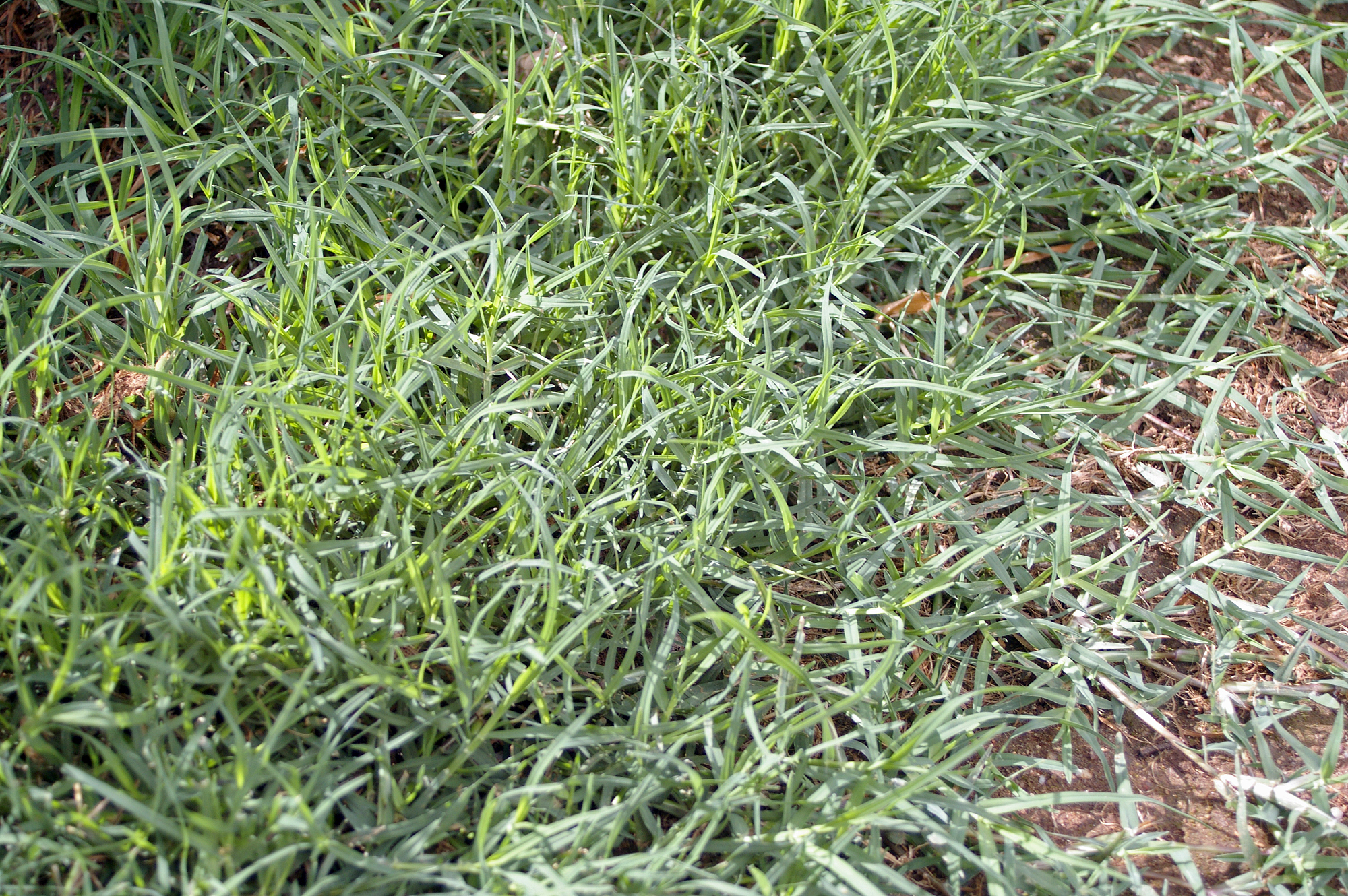
Growing in Kaloko-Honokohau National Historical Park on the Island of Hawaiʻi

The blades are grey-green in color and short, usually 2–15 cm (0.79–5.91 in) long with rough edges.[7] The erect stems can grow 1–30 cm (0.39–11.81 in) tall. The stems are slightly flattened, often white or green, and occasionally tinged purple in colour.

The seed heads are produced in a cluster of two to six spikes together at the top of the stem, each spike 2–5 cm (0.79–1.97 in) long.[7]

Cynodon dactylon has a deep root system. When grown in penetrable soil under drought conditions, its roots can grow to over 2 metres (6.6 ft) deep, though most of the root mass is less than 60 centimetres (24 in) under the surface. The grass creeps along the ground with its stolons and roots wherever a node touches the ground, forming a dense mat. C. dactylon reproduces through seeds, stolons, and rhizomes. The grass starts actively growing at temperatures above 15 °C (59 °F) with ideal growth between 24 and 37 °C (75 and 99 °F); in winter or in the dry season, the grass becomes dormant and turns light brown. Optimal development also occurs in areas of full sun exposure, while dense shade, especially near tree bases, generally suppresses it.[citation needed]

Cultivation

[edit]

Cynodon dactylon is widely cultivated in warm climates all over the world between about 30° S and 30° N latitude, and in regions that receive between 625 and 1,750 mm (24.6 and 68.9 in) of rainfall a year (or less, if irrigation is available). For example, in the United States, it is grown mostly in the southern half of the country.

Cultivated Bermuda grass with "tiger striping", caused by Rayleigh–Bénard convection during the first frosts of the fall. The frost regions turn brown after several days, and the frost-free regions remain green.[8] The spatial scale of the pattern is ~20 cm.

Cultivars

[edit]

Hundreds of cultivars have been created specifically for environmental tolerance and stakeholder requirements. New cultivars are released annually.[9][10]

Uses

[edit]

Religious

[edit]

Commonly known as "durva" or dūrvāyugma in India, this grass is used in the Ayurveda system of medicine.[11] Performing a rite called "the consecration of Rudra (Sanskrit Rudrabhisheka)" described in the Purāṇas while offering durva 11 times bestows long life.[citation needed] In Hinduism, it is considered important in the worship of Lord Ganesha.[12][13] A clump of 21 shoots of this grass is usually offered during puja (worship).[citation needed] It has been a part of Hindu rituals since Vedic times.[citation needed] A unique festival called Durga Ashtami, dedicated to this grass, is celebrated on the eighth day of the Navratri festival.[14]

It is known as "Arugampull" in Tamil, "Garikēhullu" in Kannada, and "Karuka" in Malayalam and is part of the Dashapushpam (ten sacred flowers) in Kerala.[15]

Groom tying a dubo garland on his bride's neck, in a Nepalese Khas Hindu wedding.
Groom tying a dubo garland around the bride's neck in a Nepalese Hindu wedding

In Nepal, the grass is known as "dubo" and is used by the Hindus. According to Nepalese Hindus, the grass symbolizes long life. The grass is an essential item for the Naga Panchami festival as well as the Gaura festival.[16][17][18] In a Nepalese Hindu wedding, a garland made of this grass is worn by both bride and groom.[19]

This grass is a Yoruba herb used for Esu or Elegba in the Ifá system of orishas.[citation needed]

Medicinal value

[edit]

The rhizomes are reported to act as a diuretic in humans, and the grass juice can act as an astringent.[11]

It has been observed that Cynodon dactylon may be selectively eaten by dogs to swiftly induce vomiting when they have gastrointestinal problems. The effect may be due to irritation caused by bristles on the leaf margin.[11]

Other

[edit]
Cynodon dactylon (foreground, the background grass is a separate species) at Peradeniya Royal Botanical Garden

Bermuda grass is fast-growing and tough, making it a popular choice for sports fields because it will recover quickly when damaged. It is a highly desirable turfgrass in warm temperate climates, particularly in hot and dry regions where it will survive while other grass species cannot. The combination of heat and drought tolerance makes Bermuda grass a frequent choice for golf courses in the southern and southeastern United States and South Africa. Bermuda grass is also commonly used for football and baseball fields. It has a relatively coarse-bladed form with numerous cultivars selected for different turf requirements.[citation needed]

Bermuda grass has been cultivated in saline soils in California's Central Valley, which are too salt-damaged to support agricultural crops; it was successfully irrigated with saline water and used to graze cattle.[20][21]

Ecology

[edit]
Cynodon dactylon growing out of a concrete curb

Invasive species

[edit]

Bermuda grass can be a highly aggressive invasive species, crowding out most other grasses and invading other habitats, and has become a hard-to-eradicate weed in some areas (it can be controlled somewhat with triclopyr, mesotrione, fluazifop-p-butyl, and glyphosate).[22][23] This weedy nature leads some gardeners to give it the name of devil grass. Bermuda grass is incredibly difficult to control in flower beds, and most herbicides do not work. However, Ornamec, Ornamec 170, Turflon ester (tricyclopyr), and Imazapyr have shown some effectiveness. All of these items are difficult to find in retail stores, as they are primarily marketed to professional landscapers.[24]

Toxicity

[edit]

The hybrid variety Tifton 85, like some other grasses (e.g. sorghum), produces cyanide under certain conditions,[25] and has been implicated in several livestock deaths.

References

[edit]
[edit]
Revisions and contributorsEdit on WikipediaRead on Wikipedia
from Grokipedia
Cynodon dactylon, commonly known as Bermuda grass, and as couch grass in Australia and New Zealand (whereas in the UK and North America, "couch grass" typically refers to Elymus repens, known as quackgrass), is a low-statured, creeping, warm-season grass in the family, native to , characterized by its prostrate growth habit with stems that root at nodes to form dense mats, spreading rapidly via both stolons above ground and rhizomes below ground. The plant features slightly flattened culms typically 5–45 cm tall, a fibrous root system arising from a crown (basal growing point), grey-green foliage with hairs at leaf sheath junctions, and inflorescences consisting of 2–6 radiating spikes, with reproduction occurring primarily vegetatively but also through seeds. It thrives in full sun, tolerates drought, heat, foot traffic, and a wide range of from 4.3 to 8.4, but turns straw-colored during in cooler periods. Originally from tropical and southern , Cynodon dactylon has become naturalized worldwide in temperate to tropical regions, including , the , the Pacific, and , often found in disturbed habitats such as roadsides, lawns, agricultural fields, and riparian areas up to 2,270 m elevation. Its adaptability to various types and levels, from dry to periodically flooded conditions, contributes to its and success as a . In many areas, including , it is rated as a moderate due to its ability to outcompete native through aggressive vegetative spread. Widely utilized as a turfgrass for lawns, golf courses, and sports fields in warm climates, Cynodon dactylon provides excellent wear resistance and weed suppression when maintained properly, with varieties like 'Sundevil' bred for coarser texture and seeding ease. It also serves as for , , and ground cover, yielding of 4–52 tonnes per , while traditionally used in medicine for treating wounds, , and other ailments, and even as an young or cooling drink. However, its invasiveness requires careful management in natural areas to prevent displacement of .

Taxonomy

Classification

Cynodon dactylon belongs to the kingdom Plantae, phylum Tracheophyta, class , order , family , genus , and species dactylon (L.) Pers. The species was originally described by as Panicum dactylon in in 1753 and subsequently transferred to the genus by Christiaan Hendrik Persoon in Synopsis Plantarum in 1805, establishing its current . Two varieties are recognized within the species: Cynodon dactylon var. dactylon, the nominate variety representing the typical stoloniferous form widespread in tropical and subtropical regions and predominantly tetraploid (2n=36) with some diploid forms, and var. aridus Harlan & de Wet, a diploid (2n=18), more robust, larger-growing variant distinguished primarily by its taller stature and broader leaves. Other varieties sometimes recognized include var. afghanicus, var. coursii, var. elegans, and var. polevansii, each with distinct morphological or geographical characteristics.

Etymology and synonyms

The genus name Cynodon derives from the Greek words kynos (dog) and odous (tooth), alluding to the sharp, tooth-like projections on the stolons or the toothed edges of the leaf sheaths. The specific epithet dactylon comes from the Greek daktylos (finger), referring to the finger-like arrangement of the slender racemes in the . Accepted synonyms for Cynodon dactylon include the basionym Panicum dactylon L., Capriola dactylon (L.) Kuntze, Chloris cynodon Trin., Cynodon aristiglumis Caro & E.A. , Digitaria dactylon (L.) Scop., and Dactylon officinale Vill., among approximately 98 heterotypic synonyms documented in . Common names for Cynodon dactylon vary regionally and include Bermuda grass, couch grass (primarily in Australia and New Zealand, to distinguish from Elymus repens in other regions), devil's grass, wiregrass (in the southern United States), scutch grass, dhoob, and kweek grass in English; durva or doob in ; and pasto bermuda in Spanish.

Description

Morphology

_Cynodon dactylon is a perennial, stoloniferous and rhizomatous grass that forms dense swards or mats, typically reaching 10–40 cm in height with foliage depth, though culms can extend to 60 cm in robust forms. The plant exhibits a fine to robust habit, with prostrate or ascending stems that branch freely near the base, contributing to its mat-forming growth. The vegetative structure includes grey-green to leaf blades that are linear, measuring 3–15 cm long and 2–4 mm wide, often glabrous or sparsely pubescent with minutely scabrous margins and rough hairs on the upper surface and edges. sheaths are glabrous or thinly pilose, bearded at the mouth, with a consisting of a fringe of hairs 0.2–0.6 mm long. Stems are slender culms, 0.5–1 mm in diameter and 5–40 cm tall, erect or geniculately ascending. The plant features a crown (basal growing point) and a fibrous root system, with extensive, slender, scaly rhizomes that penetrate up to 40–50 cm deep in clay soils and 70–80 cm in sandy soils, alongside prostrate stolons about 1 mm wide that root at nodes to facilitate rapid vegetative spread. The is a digitate with 2–7 finger-like spikes in a single whorl, each 1.5–10 cm long and straight or arcuate, bearing overlapping spikelets 2–3 mm long that are often purplish. Each spike typically holds 20–40 spikelets, with glumes 1.1–2 mm long and three anthers per floret.

Growth and reproduction

Cynodon dactylon is a warm-season C4 grass characterized by rapid vegetative growth during periods of high temperature and moisture availability. Optimal growth occurs between 24°C and 37°C (75°F–99°F), with significant activity initiating above 15°C (59°F), while temperatures below 10°C induce , halting above-ground development. In dry conditions, the plant enters a semi-dormant state to conserve resources, resuming growth upon rehydration. This species exhibits aggressive colonization through an extensive network of stolons and rhizomes, enabling it to form dense mats and spread efficiently across disturbed soils. Reproduction in C. dactylon is predominantly asexual, relying on rhizomes and stolons for and persistence, which allows for clonal expansion without dependence on production. Rhizomes can extend up to 95 meters per plant during peak summer growth, while stolons elongate as much as 75 cm within the first six weeks after sprouting. occurs via seeds, but it is highly variable; many biotypes are infertile, producing sparse or non-viable seeds (approximately 4.4 million per kg when fertile), and hybrid cultivars are often sterile, necessitating vegetative . Fertile seed set is more common in common varieties than in improved hybrids like Tifton 85 or Coastal. As a species, C. dactylon maintains through its below-ground structures, though individual stands may require rejuvenation after several years due to thatch accumulation and reduced vigor. Its aligns with warm-season patterns, with active vegetative growth from spring through fall in temperate regions, and flowering typically from May to September, peaking in summer and extending into November in suitable climates. Vegetative spread can reach up to 1 meter per season under optimal conditions, with monthly area increases averaging 0.9 m² and maxima of 2 m² during July and August.

Distribution and habitat

Native range

Cynodon dactylon is native to , with a broader distribution across temperate and subtropical regions of the , including parts of , , , and , though the exact native extent remains debated among botanists. In , it occurs naturally in countries such as , , , , , , , , , , , and . European native distribution includes southern regions like , , , , , , , , , and Türkiye. In , it is indigenous to areas including , , , , , , , , Korea, , , , , , and . Australian native presence is noted in , , , , , Victoria, and . The species' origins are traced to for many varieties, with var. dactylon believed to have arisen in and . Early botanical descriptions, including Carl Linnaeus's 1753 account in citing habitats in , document its pre-human-mediated presence across these regions. Historical distributions indicate long-standing occurrence in African savannas and Mediterranean grasslands, supported by records of associated parasites and ecotypes predating widespread global dispersal. In its native range, Cynodon dactylon thrives in open grasslands, roadsides, and disturbed soils within semi-arid to tropical climates. It prefers areas with frequent disturbances such as grazing, flooding, or fire, forming dense swards in subtropical biomes. The species is adapted to mean annual rainfall of 600–1,800 mm, tolerating drier conditions down to 550 mm through and deeper rooting in sandy soils.

Introduced ranges

Cynodon dactylon was introduced to the by European colonists, with deliberate introductions to occurring in the 16th and 17th centuries by Spanish and settlers seeking suitable grasses. In , the species arrived in the mid-18th century, first documented in 1751 when it was imported to , likely from via contaminated ship hay or deliberate transport. By the early 19th century, it had spread throughout the , becoming established in the Gulf states and other subtropical regions for agricultural purposes. The species is now pantropical and subtropical, occurring widely between approximately 45°N and 45°S across multiple continents. In the , it is prevalent from the (particularly dominant in the southeastern and Gulf Coast states) southward through , , and much of , including , , and . It has also naturalized in the Pacific Islands (such as and ), (including , , and the ), and parts of , where it often forms extensive stands in lawns, pastures, and disturbed areas. Dispersal of Cynodon dactylon outside its native range has occurred through both intentional and unintentional human activities. Intentional introductions were primarily for agricultural and ornamental turf, facilitated by seed trade and planting in colonial and modern agricultural expansions. Unintentional spread happened via contaminated , implements, animal , and global trade routes, allowing establishment in over 100 countries where it has become naturalized.

Ecology

Environmental adaptations

_Cynodon dactylon exhibits remarkable resistance, primarily due to its extensive that can penetrate up to 2 meters deep in penetrable soils under drought conditions, allowing access to subsurface reserves. This enables the plant to survive prolonged dry periods, with rhizomes entering for up to seven months during severe droughts, resuming growth upon moisture return. Additionally, it demonstrates short-term tolerance, enduring inundation for several weeks without significant die-off, though prolonged waterlogging can impair oxygen availability to roots. The species thrives in full sun environments, achieving optimal growth and density under high light intensity, but performance declines sharply in shaded conditions exceeding 50% canopy cover, where tiller production and overall vigor decrease, often leading to or death under medium to dense shade. In terms of soil adaptability, Cynodon dactylon grows across a broad spectrum of textures, from sandy to clayey s, demonstrating versatility in nutrient-poor or compacted substrates. It tolerates a range of 5 to 8, with some ecotypes extending to 8.5, and shows resilience in saline conditions up to 10 dS/m electrical conductivity, achieved through mechanisms like restricted sodium uptake and enhanced ion compartmentalization in tolerant varieties. High traffic tolerance is facilitated by aggressive tillering and /stolon production, which enable rapid recovery from mechanical damage, maintaining cover under heavy wear in areas like pathways or grazed pastures. Nutrient demands are moderate, with the plant responding positively to applications of 50 to 200 kg/ha per year, split into multiple doses to support vigorous growth and maintain quality in or turf settings. Optimal performance requires annual rainfall of 625 to 1,750 mm or equivalent , as lower limits expansion despite drought hardiness, while excess beyond this range is managed through its flood tolerance. These traits collectively underpin its widespread ecological success, including facilitation of invasive spread in suitable habitats.

Invasive potential

_Cynodon dactylon exhibits significant invasive potential in various regions, where it is listed as an in parts of the , including , and in and several Pacific Islands. In , it is rated as moderately invasive by the California Invasive Plant Council due to its ability to outcompete native vegetation. In , it is recognized as a with high climatic suitability, scoring a total of 5 out of possible higher values indicating invasiveness. In the Pacific Islands, such as , it is considered potentially invasive, with a high-risk score of 22 from the Pacific Island Ecosystem at Risk assessment. This grass forms dense mats through its extensive and systems, enabling rapid colonization that outcompetes native plants for resources like light, water, and nutrients. Its aggressive vegetative propagation allows it to dominate disturbed sites, reducing space available for indigenous species. These traits, combined with its environmental adaptations such as and flood tolerance, facilitate its establishment and persistence in non-native habitats. Spread dynamics are driven primarily by vegetative growth, with stolons capable of extending up to 2 meters per month during the , allowing a single to form a dense sward covering up to 25 square meters in 2.5 years. This rapid expansion displaces in grasslands by outcompeting under low-nutrient conditions and in wetlands where it tolerates partial inundation but dominates drier margins. Control strategies for invasive Cynodon dactylon typically involve integrated approaches, starting with herbicides such as , which translocates to roots for systemic kill, often requiring 2–4 applications spaced 2–4 weeks apart to exhaust reserves. Triclopyr is another effective option, particularly for suppressing growth in mixed stands, applied similarly in multiple treatments. Cultural methods include frequent mowing to weaken stolons and solarization, where clear plastic sheeting traps solar heat to kill underground structures over 4–6 weeks in summer. Biological controls remain limited, with no widely established agents like insects or pathogens currently recommended for effective management.

Toxicity and ecological interactions

Cynodon dactylon exhibits low overall toxicity to livestock, but certain hybrids, such as Tifton 85, can produce prussic acid (hydrocyanic acid) under specific conditions like stress or rapid growth following , leading to in grazing animals. In 2012, for instance, 15 in died after consuming Tifton 85 bermudagrass containing elevated levels, highlighting risks to ruminants including and equines. Such incidents are rare for pure C. dactylon strains but underscore the potential for in hybrid cultivars, with symptoms including rapid breathing, muscle tremors, and sudden death due to inhibited oxygen utilization. Additionally, contact with the may cause in sensitive humans, while its pollen is a potent triggering respiratory symptoms like sneezing and itchy eyes in susceptible individuals. Ecologically, C. dactylon serves as a host for various pests, notably fall armyworms (Spodoptera frugiperda), which can defoliate stands and reduce quality in pastures and lawns. This grass also exerts allelopathic effects through root exudates and that inhibit seed and seedling growth of nearby , such as (Ocimum basilicum) and (Portulaca oleracea), contributing to its competitive dominance. While it provides and for beneficial , its proliferation often reduces native diversity by outcompeting indigenous flora in disturbed habitats. In ecosystems, C. dactylon plays a dual role: its extensive rhizomatous enhances stability and prevents in vulnerable areas, such as riparian zones and slopes, by binding particles and reducing runoff velocity. However, in invaded sites, its rapid growth and nutrient uptake alter local nutrient cycles, particularly dynamics, by increasing competition and potentially shifting microbial communities to favor invasive traits over native assemblages. This can lead to long-term changes in productivity and resilience, exacerbating displacement of as noted in invasive contexts.

Cultivation

Propagation methods

Cynodon dactylon, commonly known as bermudagrass, is primarily propagated vegetatively in agricultural and horticultural settings due to the sterility of many hybrid cultivars, which produce few viable seeds. Vegetative methods include sodding, , and plugging. Sodding provides immediate coverage by laying pre-grown turf mats over prepared , with roots typically establishing within 2–3 weeks when kept moist. involves broadcasting or planting stolons and rhizomes at rates of 20–80 bushels per acre for forage production or 200–400 bushels per acre for denser turf stands, followed by light incorporation or pressing into the to ensure contact; this method achieves initial rooting in 2–4 weeks and full coverage in 60–90 days under optimal conditions. Plugging uses small turf sections spaced 12–24 inches apart, covering the area in 3–9 months depending on spacing and . Seeding is suitable for common varieties and selected improved types that produce viable seeds, though germination rates for unhulled seeds can be as low as 20–50%, necessitating the use of pure live seed calculations. Seeds are drilled or broadcast at 5–10 kg/ha (or 2–5 lbs/acre for pasture), planted no deeper than 1/4 inch in a firm seedbed during spring when soil temperatures exceed 65°F (18°C), promoting establishment in warm climates within 5–10 days for germination and 4–8 weeks for initial cover. Effective during enhances density and vigor. Fertilization should follow tests, incorporating and pre-planting and applying at 0.5–1 lb/1000 sq ft (25–50 kg/ha) in split applications starting 30–60 days post-planting, often using N-P-K ratios like 16-4-8 for balanced growth. is critical, with light, frequent applications (1/4–1/2 inch daily) for the first 7–14 days to maintain without saturation, transitioning to 1/2–3/4 inch weekly once rooted. Mowing begins 14–21 days after planting at 1–2 inches (2.5–5 cm) height for turf or higher for , performed frequently to remove no more than one-third of the blade length and encourage lateral spread.

Cultivars and varieties

Cynodon dactylon has seen extensive breeding efforts since the , resulting in over 100 cultivars developed primarily for enhanced performance in turf and forage applications. These breeding programs, led by institutions such as the and the USDA , have focused on traits like disease resistance—including to pathogens such as Pythium spp.—and improved cold tolerance to extend adaptability beyond tropical regions. Many cultivars are sterile hybrids, often resulting from crosses between C. dactylon and C. transvaalensis, which prevents seeding and promotes uniform vegetative propagation. The species is distinguished into varieties such as var. dactylon, which represents the common weedy form with variable morphology and lower uniformity, and improved hybrid cultivars selected for specific superior traits. Breeding has emphasized selection for traffic wear resistance, particularly for sports turf, where cultivars must withstand heavy foot and equipment use without rapid deterioration. Among prominent turf cultivars, Tifway (also known as Tifway 419), released in the , is a sterile hybrid valued for its fine texture, rapid establishment, and , making it a standard for courses and lawns. For forage production, Tifton 85, an released in 1991, offers high yields of 20–30 t/ha annually under optimal management, along with 11% greater digestibility compared to earlier varieties like Coastal. Celebration, a modern turf cultivar released in 2007, stands out for its exceptional —ranking highest among 42 tested bermudagrasses in university trials—while maintaining drought resistance and a dark blue-green color. More recent releases include , developed by and released in , which improves on the original Celebration with enhanced cold tolerance, finer leaf texture, reduced seed heads, and less thatch accumulation for turf applications. For forage, Newell, a public release from the USDA collection in collaboration with the IFAS and released in 2023, is noted for its high herbage accumulation, cold tolerance, and nutritive value, providing a genetically unique option for producers.

Uses

Agricultural and forage

Cynodon dactylon, commonly known as bermudagrass, is valued as a forage crop due to its high palatability for cattle and sheep, making it a preferred option for grazing and hay production in warm-season pastures. It can be effectively utilized through direct grazing or harvested as hay, with dry matter yields typically ranging from 10 to 20 t/ha under optimal management, including nitrogen fertilization and irrigation. The forage generally contains 8 to 12% crude protein on a dry matter basis, supporting moderate nutritional needs for livestock when harvested at appropriate stages. In agricultural systems, bermudagrass contributes to by providing effective on slopes through its dense, fibrous root system, which stabilizes soil and reduces runoff. As a in rotations, it enhances by improving structure, nutrient uptake, and overall fertility, particularly in sandy or compacted soils. The grass exhibits strong tolerance to heavy , allowing up to 80% biomass removal without significant stand loss once established, which supports intensive production. Despite these advantages, bermudagrass has limitations in temperate regions, where its growth slows considerably during winter, ceasing below 15°C and entering , which reduces its availability as a year-round . Effective management requires to prevent excessive thatch accumulation and mat formation, which can otherwise impede regrowth and increase susceptibility to pests. Certain cultivars may achieve higher yields, as detailed in specialized variety assessments.

Ornamental and turf

Cynodon dactylon, commonly known as bermudagrass, is widely utilized in warm climates for establishing low-maintenance lawns due to its vigorous growth, heat tolerance, and ability to withstand foot traffic. It thrives in USDA hardiness zones 7 through 10, where it forms a dense that requires minimal once established, making it suitable for residential and commercial in regions with hot summers. For optimal appearance and health, bermudagrass lawns are typically mowed to a height of 10-25 mm, which promotes lateral spreading via stolons and rhizomes while maintaining a uniform turf surface. In ornamental applications, Cynodon dactylon serves as an effective groundcover in parks, roadsides, and erosion-prone areas, where its prostrate growth habit stabilizes soil and reduces runoff. Hybrid varieties, such as Tifway and TifTuf, enhance these roles by offering superior color retention during periods of environmental stress and denser growth that suppresses weed establishment through competition for light and resources. These hybrids maintain a finer texture and darker green hue compared to common types, improving aesthetic appeal in landscaped settings without the need for frequent replanting. Maintenance of ornamental and turf plantings of Cynodon dactylon involves periodic to alleviate and facilitate root penetration, particularly in high-traffic areas, along with topdressing using to smooth irregularities and dilute thatch accumulation. In Australia, after scarifying and topdressing with sand, it is recommended to wait until the lawn has recovered and grown to about 40-60 mm in height before mowing. Mow to 20-30 mm initially to reduce stress on the recovering turf and encourage spreading. Once the lawn has thickened and filled in (usually 4-6 weeks), resume normal mowing height for couch grass of 10-25 mm during the growing season, never removing more than one-third of the leaf blade at a time. Pest management is essential, as chinch bugs (Blissus spp.) can cause significant damage by feeding on plant sap, leading to yellowing and thinning; scouting and targeted applications are recommended when populations exceed threshold levels. Additionally, bermudagrass demonstrates resilience to , entering during prolonged dry spells and recovering green color rapidly—often within 7–10 days—upon resumption of adequate .

Medicinal and cultural

In traditional Ayurvedic medicine, rhizome extracts of Cynodon dactylon are employed as a and to address urinary disorders and promote . Leaf juice preparations are commonly used to alleviate urinary tract issues, including infections and kidney stones, owing to their purported and effects. Additionally, observations in ethnobotanical studies note that dogs selectively consume the grass to induce , aiding in the expulsion of indigestible materials such as hairballs from the . Young leaves are occasionally consumed as an or prepared as a cooling in traditional practices. Known as "Durva" in Hindu traditions, Cynodon dactylon holds profound religious significance, particularly in rituals honoring Lord , where clumps of 21 shoots are offered as symbols of purity, resilience, and humility during worship. It is also integral to festivals like and , where the grass represents devotion and is presented in puja offerings to invoke blessings. In Nepalese Hindu weddings, garlands of the grass, called "dubo," are exchanged between bride and groom as emblems of , , and enduring marital bonds. Within Yoruba religious practices, Cynodon dactylon, referred to as "Ewe Gbegi" or yerba fina, serves in divination rituals associated with the Eleggua, facilitating spiritual communication and guidance through herbal baths and offerings. In various African folk traditions, crushed leaves are applied as poultices to wounds and bleeding sites for their hemostatic properties, reflecting broader ethnomedicinal applications across South Asian and African contexts. Across several cultures, the grass symbolizes and abundance due to its rapid growth and regenerative nature, often incorporated into rites celebrating prosperity and renewal.

Sports applications

Turf in professional sports

Cynodon dactylon, commonly known as bermudagrass, is highly suitable for turf in due to its robust performance under intense use in warm climates. Its deep and aggressive lateral growth enable it to withstand heavy foot traffic, making it a preferred choice for fields in regions with hot summers. Hybrid cultivars, such as Tifway 419, are particularly favored for their uniformity and fine texture, which provide consistent playing surfaces. One key advantage is its high wear tolerance, allowing rapid recovery from divots and damage caused by cleats or impacts, with some varieties achieving 50% recovery in approximately 10–20 days under optimal conditions. This recuperative ability supports continued play during peak seasons without significant downtime. Additionally, bermudagrass exhibits strong heat resistance, maintaining green cover and vigor at temperatures exceeding 90°F (32°C), which is essential for summer sports in subtropical areas. It is the predominant warm-season grass for athletic fields in the southern United States and similar climates, often comprising the majority of natural turf installations in professional venues. Despite these strengths, challenges arise in temperate transitions. In winter, bermudagrass enters when soil temperatures drop below 50°F (10°C), typically lasting 4–5 months and resulting in a brown, less playable surface that can compromise footing and . To address this, fields are commonly overseeded with cool-season grasses like perennial ryegrass in early fall, providing green cover and wear resistance during dormancy; however, this requires careful management to facilitate spring transition back to bermudagrass. High-traffic conditions also heighten disease risks, such as dollar spot caused by Clarireedia spp., which manifests as small, straw-colored patches and is exacerbated by stress, low , or excessive moisture on closely mowed turf. , including fungicides and cultural practices, is essential to mitigate outbreaks. Bermudagrass turf meets established standards for , including FIFA's natural turf guidelines for uniform ball rebound (typically 0.60–0.85 m for elite pitches) and secure footing to ensure player safety and performance. It also complies with NCAA specifications for athletic surfaces, such as those outlined in ASTM F-2396 for sand-based zones, promoting consistent traction and reduced risk. Hybrid cultivars are prioritized in these applications for their superior and recovery, aligning with requirements for high-impact events.

Notable implementations

In the (), Cynodon dactylon, commonly known as grass, is widely used in warm-climate stadiums for its durability under heavy foot traffic and ability to recover quickly from wear. For instance, , home of the , features Bermuda grass as its primary playing surface, selected for its heat tolerance in the desert environment. Similarly, TIAA Bank Field, where the play, employs the 'Tifway 419' hybrid of Cynodon dactylon, prized for its dense growth and resilience during the season. Historically, several NFL teams shifted from natural grass like Bermuda to in the and to reduce maintenance and withstand intense usage, though some venues have since reverted to grass for player safety and performance preferences. In (MLB), Cynodon dactylon dominates southern ballparks due to its fine texture and drought resistance, enabling consistent play in hot conditions. , the San Diego Padres' home, uses Latitude 36 Bermudagrass (as of 2025), which replaced earlier varieties to better handle low-water environments and shade from the stadium's . in features Tahoma 31 Bermudagrass on its field, overseeded with perennial ryegrass for cooler months, ensuring year-round usability in Southern California's climate. These implementations highlight the grass's adaptability, with eight MLB venues overall relying on Bermuda cultivars for outfields and infields. Cynodon dactylon has also appeared in Olympic venues, particularly in warm-host cities where its warm-season traits suit outdoor events. During the 1996 Summer Olympics, soccer matches at utilized 'Tifway 419' Bermuda grass sod, installed to cover 110,000 square feet and withstand the international competition's demands. In the 2016 Rio de Janeiro Games, 'Celebration' Bermudagrass covered fields in multiple stadiums, including the Maracanã, chosen for its extreme durability and rapid establishment in tropical conditions. On the global golf stage, in Georgia employs Cynodon dactylon as the base turf for its fairways and tees, leveraging varieties like hybrid Bermuda for their heat tolerance and ability to support precise ball lies during the . Overseeded with cool-season grasses in winter, this setup maintains the course's iconic green appearance while relying on Bermuda's foundational vigor through Georgia's humid summers.

References

Add your contribution
Related Hubs
User Avatar
No comments yet.