Hubbry Logo
Betty WilsonBetty WilsonMain
Open search
Betty Wilson
Community hub
Betty Wilson
logo
8 pages, 0 posts
0 subscribers
Be the first to start a discussion here.
Betty Wilson
Betty Wilson
from Wikipedia

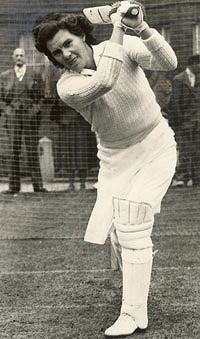
Betty Rebecca Wilson (21 November 1921 – 22 January 2010[1]) was considered one of the greatest woman cricketers of all time.[2][3] She represented Australia in Women's Test cricket between 1947–48 and 1957–58. Wilson batted right-handed, was a good off spin bowler and a superb fielder.

Key Information

Early life

[edit]

Born in Melbourne, Wilson grew up in the inner neighbourhood of Collingwood and learned the game by playing against a lamp post in her street. At the age of 10, she joined the Collingwood Women's Cricket Club where she played with the adults. She made it to the Victoria second XI at the age of 14, and to the senior side at 16.

Cricket career

[edit]

The Second World War delayed her Test appearances till 1948. On her debut against New Zealand, she scored 90 and took 4/37 and 6/28. In her second Test in 1949, she scored 111 against England becoming the first Australian woman to score a Test century against England, and took nine more wickets. This made her the first woman cricketer to score a century and to take a five wicket haul in an innings of a Women's Test match.[4]

She toured England in 1951 and scored 81 in the first Test at Scarborough. Against Yorkshire, she scored 100* in 77 minutes, leading Australia to a last ball win. After this series, she stayed in England for two and a half years.

In the St. Kilda Test against England in 1957–58, she became the first cricketer, male or female, to score a 100 and to take 10 wickets in a Test.[5] On a wet wicket, she took 7/7 in the first innings which included the first ever hat-trick in a women's Test.[6] The feat was not repeated until Shaiza Khan of Pakistan did the same in 2004. Wilson top scored with 12 in Australia's low first innings and a 100 in the second. Taking 4/9 in 19 overs in the second, she set another record for the best bowling of 11/16 in a match, which also stood as a record till 2004, Pakistan's Shazia Khan took 13/226 against the West Indies in Karachi.[7][8][9]

Wilson played 11 Tests in her career, scoring 862 runs at 57.46 and taking 68 wickets at 11.80.

Test match centuries

[edit]
Betty Wilson's Test centuries[10]
No. Runs Opponents City/Country Venue Year
1 111  England Adelaide, Australia Adelaide Oval 1949[11]
2 100  England Melbourne, Australia Junction Oval 1958[12]
3 127  England Adelaide, Australia Adelaide Oval 1958[13]

Honours

[edit]

In 1985, Wilson became the first woman cricketer to be inducted into the Australian Sporting Hall of Fame. In 1985–86, the Under-21 National Women's Cricket Championship was renamed the Betty Wilson Shield. In 1996–97, the age group was changed to Under-19.

In 2015, Wilson was inducted into the ICC Cricket Hall of Fame.[14]

In 2017, Wilson was inducted into the Australian Cricket Hall of Fame.[15] The Betty Wilson Young Player of the Year award was inaugurated at the 2017 Allan Border Medal Ceremony, to recognise a female cricketer who, prior to 5 December 2015, was aged under 25 and had played 10 or fewer matches.[16]

References

[edit]
[edit]
Revisions and contributorsEdit on WikipediaRead on Wikipedia
from Grokipedia
Betty Wilson (21 November 1921 – 22 January 2010) was an Australian cricketer renowned as one of the greatest female players in the sport's history, celebrated for her all-round prowess as a right-handed batter, off-spin bowler, and exceptional close fielder. Representing in women's Test cricket from 1948 to 1958, Wilson played in 11 matches, amassing 862 runs at an average of 57.46 and capturing 68 wickets at an average of 11.80, figures that underscored her dominance in an era when women's cricket was gaining prominence post-World War II. Her most iconic performance came during the 1957–58 series against , where she became the first cricketer—male or female—to score a century (100 ) and take 10 wickets (7/7 and 4/9, including a ) in the same Test match, a feat achieved at the St Kilda Cricket Ground in . Born in , Victoria, Wilson honed her skills in unconventional ways, such as practicing fielding by throwing stones at lampposts and batting against a ball in a stocking tied to a washing line, before making her international debut at age 26. Wilson's contributions extended beyond the field; she was instrumental in popularizing in , becoming a household name and earning comparisons to the legendary for her batting brilliance. In recognition of her achievements, she was inducted into the Australian Cricket Hall of Fame in 2017 and the in 2015, and she remained a fixture at events until her death at age 88. Her legacy endures as a pioneer who elevated the visibility and skill level of women's during its formative years.

Early life

Family and childhood

Elizabeth Rebecca Wilson was born on 21 November 1921 in , Victoria, as the second of four children to George Robert Wilson and his wife . Her father worked as a bootmaker, a trade that reflected the modest circumstances of their family in Melbourne's working-class Collingwood area, where they resided during the 1920s and 1930s. George crafted lightweight boots for his daughter, supporting her emerging interests while the family navigated the economic hardships of the . Wilson displayed early athletic talents beyond organized sports, including exceptional running speed—described as being able to "run like a "—and strong hand-eye coordination honed through informal street play in neighborhoods like Abbotsford and Clifton Hill. These abilities developed amid the resourceful activities typical of Depression-era childhoods in industrial , where limited resources encouraged and among working-class youth. By age 10, her natural skills led to an introduction to local clubs.

Entry into cricket

Betty Wilson's introduction to cricket began in the streets of Collingwood, , where, as a child around the age of 8 to 10 in the late and early , she engaged in informal play using everyday objects. She practiced by hitting a ball enclosed in one of her mother's tied to a clothesline or lamp post, which served as an improvised and allowed the ball to rebound unpredictably, honing her hand-eye coordination and straight batting technique. These street games with neighborhood children, using makeshift bats and balls against lamp posts as targets, fostered her early athleticism and passion for the sport. In 1931, at the age of 10, Wilson joined the Collingwood Club, becoming a regular player within months after a serendipitous encounter during one of their matches. Accompanied by her father, a bootmaker who supported her by crafting lightweight boots, she watched a practice session when an errant ball rolled to her feet; she picked it up and threw it back to the wicketkeeper, impressing the team and leading to an invitation to join immediately. This marked her transition from casual play to structured involvement in the local scene. Wilson's first competitive experiences came in club matches for Collingwood, where she quickly demonstrated all-round skills in batting and fielding, often contributing with agile catches and reliable strokes. Her rapid adaptation to team play showcased the foundational abilities developed through her informal practices, allowing her to compete effectively against adult players despite her youth. The local scene in Victoria during was burgeoning but faced significant barriers, including societal views that was a masculine domain unsuitable for women, which limited resources, facilities, and public support for female players. Despite these challenges, clubs like Collingwood provided vital opportunities for emerging talents like Wilson amid the sport's gradual organization through interstate competitions starting in 1930–31.

Domestic cricket career

Club performances

Betty Wilson joined the Collingwood Women's Cricket Club at the age of 10 in 1931, marking the start of her involvement in organized after she impressed club members by fielding a stray ball during a training session and returning it accurately to the wicketkeeper from the boundary. Her natural athleticism, speed, and hand-eye coordination allowed her to compete with adult players from the outset, earning her recognition as the most improved player in her debut season. She played with Collingwood for three years before moving at age 13 to the Clarendon Club in Middle Park, where she continued to develop as a right-handed batter, off-spin bowler, and exceptional fielder renowned for sharp close-in catches that often turned the course of matches. Her consistent performances at club level, including with Clarendon, helped elevate local teams' standings in competitions and demonstrated her leadership in guiding younger teammates. Wilson's early club experiences played a pivotal role in the development of in Victoria, transitioning from rudimentary street games and informal practices to more formalized club structures during the interwar and periods. As a trailblazer, she advocated for improved facilities and greater opportunities for women in the sport, contributing to the broader growth of club-level play that supported emerging talents.

State debut and achievements

Wilson made her debut for the Victorian women's cricket team in 1938, at the age of 16, against at Unley Oval, where she emerged as a promising capable of both aggressive batting and effective off-spin bowling. Her entry into state cricket followed strong performances in , including with the Clarendon Women's Cricket Club. Over her domestic first-class career spanning 1937/38 to 1957/58, Wilson played 50 matches for Victoria, accumulating 2,271 runs at an average of 44.52 while taking 202 wickets at an average of 9.83, with best figures of 7/7. She recorded 14 five-wicket hauls in an innings and five instances of ten wickets in a match, underscoring her dominance as a bowler in interstate fixtures. These performances were instrumental in Victoria's sustained success, including an unbroken streak of national championships from 1938/39 to 1949/50 (with no contests held from 1940/41 to 1945/46 due to ). The 1940s brought significant challenges to her representative career, as curtailed interstate tours and limited opportunities for due to travel restrictions and resource shortages. Post-war, Wilson played a central role in the revival of Victorian , contributing to the team's victory in the 1946/47 and helping reestablish the state's preeminence in Australian domestic competition.

International Test career

Debut and initial series

Betty Wilson's entry into Test cricket came during Australia's tour of New Zealand in early 1948, marking the resumption of international women's cricket after World War II disruptions. At age 26, she made her debut on 20 March at the Basin Reserve in Wellington, scoring 90 runs in the first innings while batting at number five. With her right-arm off-spin, she took 4 wickets for 37 runs in New Zealand's first innings and 6 for 28 in the second, securing match figures of 10 for 65 and contributing to Australia's 10-wicket victory. This all-round display highlighted her potential, though her selection had required postponing her wedding, as married women were ineligible for the national team at the time. The 1948–49 Ashes series against England, played at home, represented Wilson's first exposure to the rivalry and tested her adaptation to higher-stakes competition. In the opening Test at from 15 to 18 January 1949, she scored 111 in Australia's first innings—the first Test century by an Australian woman against England—and claimed 6 for 23 to dismantle England's reply of 72, leading to a 186-run win. Her form continued in the second Test at the from 28 to 31 January, where she achieved her maiden of 5 for 31 in the first innings. The series ended in a draw in the third Test at , with Wilson scoring 28. Across the three matches, she totaled 140 runs and 10 wickets, building key partnerships amid early pressures to perform on reclaimed pitches. Her domestic grounding with Victoria had prepared her for these challenges, emphasizing consistent all-round contributions. Wilson's development accelerated with the 1951 tour of under captain Mollie , where she faced varied conditions and fiercer opposition. In the first Test at Scarborough from 2 to 5 June, she scored 81, aiding Australia's innings total and series lead. Overcoming initial inconsistencies in batting on seaming pitches, she formed vital stands with and others to stabilize the middle order. Over the three Tests, Wilson accumulated 90 runs at an average of 30.00 and captured 15 wickets at 15.00, including economical spells that restricted 's scoring. These efforts, blending resilience with skill, cemented her role in Australia's 1–0 series win and underscored her evolution into a reliable international by the early 1950s.

Record-breaking performances

Betty Wilson's most iconic performance came in the second Test against at in February 1958, where she became the first cricketer in history—male or female—to score a century and take 10 wickets in a single . Batting at number 7, she scored 100 in Australia's second innings declaration of 202/9, helping set up a tense run chase that rain ultimately denied. With the ball, she claimed 7/7 in 's first innings collapse to 35 all out—the lowest innings total in women's history—and followed with 4/9 in the second innings for match figures of 11/16, including a that marked the first by a woman in . This extraordinary all-round display not only secured a draw but also established Wilson as a benchmark for excellence in . Earlier in her career, Wilson had already etched her name in history with her maiden Test century of 111 against at in January 1949, a knock that showcased her aggressive batting and contributed to Australia's dominance in the series opener. This was the first century by an Australian woman in Tests against , coming in just her second appearance and underscoring her rapid rise as an all-round force. She followed this with a second century of 100 against in the 1958 Test, and a third of 127 in the subsequent Test at in March 1958. Over her international career, Wilson amassed 862 runs at an average of 57.46, including those three centuries, while capturing 68 wickets at 11.80—an unparalleled all-round record that highlighted her versatility and impact from the mid-1940s through the late . Her 1958 feat, in particular, remained unmatched for over two decades until replicated the century-and-10-wickets combination in 1980, cementing Wilson's legacy as a pioneer whose performances transcended gender barriers in the sport.

Playing style and records

Batting approach

Betty Wilson was a right-handed batter renowned for her solid defensive technique, which enabled her to build substantial even on challenging pitches. Her batting average of 57.46 across 11 matches stood out markedly against many contemporaries, whose averages typically ranged from the low 20s to mid-30s, such as England's Molly Hide at 36.33. This prowess was particularly evident in her ability to anchor the Australian under pressure, as demonstrated in her century of 100 during the 1958 Ashes Test at St Kilda on a rain-affected, turning pitch, where she patiently occupied the crease to guide her team to victory. Wilson's style emphasized fluent strokeplay with a preference for off-side shots, honed through informal street in her neighborhood during childhood, which developed her natural timing and balance for hard-hit boundaries along the ground. She placed a premium on concentration, often using unconventional aids like a starched to block distractions, allowing her to maintain focus over long periods at the crease. Her sharp running between the wickets further complemented this approach, enabling efficient accumulation of runs and pressuring fielding sides, traits that contributed to her reputation as one of the era's most reliable batters. Over her career, Wilson's batting evolved from the more aggressive instincts displayed in to a measured anchoring role in s, reflecting her obsessive preparation and practice of weaker shots to address vulnerabilities. This maturation was underscored by her three centuries—including scores of 111 in 1948–49, 100 and 127 in 1957–58—highlighting her growth into a pillar of the Australian lineup. Her overall hovered around 50, indicative of a deliberate pace suited to the longer format, while her nickname "the Female Bradman," a nod to the legendary , captured the admiration for her dominance in during the post-war years.

Bowling technique

Betty Wilson was a right-arm off-spin bowler renowned for her sharp turn, flight, drift, and dip, which allowed her to deceive batters without relying on pace. Her style emphasized control and accuracy, honed through self-taught methods developed during her club days, where she practiced against a lamp post using a ball tied in her mother's stocking. This backyard innovation contributed to her exceptional precision, enabling her to target specific lengths and variations effectively in matches. In Tests, Wilson claimed 68 wickets at an average of 11.80, with her best figures of 7/7 achieved against in 1958 at , where she bowled on a wet to dismantle the batting lineup. She incorporated key variations such as the top-spinner to generate extra bounce and the for a straighter trajectory, making her particularly effective against left-handers by exploiting their alignment to the off-side. Her tactical acumen shone in long spells, often exceeding 30 overs, as demonstrated in her 19-over second-innings effort in the 1958 , where she took 4/9. Wilson's in that 1958 match—the first in —came in the first innings, dismissing Edna Barker (), Joan Hawes (), and Dorothy Macfarlane (lbw) in three consecutive deliveries, showcasing her ability to vary dismissal methods through flight and turn. Domestically, she amassed 202 first-class wickets at an average of 9.83, including hauls like 6/22 for Victoria, underscoring her dominance from club to international level. Her bowling complemented her all-round contributions, providing balance to Australia's attack.

Later life

Teaching and coaching roles

After retiring from in , Betty Wilson dedicated much of her time to mentoring and informally coaching the next generation of women's ers in . She became a familiar presence at matches, particularly at the , where she observed games and provided direct advice to players on techniques, fielding, and strategy. Her insights, drawn from her own all-round prowess, were often delivered with characteristic directness, helping to refine skills among emerging talents. Wilson's coaching influence extended to state-level programs, where she supported Victorian teams during training sessions. For instance, while served as coach for Victoria in the and , Wilson would intervene during warm-ups to critique aspects like catching drills, urging improvements with comments such as "they can’t catch" or suggesting specific adjustments to footwork and positioning. Former Australian captain recalled Wilson's habit of "holding court" from the stands, offering unsolicited but valuable "technique sprays" to players regardless of their experience level. Through these efforts, Wilson emphasized all-round development, promoting balanced skills in batting, bowling, and fielding—principles central to her own career. Her hands-on guidance contributed to the growth of at junior and state levels, fostering players who went on to represent in the 1960s and beyond. This legacy is honored by the Betty Wilson Shield, a trophy for the national Under-21 (later Under-19) championship, which recognizes her pivotal role in nurturing young talent.

Death and personal reflections

After retiring from all forms of cricket at the end of the 1957–58 season at the age of 36, Wilson settled into a quieter life in , where she had lived since childhood in the Clifton Hill area. She remained unmarried throughout her life, having turned down two marriage proposals to prioritize her cricketing career, a choice she later reflected on without regret. In interviews, she famously remarked, "Why would anyone get married in preference to playing for ?" encapsulating her unwavering dedication to the sport over personal milestones. Wilson stayed close to her family, the second of four siblings in a supportive household headed by her bootmaker father and homemaker mother, who had encouraged her athletic pursuits from a young age. She passed away on 22 January 2010 in at the age of 88 from natural causes.

Legacy and honours

Awards and inductions

Betty Wilson was inducted into the Sport Australia Hall of Fame on 10 December 1985, becoming the first female cricketer to receive this honor and recognizing her pioneering contributions to . In 2005, Wilson was awarded an honorary baggy green cap numbered 25 by . In 2015, she was inducted into the , acknowledging her exceptional all-round records, including being the first player to score a century and take ten wickets in the same match. Wilson's induction into the Australian Cricket Hall of Fame occurred in 2017, where she was honored alongside former openers and during a presented by .

Impact on women's cricket

Betty Wilson's trailblazing performances in the post-World War II era played a pivotal role in popularizing in , where she emerged as a household name during a time when the sport was gaining momentum after the war. Her standout all-round contributions, including becoming the first cricketer to score a century and take 10 wickets in a single Test match in 1958, helped shift public perceptions and inspired the growth of the women's game by demonstrating its competitive depth and appeal. As one of the earliest dominant figures in international from 1948 to 1958, Wilson elevated the visibility of female athletes, encouraging participation and support in a period when opportunities for women in sport were limited. Several awards named in her honor underscore her enduring influence on youth development in Australian . The Betty Wilson , established in 1985–86 for the Under-21 National Women's Championship and later adjusted to Under-19 in 1996–97, recognizes the top Under-19 team annually, fostering the next generation of players. Additionally, the Betty Wilson Young Cricketer of the Year Award, introduced in 2017 as part of the Australian Cricket Awards, honors emerging female talents under 24 with limited professional experience, promoting excellence in domestic and international pathways. In the 2020s, amid the boom in fueled by leagues like the (WBBL), Wilson's legacy has been frequently invoked as a foundational influence on the sport's professionalization and popularity. A 2020 feature on cricket.com.au described her as "ahead of her time," highlighting her pioneering all-round prowess that prefigured the versatile stars of today. Her Hall of Fame inductions, including into the ICC in 2015 and the Australian Cricket Hall of Fame in 2017, serve as markers of this ongoing recognition. Posthumous tributes in the 2020s have addressed historical gaps in coverage through archival and commemorative initiatives, such as features and society profiles that preserve her story for educational purposes. These efforts, including detailed historical entries by organizations like the Collingwood Historical Society, ensure Wilson's contributions remain central to narratives of women's sporting progress in .

References

Add your contribution
Related Hubs
User Avatar
No comments yet.