Hubbry Logo
search
logo
2227535

Blacklight

logo
Community Hub0 Subscribers
Read side by side
from Wikipedia
Blacklight fluorescent tubes. The violet glow of a blacklight is not the UV light itself, but visible light that escapes being filtered out by the filter material in the glass envelope.

A blacklight, also called a UV-A light, Wood's lamp, or ultraviolet light, is a lamp that emits long-wave (UV-A) ultraviolet light and very little visible light.[1][2][3] One type of lamp has a violet filter material, either on the bulb or in a separate glass filter in the lamp housing, which blocks most visible light and allows through UV,[2] so the lamp has a dim violet glow when operating.[4][5] Blacklight lamps which have this filter have a lighting industry designation that includes the letters "BLB".[2][4] This stands for "blacklight blue". A second type of lamp produces ultraviolet but does not have the filter material, so it produces more visible light and has a blue color when operating.[2][3][4] These tubes are made for use in "bug zapper" insect traps, and are identified by the industry designation "BL".[4][5] This stands for "blacklight".

Blacklight sources may be specially designed fluorescent lamps, mercury-vapor lamps, light-emitting diodes (LEDs), lasers, or incandescent lamps. In medicine, forensics, and some other scientific fields, such a light source is referred to as a Wood's lamp, named after Robert Williams Wood, who invented the original Wood's glass UV filters.

Although many other types of lamp emit ultraviolet light with visible light, blacklights are essential when UV-A light without visible light is needed, particularly in observing fluorescence,[3][4] the colored glow that many substances emit when exposed to UV. They are employed for decorative and artistic lighting effects, diagnostic and therapeutic uses in medicine,[2] the detection of substances tagged with fluorescent dyes, rock-hunting, scorpion-hunting,[6] the detection of counterfeit money, the curing of plastic resins, attracting insects[3] and the detection of refrigerant leaks affecting refrigerators and air conditioning systems. Strong sources of long-wave ultraviolet light are used in tanning beds.[3]

Medical hazard

[edit]

UV-A presents a potential hazard when eyes and skin are exposed, especially to high power sources. According to the World Health Organization, UV-A is responsible for the initial tanning of skin and it contributes to skin ageing and wrinkling. UV-A may also contribute to the progression of skin cancers.[7] Additionally, UV-A can have negative effects on eyes in both the short-term and long-term.[8] However, there is little evidence that blacklight products with wavelengths above 350 nanometres and designed for domestic uses and intensities have any adverse health effects.

Types

[edit]

Fluorescent

[edit]
Two blacklight fluorescent tubes, showing use. The top is a F15T8/BLB 18-inch, 15-watt tube, used in a standard plug-in fluorescent fixture. The bottom is an F8T5/BLB 12-inch, 8-watt tube, used in a portable battery-powered blacklight sold as a pet urine detector.

Fluorescent blacklight tubes are typically made in the same fashion as normal fluorescent tubes except that a phosphor that emits UVA light instead of visible white light is used on the inside of the tube. The type most commonly used for blacklights, designated blacklight blue or "BLB" by the industry, has a dark blue filter coating on the tube, which filters out most visible light, so that fluorescence effects can be observed.[9] These tubes have a dim violet glow when operating. They should not be confused with "blacklight" or "BL" tubes, which have no filter coating, and have a brighter blue color.[10][9] These are made for use in "bug zapper" insect traps where the emission of visible light does not interfere with the performance of the product. The phosphor typically used for a near 368 to 371 nanometer emission peak is either europium-doped strontium fluoride (SrB
2
F
8
:Eu2+
) or europium-doped strontium borate (Sr
3
B
2
O
6
:Eu2+
) while the phosphor used to produce a peak around 350 to 353 nanometres is lead-doped barium silicate (BaSi
2
O
5
:Pb+
). "Blacklight blue" lamps peak at 365 nm.[11]

Compact fluorescent blacklight bulb

Manufacturers use different numbering systems for blacklight tubes. Philips' is becoming outdated (as of 2010), while the (German) Osram system is becoming dominant outside North America. The following table lists the tubes generating blue, UVA and UVB, in order of decreasing wavelength of the most intense peak.[a] Approximate phosphor compositions, major manufacturer's type numbers and some uses are given as an overview of the types available. "Peak" position is approximated to the nearest 10 nm. "Width" is the measure between points on the shoulders of the peak that represent 50% intensity.

Various phosphor compositions used in blacklight[a]
Phosphor
Mixture
Peak
(nm)
Width
(nm)
Philips
suffix
Osram
suffix
U.S. Type Typical use
450 50 /71 hyperbilirubinaemia, polymerization
SrP
2
O
7
:Eu
420 30 /03 /72 photochemical polymerization
SrB
4
O
7
:Eu
370 20 /08 /73 ("BLB") [b] forensics, lapidary, night clubs
SrB
4
O
7
:Eu
370 20 /78 ("BY") [c] insect attraction, polymerization, psoriasis, tanning beds
BaSi
2
O
5
:Pb
350 40 /09 /79 "BL" [c] insect attraction, tanning beds
BaSi
2
O
5
:Pb
350 40 /08 "BLB" [b] dermatology, lapidary, forensics, night clubs
SrAl
11
O
18
:Ce
340 30 photochemistry
MgSrAl
10
O
17
:Ce
310 40 medical applications, polymerization
Spectrum of a blacklight fluorescent tube. FWHM spectral bandwidth of the 370 nm peak is about 20 nm. The tiny secondary peak (2) is light from the mercury vapor line at 404 nm leaking through the filter, which gives the lamp its purple glow.

Bug zappers

[edit]
A bug zapper

Another class of UV fluorescent bulb is designed for use in bug zappers. Insects are attracted to the UV light, which they are able to see, and are then electrocuted by the device. These bulbs use the same UV-A emitting phosphor blend as the filtered blacklight, but since they do not need to suppress visible light output, they do not use a purple filter material in the bulb. Plain glass blocks out less of the visible mercury emission spectrum, making them appear light blue-violet to the naked eye. These lamps are referred to by the designation "blacklight" or "BL" in some North American lighting catalogs. These types are not suitable for applications which require the low visible light output of "BLB" tubes[13] lamps.

Incandescent

[edit]
100-watt incandescent blacklight bulb

A blacklight may also be formed by simply using a UV filter coating such as Wood's glass on the envelope of a common incandescent bulb. This was the method that was used to create the very first blacklight sources. Although incandescent bulbs are a cheaper alternative to fluorescent tubes, they are exceptionally inefficient at producing UV light since most of the light emitted by the filament is visible light which must be blocked. Due to its black body spectrum, an incandescent light radiates less than 0.1% of its energy as UV light. Incandescent UV bulbs, due to the necessary absorption of the visible light, become very hot during use. This heat is, in fact, encouraged in such bulbs, since a hotter filament increases the proportion of UVA in the black-body radiation emitted. This high running-temperature reduces the life of the lamp from a typical 1,000 hours to around 100 hours.

Mercury vapor

[edit]
A 160-watt mercury vapor blacklight

High-power mercury vapor blacklight lamps are made in power ratings of 100 to 1,000 watts. These do not use phosphors, but rely on the intensified and slightly broadened 350–375 nm spectral line of mercury from high pressure discharge at between 5 and 10 standard atmospheres (500 and 1,000 kPa), depending upon the specific type. These lamps use envelopes of Wood's glass or similar optical filter coatings to block out all the visible light and also the short wavelength (UVC) lines of mercury at 184.4 and 253.7 nm, which are harmful to the eyes and skin. A few other spectral lines, falling within the pass band of the Wood's glass between 300 and 400 nm, contribute to the output. These lamps are used mainly for theatrical purposes and concert displays. They are more efficient UVA producers per unit of power consumption than fluorescent tubes.

LED

[edit]
UV LED

Ultraviolet light can be generated by some light-emitting diodes, but wavelengths shorter than 380 nm are uncommon, and the emission peaks are broad, so only the very lowest energy UV photons are emitted, within predominant not visible light.

Safety

[edit]

Although blacklights produce light in the UV range, their spectrum is mostly confined to the longwave UVA region, that is, UV radiation nearest in wavelength to visible light, with low frequency and therefore relatively low energy. While low, there is still some power of a conventional blacklight in the UVB range.[14] UVA is the safest of the three spectra of UV light. The relatively low energy of UVA light does not cause sunburn. It can damage collagen fibers, so may accelerate skin aging and cause wrinkles. It can also degrade vitamin A in the skin.

UVA light has been shown to cause DNA damage, but not directly, like UVB and UVC. Due to its longer wavelength, it is absorbed less and reaches deeper into skin layers, where it produces reactive chemical intermediates such as hydroxyl and oxygen radicals, which in turn can damage DNA and result in a risk of melanoma. The weak output of blacklights is not sufficient to cause DNA damage or cellular mutations in the way that direct summer sunlight can, although there are reports that overexposure to the type of UV radiation used for creating artificial suntans on sunbeds can cause DNA damage, photo-aging (damage to the skin from prolonged exposure to sunlight), toughening of the skin, suppression of the immune system, cataract formation and skin cancer.[15][16]

UV-A can have negative effects on eyes in both the short-term and long-term.[8]

Uses

[edit]

Ultraviolet radiation is invisible to the human eye, but illuminating certain materials with UV radiation causes the emission of visible light, causing these substances to glow with various colors. This is called fluorescence, and has many practical uses. Blacklights are required to observe fluorescence, since other types of ultraviolet lamps emit visible light which drowns out the dim fluorescent glow.

Medical applications

[edit]

A Wood's lamp is a diagnostic tool used in dermatology by which ultraviolet light is shone (at a wavelength of approximately 365 nanometers) onto the skin of the patient; a technician then observes any subsequent fluorescence. For example, porphyrins—associated with some skin diseases—will fluoresce pink. Though the technique for producing a source of ultraviolet light was devised by Robert Williams Wood in 1903 using "Wood's glass", it was in 1925 that the technique was used in dermatology by Margarot and Deveze for the detection of fungal infection of hair. It has many uses, both in distinguishing fluorescent conditions from other conditions and in locating the precise boundaries of the condition.

Fungal and bacterial infections

[edit]

It is also helpful in diagnosing:

Ethylene glycol poisoning

[edit]
Fluorescein glowing under ultraviolet light

A Wood's lamp may be used to rapidly assess whether an individual is suffering from ethylene glycol poisoning as a consequence of antifreeze ingestion. Manufacturers of ethylene glycol-containing antifreezes commonly add fluorescein, which causes the patient's urine to fluoresce under Wood's lamp.[20]

Diagnosis

[edit]

Wood's lamp is useful in diagnosing conditions such as tuberous sclerosis[21] and erythrasma (caused by Corynebacterium minutissimum, see above).[22] Additionally, detection of porphyria cutanea tarda can sometimes be made when urine turns pink upon illumination with Wood's lamp.[23] Wood's lamps have also been used to differentiate hypopigmentation from depigmentation such as with vitiligo. A vitiligo patient's skin will appear yellow-green or blue under the Wood's lamp.[citation needed] Its use in detecting melanoma has been reported.[24]

Security and authentication

[edit]

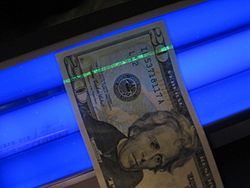
Blacklight is commonly used to authenticate oil paintings, antiques and banknotes. It can also differentiate real currency from counterfeit notes because, in many countries, legal banknotes have fluorescent symbols on them that only show under a blacklight. In addition, the paper used for printing money does not contain any of the brightening agents which cause commercially available papers to fluoresce under blacklight. Both of these features make illegal notes easier to detect and more difficult to successfully counterfeit. The same security features can be applied to identification cards such as passports or driver's licenses.

Other security applications include the use of pens containing a fluorescent ink, generally with a soft tip, that can be used to "invisibly" mark items. If the objects that are so marked are subsequently stolen, a blacklight can be used to search for these security markings. At some amusement parks, nightclubs and at other, day-long (or night-long) events, a fluorescent mark is rubber stamped onto the wrist of a guest who can then exercise the option of leaving and being able to return again without paying another admission fee.

Biology

[edit]

Fluorescent materials are also very widely used in numerous applications in molecular biology, often as "tags" which bind themselves to a substance of interest (for example, DNA), so allowing their visualization.

Thousands of moth and insect collectors all over the world use various types of blacklights to attract moth and insect specimens for photography and collecting. It is one of the preferred light sources for attracting insects and moths at night. They can illuminate animal excreta, such as urine and vomit, that is not always visible to the naked eye.

Fault detection

[edit]

Blacklight is used extensively in non-destructive testing. Fluorescing fluids are applied to metal structures and illuminated, allowing easy detection of cracks and other weaknesses.

If a leak is suspected in a refrigerator or an air conditioning system, a UV tracer dye can be injected into the system along with the compressor lubricant oil and refrigerant mixture. The system is then run in order to circulate the dye across the piping and components and then the system is examined with a blacklight lamp. Any evidence of fluorescent dye then pinpoints the leaking part which needs replacement.

Art and decor

[edit]
Fluorescent body paint. Paints and decorations that fluoresce under blacklight are used in theater and several art forms.
Uranium glass glows under UV light.

Blacklight is used to illuminate pictures painted with fluorescent colors, particularly on black velvet, which intensifies the illusion of self-illumination. The use of such materials, often in the form of tiles viewed in a sensory room under UV light, is common in the United Kingdom for the education of students with profound and multiple learning difficulties.[25] Such fluorescence from certain textile fibers, especially those bearing optical brightener residues, can also be used for recreational effect, as seen, for example, in the opening credits of the James Bond film A View to a Kill. Blacklight puppetry is performed in a blacklight theater.

Mineral identification

[edit]

Blacklights are a common tool for rock-hunting and identification of minerals by their fluorescence. The most common minerals and rocks that glow under UV light are fluorite, calcite, aragonite, opal, apatite, chalcedony, corundum (ruby and sapphire), scheelite, selenite, smithsonite, sphalerite, sodalite. The first person to observe fluorescence in minerals was George Stokes in 1852. He noted the ability of fluorite to produce a blue glow when illuminated with ultraviolet light and called this phenomenon “fluorescence” after the mineral fluorite. Lamps used to visualise seams of fluorite and other fluorescent minerals are commonly used in mines but they tend to be on an industrial scale. The lamps need to be short wavelength to be useful for this purpose and of scientific grade. UVP range of hand held UV lamps are ideal for this purpose and are used by Geologists to identify the best sources of fluorite in mines or potential new mines. Some transparent selenite crystals exhibit an “hourglass” pattern under UV light that is not visible in natural light. These crystals are also phosphorescent. Limestone, marble, and travertine can glow because of calcite presence. Granite, syenite, and granitic pegmatite rocks can also glow.

Curing resins

[edit]

UV light can be used to harden particular glues, resins and inks by causing a photochemical reaction inside those substances. This process of hardening is called ‘curing’. UV curing is adaptable to printing, coating, decorating, stereolithography, and in the assembly of a variety of products and materials. In comparison to other technologies, curing with UV energy may be considered a low-temperature process, a high-speed process, and is a solventless process, as cure occurs via direct polymerization rather than by evaporation. Originally introduced in the 1960s, this technology has streamlined and increased automation in many industries in the manufacturing sector. A primary advantage of curing with ultraviolet light is the speed at which a material can be processed. Speeding up the curing or drying step in a process can reduce flaws and errors by decreasing time that an ink or coating spends wet. This can increase the quality of a finished item, and potentially allow for greater consistency. Another benefit to decreasing manufacturing time is that less space needs to be devoted to storing items which can not be used until the drying step is finished. Because UV energy has unique interactions with many different materials, UV curing allows for the creation of products with characteristics not achievable via other means. This has led to UV curing becoming fundamental in many fields of manufacturing and technology, where changes in strength, hardness, durability, chemical resistance, and many other properties are required.

Cockpit lighting, LSD testing and tanning

[edit]

One of the innovations for night and all-weather flying used by the US, UK, Japan and Germany during World War II was the use of UV interior lighting to illuminate the instrument panel, giving a safer alternative to the radium-painted instrument faces and pointers, and an intensity that could be varied easily and without visible illumination that would give away an aircraft's position. This went so far as to include the printing of charts that were marked in UV-fluorescent inks, and the provision of UV-visible pencils and slide rules such as the E6B.

They may also be used to test for LSD, which fluoresces under blacklight while common substitutes such as 25I-NBOMe do not.[26]

Strong sources of long-wave ultraviolet light are used in tanning beds.[3]

See also

[edit]

Footnotes

[edit]

References

[edit]
[edit]
Revisions and contributorsEdit on WikipediaRead on Wikipedia
from Grokipedia
A blacklight, also known as a UV-A light or Wood's lamp, is a specialized lamp that emits long-wave ultraviolet radiation primarily in the UVA spectrum (315–400 nanometers) while producing minimal visible light, rendering it nearly invisible to the human eye.[1][2] This radiation excites phosphors and fluorescent materials, causing them to absorb the UV energy and re-emit it as visible light in a process known as fluorescence, which produces the characteristic glowing effect.[1] Blacklights operate through two main types: fluorescent tube blacklights, which use a phosphor coating inside the tube to convert shortwave UV from mercury vapor into longer-wave UVA, and incandescent blacklights, which employ filters to block visible light from a standard bulb while allowing UVA to pass.[1] The technology traces its origins to the early 20th century, building on the 1903 invention of Wood's glass by physicist Robert Williams Wood, a nickel-oxide-doped glass that selectively transmits UV while filtering visible light, enabling the creation of practical UV lamps.[3] Commercial blacklights gained popularity in the mid-20th century for entertainment and scientific applications, though earlier UV discoveries date back to Johann Wilhelm Ritter's 1801 identification of invisible rays beyond the violet end of the spectrum.[4] Key applications of blacklights span forensics, where they reveal bodily fluids, fingerprints, and counterfeit documents through fluorescence; medical diagnostics, such as Wood's lamps used to detect skin conditions like fungal infections or vitiligo; and entertainment, including nightclub lighting, glow-in-the-dark posters, and theme park attractions that enhance visual effects with fluorescent paints and markings.[1] Unlike shorter-wavelength UV-B or UV-C lights, which are more energetic and used for disinfection, blacklights in the UVA range are generally safer for human exposure but still require precautions to avoid potential skin and eye damage from prolonged use.[5] Modern LED-based blacklights have largely replaced older fluorescent and incandescent models due to their efficiency, portability, and lower heat output, expanding uses in portable detection tools and consumer products.[6]

Definition and Principles

What is a Blacklight

A blacklight is a specialized lamp designed to emit primarily ultraviolet-A (UV-A) radiation in the wavelength range of 315–400 nm, producing a "black light" effect that causes certain materials to fluoresce while minimizing visible illumination of the surroundings.[7] These lamps are engineered to excite phosphors and fluorescent substances, such as those in paints, inks, or biological samples, by delivering high-energy UV photons that trigger visible glows without brightly lighting the environment.[8] The peak emission of a blacklight typically occurs around 365 nm, optimizing it for fluorescence induction rather than general illumination.[9] The term "black light" derives from the dark filter employed in traditional designs, which blocks most visible light to isolate UV output, creating an appearance of "blackness" from the lamp itself.[3] This nomenclature is a common misconception, as blacklights do not produce truly "black" or entirely invisible light; instead, they emit UV-A that is largely imperceptible to the human eye but can include trace visible purple hues from imperfect filtering.[1] The effect enhances contrast in applications like inspection or entertainment by illuminating only reactive materials against a dim background.[10] At their core, blacklights consist of a bulb—such as a glass tube or envelope—housing the light-generating medium, along with components to produce and refine the UV output. In fluorescent types, a phosphor coating lines the interior, converting the electrical discharge (often from mercury vapor) into the desired UV-A spectrum.[8] A filter, typically a deep blue glass or external coating, suppresses wavelengths in the visible range (400–700 nm) to ensure the emission remains predominantly ultraviolet.[11] These elements work together to deliver targeted UV radiation for fluorescence without significant environmental glow.[12]

Physics of Ultraviolet Light

Ultraviolet (UV) radiation is part of the electromagnetic spectrum, occupying wavelengths shorter than visible light but longer than X-rays, typically spanning 10 to 400 nanometers. It is subdivided into three bands: UV-C (100–280 nm), UV-B (280–315 nm), and UV-A (315–400 nm).[13] Blacklights emit primarily in the UV-A band, peaking around 365 nm, due to its relative safety for human exposure compared to the more energetic UV-B and UV-C, which can cause immediate skin erythema and severe eye damage, while effectively inducing fluorescence in target materials.[14] The core mechanism enabling blacklight effects is fluorescence, a photoluminescent process where molecules absorb UV photons and re-emit light at longer wavelengths. Upon excitation by UV-A photons, electrons in the absorbing molecules transition from ground-state orbitals to higher-energy excited states; non-radiative relaxation then occurs, followed by emission of photons with lower energy (longer wavelength) than the absorbed ones, a phenomenon known as the Stokes shift, typically 20–100 nm in common fluorophores.[15] This shift ensures that the emitted visible light (often in the blue to green range) is distinguishable from the excitation source, preventing overlap and enabling clear detection of fluorescent patterns.[16] In blacklight lamps, phosphors play a crucial role in generating the UV-A output by converting the short-wavelength UV emission from the lamp's mercury vapor discharge—primarily at 253.7 nm—into longer-wavelength UV-A radiation. These phosphors, such as europium-doped strontium fluoroborate or specialized rare-earth compounds, absorb the 253.7 nm photons and fluoresce efficiently in the 350–370 nm range, optimizing the lamp's output for fluorescence induction while minimizing visible light leakage. [Note: Used as placeholder; replace with non-Wiki authoritative source like lamp tech reference] Key considerations for blacklight use involve managing UV-A intensity and exposure to prevent cumulative effects like skin aging or photokeratitis. Irradiance, measured in watts per square meter (W/m²), quantifies the power density of UV-A radiation; typical blacklight sources deliver 1–10 W/m² at close range. The American Conference of Governmental Industrial Hygienists (ACGIH) recommends an exposure limit of 1 mW/cm² (equivalent to 10 W/m²) for UV-A over periods exceeding 1000 seconds, or a total radiant exposure of 1 J/cm² (10,000 J/m²) for shorter durations, to safeguard ocular and dermal health.[17]

History

Invention and Early Development

The discovery of X-rays by Wilhelm Röntgen in 1895 sparked widespread interest in invisible forms of radiation, prompting further exploration of ultraviolet (UV) light, which had been identified decades earlier by Johann Ritter in 1801 as rays beyond the violet spectrum that could darken silver chloride.[18] This early research laid the groundwork for practical UV sources, as scientists sought to harness these wavelengths for scientific and industrial purposes. In the early 1900s, advancements in lamp technology enabled more effective UV generation. Peter Cooper Hewitt patented the mercury-vapor arc lamp in 1903, a device that produced intense UV radiation alongside visible light through the excitation of mercury vapor in a quartz tube.[19] To isolate UV output and minimize visible emission, physicist Robert Williams Wood developed Wood's glass that same year—a specialized barium-sodium silicate filter that transmitted UVA (long-wave ultraviolet) while blocking most visible light.[20] These innovations allowed mercury arc lamps enclosed in Wood's glass to function as rudimentary blacklights, emitting primarily non-visible UV for applications requiring fluorescence without glare. The 1930s marked the invention of the fluorescent blacklight as a more efficient and versatile technology. General Electric (GE) engineers, building on mercury-vapor principles, created fluorescent tubes in which a mercury-vapor discharge generated shortwave UV that excited a phosphor coating to produce predominantly UVA output, rather than visible light.[21] This adaptation stemmed from GE's broader fluorescent lamp research, where early prototypes used filtered mercury vapor to excite phosphors, resulting in lamps optimized for "black light" effects. The first practical fluorescent blacklight tubes emerged around 1935–1937, patented as part of GE's fluorescent innovations, such as those filed by George E. Inman for UV-emitting designs.[22] Commercialization accelerated with GE's introduction of these lamps for entertainment and display purposes. Debuting at expositions in the late 1930s, such as the 1939 New York World's Fair, where GE showcased fluorescent technologies, blacklights illuminated glowing exhibits and signage, captivating audiences with fluorescent effects.[23] Key patents, including those for specialized fluorescent tubes (e.g., U.S. Patent applications from 1936–1937 by GE teams), facilitated mass production, enabling widespread adoption.[21] Prior to World War II, blacklights found initial applications in artistic and novelty contexts. They powered "black light" theaters, where performers in fluorescent costumes created illusory spectacles, as seen in early 1930s stage illusions by innovators like the Switzer brothers.[24] In signage and art, blacklights highlighted fluorescent paints for dynamic advertising displays in stores and public venues, emphasizing their role in visual entertainment over illumination.[4]

Modern Advancements

During World War II, blacklights were employed in military applications, including the detection of invisible inks for secure communications and forensic identification of sabotage.[24] Following World War II, blacklight technology expanded significantly in the 1950s, driven by the postwar boom in fluorescent lighting and its adoption in forensics and medical diagnostics. This period saw the introduction of high-output fluorescent tubes, which provided brighter and more reliable UV-A emission compared to earlier designs, enabling wider practical use in detecting fluorescent materials in investigative and clinical settings.[25][26] The 2000s marked the beginning of the LED revolution in blacklight sources, shifting from traditional fluorescent and mercury vapor lamps to solid-state UV-A LEDs for improved efficiency and durability. By the 2010s, commercialization of high-power UV-A LEDs achieved optical outputs exceeding 100 mW per device, a substantial leap from prior generations and enabling compact, high-intensity blacklights suitable for diverse applications.[27][28] These advancements yielded notable energy efficiency gains, with modern LED blacklights consuming as little as 5 W to match the output of traditional 40 W fluorescent tubes, while eliminating mercury content to reduce environmental hazards associated with lamp disposal.[29] As of 2025, recent innovations include the integration of blacklight systems with IoT for smart, remotely controllable lighting setups and progress in tunable UV spectra, allowing precise wavelength adjustment within the UV-A range for optimized performance.[30]

Types

Fluorescent Blacklights

Fluorescent blacklights, also known as BL (blacklight) or BLB (blacklight blue) lamps, are linear tube lamps that operate on the principle of low-pressure mercury vapor discharge coated with a specialized phosphor to generate ultraviolet A (UV-A) radiation. BLB variants use additional Wood's glass filtering for minimal visible light output, while BL types emit more visible purple light. These lamps consist of a long glass tube, typically 1 to 4 feet in length, filled with a mixture of low-pressure mercury vapor and inert gas such as argon. The interior surface of the tube is coated with a phosphor material designed to convert short-wavelength ultraviolet light into longer-wavelength UV-A.[31] The tube envelope is constructed from Wood's glass, a proprietary deep violet-blue filter material that transmits UV-A (above approximately 320 nm) while blocking most visible light below 400 nm, resulting in the characteristic dark purple glow observed during operation. This construction ensures that the primary output is near-ultraviolet light in the 350–400 nm range, minimizing visible illumination to enhance fluorescence effects in materials. Electrodes at each end of the tube initiate the discharge when powered by a ballast, typically requiring 110–240 V AC.[32][33] In operation, an electrical current passes through the gas mixture, exciting the mercury atoms to produce a plasma discharge that primarily emits ultraviolet C (UVC) radiation at 254 nm. This short-wavelength UV is absorbed by the phosphor coating, which undergoes fluorescence and re-emits energy as UV-A peaking around 365 nm, with a spectral bandwidth of approximately 350–375 nm. The process yields a typical UV-A radiant output of approximately 1.5–2 W per linear foot of tube, depending on the lamp wattage and efficiency, making these lamps suitable for illuminating large areas with effective fluorescence. A brief warm-up period of 1–2 minutes is required for the mercury to fully vaporize and stabilize the discharge intensity.[32][34] These lamps offer advantages including high UV-A intensity relative to power consumption and low manufacturing cost, rendering them economical for widespread use. They are frequently integrated into bug zappers, where the UV-A emission attracts insects toward an electrocution grid without producing excessive visible light. However, limitations include the inherent fragility of the glass tube, which can shatter upon impact, and the presence of elemental mercury (typically 2–5 mg per tube), posing environmental and health risks if broken or improperly disposed. Additionally, the warm-up time and need for a ballast add to operational complexity compared to solid-state alternatives.[35][36][37]

Incandescent and Mercury Vapor Blacklights

Incandescent blacklights utilize a filament-heated bulb, similar to standard household incandescent lamps, where the envelope or an external filter made of Wood's glass transmits ultraviolet-A (UV-A) radiation while blocking most visible light. This configuration produces a dim violet glow from residual visible light, but the primary output is low-intensity UV-A, typically ranging from 1 to 2 watts for a standard 100-watt bulb, due to the blackbody radiation spectrum peaking in the infrared and visible regions rather than UV.[1] In contrast, mercury vapor blacklights employ high-pressure arc lamps with a UV-transmissive envelope, such as quartz, to allow emission of ultraviolet light, often combined with filters that isolate the peak at approximately 365 nm for optimal fluorescence excitation.[38] These lamps generate light through a plasma discharge in vaporized mercury, producing discrete spectral lines including strong UV emissions, making them suitable for high-intensity applications like UV curing in industrial processes.[39] The operational mechanisms differ fundamentally: incandescent types rely on thermal excitation of a tungsten filament to emit a continuous blackbody spectrum filtered for UV-A, whereas mercury vapor lamps use an electric arc to ionize mercury atoms, yielding line spectra with prominent UV peaks but requiring a ballast for starting and stable operation, along with cooling to manage heat from the arc.[40] Incandescent blacklights offer simplicity in design, instant startup without auxiliary components, and freedom from mercury, though their inefficiency limits UV output and shortens lifespan under prolonged use. Mercury vapor variants provide higher power and brighter UV illumination for demanding tasks but necessitate ballasts, potential cooling systems, and careful handling due to mercury content and higher operational temperatures.[41]

LED Blacklights

LED blacklights utilize solid-state light-emitting diodes (LEDs) to produce ultraviolet-A (UV-A) radiation, primarily in the 365–395 nm range, offering a compact and efficient alternative to traditional blacklight sources. These devices have become the dominant form in modern applications due to their reliability and adaptability, marking a significant shift from earlier lamp technologies in recent decades.[42] The construction of LED blacklights relies on gallium nitride (GaN)-based semiconductors, such as aluminum gallium nitride (AlGaN) for shorter wavelengths like 365 nm and indium gallium nitride (InGaN) for longer ones approaching 395 nm, which enable direct emission of UV photons without the need for mercury vapor or optical filters.[43][44][45] For higher power output, multiple LEDs are arranged in arrays, allowing scalable intensity while maintaining a small footprint.[46] In operation, these blacklights employ direct electroluminescence, where electrical current excites electrons in the semiconductor to emit UV light instantaneously upon activation, supporting instant-on functionality and dimmability without warm-up time. Typical wall-plug efficiency ranges from 20% to 50% for UV conversion, converting a substantial portion of input electrical power into usable UV output.[47][46] Common variants include UV-A floodlights for broad-area illumination, flexible LED strips for custom installations, and portable handheld units for mobile use. High-power LED floodlights, such as 50W models (e.g., the "LED Flood Light Luz Negra UV 50W para cura resina 3D"), emit UV-A at 385–405 nm, are often IP66 waterproof, plug-and-play, and are commonly used for post-curing UV-sensitive 3D printing resins to accelerate hardening, as well as for fluorescent decor and party lighting.[48][49][50][44] Wavelength tuning is possible, with 385 nm often preferred for inducing strong fluorescence in materials due to optimal excitation, while 365 nm is selected for applications like surface sterilization where deeper UV penetration enhances germicidal effects. Wavelengths in the 385–405 nm range are also commonly used for post-curing UV-curable photopolymer resins in 3D printing, as they correspond to the absorption spectra of photoinitiators in many resin formulations, accelerating the hardening of printed parts.[51][48] Key advantages of LED blacklights include an extended lifespan exceeding 50,000 hours, minimal heat generation for safer handling, and high portability in battery-powered designs. However, they face drawbacks such as higher upfront costs compared to legacy options and potential leakage of visible blue-violet light, particularly at wavelengths near 395 nm, which can reduce pure UV performance.[52][53][54]

Safety and Hazards

Health Risks

Short exposure to UV light from blacklights, such as shining the light on a hand, causes normal human skin to appear bluish or dull bluish-white due to weak fluorescence from natural skin components. No immediate dramatic visible changes or harm occur with short exposure, though prolonged or intense exposure can damage skin, leading to sunburn, premature aging, or increased skin cancer risk.[55][56] Ultraviolet-A (UV-A) radiation from blacklights penetrates deeper into the skin than ultraviolet-B (UV-B) rays, reaching the dermis and causing indirect DNA damage primarily through the generation of reactive oxygen species (ROS).[56][57][58] This oxidative stress disrupts cellular antioxidants, leading to long-term effects such as premature skin aging, characterized by wrinkles and loss of elasticity, and an elevated risk of skin cancers, including melanoma.[59][60][61] Direct exposure to UV-A light from blacklights can induce photokeratitis, an acute inflammation of the cornea that causes symptoms like pain, tearing, and a gritty sensation, akin to a sunburn of the eye.[62][63] Prolonged or chronic exposure increases the risk of cataract formation by damaging the lens proteins through cumulative oxidative stress.[64][65][66] Acute overexposure to UV-A radiation may result in systemic symptoms including nausea, headaches, and fatigue, particularly in intense or prolonged scenarios. The American Conference of Governmental Industrial Hygienists (ACGIH) recommends a UV-A irradiance limit of 1 mW/cm² for exposure durations greater than 1000 seconds (e.g., an 8-hour period) to prevent such effects.[67] Children and individuals with fair skin are particularly vulnerable to UV-A hazards, as their thinner skin and lower melanin levels offer reduced natural protection against penetration and oxidative damage.[68][69][70] Unlike certain UV-C sources that can generate ozone as a byproduct, UV-A blacklights present no such risk.[71]

Operational Precautions

When operating blacklights, which emit ultraviolet-A (UV-A) radiation primarily around 365 nm, users must implement personal protective equipment (PPE) to safeguard against potential eye and skin exposure. UV-blocking goggles are essential, designed to have transmittance less than 1% at 365 nm to prevent photic damage to the cornea and lens, while allowing sufficient visible light transmission for task visibility.[72] Additionally, clothing that covers exposed skin, such as long-sleeved shirts and pants, should be worn to minimize direct UV-A contact, and operators must avoid staring directly into the light source to reduce the risk of acute discomfort or long-term ocular effects.[62] These measures complement awareness of health risks like erythema and photochemical keratitis by providing physical barriers during use.[73] Practical usage guidelines emphasize controlling exposure duration and proximity to the blacklight source. For high-output lamps, such as those used in non-destructive testing, limit continuous exposure to under 30 minutes without breaks to stay below ACGIH Threshold Limit Values (TLVs) for UV-A, which recommend an irradiance ceiling of 1 mW/cm² for periods greater than 1000 seconds (with a total exposure limit of 1 J/cm² for shorter durations). Maintaining a distance greater than 1 meter from the lamp further reduces irradiance via the inverse square law, potentially extending safe exposure times by a factor of four or more for typical 1000 µW/cm² blacklights.[74] In controlled environments, shielding or enclosures can further mitigate stray radiation, ensuring compliance with occupational safety protocols. For installation, particularly with mercury vapor blacklights, adequate ventilation is critical to disperse any potential mercury vapor release in case of lamp breakage, as elemental mercury can vaporize and pose inhalation hazards.[75] Systems should include exhaust fans or operate in well-ventilated areas to maintain air quality below OSHA permissible exposure limits of 0.1 mg/m³ for mercury vapor.[37] Electrical safety requires proper grounding of fixtures to prevent shocks, using grounded outlets and wiring rated for the lamp's voltage and current, in line with National Electrical Code standards.[76] Adherence to regulatory standards ensures safe deployment of blacklights. The ANSI/IES RP-27 Recommended Practice for Photobiological Safety for Lamps and Lamp Systems classifies UV sources into risk groups and mandates labeling for hazard minimization, applicable to general lighting installations.[77] For medical or diagnostic devices incorporating blacklights, compliance with FDA regulations under 21 CFR Part 1040 limits UV emissions to prevent excessive exposure, requiring performance standards for radiation-emitting products.[78]

Applications

Medical and Diagnostic Uses

Blacklights, particularly Wood's lamps emitting ultraviolet A (UVA) radiation at approximately 365 nm, are employed in medical diagnostics to induce fluorescence in various tissues and substances, aiding in the identification of infections and abnormalities without invasive procedures.[79] In dermatology, under a Wood's lamp, normal human skin appears bluish or dull bluish-white due to weak fluorescence from natural components such as collagen and elastin. For example, when a Wood's lamp is shone on a normal hand, the skin exhibits this subtle bluish appearance with no immediate dramatic visible changes. This baseline contrast facilitates the detection of abnormalities, such as fungal infections like tinea capitis caused by Microsporum species, where infected hairs exhibit bright green fluorescence due to pteridine compounds produced by the fungus.[80][81] Similarly, bacterial infections like those from Pseudomonas aeruginosa produce blue-green fluorescence from pyoverdin and fluorescein pigments, allowing clinicians to visualize affected areas on the skin or nails.[82] These fluorescence patterns help delineate the extent of infection, guiding targeted antifungal or antibiotic therapy.[79] For diagnosing ethylene glycol poisoning, often from antifreeze ingestion, a Wood's lamp can reveal green fluorescence in urine due to added sodium fluorescein in many commercial products, serving as a rapid bedside indicator in emergency settings.[83] This test has a sensitivity of approximately 42% under optimal conditions but is most useful for early detection when combined with clinical suspicion and serum assays.[84] In ophthalmology, blacklights enhance the visualization of corneal abrasions when fluorescein dye is applied; the defect fluoresces bright green-yellow, confirming the diagnosis even for subtle scratches.[85] Although sensitivity varies (around 56% in some studies), it remains a standard, non-invasive tool in emergency eye exams.[86] Therapeutically, narrowband UVA from blacklight sources is integral to psoralen plus UVA (PUVA) therapy for conditions like psoriasis and vitiligo, where oral or topical psoralen sensitizes the skin to UVA, reducing plaques or repigmenting lesions through controlled photochemotherapy sessions.[87] Blacklight fluorescent lamps ensure the appropriate spectral output for safe, effective dosing in clinical phototherapy units.[88] Portable blacklights, including compact Wood's lamps, are included in emergency medical kits for field use, enabling on-site diagnostics for infections, poisonings, and ocular injuries in austere environments.[89] Operational precautions, such as eye protection during use, mitigate UV exposure risks in these settings.[79]

Security and Forensic Applications

Blacklights play a crucial role in security and forensic applications by exploiting ultraviolet-induced fluorescence to reveal hidden features and evidence invisible under normal lighting. In currency and identification verification, UV-reactive inks embedded in banknotes and documents glow distinctly under blacklight exposure, aiding in the detection of counterfeits. For instance, the security thread in U.S. dollar bills fluoresces in specific colors depending on the denomination: the $5 thread glows blue, the $10 thread glows orange, the $20 thread glows green, the $50 thread glows yellow, and the $100 thread glows pink when illuminated by UV light.[90][91] Similarly, passports incorporate UV-fluorescent inks and patterns that become visible under blacklight, revealing complex designs such as national symbols or text that are difficult for forgers to replicate accurately.[92][93] In forensic investigations, blacklights enable the detection of bodily fluids and trace evidence at crime scenes through their natural or enhanced fluorescence. Semen typically fluoresces a bright blue-white under UV light due to its organic composition, allowing investigators to locate stains even on washed or porous surfaces.[94] Blood, which does not fluoresce naturally, can be treated with luminol to produce a blue chemiluminescent glow visible in low light.[95][96] Additionally, trace evidence such as synthetic fibers from clothing or carpets may fluoresce under UV illumination, helping to link suspects to scenes via material matches.[97][98] Counterfeit detection extends blacklight use to pharmaceuticals and luxury goods, where UV markers serve as covert authentication layers. Many genuine medications feature invisible UV-reactive taggants or inks on packaging that fluoresce under blacklight, enabling border agents and inspectors to distinguish fakes lacking these precise signatures.[99][100] Luxury items, such as handbags or watches, often include UV-fluorescent threads or labels that glow in unique patterns, thwarting replication by counterfeiters.[101] Blacklight scanners are routinely deployed at international borders for rapid verification of these features in high-volume checks.[102] As of 2025, modern forensic tools have advanced with portable, handheld LED blacklights that offer high-intensity UV output in compact designs, improving field usability. These devices, often operating at 365 nm wavelengths, integrate with mobile applications for real-time image capture, fluorescence analysis, and evidence logging, allowing investigators to document findings on-site without bulky equipment.[103][104] Such innovations enhance efficiency in security screenings and crime scene processing while maintaining compatibility with established fluorescence principles.

Industrial and Artistic Uses

In industrial applications, blacklights are essential for nondestructive testing methods like fluorescent dye penetrant inspection, which detects surface-breaking defects such as cracks, welds, and porosity in metals. A liquid penetrant containing fluorescent dye is applied to the cleaned surface, where it seeps into flaws; excess is removed, and a developer draws the dye out, making defects visible as glowing indications under ultraviolet blacklight illumination.[105][106] This technique is widely used in aerospace, automotive, and manufacturing sectors for quality assurance, as it reveals flaws that might compromise structural integrity without damaging the material.[107] Blacklights also facilitate leak detection in HVAC and refrigeration systems by employing fluorescent dyes injected into the refrigerant circuit, which accumulate at leak sites and fluoresce brightly under UV light, enabling precise identification even in complex assemblies.[108][109] For maintenance and repair, this method reduces downtime and prevents environmental refrigerant releases, with dyes designed to be compatible with system components for long-term use if needed.[110] In manufacturing processes, UV-A blacklights initiate photopolymerization in UV-curable adhesives and resins, rapidly forming strong bonds or solid structures upon light exposure. For adhesives, the process typically requires 10–60 seconds of UV illumination to achieve full polymerization, depending on intensity, formulation, and thickness, enabling high-speed assembly in electronics and optics.[111][112] Similarly, in 3D printing, post-curing with blacklights, particularly LED flood lights commonly used for this purpose (such as 50W UV LED units emitting typically 385-405 nm), hardens resin prints by completing the polymerization reaction. These lights accelerate the hardening of UV-sensitive resin prints, with exposure times varying from several minutes to longer depending on light intensity, part size, and setup, to enhance mechanical strength and durability.[113][114][115] Blacklights serve as booth lighting in commercial tanning facilities to provide even UV-A exposure across the body, promoting uniform melanin production for tanning without hotspots from uneven illumination.[116] Historically, fluorescence under blacklight was used as a presumptive test for LSD purity in illicit samples during the 1960s and 1970s, where pure LSD exhibited a characteristic blue glow; this method has since become obsolete due to more accurate chromatographic techniques.[117] Artistically, blacklights illuminate fluorescent posters and paints to create vibrant, neon-like visual effects, particularly in entertainment venues like nightclubs and parties, where high-power LED flood lights are often employed to enhance immersive atmospheres with glowing patterns and colors invisible under normal light. These lights are also popular for fluorescent decor and party setups.[118] This technique gained prominence in the 1960s psychedelic art movement, exemplified by posters for events at San Francisco's Fillmore Auditorium, where artists like Wes Wilson and Victor Moscoso designed works with fluorescent inks that "came alive" under blacklight, capturing the era's countercultural energy and influencing decor in music halls and homes.[119][120]

Biological and Environmental Applications

In biological research, blacklights, which emit ultraviolet-A (UV-A) radiation in the 315–400 nm range, play a crucial role in fluorescence microscopy by exciting fluorescent tags such as green fluorescent protein (GFP). GFP, originally isolated from the jellyfish Aequorea victoria, absorbs UV light near 395 nm and emits green fluorescence at approximately 509 nm, enabling scientists to visualize protein localization and dynamics within living cells without invasive techniques.[121] This non-destructive imaging method has revolutionized cell biology, allowing real-time tracking of cellular processes like gene expression and organelle movement.[122] Blacklights also facilitate the study of certain organisms in field settings, notably scorpions, whose exoskeletons fluoresce bright green under UV-A illumination due to beta-carboline alkaloids and other compounds in the hyaline layer of their cuticle. This property, observable in nearly all scorpion species when exposed to wavelengths of 320–400 nm, aids researchers and naturalists in locating and tracking these nocturnal arachnids during night surveys, enhancing ecological studies of their behavior and distribution.[123][124] Geologists employ blacklights for mineral identification in the field, as many rocks and ores exhibit characteristic fluorescence under UV-A light. For instance, fluorite typically glows blue-violet, while scheelite emits a bright white or blue-white hue, allowing rapid differentiation from similar non-fluorescent minerals during prospecting or sample analysis without destructive testing.[125][126] These visual signatures stem from activator ions like europium or tungsten within the mineral lattices, providing a practical tool for resource exploration and geological mapping.[127] In environmental monitoring, blacklights enable the detection of pollutants through induced fluorescence, particularly for oil spills where aromatic hydrocarbons in crude oil or petroleum products emit yellow-green light under UV-A excitation. This technique allows for quick, non-contact assessment of spill extent and hydrocarbon concentrations as low as parts per billion in water or soil, supporting rapid response efforts in marine and coastal ecosystems.[128][129] Portable blacklights serve as essential research tools in field biology for tracking nocturnal animals by attracting insects that form part of their diet. For example, UV-A emissions draw moths and other flying insects, indirectly luring bats for acoustic monitoring studies, while direct fluorescence helps observe insect behaviors and biodiversity in low-light habitats.[130] In vector studies, UV-equipped bug zappers are used to capture mosquitoes, though their efficacy is enhanced when combined with attractants like carbon dioxide, aiding in population surveillance and disease transmission research.[131]

References

User Avatar
No comments yet.