


Community hub
Recent from talks
Contribute something
Nothing was collected or created yet.
Passport
View on Wikipedia

A passport is a formal travel document issued by a government that certifies a person's identity and nationality for international travel.[1] A passport allows its bearer to enter and temporarily reside in a foreign country, access local aid and protection, and obtain consular assistance from their government. In addition to facilitating travel, passports are a key mechanism for border security and regulating migration; they may also serve as identity documents for various domestic purposes.
State-issued travel documents have existed in some form since antiquity; the modern passport was universally adopted and standardized in 1920.[2] The passport takes the form of a booklet bearing the name and emblem of the issuing government and containing the biographical information of the individual, including their full name, photograph, place and date of birth, and signature. A passport does not create any rights in the country being visited nor impose any obligation on the issuing country; rather, it provides certification to foreign government officials of the holder's identity and right to travel, with pages available for inserting entry and exit stamps and travel visas—endorsements that allow the individual to enter and temporarily reside in a country for a period of time and under certain conditions.
Since 1998, many countries have transitioned to biometric passports, which contain an embedded microchip to facilitate authentication and safeguard against counterfeiting.[3] As of July 2024, over 150 jurisdictions issue such "e-passports";[4] previously issued non-biometric passports usually remain valid until expiration.
.jpg)
Eligibility for a passport varies by jurisdiction, although citizenship is a common prerequisite. However, a passport may be issued to individuals who do not have the status or full rights of citizenship, such as American or British nationals. Likewise, certain classes of individuals, such as diplomats and government officials, may be issued special passports that provide certain rights and privileges, such as immunity from arrest or prosecution.[3]
While passports are typically issued by national governments, certain subnational entities are authorised to issue passports to citizens residing within their borders.[a] Additionally, other types of travel documents may serve a similar role to passports but are subject to different eligibility requirements, purposes, or restrictions.
History
[edit]Etymology and origin
[edit]Etymological sources[example needed] show that the term "passport" may derive from a document required by some medieval Italian states in order for an individual to pass through the physical harbor (Italian passa porto, "to pass the harbor") or gate (Italian passa porte, "to pass the gates") of a walled city or jurisdiction.[5][6] Such documents were issued by local authorities to foreign travellers—as opposed to local citizens, as is the modern practice—and generally contained a list of towns and cities the document holder was permitted to enter or pass through. On the whole, documents were not required for travel to seaports, which were considered open trading points, but documents were required to pass harbor controls and travel inland from seaports.[7] The transition from private to state control over movement was an essential aspect of the transition from feudalism to capitalism. Communal obligations to provide poor relief were an important source of the desire for controls on movement.[8]:10
Antecedents
[edit]One of the earliest known references to paperwork that served an analogous role to a passport is found in the Hebrew Bible. Nehemiah 2:7–9, dating from approximately 450 BC, states that Nehemiah, an official serving King Artaxerxes I of Persia, asked permission to travel to Judea; the king granted leave and gave him a letter "to the governors beyond the river" requesting safe passage for him as he traveled through their lands.[9]
The ancient Indian political text Arthashastra (third century BCE) mentions passes issued at the rate of one masha per pass to enter and exit the country, and describes the duties of the Mudrādhyakṣa (lit. 'Superintendent of Seals') who must issue sealed passes before a person could enter or leave the countryside.[10]
Passports were an important part of the Chinese bureaucracy as early as the Western Han (202 BC – 9 AD), if not in the Qin dynasty. They required such details as age, height, and bodily features.[11] These passports (傳; zhuan) determined a person's ability to move throughout imperial counties and through points of control. Even children needed passports, but those of one year or less who were in their mother's care may not have needed them.[11]
In the medieval Islamic Caliphate, a form of passport was the bara'a, a receipt for taxes paid. Only people who paid their zakah (for Muslims) or jizya (for dhimmis) taxes were permitted to travel to different regions of the Caliphate; thus, the bara'a receipt was a "basic passport".[12]
In the 12th century, the Republic of Genoa issued a document called Bulletta, which was issued to the nationals of the Republic who were traveling to the ports of the emporiums and the ports of the Genoese colonies overseas, as well as to foreigners who entered them.
King Henry V of England is credited with having invented what some consider the first British passport in the modern sense, as a means of helping his subjects prove who they were in foreign lands. The earliest reference to these documents is found in a 1414 Act of Parliament.[13][14] In 1540, granting travel documents in England became a role of the Privy Council of England, and it was around this time that the term "passport" was used. In 1794, issuing British passports became the job of the Office of the Secretary of State.[13] In the Holy Roman Empire, the 1548 Imperial Diet of Augsburg required the public to hold imperial documents for travel, at the risk of permanent exile.[15]
In 1791, Louis XVI masqueraded as a valet during his Flight to Varennes as passports for the nobility typically included a number of persons listed by their function but without further description.[8]:31–32
A Pass-Card Treaty of October 18, 1850 among German states standardized information including issuing state, name, status, residence, and description of bearer. Tramping journeymen and jobseekers of all kinds were not to receive pass-cards.[8]:92–93
Before World War I, in most situations only adult males could receive a passport; their family members were written in their passport if they traveled with them. Even if a married woman had her own passport, she could not use it without her husband present.[16]:93–94
Modern development
[edit]A rapid expansion of railway infrastructure and wealth in Europe beginning in the mid-nineteenth century led to large increases in the volume of international travel and a consequent unique dilution of the passport system for approximately thirty years prior to World War I. The speed of trains, as well as the number of passengers that crossed multiple borders, made enforcement of passport laws difficult. The general reaction was the relaxation of passport requirements.[17] In the later part of the nineteenth century and up to World War I, passports were not required, on the whole, for travel within Europe, and crossing a border was a relatively straightforward procedure. Consequently, comparatively few people held passports.
During World War I, European governments introduced border passport requirements for security reasons, and to control the emigration of people with useful skills. These controls remained in place after the war, becoming a standard, though controversial, procedure. British tourists of the 1920s complained, especially about attached photographs and physical descriptions, which they considered led to a "nasty dehumanisation".[18] The British Nationality and Status of Aliens Act was passed in 1914, clearly defining the notions of citizenship and creating a booklet form of the passport. It also made a photographs in a passport mandatory.[16]:93
In 1920, the League of Nations held a conference on passports, the Paris Conference on Passports & Customs Formalities and Through Tickets.[19] Passport guidelines and a general booklet design resulted from the conference,[20] which was followed up by conferences in 1926 and 1927.[21] The League of Nations issued Nansen passports to stateless refugees from 1922 to 1938.[22]
While the United Nations held a travel conference in 1963, no passport guidelines resulted from it. Passport standardization came about in 1980, under the auspices of the ICAO. ICAO standards include those for machine-readable passports.[23] Such passports have an area where some of the information otherwise written in textual form is written as strings of alphanumeric characters, printed in a manner suitable for optical character recognition. This enables border controllers and other law enforcement agents to process these passports more quickly, without having to input the information manually into a computer. ICAO publishes Doc 9303 Machine Readable Travel Documents, the technical standard for machine-readable passports.[24] A more recent standard is for biometric passports. These contain biometrics to authenticate the identity of travellers. The passport's critical information is stored on a small RFID computer chip, much like information stored on smartcards. Like some smartcards, the passport booklet design calls for an embedded contactless chip that is able to hold digital signature data to ensure the integrity of the passport and the biometric data.
Historically, legal authority to issue passports is founded on the exercise of each country's executive discretion. Certain legal tenets follow, namely: first, passports are issued in the name of the state; second, no person has a legal right to be issued a passport; third, each country's government, in exercising its executive discretion, has complete and unfettered discretion to refuse to issue or to revoke a passport; and fourth, that the latter discretion is not subject to judicial review. However, legal scholars including A.J. Arkelian have argued that evolutions in both the constitutional law of democratic countries and the international law applicable to all countries now render those historical tenets both obsolete and unlawful.[25][26]
-
 Arabic papyrus with an exit permit, dated January 24, 722 AD, pointing to the regulation of travel activities. From Hermopolis Magna, Egypt
 -
 First Japanese passport, issued in 1866
 -
 Italian passport, issued in 1872
 -
 Chinese passport from the Qing dynasty, 24th Year of the Guangxu Reign, 1898
 -

-
 World War II Spanish official passport issued in late 1944 and used during the last six months of the war by an official being sent to Berlin


Types
[edit]
Governments around the world issue a variety of passports for different purposes. The most common variety are ordinary passports issued to individual citizens and other nationals. In the past, certain countries issued collective passports[b] or family passports.[c] Today, passports are typically issued to individual travellers rather than groups. Aside from ordinary passports issued to citizens by national governments, there are a variety of other types of passports by governments in specific circumstances.
While individuals are typically only permitted to hold one passport, certain governments permit citizens to hold more than one ordinary passport.[d] Individuals may also simultaneously hold an ordinary passport and an official or diplomatic passport.
Emergency passport
[edit]

Emergency passports (also called temporary passports) are issued to persons with urgent need to travel who do not have passports, e.g. someone abroad whose passport has been lost or stolen who needs to travel home within a few days, someone whose passport expires abroad, or someone who urgently needs to travel abroad who does not have a passport with sufficient validity. These passports are intended for very short durations, e.g. to allow immediate one-way travel back to the home country. Laissez-passer are also used for this purpose.[29] Uniquely, the United Kingdom issues emergency passports to citizens of certain Commonwealth states who lose their passports in non-Commonwealth countries where their home state does not maintain a diplomatic or consular mission.
Diplomatic and official passports
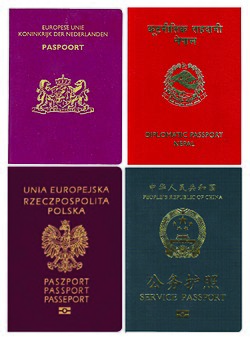
[edit].svg)


.png)
.png)
.png)


Pursuant to the Vienna Convention on Diplomatic Relations, Vienna Convention on Consular Relations, and the immunity afforded to officials of a foreign state under customary international law, diplomats and other individuals travelling on government business are entitled to reduced scrutiny at border checkpoints when travelling overseas. Consequently, such individuals are typically issued special passports indicating their status. These passports come in three distinct varieties:
Diplomatic passports
[edit]- Typically issued to accredited diplomats, senior consular staff, heads of state or government, and to senior foreign ministry employees. Individuals holding diplomatic passports are usually entitled to certain degrees of immunity from border control inspections, depending on their home countries and their countries of entry.
Service/official passports
[edit]- Issued to senior government officials travelling on state business who are not eligible for diplomatic passports. Holders of official passports are typically entitled to similar immunity from border control inspections. In the United States of America, official and service passports are two distinct categories of passport, with official passports being issued to senior government officials while service passports are issued to government contractors.[e]
Public affairs passports
[edit]- Issued to Chinese citizens holding senior positions in state-owned companies. While public affairs passports do not usually entitle their bearers to exemption from searches at border checkpoints, they are subject to more liberal visa policies in several countries primarily in Africa and Asia (see: Visa requirements for Chinese citizens).
Passports without right of abode
[edit]Unlike most countries, the United Kingdom and the Republic of China issue various categories of passports to individuals without the right of abode in their territory. In the United Kingdom's case, these passports are typically issued to individuals connected with a former British colony while, in the ROC's case, these passports are the result of the legal distinction between ROC nationals with and without residence in the area it administers.[f] In both cases, holders of such passports are able to obtain residence on an equal footing with foreigners by applying for indefinite leave to remain (UK) or a resident certificate (ROC).
Republic of China (Taiwan)
[edit]
A Republic of China citizen who does not have household registration (Chinese: 戶籍; pinyin: hùjí) in the area administered by the ROC[f] is classified as a National Without Household Registration (NWOHR; Chinese: 無戶籍國民) and is subject to immigration controls when clearing ROC border controls, does not have automatic residence rights, and cannot vote in Taiwanese elections. However, they are exempt from conscription. Most individuals with this status are children born overseas to ROC citizens who do hold household registration. Additionally, because the ROC observes the principle of jus sanguinis, members of the overseas Chinese community are also regarded as citizens.[33] During the Cold War, both the ROC and PRC governments actively sought the support of overseas Chinese communities in their attempts to secure the position as the legitimate sole government of China. The ROC also encouraged overseas Chinese businessmen to settle in Taiwan to facilitate economic development and regulations concerning evidence of ROC nationality by descent were particularly lax during the period, allowing many overseas Chinese the right to settle in Taiwan.[34] About 60,000 NWOHRs currently hold Taiwanese passports with this status.[35]
United Kingdom
[edit]The United Kingdom issues several similar but distinct passports which correspond to the country's several categories of nationality. Full British citizens are issued a standard British passport. British citizens resident in the Crown Dependencies may hold variants of the British passport which confirm their Isle of Man, Jersey, or Guernsey identity. Many of the other categories of nationality do not grant bearers right of abode in the United Kingdom itself.
British National (Overseas) passports are issued to individuals connected to Hong Kong prior to the territory's transfer from Britain to China. British Overseas Citizen passports are primarily issued to individuals who did not acquire the citizenship of the colony they were connected to when it obtained independence (or their stateless descendants). British Overseas Citizen passports are also issued to certain categories of Malaysian nationals in Penang and Malacca, and individuals connected to Cyprus as a result of the legislation granting independence to those former British colonies. British Protected Person passports are issued to otherwise stateless people connected to a former British protectorate. British subject passports are issued to otherwise stateless individuals connected to British India or to certain categories of Irish citizens (though, in the latter case, they do convey right of abode).
Additionally, individuals connected to a British overseas territory are accorded British Overseas Territories citizenship and may hold passports issued by the governments of their respective territory. All overseas territory citizens are also now eligible for full British citizenship. Each territory maintains its own criteria for determining whom it grants right of abode. Consequently, individuals holding BOTC passports are not necessarily entitled to enter or reside in the territory that issued their passport. Most countries distinguish between BOTC and other classes of British nationality for border control purposes. For instance, only Bermudian passport holders with an endorsement stating that they possess right of abode or belonger status in Bermuda are entitled to enter America without an electronic travel authorisation.[36]
Border control policies in many jurisdictions distinguish between holders of passports with and without right of abode, including NWOHRs and holders of the various British passports that do not confer right of abode upon the bearer. Certain jurisdictions may additionally distinguish between holders of such British passports with and without indefinite leave to remain in the United Kingdom. NWOHRs do not, for instance, have access to the Visa Waiver Program, or to visa free access to the Schengen Area or Japan. Other countries, such as India which allows all Chinese nationals to apply for eVisas, do not make such a distinction. Notably, while Singapore does permit visa free entry to all categories of British passport holders, it reduces length of stay for British nationals without right of abode in the United Kingdom, but does not distinguish between ROC passport holders with and without household registration.
Until 31 January 2021, holders of British National (Overseas) passports were able to use their UK passports for immigration clearance in Hong Kong[37] and to seek consular protection from overseas Chinese diplomatic missions. This was a unique arrangement as it involved a passport issued by one state conferring right of abode (or, more precisely right to land) in and consular protection from another state. Since that date, the Chinese and Hong Kong governments have prohibited the use of BN(O) passports as travel documents or proof of identity and it; much like British Overseas Citizen, British Protected Person, or ROC NWOHR passports; is not associated with right of abode in any territory. BN(O)s who do not possess Chinese (or any other) nationality are required to use a Document of Identity for Visa Purposes for travel.[37] This restriction disproportionally affects ease of travel for permanent residents of Indian, Pakistani, and Nepali ethnicity,[38] who were not granted Chinese nationality in 1997. As an additional consequence, Hongkongers seeking early pre-retirement withdrawals from the Mandatory Provident Fund pension scheme may not use BN(O) passports for identity verification.[39]
Latvia and Estonia
[edit]Similarly, non-citizens in Latvia and in Estonia are individuals, primarily of Russian or Ukrainian ethnicity, who are not citizens of Latvia or Estonia, but who have settled during the Soviet occupation, and thus have the right to a special non-citizen passport issued by the government as well as some other specific rights. Approximately two thirds of them are ethnic Russians, followed by ethnic Belarusians, ethnic Ukrainians, ethnic Poles and ethnic Lithuanians.[40][41] According to the UN Special Rapporteur, the citizenship and naturalization laws in Latvia "are seen by the Russian community as discriminatory practices".[42] Per Russian visa policy, holders of the Estonian alien's passport or the Latvian non-citizen passport are entitled to visa free entry to Russia, in contrast to Estonian and Latvian citizens who must obtain an electronic visa.
Regional and subnational passports
[edit]China
[edit]The People's Republic of China (PRC) authorises its Special Administrative Regions of Hong Kong and Macau to issue passports to their permanent residents with Chinese nationality under the "one country, two systems" arrangement. Visa policies imposed by foreign authorities on Hong Kong and Macau permanent residents holding such passports are different from those holding ordinary passports of the People's Republic of China. A Hong Kong Special Administrative Region passport (HKSAR passport) and Macau Special Administrative Region passport (MSAR passport) gain visa-free access to many more countries than ordinary PRC passports.[43]
On 1 July 2011, the Ministry of Foreign Affairs of the People's Republic of China launched a trial issuance of e-passports for individuals conducting public affairs work overseas on behalf of the Chinese government.[44][45] The face, fingerprints, and other biometric features of the passport holder is digitized and stored in pre-installed contactless smart chip,[46][47] along with "the passport owner's name, sex and personal photo as well as the passport's term of validity and [the] digital certificate of the chip".[48] Ordinary biometric passports were introduced by the Ministry of Public Security on 15 May 2012.[49] As of January 2015, all new passports issued by China are biometric e-passports, and non-biometric passports are no longer issued.[48]
In 2012, over 38 million Chinese citizens held ordinary passports, comprising only 2.86 percent of the total population at the time.[50] In 2014, China issued 16 million passports, ranking first in the world, surpassing the United States (14 million) and India (10 million).[51] The number of ordinary passports in circulation rose to 120 million by October 2016, which was approximately 8.7 percent of the population.[52] As of April 2017 to date, China had issued over 100 million biometric ordinary passports.[53]
Kingdom of Denmark
[edit]The three constituent countries of the Danish Realm have a common nationality. Denmark proper is a member of the European Union, but Greenland and Faroe Islands are not. Danish citizens residing in Greenland or Faroe Islands can choose between holding a Danish EU passport and a Greenlandic or Faroese non-EU Danish passport.
As of 21 September 2022, Danish citizens had visa-free or visa on arrival access to 188 countries and territories, thus ranking the Danish passport fifth in the world (tied with the passports of Austria, the Netherlands, and Sweden) according to the Henley Passport Index.[54] According to the World Tourism Organization 2016 report, the Danish passport is first in the world (tied with Finland, Germany, Italy, Luxembourg, Singapore, and the United Kingdom) in terms of travel freedom, with the mobility index of 160 (out of 215 with no visa weighted by 1, visa on arrival weighted by 0.7, eVisa by 0.5 and traditional visa weighted by 0).[55]
Serbian Coordination Directorate Passports in Kosovo
[edit]Under Serbian law, people born or otherwise legally settled in Kosovo[g] are considered Serbian nationals and as such they are entitled to a Serbian passport.[56] However, these passports are not issued directly by the Serbian Ministry of Internal Affairs but by the Serbian Coordination Directorate for Kosovo and Metohija instead.[57] These particular passports do not allow the holder to enter the Schengen Area without a visa.[58][59]
As of August 2023, Serbian citizens had visa-free or visa on arrival access to 138 countries and territories, ranking the Serbian passport 38th overall in terms of travel freedom according to the Henley Passport Index.[60][61] The Serbian passport is one of the 5 passports with the most improved rating globally since 2006, in terms of the number of countries that its holders may visit without a visa.[62][63][64]
American Samoa
[edit]Although all U.S. citizens are also U.S. nationals, the reverse is not true. As specified in 8 U.S.C. § 1408, a person whose only connection to the United States is through birth in an outlying possession (which is defined in 8 U.S.C. § 1101 as American Samoa and Swains Island, the latter of which is administered as part of American Samoa), or through descent from a person so born, acquires U.S. nationality but not the citizenship. This was formerly the case in a few other current or former U.S. overseas possessions, i.e. the Panama Canal Zone and Trust Territory of the Pacific Islands.[65] The passport issued to non-citizen nationals contains the endorsement code 9 which states: "THE BEARER IS A UNITED STATES NATIONAL AND NOT A UNITED STATES CITIZEN." on the annotations page.[66] Non-citizen nationals may reside and work in the United States without restrictions, and may apply for citizenship under the same rules as resident aliens. Like resident aliens, they are not presently allowed by any U.S. state to vote in federal or state elections.
Passports issued by entities without sovereign territory
[edit]Several entities without a sovereign territory issue documents described as passports, most notably Iroquois League,[67][68] the Aboriginal Provisional Government in Australia and the Sovereign Military Order of Malta.[69] Such documents are not necessarily accepted for entry into a country.
Details and specifications
[edit]
Criteria for issuance
[edit]Each country sets its own conditions for the issue of passports.[71] Under the law of most countries, passports are government property, and may be limited or revoked at any time, usually on specified grounds, and possibly subject to judicial review.[72] In many countries, surrender of one's passport is a condition of granting bail in lieu of imprisonment for a pending criminal trial due to the risk of the person leaving the country.[73] When passport holders apply for a new passport (commonly, due to expiration of the previous passport, insufficient validity for entry to some countries or lack of blank pages), they may be required to surrender the old passport for invalidation. In some circumstances an expired passport is not required to be surrendered or invalidated (for example, if it contains an unexpired visa).
Requirements for passport applicants vary significantly from country to country, with some states imposing stricter measures than others. For example, Pakistan requires applicants to be interviewed before a Pakistani passport will be granted.[74] When applying for a passport or a national ID card, all Pakistanis are required to sign an oath declaring Mirza Ghulam Ahmad to be an impostor prophet and all Ahmadis to be non-Muslims.[75] In contrast, individuals holding British National (Overseas) status are legally entitled to hold a passport in that capacity.
Countries with conscription or national service requirements may impose restrictions on passport applicants who have not yet completed their military obligations. For example, in Finland, male citizens aged 18–30 years must prove that they have completed, or are exempt from, their obligatory military service to be granted an unrestricted passport; otherwise a passport is issued valid only until the end of their 28th year, to ensure that they return to carry out military service.[76] Other countries with obligatory military service, such as South Korea and Syria, have similar requirements, e.g. South Korean passport and Syrian passport.[77]
Validity
[edit]Passports have a limited validity, usually between 5 and 10 years. Many countries require passports to be valid for a minimum of six months beyond the planned date of departure, as well as having at least two to four blank pages.[78] It is recommended that a passport be valid for at least six months from the departure date as many airlines deny boarding to passengers whose passport has a shorter expiry date, even if the destination country does not have such a requirement for incoming visitors.
There is an increasing trend for adult passports to be valid for ten years, such as a United Kingdom passport, United States Passport, New Zealand Passport (after 30 November 2015)[79] or Australian passport.
Some countries issue passports that are valid for longer than 10 years, which the ICAO does not recommend due to their security concerns. Some countries, including all member states of the European Union, do not accept passports older than 10 years.
Cover designs
[edit]
Passport booklets from almost all countries around the world display the national coat of arms of the issuing country on the front cover. The United Nations keeps a record of national coats of arms, but displaying a coat of arms is not an internationally recognised requirement for a passport.
There are several groups of countries that have, by mutual agreement, adopted common designs for their passports:
- The European Union. The design and layout of passports of the member states of the European Union are a result of consensus and recommendation, rather than of directive.[80] Passports are issued by member states and may consist of either the usual passport booklet or the newer passport card format. The covers of ordinary passport booklets are burgundy-red (except for Croatia which has a blue cover), with "European Union" written in the national language or languages. Below that are the name of the country, the national coat of arms, the word or words for "passport", and, at the bottom, the symbol for a biometric passport. The data page can be at the front or at the back of a passport booklet and there are significant design differences throughout to indicate which member state is the issuer. Member states that participate in the Schengen Agreement have agreed that their e-passports should contain fingerprint information in the chip.[81]
- In 2006, the members of the CA-4 Treaty (Guatemala, El Salvador, Honduras, and Nicaragua) adopted a common-design passport, called the Central American passport, following a design already in use by Nicaragua and El Salvador since the mid-1990s. It features a navy-blue cover with the words "América Central" and a map of Central America, and with the territory of the issuing country highlighted in gold (in place of the individual nations' coats of arms). At the bottom of the cover are the name of the issuing country and the passport type.
- The members of the Andean Community of Nations (Bolivia, Colombia, Ecuador, and Peru) began to issue commonly designed passports in 2005. Specifications for the common passport format were outlined in an Andean Council of Foreign Ministers meeting in 2002.[82] Previously issued national passports will be valid until their expiry dates. Andean passports are bordeaux (burgundy-red), with words in gold. Centred above the national seal of the issuing country is the name of the regional body in Spanish (Comunidad Andina). Below the seal is the official name of the member country. At the bottom of the cover is the Spanish word "pasaporte" along with the English "passport". Venezuela had issued Andean passports, but has subsequently left the Andean Community, so they will no longer issue Andean passports.
- The Union of South American Nations had signaled an intention to establish a common passport design, but it is doubtful that this will happen since the group effectively broke up in 2019.
- Twelve member states of the Caribbean Community (CARICOM) began issuing passports with a common design since early 2009.[83][84] It features the CARICOM symbol along with the national coat of arms and name of the member state, rendered in a CARICOM official language (English, French, Dutch). The member states which use the common design are Antigua and Barbuda, Barbados, Belize, Dominica, Grenada, Guyana, Jamaica, Saint Kitts and Nevis, Saint Lucia, Saint Vincent and the Grenadines, Suriname, and Trinidad and Tobago. There was a movement by the Organisation of Eastern Caribbean States (OECS) to issue a common designed passport, but the implementation of the CARICOM passport made that redundant, and it was abandoned.[85]
Request page
[edit]
Passports sometimes contain a message, usually near the front, requesting that the passport's bearer be allowed to pass freely, and further requesting that, in the event of need, the bearer be granted assistance. The message is sometimes made in the name of the government or the head of state, and may be written in more than one language, depending on the language policies of the issuing authority.
Languages
[edit]In 1920, an international conference on passports and through tickets held by the League of Nations recommended that passports be issued in the French language, historically the language of diplomacy, and one other language.[86] Currently, the ICAO recommends that passports be issued in English, French, and Spanish; or in the national language of the issuing country and in either English, French, or Spanish.[87] Many European countries use their national language, along with English and French.
Some additional language combinations are:
- National passports of the European Union bear all of the official languages of the European Union. Two or three languages are printed at the relevant points, followed by reference numbers which point to the passport page where translations into the remaining languages appear.[citation needed]
- Algerian, Chadian, Lebanese, Mauritanian, Moroccan and Tunisian passports are in three languages: Arabic, English, and French.
- The Barbadian passport and the United States passport are tri-lingual: English, French and Spanish. United States passports were English and French since 1976, but began being printed with a Spanish message and labels during the late 1990s, in recognition of Puerto Rico's Spanish-speaking status. Since 2007, the Data Page, which contains photo, identifying information, and the passport's issuance and expiration dates, and the Personal Data and Emergency Contact page are written in English, French, and Spanish;[88] the cover and instructions pages are printed solely in English.
- On Belgian passports, all three official languages (Dutch, French, German) appear on the cover, in addition to English on the main page. The order of the official languages depends on the official residence of the holder.
- Passports of Bosnia and Herzegovina are in the three official languages of Bosnian, Serbian and Croatian in addition to English.
- Brazilian passports contain four languages: Portuguese, the official country language; Spanish, because of bordering nations; English and French.
- British passports bear English and French on the information page and Spanish, Welsh, Irish and Scottish Gaelic translations on an extra page.
- Cypriot passports are in Greek, Turkish and English.
- Haitian passports are in French and Haitian Creole.
- Passports issued by the Holy See are in Latin (the language of the Catholic Church), French, and English.[88]
- The first page of the old Libyan passport (green cover) was in Arabic only. The current passport has dark-blue cover, is electronically readable, and has Arabic with English translation in the first page (first page from a right-to-left script viewpoint). Similar arrangements are found in the passports of some other Arab countries.
- Iraqi passports are in Arabic, Kurdish and English.
- Macau SAR passports are in three languages: Chinese (in traditional Chinese characters), Portuguese and English.
- New Zealand passports are in English and te reo Māori.
- Norwegian passports are in the two forms of the Norwegian language, Bokmål and Nynorsk, Northern Sami and English.
- Sri Lankan passports are in Sinhala, Tamil and English.
- Swiss passports are in five languages: German, French, Italian, Romansh and English.
Limitations on use
[edit]
A passport is merely an identity document that is widely recognised for international travel purposes, and the possession of a passport does not in itself entitle a traveller to enter any country other than the country that issued it, and sometimes not even then, as with holders of the British Overseas citizen passport. Many countries normally require visitors to obtain a visa. Each country has different requirements or conditions for the grant of visas, such as for the visitor not being likely to become a public charge for financial, health, family, or other reasons, and the holder not having been convicted of a crime or considered likely to commit one.[89][90] Where a country does not recognise another, or is in dispute with it, entry may be prohibited to holders of passports of the other party to the dispute, and sometimes to others who have, for example, visited the other country; examples are listed below. A country that issues a passport may also restrict its validity or use in specified circumstances, such as use for travel to certain countries for political, security, or health reasons.
Many nations implement border controls restricting the entry of people of certain nationalities or who have visited certain countries. For instance, Georgia refuses entry to holders of passports issued by the Republic of China.[91] Similarly, since April 2017, nationals of Bangladesh, Pakistan, Sudan, Syria, Yemen, and Iran have been banned from entering the parts of eastern Libya under the control of the Tobruk government.[91][92][93] The Pakistani passports explicitly mention that these passports are valid in all countries except Israel. The majority of Arab countries, as well as Iran and Malaysia, ban Israeli citizens;[91] however, exceptional entry to Malaysia is possible with approval from the Ministry of Home Affairs.[94] Certain countries may also restrict entry to those with Israeli stamps or visas in their passports. As a result of tension over the former Republic of Artsakh dispute, Azerbaijan currently forbids entry to Armenian citizens as well as to individuals with proof of travel to Artsakh.

Between September 2017 and January 2021, the United States of America did not issue new visas to nationals of Iran, North Korea, Libya, Somalia, Syria, or Yemen pursuant to restrictions imposed by the Trump administration,[95] which were subsequently repealed by the Biden administration on 20 January 2021.[96] Similarly, the United States of America does not issue new visa to nationals of Afghanistan, Burma, Chad, Republic of the Congo, Equatorial Guinea, Eritrea, Haiti, Iran, Libya, Somalia, Sudan, and Yemen, as well as limiting the entry of nationals from Burundi, Cuba, Laos, Sierra Leone, Togo, Turkmenistan, and Venezuela.[97] The restrictions were/are conditional and could be lifted if the countries affected met the required security standards specified by the Trump administration. Dual citizens of these countries could/can still enter the United States of America if they presented a passport from a non-designated country.
Value
[edit]One method by which to rank the value of a passport is to calculate its mobility score (MS). The mobility score of a passport is the number of countries that allow the holder of that passport to enter for general tourism visa-free, visa-on-arrival, eTA, or eVisa issued within 3 days. As of 2023, the strongest passport in the world is the Singaporean passport.[98]
However, another way to determine passport mobility score is the number of countries it allows holders to live and work in. For example, by this measure, the Irish passport would be most powerful because it allows the holder to live in all European Union/European Economic Area countries, as well as Switzerland and the United Kingdom, as the Irish passport is the only European Union passport now that still allows its users the right to live/work in the United Kingdom.[citation needed]
Passport issuance volumes
[edit]| Nationality | Number of issuances in year |
Latest year |
Number of issuances per capita |
|---|---|---|---|
 United States[99] United States[99]
|
24,021,257 | 2023 | 73‰ |
 France[100] France[100]
|
5,400,000 | 2022 | 80‰ |
 Australia[101] Australia[101]
|
1,745,340 | 2019–2020 | 68‰ |
 Ireland[102] Ireland[102]
|
1,080,000 | 2022 | 210‰ |
 Hong Kong[103] Hong Kong[103]
|
71,827 | 2019 | 10‰ |
 United Kingdom[104] United Kingdom[104]
|
4,008,870 | 2020 | 61‰ |
 Canada[105] Canada[105]
|
5,100,000 | 2014–2015 | 134‰ |
 China[106] China[106]
|
30,080,000 | 2018 | 21‰ |
 Finland[107] Finland[107]
|
774,544 | 2015 | 141‰[108] |
 Sweden[109] Sweden[109]
|
1,478,583 | 2013 | 154‰ |
See also
[edit]- Animal passport
- Identity document
- Identity theft
- ISO/IEC 7810 defines the standard size for passport booklets.
- List of passports
- Passport card (disambiguation)
- Passport stamp
- Pet passport
- Self-sovereign identity
- Travel document
Notes
[edit]- ^ The local governments of most inhabited British Overseas Territories issue passports to British Overseas Territories citizens resident holding belonger status in the territory concerned, while the Chinese Special Administrative Regions of Hong Kong and Macau issue passports to Chinese citizens holding permanent residence in the region concerned. Additionally, the British territories of Gibraltar, Jersey, Guernsey, and the Isle of Man are permitted to issue passports identifying their bearers as full British citizens.
- ^ These were issued to defined groups for travel together to particular destinations, such as a group of school children on a school trip. As of 2021, collective passports are still issued by the United Kingdom for field-trips to certain countries within the Schengen Area.[27]
- ^ Family passports were typically issued to one passport holder, who may travel alone or with other family members included in the passport. A family member not listed as the passport holder could not use the passport for travel without the passport holder. These passports are essentially obsolete as most countries; including all the EU states, Canada, the United States, and the United Kingdom; require each traveller to have their own passport.[28]
- ^ This may apply, for example, to people who travel a lot on business, and may need to have, say, a passport to travel on while another is awaiting a visa for another country. The UK for example may issue a second passport if the applicant can show a need and supporting documentation, such as a letter from an employer.
- ^ Service Passports are issued by the Department of State to "certain non-personal services contractors who travel abroad in support of and pursuant to a contract with the U.S. government", to demonstrate the passport holder is travelling "to conduct work in support of the U.S. government while simultaneously indicating that the traveler has a more attenuated relationship with the U.S. government that does not justify a diplomatic or official passport."[30][31][32]
- ^ a b The area under the definition consists of:
- ^ Kosovo is the subject of a territorial dispute between the Republic of Kosovo and the Republic of Serbia. The Republic of Kosovo unilaterally declared independence on 17 February 2008. Serbia continues to claim it as part of its own sovereign territory. The two governments began to normalise relations in 2013, as part of the 2013 Brussels Agreement. Kosovo is currently recognised as an independent state by 109 out of the 193 United Nations member states. In total, 117 UN member states have recognised Kosovo at some point, of which eight later withdrew their recognition.
References
[edit]- ^ "Definition of Passport". www.merriam-webster.com. Retrieved 2024-05-18.
- ^ "A History of the Passport". History. 2017-05-16. Retrieved 2024-07-01.
- ^ a b Cane, P & Conaghan, J, eds. (2008). The New Oxford Companion to Law. London: Oxford University Press. ISBN 9780199290543.
- ^ "The electronic passport in 2021 and beyond". Thales Group.
- ^ George William Lemon (1783). English etymology; or, A derivative dictionary of the English language. p. 397. said that passport may signify either a permission to pass through a portus or gate, but noted that an earlier work had contained information that a traveling warrant, a permission or license to pass through the whole dominions of any prince, was originally called a pass par tout.
- ^ James Donald (1867). Chamber's etymological dictionary of the English language. W. and R. Chambers. pp. 366.
passport, pass'pōrt, n. orig. permission to pass out of port or through the gates; a written warrant granting permission to travel.
- ^ Lopez, Robert Sebationo; W. Raymond, Irving (2001). Medieval Trade in the Mediterranean World: Illustrative Documents. Columbia University Press. pp. 36–39. ISBN 9780231123563.
- ^ a b c Torpey, John (2018). The Invention of the Passport.
- ^
- Nehemiah 2:7–9
- Coskun, Cumhur (28 December 2017). "Cultural Identity and Passport Designs". New Trends and Issues Proceedings on Humanities and Social Sciences. 4 (11): 139–146. doi:10.18844/prosoc.v4i11.2868. Retrieved 24 March 2023.
- Davis, John M. (July 1998). "Passport Fraud: Protecting U.S. Passport Integrity". FBI Law Enforcement Bulletin. Vol. 67, no. 7. pp. 9–13. NCJ 175115. Retrieved 24 March 2023.
- Meyer, Karl E. (2009). "The Curious Life of the Lowly Passport". World Policy Journal. 26 (1): 71–77. doi:10.1162/wopj.2009.26.1.71. JSTOR 40210108. Retrieved 24 March 2023.
- ^ Boesche, Roger (2003). The First Great Political Realist: Kautilya and His Arthashastra. Lexington Books. pp. 62 A superintendent must issue sealed passes before one could enter or leave the countryside(A.2.34.2, 181) a practice that might constitute the first passbooks and passports in world history. ISBN 9780739106075.
- ^ a b Nylan, Michael; Loewe, Michael, eds. (2010). China's early empires: a re-appraisal. Cambridge: Cambridge University Press. pp. 297, 317–318. ISBN 9780521852975. LCCN 2011378715. OCLC 428776512. OL 24864515M.
- ^ Frank, Daniel (1995). The Jews of Medieval Islam: Community, Society, and Identity. Brill Publishers. p. 6. ISBN 90-04-10404-6.
- ^ a b A brief history of the passport Archived 2019-10-09 at the Wayback Machine – The Guardian
- ^ Casciani, Dominic (2008-09-25). "Analysis: The first ID cards". BBC. Retrieved 2008-09-27.
- ^ John Torpey, Le contrôle des passeports et la liberté de circulation. Le cas de l'Allemagne au XIXe siècle, Genèses, 1998, n° 1, pp. 53–76
- ^ a b Bixby, Patrick (2023). License to Travel: A Cultural History of the Passport. University of California Press. ISBN 978-0-520-39789-7.
- ^ "History of Passports". Government of Canada. 10 April 2014. Retrieved April 7, 2018.
- ^ Marrus, Michael Robert (1985). The unwanted : European refugees in the twentieth century. Mazal Holocaust Collection. New York: Oxford University Press. p. 95. ISBN 0-19-503615-8. OCLC 12344863.
- ^ "League of Nations Photo Archive – Timeline – 1920". Indiana University. Archived from the original on April 2, 2020. Retrieved July 13, 2013.
- ^ "League of Nations 'International' or 'Standard' passport design". Illustrated album of the League of Nations. Geneva: League of Nations Secretariat, Information Section. 1926. p. 63. Archived from the original on 2011-07-19. Retrieved 2010-06-27.
- ^ "International Conferences – League of Nations Archives". Center for the Study of Global Change. 2002. Retrieved 2009-08-05.
- ^ Giaimo, Cara (2017-02-07). "The Little-Known Passport That Protected 450,000 Refugees". Atlas Obscura. Retrieved 2022-01-30.
- ^ "Welcome to the ICAO Machine Readable Travel Documents Programme". ICAO. Retrieved 2012-09-06.
- ^ Machine Readable Travel Documents, Doc 9303 (Sixth ed.). ICAO. 2006. Retrieved 2013-08-09.
- ^ Arkelian, A.J. "The Right to a Passport in Canadian Law." The Canadian Yearbook of International Law, Volume XXI, 1983. Republished in November 2012 in Artsforum Magazine at http://artsforum.ca/ideas/in-depth Archived 2013-12-02 at the Wayback Machine
- ^ Arkelian, A.J. "Freedom of Movement of Persons Between States and Entitlement to Passports". Saskatchewan Law Review, Volume 49, No. 1, 1984–85.
- ^ "Collective (group) passports". GOV.UK. Government Digital Service. Retrieved 13 November 2021.
- ^ "Passports for children". Canada.CA. Government of Canada. Retrieved 6 December 2015.
- ^ "Guidance ECB08: What are acceptable travel documents for entry clearance". Retrieved 19 March 2015.
- ^ "Passports: Service Passports". 30 September 2016.
- ^ "Introduction to Passport Services". Archived from the original on 2018-08-02. Retrieved 2021-11-13.
- ^ "US Diplomatic Note" (PDF).
- ^ Selya 2004, pp. 329–330.
- ^ Cheng 2014, p. 138.
- ^ Chen, Yuren 陳郁仁; Tang, Zhenyu 唐鎮宇 (August 16, 2011). "無戶籍國民 返台將免簽" [Nationals without household registration returning to Taiwan will soon be visa-exempt]. Apple Daily (in Chinese). Archived from the original on February 4, 2020. Retrieved October 10, 2019.
- ^ "Visa Exemptions for Bermudians Archived 2016-12-01 at the Wayback Machine". U.S. Consulate General in Bermuda. Retrieved 31 October 2021.
- ^ a b "HKSAR Government follows up on China's countermeasures against British Government's handling of issues related to British National (Overseas) passport" (Press release). Government of Hong Kong. 29 January 2021. Archived from the original on 9 February 2021. Retrieved 8 February 2021.
- ^ Tsang, Emily; Paul, Ethan (2 February 2021). "Hong Kong BN(O): official rejection of passports leaves many members of ethnic minority communities stranded at home". South China Morning Post. Archived from the original on 9 February 2021. Retrieved 8 February 2021.
- ^ "MPFA statement" (Press release). Mandatory Provident Fund. 10 March 2021. Archived from the original on 10 March 2021. Retrieved 17 May 2021.
- ^ Population of Latvia by ethnicity and nationality; Office of Citizenship and Migration Affairs Archived 31 October 2019 at the Wayback Machine 2015 (in Latvian)
- ^ "Section 1 and Section 8, Law "On the Status of those Former U.S.S.R. Citizens who do not have the Citizenship of Latvia or that of any Other State"". Archived from the original on 3 March 2016.
- ^ Report on mission to Latvia (2008) Archived 2016-03-03 at the Wayback Machine, UN Special Rapporteur on contemporary forms of racism, racial discrimination, xenophobia and related intolerance — see Para. 30 and 88
- ^ "Visa-Free Access for PRC, HKSAR and MSAR Passports". aipassportphoto.com.
- ^ 中华人民共和国外交部公告 (in Chinese). Ministry of Foreign Affairs of the People's Republic of China. 1 June 2011. Archived from the original on 13 September 2011. Retrieved 31 August 2011.
- ^ "China: Procedure and requirements to obtain a biometric passport,..." Canada. Immigration and Refugee Board. 6 May 2013. Archived from the original on 28 July 2020. Retrieved 12 December 2019 – via UNHCR.
- ^ "Foreign Minister Yang Jiechi Attends the Launch Ceremony for the Trial Issuance of E-Passports for Public Affairs". Ministry of Foreign Affairs. Archived from the original on 5 February 2011. Retrieved 15 February 2011.
- ^ "因公电子护照31日试点签发 可使持照人快速通关". 中国网. Archived from the original on 7 July 2011. Retrieved 15 February 2011.
- ^ a b "Responses to Information Requests: CHN105049.E China: Information on electronic/biometric passports,..." (PDF). Canada. Immigration and Refugee Board. 22 September 2015. Archived (PDF) from the original on 9 October 2021. Retrieved 12 December 2019.
- ^ "Chinese passports to get chipped". China Daily USA. Archived from the original on 21 September 2018. Retrieved 5 May 2012.
- ^ "3800万中国公民持有普通护照 电子护照正式签发启用". Archived from the original on 2016-04-14. Retrieved 2016-03-31.
- ^ "India ranks third in issuing passports". Times of India. Archived from the original on 2016-03-05. Retrieved 2016-03-31.
- ^ "国务院关于出境入境管理法执行情况的报告". Archived from the original on 2016-11-06. Retrieved 2016-11-05.
- ^ "4月全国启用新号段电子普通护照 你拿到新护照了吗 - 爱旅行网". www.ailvxing.com. Archived from the original on 2017-12-01. Retrieved 2017-11-19.
- ^ "Henley Passport Index 2020 Q1 Infographic Global Ranking" (PDF). Archived (PDF) from the original on 29 June 2021. Retrieved 14 July 2021.
- ^ "Visa Openness Report 2016" (PDF). World Tourism Organization. Archived from the original (PDF) on 23 January 2016. Retrieved 23 January 2016.
- ^ "Najnovije vesti". Glas javnosti. 7 November 2008.
- ^ "Kako do biometrijskih dokumenata ako sam stanovnik Kosova i Metohije?". Archived from the original on 2013-10-20. Retrieved 2021-11-13.
- ^ "Consolidated version of Council regulation No. 539/2001, as of 19 December 2009". Archived from the original on 20 April 2011.
- ^ "Putna isprava – Pasoš" (in Serbian). Ministry of Internal Affairs. Archived from the original on 10 January 2010. Retrieved 19 December 2009.
- ^ "The Official Passport Index Ranking".
- ^ "Law on Travel Documents" (PDF). Archived from the original (PDF) on 2009-03-25. Retrieved 2023-11-21.
- ^ "The Henley & Partners Visa Restrictions Index Celebrates Ten Years" (Press release). Henley & Partners – via www.prnewswire.com.
- ^ "Izdavanje pasoša u diplomatsko-konzularnim predstavništvima Srbije". Archived from the original on 24 September 2009.
- ^ "Izgled biometrijskog pasoša" (in Serbian). Ministry of Internal Affairs. Archived from the original on 2 March 2010. Retrieved 19 December 2009.
- ^ In the Panama Canal Zone only those persons born there prior to January 1, 2000 with at least one parent as an American citizen were recognised as citizens and were both nationals and citizens. Also in the former Trust Territory of the Pacific Islands the residents were considered nationals and citizens of the Trust Territory and not American nationals.
- ^ "8 FAM 505.2 Passport Endorsements". U.S. Department of State. Retrieved 2018-07-18.
- ^ "Question 1". Dear Uncle Ezra... Cornell University. 2012. Retrieved 15 October 2012.
- ^ Wallace, William N. (1990-06-12). "Putting Tradition to the Test". The New York Times. Retrieved 2010-05-21.
- ^ "The New e-Passport". Osterreichs Bundesheer (in German and English). Eigentümer und Herausgeber: Bundesministerium für Landesverteidigung und Sport. February 2006. Retrieved 15 October 2012.
- ^ "How Your Passport is Made – Exclusive Behind-The-Scenes Footage". National Archives. July 1, 2013. Archived from the original on January 14, 2014.
- ^ Hannum, Hurst (1987). The Right to Leave and Return in International Law and Practice. Martinus Nijhoff Publishers. p. 73. ISBN 9789024734450. Retrieved 3 November 2012.
- ^ "What Is a Passport Seizure?". 26 August 2016.
- ^ Devine, F. E (1991). Commercial bail bonding: a comparison of common law alternatives. ABC-CLIO. pp. 84, 91, 116, 178. ISBN 978-0-275-93732-4.
- ^ "Government of Pakistan, Directorate General of Immigration & Passports". Dgip.gov.pk. Archived from the original on 2009-08-06. Retrieved 2013-07-01.
- ^ Hanif, Mohammed (16 June 2010). "Why Pakistan's Ahmadi community is officially detested". BBC News.
- ^ "Passports for persons liable for military service". Finnish Police. 2009. Archived from the original on 2008-10-14. Retrieved 2009-08-24.
- ^ "Passports for Syrian Citizens". Archived from the original on 2012-11-13. Retrieved 2013-01-11.
- ^ "Frequently Asked Questions". US Department of State. Retrieved 9 August 2016.
- ^ "10-year passport law passes". The New Zealand Herald. December 4, 2023.
- ^ Resolutions of 23 June 1981, 30 June 1982, 14 July 1986 and 10 July 1995 concerning the introduction of a passport of uniform pattern, OJEC, 19 September 1981, C 241, p. 1; 16 July 1982, C 179, p. 1; 14 July 1986, C 185, p. 1; 4 August 1995, C 200, p. 1.
- ^ "Council Regulation (EC) No 2252/2004 of 13 December 2004 on standards for security features and biometrics in passports and travel documents issued by Member States". Official Journal of the European Union. 29 December 2004. Retrieved 6 October 2010.
- ^ Andean Community / Decision 525: Minimum specific technical characteristics of Andean Passport Archived 2016-09-22 at the Wayback Machine.
- ^ "More Member States using the new CARICOM passport". Archived from the original on 8 June 2011. Retrieved 15 June 2021.
- ^ "Lesser Known Facts about the CSM". Archived from the original on October 19, 2010.
- ^ "Benefits of CARICOM passport". Best Citizenships. 8 February 2021. Retrieved 2023-03-08.
- ^ Baenninger, Martin (2009). In the eye of the wind: a travel memoir of prewar Japan. Footprints. Vol. Footprints. Cheltenham, England: McGill-Queen's Press – MQUP. p. 12. ISBN 978-0-7735-3497-1. Retrieved 2011-11-17.
- ^ Doc 9303, Machine Readable Travel Documents Part 3 - Specifications Common to all MRTDs (PDF) (8th ed.). Montréal, Quebec, Canada: International Civil Aviation Organization. 2021. p. 3. ISBN 9789292659349. Archived from the original (PDF) on 2025-02-07. Retrieved 2023-07-20.
- ^ a b "PRADO". European Council. Retrieved 2021-06-21.
- ^ "ilink – USCIS". uscis.gov. Archived from the original on 2016-03-08. Retrieved 2014-04-24.
- ^ Bourke, Latika (September 27, 2015). "Chris Brown won't be able to come to Australia unless he challenges visa refusal and wins". The Age.
- ^ a b c "Country information (passport section)". Timatic. International Air Transport Association (IATA) through Olympic Air. Archived from the original on 29 January 2019. Retrieved 3 August 2018.
- ^ Cusack, Robert (11 April 2017). "Khalifa Haftar introduces a 'Muslim ban' in east Libya". Alaraby.co.uk.
- ^ "Haftar issues travel ban on six Muslim countries in eastern Libya". Libyanexpress.com. Libyan Express. 11 April 2017. Retrieved 10 August 2017.
- ^ "Visa requirements by country". Immigration Department of Malaysia. Archived from the original on 10 February 2017. Retrieved 3 August 2018.
- ^ Shear, Michael D. (24 September 2017). "New Order Indefinitely Bars Almost All Travel from Seven Countries". The New York Times.
- ^ "Proclamation on Ending Discriminatory Bans on Entry to The United States". The White House. 2021-01-21. Retrieved 2021-01-24.
- ^ https://www.whitehouse.gov/fact-sheets/2025/06/fact-sheet-president-donald-j-trump-restricts-the-entry-of-foreign-nationals-to-protect-the-united-states-from-foreign-terrorists-and-other-national-security-and-public-safety-threats
- ^ "The world's most powerful passports for 2023". 18 July 2023.
- ^ "Reports and Statistics (state.gov)".
- ^ "Nos résultats".
- ^ "2019-20 Passport Facts". 2 March 2018.
- ^ Department of Foreign Affairs (29 December 2022). "2022 sets new record for Irish passports". gov.ie. Archived from the original on 17 June 2023. Retrieved 18 June 2023.
- ^ No. of HKSAR passport issued (format: spreadsheet) Archived 2022-01-15 at the Wayback Machine
- ^ "HM Passport Office data: February 2021".
- ^ "Rapport annuel du Programme de passeport pour 2014–2015". 19 October 2016.
- ^ "2018年,中国护照签发量首次突破3000万". 25 September 2019.
- ^ "Poliisi: Yli 800000 tarvitsee uuden passin tänä vuonna – tiedossa on ruuhkaa". 20 January 2016.
- ^ "Suomen virallinen väkiluku oli vuoden 2015 lopussa 5 487 308". 1 April 2016.
- ^ "Rekordmånga nya pass förra året". 27 February 2014.
Further reading
[edit]- Advisory and technical committee for communications and transit. Replies of the governments to the enquiry on the application of the resolutions relating to passports, customs formalities and through tickets. Geneva: League of Nations. 1922. OCLC 46235968.
- Holder IV, Floyd William (Fall 2009). An Empirical Analysis of the State's Monopolization of the Legitimate Means of Movement: Evaluating the Effects of Required Passport use on International Travel (M. P. A. thesis). San Marcos: Texas State University. OCLC 503473693. Docket Applied Research Projects, Paper 308.
- Lloyd, Martin (2008) [2003]. The Passport: The History of Man's Most Travelled Document (2nd ed.). Canterbury: Queen Anne's Fan. ISBN 978-0-9547150-3-8. OCLC 220013999.
- Salter, Mark B. (2003). Rights of Passage: The Passport in International Relations. Boulder, Co: Lynne Rienner Publishers. ISBN 978-1-58826-145-8. OCLC 51518371.
- Torpey, John C. (2000). The Invention of the Passport: Surveillance, Citizenship and the State. Cambridge studies in law and society. Cambridge: Cambridge University Press. ISBN 0-521-63249-8. OCLC 59408523.
- United States; Hunt, Gaillard (1898). The American Passport; Its History and a Digest of Laws, Rulings and Regulations Governing Its Issuance by the Department of State. Washington: Govt. print. off. OCLC 3836079.
- Bixby, Patrick (2023). License to Travel: A Cultural History of the Passport. University of California Press. ISBN 978-0-520-39789-7.
External links
[edit]

 Media related to Passports at Wikimedia Commons
- PRADO – The Council of the European Union Public Register of Authentic Travel- and ID Documents Online
- How Passports Work US-focused information from Howstuffworks
- Investigation into passport fraud, Dateline NBC, December 28, 2007
- Passport-free travel to begin for citizens of nine more European countries, Seattle Times, November 8, 2007

| |||||||||||||||||||||||
| |||||||||||||||||||||||
| |||||||||||||||||||||||
| |||||||||||||||||||||||


| Types |
|
|---|---|
| Hospitality industry | |
| Terminology |
|
| Travel literature | |
| Trade associations |
|
| Trade fairs and events | |
| Issues | |
| Lists | |
| International | |
|---|---|
| National | |
| Other | |

Passport
View on GrokipediaHistory
Etymology and Origin
The term "passport" entered English around 1500 from Middle French passeport, a compound of passer ("to pass") and port ("harbor" or "gate"), denoting permission to pass through a port or controlled entry point.[10] This etymology reflects the document's original function in authorizing transit across maritime or land borders, often during periods of restricted movement such as plagues or conflicts.[11] Equivalent terms in other languages, like Dutch paspoort, trace similarly to French influences, emphasizing the passage through gates or ports rather than identity verification.[12] Precursors to passports existed in ancient civilizations as safe-conduct letters or exit permits regulating travel. An Arabic papyrus from Hermopolis Magna, Egypt, dated January 24, 722 CE, records an exit permit, evidencing early state control over departure.[13] Biblical accounts describe similar authorizations, such as Persian King Artaxerxes I granting Nehemiah letters of safe passage in 445 BCE to travel to Jerusalem and inspect its walls.[14] These early forms focused on royal or official permission for safe transit rather than personal identification, evolving from ad hoc protections into more systematic documents by the medieval period. The modern passport's origin as a standardized travel and identity document emerged in 15th-century Europe amid rising state sovereignty and border controls. In England, King Henry V enacted the Safe Conducts Act of 1414, requiring letters for foreign travel to ensure return and prevent desertion during wars.[15] By the late 15th century, French and Italian city-states issued passeports or similar permits to regulate movement through gates, particularly in response to vagrancy, espionage, and disease outbreaks like the Black Death.[9] This shift marked a transition from feudal safe conducts to state-issued credentials linking individuals to sovereign authority.Early Antecedents and Safe Conducts
One of the earliest documented travel permits is an Arabic papyrus from Hermopolis Magna, Egypt, dated January 24, 722 CE, serving as an exit permit that regulated departure and travel activities under early Islamic administration.[16] This artifact indicates state control over movement, predating European medieval practices, though such regulations were sporadic and tied to administrative needs rather than universal identity verification. In medieval Europe, safe conducts—also known as letters of protection or sauf-conduits—emerged as formal assurances of safe passage issued by monarchs, feudal lords, and city-states to merchants, pilgrims, diplomats, and other travelers.[13] These documents guaranteed protection from arrest, violence, or property seizure within the issuer's domain, facilitating trade and pilgrimage amid fragmented polities and frequent conflicts.[17] Unlike modern passports, safe conducts did not establish nationality or personal identity but were jurisdiction-specific, often requiring renewal at borders or upon entering new territories.[17] By the 12th century in England, safe conducts proliferated due to expanding mercantile activity, with records showing issuance to foreigners for domestic travel and to English subjects abroad.[17] The Safe Conducts Act of 1414 under King Henry V codified this practice, empowering the crown to grant protections primarily to foreign merchants and pilgrims, marking a step toward standardized travel authorization.[18] In France, similar documents appeared earlier; during Louis XI's reign (1461–1483), passports ensured safe transit for nobility and prominent figures across Europe.[19] The term "passport" itself derives from medieval Italian "passa porto," denoting permission to pass ports or gates, reflecting origins in maritime and urban access controls.[20] Examples include a 1425 safe conduct for Roma pilgrims in Iberia en route to Santiago de Compostela, highlighting use for marginalized groups seeking devotional travel.[21] In Spain, such letters protected Christian pilgrims under Catholic Monarchs' authority, underscoring their role in religious mobility.[22] By the 16th century, safe conducts became more uniform across Europe, evolving into precursors of state-issued identity documents amid rising centralized authority.[23]Emergence of Modern Passports
![Italian passport, issued in 1872][float-right] The emergence of modern passports in the 19th century coincided with the rise of nation-states, industrialization, and expanded cross-border mobility via railways, which necessitated systematic identification and control of travelers beyond ad hoc feudal permissions.[20] Prior to this period, travel documents were sporadically issued for specific purposes, often as letters of safe conduct between rulers, lacking the standardized linkage to national citizenship that characterized emerging forms.[9] By the mid-19th century, European states began formalizing passport issuance to manage growing populations and migration flows driven by economic opportunities and technological advancements.[24] In 1850, German states introduced standardized passport formats containing consistent personal details to facilitate rail travel and border verification, reflecting a shift toward bureaucratic uniformity amid unification efforts.[20] France, having experimented with internal passports during the Revolution for population surveillance, relaxed international requirements in 1861 due to the impracticality of enforcing them against surging emigration, a policy trend echoed across much of Europe where passports remained optional for most travelers until the early 20th century.[24] In the United States, passports had been issued since the 1780s by consular officials abroad, primarily as voluntary aids for diplomatic protection rather than mandatory entry controls, with formats featuring physical descriptions but no photographs.[25] These documents typically consisted of thin paper booklets or single sheets detailing the bearer's name, age, occupation, and physical traits, signed by state officials to affirm permission to depart and seek readmission.[26] Unlike earlier safe conducts, which emphasized interpersonal or royal guarantees, 19th-century passports increasingly embodied state sovereignty over citizens' mobility, serving dual roles in emigration oversight and rudimentary immigration screening, though enforcement varied and widespread passport-free travel persisted in regions like Europe and North America.[9] This evolution laid the groundwork for stricter controls, as governments grappled with the challenges of verifying identity without modern biometrics, often relying on written attestations prone to forgery.[24]Post-World War Developments and Standardization
Following World War II, the International Civil Aviation Organization (ICAO), formed under the 1944 Convention on International Civil Aviation, assumed responsibility for harmonizing travel documents to support burgeoning international air travel and border security. ICAO's Facilitation Division initiated systematic reviews of passports and visas in the late 1940s, emphasizing uniform formats to reduce forgery risks and streamline inspections amid rising refugee movements and decolonization. By the 1960s, with air passenger traffic surging—ICAO recorded over 100 million annual passengers by 1960—the need for technological upgrades prompted the creation of a Panel on Passport Cards in 1968, tasked with developing machine-readable standards for enhanced verification of citizenship and identity.[27] In 1980, ICAO formalized the machine-readable passport (MRP) standard through Document 9303, mandating optical character recognition (OCR) zones on the data page for automated reading, which improved processing efficiency at borders and airports. This addressed inconsistencies in pre-war documents, where varied layouts hindered interoperability; for instance, early post-war passports often lacked standardized fields, leading to delays documented in ICAO facilitation reports. Member states progressively adopted MRPs, with full compliance required by April 1, 2010, after which non-MRPs were phased out globally to mitigate fraud, as evidenced by reduced document rejection rates in ICAO-monitored trials.[28][29] The early 2000s saw further evolution with biometric integration, driven by security imperatives post-9/11 and advances in digital verification. In 2003, ICAO endorsed electronic MRTDs (eMRTDs), incorporating contactless RFID chips storing facial biometrics as the primary identifier, alongside optional fingerprints or iris scans, per updated Doc 9303 specifications. This standard, ratified by over 190 member states, embedded public key infrastructure for chip authentication, verifying document integrity against counterfeiting—a vulnerability in paper-based MRPs, where forgery rates exceeded 10% in some regions per Interpol data shared with ICAO. By 2006, initial ePassport issuances began in countries like Malaysia and the EU, with global adoption accelerating; as of 2023, over 150 nations issued biometric passports, correlating with a 40% drop in identity fraud at e-gates according to ICAO analytics.[27][30] Ongoing refinements include 2024 updates to Doc 9303 for flexible biometric data encoding, allowing transitions to advanced formats like JPEG 2000 while maintaining backward compatibility until 2030, ensuring interoperability amid evolving threats such as deepfakes. These developments reflect causal priorities: empirical security gains from verifiable biometrics outweighed implementation costs, as validated by ICAO's cross-state validations showing error rates below 0.1% in facial matching. Standardization has thus shifted passports from discretionary safe-conducts to rigorously encoded proofs of nationality, underpinning causal chains in global migration control and aviation facilitation.[31]Types and Categories
Ordinary and Full Validity Passports
Ordinary passports, also referred to as regular or tourist passports, are the standard travel documents issued by national governments to civilian citizens for purposes of international travel, verifying the holder's identity, nationality, and right to return to the issuing country. These passports are distinct from diplomatic, official, or service variants, as they are provided to individuals not engaged in government duties, and they facilitate general tourism, business, or personal travel subject to destination countries' entry regulations. Under ICAO standards outlined in Doc 9303, ordinary passports are designated with the document code "PP" in machine-readable zones, ensuring interoperability for border controls worldwide.[32][33][34][35] Full-validity ordinary passports are issued for the maximum standard duration permitted by the issuing authority, typically ranging from 5 to 10 years for adults, in contrast to limited-validity documents provided for emergencies or provisional needs, which may expire within 1 year or less. This full term supports extended international mobility without frequent renewals, though actual usability depends on remaining validity requirements imposed by receiving nations, such as the common 6-month rule for visa-free entry. For instance, in Pakistan, ordinary passports are granted to all eligible citizens upon fulfilling procedural requirements, without specified validity distinctions in issuance but aligned with national norms.[36][37][38][33] Validity periods for full-validity ordinary passports vary by country and applicant age. In the United States, they are valid for 10 years for persons 16 and older, and 5 years for children under 16.[39] Canada's regular passports offer 10 years for adults aged 16 or over and 5 years for minors.[40] Tanzania issues ordinary passports to citizens without age-based validity caps specified in general issuance, though aligned with regional standards. These durations reflect national policies balancing security, administrative efficiency, and holder convenience, with ICAO recommending but not mandating uniform terms to accommodate diverse sovereign practices.[34][32]Special Purpose Passports
Special purpose passports are travel documents issued by governments or international organizations for targeted uses, such as diplomatic representation, official non-diplomatic duties, urgent repatriation, religious pilgrimages, or employment with supranational bodies, differing from ordinary passports in privileges, validity, and eligibility. These passports typically confer specific immunities or facilitations aligned with the holder's role, but their recognition varies by receiving state under bilateral agreements or conventions.[41] Diplomatic passports are allocated to personnel with diplomatic rank, including ambassadors, consuls, and foreign service officers on representational missions, enabling visa exemptions or expedited entry in many jurisdictions per the Vienna Convention on Diplomatic Relations of 1961. In the United States, these black-covered documents are issued by the Department of State to individuals with comparable status and remain valid for no more than five years, strictly for official travel. Holders must often carry a regular passport for personal trips to avoid misuse implications.[35][42] Official and service passports target government employees undertaking administrative, technical, or military duties without diplomatic immunity, such as civil servants or contractors on state business. These documents, exemplified by U.S. official passports for Department of Defense personnel, provide limited fee waivers or endorsements but generally require visas akin to regular passports. Pakistan distinguishes official passports for public servants on duty from diplomatic ones reserved for higher envoys. Validity mirrors diplomatic types at up to five years, with issuance tied to verified employment and purpose.[41][33][43] Emergency passports or limited-validity travel documents address acute needs, like lost credentials abroad or life-or-death urgency, permitting one-way return or essential transit. U.S. authorities issue these through embassies with short-term validity, requiring replacement upon arrival home, while Pakistan offers emergency travel documents for citizens stranded without papers. Such instruments prioritize repatriation over broad travel, often lacking biometric features of standard passports.[44][33] Pilgrimage-specific passports facilitate religious travel, notably for Hajj, where select nations like Indonesia produce dedicated booklets restricting use to Saudi Arabia entry for the annual Mecca pilgrimage. These documents align with Saudi visa quotas and health protocols, ensuring pilgrims' return post-ritual, though many countries now embed Hajj permits in ordinary passports.[45] The United Nations laissez-passer serves UN officials and affiliated agency staff for mission-related journeys, recognized by member states under the 1946 Convention on Privileges and Immunities as a valid travel instrument alongside national passports. Issued in blue for standard staff and occasionally red for senior roles, it supports official duties without conferring nationality-based rights, with over 40,000 in circulation as of recent estimates. Complementary to personal passports, it underscores the bearer's functional immunity during endorsed travel.[46][47]Passports for Refugees, Stateless Persons, and Limited Rights
The Nansen passport, introduced in 1922 by the League of Nations under High Commissioner Fridtjof Nansen, served as an early internationally recognized travel document for stateless refugees, primarily Russian émigrés displaced by the Bolshevik Revolution and subsequent civil war.[48] Valid for one year and endorsed by up to 52 governments, it facilitated movement and employment for approximately 450,000 individuals until its discontinuation in 1938 amid rising geopolitical tensions.[49] This initiative addressed the acute mobility crisis for those lacking national protection, establishing a precedent for supranational travel facilitation outside standard passport systems.[48] Post-World War II, the 1951 Convention Relating to the Status of Refugees, ratified by 146 states as of 2023, mandates in Article 28 that contracting parties issue travel documents—known as Convention Travel Documents (CTDs) or refugee travel documents—to refugees lawfully residing in their territory, enabling international travel while barring return to the country of feared persecution.[50] These documents, often resembling passports in format with machine-readable zones per ICAO standards, typically feature a blue cover and are valid for one to two years, though acceptance varies; many countries impose visa requirements, constraining practical utility.[51] For instance, the United States issues Form I-571 refugee travel documents valid for one year to comply with the Convention, requiring applicants to demonstrate ongoing refugee status without abandonment of U.S. residence.[52] Only about 52% of signatory states provide fully compliant machine-readable CTDs, highlighting uneven implementation that limits refugee mobility despite legal obligations.[53] For stateless persons—individuals without nationality recognized by any state—the 1954 Convention Relating to the Status of Stateless Persons, acceded to by 98 states, similarly requires in Article 28 the issuance of travel documents to those lawfully staying in contracting states' territories for international travel purposes.[54] These CTDs mirror refugee versions in structure and limitations, issued by the host country rather than conferring nationality, and often demand visas for entry elsewhere, perpetuating de facto restrictions on freedom of movement.[55] In the United Kingdom, for example, recognized stateless persons apply for a dedicated travel document under the 1954 Convention, distinct from refugee documents and excluding those with concurrent refugee status.[56] Documents for persons with limited rights, such as those under temporary protection or with undetermined status, typically fall outside full CTD entitlements and include one-way or emergency variants with narrower scope. These may permit repatriation or limited transit but lack the recurrent validity of standard CTDs, reflecting host states' discretion in balancing security and humanitarian needs without granting equivalent protections.[57] UNHCR guidelines emphasize harmonized issuance to enhance access, yet empirical data indicate persistent gaps, with stateless and refugee travelers facing higher visa denial rates due to perceived risks over legal status.[58]Passports Issued by Disputed or Subnational Entities
Passports issued by entities exercising de facto control over disputed territories or lacking full international recognition serve as travel documents for their populations but face variable acceptance abroad, determined primarily by bilateral political relations rather than standardized legal criteria. These documents are often produced in compliance with International Civil Aviation Organization (ICAO) technical standards for machine-readable passports to facilitate potential use, yet their validity hinges on whether destination states view the issuer as a legitimate sovereign authority. Airlines, bound by the Chicago Convention, may deny boarding if the destination country does not recognize the passport, leading holders to seek alternative citizenships or documents from recognizing states.[9] Partially recognized states like the Republic of China (Taiwan) issue passports that enable visa-free or visa-on-arrival access to 146 countries and territories as of 2019, reflecting de facto acceptance driven by Taiwan's economic integration despite diplomatic recognition by only 13 United Nations member states. Recent incidents, such as Somalia's temporary 2025 ban on Taiwanese passport holders amid disputes over Somaliland ties, highlight how geopolitical pressures from powers like China can disrupt travel, though such measures were reversed following international advocacy.[59][60][61] The Palestinian Authority's passports, coordinated through Israeli border controls for issuance, permit visa-free entry to 38 countries as of 2025, ranking low in global mobility indices due to restricted issuance and acceptance tied to the ongoing territorial dispute. U.S. policy, for instance, requires Palestinian passport holders resident in the West Bank to apply for entry via Israel's electronic system, underscoring the interplay of security concerns and recognition limits.[62][63] Unrecognized de facto states present greater challenges; Somaliland's passports, from an entity controlling territory since 1991 without formal sovereignty acknowledgment, are accepted for entry into Djibouti, the United Arab Emirates, the United Kingdom, and select African nations like Ethiopia and Kenya, enabling practical travel despite no UN membership. In Northern Cyprus, passports issued by the Turkish Republic of Northern Cyprus hold official validity solely in Turkey, prompting most residents to acquire Turkish citizenship for international journeys, as non-Turkish destinations routinely reject them.[64][65] Similar constraints affect passports from Abkhazia and Transnistria, where limited recognition—primarily from Russia for the former—affects usability; Abkhazian holders often rely on Russian passports for outbound travel, as their local documents lack broad acceptance and expose users to entry denials elsewhere. These cases illustrate how passport efficacy correlates with alliances, such as Russia's support enabling some mobility for residents of its aligned breakaway regions, rather than intrinsic document quality.[66][67]Issuance Processes
Eligibility Criteria and Requirements
Eligibility for a passport is determined by the laws of the issuing sovereign state and generally requires the applicant to be a citizen or national of that state, as passports serve as primary evidence of nationality for international travel.[2] In practice, most countries restrict issuance to those who can prove citizenship through official documentation, reflecting the document's role in verifying identity and allegiance to the state. Exceptions exist in limited cases, such as passports issued to non-citizen permanent residents in certain jurisdictions like the United Kingdom for British Overseas Territories citizens or to refugees under international conventions, but these are not standard and often carry restricted validity.[36] Common evidentiary requirements for proving citizenship include an original or certified birth certificate, certificate of naturalization, consular report of birth abroad, or a previously issued passport, with photocopies often required alongside originals to prevent fraud.[68] Applicants must also submit proof of identity, such as a government-issued driver's license or national ID card, to corroborate personal details against citizenship records.[68] A passport-style photograph is mandatory, typically measuring 2 inches by 2 inches with specific standards for clarity, neutral expression, and plain background to facilitate machine-readable processing, aligning with guidelines from the International Civil Aviation Organization (ICAO) adopted by many states.[69] Additional procedural requirements encompass a completed application form detailing personal information, travel history, and purpose; payment of fees scaled by age, urgency, or passport type (e.g., standard processing in the U.S. costs $130 for adults as of 2025); and, for minors under 16, in-person appearance with both parents or legal guardians providing consent affidavits to mitigate child trafficking risks.[68] Background checks for criminal records or outstanding warrants may be conducted, particularly for first-time applicants or those seeking expedited service, ensuring issuance aligns with national security interests.[68] These criteria vary by jurisdiction—for example, some nations like Canada require similar proofs but allow online renewals for existing holders—necessitating consultation of official government portals for precise compliance.[70]Application Procedures and Processing
Applicants for passports typically initiate the process by obtaining an official application form from the issuing government's website or authorized outlets, which requires personal details, travel history, and emergency contact information. Supporting documents must verify citizenship or nationality, such as a birth certificate or previous passport, alongside proof of identity like a driver's license or national ID card, and two passport photographs adhering to International Civil Aviation Organization (ICAO) standards for size (35x45 mm or 2x2 inches), neutral expression, and plain background to ensure machine readability and facial recognition compatibility.[71] Fees vary by country and passport type but generally range from $30 to $200 USD equivalent for standard adult applications, payable at submission. Applications for minors under 16 often necessitate parental consent and presence, with additional safeguards against child trafficking risks. Submission methods include in-person visits to passport agencies, post offices, or consular posts abroad for verification and biometric enrollment (facial image and fingerprints for e-passports), mailed applications for renewals in some jurisdictions, or fully online portals where digital signatures and uploaded scans suffice for pre-verified applicants. Biometric data collection aligns with ICAO Doc 9303 specifications to enable interoperability with border control systems, involving live-scan capture to prevent fraud.[27] For applicants abroad, embassies or consulates handle processing under the same national criteria, though expedited services may incur surcharges up to 50% higher. First-time applicants or those with name changes frequently require interviews to confirm details against records.[72] Post-submission processing entails administrative review for completeness, cross-checks against criminal databases, citizenship registries, and watchlists via inter-agency coordination—such as the U.S. Department of State's integration with FBI and Interpol systems—and manual or automated verification of documents for authenticity. If discrepancies arise, applicants receive requests for additional evidence, potentially extending timelines. Personalization follows approval, involving laser engraving of data pages, embedding of electronic chips for e-passports, and quality assurance before sealing. Issuance occurs via secure mail or pickup, with tracking numbers provided in digitized systems. Processing durations differ significantly: the United States reports routine times of 4-6 weeks and expedited at 2-3 weeks as of June 2025, excluding mailing; the United Kingdom averages 3 weeks for standard online or paper applications; Canada processes adult renewals in 10-20 business days domestically.[73] Delays can stem from high demand, staffing shortages, or enhanced security scrutiny, as observed in post-pandemic surges where U.S. wait times peaked at 18 weeks in 2021 before stabilizing.[73] Revocation risks during processing include flagged security concerns, prompting denial without refund.Validity Periods, Renewal, and Revocation
The validity period of a passport denotes the timeframe during which it is recognized as a legitimate travel document by the issuing state, typically ranging from 5 to 10 years for adult ordinary passports, with shorter durations for minors, emergency documents, or limited-recognition variants. Issuing authorities determine these periods nationally, without a binding ICAO mandate on maximum duration, though ICAO standards in Doc 9303 distinguish full-validity passports (intended for standard multi-year use) from limited-validity or emergency issuances for urgent needs.[36] In the United States, adult passports (for those aged 16 and older) are valid for 10 years, while those for minors under 16 expire after 5 years, reflecting assessments of developmental changes in appearance.[68] Comparable 10-year adult validity applies in Canada and the United Kingdom, whereas some nations, such as Indonesia, limit ordinary adult passports to 5 years. Many countries entering the Schengen Area or traveling to the US require incoming passports to have at least 3 or 6 months' remaining validity beyond the planned departure to mitigate risks of overstay or invalidation mid-trip, though this pertains to entry rules rather than issuance terms.[74] Renewal extends an existing passport's usability without necessitating a full first-time application, provided the document meets criteria like undamaged condition, issuance within the prior 15 years (in the US), and no name changes requiring in-person verification.[75] Processes vary by jurisdiction but often involve submitting a dedicated form, recent photographs, fees, and the expiring passport; in the US, eligible adults use Form DS-82 for mail or online submission, with routine processing averaging 4-6 weeks and expedited options at 2-3 weeks for additional cost.[73] Abroad, US citizens renew via embassies or consulates using similar forms, though in-person attendance may be required if mailing is unavailable.[76] Renewals do not automatically reset the validity clock to a full term; the new passport's expiration aligns with the original issuance date plus the standard period, minus any time already elapsed, to prevent indefinite extensions. Some states permit online renewals for biometric e-passports, streamlining verification against stored data. Revocation nullifies a passport's legal standing, compelling surrender and potentially barring reissuance until underlying issues resolve, with grounds typically encompassing fraud in acquisition, national security threats, or legal prohibitions.[77] In the US, the Secretary of State may revoke for activities abroad likely to damage foreign policy or security, unsealed arrest warrants, or court orders restricting international travel; additionally, since 2018, passports are denied or revoked for seriously delinquent tax debts over inflation-adjusted thresholds (e.g., $59,000 in 2023).[78] [79] European Union member states vary: several, including the UK and Germany, revoke for proven citizenship fraud or terrorism involvement, while others limit to voluntary renunciation or prolonged foreign residence triggering loss of nationality.[80] Revocation procedures generally afford notice and appeal rights in rule-of-law systems, distinguishing it from mere cancellation for expiration or damage, though emergency revocations can occur without prior warning for imminent risks. Post-revocation, affected individuals may receive limited travel documents or face statelessness risks if no alternative nationality exists, underscoring passports' ties to sovereign discretion over mobility.Physical and Technical Specifications
Cover Designs and Material Variations
Passport covers exhibit significant variation in color, emblematic design, and construction to signify issuing authority, document type, and national identity, while adhering to practical constraints for international recognition and production. Although the International Civil Aviation Organization (ICAO) does not mandate specific colors or designs for machine-readable travel documents, conventions have emerged, limiting most covers to shades of red, blue, green, or black due to historical dye availability, manufacturing traditions, and symbolic associations.[81] Red or maroon predominates in 67 countries, including all European Union members since a 1981 harmonization effort to facilitate visual uniformity, as well as nations with communist histories where the hue evokes revolutionary symbolism.[82] Blue appears on passports from the United States (adopted in 1941 for its association with stability), Canada, Australia, and others; green on those from Pakistan, Saudi Arabia, and Morocco; while black is rarer for ordinary passports but common for diplomatic variants.[83][84] Design elements typically include the issuing country's name in its official language, often embossed or foil-stamped in gold or silver, alongside a national coat of arms, flag, or symbolic motif centered on the front cover. These features aid quick identification at borders and deter counterfeiting through tactile and visual distinctiveness. Rear covers are usually plain or bear minimal text, such as legal disclaimers. Variations occur by document category: ordinary passports display standard emblems, while diplomatic versions may incorporate additional indicators like "Diplomatic" lettering or altered heraldry. For instance, United States diplomatic passports feature a black cover with gold-embossed "United States Diplomatic Passport," distinguishing them from blue ordinary ones; Indian diplomatic passports use maroon covers versus navy blue for ordinary, and white for official; and Chinese diplomatic passports maintain red covers but with specialized endorsements.[85][86] United Nations laissez-passer documents employ red for senior officials and light blue for others, reflecting rank-based privileges.[87] Materials for covers prioritize flexibility, abrasion resistance, and integration with internal security elements, evolving from traditional cardstock to advanced synthetics. Modern covers commonly consist of thermoplastic polyurethane (TPU) films or multi-layered synthetic composites, providing tear-proof protection and compatibility with embedded RFID chips in e-passports.[88] These are often coated with water-based, FSC-certified layers to enhance durability against wear, bending, and environmental exposure, while some incorporate bio-based or recycled components for sustainability without compromising ICAO-compliant robustness.[89] Earlier designs used polyvinyl chloride (PVC) or leatherette, but shifts toward PVC-free alternatives address ecological concerns and improve longevity, with inner e-cover layers adhering to security paper for chip shielding.[90] Variations exist for temporary or emergency documents, which may employ lighter paperboard or simplified plastics to expedite production.[91]Data Page Structure and Content
The data page, also referred to as the biographical or personal details page, serves as the core identification element in a passport booklet, compiling the holder's essential personal and document-specific information in a standardized format to enable verification by border authorities worldwide. Governed by ICAO Document 9303, Part 1, this page ensures machine readability and visual consistency across member states, with the layout divided into a visual zone for human inspection and a machine-readable zone (MRZ) for automated processing.[27] It is typically positioned as the second page in the booklet, adjacent to the inside front cover, to facilitate quick access during inspections.[32] The visual zone occupies the upper portion of the page and includes mandatory fields such as the document type (e.g., "P" for personal passport), the three-letter issuing state code per ISO 3166-1 alpha-3, passport number, holder's surname and given names (separated and padded with fillers if needed), nationality code, date of birth in YYMMDD format, sex (M, F, or X), place of birth, date of issue, date of expiry, issuing authority, and the holder's signature.[32] A photograph, measuring 35 mm by 45 mm and positioned to the right or left depending on national design, captures the holder's facial image against a plain light background, adhering to ICAO specifications for clarity and neutrality to minimize forgery risks.[27] Optional fields may include height, eye color, or personal number, but these vary by issuing country and are not universally required under ICAO standards.[32] ![ROC National Without Registration Passport Datapage.jpg][center] At the bottom of the data page lies the MRZ, a two-line (Type 3 format for passports) alphanumeric band printed in OCR-B font at a fixed height of 23.5 mm ±0.5 mm, spanning the page width minus margins, to allow optical scanning by immigration systems.[92] The first line begins with "P" followed by the issuing country code, then the primary identifier (surname and given names separated by double angle brackets "<<", padded with single "<" fillers, and ending with a check digit). The second line contains the passport number (nine characters with check digit), nationality code, date of birth (with check digit), sex, date of expiry (with check digit), optional personal number (with check digit), and final check digit, all separated by "<" and using check digits calculated via the Luhn algorithm for error detection.[32][92] This zone's fixed positioning—parallel to the page's long edge and at least 2 mm from the bottom—prevents tampering while supporting global interoperability, with degradation-resistant printing to withstand wear.[92] In electronic passports (e-Passports), the data page's content is mirrored in the embedded contactless integrated circuit chip using Logical Data Structure (LDS) format, but the physical page remains the primary visual and initial verification medium.[27] National variations exist, such as polycarbonate substrates in modern designs for durability or additional security printing, but all compliant passports adhere to ICAO's core structure to avoid rejection at borders.[32]Security Features and Anti-Forgery Measures
Modern passports incorporate multiple layers of physical and optical security features designed to deter forgery, alteration, and counterfeiting, as standardized by the International Civil Aviation Organization (ICAO) in Document 9303, which mandates protections against unauthorized reproduction and tampering.[93] These features span visible, tactile, and machine-detectable elements, often combined in the booklet's paper, printing, laminate, and data page to create verification challenges for counterfeiters requiring specialized equipment and materials.[27] Prominent visible and tactile features include holograms and optically variable devices (OVDs), which produce color-shifting images or kinetic effects when tilted, embedded in laminates or foils to prevent delamination or substitution.[94] Watermarks, formed during paper manufacturing, depict intricate designs or portraits visible when held to light, providing a substrate-level authenticity check resistant to photocopying or scanning.[95] Security threads—metallic or plastic strips woven into the paper—may fluoresce under ultraviolet (UV) light or display microtext, further complicating reproduction.[96] Microprinting and guilloche patterns, fine-line engravings too small for standard reproduction without blurring, appear as solid lines to the naked eye but reveal text under magnification, often integrated with intaglio printing for raised, tactile ink.[94] UV-reactive inks and elements, invisible under normal light, glow in specific colors or patterns under UV illumination, including fluorescent fibers embedded in the paper substrate.[95] Optically variable ink (OVI) on elements like serial numbers shifts color based on viewing angle, adding another layer verifiable by border agents.[97] Personalization techniques, such as laser engraving on polycarbonate data pages, etch variable data into durable, tamper-evident material that cracks or discolors if altered, while thin-film overlays with holographic elements seal the page against substitution.[93] These features, evolving per ICAO updates—like enhanced polycarbonates and multi-level optically variable devices in post-2020 issuances—aim to balance human inspection with forensic tools, though vulnerabilities persist against state-level forgers using advanced replication.[98] National variations, such as Canada's multiple photo versions and metallic foils, exemplify implementation while adhering to global minima.[99]Biometrics and Electronic Integration
Biometric Data Standards
The International Civil Aviation Organization (ICAO) establishes biometric data standards for passports through Doc 9303, which outlines specifications for electronic machine-readable travel documents (eMRTDs) to ensure global interoperability and security.[100] These standards mandate the inclusion of biometric data in an embedded contactless integrated circuit chip, with data organized into logical Data Groups (DGs) for structured storage and retrieval.[101] The primary purpose is to enable automated verification by comparing live captures against stored templates, reducing reliance on visual inspection while minimizing forgery risks.[102] Facial recognition serves as the required biometric modality, with fingerprints and iris scans designated as optional to accommodate varying national implementations and privacy considerations.[102] Facial images must comply with ICAO's quality guidelines, including a minimum resolution of 240x240 pixels, JPEG 2000 compression (Part 1 compliant), and adherence to ISO/IEC 19794-5 for interchange formats to support high-fidelity matching algorithms.[103] For optional fingerprints, data follows ISO/IEC 19794-2 or -4 standards, typically encoded in WSQ format with at least four fingers captured (two from each hand) at 500 dpi resolution; iris data adheres to ISO/IEC 19794-6, requiring circular scans of both eyes.[101] These formats prioritize lossless or near-lossless encoding to preserve minutiae points essential for one-to-many identification. Interoperability is enforced through mandatory conformance testing, including ICAO's Public Key Directory (PKD) for digital signatures and biometric sample validation against defined thresholds for false match and non-match rates.[102] Updates to Doc 9303, such as those in 2024 editions, introduce flexible encoding options like extended data structures while maintaining backward compatibility, reflecting empirical advancements in biometric accuracy from sources like NIST evaluations showing facial systems achieving error rates below 0.1% under controlled conditions.[31] National variations exist—e.g., the European Union requires fingerprints in addition to facial data per Regulation (EC) No 2252/2004—but all must align with ICAO baselines to avoid rejection at borders.[104] This framework has facilitated widespread adoption, with over 150 countries issuing compliant e-passports by 2024, enhancing causal links between biometric verification and reduced identity fraud incidents reported in ICAO audits.[100]Electronic Passports (e-Passports)
Electronic passports, also known as e-Passports or eMRTDs (electronic Machine Readable Travel Documents), incorporate a contactless integrated circuit chip embedded within the passport booklet. This chip stores the holder's biographical data, a digital photograph, and optionally other biometric identifiers such as fingerprints or iris scans, enabling automated verification at border controls.[105] The technology aims to enhance document security by linking the electronic data to the physical holder through biometrics, reducing risks of identity fraud compared to traditional paper passports.[103] Standards for e-Passports are defined by the International Civil Aviation Organization (ICAO) in Document 9303, which specifies data formats, communication protocols, and security mechanisms to ensure global interoperability.[27] Development of e-Passport standards traces back to ICAO's broader work on machine-readable travel documents initiated in 1968, with biometric integration formalized around 2003 to address post-9/11 security concerns.[27] Malaysia issued the world's first biometric passport in 1998 using an early chip technology, though it predated full ICAO compliance; subsequent adoptions aligned with ICAO specifications by 2006, when countries like the United States began issuance.[106] The chip employs radio-frequency identification (RFID) for contactless reading, typically operating at 13.56 MHz, and protects data via public key infrastructure (PKI).[107] PKI involves digital signatures from the issuing authority's Document Signer Certificate, creating a chain of trust verifiable against ICAO's Public Key Directory (PKD).[105] Access to chip data requires authentication protocols: Basic Access Control (BAC) uses machine-readable zone (MRZ) data to generate a session key, preventing unauthorized skimming, while Extended Access Control (EAC) permits optional biometric data release after additional verification.[104] As of 2025, more than 140 countries issue e-Passports compliant with ICAO standards, representing a significant shift from paper-based documents.[108] Adoption has accelerated due to requirements for visa-waiver programs, such as the U.S. Visa Waiver Program mandating e-Passports since 2007, and EU Schengen Area rules.[109] The chips store data in logical data groups (LDGs), with LDG1 for basic biographic details and LDG2 for the facial image in JPEG 2000 format, ensuring compatibility with automated border control systems like eGates.[105] Security features include tamper-evident polycarbonate data pages fused to the chip inlay and cryptographic protections that make forgery resource-intensive, as altering data invalidates digital signatures.[110] While early implementations faced concerns over RFID signal interception, ICAO-mandated shielding in passport covers and access controls mitigate such risks, with no widespread exploitation reported in compliant systems.[111]Digital Travel Credentials and Future Tech
Digital Travel Credentials (DTCs) represent an evolving standard for electronic travel documents that extend beyond traditional e-passports by enabling verifiable digital representations of identity, visas, and authorizations stored in user-controlled digital wallets. Defined by the International Civil Aviation Organization (ICAO), a DTC conforms to specifications in ICAO Technical Reports, allowing travelers to present credentials via biometrics or secure protocols at border checkpoints without physical documents.[112] This framework builds on public-key infrastructure (PKI) and verifiable credentials standards from the World Wide Web Consortium (W3C), ensuring tamper-evident issuance and selective disclosure of data to minimize privacy risks.[113] The International Air Transport Association (IATA) integrates DTCs into its One ID program, where passengers consent to share biometric data—typically facial scans—from enrolled digital identities to streamline airport processes like check-in, bag drop, and boarding. As of 2023, IATA developed W3C-compliant schemas for passports, visas, and ICAO Digital Travel Authorizations, facilitating contactless verification across 24 touchpoints in the travel journey. Pilots, such as those in Aruba and trials by airlines like Air New Zealand, demonstrate reduced processing times by up to 40% while maintaining security through multi-factor biometric matching against government-issued sources.[114][115] Advancements in supporting technologies include near-field communication (NFC) and Bluetooth Low Energy (BLE) in document readers for hybrid physical-digital verification, alongside blockchain-inspired ledgers for credential provenance. By 2025, ICAO's DTC initiative aims for global interoperability, with early adopters like the European Union's Entry/Exit System—operational since October 12, 2025—employing facial biometrics for non-EU travelers to automate border controls and track overstays via centralized databases. Surveys indicate strong passenger demand, with 80% favoring digital IDs for faster travel, though adoption hinges on resolving interoperability gaps between national systems.[116][117][118] Future developments emphasize privacy-enhancing technologies like zero-knowledge proofs, enabling verification of attributes (e.g., age or visa validity) without revealing full identity data, and integration with AI for real-time fraud detection. However, challenges persist, including cybersecurity vulnerabilities in digital wallets—evidenced by past breaches in biometric systems—and regulatory hurdles for cross-border trust, as national governments retain sovereignty over issuance. ICAO projects DTCs could phase in alongside e-passports by the early 2030s, potentially reducing forgery risks through decentralized issuance models, but full replacement of physical passports remains contingent on universal standards and public acceptance.[119][120][121]International Frameworks and Use
ICAO Standards and Global Interoperability
The International Civil Aviation Organization (ICAO), established under the 1944 Chicago Convention, develops and maintains technical standards for machine-readable travel documents (MRTDs) to ensure secure and efficient international border crossing by air.[100] These standards, primarily outlined in ICAO Document 9303, specify uniform formats for passports as machine-readable passports (MRPs) and their electronic variants (eMRTDs), promoting global interoperability through consistent data placement, readability, and verification mechanisms.[27] Standardization efforts began in 1968 with ICAO's Panel on Passport Cards, focusing on document security and citizenship proof, evolving into machine-readable specifications by the 1980s to enable automated processing.[29] In 2005, ICAO mandated that all member states issue only MRPs compliant with Doc 9303, effective no later than April 1, 2010, phasing out non-machine-readable passports to enhance efficiency and reduce forgery risks.[122] [123] The document comprises multiple parts, including Part 3 for common MRTD specifications (e.g., data page layout with visual inspection zone and machine-readable zone in OCR-B font) and Part 7 for machine-readable visas ensuring compatibility.[71] [92] Global interoperability is achieved via standardized machine-readable zones (MRZ)—two 44-character lines encoding holder details like name, nationality, and expiry—for universal scanning at borders, alongside optional biometric integration in eMRTDs using public key infrastructure (PKI) for digital signatures validated through ICAO's Public Key Directory (PKD).[27] [124] Facial recognition biometrics are mandatory for eMRTDs, with fingerprints and iris optional, aligning with ISO/IEC standards to support automated gates and reduce human error in identity verification.[125] The 8th edition of Doc 9303, released in 2021, incorporates updated ISO/IEC 39794 encoding for biometric data (face, finger, iris), facilitating higher-quality image interchange and future-proofing against evolving technology.[126] [127] These standards enable seamless cross-border data exchange, as evidenced by widespread adoption: over 150 ICAO member states issue eMRTDs, allowing real-time validation of authenticity and preventing document misuse through shared PKD hierarchies.[124] Non-compliance risks border delays or rejection, underscoring the framework's role in causal security outcomes like fraud detection, though implementation varies by state capacity.[128] Emerging extensions, such as digital travel credentials (DTCs) per ICAO technical reports, build on Doc 9303 for mobile verifiable credentials, maintaining interoperability via PKI and biometric linkages.[128]Visa Policies and Travel Restrictions
Visa policies dictate entry requirements for foreign nationals, typically mandating a visa endorsement in the traveler's passport unless exempted by bilateral agreements or unilateral waivers based on the issuing country. These policies hinge on the passport's nationality indicator, with destination countries assessing risk, reciprocity, and diplomatic relations to classify access as visa-free, visa on arrival, electronic visa, or prior approval required.[129][130] Reciprocity forms the cornerstone of many visa regimes, where nations mirror treatment afforded to their citizens; for instance, the United States aligns visa validity and fees with those imposed on U.S. passport holders abroad, leading to adjustments like reduced multiple-entry durations for applicants from Cameroon, Ethiopia, Ghana, and Nigeria in July 2025.[131][132] Similarly, Mali introduced a reciprocal high-fee visa program for U.S. citizens in October 2025 in response to U.S. policies.[133] Non-reciprocal exemptions often favor economically powerful or allied nations, enabling broader visa-free access.[134] Travel restrictions extend beyond visas to include passport-specific validity mandates, such as the widespread six-month rule requiring validity beyond intended departure from the host country, applied by over 70 nations including much of Europe and Asia.[135][136] Programs like the U.S. Visa Waiver Program further restrict eligibility to holders of e-passports with biometric chips and machine-readable zones, excluding older document types.[137] Permanent limitations arise from issuing-country impositions or host-country bans; Pakistani passports, for example, bear explicit notations invalidating travel to Israel due to national policy.[138] Temporary restrictions, often health- or security-driven, override standard policies; during the COVID-19 pandemic from March 2020 onward, numerous countries barred entry regardless of passport strength until phased reopenings by 2022.[139] Sanctions enforce broader prohibitions, such as U.S. restrictions on North Korean passport use since 2017, limiting access to designated destinations.[140] These measures prioritize national security over uniform access, with enforcement via border checks of passport details.Limitations on Passport Usage
Passport usage for international travel is constrained by document validity, physical integrity, legal status, and sovereign entry policies of destination states. A passport ceases to be usable upon expiration, as defined by its issuance terms—typically 10 years for adults in countries like the United States, though shorter for children under 16 or limited-validity issues in emergencies.[39] [141] Many nations enforce a six-month validity rule, requiring the passport to remain valid for at least six months beyond the traveler's intended departure date to mitigate risks of overstay or renewal issues during visits.[74] [142] Variations exist, such as the three-month requirement for Schengen Area entry.[143] Physical damage renders a passport invalid, prompting denial of boarding by airlines or entry by border authorities to prevent fraud or identification errors. Examples include tears, water damage, detached pages, or unauthorized alterations like souvenir stamps, which can be interpreted as tampering.[144] [145] U.S. guidelines specify that applications with damaged documents may be rejected outright.[146] Governments may revoke or invalidate passports for legal infractions, including serious tax delinquency exceeding thresholds like $62,000 in the U.S., outstanding arrest warrants, fraudulent acquisition, or cessation of citizenship.[79] [78] [147] Passports reported lost or stolen are similarly deactivated through international databases, prohibiting their use.[148] Certain passports incorporate explicit usage restrictions, such as notations excluding travel to specific countries due to diplomatic relations—evident in some issuances from Pakistan barring entry to Israel. Additionally, prior travel stamps, particularly from adversarial states like Israel in passports presented to select Middle Eastern nations, can result in entry denials at the discretion of immigration officials.[149] Even with a valid passport, ultimate entry remains subject to the receiving country's laws, visas, health requirements, and security assessments, underscoring that no document guarantees admission.[150]Evaluation of Passport Efficacy
Passport Power Indices and Visa-Free Access
Passport power indices quantify the international mobility afforded by national passports, primarily by measuring the number of destinations accessible to holders without requiring a prior visa, such as through visa-free entry, visa on arrival, or electronic travel authorizations (eTAs). These indices, derived from data compiled by organizations like the International Air Transport Association (IATA), aggregate bilateral and multilateral travel agreements between countries, where "visa-free access" typically permits short-term stays for purposes like tourism or business without advance consular approval.[151][152] The rankings reflect geopolitical alliances, economic reciprocity, and diplomatic relations, with higher scores indicating greater travel freedom; for instance, a passport granting access to 190+ out of approximately 227 global destinations is considered among the strongest.[153] The Henley Passport Index, updated quarterly and based exclusively on IATA's Timatic database, assigns scores by counting unique destinations per passport, treating visa on arrival and eTAs as equivalent to visa-free for scoring purposes.[151] Similarly, the Arton Capital Passport Index employs a real-time "mobility score" that prioritizes visa-free and visa-on-arrival privileges, drawing from over 13,000 data points on entry requirements across 193 United Nations member states and territories.[154] Both methodologies exclude destinations requiring visas obtained in advance, emphasizing de facto travel ease rather than formal exemptions alone, though they do not factor in variables like stay durations (often 30-90 days) or purpose-specific restrictions.[152] Discrepancies between indices can arise from update timing or inclusion criteria, such as whether certain eTAs count fully; for example, Henley's conservative approach may yield slightly lower scores than Arton's broader aggregation.[151] As of the Q4 2025 update, Singapore holds the top position on the Henley Passport Index with visa-free access to 193 destinations, followed closely by passports from South Korea (190) and Japan (189). European Union member states like Germany, Italy, Spain, and others cluster in the high 180s, while the United States ranks outside the top 10 at approximately 186 destinations, reflecting stalled diplomatic gains amid shifting global openness.[155] The Arton Capital Index aligns closely, with Singapore leading at a mobility score exceeding 190, underscoring East Asian passports' dominance due to extensive Asia-Pacific and Schengen Area agreements.[156]| Rank | Passport | Visa-Free Destinations (Henley, Q4 2025) |
|---|---|---|
| 1 | Singapore | 193 |
| 2 | South Korea | 190 |
| 3 | Japan | 189 |
| 4-6 | Germany, Italy, Spain | 188-189 |
| 7-9 | Austria, Finland, Netherlands, Sweden | 187-188 |
| 10 | Denmark, France, Ireland | 187 |
Factors Determining Passport Value
The value of a passport is chiefly assessed by the number of destinations its holders can access without a prior visa or with visa-on-arrival, as measured by indices such as the Henley Passport Index, which ranks passports based on access to 227 destinations worldwide.[162] This metric reflects bilateral and multilateral agreements negotiated between issuing countries and host nations, where reciprocity plays a central role: countries often extend visa waivers only if mutual access is granted, as seen in the United States' loss of visa-free entry to Brazil in April 2025 due to unmet reciprocity conditions.[160] Empirical analyses confirm that stronger passports correlate with higher gross domestic product (GDP) per capita, enabling wealthier nations to leverage economic influence in diplomacy to secure favorable travel terms.[163] Political stability and low corruption further enhance passport strength by reducing perceived risks of overstay or illicit activities by citizens, fostering trust among receiving countries. A 2019 study of Henley Passport Index predictors found that nations with minimal internal conflicts and high governance integrity—measured via indices like the Corruption Perceptions Index—enjoy significantly more visa-free privileges, as hosts view their travelers as lower-security threats.[164] Geopolitical alliances and soft power also contribute; for instance, membership in blocs like the European Union or strong bilateral ties amplify access through collective bargaining, while tourism inflows from a country can incentivize hosts to liberalize entry to capture economic benefits.[165] Security features of the passport document itself indirectly bolster its value by deterring forgery and fraud, which could otherwise lead to tightened restrictions from wary destinations. Advanced biometric chips, polycarbonate pages, and holographic elements—standard in e-passports compliant with ICAO Doc 9303—enhance credibility, as evidenced by lower rejection rates for documents from countries investing in such technologies.[166] Economic interdependence, including trade volumes and foreign direct investment, reinforces these factors, as interdependent partners prioritize mobility to sustain commerce, though security concerns can override this in high-risk scenarios.[167] Overall, passport value emerges from a causal interplay of national prosperity, reliable governance, and strategic diplomacy, rather than isolated attributes.Empirical Impacts on Travel and Security
Empirical analyses indicate that passport-linked visa requirements significantly constrain international travel volumes. A study examining bilateral tourism flows found that imposing visa restrictions reduces tourism movements by 52% to 63% on average, with stronger effects in developed countries where procedural barriers amplify deterrence.[168] Similarly, econometric models of migration data from 1969 to 2009 demonstrate that travel visa requirements decrease bilateral migration flows by approximately 55%, highlighting passports' role in enforcing state controls that limit mobility for citizens of less privileged nations.[169] These restrictions correlate with passport strength indices, where weaker passports—facing more visa hurdles—result in reduced geographic and professional mobility, as evidenced by global datasets linking issuing-country development levels to travel freedom disparities.[170] High costs associated with obtaining passports further empirically dampen emigration and travel. Research across developing countries shows that elevated passport fees correlate with lower outbound migration rates, suggesting that domestic policy barriers independent of foreign visa policies impede flows.[171] Conversely, visa-waiver programs, facilitated by trusted passports, boost bilateral travel; for instance, analyses of global visa regimes reveal that easing requirements for democratic nations increases mobility without proportionally elevating irregular entries, underscoring selective liberalization's role in enhancing legitimate tourism and business exchanges.[172] On security, biometric e-passports have demonstrably improved fraud detection at borders. U.S. Government Accountability Office assessments confirm that electronic chips in passports, when properly utilized with verification tools, reduce risks of alteration or forgery, though inconsistent implementation limits full efficacy.[173] Integration of facial biometrics in e-passport systems has been linked to fraud reductions of up to 80% in verification processes, enabling faster, more accurate identity checks at automated gates.[174] However, empirical evidence tying passports directly to terrorism prevention remains indirect; while enhanced document security interrupts fraudulent travel by potential threats, spatial analyses of migrant inflows and attacks across 145 countries find no strong causal link between immigration volumes—governed partly by passport controls—and increased terrorism incidence, indicating that broader enforcement factors dominate.[175] Overall, passports contribute to layered border security but rely on complementary measures for comprehensive threat mitigation.Global Statistics and Trends
Annual Issuance Volumes by Country
China issued 18.43 million ordinary passports in 2023, a sharp increase attributed to post-pandemic travel recovery and policy expansions for outbound tourism.[176] In 2024, this figure rose to 23.32 million, reflecting a 26.5% year-over-year growth amid rising visa-free agreements and domestic economic rebound.[177] These volumes position China as one of the world's largest issuers, driven by its 1.4 billion population and increasing middle-class demand for international mobility, though issuance remains below peak pre-2019 levels adjusted for population scale. The United States issued 24.02 million passports in 2023, surpassing China's that year and continuing a trend of record highs fueled by domestic processing capacity expansions and heightened global travel interest.[178] Preliminary data for 2024 indicate over 24.5 million issuances, with valid passports in circulation reaching 160.7 million by late 2023, representing about 48% of the citizenry.[179] U.S. volumes are supported by automated application systems and high per-capita travel rates, though backlogs from pandemic-era surges have largely resolved. India recorded 13.7 million passports issued in 2023, equivalent to approximately 37,700 daily, marking a record amid economic growth and diaspora connectivity needs, with states like Kerala and Maharashtra leading regional contributions.[180] This equates to roughly 6.5% of the population holding valid passports by late 2023, up from prior years due to streamlined digital services via the Passport Seva portal.[181] Issuance trends correlate with rising outbound remittances and labor migration, though infrastructure constraints limit faster scaling compared to China or the U.S. Other notable issuers include Japan, with 3.82 million passports in 2024, primarily ordinary types amid steady tourism outflows.[182] The United Kingdom processed around 7.3 million in 2023, reflecting post-Brexit adjustments and seasonal application peaks, though official quarterly aggregates confirm sustained demand exceeding pre-2020 averages.[183] Globally, issuance correlates with GDP per capita, population size, and geopolitical stability, with developing nations like India showing accelerated growth rates exceeding 10% annually post-2022, per aggregated government reports. No centralized international database tracks all countries uniformly, but these major economies account for over 60 million annual issuances combined, dwarfing smaller states.Recent Demand Surges and Technological Shifts
Following the relaxation of COVID-19 travel restrictions in 2021-2022, global demand for passports surged due to pent-up international travel needs and increased mobility enabled by remote work trends. In the United States, passport issuances reached a record 24.02 million in fiscal year 2023, followed by 24.52 million in fiscal year 2024, reflecting a sustained post-pandemic rebound that exceeded pre-2020 levels by over 30% in circulation volume.[179][184] Similar patterns emerged elsewhere, with Canada's passport program reporting elevated application volumes into 2024, driven by economic recovery and tourism revival.[185] Geopolitical factors, including U.S. domestic uncertainties, further boosted demand for second passports among Americans, with inquiries rising 400% in the first quarter of 2025 compared to 2024.[186] This demand pressure initially caused processing backlogs in major issuing countries, such as the U.S. State Department's delays extending to months in early 2023, though routine times normalized to 6-8 weeks by December 2023 through expanded staffing and digital application enhancements.[187] Globally, the trend correlates with rising passport ownership rates, from 15 per 100,000 people in the 1990s to significantly higher in 2025, underscoring passports' role as essential for economic participation in a connected world.[188] Technological shifts have accelerated since 2020, with near-universal adoption of electronic passports (e-passports) embedding RFID chips for biometric data storage, compliant with ICAO Doc 9303 standards to enable automated border control. By 2025, the global e-passport market is valued at approximately $69.6 billion, projected to expand at a 21-24% CAGR through 2035, fueled by integrations of facial recognition and iris scanning in over 65% of new issuances.[189][190] These advancements enhance forgery resistance via digital signatures and Basic Access Control protocols, reducing manual inspections while addressing security vulnerabilities exposed in earlier chipless designs. Emerging digital travel credentials (DTCs) represent a pivotal shift toward mobile-based verification, allowing secure storage of passport data on smartphones for contactless processing at e-gates and checkpoints. Initiatives like the U.S. Mobile Passport Control app and IATA's DTC framework, piloted in Europe and Asia since 2023, streamline pre-arrival biometric checks, cutting wait times by up to 50% in adopting airports.[121][191] AI-driven enhancements, including real-time anomaly detection in biometric matching, are increasingly standard, though implementation varies by jurisdiction due to interoperability challenges and data privacy regulations like GDPR.[192] Traditional physical passports persist as the primary trusted document, but hybrid models blending chips with app-linked verification signal a transition to "virtual" credentials by the late 2020s.[193]Controversies and Debates
Historical Resistance to Passport Systems
Prior to World War I, passports were widely viewed as outdated relics of absolutist regimes, prompting widespread abolition across Europe and beyond. In 1860, France formally abolished passport requirements, with Foreign Minister Édouard Thouvenel describing them as "an oppressive invention" that hindered free movement and commerce.[194] Similar reforms occurred in other nations, including Prussia in 1867 and the German Empire by 1870, reflecting a liberal consensus that internal travel documents stifled economic growth and individual liberty; by the early 20th century, only a handful of states, such as Russia and the Ottoman Empire, retained strict mandates.[194] This resistance stemmed from first-principles arguments favoring unrestricted mobility as a natural right, evidenced by declining usage in international agreements like the 1865 International Telegraph Convention, which implicitly endorsed border-free signaling.[195] The outbreak of World War I in 1914 reversed this trend, as belligerent states imposed passports as emergency controls on espionage and migration, a measure initially framed as temporary. In Britain, public and elite backlash erupted against the sudden demand for physical descriptions and photographs, which many deemed an insulting infringement on personal dignity and privacy; cartoonists and newspapers lampooned the requirements as bureaucratic overreach.[196] The United States followed suit with the 1918 Passport Act, but citizens resisted the postwar persistence of these controls, viewing them as wartime expedients unfit for peacetime.[195] In the interwar period, particularly the early 1920s, the "passport nuisance" emerged as a focal point of opposition in the United States, where travelers decried delays, costs, and arbitrary visa denials as barriers to international exchange.[197] Advocacy groups and intellectuals, including members of the League of Nations' advisory committees, pushed for abolition or simplification, arguing that universal passports exacerbated unemployment and hindered global recovery; proposals for "passportless travel" gained traction in diplomatic circles but faltered amid security concerns from events like the 1919 Red Scare.[195] This resistance highlighted causal tensions between state sovereignty and economic interdependence, with empirical data from the era showing passport regimes correlating with reduced transatlantic migration flows compared to prewar levels.[197] Despite these efforts, the 1920 Paris Conference on Passports entrenched the system, prioritizing national control over abolitionist ideals.[195]Tensions Between Security and Travel Rights
Passport systems embody a fundamental conflict between national security imperatives, which necessitate stringent identity verification and travel restrictions to mitigate risks such as terrorism and transnational crime, and the individual right to freedom of movement, particularly the liberty to depart one's country of nationality. Under international human rights law, Article 13 of the Universal Declaration of Human Rights affirms the right of individuals to leave any country, including their own, though this does not extend to a reciprocal right of entry into foreign states, allowing sovereign governments to enforce border controls via passports and visas. In practice, passports serve as gatekeeping mechanisms, enabling states to deny issuance or revoke documents based on security assessments, as upheld in U.S. Supreme Court precedents like Haig v. Agee (1981), where the revocation of a passport from a former CIA officer aiding terrorist activities was deemed constitutional under executive authority to protect national security. This tension manifests in policies targeting perceived threats, where passport denials or revocations have prevented individuals linked to terrorism from traveling; for instance, the U.S. Visa Waiver Program Improvement and Terrorist Travel Prevention Act of 2015 expanded pre-travel screening, leading to the denial of entry to thousands of high-risk travelers annually by integrating data from terrorist watchlists.[198] Empirical evidence supports the efficacy of such controls: a 2011 U.S. Government Accountability Office report highlighted how corruption vulnerabilities in passport issuance facilitate terrorist mobility, recommending enhanced verification to disrupt networks, with subsequent implementations correlating to fewer detected incursions by known suspects.[199] However, these measures have drawn criticism for overbreadth and due process lapses, as erroneous inclusions on no-fly lists or watchlists—numbering over 1.1 million entries by 2023—have stranded U.S. citizens abroad or delayed legitimate travel, prompting lawsuits alleging violations of the right to international movement recognized in Kent v. Dulles (1958).[200] Further exacerbating the divide, biometric passports and real-time data sharing via systems like Interpol's Stolen and Lost Travel Documents database enhance security by flagging fraudulent identities, reducing successful terrorist crossings as evidenced by post-9/11 reforms that intercepted over 100,000 invalid documents yearly at U.S. borders.[201] Yet, civil liberties advocates argue these encroach on privacy and enable arbitrary restrictions, particularly in cases of passport revocation without judicial oversight, such as the U.S. denial of passports to suspected foreign terrorist affiliates under proposed 2025 legislation.[202] In authoritarian contexts, similar tools have been abused to suppress dissent, with at least 55 governments employing travel bans or document seizures against opponents, underscoring how security rationales can mask political control absent robust legal safeguards.[203] Balancing these imperatives requires empirical scrutiny: while controls demonstrably curb illicit flows, their net security gains must be weighed against documented economic costs to global mobility, estimated at billions in foregone tourism and trade, without presuming unrestricted travel as an unqualified right.[204]Specific Policy Disputes and Denials
In the United States, federal law authorizes the denial or revocation of passports for individuals with seriously delinquent tax debts exceeding $59,000 as of 2024, adjusted annually for inflation, under Internal Revenue Code Section 7345. The IRS certifies such debts to the State Department, which then blocks new issuances or revokes existing passports until the debt is resolved, with over 360,000 taxpayers potentially affected based on 2023 data. Courts, including the Fifth and Tenth Circuits, have upheld the policy's constitutionality against challenges claiming it violates due process or the right to international travel, reasoning that passport issuance is a privilege subject to congressional conditions rather than an absolute right.[79][205][206] A parallel policy denies passports to parents owing more than $2,500 in child support arrears, enforced since 1996 under the Personal Responsibility and Work Opportunity Reconciliation Act, with the Office of Child Support Enforcement referring cases to the State Department. This has impacted thousands annually, prompting disputes over enforcement fairness, particularly for low-income obligors, though federal data indicate it recovers over $500 million yearly in support payments. Critics, including some legal advocates, argue it disproportionately affects marginalized groups without adequate hearings, but administrative reviews are available prior to denial.[207] Along the U.S.-Mexico border, the State Department has denied passports to hundreds of U.S. citizens of Hispanic descent since the 2000s, citing suspicions of fraudulent birth certificates from local hospitals, a practice intensified under enhanced scrutiny post-2018. Congressional investigations, including a 2018 letter from House committees to Secretary Pompeo, highlighted over 200 affected families in Texas alone, attributing denials to inconsistent application of consular verification standards rather than uniform fraud evidence. The policy stems from anti-fraud measures but has led to lawsuits alleging discrimination, with the ACLU documenting cases resolved only after DNA testing or court orders proved citizenship.[208][209][210] Disputes over sex designations on U.S. passports escalated in 2025, with the State Department under the Trump administration refusing to issue or update markers to "X" for nonbinary individuals or altering female/male based solely on self-attestation, requiring medical certification instead. A federal lawsuit filed by seven plaintiffs challenged this as violating equal protection and privacy rights, securing a preliminary injunction in September 2025 preserving prior approvals; the D.C. Circuit denied a stay, citing irreparable harm to travel. Proponents of the policy cite biological sex as the evidentiary standard for document integrity, while opponents, per court filings, emphasize administrative consistency with prior Obama-era rules.[211][212] Internationally, Japan's Foreign Ministry denied a passport renewal to journalist Yasuda Junpei in 2023, citing national security without specifics, prompting a UN complaint alleging violations of freedom of movement under the International Covenant on Civil and Political Rights. The denial followed Yasuda's reporting on North Korea, raising concerns over journalistic reprisals, though Japanese officials maintained it aligned with discretionary issuance powers absent a constitutional right to passports. Similarly, in Zivotofsky v. Clinton (2012), the U.S. Supreme Court ruled against congressional mandates to list "Israel" as the birthplace on passports for Jerusalem-born citizens, affirming executive authority over foreign relations and recognition of sovereignty.[213][214]References
- https://commons.wikimedia.org/wiki/File:Arabic_papyrus_with_an_exit_permit%2C_dated_January_24%2C_722_CE%2C_pointing_to_the_regulation_of_travel_activities._From_Hermopolis_Magna%2C_Egypt.jpg