
Bloom's taxonomy
View on WikipediaBloom's taxonomy is a framework for categorizing educational goals, developed by a committee of educators chaired by Benjamin Bloom in 1956. It was first introduced in the publication Taxonomy of Educational Objectives: The Classification of Educational Goals. The taxonomy divides learning objectives into three broad domains: cognitive (knowledge-based), affective (emotion-based), and psychomotor (action-based), each with a hierarchy of skills and abilities. These domains are used by educators to structure curricula, assessments, and teaching methods to foster different types of learning.
The cognitive domain, the most widely recognized component of the taxonomy, was originally divided into six levels: Knowledge, Comprehension, Application, Analysis, Synthesis, and Evaluation. In 2001, this taxonomy was revised, renaming and reordering the levels as Remember, Understand, Apply, Analyze, Evaluate, and Create. This domain focuses on intellectual skills and the development of critical thinking and problem-solving abilities.
The affective domain addresses attitudes, emotions, and feelings, moving from basic awareness and responsiveness to more complex values and beliefs. This domain outlines five levels: Receiving, Responding, Valuing, Organizing, and Characterizing.
The psychomotor domain, less elaborated by Bloom's original team, pertains to physical skills and the use of motor functions. Subsequent educators, such as Elizabeth Simpson, further developed this domain, outlining levels of skill acquisition from simple perceptions to the origination of new movements.
Bloom's taxonomy has become a widely adopted tool in education, influencing instructional design, assessment strategies, and learning outcomes across various disciplines. Despite its broad application, the taxonomy has also faced criticism, particularly regarding the hierarchical structure of cognitive skills and its implications for teaching and assessment practices.
History
[edit]The publication of Taxonomy of Educational Objectives followed a series of conferences from 1949 to 1953, which were designed to improve communication between educators on the design of curricula and examinations.[1] The models were named after Benjamin Bloom, who chaired the committee of educators that devised the taxonomy. He also edited the first volume of the standard text, Taxonomy of Educational Objectives: The Classification of Educational Goals.[2][3]
The first volume of the taxonomy, Handbook I: Cognitive[2] was published in 1956, and in 1964 the second volume Handbook II: Affective was published.[4][5][6][7][8] A revised version of the taxonomy for the cognitive domain was created in 2001.[9]
Domains
[edit]Cognitive (knowledge-based)
[edit]
In the 1956 original version of the taxonomy, the cognitive domain is divided into six levels of objectives.[10] In the 2001 revised edition of Bloom's taxonomy, the levels were renamed and reordered: Remember, Understand, Apply, Analyze, Evaluate, and Create.[11]
- Knowledge: Recognizing or recalling facts, terms, basic concepts, or answers without necessarily understanding their meaning.
- Comprehension: Demonstrating an understanding of facts and ideas by organizing and summarizing information.
- Application: Using acquired knowledge to solve problems in new or unfamiliar situations.
- Analysis: Breaking down information into parts to understand relationships, motives, or causes.
- Synthesis: Building a new whole by combining elements or creating new meaning.
- Evaluation: Making judgments about information, based on set criteria or standards.
Affective (emotion-based)
[edit]
Skills in the affective domain describe the way people react emotionally and their ability to feel other living things' pain or joy. Affective objectives typically target the awareness and growth in attitudes, emotion, and feelings.
There are five levels in the affective domain, moving through the lowest-order processes to the highest:
- Receiving: The lowest level; the student passively pays attention. Without this level, no learning can occur. Receiving is about the student's memory and recognition as well.
- Responding: The student actively participates in the learning process. Not only attends to a stimulus, but the student also reacts in some way.
- Valuing: The student attaches a value to an object, phenomenon, or piece of information. The student associates a value or some values to the knowledge they acquired.
- Organizing: The student can put together different values, information, and ideas and accommodate them within their own schema. The student is comparing, relating, and elaborating on what has been learned.
- Characterizing: At this level, the student tries to build abstract knowledge.
Psychomotor (action-based)
[edit]
Skills in the psychomotor domain describe the ability to physically manipulate tools or instruments, such as using a hand or a hammer. Objectives in this domain often focus on the development and change of physical skills or behavior.
Although Bloom and his colleagues did not create subcategories for the psychomotor domain, later educators, such as Elizabeth Simpson, proposed a taxonomy for psychomotor skills. Simpson’s taxonomy, introduced in 1972, categorizes psychomotor learning into seven levels, each describing progressively complex physical skills and behaviors.[12] These levels include:
- Perception: Using sensory cues to guide motor activity (e.g., detecting non-verbal communication or adjusting tools based on sensory feedback).
- Set: Readiness to act, including mental, physical, and emotional preparedness.
- Guided response: The early stages of skill acquisition, involving imitation and trial and error.
- Mechanism: Intermediate skill proficiency, where movements become habitual.
- Complex overt response: The skillful and accurate performance of complex tasks.
- Adaptation: The ability to modify movements to fit specific circumstances.
- Origination: Creating new movement patterns to address novel problems or situations.
This taxonomy helps educators frame psychomotor objectives in contexts such as vocational training, sports, and performing arts, where physical dexterity is central to learning outcomes.[13]
Significance
[edit]Theory of knowledge
[edit]In the appendix to Handbook I, knowledge is defined as involving the recall of specifics, methods, and structures. This definition is a cornerstone of the taxonomy of educational goals, widely applied beyond education, notably in knowledge management. Knowledge is categorized into specific domains: the recall of terminology and facts, understanding methods and conventions, and recognizing patterns and principles in various fields. This framework highlights the complexity of knowledge, spanning from concrete specifics to abstract theories.[14]
Criticism of the taxonomy
[edit]Richard W. Morshead criticized the original taxonomy, noting that it was not a properly constructed taxonomy as it lacked a systematic rationale of construction.[15] This was later acknowledged in the 2001 revision, where the taxonomy was restructured on more systematic lines.[9][page needed]
Some critiques of the taxonomy's cognitive domain accept the six categories but question the existence of a sequential, hierarchical link.[16] Often, educators may see the taxonomy as a hierarchy and mistakenly dismiss the lower levels as less important for teaching.[17][18] In response, others have argued that the learning of lower levels supports the development of skills at higher levels, and in certain fields, the most critical skills may reside in the lower levels, such as species identification in natural history.[17][18] Instructional scaffolding from lower-level to higher-level skills is an application of Vygotskian constructivism.[19][20]
While some consider the three lower levels hierarchically ordered and the three higher levels parallel,[9] others argue that it can be beneficial to move to application before introducing concepts, particularly in problem-based learning environments where real-world contexts precede theoretical understanding.[citation needed]
The distinction between categories can be seen as artificial, since cognitive tasks often involve multiple processes.[21] Categorizing mental processes into distinct classifications may undermine the interconnected nature of cognition, a critique commonly directed at taxonomies of mental processes. Despite this, the taxonomy is widely used in educational settings to structure learning outcomes, though a 2020 study revealed inconsistencies between institutions in the mapping of action verbs to the taxonomy's levels.[22] In 2025, educator and AI researcher Tina R. Austin proposed a reimagined framework known as the UnBlooms™ model, which reconceptualizes Bloom’s taxonomy for the age of artificial intelligence. The model replaces the linear hierarchy with a recursive, problem-centered design intended to support metacognitive and ethical learning in AI-mediated environments.[23]
Implications
[edit]Bloom's taxonomy serves as the backbone of many teaching philosophies, in particular, those that lean more towards skills rather than content.[8][9] These educators view content as a vessel for teaching skills. The emphasis on higher-order thinking inherent in such philosophies is based on the top levels of the taxonomy including application, analysis, synthesis, and evaluation.[citation needed] Bloom's taxonomy can be used as a teaching tool to help balance evaluative and assessment-based questions in assignments, texts, and class engagements to ensure that all orders of thinking are exercised in students' learning, including aspects of information searching.[24]
Connections between disciplines
[edit]Bloom's taxonomy is a source of inspiration for educational philosophy and for developing new teaching strategies, particularly in light of trends in developing global focus on multiple literacies and modalities in learning and the emerging field of integrated disciplines.[25] For example, ability to interface with and create media draws upon skills from both higher and lower-order thinking skills.[26][27]
Gallery
[edit]-
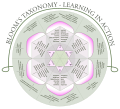 Bloom's taxonomy organized radially
 -
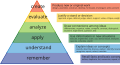 Bloom's revised taxonomy organized as a pyramid of learning levels with explanations of each
 -
 Bloom's taxonomy verbs portrayed as a light bulb
 -
 Bloom's cognitive domain organized as an inverted pyramid


See also
[edit]- DIKW pyramid – Data, information, knowledge, wisdom hierarchy
- Educational psychology – Branch of psychology concerned with the scientific study of human learning
- Educational technology – Use of technology in education to improve learning and teaching
- Fluid and crystallized intelligence – Factors of general intelligence
- Higher-order thinking – Concept in education and education reform
- In Over Our Heads – Book on psychological development by Robert Kegan
- Integrative complexity – Research psychometric
- Know-how – Knowledge of how to perform a task
- Ladder of inference – Metaphorical model of cognition and action by Chris Argyris
- Learning cycle – How people learn from experience
- Mastery learning – Instructional strategy and educational philosophy
- Metacognition – Self-awareness about thinking, higher-order thinking skills
- Model of hierarchical complexity – Framework for scoring a behavior's complexity
- Pedagogy – Theory and practice of education
- Physical education – Educational course related to the physique and care of the body
- Reflective practice – Ability to reflect on one's actions so as to engage in a process of continuous learning
- Rubric (academic) – Scoring guide for assessment
- Structure of observed learning outcome – Model of levels of increasing complexity in understanding
- Wisdom – Ability to apply knowledge with good judgment
References
[edit]- ^ Bloom et al. 1956, p. 4: "The idea for this classification system was formed at an informal meeting of college examiners attending the 1948 American Psychological Association Convention in Boston. At this meeting, interest was expressed in a theoretical framework which could be used to facilitate communication among examiners.
- ^ a b Bloom, B. S.; Engelhart, M. D.; Furst, E. J.; Hill, W. H.; Krathwohl, D. R. (1956). Taxonomy of educational objectives: The classification of educational goals. Vol. Handbook I: Cognitive domain. New York: David McKay Company.
- ^ Shane, Harold G. (1981). "Significant writings that have influenced the curriculum: 1906–1981". Phi Delta Kappan. 62 (5): 311–314.
- ^ Simpson, Elizabeth J. (1966). "The classification of educational objectives: Psychomotor domain". Illinois Journal of Home Economics. 10 (4): 110–144.
- ^ Harrow, Anita J. (1972). A taxonomy of the psychomotor domain: A guide for developing behavioral objectives. New York: David McKay Company.
- ^ Dave, R. H. (1975). Armstrong, R. J. (ed.). Developing and writing behavioral objectives. Tucson: Educational Innovators Press.
- ^ Clark, Donald R. (1999). "Bloom's Taxonomy of Learning Domains". Retrieved 28 Jan 2014.
- ^ a b Krathwohl, David R. (2002). "A revision of Bloom's taxonomy: An overview". Theory into Practice. 41 (4). Routledge: 212–218. doi:10.1207/s15430421tip4104_2. ISSN 0040-5841. S2CID 13116159.
- ^ a b c d Anderson, Lorin W.; Krathwohl, David R., eds. (2001). A taxonomy for learning, teaching, and assessing: A revision of Bloom's taxonomy of educational objectives. New York: Longman. ISBN 978-0-8013-1903-7.
- ^ Hoy, Anita Woolfolk (2007). Educational psychology (10th ed.). Boston: Pearson/Allyn and Bacon. pp. 530–531, 545. ISBN 978-0205459469. OCLC 68694368.
- ^ Armstrong, Patricia (2010-06-10). "Bloom's Taxonomy". Vanderbilt University Center for Teaching. Vanderbilt University. Retrieved 29 June 2016.
- ^ Simpson, Elizabeth (1972). Educational objectives in the psychomotor domain (PDF) (Report). Vol. 3. Washington, D.C.: Gryphon House. pp. 25–30. ERIC ED010368. Retrieved 3 April 2018.
- ^ Simpson 1972.
- ^ Bloom et al. 1956, p. 201.
- ^ Morshead, Richard W. (1965). "On Taxonomy of educational objectives Handbook II: Affective domain" (PDF). Studies in Philosophy and Education. 4 (1): 164–170. doi:10.1007/bf00373956. hdl:2027.42/43808. S2CID 143935506.
- ^ Paul, R. (1993). Critical thinking: what every person needs to survive in a rapidly changing world (3rd ed.). Rohnert Park, CA: Sonoma State University Press.
- ^ a b Flannery, Maura C. (November 2007). "Observations on biology" (PDF). The American Biology Teacher. 69 (9): 561–564. doi:10.1662/0002-7685(2007)69[561:OOB]2.0.CO;2. S2CID 85828325. Archived from the original (PDF) on 2017-03-06. Retrieved 2017-03-05.
Biology is often referred to as an observational science almost as a slur, with the implication that biologists simply look at the living world without the strong theoretical and mathematic underpinnings of a science like physics. There is the suggestion that observation is easy. Thus biology is viewed as a lightweight science—anyone can do it: just go out and start looking, at birds, at grass, at cells under the microscope. Benjamin Bloom's taxonomy of learning tasks puts observation at the lowest level, with recall of information. This denigration of observation has long bothered me because I see it as often difficult and complex, a skill that needs to be learned and a talent that is much more developed in some.
- ^ a b Lawler, Susan (26 February 2016). "Identification of animals and plants is an essential skill set". The Conversation. Archived from the original on 17 November 2016. Retrieved 5 March 2017.
Ironically, the dogma that has been so detrimental to field taxonomy is known as Bloom's taxonomy. University lecturers are told to apply an educational theory developed by Benjamin Bloom, which categorises assessment tasks and learning activities into cognitive domains. In Bloom's taxonomy, identifying and naming are at the lowest level of cognitive skills and have been systematically excluded from University degrees because they are considered simplistic.
- ^ Vygotsky, L. S. (1978). "Chapter 6: Interaction between learning and development". Mind in society: the development of higher psychological processes. Cambridge, Massachusetts: Harvard University Press. pp. 79–91.
- ^ Keene, Judith; Colvin, John; Sissons, Justine (June 2010) [2010]. "Mapping student information literacy activity against Bloom's taxonomy of cognitive skills" (PDF). Journal of Information Literacy. 4 (1): 6–21. doi:10.11645/4.1.189.
When supporting students outside the classroom situation, a subject aware advisor should be capable of spotting mistakes in a student's solution and of analysing these mistakes to identify the difficulty that the student is encountering. Such support can be seen as offering scaffolding in a student's 'zone of proximal development' (Vygotsky, 1978) and exemplified by teaching students to analyse a problem through the identification of the key elements and the relationships between these elements.
- ^ Fadul, J. A. (2009). "Collective Learning: Applying distributed cognition for collective intelligence". The International Journal of Learning. 16 (4): 211–220. doi:10.18848/1447-9494/CGP/v16i04/46223. ISSN 1447-9494.
- ^ Newton, Philip M.; Da Silva, Ana; Peters, Lee George (10 July 2020). "A pragmatic master list of action verbs for Bloom's taxonomy". Frontiers in Education. 5. doi:10.3389/feduc.2020.00107.
- ^ Austin, Tina R. (2025). "The UnBlooms™ model: A Problem-Centered Framework for Learning Design in the AI Era". Zenodo. doi:10.5281/ZENODO.17298679.
- ^ Jansen, B. J.; Booth, D.; Smith, B. (2009). "Using the taxonomy of cognitive learning to model online searching" (PDF). Information Processing & Management. 45 (6): 643–663. doi:10.1016/j.ipm.2009.05.004.
- ^ Kress, G.; Selander, S. (2012). "Multimodal design, learning and cultures of recognition". Internet and Higher Education. 15 (1): 265–268. doi:10.1016/j.iheduc.2011.12.003.
- ^ Paul, R.; Elder, L. (2004). Critical and creative thinking. Dillon Beach, CA: The Foundation for Critical Thinking.
- ^ The New London Group (1996). "A pedagogy of multiliteracies: designing social futures". Harvard Educational Review. 66 (1): 60–93. doi:10.17763/haer.66.1.17370n67v22j160u.
Further reading
[edit]- Bloom, B. S. (1994). "Reflections on the development and use of the taxonomy". In Rehage, Kenneth J.; Anderson, Lorin W.; Sosniak, Lauren A. (eds.). Bloom's taxonomy: A forty-year retrospective. Yearbook of the National Society for the Study of Education. Vol. 93. Chicago: National Society for the Study of Education. ISSN 1744-7984.
- Clark, Donald R. (1999). "Bloom's Taxonomy of Learning Domains". Retrieved 28 Jan 2014.
- Krathwohl, D. R.; Bloom, B. S.; Masia, B. B. (1964). Taxonomy of educational objectives: The classification of educational goals. Vol. Handbook II: the affective domain. New York: David McKay Company.
- Orlich, Donald; Harder, Robert; Callahan, Richard; Trevisan, Michael; Brown, Abbie (2004). Teaching strategies: a guide to effective instruction (7th ed.). Houghton Mifflin. ISBN 978-0-6182-9999-7.


Bloom's taxonomy
View on GrokipediaHistory and Development
Original Framework (1956)
The original framework of Bloom's Taxonomy was developed by Benjamin S. Bloom, an educational psychologist at the University of Chicago, along with a committee of colleagues including Max D. Engelhart, Edward J. Furst, Walker H. Hill, and David R. Krathwohl.[7] The effort began informally at the 1948 American Psychological Association Convention in Boston, where college examiners discussed the need for a standardized classification of educational goals; this led to annual conferences from 1949 to 1953 involving over 30 participants who analyzed thousands of test items and objectives from various subjects.[7] The work culminated in the 1956 publication Taxonomy of Educational Objectives: The Classification of Educational Goals, Handbook I: Cognitive Domain, a collaborative product distributed initially in a preliminary edition for feedback.[7] This framework emerged in the post-World War II era, a time of significant educational expansion and reform in the United States, driven by initiatives like the GI Bill and a push for standardized evaluation to meet growing demands for higher education and workforce preparation.[8] The primary goal was to promote higher forms of thinking in education by providing a hierarchical classification system for educational objectives, enabling educators, testers, and researchers to communicate more effectively, compare goals across institutions, and design curricula that progressed from basic recall to advanced critical thinking.[7] By organizing objectives into a clear hierarchy, the taxonomy aimed to shift focus beyond rote memorization toward fostering analytical, synthetic, and evaluative skills essential for independent thought in a rapidly changing society.[7] The original publication concentrated exclusively on the cognitive domain, outlining six progressive levels that build upon one another, with each higher level presupposing mastery of the preceding ones.[7] This structure was influenced by earlier educational evaluation work, particularly Ralph W. Tyler's principles in Basic Principles of Curriculum and Instruction (1949), which emphasized defining clear objectives and assessing achievement systematically; the taxonomy is dedicated to Tyler for his foundational impact.[7] The levels, each accompanied by definitional descriptions, explanatory action verbs, and illustrative examples drawn from diverse subjects like history, science, and literature, are detailed below:| Level | Definition | Explanatory Verbs | Examples |
|---|---|---|---|
| 1. Knowledge | Recall or recognition of specific facts, terms, concepts, principles, or theories without necessarily understanding them. | define, list, recall, name, identify | List the capitals of U.S. states; recall major historical dates; identify scientific methods used in experiments.[7] |
| 2. Comprehension | Grasping the meaning of material, including translating, interpreting, or extrapolating it into one's own words or other forms. | explain, summarize, interpret, paraphrase, describe | Summarize a short story in one's own words; explain a biological process like photosynthesis; interpret a poem's underlying theme.[7] |
| 3. Application | Using learned information in new or concrete situations to solve problems or demonstrate skills. | apply, demonstrate, use, solve, illustrate | Apply a mathematical formula to compute interest rates; use Newton's laws to predict object motion; solve a case study in economics.[7] |
| 4. Analysis | Breaking down material into constituent parts to examine relationships, structure, or underlying assumptions. | analyze, compare, differentiate, infer, distinguish, diagram | Analyze the structure of a sonnet; compare economic theories of Keynes and Friedman; infer motives from historical documents.[7] |
| 5. Synthesis | Combining elements to form a new, coherent whole, such as a plan, original product, or abstract relation. | design, create, formulate, propose, invent, compose | Design an experiment to test a hypothesis; write a creative short story; formulate a plan for community health improvement.[7] |
| 6. Evaluation | Making judgments about the value of material or methods based on defined criteria, internal evidence, or external standards. | judge, assess, evaluate, critique, appraise, argue | Evaluate the effectiveness of a government policy; critique the logical consistency of an argument; assess the adequacy of a scientific theory.[7] |
Revisions and Expansions
In 2001, Lorin Anderson and David Krathwohl led a revision of the original cognitive domain of Bloom's taxonomy, transforming the category labels from nouns to action-oriented verbs and restructuring the hierarchy to place "Creating" at the highest level.[9] The updated levels became Remembering, Understanding, Applying, Analyzing, Evaluating, and Creating, with this shift emphasizing the dynamic processes of learning rather than static knowledge states.[3] The revision also introduced a two-dimensional framework incorporating both cognitive processes and knowledge dimensions, such as factual, conceptual, procedural, and metacognitive knowledge.[2] The rationale for these changes stemmed from evolving educational research that viewed learning as an active, constructive process, addressing criticisms of the original taxonomy's rigid hierarchy and noun-based terms that implied passivity.[10] Anderson and Krathwohl aimed to better align the taxonomy with contemporary theories of cognition, including constructivism, while maintaining compatibility with the original for practical use in assessment and instruction design.[11] This update has since become the predominant version in educational practice, influencing global curriculum standards.[12] The affective domain received its foundational expansion in 1964 through the work of David Krathwohl, Benjamin Bloom, and Bertram Masia, who outlined five progressive levels: Receiving (awareness and willingness to receive stimuli), Responding (active engagement), Valuing (commitment to attitudes or values), Organizing (integrating values into a system), and Characterizing (internalizing values into a consistent lifestyle).[13] This handbook built on the cognitive domain by classifying emotional and attitudinal learning outcomes, providing educators with tools to foster motivation and ethical development alongside knowledge acquisition.[14] Krathwohl's leadership in this effort underscored the interconnectedness of cognitive and affective growth in holistic education.[9] For the psychomotor domain, which remained underdeveloped in the original 1956 work, R.H. Dave proposed a five-level taxonomy in 1970: Imitation (observing and copying actions), Manipulation (performing with guidance), Precision (accurate execution without assistance), Articulation (coordinating multiple skills), and Naturalization (skill automation for fluent performance).[15] Independently, Elizabeth J. Simpson developed a seven-level schema in 1972: Perception (sensing cues for action), Set (readiness to act), Guided Response (imitating with feedback), Mechanism (habitual proficiency), Complex Overt Response (smooth integration of skills), Adaptation (modifying skills to new demands), and Origination (creating new movement patterns).[16] These models addressed physical skill development through hierarchical progression, filling a gap in Bloom's framework for vocational and kinesthetic learning.[17] Beyond domain-specific revisions, Bloom's taxonomy has integrated into broader educational frameworks, such as L. Dee Fink's Taxonomy of Significant Learning (2003), which expands beyond hierarchical levels to include interconnected categories like foundational knowledge, application, integration, human dimension, caring, and learning how to learn, often drawing on Bloom's cognitive processes for depth.[18] Similarly, Grant Wiggins and Jay McTighe's Understanding by Design (1998, expanded 2005) incorporates Bloom's levels within its backward design approach, using them to align enduring understandings, essential questions, and performance tasks for curriculum planning.[19] In the 2020s, adaptations of Bloom's taxonomy have increasingly incorporated digital learning contexts, such as massive open online courses (MOOCs), where revised levels guide the design of interactive modules to promote higher-order thinking via multimedia assessments and collaborative tools.[20] For instance, studies on MOOC feedback analysis have applied Bloom's framework with AI enhancements to optimize learner engagement and course refinement, ensuring scalability in online environments.[21] These updates reflect ongoing efforts to adapt the taxonomy for technology-mediated instruction without altering its core structure.[22]Learning Domains
Cognitive Domain
The cognitive domain of Bloom's Taxonomy focuses on intellectual skills and mental processes involved in acquiring and applying knowledge, progressing from lower-order thinking skills, such as basic recall, to higher-order thinking skills, like synthesis and judgment.[12] This domain emphasizes the development of cognitive abilities essential for learning, problem-solving, and critical thinking in educational settings.[23] Originally outlined in 1956 by Benjamin Bloom and colleagues, the cognitive domain used noun-based categories: Knowledge, Comprehension, Application, Analysis, Synthesis, and Evaluation.[12] In 2001, Lorin W. Anderson and David R. Krathwohl revised this framework, converting the categories to action-oriented verbs—Remembering, Understanding, Applying, Analyzing, Evaluating, and Creating—to better reflect active learning processes, while repositioning Creating as the highest level to prioritize innovation over mere evaluation.[9] Each level includes subcategories that specify cognitive processes, aiding educators in designing precise learning objectives. The revised cognitive process dimension is structured hierarchically, with the following levels:- Remembering: Involves retrieving relevant knowledge from long-term memory, such as recalling facts or recognizing information. Subcategories include recognizing and recalling. Associated verbs: define, identify, list, recall, recognize. Example: Listing the capitals of countries.[9][12]
- Understanding: Entails constructing meaning from instructional messages, including explaining ideas or concepts. Subcategories: interpreting, exemplifying, classifying, summarizing, inferring, comparing, explaining. Associated verbs: describe, explain, interpret, paraphrase, summarize. Example: Explaining the main ideas of a historical event in one's own words.[9][12]
- Applying: Requires executing or implementing procedures in new situations, such as using information practically. Subcategories: executing, implementing. Associated verbs: apply, demonstrate, execute, implement, use. Example: Solving a math problem using a learned formula in a real-world scenario.[9][12]
- Analyzing: Focuses on breaking material into parts and determining how they relate, such as drawing connections among ideas. Subcategories: differentiating, organizing, attributing. Associated verbs: analyze, attribute, compare, contrast, differentiate, organize. Example: Comparing the roles of characters in a literary work to identify relationships.[9][12]
- Evaluating: Involves making judgments based on criteria and standards, such as justifying a position. Subcategories: checking, critiquing. Associated verbs: appraise, argue, assess, critique, evaluate, judge, support. Example: Critiquing the validity of an argument in a debate with evidence.[9][12]
- Creating: Centers on putting elements together to form a coherent or novel product, such as generating new ideas. Subcategories: generating, planning, producing. Associated verbs: construct, create, design, develop, generate, hypothesize, produce. Example: Designing a scientific experiment to test a hypothesis.[9][12]
- Factual Knowledge: Basic elements such as terminology, specific details, and conventions that form the foundation of a discipline. Example: Recalling key terms in biology.[23][9]
- Conceptual Knowledge: Interrelationships among basic elements, including classifications, principles, generalizations, theories, models, and structures. Example: Understanding how principles of supply and demand interact in economics.[23][9]
- Procedural Knowledge: Skills, techniques, methods, and criteria for using tools or knowing how to perform processes. Example: Applying a step-by-step algorithm to solve equations.[23][9]
- Metacognitive Knowledge: Awareness of one's own cognition, including knowledge of cognition, cognitive awareness, and strategic knowledge for self-regulation. Example: Reflecting on personal learning strategies to improve study habits.[23][9]
Affective Domain
The affective domain in Bloom's taxonomy addresses the emotional and attitudinal aspects of learning, focusing on how feelings, emotions, attitudes, and values influence the acquisition and application of knowledge.[25] This domain emphasizes the internalization of these elements, progressing from basic awareness to a pervasive influence on one's lifestyle, thereby shaping motivation and behavioral responses in educational contexts.[26] Developed as a complement to the cognitive domain, it was outlined in a separate handbook led by David R. Krathwohl, building on Benjamin Bloom's initial taxonomy project but published independently in 1964 by Krathwohl, Bloom, and Bertram B. Masia.[4] The framework arose from efforts to classify educational objectives beyond intellectual skills, addressing the challenges of measuring emotional growth in learning environments.[26] The hierarchy consists of five progressive levels, each with subcategories that detail the deepening internalization process. At the base level, receiving involves passive awareness and selective attention to stimuli; subcategories include awareness (e.g., recognizing the existence of diverse viewpoints), willingness to receive (e.g., tolerating discussions on sensitive topics), and controlled attention (e.g., actively listening to opposing arguments without interruption).[25] The next level, responding, entails active engagement and satisfaction in participation; subcategories encompass acquiescence (e.g., complying with group norms), willingness to respond (e.g., voluntarily sharing personal reactions), and satisfaction in response (e.g., deriving enjoyment from collaborative debates).[25] Higher levels focus on commitment and integration. Valuing reflects the attachment of worth to ideas or behaviors, with subcategories of acceptance (e.g., consistently prioritizing ethical considerations in decisions), preference (e.g., seeking out resources that align with personal values), and commitment (e.g., defending a value against challenges).[25] Organization involves synthesizing values into a coherent system; subcategories include conceptualization (e.g., abstractly relating environmental ethics to broader philosophies) and organization of a value system (e.g., balancing competing principles like individual rights and community welfare).[25] The pinnacle, characterization by a value or value complex, manifests as consistent behavior guided by internalized principles; subcategories feature generalized set (e.g., habitually revising opinions based on new evidence) and full characterization (e.g., adopting a lifestyle that advocates for sustainable practices).[25] For instance, a learner at the receiving level might simply listen attentively to discussions on cultural diversity, while at characterization, they would actively promote inclusive policies in their community.[13] In holistic education, the affective domain plays a crucial role by linking emotional development to sustained motivation and long-term behavior change, fostering not only knowledge acquisition but also ethical decision-making and social engagement.[27] This integration ensures that learning objectives address the full spectrum of human response, complementing cognitive goals to promote well-rounded personal growth.[28]Psychomotor Domain
The psychomotor domain in Bloom's taxonomy encompasses the development of manual or physical skills, ranging from basic reflexive movements to complex, coordinated actions that require practice and feedback for mastery.[4] Unlike the original cognitive domain outlined by Bloom in 1956, the psychomotor domain emerged as a post-Bloom addition during the 1960s and 1970s, driven by educators seeking to address physical skill acquisition in vocational, health, and physical education contexts.[29] This domain emphasizes observable motor behaviors, such as coordination, dexterity, and precision, which build progressively through repetition and refinement.[30] The psychomotor domain lacks the standardization seen in the cognitive and affective domains, resulting in several competing models developed independently in the early 1970s.[12] One prominent framework is Dave's five-level taxonomy (1970), which progresses from imitation—where learners observe and replicate a demonstrated action, such as copying a dance sequence—to naturalization, the highest level of habitual, effortless performance integrated into daily routines.[31] Intermediate levels include manipulation (performing under guidance), precision (accurate execution without aid), and articulation (coordinating multiple skills fluidly).[17] Similarly, Simpson's seven-level model (1972) starts with perception (using sensory cues to guide motor actions) and advances to origination, where learners invent novel movement patterns, like designing an original exercise routine.[30] Its levels encompass set (preparing mentally and physically), guided response (trial-and-error imitation), mechanism (basic proficiency), complex overt response (skillful, independent action), and adaptation (modifying skills for new situations).[32] Harrow's six-level taxonomy (1972) takes a broader view, beginning with involuntary reflex movements and fundamental body control, then incorporating perceptual abilities (sensory-motor integration), physical abilities (endurance and strength), skilled movements (complex coordination), and culminating in non-discursive communication (expressive, nonverbal gestures like interpretive dance).[33] These models are frequently adapted for specialized fields such as sports training, surgical simulations, and occupational therapy, where physical competence is paramount, rather than being universally applied in general education curricula.[32] For instance, imitation might involve mirroring a coach's technique in athletics, while origination could require athletes to devise innovative strategies during competition.[30] Despite their utility, the psychomotor domain is rarely emphasized in broader educational settings, often overshadowed by cognitive and affective priorities, leading to challenges in integrating motor skill objectives into holistic learning frameworks.[12]Theoretical Foundations
Knowledge Classification
In Bloom's original 1956 framework, knowledge serves as the foundational category within the cognitive domain, representing the lowest level of intellectual behavior and encompassing both recallable facts and intellectual abilities or skills. This category is subdivided into three main areas: knowledge of specifics, which includes basic terminology, facts, and details; knowledge of ways and means, covering conventions, classifications, criteria, and methodologies; and knowledge of universals and abstractions, involving principles, generalizations, theories, and structures that organize a field of study. These subdivisions emphasize not just rote recall but also the comprehension of intellectual operations necessary for further learning, positioning knowledge as a prerequisite for higher cognitive processes.[1][6] The original classification, however, was limited primarily to declarative knowledge—what is known—overlooking procedural aspects of how knowledge is enacted or produced, which constrained its applicability to skill-based or self-reflective learning. This gap highlighted a unidimensional approach that conflated content (nouns) with basic recall (verbs), potentially reinforcing rote memorization without addressing deeper cognitive engagement. To address these limitations, the 2001 revision by Anderson and Krathwohl expanded the knowledge dimension into four distinct types: factual knowledge, comprising basic elements like terminology and specific details; conceptual knowledge, focusing on interrelationships such as classifications, principles, and models; procedural knowledge, involving skills, techniques, methods, and criteria for performing tasks; and metacognitive knowledge, centered on awareness of one's own cognition, including strategies for learning and self-regulation. These expansions integrate procedural and reflective elements, broadening the taxonomy's scope beyond declarative forms.[34][9] The revised framework introduces a two-dimensional model that intersects the knowledge dimensions with cognitive processes (remembering, understanding, applying, analyzing, evaluating, and creating), forming a matrix with 24 cells to classify and create educational objectives more precisely—for instance, an objective might target "analyzing procedural knowledge" to guide instruction and assessment. Overall, the purpose of this knowledge classification is to promote progression from rote memorization to deeper understanding and higher-order thinking, enabling educators to design objectives that foster comprehensive intellectual development.[11]Educational Knowledge Structure
Bloom's Taxonomy structures educational knowledge hierarchically, positing that cognitive learning progresses through increasingly complex levels where lower-order skills serve as prerequisites for higher-order ones. In the original framework, this hierarchy comprises six levels—Knowledge, Comprehension, Application, Analysis, Synthesis, and Evaluation—with each subsequent level requiring mastery of the preceding ones to enable more sophisticated mental processes.[7] For instance, acquiring factual knowledge forms the foundation for comprehending concepts, which in turn supports applying that understanding to novel situations before advancing to analytical or evaluative tasks.[7] The 2001 revision refines this structure into Remembering, Understanding, Applying, Analyzing, Evaluating, and Creating, maintaining the prerequisite logic while emphasizing active cognitive engagement at higher levels.[9] This cumulative nature fosters scaffolded learning, where proficiency at one level integrates and extends prior achievements to build deeper educational outcomes. Mastery of basic recall enables interpretive comprehension, which accumulates to support synthesis of new ideas from disparate elements, promoting a layered progression in knowledge acquisition.[7] The taxonomy views knowledge types—such as factual details, conceptual interrelations, procedural methods, and metacognitive awareness—as building blocks that accumulate across levels, ensuring that educational goals reflect progressive cognitive development.[9] In instructional design, this approach aligns with constructivist theories by emphasizing how learners construct meaning through sequential experiences.[35] The taxonomy's broader structure facilitates both vertical alignment, deepening knowledge within a domain through hierarchical progression, and horizontal alignment, ensuring consistency across cognitive, affective, and psychomotor domains for holistic educational planning.[7] Theoretically, it draws from behaviorism by prioritizing observable outcomes, such as rote recall and reinforced applications, while incorporating cognitivist principles that highlight internal mental processes like problem-solving and critical judgment.[7] However, the structure is not strictly linear, as creative leaps in synthesis or evaluation may occur without exhaustive mastery of intermediates, particularly in contexts involving intuition or interdisciplinary integration.[7]Applications and Impact
Curriculum and Instruction Design
Bloom's Taxonomy provides a structured framework for writing learning objectives in curriculum design by classifying cognitive processes into hierarchical levels, enabling educators to create measurable goals that progress from basic recall to advanced creation. This approach uses action verbs aligned with each level to ensure objectives are specific and observable, such as "identify" for remembering or "critique" for evaluating, which facilitates alignment across instruction, activities, and assessments. For instance, in developing course syllabi, instructors might employ Bloom's wheel—a visual tool—to map objectives that integrate lower-order thinking skills (LOTS) like understanding with higher-order thinking skills (HOTS) like analyzing, promoting comprehensive skill development.[36] In lesson planning, the taxonomy supports scaffolding by sequencing instructional activities from lower to higher cognitive levels within units, allowing students to build foundational knowledge before tackling complex tasks. Educators begin with activities focused on remembering and understanding, such as lectures or readings, then advance to application through problem-solving exercises, and culminate in evaluation via debates or projects, ensuring progressive mastery and reducing cognitive overload. This method, as outlined in educational workshops, enhances coherence in unit design by aligning daily lessons to overarching goals, with tools like rubrics to track progression across the six levels.[37] Applications of the taxonomy vary by subject, with tailored emphases to meet disciplinary demands. In STEM fields, such as biology, it guides the design of lab activities where students apply concepts to conduct experiments (application level) and analyze data to draw conclusions (analysis level), as seen in the Blooming Biology Tool, which categorizes questions to promote higher-order skills in inquiry-based settings. In humanities disciplines, the framework informs the evaluation of texts, where learners comprehend narratives (understanding) and synthesize interpretations (creating), fostering critical discourse without rote memorization. These adaptations ensure curricula address domain-specific cognitive demands while maintaining the taxonomy's hierarchical progression.[38] Modern adaptations integrate Bloom's Taxonomy into innovative pedagogies like flipped classrooms and project-based learning to balance objectives across cognitive levels. In flipped models, pre-class materials target lower levels (e.g., remembering via videos on root canal therapy), while in-class sessions emphasize HOTS through discussions and simulations, as demonstrated in endodontics education where this approach improved theoretical knowledge by 10.9% and exam scores by 17.1%. Similarly, in project-based learning, students engage upper levels by designing solutions to real-world problems, with flipped elements providing foundational support; studies show project-based learning yields higher academic achievement (p=0.001) and retention (p=0.019) compared to traditional methods, with the flipped classroom-supported version also showing significant gains in achievement (p=0.020).[39][40] These strategies ensure equitable skill distribution, adapting the taxonomy to active, student-centered environments. The taxonomy has influenced major educational standards frameworks, shaping their emphasis on cognitive progression. It underpins the International Baccalaureate (IB) programs across Primary Years (PYP), Middle Years (MYP), and Diploma (DP), where modified versions guide thinking skills development, explicit articulation of objectives, and alignment in subjects like Theory of Knowledge to promote critical and creative thinking beyond rote learning. Likewise, the Common Core State Standards reflect Bloom's focus on higher-order thinking by requiring students to apply and analyze knowledge in English language arts and mathematics, informing lesson planning to meet proficiency benchmarks.[41][42] Empirical evidence indicates that taxonomy-aligned curriculum design enhances student outcomes, particularly in achievement and perceived learning. A study aligning reading instruction with state standards using Bloom's levels showed positive gains in individual student scores on comprehension tasks, though group differences were not significant, highlighting benefits for targeted skill-building. In undergraduate biology, constructive alignment with the taxonomy increased higher-order cognitive engagement in practicals, with aligned sessions making up 77% of those valued by students for fostering "deep learning," and surveys revealing 80% agreement on question rankings that improved metacognition. These findings underscore the taxonomy's role in elevating performance when integrated thoughtfully into instruction.[43][44]Assessment and Evaluation Practices
Bloom's taxonomy guides the alignment of assessment strategies with cognitive levels to evaluate student learning comprehensively, ensuring that instruments match the intended objectives across the hierarchy from lower- to higher-order thinking. In the original 1956 framework, assessments for knowledge and comprehension levels often employ objective formats such as multiple-choice questions or matching exercises to test recall and basic understanding, while application, analysis, synthesis, and evaluation require constructed-response items like problem-solving tasks or debates to gauge deeper processing. The 2001 revision refines this by emphasizing verbs like "remember," "understand," "apply," "analyze," "evaluate," and "create," allowing educators to design assessments that progressively challenge students, such as using diagrams for application or critiques for evaluation.[9][2]| Cognitive Level | Example Assessment Alignment |
|---|---|
| Remembering | Multiple-choice quizzes to recall facts or definitions. |
| Understanding | Short-answer questions explaining concepts in one's own words.[45] |
| Applying | Scenario-based problems requiring use of principles in new contexts.[46] |
| Analyzing | Comparative essays breaking down components and relationships. |
| Evaluating | Argumentation tasks judging validity with evidence.[2] |
| Creating | Project designs synthesizing ideas into original products.[9] |