Hubbry Logo
Brass sectionBrass sectionMain
Open search
Brass section
Community hub
Brass section
logo
8 pages, 0 posts
0 subscribers
Be the first to start a discussion here.
Brass section
Brass section
from Wikipedia
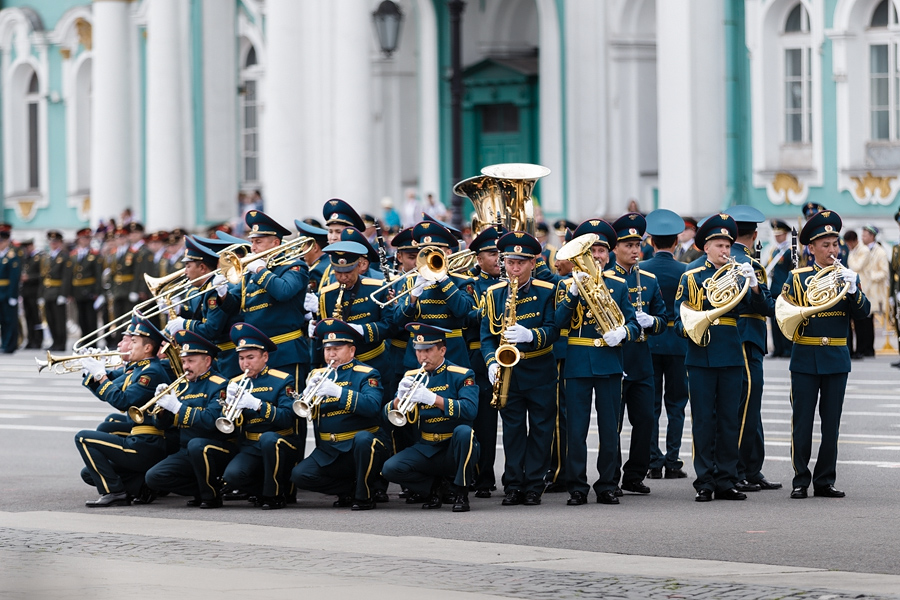
The brass section of the Band of the General Staff of the Armed Forces of Kyrgyzstan in St. Petersburg.

The brass section of the orchestra, concert band, and jazz ensemble consist of brass instruments, and is one of the main sections in all three ensembles. The British-style brass band contains only brass and percussion instruments.

They contain instruments given Hornbostel-Sachs classification 423 (brass instruments).

Orchestra

[edit]

The typical brass section of a modern orchestra is as follows:[1][2]

Some scores may also call for a second bass trombone and either a Contrabass trombone or a Cimbasso.

Concert band

[edit]

The brass section of the concert band is generally larger and more diverse than the brass section of the orchestra.[citation needed]

The typical brass section of a concert band is as follows:

The brass instruments that are sometimes, but very rarely, used in the concert band:

Brass band

[edit]

Jazz ensemble

[edit]

The brass section of jazz ensembles usually include:

See also

[edit]

References

[edit]
Revisions and contributorsEdit on WikipediaRead on Wikipedia
from Grokipedia
The brass section is a core ensemble within orchestras, concert bands, and groups, consisting of metal instruments such as the , , , and that produce sound through the vibration of the player's lips against a cup-shaped mouthpiece, creating a buzzing effect that resonates through coiled tubing and projects via a flared bell. Pitch is adjusted by altering the length of the tubing using valves on instruments like the , , and or a sliding mechanism on the , while (lip tension) and mouthpiece shape further refine tone and range. These instruments typically feature long, coiled tubes—ranging from about 4.5 feet for the to 12–20 feet for the —allowing for a wide dynamic spectrum from soft, mellow tones to bold, piercing fanfares. In orchestral settings, the brass section plays a pivotal role in providing harmonic support, melodic lines, and rhythmic drive, often delivering climactic power and timbral contrast due to its homogeneous yet versatile sound palette, which excels in projection and rich chordal sonorities. A standard symphony orchestra section includes two to three trumpets (highest register), four French horns (mid-range, blending warmth), three (typically two tenor and one bass for deeper tones), and one (bass foundation), though configurations vary by era and . Brass instruments can be muted to alter , creating subdued or nasal effects, and their vast —from pianissimo to fortissimo—makes them essential for balancing with strings, woodwinds, and percussion. Historically, instruments evolved from ancient signaling tools used for communication, warfare, and ceremonies, with orchestral integration beginning in the when trumpets and horns were added for ceremonial flair in French ensembles around 1650. The saw expansions with the tuba's invention and improvements, enhancing chromatic capabilities and solidifying the section's maturation in symphonic works by composers like Brahms and Mahler. Today, the section remains indispensable for its majestic resonance and ability to evoke grandeur, as exemplified in pieces like Poulenc's 1922 Sonata for Horn, Trumpet and Trombone, which highlights their chamber interplay.

Overview and Fundamentals

Definition and Role

The brass section comprises the ensemble of brass instruments, including examples such as the , horn, , and , which generate sound through the of the player's lips serving as a reed against a cup-shaped mouthpiece, channeling through lengths of metal tubing to create resonance in the instrument's bore and bell. This lip-reed mechanism distinguishes brass from other wind families and enables a wide range of pitches via adjustments in lip tension and air pressure. Acoustically, brass instruments produce a bright, projecting characterized by a strong series of , where the bore shape—cylindrical for brighter, more direct tones or conical for mellower warmth—influences the balance of even and odd radiated from the flared bell. Cylindrical bores, common in trumpets and trombones, emphasize higher for a brassy quality, while conical designs in horns and tubas yield smoother spectra, allowing the section to cut through ensembles with clarity and power. In musical ensembles across genres, the brass section fulfills versatile roles, including laying harmonic foundations through chordal support, delivering prominent melodic lines, propelling rhythmic drive, and executing bold effects for dramatic emphasis. This contrasts with the reedy, flexible timbres of woodwinds and the percussive, indefinite pitches of struck percussion, positioning as a core provider of tonal weight and intensity. Often termed the "power" section, it excels in building climaxes and passages due to its and projection, making it particularly suited for outdoor performances where audibility over distance is essential. The modern brass section's capabilities trace to a pivotal 19th-century evolution from natural horns and trumpets, limited to notes of the harmonic series, to valved instruments invented around 1818–1835, which extended tubing length to enable fully chromatic playing and integrate seamlessly into complex ensemble textures.

Historical Development

The origins of brass instruments trace back to ancient civilizations, where precursors such as animal horns and early metal trumpets served ceremonial and military purposes. In , the —a straight, conical-bore trumpet made of —was used by legions for signaling during battles and processions. Similarly, the , a ram's horn instrument from ancient Jewish traditions, functioned as a signaling device in religious and communal contexts, influencing later brass designs. During the medieval period, natural horns crafted from or animal materials emerged in European courts and military ensembles, while the , an early slide trombone developed around 1450, provided chromatic capabilities in sacred and civic music. These instruments were limited to harmonic overtones and primarily used for fanfares rather than melodic roles. From the to the era, brass instruments evolved with greater integration into polyphonic ensembles. The further developed as the primary , appearing in antiphonal choirs and early operas, such as Claudio Monteverdi's L'Orfeo (1607), which featured five trombones (two altos, two tenors, and a bass) to underscore dramatic scenes. These advancements allowed brass to contribute to textured ensembles, though still constrained by natural tuning. In the Classical era, composers like and began incorporating into symphonic works, marking a shift toward orchestral prominence, yet natural instruments restricted players to harmonic series overtones, limiting melodic flexibility. Haydn's The Creation (1798) and Mozart's symphonies employed trumpets and horns for punctuating climaxes, but the absence of confined to supportive roles. The brought revolutionary changes with the invention of , enabling chromatic scales. In 1814, Heinrich Stölzel and Friedrich Blühmel developed the first practical valve system for the horn, patented in 1818, which extended to trumpets and other by the 1830s through and rotary mechanisms. Keyed bugles, introduced earlier in the , bridged natural and valved designs, while valves gained traction for their reliability in and civilian bands. Significant events accelerated brass adoption: the 1814 featured elaborate fanfares with trumpets and horns, composed by for celebratory occasions, highlighting brass's ceremonial power. In the 1840s, patented the family—upright valved instruments in various sizes—which standardized chromatic brass for bands, influencing military and civilian ensembles across and America. The saw standardization of the section in orchestras and bands, driven by Richard Wagner's expansions in works like (1876), which introduced additional low such as Wagner tubas and reinforced sections for dramatic depth, influencing subsequent composers. Post-World War I, bands experienced revival and widespread adoption in community and labor movements, particularly in Britain, where they symbolized working-class resilience amid economic recovery. Modern alloys, shifting from leaded 19th-century brasses to lead-free yellow (approximately 70% , 30% ) by the mid-, enhanced durability and tonal consistency while meeting health standards. By the early , the orchestral section stabilized at four horns, three trumpets, three trombones, and one , reflecting technological and compositional maturity.

Instruments and Techniques

Primary Instruments

The primary instruments of the brass section are the , , , , and , each characterized by distinct construction features, pitch ranges, and transpositions that enable their integration into playing. The features a predominantly cylindrical bore, typically measuring around 11.66 mm (0.459 inches) in diameter, which contributes to its bright, piercing tone suitable for melodic lines and fanfares. It is most commonly built in Bb transposition, where written notes sound a major second lower than notated, with a standard written range spanning from F♯3 to C6. Variants include the , also in Bb, which has a smaller overall size and higher range extending up to about F6 or beyond, allowing for brilliant upper-register effects in orchestral works. The employs a conical bore, gradually expanding from about 12 mm (0.472 inches) at the mouthpiece end, which produces a warmer, more mellow compared to cylindrical-bore instruments. The standard model is a double horn in F/Bb, featuring a thumb-operated to switch between the two keys for extended range and intonation flexibility, with a written range from B2 (low) to F5 (high). Its tubing is extensively wrapped and coiled for compactness and portability, typically totaling around 12-18 feet in length when uncoiled. Trombones utilize a telescoping slide mechanism for pitch alteration, distinguishing them from valved brass instruments. The tenor trombone, pitched in Bb, has a medium bore of approximately 12.7 mm (0.500 inches) and a written range from E2 to Bb4 (or higher) across its seven slide positions. The extends this capability with an F attachment valve that lowers the fundamental pitch, enabling a range down to low Bb1 or lower, and often features a larger bore around 13.9 mm (0.547 inches) for enhanced low-end power. The serves as the foundational bass instrument of the section, constructed as the largest with a wide conical bore and extensive tubing length—up to 26 feet for models. Standard tubas are built in Bb or , with a written range from approximately D1 to F4 (sounding as notated in or a major ninth lower in Bb), providing deep, resonant support. A marching variant, the sousaphone, features a forward-facing bell for improved projection in outdoor settings while maintaining similar pitch and range specifications. The , often described as a tenor tuba, has a conical bore of about 14.5 mm (0.571 inches) and is pitched in Bb, with a written range from B1 to Bb4 that overlaps with the but offers a smoother, more lyrical quality. Its counterpart shares the Bb transposition but employs a narrower bore, typically around 13 mm (0.512 inches), resulting in a brighter, more agile tone suitable for higher roles in bands. Construction across these instruments emphasizes components like mouthpieces, bells, and materials that influence and projection. Mouthpieces vary in cup depth, with deeper cups producing a darker, more fundamental-rich by allowing greater resistance, while shallower cups yield brighter, higher-overtone sounds for cutting through ensembles. Bell flares, which expand outward from the tubing, enhance projection by directing more efficiently into the air, with wider flares promoting broader dispersion and . Materials commonly include yellow (70% , 30% ) for a balanced, projecting tone, or gold (85% , 15% ) for a warmer, more resonant quality with reduced brightness. In standard brass sections, configurations typically include 2-4 , 2-4 , 2-3 (often two tenors and one bass), and 1 , scalable based on ensemble size and repertoire demands.

Playing Techniques and Notation

The primary method of production on involves the , where the player's lips vibrate against the mouthpiece to create a buzzing that excites the air column within the instrument. This lip vibration, often practiced by buzzing the mouthpiece alone, generates the initial , with firm lip corners and a relaxed center facilitating the most efficient tone production. The resulting pitches are derived from the harmonic series, consisting of the and its overtones, where each partial represents a resonant multiple of the fundamental, enabling the instrument to produce a range of notes through adjustments in lip tension, air pressure, and or slide positions. Key playing techniques include for articulation, where the strikes the stream of air near the lips to separate notes; single uses a "ta" or "da" for basic attacks, while double tonguing alternates "ta-ka" and triple tonguing employs "ta-ka-ta" for rapid passages, allowing speeds up to around 170 beats per minute or more for professionals in double tonguing. Mutes alter by inserting devices into the bell: straight mutes produce a muted, nasal tone; cup mutes add a brighter, warmer effect; and mutes, with adjustable stems, enable wah-wah effects for expressive variation. Pedal tones, achieved by loosening the to produce the fundamental or subharmonic frequencies below the typical low register, extend the downward range but require precise control to maintain intonation and stability. Brass ranges present specific challenges, with the high register demanding increased tension and air speed, often leading to strain and fatigue, while the low register allows growl effects through vocal cord or buzzing for a raspy . For example, on the B-flat , the pedal F below the fundamental B-flat1 serves as a low extension but is difficult to sustain without buzzing instability. Transposition rules account for instrument pitch: parts are written in F, sounding a lower than notated, while B-flat parts sound a major second lower, ensuring performers read adjusted notation for alignment. Notation for brass typically uses treble clef for trumpets and tenor trombones (with bass clef optional for low passages), and bass clef for tubas and bass trombones, with key signatures shifted for transposing instruments to match their sounding pitches. Dynamics are notated with emphasis on forte and fortissimo markings to exploit the brass section's inherent power and projection, often requiring careful control to avoid overblowing. Maintenance practices include managing mouthpiece pressure to prevent embouchure fatigue, with relaxed placement recommended to sustain long sessions without lip bruising or reduced flexibility. Slides on trombones and valves on other require regular lubrication with oils or creams to ensure smooth operation and responsive action, minimizing wear and sticking. Common challenges encompass intonation variations due to temperature changes, as colder air contracts the instrument's tubing and lowers pitch, necessitating warm-up adjustments for stable tuning. Blending within sections relies on matched mouthpieces among players to achieve uniform and balance, reducing discrepancies in tone color during ensemble performance.

Applications in Classical Ensembles

Orchestral Brass Section

The orchestral brass section has evolved significantly since the era, when it typically consisted of two natural trumpets and two natural horns, used sparingly for ceremonial fanfares and harmonic reinforcement in works by composers like Johann Sebastian Bach. These valveless instruments limited players to diatonic notes in their harmonic series, restricting the section's role to punctuating tuttis rather than sustained melodic lines. By the Classical period, composers such as began integrating horns more frequently for lyrical solos, though the core lineup remained modest at two trumpets, two horns, and occasional trombones. In the Romantic era, the brass section expanded to meet demands for greater volume and color in larger halls, influenced by the valve inventions of the early that enabled chromatic playing. The standard modern configuration—four French horns, two to three trumpets, three trombones (two tenor and one bass), and one tuba—emerged from models established by and , providing a balanced foundation for harmonic depth and dynamic power. Wagner's operas, such as the Ring cycle, often doubled or tripled brass voices for intensity, while Tchaikovsky's symphonies employed the section for bold thematic statements. Further expansions occurred in late-Romantic works; for instance, Richard Strauss's Eine Alpensinfonie (1915) requires eight horns onstage plus additional offstage brass to evoke mountainous spatial effects and climactic volume. Within the symphony orchestra, the brass section primarily offers harmonic support during full-ensemble tuttis, reinforcing the foundational chords while blending with strings and woodwinds. It also features prominently in soloistic roles, such as the lyrical horn passages in Ludwig van Beethoven's Symphony No. 3 ("Eroica"), where the instrument carries pastoral melodies. Offstage brass placements enhance spatial depth, as in Strauss's aforementioned work or Berlioz's (1830), whose fourth movement features a dramatic depicting a march to the scaffold. Composers like influenced brass usage by doubling sections for heightened emotional intensity, evident in the expansive orchestration of his Symphony No. 2 ("Resurrection"). In 20th-century repertoire, Dmitri Shostakovich's symphonies, such as No. 5 (1937), exploit brass for stark contrasts and ironic triumph, with the finale's blazing underscoring themes of resilience. Minimalist composers like later employed brass for rhythmic pulse and phasing patterns, as in Music for Large Ensemble (1978), shifting focus from Romantic bombast to repetitive textural layers. Acoustically, brass instruments are positioned at the rear of the to optimize projection, as their bright, travels effectively over the forward strings without overwhelming them. This placement aids balance, with horns often antiphonally divided left and right to envelop the in warm , while trumpets and trombones align centrally for piercing clarity in fanfares. In larger Romantic and modern scores, offstage further manipulates acoustics for immersive effects, simulating distance and echo in concert halls.

Band Brass Sections

In concert bands, the brass section is typically larger to balance the woodwind and percussion forces in indoor acoustic settings, often comprising 4-6 trumpets, 4 horns, 4 trombones, 2 euphoniums, and 2 tubas. This configuration allows for robust harmonic support and dynamic contrast, with trumpets providing bright melodic lines, horns filling mid-range harmonies, and low brass anchoring the foundation. The setup emphasizes blend with , avoiding the overpowering projection suited to orchestral halls. British-style brass bands represent an all-brass tradition, standardized to 24-30 players ranging from cornet to bass , excluding woodwinds and focusing on valved for a unified . Typical includes 1 E-flat cornet, 8-10 B-flat , 1 , 3 tenor horns, 2 baritones, 2 euphoniums, 3 trombones, and 4 basses (2 E-flat and 2 B-flat), often with 2-3 percussionists. These bands perform graded test pieces in competitions, where sections are evaluated for precision, intonation, and interpretive depth, fostering a competitive culture since the first national contests in the 1850s. Marching adaptations prioritize mobility and projection outdoors, with sousaphones substituting for concert tubas to distribute weight over the shoulder while maintaining low-range bass lines. Slide trombones with marching adaptations, such as upright bells, are used for mobility during formations. Modern drum corps allow amplification for the front ensemble and, as of 2025, a single featured to enhance solos amid percussion-heavy arrangements, while the main remains unamplified. In these settings, the provides core melodic and rhythmic drive, adapted from roots to high-stepping parades and field shows. The brass section's roles in band music include melodic leads on higher cornets or trumpets, robust bass lines from tubas for rhythmic stability, and harmonized chorales in works like John Philip Sousa's marches, where low brass reinforce triumphant fanfares. This structure supports layered textures, with mid-brass (horns, euphoniums) handling inner voices for choral-like passages in American wind band repertoire, such as Vincent Persichetti's Symphony for Band. Key traditions highlight American wind bands' evolution through Persichetti's influential works, which expanded the medium's artistic scope in the mid-20th century. British brass contests, originating in the 1850s at Belle Vue, , emphasize technical excellence and continue as premier events. In Japan, Rissho Kosei-kai ensembles like the Tokyo Kosei Wind Orchestra blend Western band formats with local influences, performing globally since 1960. The evolution traces to post-Civil War military bands, where disbanded regimental units reformed as civilian wind ensembles, popularizing brass-heavy marches. In the , and fused brass with expanded percussion, emerging from veterans' organizations in to create competitive, visually dynamic formats.

Jazz Brass Section

In the big band era of the 1930s and 1940s, the jazz brass section typically comprised four trumpets and three to four trombones, providing a robust foundation for ensemble playing that emphasized rhythmic drive and harmonic support. These sections often engaged in call-and-response riffs with the reed instruments, creating dynamic interplay central to the swing style, as heard in Duke Ellington's innovative arrangements that highlighted contrasting brass phrases. The lead trumpet player frequently emerged for virtuosic solos, while the trombone section contributed punchy, syncopated lines that locked in with the rhythm section's swing feel, fostering the genre's infectious propulsion. Key innovations in jazz brass arose from pioneering figures who expanded the section's expressive palette. Louis Armstrong's trumpet work in the hot jazz of the 1920s, exemplified by his Hot Five recordings, introduced bold, emotive phrasing and improvisational flair that influenced subsequent generations. In the cool jazz movement, arranger collaborated with on the 1949-1950 sessions, employing muted horns to achieve a subdued, atmospheric texture that contrasted earlier hot styles and featured subtle brass voicings. These recordings showcased a nonet with , , and , prioritizing arranged ensemble colors over aggressive solos. In smaller jazz combos, particularly during the bebop era of the 1940s, brass roles shifted toward intimate improvisation, with trumpet-trombone pairings becoming prominent; , often called the "Charlie Parker of the trombone," elevated the instrument's agility in fast-paced small-group settings alongside trumpeters like . By the 1970s fusion period, incorporated the into his electric bands, blending its warmer tone with rock elements for expansive, textural brass lines in his fusion works. Unique to jazz, brass techniques such as growls—produced by vocalizing into the instrument for a raspy —falls, and half-valve smears allowed players to mimic human speech and add idiomatic color, often in scat-like solos that echoed vocal . Contemporary hip-hop jazz hybrids, as explored by artists like , integrate brass riffs with beat-driven grooves, reviving energy in urban contexts. As of 2025, groups like the Dirty Dozen Brass Band continue to innovate in jazz brass traditions, blending New Orleans roots with modern . In popular music, brass sections often serve supportive roles, delivering tight riffs, punctuating rhythms, and adding harmonic layers to blend with electric guitars, drums, and vocals in genres like rock, pop, , and R&B. Unlike more improvisational uses in , these ensembles emphasize composed arrangements that enhance the track's energy without overpowering the core band sound. Emerging prominently in the mid-20th century, brass integration allowed soul-influenced acts to infuse rock with bold, horn-driven dynamics, evolving into versatile studio and live elements across contemporary styles. The incorporation of brass into gained momentum in the 1960s through soul-rock fusions, where horn sections provided melodic hooks and rhythmic drive. The band Chicago exemplified this with their core horn trio—trumpet player , trombonist , and multi-reedist —drawing from R&B to create brass-heavy arrangements that propelled hits like "25 or 6 to 4." Similarly, Stax and records featured brass-led horn sections, such as (trumpeter Wayne Jackson and saxophonist Andrew Love), which delivered punchy, lead-like brass lines over soul charts, as heard in tracks by and . In and R&B, sections emphasized synchronized riffs and percussive attacks to underpin groovy basslines and beats. James Brown's ensembles, including , typically deployed a compact horn unit of two trumpets and one under Fred Wesley's direction, crafting tight, repetitive motifs with techniques like slap-tonguing on for sharp, emphatic punches in songs such as "Super Bad." This approach influenced the genre's emphasis on interlocking horn patterns that locked in with , creating infectious, danceable textures. Pop music in the 1970s showcased expansive brass lines as signature elements in horn-driven acts. , Wind & Fire's —featuring saxophonist , trumpeter Louis Saterfield, trombonist Rahmlee Michael Davis, and others—integrated , , and sax for lush, orchestral flourishes in hits like "Shining Star," blending grooves with pop accessibility. In more recent pop, brass accents appear selectively for rhythmic emphasis, as in Beyoncé's "Single Ladies (Put a Ring on It)," where horn-like stabs underscore the track's bold, percussive hooks in live and remixed versions. Studio production techniques have expanded brass's presence in through , where multiple takes of horn parts are layered to achieve a fuller, denser sound without requiring a large live ensemble. This method, common in non-classical recordings, allows engineers to double or triple lines for added intensity, as practiced in and pop sessions to simulate big-band heft. Electronic enhancements further innovate, with sampled sounds integrated into EDM and electronic tracks; for instance, electroswing producers layer digitized horn stabs over synthesized beats to evoke vintage swing while fitting modern production. Modern trends in and hip-hop continue to revitalize brass in genre-blending contexts. Arcade Fire incorporates orchestral brass elements, including trumpets and trombones, into their anthems for sweeping, emotional builds, as evident in albums like where horns add textural drama. In hip-hop, (Troy Andrews) fuses traditions with bounce rhythms—a fast-paced, hip-hop variant—leading horn sections that drive tracks like "Hurricane Season" with trombone solos and ensemble riffs. Modern brass bands like Funky Dawgz Brass Band integrate hip-hop and , performing top hits and originals as of 2025. Brass sections in face practical challenges, particularly in live settings dominated by amplified electric instruments. Achieving balance requires careful amplification to cut through guitar volumes without feedback or bleed, often involving directional and in-ear monitors for brass players on tour. Portable setups, such as compact folding stands and lightweight miking rigs, are essential for mobile performances, enabling horn sections to integrate seamlessly into rock and pop tours despite the instruments' acoustic volume limitations in high-decibel environments.

References

Add your contribution
Related Hubs
User Avatar
No comments yet.