


Community hub
Recent from talks
Contribute something
Nothing was collected or created yet.
Kabanos
View on Wikipedia Polish kabanos | |
| Alternative names | Cabanossi, kabana, cabano |
|---|---|
| Type | Sausage |
| Course | Appetizer, main |
| Place of origin | Poland[1][2][3] |
| Serving temperature | Hot, cold |
| Main ingredients | Pork |

 | This article needs additional citations for verification. (July 2025) |
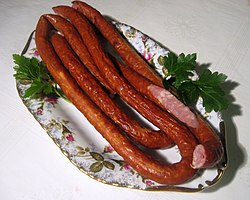
Kabanos (/kəˈbænəs/; Polish: [kaˈbanɔs] ⓘ, plural: kabanosy), also known as cabanossi or kabana, is a long, thin, dry sausage usually made of pork which originated in Poland. They are smoky in flavor, and can be soft or very dry in texture depending on freshness. Typically, they are quite long, 60 cm (24 in), but very thin, with a diameter around 1 cm (1⁄2 in), and folded in two, giving them a characteristic appearance. Versions made of chicken and turkey are staples in kosher meat markets and delicatessens.
Etymology and history
[edit]The name comes from the word kaban, an old obsolete term used in eastern parts of Poland for a young male pig fattened with potatoes specially for making this kind of sausage (hence kabanos, 'made of kaban'). The word kaban with a similar meaning is also present in other neighbouring languages; it was initially loaned from Turkic languages where it denotes a boar[4] (compare Tatar: kaban, Azerbaijani: qaban, Kazakh: қабан, cognate with Turkish: yaban).
Kabanosy are known to have been produced since medieval times at least, and because of their long-lasting capabilities they were considered perfect food for soldiers and travellers, which is reflected by kabanos' design traits: thinness, usually very extended length, and shape in which they are always kept. According to some historians, they were hung around the neck like a necklace, allowing horsemen to eat on the go without stopping for a food break. For the same reason, they were also used as hiking food and are very common among Gorals. Tighter, smaller wraps of long kabanosy — as sold nowadays — were also common among foot soldiers (and travellers). Smaller kabanos wrapping allowed it to be "worn" on a wrist and eaten while marching.
Nowadays, kabanosy are made using different spices, and come in many different flavours. Before the 20th century, various spices were also being used in the production of kabanosy, giving them locally distinct tastes, which differed between various regions of Poland.
Modern times
[edit]Production of kabanosy requires a minimum of 150 grams (5.3 oz) of best grade pork meat to make 100 grams (3.5 oz) of sausage, which is known today as the "minimum of 3:2 ratio". This is required because of the loss of some of the water contained within the meat used to prepare the raw sausage, which evaporates during the long process of meat smoking.[5] Nowadays almost every Polish manufacturer of kabanosy describes on the packaging at which ratio their sausage was made; for example, the manufacturer Kania states that "157 grams of meat was used to make 100 grams of kabanosy".[6]
The two main types of kabanosy include a slightly "softer" and more common type (smoked much less, just for the taste), and a "harder" type (much drier than the softer ones), which are smoked for a very long time, basically until bending the sausage becomes difficult (to the point that it cracks when someone attempts to bend it). Because of the long and thorough smoking process, the "harder" kabanos type is extremely long-lasting and does not spoil as quickly as most other meats without preservatives.
Furthermore, kabanosy are also categorized into two other main types, depending on the amount of spices used: "hot" (very spicy) and "mild" (less spicy). Both "harder" and "softer" types of kabanosy come in "hot" or "mild", since the "hardness" of the sausage comes only from the length of its smoking time, but otherwise the two are made of the same ingredients.
According to modern recipes, kabanosy are seasoned with different spices, such as black pepper, chili, and others. Unlike other meats, these sausages are typically eaten alone as an appetiser or are often served with cheese. Although kabanosy can be cooked with other food, they are usually served cold only. Only if no other meat were available to Polish travelers or soldiers would they then have sliced kabanos into small pieces to cook them with vegetables, buckwheat, millet, potatoes, or whatever else was available.
Some manufacturers have created sausages made with the same process as kabanosy, but have substituted the traditional pork with other meat (mainly poultry). Due to their distinct shape and look, they are often called kabanosy, too, with the addition of the name of the meat they contain, such as kabanosy z kurczaka, 'chicken kabanosy'.
Serving
[edit]
It is commonly cut into bite-sized chunks and eaten cold as an appetiser or snack, often with cheese and crackers. Small kabanosy, called mini-kabanosy, are also available. Sliced kabanosy is also a popular pizza topping.[where?]
Distribution
[edit]The kabanos sausage is mostly found in Southern, Central and Eastern European countries from the Adriatic Sea to the Baltic states, and is also very popular in Australia, New Zealand, South Africa, Israel, and Peru, where the sausage is one of the most prevalent dried sausages. In Central and Eastern Europe, kabanos is mostly consumed as a snack. In Israel, because of dietary laws (Jewish kashrut and Muslim halal), kabanos sausage is almost exclusively made of chicken or turkey. Kabanos is also fairly popular in Colombia, where it is called cábano.
Traditional Speciality Guaranteed: Kabanosy staropolskie
[edit]After the accession of Poland to the European Union, Poland and Germany became involved in a trade dispute over the name kabanos (due to a German claim to the traditional Polish recipe).[7] In 2011, when Polish manufacturers submitted scientific proofs of kabanos' Polish origins, the EU registered Kabanosy staropolskie as a Traditional Speciality Guaranteed on request of Poland.[8] This status does not forbid manufacturers from other countries to produce and sell kabanos under that name, but demands that when using the name Kabanosy staropolskie, it is made according to specified "time-honoured recipes".[9]
See also
[edit]References
[edit]- ^ Tomnay, Susan (19 April 1997). Recipe Encyclopedia. Crescent Books. ISBN 9780517184424. Retrieved 19 April 2019 – via Google Books.
- ^ "Polish Kabana Spice Pack". Country Brewer. Retrieved 19 April 2019.
- ^ "Cabanossi". www.bell1869.com. Retrieved 19 April 2019.
- ^ Max Vasmer (1953–1958). "Кабан". Russisches etymologisches Wörterbuch (in German). Heidelberg: Winter. Russian translation by Oleg Trubachyov: "Кабан". Этимологический словарь русского языка. Moscow: Progress. 1964–1973.
- ^ "Kabanosy - tradycyjny specjał z Polski". Prawdziwe Mistrzostwo. Archived from the original on 13 April 2014. Retrieved 1 November 2015.
- ^ "ZM Kania - Kabanosy". Zakład Mięsny Kania. Archived from the original on 4 March 2016. Retrieved 1 November 2015.
- ^ "Polish–German War Over Kabanosy". TVN24. 30 August 2010. Archived from the original on 11 November 2018. Retrieved 1 November 2015.
- ^ "Poland has won the war over Kabanosy". TVP Info. 22 September 2011. Retrieved 1 November 2015.
- ^ Stratis G. Camatsos (27 September 2011). "Kabanos sausages obtain EU certification. Germany withdraws its objection". NewEurope. Archived from the original on 6 March 2016. Retrieved 1 November 2015.
External links
[edit]| Overview |  | ||||
|---|---|---|---|---|---|
| Fresh sausage | |||||
| Dry sausage |
| ||||
| Smoked sausage | |||||
| Cooked sausage | |||||
| Cooked smoked sausage | |||||
| Precooked sausage | |||||
| Grilled sausage | |||||
| Related articles | |||||

Kabanos
View on GrokipediaOrigins
Etymology
The term kabanos derives from the Polish dialectal word kaban (or its diminutive kabanek), an obsolete eastern Polish and Lithuanian expression from the 19th century denoting a young male hog extensively reared and fattened primarily with potatoes for superior meat quality in sausage production.[1][7] This nomenclature reflects pre-industrial farming practices in the region, where such pigs were selectively bred for lean, flavorful pork suited to dry-cured sausages, distinguishing the term's agricultural specificity from broader Slavic words for swine like wieprz.[8] While some linguistic analyses trace kaban to a Turkish borrowing meaning "hog" or "wild pig," its adoption in Polish dialects emphasized local porcine rearing traditions rather than direct Ottoman influence, evolving into a specialized meat-processing descriptor by the late 19th to early 20th centuries.[8][9] In non-Polish contexts, adaptations like cabanossi or kabana often diverge etymologically and compositionally, incorporating beef or altering preparation, underscoring the Polish term's origin tied exclusively to potato-fed pork hogs rather than generalized salami nomenclature.[10]Historical Development
Kabanos first appeared in Poland during the interwar period, with production beginning in small-scale meat processing facilities in the 1920s and 1930s. This development coincided with efforts to efficiently utilize lean pork trimmings and cuts in rural areas, where resource constraints favored durable, preserved products over fresh meat that spoiled quickly without refrigeration.[11] By the late 1920s, kabanos had spread nationwide, marking its transition from localized experimentation to a recognized sausage type valued for its longevity and portability.[12] The product's dry-curing process—relying primarily on pork, salt, and smoke without synthetic additives—proved advantageous during World War II shortages, enabling preservation of scarce meat resources through extended shelf life amid disrupted supply chains and rationing. Post-1945, under communist-era economic controls and ongoing food scarcity, kabanos maintained widespread appeal as a ration-stable snack, its simple formulation allowing artisanal continuity despite industrial centralization pressures.[13] This era underscored causal ties between material deprivation and refinements in smoking and drying techniques, prioritizing empirical durability over flavor complexity.[12] In the late 20th century, particularly from the 1970s onward, kabanos production shifted toward semi-industrial scales as state meat combines expanded output while retaining core traditional elements, though standardization introduced minor variations in diameter and smoking intensity. This evolution reflected broader Polish food industry mechanization, yet preserved the sausage's essence as a lean, snapped-textured preserved good born from necessity.[11]Production
Traditional Methods
Traditional kabanos production utilizes high-quality pork, primarily lean cuts such as shoulder, with formulations targeting 70-80% lean meat content to achieve the characteristic firm, chewy texture after processing.[5] Essential ingredients include salt at 1.5-2% of meat weight for osmotic preservation, curing agents containing sodium nitrite (modern cure #1 or historically saltpeter for color fixation and botulism inhibition), and spices like garlic, black pepper, coriander, nutmeg, and occasionally caraway.[2][5] The process commences with grinding the chilled pork to a medium-fine consistency (3-6 mm plate), followed by thorough mixing with seasonings, cure, and ice water until a sticky emulsion forms, ensuring cohesion without binders. This mixture is stuffed into natural sheep casings of 18-22 mm diameter, producing thin strands that contract during subsequent steps.[2][5] Sausages are initially air-dried briefly to develop a tacky surface pellicle, then cold-smoked over hardwood (beech or oak) at 20-30°C for 12-24 hours, which deposits phenolic compounds that inhibit microbial growth while initiating moisture reduction.[2][5] An optional baking phase at 70-80°C follows, heating to an internal temperature of 68-72°C to further diminish pathogens.[2] Final air-drying occurs at 12-15°C and 75% humidity until the yield falls below 68% of initial weight, yielding a low-moisture product with enhanced shelf-stability through reduced water activity.[2][14] Recipes archived in Polish government records from 1945 onward, reflecting pre-1950 practices, prioritize these smoking and drying sequences for preservation efficacy in non-refrigerated conditions, with spices enhancing palatability secondarily.[5]Modern Adaptations
In large-scale production facilities, such as those operated by Tarczyński S.A. since its founding in the late 1980s, modern kabanos manufacturing incorporates mechanical mincing of pork trimmings, automated stuffing into casings via high-capacity fillers, and drying in climate-controlled chambers that regulate temperature and humidity to optimize airflow and microbial control.[15][16] These processes enable continuous output exceeding traditional artisanal batches, with efficiency gains from integrated lines that handle grinding, mixing, and encasing in sequence, reducing labor dependency while maintaining structural integrity through precise pressure controls.[17] Commercial formulations often include standardized additives like sodium nitrite for antimicrobial action and color stabilization, alongside dextrose to fuel lactic acid bacteria fermentation, accelerating pH drop and ripening compared to salt-and-spice-only traditional cures.[18][19] This shortens drying from the 3-5 days required in traditional recipes—achieving ≤68% yield at 14-18°C and 80% humidity—to as little as 1-2 days in optimized chambers by lowering relative humidity to 60% or below, facilitating faster moisture loss without excessive case hardening.[20][21] Such adaptations ensure export compliance under food safety standards but introduce trade-offs, including potential nitrite-derived nitrosamine formation under high-heat conditions, though levels remain below regulatory limits in controlled settings.[18] Empirical analyses reveal commercial kabanos variants with 3-5% higher fat content than traditional counterparts, attributed to optimized emulsion stability for texture and yield, yet offset by vacuum packaging that extends unopened shelf life from weeks to 2-3 months refrigerated by minimizing oxidation and bacterial ingress.[22][23] This packaging, combined with nitrite use, prioritizes microbial stability over unaltered flavor profiles, yielding products with consistent firmness but occasionally diminished smoky depth due to abbreviated maturation.[22]Characteristics
Physical Properties
Kabanos takes the form of long, thin sticks of dry sausage, typically stuffed into sheep casings measuring 20-22 mm in diameter, yielding a slender, uniform profile. The sticks are approximately 25 cm in length, twisted off at one end, evenly wrinkled along the surface, and commonly folded in two with a characteristic indent at the curve.[24] The exterior surface displays a dark red coloration with a cherry tint, resulting from the smoking process, while the interior cross-section consists of dark red lean meat particles embedded with cream-colored fat. This structure contributes to a smooth yet dry and wrinkled outer texture.[24] Extensive drying reduces the yield to less than 68% of the initial raw meat weight, imparting a firm consistency that produces an audible snapping or breaking noise when bent or broken, balanced by a tender and succulent chew. The water content is restricted to 60% or less, alongside fat not exceeding 35%, enabling room-temperature shelf stability through combined effects of dehydration, smoking, and fermentation.[24]| Property | Specification |
|---|---|
| Diameter | 20-22 mm (sheep casings) |
| Length | ~25 cm (folded sticks) |
| Moisture | ≤60% |
| Yield Loss | >32% (from raw meat) |
| Texture | Firm, wrinkled exterior; tender interior with breaking sound |