Hubbry Logo
ChamanChamanMain
Open search
Chaman
Community hub
Chaman
logo
8 pages, 0 posts
0 subscribers
Be the first to start a discussion here.
Chaman
Chaman
from Wikipedia

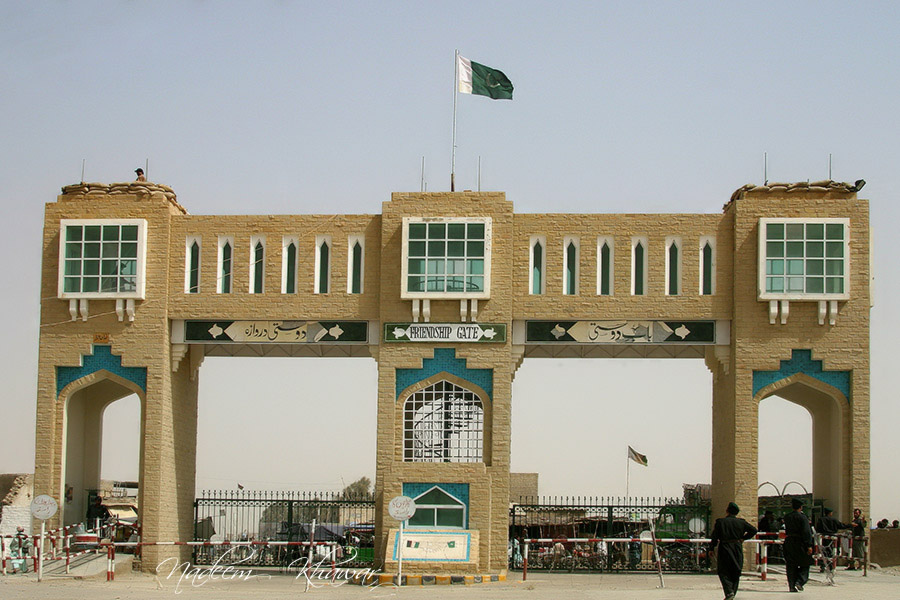
Chaman (Pashto and Urdu: چمن) is the capital city of the Chaman District in Balochistan, Pakistan. It is located near the Afghanistan-Pakistan border. The city is situated south of the Wesh–Chaman border crossing with the neighbouring Kandahar province of Afghanistan.

Key Information

Etymology

[edit]

The name Chaman is thought to be derived from garden in Urdu.[2][3][4][5] There is little verifiable evidence to a singular and apparently unfounded claim that the name partly derived from that of a Hindu trader in the city before the partition, as the area was known as Chaman much before this period.[5][6]

History

[edit]
Train station at Chaman near Khojak Tunnel in 1895, by William Henry Jackson

Chaman has been used by NATO forces as a major supply route into Afghanistan since 2000.[7]

Thousands of Afghan refugees enter Pakistan via the Chaman route on a regular basis.[8]

Bombings occurred in 2017,[9] 2020 Chaman bombing, and 2021.[10]

In December 2022, the Afghan Taliban forces launched indiscriminate fire at the Chaman border, twice in a week and caused civilian casualties on the Pakistani side.[11]

In October 2023, the border crossing process was made more stringent, requiring a passport and visa, whereas previously only requiring a national identification card, to cross from Pakistan to Afghanistan. This has resulted in protests in the city.[12]

Climate

[edit]

With an influence from the local steppe climate, Chaman features a hot semi-arid climate (Köppen BSh). The average annual temperature in Chaman is 19.0 °C, while the annual precipitation averages 232 mm. June is the driest month with virtually no rain rainfall, while January is the wettest month, with an average 65 mm of precipitation.

July is the hottest month of the year with an average temperature of 31.0 °C. January is the coldest month with an average temperature of 6.4 °C.

Climate data for Chaman
Month Jan Feb Mar Apr May Jun Jul Aug Sep Oct Nov Dec Year
Mean daily maximum °C (°F) 13.3
(55.9)
16.0
(60.8)
21.2
(70.2)
27.3
(81.1)
33.8
(92.8)
38.7
(101.7)
39.3
(102.7)
38.5
(101.3)
35.2
(95.4)
29.2
(84.6)
21.1
(70.0)
16.8
(62.2)
27.5
(81.6)
Daily mean °C (°F) 6.4
(43.5)
9.0
(48.2)
13.8
(56.8)
19.5
(67.1)
24.7
(76.5)
29.1
(84.4)
31.0
(87.8)
29.6
(85.3)
24.9
(76.8)
18.9
(66.0)
12.8
(55.0)
8.5
(47.3)
19.0
(66.2)
Mean daily minimum °C (°F) −0.4
(31.3)
2.1
(35.8)
6.5
(43.7)
11.7
(53.1)
15.6
(60.1)
19.5
(67.1)
22.7
(72.9)
20.7
(69.3)
14.7
(58.5)
8.7
(47.7)
3.6
(38.5)
0.3
(32.5)
10.5
(50.9)
Source: Climate-Data.org[13]

Demographics

[edit]

Population

[edit]
Historical population
YearPop.±% p.a.
19516,980—    
196112,208+5.75%
197220,702+4.92%
198129,793+4.13%
199856,792+3.87%
2017123,191+4.16%
2023130,139+0.92%
Sources:[14]

According to 2023 census, Chaman had a population of 130,139. After the capital Quetta, Chaman is Balochistan's fifth-largest city according to the 2017 Pakistani census.[15] The city is located at the Pashtun majority northern part of Balochistan.

Languages

Languages of Chaman (2023 Census)[16]
  1. Pashto (98.2%)
  2. Punjabi (0.68%)
  3. Urdu (0.34%)
  4. Others (0.78%)

Religion

[edit]
Religious groups in Chaman City (1941 & 2017)[a]
Religious
group
1941[17]: 13–14  2017[18][19]
Pop. % Pop. %
Hinduism 2,898 43.58% 379 0.31%
Islam 2,812 42.29% 122,263 99.23%
Sikhism 697 10.48%
Christianity 242 3.64% 515 0.42%
Jainism 1 0.02%
Ahmadiyya 49 0.04%
Total population 6,650 100% 123,206 100%

Transport

[edit]
Passenger train entering the Khojak Tunnel

Chaman has a railway station which accommodates services with Kandahar as well as other parts of Afghanistan. A slow passenger train runs between Chaman and Quetta daily. In 2008, it was proposed to extend this railway to Central Asia through Afghanistan. Chaman is on the Silk Road on the eastern side.

Trade

[edit]
Empty fuel trucks crossing border between Afghanistan and Pakistan through Chaman

The town is an important trade point in the Balochistan region, providing a gateway on the trade routes between Afghanistan and Karachi. It underwent development during the martial law period of 1977 - 1985. People of the city import many things like cars, motor bikes and motor rickshaws. Besides, they import Japanese, Chinese and UAE phones, cosmetics, perfumes, and many other consumer goods from Afghanistan to Pakistan.[7]

Sports

[edit]
Kaleemullah is the first Pakistani footballer to play in the United States

Football is the most popular sport in the city, which have produced notable footballers for the Pakistan national football team including Muhammad Essa, Kaleemullah, Mehmood Khan, Jadid Khan Pathan, and Fareed Ullah.[20]

The Chaman Derby between popular clubs Afghan Chaman and Muslim FC, share intense rivalry which have managed to command the highest crowds in Pakistani domestic football.[21][22][23][24]

Notable people

[edit]

Notes

[edit]

References

[edit]
Revisions and contributorsEdit on WikipediaRead on Wikipedia
from Grokipedia
Chaman is a city and the seat of in province, , positioned directly south of the Wesh–Chaman crossing along the with 's . As 's fifth-largest city, it functions as a primary gateway for trade routes linking to 's ports, including , and integrates with the China- (CPEC). The district recorded a of 466,218 in the 2023 census, with the housing approximately 130,139 residents, reflecting a density of about 348 persons per square kilometer across 1,341 square kilometers. Its centers on cross- commerce—importing vehicles and electronics while exporting fruits—supplemented by (notably grapes and melons), extensive rearing (over 662,000 animals), and small-scale industries such as ice production and . Strategically vital since British incorporation in , Chaman has served as a NATO supply route and absorbed Afghan populations since 1979, underscoring its role amid regional geopolitical dynamics.

Geography

Location and Topography


Chaman is situated in Balochistan province, Pakistan, serving as the capital of Chaman District at geographic coordinates 30°55′03″N 66°27′09″E. It occupies a strategic position along the Durand Line, the 2,640-kilometer international border separating Pakistan from Afghanistan, directly opposite Spin Boldak in Afghanistan's Kandahar Province. This placement establishes Chaman as the primary official crossing for vehicular and pedestrian traffic between the two nations, approximately 100 kilometers southwest of Quetta.
The town's topography consists of the flat, arid Chaman Basin, characterized by low-relief plains that extend across the border region and support limited amid sparse vegetation. To the east, the basin is bordered by the rising Khojak Pass Mountains, formed from to Recent sedimentary rocks of the Katawaz Basin, which create a and gradient. The Khojak Pass itself, at an elevation of 2,290 meters, lies about 80 kilometers north of Chaman, channeling regional connectivity via a key mountain route and the associated for rail and road access. These features, including the active Chaman strike-slip fault underlying the area, contribute to a of seismic activity and geomorphic responses like boulder-strewn terrains, influencing both accessibility and defensive considerations.

Climate and Environment

Chaman experiences a hot classified as BSh under the Köppen system, characterized by extreme temperature variations and minimal . Average annual rainfall is under 150 mm, with the wettest month, , receiving approximately 30 mm, while most months see negligible amounts, contributing to persistent . Summer highs frequently exceed 40°C in and , with July averaging 42.8°C, while winter lows dip to around 4°C in , rarely falling below freezing. Dust storms are a recurrent , driven by strong winds eroding sandy soils from surrounding arid plains and Afghan highlands, which degrade air quality and strain such as roads and crossings. Occasional flash floods occur during rare heavy downpours, often originating from upstream Afghan watersheds, causing localized damage to settlements and transport links despite the overall low rainfall. Water scarcity intensifies environmental pressures, as depletion from agricultural and -related demands outpaces recharge in this low-precipitation zone, exacerbating reliance on distant or cross-border sources. by livestock, common in Balochistan's pastoral economy, accelerates and vegetation loss, with the province's natural remaining below 0.1% of land area amid ongoing degradation. traffic, including heavy truck movements, further contributes to dust generation and , though quantifiable rates in Chaman specifically remain limited due to sparse baseline vegetation.

History

Pre-Modern Period

The region now known as Chaman, situated along the mountainous frontier between present-day and , was primarily inhabited by semi-nomadic including the and Noorzai, who sustained a economy reliant on sheep and herding for centuries prior to the . These groups, sub-tribes of the Pashtun confederation, migrated seasonally across the arid plateaus and valleys, with settlements consisting of temporary encampments rather than fixed villages. Archaeological surveys in broader indicate sparse pre-Islamic occupation in the Chaman area, with no major urban sites or monumental remains documented, contrasting with more developed centers like to the east; this paucity of evidence aligns with a tribal economy focused on mobility over sedentary agriculture or craftsmanship. The terrain's passes, including precursors to the modern route near Chaman, served as conduits for overland transporting goods such as , dried fruits, and spices from Central Asian steppes to the Indus plains, though records of specific pre-modern through this precise locale remain anecdotal and tied to tribal tolls rather than organized state commerce. Inter-tribal conflicts, particularly endemic feuds between the and Noorzai over grazing lands and transit rights, fostered chronic instability, as rival clans conducted raids that disrupted local alliances and precluded any proto-urban consolidation until external interventions in the colonial era. Such dynamics, rooted in codes emphasizing honor and revenge, prioritized kinship-based defense over broader governance structures.

British Colonial Era and Partition

During the Second (1878–1880), British Indian forces advanced northwest from into territory, occupying the area around Chaman to counter Emir Sher Ali Khan's resistance and secure supply lines against perceived Russian encroachment via . Post-war, under the (1880), Britain gained influence over Afghan foreign policy, prompting the fortification of Chaman as a military outpost for frontier defense. To bolster logistical capabilities, the North Western State Railway extended lines through the challenging terrain of British Baluchistan, completing the Chaman Extension from Bostan to the Afghan frontier on 30 September 1891, including the pierced in 1892. This infrastructure, spanning arid desert and mountains, positioned Chaman as a vital railhead and , facilitating troop movements and trade oversight while asserting control over Pashtun borderlands. The 1893 Durand Line agreement, negotiated between British India and Afghan Emir , formalized the frontier by bisecting Pashtun tribal territories, including those around Chaman where clans like the and Noorzai maintained interconnected settlements, grazing lands, and marriage ties. Imposed without tribal consultation, the demarcation ignored ethnographic realities, perpetuating kin-based networks that routinely disregarded the boundary for seasonal migrations and commerce, laying groundwork for persistent irredentist aspirations and informal cross-border economies. British India's partition in August 1947 integrated the directly administered districts of British Baluchistan, encompassing Chaman, into the Dominion of Pakistan, thereby internationalizing the Durand Line despite Afghan objections and non-recognition. This abrupt shift crystallized divided tribal allegiances, as the artificial border severed unified Pashtun social structures, engendering long-term frictions in enforcement and enabling smuggling practices rooted in pre-colonial trade patterns that transcended state-imposed divisions. Initial border formalization strained nascent Pakistani administration with customs setup and tribal negotiations, amplifying causal tensions from colonial partitioning that prioritized geopolitical buffers over local cohesion.

Post-Independence Developments

Following Pakistan's independence, Chaman's administrative status evolved within province, initially as a under Qila Abdullah , with limited standalone development due to its remote border location. The town's role intensified during the Soviet-Afghan War (1979-1989), when it emerged as a primary transit point for and fighters entering . Over 3 million Afghans fled across borders including Chaman, which facilitated logistics for anti-Soviet resistance groups supplied via Pakistani routes to southern battlefields. This influx established Chaman as a hub for arms, aid, and personnel, but also embedded militant networks and ideological extremism in local Pashtun communities, complicating long-term stability. In the post-9/11 era, Pakistan's alignment with U.S. efforts led to a surge in military deployments around Chaman to interdict and elements using Afghan sanctuaries for cross-border operations. and army units expanded checkposts and patrols along the near Chaman, prioritizing border sealing over civilian projects amid rising threats from affiliates. These measures, while aimed at curbing militancy spillovers, diverted resources from , leaving gaps in local and despite Chaman's trade potential. Administrative reforms accelerated in 2021, when the Balochistan government bifurcated Qila Abdullah District on June 29 to create Chaman District, granting it separate status with its own administrative headquarters to enhance border oversight and local decision-making. This elevation sought to address inefficiencies in managing refugee returns, trade flows, and insurgency pressures from Baloch separatist groups active in adjacent areas, though persistent security demands have constrained broader developmental autonomy.

Demographics

The population of Chaman city, as recorded in the 2023 , stood at 130,139 residents, reflecting a modest increase of 5.34% from the 123,191 counted in the 2017 . This growth rate aligns with the broader Chaman District's annual average of 1.18% between 2017 and 2023, where the district population rose from 434,561 to 466,218, significantly lower than 's national average of approximately 2.55%. The district encompasses 61,942 households with an average size of 7.53 persons, indicating larger family units typical of frontier regions but constrained expansion. Urbanization in Chaman remains heavily concentrated around the border crossing points, with the exhibiting a high of 5,915 persons per square kilometer across its 22 square kilometers, driven by its role as a trade hub. Peripheral rural and tribal areas, however, show stagnation or minimal growth, attributable to ongoing insecurity from militancy and border skirmishes, which deter settlement and . Historical surges in occurred during periods of Afghan instability, such as the Soviet invasion (1979–1989) and post-2001 conflicts, when refugee inflows from neighboring swelled local numbers, though official censuses capture only registered residents. Undocumented Afghan residents, estimated in the tens of thousands in border zones like Chaman prior to recent repatriations, have exerted pressure on including , , and healthcare, often without proportional infrastructural scaling. Pakistan's repatriation drives from late 2023 onward, deporting or encouraging voluntary returns of over 842,000 Afghans by March 2025—including many from —have likely contributed to tempered growth projections, with the forecasting continued low rates amid security challenges and reduced cross-border migration. These dynamics underscore a pattern of volatile, conflict-linked demographic shifts rather than steady endogenous .

Ethnic Composition and Religion

The population of Chaman District is overwhelmingly ethnic Pashtun, comprising the vast majority who speak as their primary language and maintain strong ties to tribal structures, particularly the (a subclan) and Noorzai tribes, which foster social cohesion through kinship networks and customary codes. Smaller minorities include Baloch groups and transient populations from other Pakistani ethnicities, but Pashtun dominance reflects historical settlement patterns along the , with limited inter-ethnic intermarriage due to tribal . Religiously, residents are nearly uniformly adhering to the of , with negligible presence of Shia, Christian, or other minorities, aligning with broader Pashtun cultural norms emphasizing orthodox Islamic practices. Deobandi-influenced madrassas exert notable influence in the area, promoting a conservative interpretation of Hanafi that has historically intersected with cross-border militancy dynamics, though local adherence prioritizes tribal over sectarian divisions. Demographic indicators reveal conservative social structures: the 2017 recorded a of 127.4 males per 100 females in , skewed by male-dominated cross-border labor migration and cultural son-preference in a patrilineal society. stands at 39.97%, with males at 47.73% and females at 30.60%, disparities exacerbated by restricted female mobility under tribal norms, inadequate schooling infrastructure, and intermittent disruptions from border insecurity and conflict. These patterns underscore limited equity, with often deprioritized in favor of early marriage and domestic roles within extended tribal families.

Economy

Trade and Cross-Border Commerce

Chaman serves as a primary conduit for cross-border trade between and through the Wesh-Chaman border crossing, facilitating the exchange of goods such as fruits, , minerals, and originating from Afghan provinces like . This route supports Afghanistan's transit trade under the Afghanistan-Pakistan Transit Trade Agreement (APTTA), which permits duty-free movement of specified exports to and onward transit to for re-export, though implementation has been marred by frequent revisions and disputes over prohibited items. Bilateral trade volumes between and reached approximately $1.998 billion in the 2024-25, marking a 25% increase from $1.603 billion the prior year, with Chaman handling a substantial portion alongside , particularly for perishable agricultural products and bulk commodities. However, formal flows are overshadowed by informal and , estimated to cause annual losses of up to 30% of Afghan transit value due to evasion tactics like misdeclaration and under-invoicing under APTTA provisions. These illicit activities, including the diversion of transit into Pakistan's without duties, distort local and undermine legitimate exporters, contributing to persistent economic in Chaman by discouraging formal and compliance. Local bazaars in Chaman rely heavily on exchanges and small-scale cross-border vending of textiles, , and foodstuffs, which provide livelihoods for thousands but are frequently disrupted by impositions and border duties that favor informal circumvention over structured commerce. Empirical assessments indicate that such economies perpetuate by channeling revenues into unmonitored networks rather than public infrastructure, with Pakistan's overall illicit trade inflicting losses equivalent to 3-6% of GDP, a dynamic acutely felt at frontier points like Chaman where formal trade potential remains untapped. Efforts to formalize these flows through APTTA reforms have yielded limited success, as evasion persists due to weak and economic incentives for informality.

Infrastructure and Employment

The Quetta-Chaman railway line, part of 's historic rail network, has been operational since the late , with the Chaman Extension Railway established in to connect westward toward the Afghan border. This single-track line, including the challenging at an elevation of over 6,000 feet, remains functional for and freight services, such as the Chaman , despite periodic suspensions due to security concerns. Road infrastructure links Chaman to via National Highway N-25 and extends connectivity to port, facilitating overland transport, though the network suffers from underinvestment amid Balochistan's security risks. Recent government allocations, including Rs 100 billion approved in August 2025 for upgrades to the --Chaman road corridor, aim to improve this vital artery. Employment in Chaman is heavily reliant on informal border-related activities, including trucking and customs brokerage, which support cross-border but expose workers to disruptions from policy changes and closures. provides seasonal jobs, particularly in grape cultivation, with annual production reaching 1,600 metric tons as reported by Balochistan's agricultural research director. However, the district faces high , exacerbated by skill gaps and limited diversification beyond these sectors; Balochistan's overall rate stood at 9.13% in 2021, the highest in , with youth particularly affected due to underdeveloped and mismatched . This dependence on volatile border economies underscores vulnerabilities to geopolitical tensions, hindering formal job growth despite potential in and farming.

Security and Border Dynamics

Militancy and Terrorism Threats

The proximity of Chaman to , particularly district, has made it a focal point for cross-border incursions by Tehrik-i-Taliban Pakistan (TTP) militants, who exploit porous terrain for infiltration and staging attacks. Since the Afghan Taliban's August 2021 takeover, TTP has experienced a marked resurgence, with attacks rising from 267 terrorist incidents across in 2021 to significantly higher levels in subsequent years, many traced to Afghan safe havens. Pakistani authorities attribute this to the Afghan Taliban's tolerance or active harboring of TTP fighters, enabling operations that have killed hundreds of security personnel and civilians; for instance, TTP bombings and assaults in border areas like Chaman have intensified, contributing to broader national fatalities exceeding 1,600 civilians and forces in recent escalation phases. In specifically, 110 terrorist attacks in 2023 resulted in 229 deaths and 282 injuries, with TTP-linked violence prominent near Chaman. Pakistani military responses have included intelligence-driven operations extending prior efforts like Zarb-e-Azb, targeting TTP networks in the region and beyond. Recent actions encompass airstrikes on alleged TTP camps in Afghan provinces such as , killing at least 19 militants in one October 2025 incident, amid claims of complicity in providing sanctuary. These operations reveal patterns of militants retreating across the border post-attack, with Pakistani sources documenting TTP use of as a and recovery hub, despite denials of formal alliances. Independent analyses corroborate that incomplete control over border militants has enabled such harboring, undermining pledges made during the 2021 process. In response to heightened infiltration risks, launched large-scale deportations of undocumented Afghan nationals starting in late 2023, repatriating over 1 million by mid-2025, explicitly linking the policy to security threats from embedded among refugees. Officials cited empirical correlations between unchecked migration and TTP cross- activities, including arrests of infiltrators near Chaman, as justification for prioritizing stabilization over indefinite hosting. This measure, while controversial, aligns with documented spikes in attacks originating from Afghan territory, reflecting a causal focus on disrupting mobility rather than broader xenophobic motives.

Smuggling, Crime, and Economic Leakage

Smugglers at the Chaman exploit the porous terrain and incomplete fencing to traffic , , arms, and consumer goods, often using slingshots to propel packages over barriers and navigating remote paths to bypass checkpoints. These methods enable the diversion of goods intended for Afghan transit trade into Pakistan's , evading duties and taxes. Drug seizures in , where Chaman is located, form part of nationwide operations recovering tons of narcotics annually, though officials acknowledge such hauls represent only a fraction of total flows due to underreporting and sophisticated evasion tactics. The scale of inflicts substantial economic leakage on , with Afghan transit abuses—primarily via Chaman and crossings—estimated to have cost $35 billion in lost revenue from 2001 to 2009, equivalent to billions annually when prorated. Nationwide illicit , heavily influenced by activities, now drains over Rs3.4 trillion yearly in foregone taxes and duties, undermining formal by flooding markets with untaxed imports like electronics, textiles, and fuels. accompanies narcotics along shared routes, exacerbating insecurity, while human leverages the same networks for irregular migration. Proceeds from these operations frequently flow through systems, informal value transfer networks that obscure origins and evade banking oversight, facilitating reinvestment in further or cross-border financial flows. This offers locals immediate income via transport, brokerage, and black-market sales, sustaining households amid limited formal opportunities. However, it causally erodes state authority by depleting customs revenues needed for border security and , distorts legitimate incentives, and perpetuates a cycle of dependency that hinders and bolsters criminal resilience over time.

Protests, Closures, and Policy Responses

In late 2023, traders and residents in Chaman initiated prolonged protests against Pakistan's imposition of stricter border crossing requirements, including mandatory passports and visas effective November 1, 2023, aimed at curbing illegal migration and infiltration. The , which began in November 2023 and lasted over eight months, highlighted economic disruptions to cross-border reliant on informal, document-free movement, but Pakistani authorities justified the measures as essential to enforce sovereignty and reduce security risks from unchecked Afghan inflows. Protests escalated in October 2023 with rallies by political parties and traders demanding visa-free access, underscoring local dependence on the border for livelihoods amid rising deportations of undocumented . The demonstrations concluded on July 22, 2024, when protest leaders accepted the government's and policy following concessions, including streamlined processing for locals, though sporadic unrest persisted into August 2024 over implementation delays. These events coincided with Pakistan's broader deportation campaign targeting over 1.7 million undocumented since late 2023, including accelerated repatriations through Chaman in 2025, driven by intelligence linking porous borders to heightened Tehrik-i-Taliban Pakistan (TTP) attacks post-2021 takeover in . While deportations strained local traders by halting pedestrian crossings, they aligned with Pakistan's security strategy to dismantle TTP safe havens, as Afghan authorities' refusal to act against the group exacerbated cross-border threats. Border closures have recurred as a Pakistani response to Afghan non-cooperation on militancy, such as the 2021 retaliatory shutdowns following objections to fencing efforts, which aimed to prevent TTP incursions but provoked Afghan interference. More recently, in October 2025, Pakistan closed the Chaman crossing amid escalating clashes, including claims of Pakistani airstrikes and subsequent Afghan border operations, disrupting and refugee flows while prioritizing threat mitigation over economic continuity. These closures, often lasting days to weeks, have inflated local prices for essentials but correlated with reduced immediate militant crossings, reflecting causal links between open borders and TTP operational freedom in . Policy responses have included bilateral talks, such as the October 2025 meetings hosted by , where pressed the to extradite TTP leaders and dismantle their Afghan bases, yielding a temporary truce but limited progress due to Taliban's persistent denial of harboring the group despite evidence of sanctuary provision. The negotiations, spanning October 25-26, 2025, broke down after Pakistan's , highlighting Afghan intransigence as a barrier to and underscoring closures as enforced leverage against non-cooperative neighbors. Pakistani concessions in prior protests, like expedited visa lanes, balanced security imperatives with economic realities, yet persistent TTP denialism has sustained restrictive measures as a pragmatic deterrent.

Governance and Administration

District Formation and Local Government

Chaman was established on June 29, 2021, via the bifurcation of Qila Abdullah District in Province, , incorporating the tehsils of Chaman and . This administrative reconfiguration aimed to improve localized and responsiveness amid persistent border-related insecurity and economic pressures from cross-border trade. Prior to this, Chaman functioned primarily as a within Qila Abdullah, with limited that hindered targeted development in the face of tribal disputes and dynamics. District administration is headed by a , responsible for coordinating civil services, , and development initiatives, with the inaugural appointee being Capt. (R) Juma Dad Mandokhail. At the tehsil level, nazims (elected local council heads) oversee union councils, while levies forces—semi-autonomous units—play a central role in dispute mediation and policing, particularly in tribal Pashtun communities where formal courts often yield to systems. However, these structures exhibit chronic capacity constraints, including understaffing and inadequate training, which undermine effective enforcement in a region marked by porous borders and informal economies. Corruption remains a systemic barrier, with reports highlighting graft in local offices such as issuance, eroding public trust and diverting resources from . Balochistan-wide analyses attribute such issues to over-centralization, where provincial and federal oversight fails to integrate tribal mechanisms, perpetuating authority vacuums that levies and nazims cannot fully address without enhanced . The district's fiscal operations depend almost entirely on federal and provincial grants, which have faced shortfalls—exemplified by Balochistan's broader Rs6.99 billion discrepancy in federal allocations—resulting in stalled projects like facilities and exacerbating despite revenues.

Geopolitical Role in Pakistan-Afghanistan Relations

Chaman serves as a primary flashpoint in disputes over the , the 19th-century border delineation rejected by successive Afghan governments. Pakistan initiated border fencing in Chaman in 2017 to curb militant incursions and , completing significant portions by 2020 despite resistance from local tribes and Afghan forces. This effort reduced cross-border terrorism but provoked clashes, including deadly exchanges in May 2017 that killed at least 13 and wounded over 80, and further skirmishes in December 2022 that resulted in seven deaths and 31 injuries. Recent escalations in October 2025 saw intense fighting along the Chaman sector, with reporting over 200 Taliban-linked militants killed before a mediated in . Pakistan has leveraged Chaman's role as a critical trade conduit to pressure the Taliban regime on security cooperation since their 2021 takeover. The crossing handles substantial bilateral commerce, including Afghan transit trade to India, making closures economically disruptive for Kabul, which relies on these routes amid sanctions and isolation. In October 2025, following clashes, Pakistan shut Chaman and Torkham borders, conditioning reopening on Taliban action against Tehreek-e-Taliban Pakistan (TTP) sanctuaries in Afghanistan, where the group has regrouped to launch attacks killing hundreds in Pakistan annually. This tactic reflects Islamabad's strategy of using trade dependencies to enforce accountability, as repeated closures since 2021 have strained Afghan exports and fuel supplies, prompting intermittent concessions from the Taliban despite their denials of harboring militants. Geopolitically, stability at Chaman bolsters Pakistan's position in broader regional dynamics, including potential extensions of the (CPEC) westward. Securing the facilitates connectivity projects that could integrate into CPEC, enhancing Pakistan's influence in and countering Indian outreach through ports like and historical ties with Afghan governments. Afghan dependence on Chaman underscores Pakistan's realist approach: controls not only deter TTP threats but also limit external powers' ability to exploit instability for anti-Pakistan activities, as evidenced by Islamabad's demands tying transit resumption to verified militant crackdowns.

Society and Culture

Daily Life and Social Structure

Social organization in Chaman revolves around kinship ties within , predominantly the , who trace descent through patrilineal lines and maintain tribal loyalties across the Pakistan-Afghanistan border. These structures enforce for disputes and resources, with decision-making dominated by male elders under the code, an unwritten ethical framework emphasizing , , and honor. Conflicts, ranging from land disagreements to honor feuds, are typically resolved through jirgas—informal councils of tribal elders that apply parallel to state courts, often imposing fines, marriages, or blood money as penalties. This system persists due to distrust in formal and geographic isolation, though it excludes women and has been criticized for reinforcing patriarchal biases. Pashtunwali prescribes rigid gender norms, positioning women primarily in domestic roles as guardians of family honor, with public visibility curtailed to preserve modesty () and prevent social stigma. In Chaman's conservative rural setting, this manifests in limited female participation in markets or gatherings, where violations can trigger interventions or familial ostracism, perpetuating subordination amid cross-border cultural exchanges. Access to remains hampered by chronic insecurity, which disrupts schools and funnels children—especially boys—into madrassas offering free religious schooling as an alternative to under-resourced public institutions. Health services face parallel strains, with facilities in Chaman and nearby Qilla Abdullah undermined by threats to paramedics, resulting in inadequate maternal care and outbreaks like in 2023. Social events, such as Eid celebrations or weekly markets blending Pakistani and Afghan goods, reflect shared Pashtun heritage but adhere to segregation, with women often confined to home-based observances or veiled attendance, underscoring the code's enduring influence over communal life. Border volatility intermittently halts these routines, amplifying hardships like restricted medical crossings for treatment.

Sports and Recreation

Football dominates local sports in Chaman, serving as a key avenue for community engagement and youth development amid the city's resource constraints. Clubs such as Afghan FC Chaman compete in 's national leagues, drawing on the border region's strong Afghan-Pakistani football ties to build team rosters and fan bases. Muslim Club Chaman has participated in tournaments like the All CM Football Gold Cup, advancing to semi-finals in 2025 and highlighting grassroots competitiveness despite limited infrastructure. Cricket enjoys widespread popularity, with community clubs fostering tribal and Pashtun social bonds through local leagues and talent hunts. Organizations like Chaman Cricket Academy and Al Khidmat Cricket Club Chaman organize matches that promote discipline and identity among participants, though events often depend on regional stability due to the area's proximity to the volatile . The Pakistan Cricket Board's Talent Hunt Programme has held district finals in Chaman, such as Elmi Public School's victory over Universal Public School in 2025 at Sadiq Cricket Ground, underscoring efforts to nurture emerging players in under-resourced settings. Traditional equestrian sports like , involving horseback competition over a carcass, occur sporadically in Balochistan's Pashtun areas including near Chaman, reinforcing valor and camaraderie but constrained by security and logistical challenges. These activities tie into broader recreational patterns where informal gatherings substitute for formal venues, limited by the scarcity of dedicated fields or stadiums in this frontier district.

Notable Individuals

Kaleemullah Khan, born on 20 September 1992 in Chaman, , is a Pakistani professional footballer who has competed as a centre-forward for clubs in multiple countries, including Pakistan's Afghan Chaman FC, Kyrgyz side Dordoi Bishkek, U.S. team in the , and Iraqi club Zakho FC. His international career highlights include scoring in the Kyrgyz league and representing at the senior national level, contributing to the region's reputation for producing football talent amid its border-town challenges. Chaman's association with football extends to other players like , a cousin of Kaleemullah Khan, who captained the national team and played professionally, though his direct birthplace ties to Chaman are through family and club affiliations such as Afghan Chaman. Local clubs like Afghan Chaman FC have nurtured talents who have competed in , reflecting the sport's role in community resilience despite economic and security issues.

References

Add your contribution
Related Hubs
User Avatar
No comments yet.