


Community hub
Recent from talks
Contribute something
Nothing was collected or created yet.
Chakwal
View on Wikipedia
Chakwal (Punjabi and Urdu: چکوال) is a city in Chakwal District in the Potohar region of Punjab, Pakistan.[1]
Key Information

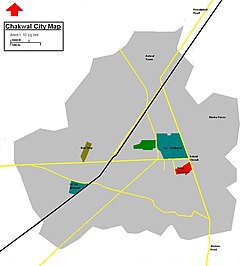
.jpg)


It is the 48th most populous city of Pakistan.[2] Chakwal is located 90 kilometres south-west of the federal capital, Islamabad and 270 kilometres from the provincial capital, Lahore. It is accessible by both the Islamabad International Airport and the Lahore International Airport.[3]
Geography
[edit]Chakwal is part of the Pothohar Plateau region, with flat to gently undulating land broken up by gullies and low hill ranges.[4] Chakwal's landscape features the canyons in Thirchak-Mahal. There are man-made and natural lakes around the city in neighbouring communities.[5] The climate is semi-arid to sub-humid, with highly erratic rainfall patterns that occur during the monsoon season, ranging from 250 mm to 1500 mm annually. These variations often cause soil erosion and occasional flooding.[4]
Administration
[edit]Chakwal was created as an independent district of Rawalpindi in 1985 by combining sub division Chakwal of district Jhelum, sub division Talagang of district Attock and the police station Choa Saidan Shah, carved out of sub division Pind Dadan Khan of district Jhelum.[6]
In addition to being the district headquarters, Chakwal city is also the administrative centre of Chakwal Tehsil (a subdivision of the district). The Chakwal District is divided into three Tehsils, namely, Kalar-Kahar, Choa Saidan Shah and Chakwal itself. The city of Chakwal itself is divided into five Union councils,[7] and Chakwal district is divided into 68 union councils.
Demographics
[edit]Population
[edit]According to 2023 census, Chakwal had a population of 218,356 - details of the population at each census are shown below (note the 1901 census was done by colonial era authorities):
| Year | Pop. | ±% p.a. |
|---|---|---|
| 1901 | 6,520 | — |
| 1951 | 13,310 | +1.44% |
| 1961 | 16,843 | +2.38% |
| 1972 | 29,143 | +5.11% |
| 1981 | 43,670 | +4.60% |
| 1998 | 80,508 | +3.66% |
| 2017 | 138,146 | +2.88% |
| 2023 | 218,356 | +7.93% |
| Sources:[8][9] | ||
Religion
[edit]| Religious group |
1881[11][12]: 520 | 1901[13]: 44 [14]: 26 | 1911[15]: 23 [16]: 19 | 1921[17]: 25 [18]: 21 | 1931[19]: 26 | 1941[10]: 32 | 2017[20] | |||||||
|---|---|---|---|---|---|---|---|---|---|---|---|---|---|---|
| Pop. | % | Pop. | % | Pop. | % | Pop. | % | Pop. | % | Pop. | % | Pop. | % | |
Islam 
|
3,279 | 57.36% | 3,853 | 59.1% | 3,834 | 59.91% | 4,442 | 59.82% | 5,585 | 58.53% | 6,684 | 56.48% | 136,235 | 98.57% |
Hinduism 
|
2,045 | 35.77% | 1,946 | 29.85% | 1,310 | 20.47% | 1,878 | 25.29% | 2,461[b] | 25.79% | 2,718[b] | 22.97% | 19 | 0.01% |
Sikhism 
|
393 | 6.87% | 717 | 11% | 1,253 | 19.58% | 1,103 | 14.86% | 1,466 | 15.36% | 2,388 | 20.18% | — | — |
Christianity 
|
— | — | 4 | 0.06% | 3 | 0.05% | 2 | 0.03% | 30 | 0.31% | 40 | 0.34% | 1,935 | 1.4% |
Ahmadiyya 
|
— | — | — | — | — | — | — | — | — | — | — | — | 25 | 0.02% |
| Others | 0 | 0% | 0 | 0% | 0 | 0% | 0 | 0% | 0 | 0% | 5 | 0.04% | 0 | 0% |
| Total population | 5,717 | 100% | 6,520 | 100% | 6,400 | 100% | 7,425 | 100% | 9,542 | 100% | 11,835 | 100% | 138,214 | 100% |
Economy
[edit]Much like the other semi-rural areas within Punjab, Chakwal has a predominantly agricultural economy, which includes a mix of livestock, wheat, crops, and groundnuts.[4] Groundnuts are particularly important for Pakistan’s economy, as the country is the 7th largest producer of groundnuts in the world.[21] Chakwal relies heavily on groundnut production because dryland crops serve as a key source of food security in semi-arid regions like this. However, the district’s agricultural production suffers from a lack of modern farming practices and outdated technology, which leads to inefficient yields; farmers mainly rely on hand-sowing methods with little to no mechanization.[22]
This agricultural economy, which is vital for both Chakwal and Pakistan as a whole, faces several natural, structural, and fiscal challenges. Farmers are highly dependent on irregular rainfall, which can cause significant crop and soil damage during periods of heavy precipitation. The region also experiences low levels of formal education, limiting the availability of skilled labor necessary for improved farming methods and mechanization.[21] Poverty and socioeconomic inequality, caused by high population growth and unemployment, further contribute to the area’s challenges. Women play an active role in agricultural labor but often have limited access to formal employment opportunities.[22]
Chakwal’s agricultural sector is also influenced by external factors, such as Pakistan’s reliance on imported groundnuts from foreign producers like India. This influx of cheaper imported groundnuts lowers local market prices and discourages domestic production.[23] Farmers and local organizations have called for government interventions to address these challenges and enhance agricultural productivity. One such proposed intervention involves expanding the value of groundnuts beyond their edible use by establishing oil extraction plants in Chakwal.[21]
Culture
[edit]Chakwal has a longstanding military tradition that predates the establishment of Pakistan. Economic hardship in the region led the British Army to recruit physically capable but unemployed workers; 460 residents were enlisted during World War I, and more followed in World War II. [24] Several soldiers from Chakwal lost their lives during these conflicts and were awarded British honors, including the Victoria Cross. The area is marked by cannons, monuments, and memorials that commemorate these contributions.[25] Some community members have expressed a desire for greater recognition of these sacrifices from Britain.[24]
After the partition of the Indian subcontinent, Chakwal remained one of the key recruitment areas and continued to produce military personnel who served in the Pakistan Armed Forces. The region has become known for its military heritage, and several individuals from Chakwal have attained high-ranking positions, including generals such as Abdul Majeed Malik. Due to Pakistan’s broader military culture, some soldiers from Chakwal, including Malik, have also held positions in political office.[25]
Notable people
[edit]- Sub. Abdul Khaliq (23 March 1933 – 10 March 1988), Fastest Man of Asia, Flying Bird of Asia, Olympian, Pride of Performance (Presidential Award) holder
- Sukh Dev, Indian Organic Chemist
- Amir Gulistan Janjua, Governor of North West Frontier Province, Ambassador to Nepal, United Arab Emirates, Kingdom of Saudi Arabia.
- Ayaz Amir, journalist, columnist, and a senior politician
- Fozia Behram, politician
- Talib Chakwali (1900–1988), Indian Urdu poet
- Sadaf Hussain, cricketer
- Colonel Imam (died January 2011), member of Special Service Group (SSG) and Inter Services Intelligence (ISI) of Pakistan Army
- Sardar Zulfiqar Ali Khan Dullah, politician
- Iftikhar Khan (10 January 1907 – 13 December 1949), designated to become the first Commander-in-Chief of Pakistan Army, died in air crash.
- Khudadad Khan (20 October 1888 – 8 March 1971), was the first South Asian recipient of the Victoria Cross.
- Muhammad Khan (1910 – 23 October 1999), veteran of World War II
- Yahya Khan (4 February 1917 – 10 August 1980), third President of Pakistan
- Allah Bakhsh Malik, academic, researcher, development economist, social scientist, management and institutional development specialist
- Madan Mohan, music director of India
- Malik Munawar Khan Awan, Major rank officer in the Pakistan Army
- Lt. General Abdul Qayyum, retired three-star General
- Manmohan Singh, former Prime Minister of India
- Awais Zia, cricketer
- Mudassar Ali Khan, former Field Hockey Player of Pakistan and Olympian
See also
[edit]Notes
[edit]- ^ 1881-1941: Data for the entirety of the town of Chakwal, which included Chakwal Municipality.[10]: 32
- ^ a b 1931-1941: Including Ad-Dharmis
References
[edit]- ^ a b "PAKISTAN: Provinces and Major Cities (Chakwal city)". citypopulation.de website. Retrieved 15 October 2021.
- ^ Chakwal is the 66th largest city per population in Pakistan Tageo.com website, Retrieved 15 October 2021
- ^ Tayeba Batool (23 February 2019). "A walk through the historic streets of Chakwal". The Express Tribune (newspaper). Retrieved 15 October 2021.
- ^ a b c "SA-AS009 - Chakwal (Pakistan)". mel.cgiar.org. Retrieved 5 October 2025.
- ^ Adamson, Hilary; Shaw, Isobel (1981). A traveller's guide to Pakistan. Asian Study Group.
- ^ "Chakwal | Punjab Portal". www.punjab.gov.pk. Archived from the original on 20 December 2016. Retrieved 20 October 2021.
- ^ "Tehsils & Unions in the District of Chakwal". National Reconstruction Bureau, Government of Pakistan website. 2 December 2007. Archived from the original on 24 January 2008. Retrieved 15 October 2021.
- ^ "Population by administrative units 1951-1998" (PDF). Pakistan Bureau of Statistics.
- ^ Chakwāl Town - Imperial Gazetteer of India, volume 10: p. 126
- ^ a b "CENSUS OF INDIA, 1941 VOLUME VI PUNJAB". Retrieved 9 January 2024.
- ^ "Census of India, 1881 Report on the Census of the Panjáb Taken on the 17th of February 1881, vol. I." 1881. JSTOR saoa.crl.25057656. Retrieved 14 January 2024.
- ^ "Census of India, 1881 Report on the Census of the Panjáb Taken on the 17th of February 1881, vol. II". 1881. JSTOR saoa.crl.25057657. Retrieved 14 January 2024.
- ^ "Census of India 1901. Vol. 1A, India. Pt. 2, Tables". 1901. JSTOR saoa.crl.25352838. Retrieved 9 January 2024.
- ^ "Census of India 1901. [Vol. 17A]. Imperial tables, I-VIII, X-XV, XVII and XVIII for the Punjab, with the native states under the political control of the Punjab Government, and for the North-west Frontier Province". 1901. JSTOR saoa.crl.25363739. Retrieved 9 January 2024.
- ^ "Census of India, 1911. Vol. 1., Pt. 2, Tables". 1911. JSTOR saoa.crl.25393779. Retrieved 9 January 2024.
- ^ "Census of India 1911. Vol. 14, Punjab. Pt. 2, Tables". 1911. JSTOR saoa.crl.25393788. Retrieved 9 January 2024.
- ^ "Census of India 1921. Vol. 1, India. Pt. 2, Tables". 1921. JSTOR saoa.crl.25394121. Retrieved 9 January 2024.
- ^ "Census of India 1921. Vol. 15, Punjab and Delhi. Pt. 2, Tables". 1921. JSTOR saoa.crl.25430165. Retrieved 9 January 2024.
- ^ "CENSUS OF INDIA, 1931 VOLUME XVII PUNJAB PART II TABLES". Retrieved 9 January 2024.
- ^ "Final Results (Census-2017)". Retrieved 27 January 2024.
- ^ a b c Dhakku, Nabeel Anwar (20 December 2015). "Groundnut farmers lament low production, lack of govt attention". Dawn. Retrieved 5 October 2025.
- ^ a b Rasheed, Muhammad Taseer; Hussain, Safdar; Saboor, Abdul (30 June 2023). "Assessing Technical Efficiency and Resource Utilization in Dryland Groundnut Farming: A Case Study of Tehsil Chakwal". Global Economics Review. 8 (2): 268–276. doi:10.31703/ger.2023(VIII-II).20. ISSN 2707-0093.
- ^ "Pakistan's groundnut farmers thrive amid India trade ban". Arab News PK. 2 December 2019. Retrieved 5 October 2025.
- ^ a b Dhakku, Nabeel Anwar (10 August 2014). "A village of forgotten heroes". Dawn. Retrieved 5 October 2025.
- ^ a b Dhakku, Nabeel Anwar (25 January 2024). "Which way will 'martial' Chakwal vote". Dawn. Retrieved 5 October 2025.
External links
[edit]
Chakwal
View on GrokipediaChakwal District is an administrative division in the Punjab province of Pakistan, with Chakwal city serving as its headquarters.[1] It occupies 6,525 square kilometers in the Pothohar Plateau region, bounded by coordinates from 32°33' to 33°12' north latitude and 71°48' to 73°16' east longitude.[2][3] The district's population stood at 1,734,854 in the 2023 census, predominantly rural with agriculture and livestock as primary economic activities.[3] It comprises five tehsils and 71 union councils, supporting crops such as wheat alongside mineral resources that contribute to local industry.[1]
The district's terrain features steppe-like climate conditions, with summers extending from April to October and reliance on small dams for irrigation across 11,089 acres.[4][5] Economically, Chakwal emphasizes farming on 1,619,265 acres of total land, including forests and uncultivated areas, while its strategic location in northern Punjab fosters transportation links within Rawalpindi Division.[1][6] Notable for its rural character—over 88% of residents live outside urban centers—the district maintains high educational access with 1,201 institutions reported.[7][1]
History
Ancient and Medieval Periods
The region of Chakwal, situated on the Pothohar Plateau, preserves evidence of prehistoric human activity associated with the Soanian culture, a Paleolithic technological tradition characterized by chopper-chopping tools found in the Soan Valley and surrounding Siwalik Hills, dating to the Middle Pleistocene epoch (approximately 500,000–125,000 years ago). Archaeological surveys in the district have documented over 20 sites spanning pre-historic to proto-historic periods, including two proto-historic settlements in Mehro Pelo village featuring early lithic artifacts and structural remains indicative of rudimentary habitation.[8] These findings underscore the area's role as a cradle for early hominid tool-making traditions in northern Punjab, distinct from but contemporaneous with broader South Asian Paleolithic developments.[9] During the early medieval period, Chakwal emerged as a center of Hindu religious architecture under the Hindu Shahi dynasty (c. 615–950 CE), with the Katas Raj temple complex—comprising multiple shrines encircling a sacred pool—constructed primarily as a Shiva pilgrimage site, incorporating elements of Gupta-era stylistic influences adapted locally.[10] Similarly, the Malot Fort and its adjoining red sandstone temples, erected around 980 CE by Raja Mal Khan of the Janjua Rajputs, demonstrate a synthesis of Kashmiri trabeate construction and Hellenistic decorative motifs, such as Corinthian-inspired capitals, reflecting cross-cultural exchanges in the [Salt Range](/page/Salt Range) foothills.[11] These structures, fortified against regional threats, highlight the defensive and devotional priorities of pre-Islamic rulers in the area.[12] In the subsequent medieval phase (c. 10th–15th centuries), control of the Chakwal tract shifted among local Rajput lineages, including the Dogra and Khokhar clans, who dominated the Pothohar landscape amid the decline of Hindu Shahi power and the rise of Delhi Sultanate incursions into Punjab.[13] The Khokhars, known for their resistance to early Muslim expansions in the 12th–13th centuries, maintained semi-autonomous hill forts in the region, fostering a martial agrarian society tied to tribal allegiances rather than centralized imperial oversight.[14] This era's material culture, evidenced by scattered masonry ruins and commemorative samadhis blending indigenous and Persianate elements, attests to gradual Islamic influences prior to full Mughal consolidation, though primary governance remained decentralized among feudal chieftains.[15]Colonial Era and 1857 War
The annexation of Punjab by the British East India Company in 1849, following victory in the Second Anglo-Sikh War, incorporated the Chakwal region into the newly formed Punjab Province as part of Jhelum district. Administrative consolidation under British rule emphasized revenue collection through land settlements and canal irrigation projects, which extended to Jhelum district, fostering agricultural improvements amid the area's semi-arid terrain.[16] By the late 19th century, Chakwal's population stood at 164,912 according to the 1891 Census of India, reflecting a mix of agrarian communities with emerging ties to colonial infrastructure.[17] In 1881, Chakwal was elevated to tehsil headquarters within Jhelum district, marking a key administrative milestone that centralized local governance, taxation, and judicial functions under British oversight.[18] This status facilitated recruitment into the British Indian Army, drawing on the region's martial tribes such as Awan and Janjua, driven by economic pressures and promises of land grants; Chakwal's proximity to military cantonments in Jhelum amplified this role, contributing to Punjab's reputation as a recruiting ground for loyal sepoy units.[19] During the 1857 Rebellion—known to British sources as the Sepoy Mutiny—the Punjab Province, including Jhelum district and Chakwal tehsil, exhibited strong loyalty to colonial authorities, with no documented uprisings in the area.[20] Local Punjabi chieftains, Muslim and Sikh alike, provided troops and logistics to reinforce British forces, aiding the suppression of mutinies in Delhi and beyond; this allegiance stemmed from recent annexation dynamics, where British policies favored Punjab's elites over potential solidarity with Bengal sepoys.[19] Punjab's regiments, including those recruitable from Jhelum, played pivotal roles in recapturing key sites, solidifying the province's strategic value to the Crown post-rebellion.[21]Post-Partition Developments
Following the partition of British India on August 14, 1947, Chakwal tehsil, previously part of Jhelum district in Punjab province, was integrated into the newly formed Dominion of Pakistan without territorial contestation, as the region had a Muslim-majority population.[18] The immediate aftermath involved large-scale migration, with most of the area's Hindu and Sikh communities departing for India amid communal violence, leaving behind abandoned temples and gurdwaras whose lands were often encroached upon by locals or repurposed without official intervention.[22] This demographic shift solidified Chakwal's Muslim character, with remaining non-Muslim sites falling into disrepair due to lack of maintenance and community displacement.[23] Chakwal retained its status as a tehsil within Jhelum district in post-independence Punjab, benefiting from provincial administrative frameworks focused on rehabilitation of migrants and agricultural stabilization.[24] The region's martial traditions, rooted in pre-partition recruitment for British Indian Army units, persisted, with Chakwal emerging as a primary source of personnel for the Pakistan Army; villages like Dulmial alone contributed five lieutenant generals, 23 brigadiers, and numerous junior officers by the late 20th century, outpacing other areas in officer production.[25] [26] This military emphasis supported local economic stability through pensions and remittances, though broader infrastructure lagged behind urban centers. Administrative reforms culminated in Chakwal's elevation to full district status on July 1, 1985, under President General Zia-ul-Haq, by amalgamating the Chakwal tehsil from Jhelum, Talagang from Attock, and parts of Pind Dadan Khan, enhancing local governance autonomy.[27] [28] Post-upgrade developments included the establishment of a District Public School in the late 1980s to bolster education, alongside incremental improvements in roads and public services amid Punjab's wider economic push.[27] The district's economy leaned on subsistence agriculture, mining in the Salt Range, and labor migration to the Middle East starting in the 1980s, fostering modest remittances-driven growth without major industrial hubs.[13] By the 1990s, sub-divisions like Choa Saidan Shah were formalized, aiding decentralized administration.[24]Geography
Location and Topography
Chakwal District is located in the northern region of Punjab province, Pakistan, within the Pothohar Plateau.[29] The district headquarters, the city of Chakwal, sits at an elevation of 498 meters above sea level.[29] Geographically, it lies approximately 90 kilometers southwest of Islamabad, the national capital.[30] The district encompasses an area of 1,864,934 acres, featuring the undulating terrain typical of the Pothohar Plateau, including low hills, ravines, ridges, gullies, and troughs characteristic of badlands topography.[29][31] In the southern portions, the landscape transitions into the more rugged Salt Range, a series of hills and low mountains that form part of the district's boundary and include its highest elevations.[32][33] The Salt Range extends across Chakwal and neighboring districts, contributing to the region's varied topography with steep slopes and elevated plateaus.[33]Climate and Natural Resources
Chakwal district exhibits a semi-arid to steppe climate, marked by pronounced seasonal variations and low overall humidity. Summers commence in April and persist through October, with peak heat in May and June when daytime temperatures routinely climb to 40–45°C. Winters set in from November, featuring cooler conditions with nighttime lows occasionally approaching 0°C and daytime highs around 15–20°C in December and January. Diurnal temperature swings are significant, often exceeding 15°C due to the district's inland location on the Potwar Plateau.[4] Precipitation is erratic and insufficient for intensive irrigation, averaging 558–635 mm annually in this predominantly barani (rain-fed) region, with the bulk falling during the July–September monsoon influenced by southwestern winds. Dry spells dominate the rest of the year, contributing to drought risks and reliance on stored soil moisture for crops; historical data from 1979–2014 indicate variability between 500–1,000 mm, underscoring the district's vulnerability to climate fluctuations.[34][35] The district's natural resources stem from its Salt Range geology, encompassing Paleozoic to Tertiary formations rich in evaporites and sediments. Key minerals include coal (notably in the Patala Formation near Choa Saiden Shah), gypsum, limestone, fireclay, dolomite, bentonite, argillaceous clay, rock salt, and silica sand, with active mining operations extracting these for construction, cement production, and industrial uses. Coal seams vary in thickness and quality, supporting small-scale extraction but posing environmental challenges like acid mine drainage and heavy metal leaching into local aquifers.[36][37][38] Agricultural potential is constrained by shallow soils and water scarcity, favoring rain-fed cultivation of drought-resistant crops such as wheat, gram, barley, and oilseeds on about 33% of the rain-dependent arid zone's cultivated area; groundwater, recharged mainly by episodic rains, shows variable suitability for irrigation due to elevated total dissolved solids in some zones. Sparse subtropical thorny scrub forests cover hilly tracts, providing limited fodder and fuelwood, while ongoing mineral exploration hints at untapped hydrocarbons, though confirmed reserves remain modest compared to national aggregates.[39][40]Administration
Tehsils and Union Councils
Chakwal District is administratively subdivided into five tehsils: Chakwal, Choa Saidan Shah, Kallar Kahar, Lawa, and Talagang.[24] Each tehsil is governed by a tehsil council and tehsil nazim, overseeing local administration, revenue collection, and development projects within their jurisdiction.[41] These tehsils are further divided into union councils, the primary units of local governance comprising clusters of villages or urban neighborhoods. The district contains 71 union councils in total, which handle grassroots functions such as sanitation, minor roads, water management, and community dispute resolution under the Punjab Local Government Act 2019.[1] [41] Union councils are led by elected chairpersons and general councilors, with boundaries delineated to reflect population and geographic coherence as per the latest delimitations by the Election Commission of Pakistan.[42] Chakwal Tehsil, encompassing the district headquarters, includes multiple numbered union councils such as UC No. 1 (Thanil Kamal), UC No. 2 (Mangwal), and others extending to rural peripheries like Bheen and Chak Umra.[41] Talagang Tehsil features union councils covering areas like Bhilomar, Bidher, and Jhatla, supporting its semi-rural and agricultural base.[42] Kallar Kahar and the recently carved Lawa Tehsil (established in 2022) manage union councils in the southern salt range regions, including locales near Kallar Kahar town. Choa Saidan Shah Tehsil administers union councils in its compact, shrine-centered territory. These subdivisions ensure decentralized service delivery, with union councils often integrating with municipal committees in urban centers like Chakwal and Talagang.[41][42]Governance and Political Representation
The administration of Chakwal District is led by a Deputy Commissioner appointed by the Punjab government, who serves as the chief executive officer coordinating revenue collection, development projects, public services, and coordination with provincial authorities. The position was held by Quratul Ain Malik until her transfer on April 8, 2025, after which the role was assumed by a new appointee from the Pakistan Administrative Service.[43] Local governance operates under the Punjab Local Government Act, featuring a District Council as the primary elected body for district-wide planning and oversight, supplemented by six Municipal Committees responsible for urban services in Chakwal, Talagang, Choa Saidan Shah, Kallar Kahar, Lawa, and Naurang.[44] These bodies handle municipal functions such as sanitation, water supply, and local taxation, with chairpersons elected periodically.[2] Chakwal District contributes three constituencies to the National Assembly of Pakistan—NA-58, NA-59, and NA-60—covering its tehsils and enabling representation of local interests in federal legislation, including defense and economic policies relevant to the region's military recruitment patterns.[45] At the provincial level, the district encompasses four to six seats in the Punjab Assembly, such as PP-20 through PP-24, where members address regional issues like infrastructure and agriculture through the assembly in Lahore.[46] [47] Electoral politics in Chakwal is marked by clan-based (biradari) loyalties and competition among established families, often aligned with parties like Pakistan Muslim League-Nawaz (PML-N) or independents with ties to Pakistan Muslim League-Quaid (PML-Q) legacies, as seen in the 2024 general elections where traditional rivalries dominated campaigns.[48] The district's high military enlistment history influences candidate profiles, with several ex-servicemen contesting seats, reflecting voter preferences for disciplined leadership amid rural-conservative demographics.[26] Voter turnout in recent polls, such as the February 8, 2024, elections, hovered around provincial averages, shaped by family networks rather than ideological shifts.[49]Demographics
Population Trends and Census Data
According to the 1998 Population Census of Pakistan, Chakwal District had a recorded population of 1,083,725.[50] The 2017 census reported a population of 1,495,463, marking an average annual growth rate of 1.71% from 1998 to 2017; this period saw an urban proportion of approximately 22.9%.[51][50] The 2023 census enumerated 1,734,854 residents, with 288,997 households and an average household size of 6.00 persons; the average annual growth rate from 2017 to 2023 accelerated to 2.51%.[52]| Census Year | Population | Avg. Annual Growth Rate (from prior census) | Households | Avg. Household Size |
|---|---|---|---|---|
| 1998 | 1,083,725 | - | - | - |
| 2017 | 1,495,463 | 1.71% | - | - |
| 2023 | 1,734,854 | 2.51% | 288,997 | 6.00 |
Ethnic, Linguistic, and Religious Composition
The ethnic composition of Chakwal district reflects the tribal structure typical of the Pothohar region in Punjab, Pakistan, with no official census data on ethnicity due to the absence of such categorization in national surveys. Major groups include the Awans, who form a significant portion of the population and are historically associated with landownership and military service in the area. Other prominent tribes are the Mair-Minhas Rajputs, Kassar Mughals, Kahut Quraish, and various Rajput clans such as Bhatti and Khokhar, which dominate rural landholding patterns, particularly in the Dhani sub-region. These groups trace their settlement to Mughal-era migrations and earlier periods, with Awans, Minhas, and Mughals often cited as foundational landowning families in historical accounts of the district.[13][54] Linguistically, the district's inhabitants predominantly speak Punjabi, with the Dhani dialect prevailing in rural areas as a transitional variety blending elements of western Punjabi (Lahnda), Saraiki, and Hindko influences. Urban and educated populations also use Majhi Punjabi, the standard dialect, alongside Urdu as the national language and English for administrative and professional purposes. Pashto is spoken by a minority, primarily among migrant communities from northern regions.[55][56] Religiously, the population is overwhelmingly Muslim, comprising over 99% according to district gazetteer assessments aligned with 2017 census trends, with Sunni Islam as the dominant sect. Religious minorities, mainly Christians, account for less than 1% and are concentrated in urban pockets, reflecting post-Partition migrations and conversions. No significant Hindu, Ahmadi, or other communities are reported in recent data.[57]Economy
Agriculture and Primary Industries
Agriculture in Chakwal district relies predominantly on rain-fed (barani) systems due to the arid Pothohar plateau topography, with limited irrigation covering only 10,894 acres out of a total district area of 1,619,265 acres. Uncultivated land spans 831,772 acres, reflecting challenges from low rainfall (250-300 mm annually) and soil constraints in this low-input subsistence farming zone. Wheat serves as the principal staple crop, vital for food security in rain-fed Punjab areas, while groundnut functions as a key cash crop in the wheat-groundnut rotation pattern practiced across much of the district. Other crops include pulses such as gram, oilseeds, sorghum, millet, maize, chickpea, canola, and guar, grown in patches to diversify output amid variable monsoon dependence.[1][58][59] Livestock integration bolsters agricultural resilience, with cattle predominant among holdings (present in 70% of sample households), alongside sheep, goats, buffaloes, and poultry for milk, meat, and draft power. This subsector supports rural incomes through low-input rearing, though precise district-level populations remain underreported; Punjab province overall dominates national livestock shares, with Chakwal contributing via density metrics comparable to regional averages (around 3.4 animals per hectare in similar districts). Forestry remains marginal, encompassing 143,377 acres of scrub forests managed by the Chakwal Forest Division (totaling 150,250 acres including 375 km of roadside plantations), primarily yielding fuelwood rather than commercial timber, amid scrub vegetation suited to semi-arid conditions.[1][60][61][62] Mining constitutes a secondary primary industry, exploiting coal seams in the eastern Salt Range near Choa Saidan Shah (with cluster operations dating to early 20th-century development) and salt at Makrach mines (2,142 acres leased, room-and-pillar method on Pre-Cambrian horizons). Limestone quarrying feeds local cement factories, while deposits of gypsum, fireclay, bentonite, argillaceous clay, dolomite, rock salt, and silica sand support extractive activities, though environmental impacts like vegetation degradation and water contamination from open-cast operations pose ongoing concerns. These sectors employ locals but lag behind agriculture in economic dominance, with no major processing industries noted.[63][64][37]Manufacturing, Services, and Remittances
The manufacturing sector in Chakwal district remains small-scale and agro-oriented, primarily consisting of textile spinning and weaving mills, flour and feed mills, and cement production. Notable facilities include Al-Abbas Fabrics Mills and Rizwan Textile Mills, focused on fabric production.[65] Among small industries, non-metallic mineral products dominate at 33% of the total, driven by cement manufacturing such as the Bestway Cement factory, described as one of Asia's largest. Food production accounts for 20% of small industries, supporting local agro-processing.[66][67] In September 2025, the Punjab government approved a new cement plant, potentially expanding capacity amid regional demand for construction materials.[68] The services sector is underdeveloped relative to agriculture, with limited formal infrastructure but growing potential in trade, construction, and private management services. The Chakwal Chamber of Commerce highlights opportunities in construction and small-scale support industries. In March 2021, special economic zones were established in Chakwal, drawing Chinese investments into medical equipment, metals recycling, automobiles, and agriculture-related services, though implementation has proceeded slowly.[69][70] Remittances from overseas workers form a vital economic supplement in Chakwal, a high-migration district with 17,128 documented emigrants from 2001 to 2010, equating to 1.59% of the local population and ranking it among Pakistan's top districts for outward migration. These inflows, primarily from Gulf states and other destinations, bolster household consumption, real estate development, and poverty alleviation, though district-specific remittance volumes remain underreported in national data.[71]Military Significance
Recruitment Patterns and Contributions
Chakwal's recruitment patterns into the Pakistan Army trace back to the British colonial era, when economic hardship in the arid Pothohar Plateau prompted the enlistment of physically robust but underemployed local men as a "martial race." During World War I, the village of Dulmial in Chakwal contributed 460 soldiers to the British Indian Army—the largest from any single village in Asia—with nine fatalities, earning the community a commemorative cannon in recognition of their service.[72] This pattern persisted post-1947 partition, as Chakwal, integrated into Punjab's recruitment base, supplied personnel amid the new state's security needs against India, leveraging established regimental loyalties from Punjabi Muslim recruits.[73] Contemporary recruitment remains voluntary and competitive, driven by a mix of cultural valorization of military service, limited local employment opportunities in agriculture and small-scale industry, and army-provided welfare benefits like housing, education, and pensions that support extended families. Ethnographic studies highlight Chakwal as a designated "martial district" with dedicated infrastructure, such as selection centers and family support networks, facilitating high enlistment rates among rural youth from tribes like the Awan and Janjua.[74] While exact figures are not publicly detailed by the military, the district's per capita contribution exceeds national averages, reflecting sustained patterns from colonial "martial race" preferences now adapted to national quotas favoring Punjab's northern districts.[75] Contributions from Chakwal personnel have been notable in Pakistan's major conflicts, including the 1948, 1965, and 1971 wars with India, as well as counterinsurgency operations, though specific casualty or deployment statistics remain classified. The district's role underscores a broader reliance on regional kin networks for unit cohesion and loyalty, enhancing operational effectiveness in infantry and armored units. Local narratives emphasize sacrifice as a pathway to social mobility, with returning veterans bolstering community prestige and economic stability through remittances and land grants.[74]Installations and Strategic Role
PAF Base Murid, situated near the village of Murid in Chakwal District, Punjab, operates as a forward flying base for the Pakistan Air Force, supporting aerial operations approximately 120 kilometers northwest of Islamabad.[76] The installation facilitates rapid deployment for air defense and reconnaissance missions, leveraging its position in the northern Punjab region to cover central Pakistan's airspace.[76] The base has gained prominence for hosting unmanned aerial vehicle (UAV) and drone activities, serving as a hub for surveillance and potential strike capabilities directed eastward.[77] Its underground facilities and operational infrastructure enhance resilience against aerial threats, as evidenced by satellite imagery analysis following reported strikes in May 2025.[78] Chakwal's strategic military role extends beyond the base through its contribution to national defense logistics, bolstered by the district's rugged Salt Range terrain suitable for training and the high enlistment rates from local populations into the armed forces. This combination positions the area as a supportive node in Pakistan's layered defense strategy against regional adversaries, particularly in scenarios involving air superiority and border contingencies.[32]Education and Infrastructure
Educational Institutions and Literacy Rates
According to the 2017 Pakistan Census conducted by the Pakistan Bureau of Statistics, the literacy rate in Chakwal District for individuals aged 10 years and above was 74.64% overall, with males at 84.63% and females at 65.57%.[79] This reflects a gender gap of nearly 20 percentage points, consistent with broader patterns in rural Punjab districts where female enrollment and retention lag due to socioeconomic factors including early marriage and limited school infrastructure.[79] Urban areas within the district reported higher rates at 84.29%, compared to 71.74% in rural locales, underscoring disparities tied to access and economic opportunities.[79]| Demographic Group | Literacy Rate (10+ years, %) |
|---|---|
| Overall | 74.64 |
| Male | 84.63 |
| Female | 65.57 |
| Urban | 84.29 |
| Rural | 71.74 |
Transportation, Health, and Utilities
Chakwal's transportation infrastructure centers on road networks, with the M-2 Lahore-Islamabad Motorway providing high-speed connectivity to major cities like Lahore and Islamabad, while the Grand Trunk Road handles local and regional traffic.[87] Bus services, such as Sufi Bus Service and others, operate daily routes linking Chakwal to Rawalpindi, Lahore, and surrounding areas, supporting commuter and freight movement.[87] Railway access remains limited, as the historic Mandra-Chakwal line, dormant since the mid-20th century, has been partially dismantled for urban development, including roads and markets on former tracks; despite ministerial assurances in recent years, revival efforts have not progressed by September 2025, prompting local demands for extensions to Kallar Kahar and Sargodha to alleviate road congestion from industrial traffic like cement trucks.[88][89][90] Health services in the district are anchored by the District Headquarters (DHQ) Hospital in Chakwal city, which has received revamping investments since 2016-17 for infrastructure upgrades, including specialized units for burns, alongside the Tehsil Headquarters (THQ) Hospital in Talagang for secondary care.[91][92] Basic Health Units (BHUs) and rural health centers provide primary care, though household satisfaction rates in Chakwal fall below 91%, reflecting gaps in staffing, medicines, and accessibility compared to urban Punjab averages.[93] Punjab-wide data from 2022 indicates the district's facilities align with regional trends, with over 1,000 public institutions province-wide but persistent challenges in remote tehsils like those in Chakwal.[94] Utilities in Chakwal face reliability issues, with electricity distributed via Islamabad Electric Supply Company (IESCO) networks, bolstered by the 500kV Chakwal Substation whose construction started in 2020 to enhance grid capacity amid growing industrial demand.[95][96] Storms in July 2025 caused outages across five feeders, affecting areas like Talagang and Pind Dadan Khan, highlighting vulnerability in transmission infrastructure.[97] Water supply lags, with 2017 census data showing only 17.2% of households relying on tap water district-wide, supplemented by hand pumps (86.42% with indoor access overall) but strained by shortages; schemes approved in 2013 and 2015 for urban piping from local dams remain unexecuted or delayed as of 2019, depriving 65% of city residents of piped clean water.[98][99][100]Culture and Heritage
Local Traditions and Festivals
Chakwal's local traditions are deeply rooted in Sufi devotional practices and rural Punjabi customs, manifesting primarily through annual melas and urs celebrations at shrines, which blend religious observance with community sports, music, and dance. These events emphasize martial and equestrian skills reflective of the region's Awan tribal heritage, including tent pegging, kabaddi, and horse dances, alongside spiritual elements like qawwali and dhamal.[101][102] Mela Karsal, a 104-year-old festival held in Karsal village approximately 26 km west of Chakwal city, centers on the shrine of Sufi saint Hazrat Syed Walait Shah and has historically featured horse dances, shooting ball matches, kabaddi competitions, karah bull fights, daali processions, and performances by renowned artists such as Nusrat Fateh Ali Khan and Noor Jehan. The event underscores Sufi traditions through communal dhamaal dances and gatherings, drawing participants for both spiritual and cultural exchange. In October 2024, the fair was abruptly halted by local authorities for lacking formal permission, leading to the cancellation of scheduled activities like tent pegging and resulting in legal action against organizers.[101] The annual Mela Choa Saiden Shah, honoring Sufi saint Hazrat Saidan Shah Shirazi in the town of Choa Saiden Shah, incorporates qawwali recitations, naat poetry, and dhamal dances alongside bustling bazaars selling local handicrafts, foods, and attire, funfair rides, and traditional sports including kabaddi, tent pegging, and kushti wrestling. This gathering serves as a vital social hub for rural communities to reconnect, preserve cultural practices, and celebrate the valley's spiritual legacy through a mix of devotion and entertainment.[102] Other urs observances, such as the Urs of Chak Mastali, highlight Chakwal's religious heritage with folk music performances characterized by rhythmic beats and traditional dances in colorful attire, fostering expressions of local identity tied to shrine veneration. These festivals collectively perpetuate undiluted agrarian and martial customs, often organized without modern bureaucratic oversight until recent interventions, prioritizing communal participation over commercial spectacle.[103]Historical Sites and Landmarks
The historical sites and landmarks of Chakwal District in Punjab, Pakistan, encompass remnants of prehistoric Soan Valley settlements, ancient Buddhist and Hindu structures, and Mughal-era monuments, underscoring the region's layered archaeological significance spanning millennia. Evidence from excavations in the Soan Valley indicates human activity dating back to the Paleolithic era, with stone tools and fossils providing insights into early civilizations, though specific monumental landmarks from this period are scarce and primarily consist of scattered artifacts rather than intact structures.[104] Later layers reveal Buddhist influences, followed by prominent Hindu temple complexes from the early medieval period, reflecting the area's role in regional religious and cultural exchanges prior to Islamic conquests. Katas Raj Temples, located near Choa Saidanshah approximately 15 kilometers southwest of Chakwal city, form a pivotal Hindu temple complex centered around a sacred pond believed in Hindu tradition to have originated from the tears of Shiva mourning the death of his wife Sati. The site includes the Satgraha group of seven ancient temples, remnants of a Buddhist stupa estimated to date to the 3rd century BCE during the reign of Ashoka, and several medieval havelis (mansions) used by pilgrims and priests. Attributed primarily to the Hindu Shahi dynasty (circa 615–950 CE), the temples exhibit architectural features such as intricate stone carvings and interconnected walkways, with historical records noting their use by pilgrims until the partition of India in 1947; the complex underwent partial restoration in the early 21st century to preserve its structures against weathering.[105][106] Malot Temples, situated in the Salt Range near Pind Dadan Khan but within Chakwal District's influence, comprise a cluster of 10th-century Hindu temples built during the Hindu Shahi period, showcasing a rare fusion of Kashmiri trabeate construction with Hellenistic column motifs likely influenced by earlier Greco-Bactrian interactions. The site, accessible via hilly terrain, includes fortified elements suggesting defensive purposes, and archaeological surveys have identified inscriptions and sculptures indicative of Shaivite worship; its remote location has preserved much of the original masonry, though erosion poses ongoing threats.[107] In Kallar Kahar, a town 25 kilometers southeast of Chakwal, the Takht-e-Babri (Throne of Babur) marks a Mughal landmark where Emperor Babur reportedly rested and composed verses during his 1519 and 1525 campaigns, as documented in his memoirs Baburnama. This stone platform overlooks the Kallar Kahar Lake, a natural saline body at 500 meters elevation surrounded by peacocks, which Babur praised for its scenic beauty; the site also features a 19th-century garden complex developed under British colonial influence but rooted in the area's pre-Mughal strategic importance along trade routes.[106][108]Notable People
Military Figures
Major General Muhammad Akbar Khan (1897–1993), born in Chakwal to a Minhas Rajput family, was the first Muslim general in the British Indian Army and the senior-most officer (PA-1) in the Pakistan Army after independence. He participated in both World Wars, earning recognition for his leadership in artillery and cavalry units.[109][110] Field Marshal Muhammad Yahya Khan (1917–1980), born in Chakwal, served as Chief of Army Staff from 1966 to 1971 and as President of Pakistan from 1969 to 1971. He commanded forces during the 1965 Indo-Pakistani War and oversaw the 1971 conflict, which led to the secession of East Pakistan.[109] Lieutenant General Abdul Qayyum (retired), a three-star general from Chakwal District, held key positions including Chairman of the Pakistan Ordnance Factories from 2003 to 2004 and later Chairman of Pakistan Steel Mills.[111] Chakwal's villages, such as Dulmial, have contributed disproportionately to Pakistan's military, producing five lieutenant generals and 23 brigadiers since partition, alongside World War I veterans like Captain Ghulam Mohammad Malik, who received a 12-pounder cannon as a gallantry award now displayed in his village.[72][112]Political, Academic, and Cultural Icons
Ayaz Amir, a journalist, columnist, and politician associated with Chakwal, has represented the constituency in the National Assembly of Pakistan and served as a federal minister in the Pakistan Muslim League (Nawaz) government.[111][109] Fozia Behram, born in Chakwal, is a politician with the Pakistan Peoples Party who was elected to the National Assembly from NA-60 Chakwal in the 2013 general elections, focusing on women's rights and local development issues.[109] Manmohan Singh (1932–2024), born on September 26, 1932, in Gah village of Chakwal district, emerged as a leading academic economist, earning a PhD from Oxford University and influencing economic policy through roles such as Chief Economic Adviser to the Indian government in 1972 and Governor of the Reserve Bank of India from 1997 to 2003 before entering politics.[113] Talib Chakwali (1900–1988), born in Chakwal, was an Urdu poet recognized for his contributions to classical Urdu literature, including works reflecting local Punjabi influences and traditional themes.[109]References
- https://en.wikivoyage.org/wiki/Chakwal