Hubbry Logo
TimergaraTimergaraMain
Open search
Timergara
Community hub
Timergara
logo
8 pages, 0 posts
0 subscribers
Be the first to start a discussion here.
Timergara
Timergara
from Wikipedia

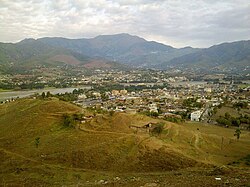
Timergara (Pashto: تيمرګره, Urdu: تیمرگرہ) is a city and the district headquarters of the Lower Dir District and temporary headquarter of newly established Central Dir District in Khyber Pakhtunkhwa, Pakistan. Timergara city is located on the east bank of the Panjkora River. It lies at an altitude of 823 metres (2,700 ft). The town is the site of excavated graves of Indo-Aryans, dating from 1500 to 600 BC. On the west side of the Panjkora River is the excavated site of Balambat. The site has been occupied continuously since the time of the Indo-Aryans in 1500 BC. Discoveries included houses dating from 500 BC and fire altars, showing that the people followed early Vedic Hinduism which revolved around fire worshipping. The areas early political history is defined by the control of the Hindu Shahis, artifacts and ruins from the period is found throughout the region.[1] At the 2023 Census, the town had a population of 47,860. Most of the main city lies on the bank of the river Panjkora, which separates Balambat from the main city.

Key Information

Timergara fields in winter

Public Universities in Timergara Dir Lower

[edit]
  • University of Dir
  • Virtual University of Pakistan Timergara Campus
  • Timergara Medical College (Rani) pending from 2015
  • Government College of Technology Kandaro Balambat Timergara
  • Government Post Graduate college Timergara
  • Government Girls Post Graduate college Timergara
  • Government Girls Post Graduate college Balambat
  • Abdul Wali Khan university Mardan Timergara Campus

Education demographics in Timergara Lower Dir

[edit]

The total gross enrollment ratio is 73.83%[2] excluding Kachi and 79.59% including Kachi class. Student–teacher ratio is 43 students per teacher. There are 41 boys per male teacher and 46 girls per female teacher.

According to the recent Universal Primary Education (UPE) survey, the total number of children in the age group 5–7 years is 104,498[3] in which 56,937 [3] are boys and 47,561 are girls. Due to the limited access, the number of out-of-school children among the age group 5–7 years is 25,169.[3] Almost 24% children of the total (age group 5–7 years) are out of school, in which 19% are boys and 30% are girls. These figures also include the dropout students of both genders.

Economy

[edit]

The area has a weak agriculture infrastructure with no industry. The economy is completely based on the remittances sent back to the area by people (mainly males) living in the Middle East.[citation needed]

People

[edit]

The people of Timergara are mainly Pashtun. The main tribes are Yousafzai, Ibrahimkhel, Utmankhel ghilzai Tajiks and Umarkhel Tor Baba (Abdur Rahim Khan), Timergara Babaje and Jaloo Baba were the prominent religious figures of this area.[4] Abdur Rahim Khan migrated from Mandal (Bajawar Agency) in the late seventeenth century and settled in Timergara. He was known as Tor Baba for his piousness. Abdur Rahim Khan and Akhund Ilyas (d. 1676) were disciples of Shaikh Adam Binori. The Mandal (clan of Utmankheil) in Timergara or mostly called Shaikhan are the descendants of Baba Abdur Rahim Khan.[5]

Climate

[edit]

The summer season is hot and arid while the winter is cold and wet. A steep rise in temperature occurs from May to June, and then is very hot from July to the end of August. However, the weather becomes cooler, especially at night, during September. A rapid fall in temperature occurs from October onwards. The coldest months are December and January. The mean minimum temperature recorded for the month of January is −8 °C.

Rainfall mostly occurs in the months of July, August, December, January and February. Towards the end of cold weather, there are occasional thunderstorms and hailstorms. Timergara is equally affected by global warming and climatic changes. In 2010, along with snowfall, heavy floods occurred which resulted in heavy damage to the infrastructure of the city. In March 2014, the Panjkora river's level began rising again, which was a threat to the Balambat bridge.[citation needed]

Food

[edit]

Popular foods are fish and beef cooked as Chapli Kabab, Seekh Kabab, and tikka. A Tandoor (oven) for baking bread is present in many houses. Many inhabitants eat Lobya (Beans), Saag and Juwar Doday (bread of Maize). Lassi and Saag with Sookrak (sweet bread of Maize) are also offered to guests.

Dress and ornaments

[edit]

The people generally wear typical Pashtun dress. During the winter season, men wear a Chadar (a long piece of cloth, mostly used to make the body warm) around the body along with Kameez (shirt) and Shalwar. Women typically wear Shalwar Kameez and Burqa. A Chitrali woolen cap is used in winter, while a typical white Diroji cap is worn in the summer. Peshawari Chappal (leather sandals) are the most common footwear among men.

Festivals and fairs

[edit]

Festivals and fairs are a part of the Pashtun culture. The most important festivals are the two Eids (Eid al-Adha and Eid al-Fitr). Apart from that, most youngsters hike in the hills of Kumrat, Lowari Pass, Laram, Shahi and Oshery in pleasant weather.

Demographics

[edit]

Population

[edit]
Historical population
YearPop.±% p.a.
1951...—    
1961...—    
1972...—    
1981...—    
199844,335—    
201740,314−0.50%
202347,860+2.90%
Sources:[6][7]

As of the 2023 census, Timergara had a population of 47,860.[8][9]

Transport

[edit]

Timergara connects Bajawar, Dir Upper and Chitral to the rest of Khyber Pukhtunkhwa. Timergara has two busy bypass roads that connect different areas. The nearest airport is Peshawar International Airport, about ninety-eight miles away. The buses, taxis and private vehicles are the main means of transport.

Sports

[edit]

There is no public sports ground but the people of khungi payeen village make for themselves a very beautiful ground in the bank of river. Football players play their football and cricketers play Cricket and also players play volleyball. There is no proper facility available for players to play a professional sports. The area has produced some prominent players in different sports i.e. Naseem Shah, Imran Khan and Israrullah (cricket), Murtaza Ahmad (hockey) and Irfan Ahmad (badminton). These players have represented Pakistan in different types of international cricket and provincial and regional teams in different games. The youngsters have a great passion for sports like cricket, football, basketball, volleyball, and hockey. Rest House Ground and FC Ground (Balambat) are the two main sporting events sites. The residents have made small grounds for sports facilities on the banks of rivers and as well as at the bottom of mountains.

Health facilities

[edit]

The main healthcare facility is District Headquarters Hospital Timergara. There are many more private hospitals and a number of hospitals available for ladies' treatment. MSF (Médecins Sans Frontières), an international NGO, is supporting parts of the District Headquarters Hospital e.g. Maternity, Accident, Emergency and Newborn Unit.

The pioneer practitioner of this area was the late Dr. Burhan Uddin (1942–2009). He provided primary health care to the people of this area when no hospital existed.[citation needed]

See also

[edit]

References

[edit]
Revisions and contributorsEdit on WikipediaRead on Wikipedia
from Grokipedia
Timergara is a and tehsil headquarters in , province, , serving as the district's administrative center. Located on the eastern bank of the Panjkora River at an elevation of 823 meters (2,700 ft), it is a key settlement in the region bordered by Swat to the east, Upper Dir to the north, Malakand and Bajaur to the south, and to the west. The holds significant archaeological importance as the site of protohistoric graves linked to the , representing Indo-Aryan influences from approximately 1500 to 600 BC, with notable excavations at Timergara itself and the nearby Balambat site across the river. The , of which Timergara is the largest city, was formed in 1996 through the division of the former Dir District into Upper and Lower Dir. According to the 2023 census, the Timergara has a of 596,173, while the broader encompasses 1,650,183 residents across an area of 1,583 square kilometers. The is predominantly Pashtun, with as the primary language, alongside some Kohistani and Gujri speakers, and the area features a rural landscape dotted with villages and bazaars along major roads. Timergara's economy is predominantly agrarian, relying on the fertile lands along the Panjkora River for cultivating crops such as , , , and tobacco, though it faces challenges from limited irrigation infrastructure and lack of industrial development. The region also benefits from its proximity to the Hindu Kush mountains and scenic valleys, fostering potential in and adventure activities, while historical sites contribute to tourism; in June 2025, a Tourist Facilitation Center was established at Zolam Bridge to support visitors. and healthcare facilities, including colleges and hospitals in Timergara, support the local population, with ongoing government initiatives aimed at improving connectivity and public services.

Geography

Location and topography

Timergara, the headquarters of , is situated in the province of , at coordinates approximately 34°49′40″N 71°50′30″E. The city lies at an elevation of 823 meters (2,700 feet) above . Positioned on the east bank of the Panjkora River in the Dir Valley, Timergara serves as the administrative center of , which was established in 1996 through the division of the former Dir District. The district, encompassing an area of 1,583 km², features boundaries with Upper Dir and to the north and northwest, Swat to the east, Malakand and Bajaur to the south and southwest, and to the west. The topography of the region is characterized by hilly and mountainous terrain within the range, where the Panjkora River acts as a vital waterway shaping local settlement patterns and supporting agricultural activities along its valley. This river, originating from glaciers, flows through the district, contributing to the area's relatively more level plains compared to neighboring Upper Dir while still dominated by rugged elevations.

Climate

Timergara experiences a hot-summer (Köppen Csa), characterized by hot summers and cold, wet winters, with weather patterns influenced by the summer and winter western disturbances. Summer temperatures peak from to , with average highs reaching 35–36°C and extremes up to 40°C, while winters feature mean minimum temperatures around 2–5°C in . Annual averages approximately 685 mm, predominantly occurring during the winter season due to western disturbances and the period from July to September. The region is prone to environmental risks such as flash floods, exemplified by the 2010 Panjkora River flooding, which severely damaged local including bridges and roads. Occasional snowfall occurs in higher elevations surrounding Timergara, contributing to seasonal variability. Recent trends indicate increasing variability in , with more frequent and intense events, including heavier rainfall and floods, attributed to as documented in provincial reports through 2025. River valleys in the area amplify rainfall distribution, exacerbating flood risks during heavy ; the August 2025 flash floods affected parts of , including areas near Lower Dir.

History

Ancient and medieval periods

Timergara's prehistoric significance is evidenced by the discovery of Indo-Aryan graves dating from approximately 1500 to 600 BC, marking early human activity in the region. The , located on the of the Panjkora River, demonstrates continuous occupation since 1500 BC, with remnants including and altars indicative of early Vedic religious practices centered on . These findings, excavated in the 1960s, highlight the site's role as a persistent settlement through the late Bronze and early Iron Ages. Excavations across the Panjkora River have uncovered graves characteristic of the , containing weapons such as iron daggers and horse bits, jewelry including bronze hairpins, gold and silver earrings, and beads, as well as human remains in the form of skeletons, charred bones, and urn burials. These artifacts, spanning periods from around 1500–1200 BC (inflexed burials in stone-lined pits) to 800– (fractional burials with iron tools), reflect evolving funerary practices and in the area. At Balambat, structures including houses dating to 500 BC further illustrate emerging settled communities. The region's archaeological record positions Timergara as a crucial site for understanding into northwestern , with the serving as a key indicator of these movements through new , ceramics, and the introduction of . Balambat's long-term habitation also provides insights into early , transitioning from protohistoric cemeteries to structured settlements that supported . In 2025, eight new ancient sites were identified across , including a 1,200-year-old temple in Barikot near Swat and Buddhist remains in Tokardara, underscoring the area's ongoing archaeological value for tracing cultural continuities from prehistoric to early historic eras. During the medieval period, Timergara and surrounding Lower Dir fell under the rule of the Hindu Shahis from the 8th to 11th centuries AD, with systematic surveys identifying 225 sites in the region, including 54 in the densely occupied Mayar valley featuring defensive watchtowers on hilltops near strategic passes. This dynasty, ruling circa 822–1026 CE, maintained control over northwestern Pakistan, emphasizing fortified architecture for socio-political and military purposes. The transition to Muslim rule occurred under the in the late 10th and early 11th centuries, following their conquests that overthrew the Hindu Shahis across the broader region. Architectural remnants from this transitional era are reflected in structures like the wooden Baba Jee Mosque in central Timergara, constructed around 1899 but incorporating intricate wood carvings and ceiling designs influenced by earlier Islamic styles from the Mughal period, which drew on medieval precedents.

Modern development

Timergara, as part of the of Dir, remained under British suzerainty during the colonial period until the in 1947. Following independence, the state acceded to on February 18, 1948, maintaining its status as a princely state within the new . Post-independence administrative reforms transformed the region significantly. The of Dir was abolished on July 28, 1969, by presidential order, and the area was reorganized as Dir District in 1970 under the . Further division occurred on June 28, 1996, when Dir District was split into Upper Dir and Lower Dir, with Timergara established as the headquarters of the latter. In recent decades, Timergara and Lower Dir have faced major challenges from , notably the 2010 floods that caused widespread damage, including the destruction of tube wells and schemes along the Panjkora River. More recently, flash floods in August 2025 resulted in 5 fatalities and significant damage to in Timergara, exacerbating vulnerabilities to climate-related events. Recovery initiatives post-2010 have focused on rebuilding efforts, such as road network improvements and expansions in educational to enhance connectivity and access. Development milestones in the and have bolstered the area's educational landscape. The University of Dir was established in 2021 in Timergara, evolving from a campus of Abdul Wali Khan University to a full public institution. Similarly, Timergara Medical College was inaugurated on July 4, 2015, with construction completing by 2023 and academic sessions set to begin in 2025, addressing regional healthcare training needs. Amid these advances, the local economy has increasingly depended on remittances from overseas workers, with a significant portion of the relying on them as they migrate for livelihoods, alongside declining agricultural output due to persistent and flood vulnerabilities.

Demographics

Population and growth

According to the 2023 , Timergara has a of 47,860 residents. The annual growth rate stood at +2.90% between and 2023, reflecting steady urban expansion in the region. Historical trends indicate significant growth, with the population recorded at 40,314 in the . This increase has been driven primarily by rural-to-urban migration within , alongside inflows supported by remittances from overseas workers. The population is predominantly Pashtun, aligning with broader demographic patterns in Lower Dir. The district has a of 97.2 males per 100 females as of the 2023 . As the headquarters of Lower Dir District, Timergara functions as a key commercial hub, drawing residents and traders from surrounding rural villages for markets, services, and administrative functions. Ongoing infrastructure developments such as road improvements and bridge constructions in the area include approved projects like a Kambar bypass road and a Darul Aman facility. Timergara faces demographic challenges typical of rapidly urbanizing areas in Pakistan, including a high youth population where approximately 64% of the district's residents are under 25 years old as of the 2023 census. The literacy rate in the district for the population aged 10 and over is 57.4% as of 2023.

Ethnic groups and languages

Timergara's population is predominantly composed of Pashtuns, primarily from the Yousafzai and Utmankhel subtribes, alongside small minorities such as Gujars and other groups. Pashto serves as the primary spoken language among the populace, with the Yusufzai dialect being the most prevalent form; Urdu functions as the official language and primary medium of education, while English is employed in higher education settings. The area's cultural homogeneity is reinforced by adherence to the code, a traditional Pashtun ethical framework emphasizing values like (melmastia), honor (nang), and (badal), which profoundly influences social norms and interpersonal relations. Migration patterns, including seasonal movements from adjacent tribal areas and labor outflows to urban centers, contribute to local dynamics while preserving the overarching Pashtun identity. Recent demographic shifts include a minor influx of returnees from the , driven by labor migration cycles, though this has not appreciably diversified the ethnic composition in a of approximately 47,860 residents as of 2023.

Economy

Agriculture and natural resources

Agriculture in Timergara, the headquarters of in , , forms a foundational part of the local economy, contributing modestly to the district's GDP through subsistence and small-scale commercial farming. The fertile valleys along the Panjkora River support the cultivation of major staple crops such as , , and , which dominate the cropped area of approximately 46,701 hectares (as of 2012-13). also plays a key role, with fruits like apples, walnuts, and persimmons grown in terraced orchards, leveraging the region's for high-value produce. rearing, including , goats, sheep, and buffaloes, accounts for a substantial portion of agricultural value—mirroring national trends where it comprises about 60% of the sector's output—providing , , and draft power to rural households. The district's mountainous terrain severely constrains agricultural expansion, with only about 30% of the total geographical area of 1,583 square kilometers (158,300 hectares) under cultivation, limiting large-scale mechanization and crop diversification. exacerbates these issues, as reliance on rainfed systems and irregular channels affects a significant number of farms, leading to inconsistent yields. Recent reports from 2022 to 2025 highlight the impacts of , including erratic rainfall and rising temperatures, which have contributed to plummeting farm outputs in Dir, with national crop production declining by up to 13.5% in fiscal year 2024-25 due to similar environmental pressures. Natural resources in the region are primarily tied to farm-based , which boasts supporting timber production and harvested from the 77,515 hectares of forest cover. Poultry farming is an emerging sub-sector, with operations gaining traction as a supplementary source for smallholders. There is no significant activity contributing to the agricultural economy. Sustainability efforts include government initiatives like credit from the (ZTBL) for irrigation improvements, such as drip systems and solar tube wells, though these are hampered by broader national agricultural challenges, including structural inefficiencies and declining sectoral growth. Remittances from overseas workers briefly supplement farm incomes, enabling investments in inputs and equipment.

Employment and remittances

The labor landscape in Timergara, the administrative center of , is dominated by , which accounted for approximately 47% of total in 2012–13, with skilled agricultural and fisheries workers comprising 46% of the occupational groups. However, rural is increasingly shifting toward non-farm sectors, including services (22% of jobs) and (19%), driven by limited on-farm opportunities and seasonal labor demands. remains a pressing issue, exacerbating economic pressures amid national youth unemployment trends around 10%. Micro-enterprises, such as local shops and service-oriented businesses, play a vital role in generating , with an average of 4.75 jobs per enterprise across surveyed operations in Timergara, contributing to positive growth in local income generation despite challenges like financial constraints and shortages. Remittances from overseas workers serve as a primary economic driver in Timergara and Lower Dir, where migration has been substantial, with the district contributing over 352,000 migrants between 1981 and 2018, ranking fifth nationally. Significant outflows target the , particularly and the , supporting household incomes and welfare; recipient families report enhanced access to and healthcare, with remittances comprising a key portion of revenue in migrant-dependent areas. Out-migration for livelihoods is substantial in the district, underscoring remittances' role in alleviation and . The absence of major industrial facilities in Timergara limits formal to just 1.4% of , with small-scale and sectors heavily reliant on seasonal labor migration to sustain operations. Economic vulnerabilities are heightened by constrained access to farm credit, which pushes more households toward remittance dependence as an alternative to agricultural . National reports from 2023–2025 highlight Dir District's susceptibility to climate-disrupted jobs, including flood-related losses in that further incentivize migration and non-farm shifts.

Infrastructure

Education

Timergara, as the administrative center of in , , hosts a range of educational institutions serving a predominantly rural where remains low, particularly among females. According to the Pakistan Social and Living Standards Measurement (PSLM) 2018-19 survey, the district's overall rate (age 10+) was 56.92%, with male at 71.35% and female at 43.16%, reflecting significant disparities in rural areas that constitute 93.82% of the . Primary enrollment rates in have improved, with gross enrollment exceeding 90% in recent surveys, though district-specific challenges in retention persist. Higher education in Timergara has expanded in recent years to address regional needs. The University of Dir, established on 23 November 2021 as an independent public institution previously affiliated with Abdul Wali Khan University Mardan, offers undergraduate and graduate programs focused on local development. Timergara Medical College, established in 2015 and affiliated with , is in the process of becoming operational, with efforts to launch the 2025-26 academic session ongoing as of November 2025. The Government Postgraduate College Timergara, under the Higher Education Department, delivers BS degrees in fields such as , , , , , and Health & . Additionally, the Government College of Management Sciences Timergara specializes in commerce and business administration programs. The Regional Campus, approved in 2019, supports distance learning with 12 study centers and serves over 2,945 students annually through flexible programs. Primary and secondary education in Timergara includes both government and private institutions emphasizing STEM and health sciences. Government schools form the backbone, supplemented by private entities like Pakistan Leadership College, which focuses on pre-medical, pre-engineering, and computer science curricula to prepare students for competitive exams. Similarly, SPS College Timergara, part of a regional chain, offers English-medium instruction from nursery to grade 10 with an emphasis on science and technology. Educational challenges in Timergara persist, including low rural and access barriers, but post-2020 expansions have aimed to mitigate out-of-school children through upgrades and affiliations. Several colleges in Timergara, such as Al-Azhar College of Education and Government Postgraduate College, are affiliated with the University of Malakand for advanced degree programs, enhancing local higher education options and enrollment.

Health facilities

Timergara's primary medical institution is the District Headquarters Hospital (DHQ), a 1,305-bed facility providing basic and emergency care to residents of . The hospital handles routine services such as general medicine, surgery, and obstetrics, serving as the main referral center for the region's approximately 1.65 million inhabitants. In 2021, international organizations like (MSF) supported enhancements to its newborn unit, maternity ward, and systems before transitioning operations to local authorities. The Timergara Medical College, affiliated with the DHQ Hospital as its teaching facility, is in the process of becoming operational, with a submitted for the 2025-26 MBBS session to address local healthcare needs. Upgrades to the DHQ Hospital to meet standards have integrated with clinical practice, enabling hands-on training in specialties like . Primary health centers (PHCs) and basic health units across Lower Dir supplement these efforts, delivering outpatient care, vaccinations, and maternal services to the district's rural population. Infectious disease management forms a key aspect of local services, with studies highlighting high burdens of conditions like . A 2023 cross-sectional study of dyspepsia patients in Timergara reported a 73.3% of H. pylori , underscoring the need for targeted diagnostics and treatment in gastrointestinal care. PHCs focus on preventive measures, including routine screenings for endemic infections prevalent in the area's water and challenges. Access to advanced care remains constrained, with rural residents in Lower Dir facing barriers due to geographic isolation and limited transportation to Timergara's urban facilities. Post-2010 floods, which damaged infrastructure, prompted recovery initiatives that improved response capabilities by 2025 through expansions and equipment donations. However, shortages of specialists persist, often requiring referrals to for complex procedures like or . Public health priorities emphasize maternal and child health, where high needs stem from elevated risks of and infectious diseases among vulnerable groups. Government initiatives under the Health Systems Strengthening Program provide vaccinations and nutritional support, achieving partial coverage through PHCs and campaigns. Despite these, gaps in pediatric and obstetric care contribute to suboptimal outcomes, with rates lagging due to hesitancy and logistical hurdles in remote areas. Despite announcements, the Timergara Medical College's full operations have been delayed, with academic activities expected to start in the 2025-26 session. The DHQ Hospital underwent expansion to 1,305 beds in 2025 to support teaching and increased demand.

Transport

Timergara's primary connectivity is through the road network, with the main access route being the N-45 National Highway, also known as the Swat-Chitral Highway, which links the city to approximately 170 km southwest, typically taking 2 to 3 hours by car depending on road conditions and traffic. This highway facilitates onward connections to , about 250 km southeast, with a driving time of around 4 hours via the M-1 Motorway and N-5. Local roads within the district, including links from Balambat to Timergara and to Kalpani Maidan, have undergone improvements following the severe damage caused by the 2010 floods, which affected bridges and approaches over the Panjkora River and other waterways. Public transportation options include intercity bus services connecting Timergara to major urban centers such as , , and even long-haul routes to , which can exceed 20 hours due to the distance of over 1,500 km. Within the district and to nearby areas like Swat, Hiace vans and pick-up vehicles provide frequent intra-regional service, while auto-rickshaws and three-wheelers handle short-distance local travel in urban and rural parts of Timergara. There is no railway infrastructure serving the area, as ' network does not extend to . The nearest airport is Peshawar International Airport (PEW), located about 98 km southwest, offering domestic and international flights, though the drive along N-45 takes roughly 3 hours; Saidu Sharif Airport (SDT) in neighboring Swat District is closer at approximately 48 km straight-line distance but has limited commercial operations. Timergara itself lacks a dedicated airstrip or airport. Challenges in transport include frequent traffic congestion and seasonal disruptions due to the mountainous terrain and river crossings, such as the Panjkora, which can lead to delays during monsoons. The Communication and Works (C&W) Department of Khyber Pakhtunkhwa is overseeing several upgrade schemes, including the design and construction of a grade-separated intersection at Shaheed Chowk in Timergara and widening of N-45's Chakdara-Timergara section (39 km), with ongoing foreign-funded projects aimed for completion by 2025 to enhance safety and capacity.

Culture

Festivals and traditions

Timergara, as the administrative center of in , , observes festivals and traditions deeply rooted in its predominantly Pashtun population and Islamic faith. The district's residents, nearly 100% Muslim according to provincial demographics, integrate religious observances with Pashtun cultural practices, shaping communal life around faith-based events and honor codes. The primary festivals are Eid al-Fitr and Eid al-Adha, marking the end of Ramadan and the Hajj pilgrimage, respectively. These celebrations involve communal prayers at local mosques, followed by family gatherings and feasts that emphasize charity and reconciliation. In Lower Dir, including Timergara, Eid observances often align with moon-sighting decisions from the nearby Malakand division, leading to synchronized festivities across the region, though occasional local variations occur based on traditional sightings. Local fairs accompany these Eids, featuring temporary markets and social interactions that reinforce community bonds, though no major non-Islamic events are held due to the uniform Muslim demographic. A notable local festival is Jashn-e-Dir, which features traditional dance, music, and crafts, celebrating the region's heritage. Central to daily and ceremonial traditions is , the unwritten Pashtun code of honor, which governs —known as melmastia—by mandating protection and generosity toward guests, and dispute resolution through tribal councils or jirgas that prioritize mediation over violence. This code permeates social interactions in Timergara, reflecting the area's Pashtun ethnic heritage. Wedding customs exemplify these traditions, with elaborate processions, music from instruments like the rabab, and communal dancing such as the to celebrate unions, often drawing large crowds to showcase cultural continuity, as seen in a 2021 traditional ceremony in Lower Dir that highlighted Pashtun rituals. Community events further enliven cultural expression, including festivals that promote heritage through performances. A notable example was the two-week festival in Timergara's Sheen Ghar area, organized by local governments, which included colorful cultural shows to foster brotherhood and highlight the region's potential.

Cuisine and attire

The cuisine of Timergara reflects the Pashtun heritage of Lower Dir, emphasizing hearty, spice-infused dishes prepared with locally sourced ingredients. Staple foods include , a flat minced meat patty made from or mutton blended with , seeds, green chilies, and onions, often fried in and served as a daily . Freshly baked , a soft , accompanies most meals, while —a spiced greens dish—provides a simple yet flavorful staple influenced by the region's agricultural bounty. Local contributes significantly, with walnuts consumed raw or incorporated into dishes for their nutty flavor, and boiled or ground into flour for everyday porridges and breads. Dairy products like and are common, adding creaminess to meals, and serves as a ubiquitous beverage, often sweetened and shared throughout the day. Food in Timergara is typically shared in communal settings, underscoring the Pashtun value of hospitality known as melmastia, where meals bring families and guests together around simple, abundant spreads. During festivals like Eid, these staples are enhanced with special preparations of meats, though daily habits remain focused on modest, home-cooked fare. Traditional attire in Timergara embodies Pashtun modesty and tribal identity, with both men and women favoring the shalwar kameez—a loose tunic paired with baggy trousers—for its comfort and cultural significance. Men often complete the outfit with a waistcoat and a pakol cap or turban, which signifies regional pride and protection from the elements. Women wear embroidered shalwar kameez ensembles draped with a dupatta scarf, featuring intricate handwoven patterns that highlight local craftsmanship and femininity. Silver jewelry, including necklaces, bangles, and earrings, adorns women during daily life and special occasions, serving as symbols of heritage and status. Due to Timergara's cold winters, regional variations include heavier fabrics and shawls for added warmth, with men incorporating a chadar—a long cloth—over their for insulation. In urban areas by , younger residents blend these traditions with modern influences, such as fitted Western-style or jackets paired with traditional elements, reflecting evolving tastes while preserving core cultural motifs.

Sports and recreation

Sports in Timergara primarily revolve around popular team activities such as , football, , and hockey, which are widely played by the youth on makeshift grounds due to limited formal . The city features only one primary sports field in Timergara City, which serves multiple disciplines but has deteriorated over years without maintenance, highlighting a lack of in sports development. Additional venues include the Rest House Ground and FC Ground in nearby Balambat, along with the Lal Qilla Sports Stadium in Maidan, inaugurated in 2016 to host local events. Emerging trends include women's participation in , with local girls training and competing at regional levels. Notable athletes from the area include cricketer , known for his in international matches, and hockey player Murtaza Ahmad. Recreational activities in Timergara emphasize outdoor tied to the natural , including walking tracks and riverbank areas along the Panjkora . The River offers spaces for picnics and casual gatherings, while development projects initiated in 2022 aim to establish formal parks and in Timergara and adjacent Chakdara, covering over 300 kanals at a cost of PKR 40 million to enhance community recreation. These initiatives, including a dedicated playground opposite the Chakdara railway station, seek to address the of organized facilities and promote amid the region's mountainous . and also see informal play in improvised mountain-base areas, fostering despite infrastructural challenges.

References

Add your contribution
Related Hubs
User Avatar
No comments yet.