Hubbry Logo
ChawanChawanMain
Open search
Chawan
Community hub
Chawan
logo
8 pages, 0 posts
0 subscribers
Be the first to start a discussion here.
Chawan
Chawan
from Wikipedia

Chawan
White raku tea bowl named "Fuji-san" by Honami Kōetsu, Edo period, 17th century (National Treasure)
Chinese name
Chinese茶碗
Literal meaning"tea bowl"
Transcriptions
Standard Mandarin
Hanyu Pinyincháwǎn
Middle Chinese
Middle Chinese/ɖˠa.ʔuɑnX/
Old Chinese
Zhengzhang/*rlaː.qoːnʔ/
Alternate Chinese name
Traditional Chinese茶盞
Simplified Chinese茶盏
Literal meaning"tea cup"
Transcriptions
Standard Mandarin
Hanyu Pinyincházhăn
Wade–Gilesch'a2chan3
Vietnamese name
Vietnamese alphabettrà oản
Chữ Hán茶碗
Korean name
Hangul찻사발, 다완
Hanjan/a, 茶碗
Literal meaning"tea bowl"
Transcriptions
Revised Romanizationchat-sabal, dawan
McCune–Reischauerch'a-sabal, tawan
Japanese name
Kanji茶碗
Kanaちゃわん
Transcriptions
Revised Hepburnchawan

A chawan (茶碗; literally "tea bowl") is a bowl used for preparing and drinking tea. Many types of chawan are used in East Asian tea ceremonies.

History

[edit]
Ido chawan (井戸茶碗) named "Kizaemon" (喜左衛門), Joseon dynasty, 16th century, National Treasure
Shino type Mino ware chawan named "Furisode" (振袖), Azuchi-Momoyama to Edo period, 16th-17th century

The chawan originated in China. The earliest chawan in Japan were imported from China between the 13th and the 16th centuries.[1]

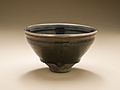
The Jian chawan, a Chinese tea bowl known as Tenmoku chawan in Japan, was the preferred tea bowl for the Japanese tea ceremony until the 16th century.[2] In Japan, tea was also mainly drunk from this Chinese variety of tea bowls until about the 15th century.[3] The Japanese term tenmoku is derived from the name of the Tianmu Mountain, where Japanese priests acquired these tea bowls from Chinese temples to bring back to Japan, according to tradition.[4]

An 11th-century resident of Fujian wrote about the Jian tea wares:

Tea is of light colour and looks best in black cups. The cups made at Jianyang are bluish-black in colour, marked like the fur of a hare. Being of rather thick fabric, they retain the heat, so that when once warmed through, they cool very slowly, and they are additionally valued on this account. None of the cups produced at other places can rival these. Blue and white cups are not used by those who give tea-tasting parties.[5]

By the end of the Kamakura period (1185–1333), as the custom of tea drinking spread throughout Japan and the Tenmoku chawan became desired by all ranks of society, the Japanese began to make their own copies in Seto (in present-day Aichi Prefecture).[6] Although the Tenmoku chawan was derived from the original Chinese that came in various colors, shapes, and designs, the Japanese particularly liked the bowls with a tapered shape, so most Seto-made Tenmoku chawan had this shape.[6]

With the rise of the wabi tea ceremony in the late Muromachi period (1336–1573), the Ido chawan, which originated from a Met-Saabal or a large bowl used for rice in Korea, also became highly prized in Japan.[7] These Korean-influenced bowls were favored by the tea master Sen no Rikyū because of their rough simplicity.[8]

Over time and with the development of the Japanese tea ceremony as a distinct form, local Japanese pottery and porcelain became more highly priced and developed. Around the Edo period, the chawan was often made in Japan. The most esteemed pieces for a tea ceremony chawan are raku ware, Hagi ware, and Karatsu ware. A saying in the tea ceremony schools for the preferred types of chawan relates: "Raku first, Hagi second, Karatsu third."[9]

Another chawan type that became slightly popular during the Edo period from abroad was the Annan ware from Vietnam (Annam), which were originally used there as rice bowls. Annan ware is blue and white, with a high foot.

Usage

[edit]

A cloth called chakin (茶巾) is used to wipe the bowl clean.

Normally the bowl would be wrapped in an orange turmeric-coloured cloth called ukon-nuno (ウコン布) for storage in the box, which apparently helps ward insects away.

A cloth bag shifuku (仕服) made out of silk or brocade can be used for storage of special tea bowls, especially for tenmoku chawan types. This is supported by four smaller cushions on each side inside the wooden box to help stabilise and protect the bowl. A more simpler cloth bag gomotsu-bukuro (御物袋) can also be used instead.

Shapes

[edit]

Japanese chawan have various shapes and types, many of which have specific names:[10]

  • Circle shape (鉄鉢形, Wa-nari)[11]
  • Wooden bowl shape (椀形, Wan-nari)[12]
  • Goki type (呉記型, Goki-gata)[13]
  • Half cylinder shape (半筒型, Han tsutsu-gata)[14]
  • Cylinder type (筒型, Tsutsu-gata)[15]
  • Go stone box type (碁笥底型, Gokezoko-gata)
  • Waist type (胴締, Dojimari-gata)[16]
  • Rider's cup (馬上杯, Bajyohai)
  • Cedar shape (杉形, Sugi-nari)[17]
  • Ido or well type (井戸型, Ido-gata)[18][19]
  • Tenmoku type (天目型, Tenmoku-gata)[20]
  • Komogai shape (Komogai-nari)[21][18] – formerly imported from the Korean port of Ungcheon-dong [ko] now part of Changwon
  • Curving lip type (端反り型, Hatazori-gata)
  • Flat shape (平形, Hira-gata)[22]
  • Horse bucket (馬盥, Badarai)
  • Clog or shoe shape (沓形, Kutsu-gata)[23]
  • Shoreline type (砂浜形, Suhama-gata)
  • Peach shape (桃形, Momo-gata)
  • Brush washer shape (筆洗形, Hissen-gata)[24]
  • Straw hat (編笠, Amikasa)
  • Triangular shape (三角形, Sankaku-gata)
  • Four sided shape (四方形, Shiho-gata)


  • Iron bowl (鉄鉢形, tetsubachi-nari / teppatsu-nari)[25]
  • Silver tenmoku (銀天目茶碗, silver tea bowl made in the tenmoku style)
[edit]

The foot (高台 Kōdai) of the Japanese chawan can be in various different shapes and sizes. The most known are:[26]

  • Ring foot (輪高台, Wa Kōdai)
  • Snake’s eye foot (蛇ノ目高台 or 普通高台, Janome or Futsū Kōdai)
  • Double foot (二重高台, Nijū Kōdai)
  • Crescent moon foot (三日月高台, Mikazuki Kōdai)
  • Shamisen plectrum foot (撥高台, Bachi Kōdai)
  • Bamboo node foot (竹節高台, Takenofushi Kōdai)
  • Cherry blossom foot (桜高台, Sakura Kōdai)
  • Four directions foot (四角高台, Shiho Kōdai)
  • Go stone box foot (碁石高台, Gokezoko-Kōdai)
  • Nail carved foot (釘彫高台, Kugibori Kōdai)
  • Spiral shell foot (貝尻高台, Kaijiri Kōdai)
  • Whirlpool foot (渦巻高台, Uzumaki Kōdai)
  • Helmet foot (兜巾, Tokin Kōdai)
  • Crinkled cloth foot (縮緬高台, Chirimen Kōdai)
  • Split foot (割高台, Wari Kōdai)
  • Cut foot (切高台, Kiri Kōdai)
  • Two split foot (割一文字高台, Wariichimonji Kōdai)
  • Bar cut foot (釘彫高台, Kiriichimonji Kōdai)
  • Four split foot (割十文字高台, Warijūmonji Kōdai)
  • Cross cut foot (切十文字高台, Kirijūmonji Kōdai)

See also

[edit]

References

[edit]
[edit]
Revisions and contributorsEdit on WikipediaRead on Wikipedia
from Grokipedia
A chawan (茶碗), literally meaning "tea bowl" in Japanese, is a wide-mouthed ceramic vessel specifically designed for whisking, serving, and drinking , the powdered central to the traditional known as chanoyu. These bowls have roots in Chinese tea culture from the (618–907 CE), but the dark-glazed bowls favored for their ability to highlight the tea's frothy texture and color emerged during the (960–1279 CE), before being adapted and refined in Korea and over subsequent centuries. In , the chawan evolved into a profound cultural artifact during the Kamakura (1185–1333) and Muromachi (1336–1573) periods, influenced by Buddhist practices introduced via monks like , who promoted tea as a medicinal and spiritual aid in his 1211 treatise Kissa yōjōki. The form and aesthetics of the chawan reflect core principles of Japanese tea culture, including —an appreciation for imperfection, transience, and natural simplicity—prioritizing tactile warmth, balanced proportions, and subtle glaze variations (keshiki) that enhance the ritual's sensory harmony. Key types include the tall, cylindrical tsutsugata for concentrated whisking; the shallow, footed hira-chawan suited for summer use; and the iconic hand-built , developed in the late 16th century by potter Chōjirō under tea master , which became synonymous with the intimate, rustic wabi style of chanoyu. Other notable variants encompass Korean-influenced bowls from the dynasty (918–1392), prized for their crackled green glazes, and later types like those from Arita kilns during the (1603–1868), which democratized tea consumption across social classes. Beyond utility, the chawan holds immense symbolic value, embodying , , and the fleeting of life in chanoyu, a practice that spread from elite Buddhist circles to warriors, merchants, and eventually commoners by the through urban tea houses. Its production spurred regional ceramic traditions, such as Kyoto's Kyo-yaki with ornate enamels and the minimalist Bizen ware from , while famous examples—like the National Treasures designated between 1951 and 1959—represent pinnacles of artistic and national identity, often fetching extraordinary prices in historical auctions and underscoring the bowl's role as a in Japan's . Today, chawan continue to inspire contemporary potters worldwide, bridging ancient rituals with modern expressions of craft and contemplation.

Introduction

Definition and Etymology

A chawan (茶碗) is a wide-mouthed bowl specifically designed for whisking and drinking , typically measuring 11 to 16 cm in diameter to facilitate the preparation of frothy with a bamboo whisk and to allow comfortable handling with both hands. Unlike ordinary rice bowls or cups, its form emphasizes functionality for the powdered , with a stable base and interior shape that enhances the 's texture and retention during consumption. The term chawan derives from Japanese "cha" (茶), meaning "," and "wan" (碗), meaning "," directly translating to "tea bowl." This nomenclature has historical roots in the Chinese "cháwǎn" (茶碗), the original term for a tea bowl introduced via cultural exchanges during the , and shares linguistic influences with Korean "dawan" (다완), reflecting shared East Asian ceramic traditions. In English, chawan is commonly pronounced /tʃəˈwɑːn/, approximating the Japanese "cha-wahn," though romanization variations include "chawan" or "chawen" in . As a central utensil, the chawan embodies and in the , where its selection and handling underscore themes of harmony and impermanence.

Cultural Significance

The chawan exemplifies the aesthetic, which values imperfection, asymmetry, and the transient nature of beauty, often manifesting in its rustic, hand-formed shapes, uneven glazes, and subtle patinas that evoke a quiet melancholy over fleeting . These qualities contrast with opulent designs, emphasizing and the beauty inherent in natural irregularities. Within tea gatherings, the chawan fosters as guests pause to appreciate its tactile and visual details, encouraging a meditative focus on the present moment. It also embodies hospitality through the ritual of sharing a single bowl among participants, symbolizing humility and equality by diminishing social hierarchies and promoting communal harmony. As a cultural icon, the chawan has profoundly shaped Japanese arts beyond tea practice, inspiring ceramics with its emphasis on understated, imperfect forms that prioritize authenticity over precision. Similarly, its wabi-sabi principles influence ikebana, where arrangements highlight natural asymmetry and impermanence to capture the essence of transience in organic materials.

Historical Development

Origins and Influences

The chawan, or tea bowl, originated in the Song Dynasty of China (960–1279), where it served as a vessel for preparing and drinking powdered green tea through the dian cha method, involving whisking finely ground tea leaves with hot water to create a frothy beverage. These early tea bowls, particularly the tenmoku style produced at Jian kilns in Fujian province during the 12th century, featured dark stoneware bodies coated in black or iron-rich glazes that produced distinctive patterns like hare's fur or oil spots, enhancing the visual appeal during tea whisking. The form emphasized practicality for the ritualistic pouring and stirring of powdered tea, reflecting the Song era's refined tea culture among literati and monks. This Chinese tradition influenced Korean celadon production during the Goryeo period (918–1392), where potters adapted Song techniques to create jade-green glazed bowls that were later imported to as early tea vessels. Goryeo celadon tea bowls, often with flat interiors and subtle inlaid designs, arrived via maritime trade routes and were valued for their serene aesthetics, contributing to the diverse pool of continental Asian wares that shaped initial Japanese tea practices. Excavations at sites like reveal these Korean imports from the 11th to 14th centuries, used alongside Chinese examples in elite and monastic settings. The chawan was introduced to Japan in the 12th and centuries through networks and returning Buddhist monks, who brought bowls from Chinese temples on Mount Tianmu, naming them after the "heavenly eye" glaze effects. A pivotal figure in its adoption was the monk (1141–1215), who traveled to Song China in 1191 and imported seeds and knowledge, promoting consumption as a healthful aid for and in his 1214 Kissa Yōjōki ("Record of Drinking Tea for Health"). presented the book and to Shogun , establishing its initial use within monasteries, where powdered rituals supported long sessions among and clergy.

Evolution in Japanese Tea Culture

The chawan's role in Japanese tea culture began with influences from continental imports, particularly Chinese and Korean ceramics, which served as the initial models during the early development of chanoyu. During the (1336–1573), the chawan rose to prominence as tea practices evolved among the elite, with tea masters like Murata Jukō laying the groundwork for wabi aesthetics that valued simplicity and rusticity in utensils. This period marked the chawan's integration into formalized tea gatherings, where imported wares were initially prized for their refinement, but a shift toward appreciating imperfect, natural forms began to emerge. (1522–1591), active in the late Muromachi and into the Azuchi-Momoyama period, further elevated the wabi tea style, emphasizing simple, rustic chawan that embodied austerity and humility over ostentatious displays. In the , innovations under tea masters such as Takeno Jōō (1502–1555) and accelerated the chawan's transformation, promoting a deliberate move away from exclusively imported Chinese wares toward native Japanese . Jōō introduced greater creativity by incorporating both Japanese-made and select imported chawan, fostering a more inclusive aesthetic that blended local craftsmanship with wabi principles of imperfection and detachment. Rikyū built on this by championing domestically produced ceramics, including the development of the Raku style, which prioritized hand-molded, unpretentious forms to align with the philosophical depth of . This shift not only democratized access to suitable chawan but also stimulated Japanese kiln advancements, reducing reliance on foreign imports and embedding the vessel more deeply into national tea traditions. During the (1603–1868), the chawan underwent standardization and diversification, largely driven by patronage from and the shogunate, which institutionalized tea practices as a marker of social and political status. Daimyo-hosted tea gatherings reinforced hierarchical bonds, leading to the refinement of chawan production with signed works by potters like Nonomura Ninsei, who elevated ceramics to elite standards. This era saw the proliferation of specialized styles such as Shino and Oribe alongside Raku, as regional kilns catered to affluent patrons, ensuring the chawan's centrality in chanoyu while adapting to broader cultural dissemination among and merchants.

Design and Construction

Materials and Techniques

Chawans are primarily crafted from clays sourced from specific Japanese regions, such as the iron-rich clays of Tamba in Hyogo Prefecture, which provide a dense, resonant body ideal for tea utensils due to their heat retention properties. Seto clays from , known for their fine texture and workability, have been used since the medieval period to produce durable bodies that withstand repeated use in tea ceremonies. While primarily , chawan can also be made from clays, as in . These regional clays contribute to the bowls' subtle variations in color and porosity, influencing the overall tactile experience when handling . Traditional production techniques for chawan vary, including hand-building (such as for ) and wheel-throwing, allowing potters to create asymmetrical, organic shapes that embody aesthetics. After drying, the forms are trimmed and refined, often incorporating subtle imperfections to enhance their rustic appeal. Glazing follows, with application methods varying by style; for instance, temmoku glazes—iron-rich feldspathic mixtures—are brushed or dipped to achieve mottled effects like hare's fur or oil spots, where crystalline formations emerge during firing. Ash-based glazes, derived from and , are commonly used for matte, earthy finishes that promote a soft, non-reflective surface suited to chanoyu rituals. For high-fired stoneware chawan, firing occurs in wood-fueled kilns, such as the noborigama climbing kiln, which ascends a hillside to facilitate multi-chambered, prolonged heat exposure. Temperatures typically reach 1200–1300°C over extended periods—up to 60 hours or more—allowing natural ash from the firewood to melt and form incidental glazes while vitrifying the clay for enhanced durability and water resistance. In contrast, Raku ware uses low-temperature firing around 1000°C in specialized kilns followed by post-firing reduction. This high-heat process for stoneware, evolved from Song-dynasty influences, results in textured surfaces with subtle crackle or drips, where the clay's iron content interacts with the atmosphere to produce warm, earthy tones and resilient structures that age gracefully with use.

Shapes and Forms

Chawan shapes are crafted to balance functionality, , and , influencing how is whisked, served, and appreciated during the tea ceremony. These forms are broadly categorized by their profile, with variations suited to the season or the consistency of the tea being prepared. Wide and shallow bowls, often referred to as hira-gata, feature a broad mouth and low sides, providing ample surface area for the matcha to cool rapidly; this design is particularly suited for summer use when hot tea needs to be tempered quickly for comfortable drinking. In contrast, deeper forms like tsutsu-gata adopt a more cylindrical or tapered body to retain heat, making them ideal for winter ceremonies where warmth is prized. Conical profiles, seen in styles such as tenmoku-gata, offer a graceful taper from a narrower base to a wider rim, facilitating smooth whisking motions and a contemplative drinking experience. Typical proportions for chawan range from 10 to 15 cm in diameter and 7 to 10 cm in height, ensuring the bowl holds approximately 200 to 300 of while remaining and balanced for one-handed use. Ergonomic considerations are , with many designs incorporating subtle contours like a waisted groove (dojimari) for finger placement, allowing secure handling during vigorous whisking or passing the bowl in . These features promote a natural grip, reducing strain and enhancing the sensory connection to the vessel. Asymmetry plays a key role in chawan aesthetics, encouraging tactile exploration and embodying principles of imperfection. For instance, kutsu-gata bowls exhibit warped or oblong forms with uneven walls, while ido-gata styles often have irregular rims marked by subtle ribbing or spiral patterns (rokurome), inviting the user to rotate and engage the bowl fully with each sip. Such designs heighten the intimate, multisensory nature of the tea ritual without compromising usability.

Foot and Base

The foot, known as kodai in Japanese pottery, serves as the foundational support for the chawan, ensuring stability and facilitating handling during use. Low, rounded forms such as the wa kodai (ring foot) provide a broad base that enhances balance, preventing the bowl from tipping when placed on mats or other surfaces. These designs are particularly valued for their simplicity and reliability in maintaining the chawan's equilibrium. Carved variations, like the kugibori kodai (nail-carved foot), introduce textured elements that improve grip, allowing users to securely hold the hot by the base during tea preparation and serving. Unglazed sections on the foot often expose the raw clay body, offering both a tactile grip and an aesthetic contrast that highlights the material's natural qualities. This unglazed finish not only aids in practical handling but also reveals the potter's technique through visible tool marks and clay texture. In , the foot is typically formed with sufficient robustness to withstand repeated use and , often left unglazed to showcase the clay's inherent character while integrating seamlessly with the 's overall profile for optimal weight distribution. Functionally, the foot's varies to complement specific chawan shapes, enabling precise manipulation—such as lifting and rotating the bowl—essential in chanoyu rituals where the vessel is passed between participants without direct contact to the heated interior.

Types and Variations

Raku Ware Examples

Raku ware, a hallmark of Japanese tea ceremony pottery, was founded in the late 16th century by the potter Chōjirō (c. 1516–1592), who developed it in Kyoto under the guidance of the renowned tea master Sen no Rikyū (1522–1591). Chōjirō, originally a tile maker, created the first Raku chawan using hand-building techniques suited to the emerging wabi-sabi aesthetic, emphasizing simplicity, imperfection, and transience in tea utensils. This tradition has been passed down through the Raku family for over 450 years, with the current head, Raku Kichizaemon XVI (born 1981), representing the 16th generation since succeeding his father in 2019. Raku chawan are distinguished by their low-fired bodies, typically produced at temperatures around 800–1,000°C, resulting in porous, lightweight forms that feel warm to the touch and absorb moisture effectively during thick preparation. The two primary variants are kuro-raku (black Raku), featuring a dense, matte black glaze often used in formal chanoyu settings for its subdued elegance, and aka-raku (red Raku), made from iron-rich red clay with a unglazed or lightly glazed surface suited to more casual gatherings. These characteristics stem from the unique Raku firing process, where pieces are removed from the while hot and cooled rapidly, enhancing their rustic texture and asymmetry. Among the most celebrated Raku examples are Chōjirō's early chawan, such as the black-glazed "Ama-dera" bowl, now held in the , which exemplifies the bold, irregular forms that influenced principles by prioritizing natural irregularity over refined symmetry. His works, often hand-molded without a wheel using the tezukune slab-forming method, rejected ornate Chinese imports in favor of humble, everyday beauty, profoundly shaping the aesthetic of Japanese culture. Later generations, including Nonkō (2nd generation) and Dōnyū (3rd generation, also known as Nonkō), built on this foundation, producing pieces like Dōnyū's red Raku bowls that further embodied transience and intimacy in tea rituals.

Other Regional Styles

Hagi ware chawans, originating from the , are crafted from a soft, absorbent clay body that allows the vessels to gradually absorb residues, leading to distinctive color shifts and development over time—a phenomenon known as "Hagi no Nanabake" or the seven changes of Hagi. This low-fired , developed in the early under the influence of Korean potters, features coarse textures mixed with sand for robustness and often employs thick, frosty white ash or glazes that enhance the rustic warmth. Prized for their earthy feel and evolving aesthetic, Hagi chawans contrast with more formal styles by emphasizing subtle, personal transformation through daily interaction. Karatsu ware chawans, produced in the Saga Prefecture since the late 16th century, embody a rustic simplicity suited to everyday tea preparation, utilizing iron-rich black glazes alongside straw ash for cloudy, natural effects on high-fired stoneware forms. The clay, often sandy and iron-laden, yields straightforward shapes like the half-cylinder or Oku-Gorai style, with glazes that highlight wabi-sabi imperfections such as drips and speckles, reflecting Korean technical influences from the Imjin War era. These vessels prioritize unpretentious utility, their durable, unglazed or minimally glazed surfaces fostering a grounded connection to the tea ritual. Seto ware contributes high-fired variations to chawan design, drawing from Aichi Prefecture's ancient kilns established in the , where iron-rich wood-ash glazes produce celadon-like bone colors in reduction firings or bold blackish-brown tones in Seto-guro styles. Known for versatility, Seto chawans often feature smooth, translucent finishes on durable bodies, enabling diverse forms from tenmoku-inspired bowls to more experimental shapes that balance tradition with technical precision. Bizen ware offers unglazed high-fired interpretations, sourced from iron-rich clay in and subjected to prolonged wood-firing at 1,200–1,300°C, resulting in dark brown hues marked by natural effects like flame scars and ash deposits. In modern contexts, contemporary Bizen chawans by artists such as Hisamoto Kōichi maintain this 1,000-year-old tradition's emphasis on raw texture and heat retention while introducing subtle form innovations, such as asymmetrical profiles that enhance the vessel's subtle presence in settings. These pieces age gracefully, developing a yōhen that underscores their enduring, unadorned strength. These regional styles expand the spectrum of Japanese chawan craftsmanship, building on foundational pottery traditions with localized materials and firing methods that prioritize tactile diversity and natural evolution.

Usage and Rituals

Role in Chanoyu

In the formal known as chanoyu, the chawan serves as the central vessel for preparing, serving, and consuming , embodying principles of , , and aesthetic appreciation. The host meticulously selects and handles the bowl to guide guests through a sequence of actions that heighten sensory engagement, from the tactile warmth of the to the visual and olfactory qualities of the . This ritualistic use underscores the chawan's role not merely as a utensil but as a focal point for communal interaction and contemplation. The sequence begins with preparation, where the host wipes the chawan with a silk cloth called chakin to ensure purity, then adds powdered —typically 2-3 scoops for thin tea (usucha) or about 4 grams for thick tea (koicha)—along with hot water (around 80°C for usucha or less for koicha), whisking vigorously with a bamboo whisk (chasen) until frothy. This process occurs in view of the guests, allowing them to observe the bowl's form and the emerging tea's vibrant green hue. For koicha, the denser preparation requires a more robust chawan, often in muted tones like brown-glazed Seto ware to evoke seasonal sobriety. Serving follows, with the host presenting the chawan to the principal guest, who receives it with both hands—left palm supporting the base and right hand steadying the side—before rotating it twice to position the front (mizusashi side) away from themselves, a that respects the bowl's orientation and avoids drinking from the decorated front. In koicha gatherings, the bowl is shared sequentially among guests, passed hand-to-hand after each use, fostering a sense of unity; usucha is served individually to each participant. The warmth radiating from the chawan signals readiness, inviting immediate appreciation of its heft and texture. Drinking concludes the sequence, with the guest raising the chawan to eye level in a bow of before taking three deliberate sips—slurping the final one audibly to savor the last traces—then wiping the rim with a small cloth (kaishi) or paper before returning it. This measured consumption empties the bowl without excess, symbolizing restraint and completeness in the ritual. After koicha, guests may engage in haiken, a collective examination where the chawan is passed around for closer inspection of its interior and exterior. Selection of the chawan is a deliberate act guided by toriawase, the host's curation process, matching the bowl to the season (e.g., a wide, shallow form for summer's lightness or a deep, insulated one for winter), the guest's status or preferences, and the ceremony's overarching theme to ensure aesthetic and thematic harmony with other utensils. The host's presentation emphasizes the object's intrinsic qualities, such as glaze imperfections or subtle , elevating it as a transient artwork. Symbolic gestures throughout reinforce the chawan's contemplative role: guests admire the exterior's craftsmanship—tracing fingers over its surface to feel warmth, texture, and weight—before turning attention inward to the , a progression that cultivates deeper appreciation and among participants. This handling transforms the act of drinking into a meditative exchange, where the bowl's humble form invites reflection on impermanence and in .

Contemporary Applications

In contemporary Japanese households, chawan have transitioned from exclusive ceremonial roles to versatile tools for casual tea consumption, particularly for preparing and enjoying lattes or everyday infusions without the formality of chanoyu. Affordable mass-produced versions, often made from durable or simple , are widely available and favored for their practicality in daily routines, allowing users to whisk with hot milk or water in a compact, wide-mouthed that facilitates frothing and sipping directly from the rim. These , typically ranging from 150 to 300 ml in capacity, enable quick preparation in home kitchens, blending tradition with modern convenience for health-conscious consumers incorporating into breakfasts or afternoon breaks. Globally, the chawan has influenced Western ceramics and since the mid-20th century, inspiring adaptations in Zen-inspired cafes and artisanal studios that emphasize and aesthetic . In places like American tea houses and European design workshops, chawan forms are replicated or reinterpreted using local clays to serve matcha-based beverages, fostering a cross-cultural appreciation for principles in casual settings. Potters such as Willi Singleton have pioneered "American chawan," blending Japanese techniques with regional materials like creek clay to create functional bowls that support informal practices while evoking philosophical depth. Contemporary artists continue to innovate with chawan forms, pushing beyond utility into sculptural and culinary expressions that fuse traditional silhouettes with modern experimentation. Ceramicists like Miwa Neishi hand-build teabowls incorporating textured patterns and glazes inspired by music or , transforming them into standalone art pieces suitable for gallery display or enhanced dining experiences. In fusion cuisine contexts, designers adapt chawan shapes for serving innovative desserts or cocktails, where the bowl's tactile warmth and irregular contours elevate sensory engagement, as seen in collaborative works that merge ceramics with in international exhibitions.

Collecting and Legacy

Notable Specimens

One of the most renowned chawan associated with the tea master is the Kizaemon Ido, a Korean Ido ware from the 15th or , prized for its rustic, uneven form and subtle grayish glaze that embodies aesthetics of imperfection and simplicity. This specimen, designated a of , was favored by Rikyū for its unpretentious qualities and is housed at temple in , reflecting its historical provenance tied to influences in chanoyu. Another celebrated example is the red Raku tea bowl named "Jukushi," created by Hon'ami Kōetsu in the early 17th century during the Momoyama period. Crafted from red clay coated in a white glaze that formed numerous large and small bubbles during firing, the bowl features a plump, slightly distorted squat shape achieved through hand-forming, highlighting Kōetsu's innovative approach to asymmetry and tactile warmth. This piece is held in the Museum of Art in , where its unique glaze imperfections and ergonomic grip underscore its status as a , or famed utensil, in tea ceremony lore. The black Raku chawan by the first-generation Raku potter Chōjirō, dating to the late and commissioned under Rikyū's guidance, represents an early pinnacle of Japanese raku ware with its matte black glaze over a hand-molded body that emphasizes subtle cracks and organic contours for a sense of quiet profundity. Preserved in the Raku Museum in , this specimen exemplifies the shift toward domestic production in chanoyu and is part of the core collection maintained by the Raku family lineage. Many such notable chawan, including additional raku examples from Chōjirō and Kōetsu, reside in private collections of major tea schools like and Omotesenke in , where they are used in ceremonial contexts and documented in historical inventories as with provenances tracing back to influential tea masters. For instance, a 17th-century black Raku chawan attributed to the fourth-generation Raku master Ichinyū (1640–1696) fetched $11,250 at a auction in 2013, illustrating the enduring market interest in these artifacts for their historical and artistic significance.

Cultural and Economic Value

Chawan hold significant cultural value within the (chanoyu), symbolizing principles of aesthetics, impermanence, and mindful interaction, and are actively collected by practitioners who use them in rituals to deepen their understanding of tradition. Museums worldwide, such as the and the , acquire and display chawan to preserve their role in chanoyu as embodiments of artistic and philosophical heritage, often acquiring pieces through donations or purchases from private collections. Authentication typically involves examining impressed family seals on the base—such as the "Raku" seal used by the Raku family since the —and expert appraisal by specialists or tea masters who assess , glaze characteristics, and historical context to verify authenticity and lineage. Economically, chawan represent a dynamic market influenced by their scarcity and cultural prestige, with modern reproductions starting at approximately ¥10,000 for entry-level pieces suitable for contemporary chanoyu practice, while antique examples from renowned kilns like Raku command substantially higher values due to their age and association with historical tea masters. Auction trends show steady appreciation, particularly for Edo-period (1603–1868) Raku ware; for instance, a 17th-century black Raku chawan realized GBP 3,000 (about ¥500,000) at Christie's in 2016, and exceptional specimens with documented provenance have reached into the millions of yen at major sales. The Japanese art market, including auctions for items like chawan, has grown by 11% from 2019 to 2023, reaching an estimated $681 million and ranking as Asia's second-largest, driven by rising appreciation for Japanese aesthetics in Western and Asian markets, with international auctions like those at Sotheby's reporting increased participation from collectors outside Japan. Preservation efforts emphasize both traditional and institutional methods to safeguard chawan as vital artifacts of chanoyu, ensuring their continued use and study. A key technique is , the Japanese practice of mending fractured ceramics with urushi lacquer mixed with gold, silver, or platinum powders, which not only restores functionality but celebrates breakage as part of the object's history, often applied to antique chawan to maintain their ritual integrity without concealing imperfections. Museums employ advanced conservation approaches, including climate-controlled storage, non-invasive cleaning, and expert restoration by ceramicists trained in historical firing methods, to prevent degradation from environmental factors like humidity. Indirectly supporting these endeavors, UNESCO's 2013 inscription of washoku—traditional Japanese dietary culture—highlights the broader intangible heritage encompassing chanoyu elements, such as the mindful preparation and serving of with chawan, fostering global awareness and funding for related preservation initiatives through Japan's Living National Treasures program, which designates master artisans to transmit ceramic skills.

References

Add your contribution
Related Hubs
User Avatar
No comments yet.