Hubbry Logo
Spectral methodSpectral methodMain
Open search
Spectral method
Community hub
Spectral method
logo
7 pages, 0 posts
0 subscribers
Be the first to start a discussion here.
Spectral method
Spectral method
from Wikipedia

Spectral methods are a class of techniques used in applied mathematics and scientific computing to numerically solve certain differential equations. The idea is to write the solution of the differential equation as a sum of certain "basis functions" (for example, as a Fourier series which is a sum of sinusoids) and then to choose the coefficients in the sum in order to satisfy the differential equation as well as possible.

Spectral methods and finite-element methods are closely related and built on the same ideas; the main difference between them is that spectral methods use basis functions that are generally nonzero over the whole domain, while finite element methods use basis functions that are nonzero only on small subdomains (compact support). Consequently, spectral methods connect variables globally while finite elements do so locally. Partially for this reason, spectral methods have excellent error properties, with the so-called "exponential convergence" being the fastest possible, when the solution is smooth. However, there are no known three-dimensional single-domain spectral shock capturing results (shock waves are not smooth).[1] In the finite-element community, a method where the degree of the elements is very high or increases as the grid parameter h increases is sometimes called a spectral-element method.

Spectral methods can be used to solve differential equations (PDEs, ODEs, eigenvalue, etc) [2] and optimization problems. When applying spectral methods to time-dependent PDEs, the solution is typically written as a sum of basis functions with time-dependent coefficients; substituting this in the PDE yields a system of ODEs in the coefficients which can be solved using any numerical method for ODEs.[3] Eigenvalue problems for ODEs are similarly converted to matrix eigenvalue problems [citation needed].

Spectral methods were developed in a long series of papers by Steven Orszag starting in 1969 including, but not limited to, Fourier series methods for periodic geometry problems, polynomial spectral methods for finite and unbounded geometry problems, pseudospectral methods for highly nonlinear problems, and spectral iteration methods for fast solution of steady-state problems. The implementation of the spectral method is normally accomplished either with collocation or a Galerkin or a Tau approach . For very small problems, the spectral method is unique in that solutions may be written out symbolically, yielding a practical alternative to series solutions for differential equations.

Spectral methods can be computationally less expensive and easier to implement than finite element methods; they shine best when high accuracy is sought in simple domains with smooth solutions. However, because of their global nature, the matrices associated with step computation are dense and computational efficiency will quickly suffer when there are many degrees of freedom (with some exceptions, for example if matrix applications can be written as Fourier transforms). For larger problems and nonsmooth solutions, finite elements will generally work better due to sparse matrices and better modelling of discontinuities and sharp bends.

Examples of spectral methods

[edit]

A concrete, linear example

[edit]

Here we presume an understanding of basic multivariate calculus and Fourier series. If is a known, complex-valued function of two real variables, and g is periodic in x and y (that is, ) then we are interested in finding a function f(x,y) so that


where the expression on the left denotes the second partial derivatives of f in x and y, respectively. This is the Poisson equation, and can be physically interpreted as some sort of heat conduction problem, or a problem in potential theory, among other possibilities.

If we write f and g in Fourier series:

and substitute into the differential equation, we obtain this equation:

We have exchanged partial differentiation with an infinite sum, which is legitimate if we assume for instance that f has a continuous second derivative. By the uniqueness theorem for Fourier expansions, we must then equate the Fourier coefficients term by term, giving

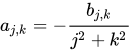
which is an explicit formula for the Fourier coefficients aj,k.

With periodic boundary conditions, the Poisson equation possesses a solution only if b0,0 = 0. Therefore, we can freely choose a0,0 which will be equal to the mean of the resolution. This corresponds to choosing the integration constant.

To turn this into an algorithm, only finitely many frequencies are solved for. This introduces an error which can be shown to be proportional to , where and is the highest frequency treated.

Algorithm

[edit]
  1. Compute the Fourier transform (bj,k) of g.
  2. Compute the Fourier transform (aj,k) of f via the formula (*).
  3. Compute f by taking an inverse Fourier transform of (aj,k).

Since we're only interested in a finite window of frequencies (of size n, say) this can be done using a fast Fourier transform algorithm. Therefore, globally the algorithm runs in time O(n log n).

Nonlinear example

[edit]

We wish to solve the forced, transient, nonlinear Burgers' equation using a spectral approach.

Given on the periodic domain , find such that

where ρ is the viscosity coefficient. In weak conservative form this becomes

where following inner product notation. Integrating by parts and using periodicity grants

To apply the Fourier–Galerkin method, choose both
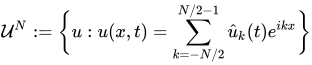
and

where . This reduces the problem to finding such that
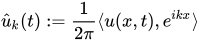
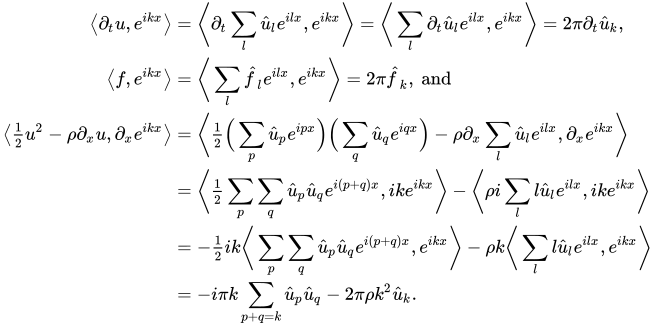
Using the orthogonality relation where is the Kronecker delta, we simplify the above three terms for each to see

Assemble the three terms for each to obtain

Dividing through by , we finally arrive at

With Fourier transformed initial conditions and forcing , this coupled system of ordinary differential equations may be integrated in time (using, e.g., a Runge Kutta technique) to find a solution. The nonlinear term is a convolution, and there are several transform-based techniques for evaluating it efficiently. See the references by Boyd and Canuto et al. for more details.

A relationship with the spectral element method

[edit]

One can show that if is infinitely differentiable, then the numerical algorithm using Fast Fourier Transforms will converge faster than any polynomial in the grid size h. That is, for any n>0, there is a such that the error is less than for all sufficiently small values of . We say that the spectral method is of order , for every n>0.

Because a spectral element method is a finite element method of very high order, there is a similarity in the convergence properties. However, whereas the spectral method is based on the eigendecomposition of the particular boundary value problem, the finite element method does not use that information and works for arbitrary elliptic boundary value problems.

See also

[edit]

References

[edit]
Revisions and contributorsEdit on WikipediaRead on Wikipedia
from Grokipedia
The spectral method is a class of numerical techniques used in applied mathematics and computational science to approximate solutions to partial differential equations (PDEs) by expanding the solution as a truncated series of global basis functions, such as Fourier series for periodic domains or orthogonal polynomials like Chebyshev or Legendre for non-periodic domains. These methods enforce the governing equations either through projection onto the basis (e.g., Galerkin approach) or by collocation at specific points, transforming the PDE into a system of ordinary differential equations (ODEs) that can be solved efficiently. Unlike local methods such as finite differences, spectral methods leverage the entire domain for approximation, achieving exponential convergence rates for smooth solutions, where the error decreases rapidly as the number of basis functions increases. Spectral methods are particularly advantageous for problems requiring high accuracy and resolution, such as those in fluid dynamics, where they demand significantly fewer degrees of freedom—approximately seven times fewer per dimension—compared to second-order finite difference schemes while delivering superior precision. The choice of basis functions is tailored to the problem's geometry and boundary conditions: Fourier bases excel in periodic settings due to their trigonometric nature, enabling straightforward handling of wave propagation and periodic flows, whereas polynomial bases like Chebyshev are preferred for bounded, non-periodic domains to manage boundary layers and singularities effectively. Error analysis in these methods typically involves estimates in Sobolev spaces, showing that for analytic solutions, the approximation error scales as O(Nm)O(N^{-m}) or better, where NN is the polynomial degree and mm reflects the solution's smoothness, often leading to machine-precision accuracy with modest NN. Applications of spectral methods span diverse fields, including the simulation of incompressible Navier-Stokes equations for turbulent flows, the heat equation, the Korteweg-de Vries (KdV) equation for solitons, and Schrödinger equations in quantum mechanics. In engineering contexts, they are employed for aeroacoustics, electromagnetics, combustion modeling, and seismic wave propagation, benefiting from their efficiency in multi-dimensional problems and ability to resolve fine-scale features in smooth regimes. Implementations often rely on spectral-collocation or spectral-Galerkin formulations, with software tools like PseudoPack facilitating practical use in both one- and multi-dimensional settings. Despite their strengths, spectral methods are most effective for problems with sufficient smoothness, as discontinuities or sharp gradients can degrade convergence, necessitating hybrid approaches with local methods in such cases.

Fundamentals

Definition and core principles

Spectral methods constitute a class of numerical techniques employed in applied mathematics and scientific computing to solve partial differential equations (PDEs) by approximating the solution through an expansion in a basis of smooth, global functions that span the entire computational domain. Unlike local methods such as finite differences or finite elements, which rely on piecewise approximations over small subdomains, spectral methods represent the solution globally, leveraging the inherent smoothness of the basis functions to achieve high accuracy. The core principles of spectral methods center on the projection of the PDE onto a finite-dimensional subspace generated by these global basis functions, typically orthogonal polynomials like Chebyshev or Legendre, or trigonometric functions for periodic problems. This approximation takes the form u(x)k=0Nu^kϕk(x)u(x) \approx \sum_{k=0}^N \hat{u}_k \phi_k(x), where {ϕk(x)}\{\phi_k(x)\} are the basis functions and u^k\hat{u}_k are the expansion coefficients determined by techniques such as Galerkin projection or collocation. The method's efficiency stems from the use of fast transforms, such as the Fast Fourier Transform (FFT) for trigonometric bases, which enable rapid computation of derivatives and projections with near-linear scaling in the number of modes NN. A key advantage of spectral methods lies in their convergence properties: for analytic or sufficiently smooth solutions, the approximation error decays exponentially with increasing NN, often reaching machine precision with modest NN values, such as around 20 modes for CC^\infty functions on simple domains. This spectral accuracy arises because the global basis captures the solution's features across the domain without introducing artificial discontinuities, making the methods particularly effective for problems with smooth, periodic, or entire-domain behavior.

Historical development

The foundations of spectral methods lie in Joseph Fourier's 1822 publication of Théorie analytique de la chaleur, where he introduced Fourier series to decompose periodic functions into trigonometric components, enabling global approximations central to later spectral techniques. This approach provided the basis for expanding solutions of partial differential equations in eigenfunction series compatible with the problem's geometry. Complementing this, Boris Galerkin developed in 1915 a weighted residual method for solving variational problems in elasticity, such as beam and plate equilibria, which evolved into the spectral Galerkin framework for projecting differential equations onto finite-dimensional subspaces. Following World War II, spectral methods gained traction in meteorology and aerodynamics for simulating complex flows. Cornelius Lanczos advanced the field in his 1956 book Applied Analysis, exploring Fourier series and orthogonal expansions for practical computational problems in physics and engineering. A major breakthrough came in 1971 when Steven Orszag applied pseudospectral methods to model turbulence, using Fourier transforms to handle nonlinear interactions efficiently while mitigating aliasing errors through techniques like the 2/3-rule filtering. Key milestones in the 1960s and 1970s further propelled spectral methods toward practicality. The fast Fourier transform (FFT) algorithm, introduced by James Cooley and John Tukey in 1965, dramatically reduced the computational complexity of Fourier-based expansions from O(N²) to O(N log N), making high-resolution simulations feasible. In the 1970s, David Gottlieb and Steven Orszag extended these ideas to Chebyshev polynomial bases for non-periodic domains, as detailed in their 1977 monograph Numerical Analysis of Spectral Methods: Theory and Applications, which analyzed convergence and stability for fluid dynamics problems. By the 1980s, spectral methods saw widespread adoption in computational fluid dynamics (CFD), solidified by the comprehensive text Spectral Methods in Fluid Dynamics by Claudio Canuto, M. Yousuff Hussaini, Alfo Quarteroni, and Thomas A. Zang in 1988, which integrated theory with implementation strategies. From the 1990s onward, spectral methods evolved to leverage parallel computing architectures, enabling large-scale simulations on distributed systems through techniques like spectral elements and domain decomposition. High-performance implementations addressed challenges in multidomain and non-periodic settings, with ongoing refinements focusing on efficiency for turbulent flows and complex geometries in aerodynamics and beyond.

Mathematical foundations

Choice of basis functions

In spectral methods, the choice of basis functions is crucial for achieving high-order accuracy in approximating solutions to differential equations. For problems on periodic domains, trigonometric functions, such as sines and cosines, serve as the primary basis due to their natural alignment with periodic boundary conditions and their ability to represent smooth periodic functions efficiently. These functions form a complete orthogonal set in the space of square-integrable periodic functions, enabling exponential convergence rates for sufficiently smooth solutions. For non-periodic domains, polynomial bases are preferred, with Chebyshev polynomials of the first kind, defined as Tn(x)=cos(narccosx)T_n(x) = \cos(n \arccos x) for x[1,1]x \in [-1, 1], being a widely adopted choice owing to their minimax properties and clustering of roots near the boundaries, which aids in boundary layer resolution. Legendre polynomials, denoted Pn(x)P_n(x), provide an alternative for non-periodic problems, particularly when uniform weighting in the inner product is desirable, as they are orthogonal with respect to the standard L2L^2 inner product on [1,1][-1, 1]. Both families ensure spectral accuracy, where the error decreases faster than any power of the polynomial degree for analytic functions. The orthogonality of these bases is fundamental to their efficacy; for Chebyshev polynomials, they satisfy 11Tm(x)Tn(x)(1x2)1/2dx=0\int_{-1}^{1} T_m(x) T_n(x) (1 - x^2)^{-1/2} \, dx = 0 for mnm \neq n, with the weight function (1x2)1/2(1 - x^2)^{-1/2} reflecting the Chebyshev measure. Legendre polynomials are orthogonal under 11Pm(x)Pn(x)dx=0\int_{-1}^{1} P_m(x) P_n(x) \, dx = 0 for mnm \neq n, normalized such that the integral equals 2/(2n+1)2/(2n+1) on the diagonal. Completeness in the L2L^2 space guarantees that any function in the space can be approximated arbitrarily well by finite expansions of these bases. Selection criteria emphasize matching the basis to the problem's domain characteristics: trigonometric bases excel for periodic settings to avoid Gibbs phenomena at boundaries, while polynomials suit bounded non-periodic domains and yield spectral accuracy for smooth functions, often outperforming finite differences by orders of magnitude in convergence rate. Boundary conditions are handled through techniques like the tau method, which enforces constraints by modifying the highest-mode coefficients, or penalty methods that add stabilizing terms without altering the basis orthogonality. Domain transformations are essential for adapting general geometries; non-interval domains are mapped to [1,1][-1, 1] via affine or more complex mappings to leverage polynomial bases, preserving smoothness to maintain high accuracy. In discrete implementations, aliasing arises from the nonlinear interaction of modes in trigonometric or polynomial expansions, necessitating de-aliasing strategies like the 3/2 rule to filter high-wavenumber artifacts and ensure stability.

Projection and discretization techniques

Spectral methods discretize partial differential equations (PDEs) by expanding the solution in a basis of global functions, such as Fourier or polynomials, and applying projection or interpolation techniques to convert the continuous problem into a discrete algebraic system. These techniques ensure high accuracy by exploiting the smoothness of the solution and the rapid convergence of the basis expansions. The choice of projection method influences the ease of implementation, handling of boundary conditions, and computational efficiency, with each approach leading to matrix equations whose properties determine the method's stability and conditioning. The Galerkin method is a weighted residual approach that projects the residual of the PDE onto the basis functions to enforce orthogonality in an inner product space. For a differential equation Lu=fLu = f with solution approximated as uN=k=0Nakϕku_N = \sum_{k=0}^N a_k \phi_k, the residual R(uN)=LuNfR(u_N) = Lu_N - f satisfies R(uN)ϕjdx=0\int R(u_N) \phi_j \, dx = 0 for j=0,,Nj = 0, \dots, N, where ϕj\phi_j are the basis functions. This leads to a stiffness matrix Ajk=ϕjLϕkdxA_{jk} = \int \phi_j L \phi_k \, dx, coupling the coefficients aka_k through the differential operator LL. The method is particularly effective for problems with periodic boundaries, as the integrals can be computed analytically for orthogonal bases, yielding sparse or diagonal mass matrices in Fourier cases. However, for non-periodic problems, numerical quadrature is required, increasing computational cost. In contrast, the collocation method, often termed pseudospectral, enforces the PDE exactly at a set of discrete points rather than through integrals, simplifying implementation for nonlinear terms. The approximation uN(xj)u_N(x_j) satisfies LuN(xj)=f(xj)L u_N(x_j) = f(x_j) at collocation points xjx_j, typically chosen as Gauss-Lobatto quadrature nodes for polynomial bases to ensure accurate interpolation and differentiation. Derivatives are approximated using differentiation matrices Djkdϕkdx(xj)D_{jk} \approx \frac{d \phi_k}{dx}(x_j), allowing the operator LL to be represented as a matrix product applied to the vector of nodal values. For Chebyshev bases, these points cluster near boundaries, improving resolution of boundary layers. The method's efficiency stems from fast transform techniques for evaluating nonlinearities, though it requires careful point selection to avoid Runge phenomena. The tau method addresses boundary conditions in polynomial approximations by perturbing the PDE with tau parameters, avoiding full projection while maintaining spectral accuracy. In this approach, the solution is expanded as uN=k=0Nakϕku_N = \sum_{k=0}^N a_k \phi_k, and the residual is projected onto lower-order basis functions, with the highest modes adjusted to satisfy boundary conditions exactly, introducing tau corrections like LuNf=m=1MτmϕNm+1L u_N - f = \sum_{m=1}^M \tau_m \phi_{N-m+1}. This method is useful for non-periodic problems where exact boundary enforcement is crucial, as it decouples the interior approximation from boundary satisfaction without additional variables. It shares similarities with Galerkin but reduces the system size for boundary-constrained problems. Regardless of the projection technique, time-independent spectral discretizations generally reduce to matrix equations of the form Au=fA \mathbf{u} = \mathbf{f}, where u\mathbf{u} collects the expansion coefficients or nodal values, and AA incorporates the operator LL in the chosen basis. The spectral radius of AA, determined by the eigenvalues of the basis and operator, governs exponential convergence rates for smooth solutions, often achieving machine precision with modest NN. However, conditioning of AA deteriorates as O(N4)O(N^4) for second-order operators in polynomial bases, necessitating preconditioning or iterative solvers for large NN; stability analysis reveals that the methods are well-conditioned for elliptic problems but require time-step restrictions in hyperbolic or parabolic cases to control error growth.

Specific methods

Fourier-based spectral methods

Fourier-based spectral methods utilize trigonometric basis functions, specifically complex exponentials or sines and cosines, to approximate solutions of partial differential equations on periodic domains. For a function u(x)u(x) defined on [0,2π][0, 2\pi] with periodic boundary conditions, the approximation takes the form uN(x)=k=N/2N/21u^keikx,u_N(x) = \sum_{k=-N/2}^{N/2-1} \hat{u}_k e^{i k x}, where the Fourier coefficients u^k\hat{u}_k are computed via the discrete Fourier transform of grid-point values at xj=2πj/Nx_j = 2\pi j / N, j=0,,N1j = 0, \dots, N-1. This expansion leverages the orthogonality of the basis functions to project the governing equations onto the spectral space, enabling high accuracy for smooth periodic functions with exponential convergence rates. Differentiation in Fourier-based methods is performed efficiently in spectral space by multiplying the coefficients by the wave number: the derivative u(x)u'(x) corresponds to coefficients iku^ki k \hat{u}_k, followed by an inverse transform to return to physical space. This approach avoids the slower convergence of finite difference schemes and preserves the structure of linear operators like the Laplacian, which becomes multiplication by k2-k^2. Energy conservation is ensured through Parseval's theorem, which states that for the periodic interval [π,π][-\pi, \pi], ππu(x)2dx=2πku^k2,\int_{-\pi}^{\pi} |u(x)|^2 \, dx = 2\pi \sum_{k} |\hat{u}_k|^2, equating the L2L^2 norm in physical space to the 2\ell^2 norm of the coefficients, a property vital for simulating conservative systems like incompressible flows. Nonlinear terms, such as products in advection equations, introduce aliasing errors when evaluated in spectral space due to the convolution theorem, where high-wavenumber interactions fold back into lower modes. To mitigate this, the 3/2-rule dealiasing technique extends the grid to 3N/23N/2 points for computing the product, padding with zeros in spectral space, and then truncates to retain only the original NN modes, eliminating quadratic aliasing while increasing computational cost by a factor of about 1.5 in one dimension. This method, originally developed for turbulence simulations, maintains stability and accuracy for nonlinear problems without excessive mode truncation. The pseudospectral implementation combines the efficiency of grid-point evaluations for nonlinearities with spectral differentiation, relying on the fast Fourier transform (FFT) for forward and inverse transforms between physical and spectral spaces. The FFT algorithm achieves O(NlogN)O(N \log N) complexity per transform, dramatically reducing the cost compared to direct summation O(N2)O(N^2), and enables practical simulations at high resolutions on periodic domains. This approach, pioneered in the early 1970s, forms the backbone of many computational fluid dynamics codes for periodic problems.

Polynomial-based spectral methods

Polynomial-based spectral methods employ orthogonal polynomial bases, such as Chebyshev or Legendre polynomials, to approximate solutions of differential equations on non-periodic domains, particularly those involving boundaries. These methods are well-suited for boundary value problems where the solution is smooth but not periodic, offering high-order accuracy through global expansions. Unlike Fourier methods, which rely on trigonometric functions for periodic settings, polynomial approaches use bases orthogonal over finite intervals like [1,1][-1, 1], enabling efficient handling of irregular geometries via domain mapping. The Chebyshev spectral method utilizes Chebyshev polynomials of the first kind, Tn(x)T_n(x), defined by the recurrence relation Tn+1(x)=2xTn(x)Tn1(x)T_{n+1}(x) = 2x T_n(x) - T_{n-1}(x) with T0(x)=1T_0(x) = 1 and T1(x)=xT_1(x) = x, orthogonal on [1,1][-1, 1] with weight (1x2)1/2(1 - x^2)^{-1/2}. In the collocation framework, interpolation nodes are chosen as the Chebyshev-Gauss-Lobatto points xj=cos(πj/N)x_j = \cos(\pi j / N), for j=0,1,,Nj = 0, 1, \dots, N, which cluster near the endpoints to resolve boundary layers effectively. Quadrature weights for integration at these nodes are ωj=π/N\omega_j = \pi / N for 1jN11 \leq j \leq N-1, and ω0=ωN=π/(2N)\omega_0 = \omega_N = \pi / (2N), facilitating accurate computation of inner products. Derivatives are computed via the differentiation matrix DD, with entries Djj=xj/(2(1xj2))D_{jj} = -x_j / (2(1 - x_j^2)) for interior points, and boundary-adjusted values like D00=(2N2+1)/6D_{00} = -(2N^2 + 1)/6, derived from Lagrange interpolation properties; higher derivatives follow by repeated matrix multiplication. The Legendre spectral method, in contrast, uses Legendre polynomials Pn(x)P_n(x), satisfying the recurrence (n+1)Pn+1(x)=(2n+1)xPn(x)nPn1(x)(n+1) P_{n+1}(x) = (2n+1) x P_n(x) - n P_{n-1}(x) with P0(x)=1P_0(x) = 1 and P1(x)=xP_1(x) = x, which are orthogonal on [1,1][-1, 1] with respect to the uniform weight function w(x)=1w(x) = 1, such that 11Pn(x)Pm(x)dx=22n+1δnm\int_{-1}^1 P_n(x) P_m(x) \, dx = \frac{2}{2n+1} \delta_{nm}. Collocation or Galerkin projections employ Gauss-Legendre-Lobatto quadrature points, including the endpoints x0=1x_0 = -1 and xN=1x_N = 1, with interior nodes as roots of the derivative PN(x)P_N'(x); corresponding weights are ωj=2N(N+1)[PN(xj)]2\omega_j = \frac{2}{N(N+1) [P_N(x_j)]^2}. Expansion coefficients for a function u(x)u(x) in the basis are given by u^n=2n+1211u(x)Pn(x)dx\hat{u}_n = \frac{2n+1}{2} \int_{-1}^1 u(x) P_n(x) \, dx, computable via the orthogonality integral divided by the norm 11Pn2(x)dx=22n+1\int_{-1}^1 P_n^2(x) \, dx = \frac{2}{2n+1}. Boundary conditions are imposed in polynomial spectral methods through either collocation, where values at nodes satisfy Dirichlet or Neumann constraints directly, or Galerkin frameworks, which weakly enforce conditions via modified basis functions. For Dirichlet conditions u(±1)=g±u(\pm 1) = g_{\pm}, basis functions like ϕk(x)=Tk(x)Tk+2(x)\phi_k(x) = T_k(x) - T_{k+2}(x) (Chebyshev) or ϕk(x)=Pk(x)Pk+2(x)\phi_k(x) = P_k(x) - P_{k+2}(x) (Legendre) are used to ensure ϕk(±1)=0\phi_k(\pm 1) = 0, reducing the expansion degree while preserving orthogonality; Neumann conditions u(±1)=h±u'(\pm 1) = h_{\pm} follow similarly by adjusting derivative representations, such as u(x)=k=0N1(2k+1)u~kPk+1(x)u'(x) = \sum_{k=0}^{N-1} (2k+1) \tilde{u}_k P_{k+1}(x) for Legendre. General mixed conditions a±u(±1)+b±u(±1)=c±a^{\pm} u(\pm 1) + b^{\pm} u'(\pm 1) = c^{\pm} are handled by incorporating constraint matrices into the system coefficients. Efficient integration in these methods often relies on Clenshaw-Curtis quadrature, which expands the integrand in Chebyshev series and evaluates at the same nodes xj=cos(πj/N)x_j = \cos(\pi j / N), yielding weights via a fast cosine transform with accuracy comparable to Gauss quadrature for smooth functions on [1,1][-1, 1]. For smooth non-periodic functions, polynomial spectral methods achieve spectral accuracy, with approximation errors decaying exponentially as O(ecN)O(e^{-c N}) or O(ecN)O(e^{-c \sqrt{N}})
Add your contribution
Related Hubs
User Avatar
No comments yet.