Hubbry Logo
XionitesXionitesMain
Open search
Xionites
Community hub
Xionites
logo
8 pages, 0 posts
0 subscribers
Be the first to start a discussion here.
Xionites
Xionites
from Wikipedia
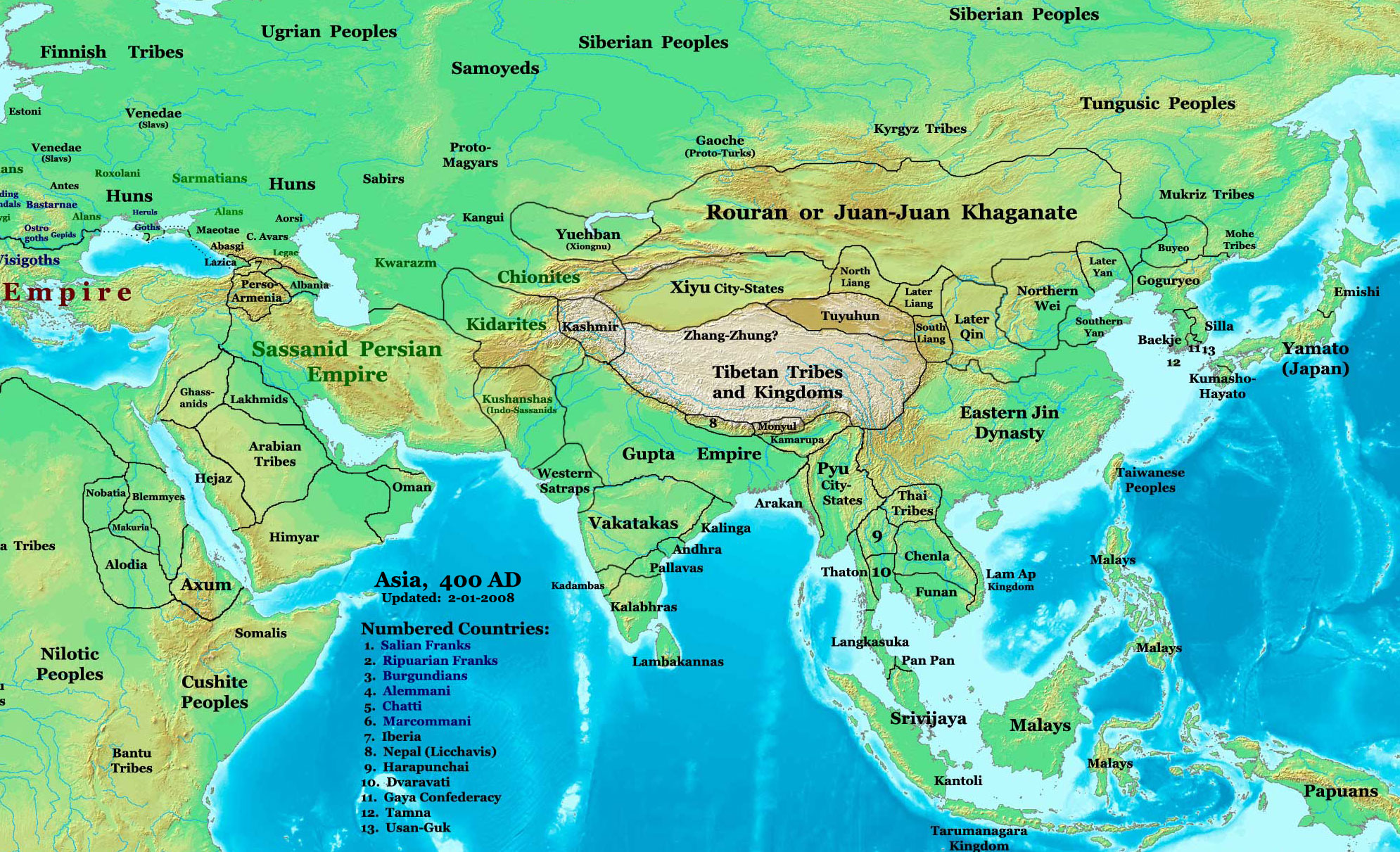
Asia in 400 AD, showing the Xionites ("Chionites") and their neighbors.

Xionites, Chionites, or Chionitae (Middle Persian: Xiyōn or Hiyōn; Avestan: X́iiaona-; Sogdian xwn; Pahlavi Xyōn) were a nomadic people in the Central Asian regions of Transoxiana and Bactria.[1]

The Xionites appear to be synonymous with the Huna peoples of the South Asian regions of classical/medieval India,[2] and possibly also the Huns of European late antiquity, who were in turn connected onomastically to the Xiongnu in Chinese history.[3]

They were first described by the Roman historian, Ammianus Marcellinus, who was in Bactria during 356–357 CE; he described the Chionitæ as living with the Kushans.[4] Ammianus indicates that the Xionites had previously lived in Transoxiana and, after entering Bactria, became vassals of the Kushans, were influenced culturally by them and had adopted the Bactrian language. They had attacked the Sassanid Empire,[1][5] but later (led by a chief named Grumbates), served as mercenaries in the Persian Sassanian army.

Within the Xionites, there seem to have been two main subgroups, which were known in the Iranian languages by names such as Karmir Xyon and Spet Xyon. The prefixes karmir ("red") and speta ("white") likely refer to Central Asian traditions in which particular colours symbolised the cardinal points. The Karmir Xyon were known in European sources as the Kermichiones or "Red Huns", and some scholars have identified them with the Kidarites and/or Alchon. The Spet Xyon or "White Huns" appear to have been the known in South Asia by the cognate name Sveta-huna, and are often identified, controversially, with the Hephthalites.

Origins and culture

[edit]
Alchon Hun horseman on the so-called "Hephthalite bowl" in the British Museum, 460–479 CE.[6]

The original culture of the Xionites and their geographical urheimat are uncertain. They appear to have originally followed animist religious beliefs,[citation needed] which mixed later with varieties of Buddhism [citation needed] and Shaivism.[citation needed] It is difficult to determine their ethnic composition.[1]

Differences between the Xionites, the Huns who invaded Europe in the 4th century, and the Turks were emphasised by Carlile Aylmer Macartney (1944), who suggested that the name "Chyon", originally that of an unrelated people, was "transferred later to the Huns owing to the similarity of sound". The Chyon who appeared in the 4th century, in the steppes on the northeastern frontier of Persia were probably a branch of the Huns that appeared shortly afterwards in Europe. The Huns appear to have attacked and conquered the Alans, then living between the Urals and the Volga about 360 AD, and the first mention of the Chyon was in 356 AD.[7]

At least some Turkic tribes were involved in the formation of the Xionites, despite their later character as an Eastern Iranian people, according to Richard Nelson Frye (1991): "Just as later nomadic empires were confederations of many peoples, we may tentatively propose that the ruling groups of these invaders were, or at least included, Turkic-speaking tribesmen from the east and north, although most probably the bulk of the people in the confederation of Chionites... spoke an Iranian language.... This was the last time in the history of Central Asia that Iranian-speaking nomads played any role; hereafter all nomads would speak Turkic languages".[8]

The proposition that the Xionites probably originated as an Iranian tribe was put forward by Wolfgang Felix in Encyclopedia Iranica (1992).[1]

In 2005, As-Shahbazi suggested that they were originally a Hunnish people who had mixed with Iranian tribes in Transoxiana and Bactria, where they adopted the Kushan-Bactrian language.[5] Likewise, Peter B. Golden wrote that the Chionite confederation included earlier Iranian nomads as well as Proto-Mongolic and Turkic elements.[9]

History

[edit]

The defeat of the Xiongnu in 89 CE by Han dynasty forces at the Battle of Ikh Bayan and subsequent Han campaigns against them, led by Ban Chao may have been a factor in the ethnogenesis of the Xionites and their migration into Central Asia.

Xionite tribes reportedly organised themselves into four main hordes: "Black" or northern (beyond the Jaxartes), "Blue" or eastern (in Tianshan), "White" or western (possibly the Hephthalites), around Khiva, and the "Red" or southern (Kidarites and/or Alchon), south of the Oxus. Artefacts found from the area they inhabited dating from their period indicate their totem animal seems to have been the (rein)deer. The Xionites are best documented in southern Central Asia from the late 4th century AD until the mid-5th century AD.

Chionite rulers of Chach

[edit]
Mural of a man, from Balalyk Tepe, with an appearance similar to that on the coinage of the Chionites of Chach. 5th–7th century CE.[10]

Some Chionites are known to have ruled in Chach (modern Tashkent), at the foot of the Altai Range, between the middle of the 4th century CE to the 6th century CE.[10] A special type of coinage has been attributed to them, where they appear in portraits as diademed kings, facing right, with a tamgha in the shape of an X, and a circular Sogdian legend. They also often appear with a crescent over the head.[10] It has been suggested that the facial characteristics and the hairstyle of these Chionite rulers as they appear on their coinage, are similar to those appearing on the murals of Balalyk Tepe further south.[10]

Kidarites

[edit]
Portrait of Kidarites king Kidara, c. 350–386 AD.[11]

Sometime between 194 and 214, according to the Armenian historian Moses of Khorene (5th century), Hunni (probably the Kidarites) captured the city of Balkh (Armenian name: Kush) .[12] According to Armenian sources, Balkh became the capital of the Hunni.

At the end of the 4th century AD, the Kidarites were pushed into Gandhara, after a new wave of invaders from the north, the Alchon, entered Bactria.[13]

Clashes with the Sasanians

[edit]

Early confrontations between the Sasanian Empire of Shapur II with the Xionites were described by Ammianus Marcellinus: he reports that in 356 CE, Shapur II was taking his winter quarters on his eastern borders, "repelling the hostilities of the bordering tribes" of the Xionites and the Euseni, a name often amended to Cuseni (meaning the Kushans).[14][15]

Shapur II successfully waged war against the Xionites for ten years which concluded in a treaty alliance with the Chionites and the Gelani in 358 CE under which the Xionites would help Shapur II in his war against the Romans.[16][17]

Alchon

[edit]
Artificial cranial deformation is suggested by a portrait of Khingila, king of the Alchon c. 430 – 490 AD.[18]

In 460, Khingila I reportedly united a Hephthalite ruling élite with elements of the Uar and Xionites as Alchon (or Alχon). [citation needed] when.[citation needed]

At the end of the 5th century the Alchon invaded North India where they were known as the Huna.[citation needed] In India the Alchon were not distinguished from their immediate Hephthalite predecessors,[citation needed] and both are known as Sveta-Hunas there.[citation needed] Perhaps complimenting this term, Procopius (527–565) wrote that they were white skinned,[citation needed] had an organized kingship, and that their life was not wild/nomadic and they lived in cities.

The Alchon were noted for their distinctive coins, minted in Bactria in the 5th and 6th centuries. The name Khigi, inscribed in Bactrian script on one of the coins, and Narendra on another, have led some scholars [who?] to believe that the Hephthalite kings Khingila and Narana were of the AlChoNo tribe.[vague] [citation needed] They imitated the earlier style of their Hephthalite predecessors, the Kidarite Hun successors to the Kushans. In particular the Alchon style imitates the coins of Kidarite Varhran I (syn. Kushan Varhran IV).[citation needed]

The earliest coins of the Alchon have several distinctive features: 1) the king's head is presented in an elongated form to reflect the Alchon practice of head binding; 2) The characteristic bull/lunar tamgha of the Alchon is represented on the obverse of the coins.[19]

Hephthalites

[edit]

The Hephthalites, or White Huns, were a nomadic tribe who conquered large parts of the eastern middle-east and may have originally been part of the Xionites.

Nezak

[edit]
Portrait of a Nezak ruler, c. 460–560 CE.

Although the power of the Huna in Bactria was shattered in the 560s by a combination of Sassanid and Turkic forces, the last Hephthalite king Narana/Narendra managed to maintain some kind of rule between 570 and 600 AD over the nspk, napki or Nezak tribes that remained.

Identity of the Karmir Xyon and White Xyon

[edit]

Bailey argues that the Pahlavi name Xyon may be read as the Indian Huna owing to the similarity of sound.[20] In the Avestan tradition (Yts. 9.30-31, 19.87) the Xiiaona were characterized as enemies of Vishtaspa, the patron of Zoroaster.[1]

In the later Pahlavi tradition, the Karmir Xyon ("Red Xyon") and Spet Xyon ("White Xyon") are mentioned.[1] The Red Xyon of the Pahlavi tradition (7th century)[21] have been identified by Bailey as the Kermichiones or Ermechiones.[1]

According to Bailey, the Hara Huna of Indian sources are to be identified with the Karmir Xyon of the Avesta.[22] Similarly he identifies the Sveta Huna of Indian sources with the Spet Xyon of the Avesta. While the Hephthalite are not mentioned in Indian sources, they are sometimes also linked to the Spet Xyon (and therefore possibly to the Sveta Huna).

More controversially, the names Karmir Xyon and Spet Xyon are often rendered as "Red Huns" and "White Huns", reflecting speculation that the Xyon were linked to Huns recorded simultaneously in Europe.

See also

[edit]

References

[edit]

Sources

[edit]
[edit]
Revisions and contributorsEdit on WikipediaRead on Wikipedia
from Grokipedia
The Xionites, also known as Chionites or Chionitae, were a nomadic East Iranian that flourished in during the 4th and 5th centuries CE, primarily in the regions of , , and parts of modern-day and . Emerging as one of several waves of migrants into and surrounding areas in , they are first attested in historical records by the Roman historian , who described their king Grumbates leading warriors allied with the Sassanid ruler during the siege of Amida in 359 CE. Renowned for their military prowess and lifestyle, the Xionites contributed to the fragmentation of the waning and established short-lived kingdoms, such as in Chach (modern Tashkent region), where they minted coins bearing inscriptions in an East Iranian language, confirming their ethnic ties to Iranian-speaking nomads rather than Turkic or Mongol groups. Their alliances with the Sassanids against Roman forces marked a period of strategic cooperation, though subsequent internal divisions and external pressures led to their absorption or displacement by related groups like the around the late 4th century. Scholars debate the precise origins of the Xionites, with some viewing them as a branch of the broader Hunnic confederation that migrated westward from the Eurasian steppes, while others emphasize their distinct Iranian cultural and linguistic features, distinguishing them from later (often called White Huns). Their legacy endures in numismatic evidence and references in Pahlavi texts, highlighting their role in the turbulent ethno-political dynamics of during a transformative era.

Terminology

Etymology

The term "Xionites" derives primarily from the Greek rendering "Chionitai" or "Chionitae," which appears in ancient sources as a designation for nomadic tribes in . This form is a Hellenized transcription of an Iranian-language , reflecting phonetic adaptations in Greek texts. The first reliable attestation in Greco-Roman sources is by the historian (c. 359 CE), describing their Grumbates allied with the Sassanids. The name's Iranian roots trace to Middle Persian Xyōn or Hyōn (often transcribed as Xwn in Pahlavi script), cognate with Avestan X'iiaona- (Hyaona-), an ancient term for hostile northern nomads in Zoroastrian texts, later extended to denote "Huns" in Persian sources. This equivalence is evident in its semantic overlap with "Hun," suggesting the Xionites were perceived as part of broader Hunnic confederations, though distinct in their Iranian linguistic affiliations. Some interpretations link Xyōn to descriptors like "red-skinned nomads," drawing from color-based tribal distinctions in later Byzantine accounts of "Red Huns," but this remains secondary to the core Hunnic connotation. Parallel forms appear in neighboring languages, indicating phonetic shifts across linguistic boundaries. In Armenian sources, the term manifests as "Hion" or "Hon," a direct adaptation of Hyōn, used to describe invading nomads in the 4th-5th centuries CE. Similarly, and texts employ "Huna," reflecting an Indo-Aryan phonetic evolution from the same Iranian base, with the initial h- replacing the aspirated x- or kh- sound, as seen in Gupta-era inscriptions referring to Central Asian invaders. A possible connection to the Chinese "Xiongnu" (匈奴, Hsiung-nu) has been debated since the , with some scholars proposing a distant etymological or migrational link due to superficial phonetic similarities and shared nomadic lifestyles, but most modern analyses reject direct derivation, attributing the Xionite name to indigenous Iranian nomenclature rather than a Sinic transcription. Over time, "Xionites" evolved in Greco-Roman and Byzantine usage to specifically denote Iranian-speaking Hunnic groups in and , distinguishing them from the European who ravaged the West in the 4th-5th centuries CE, as noted in and other historians who emphasized their eastern origins and cultural adaptations. Robert Göbl classified the Xionites, collectively known as , into four major states based on their coinage: the , , , and Hephthalites. This classification, detailed in Göbl's 1967 work Dokumente zur Geschichte der Iranischen Hunnen in Baktrien und Indien, relies on distinct monetary types and legends, such as the "kdry" for and "αλχαννο" for Alchons, reflecting their sequential dominance in regions like , , and from the late 4th to 6th centuries CE. The Xionites were subdivided in Iranian sources using color-based terms, with "Karmir Xyon" (Red Huns) denoting southern groups like the and Alchons, and "Spet Xyon" (White Huns) referring to northern ones like the Hephthalites, possibly alluding to skin color descriptions or cardinal direction symbolism in Central Asian traditions. These designations appear in and Sogdian texts, where the prefixes karmir ("red") and speta ("white") highlight geographical or phenotypic distinctions among the nomadic confederations. Chinese annals, such as the Beishi and Weishu, describe Transoxianan nomads under the broader "Xiyu" () category, linking groups like the (as Jiduoluo) to earlier migrations while noting their presence in by the 5th century CE. In Indian sources, the refer to the "Huna" as foreign invaders from the northwest, portraying them as Mlechha tribes disrupting rule, without distinguishing subgroups but encompassing the Xionite incursions into northern . Scholars debate whether the term "Xionites" or "Huna" encompasses all Central Asian Hunnic invaders or solely the Iranian-speaking branches, explicitly excluding the earlier of northeastern due to linguistic, chronological, and cultural differences, with no solid connecting the two beyond superficial name similarities. This view emphasizes the Xionites' adoption of and Zoroastrian elements, contrasting with the proto-Turkic or Mongolic profile of the .

Origins

Ethnic and linguistic background

The ethnic origins of the Xionites, also known as Chionites, remain a subject of scholarly debate, with evidence pointing to a primarily Iranian nomadic background distinct from the Turkic or Mongolic affiliations of the earlier Xiongnu confederation. Scholars debate whether the Xionites were a branch of the broader Hunnic confederation or a distinct Iranian nomadic group. Historical sources describe them as a tribal group active in Bactria and Transoxania during late antiquity, likely comprising Iranian-speaking groups, marking one of the last major waves of Iranian tribal migrations from the northern steppes. This composition aligns with broader patterns of Central Asian nomadism, where Iranian elements predominated among groups labeled as "Huns" in Greco-Roman and Persian texts, differentiating them from the East Asian Xiongnu through linguistic and cultural markers. Linguistically, the Xionites are associated with , particularly those of the branch, as evidenced by onomastic and toponymic remnants in Bactrian and Sogdian records that reflect Scythian-Iranian influences rather than Turkic or Mongolic substrates. Some scholars propose limited Tocharian influences due to regional interactions in the and , where Xionite territories overlapped with remnants of earlier Indo-European groups like the , potentially incorporating hybrid linguistic elements in administrative or elite contexts. However, the core vocabulary and tribal nomenclature, such as the self-designation linked to X'iiaona (denoting nomadic raiders), underscore an Iranian foundation, with no direct evidence of primary Tocharian dominance.

Migration and early evidence

The Xionites, also known as Chionites, emerged as a nomadic confederation from the eastern steppes, likely originating among Iranian-speaking groups in the region east of the or further in , and began their westward migration into in the mid-4th century CE. This movement brought them into the territories of and , where they encountered and gradually displaced the weakening , contributing to its fragmentation by the mid-4th century. Scholarly analysis places their arrival in these areas as part of broader nomadic migrations, with the Xionites establishing control over key oases and river valleys, marking the onset of Hunnic influences in the region. The earliest archaeological evidence of Xionite presence appears in 4th-century Transoxiana, particularly at sites in the Chach region (modern oasis), where coins bearing the names of Xionite rulers in an East Iranian script have been uncovered. These numismatic finds, dating from the mid-4th century onward, depict rulers such as those under King Grumbates, mentioned in contemporary Roman accounts, and feature tamghas (tribal marks) indicative of their steppe origins. Inscriptions and associated artifacts from these sites confirm Xionite administrative control, providing tangible proof of their settlement and integration into local economies shortly after migration. The Xionites played a pivotal role in the collapse of the around 350 CE, initially serving as auxiliaries or mercenaries to Kushan forces before transitioning to invaders who exploited internal divisions and external pressures from the Sasanians. Historical records describe them as overrunning Bactrian territories, leading to the displacement of Kushan rulers and the establishment of Xionite dominance in former Kushan heartlands. This shift not only ended Kushan but also facilitated further nomadic incursions into .

Society and culture

Religion and beliefs

The Xionites, as an East Iranian nomadic , likely adhered to beliefs rooted in their steppe heritage, possibly including animistic practices and variants of early Iranian , as evidenced by rites observed among them. These may have involved harmony with nature and veneration of natural forces, reflecting polytheistic elements common among ancient Iranian nomads. Historical accounts, including the Chinese Liang shu, describe related later groups like Hephthalite subgroups—sometimes associated with the broader Hunnic or Xionite migrations—revering both heaven and fire, indicative of Zoroastrian influences. In regions like , later Xionite-related rulers supported , particularly during the 5th century under Hephthalite rule, where the faith flourished despite varying royal endorsement reported by pilgrims like Song Yun. Archaeological evidence from and reveals continued Buddhist activity, including monastic complexes that received from local rulers, supporting the spread of traditions along trade routes. Coin iconography from Kidarite and Hephthalite mints illustrates , featuring Zoroastrian fire altars with attendants on the reverse—symbolizing purity and divine favor—while some issues incorporate Buddhist motifs in the fields. Limited evidence points to Manichaeism's presence in urban centers of and during the period of Xionite-related rule, where it blended with local Iranian and Buddhist ideas as a dualistic faith emphasizing light versus darkness. Archaeological discoveries in , including textual fragments and artifacts from 5th-6th century sites, suggest its adoption by educated classes, though it remained marginal compared to dominant Zoroastrian and Buddhist practices. Due to sparse direct sources on early Xionites, much of their religious practices are inferred from numismatic and archaeological evidence, as well as accounts of allied or successor groups. Overall, Xionite-related religion exemplified pragmatic tolerance, integrating nomadic spiritualism with sedentary imperial faiths to legitimize rule across diverse territories.

Economy, lifestyle, and art

The Xionites initially maintained a nomadic lifestyle centered on herding , including sheep, , and especially horses, which formed the backbone of their mobile economy and renowned forces. was a key activity, enabling seasonal migrations across the steppes of in search of water and pasture, while their involvement in caravan trade along the positioned them as intermediaries exchanging goods like furs and metals. This nomadic economy supported tribal mobility but also integrated with broader networks, where Xionite groups controlled key routes through and , facilitating the flow of silk, spices, and other commodities eastward and westward. Following their expansions in the 4th and 5th centuries, some Xionite communities transitioned toward semi-sedentary or settled lifestyles, particularly in fertile regions like , where they adopted agricultural practices inherited from Kushan predecessors. This shift involved the development of irrigation systems, including protective dykes, small reservoirs, and dams constructed in the 5th century to channel water from rivers such as the , supporting crop cultivation in urban centers like and . These efforts transformed the economy into a mixed system combining with settled farming, enhancing productivity and enabling tribute collection from subject populations. Xionite art reflected a synthesis of nomadic traditions and regional influences, notably Greco-Buddhist styles evident in their coinage, which often imitated Kushan prototypes with Bactrian script, symbols, and motifs like royal figures on horseback. Silver bowls and murals from sites such as Dilberdzhin and Balalyk-tepe depict scenes with mounted warriors pursuing game, symbolizing power and abundance, while architectural sculptures incorporated Hellenistic elements alongside Central Asian patterns. Some religious art, such as elements in Bamiyan cave decorations, blended these with Buddhist iconography, though practical motifs dominated secular expressions. Socially, Xionite society was organized into loose tribal confederacies governed by chieftains bearing titles like (lord or king), who coordinated alliances among clans for migration, trade, and warfare. A class-based placed family and at the top, with common herders below. Among later related groups like the Hephthalites, practices such as —where brothers shared a —reflected adaptations to scarcity, though direct evidence for early Xionites is limited. Gender roles allowed women significant autonomy, as suggested by depictions in regional showing females in elite or protective roles.

History

Chionites and early expansions

The Chionites, regarded as the earliest distinct branch of the Xionites, emerged as a dominant force in during the mid-4th century CE, building on prior nomadic migrations into the region. By around 350 CE, the Chionites had established rule over Chach (modern area), maintaining control until the early 7th century CE under various rulers attested through . Their authority is attested through numismatic evidence, including bronze coins that imitated Kushan types in design and weight, while featuring inscriptions in an East Iranian language, reflecting their ethnic and linguistic affiliations. Seeking further territorial gains, the Chionites expanded into neighboring around 360 CE and forged a with the Sasanian ruler (r. 309–379 CE) against Roman forces, supplying cavalry auxiliaries for Sasanian campaigns in exchange for territorial concessions. Relations deteriorated soon after, prompting to launch punitive expeditions against the Chionites in the 360s and early 370s CE; these conflicts culminated in Sasanian victories that reduced the Chionites to tributary status, limiting their autonomy while integrating them into the broader Sasanian .

Kidarite kingdom

The Kidarite kingdom emerged in the late CE as the first major Xionite polity in and , succeeding Chionite precursors in the region. Founded by the ruler Kidara, it marked a period of consolidation for Xionite groups following earlier migrations from . The kingdom's core territories spanned (modern northern and southern /), with its capital likely at (ancient ), and extended southward across the Hindu Kush into . This expansion reflected the Kidarites' adaptation of local administrative structures from the declining Kushano-Sasanian and Kushan remnants, blending nomadic traditions with settled governance. Around 390 CE, Kidara orchestrated the invasion and conquest of the Kushan Empire's lingering territories in northwestern , effectively dismantling the remnants of Kushan authority in and . This campaign allowed the Kidarites to seize control of strategic urban centers, including and , which served as vital hubs for trade along the and facilitated further incursions into the . Numismatic evidence, including gold dinars issued in Kidara's name, corroborates this timeline and underscores the rapid establishment of Kidarite dominance in these areas by the early . The conquest not only secured economic resources but also positioned the Kidarites as a formidable power bridging Central Asian steppes and South Asian plains. In terms of economic and symbolic reforms, the introduced distinctive silver drachms that imitated Sasanian prototypes, featuring Zoroastrian fire altars flanked by attendants on the reverse. These coins, minted primarily in , circulated widely between approximately 410 and 450 CE, reflecting the kingdom's integration into broader Iranian cultural and monetary networks while asserting Kidarite . The fire altar motif, a hallmark of Sasanian , appeared on issues from mints in and , with overstruck examples on earlier Kushano-Sasanian types demonstrating the transition of control. This numismatic innovation supported expanded trade, evidenced by a notable increase in finds (up to 23% in Gandhāra hoards), and helped stabilize the economy amid territorial expansions. The pursued diplomatic ties with the in northern , navigating a complex landscape of rivalry and negotiation as recorded in 5th-century inscriptions. The Bhitari pillar inscription from the reign of ruler (c. 455–467 CE) alludes to confrontations with Huna (Xionite) invaders, highlighting the ' pressure on frontiers and the diplomatic maneuvers employed to manage these threats. These interactions, including potential alliances to secure borders, underscore the ' strategic engagement with Indian powers to maintain influence in and beyond. Chinese accounts from the period further illuminate these relations, portraying the as key intermediaries in regional diplomacy. By around 460 CE, internal divisions plagued the Kidarite kingdom, leading to its fragmentation into regional branches and a decline in centralized authority. Chinese historical sources, including annals like the Pei-shih (compiled 643 CE), describe strife among Kidarite leaders and the erosion of unity, exacerbated by external pressures from neighboring powers. Buddhist pilgrim accounts, such as those from Faxian (early 5th century), hint at early signs of disarray in Gandhara, while later records confirm the splintering that weakened the state's cohesion. This internal fragmentation ultimately curtailed the Kidarites' dominance, paving the way for subsequent shifts in regional power dynamics.

Alchon Huns

The , a branch of the Xionite confederation, established dominance in northern India and from approximately 460 to 530 CE, launching invasions that disrupted the waning and extended their control over regions including , , and parts of . Emerging as successors to the , they capitalized on the power vacuum following earlier Central Asian migrations, blending nomadic warfare with administrative adaptations from conquered territories. Their rule marked a phase of intense conflict and cultural , characterized by aggressive expansions southward and the imposition of on local kingdoms. Under the leadership of Toramana, who reigned around 500–520 CE, the Alchon Huns conducted raids that sacked cities in northern and central India circa 500 CE, penetrating as far as Malwa and Eran in present-day Madhya Pradesh. The Eran boar inscription, dated to the first year of Toramana's reign (approximately 500 CE), records his sovereignty over Malwa, describing him as a great king governing the earth and a devotee of both Shiva and Vishnu, while commemorating a local donor's erection of a Varaha (boar incarnation) image. This epigraphic evidence underscores Toramana's military reach and his strategy of patronizing local religious traditions to legitimize rule in conquered areas. Toramana's son, , succeeded him and ruled from circa 515 to 534 CE, shifting the Alchon capital to regions like and intensifying campaigns across northern , where he extracted heavy tributes and enforced Shaivite preferences. Chinese pilgrim Xuanzang's accounts, recorded in the CE, portray as a who destroyed around 1,600 Buddhist stupas and monasteries, particularly in , , and , while persecuting monks and plundering religious sites, actions attributed to his shift toward after initial Buddhist overtures were rebuffed. These depredations contributed to the decline of Buddhist institutions in northwest , though some monastic centers persisted through local patronage. Alchon numismatics reflect this era's cultural fusion, with over 350 coin types featuring bull-and-horseman motifs that combine Hunnic, , and Sasanian elements, often inscribed in Bactrian, , or to assert royal authority and facilitate trade. These imitations of gold dinars and silver drachms, issued by rulers including and , circulated widely in and , symbolizing the Alchons' adaptation of Indian monetary standards while retaining nomadic iconography like the charging horseman. Mihirakula's dominance waned after his defeat by , the Aulikara king of , around 528 CE, in a battle near that shattered Alchon control over and confined their influence to peripheral areas. Supported by a confederacy, Yashodharman's victory, celebrated in inscriptions like the Mandasor pillar, marked the effective end of Alchon hegemony in the subcontinent, paving the way for regional powers to reclaim territory.

Hephthalite Empire

The Hephthalite Empire rose to prominence in the mid-5th century CE under the leadership of Khingila, who around 470 CE initiated conquests that dismantled the Kidarite kingdom in Bactria and Tokharistan. Khingila's campaigns extended Hephthalite control westward across Central Asia, subjugating Sogdian territories and pushing the Kidarites eastward into the Tarim Basin by the late 470s, while establishing dominance in Gandhara and Afghanistan. By the 480s, Hephthalite expansion reached the Caspian Sea region, incorporating areas north of the Alburz Mountains and securing tribute from neighboring powers, marking the transition from nomadic confederation to imperial structure. The empire attained its zenith during the reign of Khusnavaz (c. 490–530 CE), whose rule solidified over a vast domain stretching from the Pamirs to northern , including conquests in Sughd and further extensions into regions like . According to the Wei Shu, a key Chinese historical text, Khusnavaz's court received tributes from over 40 polities, encompassing Persian territories that paid annual indemnities from 484 CE onward, as well as indirect exchanges with Chinese states along the , underscoring the empire's economic leverage. These tributes, often in the form of gold, silk, and military support, facilitated Hephthalite diplomacy and military campaigns, briefly allying with the in shared expansions. Hephthalite administration introduced structured governance through satrapies and taxation, adapting local Iranian systems to their nomadic heritage. Regions such as Chaganiyan and Khuttal were governed by semi-autonomous local dynasties under Hephthalite overlords, while a centralized levied property and poll taxes on Bactrian populations, as documented in contracts from 492–527 CE requiring payments in and to "Hephthalite lords." This system is evidenced by 6th-century seals and bullae bearing Bactrian inscriptions with titles like oazorko () and hazaroxto (), indicating a hierarchical that integrated conquered elites. Culturally, the Hephthalites patronized Buddhist institutions, fostering artistic synthesis in their territories. At the Fundukistan monastery in , , they supported the creation of murals and sculptures from the late 5th to early 6th centuries, blending Iranian Sasanian motifs—such as stylized floral patterns and royal —with Indian influences like dynamic poses and narrative friezes, evident in depictions of deities and bodhisattvas. This patronage extended to monumental sites like Bamiyan, reflecting the empire's role in transmitting Buddhist across .

Nezak dynasty

The Nezak dynasty emerged in around 484 CE, following the defeat of the Sasanian king by the Hephthalites, establishing a localized principality under rulers who adopted the title "Nezak Shah." These kings, including figures like Zunbil, issued distinctive silver drachms featuring a bust with a characteristic water-buffalo-head crown and the Bactrian legend nyzky MLKA ("Nezak king"), minted primarily at facilities in and . This coinage, which began in the late fifth century, reflected their efforts to consolidate power in southern and assert economic independence through imitations of Sasanian styles adapted with local . Despite operating within the broader sphere of Hephthalite influence, the Nezak Huns resisted direct overlordship, maintaining significant autonomy in key areas such as and Bamiyan through the sixth and seventh centuries. Their rule in these regions is evidenced by the distribution of coin types, with the š-group linked to in and the ā-group associated with , indicating controlled minting and regional administration. Notable rulers like Narana-Narendra, active circa 570–600 CE, and later figures such as Zhulād, continued this tradition, blending Hunnic nomadic heritage with settled governance amid pressures from neighboring powers. The dynasty persisted until the early eighth century, transitioning to Islamic rule following the Arab conquest of and surrounding areas around 664–711 CE. The final phases of Nezak coinage, particularly under the "Napki Malka" series circa 625–711 CE, incorporated such as bull-headed figures on the reverse, signaling cultural and adaptation in the face of Umayyad expansion. Archaeological evidence, including hoards of Nezak drachms from the Kāpiśa-Kabul region, underscores their enduring economic role and provides tangible links to this localized Hunnic legacy.

Conflicts with the Sasanians

The relations between the Xionites and the initially involved that later deteriorated into prolonged military conflicts spanning the 4th to 6th centuries CE. Under (r. 309–379 CE), the Sasanians formed a tactical with the Chionites, a branch of the Xionites, against the ; the Chionite king Grumbates led his forces in support of Shapur during the siege of Amida in 359 CE, where they suffered losses but contributed to the city's capture after a grueling 73-day assault. This partnership shifted as Shapur sought to consolidate eastern frontiers, leading to campaigns against the Chionites in the 350s CE, where he allied with Kushan remnants to repel their incursions into Persian territory. By the 360s CE, escalating tensions culminated in renewed warfare, including conflicts around 367–368 CE, as Shapur aimed to subdue the Chionites and secure the northeastern borders following his Roman engagements. In the 5th century CE, conflicts intensified under Sasanian king Peroz I (r. 459–484 CE) against the Hephthalites, another prominent Xionite group. Peroz launched three major wars against the Hephthalites between approximately 474/5 and 484 CE, driven by territorial ambitions in Transoxiana and efforts to reverse earlier concessions. The first war (474/5 CE) ended in Peroz's capture after his army of 70,000–80,000 men was ambushed; he was ransomed using funds from the Roman emperor Zeno, leading to a peace treaty that likely included tribute payments and border recognitions. The second war (478–479 CE) saw another Sasanian defeat through a Hephthalite desert stratagem that decimated Peroz's 50,000-strong force; he was captured again, paying a substantial ransom of 30 mule-loads of silver drachmas and ceding territories like Merv, with his son Kavadh held as hostage. The third and final war (483–484 CE) proved catastrophic, as Peroz's invading army was annihilated near the Hulwan River, resulting in his death at the hands of the Hephthalite king Khusnavaz (also known as Akhshunwar), which plunged the Sasanian Empire into a brief succession crisis. Following Peroz's demise, Khusnavaz exploited the Sasanian vulnerability by launching a retaliatory invasion into eastern Persia in 484 CE, sacking the city of and conducting broader raids that devastated key settlements, including the destruction of the Bandian complex. This incursion forced the weakened Sasanians under (r. 484–488 CE) to negotiate peace, resulting in annual tribute payments to the Hephthalites to avert further incursions and stabilize the frontier. These payments underscored the Hephthalites' temporary dominance in the region, though they were later contested under Kavadh I (r. 488–531 CE). Xionite military tactics emphasized mobile units armed with lances, which provided shock capabilities in open battles, contrasting with the heavily armored Sasanian cataphracts that relied on massed charges and support. Byzantine historian , drawing on 6th-century accounts, highlighted how such nomadic-derived formations exploited terrain and feigned retreats to outmaneuver Sasanian forces, contributing to victories like those against Peroz. This tactical disparity often favored the Xionites in eastern engagements, where their adaptability disrupted Sasanian and cohesion.

Decline and legacy

Fall of major Xionite states

The collapse of the Hephthalite Empire, the preeminent Xionite polity in , was precipitated by a confluence of internal weaknesses and coordinated external assaults in the mid-6th century CE. Overextension across expansive territories from the Oxus River to northern strained administrative and military resources, fostering internal divisions among the ruling elite and subject populations. The Justinianic Plague, originating in and spreading through Hephthalite trade networks around 541–544 CE, further exacerbated demographic decline by decimating urban centers and nomadic forces alike, as evidenced by analysis linking the pathogen's early diffusion to Hephthalite conduits. Byzantine historian Protector, drawing on contemporary diplomatic reports, highlighted these vulnerabilities, noting the empire's fragmented response to mounting pressures from Turkic migrations southward across the . A pivotal factor in the Hephthalites' downfall was the strategic alliance forged in 557 CE between Sasanian Shah Khusrau I Anushirvan and İstemi Yabgu, yabgu of the Western Turkic Khaganate, aimed at dismantling their mutual rival. This pact enabled a pincer movement: Sasanian forces struck from the southwest, capturing key territories like Bactria, while Turkic armies advanced from the northeast, culminating in decisive victories that fragmented Hephthalite holdings by 560 CE. Menander Protector's account, preserved in excerpts from the Excerpta de Legationibus Gentium, describes how the Turks subjugated Hephthalite cities and nobility, with figures like the defector Katulph facilitating the transition to Turkic overlordship. The alliance's campaigns rendered the Hephthalites vassals to the Sasanians and Turks, leading to the empire's effective extinction as an independent entity by 567 CE, when the last major strongholds fell at Nesef (modern Karshi). Turkic migrations intensified this process, as Göktürk forces absorbed or displaced Hephthalite remnants, reshaping the regional power dynamics per 6th-century Byzantine diplomatic records. Smaller Xionite successor states, such as the Nezak dynasty in Zabulistan (southern Afghanistan), endured amid the chaos, maintaining autonomy through localized rule and coinage until approximately 665 CE, when they were replaced by the Turk Shahi dynasty; the latter persisted until Umayyad expansions overran the region around 711 CE during campaigns into Sistan and Arachosia.

Successors and historical impact

Following the collapse of the Hephthalite Empire in the mid-6th century, remnants of Xionite groups were absorbed into emerging Turkic polities, notably the Turk Shahi kingdoms and Kabul Shahis, which ruled from Kabul and Kapisa to Gandhara between the 7th and 9th centuries CE. These successor states represented a fusion of Hunnic-Iranian traditions, as evidenced by their coinage, which blended Hephthalite iconography—such as royal busts and tamghas—with Turkic elements like winged motifs and Bactrian inscriptions, indicating cultural and administrative continuity in the region. The Turk Shahis, often of mixed Turco-Hephthalite origin, maintained control over key trade routes until the rise of the Hindu Shahis around 870 CE, preserving Xionite influences in governance and military organization. The Xionites profoundly shaped Silk Road commerce and Indo-Iranian artistic traditions, facilitating intensified trans-Eurasian exchange under Hephthalite rule from Sogdian cities like Samarkand. By controlling key oases and passes, they boosted trade in silk, spices, and metals, integrating Iranian, Indian, and Chinese economies more tightly than under prior regimes. In art, Hunnic motifs persisted in Sogdian silverware, as seen in 5th-6th century pieces like the Chilek bowl from Uzbekistan, which features beardless busts, tamghas, and hunting scenes echoing Hephthalite iconography from and Sasanian influences. These elements blended into broader Indo-Iranian styles, appearing in wall paintings at sites like Pendzhikent and Bamiyan, where Hephthalite royal profiles merged with local Buddhist and Zoroastrian themes. In modern historiography, the Xionites' role in the so-called "Dark Ages" of India and Persia has undergone significant revision in the 2020s, challenging long-held views of them as mere destroyers of classical civilizations. Scholars now emphasize their contributions to cultural synthesis and economic vitality, arguing that Hephthalite incursions spurred innovation in art and trade rather than unmitigated devastation, as earlier narratives suggested. This reevaluation, supported by numismatic and archaeological evidence, portrays the Xionites as pivotal in bridging Eurasian worlds, influencing the transition to medieval Islamic states in the region.

References

Add your contribution
Related Hubs
User Avatar
No comments yet.