Hubbry Logo
search
logo

Chromaticism

logo
Community Hub0 Subscribers
Read side by side
from Wikipedia
Chromatic fourth: lament bass bassline in Dm (D–C–C()–B–B–A)
The diatonic scale notes (above) and the non-scale chromatic notes (below)[1]

Chromaticism is a compositional technique interspersing the primary diatonic pitches and chords with other pitches of the chromatic scale. In simple terms, within each octave, diatonic music uses only seven different notes, rather than the twelve available on a standard piano keyboard. Music is chromatic when it uses more than just these seven notes.

Chromaticism is in contrast or addition to tonality or diatonicism and modality (the major and minor, or "white key", scales). Chromatic elements are considered, "elaborations of or substitutions for diatonic scale members".[2]

Development of chromaticism

[edit]
Contemporary jazz and rock bass guitarist Joseph Patrick Moore demonstrating chromaticism (video)

Chromaticism began to develop in the late Renaissance period, notably in the 1550s, often as part of musica reservata, in the music of Cipriano de Rore, in Orlando Lasso's Prophetiae Sibyllarum, and in the theoretical work of Nicola Vicentino.

The following timeline is abbreviated from its presentation by Benward & Saker:[3]

Baroque Period (1600—1750) "The system of major and minor scales developed during the early part of the baroque period. This coincided with the emergence of key consciousness in music."[3]
Classical Period (1750—1825) "The major and minor keys were the basis of music in the classical period. Chromaticism was decorative for the most part and shifts from one key to another...were used to create formal divisions."[3]
Romantic Period (1825—1900) "Chromaticism increased to the point that the major—minor key system began to be threatened. By the end of the period, keys often shifted so rapidly in the course of a composition that tonality itself began to break down."[3]
Post-Romantic and Impressionistic Period (1875—1920) "With the breakdown of the major—minor key system, impressionist composers began to experiment with other scales....particularly...pentatonic, modal, and whole-tone scales."[3]
Contemporary Period (1920—present) "The chromatic scale has predominated in much of the music of our period."[3]
Jazz and Popular Music (1900—present) "Popular music has remained the last bastion of the major-minor key system... The blues scale ["a chromatic variant of the major scale"] is often found in jazz and popular music with blues influence."[3]
Mode mixture, using minor triads in the major key[4]
Final chord of Arnold Schoenberg's Sechs kleine Klavierstücke, 2nd movement,[5] in thirds: C–E–G–B–D–F–A–Cdouble sharp

As tonality began to expand during the last half of the nineteenth century, with new combinations of chords, keys and harmonies being tried, the chromatic scale and chromaticism became more widely used, especially in the works of Richard Wagner, such as the opera "Tristan und Isolde". Increased chromaticism is often cited as one of the main causes or signs of the "breakdown" of tonality, in the form of increased importance or use of:

As tonal harmony continued to widen and even break down, the chromatic scale became the basis of modern music written using the twelve-tone technique, a tone row being a specific ordering or series of the chromatic scale, and later serialism. Though these styles/methods continue to (re)incorporate tonality or tonal elements, often the trends that led to these methods were abandoned, such as modulation.

Types of chromaticism

[edit]
This phrase from Cesar Franck's Variations symphoniques (1885), mm. 5–9, demonstrates chromaticism from use of parallel keys (borrowed chords), that "chordal structures ... [may be] partially resultants of the descending bass lines" and that "chromatic evasiveness internally in the phrases [may be] countered by cadence strength and clarity", such as the "resolute movement from V of V to V to I".[6]
Chromaticism from "linear considerations" [voice leading], borrowed chords, and extended chords from the ending of Alexander Scriabin's Preludes, Op. 48, No. 4; "though most vertical sonorities include the seventh, ninth, eleventh, and thirteenth, the basic harmonic progressions are strongly anchored to the concept of root movement by fifths".[7]

David Cope[8] describes three forms of chromaticism: modulation, borrowed chords from secondary keys, and chromatic chords such as augmented sixth chords.

The chromatic expansion of tonality which characterizes much of nineteenth century music is illustrated in miniature by the substitution of a chromatic harmony for an expected diatonic harmony. This technique resembles the deceptive cadence, which involves the substitution of another diatonic chord for the expected diatonic goal harmony.[9] ...

In the major mode a substitute chromatic consonance often proves to be a triad which has been taken from the parallel minor mode. This process ["assimilation"]...is called mixture of mode or simply mixture... Four consonant triads from the minor mode may replace their counterparts in the major mode. These we call chromatic triads by mixture.[4]

— Allen Forte (1979)

The total chromatic is the collection of all twelve equally tempered pitch classes of the chromatic scale.

List of chromatic chords:

Other types of chromaticity:

Chromatic note

[edit]
One of seven examples of linear chromaticism from Dizzy Gillespie's solo from "Hot House"[11] or Listen on YouTube

Notes which do not belong to the key [those, "that lie within the major 2nds," of the diatonic scale] are called chromatic notes.

— Allen Forte (1979)[1]

A chromatic note is one which does not belong to the scale of the key prevailing at the time. Similarly, a chromatic chord is one which includes one or more such notes. A chromatic and a diatonic note, or two chromatic notes, create chromatic intervals.

When one note of an interval is chromatic or when both notes are chromatic, the entire interval is called chromatic. Chromatic intervals arise by raising or lowering one or both notes of a diatonic interval, so that the interval is made larger or smaller by the interval of half step ["altered diatonic intervals"].

— Allen Forte (1979)[12]

A chromatic scale is one which proceeds entirely by semitones, so dividing the octave into twelve equal steps of one semitone each.

Linear chromaticism is used in jazz: "All improvised lines ... will include non-harmonic, chromatic notes." Similar to in the bebop scale this may be the result of metric issues, or simply the desire to use a portion of the chromatic scale[11]

Chromatic chord

[edit]

By chromatic linear chord is meant simply a chord entirely of linear origin which contains one or more chromatic notes. A great many of these chords are to be found in the literature.

— Allen Forte (1979)[13]

[During the Romantic period] There was more prominent use of chromatic harmony, which employs chords containing tones not found in the prevailing major or minor scale. ... Chromatic chords add color and motion to romantic music. Dissonant, or unstable, chords were also more freely than during the classical era. By deliberately delaying the resolution of dissonance to a consonant, or stable, chord, romantic composers created feelings of yearning, tension, and mystery.

— Roger Kamien (1976)[14]


   \new PianoStaff <<
      \new Staff <<
         \new Voice \relative c'' {
             \stemUp \clef treble \key c \major \time 4/4
             des2 b c1
             }
         \new Voice \relative c'' {
             \stemDown
             aes2 g g1
             }
            >>
     \new Staff <<
         \new Voice \relative c' {
             \stemUp \clef bass \key c \major \time 4/4
             f2 d e1
             }
         \new Voice \relative c' {
             \stemDown
             f,2 g c,1 \bar "||"
             }
         >>
    >>
II 6–V–I in C minor

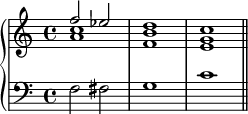
A chromatic chord is a musical chord that includes at least one note not belonging in the diatonic scale associated with the prevailing key, the use of such chords is the use of chromatic harmony. In other words, at least one note of the chord is chromatically altered. Any chord that is not chromatic is a diatonic chord.

   \new PianoStaff <<
      \new Staff <<
         \new Voice \relative c'' {
             \stemUp \clef treble \key c \major \time 4/4
             f2 es d1 c
             }
         \new Voice \relative c'' {
             \stemDown
              <a c>1 <f b> <e g>
              }
            >>
     \new Staff <<
         \new Voice \relative c {
             \clef bass \key c \major \time 4/4
             f2 fis g1 c \bar "||"
             }
         >>
    >>
IV-ivo7–V7–I

For example, in the key of C major, the following chords (all diatonic) are naturally built on each degree of the scale:

  • I = C major triad [contains pitch classes C E G]
  • ii = D minor triad [contains D F A]
  • iii = E minor triad [contains E G B]
  • IV = F major triad [contains F A C]
  • V = G major triad [contains G B D]
  • vi = A minor triad [contains A C E]
  • viio = B diminished triad [contains B D F]

    {
      \new PianoStaff <<
        \new Staff <<
            \relative c' {
                \clef treble \key c \minor \time 4/4
                fis1 g
                }
            >>
        \new Staff <<
            \relative c' {
                \clef bass \key c \minor \time 4/4
                aes1 g \bar "||"
                }
            >>
    >> }
The interval of the augmented sixth normally resolves outwards by semitone to an octave.

However, a number of other chords may also be built on the degrees of the scale, and some of these are chromatic. Examples:

  • II in first inversion is called the Neapolitan sixth chord. For example, in C Major: F–A–D. The Neapolitan Sixth chord resolves to the V.
  • The iv diminished chord is the sharpened subdominant with diminished seventh chord. For example: F–A–C–E. The IV diminished chord resolves to the V. The IV can also be understood as the tonicization of V where it functions as viio7 of the V chord, written viio7/V.
  • VI: The augmented sixth chord, A–C(–C, D, or E)–F, resolves to the V.
  • Consonant chromatic triads, modulation to these triads would be chromatic modulation:
    • III, VI, II, iv, vii, and VII in major
    • iii, vi, II, iv, ii, and vii in minor.

Chromatic line

[edit]

In music theory, passus duriusculus is a Latin term which refers to chromatic line, often a bassline, whether descending or ascending.

A line cliché is any chromatic line that moves against a stationary chord.[15][16] There are many different types of line clichés—most often in the root, fifth or seventh—but there are two named line clichés. The major line cliché moves from the fifth of the chord to the sixth, then back to the fifth.[16] Assuming the starting chord is the tonic, the simplest form of the major line cliché forms a I–I+–vi–I+ progression. The minor line cliché moves down from the root to the major seventh, to the minor seventh, and can continue until the fifth.[17][18]

From the late 16th century onward, chromaticism has come to symbolize intense emotional expression in music. Pierre Boulez (1986, p. 254) speaks of a long established "dualism" in Western European harmonic language: "the diatonic on the one hand and the chromatic on the other as in the time of Monteverdi and Gesualdo whose madrigals provide many examples and employ virtually the same symbolism. The chromatic symbolizing darkness doubt and grief and the diatonic light, affirmation and joy—this imagery has hardly changed for three centuries."[19] When an interviewer asked Igor Stravinsky (1959, p. 243) if he really believed in an innate connection between "pathos" and chromaticism, the composer replied: "Of course not; the association is entirely due to convention."[20] Nevertheless, the convention is a powerful one and the emotional associations evoked by chromaticism have endured and indeed strengthened over the years. To quote Cooke (1959, p. 54) "Ever since about 1850—since doubts have been cast, in intellectual circles, on the possibility, or even the desirability, of basing one's life on the concept of personal happiness—chromaticism has brought more and more painful tensions into our art-music, and finally eroded the major system and with it the whole system of tonality."[21]

Examples of descending chromatic melodic lines that would seem to convey highly charged feeling can be found in:

  1. The death-wish of a spurned lover expressed in the madrigal "Moro lasso al mio duolo", by Carlo Gesualdo (1566–1613):
    
\new PianoStaff <<
  {
    \accidentalStyle piano
    \set Score.midiInstrument = "choir aahs"
  }
  \new Staff \fixed c' {
    \omit Score.MetronomeMark \tempo 4 = 110
    <cis eis>1 | <a, e> | <b, dis> | << { d~ | 2 d' | gis a4 } \\ { b,2 c | d1~ | 2 c | } >>
  }
  \new Lyrics \lyricmode { Mo1 -- ro -- las -- so 2 al __ _ mio duo -- lo }
  \new Staff {
    \clef bass
    <cis gis>1 | <c e> | <b, fis> | << { g2 a | b1~ | 2 a | } \\ { b,1 | g | e2 a, | } >>
  }
>>
    Gesualdo moro lasso or Listen on YouTube
  2. The ground bass that underpins Dido's grief-laden Lament from Purcell's opera Dido and Aeneas (1689):
    
<<
  \new Staff \fixed c' {
    \key g \minor
    \omit Score.MetronomeMark \tempo 2=60
    \time 3/2 \partial 2
    \set Staff.midiInstrument = "choir aahs"
    r2 | R1.*4 | g2 a bes | \break
    bes a b | c'4.( bes8 a4. g8 fis4.) g8 | fis1 d'4. ees'8 | d'4.( c'8 bes2.) a4 | bes1 ees' 2 |
    4( a) 2 d' | 8( g) 4 a2 g4. fis8 | a1 r2 | R1.*2 |
  }
  \addlyrics {
    When I am laid __ _ am laid __ in earth, may my wrongs __ cre -- ate
    no trou -- ble, no trou -- ble in __ _ thy breast.
  }
  \new Staff {
    \clef bass
    \key g \minor
    \set Staff.midiInstrument = "cello"
    g2 | fis1 f2 | e1 ees2 | d1 bes,2 | c d1 | g, g2 |
    fis1 f2 | e1 ees2 | d1 bes,2 | c d d, | g,1 g2 |
    fis1 f2 | e1 ees2 | d1 bes,2 | c d d, | g,1 s2 |
  }
>>
    Dido's lament or Listen on YouTube
  3. The lover’s frustration expressed in ‘Morgengruss’ from Schubert’s song cycle Die schöne Müllerin. The progression is similar to Gesualdo’s (above) with the bass line and voice moving in parallel thirds:[22]
    
\layout { \context { \Score \accidentalStyle no-reset } }
<<
  \new Staff \fixed c' {
    \time 3/4 \partial 8
    \omit Score.MetronomeMark \tempo 4=90
    \autoBeamOff
    \set Score.currentBarNumber = 12
    \set Score.barNumberVisibility = #all-bar-numbers-visible
    \set Staff.midiInstrument = "choir aahs"
    d'8 | 4. 8 8 8 | cis'8. e'16 4. a16[( b]) | c'4. 8 8 8 | b8. d'16 4.\fermata s8 |
  }
  \addlyrics {
    Ver -- driesst dich denn mein Gruss so schwer? ver __
    stort dich denn mein Blick so sehr?
  }
  \new PianoStaff <<
    \new Staff \fixed c' {
      r8 | r d g d' g d | r e a cis' a e | \break
      r c f c' f c | r << { d[ g b]~ <g b> } \\ { d4.~ 8 } >> s8 |
    }
    \new Staff { \clef bass r8 | bes2. | a | aes | g | }
  >>
>>
    Schubert Morgengruss
  4. The seductive melody of the aria "L'amour est un oiseau rebelle" from Bizet's opera Carmen (1875):
    Carmen aria "L'amour est un oiseau rebelle" or Listen on YouTube (This phrase is quoted by Dizzy Gillespie in the jazz example given above.)
  5. The rich harmonization of a descending chromatic scale in the 'Sleep Motif' from Wagner's opera Die Walküre, act 3 (1870). Donington (1963), p. 172 speaks of this music's "slow chromatic drift and its modulations as elusive as the soft drift into sleep itself, when the sharp edges of consciousness begin to blur and fade".[23]
    Sleep music from act 3 of Wagner's opera Die Walküre or Listen on YouTube

Quotes

[edit]

Some individual views on chromaticism include:

Not only at the beginning of a composition but also in the midst of it, each scale-step [degree] manifests an irresistible urge to attain the value of the tonic for itself as that of the strongest scale-step. If the composer yields to this urge of the scale-step within the diatonic system of which this scale-step forms part, I call this process tonicalization and the phenomenon itself chromatic.

Chromaticism is almost by definition an alteration of, an interpolation in or deviation from this basic diatonic organization.

Throughout the nineteenth century, composers felt free to alter any or all chord members of a given tertian structure [chord built from thirds] according to their compositional needs and dictates. Pronounced or continuous chordal alteration [and 'extension'] resulted in chromaticism. Chromaticism, together with frequent modulations and an abundance of non-harmonicism [non-chord tones], initially effected an expansion of the tertian system; the overuse of the procedures late in the century forewarned the decline and near collapse [atonality] of the system [tonality].

— Paul Cooper (1975)[26]

Chromaticism is the name given to the use of tones outside the major or minor scales. Chromatic tones began to appear in music long before the common-practice period, and by the beginning of that period were an important part of its melodic and harmonic resources. Chromatic tones arise in music partly from inflection [alteration] of scale degrees in the major and minor modes, partly from secondary dominant harmony, from a special vocabulary of altered chords, and from certain nonharmonic tones... Notes outside the scale do not necessarily affect the tonality...tonality is established by the progression of roots and the tonal functions of the chords, even though the details of the music may contain all the tones of the chromatic scale.

— Walter Piston (1987)[27]

Sometimes...a melody based on a regular diatonic scale (major or minor) is laced with many accidentals, and although all 12 tones of the chromatic scale may appear, the tonal characteristics of the diatonic scale are maintained.[28] ... Chromaticism [is t]he introduction of some pitches of the chromatic scale into music that is basically diatonic in orientation, or music that is based on the chromatic scale instead of the diatonic scales.[29]

— Benward & Saker (2003)

Connotations

[edit]

Chromaticism is often associated with dissonance.

In the 16th century the repeated melodic semitone became associated with weeping, see: passus duriusculus, lament bass, and pianto.

Susan McClary (1991)[30] argues that chromaticism in operatic and sonata form narratives can be chosen to be understood through a Marxist narrative as the "Other", racial, sexual, class or otherwise, to diatonicism's "male" self, whether through modulation, as to the secondary key area, or other means. For instance, Catherine Clément calls the chromaticism in Wagner's Isolde "feminine stink".[31] However, McClary also contradicts herself saying that the same techniques used in opera to represent madness in women were historically highly prized in avant-garde instrumental music, "In the nineteenth-century symphony, Salome's chromatic daring is what distinguishes truly serious composition of the vanguard from mere cliché-ridden hack work." (p. 101)

See also

[edit]

References

[edit]
[edit]
Revisions and contributorsEdit on WikipediaRead on Wikipedia
from Grokipedia
Chromaticism is a fundamental compositional technique in Western music theory that involves incorporating pitches from the full chromatic scale—all twelve semitones within an octave—into melodies, harmonies, or structures that primarily rely on the diatonic scale's seven notes, thereby introducing tension, color, and expressive nuance.[1] This approach contrasts with purely diatonic music by altering scale degrees through accidentals (sharps, flats, or naturals outside the key signature), often creating non-harmonic tones or borrowed chords that enhance emotional depth or facilitate modulation.[2] In practice, chromaticism manifests in forms such as modal mixture, where notes from the parallel minor or major mode are borrowed (e.g., the lowered third or sixth in a major key), resulting in chords like the ♭VI or Neapolitan sixth.[2] It serves as a core element of extended tonal harmony, particularly in the common-practice period from approximately 1700 to 1900, where it expands the expressive palette beyond strict key centers.[3] Historically, chromaticism evolved from Renaissance practices, where it was treated as a distinct "genus" alongside diatonic music, often involving semitones for linear melodic effects in works by composers like Carlo Gesualdo.[4] By the late sixteenth to early eighteenth centuries, theorists shifted from viewing chromatic elements as separate from diatonic frameworks—rooted in ancient Greek modes—to integrating them harmonically within emerging tonal systems, as seen in treatises adapting ancient music to modern practice.[5] In the nineteenth century, chromaticism reached new heights during the Romantic era, with composers like Richard Wagner employing prolonged dissonances, such as the infamous Tristan chord in Tristan und Isolde (1859), to blur tonal boundaries and heighten dramatic intensity.[6] This period saw chromatic harmony become canonical through structures like augmented sixth chords (Italian, French, German variants), which appear in about 1.5% of minor-key progressions in classical corpora, often resolving to the dominant for heightened tension.[3] Beyond classical traditions, chromaticism permeates jazz, contemporary, and serial music, where it can denote momentary passing tones for subtle color or pan-tonal layers leading to atonality, as in Arnold Schoenberg's twelve-tone technique.[6] Key pedagogical distinctions arise in its analysis, with Anglophone traditions labeling chords like the Neapolitan sixth as ♭II⁶ (occurring in roughly 0.5% of minor-key contexts) and German-speaking approaches using terms like sn for similar functions, reflecting divergent emphases on root motion versus voice leading.[3] Overall, chromaticism's versatility—from Renaissance expressivity to modern abstraction—underscores its role in evolving musical syntax, influencing everything from chord progressions to perceptual theories of pitch organization.[7]

Fundamentals

Definition and Scope

Chromaticism in music theory refers to the compositional technique involving the use of notes, chords, or scales that lie outside the prevailing diatonic key, typically introducing semitones to create tension, expressivity, or harmonic color.[8] This approach employs accidental alterations—such as sharps, flats, or naturals—to deviate from the standard scale degrees of a given key.[9] The term derives from the Greek word chroma, meaning "color," reflecting how these elements add distinctive tonal hues to the musical fabric.[8] In contrast to diatonicism, which relies exclusively on the seven notes of a major or minor scale constructed from whole and half steps within a specific key, chromaticism incorporates pitches foreign to that key, often marked by accidentals in notation.[9] Diatonic progressions maintain structural coherence through stepwise motion and common tones aligned with the key's tonal center, whereas chromatic elements disrupt this stability by introducing half-step alterations that heighten dissonance or facilitate smoother voice leading.[8] This distinction underscores chromaticism's role as a variant or expansion of diatonic foundations, rather than a complete replacement. The scope of chromaticism is primarily rooted in Western tonal music, where it enhances expressiveness within major-minor key systems, but it extends to atonal, microtonal, or twelve-tone contexts where all twelve semitones may be fully integrated without a tonal center.[8] Basic examples include melodic chromatic passing notes, such as inserting F♯ between F and G in a C major scale (C-D-E-F-F♯-G-A-B-C) to create a smoother semitonal descent, or introducing B♭ as an auxiliary tone to add temporary color without altering the overall key.[8] These simple alterations illustrate chromaticism's foundational function in bridging diatonic intervals.

Chromatic Scale and Notes

The chromatic scale is a musical scale that divides the octave into twelve equal semitones, forming the foundation of equal temperament in Western music theory. In this system, each semitone represents an equal division of the octave's frequency ratio of 2:1, approximated by a ratio of 21/121.059462^{1/12} \approx 1.05946. A common example starting on C is C, C♯/D♭, D, D♯/E♭, E, F, F♯/G♭, G, G♯/A♭, A, A♯/B♭, B, returning to the octave C.[10][11] This scale can ascend or descend, with descending forms mirroring the pitches in reverse order, such as C, B, B♭/A♯, A, A♭/G♯, G, G♭/F♯, F, E, E♭/D♯, D, D♭/C♯, back to C. Enharmonic equivalents, such as C♯ and D♭, denote the same pitch but differ in notation to suit contextual harmonic or melodic needs, ensuring flexibility in key signatures and voice leading.[12][13] Chromatic notes are those introduced as accidentals, altering diatonic scale degrees by a semitone to deviate from the natural notes of a given key. These accidentals include sharps (♯), which raise a note by one semitone, and flats (♭), which lower it by one semitone; they appear either in key signatures to establish a new tonal center or as temporary symbols affecting only the measure in which they occur. For more extreme alterations, double sharps (×) raise a note by two semitones, and double flats (♭♭) lower it by two, often used in remote keys or modal contexts to maintain logical intervallic relationships.[14][15] In melodic contexts, chromatic notes function as non-chord tones to enhance expressivity, including passing tones that fill the gap between two diatonic notes a whole step apart via an intermediate semitone, neighbor notes that approach and depart from a principal tone by a semitone, and auxiliary notes that briefly ornament a chord tone before returning. These elements create stepwise motion, promoting smooth connections in lines.[16][17][18] Acoustically, the semitone intervals of chromatic notes introduce dissonance due to their small frequency ratio, which generates beats and roughness when sounded simultaneously, contrasting with the consonance of larger intervals like perfect fifths. This dissonant quality arises from the proximity of partials in the harmonic series, making semitones perceptually tense. In voice leading, chromatic notes facilitate smooth transitions by minimizing leaps, allowing voices to proceed by step—often resolving dissonances to consonances—for coherent polyphonic textures.[19][20][21]

Historical Development

Origins in Ancient and Medieval Music

The roots of chromaticism trace back to ancient Greek music theory, where it emerged as one of the three principal genera—diatonic, chromatic, and enharmonic—organizing scales within tetrachords, which are four-note segments spanning a perfect fourth. The chromatic genus, as detailed by Aristoxenus in his Harmonics (circa 350 BCE), replaced the whole tones of the diatonic genus with smaller intervals, particularly semitones (hemitonia), to produce a "colored" or altered melodic texture that allowed for greater expressive nuance. Aristoxenus described the chromatic tetrachord as featuring a pyknon—a dense cluster of two semitones—followed by a larger interval of a tone and a half, distinguishing it from the enharmonic genus's even smaller microtonal steps and emphasizing semitonal motion for melodic variation.[22] Aristoxenus further subdivided the chromatic genus into three types: the soft (malakon), with a pyknon of two smallest chromatic dieses and a remainder approximating two semitones plus a third of a tone; the hemiolic (hemiolion), blending enharmonic and chromatic elements; and the tonic (toniaion), using two semitones in the pyknon followed by three semitones in the remainder. These structures were notated and analyzed empirically, reflecting a practical approach to pitch perception in performance. Although surviving Greek music fragments, such as those from the Delphic Hymns, rarely preserve full chromatic passages, theoretical texts indicate its use in theatrical and lyric contexts for emotional intensification. In medieval Europe, chromaticism developed modestly within the modal systems of Gregorian chant and early polyphony, where semitones served as occasional inflections for expressive effect rather than structural elements. Gregorian chant, codified in the 9th–10th centuries, adhered primarily to diatonic modes derived from ancient traditions, but incorporated semitones sparingly—often as leading tones or to resolve cadences—under the influence of eight church modes that prioritized whole-step frameworks. In parallel organum, as outlined in the Musica enchiriadis (circa 900 CE), added voices at perfect intervals like fourths and fifths to the chant sometimes introduced semitones between voices, creating subtle dissonances that heightened textual drama, though these were resolved quickly to maintain modal purity.[23][24] A pivotal advancement came with Guido d'Arezzo's hexachord system in his Micrologus (circa 1026), which divided the diatonic gamut into overlapping six-note patterns (T-T-S-T-T) on finals G, C, and F to facilitate sight-singing. The F-hexachord uniquely included B-flat (soft B or b molle) instead of B-natural (hard B or b durum), allowing semitonal adjustment to avoid the forbidden tritone (diabolus in musica) between F and B-natural and to better suit chants with recurring F's, such as in protus modes. Guido explicitly warned against excessive use of B-flat, viewing it as a necessary exception ("mi contra fa" was to be shunned) rather than a norm, to preserve the hexachord's solmization integrity.[25][25][25] Overall, chromaticism in this era remained exceptional and limited by the modal hierarchies of chant and the Pythagorean tuning systems prevalent in medieval practice, which lacked equal temperament and rendered frequent semitonal shifts intonationally challenging on monophonic or early polyphonic instruments like the monochord. These constraints ensured that chromatic notes functioned primarily as inflections for pathos or modal transposition, foreshadowing but not yet enabling the more systematic applications of later periods.[23][24]

Evolution in Baroque to Romantic Periods

The Renaissance period (c. 1400–1600) marked a significant evolution in chromaticism, particularly in secular vocal music such as madrigals, where composers began to exploit semitonal inflections for expressive purposes beyond modal constraints. Figures like Carlo Gesualdo pushed chromatic boundaries in his late madrigals (Books 4–6, 1596–1611), employing abrupt chromatic shifts, dissonant suspensions, and unusual progressions to convey intense emotional and textual imagery, often treating chromaticism as a linear melodic device while hinting at emerging harmonic functions. This era transitioned from medieval modal inflections to more integrated chromatic elements, setting the stage for tonal developments.[4] In the Baroque era, chromaticism served primarily as a tool for affective expression, enhancing emotional pathos through chromatic lines and harmonies within the framework of emerging tonality. Composers like Johann Sebastian Bach employed chromatic descending lines in chorales, such as in O Gott, du frommer Gott (BWV 767/7), where passing tones and sequences create tension and resolution to evoke sorrow or devotion, aligning with the rhetorical doctrine of pathopoeia that links semitonal motion to passionate affections.[26][27] The practice of figured bass further enabled chromatic harmonies by providing numerical indications for altered chords, allowing continuo players to realize dissonances that intensified expressive contrasts without disrupting the diatonic foundation.[28] During the Classical period, chromaticism became more restrained yet integral to structural functions like modulation and thematic contrast, particularly within sonata form's balanced architecture. Joseph Haydn utilized chromatic completion techniques in late works, such as his masses, to symbolically heighten emotional or grammatical emphasis through altered notes that smooth key transitions and create subtle dissonances.[29] Wolfgang Amadeus Mozart similarly integrated chromaticism for dynamic contrast, as seen in the Piano Sonata in C minor, K. 457, where unexpected modulations via secondary dominants and chromatic lines propel the development section while maintaining Classical clarity and proportion.[30] The Romantic period marked a profound expansion of chromaticism, transforming it from an ornamental device into a core element for conveying intense emotional depth and narrative ambiguity. Richard Wagner's opera Tristan und Isolde exemplifies this through the iconic Tristan chord (F-B-D♯-G♯), a dissonant sonority introduced in the prelude that delays resolution via chromatic alterations, fueling the work's themes of longing and leitmotifs that weave psychological tension across the score.[31] Franz Liszt advanced similar innovations in his symphonic poems, such as Hunnenschlacht, where expressive chromaticism merges thematic transformation with fluid harmonic progressions to evoke dramatic narrative, often blurring tonal boundaries for heightened subjectivity.[32] Theoretical advancements paralleled these developments, with Jean-Philippe Rameau's treatises laying groundwork for chromatic integration in tonal harmony. In Traité de l'harmonie (1722), Rameau introduced the fundamental bass as a generative line of root-position chords, permitting chromatic alterations like secondary dominants to enrich progressions while preserving acoustic principles derived from the overtone series.[33] This shift emphasized chromaticism's dual role—from functional support in Baroque and Classical music to an expressive force in Romanticism—facilitating its evolution as tonality matured.[34]

Modern and Contemporary Uses

In the early 20th century, chromaticism evolved beyond tonal frameworks into atonality, particularly through Arnold Schoenberg's Expressionist works, where the full chromatic spectrum was emancipated from traditional harmony to convey psychological intensity. In Pierrot lunaire (1912), Schoenberg employs dense chromatic textures and Sprechstimme to create an atonal sound world that blurs melodic and harmonic boundaries, marking a pivotal shift toward free chromatic usage.[35] Similarly, Igor Stravinsky incorporated chromatic layers in rhythmic superimpositions, as seen in The Rite of Spring (1913), where polychords and ostinati layer chromatic dissonances over irregular rhythms to evoke primal energy, expanding chromaticism's role in textural complexity.[36] By mid-century, serialism formalized chromaticism's total integration via the twelve-tone technique, developed by Schoenberg in the 1920s and refined in works like his Suite for Piano, Op. 25 (1923), which organizes all twelve chromatic pitches into a row to ensure aggregate equality and avoid tonal hierarchy.[37] Béla Bartók, influenced by Eastern European folk traditions, blended chromatic modalities with acoustic scales in pieces such as the String Quartet No. 4 (1928), creating polymodal structures that derive chromaticism from folk-derived intervals rather than strict serialism, thus grounding atonal elements in modal ambiguity.[38] In contemporary music since the late 20th century, minimalism reintroduced chromaticism through repetitive processes, as in Steve Reich's Piano Phase (1967), where phased patterns shift chromatic motifs between performers, generating harmonic tension via gradual misalignment of diatonic-chromatic overlays. Spectralism further extended chromaticism into microtonal realms, with composers like Gérard Grisey using spectral analysis in Partiels (1975) to derive pitches from harmonic series beyond equal temperament, incorporating just intonation microintervals for timbrally rich chromatic continuums.[39] Technological advancements in electronic music have amplified chromaticism's expressive potential, with synthesizers enabling the synthesis of complex, evolving chromatic timbres unattainable on traditional instruments, as explored in Karlheinz Stockhausen's Kontakte (1960), which layers electronically generated chromatic spectra for spatial and timbral depth.[40] Post-2000 theoretical updates, such as those in tone-clock theory, have analyzed chromatic progressions in contemporary repertoires using geometric models to map non-diatonic relations, providing frameworks for understanding chromaticism in film scores and popular genres.[41]

Types and Techniques

Functional Chromaticism

Functional chromaticism encompasses the strategic incorporation of notes or chords outside the diatonic scale to bolster the tonal hierarchy and functional progressions within a composition, thereby intensifying tension and resolution without undermining the overall key structure. Unlike purely decorative uses, these alterations—such as secondary dominants and augmented sixth chords—temporarily tonicize non-tonic diatonic chords or mediate harmonic motion, reinforcing relationships between scale degrees and facilitating smoother voice leading in common-practice tonal music.[42] This approach maintains the diatonic framework's integrity while adding depth to cadential drives and modulatory pivots.[43] Key techniques in functional chromaticism include secondary dominants, which function as the dominant (V or V7) of a target chord other than the tonic, creating localized tonicizations that propel the harmony forward. For instance, in C major, the secondary dominant V/V (D major) resolves to the diatonic V (G major), heightening anticipation for the tonic.[43] Augmented sixth chords, appearing in Italian (It+6: ♭6, ♯4, 1), French (Fr+6: ♭6, ♯2, ♯4, 1), and German (Ger+6: ♭3, ♭6, ♯4, 1) variants, serve as pre-dominant harmonies that resolve outward to the dominant by expanding the augmented sixth interval into an octave, often employing chromatic mediation during modulations via pivot chords with added accidentals.[44] The Neapolitan sixth (N6: ♭II6), borrowed from the parallel minor, acts as a chromatically altered subdominant to heighten tension before resolving to the dominant, while the fully diminished seventh (vii°7) frequently appears as a secondary leading-tone chord to intensify resolutions in voice leading.[42] These elements enable chromatic fills in standard progressions, such as inserting passing tones between I and IV in an I-IV-V-I cadence, preserving functional flow.[45] Prominent examples illustrate functional chromaticism's structural role, particularly in Beethoven's symphonies, where it creates pivotal moments of tension and release. In the first movement of Symphony No. 5 in C minor (mm. 18–21), an Italian augmented sixth chord (It+6 on A♭) precedes the dominant, its ♭6 (A♭) and ♯4 (G) resolving outward to V, underscoring the movement's motivic drive and tonal coherence.[46] Beethoven employs secondary dominants and diminished sevenths similarly in the Eroica Symphony (Op. 55), using chromatic upper-voice lines and altered dominants to prolong tonic harmony and facilitate modulatory shifts, as seen in the development section's ascending chromatic sequences that reinforce subdominant-to-dominant motions.[47] These instances highlight how functional chromaticism supports voice leading in progressions like I-IV-V-I, where chromatic passing tones between chord tones maintain smooth contrary motion and harmonic function.[45] The theoretical foundation for classifying these chromatic elements lies in Hugo Riemann's function theory, which categorizes chords by their relational roles to the tonic rather than strict intervallic content, allowing chromatic alterations to be interpreted as variants of primary functions. In this system, secondary dominants and augmented sixths are often deemed altered dominants (D function), generating tension for tonic resolution, while Neapolitan sixths function as parallel subdominants (Sp), and certain diminished sevenths as leading-tone substitutes enhancing dominant pull.[48] Riemann's framework thus integrates chromaticism into the tonal system by emphasizing functional equivalence, such as respelling a German +6 as an altered V7 for resolution purposes.[42]

Non-Functional Chromaticism

Non-functional chromaticism refers to the use of chromatic elements that prioritize timbral color, expressive ambiguity, or parallel motion over traditional tonal resolution or structural support within a diatonic framework.[49] In this approach, chromatic notes function as independent entities, creating sonorities that evade clear hierarchical relationships and instead emphasize sensory effects or fluid transformations between pitch collections.[50] Key techniques include chromatic sequences employed for melodic ornamentation, such as runs derived from the diminished or octatonic scales, which generate tension through symmetrical patterns without implying dominant-to-tonic progressions.[51] Parallel chromaticism, often involving hexatonic or whole-tone collections, further enhances this by facilitating smooth voice leading across non-diatonic harmonies, as seen in impressionistic compositions where chords shift via shared tones rather than functional pulls.[50] A prominent example is Claude Debussy's Prélude à l'après-midi d'un faune, where pentatonic scales blend with chromatic inflections to produce hazy, unresolved textures; the opening flute melody juxtaposes pentatonic elements (e.g., the [02479] collection) against fleeting chromatic passing tones, evoking an ambiguous sonic landscape independent of tonal goals.[50] Similarly, Alexander Scriabin's mystic chord—typically structured as stacked fourths (e.g., C–F♯–B♭–E–A–D)—appears persistently in works like Prometheus: The Poem of Fire, Op. 60, with its unresolved chromatic components functioning as a synthetic sonority outside formal-tonal contexts to convey mystical symbolism.[52] Theoretically, non-functional chromaticism is illuminated by neo-Riemannian theory, which models these phenomena through operations like parallel (P), relative (R), and leading-tone exchange (L) transformations, enabling analysis of smooth voice-leading between triads without reliance on functional tonality.[53] This framework, developed from Hugo Riemann's dualism, highlights parsimonious hexatonic systems where chromatic shifts occur via minimal pitch changes, underscoring the aesthetic autonomy of such progressions.[53]

Musical Elements

Chromatic Notes and Alterations

Chromatic notes are introduced into a diatonic melody through alterations of scale degrees, typically by raising or lowering them by a semitone to create temporary dissonances or inflections. Common examples include the raised fourth scale degree (such as F# in C major, often functioning as a leading tone) or the lowered seventh (such as B♭ in C major, borrowing from the parallel minor for added color).[54][55] These alterations expand the twelve-tone chromatic scale beyond the seven diatonic pitches, allowing for nuanced melodic variation without shifting the overall key.[28] In melodic contexts, chromatic dissonances often manifest as non-chord tones like appoggiaturas and échappées, which heighten expressive tension through unprepared or unresolved clashes. An appoggiatura involves a leap to a dissonant note (which may be chromatically altered) resolved by step, typically accented for emotional impact, as seen in rising chromatic approaches to a chord tone.[56] Similarly, an échappée (or escape tone) approaches a note by step but leaps away in the opposite direction, and when chromatic, it creates a brief, unstable skewing of the line, such as an upper incomplete neighbor lowered by a semitone.[57] Chromatic inflections serve key melodic roles by providing emotional shading, intensifying pathos or urgency within otherwise diatonic passages. For instance, a raised leading tone can evoke heightened expectation, while a lowered subtonic adds melancholy, subtly altering the affective character without disrupting tonal coherence.[58] Double chromaticism extends this by applying simultaneous alterations to multiple voices or notes, such as raising one scale degree while lowering another in parallel motion, amplifying dissonance and color in dense textures.[28] In counterpoint, chromatic notes integrate into species counterpoint frameworks, particularly from the second species onward, where rules permit chromatic passing tones or neighbors between voices to maintain smooth voice leading while introducing tension. Johann Joseph Fux's Gradus ad Parnassum (1725) outlines these in later exercises, allowing chromatic lines in third and fourth species as long as dissonances resolve properly and avoid parallel octaves or fifths, as exemplified in his demonstrations of florid counterpoint with altered neighbors bridging diatonic intervals.[59][60] Acoustically, chromatic notes placed a semitone apart from diatonic tones produce beating frequencies due to their close pitch proximity, creating perceptible roughness that enhances musical tension. These beats arise when two nearly identical frequencies interfere, with semitones (approximately 15-30 Hz difference at middle pitches, e.g., 261-440 Hz) generating moderate beating rates that the ear interprets as dissonance, contrasting with smoother consonant intervals.[61][62]

Chromatic Chords and Harmony

Chromatic chords incorporate altered pitches from the chromatic scale into traditional diatonic structures, expanding the harmonic palette beyond standard major-minor progressions. These chords often introduce tensions that enhance expressivity and facilitate smoother voice leading or abrupt modulations. Common types include augmented sixth chords, which feature an augmented sixth interval between the bass and upper voices, creating a poignant dissonance that resolves to the dominant. The Italian augmented sixth (It+6) consists of the scale degrees ♭6, 1, and ♯4 (e.g., Ab-C-F♯ in C minor), while the French (Fr+6) adds ♭2, and the German (Ger+6) incorporates ♭3, all enharmonically equivalent to a dominant seventh chord for resolution purposes.[44] Altered dominant chords further exemplify chromatic harmony by modifying the fifth, ninth, or eleventh degrees of a dominant seventh chord to heighten tension before resolution. For instance, the V7#11 chord raises the eleventh by a half step, producing a Lydian-like color often used to intensify the pull toward the tonic without altering the fundamental dominant function. These alterations derive from the altered scale (super Locrian mode), where the chord tones are the root, ♭3, ♭5, ♭♭7, allowing for flexible chromatic tensions like ♭9 or #9.[55] Chromatic mediants represent another key category, involving chords whose roots are separated by a major or minor third while sharing a single common tone, typically maintaining the same quality (major-to-major or minor-to-minor). This root motion by third introduces chromatic shifts that evade traditional fifth- or second-based progressions, fostering a sense of distant relatedness. In theoretical terms, such relations can be visualized as stepwise chromatic motion in the bass (e.g., C major to E♭ major, with G as the pivot tone), enabling expanded tonal exploration without full modulation.[63] Harmonic functions of chromatic chords often arise through modal borrowing, where pitches or entire chords are imported from parallel modes to inflect the prevailing key. For example, in a major key, borrowing the ♭3 from the parallel minor yields a ♭III or ♭VI chord, as seen in Dorian-inflected progressions that add melancholy without abandoning the tonic. This modal mixture enriches diatonic harmony by introducing lowered scale degrees (♭3, ♭6, ♭7) that function as subdominants or mediants. Chromatic voice leading in four-part harmony supports these borrowings, with upper voices moving by half steps to accommodate alterations while the bass outlines root motion, ensuring contrapuntal smoothness—such as parallel thirds descending chromatically between borrowed and diatonic chords.[64][65] In extended harmony, chromatic tensions extend beyond seventh chords to include ninths, elevenths, and thirteenths, where alterations like #11 or ♭13 create dense, colorful sonorities. These build on individual note alterations by stacking chromatic intervals atop basic triads, allowing for polychordal constructions—superimposed triads on different roots—that amplify harmonic complexity. Composers like Mahler employed such polychords in symphonies (e.g., layered major triads a tritone apart in the Ninth Symphony's finale), where chromatic root motion by steps integrates vertical densities into broader tonal narratives, influencing subsequent voicings in advanced harmonic practices.[66]

Chromatic Lines and Progressions

Chromatic lines encompass sequential patterns in melodies and bass lines that incorporate half-step movements, extending diatonic structures through continuous or patterned chromaticism. These lines often function horizontally across multiple measures, creating momentum and tension distinct from vertical chordal formations. In bass lines, chromatic descents are particularly prominent, as seen in the Baroque-era lament bass, a ground bass pattern descending a perfect fourth from the tonic to the dominant via half steps (e.g., in C minor: C–B♮–B♭–A–A♭–G), typically harmonized with poignant progressions like i–VII–VI–V–iv–V–i to evoke sorrow.[67] This pattern, originating in early Baroque laments such as Claudio Monteverdi's Lamento della Ninfa (1638), provided a foundational model for expressive chromatic bass motion in later works.[68] Melodic chromatic lines frequently appear in sequences, where motifs ascend or descend by half steps, generating stepwise chromatic scales within a larger tonal framework. For instance, a descending 5–6 chromatic sequence might outline half-step drops in the upper voice while the bass progresses diatonically, as in examples from Romantic repertoire where such lines facilitate modulation by half step.[69] These sequences exploit symmetry between melody and harmony, with the melodic pattern mirroring chromatic alterations in the underlying chords, often resulting in rapid shifts like a whole-tone scale outline on strong beats.[70] Ascending variants, such as chromatic thirds or steps, build urgency, commonly employed in transitional passages to pivot keys. Progression techniques involving chromatic lines include modifications to the circle-of-fifths sequence, where chromatic inserts—such as augmented sixths or secondary dominants—interrupt the diatonic fifths to heighten tension before resolving.[71] In contrary motion, two lines move oppositely (one ascending, one descending), often chromatically, to produce dense vertical sonorities; for example, an upper voice rising by half steps against a descending bass creates passing dissonances that enrich harmony without disrupting tonality.[72] Johannes Brahms masterfully wove such lines in his Variations and Fugue on a Theme by Handel, Op. 24 (1861), where variations like No. 2 interlock chromatic descents in inner voices with the theme's motif, intensifying motivic development through layered half-step motions.[73] In Schenkerian analysis, chromatic lines play a supportive role in the Urlinie (fundamental line), where passing tones—often chromatic—embellish the diatonic descent from the initial Urlinie tone to the tonic, as in prolongations spanning I–V that incorporate half-step inflections for expressive depth. These elements contribute to structural roles in large-scale forms, such as sonata movements, by driving chromatic intensification from exposition to recapitulation, accumulating tension through sequential lines that culminate in resolution and thematic return.

Applications and Interpretations

In Western Classical Music

In Johann Sebastian Bach's St. Matthew Passion (BWV 244), chromatic chorales vividly convey sorrow and the theme of Christ's suffering, aligning with Lutheran theology's emphasis on the Passion. For instance, in Movement 19 (mm. 21-23), an augmented sixth chord underscores the word "erduldet" (endured), heightening the expression of anguish through dissonant chromatic tension. Similarly, Movement 61a (mm. 7-9) employs a Neapolitan sixth on "Eli" in the cry "Eli, Eli, lama asabthani," while Movement 58e (mm. 64-66) uses another Neapolitan sixth on "ihm gekreuziget" (crucified him), integrating chromatic alterations to symbolize the cross and emotional torment. These techniques draw from chromatic writing in Bach's vocal works to evoke the Affekt of sorrow at key narrative moments.[74] In the Classical era, Ludwig van Beethoven employed chromatic modulations in the finale variations of his Symphony No. 3, "Eroica" (Op. 55), to expand thematic development and structural drama. The fourth movement's variations on the Prometheus theme feature chromatic bass motion in the transition (mm. 396-430), rising from E-flat major through E-flat minor to a G minor pedal, facilitating abrupt key shifts that intensify the heroic narrative. Variation IV (mm. 117-174) introduces a fugue in C minor with modulations to F, B-flat, A-flat, and B, where chromatic lines propel the polyphonic texture forward. Variation VI (mm. 211-242) in G minor extends cadentially to C major (mm. 242-256), using chromatic elements to bridge contrasting moods and affirm the symphony's innovative form. These modulations reflect Beethoven's push toward greater harmonic freedom within variation structure.[75] The Romantic period saw chromaticism integrated into leitmotifs and ornamental lines, as in Richard Wagner's Der Ring des Nibelungen, where it underscores dramatic and psychological depth. The Ring Motive in E minor outlines a vii°7 chord with minor thirds, incorporating chromatic scale movement to symbolize endless pain and the cycle's fateful sorrow. Alberich's Curse in B minor features a tritone (C to F-sharp), a dissonant chromatic interval evoking sinister confidence amid torment. In Chopin's Nocturnes, ornamental chromaticism adds expressive nuance to lyrical melodies; for example, the Nocturne in E Minor, Op. 72, No. 1, employs fast chromatic passages and appoggiaturas in the returning A section to approach and leave important notes, enhancing emotional intensity. The Nocturne in C Minor, Op. 48, No. 1, uses chromatic harmonies in the B section's "skyscraper" chords, creating dissonant density that mirrors Romantic introspection.[76][77] In the 20th century, Alban Berg's opera Wozzeck (1925) exemplifies chromatic expressionism through atonal chromaticism that mirrors psychological fragmentation. Act I, Scene 2, builds on a three-chord structure (tonic, dominant, subdominant) laced with chromatic complexity to depict Wozzeck's inner turmoil. The passacaglia in Act I, Scene 4, derives from a twelve-tone theme, saturating the texture with chromatic saturation to evoke existential dread. In Act III, Scene 4, a six-tone chord expands chromatically across all twelve pitches, culminating in a tonal climax that intensifies the opera's tragic expressionism. These passages blend chromatic lines with formal invention, tying non-functional chromaticism to the characters' distorted realities.[78] In jazz, chromaticism manifests through improvisational techniques that extend diatonic frameworks, particularly via blue notes and bebop scales. Blue notes, often the flattened third, fifth, and seventh degrees of the major scale, introduce chromatic inflections by bending pitches between standard intervals, creating a soulful, expressive tension characteristic of blues-derived jazz. These bends, performed on instruments like the trumpet or saxophone, approximate microtonal variations outside the equal-tempered scale, adding emotional depth to solos and melodies.[79] Bebop scales further incorporate chromatic passing tones, such as the major seventh in the dominant bebop scale (e.g., C-D-E-F-G-A-B♭-B-C) or the raised fifth in the major bebop scale, allowing smooth connections between chord tones on downbeats while emphasizing chromatic approaches like half-step enclosures.[80] A seminal example of advanced chromaticism in jazz is the Coltrane changes, developed by John Coltrane in the late 1950s and featured prominently in his 1959 recording "Giant Steps." This progression cycles through major seventh chords in descending major thirds (e.g., B♭maj7 to Gmaj7 to E♭maj7, each preceded by dominants like B♭7 to G7), forming a chromatic third relation that outlines an augmented triad and enables rapid key shifts across distantly related tonalities. The technique, also known as the Coltrane cycle, revolutionized harmonic improvisation by integrating chromatic voice leading into fast-paced, cycle-of-fifths substitutions, influencing subsequent jazz compositions and reharmonizations.[81] In popular music, chromaticism often appears in melodic lines and harmonic progressions to heighten emotional impact, as seen in the Beatles' 1965 ballad "Yesterday." The song's verse features a descending chromatic inner-voice line (e.g., C-B-B♭-A accompanying the progression from Em to A7 to Dm), which supports the vocal melody and creates a poignant, stepwise tension resolution back to the tonic F major. This device, reminiscent of barbershop harmony but applied subtly, underscores the lyrics' themes of loss through smooth chromatic descent.[82] In hip-hop, chromatic motifs frequently emerge through sampling techniques, where producers extract and manipulate chromatic elements from soul, jazz, or funk sources to build layered beats. For instance, chromatic bass runs (e.g., descending half-steps like C-B-B♭-A) add gritty tension to tracks, often via pitch-shifted samples or synthesized 808 glides, enhancing rhythmic complexity and mood in subgenres like boom-bap or trap.[83] Non-Western traditions adapt chromaticism through microtonal systems that extend beyond the twelve-tone equal temperament. In Indian classical music, particularly Hindustani ragas, the ornament meend involves smooth glides or slides between notes, traversing microchromatic intervals (shrutis) that fill the gaps between swaras, allowing performers to evoke raga-specific emotions through subtle pitch variations. For example, a meend from Sa to Ga might pass through intermediate microtones, creating a fluid, expressive continuum rather than discrete steps, integral to improvisation in slow alaap sections.[84] Similarly, Arabic maqams employ quarter-tones as extensions of the chromatic scale, dividing the octave into 24 intervals for nuanced melodic contours. Maqams like Hijaz feature quarter-flat seconds or thirds (e.g., E quarter-flat to F in E Hijaz), which function as "extended chromatics" to convey longing or intensity, performed on instruments like the oud or qanun with precise intonation.[85] Post-1950 global fusions, such as world jazz, have integrated chromatic elements from diverse traditions, bridging Western improvisation with non-Western scales. George Russell's Lydian Chromatic Concept of Tonal Organization (first published in 1953), emphasizes the Lydian mode as a tonal gravity center and incorporates chromatic layers from modal systems, influencing fusions with African polyrhythms and Indian ragas in ensembles like the Living Time Orchestra. This approach, adopted by figures like Miles Davis in modal jazz, facilitated cross-cultural exchanges by layering chromatic passing tones over ethnic modes, expanding jazz's harmonic palette in international contexts.[86]

Symbolic and Expressive Connotations

In the Romantic era, chromaticism often carried connotations of intense emotional tension and unfulfilled longing, most iconically exemplified by the "Tristan" chord in Richard Wagner's opera Tristan und Isolde (1859), where its unresolved dissonance symbolizes erotic desire and metaphysical yearning that defies tonal closure.[87] This half-diminished seventh chord, introduced in the prelude, evokes a sense of perpetual suspension, mirroring the opera's themes of forbidden love and existential unrest, as analyzed in studies of Wagnerian leitmotifs and their psychological impact.[88] Earlier, in Baroque passions such as Johann Sebastian Bach's St. Matthew Passion (1727), chromatic dissonances and altered notes were employed to depict grief and spiritual torment, with unprepared dissonances heightening the affective representation of sorrow in texts about Christ's suffering.[89] These usages aligned with the doctrine of affections, where specific musical figures, including chromatic lines, were prescribed to arouse particular passions like despair or lamentation.[90] Culturally, chromaticism has symbolized exoticism and instability, particularly in 19th-century European music's orientalist portrayals, where it suggested the "otherness" of non-Western cultures through harmonic ambiguity and scalar inflections. For instance, Franz Schubert's lied "Du liebst mich nicht" (1822) deploys extreme chromaticism to evoke an exotic atmosphere, reinforcing colonial fantasies of Eastern sensuality and unpredictability.[91] In modern contexts, such as contemporary indie and progressive genres, chromatic clashes serve to convey irony, alienation, or the uncanny, as seen in Tune-Yards' music, where deliberate "wrong" notes disrupt expectations to critique social norms and personal disconnection.[92] Theoretical perspectives on chromaticism's role highlight its primarily decorative function versus deeper structural integration. Heinrich Schenker, in his analytical framework, treated chromatic elements largely as foreground embellishments that elaborate a diatonic background, viewing them as surface-level intensifications rather than fundamental to tonal architecture.[93] Cultural studies further link chromaticism to gendered connotations of expressivity; Susan McClary argues that its "wandering" through non-diatonic spaces often codes feminine subjectivity in Western music, contrasting with the resolute diatonicism associated with masculine rationality, as evident in analyses of resolution patterns in tonal works.[94] Perceptions of chromaticism have evolved significantly from medieval associations with peril to contemporary neutrality. In the Middle Ages, the tritone—a key chromatic interval—was dubbed diabolus in musica ("devil in music") for its dissonant instability, symbolizing moral discord and avoided in sacred polyphony due to its perceived infernal quality.[95] By the 21st century, in minimalist compositions like those of Philip Glass, chromaticism functions as a neutral structural tool, providing subtle timbral variation without the historical burden of emotional excess, reflecting a demystified approach in post-tonal and experimental idioms.[96]

References

User Avatar
No comments yet.