



Community hub
Chuck Connors
View on Wikipedia
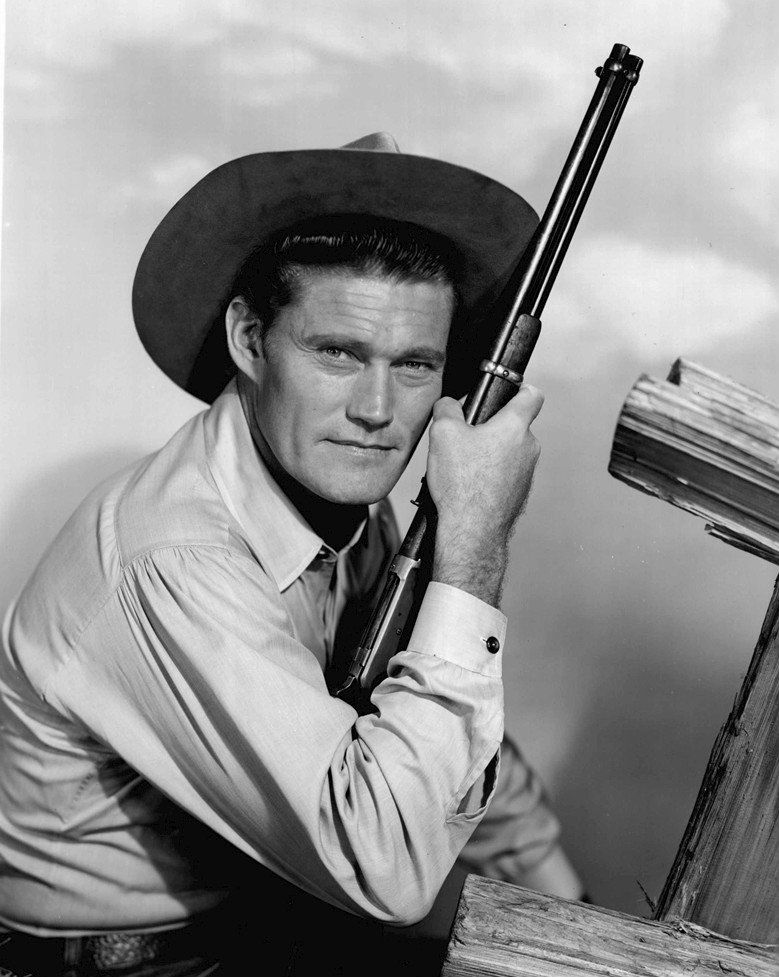
Kevin Joseph "Chuck" Connors[1] (April 10, 1921 – November 10, 1992) was an American actor and professional basketball and baseball player. He is one of only 13 athletes in the history of American professional sports to have played in both the National Basketball Association (Boston Celtics 1946–48) and Major League Baseball (Brooklyn Dodgers 1949, Chicago Cubs, 1951). With a 40-year film and television career, he is best known for his role as Lucas McCain on the ABC series The Rifleman (1958–63).[2]
Key Information


Early life and education
[edit]Connors was born on April 10, 1921 in the borough of Brooklyn in New York City, to Marcella (née Lundrigan; 1894–1971) and Alban Francis "Allan" Connors (1891–1966), immigrants of Irish descent from Newfoundland and Labrador.[3] He had one sibling, a younger sister named Gloria Marie Connors Cole (1923–2020).[4][5] Raised as a Catholic, Connors served as an altar boy at the Basilica of Our Lady of Perpetual Help in Brooklyn.[6][7]
His father became a citizen of the United States in 1914 and was working in Brooklyn in 1930 as a longshoreman, and his mother had also attained her U.S. citizenship in 1917.[3]
Connors was a devoted fan of the Brooklyn Dodgers despite their losing record during the 1930s, and hoped to join the team one day. A talented athlete, he earned a scholarship to the Adelphi Academy, a preparatory school in Brooklyn, where he graduated in 1939. He received offers for athletic scholarships from more than two dozen colleges and universities.[8] He attended Seton Hall University and played both basketball and baseball at the school.
Since childhood, Connors had disliked his first name, Kevin, and sought another name. He tried using "Lefty" and "Stretch" before finally settling on "Chuck".[9] The name derived from his time as a player on Seton Hall's baseball team. He would repeatedly yell to the pitcher from his position on first base, "Chuck it to me, baby! Chuck it to me!" The rest of his teammates and spectators at the university's games soon caught on, and the nickname stuck.[8]
Connors left Seton Hall after two years to accept a contract to play professional baseball.[8] He played on two minor league teams (see below) in 1940 and 1942, then joined the United States Army following America's entrance into World War II.[10][11] During most of the war, he served as a tank-warfare instructor at Fort Campbell, Kentucky, and later at West Point in New York.[9]
Sports career
[edit]Minor League Baseball (1940–1952)
[edit]In 1940, following his departure from college, Connors played four baseball games with the Brooklyn Dodgers' minor league team, the Newport Dodgers (Northeast Arkansas League). Released, he sat out the 1941 season, then signed with the New York Yankees farm team, the Norfolk Tars (Piedmont League), where he played 72 games before enlisting in the Army at Fort Knox, Kentucky, at the end of the season, on October 10, 1942.[12][11]
Following his time in the Army, Connors played for the Newport News Dodgers (Piedmont League) in 1946, the Mobile Bears (Southern Association) in 1947, the Montreal Royals (International League) from 1948 through 1950, and the Los Angeles Angels (Pacific Coast League) in 1951 and 1952.[13]
Professional basketball (1946–1948)
[edit]Following his military discharge in 1946, the 6 ft 5 in (1.96 m) Connors joined the Rochester Royals (now the Sacramento Kings) of the National Basketball League for their 1945–1946 championship season. For the 1946–1947 season, he joined the newly formed Boston Celtics of the Basketball Association of America.[14][15] During his tenure with the Celtics in 1946, Connors became the first professional basketball player to break a backboard. He did so during pregame practice before the Celtics' first home game of their inaugural season with a shot and not a slam dunk, which is what typically breaks a backboard in modern basketball.[16][17] He played 53 games for Boston before leaving the team early in the 1947–48 season.[18][19]
Connors is one of 13 athletes to have played in both the National Basketball Association and Major League Baseball. The 12 others: Danny Ainge, Frank Baumholtz, Hank Biasatti, Gene Conley, Dave DeBusschere, Dick Groat, Steve Hamilton, Mark Hendrickson, Cotton Nash, Ron Reed, Dick Ricketts, and Howie Schultz.[20]
Connors attended spring training in 1948 with Major League Baseball's Brooklyn Dodgers, but did not make the squad.[12] He played two seasons for the Dodgers' AAA team, the Montreal Royals, before playing one game with the Dodgers in 1949.[12] After two more seasons with Montreal, Connors joined the Chicago Cubs in 1951, playing in 66 games as a first baseman and occasional pinch hitter.[21] In 1952, he was sent to the minor leagues again to play for the Cubs' top farm team, the Los Angeles Angels.[12]
Sports career notes
[edit]In 1966, Connors played an off-field role by helping to end the celebrated holdout (see reserve clause) by Los Angeles Dodgers pitchers Don Drysdale and Sandy Koufax when he acted as an intermediary during negotiations between management and the players.[22] Connors can be seen in the Associated Press photo with Drysdale, Koufax, and Dodgers general manager Buzzie Bavasi announcing the pitchers' new contracts.[23]
Contrary to erroneous reports, Connors was not drafted by the Chicago Bears of the National Football League.[24][25][26]
Career statistics
[edit]| GP | Games played | GS | Games started | MPG | Minutes per game |
| FG% | Field goal percentage | 3P% | 3-point field goal percentage | FT% | Free throw percentage |
| RPG | Rebounds per game | APG | Assists per game | SPG | Steals per game |
| BPG | Blocks per game | PPG | Points per game | Bold | Career high |
BAA
[edit]Source[27]
Regular season
[edit]| Year | Team | GP | FG% | FT% | APG | PPG |
|---|---|---|---|---|---|---|
| 1946–47 | Boston | 49 | .247 | .464 | .8 | 4.6 |
| 1947–48 | Boston | 4 | .385 | .667 | .3 | 3.0 |
| Career | 53 | .252 | .471 | .8 | 4.5 | |
MLB
[edit]| Legend | |||||
|---|---|---|---|---|---|
| GP | Games played | AB | At Bats | R | Runs |
| H | Hits | HR | Home runs | RBI | Runs batted in |
| BB | Base on balls (walks) | SB | Stolen bases | AVG. | Batting average |
| OBP. | On-base % | SLG. | Slugging % | OPS | On-base plus slugging |
Regular season
[edit]Source[28]
| Category | G | PA | AB | R | H | 2B | 3B | HR | RBI | SB | BB | SO | AVG | OBP | SLG | OPS | OPS+ | TB | GIDP | SH |
|---|---|---|---|---|---|---|---|---|---|---|---|---|---|---|---|---|---|---|---|---|
| Total | 67 | 215 | 202 | 16 | 48 | 5 | 1 | 2 | 18 | 4 | 12 | 25 | .238 | .280 | .302 | .582 | 55 | 61 | 1 | 1 |
| Category | G | GS | CG | Innings | TC | PO | A | E | DP | Fld | RF/9 | RF/G |
|---|---|---|---|---|---|---|---|---|---|---|---|---|
| First base | 57 | 49 | 45 | 452.1 | 493 | 452 | 33 | 8 | 41 | .984 | 9.65 | 8.51 |
Acting career
[edit]Connors realized that he would not make a career in professional sports, so he decided to pursue an acting career. Playing baseball near Hollywood proved fortunate, as he was spotted by an MGM casting director and subsequently signed for the 1952 Tracy–Hepburn film Pat and Mike, performing the role of a police captain. In 1953, he starred opposite Burt Lancaster as a rebellious Marine private in South Sea Woman and then as an American football coach opposite John Wayne in Trouble Along the Way.
Television roles
[edit]Connors had a rare comedic role in a 1955 episode ("Flight to the North") of Adventures of Superman. He portrayed Sylvester J. Superman, a lanky rustic yokel who shared the same name as the title character of the series.
Connors was cast as Lou Brissie, a former professional baseball player wounded during World War II, in the 1956 episode "The Comeback" of the religion anthology series Crossroads. Don DeFore portrayed the Reverend C. E. "Stoney" Jackson, who offered the spiritual insight to assist Brissie's recovery so that he could return to the game. Grant Withers was cast as Coach Whitey Martin; Crossroads regular Robert Carson also played a coach in this episode. Edd Byrnes, Rhys Williams, and Robert Fuller played former soldiers. X Brands is cast as a baseball player.
In 1957, Connors was cast in the Walt Disney film Old Yeller in the role of Burn Sanderson. That same year, he co-starred in The Hired Gun.[29]
Character actor
[edit]
Connors acted in feature films including The Big Country with Gregory Peck and Charlton Heston, Move Over Darling with Doris Day and James Garner, Soylent Green with Heston and Edward G. Robinson, and Airplane II: The Sequel.
He also became a beloved television character actor, guest-starring in dozens of shows. His guest-starring debut was on an episode of NBC's Dear Phoebe. He played in two episodes, one as the bandit Sam Bass, on Dale Robertson's NBC Western Tales of Wells Fargo.
His other television appearances were on Hey, Jeannie!, The Loretta Young Show, Schlitz Playhouse, Screen Directors Playhouse, Four Star Playhouse, Matinee Theatre, Cavalcade of America, Gunsmoke, The Gale Storm Show, The West Point Story, The Millionaire, General Electric Theater hosted by Ronald Reagan, Wagon Train, The Restless Gun with John Payne, Murder, She Wrote, Date with the Angels with Betty White, The DuPont Show with June Allyson, The Virginian, Night Gallery hosted by Rod Serling, and Here's Lucy with Lucille Ball.
The Rifleman
[edit]
Connors beat 40 other actors for the lead in The Rifleman, portraying Lucas McCain, a widowed rancher known for his skill with a customized Winchester rifle. This ABC Western series, which aired from 1958 to 1963, was also the first show to feature a widowed father raising a young child.[29] Connors said in a 1959 interview with TV Guide that the producers of Four Star Television (Dick Powell, Charles Boyer, Ida Lupino, and David Niven) must have been looking at 40 to 50 thirty-something men. At the time, the producers offered a certain amount of money to do 40 episodes for the 1958–59 season. The offer turned out to be less than Connors was making doing freelance acting, so he turned it down. A few days later, the producers of The Rifleman took their own children to watch Old Yeller, in which Connors played a strong father figure. After the producers watched him in the movie, they decided they should cast Connors in the role of Lucas McCain and made him a better offer, including a five-percent ownership of the show.
The Rifleman was an immediate hit, ranking number four in the Nielsen ratings in 1958–59, behind three other Westerns – Gunsmoke, Wagon Train, and Have Gun – Will Travel. Johnny Crawford, an unfamiliar actor at the time, former Mousketeer, baseball fan, and Western buff, beat 40 other young stars for the role of Lucas' son, Mark. Crawford remained on the series from 1958 until its cancellation in 1963. The Rifleman landed high in the Nielsen ratings until the last season in 1962–63, when it was opposite the highly rated return to television of Lucille Ball on The Lucy Show, and ratings began to drop. The show was cancelled in 1963 after five seasons and 168 episodes.

The rifle
[edit]
Three rifles were made for the show - two identical .44–40 Winchester model 1892 rifles, one that was used on the show and one for backup, and a Spanish version called an El Tigre used in the saddle holster.[30] The rifle levers were modified from the round type to more D-shaped in later episodes.[31]
Two rifles were specifically made for Chuck Connors by Maurice "Moe" Hunt and were never used on the show. He was a fan of the show and gave them to Connors. Arnold Palmer, a friend and honorary chairman of the annual Chuck Connors charity golf event, was given one of the personal rifles[32] by Connors and it was on display at The World Golf Hall of Fame.[33]
Typecasting and other TV roles
[edit]
In 1963, Connors appeared in the film Flipper. He also appeared opposite James Garner and Doris Day in the comedy Move Over, Darling in the role earlier played by Randolph Scott in the original 1940 Irene Dunne/Cary Grant version entitled My Favorite Wife.
As Connors was strongly typecast for playing the single-father rancher, he then starred in several short-lived series, including: ABC's Arrest and Trial (1963–1964), an early forerunner of Law & Order featuring two young actors Ben Gazzara and Don Galloway; and NBC's post-Civil War-era series Branded (1965–1966).

In 1967–1968, Connors starred in the ABC series Cowboy in Africa alongside Tom Nardini and British actor Ronald Howard.
Connors guest-starred in a last-season episode of Night Gallery titled "The Ring With the Red Velvet Ropes". In 1973 and 1974, he hosted a television series called Thrill Seekers.
Connors was nominated for an Emmy Award for his performance in a key role against type: a slave owner in the 1977 miniseries Roots.[2]
Connors hosted a number of episodes of Family Theater on the Mutual Radio Network. This series was aimed at promoting prayer as a path to world peace and stronger families, with the motto, "The family which prays together stays together."
In 1980, he hosted Chuck Connors' Great Western Theatre, a combination of off-network episodes of Branded and The Guns of Will Sonnett, managed by Leo A. Gutman, Inc.[34]
In 1983, Connors joined Sam Elliott, Cybill Shepherd, Ken Curtis, and Noah Beery Jr. in the short-lived NBC series The Yellow Rose, about a modern Texas ranching family.
In 1985, he first guest-starred in the pilot episode which would become a recurring role of King Powers in the ABC TV series Spenser: For Hire, starring Robert Urich as Spenser — "with an S, like the poet" — and Avery Brooks as Hawk.
In 1987, he co-starred in the Fox series Werewolf, as drifter Janos Skorzeny.
In 1988, he guest-starred as Gideon in the TV series Paradise, starring Lee Horsley. He also starred as Nash Crawford, an aged, retired Texas Ranger, in the film Once Upon a Texas Train.
In 1991, Connors was inducted into the Western Performers Hall of Fame at the National Cowboy & Western Heritage Museum in Oklahoma City.
Personal life
[edit]
Connors was married three times. He met his first wife, Elizabeth Jane Riddell Connors, at one of his baseball games and they were married on October 1, 1948. They had four sons.
Connors married Kamala Devi (1963) the year after co-starring with her in Geronimo. She also acted with Connors in Branded, Broken Sabre, and Cowboy in Africa. They were divorced in 1973.
Connors met his third wife, Faith Quabius, when they both appeared in the film Soylent Green (1973). They were married in 1977 and divorced in 1979.[35]
Connors was a supporter of the Republican Party and attended several fundraisers for campaigns for U.S. President Richard M. Nixon. Connors also backed Barry Goldwater in the 1964 United States presidential election, and Gerald Ford in the 1976 presidential election.[36] He campaigned for Ronald Reagan, a personal friend, and marched in support of the Vietnam War in 1967.[37]

Leonid Brezhnev, the leader of the Soviet Union, met Connors when Brezhnev arrived on Air Force One at El Toro Marine Corps Air Station with President Richard Nixon in June 1973. Brezhnev noticed Connors in the group on the tarmac waiting to receive the President and him. Brezhnev shook Connors' hand and then wrapped his arms around him, and leapt into Connors' arms to be lifted up by the hulking American actor. The crowd laughed and clapped at the spectacle. Later, at a party given by Nixon at the Western White House in San Clemente, California, Connors presented Brezhnev with a pair of Colt Single Action Army "Six-Shooters" (revolvers), which Brezhnev liked greatly.[38]
Few American television programs were permitted to be broadcast in the Soviet Union at that time; The Rifleman was an exception, because it happened to be Brezhnev's favorite show. Connors and Brezhnev got along so well that Connors accepted an invitation to visit the Soviet leader in Moscow in December 1973. After Brezhnev's death in 1982, Connors expressed an interest in returning to the Soviet Union for the General Secretary's funeral, but the U.S. government would not allow Connors to be part of the official delegation.[39]
On July 18, 1984, Connors was awarded a star on the Hollywood Walk of Fame (star location at 6838 Hollywood Blvd). Over 200 close friends attended, including his family and actor Johnny Crawford.[40]
Charity
[edit]Connors hosted the annual Chuck Connors Charitable Invitational Golf Tournament, through the Chuck Connors Charitable Foundation, at the Canyon Country Club in Palm Springs, California. Proceeds went directly to the Angel View Crippled Children's Foundation and over $400,000 were raised.[41]
Death
[edit]Connors died of lung cancer on November 10, 1992, at Cedars-Sinai Medical Center in Los Angeles.[2] He is buried at San Fernando Mission Cemetery.[42]
Filmography
[edit]Film
[edit]| Year | Title | Role | Notes |
|---|---|---|---|
| 1952 | Pat and Mike | Police Captain | |
| 1953 | Trouble Along the Way | Stan Schwegler | |
| 1953 | Code Two | Deputy Sheriff | Uncredited |
| 1953 | South Sea Woman | Pvt. Davey White | |
| 1954 | Dragonfly Squadron | Captain Warnowski | |
| 1954 | The Human Jungle | Earl Swados | |
| 1954 | Naked Alibi | Capt. Owen Kincaide | |
| 1955 | Target Zero | Pvt. Moose | |
| 1955 | Good Morning, Miss Dove | Bill Holloway | |
| 1955 | Three Stripes in the Sun | Idaho Johnson | |
| 1956 | Walk the Dark Street | Frank Garrick | |
| 1956 | Hot Rod Girl | Det. Ben Merrill | |
| 1956 | Hold Back the Night | Sgt. Ekland | |
| 1957 | Tomahawk Trail | Sgt. Wade McCoy | |
| 1957 | Designing Woman | Johnnie O | |
| 1957 | Death in Small Doses | Mink Reynolds | |
| 1957 | The Hired Gun | Judd Farrow | |
| 1957 | Old Yeller | Burn Sanderson | |
| 1958 | The Lady Takes a Flyer | Phil Donahoe | |
| 1958 | The Big Country | Buck Hannassey | |
| 1962 | Geronimo | Geronimo | |
| 1963 | Flipper | Porter Ricks | |
| 1963 | Move Over, Darling | Stephen 'Adam' Burkett | |
| 1965 | Synanon | Ben | |
| 1966 | Ride Beyond Vengeance | Jonas Trapp | |
| 1968 | Kill Them All and Come Back Alone | Clyde McKay | |
| 1969 | Captain Nemo and the Underwater City | Senator Robert Fraser | |
| 1971 | The Deserter | Chaplain Reynolds | |
| 1971 | The Birdmen | Colonel Morgan Crawford | |
| 1971 | Support Your Local Gunfighter | Swifty Morgan | Uncredited |
| 1972 | Embassy | Kesten | |
| 1972 | The Proud and Damned | Will Hansen | |
| 1972 | Pancho Villa | Col. Wilcox | |
| 1973 | The Mad Bomber | William Dorn | |
| 1973 | Soylent Green | Tab Fielding | |
| 1974 | 99 and 44/100% Dead | Marvin "Claw" Zuckerman | |
| 1975 | Legend of the Sea Wolf | Wolf Larsen | |
| 1979 | Tourist Trap | Mr. Slausen | |
| 1979 | Day of the Assassin | Fleming | |
| 1980 | Virus | Captain McCloud | |
| 1981 | Bordello | Jonathan | |
| 1982 | Hit Man | Sam Fisher | |
| 1982 | Airplane II: The Sequel | The Sarge | |
| 1982 | There Was a Little Girl | ||
| 1983 | The Vals | Trish's Father | |
| 1983 | Balboa | Alabama Dern | |
| 1983 | Lone Star | Jake Ferrell | |
| 1983 | Afghanistan pourquoi? | Soviet Colonel | |
| 1987 | Hell's Heroes | Senator Morris | |
| 1987 | Sakura Killers | The Colonel | |
| 1987 | Summer Camp Nightmare | Mr. Warren | |
| 1987 | Maniac Killer | Professor Roger Osborne | |
| 1988 | Once Upon a Texas Train | Nash Crawford | |
| 1988 | Terror Squad | Chief Rawlings | |
| 1988 | Taxi Killer | Jenny's Father | |
| 1989 | Trained to Kill | Ed Cooper | |
| 1989 | Skinheads | Mr. Huston | |
| 1990 | Last Flight to Hell | Red Farley | |
| 1990 | Face the Edge | Buddy | |
| 1991 | Salmonberries | Bingo Chuck | |
| 1992 | Three Days to a Kill | Capt. Damian Wright | |
| 2001 | A Man Who Fell from the Sky | Narrator and host |
Television
[edit]| Year | Title | Role | Notes |
|---|---|---|---|
| 1953 | Your Jeweler's Showcase | Episode: "Three and One Half Musketeers" | |
| 1954 | Dear Phoebe | Rocky | Episode: "Billy Gets a Job" |
| 1954 | Big Town | Episode: "Semper Fi" | |
| 1954 | Four Star Playhouse | Mervyn / Stan | Two episodes |
| 1954–1957 | General Electric Theater | Soldier / Long Jack | Two episodes |
| 1955 | Letter to Loretta | Jess Hayes | Episode: "The Girl Who Knew" |
| 1955 | City Detective | Sam | Episode: "Trouble in Toyland" |
| 1955 | TV Reader's Digest | Charlie Masters | Episode: "The Manufactured Clue" |
| 1955 | Private Secretary | Mr. Neanderthal | Episode: "Mr. Neanderthal" |
| 1955 | Schlitz Playhouse of Stars | Stanley O'Connor | Episode: "O'Connor and the Blue-Eyed Felon" |
| 1955 | Adventures of Superman | Sylvester J. Superman | Episode: "Flight to the North" |
| 1955 | Screen Directors Playhouse | Art Shirley | Episode: "The Brush Roper" |
| 1955–1956 | The Star and the Story | Three episodes | |
| 1955 | Matinee Theatre | Episode: "O'Toole from Moscow" | |
| 1955 | Cavalcade of America | Harry | Episode: "Barbed Wire Christmas" |
| 1956 | Fireside Theatre | Officer Handley | Episode: "The Thread" |
| 1956 | Frontier | Thorpe Henderson | Episode: "The Assassin" |
| 1956 | Gunsmoke | Sam Keeler | Episode: "The Preacher" |
| 1956 | Climax! | Episode: "Fear is the Hunter" | |
| 1956 | The Joseph Cotten Show | Andy | Episode: "The Nevada Nightingale" |
| 1956 | Crossroads | Lou Brissie | Episode: "The Comeback" |
| 1956 | The West Point Story | Maj. Nielson | Two episodes |
| 1956 | The Gale Storm Show | Ooma | Episode: "The Witch Doctor" |
| 1957 | The Millionaire | Hub Grimes | Episode: "The Hub Grimes Story" |
| 1957 | Tales of Wells Fargo | Sam Bass / Button Smith | Two episodes |
| 1957 | The Silent Service | Lt. Jim Liddell | Episode: "The Story of the U.S.S. Flier" |
| 1957 | Wagon Train | Private John Sumter | Episode: "The Charles Avery Story" |
| 1957 | The Restless Gun | Toby Yeager | Episode: "Silver Threads" |
| 1958 | Hey, Jeannie! | Buck Matthews | Episode: "The Bet" |
| 1958 | Date with the Angels | Stacey L. Stacey | Episode: "Double Trouble" |
| 1958 | Love That Jill | Cliff | Episode: "They Went Thataway" |
| 1958 | Dick Powell's Zane Grey Theatre | Lucas McCain | Episode: "The Sharpshooter" |
| 1958 | The Adventures of Jim Bowie | Cephas K. Ham | Two episodes |
| 1958–1963 | The Rifleman | Lucas McCain | Lead role 168 episodes |
| 1960 | The DuPont Show with June Allyson | George Ainsworth | Episode: "Trial by Fear" |
| 1963–1964 | Arrest and Trial | John Egan | Lead role 30 episodes |
| 1965–1966 | Branded | Jason McCord | Lead role 48 episodes |
| 1967–1968 | Cowboy in Africa | Jim Sinclair | Lead role 26 episodes |
| 1971 | The Virginian | Gustaveson | Episode: "The Animal" |
| 1971 | The Name of the Game | Governor Brill | Episode: "The Broken Puzzle" |
| 1971 | The Birdmen | Colonel Morgan Crawford | TV movie |
| 1972 | Night of Terror | Brian DiPaulo | TV movie |
| 1972 | Night Gallery | Roderick Blanco | Episode: "The Ring with the Red Velvet Ropes" |
| 1973 | Set This Town on Fire | Buddy Bates | TV movie |
| 1973 | The Horror at 37,000 Feet | Captain Ernie Slade | TV movie |
| 1973 | Here's Lucy | Himself | Episode: "Lucy and Chuck Connors Have a Surprise Slumber Party" |
| 1973 | The Sonny & Cher Comedy Hour | Himself | Episode: "Chuck Conners, Howard Cosell, Miss U.S.A. and Miss Universe: 9/12/73" |
| 1973–1976 | Police Story | Various | Four episodes |
| 1975 | The Six Million Dollar Man | Niles Lingstrom | Episode: "The Price of Liberty" |
| 1976 | Banjo Hackett: Roamin' Free | Sam Ivory | TV movie |
| 1976 | Nightmare in Badham County | Sheriff Slim Danen | TV movie |
| 1977 | Roots | Tom Moore | Miniseries |
| 1977 | The Night They Took Miss Beautiful | Mike O'Toole | TV movie |
| 1978 | Standing Tall | Major Roland Hartline | TV movie |
| 1980 | Stone | Tom Lettleman | Episode: "Case Number HM-89428, Homicide" |
| 1981 | Walking Tall | Theo Brewster | Episode: "Kidnapped" |
| 1982 | Best of the West | Episode: "Frog's First Gunfight" | |
| 1982 | The Capture of Grizzly Adams | Frank Briggs | TV movie |
| 1982 | Fantasy Island | Frank Barton | Episode: "Sitting Duck/Sweet Suzi Swann" |
| 1983 | Lone Star | Jake Farrell | TV movie |
| 1983 | Kelsey's Son | Boone Kelsey | TV movie |
| 1983 | The Love Boat | Roy | Episode: "Bricker's Boy/Lotions of Love/The Hustlers" |
| 1983 | Matt Houston | Castanos | Episode: "Get Houston" |
| 1983–1984 | The Yellow Rose | Jeb Hollister | Main cast 21 episodes |
| 1985 | Spenser: For Hire | King Powers | 2 episodes |
| 1985–1989 | Murder, She Wrote | Fred Keller / Tyler Morgan | Two episodes |
| 1985 | The All-American Cowboy | TV movie | |
| 1987 | Werewolf | Captain Janos Skorzeny | Recurring role Five episodes |
| 1988 | Once Upon a Texas Train | Nash Crawford | TV movie |
| 1988 | Wolf | Episode: "Pilot" | |
| 1989 | High Desert Kill | Stan Brown | TV movie |
| 1989–1990 | Paradise | Gideon McKay | Three episodes |
| 1991 | The Gambler Returns: The Luck of the Draw | Lucas McCain | TV movie |
References
[edit]- ^ "New York, New York City, World War II Draft Registration Cards, 1940-1947", FamilySearch (https://www.familysearch.org/ark:/61903/1:1:WWR6-3RMM : Sat Mar 09 13:31:07 UTC 2024), Entry for Kevin Joseph Connors and Student College, 15 Feb 1942.
- ^ a b c "Chuck Connors, Actor, 71, Dies; Starred as Television's 'Rifleman'". The New York Times. November 11, 1992. Retrieved November 4, 2013.
Chuck Connors, a former professional basketball and baseball player who gained stardom as an actor on the television series 'The Rifleman', died yesterday at Cedars-Sinai Medical Center in Los Angeles. He was 71 years old and lived on a ranch in Tehachapi, California, north of Los Angeles. He died of lung cancer, the hospital said.
- ^ a b "Fifteenth Census of the United States: 1930", Brooklyn, Kings County, New York, April 12, 1930; Enumeration District 24-1031. Bureau of the Census, United States Department of Commerce. Digital copy of original enumeration page of cited census available at FamilySearch, an online genealogical database provided as a public service by The Church of Jesus Christ of Latter-day Saints, Salt Lake City, Utah; retrieved July 24, 2017.
- ^ "United States, Census, 1930", FamilySearch (https://www.familysearch.org/ark:/61903/1:1:X4N5-CY8 : Thu Jan 16 02:47:56 UTC 2025), Entry for Allen Connors and Marcella Connors, 1930.
- ^ "United States, Census, 1950", FamilySearch (https://www.familysearch.org/ark:/61903/1:1:6XTG-NKQP : Wed Mar 20 16:09:23 UTC 2024), Entry for Allan Connors and Marcella Connors, 10 April 1950.
- ^ "Home - Our Chuck Connors". Our Chuck Connors.com. Retrieved September 17, 2022.
- ^ "Chuck Connors". October 25, 2019.
- ^ a b c Chuck Connors biography, "Welcome to the McCain Ranch" website dedicated to the history and content of the television series The Rifleman; retrieved July 24, 2017.
- ^ a b Profile, ourchuckconnors.com; accessed March 7, 2015.
- ^ "Chuck Connors Minor Leagues Statistics & History". Baseball-Reference.com. Retrieved November 10, 2021.
- ^ a b U.S. World War II Army Enlistment Records 1938–1946, National Archives and Records Administration. Electronic Army Serial Number Merged File, 1938–1946 [Archival Database]; ARC: 1263923. World War II Army Enlistment Records; Records of the National Archives and Records Administration, Record Group 64; National Archives at College Park. College Park, Maryland, U.S.A.
- ^ a b c d "Chuck Connors Minor Leagues Statistics & History - Baseball-Reference.com". Baseball-Reference.com.
- ^ "Chuck Connors Minor League Stats". Stats Crew. Retrieved July 15, 2023.
- ^ "Chuck Connors Stats - Basketball-Reference.com". Basketball-Reference.com.
- ^ "Chuck Connors 1946-47 Game Log - Basketball-Reference.com". Basketball-Reference.com.
- ^ Football, Billy. "Backboard Shattering Dunks: Changing The Game". www.barstoolsports.com. Retrieved May 2, 2022.
- ^ "75 Moments in Boston Celtics History". NBC Sports Boston. March 10, 2022. Retrieved May 2, 2022.
- ^ "1946-47 Boston Celtics Roster and Stats - Basketball-Reference.com". Basketball-Reference.com.
- ^ "Chuck Connors 1947–48 Game Log - Basketball-Reference.com". Basketball-Reference.com.
- ^ "Baseball (MLB) and Basketball (NBA) Players | Baseball Almanac".
- ^ "Chuck Connors's career page at". Retrosheet.org. Retrieved November 4, 2013.
- ^ Katz, Jeff. "Everybody's a Star: The Dodgers Go Hollywood". SABR.org. Society for American Baseball Research. Retrieved May 3, 2015.
- ^ Thorp, Ellen. "Chuck Connors: American Actor/Athlete, Rifleman Star". When Westerns Ruled. Archived from the original on May 10, 2015. Retrieved May 3, 2015.
- ^ "NFL.com Draft 2018 - NFL Draft History: Full Draft Year". NFL.com.
- ^ "Chicago Bears All-Time Draft History - Pro-Football-Reference.com". Pro-Football-Reference.com.
- ^ "Chicago Bears". drafthistory.com. Archived from the original on August 28, 2018. Retrieved June 7, 2019.
- ^ "Chuck Connors". Basketball Reference. Sports Reference. Retrieved October 23, 2022.
- ^ "Chuck Connors MLB stats". Baseball Reference. Sports Reference LLC. Retrieved May 28, 2025.
- ^ a b The Rifleman The Original Series The Riflemen website Archived October 6, 2014, at the Wayback Machine, therifleman.net; accessed March 10, 2015.
- ^ "The Rifleman's Rifle". Archived from the original on November 23, 2007. Retrieved November 4, 2013.
- ^ "Chuck Connors Last Modified Winchester "Rifleman" Style Rifle (w/Connors' family letter and original case)". Archived from the original on December 26, 2013. Retrieved November 4, 2013.
- ^ "Chuck Connors' Last Modified Winchester "Rifleman" Style Rifle". Archived from the original on December 26, 2013. Retrieved November 4, 2013.
- ^ "The Rifleman's Rifle on display at the World Golf Hall of Fame". Archived from the original on October 10, 2008. Retrieved November 4, 2013.
- ^ "Gutman (print ad)" (PDF). Broadcasting. March 8, 1982. p. 145. Retrieved October 6, 2023.
- ^ "Chuck Connors profile at". Riflemanconnors.com. Archived from the original on March 28, 2009. Retrieved May 18, 2013.
- ^ Critchlow, Donald T. (October 21, 2013). When Hollywood Was Right: How Movie Stars, Studio Moguls, and Big Business Remade American Politics. Cambridge University Press. ISBN 9781107650282.
- ^ Lambert, Bruce (November 11, 1992). "Chuck Connors, Actor, 71, Dies - Starred as Television's 'Rifleman'". The New York Times. Retrieved August 8, 2017.
- ^ Schattenberg, Susanne (2022). "Emotions and Pills in the Cold War". Brezhnev: The Making of a Statesman. Translated by Heath, John. Dublin: I. B. Tauris. p. 309. ISBN 978-1-8386-0638-1.
- ^ "Actor asks to attend Brezhnev's funeral". UPI. November 12, 1982. Archived from the original on October 23, 2022. Retrieved October 20, 2022.
- ^ "Hollywood Star Walk: Chuck Connors". Los Angeles Times. Archived from the original on June 10, 2011. Retrieved April 20, 2021.
- ^ "Chuck Connors Charitable Invitational Golf Tournament". Archived from the original on April 26, 2014. Retrieved November 4, 2013.
- ^ "Kevin "Chuck" Connors, grave and tombstone, San Fernando Mission Cemetery, Los Angeles, California, photo". www.mygenealogyhound.com. Retrieved September 24, 2022.
External links
[edit]


- Official website at the Wayback Machine (archived February 6, 2023)
- The Rifleman: Chuck Connors
- Chuck Connors at IMDb
- Chuck Connors at the TCM Movie Database
- Jack Bales, "'The Rifleman' (As a Cub)". WrigleyIvy.com.
- Career statistics from NBA.com · Basketball Reference
- Career statistics from MLB · ESPN · Baseball Reference · Fangraphs · Baseball Reference (Minors) · Retrosheet · Baseball Almanac
- TVparty – Meeting with Brezhnev
- Time magazine – Meeting with Brezhnev
- Chuck Connors at Find a Grave
Chuck Connors
View on GrokipediaEarly Life
Childhood and Family Background
Kevin Joseph Aloysius Connors was born on April 10, 1921, in Brooklyn, New York, to Marcella Connors (née Londrigan; 1894–1971), who worked as a domestic servant and custodian, and Alban Francis "Allan" Connors (died 1966), a watchman, both of whom were Irish immigrants who had arrived in the United States via Newfoundland and Labrador, Canada.[10][3] As the elder of two siblings—with a younger sister, Gloria, born in 1923—Connors was raised in a devout Roman Catholic household, where he served as an altar boy at the Basilica of Our Lady of Perpetual Help in Brooklyn.[3][11] The family's working-class circumstances were exacerbated by the Great Depression, leading to frequent moves within Brooklyn, including residences in unheated apartments at 455 Sixty-first Street and later 358 Senator Street.[10] These economic hardships, rooted in the immigrant experience of limited opportunities and manual labor, fostered a environment of necessity-driven resilience, which Connors himself later attributed as the origin of his personal ambition and drive for self-improvement.[10] Such formative pressures in a tight-knit, faith-oriented family underscored causal pathways from socioeconomic constraints to individual determination, with early interests in physical activities emerging as a practical response to the era's challenges, though without formal resources beyond neighborhood outlets.[10] This background instilled core values of discipline and self-reliance, evident in Connors' reflections on overcoming adversity through persistent effort rather than external aid.[10]Education and Early Athletics
Connors received his early education in the public schools of Brooklyn, New York, where he first displayed athletic talent in local sandlot games and schoolyard competitions.[9] A standout multisport athlete, he secured an athletic scholarship to Adelphi Academy, a preparatory school in Brooklyn, enrolling there to focus on football, basketball, and baseball; he captained the basketball team and earned all-city honors in baseball as a first baseman and outfielder, graduating in 1939 amid offers from over 25 colleges.[6][10][12] Selecting Seton Hall University in South Orange, New Jersey, on another athletic scholarship, Connors played freshman baseball in 1941, serving as the Pirates' first baseman after summer semipro experience in New England, and participated in basketball, though his college tenure lasted only one year before transitioning to professional pursuits.[13][12][9] During his baseball play at Seton Hall, Connors adopted the nickname "Chuck"—discarding earlier monikers like "Lefty" and "Stretch"—stemming from his on-field calls to pitchers to "chuck it to me," a habit that stuck among teammates and foreshadowed his physical dominance at 6 feet 6 inches tall.[14]Military Service
Enlistment and Training Role
Connors enlisted voluntarily in the United States Army on October 20, 1942, at age 21, while actively pursuing a professional baseball career with the Brooklyn Dodgers' farm system.[9] [2] This decision occurred nearly ten months after the Japanese attack on Pearl Harbor on December 7, 1941, which spurred widespread enlistments amid national calls for mobilization; as a skilled athlete, Connors qualified for occupational deferments under Selective Service policies that often exempted professional sports figures to maintain public morale, yet he chose immediate service reflecting personal patriotic commitment.[15] [9] Following basic training in the infantry at Fort Knox, Kentucky, Connors was reassigned to tank-warfare instruction based on his exceptional height of 6 feet 6 inches, athletic build, and aptitude for handling heavy machinery, roles that demanded physical robustness for demonstrating armored vehicle operations.[6] [5] He conducted training at Camp Campbell (later Fort Campbell) in Kentucky starting in late 1942, focusing on practical drills in tank maintenance, gunnery, and tactical maneuvers to prepare recruits for potential European and Pacific theaters.[6] In 1944, he transferred to the United States Military Academy at West Point, New York, where he instructed cadets and officer candidates in advanced armored warfare techniques, contributing to the Army's expansion of mechanized units without personal overseas deployment.[5] [9] Military records confirm Connors attained the rank of sergeant and remained stateside throughout his approximately three-year tenure, with no assignments to combat zones; this placement underscored the efficacy of specialized domestic training programs in building a mechanized force capable of supporting Allied advances, as evidenced by the U.S. Army's production of over 49,000 tanks by war's end, many operated by personnel he helped prepare.[9] [16]Stateside Contributions During World War II
During World War II, Chuck Connors served exclusively in stateside training capacities after enlisting in the United States Army in October 1942, forgoing his collegiate athletic pursuits at Seton Hall University to contribute to national defense efforts.[9][5] Assigned as a tank-warfare instructor, Connors utilized his physical stature—standing at 6 feet 6 inches—and athletic background to train armored vehicle crews, emphasizing operational proficiency and tactical maneuvers essential for mechanized warfare.[17][15] His initial posting was at Camp Campbell (later Fort Campbell) in Kentucky, where he instructed recruits on tank gunnery, maintenance, and crew coordination, helping build the skills of personnel who would later deploy to Europe and the Pacific theaters.[9][3] Later transferred to the United States Military Academy at West Point, New York, Connors continued his instructional duties, notably training prominent cadets such as Glenn Davis ("Mr. Outside") and Felix "Doc" Blanchard ("Mr. Inside"), future Heisman Trophy winners who exemplified the rigorous discipline he imparted.[15][6] This role underscored the importance of individual trainer dedication in scaling military readiness, as effective stateside instruction directly enhanced the combat effectiveness of U.S. armored divisions facing Axis mechanized threats. Connors' service, spanning from enlistment through the war's end, reflected a commitment to collective defense over personal advancement, with no overseas deployment despite opportunities in a volunteer-heavy force.[9][18] Connors received an honorable discharge in early 1946, having completed over three years of uninterrupted service focused on domestic training imperatives rather than frontline engagement.[2][18] His contributions, though one element among broader Army efforts, supported the rapid expansion of armored capabilities that proved decisive in Allied victories, such as the armored breakthroughs in Normandy and the Ardennes.[9][5]Sports Career
Minor and Major League Baseball
Connors began his professional baseball career in 1940, signing with the Brooklyn Dodgers organization and appearing in four games for the Newport News Dodgers of the Class D Northeast Arkansas League, where he batted .091.[19] His early play was interrupted by military service during World War II, but he resumed in 1946 with the Dodgers' Class B Piedmont League affiliate in Newport News, batting .293 with 17 home runs and 68 RBIs over 119 games.[19] In 1947, he advanced to the Double-A Southern Association with the Mobile Bears, posting a .255 average, 15 home runs, and 82 RBIs in 145 games.[19] By 1948, Connors reached Triple-A with the Montreal Royals of the International League, where he hit .307 with 17 home runs and 88 RBIs in 147 games, demonstrating emerging power as a first baseman.[19] He repeated at Montreal in 1949, improving to .319 with 20 home runs and a league-leading 108 RBIs in 133 games, which earned him a brief major league call-up to the Dodgers on May 1, 1949, for one game with one at-bat and no hits.[19][1] Returning to the Royals, he batted .290 with six home runs in 1950 before being traded to the Chicago Cubs organization.[19] In 1951, Connors debuted more substantially with the Cubs, playing 66 games primarily at first base with a .239 batting average, two home runs, and 18 RBIs in 214 at-bats.[1][20] Despite his size (6-foot-5) and left-handed power potential—evident in minor league totals exceeding 100 career home runs—post-war influx of experienced players and recurring injuries curtailed his major league tenure to just 67 games across both teams, with an overall .238 average.[9] He returned to Triple-A Los Angeles Angels of the Pacific Coast League in 1951 (.321, 22 HR) and 1952 (.259, 6 HR) before retiring from baseball after the 1952 season.[19]Professional Basketball in the BAA/NBA
Connors joined the Boston Celtics for the inaugural season of the Basketball Association of America (BAA) in 1946–47, the league that later evolved into the National Basketball Association (NBA).[21] Standing at 6 feet 5 inches, his height provided an advantage in an era when average player stature was shorter, allowing him to contribute through physical play and rebounding, though comprehensive rebound statistics were not systematically recorded at the time.[21] He appeared in 49 regular-season games that year, starting in limited minutes, and shot 24.7% from the field on 7.8 attempts per game while averaging 4.6 points, 0.8 free throws made, and 0.8 assists.[21] In the 1947–48 BAA season, Connors returned to the Celtics but played sparingly, appearing in only 4 games and averaging 3.0 points on improved 38.5% field goal shooting in reduced opportunities.[21] His overall BAA career spanned 53 games exclusively with Boston, yielding a 4.5 points per game average, 25.2% field goal percentage, and 46.4% free throw accuracy, reflecting his role as a reserve forward-center amid divided commitments between basketball and professional baseball.[21] Connors' tenure highlighted the challenges of dual-sport professionalism, as he balanced road trips and training schedules across leagues, ultimately prioritizing baseball after departing the Celtics early in 1948.[22] His career high of 15 points came during the 1946–47 season, underscoring occasional scoring bursts in a low-output offensive era.[21]Dual-Sport Achievements and Statistical Overview
Chuck Connors stands as one of only 13 athletes in professional sports history to appear in both Major League Baseball (MLB) and the Basketball Association of America (BAA)/National Basketball Association (NBA), a feat underscoring his rare physical versatility and athletic adaptability across demanding team sports.[23][24] This dual-league participation, verified through official records, highlights the exceptional rarity of succeeding at the professional level in two distinct disciplines requiring divergent skills—power hitting and fielding in baseball juxtaposed with rebounding and shooting in basketball—amid the era's limited opportunities for multi-sport careers.[1][21] His MLB tenure spanned parts of two seasons with the Brooklyn Dodgers in 1949 and Chicago Cubs in 1951, totaling 67 games, while BAA stints with the Boston Celtics covered 53 games across 1946-47 and 1947-48. Despite marginal statistical outputs—often critiqued for brevity—reaching major professional rosters in both leagues demands elite baseline athleticism, as evidenced by the scant historical precedents; narratives downplaying such tenures overlook the probabilistic improbability, where fewer than 0.01% of athletes achieve even one pro contract, let alone dual-league exposure.[25][26]| League | Games Played | Key Batting/Scoring Stats | Source |
|---|---|---|---|
| MLB | 67 | 202 AB, .238 AVG, 2 HR, 18 RBI | [1] |
| BAA/NBA | 53 | 4.5 PPG, 25.2% FG% | [21][26] |
Transition to Entertainment
Post-Sports Challenges and Initial Roles
After retiring from professional baseball in February 1953, following shoulder injuries and a .259 batting average in his final season with the Triple-A Los Angeles Angels, Connors recognized the diminishing prospects of a sustained athletic career at age 31.[9][27] This shift left him navigating job instability, prompting him to take on odd jobs including insurance sales, water softener demonstrations, and pregame show hosting to support himself while entering the competitive Hollywood scene.[27] Connors' entry into acting began modestly in 1952, prior to full retirement, with a bit part as a state police captain in the film Pat and Mike, starring Spencer Tracy and Katharine Hepburn, for which he received $500 after being spotted by industry contacts during his Angels tenure.[9][5] He followed this with small roles in Trouble Along the Way (1953) and South Sea Woman (1953), supplementing film work with television extras and commercials to build experience amid the era's saturated market for newcomers lacking formal training.[9][28] His 6-foot-6 frame and robust physique from years of professional sports facilitated suitability for physically imposing character parts, providing a causal edge in casting decisions that favored his natural screen presence over acting novices without such attributes.[9][27] These early efforts, though sporadic, laid the groundwork for persistence in an industry where transitions from athletics often hinged on leveraging tangible physical advantages amid broader economic uncertainties for former players.[28]Acting Career
Breakthrough Television Success with The Rifleman
Chuck Connors portrayed Lucas McCain, a widowed Civil War Union veteran and rancher raising his son Mark in the fictional town of North Fork, New Mexico Territory, during the post-Civil War era. The series depicted McCain as a principled figure who enforced justice and protected his community primarily through moral suasion but resorted to his customized rifle when necessary to defend against clear threats. Spanning 168 half-hour episodes broadcast on ABC from September 30, 1958, to April 8, 1963, the show highlighted themes of paternal guidance, ethical decision-making, and the responsible use of force strictly for self-defense and protection of the innocent.[29][30] Produced by Four Star Television, The Rifleman was developed by Arnold Laven, who emphasized McCain's rifle as a signature tool distinct from typical Western six-shooters, symbolizing deliberate preparedness rather than impulsivity. The rifle, a modified Winchester Model 1892 with a shortened lever action enabling rapid successive shots, served as a plot device in the opening sequence and episodes, underscoring the realism of quick defensive responses in frontier confrontations. Sam Peckinpah directed approximately 28 episodes, contributing to the series' gritty yet morally straightforward storytelling focused on family integrity over ambiguity.[31] The program achieved strong viewership ratings, with Season 1 averaging household ratings around 21.5 in the competitive Western genre landscape, reflecting audience affinity for narratives prioritizing clear heroism and familial bonds amid 1950s cultural shifts. Its enduring syndication success, continuing into later decades, evidenced sustained demand for depictions of self-reliant characters upholding unambiguous ethical standards against lawlessness, contrasting with more relativistic portrayals in contemporary media.[32][33]Film Roles and Character Acting
Connors appeared in approximately 49 feature films between the early 1950s and the late 1980s, frequently portraying authoritative or antagonistic figures leveraging his 6-foot-6 stature and athletic background for action-oriented scenes.[34] His cinematic output extended beyond Western television, encompassing genres such as drama, comedy, and science fiction, though critics noted that formulaic scripts in B-movies sometimes limited depth, offset by his convincing physical intensity and screen presence derived from real-life sports experience.[35] A notable early supporting role came in the 1957 family drama Old Yeller, where Connors depicted Burn Sanderson, the drifter who trades ownership of the stray dog to young Arliss Coates, contributing to the film's emotional arc amid its post-Civil War Texas setting.[36] This Disney production highlighted his ability to convey rugged benevolence without overpowering the leads, Fess Parker and Tommy Kirk. In contrast, Connors took the lead as the Apache leader Geronimo in the 1962 Western of the same name, portraying a warrior navigating U.S. government duplicity and reservation life; the film, directed by Arnold Laven, emphasized his commanding physicality in action sequences despite the casting of a non-Native actor in the titular role.[37] Later films demonstrated further range, including the villainous Tab Fielding in the 1973 dystopian thriller Soylent Green, where he menaced investigator Charlton Heston's pursuit of corporate secrets amid overpopulation and scarcity.[38] Connors also featured in the 1963 screwball comedy Move Over, Darling, playing a shipwreck survivor entangled in Doris Day and James Garner's remarriage farce; the film achieved commercial success, earning an estimated $17.4 million domestically.[39] These roles underscored his versatility in tough-guy archetypes, from frontier enforcers to futuristic heavies, with authentic grit praised in performances like his key antagonist in The Big Country (1958), though lesser productions often confined him to typecast intensity over nuanced character work.[35]Typecasting, Later Television, and Career Longevity
Following the conclusion of The Rifleman in 1963, Connors encountered typecasting that confined him primarily to portrayals of tough, authoritative characters in Western and crime genres. He took the lead role of defense attorney John Egan in the ABC anthology series Arrest and Trial (1963–1964), which featured 90-minute episodes split between police investigations led by Sgt. Nick Anderson (Ben Gazzara) and courtroom defenses, marking an early format blending procedural and legal drama elements.[40] This role emphasized Connors' commanding presence but echoed the moral rectitude of his prior Western persona.[41] Connors reinforced this image in Branded (1965–1966), an NBC Western where he played Jason McCord, a West Point graduate and cavalry captain falsely accused of cowardice during a massacre, stripped of his uniform, and left to wander the frontier in search of redemption.[42] The series, airing for 48 half-hour episodes, drew on Connors' physical stature and stoic demeanor to depict a hero enduring public disgrace and personal trials, though it lasted only one season amid shifting viewer preferences away from traditional oaters.[43] Into the 1970s and 1980s, Connors sustained his career through diverse television guest roles and recurring parts, countering one-dimensional critiques with appearances across genres including anthology horror (Night Gallery), adventure (Thrill Seekers), and modern drama (Spenser: For Hire).[3] A notable shift came in 1987 when he portrayed the grizzled vampire hunter Janos Skorzeny in the Fox horror series Werewolf, showcasing his adaptability in supernatural narratives amid an industry increasingly favoring younger leads.[3] Connors' professional output persisted until 1991, encompassing over four decades of credited work that demonstrated resilience against age-related biases in casting.[3]Political Views and Public Engagement
Republican Affiliation and Endorsements
Chuck Connors identified as a lifelong Republican, actively supporting the party's candidates through campaigning and fundraising efforts. He attended several fundraisers for U.S. President Richard Nixon's presidential campaigns, demonstrating his commitment to the party's leadership during the late 1960s and early 1970s.[44] [15] Connors also campaigned vigorously for Senator Barry Goldwater's 1964 Republican presidential bid, aligning himself with the party's conservative wing amid the Cold War.[15] Connors extended his partisan support to Ronald Reagan, joining him on the campaign trail for California's 1966 gubernatorial race, where photographs document their joint appearances in events such as one in San Diego.[45] As a friend of Reagan, Connors continued advocating for Republican causes, reflecting a consistent preference for candidates emphasizing strong national defense and anti-communist policies. His political actions paralleled his public statements and participation in pro-Vietnam War demonstrations, including marching in a New York City parade on May 13, 1967, to bolster support for U.S. military involvement.[46]Advocacy for Traditional Values and Conservatism
Connors actively supported Republican candidates and conservative initiatives throughout the 1960s and 1970s, including campaigning with Ronald Reagan during his 1966 bid for California governor.[45] He also backed Richard Nixon's presidential campaigns, reflecting alignment with platforms emphasizing limited government and anti-communism.[9] In May 1967, Connors participated in a New York City parade organized to rally support for U.S. troops in Vietnam, marching alongside veterans and carrying an American flag to counter anti-war protests and affirm commitment to national defense and order.[47][46] This public stand positioned him against prevailing countercultural narratives, prioritizing empirical resolve in foreign policy over domestic relativism. Through cultural channels like The Rifleman, Connors advanced themes of paternal guidance, moral accountability, and responsible self-defense, portraying a widowed father instilling ethical individualism in his son amid frontier challenges—values he endorsed as countering 1960s moral drift in interviews.[48][49] His character's adept rifle use symbolized principled gun ownership for protection and justice, influencing viewers toward self-reliant conservatism over collectivist dependency.[50]Personal Life
Marriages, Family, and Relationships
Chuck Connors married Elizabeth Jane Riddell on October 1, 1948, after meeting her during his minor league baseball days in Montreal.[11] The couple had four sons: Michael (born 1950, died 2017), Jeffrey (born 1952, died 2014), Stephen (born 1953), and Kevin (born 1956, died 2005).[2] Their marriage ended in divorce in 1961, amid the strains of Connors' demanding professional sports and emerging entertainment career, which involved extensive travel.[51] Connors' second marriage was to actress Kamala Devi on April 10, 1963, following their collaboration in the film Geronimo.[52] The union produced no children and dissolved in divorce on February 9, 1972.[2] Connors spoke in interviews about the challenges of balancing his acting commitments with family life, often crediting his portrayal of a devoted father in The Rifleman as reflective of his own paternal values despite the logistical difficulties posed by location shooting and tours.[3] His third marriage to actress Faith Quabius occurred on September 7, 1977, and ended in divorce on April 15, 1980; this relationship also yielded no surviving children.[2] Connors maintained close ties with his sons throughout his life, with no documented major personal scandals, though biographical accounts attribute relational stresses primarily to career-induced absences rather than infidelity or conflict.[53] In later years, he was accompanied by Rose Mary Grumley, his longtime personal assistant, until his death.[54]Philanthropy and Community Involvement
Connors established the Chuck Connors Charitable Foundation to support causes benefiting disabled children, organizing the annual Chuck Connors Charitable Invitational Golf Tournament, which featured celebrity participants including Frank Sinatra and raised over $400,000 in proceeds directed to the Angel View Crippled Children's Foundation in Desert Hot Springs, California.[44][55] These events leveraged his fame from The Rifleman to generate funds for pediatric care and rehabilitation services, with Connors personally contributing through hosting and promotion efforts spanning the late 1970s into the 1980s.[15][56] Beyond the golf tournaments, Connors advocated for underprivileged youth by backing programs tied to sports and community development, drawing from his own early involvement in organizations like the Bay Ridge Boys' Club, though specific adult-era donations to such groups remain less documented.[56] His philanthropy emphasized direct aid to children's health initiatives, reflecting a commitment to tangible support rather than broad political advocacy, with the Angel View efforts providing verifiable assistance to families facing physical disabilities.[16][57]Health, Death, and Legacy
Battle with Illness
Connors, a longtime cigarette smoker who had reportedly consumed up to three packs daily for decades before attempting to quit in the mid-1970s, developed pneumonia that necessitated hospitalization in early November 1992.[58][14] During treatment at Cedars-Sinai Medical Center for this lingering respiratory infection, physicians diagnosed him with advanced lung cancer just days prior to his death.[58][59] Admitted on November 3, Connors received aggressive medical intervention, yet his condition deteriorated rapidly over the ensuing week, succumbing to pneumonia compounded by the malignancy on November 10, 1992, at age 71.[60][59] Long-term tobacco exposure, as in Connors' history, imposes substantial oncogenic risk via inhaled carcinogens that induce DNA mutations and chronic lung inflammation, with cohort studies demonstrating relative risks exceeding 20-fold for heavy users relative to nonsmokers.[58] This causal pathway underscores empirical data linking prolonged smoking to the majority of lung cancer incidences, independent of confounding factors in observational designs.[61]Enduring Cultural Impact and Recognition
The Rifleman remains in syndication on channels including MeTV, Grit, and INSP as of January 2025, with weekly airings that underscore its sustained viewership more than 60 years after its 1958 premiere.[62] The series' portrayal of Lucas McCain as a widowed father enforcing justice through personal resolve and marksmanship has preserved its appeal, evidenced by ongoing reruns that outlast many contemporaries from the Western genre.[63] This endurance reflects measurable cultural persistence, with the show's moral framework—emphasizing self-reliance and familial duty—contrasting dilutions in modern depictions of heroism. Connors' athletic achievements, as one of only 13 individuals to compete professionally in both Major League Baseball and the National Basketball Association, contribute to retrospective evaluations of his legacy, though he received no formal induction into sport-specific halls of fame.[13] His 1984 Emmy nomination for portraying slave owner Tom Moore in Roots, a role diverging from his heroic archetype, highlighted his range beyond typecasting.[64] That year, on July 18, he was honored with a star on the Hollywood Walk of Fame at 6838 Hollywood Boulevard, attended by over 200 associates, affirming his television contributions.[7] Fan engagement persists through merchandise sales on platforms like Etsy and eBay, including apparel and posters featuring Connors' Rifleman likeness, indicating commercial viability of his image decades post-mortem.[65] Efforts to reboot The Rifleman, such as development deals explored by CBS in 2011 and subsequent concepts involving director Chris Columbus, demonstrate industry recognition of its foundational themes, though no production has materialized by 2025.[66] Connors' embodiment of 1950s-1960s ideals—individual agency amid frontier challenges—positions him as a benchmark against which later media's abstracted narratives are often critiqued for lacking causal grounding in personal accountability.[67]Filmography
Feature Films
Connors appeared in over two dozen feature films from the early 1950s through the 1980s, frequently cast in supporting roles as rugged antagonists or authoritative figures in westerns, family dramas, and later genre films including science fiction and horror.[3] His early work often featured uncredited or minor parts in sports comedies and war dramas, transitioning to lead roles in mid-career westerns before diversifying into character parts in cult classics.[68]- Pat and Mike (1952), as a police captain in this Spencer Tracy-Katharine Hepburn sports comedy.[69]
- South Sea Woman (1953), as Private Davey White in a World War II action film.[7]
- Trouble Along the Way (1953), supporting role in a John Wayne football drama.[69]
- Designing Woman (1957), as Johnnie "O" in a romantic comedy with Gregory Peck and Lauren Bacall.[68]
- Old Yeller (1957), as Burn Sanderson in the Disney family adventure western.[68]
- The Big Country (1958), as Buck Hannassey, a key villainous role in the epic western directed by William Wyler.[68]
- Geronimo (1962), starring as the titular Apache leader in this historical western.[37]
- Flipper (1963), as Porter Ricks in the family adventure about a dolphin.[3]
- Move Over, Darling (1963), supporting role in the Doris Day screwball comedy remake.[69]
- Support Your Local Gunfighter (1971), as a bandit in the James Garner western parody.[3]
- Soylent Green (1973), as Tab Fielding in the dystopian science fiction thriller.
- Tourist Trap (1979), as Mr. Slausen in the horror film.[68]
- Airplane II: The Sequel (1982), as The Sarge in the sci-fi comedy spoof.[68]