




Color difference
View on WikipediaIn color science, color difference or color distance is the separation between two colors. This metric allows quantified examination of a notion that formerly could only be described with adjectives. Quantification of these properties is of great importance to those whose work is color-critical. Common definitions make use of the Euclidean distance in a device-independent color space.
Euclidean
[edit]sRGB
[edit]As most definitions of color difference are distances within a color space, the standard means of determining distances is the Euclidean distance. If one presently has an RGB (red, green, blue) tuple and wishes to find the color difference, computationally one of the easiest is to consider R, G, B linear dimensions defining the color space.
A very simple example can be given between the two colors with RGB values (0, 64, 0) ( ) and (255, 64, 0) ( ): their distance is 255. Going from there to (255, 64, 128) ( ) is a distance of 128.
When we wish to calculate distance from the first point to the third point (i.e. changing more than one of the color values), we can do this:

When the result should be computationally simple as well, it is often acceptable to remove the square root and simply use

This will work in cases when a single color is to be compared to a single color and the need is to simply know whether a distance is greater. If these squared color distances are summed, such a metric effectively becomes the variance of the color distances.
There have been many attempts to weigh RGB values, however these are demonstrably[citation needed] worse at color determinations and are properly the contributions to the brightness of these colors, rather than to the degree to which human vision has less tolerance for these colors. The closer approximations would be more properly (for non-linear sRGB, using a color range of 0–255):[1]

where:
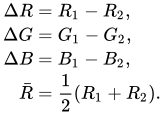
One of the better low-cost approximations, sometimes called "redmean", combines the two cases smoothly:[1]
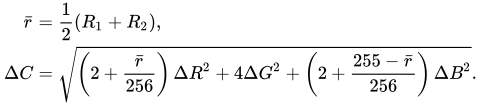
There are a number of color distance formulae that attempt to use color spaces like HSV or HSL with the hue represented as a circle, placing the various colors within a three-dimensional space of either a cylinder or cone, but most of these are just modifications of RGB; without accounting for differences in human color perception, they will tend to be on par with a simple Euclidean metric.[citation needed]
Uniform color spaces
[edit]CIELAB and CIELUV are relatively perceptually-uniform color spaces and they have been used as spaces for Euclidean measures of color difference. The CIELAB version is known as CIE76. However, the non-uniformity of these spaces were later discovered, leading to the creation of more complex formulae.
Uniform color space: a color space in which equivalent numerical differences represent equivalent visual differences, regardless of location within the color space. A truly uniform color space has been the goal of color scientists for many years. Most color spaces, though not perfectly uniform, are referred to as uniform color spaces, since they are more nearly uniform when compared to the chromaticity diagram.
— X-rite glossary[2]
A uniform color space is supposed to make a simple measure of color difference, usually Euclidean, "just work". Color spaces that improve on this issue include CAM02-UCS, CAM16-UCS, and Jzazbz.[3]
Rec. ITU-R BT.2124 or ΔEITP
[edit]In 2019 a new standard for WCG and HDR was introduced, since CIEDE2000 was not adequate for it: CIEDE2000 is not reliable below 1 cd/m2 and has not been verified above 100 cd/m2; in addition, even in BT.709 blue primary CIEDE2000 is underpredicting the error.[4] ΔEITP is scaled so that a value of 1 indicates the potential of a just noticeable color difference. The ΔEITP color difference metric is derived from display referenced ICTCP, but XYZ is also available in the standard. The formula is a simply scaled Euclidean distance:[5]

where the components of this "ITP" is given by
- I = I,
- T = 0.5 CT,
- P = CP.
Other geometric constructions
[edit]The Euclidean measure is known to work poorly on large color distances (i.e. more than 10 units in most systems). A hybrid approach where a taxicab distance is used between the lightness and the chroma plane, , is shown to work better on CIELAB.[6]

CIELAB ΔE*
[edit] | This section is missing information about acceptability difference values in industry. (July 2021) |
The International Commission on Illumination (CIE) calls their distance metric ΔE* (also inaccurately called dE*, dE, or "Delta E") where delta is a Greek letter often used to denote difference, and E stands for Empfindung; German for "sensation". Use of this term can be traced back to Hermann von Helmholtz and Ewald Hering.[7][8]
Perceptual non-uniformities in the underlying CIELAB color space have led to the CIE refining their definition over the years, leading to the superior (as recommended by the CIE) 1994 and 2000 formulas.[9] These non-uniformities are important because the human eye is more sensitive to certain colors than others. CIELAB metric is used to define color tolerance of CMYK solids. A good metric should take this into account in order for the notion of a "just noticeable difference" (JND) to have meaning. Otherwise, a certain ΔE may be insignificant between two colors in one part of the color space while being significant in some other part.[10]
All ΔE* formulae are originally designed to have the difference of 1.0 stand for a JND. This convention is generally followed by other perceptual distance functions such as the aforementioned ΔEITP.[11] However, further experimentation may invalidate this design assumption, the revision of CIE76 ΔE*ab JND to 2.3 being an example.[12]
CIE76
[edit]The CIE 1976 color difference formula is the first formula that related a measured color difference to a known set of CIELAB coordinates. This formula has been succeeded by the 1994 and 2000 formulas because the CIELAB space turned out to be not as perceptually uniform as intended, especially in the saturated regions. This means that this formula rates these colors too highly as opposed to other colors.
Given two colors in CIELAB color space, and , the CIE76 color difference formula is defined as:



corresponds to a JND (just noticeable difference).[12]

CMC l:c (1984)
[edit]In 1984, the Colour Measurement Committee of the Society of Dyers and Colourists defined a difference measure based on the CIE L*C*h color model, an alternative representation of L*a*b* coordinates. Named after the developing committee, their metric is called CMC l:c. The quasimetric (i.e. it violates symmetry: parameter T is based on the hue of the reference alone) has two parameters: lightness (l) and chroma (c), allowing the users to weight the difference based on the ratio of l:c that is deemed appropriate for the application. Commonly used values are 2:1[13] for acceptability and 1:1 for the threshold of imperceptibility.

The distance of a color to a reference is:[14]





CMC l:c is designed to be used with D65 and the CIE Supplementary Observer.[15]
CIE94
[edit]The CIE 1976 color difference definition was extended to address perceptual non-uniformities, while retaining the CIELAB color space, by the introduction of application-specific parametric weighting factors kL, kC and kH, and functions SL, SC, and SH derived from an automotive paint test's tolerance data.[11]
As with the CMC I:c, ΔE (1994) is defined in the L*C*h* color space and likewise violates symmetry, therefore defining a quasimetric. Given a reference color[a] and another color , the difference is[16][17][18]


where

and where kC and kH are usually both set to unity, and the parametric weighting factors kL, K1 and K2 depend on the application:
graphic arts textiles 1 2 0.045 0.048 0.015 0.014


Geometrically, the quantity corresponds to the arithmetic mean of the chord lengths of the equal chroma circles of the two colors.[19]

CIEDE2000
[edit]Since the 1994 definition did not adequately resolve the perceptual uniformity issue, the CIE refined their definition with the CIEDE2000 formula published in 2001, adding five corrections:[20][21]
- A hue rotation term (RT), to deal with the problematic blue region (hue angles in the neighborhood of 275°):[22]
- Compensation for neutral colors (the primed values in the L*C*h differences)
- Compensation for lightness (SL)
- Compensation for chroma (SC)
- Compensation for hue (SH)

The formulae below should use degrees rather than radians; the issue is significant for RT.
The parametric weighting factors kL, kC, and kH are usually set to unity.
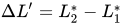




The inverse tangent (tan−1) can be computed using a common library routine atan2(b, a′) which usually has a range from −π to π radians; color specifications are given in 0 to 360 degrees, so some adjustment is needed. The inverse tangent is indeterminate if both a′ and b are zero (which also means that the corresponding C′ is zero); in that case, set the hue angle to zero. See Sharma 2005, eqn. 7.
The example above expects the parameter order of atan2 to be atan2(y, x).[23]

When either C′1 or C′2 is zero, then Δh′ is irrelevant and may be set to zero. See Sharma 2005, eqn. 10.

When either C′1 or C′2 is zero, then h′ is h′1+h′2 (no divide by 2; essentially, if one angle is indeterminate, then use the other angle as the average; relies on indeterminate angle being set to zero). See Sharma 2005, eqn. 7 and p. 23 stating most implementations on the Internet at the time had "an error in the computation of average hue".


![{\displaystyle R_{T}=-2{\sqrt {\frac {{\bar {C}}'^{7}}{{\bar {C}}'^{7}+25^{7}}}}\sin \left[60^{\circ }\cdot \exp \left(-\left[{\frac {{\bar {h}}'-275^{\circ }}{25^{\circ }}}\right]^{2}\right)\right]}](https://wikimedia.org/api/rest_v1/media/math/render/svg/591a16ecf46141685a28de8455e3c868b4977612)
CIEDE 2000 is not mathematically continuous. The discontinuity stems from calculating the mean hue and the hue difference . The maximum discontinuity happens when the hues of two sample colors are about 180° apart, and is usually small relative to ΔE (less than 4%).[24] There is also a negligible amount of discontinuity from hue rollover.[25]


Sharma, Wu, and Dalal has provided some additional notes on the mathematics and implementation of the formula.[25]
Tolerance
[edit]
Tolerancing concerns the question "What is a set of colors that are imperceptibly/acceptably close to a given reference?" If the distance measure is perceptually uniform, then the answer is simply "the set of points whose distance to the reference is less than the just-noticeable-difference (JND) threshold". This requires a perceptually uniform metric in order for the threshold to be constant throughout the gamut (range of colors). Otherwise, the threshold will be a function of the reference color—cumbersome as a practical guide.
In the CIE 1931 color space, for example, the tolerance contours are defined by the MacAdam ellipse, which holds L* (lightness) fixed. As can be observed on the adjacent diagram, the ellipses denoting the tolerance contours vary in size. It is partly this non-uniformity that led to the creation of CIELUV and CIELAB.
More generally, if the lightness is allowed to vary, then we find the tolerance set to be ellipsoidal. Increasing the weighting factor in the aforementioned distance expressions has the effect of increasing the size of the ellipsoid along the respective axis.[26]
The definition of "acceptably close" also depends on the industrial requirements and practicality. In the automotive industry the ΔE*CMC is rather stringent, often less than 0.5 under D65/10. In printing, the typical limit is 2.0 under D50, though some processes require up to 5.0.[27]
See also
[edit]Footnotes
[edit]Notes
[edit]- ^ Called such because the operator is not commutative. This makes it a quasimetric. Specifically, both depend on only.


References
[edit]- ^ a b "Colour metric". Compu Phase.
- ^ "Color Glossary". X-Rite.
- ^ Li, Changjun; Li, Zhiqiang; Wang, Zhifeng; et al. (December 2017). "Comprehensive color solutions: CAM16, CAT16, and CAM16-UCS". Color Research & Application. 42 (6): 703–718. doi:10.1002/col.22131.
- ^ "What Is ICtCp – Introduction?" (PDF). Dolby. Version 7.1. Archived (PDF) from the original on 2016-05-08.
- ^ "Objective metric for the assessment of the potential visibility of colour differences in television" (PDF). BT Series: Broadcasting service (television). International Telecommunication Union. January 2019. Recommendation ITU-R BT.2124-0.
- ^ Abasi, Saeedeh; Amani Tehran, Mohammad; Fairchild, Mark D. (April 2020). "Distance metrics for very large color differences". Color Research & Application. 45 (2): 208–223. doi:10.1002/col.22451. S2CID 209914019.
- ^ Backhaus, W.; Kliegl, R.; Werner, J. S. (1998). Color Vision: Perspectives from Different Disciplines. Walter de Gruyter. p. 188. ISBN 9783110154313. Retrieved 2014-12-02.
- ^ Valberg, A. (2005). Light Vision Color. Wiley. p. 278. ISBN 9780470849026. Retrieved 2014-12-02.
- ^ Fraser, Bruce; Bunting, Fred; Murphy, Chris (2004). Real World Color Management (2nd ed.). Pearson Education. ISBN 9780132777957.
- ^ Evaluation of the CIE Color Difference Formulas
- ^ a b "Delta E: The Color Difference". Colorwiki.com. Retrieved 2009-04-16.
- ^ a b Sharma, Gaurav (2003). Digital Color Imaging Handbook (1.7.2 ed.). CRC Press. ISBN 0-8493-0900-X.
- ^ Meaning that the lightness contributes half as much to the difference (or, identically, is allowed twice the tolerance) as the chroma
- ^ Lindbloom, Bruce Justin. "Delta E (CMC)". Brucelindbloom.com. Retrieved 2009-04-16.
- ^ "CMC" (PDF). Insight on Color. 8 (13). 1–15 October 1996. Archived from the original (PDF) on 2006-03-12.
- ^ Lindbloom, Bruce Justin. "Delta E (CIE 1994)". Brucelindbloom.com. Retrieved 2011-03-23.
- ^ "Colour Difference Software by David Heggie". Colorpro.com. 1995-12-19. Retrieved 2009-04-16.
- ^ Colorimetry - Part 4: CIE 1976 L*a*b* Colour Space (Report). Draft Standard. CIE. 2007. CIE DS 014-4.3/E:2007.
- ^ Klein, Georg A. (2010-05-18). Industrial Color Physics. Springer. p. 147. ISBN 978-1-4419-1196-4.
- ^ Sharma, Gaurav; Wu, Wencheng; Dalal, Edul N. (2005). "The CIEDE2000 color-difference formula: Implementation notes, supplementary test data, and mathematical observations" (PDF). Color Research & Application. 30 (1). Wiley Interscience: 21–30. doi:10.1002/col.20070.
- ^ Lindbloom, Bruce Justin. "Delta E (CIE 2000)". Brucelindbloom.com. Retrieved 2009-04-16.
- ^ The "Blue Turns Purple" Problem, Bruce Lindbloom
- ^ See implementation in Sharma, Gaurav. "The CIEDE2000 Color-Difference Formula". "Excel spreadsheet" hyperlink. Retrieved 2023-10-24.
- ^ Sharma, Gaurav; Wu, Wencheng; Dalal, Edul N.; Celik, Mehmet U. (1 January 2004). "Mathematical Discontinuities in CIEDE2000 Color Difference Computations". Color and Imaging Conference. 12 (1): 334–339. doi:10.2352/CIC.2004.12.1.art00058.
- ^ a b Sharma, Gaurav; Wu, Wencheng; Dalal, Edul N. (February 2005). "The CIEDE2000 color-difference formula: Implementation notes, supplementary test data, and mathematical observations". Color Research & Application. 30 (1): 21–30. doi:10.1002/col.20070.
- ^ Susan Hughes (14 January 1998). "A guide to Understanding Color Tolerancing" (PDF). Archived from the original (PDF) on 10 October 2015. Retrieved 2014-12-02.
- ^ Huda, Mike. "Tips for Defining a Realistic Pass/Fail Tolerance". X-Rite. Retrieved 13 September 2024.
Further reading
[edit]- Robertson, Alan R. (1990). "Historical development of CIE recommended color difference equations". Color Research & Application. 15 (3): 167–170. doi:10.1002/col.5080150308.[dead link]
- Melgosa, M.; Quesada, J. J.; Hita, E. (December 1994). "Uniformity of some recent color metrics tested with an accurate color-difference tolerance dataset". Applied Optics. 33 (34): 8069–77. Bibcode:1994ApOpt..33.8069M. doi:10.1364/AO.33.008069. PMID 20963027.
- McDonald, Roderick, ed. (1997). Colour Physics for Industry (2nd ed.). Society of Dyers and Colourists. ISBN 0-901956-70-8.
External links
[edit]- Bruce Lindbloom's color difference calculator. Uses all CIELAB metrics defined herein.
- The CIEDE2000 Color-Difference Formula, by Gaurav Sharma. Implementations in MATLAB and Excel.
- Explore the Spectrum with Colors in Between, by Bettie M. Cobb.
- Excel add-in for color difference calculations and color space conversions, by Edgardo García.
- Michel Leonard's CIE ΔE 2000 implementations consistent in 20+ programming languages.
Color topics | ||||||||||
|---|---|---|---|---|---|---|---|---|---|---|
| Color science |
|  | ||||||||
| Color philosophy |
| |||||||||
| Color terms |
| |||||||||
| Color organizations | ||||||||||
| Names |
| |||||||||
| Related | ||||||||||


Color difference
View on GrokipediaFundamentals
Definition and Perception
Color difference refers to the magnitude of the smallest change in a color stimulus that is perceptible to the human visual system under specified viewing conditions. This perceptual phenomenon is quantified using metrics that approximate human vision, where a difference of approximately 1 just noticeable difference (JND) corresponds to the threshold at which a variation becomes detectable about 50% of the time.[4] Human color perception begins at the retinal level, where three types of cone photoreceptors—sensitive to short (blue), medium (green), and long (red) wavelengths—enable trichromatic color vision, as described by the Young-Helmholtz theory. These cone signals are then processed through the opponent process theory, proposed by Ewald Hering, which posits three antagonistic channels: red-green, blue-yellow, and black-white (luminance). This dual mechanism explains phenomena like afterimages and the impossibility of perceiving reddish-green or bluish-yellow, transforming cone activations into perceptual color opponencies in the visual pathway.[5][6] The just noticeable difference (JND) in color perception follows Weber's law approximately, stating that the detectable change is proportional to the stimulus magnitude, such that ΔC / C ≈ k, where k is a constant (typically around 0.01–0.02 for chromaticity). For instance, a color shift of 1–2 JND units represents a perceptible change in industries requiring precise matching, though sensitivity varies by hue and luminance. Empirical studies, such as those revealing MacAdam ellipses—ellipsoidal regions in the CIE 1931 chromaticity diagram encompassing colors indistinguishable from a reference—demonstrate the non-uniformity of human color discrimination, with ellipses larger in the blue region and smaller near the spectrum locus.[7][8] Understanding color differences is crucial in fields like graphic design, textile manufacturing, and quality control, where inconsistencies can affect product aesthetics, brand consistency, and compliance. For example, in manufacturing, tolerances based on 1–3 JND ensure batches meet perceptual standards without visible variation, reducing waste and enhancing consumer satisfaction. MacAdam ellipses provide foundational empirical data for developing perceptually uniform color spaces, informing applications from digital imaging to paint formulation.[9][10]Historical Development
The foundations of quantifying color differences trace back to the early 20th century, when the International Commission on Illumination (CIE) established the 1931 XYZ tristimulus color space as a standardized framework for color specification based on human vision experiments. This system provided a device-independent representation of colors using three values derived from spectral data, enabling initial calculations of color differences via Euclidean distances in the XYZ space, though these proved perceptually non-uniform.[11] Pioneering work by David L. MacAdam in 1942 further highlighted these limitations through psychophysical experiments at the Eastman Kodak Research Laboratories in Rochester, New York, where observers matched subtle color variations; the results revealed elliptical contours of just-noticeable differences in the CIE 1931 chromaticity diagram, confirming that equal Euclidean distances did not correspond to equal perceived differences and motivating subsequent efforts toward perceptual uniformity.[12] By the 1970s, the CIE shifted focus to creating color spaces that better approximated human perception, culminating in the 1976 recommendations for CIELUV and CIELAB uniform color spaces. These transformations from XYZ incorporated non-linear functions to model the non-Euclidean nature of color perception, with CIELAB emphasizing cylindrical coordinates for lightness (L*), chroma (C*), and hue angle (h*), designed to make Euclidean distances more proportional to visual discriminability across the color gamut. This development addressed MacAdam's findings and earlier data sets, providing a basis for improved color-difference metrics in industries like printing and manufacturing.[13][14] The 1980s and 1990s brought refinements through industry-specific and standardized formulas that introduced parametric weighting to account for varying sensitivities in lightness, chroma, and hue. In 1984, the Colour Measurement Committee of the Society of Dyers and Colourists in the UK developed the CMC l:c formula, tailored for the textile sector's need for tolerant color matching, where lightness differences were weighted more heavily (typically l=2, c=1) to reflect practical acceptability thresholds. This was followed by the CIE94 formula in 1994, recommended by the CIE to enhance uniformity over CIELAB by incorporating parametric factors for lightness (SL), chroma (SC), and hue (SH), validated against expanded visual datasets from sources like the BFD and Leeds experiments. These advancements culminated in the CIEDE2000 formula, published by the CIE in 2001 (developed through Technical Committee 1-47 from 1998–2000), which added interactive terms between chroma and hue (RT) alongside refined weightings, achieving superior performance (up to 20% better fit to visual data) for small color differences under reference viewing conditions.[15][16][17] Post-2010 developments have extended these metrics to emerging digital media, particularly high-dynamic-range (HDR) and wide color gamut (WCG) applications, where traditional formulas underperform due to expanded luminance and saturation ranges. The International Telecommunication Union (ITU) incorporated adapted colorimetry into Recommendation BT.2020 in 2015, defining a WCG primaries set (with 75% larger gamut than BT.709) for UHDTV, including HDR workflows; this standard leverages CIE-based differences like CIEDE2000 for quality assessment while addressing gaps in high-luminance perception through companion recommendations like BT.2100, motivating ongoing CIE research into HDR-specific uniformity.Basic Metrics
Euclidean Distance in Device Spaces
The Euclidean distance serves as a fundamental metric for quantifying color differences in device-dependent spaces like RGB, representing the straight-line distance between two color points in a three-dimensional coordinate system. In RGB coordinates, it is defined by the formulaEuclidean Distance in Perceptually Uniform Spaces
Perceptually uniform color spaces are designed such that the Euclidean distance between two color points approximates the perceived visual difference between them, addressing the non-uniformity inherent in device-dependent spaces like RGB.[23] In these spaces, color coordinates are transformed to separate attributes like lightness, chroma, and hue in a way that equal distances correspond more closely to equal perceptual steps, enabling simpler metrics like Euclidean distance to yield better predictions of just-noticeable differences (JNDs).[24] The Commission Internationale de l'Éclairage (CIE) introduced such spaces in 1976 to standardize color difference calculations for industrial and scientific applications.[25] The CIELAB (Lab*) space exemplifies this approach, where the L* coordinate represents lightness from 0 (black) to 100 (white), while a* and b* capture opponent color dimensions: a* for green-to-red and b* for blue-to-yellow.[26] Derived from CIE XYZ tristimulus values through a nonlinear transformation involving cube-root functions and reference white normalization, CIELAB aims to achieve approximate perceptual uniformity across the visible spectrum.[27] This transformation, without delving into full matrix details, cubes the ratios of XYZ to reference values before scaling, ensuring that differences in L*, a*, and b* reflect perceptual correlates more accurately than linear device coordinates.[28] In CIELAB, the Euclidean color difference, denoted as ΔE*, is computed as the straight-line distance in this three-dimensional space:Advanced Perceptual Formulas
CIE76
The CIE76 color difference formula, also known as ΔE*ab or simply ΔE*, represents the inaugural standardized metric for quantifying perceptual color differences within the CIELAB color space, recommended by the International Commission on Illumination (CIE) in 1976 as the first attempt at a perceptually uniform color difference calculation. This formula emerged from efforts to create a device-independent space where color differences could be measured geometrically, building on earlier colorimetry work and addressing the limitations of device-dependent metrics like RGB Euclidean distances. It was rapidly adopted in early color management systems for industries such as printing and textiles, providing a foundational tool for quality control until more refined formulas were developed in subsequent decades.[36] The formula is defined as the Euclidean distance in CIELAB coordinates:CMC l:c (1984)
The CMC l:c formula, introduced in 1984 by the Colour Measurement Committee of the Society of Dyers and Colourists, serves as a parametric refinement of the CIE76 metric, designed primarily for industrial color matching in sectors like textiles where uniform tolerances are essential.[38] This development addressed the limitations of CIE76, which often failed to align calculated differences with human visual judgments in commercial settings, by incorporating adjustable weights based on empirical visual assessments of approximately 2,000 textile samples under D65 illumination.[38] The formula is expressed as:CIE94
The CIE94 color difference formula, also known as ΔE*_{94}, was developed by the International Commission on Illumination (CIE) Technical Committee TC1-29 and published in 1995 as part of CIE Publication No. 116 to provide a standardized method for industrial color evaluation beyond textiles.[44] It refines the earlier CMC l:c formula by introducing simpler, fixed weighting functions suitable for general visual industries, addressing perceptual non-uniformities in the CIELAB space more effectively for non-textile applications.[16] The formula was tested on over 200 color pairs from datasets including the RIT-DuPont (glossy paints) and BFD-P (textiles), demonstrating improved correlation with visual assessments, particularly a 20-30% better accuracy in predicting differences for blue and green hues compared to CIELAB.[29] The core equation for CIE94 is:CIEDE2000
The CIEDE2000 color difference formula, adopted by the International Commission on Illumination (CIE) in 2001 as part of Technical Report 142, serves as the current industry standard for quantifying perceptual differences between colors in the CIELAB space. Developed through collaborative efforts by CIE Technical Committee 1-47, it refines earlier models by integrating empirical corrections derived from extensive psychophysical data, achieving superior alignment with human color perception across diverse hues and luminances. The formula was formulated using a composite dataset of 3,657 color pairs from four primary experimental sources (BFD-P, Leeds, RIT-DuPont, and Witt), weighted to an effective 11,273 judgments to optimize parametric fits. Validation against these and additional datasets showed statistically significant enhancements over the CIE94 formula, with particular gains in predictive accuracy for blue and neutral gray regions, as measured by reduced performance factor (PF/3) values indicating less than 30% disagreement with visual assessments.[17][45] The core equation for the CIEDE2000 color difference, denoted ΔE_{00}, is:- Lightness nonlinearity: The weighting function S_L = 1 + [0.015 (L̄' - 50)^2] / √[20 + (L̄' - 50)^2] models the human visual system's sigmoidal response to lightness variations, emphasizing differences near black and white extremes.
- Chroma and hue uniformity with chroma dependence: S_C = 1 + 0.045 C̄' scales chroma differences linearly with magnitude, while S_H = 1 + 0.015 C̄' T incorporates chroma-influenced hue scaling, where T = 1 - 0.17 cos(h̄' - 30°) + 0.24 cos(2 h̄') + 0.32 cos(3 h̄' + 6°) - 0.20 cos(4 h̄' - 63°) captures angular dependencies in hue discrimination.
- Blue hue compensation via rotation: The interactive term R_T = -sin(2 Δθ) R_C rotates the hue-chroma interaction term, with Δθ = h̄' - 275° and R_C = 2 C̄'^7 / (C̄'^7 + 25^7); this empirically corrects for non-radial error ellipsoids in the 230°–320° blue region, where prior formulas overestimated differences by up to 20%.[17]