Hubbry Logo
Glass coloring and color markingGlass coloring and color markingMain
Open search
Glass coloring and color marking
Community hub
Glass coloring and color marking
logo
8 pages, 0 posts
0 subscribers
Be the first to start a discussion here.
Glass coloring and color marking
from Wikipedia

The appearance of different colors in glass is largely due to the way light interacts with the materials it contains. In an extremely pure glass, without impurities such as bubbles, coloring ions, or crystalline and nano-sized phases, all visible light would pass through, and the glass would appear completely transparent. When such impurities are present, they selectively absorb certain wavelengths of light, resulting in coloured glass.[1]

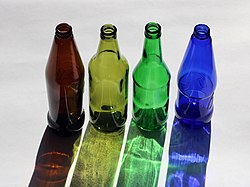
Beer bottles of different colors

Glass coloring and color marking may be obtained in several ways.

  1. by the addition of coloring ions,[2][3]
  2. by precipitation of nanometer-sized colloids (so-called striking glasses[2] such as "gold ruby"[4] or red "selenium ruby"),[3]
    Ancient Roman enamelled glass, 1st century, Treasure of Begram
  3. by colored inclusions (as in milk glass and smoked glass)
  4. by light scattering (as in phase separated glass)[3]
  5. by dichroic coatings (see dichroic glass), or
  6. by colored coatings

Coloring ions

[edit]
Iron(II) oxide glass

Ordinary soda-lime glass appears colorless to the naked eye when it is thin, although iron oxide impurities produce a green tint which can be viewed in thick pieces or with the aid of scientific instruments. Further metals and metal oxides can be added to glass during its manufacture to change its color which can enhance its aesthetic appeal. Examples of these additives are listed below:

Amber Glass
Uranium glass glowing under ultraviolet radiation
Cobalt glass for decoration
  • Iron(II) oxide may be added to glass resulting in bluish-green glass which is frequently used in beer bottles. Together with chromium it gives a richer green color, used for wine bottles.
  • Sulfur, together with carbon and iron salts, is used to form iron polysulfides and produce amber glass ranging from yellowish to almost black. In borosilicate glasses rich in boron, sulfur imparts a blue color. With calcium it yields a deep yellow color.[5]
  • Manganese can be added in small amounts to remove the green tint given by iron, or in higher concentrations to give glass an amethyst color. Manganese is one of the oldest glass additives, and purple manganese glass was used since early Egyptian history.
  • Manganese dioxide, which is black, is used to remove the green color from the glass; in a very slow process this is converted to sodium permanganate, a dark purple compound. In New England some houses built more than 300 years ago have window glass which is lightly tinted violet because of this chemical change, and such glass panes are prized as antiques. This process is widely confused with the formation of "desert amethyst glass", in which glass exposed to desert sunshine with a high ultraviolet component develops a delicate violet tint. Details of the process and the composition of the glass vary and so do the results, because it is not a simple matter to obtain or produce properly controlled specimens.[6]
  • Small concentrations of cobalt (0.025 to 0.1%) yield blue glass. The best results are achieved when using glass containing potash. Very small amounts can be used for decolorizing.
  • 2 to 3% of copper oxide produces a turquoise color.
  • Nickel, depending on the concentration, produces blue, or violet, or even black glass. Lead crystal with added nickel acquires purplish color. Nickel together with a small amount of cobalt was used for decolorizing of lead glass.
  • Chromium is a very powerful colorizing agent, yielding dark green[7] or in higher concentrations even black color. Together with tin oxide and arsenic it yields emerald green glass. Chromium aventurine, in which aventurescence is achieved by growth of large parallel chromium(III) oxide plates during cooling, is made from glass with added chromium oxide in amount above its solubility limit in glass.
  • Cadmium together with sulfur forms cadmium sulfide and results in deep yellow color, often used in glazes. However, cadmium is toxic. Together with selenium and sulfur it yields shades of bright red and orange.[8]
  • Adding titanium produces yellowish-brown glass. Titanium, rarely used on its own, is more often employed to intensify and brighten other colorizing additives.
  • Uranium (0.1 to 2%) can be added to give glass a fluorescent yellow or green color.[9] Uranium glass is typically not radioactive enough to be dangerous, but if ground into a powder, such as by polishing with sandpaper, and inhaled, it can be carcinogenic. When used with lead glass with very high proportion of lead, produces a deep red color.
  • Didymium gives green color (used in UV filters) or lilac red.[8]

Striking glasses

[edit]
Cranberry glass bowl
Photochromic eyeglass lens. The coloring is caused by silver nanoparticles.
  • Selenium, like manganese, can be used in small concentrations to decolorize glass, or in higher concentrations to impart a reddish color, caused by selenium nanoparticles dispersed in glass. It is a very important agent to make pink and red glass. When used together with cadmium sulfide,[10] it yields a brilliant red color known as "Selenium Ruby".
  • Pure metallic copper produces a very dark red, opaque glass, which is sometimes used as a substitute for gold in the production of ruby-colored glass.
  • Metallic gold, in very small concentrations (around 0.001%, or 10 ppm), produces a rich ruby-colored glass ("Ruby Gold" or "Rubino Oro"), while lower concentrations produces a less intense red, often marketed as "cranberry". The color is caused by the size and dispersion of gold particles. Ruby gold glass is usually made of lead glass with added tin.
  • Silver compounds such as silver nitrate and silver halides can produce a range of colors from orange-red to yellow. The way the glass is heated and cooled can significantly affect the colors produced by these compounds. Also photochromic lenses and photosensitive glass are based on silver.
  • Purple of Cassius is a purple pigment formed by the reaction of gold salts with tin(II) chloride.

Coloring added to glass

[edit]

The principal methods of this are enamelled glass, essentially a technique for painting patterns or images, used for both glass vessels and on stained glass, and glass paint, typically in black, and silver stain, giving yellows to oranges on stained glass. All of these are fired in a kiln or furnace to fix them, and can be extremely durable when properly applied. This is not true of "cold-painted" glass, using oil paint or other mixtures, which rarely last more than a few centuries.

Colored inclusions

[edit]

Tin oxide with antimony and arsenic oxides produce an opaque white glass (milk glass), first used in Venice to produce an imitation porcelain, very often then painted with enamels. Similarly, some smoked glasses may be based on dark-colored inclusions, but with ionic coloring it is also possible to produce dark colors (see above).

Color caused by scattering

[edit]
The Tyndall effect in opalescent glass: it appears blue from the side, but orange light shines through.[11]
Porous glass pore-size gradient (large pores on the right); coloring based on the Tyndall effect.

Glass containing two or more phases with different refractive indices shows coloring based on the Tyndall effect and explained by the Mie theory, if the dimensions of the phases are similar or larger than the wavelength of visible light. The scattered light is blue and violet as seen in the image, while the transmitted light is yellow and red.

Dichroic glass

[edit]
A pendant made from dichroic glass

Dichroic glass has one or several coatings in the nanometer-range (for example metals, metal oxides, or nitrides) which give the glass dichroic optical properties. Also the blue appearance of some automobile windshields is caused by dichroism.

See also

[edit]

References

[edit]
Revisions and contributorsEdit on WikipediaRead on Wikipedia
from Grokipedia
Glass coloring and color marking encompass the diverse chemical and physical processes used to introduce hues into glass, ranging from the addition of ions during to surface applications and colloidal formations, resulting in transparent, translucent, or opaque effects for decorative, protective, or identificatory purposes in applications like , , and . The primary method of bulk coloring involves incorporating oxides into the molten glass mixture, where ions such as iron(II) produce blue-green tones, yields green, creates intense blue, and results in purple, with absorption governed by the Beer-Lambert law and influenced by factors like and glass composition. Colloidal coloring, known as "striking," achieves vivid effects like from nanoparticles or pink to red from through controlled that precipitates nanometer-sized particles, scattering light via plasma . These techniques allow precise control over color intensity, often requiring only parts per million of additives, and are essential in commercial production for UV protection or aesthetic variation. Surface coloring and marking techniques complement bulk methods by applying pigments or enamels post-formation, such as vitreous paints made from iron or oxides mixed with and binders, fired onto the surface for shading and detail in . Silver stain, introduced in the 14th century, uses to produce yellow-orange hues when fired, enabling intricate modeling without altering the base color. In modern contexts, color marking serves identificatory roles, like distinguishing containers through selective additions or laser etching for permanent, tamper-proof codes on bottles and components. Historically, these processes trace back to ancient civilizations, where metallic oxides tinted pot-metal glass for mosaics and vessels, evolving through medieval production in (1100s–1500s) to achieve vibrant windows via pot-metal layering and enamel decoration. Today, they support industries from optical filters and applications using rare earth ions like for faint blue effects, to sustainable packaging where amber glass from iron-sulfur chromophores blocks UV light.

Intrinsic coloring methods

Ion-based coloring

Ion-based coloring involves the incorporation of ions into the matrix during the process, where these ions dissolve homogeneously to produce uniform coloration throughout the material. The color arises primarily from the absorption of visible light by these ions through d-d electron transitions, in which the degenerate d-orbitals split into different energy levels due to the ligand field of the surrounding oxygen atoms in the silica network, selectively absorbing specific wavelengths and transmitting or reflecting the . Common ions used include (Cu²⁺), which imparts hues; (Co²⁺), producing deep blue tones; and (Cr³⁺), yielding shades, all depending on the coordination environment and within the . Iron ions exemplify the role of in color variation: Fe²⁺ generates or tones, while Fe³⁺ shifts toward or , influenced by the conditions during melting. ions, particularly Mn³⁺, create purple coloration and have been historically noted for reversible coloring effects in certain glasses, akin to an "Alexandrite" phenomenon under varying light conditions. Chemically, these ions substitute for network modifiers like sodium or calcium in the silica tetrahedra, integrating into the amorphous structure without altering the overall glass formation, which ensures stable, homogeneous distribution. Color intensity depends on concentration, typically ranging from 0.1% to 1% by weight of the (e.g., CoO or CuO), where low levels (such as 0.025–0.1% for ) suffice for vivid results, but higher amounts can lead to saturation or opacity. This method dates back to ancient times, with cobalt ions used to create deep blue glass in around 1500 BCE, as evidenced in 18th Dynasty artifacts from sites like , where it mimicked the prized . While highly stable and requiring no post-melting structural changes, ion-based coloring is limited to transition metals that remain soluble in the glass melt at high temperatures, restricting the palette to blues, greens, and purples, with reds often necessitating colloidal alternatives.

Colloidal and striking coloring

Colloidal coloring in involves the formation of nanoscale metal or particles dispersed uniformly within the matrix, producing vibrant, translucent colors through and absorption rather than simple ionic transitions. This method contrasts with direct ion-based doping by requiring a secondary known as "striking" to precipitate the colloids from initially dissolved precursors. During the initial stage, compounds such as gold chloride (AuCl3) or compounds are added to the batch, where they dissolve as ions in an oxidizing environment. The is then cooled to , appearing nearly colorless, before undergoing controlled annealing—typically at 500–600°C for 1–2 hours—to nucleate and grow the colloidal particles. The striking process relies on reduction of the precursor ions to atomic form, followed by diffusion and aggregation into nanoparticles, often facilitated by redox couples like tin or antimony. Key examples include gold colloids, which yield the iconic ruby red color through particles of 5–50 nm in size; selenium-based colloids, often combined with cadmium sulfide (CdS) or cadmium selenide (CdSe), produce red to yellow hues depending on composition; and copper colloids, which require a reducing atmosphere to form red shades, though they can also yield blue or green from ionic forms. The color arises from surface plasmon resonance in these metal nanoparticles, where collective electron oscillations lead to selective absorption of light, such as around 520 nm for gold, transmitting or scattering the complementary red wavelengths for a vivid, stable effect. Historically, ruby glass was rediscovered in the late by German chemist Johann Kunckel von Löwenstern, who refined the process around 1679–1685 in , building on ancient Roman techniques like those in the but lost for centuries; his publication in Ars Vitraria Experimentalis (1679) detailed using gold chloride and tin as a , enabling production for luxury items. Modern advancements apply and growth theories to precisely control particle formation, allowing reproducible colors in applications from decorative art to optical filters. However, challenges persist in maintaining particle sizes within 5–50 nm to ensure translucency without opacity from aggregation, as well as sensitivity to rates post-striking, which can dissolve or coarsen colloids if cooling is too rapid.

Inclusion-based coloring

Inclusion-based coloring is achieved by incorporating discrete, insoluble particles or into the melt, resulting in textured, sparkling effects that arise from localized interactions rather than uniform coloration of the matrix. This method relies on adding materials like metal oxides or filings during the initial batch preparation, where they do not fully dissolve but instead form suspended inclusions that enhance visual appeal through and reflection. Unlike nanoscale colloidal particles, these inclusions are often visible and create a heterogeneous , producing metallic sheens or starry sparkles. Common examples include copper-based inclusions for traditional aventurine glass, which yields a green-brown sparkle; chromium oxide crystals for green aventurine; and sulfur or iron variants for yellowish tones. Historical goldstone, a reddish-brown variant, incorporates crystals within a clear base, while flakes can be added for iridescent effects in modern applications. These particles are typically introduced as filings, salts, or oxides—such as for goldstone or potassium bichromate for green variants—and must be carefully proportioned to avoid overpowering the composition. The mechanism behind these colors stems from the inclusions independently refracting and reflecting light, generating metallic or aventurescent effects without significantly altering the inherent color of the surrounding glass. For instance, in copper goldstone, minute octahedral copper crystals scatter light to produce a glittering appearance, while chromium oxide plates in green aventurine create parallel reflections mimicking natural quartz. This localized scattering contrasts with bulk absorption, emphasizing the particles' role in surface-level optical play. Production involves stirring the insoluble materials into the viscous molten glass to ensure even distribution, often in a reducing atmosphere to promote crystal formation from precursors like copper salts. The melt is then cooled slowly—typically in a covered pot with insulating materials like ashes—to allow nucleation and growth of the crystals while locking them in place; typical inclusion concentrations range from 0.5 to 2% by volume to achieve balanced sparkle without settling. If the melt viscosity is insufficient, particles may segregate at the bottom, compromising uniformity. This technique originated in , particularly on , where it was developed in the late 16th to early 17th century, with first documented around 1620 as a secretive art guarded by glassmakers. Initially used in elite decorative objects like beads and vessels to imitate precious stones, it remains popular today in jewelry, ornaments, and architectural elements, though challenges like particle settling persist in large-scale production.

Surface coloring and marking techniques

Applied coatings and paints

Applied coatings and paints refer to the post-manufacture application of colorants directly onto glass surfaces to achieve decorative effects or functional markings, distinct from intrinsic bulk coloring methods. These techniques enable the addition of vibrant, multi-layered designs on clear or pre-colored , enhancing its aesthetic appeal without requiring alterations to the 's core composition. Enamels and paints are applied in liquid or paste form, followed by curing processes that bond the colorant to the surface, ranging from high-temperature firing to low-heat baking or air-drying. Firing-on enamels, a primary technique, involve a mixture of powdered —typically a lead-zinc borosilicate base with 30-40% PbO, 15-19% B₂O₃, and silica as the primary network former—combined with metal pigments for coloration. Modern formulations increasingly use lead-free alternatives, such as - or zinc-based , to comply with health and environmental regulations. Common pigments include for bright yellow tones and for deep blues, with the acting as a to facilitate fusion. The enamel paste is applied via brushing for artistic details or for precise, repeatable patterns, such as bottle labels. After application and initial drying, the is fired in a at 590-820°C for 20 minutes to several hours, allowing the to soften and chemically bond with the surface, creating a durable, glossy layer. Screen printing with enamels exemplifies an industrial process where a is created on a fine screen, and the viscous enamel is forced through using a to deposit uniform layers of color. This method supports high-volume production for applications like branded glassware, with each color requiring a separate screen and firing cycle to prevent smearing. The resulting coatings are highly adherent due to matched coefficients between the enamel and glass, minimizing cracking during cooling. For applications avoiding high heat, cold paints such as Pebeo's Vitrea 160—acrylic emulsions incorporating glass-compatible dyes and pigments—offer a non-firing alternative, cured in a conventional at 160°C for 40 minutes to achieve dishwasher resistance. Similarly, Mod Podge tinted with dyes provides a simple brushing medium for temporary or low-wear decorations, though it requires a water-resistant variant for basic protection. These paints are ideal for hobbyist artistic staining on vases or ornaments, applied in thin layers to prevent bubbling during curing. A key advantage of applied coatings is their versatility in creating intricate, multi-color designs on transparent , replicating the effects of historical pot-metal techniques without the need for specialized melting equipment. The 19th-century invention of low-fire vitreous enamels marked a pivotal advancement, enabling safer industrial marking on bottles by fusing colors below the glass softening point, thus avoiding deformation and broadening commercial use. However, durability varies by method: fired enamels provide superior resistance to abrasion, chemicals, and , with microstructures that integrate pigments stably into the matrix. In contrast, non-fired paints like untempered acrylics or Mod Podge variants are prone to UV-induced fading and surface wear, limiting them to indoor or decorative roles unless sealed additionally.

Etching and engraving with color

Etching and engraving with color involves subtractive processes that remove glass material to create recessed designs, which are then filled with colored materials for durable, contrasting markings. Chemical etching typically employs hydrofluoric acid (HF) to dissolve unprotected areas of the glass surface, producing frosted patterns that can be precisely controlled through exposure time and concentration. Mechanical methods complement this by using diamond-tipped tools to scratch intricate designs or sandblasting with abrasive particles, such as aluminum oxide, propelled at high speeds to abrade the surface and form textured grooves. To integrate color, the etched or engraved grooves are filled with durable materials like resins for flexible adhesion, ceramic paints for heat-resistant finishes, or metallic powders including for opulent effects. These fillers are applied via brushing or pouring into the recesses, often followed by baking at temperatures around 350°F to fuse the color permanently to the , ensuring resistance to washing and environmental exposure. In industrial applications, this technique is widely used for labeling bottles, such as wine containers featuring etched logos or text filled with vibrant colors to enhance branding visibility and permanence. Decorative , including vases and , has employed colored since the to add artistic depth and . protocols are essential due to the hazardous nature of agents; vinyl stencils or resists mask protected areas, preventing unintended dissolution during HF exposure. Depth is meticulously controlled, typically to 0.1-0.5 mm, to securely hold the color fill while minimizing risks of cracking or weakening the structure. Historically, colored gained prominence in 19th-century production, where skilled engravers combined cutting with pigment infills to create luxurious, export-oriented pieces that defined European . In modern practice, eco-friendly alternatives to HF, such as , offer reduced toxicity while achieving similar frosting effects for sustainable manufacturing.

Laser-based marking

Laser-based marking employs focused beams to modify the surface properties of , enabling the creation of permanent, high-contrast marks such as logos, barcodes, and serial numbers without mechanical contact or chemical agents. This non-contact method relies on effects to induce localized changes, offering precision down to 0.1 mm resolution suitable for industrial applications like pharmaceutical . Unlike traditional , laser marking allows for rapid, automated processing on curved or irregular surfaces. CO2 lasers, with a of 10.6 μm, are widely used for frosted on due to strong absorption by silica, leading to micro-cracks that produce a white, light-scattering appearance for enhanced visibility. The process involves a focused through a ZnSe lens (typically 127 mm ) to a 0.6 mm spot, with power settings of 60–210 W and interaction times of 0.5–1.4 ms to vaporize or the surface without deep penetration. Speeds range from 200–500 mm/s, adjustable based on thickness and desired depth, ensuring clean edges on soda-lime or up to 3.5 mm thick. This technique, evolved from early diode-pumped systems, provides durable marks resistant to wear and tampering. Fiber lasers (1.06 μm , 10–20 power) complement CO2 systems for marking, particularly when combined with absorptive coatings to overcome low native absorption and prevent unwanted . Pre-application of marking sprays, such as ceramic-based CerMark or paints, allows the laser to fuse pigments into ablated areas, creating black, brown, or colored marks with high contrast; post-etching painting of microcracked regions further enables color addition for decorative effects. These lasers induce controlled annealing or stress , altering refractive indices for subtle color shifts (e.g., greenish hues under polarization), though primarily surface-limited. Advancements in since the 2010s have improved efficiency for high-volume production, such as traceability codes on pharmaceutical vials at rates supporting 600 units per minute. Recent innovations as of 2024 include laser-induced periodic surface structures (LIPSS) for structural coloring, enabling pigment-free iridescent effects through nanoscale gratings formed by or lasers. The advantages of laser-based marking include chemical-free operation, scalability for automation, and permanence that withstands sterilization in applications, reducing counterfeiting risks in the . However, limitations persist: marks remain surface-only, with potential micro-fractures in thicker glass (>5 mm) if power exceeds optimal thresholds, risking propagation cracks; careful parameter tuning (e.g., defocusing slightly toward the surface) mitigates this. Overall, these methods represent a shift from 1990s CO2-dominated to hybrid fiber-CO2 setups in the for versatile, high-resolution coloring.

Optical and structural color effects

Scattering-induced coloration

Scattering-induced coloration in glass results from the interaction of light with structural inhomogeneities, such as phase-separated droplets, gas bubbles, or added opacifiers, leading to and transmission effects that produce opaque, milky, or opalescent appearances. Unlike absorption-based coloring, these effects stem from light scattering, where particles or domains with refractive indices different from the surrounding glass matrix redirect photons in various directions, reducing transparency and creating color through wavelength-dependent dispersion. This phenomenon is prominent in materials like and opal glass, where controlled inhomogeneities enhance aesthetic and functional properties. The primary mechanisms involve for small scatterers (particle diameter much less than the light wavelength, typically < λ/10, where λ ≈ 400–700 nm for visible light), which preferentially scatters shorter blue wavelengths, and Mie scattering for larger particles (diameter comparable to λ), which scatters more uniformly across wavelengths, often yielding white or neutral opalescence. In phase-separated glasses, such as those undergoing liquid-liquid demixing during cooling, silica-rich droplets (typically 10–100 nm in size) form within a matrix of differing composition, like borate-rich phases in borosilicate systems, causing Rayleigh-like Tyndall effects where the glass appears blue in reflection (due to stronger scattering of short wavelengths) and reddish-orange in transmission. The scattering cross-section for Rayleigh regime follows σ ∝ 1/λ⁴, explaining the intense blue hue from fine structures, as derived from electromagnetic theory for dipole approximations: σ=8π3(2πλ)4α2(4πϵ0)2\sigma = \frac{8\pi}{3} \left( \frac{2\pi}{\lambda} \right)^4 \frac{\alpha^2}{(4\pi \epsilon_0)^2} where α is the polarizability of the scatterer. For larger inhomogeneities, such as gas bubbles (often 0.1–10 μm), Mie scattering dominates, with forward-directed patterns that contribute to overall opacity without strong color bias. The Tyndall effect, an extension to colloidal-scale particles, further manifests as iridescence or milky diffusion in these glasses. Production of scattering-induced colors relies on introducing or inducing scatterers during melting and annealing. Opacifiers like tin oxide (SnO₂, added at 1–5 wt%) form fine crystalline inclusions that scatter light when particle sizes remain sub-micrometer, transitioning from transparent to white opaque glazes or glasses; this was historically key in achieving uniform milkiness. In milk glass, bone ash (primarily calcium phosphate, Ca₃(PO₄)₂, at 1–3 wt%) serves as an opacifier, precipitating as dispersed droplets that promote phase separation and Mie/Rayleigh scattering for the characteristic translucent white. Controlled devitrification, via heat treatment to induce partial crystallization or phase separation, creates opal glass with silica-rich droplets (10–100 nm) through spinodal decomposition in alkali-lime-silica melts, enhancing opalescence without full crystallization. Gas bubbles, intentionally retained or introduced via fining agents, contribute via Mie scattering but are often minimized in high-quality production. Color effects vary with scatterer size and distribution: small particles (<50 nm) yield blue opalescence via Rayleigh dominance, as in early phase-separated borosilicates showing Tyndall blue in reflection; larger ones (>500 nm) produce broadband white , typical of . Historical examples include "," where natural weathering etches soda-lime glass surfaces over decades in marine environments, creating micro-roughness (via hydration and silica leaching) that induces diffuse surface for a frosted, milky appearance, often with subtle bluish tints from residual Rayleigh contributions. , a 19th-century French (ca. 1810–1890), exemplified these effects in semi-opaque and decorative items through in lead-alkali-silica compositions. Applications span architectural panels for diffused lighting, where scattering reduces glare while maintaining translucency, and consumer goods like Victorian-era tableware, where milk and opal variants provided elegant opacity. These techniques, rooted in 19th-century advancements in France for opaline production, continue in modern bioactive glasses and art objects, leveraging scattering for both aesthetic iridescence and functional light management.

Dichroic and interference effects

Dichroic and interference effects in glass arise from the interaction of light with thin multilayer coatings, producing vibrant, angle-dependent colors through wave interference rather than pigment absorption. These effects create materials that appear to shift hues—such as from purple to green—depending on the viewing angle or illumination direction, distinguishing them from static coloring methods. In glass applications, this phenomenon is harnessed via precisely engineered thin films deposited on the surface, enabling both decorative and functional uses in art, jewelry, and optical components. Fabrication of typically involves techniques, where multiple ultra-thin layers of metal oxides, such as (TiO₂) and (SiO₂), along with occasional metallic layers like silver, are sequentially evaporated onto a substrate in a high-vacuum chamber. This process, refined in the 1950s and 1960s by researchers to develop protective coatings for visors and gear against intense solar radiation, allows for atomic-level control over layer thickness, often on the order of nanometers. The resulting multilayer structure forms an that selectively reflects or transmits specific wavelengths, reviving an ancient aesthetic in a modern, reproducible form. The underlying mechanism relies on constructive and destructive interference of light waves as they reflect off and transmit through the alternating layers of varying refractive indices. In a common design known as a quarter-wave stack, each layer's optical thickness (n × d, where n is the refractive index and d is the physical thickness) is set to one-quarter of the target wavelength, leading to high reflection peaks at λ = 4nd for normally incident light. This interference causes certain wavelengths to reinforce in reflection while others cancel out, producing the characteristic color shifts; for instance, shorter wavelengths may dominate at steeper angles due to path length changes in the films. The effect operates distinctly in reflection mode, where colors are vividly displayed against a dark background, and transmission mode, where complementary hues pass through to illuminate the glass. Historically, dichroic effects were achieved in ancient Roman glassware, such as the from the 4th century CE, through the incorporation of and silver nanoparticles that induced plasmonic interference, causing the vessel to appear ruby red when lit from behind and green when illuminated from the front. In contemporary applications, these effects adorn jewelry, architectural panels, and , where the color-shifting properties enhance visual dynamism without fading over time. Modern producers like Bullseye Glass offer pre-coated DichroIC sheets in various patterns and hues, compatible with kiln-forming techniques that further integrate the coatings into custom designs. These sheets demonstrate enhanced durability when fused at approximately 800°C, a process that bonds the dichroic layers more securely to the base , improving resistance to and mechanical wear while preserving the interference colors. This fusing step, common in kilnforming, allows artists to create robust, multidimensional pieces that maintain their optical allure under everyday handling.

References

Add your contribution
Related Hubs
User Avatar
No comments yet.