


Community hub
Recent from talks
Contribute something
Nothing was collected or created yet.
Colt House Revolver
View on Wikipedia
Key Information


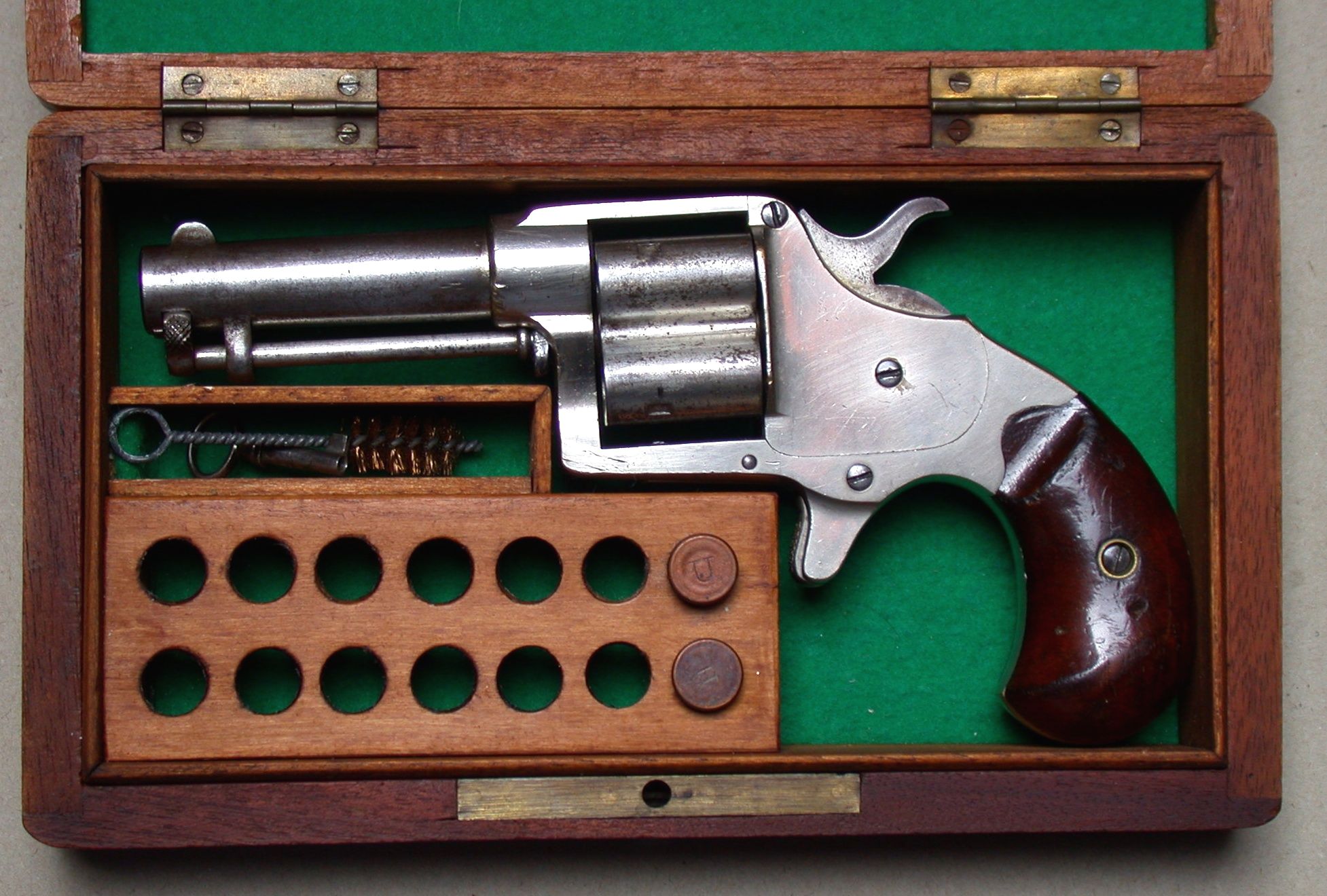
The Colt House Revolver (also called, in its alternate 4-round capacity model, the Cloverleaf) was one of the first metallic cartridge rear-loading revolvers to be produced by the Colt's Patent Fire Arms Manufacturing Company, in 1871. The same year, Colt's also patented the Colt Open Top, another metallic cartridge rear-loader, but in fact the Open Top production didn't start until 1872, although a pocket version of the Open Top, a completely different design, went on sales as of 1871, the Colt Open Top Pocket Model Revolver.[1]
The Colt House Revolver was manufactured from 1871 to 1876 in two different models: the Colt House Model itself and the Colt Cloverleaf Model, the latter being the most produced of both.[1] The House Model is also known among collectors as the Jim Fisk model or the Jim Fisk pistol, since it attained the infamy of being the gun used in the murder of James Fisk in January 1872.[2]
Anatomy and specifications
[edit]Both models, House and Cloverleaf, were built around a solid hidden spur-trigger frame, a weapon architecture also used by another Colt gun, the Colt Sidehammer (1855). The Sidehammer had a flat-ended grip, while the House and Cloverleaf models had all of them a recognizable "bird's-head" grip. These features (spur trigger, "birds-head" grips, etc.) were common on many small pistols and revolvers during that era, such as the classic 2-shot "derringer" pistol.[3]
Finally, both models, House and Cloverleaf, were chambered with .41 caliber rimfire cartridges, available in both long and short sizes. The main differences between the two models were the following:[1]
Cylinder
[edit]- The House Model, also called the Jim Fisk Model, had a five rounds straight non-fluted cylinder.[4]
- The Cloverleaf Model had a four rounds fluted cylinder. When viewed from front or rear the cylinder seemed to resemble a four-leaf clover, hence the moniker.
Barrel
[edit]- The House Model was less produced of the two and had no variant development. It was produced in a single item product with a 2-5/8" barrel.
- The Cloverleaf Model was more produced by far, and had two different variants, depending on the barrel length: 1-1/2" and 3". The 1-1/2" barrel length variant had an ejector rod contained within the center pin of the cylinder, allowing to reload while keeping the cylinder in the gun. The 3" barrel length variant of the Cloverleaf had the ejector in the same axis of the cylinder center pin and, thus, the cylinder needed to be removed from the frame when loading.[5]
Influences in later Colt firearms
[edit]The Colt New Line (1873) inherited the general shape of the Colt House: a bird's head grip and a solid spur-trigger frame.[6]
See also
[edit]References
[edit]- ^ a b c Flayderman, Norm (2007). Flayderman's Guide to Antique American Firearms and Their Values. Iola, Wisconsin: Gun Digest Books. pp. 103–105. ISBN 978-1-4402-2651-9.[permanent dead link]
- ^ Chapel, Charles Edward (19 September 2013). Guns of the Old West: An Illustrated Guide. Courier Dover Publications. p. 235. ISBN 978-0-486-42161-2.
- ^ Tarr, James (18 November 2013). Standard Catalog of Colt Firearms. Iola, Wisconsin: Krause Publications. pp. 60–63. ISBN 978-1-4402-3747-8.[permanent dead link]
- ^ Outlet; Publishing, Rh Value (12 December 1988). Guns of the World. New York: Random House Value Publishing. p. 63. ISBN 978-0-517-22518-9.
- ^ Hogg, Ian; Walter, John (29 August 2004). Pistols of the World. David & Charles. pp. 70–71. ISBN 0-87349-460-1.[permanent dead link]
- ^ Sapp, Rick (2007). Standard Catalog of Colt Firearms. Iola, Wisconsin: F+W Media, Inc. pp. 64–66. ISBN 978-0-89689-534-8.[permanent dead link]
Colt House Revolver
View on GrokipediaHistory and Development
Origins and Design Inception
Following the success of larger military-oriented revolvers like the Colt Army and Navy models during the Civil War, the Colt's Patent Fire-Arms Manufacturing Company shifted focus toward compact, pocket-sized firearms tailored for civilian self-defense in the post-war era. This emphasis stemmed from growing demand among non-military users for concealable handguns suitable for personal protection amid the social upheavals of Reconstruction and westward expansion.[4] Development of the Colt House Revolver began in 1870-1871, coinciding with the broader industry transition from percussion cap ignition to self-contained metallic cartridges, particularly rimfire designs that simplified reloading and improved reliability for everyday carry. The revolver was engineered as Colt's first model built entirely from the ground up for rimfire ammunition, chambered in the .41 Rimfire cartridge to balance stopping power with compactness. This innovation addressed limitations of earlier percussion systems, drawing partial inspiration from European pocket pistols—small, discreet handguns popular for urban self-defense—while evolving directly from Colt's own pre-war Pocket Percussion Revolver lineage. Key design advancements included a spur-trigger mechanism and an open-top frame for quicker cartridge insertion, enhancing ease of use and portability compared to cap-and-ball predecessors.[2][5] The revolver line was named the "House Model" to highlight its suitability for home protection, positioning it as an accessible defensive tool for households rather than frontline combat. It began with the distinctive four-shot Cloverleaf model featuring a cloverleaf-shaped cylinder, which minimized the overall frame size to better fit in coat pockets or drawers, further prioritizing concealability and convenience over capacity. This conceptual phase culminated in production starting in 1871, marking a pivotal step in Colt's adaptation to civilian markets during the cartridge revolution.[2][5]Production Timeline
The Colt House Revolver was manufactured at the Colt's Patent Fire Arms Manufacturing Company factory in Hartford, Connecticut, from 1871 to 1876.[5] Production commenced with the introduction of the Cloverleaf Model in 1871, a four-shot variant with cloverleaf-shaped cylinder designed for the .41 rimfire cartridge, followed by the House Model around 1873-1874, which featured a five-shot round cylinder.[1] Serial numbers for the Cloverleaf Model ranged from 1 to approximately 6100, while the House Model spanned serial numbers 6101 to about 9950, reflecting a continuous numbering system across both variants.[1] In total, slightly fewer than 10,000 units were produced across the two models, with the Cloverleaf accounting for the majority (around 7,500 units) due to its popularity as a compact self-defense weapon.[1] Early production emphasized brass frames and short barrels (1.5 or 3 inches) to appeal to concealed carry users, but output remained modest compared to Colt's larger revolver lines, as the factory balanced resources amid evolving cartridge technologies.[6] The revolver's production run ended in 1876, driven by the declining viability of rimfire cartridges, which were increasingly supplanted by more reliable and powerful centerfire ammunition following the expiration of Rollin White's bored-through cylinder patent in 1869.[7] Intense competition from rival manufacturers, such as Smith & Wesson's pocket revolvers chambered in centerfire calibers, further eroded market demand for the .41 rimfire House Revolver, prompting Colt to shift focus toward newer centerfire designs like the 1877 Lightning and Thunderer models.[7]Design and Specifications
Overall Specifications
The Colt House Revolver, encompassing both the House Model and Cloverleaf variants, is chambered in .41 Short or Long Rimfire cartridge, typically firing bullets weighing 100 to 130 grains at muzzle velocities of approximately 400 to 500 feet per second.[8][9] This single-action revolver features a spur trigger without a guard and a birds-head grip designed for concealed pocket carry, emphasizing compactness and ease of handling in close-quarters scenarios.[5][10] It holds either 4 or 5 rounds in the cylinder, with an overall length ranging from 6 to 7 inches and a weight of approximately 14 to 16 ounces, making it one of the lighter pocket revolvers of its era.[10][11] Barrel lengths vary from 1.5 to 3 inches in a round profile, equipped with fixed iron sights for basic aiming at short distances.[5][1] The construction utilizes a brass frame and blued steel barrel and cylinder for durability in a compact form, often paired with varnished walnut or rosewood grips (hard rubber in some examples).[5][1]| Specification | Details |
|---|---|
| Caliber | .41 Short/Long Rimfire |
| Action | Single-action with spur trigger |
| Capacity | 4 or 5 rounds |
| Barrel Length | 1.5–3 inches (round) |
| Overall Length | 6–7 inches |
| Weight | 14–16 ounces |
| Sights | Fixed iron |
| Materials | Brass frame; blued steel barrel and cylinder; varnished walnut, rosewood, or hard rubber grips |
| Performance | 100–130 grain bullets at 400–500 fps |