

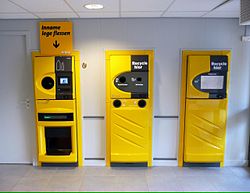

Container-deposit legislation
View on Wikipedia


Container-deposit legislation (also known as a container-deposit scheme, deposit-refund system or scheme, deposit-return system, or bottle bill) is any law that requires the collection of a monetary deposit on beverage containers (refillable or non-refillable) at the point of sale and/or the payment of refund value to the consumers. When the container is returned to an authorized redemption center, or retailer in some jurisdictions, the deposit is partly or fully refunded to the redeemer (presumed to be the original purchaser). It is a deposit-refund system.
Governments may pass container deposit legislation for several reasons, including to encourage recycling and complement existing curbside recycling programs; to reduce energy and material usage for containers, to reduce beverage container litter along highways, in lakes and rivers, and on other public or private properties (where beverage container litter occurs, a nominal deposit provides an economic incentive to clean it up, which can be a significant source of income to some poor individuals and non-profit civic organizations); and to extend the usable lifetime of taxpayer-funded landfills.
Deposits that are not redeemed are often kept by distributors or bottlers to cover the costs of the system (including handling fees paid to retailers or redemption centers to collect, sort, and handle the containers) or are escheated to the governmental entity involved to fund environmental programs. Studies have shown that container-deposit schemes are generally very successful in practice, with return rates commonly reaching up to 90% or more.[1]
History
[edit]A & R Thwaites & Co in Dublin, Ireland, announced in 1799 the provision of artificial "soda water" and that they paid 2 shillings a dozen for returned bottles. Schweppes, who were also in the business of artificially made mineral waters, had a similar recycling policy from about 1800, without any legislation.[2] Scottish bottled beverage companies also voluntarily introduced such a scheme to encourage the return of their bottles for reuse.[3] In Sweden a standard system for deposits on PET bottles and aluminium cans was established by legislation in 1984.[4][5]
British Columbia's legislated deposit-return system, enacted in 1970, is the oldest such program in North America.[6]
Laws by country
[edit]Overview
[edit]| Country | Implementation | Aluminium | Glass | PET | Beverages Covered | Driver | Ref. |
|---|---|---|---|---|---|---|---|
 Austria Austria
|
1990, last amended 2025 | 
|
|
|
Beer and beer mixes, alcoholic beverage mixes, cider and other fermented beverages, juices and nectars, soft drinks, waters, wines and spirits | Government | [7] |
 Barbados Barbados
|
1986, last amended 2019 |
|
|
|
Carbonated and non-carbonated soft drinks, mineral and soda water, beer and malt beverages | Government | [8] |
 Belarus Belarus
|
TBA | Coming soon | Coming soon | Coming soon | All beverages except dairy-based products | Government | [9] |
 Belgium Belgium
|
1993 | 
|
|
|
Refillable beer containers | Government | [10] |
 Croatia Croatia
|
2005, last amended 2020 |
|
|
|
Containers >200mL: juices, water, beer, wine, hard liquor; Containers <200mL: milk and dairy products | Government | [11] |
 Czech Republic Czech Republic
|
amended for 2026 | Coming soon |
|
Coming soon | Currently for glass bottles; planned for all containers for alcoholic (up to 15% ABV) and nonalcoholic drinks | Government | [12] |
 Denmark Denmark
|
1981, last amended 2020 |
|
|
|
Beer, carbonated and uncarbonated soft drinks, energy drinks, fermented drink products (excluding wine and spirits), cider, alcoholic and non-alcoholic mixer products, mineral water, juice | Industry (1922)[13] Government (1981) | [14][15] |
 Ecuador Ecuador
|
2012 |
|
|
|
Alcoholic, non-alcoholic, carbonated, and non-carbonated beverages | Government | [16] |
 Estonia Estonia
|
2005 |
|
|
|
Soft drinks, water, beer, cider, juice, nectars and juice concentrate, low-ethanol alcoholic beverages (≤ 6% alcohol by volume) | Government | [17] |
 Fiji Fiji
|
TBA | Coming soon | Coming soon | Coming soon | TBA | Government | [18] |
 Finland Finland
|
1996 (cans) / 2008 (PET) / 2012 (glass) |
|
|
|
Almost all soft drinks, water, beer, cider, long drinks, sport drinks, juice, liquor/spirits/wine sold by Alko | Government or Manufacturer | [19] |
 Germany Germany
|
2003, last amended 2024 (milk) |
|
|
|
Beer, soft drinks (carbonated and non-carbonated), water, mixed alcoholic drinks, juice in PET bottles, milk in PET bottles | Manufacturer | [20] |
 Iceland Iceland
|
1989 |
|
|
|
All ready-to-drink beverages, wine and liquor | Government | [21] |
 Ireland Ireland
|
2024 |
|
|
|
All beverages except dairy products | Government | [22][23] |
 Israel Israel
|
2001, last amended 2010 |
|
|
|
All containers between 100mL and 5L | Government | [24] |
 Jamaica Jamaica
|
2021 |
|
|
|
Unknown | Government | [25][26] |
 Latvia Latvia
|
2022 |
|
|
|
Water, mineral water, lemonade, energy drinks, tea, juices and nectars, beer, wine coolers and mixed drinks with less than 6% alcohol content | Government | [27] |
 Lithuania Lithuania
|
2016 |
|
|
|
Beer and beer cocktails, cider and perry, fruit wine and fruit-wine-based drinks, soft drinks, water, kvass, juices and nectar | Government | [28] |
 Luxembourg Luxembourg
|
2023 |
|
|
|
All beverages | Government | [29] |
 Kiribati Kiribati
|
2005 |
|
|
|
Beer, soft drinks, water | Government | [30] |
 Malta Malta
|
2022 |
|
|
|
Water, carbonated and non-carbonated soft drinks, ciders, beers, ready-to-drink coffee, and dilutables | Manufacturer | [31] |
 Micronesia (Kosrae) Micronesia (Kosrae)
|
1991, last amended in 2007 |
|
|
|
Unknown | Government | [32] |
 India (Maharashtra) India (Maharashtra)
|
2018, last amended 2019 |
|
|
|
Unknown | Government | [33] |
 Netherlands Netherlands
|
1991, last amended 2021 |
|
|
|
Beer, water, soft drinks; system is opt-in for fruit juice producers | Government | [34] |
 Norway Norway
|
1997, last amended 1999 |
|
|
|
Unknown | Government | [36] |
 Palau Palau
|
2011 |
|
|
|
Beer and ales, mixed wine and spirits, tea and coffee-based drinks, soda, non-carbonated water, all non-alcoholic drinks | Government | [37] |
 Poland Poland
|
2025 |
|
|
|
All single-use plastic beverage containers up to 3L, metal cans of up to 1L and reusable glass bottles up to 1.5L. | Government | [38] |
 Romania Romania
|
2023 |
|
|
|
All beverages (except milk) in single-use containers up to 3 liters | Government | [39] |
 Scotland Scotland
|
2027 | Coming soon |
|
Coming soon | TBA | Government | [40] |
 Seychelles Seychelles
|
2007 |
|
|
|
Unknown | Government | [41] |
 Singapore Singapore
|
2025 |
|
|
|
Unknown | Government | [42] |
 Slovakia Slovakia
|
2022 |
|
|
|
Water, beer, juices, wine | Government | [43][44] |
 South Korea South Korea
|
1985, last amended 2003 |
|
|
|
Alcoholic drinks, such as soju and beer, carbonated soft drinks | Government | [45] |
 Sweden Sweden
|
1982, last amended 2022 |
|
|
|
All ready-to-drink beverages, excluding dairy | Government | [46][47][48][49][50] |
 Switzerland Switzerland
|
2001 |
|
|
|
All beverages in refillable containers, one-way soft drinks, beer and mineral water; not implemented | Government | [51] |
 Turkey Turkey
|
2022 |
|
|
|
Tea and coffee, carbonated soft drinks, energy drinks, cow milk, fruit and vegetable juices, water (sparkling and non-sparkling), sports drinks, alcoholic beverages | Government | [52] |
 United Kingdom United Kingdom
|
2027 | Coming soon |
|
Coming soon | Unknown | Government | [53][54] |
Africa
[edit]Kenya
[edit]By 2005, the beverage industry in Kenya applied a deposit-refund system for glass bottles that had proven to be popular amongst wholesalers, retailers and consumers alike to participate in, not just in Nairobi, but throughout the country. At the time, there was a deposit of 10 Kenyan shillings on soft drink bottles, and 25 shillings on beer bottles.[55]
South Africa
[edit]Although there is no formalised deposit-return scheme for packaging or plastics in South Africa, individual companies such as Coca-Cola have implemented deposit-return schemes for their own products with success.[56] Manufacturers introduced this system without involvement of the government around 1948. Approximately 75% of beer containers, 45% of soft drink containers, and some wine and spirits bottles participate in the scheme.: 94 South Africa was noted in 2012 as one of the few countries that included plastic bottles in its schemes.[1] Aside from bottles, similar deposit-refund schemes exist in South Africa for batteries, cars, and tyres.[57]
Americas
[edit]
By 1998, there were voluntary deposit-refund schemes for glass containers in Barbados, Bolivia, Brazil, Chile, Colombia, Ecuador, Jamaica, Mexico and Venezuela.[58]
Canada
[edit]In 1970, British Columbia became the first Canadian province to establish a mandatory deposit-return system for soft drinks and beer containers.[citation needed] As of 2021, nearly all provinces and territories in Canada have followed suit; the territory of Nunavut is the only jurisdiction in Canada that has yet to implement some sort of deposit refund system. In Ontario, only containers of alcoholic beverages come with deposits, in Manitoba only beer containers participate in the deposit scheme.[59]
Deposits range from CAD$0.05 to CAD$0.40 per unit depending on the material and size of the container and whether the container contains an alcoholic or non-alcoholic beverage.[citation needed]
Below is a brief summary of each program:[60]
- British Columbia: While the original program covered only carbonated soft drinks and beer, the deposit legislation expanded to include any ready-to-serve beverage sold in a container that is sealed by its manufacturer (e.g. bottled water, juice, new age drinks, and alcohol). There are currently two stewardship agencies in BC that carry out deposit-refund obligations on behalf of beverage producers: Encorp Pacific (for non-alcoholic beverages, wine, spirits, some ciders and coolers, and some import beer) and Brewers Distributor Ltd. (BDL) (for domestic coolers, beers, and ciders). In 2017, BC's program recovered over 1 billion containers for an overall return-rate of 75.8%.[61] Bottle deposit on single use beverage containers have increased to CDN $0.10 from CDN $0.05 in November 2019.[62] As of February 2022 milk and milk substitute containers are also refundable.[63]
- Alberta: All beverage containers (glass bottles, metal cans, Tetra Paks, gable-top cartons, bags-in-boxes, plastic bottles and jugs, drink pouches), including milk containers (Alberta was the first jurisdiction in North America to accept and charge a deposit on milk containers in June 2009), are charged deposits at the point of sale; 10¢ for containers 1 L or less, and 25¢ for containers larger than 1 L. Containers can be dropped off at depots and are picked up by the Alberta Beverage Container Recycling Corporation. In 2014, over 2 billion beverage containers were returned to Alberta depots for an overall return rate of 83%.[citation needed]
- Saskatchewan: Established in 1988, Saskatchewan's deposit-return program applies to all ready-to-serve beverage containers, except those for meal replacements, or dietary supplements. SARCAN began taking milk and milk substitutes on April 1, 2017. SARCAN Recycling is responsible for administering the program and operates under contract to the Saskatchewan Ministry of Environment. In fiscal 2014–2015, a total of 405.6 million beverage containers were returned to SARCAN recycling depots for an overall container return rate of 87%. [citation needed]
- Manitoba: Manitoba's program was implemented in 2010 and is limited to beer containers, which are charged a deposit of CAD$0.10 or $0.20 depending on the size. Other containers (except milk) are charged a non-refundable $0.02 per unit levy (Container Recycling Fee) and can be recycled in municipal curbside recycling programs.[citation needed]
- Ontario: The Ontario Deposit Return Program (ODRP), which came into force in February 2007, is a voluntary program implemented by the provincial government that covers wine, spirits, and imported beer containers (plastics, metal, bimetal, glass, gable top, Tetra Pak, bag-in-box containers). Because there is no law mandating that wine and spirits be placed on deposit, they may be added to municipal blue box programs voluntarily. Refillable and non-refillable beer containers are collected through a separate program administered and operated by Brewers Retail Inc. (The Beer Store). Alcoholic beverage containers, as well as any associated packaging, can be returned to 443 beer store locations, 113 breweries (beer containers only), 141 retail partner stores, 63 LCBO northern agency stores, 4 additional LCBO stores, and 115 empty bottle dealers (small independent depots contracted in more remote locations where beer retailers are not available), for a total of 879 redemption locations. TBS trucks collect these empty containers and back-haul them to various distribution centres where recyclables are sent to a processing facility for sorting, baling, and shipping to market. Refillable bottles are sent back to the brewers for washing and refill. Containers returned through Ontario's deposit-return system showed a total recycling rate of 89% for 2014–2015, while refillable beer bottles were returned at a rate of 98%.[citation needed]

- Quebec: Quebec's deposit-return system was established in 1984 and covers beer and carbonated soft drink containers. As of March 1, 2025, ready-to-drink beverages ranging from 100ml to 2L carry a $0.10 deposit [64].Boissons Gazeuses Environnement (BGE) administers the program for non-refillable soft-drink containers on behalf of industry, while Recyc-Quebec oversees the beer container collection program. In 2014, the recycling rate for containers recovered via the deposit-return system was 78% (includes data for refillable bottles).[citation needed]
- New Brunswick: This program was created in 1992 and covers all ready-to-drink, non-refillable beverage containers 5 L and under, including soft-drinks, beer, wine, spirits, flavoured waters, fruit juices, vegetable juices, and low alcohol drinks. Containers for milk and milk products (and substitutes) as well as processed apple cider are exempt. Encorp Atlantic Inc. is the stewardship agency responsible for managing the collection, transportation, and partial processing of non-alcoholic beverage containers on behalf of brand-owners, and New Brunswick Liquor (NB Liquor) is responsible for the collection of alcoholic beverage containers. Program oversight is the responsibility of the Department of Environment. New Brunswick's deposit-return program is somewhat unique in that it operates under a "half-back" model where only half of the original deposit is refunded to the consumer when a container is returned for recycling. The unrefunded portion of the deposit is used to cover the costs of administering the program and part of it also goes towards the province's Environmental Trust Fund, which is used for environmental conservation and other provincial initiatives aimed at reducing waste. In 2014, New Brunswick's recycling rate for non-refillable containers was 73%.[citation needed]
- Newfoundland and Labrador: In 1996 the provincial government established The Multi Materials Stewardship Board (MMSB) as a self funded crown agency, Intended to develop, implement and manage waste diversion programs for various specific waste streams, province wide.[65] The following year MMSB began a licensing and standardization framework for recycling depots. Branded as Green Depot, all locations are independently owned and operated enterprises.[66] There are 55 Green Depots[67] province wide accepting non refillable ready-to-serve beverage containers for refund, excluding those for milk & milk alternatives, infant formula, meal replacement, beverage concentrates, distilled water bottles and containers over 5 liters. Refillable glass beer bottles are not included in MMSB's used beverage container program as local brewers regulate refillable beer bottle return. Brewers agents, breweries, and most convenience stores selling beer will accept back these bottles for store credit or sometimes cash at 10¢ per bottle being a full return of the initial deposit. A limited number of Green Depots do accept back refillable glass beer bottles for a 5¢ return depending on their location. Non refillable deposits sit in two categories with containers for non-alcoholic drinks, beer, miniature spirit bottles under 50ml and spirits in tetra-pak, gable top and pouch type containers being charged an 8¢ deposit and refunding 5¢. Containers for spirits primarily in larger glass and plastic bottles charge a deposit of 20¢ and refund at 10¢.[68] Since 1997 over 3.37 billion containers have been diverted from landfill through Newfoundland and Labrador Green Depots.[67] Additionally since 2013 Hebert's Recycling inc, has been collecting and processing all recyclable containers from Green Depot locations using its patented Enviopactor system of truck mounted recycling compactors to streamline recycling shipments from depots to centralized facilities.[67]
- Nova Scotia: Launched on 1 April 1996, Nova Scotia's deposit-return program applies to all ready-to-drink beverage containers excluding milk, milk products, soya milk and rice beverages. Other containers that are exempt from the program are certain meal replacements, formulated liquid diets, foods for very low energy diets, thickened juices, baby formulas, concentrates and non-alcoholic beverages in containers of 5 L or more. The organization responsible for managing the program is DivertNS (formerly the Resource Recovery Fund Board Inc.). Like New Brunswick's program, Nova Scotia's deposit-return system is based on a "half-back" model where only half of the original deposit paid per container is refunded to the consumer. The non-refundable portion of the deposit is used as revenue by DivertNS to help pay for program costs. In 2014, the program collected 334 million non-refillable beverage containers for a recycling rate of 84%.[citation needed]
- Prince Edward Island: The province's deposit-return system was launched on 3 May 2008 as a replacement to a law that had prohibited the sale of non-refillable soft drink containers. The program is overseen and administered by the Department of Environment, Energy and Forestry and covers all ready-to-drink beverage containers up to 5 L, except those used for dairy products, milk substitutes or nutritional supplements. Similar to the other Atlantic provinces, PEI's deposit-return system is based on a "half-back" model where only 50% of the original deposit paid is refunded to the consumer when he/she returns the empty container to a depot. In 2014–2015, PEI had a non-refillable beverage container recycling rate of 80% and a total container recycling rate of 82%.[citation needed]
- Yukon: Introduced in 1992, Yukon's deposit-return program covers all ready-to-drink beverage containers (glass, plastic, steel, aluminium, and Tetra Pak), excluding those containing milk and milk substitutes. The program is managed by the Department of Community Services and requires consumers to pay a surcharge on the purchase of certain beverage containers, which includes a refundable deposit and a non-refundable recycling fund fee (RFF). Upon return of the empty container to a depot or processor, a portion of the surcharge (the refundable deposit) is refunded to the consumer, while the non-refundable RFF is kept by the retailer and remitted to the territorial Recycling Fund, where unredeemed deposits also go. In 2014, Yukon had a non-refillable recycling rate of 82%. In May 2016, the Yukon government announced changes to the Beverage Container Regulation. These changes, which were expected to be implemented 1 August 2017, will affect the surcharges and refunds applicable to beverage containers including milk and milk substitutes and will simplify the regulation. Once the territory's new regulations kick in, all beverage containers will fall into two categories: (1) 750 ml and less, including all milk & milk substitutes (surcharge 10 cents, refund 5 cents), and (2) 750 ml and more (surcharge 35 cents, refund 25 cents).[citation needed]
- Northwest Territories: Launched on 1 November 2005, Northwest Territories' deposit-return program covers all ready-to-serve beverage containers made of glass, plastics, aluminium, bi-metal, and mixed materials, including juice, milk and liquid milk products (added February 2010), soda, water, beer, wine, liquor and other alcoholic beverages. Excluded from the program are containers for infant formula; containers for milk and liquid milk products smaller than 30 ml; and powder milk. The Department of Environment and Natural Resources (DNR) is responsible for administering the program. Similar to Yukon's program, the total surcharge per container includes a refundable deposit and a non-refundable handling fee. Whereas the refundable deposit is returned to the consumer when they return the beverage container to a depot, the non-refundable handing fee is put into the Environment Fund and is used to help cover program costs. In fiscal 2014, approximately 26 million beverage containers were returned for reuse or recycling, translating into an overall recycling rate of 89%.[citation needed]
Peru
[edit]Peru has a deposit on some bottles of 620 millilitres (ml).: 94
United States
[edit]
There are currently 11 states in the United States with the container deposit legislation.
- California: Enacted in 1981 and operated by CalRecycle, California's bottle bill charges a 5¢ refundable deposit on containers less than 24 US fluid ounces (710 ml), and 10¢ for containers 24 US fluid ounces (710 ml) or greater.[citation needed]
- Connecticut: Connecticut's bottle bill was introduced in 1980, but was expanded in 2009 to include bottled water. The deposit is the same for all container types and is 10¢.[69]
- Hawaii: Hawaii's bottle bill has been in place since 2005 and is government-operated. A refundable deposit of 5¢ is charged on all plastic (PET, HDPE), metal, bi-metal, and glass beverage containers 2 l or less, except for milk and dairy products. In 2015, the system achieved a total return rate of 68%.[citation needed]
- Iowa: Introduced in 1979,[70] The deposit is uniform across beverage categories and is currently 5¢. Unredeemed funds are kept by beverage distributors and it has been found to be highly profitable to them.[71]
- Maine: Established in 1978 after a ballot initiative,[72] Maine's bottle bill charges a 5¢ deposit on plastic, metal, and glass containers and 15¢ for most liquor and wine bottles.[73]
- Massachusetts: The state's bottle bill was effective as of January 17, 1983.[74] The deposit levied is 5¢.[citation needed]
- Michigan: Implemented in 1978, Michigan's bottle bill charges a 10¢ deposit on plastic, metal, glass, and paper containers less than 1 gallon.[75]
- New York: New York's bottle bill has been in place since January 12, 1983.[76] New York charges a 5¢ deposit on plastic, metal, and glass containers 3.78 l (1 gallon) or less.[citation needed]
- Oregon: The Oregon Bottle Bill, enacted in 1972, was the first container deposit legislation in the United States. The deposit/refund value is uniformly 10¢ per applicable container.[77] The deposit is held by the beverage industry cooperative and they keep all the unclaimed deposit.[71]
- Vermont: Implemented in 1973, Vermont's bottle bill charges a 5¢ deposit on plastic, metal, and glass beer, wine coolers and other malt beverages, soft drinks and other carbonated beverage containers. Most liquor and spirits bottles are charged a deposit of 15¢.[citation needed]
States that formerly had can deposit regulation:
- Delaware (5¢), introduced 1982, abolished 2009, replaced by Universal Recycling law.[citation needed]
Asia
[edit]Israel
[edit]In Israel, there is a 0.30-shekel (₪) deposit on beverage containers over 100 mL and under 5 L, except for dairy products. The system is operated by the ELA Recycling Corporation, a private non-profit organization owned by Israel's beverage manufacturers. Businesses are required to accept bottles if they sold them, or if they are over 28 square meters and sell beverages from the same manufacturer or importer. Businesses are not required to accept more than 50 bottles per customer per day. The deposit was initially ₪0.25, but was raised shortly after the ₪0.05 coin was discontinued.[78]
In 2015, the system achieved a total return rate of 77%.[79]
Most 500 ml beer bottles (local brands such as Goldstar and Maccabee plus certain imported ones like Carlsberg and Tuborg) have a deposit of ₪1.20, and are willingly accepted even by smaller businesses (plastic water bottles, glass wine bottles and soda cans are mostly accepted by larger supermarket chains, some of which possess reverse vending machines).[80] In order to collect more products with its large storage area, Aco Recycling introduced G-1 Smart Reverse Vending Machines with 3 Shredder for Asofta; official operator for deposit scheme in Israel.
Japan
[edit]The container deposit legislation, as a monetary approach to the garbage/recycling problem, has never caught on in Japan. However, under increasingly ever stricter sorting rules announced by each town or city, garbage is meticulously sorted into kitchen garbage, newspapers/books, metal cans (washed)/plastic bottles (rinsed), garden weeds, etc. in each neighborhood for pickup by collection cars, usually on different days notified by the local government.[81]
South Korea
[edit]By 1997, South Korea had introduced a deposit-refund system for beverage containers.[58]
Taiwan
[edit]By 1997, Taiwan had introduced a deposit-refund scheme for PET soft drink bottles.[58]
Turkey
[edit]In Turkey, a recycling pilot project was launched in 2018, where plastic bottles and cans could be deposited at vending machines at three Istanbul Metro stations in return for credit on a public transport ticket card.[82] In 2021, the Turkish government decided to introduce deposit return system (DRS) by January 1, 2022, to protect Turkey's 8,000-kilometer coastline. The upcoming deposit refund scheme is expected to help reduce different types of litter, such as land and marine litter, and prohibit packaging waste from damaging landfills within the country. One of the main reasons the Turkish government has implemented DRS is that it will increase the recycling of plastic and glass containers by 250 percent and help turn the 811,000 tons of glass and plastic containers thrown into landfills each year into secondary raw materials.[83]
Oceania
[edit]Australia
[edit]
In the days when bottles were washed and re-used, drinks manufacturers paid for the return of their (proprietary) containers, but with the advent of single-use containers great savings were possible, leaving their disposal as the consumer's responsibility.
While a national scheme has been repeatedly delayed largely due to threats from the beverage industry of multi-million dollar advertisements against politicians who support it and earlier disagreements between states,[84] there has been a growing momentum of state-based operated container deposit schemes (CDS). All states have implemented or will introduce a state-based container deposit scheme operating by 2023, with Victoria the final jurisdiction to support such a scheme.[85] With 8 billion beverage containers landfilled or littered every year in Australia, proponents argue that it is the most effective method to reduce such litter; and improve recycling above that achieved by kerbside. It also has many co-benefits such as funds for charities and several thousand new jobs, that cannot be achieved by other approaches.[86]
- The state of South Australia introduced a container deposit scheme in 1977.[87] A refundable deposit of AUD 10 cents is charged per drinks carton, can or bottle (only containers marked as eligible for refund; currently does not include wine and spirit bottles, milk cartons, or concentrated/and or vegetable juice intended to be diluted before consumption), however the introduction of a 10-cent deposit on wine and spirit bottles is expected to be fully implemented by late 2027.[88] As of 2023, the overall return rate is 76%.[89]
- Northern Territory introduced a container deposit scheme in 2012. A 10-cent (AUD) refundable deposit is charged on all beverage containers with the exception of unflavoured milk, soy milk, cordial bottles (undiluted), concentrated fruit/vegetable juice intended to be diluted before consumption, and still or sparkling wine (in glass bottles). Unredeemed deposits remain with the producer/filler. In 2015–2016, the system achieved a total return rate of 54%.[90]
- The state of New South Wales (the most populated state, with 7.5 million residents) announced that it would be adopting a 10-cent (AUD) deposit scheme, which commenced on 1 December 2017.[91] Wine and spirit bottles are expected to be included in this deposit scheme by mid-2027.[88] The program has achieved a return rate of 69%.[92]
- On 22 July 2016, the Queensland government announced that the state would introduce a container deposit scheme which commenced on 1 November 2018.[93] A 10 cent (AUD) refund is provided for empty drink containers between 150 ml and 3 l. The scheme was extended to wine and spirit bottles in Nov 2023.[94]
- The state of Western Australia's scheme commenced on 1 October 2020.[95] The scheme applies to certain empty drink containers ranging in size from 150 ml to 3 L and excludes domestically consumed drink containers such as wine and spirit bottles, milk and juice containers. The amount of the deposit/refund is AUD 10-cents.[96]
- Victoria's Container Deposit Scheme (CDS Vic) was introduced on 1 November 2023 as part of its updated recycling and waste management policies, through scheme coordinator VicReturn.[97][98] A 10 cent refund is provided to Victorians for every eligible drink container they return. Most aluminium, glass, plastic and liquid paperboard (carton) drink containers are accepted. [99]
- Tasmania launched its scheme on 1 May 2025.[100]
Fiji
[edit]The United Nations Development Programme had funded a feasibility study to look at the possibility of establishing a deposit-return system in Fiji, building on the experience gained from their successful projects in Kiribati and the Federated States of Micronesia.[101]
In 2011, the Fijian Government approved the Environment Management Waste Disposal and Recycling Amendment Regulations 2011, and the Environment Management Container Deposit Regulations 2011.[102] The Regulations provide the legal framework for the introduction of a container deposit and refund system, allowing beverage producers and importers to adjust pricing and accommodate deposits.[103] The Regulations will also allow the Department of Environment to register and establish the Managing Agency that will administer Fiji's container deposit system, and establish a revolving fund account to receive all deposits paid by producers for all beverages sold.[104] No further details are available.[105]
New Zealand
[edit]Single-use containers were increasingly introduced between the 1950s[106] and 1980s.[107][108] New Zealand had no container-deposit legislation until 2008 when the Waste Minimisation Act 2008 passed into law. The Act has provision for product stewardship of which container-deposit legislation is the most familiar type. As of 2010[update] there is no widespread deposits available on containers with some beer bottles being a notable exception. The Ministry for the Environment is working on a container return scheme, which may be introduced in about 2023.[109]
Europe
[edit]Austria
[edit]Austria has a container-deposit system for refillable PET and glas bottles since 1990. In 2025, Austria introduced a 25-cent deposit that is levied on all disposable plastic bottles from 100ml up to three litres and disposable aluminium cans in 2025.[110]
Belgium
[edit]Smaller beer bottles (250 or 330 mL) carry a €0.10 deposit, and larger ones (750 mL or 1 L) a €0.20 one. Some fruit-juice bottles, such as those sold by Oxfam Wereldwinkels/Magasins du Monde, carry a €0.30 deposit. Some hard plastic milk and orange juice bottles such as those sold by Delhaize carry a €0.20 deposit. In April 2019 the Brussels Capital Region started a project to test out an expansion of the system to cans, which hold a €0.05 deposit.[111] After the 2019 Belgian regional elections the new Brussels regional government decided to introduce the deposit system for cans, as well as for plastic bottles.[112]
Croatia
[edit]A deposit system for some glass bottles such as beer bottles existed since the time of Yugoslavia.
In 2006, a refundable deposit of 0.50 kn was first levied on non-refillable containers (except dairy products) with a minimum volume of 200 mL (7.0 imp fl oz; 6.8 US fl oz). Retailers over 200 m2 (2,200 sq ft) are obliged to take-back containers. Collection is often manual, although some collection occurs with reverse vending machines. Retailers must sort containers by material type (PET bottles, aluminium/steel cans, and glass bottles). The scheme is government operated and there is a collection target of 95%. In 2015, the scheme recovered up to 90% of all non-refillable containers placed on the Croatian market.[113]
The plastic bottles for dairy products were later included in the system, then excluded from the system in late 2015, and then brought back into it in 2019.[114]
With the introduction of the Euro as legal tender in 2023, the refundable deposit was converted to €0.07. In 2025, the deposit was increased to €0.10 per item.[115]
Czech Republic
[edit]In the Czech Republic most beer is sold in returnable glass bottles that carry a CZK 3 deposit. These bottles are collected by shops and supermarkets. Reverse vending machines have mostly replaced human staff. There is also a CZK 100 deposit on plastic beer crates with a 20 bottle capacity. Most reverse vending machines accept an entire crate full of empty bottles, returning CZK 160. There is no deposit on other containers.[citation needed]
Denmark
[edit]In Denmark, the first national deposit-return system was introduced in 1922, when the Danish breweries agreed on a standardized glass bottle for beer and carbonized drinks, due to the limited resources available during and in the aftermath of World War I.[116][117] In 1991 and 1993 this was expanded to also include plastic bottles. Aluminium beverage cans were forbidden from 1982 to 2002, but this ban was found to violate European Union law, and to get into compliance Denmark introduced new legislation in 2002, extending the deposit scheme to also cover aluminium cans.[116][118]
The law covers beer (alcohol content >0.5% by volume), carbonated soft drinks (alcohol content 0-0.5%), energy drinks, mineral water, iced tea, ready-to-drink beverages, and mixer products (alcohol content 0.5%-10%); juice and uncarbonated soft drinks were added to the deposit scheme in 2019–2020. Excluded from the scheme are wine and spirits (alcohol content >10%), products containing milk, and containers larger than 20 liters.[118][119][120] The deposit levels are as follows:[121]
- Disposable aluminium and glass containers under 1 L and refillable glass bottles under 0.5 L, labelled "Pant A": DKK 1.
- Disposable and refillable plastic containers under 1 L, labelled "Pant B": DKK 1.5.
- Metal and plastic containers equal to or greater than 1 L or refillable glass bottles over 0.5 L, labelled "Pant C": DKK 3.
The deposit system operator is Dansk Retursystem A/S, a private non-profit organization. Most collection (95%) is done automatically using reverse vending machines, but some (5%) is done manually.[122] In 2019, the system achieved a total return rate of 92%.[123]
Estonia
[edit]
In Estonia there is a universal deposit and recycling system since 2005 for one-time and refillable containers. This includes soft drinks, water, beer, cider, juice, juice concentrates, nectars, and low-ethanol alcoholic beverages (up to 6% volume). The deposit is €0.10 on most metal, plastic, and glass beverage containers. It does not include strong alcoholic beverages, such as wine or vodka, syrup bottles, glass jars, or Tetra Paks.[124] Since 2019, the system has been set to also accept some out-of-system bottles within accepted categories, though people will not receive a deposit for those. The system is operated by Eesti Pandipakend OÜ, which is a producer responsibility organization representing the Estonian Association of Brewers, the Association of Producers of Soft Drinks, the Association of Importers of Soft Drinks and Beer, and the Estonian Retailers Association.[citation needed]
In 2015, 90% of all PET bottles, 70% of all aluminium cans and 87% of all glass bottles sold in Estonia were returned for recycling and/or reuse. The overall return rate was 82.3%.[125]
Finland
[edit]Deposit system was first introduced to Finland in 1952 along with summer Olympic Games which brought Coca-Cola to the country – in glass bottles. In the 1980s some re-usable and durable plastic bottles were included in the deposit system. Deposits were introduced on aluminium cans in 1996, on PET bottles in 2008, and on recycled glass bottles in 2012. Almost all soft drinks are covered by the program, in addition to water, beer, cider, long drinks, sport drinks, juice, and liquor/spirits/wine sold by Alko. Milk and other products packed in liquid packaging board are exempt. The system is administered by Suomen palautuspakkaus Oy (abbr. Palpa), which is a private consortium of beverage importers and manufacturers. In 2016, aluminium cans were recovered at a rate of 96%, PET bottles 92%, and one-way glass 88%.[126] The deposit values for these containers are as follows:[79]
- Plastic <0.35 L: €0.10
- Plastic 0.35–1 L: €0.20
- Plastic >1 L: €0.40
- Metal: €0.15
- Glass: €0.10
The scheme is, in technical sense, voluntary and Palpa does not hold a legal monopoly for container deposits systems. Lidl has its own levy system for Lidl bottles. Those beverage containers that do not belong to a container deposit system are levied an excise tax of €0.51/L, regardless of the container size.[127] The tax is so high that essentially all beverage manufacturers and importers opt to join the Palpa system instead of paying the excise tax.[128]
Germany
[edit]
In Germany, the deposit legislation covers plastic, aluminium, and glass containers for water, beer, mixed drinks containing beer, carbonated and non-carbonated soft drinks including fruit juices, as well as mixed alcoholic drinks. Excluded from the programme are containers for milk products, wine, spirits, liquors, and certain dietary drinks. Also excluded are containers smaller than 100 mL and larger than 3 L.[129] Germany was noted in 2012 as one of the few countries that included plastic bottles in its schemes.[1]
There is separate legislation (known as Einwegpfand or single use deposit) for non-reusable containers, mostly thin plastic bottles and aluminium cans, distinct from (Mehrwegpfand reusable deposit) for reusable containers, mostly glass and thicker plastic.[130]
Legislation for an Einwegpfand (single use) deposit system was created in 2002 and came into force on 1 January 2003.[131] However, its implementation was fought by lobby groups of German bottling industry and retailers. This fight also included trials at the Federal Administrative Court of Germany and the Federal Constitutional Court of Germany, but all trials were won by the German federal government.[132]
The deposit charge for Einwegpfand containers is required to be relatively high. As of October 2016, the standard deposit for these is €0.25. By comparison, the deposit for reusable containers (mostly glass bottles) is usually between 8 and 15 cents. The usual rates are locally €0.02 for some wine bottles, €0.08 for beer bottles up to 0.5 L, and €0.15 for beer bottles with flip-top closures, beer bottles over 0.5 L and other bottles (mostly water and soft-drinks, lesser fruit drinks, milk, cream, yoghurt). Some bottles have an even higher deposit. Bottle crates have a deposit of €1.50.[133]
The reasoning behind the price discrepancy was to keep environmentally-harmful plastics from ending up as litter or in the regular garbage system.[134] It was also meant to make non-reusable beverage containers more expensive and thus, less attractive.[134]

Retailers are only obliged to take back the material fractions that they sell. The deposit for refillable bottles is not defined by law. Germany's collection system is 80% automated and 20% manual. Most supermarkets in Germany have a reverse vending machine that is designed to be used by customers and which scans "Pfand" returns and prints a receipt for the total value of the refund which can be exchanged for cash or put towards the cost of future purchases.[135]
Supermarkets near the Danish border have established a scheme, where Scandinavian residents are exempt from "Pfand", by signing an "Export declaration" and providing that cans are exported within 24 hours and the contents are not consumed within Germany.[136]
The system has successfully encouraged the recycling of Einwegpfand containers. Between 97 and 99% of non-reusable bottles are returned, and recycling rates for cans are around 99%.[134] On the other hand, the percentage of containers being sold that are reusable has actually decreased from about 80% to below 50% since the system was established.[134] Since manufacturers keep the deposit on any unreturned containers, they are effectively incentivized to produce Einwegpfand containers which yield a higher profit if they are not returned. One estimate suggests they have earned €3bn on unreturned bottles since the system was introduced.[134]
At any given time, an estimated 2 billion beer bottles are in circulation in Germany, each of which sees an average of 36 reuses.[137]
Hungary
[edit]In Hungary, beer, wine and standardized liquor bottles carry a deposit on them, which has been liberalized — beer bottles had 25 forints on them, but for wine and liquor bottles, the sum was decided by the trader, which people could exploit by buying a drink from one retailer and returning the empty container to the rival who returned a bigger deposit. On January 1, 2024, Hungary introduced a standardized bottle refund system with each single-use bottle and can from 0.1 Liter (apart from milk and milk products) having a 50 Forint (~0.13€) deposit, and bottles/cans are mainly collected by reverse vending machines and must be taken back by every retailer. It is operated by the company MOHU, a subsidiary of the Hungarian oil company MOL. [138]
Iceland
[edit]Iceland has had a deposit system on a national scale for a wide range of containers (plastic, aluminium, and glass) since 1989.[139] All ready-to-drink beverages, wine, and liquor are included in the program. Milk, milk products, and juice extracts are excluded. The deposit is the same for all bottles and cans, ISK 18.[140]
The recycling rate per product is approximately 90% aluminium, 87% PET. Glass is not recycled.[citation needed]
Ireland
[edit]Ireland introduced a Deposit Return Scheme for plastic bottles and aluminium cans on 1 February 2024.[141]
The scheme applies to plastic bottles and aluminium and steel cans between 150mL and 3L. Glass containers and dairy products are excluded.
A deposit of €0.15 applies to containers from 150mL to 500mL inclusive and a deposit of €0.25 for containers over 500mL to 3L inclusive.
All retailers that sell "in scope" beverages are required to be part of the scheme.
Lithuania
[edit]Lithuania implemented container deposit legislation for single-use cans and bottles in February 2016. Lithuania's program is comprehensive and charges a deposit on nearly all types of beverage containers, including those made of plastic, metal, and glass 0.1 l to 3 l. The deposit is applicable to beer and beer cocktails; cider and other fermented beverages; mixed alcoholic and non-alcoholic beverages; all types of water; juice and nectars (sold in glass, plastic, and metal packaging); and fruit wines and wine-product cocktails sold in plastic and metal packaging. Milk, wine, and spirits are exempt. The deposit is the same for all containers and is €0.10 per bottle/can, and most collection is done using reverse vending machines.[142]
Lithuania's deposit return system is operated by Užstato Sistemos Administratorius (USAD). Container return rates for plastic bottles were 34% before the deposit scheme, 74.3% at end of 2016, 91.9% at end of 2017, and 93% in 2018.[143][144]
Netherlands
[edit]Under the current deposit-return scheme, large polyethylene terephthalate (PET) 1 liter bottles and greater are subject to a €0.25 deposit, but only those for soft drinks and water. All other beverage types, such as medical drinks, wine, spirits, etc., are excluded. The system, which is operated by Stichting Retourverpakkingen NL, is mostly automated collection (89%) with only 11% of returns being done manually. Beer bottles carry a €0.10 deposit, and beer crates €1.50. In 2014, the Netherlands' deposit system recovered 95% of the containers covered by the program.[145]
On 24 April 2020, the State Secretary for Infrastructure and Water Management Stientje van Veldhoven announced that plastic bottles smaller than 1 liter will be subject to a €0.15 deposit, starting on 1 July 2021.[146] While Dutch environmental organisations acclaimed the decision,[147] it is believed that the extensive campaigning activities by athlete and environmentalist Merijn Tinga[148] made the extension of the deposit law happen.[149]
On 3 February 2021, Van Veldhoven furthermore announced that cans too will be subject to a €0.15 deposit, starting on 1 April 2023.[150] Originally it was meant to start on 31 December 2022,[151] but it was postponed due to lobbying of the supermarkets.
Norway
[edit]
Automated recycling of bottles has been in use since the 1970s. Aluminium and steel beverage cans had a 5,60 kr surtax in Norway up until the end of the 20th century. In 1999, a container deposit legislation was passed, which also abolished this regulation. Today, these are the following container deposits in Norway:[citation needed]
- Cans and plastic bottles up to 0.5 L: 2.00 kroner
- Cans and plastic bottles over 0.5 L: 3 kr
- Bottle crates are also reverse vended.
- As of September 2018 container deposit legislation were removed from glass bottles.
In 2018 the rates were increased to 2 NOK (formerly 1 NOK) and 3 NOK (previously 2.50 NOK) due to inflation and the discontinuation of the 50-øre coin.[citation needed]
Infinitum AS (formerly Norsk Resirk A/S) is responsible for operating the national recycling scheme for non-refillable plastic bottles and beverage cans in Norway. The non-profit corporation was founded in 1999 and is owned by companies and organizations in the beverage industry and food trading.[152]
The Norwegian system works in such a way that the excise tax decreases as the returns increases,[153] meaning for example that 90 per cent returns for cans translates into a 90 per cent discount on the excise tax. This again allows drink products to be sold at lower prices.[citation needed]
In 2014, 95.4% of PET bottles and 96.6% of all drink cans in Norway were returned under the scheme.[citation needed]
Deposits on drink containers have a long history in Norway, starting with deposits on beer bottles in 1902. The deposit back then was 0.06 kr (3.30 kr in 2006 currency value). This deposit arrangement was later expanded to include soft drink bottles.[citation needed]
Up until 1 January 2001, the Vinmonopolet government wine and spirits monopoly chain had deposits on products made by the company itself, this did not include imported products.[citation needed]
All sellers of deposit marked drinking containers are required by law to accept returns of empty containers for cash. As of 2016, drink containers can be returned and deposits retrieved at over 15,000 establishments in Norway. The collection system is 95% automated (using reverse vending machines) and only 5% manual. Most reverse vending machines in Norway are manufactured by Tomra Systems ASA.[citation needed]
Portugal
[edit]In Portugal, fillers must ensure that their return quotas are met, which are 80% for beer, 65% for wine (with certain exceptions) and 30% for soft drinks. Retailers must sell refillable containers for all nonrefillables sold.: 94
Spain
[edit]Spain has a voluntary deposit return scheme that is regulated by three laws:[154]
- Act 11/1997, 24 April, packaging and packaging waste ("Chapter IV: Deposit, devolution and return system integrated management systems for used packaging and packaging waste")
- Act 22/2011, 28 July, waste and contaminated soil (Article 31)
- Royal Decree 293/2018, 18 May, on reducing the consumption of plastic bags
Article 31.2.d of Act 21/2011 of 28 July establishes deposit systems that guarantee the return of the amounts deposited and the return of the product for reuse.[154][155]
In 2010, the overall return rate was calculated at 87%, while the reuse of beer containers was 57%.: 94
Sweden
[edit] | This section needs to be updated. The reason given is: The values has been increased. See Pantamera website. (September 2025) |

In Sweden, there are deposits on nearly all ready-to-serve beverages, including beer, soft drinks, cider, and bottled water. Since 2015, syrup producers can voluntarily join the deposit system. Since 2017 juice producers are also allowed to join.[156] The deposit values are as follows:
- Metal: SEK 1
- Plastic < 1 l: SEK 1
- Plastic > 1 l: SEK 2
- Glass 33 cl: SEK 0,60, an empty red bottle crate for 20 bottles has a SEK 22,40 deposit.
- Glass 50 cl: SEK 0,90, an empty blue bottle crate for 15 bottles has a SEK 28,00 deposit.
AB Svenska Returpack (Pantamera)[157] is responsible for the deposit system for aluminium cans and PET bottles.[158] The aluminium cans have had a deposit since 1984, and PET bottles since 1994. Svensk GlasÅtervinning AB is responsible for the deposit system of glass bottles.[159][160] A glass bottle recycling system was introduced in 1884 and the bottles were first standardized in 1885.[161]
Until 1998, all hard alcohol and wine bottles sold at Systembolaget — the government owned alcohol retail monopoly — were sold in standardised reusable bottles with deposit, but due to the deregulation of the Systembolaget's suppliers, the former sole supplier V&S Group dropped the deposit on their bottles due to the restricted bottle shapes giving V&S a disadvantage compared to the competitors. The bottles could be returned and deposit refunded until early 1999 at Systembolaget.[162]
The legislation regarding container deposit systems was updated so that from 1 January 2006, containers from other plastics and metals, e.g., steel cans, can be included in the deposit systems.[163][164] The law also makes it illegal in Sweden to sell consumption-ready beverages in containers that are not part of an authorized Swedish container deposit system, with the exception of beverages that mainly consist of dairy products or vegetable, fruit, or berry juice. However, private importation from (mainly Eastern European) countries without deposit occurs by vendors that thus compete with a somewhat lower customer price. The recycling of these contraband cans has not been seen as a problem, but Returpack made a campaign in 2010 offering 0.10 krona for each imported can (without deposit) to the benefit of WWF, retrieving 17 million cans. In 2011, a similar campaign was repeated, retrieving almost 18 million cans.[165]
The 1.5 L refillable PET bottle with a deposit of 4.00 kr has been discontinued, and has been replaced by the 1.5 L recycle PET bottle. The last day for returning bottles made by Spendrups for deposit was 30 June 2007,[166] and the last day for bottles made by Coca-Cola Sweden was 30 June 2008.[167]
Although Sweden is one of the leading countries in recycling of beverage containers, Returpack uses TV commercials to promote more recycling. Commercials have been made with well-known melodies sung, like "Guantanamera" and "Pata pata"—sounding like Returpack's slogan "panta mera" (i.e., "recycle more").[168]
In 2016, the overall recycling rate was 84.9% for both aluminium cans and PET bottles, which translates to 177 packages per person in Sweden.[169]
Switzerland and Liechtenstein
[edit] |
In Switzerland, there is a government ruling that 75% of containers must be returned, otherwise a deposit system may be introduced.[170] Currently a handful of beverages, including milk, sold in glass bottles are done so with a small deposit of 30 or 50 rappen paid by the purchaser, which is returned when the empty bottle is brought back to the store.[171]
According to the Swiss Federal Office for the Environment, The IGORA-Genossenschaft aluminium recycling cooperative levies a prepaid disposal fee on aluminium beverage cans and uses the fees to finance recycling activities.[172]
United Kingdom
[edit]Until the turn of the 21st century, most British bottled beer was sold (whether in off-licences or pubs) in standard quart, pint, half-pint or third-pint (nip) bottles, although some brewers preferred their own distinctive designs. The standard deposit was 7pence (p) for a pint bottle and 5p for a half-pint. However, in the absence of legislation, and given the switch from pub to supermarket sales, and from Imperial to metric measures, the industry has now entirely abandoned refillable bottles.[citation needed]
Beer casks sold for the home or party consumption of draught beer are usually also loaned out against a deposit which may run to several tens of pounds.[citation needed]
In April 2024, Environment Minister, Robbie Moore announced that the UK deposit return scheme would be delayed until October 2027[173]
England
[edit]In England, in January 2017, ministers were reported to be considering a 10p or 20p refundable deposit on plastic bottles and containers after Green Party co-leader Caroline Lucas had voiced her support of such a scheme at the end of 2016. As of February 2017, the idea of a plastic bottle levy was unlikely as the government rejected the deposit scheme proposal.[174] In March 2018, the UK government announced plans to introduce a deposit return scheme in England for drinks containers.[175]
Northern Ireland
[edit]As of June 2015, Northern Ireland had been considering a drinks deposit scheme, following the publication of a feasibility study for a deposit return scheme for drinks containers in Scotland.[176] It has yet to implement such a scheme.[citation needed]
Scotland
[edit]In Scotland, some Barr products in 750 mL glass bottles, had a 30p container deposit although this was discontinued in August 2015. Some Tesco stores have reverse vending machines which pay 1⁄2p per aluminium can (equivalent value in Tesco Clubcard Points). Furthermore, the landmark Climate Change (Scotland) Act 2009 passed by the Scottish Parliament contains within it powers for Scottish ministers to implement a national scheme.[177] As of April 2017, a Holyrood motion supporting the idea of a small deposit on all drinks containers was signed by 66 MSPs, including member from every party. In May 2015, the Association for the Protection of Rural Scotland (APRS) published Scottish polling which revealed overwhelming support for deposit-return. The figures showed that 78.8% of those who expressed a view supported this approach for Scotland, while just 8.5% opposed it.[178] Several companies, most notably large drinks corporations like Coca-Cola, are known to have lobbied against the introduction of a national deposit scheme.[179][180] But in February 2017, the drinks company unexpectedly announced its support for a deposit-return program in Scotland, and in a statement to the Independent, Coca-Cola UK stated: "We have embarked on a major review of our sustainable packaging strategy to understand what role we can play in unlocking the full potential of a circular economy in Great Britain."[181] On 5 September 2017, Scotland's First Minister Nicola Sturgeon announced that a deposit return scheme would be implemented as a means to tackle the rising tide of waste.[182] In March 2020 it was announced that the launch date would be delayed to July 2022.[183]
Wales
[edit]As of March 2018, Welsh ministers are working on a plan to introduce a deposit return scheme.[184] In November 2024, the Welsh government announced that its scheme would include glass bottles, in contrast with other schemes in the UK that would be limited to aluminium and PET plastic containers. [185]
See also
[edit]References
[edit]- ^ a b c Dalzall, J. M. (2012). Food Industry and the Environment: Practical Issues and Cost Implications. Dordrecht: Springer Science & Business Media. p. 327. ISBN 9781461520979. Retrieved 12 August 2021.
- ^ "Archived copy" (PDF). Archived from the original (PDF) on 14 October 2012. Retrieved 27 October 2012.
{{cite web}}: CS1 maint: archived copy as title (link) - ^ "A.G.Barr p.l.c. Website : About Us : Frequently Asked Questions". www.agbarr.co.uk. Archived from the original on 26 April 2014. Retrieved 13 January 2022.
- ^ "That's pant! The story behind Sweden's bottle recycling scheme". 28 March 2018. Retrieved 16 November 2024.
- ^ "BottleBill.org - Beverage Container Legislation in Sweden". www.bottlebill.org. Retrieved 15 November 2024.
- ^ "BottleBill.org - The British Columbia Deposit Law".
- ^ "Austria". bottlebill.org. Retrieved 19 November 2021.
- ^ "Barbados". bottlebill.org. Retrieved 19 November 2021.
- ^ "Belarus". bottlebill.org. Retrieved 19 November 2021.
- ^ "Belgium". bottlebill.org. Retrieved 6 February 2023.
- ^ "Croatia". bottlebill.org. Retrieved 19 November 2021.
- ^ "EXPLAINED: How Czechia's new compulsory bottle-return system will work". 10 July 2024.
- ^ "Historisk udvikling af pantsystemet". bryggeriforeningen.dk (in Danish). Retrieved 1 December 2023.
Det nuværende pant- og retursystem for flasker til øl og kulsyreholdige læskedrikke har eksisteret siden 1922, da bryggerierne indgik en frivillig aftale om at benytte en fælles flaske til øl i stedet for bryggeriernes egne navnemærkede flasker.
- ^ "Bekendtgørelse om emballage til øl og læskedrikke". retsinformation.dk (in Danish). Retrieved 1 December 2023.
§1 Stk. 2. Ved returemballage forstås i denne bekendtgørelse emballage, som indgår i et retursystem, hvor en væsentlig del af emballagerne efter tømningen hos forbrugeren returneres til fornyet påfyldning.
- ^ "Denmark". bottlebill.org. Retrieved 19 November 2021.
- ^ "Ecuador". bottlebill.org. Retrieved 1 October 2012.
- ^ "Estonia". bottlebill.org. Retrieved 19 November 2021.
- ^ "Fiji". bottlebill.org. Retrieved 19 November 2021.
- ^ "Finland". bottlebill.org. Retrieved 19 November 2021.
- ^ "Germany". bottlebill.org. Retrieved 19 November 2021.
- ^ "Iceland". bottlebill.org. Retrieved 19 November 2021.
- ^ "Ireland". bottlebill.org. Retrieved 6 February 2023.
- ^ "Ireland". DRSI (Re-Turn). Retrieved 25 January 2023.
- ^ "Israel". bottlebill.org. Retrieved 19 November 2021.
- ^ "Jamaica". bottlebill.org. Retrieved 19 November 2021.
- ^ "Deposit Refund Scheme For Plastic Bottles Now In Place". jis.gov.jm. 25 June 2021. Retrieved 1 October 2023.
- ^ "Latvia". bottlebill.org. Retrieved 19 November 2021.
- ^ "Lithuania". bottlebill.org. Retrieved 19 November 2021.
- ^ "Ce que va changer la loi déchets dans notre quotidien". virgule.lu (in French). 27 April 2022. Retrieved 3 October 2023.
- ^ "Kiribati". bottlebill.org. Retrieved 19 November 2021.
- ^ "BCRS Malta homepage". bcrsmalta.mt. Retrieved 6 February 2023.
- ^ "Federated States of Micronesia". bottlebill.org. Retrieved 19 November 2021.
- ^ "Maharashtra, India". bottlebill.org. Retrieved 19 November 2021.
- ^ "The Netherlands". bottlebill.org. Retrieved 19 November 2021.
- ^ "Statiegeld Nederland". statiegeldnederland.nl. Retrieved 24 January 2024.
- ^ "Norway". bottlebill.org. Retrieved 19 November 2021.
- ^ "Palau". bottlebill.org. Retrieved 19 November 2021.
- ^ "Deposit-refund system in Poland". www.gov.pl. Retrieved 17 July 2025.
- ^ "TOMRA welcomes today's launch of Romania's deposit return scheme". Tomra. 30 November 2023. Retrieved 1 December 2023.
- ^ "Scotland". bottlebill.org. Retrieved 19 November 2021.
- ^ "Seychelles". bottlebill.org. Retrieved 19 November 2021.
- ^ "Singapore". bottlebill.org. Retrieved 1 October 2023.
- ^ "Slovakia". bottlebill.org. Retrieved 19 November 2021.
- ^ "Správca Zálohového Systému - Homepage". spravcazaloh.sk. Retrieved 6 February 2023.
- ^ "South Korea". bottlebill.org. Retrieved 19 November 2021.
- ^ "Svensk författningssamling". Retrieved 1 February 2022.
- ^ "Sweden". bottlebill.org. Retrieved 19 November 2021.
- ^ "Förordning (2022:1274) om producentansvar för förpackningar". www.riksdagen.se (in Swedish). Retrieved 11 January 2024.
- ^ "Panta och återvinn som en vardagshjälte!". www.systembolaget.se (in Swedish). Retrieved 11 January 2024.
- ^ "Nya regler för pant och retur". aftonbladet.se. 15 January 2023. Retrieved 3 March 2024.
- ^ "Switzerland". bottlebill.org. Retrieved 19 November 2021.
- ^ "Turkey". bottlebill.org. Retrieved 19 November 2021.
- ^ "United Kingdom". bottlebill.org. Retrieved 1 October 2023.
- ^ "Deposit Return Scheme for drinks containers moves a step closer". gov.uk. 20 January 2023. Retrieved 1 October 2023.
- ^ United Nations Environment Programme (2005). Selection, Design and Implementation of Economic Instruments in the Solid Waste Management Sector in Kenya: The Case of Plastic Bags. United Nations Environment Programme. p. 11. ISBN 9789280725339. Retrieved 14 August 2021.
- ^ Deepa Vallabh, Lebogang Molebale, Azola Futshane. "Plastics and packaging laws in South Africa". CMS.law. Retrieved 11 August 2021.
{{cite web}}: CS1 maint: multiple names: authors list (link) - ^ Nyika, Joan Mwihaki (2019). Sustainable Waste Management Challenges in Developing Countries. Hershey, Pennsylvania: IGI Global. p. 344. ISBN 9781799802006. Retrieved 11 August 2021.
- ^ a b c Stavins, R. N. (2003). Handbook of Environmental Economics: Environmental Degradation and Institutional Responses. Amsterdam: Elsevier. p. 376. ISBN 9780080495095. Retrieved 14 August 2021.
- ^ "All Provinces Table (Canada)". Bottle Bill. Retrieved 11 August 2021.
- ^ CM Consulting (2016). "Who Pays What 2016" (PDF). Retrieved 2 October 2017.
- ^ "Encorp Pacific Executive Summary 2017". Encorp Pacific. Retrieved 2 October 2018.
- ^ "'Double what you make': Binners pleased with bottle deposit hike". CBC News. 24 October 2019.
- ^ "Frequently Asked Question | Encorp Pacific (Canada)". www.return-it.ca. Retrieved 9 May 2023.
- ^ "Key changes introduced by the modernization of deposit-refund in Quebec". 1 March 2025.
- ^ kieran (24 September 2021). "Multi-Materials Stewardship Board (MMSB) » econext". econext. Retrieved 16 May 2023.
- ^ "Frequently Asked Questions". Green Depot. Retrieved 16 May 2023.
- ^ a b c "25 Years of Guiding our Province to a Greener Future". MMSB - Multi-Materials Stewardship Board. Retrieved 16 May 2023.
- ^ "What's Accepted". Green Depot. Retrieved 16 May 2023.
- ^ Joas, Jennifer (1 January 2024). "Bottle and can deposit doubles on Jan. 1". NBC Connecticut. Retrieved 18 March 2024.
- ^ Roth, Evan (June 9, 1985). "Handling Called Messy: Iowa Cleaner; Bottle Law Praised". Omaha World-Herald (Omaha, Nebraska).
- ^ a b Jaquiss, Nigel (1 February 2017). "Corporate Lobbyists Turned Oregon's Iconic Bottle Bill Into a Sweet Payday For Their Clients". Willamette Week. Retrieved 8 September 2019.
- ^ Merry, George B. (January 27, 1981). "New 'bottle bills' face crucial test in months ahead". The Christian Science Monitor. p. 7.
- ^ "Maine's Beverage Container Redemption Program (Bottle Bill), Sustainability, Maine Department of Environmental Protection". maine.gov. Retrieved 2 September 2019.
- ^ Merry, George B. (November 18, 1981). "Bay State places 'nickel-and-dime' bounty on all beverage containers". The Christian Science Monitor. p. 9.
- ^ "Bottle Deposit".
- ^ "New York stores carry the (empty) can". Financial Times (London, United Kingdom). September 17, 1983. p. 17.
- ^ Acker, Lizzy (3 August 2016). "What you need to know about Oregon's 10 cent bottle deposit". oregonlive. Retrieved 8 September 2019.
- ^ "Cancellation of the 5 agora coin" (in Hebrew). The Bank of Israel. 1 January 2008. Archived from the original on 6 May 2016. Retrieved 4 September 2016.
- ^ a b Reloop Platform & CM Consulting. "Deposit Systems for One-Way Beverage Containers: Global Overview (2016)" (PDF). Retrieved 2 October 2017.
- ^ קריסטל, מירב (30 November 2021). "מהיום נשלם 30 אג' על בקבוקים גדולים, איפה יש מכונות אוטומטיות?". Ynet (in Hebrew). Retrieved 15 January 2024.
- ^ "A Guide to Trash and Garbage Disposal in Japan – Japan Info". Archived from the original on 21 May 2022.
- ^ Yeginsu, Ceylan (17 October 2018). "Istanbul Vending Machines Offer Subway Credit for Recycled Bottles and Cans". New York Times. Retrieved 31 December 2018.
- ^ "Deposit Return Scheme". Aco Recycling. 21 October 2021.
- ^ "Millions of dollars in attack ads coming in March". The Sydney Morning Herald. 24 October 2014.
- ^ "Victoria to introduce container deposit scheme as part of recycling industry overhaul". ABC News. 24 February 2020. Retrieved 26 February 2020.
- ^ "Boomerang Alliance".
- ^ "Container deposit scheme | EPA". epa.sa.gov.au. Retrieved 2 October 2017.
- ^ a b "Container deposit schemes to include wine, spirit bottles". ABC News. 3 September 2025. Retrieved 4 September 2025.
- ^ "Container deposits". Environment Protection Authority. Retrieved 30 December 2017.
- ^ "Annual Report 2015-16" (PDF). Environment Protection (Beverage Containers and Plastic Bags) Act. Northern Territory Environment Protection Authority. Retrieved 30 December 2017.
- ^ "NSW CDS". NSW Environment & Heritage. Retrieved 30 December 2017.
- ^ "A billion reasons to celebrate". Return and Earn NSW. Retrieved 5 May 2019.
- ^ "Container deposit scheme for Queensland". qld.gov.au. Queensland government. Retrieved 27 July 2016.
- ^ "How it works". CoEx - Container Exchange. Retrieved 5 May 2019.
- ^ Logan, Tyne (30 September 2020). "WA container deposit scheme begins, but remote communities opt for vouchers over cash". ABC News. Retrieved 6 May 2025.
- ^ "Programs - Department of Water and Environmental Regulation". Department of Water and Environmental Regulation. Government of Western Australia. Archived from the original on 30 December 2017. Retrieved 30 December 2017.
- ^ "Victoria to introduce container deposit scheme to tackle recycling crisis". The Guardian. Australian Associated Press. 24 February 2020. Retrieved 26 February 2020.
- ^ "Victorians to Benefit from New Container Deposit Scheme | Premier of Victoria".
- ^ "Victoria's Container Deposit Scheme | Find Eligible Containers". cdsvic.org.au. Retrieved 17 January 2025.
- ^ Oong, Susan (1 May 2025). "Tasmania's container refund scheme has started. What you need to know". ABC News. Retrieved 6 May 2025.
- ^ "Country Report Fiji" (PDF).
- ^ "THE ECONOMICS OF DEPOSIT-REFUND SYSTEMS: EXPLORING THE MARKET-BASED ENVIRONMENTAL POLICIES TO SUSTAIN THE ECOLOGICAL BALANCE OF DHAKA CITY". Archived from the original on 2 October 2017. Retrieved 2 October 2017.
- ^ "Cabinet Approves Waste Management Laws".
- ^ Nand, Edwin. "Cabinet approves amendments to laws".
- ^ "Cabinet Approves Environment Management (Waste Disposal And Recycling) (Amendment) Regulations 2011". Fijian Government. 29 September 2011. Archived from the original on 11 March 2012. Retrieved 2 October 2011.
- ^ Blumhardt, Hannah (November 2018). "Trashing Waste: unlocking the wasted potential of New Zealand's Waste Minimisation Act". Institute for Government and Policy Studies.
- ^ Snow, Warren (February 2019). "HAPPY RETURNS A proposed model for a Container Deposit Scheme (CDS) for New Zealand" (PDF). New Zealand Product Stewardship Council.
- ^ "Cold drinks". teara.govt.nz. 11 March 2010. Retrieved 30 March 2021.
- ^ "Container return scheme: An option for reducing litter and waste to landfill". www.mfe.govt.nz. Retrieved 30 March 2021.
- ^ "Einwegpfand seit 1. Jänner 2025". Stadt Wien (in German). Retrieved 28 July 2025.
- ^ "Proefproject met statiegeld voor blikjes in Brussel".
- ^ "Brussel voert als eerste gewest statiegeld in voor blikjes en plastic flessen". 18 July 2019.
- ^ Reloop Platform & CM Consulting (2016). "Deposit Systems for One-Way Beverage Containers: Global Overview (2016)" (PDF). Retrieved 2 October 2017.
- ^ R.I. (28 November 2018). "Vraća se povrat od 50 lipa na boce za mlijeko i mliječne proizvode" (in Croatian). Index.hr.
- ^ "Croatia's Bottle Refund Remains Lowest in EU Despite Increase". The Dubrovnik Times. Retrieved 29 July 2025.
- ^ a b "Historisk udvikling". Bryggeri Foreningen (in Danish). Retrieved 9 April 2020.
- ^ "Et pantsystem, vi kan være stolte af" (in Danish). Carlsberg. 2018. Retrieved 9 April 2020.
- ^ a b "Bekendtgørelse om pant på og indsamling m.v. af emballager til visse drikkevarer" (in Danish). Retsinformation (Civilstyrelsen, Ministry of Justice). Retrieved 9 April 2020.
- ^ "Der kommer pant på juice- og saftflasker" (in Danish). Miljø og Fødevareministeriet. 26 June 2018. Retrieved 9 April 2020.
- ^ "Med eller uden pant" (in Danish). Dansk Retur System. Retrieved 9 April 2020.
- ^ "Deposit Amounts in Denmark". Dansk Retur System. Retrieved 2 October 2017.
- ^ Reloop Platform & CM Consulting (2016). "Deposit Systems for One-Way Beverage Containers" (PDF). Retrieved 2 October 2017.
- ^ "Danskerne panter som aldrig før". danskretursystem.dk (in Danish). 16 March 2020. Retrieved 9 April 2020.
- ^ Eesti Pandipakend OÜ. "How does the deposit system work?". Retrieved 2 October 2017.
- ^ Reloop Platform & CM Consulting. "Deposit Systems for One-Way Beverage Containers: Global Overview" (PDF). Retrieved 2 October 2017.
- ^ "Return rates of Palpa's deposit packages in 2016".
- ^ Laki eräiden juomapakkausten valmisteverosta (1037/2004). Finlex.fi. Retrieved on 2015-08-30. (in Finnish).
- ^ Laura Descombes, Erkka Ryynänen ja Mari Saario. Pantti on arvostettu brändi Archived 2018-03-20 at the Wayback Machine. Jäteplus 42/2014. Jätehuoltoyhdistys ry. Retrieved on 2015-08-30. (in Finnish).
- ^ "Fragen und Antworten zum Einweg-Pfand ("Dosenpfand")". 13 February 2024.
- ^ "Mehrweg oder Einweg: Verwirrung total beim Pfand". 14 February 2024.
- ^ "About deposit clearing: The German deposit system". CCR Clearing Reverse Logistics Group. Retrieved 10 June 2017.
- ^ "Ruling of the Constitutional Court of Germany" Archived 2011-09-28 at the Wayback Machine
- ^ "Pfandkunde – So funktioniert das deutsche Flaschenpfandsystem" [Deposit customer – This is how the German bottle deposit system works.] (PDF). www.getraenke-streng.de (in German). Retrieved 29 October 2023.
- ^ a b c d e Oltermann, Philip (30 March 2018). "Has Germany hit the jackpot of recycling? The jury's still out". The Guardian.
- ^ "Pfandbon: Wie lange ist er gültig? | das Rechtsportal der ERGO".
- ^ "Deutsch-Dänische Grenze: Stillstand im Konflikt um Pfand-Sonderzone". 21 August 2020.
- ^ Gassmann, Michael (9 April 2014). "Der Wahnsinn, wenn Sie in München Flens trinken" [The Madness of drinking Flens in Munich]. Die Welt (in German). Retrieved 30 October 2016.
- ^ "Pfandsystem für Einweg-Getränkeverpackungen in Ungarn gestartet". 12 January 2024.
- ^ Nethönnun ehf. "Endurvinnslan - English".
- ^ Endurvinnslan hf. (Recycling Ltd). "Deposit System". Retrieved 2 October 2017.
- ^ Re-Turn. "Re-Turn: Ireland's new Deposit Return Scheme".
- ^ Užstato Sistemos Administratorius. "Deposit". Retrieved 2 October 2017.
- ^ "Recycling: Lithuania deposit system exceeds all expectations". Open Access Government. 24 April 2018.
- ^ "Vending in reverse: the industry is leading on returnable plastics". Foodbev Media. 9 July 2018.
- ^ Reloop Platform & CM Consulting. "Deposit Systems for One-Way Beverage Containers: Global Overview (2016)" (PDF).
- ^ "Vanaf volgend jaar statiegeld op kleine plastic flesjes, later mogelijk ook op blik". nos.nl. 24 April 2020. Retrieved 7 May 2020.
- ^ "Statiegeld op kleine plastic flessen: "Eindelijk goed nieuws voor het milieu!"". recyclingnetwerk.org. 24 April 2020. Retrieved 7 May 2020.
- ^ "Mission successful: deposits on small plastic bottles". Leiden University. 29 June 2021. Retrieved 19 January 2024.
- ^ "Surfer makes waves on Thames over plastic recycling". BBC. 19 July 2023. Retrieved 19 January 2024.
- ^ "Vanaf volgende week statiegeld op blik, 'ongelooflijke operatie'". nos.nl. 25 March 2023. Retrieved 11 April 2023.
- ^ "Kogel door de kerk: per 31 december 2022 statiegeld op blikjes". nos.nl. 3 February 2021. Retrieved 3 February 2021.
- ^ "Infinitum.no - homepage". Infinitum.no.
- ^ "Beverage packaging excise duties". skatteetaten.no. Skatteetaten.
- ^ a b Alfonso Codes, Carlos Peña. "Plastics and packaging laws in Spain". CMS.law. Retrieved 12 August 2021.
- ^ "Ley 22/2011, de 28 de julio, de residuos y suelos contaminados". Boletín Oficial del Estado (in Spanish). Agencia Estatal. 28 July 2011. Retrieved 12 August 2021.
2. En aplicación de la responsabilidad ampliada y con la finalidad de promover la prevención y de mejorar la reutilización, el reciclado y la valorización de residuos, los productores de productos que con el uso se convierten en residuos podrán ser obligados a: (...) d) Establecer sistemas de depósito que garanticen la devolución de las cantidades depositadas y el retorno del producto para su reutilización o del residuo para su tratamiento en los casos de residuos de difícil valorización o eliminación, de residuos cuyas características de peligrosidad determinen la necesidad del establecimiento de este sistema para garantizar su correcta gestión, o cuando no se cumplan los objetivos de gestión fijados en la normativa vigente.
- ^ "Vad kan pantas". Pantamera (in Swedish). Returpack AB. Retrieved 10 September 2019.
- ^ Pantamera
- ^ "Fakta om Returpack". AB Svenska Returpack. Archived from the original on 30 August 2009. Retrieved 2 July 2008.
- ^ "Om du har producentansvar". Svensk Glasåtervinning. Archived from the original on 24 October 2020. Retrieved 2 July 2008.
- ^ "Svensk Glasåtervinning". Sveriges Bryggerier. Archived from the original on 18 April 2013. Retrieved 2 July 2008.
- ^ "Standard sedan 1885". Svergies Bryggerier. Archived from the original on 23 September 2007. Retrieved 2 July 2008.
- ^ "Sista chansen att panta vin- och spritflaskor". Aftonbladet. 21 February 1999. Retrieved 2 July 2008.
- ^ "Fakta om Returpack" (PDF). AB Svenska Returpack. Archived from the original (PDF) on 19 September 2007. Retrieved 7 January 2010.
- ^ "Svensk författningssamling SFS 2005:220" (PDF). Parliament of Sweden. 14 April 2005. Archived from the original (PDF) on 27 September 2007. Retrieved 2 July 2008.
- ^ "Välkommen till Pantamera". Pantamera.
- ^ "Viktig information angående 4:- pant för hårda retur-PET flaskor Sverige" (PDF) (Press release) (in Swedish). Sveriges Bryggerier. July 2007. Archived from the original (PDF) on 20 March 2009. Retrieved 2 July 2008.
- ^ "Pant upphör 30 juni 2008". Sveriges Bryggerier. Archived from the original on 23 April 2008. Retrieved 2 July 2008.
- ^ Returpack's YouTube channel
- ^ Pantamera. "About Returpack". Pantamera. Retrieved 2 October 2017.
- ^ Bundeskanzlei - P. "SR 814.621 Verordnung vom 5. Juli 2000 über Getränkeverpackungen (VGV)".
- ^ "Coop lancia il latte intero bio Naturaplan in vetro riutilizzabile".
- ^ "Switzerland".
- ^ Comerford, Ruth (25 April 2024). "UK cash-for-bottle deposit scheme delayed until 2027". BBC News. Retrieved 13 January 2025.
- ^ "Circular Online". Archived from the original on 2 October 2017. Retrieved 2 October 2017.
- ^ "Drinks bottles and can deposit return scheme proposed". BBC News. 28 March 2018. Retrieved 28 March 2018.
- ^ "Circular Online". Archived from the original on 2 October 2017. Retrieved 2 October 2017.
- ^ "Climate Change (Scotland) Act 2009". www.legislation.gov.uk. Archived from the original on 16 October 2010. Retrieved 13 January 2022.
- ^ "New campaign launched for a deposit return system for Scotland". Have You Got the Bottle. 27 September 2015.
- ^ "Industry's battle to block drinks deposit scheme". 3 October 2016.
- ^ Jamieson, Sophie (15 February 2017). "Plastic bottle 'tax' unlikely as Government rejects deposit scheme proposal". The Telegraph.
- ^ "Coca-Cola in recycling U-turn as firm backs Scottish drinks bottle return scheme". Independent.co.uk. 22 February 2017.
- ^ "Nicola Sturgeon announces can and bottle deposit return scheme". 5 September 2017.
- ^ "Deposit return scheme delayed until July 2022". BBC News. 16 March 2020.
- ^ "Bottle deposit scheme: Welsh ministers 'already working' on plan". BBC News. 28 March 2018. Retrieved 28 March 2018.
- ^ Evans, Tomos (18 November 2024). "Wales to form own deposit return scheme to encourage recycling - after glass bottles row". Sky News. Retrieved 13 January 2025.
Further reading
[edit]- Butler, Graham (2025). "Deposit return schemes of EU Member States and the EU's internal market". Review of European, Comparative & International Environmental Law. 34 (1): 101–108. Bibcode:2025RECIE..34..101B. doi:10.1111/reel.12591.
External links
[edit]
- Container Recycling Institute - Bottle Bill Resource Guide
- Deposit System Administration
- Dansk Retursystem A/S - operator of the Danish deposit and return system (in Danish and English)
- Norsk Resirk - operator of the Norwegian deposit and return system (in Norwegian and English)


Container-deposit legislation
View on GrokipediaFundamentals
Definition and Core Mechanism
Container-deposit legislation, commonly referred to as bottle bills or deposit-return systems, consists of statutes that mandate a refundable monetary deposit on specified beverage containers at the point of purchase, with the deposit reimbursed to consumers upon return of the empty containers to designated redemption sites.[11][12] These laws typically apply to single-use containers for beverages such as carbonated soft drinks, beer, malt beverages, and sometimes water or juice, excluding milk and infant formula in many jurisdictions.[11][13] The primary aim is to incentivize the return of containers for recycling or reuse, thereby increasing recovery rates beyond what voluntary or curbside programs achieve.[11] The core mechanism operates through a financial incentive structure integrated into the supply chain. When retailers purchase beverages from distributors, they pay a deposit fee per container, which is passed on to consumers as an additional charge at checkout, typically ranging from 5 to 15 cents depending on the jurisdiction and container type.[12][11] Upon returning empty containers to retailers, redemption centers, or automated reverse vending machines, consumers receive the deposit refund in cash or store credit.[13][4] Retailers then redeem the returned containers with distributors or bottlers, who reimburse the deposits plus any handling fees, while producers or the state often manage unredeemed deposits to fund system administration or environmental programs.[12][11] This closed-loop flow ensures that the economic penalty for non-return discourages disposal as litter or waste, channeling containers back into recycling streams.[4] Implementation details vary by legislation, but key elements include container labeling requirements for deposit applicability, restrictions on out-of-state or non-deposit containers to prevent fraud, and provisions for handling fees to cover redemption logistics.[11][13] For instance, in U.S. states with such laws, coverage often includes aluminum cans, glass, and plastic bottles up to 3 liters, with deposits statutorily fixed to maintain consistent incentives.[11] Internationally, similar systems in countries like Germany or Australia extend to a broader range of materials and beverages, often achieving return rates exceeding 90% through widespread collection infrastructure.[4] The mechanism's effectiveness hinges on accessibility of return points and minimal administrative burdens, as fragmented systems can lead to lower participation.[14]Theoretical Rationale from First Principles
Container-deposit legislation addresses the negative externalities of beverage container disposal through a refundable deposit mechanism, which internalizes the social costs of littering and inefficient waste management. In the absence of such incentives, individuals often discard containers as valueless after consumption, externalizing cleanup, environmental degradation, and recycling preparation costs onto society. The deposit functions as a conditional tax: paid upfront on purchase and refunded only upon return, effectively penalizing non-return while rewarding proper disposal. This aligns private incentives with collective benefits, as the marginal cost of return (time and effort) is offset by the refund, encouraging higher recovery rates without relying on altruism or mandates.[15][16] From economic first principles, the system leverages human responsiveness to financial incentives to alter behavior at the point of disposal. Containers become an asset with redeemable value, transforming potential litter into a recyclable commodity that enters efficient collection channels. This creates a self-sustaining loop: increased returns supply sorted, uncontaminated materials to recycling markets, reducing downstream processing costs and virgin resource extraction. The policy avoids over-reliance on curbside programs, which suffer from contamination and low participation due to diffused responsibility, by concentrating incentives on high-value, single-material items like bottles and cans.[17][18] Causal realism underscores the mechanism's logic: deposits do not merely symbolize responsibility but impose a real economic penalty for discard, mirroring how pricing signals guide resource use in markets. Unredeemed deposits can further fund system operations or subsidize recycling infrastructure, enhancing scalability without additional taxation. While administrative frictions exist, the core rationale holds that incentivizing upstream recovery prevents downstream waste accumulation more directly than punitive fines or voluntary appeals, which fail to match the immediacy of personal gain.[15][19]Empirical Evidence on Performance
Recycling and Recovery Rates
Container-deposit legislation, also known as deposit-return systems (DRS), consistently achieves higher recovery rates for beverage containers compared to non-deposit systems reliant on curbside collection or voluntary recycling. Empirical data from jurisdictions with mandatory deposits demonstrate return rates often exceeding 90% for targeted materials like aluminum cans, PET plastic bottles, and glass, far surpassing national averages in countries without such schemes. For instance, in the United States, states with bottle bills recover beverage containers at rates 3-5 times higher than non-deposit states, with plastic bottle recycling reaching 63% in deposit states versus 17% elsewhere as of 2023.[20][21] In Europe, mature DRS programs yield median return rates of 91%, ranging from 84% to 96% across systems covering single-use drinks containers. Germany's DRS, implemented since 2003 for one-way containers, reported a 97.6% recycling rate for PET beverage bottles in 2023, supported by widespread reverse vending machines and deposit values of €0.25. Norway's system, managed by Infinitum since 1999 for plastic and metal containers, achieved a 92.3% overall return rate in 2023, with total returns (including reusable containers) at 97.7%. These high figures stem from economic incentives aligning consumer behavior with material recovery, as evidenced by meta-analyses confirming DRS efficacy in exceeding 90% recovery in countries like Germany, Norway, and Lithuania.[22][23][24]| Jurisdiction | Material Covered | Return/Recovery Rate | Year | Source |
|---|---|---|---|---|
| Germany (DRS) | PET bottles | 97.6% | 2023 | [23] |
| Norway (DRS) | Cans & plastic bottles | 92.3% | 2023 | [24] |
| US Bottle Bill States | Beverage containers | ~50% of national total (11 states) | 2006 | [21] |
| US Non-Deposit States | Plastic bottles | 17% | 2023 | [20] |
| Australia (CDS states) | Eligible containers | ~68% average | 2025 | [25] |
Effects on Litter and Waste Reduction
Studies in jurisdictions implementing container-deposit legislation consistently report substantial reductions in beverage container litter, attributable to the financial incentive against discarding redeemable items. In New York State, beverage container litter declined by 70 percent following the 1982 enactment of its bottle bill, based on state monitoring data.[13] Similarly, pre- and post-implementation surveys in other U.S. bottle bill states, such as Oregon and Michigan, documented 76 to 83 percent drops in beverage container litter, alongside 35 to 39 percent decreases in total litter volume, as beverage containers comprise a disproportionate share of roadside debris.[29] Comparative analyses across U.S. states reinforce these findings, showing bottle bill states with 68 to 84 percent less beverage container litter than non-deposit counterparts, per litter composition audits conducted in the 1970s through 1990s.[30] Internationally, peer-reviewed evaluations of deposit-return systems report 40 to 60 percent overall litter reductions post-implementation, with near-elimination of deposit-bearing containers in public spaces due to the economic disincentive for littering.[31] [32] Regarding broader waste reduction, these systems divert returned containers from municipal solid waste streams, lowering landfill burdens and associated disposal costs; for instance, effective deposit programs have cut beverage container waste by up to 80 percent through higher recovery rates that prevent improper disposal.[7] However, total waste impacts depend on baseline behaviors and enforcement, with evidence primarily from self-reported and observational studies rather than randomized controls.[33]| Jurisdiction/Example | Beverage Container Litter Reduction | Total Litter Reduction | Source |
|---|---|---|---|
| New York (post-1982) | 70% | Not specified | NYSDEC[13] |
| U.S. Bottle Bill States (various) | 76-83% (e.g., Oregon, Michigan) | 35-39% | AFS Policy Statement[29] |
| International DRS Implementations | 40-60% | Variable | MDPI Review[31] |
Critiques of Effectiveness Claims
Critics contend that container-deposit legislation achieves only marginal net increases in overall recycling volumes, as it often cannibalizes materials from existing curbside programs rather than diverting new waste from landfills. In U.S. states with deposit laws, high recovery rates for covered beverage containers—typically 60-70%—mask the diversion of high-value recyclables like aluminum and PET plastic from municipal recycling facilities (MRFs), undermining the financial viability of broader curbside systems and resulting in little to no gain in total municipal solid waste (MSW) diversion.[34][7] For instance, deposit systems compete directly with curbside collection by incentivizing consumers to redeem containers for cash incentives, reducing the volume and revenue available to MRFs, which process a wider array of materials.[35] Proponents' assertions of substantial litter reductions—often cited as 79-83% for beverage containers—are critiqued for overlooking the limited scope of the problem, as such items constitute less than 5% of total roadside litter by volume.[7] Empirical assessments indicate that while deposit laws may lower container-specific litter, overall litter abatement remains modest, particularly in areas with established waste management infrastructure where baseline littering rates for these items are already low.[36] Moreover, the environmental benefits of increased recycling are disputed, with analyses arguing that the energy, transportation, and processing costs of redeemed containers can exceed those of virgin material production, especially for plastics, yielding negligible net reductions in emissions or resource depletion.[37] Redemption rates, frequently touted as evidence of success (e.g., 72-98% in some U.S. deposit states), are further challenged by high unclaimed deposits—often 10-40%—which represent a de facto tax subsidizing beverage producers rather than enhancing recycling infrastructure.[7] Critics highlight that these systems fail to address upstream consumption behaviors, potentially encouraging over-purchasing of deposit-eligible items for redemption value, as observed in some European implementations where eligible container sales rose post-enactment without corresponding overall waste reductions.[38] Long-term effectiveness is also questioned due to administrative inefficiencies and material substitutions; for example, deposit laws have prompted shifts from glass to lighter plastics or cans, complicating downstream recycling and failing to achieve broader sustainability goals.[7][39] Such critiques, drawn from government audits and economic analyses, underscore that deposit schemes' targeted incentives do not reliably translate to systemic waste management improvements when weighed against alternative voluntary or market-based approaches.[7]Economic Analysis
Costs Imposed on Consumers and Retailers
Consumers pay a refundable deposit, typically 5 to 10 cents per beverage container, which ties up their capital until containers are returned, representing an opportunity cost equivalent to an interest-free loan to the deposit system.[7] This upfront payment, combined with the time and effort required to transport and redeem containers at designated locations, imposes non-monetary burdens, as evidenced by consumer surveys identifying inconvenience as a key barrier to participation in deposit return systems.[40] Additionally, administrative and handling costs throughout the supply chain are often passed through to consumers via elevated beverage prices; for instance, following New York's 2009 bottle bill expansion, prices for covered single-serve containers rose by an average of 4%, with smaller packages (e.g., 11 fluid ounces) experiencing increases up to 13%.[41] [7] Retailers bear direct operational costs from mandatory acceptance of returns, including labor for sorting, cleaning, and accounting—estimated at 2.4 to 3.2 cents per container—along with space allocation for storage or reverse vending machines that occupy valuable floor area.[7] These machines, required in some jurisdictions like Connecticut where certain retailers must install at least two units, entail significant upfront capital expenditures often in the tens of thousands of dollars per device, plus ongoing maintenance and electricity costs.[42] Handling fees, typically 1 to 3 cents per returned container, partially reimburse these expenses but frequently fall short; in New York, retailer costs exceeded the 1.5-cent statutory fee, leading to further price adjustments on beverages.[7] Theft of redeemable containers and discrepancies in deposit accounting add further financial strain, with overall system implementation prompting retailers to raise prices on affected products to maintain margins.[41] In response to these pressures, beverage sales volumes declined by about 6% in affected categories post-enactment, as consumers shifted toward larger, non-deposit packages to minimize per-unit costs and hassle.[41]Industry and Market Distortions
Container-deposit legislation imposes handling, transportation, and administrative costs on beverage producers and retailers that often exceed the deposit amount, leading to reduced profit margins and distorted investment decisions in the industry. Retailers incur net costs of 2.4 to 3.2 cents per container after handling fees, while distributors face additional logistics expenses, prompting producers in competitive markets to downsize operations or cut jobs to absorb unpassable costs.[7][43] These compliance burdens result in higher retail prices for deposit-covered beverages, with empirical evidence showing markups of approximately 4% on affected items relative to non-covered products, as retailers pass on operational expenses. In Australian implementations, non-alcoholic beverage prices rose by 9 to 10.1 cents per unit post-scheme, contributing to local CPI increases of 8-10% in affected regions, which further erodes household purchasing power and beverage demand by up to 3.4% in volume.[44][43] Flat-rate deposits per container, rather than per volume, create incentives for consumers to favor larger packaging sizes to minimize the effective deposit cost per unit of beverage, distorting packaging markets and potentially increasing single-serve overconsumption in unintended ways. Such structures exacerbate regressive effects on lower-income households by raising the relative cost of smaller, affordable units.[44][45][46] The legislation also shifts material preferences within the beverage container market, encouraging lighter plastics and aluminum cans over glass due to easier handling and lower return logistics, a trend observed even as glass market share declines nationally. By diverting redeemable materials from lower-cost curbside programs to deposit systems, resources are reallocated inefficiently, undermining broader recycling economies without proportional gains in overall recovery.[7][43] Small retailers bear disproportionate burdens from redemption infrastructure requirements, such as space and staffing for returns, which favor larger chains or centralized depots and consolidate market power among fewer players. This dynamic, coupled with scheme fees exceeding refunds, reduces industry competitiveness and deters entry for independent operators.[7][47]Net Economic Benefits and Opportunity Costs
Container-deposit legislation imposes direct economic costs through administrative overhead, compliance requirements for producers and retailers, and handling fees for collection and processing, often exceeding the deposit amount itself. In Australian schemes, average running costs per container reached approximately 9 cents beyond the 10-cent refund, including scheme coordination and industry compliance, leading to higher beverage prices passed onto consumers—such as 10.1 cents per non-alcoholic container in New South Wales.[43] Retailers in jurisdictions with bottle bills have raised prices on covered items by about 4%, while overall beverage sales declined by roughly 3% due to the added deposit burden.[48] [49] These costs distort consumption patterns, increasing household expenditures on beverages and potentially reducing producer investments or employment in the sector.[43] Proponents cite benefits from reduced municipal waste disposal and landfill fees, as well as revenue from recovered materials, particularly aluminum where recycling yields net energy and material savings over virgin production. Some analyses estimate municipal savings from lower collection, treatment, and street-sweeping costs under deposit systems, though these vary by jurisdiction and depend on high redemption rates above 70-80%.[50] However, for glass containers, which constitute a significant portion in many schemes, recycling costs often exceed virgin material production due to high transport and processing demands, limiting net gains.[7] Net economic assessments reveal trade-offs, with social benefit-cost ratios hinging on subjective valuations of litter aesthetics and consumer time. A foundational analysis identified five resource effects—litter cleanup, waste collection, container production, distribution, and convenience—but concluded mandatory deposits' efficiency is not indisputable, as benefits from reduced litter (estimated 75% drop) must outweigh time costs, which deter higher-wage individuals from returns, effectively imposing a regressive time tax.[51] [52] In practice, schemes divert resources from potentially cheaper curbside programs, yielding lower-quality recyclate at higher per-unit costs and forgoing efficiencies in scale.[43] Opportunity costs include capital locked in unredeemed deposits (10-20% in many systems, often retained by governments), labor redirected to manual sorting over automated waste streams, and public funds allocated to enforcement rather than broader fiscal relief or alternative waste innovations.[7] Independent reviews, such as U.S. Government Accountability Office evaluations, affirm additional industry capital and operating expenses without clear evidence of overriding societal economic surpluses when excluding environmental externalities.[7]Environmental Evaluations
Purported Environmental Gains
Proponents of container-deposit legislation assert that such systems substantially elevate recycling rates for beverage containers by incentivizing consumer returns through refunds, often achieving return rates above 90% in mature programs like those in Germany, Norway, and Lithuania.[28] A meta-analysis of deposit-refund systems indicates average recycling rate increases of 5 percentage points for plastic containers and 15 percentage points for glass relative to non-deposit jurisdictions.[31] In the United States, Connecticut's enhancements to its deposit system in 2024 resulted in a 21% jump in beverage container redemption rates from the prior year.[53] Similarly, Oregon's deposit increase correlated with a 9% overall rise in recycling rates.[54] These systems are also credited with marked reductions in litter, particularly for targeted containers. Pre- and post-implementation surveys in U.S. bottle-bill states documented beverage container litter declines of 69% to 84%, alongside total litter reductions of 34% to 64%.[30] In Iowa, beverage container litter fell by 76%, contributing to a 39% drop in overall litter composition.[55] Coastal surveys in one state showed a 43% initial decline in deposit-container litter within nine months of enactment, followed by an additional 22% reduction the next year.[56] Beyond direct waste metrics, advocates highlight indirect environmental advantages, such as decreased reliance on virgin materials, which purportedly lowers energy consumption and emissions in production. For example, New York attributed 47% to 70% reductions in airborne pollutants and 44% to 69% in waterborne pollutants from the beverage sector to its deposit law.[29] Deposit systems are further claimed to foster resource conservation by prioritizing reusable or recyclable containers, aligning with circular economy principles through higher material recovery.[57] These gains are often emphasized in policy analyses, though empirical validation varies by implementation scale and enforcement rigor.[58]Actual Net Impacts Including Trade-offs
Container deposit legislation (CDL) typically yields net environmental benefits through elevated recycling rates that diminish reliance on virgin materials, whose production entails substantial greenhouse gas (GHG) emissions and resource depletion. In systems like Germany's Pfand, return rates for plastic bottles exceed 98%, averting the environmental costs of extracting petroleum feedstocks and reducing landfill diversion by equivalent volumes.[59] Life cycle assessments (LCAs) confirm that such high recovery minimizes the carbon intensity of packaging production, with recycled PET emitting approximately 1.5-2 kg CO2e per kg compared to 3-4 kg CO2e for virgin PET.[60] Trade-offs arise from intensified reverse logistics, including consumer vehicle trips to redemption centers and aggregated transport to processing facilities, which can elevate GHG emissions by 10-20% relative to curbside collection in low-density areas.[7] A 2025 modeling study of PET and glass under deposit schemes estimated net carbon savings of 20-30% overall, as recycling efficiencies offset logistical burdens when returns surpass 80%; below this threshold, net gains diminish due to contamination risks and incomplete material loops.[61] Additionally, CDL prioritizes beverage containers, potentially diverting resources from broader waste streams and yielding lower-quality recyclate if not paired with advanced sorting, though deposit systems generally produce cleaner inputs than mixed curbside streams.[54] Beyond GHGs, CDL curtails litter-related harms, such as microplastic leaching into waterways and wildlife entanglement, with studies attributing 70-90% litter reductions in targeted containers to deposit incentives.[62] However, administrative energy for handling and potential shifts to heavier reusable glass in some regimes increase water and fuel use during cleaning and transport, as evidenced by Norwegian LCAs favoring single-use recycling over reuse for net climate impacts.[63] These dynamics underscore that net environmental outcomes hinge on implementation scale, material specificity, and integration with complementary policies, rather than universal superiority over alternatives.[64]Comparisons to Non-Mandatory Alternatives
Non-mandatory alternatives to container-deposit legislation (CDL) primarily include curbside recycling programs, voluntary buy-back centers, pay-as-you-throw (PAYT) schemes, and public education initiatives aimed at encouraging beverage container recovery without legally mandated deposits or refunds. These approaches rely on convenience, infrastructure investment, and behavioral nudges rather than direct financial incentives tied to specific containers.[65] In the United States, empirical data consistently show that states with CDL achieve markedly higher recycling rates for beverage containers compared to non-CDL states dependent on curbside and voluntary systems. For instance, as of 2023, bottle bill states average beverage container recovery rates of approximately 60%, while non-bottle bill states hover around 20-30%, with nationwide curbside collection yielding only about 15-25% for such items due to contamination and lower participation.[66][21] The Container Recycling Institute reports that the 10 U.S. bottle bill states, representing just 20% of the population, accounted for nearly 60% of all beverage containers recycled in recent years, underscoring the superior material capture of deposit systems over decentralized voluntary efforts.[21] Curbside programs, a common non-mandatory alternative, facilitate broader household recycling but underperform for lightweight beverage containers, which often escape collection due to sorting errors or wind dispersal, resulting in lower-quality feedstock and higher processing losses. Studies indicate deposit-refund systems (DRS) recover 2-3 times more targeted containers than equivalent curbside investments, as the explicit refund creates a market-driven motive absent in voluntary setups.[54][67] However, non-mandatory systems can achieve respectable overall diversion rates—up to 50% in well-funded municipal programs—when paired with PAYT fees that penalize mixed waste, though these rarely match CDL's precision for high-value recyclables like PET and aluminum. Environmentally, CDL's higher recovery translates to reduced landfill inputs and virgin material use, but non-mandatory alternatives may incur fewer logistical emissions from dedicated return trips to redemption centers. A 1991 U.S. Government Accountability Office analysis noted that while deposits divert containers effectively, they can compete with curbside efforts, potentially fragmenting infrastructure without net gains if voluntary programs scale efficiently.[7] Recent evaluations affirm DRS superiority in material quality and litter abatement for beverages, yet highlight that comprehensive non-deposit strategies, such as advanced sorting technologies in curbside streams, offer scalable alternatives in densely populated areas, albeit with ongoing challenges in consumer compliance.[68][54]Controversies and Criticisms
Government Intervention and Liberty Concerns
Container-deposit legislation mandates that beverage producers and retailers impose deposits on consumers, with refunds conditional on returns, compelling private entities to administer collection and redemption systems under threat of penalties. This requirement overrides voluntary market arrangements, as retailers must dedicate space, equipment, and staff for handling returns regardless of profitability, effectively conscripting businesses into state-directed recycling infrastructure.[7] Opponents argue this constitutes undue government coercion, interfering with contractual freedoms between producers, sellers, and buyers by dictating pricing structures and operational mandates rather than allowing competition to determine recycling incentives.[69] A core liberty concern arises from the disposition of unclaimed deposits, which in jurisdictions like Connecticut are retained by the state as revenue rather than escheated to producers or refunded proportionally. In 2008, Connecticut redirected approximately $100 million in such funds from beverage dealers to the general fund amid fiscal shortfalls, prompting critiques of this as expropriation of private escrow funds for public spending, akin to theft enabled by legislative fiat.[70] Similar practices in other U.S. states, where redemption rates average 70-80%, result in billions in annual unclaimed deposits accruing to governments, raising questions of property rights violations since deposits originate from consumer payments intended as temporary holds, not taxes.[70] Critics from free-market perspectives contend this transforms a purported incentive mechanism into a stealth revenue tool, eroding trust in government-honored contracts and exemplifying fiscal overreach.[70] Broader philosophical objections frame such schemes as paternalistic "nanny state" policies that prioritize coerced behavioral modification for environmental ends over individual autonomy and convenience. In implementations like Ireland's 2024 Deposit Return Scheme, mandatory participation has been lambasted for treating adults as needing state nudges to recycle, imposing upfront costs and logistical hurdles that penalize non-participants without opt-outs, thus infringing on the liberty to discard waste as one sees fit absent proven externalities warranting intervention.[71] Libertarian analysts emphasize that true recycling efficacy stems from voluntary market signals, such as variable pricing for reusable versus disposable containers, rather than top-down mandates that distort choices and foster dependency on bureaucratic enforcement, including fraud investigations that expand state surveillance.[72][73] Proponents counter that externalities like litter justify intervention, but detractors rebut that empirical evidence of net benefits remains contested, rendering the liberty costs disproportionate to unverified gains.[74]Administrative Failures and Unintended Consequences
Container deposit legislation has frequently suffered from inadequate oversight and enforcement mechanisms, enabling pervasive fraud that erodes program efficacy. In Hawaii, the Deposit Beverage Container Program has relied on an unreliable "honor system" for over two decades, leading to inaccurate reporting, unverified claims, and documented fraud instances, as detailed in a May 2025 state auditor's financial and program review of the Department of Health's administration.[75] New York's Returnable Container Act similarly contends with systemic enforcement gaps, culminating in a October 2023 multi-agency initiative to combat transshipping of filled containers from non-deposit states and bogus redemptions, which exploit lax verification at redemption points.[76] These administrative lapses result in millions in diverted funds, with California's program alone witnessing a July 2023 prosecution of eight individuals for a $7.6 million multi-state scheme involving falsified container counts and origins at recycling centers.[77] Low redemption rates further expose operational shortcomings, often tied to insufficient infrastructure and monitoring. Massachusetts recorded a 38% redemption rate in 2023, among the lowest for deposit states, primarily due to limited redemption centers and inadequate incentives for participation, signaling broader failures in scaling return logistics.[78] In Michigan, fraudulent practices such as importing non-deposit beverages for resale without fees have necessitated felony classifications under 2021 laws, yet persistent transshipping continues to inflate redemption volumes artificially while genuine returns lag.[79] Such issues not only inflate administrative burdens—covered in part by unclaimed deposits—but also fail to deliver promised recycling volumes, as evidenced by containers bypassing systems entirely. Unintended consequences compound these failures, including market distortions and unintended social incentives. Empirical evidence indicates bottle bills prompt retailers to raise prices on deposit-covered items by about 4%, shifting costs to consumers beyond the refundable deposit amid handling and compliance overheads.[44] Fraud incentives have spurred black-market-like activities, such as cross-state smuggling of empties, undermining equitable participation and fostering criminal enterprises over environmental gains.[80] Moreover, systems have inadvertently positioned container scavenging as a crutch for economically vulnerable groups, including the homeless, generating supplemental income in lieu of formal welfare but entrenching dependency without addressing root poverty, per community-based analyses in deposit jurisdictions.[81]Ideological Debates and Stakeholder Conflicts
Container-deposit legislation elicits ideological tensions between proponents who view it as a necessary corrective for environmental externalities through incentivized recycling, and critics who argue it represents inefficient government intervention that distorts free markets and imposes undue burdens on consumers and businesses. Advocates, often aligned with environmental organizations, emphasize first-principles causal links between deposit refunds and higher recovery rates—such as Michigan's 90-95% return rate for eligible containers since 1976—claiming it reduces litter and landfill waste more effectively than voluntary or curbside systems.[74] Opponents, including free-market think tanks, contend that such schemes overlook opportunity costs, as the administrative overhead and handling fees divert resources from potentially superior private innovations in packaging or recycling infrastructure, while unredeemed deposits create windfall profits for retailers rather than genuine market signals.[54][36] Stakeholder conflicts pit the beverage industry against recycling advocates and some waste management firms. Major producers like Coca-Cola and PepsiCo have historically lobbied against expansions, citing added operational costs—estimated at $0.05-$0.10 per container in handling and logistics—that are passed to consumers without proportional environmental gains when curbside programs exist, as evidenced by lower overall recycling rates in non-DRS states like Texas compared to Oregon's 80%+ recovery.[82][7] Environmental groups counter that industry opposition stems primarily from profit retention, as producers retain funds from unreturned containers under weaker systems, and point to European DRS achieving 90%+ return rates as proof of efficacy despite similar critiques.[9] Retailers and labor unions often oppose mandates due to increased labor for returns and space constraints; for instance, in 2025, New York unions warned of grocery cost hikes and job strains from proposed expansions, while liquor store owners decry hygiene risks from returned containers.[83][84] Political debates reveal divides over liberty and paternalism, with libertarian-leaning critics framing CDL as coercive nanny-state policy that mandates participation in recycling via surcharges, potentially fostering dependency on government-orchestrated systems over voluntary market responses.[74] In Australia, industry resistance delayed New South Wales' scheme until 2017 amid accusations of regulatory capture, where producers funded campaigns portraying deposits as regressive taxes on low-income consumers who may forfeit refunds due to inconvenience.[85] Proponents rebut that externalities like pollution justify intervention, akin to Pigovian taxes, and cite empirical data from Vermont's failed 2014 expansion attempt—overturned by industry-backed referendums—as evidence of undue corporate influence skewing public discourse away from long-term ecological benefits.[35] These clashes often manifest in legislative gridlock, as seen in 2022-2025 U.S. state battles where bills in California and Massachusetts stalled over retailer exemptions and funding disputes, highlighting how short-term economic interests can overshadow verifiable waste reduction outcomes.[86][87]Historical Development
Origins in the 20th Century
Deposit systems for beverage containers originated as voluntary practices by producers in the late 19th and early 20th centuries, primarily to recover the economic value of reusable glass bottles, which achieved return rates exceeding 95% in many markets without government mandates.[88] These systems relied on consumers paying a refundable fee upfront, redeemable upon return, incentivized by the containers' durability and reuse potential of up to 40 times for items like milk bottles.[88] By the mid-20th century, the proliferation of cheaper, single-use metal cans and plastic bottles—accelerated post-World War II—eroded these high return rates, contributing to visible litter problems along roadsides and in public spaces, which shifted focus toward legislative enforcement.[88][89] One of the earliest formalized deposit return systems appeared in Finland during the 1950s, coinciding with the introduction of imported glass bottles for events like the 1952 Helsinki Olympics, where a refundable deposit encouraged returns and supported domestic reuse infrastructure.[90][91] Initially managed through industry-state collaboration, this system emphasized convenience via widespread collection points, laying groundwork for later expansions to cans and PET plastics while maintaining near-universal return rates.[90] In the United States, Vermont pioneered restrictive measures in 1953 by banning the sale of beer and ale in non-returnable containers, effectively mandating returnable systems to preserve bottle reuse amid rising disposable packaging adoption, though it stopped short of a explicit deposit requirement.[92] The 1970s marked the advent of explicit container-deposit legislation globally, driven by empirical evidence linking disposable containers to litter proliferation; for instance, discarded bottles and cans comprised up to 40% of roadside waste in affected areas.[89] British Columbia, Canada, enacted the world's first comprehensive legislated deposit-return system in 1970 through amendments to the Litter Act, imposing refunds on beer and soft drink containers to curb environmental degradation.[88] Oregon followed suit in 1971 with its Bottle Bill, the first U.S. state law requiring a 5-cent deposit on similar beverages, explicitly targeting highway litter observed in state surveys.[89][93] Vermont expanded to a full deposit law in 1973, while efforts in states like Maine traced back to 1940s proposals for mandatory returns, reflecting broader causal links between non-refundable packaging and waste accumulation.[94][95] In Europe, legislative adoption lagged slightly but built on longstanding voluntary precedents; Sweden implemented its first national deposit system in 1984 for aluminum cans, responding to import-driven waste increases and achieving rapid compliance through retailer-integrated redemption.[88] These early laws demonstrated deposit mechanisms' efficacy in restoring high recovery rates—often 80-90%—by aligning consumer incentives with container economics, contrasting voluntary systems' vulnerability to market shifts toward disposables.[88] By century's end, such legislation had proliferated in response to quantifiable litter reductions, though debates emerged over administrative costs and industry resistance to refillable mandates.[94]Expansion and Key Milestones
The transition from voluntary deposit practices to mandatory container-deposit legislation gained momentum in the 1970s amid rising concerns over litter and waste. British Columbia, Canada, pioneered the world's first legally binding deposit return scheme (DRS) in 1970 through the Litter Act, imposing deposits on beer and soft drink cans and bottles to curb roadside pollution.[88] Oregon, United States, followed suit in 1972 with the nation's inaugural state-level bottle bill, requiring a 5-cent refundable deposit on similar beverages and achieving rapid litter reduction in targeted containers.[88] By the mid-1980s, ten U.S. states had enacted such laws, though opposition from beverage industries slowed further domestic expansion after Hawaii's adoption in 2005.[88] Europe's expansion began in the 1980s, with Sweden implementing the continent's first mandatory DRS in 1984, initially for aluminum cans and later extended to plastic bottles, attaining return rates exceeding 85%.[88] [96] Australia marked an early outlier with South Australia's DRS launch in 1977, focusing on refillable and single-use containers, but nationwide rollout stalled until the 2010s.[88] Other regions saw sporadic adoptions, including Barbados in 1986 and Israel’s nationwide mandate in 2001, which integrated automated collection to boost efficiency.[88] The 21st century witnessed accelerated global proliferation, particularly in response to plastic pollution pressures and recycling mandates. Australia expanded aggressively from 2012, with the Northern Territory joining followed by New South Wales, Queensland, and others, culminating in all states and territories operational by May 2025.[88] [97] In Europe, schemes proliferated post-2000, exemplified by Germany's 2003 overhaul requiring deposits on one-way PET bottles and cans, which increased return volumes despite initial industry resistance.[96] By 2020, 46 jurisdictions operated DRS covering diverse container types, expanding to over 50 by 2022 and serving 370 million people, with EU packaging directives spurring 12 additional European implementations between 2020 and 2023.[96] [88] Notable recent successes include Lithuania's 2016 DRS, which scaled to 90% return rates within two years through digital tracking and incentives.[96]Recent Reforms and Proposals (Post-2020)
In the European Union, the 2024 Packaging and Packaging Waste Regulation (PPWR) proposal mandates that member states establish deposit return systems (DRS) for single-use plastic beverage bottles with capacities up to 3 liters by January 1, 2029, aiming to achieve at least 90% separate collection rates to curb plastic leakage into the environment.[58] As of September 2025, 16 EU countries operate DRS, with four others having enacted laws for upcoming implementations, including Poland's system set to launch in early 2025 covering plastic, metal, and glass containers from 0.1 to 3 liters at a 0.50 PLN deposit.[31][98] The United Kingdom advanced DRS frameworks post-2020 through a joint policy statement in April 2024 across England, Scotland, Wales, and Northern Ireland, requiring deposits on single-use plastic and metal drinks containers (100 ml to 3 liters) with refunds via reverse vending machines or manual returns, with phased rollouts targeting 2025–2027 to boost recycling amid delays from earlier Scottish plans postponed from 2022.[99][100] In Wales, a 2025 consultation refined the scheme to include glass where feasible, emphasizing consumer convenience and producer responsibility while addressing administrative costs.[100] Australia completed its national Container Refund Scheme expansion by mid-2023, with Victoria implementing a 10-cent deposit on eligible beverage containers (under 3 liters for most, up to 110 liters for milk), achieving over 50% redemption in early operations and integrating with state systems for streamlined returns. In the United States, Oregon enacted reforms in May 2025 permitting retailers to halt container redemptions after 8 p.m. statewide, responding to documented increases in drug-related incidents and homelessness at redemption centers following the 2021 Bottle Bill expansion to non-carbonated drinks.[101] New York pursued expansions via the "Bigger, Better Bottle Bill" proposals (S237B in 2023 and subsequent iterations), aiming to include non-carbonated beverages like water and juice, raise the deposit from 5 to 10 cents, and allocate unclaimed funds—potentially $100 million annually—to recycling programs, amid closures of independent centers due to low reimbursement rates.[102][103][104] Federal efforts for a national 10-cent deposit on beverage containers resurfaced in discussions but lacked enactment by October 2025.[105]Global Implementation
North America
In the United States, container-deposit legislation exists in ten states: California, Connecticut, Hawaii, Iowa, Maine, Massachusetts, Michigan, New York, Oregon, and Vermont, as well as the territory of Guam.[11] These laws mandate refundable deposits, typically 5 or 10 cents per container, on specified beverage containers including carbonated soft drinks, beer, and in some cases water or juice, to incentivize returns for recycling and reduce roadside litter.[14] Oregon pioneered the approach with its Bottle Bill enacted in 1971 and effective October 1972, covering beer and soft drink containers up to 24 ounces; subsequent states followed, with Vermont's program launching in July 2024 after legislation passed in 2023, and Massachusetts implementing its system in January 2024 following a 2019 law.[11] Return rates in these jurisdictions often exceed 70-90%, significantly higher than the national average of around 30% for plastic bottles, attributed to the financial incentive structure.[106] Canada implements deposit-return systems across all ten provinces and three territories, with administration typically handled by non-profit corporations or government agencies funded by unclaimed deposits and handling fees.[107] Coverage includes beer, carbonated beverages, and often non-alcoholic drinks, with deposits ranging from 5 to 20 Canadian cents depending on container size and type; for instance, British Columbia's program, managed by Encorp Pacific since 1970, refunds 10 cents on most ready-to-drink beverages under 1 liter and 25 cents above, achieving return rates above 85% as of 2023.[108] Quebec expanded its system in 2023 to include all metal cans and plans to add plastic bottles by March 2025, while Ontario restricts non-alcoholic coverage to retailers but mandates deposits on alcohol containers via The Beer Store.[109] Manitoba and Prince Edward Island maintain narrower scopes focused on alcohol and larger containers, but overall, provincial systems collect over 80% of eligible containers annually, supported by widespread redemption centers and reverse vending machines.[106] Mexico has no comprehensive national container-deposit legislation for single-use beverage containers akin to those in the U.S. or Canada; instead, traditional "retornable" practices persist for reusable glass bottles in beer and soda, where consumers pay an additional 10-20 pesos (refundable upon return to retailers or distributors) to encourage reuse rather than recycling.[110] This informal system, rooted in pre-plastic era supply chains, achieves high return rates for glass but does not extend to cans, PET plastics, or non-returnable formats, contributing to lower overall recycling rates for single-use packaging amid limited formal infrastructure.[111] Pilot or voluntary programs exist in some urban areas, such as Mexico City's voucher exchanges for plastics, but lack mandatory deposits or nationwide enforcement.[112]Europe
Container-deposit legislation, implemented through deposit return schemes (DRS), operates in 17 European countries as of 2025, primarily targeting one-way beverage containers to boost recycling and curb litter.[113] These systems charge deposits ranging from €0.08 to €0.25 (or equivalent), refunded upon return via reverse vending machines or collection points, yielding average return rates of 87% across established programs.[114] The European Union's Single-Use Plastics Directive mandates 77% separate collection of single-use plastic bottles by 2025, escalating to 90% by 2029, driving DRS expansion as an effective compliance mechanism. Complementing this, the Packaging and Packaging Waste Regulation requires DRS for single-use plastic and metal beverage containers up to 3 liters by January 2029.[115] Nordic countries pioneered efficient DRS models. Norway's system, launched in 1999 for plastic bottles and aluminum cans with deposits of 1-3 NOK, sustains return rates exceeding 92%, supported by mandatory retailer collection.[116][6] Finland's 1996 scheme for aluminum cans and PET bottles, with deposits of €0.10-€0.40, achieves 97% returns, managed by the producer responsibility organization PALPA.[98][116] Sweden, implementing DRS for cans in 1984 and PET in 1994 (deposits 1-2 SEK), maintains high compliance through widespread automated collection infrastructure.[116] Germany's 2003 legislation covers PET bottles, glass, metal cans, and cartons with a uniform €0.25 deposit, delivering return rates over 98% via extensive deposit-marked packaging and retailer obligations.[116][6] The Netherlands joined in 2021, applying €0.15-€0.25 deposits to PET bottles and cans, rapidly scaling collection networks.[116] Eastern expansions include Croatia since 2006 and Lithuania, where returns surged from below 34% pre-DRS to higher levels post-implementation.[116][6] Recent adoptions reflect EU targets: Austria enacted a €0.25 deposit on plastic bottles (100 ml-3 L) and aluminum cans effective January 1, 2025.[117] Belgium's regions (Flanders, Brussels, Wallonia) initiated DRS for cans and plastic bottles in 2025.[98] Poland's system launches in 2025, while Portugal plans for 2026.[6] These developments prioritize empirical outcomes, with high-deposit, automated systems correlating to superior material recovery over voluntary recycling.[118]| Country | Year Introduced | Containers Covered | Deposit Amount | Return Rate (Recent) |
|---|---|---|---|---|
| Germany | 2003 | PET, glass, cans, cartons | €0.25 | >98% [6] |
| Norway | 1999 | PET bottles, aluminum cans | 1-3 NOK | 92% [6] |
| Finland | 1996 | Aluminum cans, PET bottles | €0.10-€0.40 | 97% [98] |
| Sweden | 1984 (cans), 1994 (PET) | Aluminum cans, PET bottles | 1-2 SEK | High (system-specific data varies)[116] |