Hubbry Logo
Weill Cornell MedicineWeill Cornell MedicineMain
Open search
Weill Cornell Medicine
Community hub
Weill Cornell Medicine
logo
8 pages, 0 posts
0 subscribers
Be the first to start a discussion here.
Weill Cornell Medicine
from Wikipedia

Weill Cornell Medicine (/wl/; officially Joan and Sanford I. Weill Medical College of Cornell University[5]), originally Cornell University Medical College, is the medical school of Cornell University, located on the Upper East Side of Manhattan in New York City.

Key Information

The school and its associated research organization is affiliated with several hospitals and medical centers, including NewYork-Presbyterian Hospital, Weill Cornell Medical Center, Hospital for Special Surgery, Memorial Sloan Kettering Cancer Center, and Rockefeller University, all of which are located on or near York Avenue and Sutton Place.[1] Since 2004, Weill Cornell has also been affiliated with Houston Methodist Hospital.[1]

In 1991, Memorial Sloan Kettering Cancer Center and Rockefeller University joined Weill Cornell to establish the Tri-Institutional MD–PhD Program.[1] In 2001, the school opened the Weill Cornell Medical College in Qatar, a medical school in Qatar.

History

[edit]

19th century

[edit]
Weill Cornell Medicine
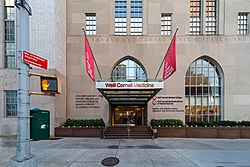
Weill Cornell Medicine's facade on the East River
Cornell Medical College's Stimson Hall on the main campus in Ithaca in 1910

The Cornell Medical College was founded on April 14, 1898, with an endowment by Col. Oliver H. Payne. The college was established in New York City because Ithaca, where the Cornell main campus is located, was deemed too small to offer adequate clinical training opportunities. James Ewing was the first professor of clinical pathology at the school, and for a while the only full-time professor.[6][7][8]

20th century

[edit]

The college founded the medical fraternity, Phi Delta Epsilon, on October 13, 1904.[9]

A branch of the medical school operated in Stimson Hall on the main campus. The two-year Ithaca course paralleled the first two years of the New York school. The Ithaca location closed in 1938 due to declining enrollment.

The school became affiliated with New York Hospital, now NewYork–Presbyterian Hospital, in 1913.[1] The institutions opened a joint hospital-educational campus in Yorkville in 1932.[1]

In 1927, William Payne Whitney's $27 million donation led to the building of the Payne Whitney Psychiatric Clinic, which became the name for Cornell's large psychiatric effort. Its Training School for Nurses became affiliated with the university in 1942, operating as the Cornell Nursing School until it closed in 1979.[10]

In 1936, the Swiss professor and psychiatrist Oskar Diethelm[11] contributed a collection of more than 10,000 titles related to the history of psychiatry, helping to build up the Oskar Diethelm Historical Library.[12] [13]

The Cornell University Medical College was renamed the "Joan and Sanford I. Weill Medical College of Cornell University" after then-Citigroup chairman Sanford I. Weill pledged a $100 million donation to Cornell University for its biomedical research in 1998.[5]

21st century

[edit]

In 2015, the school was renamed Weill Cornell Medicine.[14]

On September 16, 2019, Augustine M.K. Choi announced Weill Cornell Medicine would make the cost of attendance free for all students who qualify for financial aid, made possible by a $160 million gift from The Starr Foundation, directed by Weill Cornell Medicine overseer Maurice R. Greenberg, in partnership with gifts from Joan and Board of Overseers Chairman Emeritus Sanford I. Weill.[15]

In March 2024, Augustine M.K. Choi, professor and former Dean of Weill Cornell Medicine, was accused of altering data for two decades in his research on animals.[16]

Notable alumni

[edit]
Anthony Fauci, a 1966 Weill Cornell Medicine alumnus[17]
Elizabeth Nabel, a 1981 Well Cornell Medicine alumnus

Notable faculty

[edit]
  • David H. Abramson, ophthalmic surgeon
  • Jonathan Avery, addiction psychiatrist
  • Lewis C. Cantley, Meyer Director and Professor of Cancer Biology at the Sandra and Edward Meyer Cancer Center at Weill Cornell Medicine
  • Olivier Elemento, Director of the Englander Institute for Precision Medicine
  • Mario Gaudino, professor of cardiothoracic surgery, principal investigator of the ROMA trial, a multinational trial of radial artery grafting in CABG
  • Antonio Gotto, cardiologist and dean emeritus
  • Amos Grunebaum, obstetrician and gynecologist
  • David P. Hajjar, dean emeritus, Professor and Professor of Pathology and Biochemistry, and the Frank Rhodes Distinguished Professor of Cardiovascular Biology and Genetics
  • Allan McLane Hamilton, Professor of Psychiatry at Cornell Medical College
  • Yoon Kang, Richard P. Cohen, M.D. Professor of Medical Education and the senior associate dean for education
  • Ben Kean, Professor of Medicine, founder of the Tropical Medicine Unit, chief of the Parasitology Laboratory at New York Hospital, and personal physician to the Shah of Iran, whose health and treatment was a factor in the Iran Hostage Crisis[18]
  • Otto F. Kernberg, psychiatrist
  • David Kissane, Professor of Psychiatry and Chairman, Department of Psychiatry and Behavioral Sciences and inaugural Jimmie C. Holland Chair in Psychiatric Oncology at Memorial Sloan Kettering Cancer Center
  • Bruce Lerman, cardiologist, the Hilda Altschul Master Professor of Medicine at Weill Cornell Medical College, and Chief of the Division of Cardiology and Director of the Cardiac Electrophysiology Laboratory at Weill Cornell Medicine and the New York Presbyterian Hospital
  • Fabrizio Michelassi, Lewis Atterbury Stimson Professor and Chairman of the Department of Surgery at Weill Cornell Medicine
  • John P. Moore, virologist and professor at Weill Cornell Medicine[19]
  • Georgios Papanikolaou, Former professor of clinical anatomy at Cornell University Medical College, inventor of the Pap test[20]
  • Rajiv Ratan, professor, administrator, scientist, and the Burke Professor of Neurology and Neuroscience at Weill Cornell Medicine[21]
  • Douglas Scherr, surgeon, medical researcher and Clinical Director of Urologic Oncology at Weill Cornell Medicine[22]
  • Harold E. Varmus, Nobel Prize-winning scientist and the Lewis Thomas University Professor of Medicine at Weill Cornell Medicine[23]
  • Radu Lucian Sulica, Professor and Chief, Laryngology and Voice Disorders[24]
  • Ruth Westheimer (born Karola Siegel, 1928; known as "Dr. Ruth"), German American sex therapist, talk show host, author, professor, Holocaust survivor, and former Haganah sniper

See also

[edit]

References

[edit]

Further reading

[edit]
[edit]
Revisions and contributorsEdit on WikipediaRead on Wikipedia
from Grokipedia
Weill Cornell Medicine is a premier academic medical center and biomedical research institution in , functioning as the of and a major affiliate of , with a mission centered on excellence in patient care, scientific discovery, and the education of future physicians and scientists. Founded in 1898 as Cornell University Medical College by philanthropist Colonel Oliver H. Payne, it has evolved into one of the nation's top-ranked medical and graduate schools, emphasizing innovative education that integrates basic sciences, clinical training, and liberal arts. The institution's history reflects a commitment to advancing and healthcare, beginning with its early admission of a large proportion of women students and fostering innovative curricula. Key milestones include its 1913 affiliation with , the establishment of a shared on Manhattan's in 1932, and the founding of the Weill Cornell Graduate School of Medical Sciences in 1952. In 1991, it launched the Tri-Institutional M.D.-Ph.D. Program in collaboration with and The , enhancing interdisciplinary research opportunities. Renamed Weill Cornell Medicine in 1998 to honor a significant donation from Joan and , and rebranded in 2015 to better encapsulate its tripartite mission, the institution enrolled 1,735 students across its medical college and graduate programs as of 2024. Weill Cornell Medicine's research endeavors are collaborative and patient-oriented, addressing contemporary health challenges through initiatives funded by 1,356 awards in the 2023-2024 cycle. It maintains strategic affiliations with leading entities such as , The , and , alongside international partnerships including Weill Cornell Medicine-Qatar (established in 2001) and the Weill Bugando School of Medicine in (2006). These collaborations support over 20 global programs across six continents, promoting diversity, innovation, and mentorship as core values. In patient care, Weill Cornell Medicine delivers individualized treatment through world-renowned physicians, handling 3.31 million annual encounters as of while prioritizing compassionate, evidence-based approaches. Its educational programs prepare students for leadership in healthcare via competitive curricula that blend rigorous scientific training with clinical immersion at affiliated sites. Overall, the institution stands as a global leader in translating research into clinical advancements, fostering a legacy of excellence that spans more than a century.

History

Founding and Early Development (1898–1913)

The Cornell University Medical College was founded on April 14, 1898, through a $1 million endowment from Oliver H. Payne, a philanthropist and executive, to establish a under 's auspices in with a strong emphasis on clinical education. This initiative arose from a group of prominent physicians, including Dr. Henry P. Loomis and Dr. Lewis A. Stimson, who sought to create an institution prioritizing rigorous scientific training and hands-on medical practice amid the rapid and medical advancements of the late . The school's establishment followed a dispute with , leading to the of its medical faculty and students to form this new entity dedicated to advancing in a major clinical hub. Initially located in temporary facilities at the Loomis Laboratory on East 26th Street in , near , the college opened its doors on October 4, 1898, admitting an inaugural class that included over 200 students, many transferred from predecessor institutions, with a notable proportion of women at a time when coeducation was rare in American medical schools. From the outset, the curriculum integrated basic sciences with practical training, utilizing nearby hospitals for clinical exposure; students began working on wards at by 1906, laying the groundwork for immersive . The college also used New York Hospital as a facility to enhance practical instruction in patient care. In 1900, a permanent building opened on First Avenue between 27th and 28th Streets, funded in part by an additional $1.5 million from Payne for equipment and construction, opposite to facilitate direct access to clinical resources. Key early milestones included the development of dedicated basic science laboratories and the graduation of the first class in 1902, consisting of 67 students, including 12 women, marking the completion of the four-year program under Dean William M. Polk. By 1908, admission requirements were elevated to mandate a college degree, reflecting the school's commitment to high academic standards. Clinical clerkships were formalized at Bellevue Hospital's Second Division in 1911, with staff appointments following in 1913, strengthening the bridge between classroom learning and real-world application. The early years were not without challenges, including funding shortages that relied heavily on Payne's ongoing philanthropy to sustain operations and expansion, as well as intense competition from established New York City medical institutions like Columbia's College of Physicians and Surgeons and New York University. These pressures underscored the need for strategic affiliations and innovative educational models to differentiate the college in a crowded urban landscape.

Expansion and Renaming (1914–2000)

In 1913, Medical College formalized its affiliation with New York Hospital through an agreement that enabled shared facilities and structured clinical rotations for medical students, marking a pivotal step in integrating academic training with practical patient care. This partnership, stimulated by philanthropic gifts including those from George F. Baker, laid the groundwork for collaborative and operations, culminating in the opening of a joint campus on Manhattan's in 1932. The affiliation strengthened the college's clinical resources and positioned it as a leader in merging education with hospital-based learning. During , faculty and staff from the medical college staffed Base Hospital No. 9 in Savenay, , from 1917 to 1918, providing critical care amid the conflict's devastation and contributing to advancements in . The war's toll spurred innovations in treating mass casualties and infectious diseases. In , the institution accelerated training for military medical personnel through specialized courses in from 1941 to 1945, covering topics such as army organization, communicable disease prevention, and war-specific surgical conditions; graduates were commissioned as first lieutenants in the U.S. Army Medical Corps. Departments engaged in war-related research on injuries and tactical medical responses, with a third of the teaching staff serving overseas, enhancing the college's expertise in trauma care. Post-World War II, the medical college expanded its graduate programs in the 1950s to foster advanced biomedical education, notably establishing the Graduate School of Medical Sciences in 1952, which offered degrees in basic sciences and supported interdisciplinary training. This initiative capitalized on the era's surge in federal funding for , enabling growth in postgraduate studies and faculty development. In 1991, it launched the Tri-Institutional M.D.-Ph.D. Program in collaboration with and The Rockefeller University, enhancing interdisciplinary opportunities. In the and , biomedical became more deeply integrated into the institution's core activities, with departments advancing studies in areas such as , , and visual processing in animal models, while benefiting from national policies like Medicare and that expanded opportunities. These developments solidified the college's role in translational science amid broader social and changes. The period culminated in 1998 with the renaming of the institution to Weill Cornell Medical College, honoring a landmark $100 million donation from Joan and during the college's centennial celebration. This gift, the largest to a U.S. at the time, primarily bolstered biomedical research initiatives and provided endowments for recruiting top faculty, enhancing retention through competitive salaries, and upgrading research infrastructure, including laboratories and clinical facilities. The addressed financial challenges from the late 1970s and propelled the institution toward greater prominence in medical innovation.

Modern Era and Innovations (2001–present)

In 2001, Weill Cornell Medicine established its campus in (WCM-Q) through a partnership with the , marking the first American in the . The pre-medical program officially opened in fall 2002 with 25 students, becoming Qatar's inaugural coeducational higher education institution and expanding access to Cornell's curriculum in the region. This initiative reflected a strategic push toward global , with enrollment growing rapidly to support full MD programs by the mid-2000s. By 2015, the institution underwent a significant from Weill Cornell Medical College to Weill Cornell Medicine, emphasizing its integrated mission to care for patients, discover new knowledge, and teach future physicians. This change highlighted the broader scope encompassing clinical care, , and beyond traditional college boundaries. In 2019, Weill Cornell Medicine launched a transformative program, eliminating tuition and fees for all students qualifying for financial aid starting in the 2019-2020 , funded by a $160 million gift led by the Weill Family Foundation and other donors. This initiative aimed to reduce debt burdens, with approximately 50% of students graduating debt-free as a result. Leadership transitions marked the early 2020s, including the appointment of Dr. Robert A. Harrington as the Stephen and Suzanne Weiss Dean in September 2023, bringing expertise in and clinical trials to advance institutional priorities. However, the period also saw challenges, such as 2024 allegations of research misconduct against former dean Dr. Augustine M.K. Choi, involving data manipulation in animal experiments across multiple studies dating back decades; an internal committee had recommended retractions of several papers as early as 2023, prompting ongoing investigations. During the , Weill Cornell Medicine adapted swiftly by implementing real-time interactive experiences (RITE) for clerkship students to maintain clinical training remotely and launching a program training students as volunteer vaccinators. These efforts, alongside research into post-pandemic respiratory illnesses, underscored adaptive educational reforms. By 2025, innovations included the integration of AI-driven tools into the medical curriculum, such as the MedSimAI simulator for practicing patient communication skills via text and voice modes simulating visits. Courses like AI in Medicine further embedded these technologies to prepare students for data-informed healthcare. initiatives advanced through the Office of Energy & , featuring the 2025 Freezer Challenge to reduce lab energy use and a pilot with My Green Doctor for waste reduction and greener procurement in clinical settings. Preclinical incorporated lectures on climate change's health impacts and sustainable healthcare practices, aligning training with .

Organization and Administration

Governance Structure

Weill Cornell Medicine operates as a constituent college of , with its governance structure integrated into the university's overarching framework as outlined in the University Bylaws. The primary oversight body is the Board of Fellows, comprising 85 voting members, including 65 public members elected by the board, 10 elected by 's Board of Trustees, 2 elected by , elected student and faculty representatives, and 5 ex officio members. This board holds responsibility for the general supervision of academic, financial, and operational programs; it approves domestic and international affiliations, faculty appointments and tenure, endowed professorships, and major facility developments. Reporting lines flow from the Dean of Weill Cornell Medicine to the university's , ensuring alignment with Cornell's strategic priorities while maintaining autonomy in , research, and clinical missions. Faculty governance is facilitated through two primary bodies established under the University Bylaws: the Executive Faculty Council (EFC), chaired by the Dean, and the General Faculty Council (GFC), led by an elected faculty chair. These councils exercise jurisdiction over academic policies, educational matters, and faculty affairs, with the EFC focusing on executive oversight and the GFC on broader faculty representation. Key institutional policies emphasize , guided by Cornell University's Policy Statement on and and Expression, which safeguards the rights to conduct research, teach, and express ideas without undue interference. Ethical standards for research are upheld by the (IRB), which reviews all human subjects protocols to ensure compliance with federal regulations (e.g., 45 CFR 46) and ethical principles such as and risk minimization. Diversity, equity, and inclusion (DEI) policies were formalized and expanded in the 2010s, with the creation of the Office of Diversity and Inclusion Programs and the appointment of the inaugural Senior Associate Dean for Diversity and Inclusion in 2018; these initiatives build on foundational efforts from 1969 but include mandates for unconscious bias training, inclusive recruitment, and annual Diversity Week programming starting in 2018 to foster equity in education, research, and patient care. As of 2025, the office is led by Associate Dean Rache M. Simmons, M.D., with assistant deans supporting specific programs. The financial structure supports these operations through diversified funding sources beyond tuition, including endowment income ($71 million annually as of fiscal year 2024), philanthropy ($65 million as of fiscal year 2024), federal and private research grants, and professional education fees ($72 million as of fiscal year 2024), managed under the Board of Fellows' fiscal oversight in coordination with Cornell's central financial administration. Specialized committees provide operational governance across core areas. The curriculum is managed by the Executive Medical Education Committee (EMEC) and the Medical Education Policy Council (MEPC), which develop and approve policies for the M.D. program, including subcommittees for longitudinal science and clinical curricula, admissions, promotions, and ; these report to the EFC and GFC. Research oversight involves the for ethical compliance and (DSMCs) for ongoing safety reviews of clinical trials. Clinical affairs are addressed by the Board of Fellows' Clinical Affairs/Physician Organization Committee, which handles physician organization policies and affiliations, alongside the GFC's Clinical Affairs Committee, which advises on clinical and practice standards.

Leadership and Key Figures

Dr. Robert A. Harrington, a renowned cardiologist specializing in therapies and clinical trials, has served as the Stephen and Suzanne Weiss Dean of Weill Cornell Medicine and Provost for Medical Affairs at since July 2023. Prior to his appointment, Harrington held the position of chair of the Department of Medicine at and served as past president of the . Under his leadership, the institution has prioritized the use of and data integration to enhance healthcare delivery and research outcomes, including contributions to perspectives on AI's role in improving patient care systems. His predecessor, Dr. Augustine M.K. Choi, served as dean from January 2017 to June 2023, following an interim role starting in June 2016. A focused on disease and , Choi oversaw significant research expansion during his tenure, including increased funding and collaborative initiatives, before resigning amid investigations into issues in his prior research publications. Other key administrative figures include Dr. Hugh C. Hemmings Jr., who serves as Senior Associate Dean for and Chair of the Department of , contributing to advancements in neuropharmacology and through over 200 publications and in research compliance. Additionally, Dr. Rainu Kaushal holds the role of Senior Associate Dean for Health Data Science, driving strategic planning in and analytics to support precision health efforts. Under recent leadership, Weill Cornell Medicine has seen enrollment growth, with the Class of 2028 comprising 106 medical students from over 7,300 applicants, contributing to a total institutional enrollment of 1,735 students across programs as of 2024. Faculty numbers have expanded to include 6,719 clinical and 405 basic science members as of 2024, bolstering and clinical capabilities.

Academics

Degree Programs and Curriculum

Weill Cornell Medicine offers a primary (MD) program structured over four years, divided into three distinct phases that integrate foundational sciences with clinical training. Phase 1 (Foundations) spans the first 18 months and emphasizes basic sciences through courses like Essential Principles of and , Illness, and , incorporating the Longitudinal in Academic Practices (LEAP) program for early clinical exposure. Phase 2 (Principal Clinical Year) covers the next 12 months with core clerkships in specialties such as , , and , fostering hands-on patient care skills. Phase 3 (Electives and Career Exploration) completes the final 18 months, allowing students to pursue advanced electives, sub-internships, and a scholarly project to tailor their toward specific career goals. This phased approach promotes an enhanced integration of scientific principles, patient-centered care, and throughout the curriculum. A key innovation in the curriculum is the incorporation of (PBL), introduced in 1996 as a shift toward small-group, student-centered teaching where learners actively solve clinical cases to build knowledge. PBL sessions complement lectures and labs, encouraging and application of concepts to real-world scenarios. Additionally, the includes a longitudinal global health track, established in 2009, which offers elective modules, preceptorships, , and international electives to address health disparities and cultural competency. Recent updates have integrated modules on (AI) in medicine, such as courses exploring AI applications in diagnostics and ethics, reflecting advancements in computational health tools as of 2024. The program maintains continuous full accreditation from the (LCME) through the 2025-2026 academic year. The MD program integrates with the Tri-Institutional MD-PhD program, launched in 1991 in collaboration with The Rockefeller University and , enabling students to earn dual degrees with a focus on training. Participants complete the MD at Weill Cornell while conducting PhD across the three institutions, accessing over 400 laboratories and interdisciplinary . This joint program provides full tuition scholarships and stipends, emphasizing rigorous training in biomedical alongside clinical education. Beyond the MD, Weill Cornell's Graduate School of Medical Sciences offers advanced degrees, including PhD programs in , which explores drug interactions in areas like cancer and ; , covering neural development and disease mechanisms; and through a tri-institutional collaboration. (MS) programs include , a 18-month training students in quantitative methods for biomedical , alongside options in related fields like sciences. These graduate offerings emphasize interdisciplinary training, with coursework in advanced methodologies and work under faculty guidance. The medical school's research-oriented programs consistently rank in the top 20 by for 2025.

Admissions, Enrollment, and Student Life

Weill Cornell Medicine employs a holistic admissions process through the American Medical College Application Service (AMCAS), evaluating applicants based on academic performance, MCAT scores, personal experiences, letters of recommendation, and interviews to select candidates who demonstrate potential for and service in . For the 2025 application cycle, successful applicants typically have an average MCAT score of 518 and a GPA of 3.9, reflecting the program's selectivity with an acceptance rate of approximately 1.4%. The admissions committee places a strong emphasis on . Enrollment at Weill Cornell Medicine includes 106 students per class, yielding a total of approximately 414 medical students across the four-year program based on 2023–2024 data. The institution also enrolls over 800 graduate students in programs, contributing to a vibrant academic community focused on and clinical training. Student life at Weill Cornell Medicine is supported by comprehensive resources, including the Student Program, which provides free, confidential , psychiatric care, and assessments to address the heightened needs following the . Key organizations include the Medical Student Executive Council (MSEC), which advocates for student interests and organizes events, as well as affinity groups such as the Student National Medical Association and Latino Medical Student Association that promote through cultural programming and community outreach. Graduates achieve strong outcomes, with a 98% residency match rate; for the class of 2025, 96 of 98 students secured positions, 86% at top-ranked hospitals including NewYork-Presbyterian, Massachusetts General, and .

Research

Research Institutes and Centers

Weill Cornell Medicine hosts several prominent research institutes dedicated to advancing biomedical discovery through interdisciplinary collaboration. These units integrate basic science, , and translational efforts to address complex health challenges, leveraging shared resources across affiliated institutions. The Feil Family Brain and Mind Research Institute focuses on , investigating the mechanisms of brain function and disorders such as Alzheimer's, Parkinson's, and to develop novel therapeutics. Established in , it fosters integrated research across cellular, systems, and . The Caryl and Institute for Precision Medicine emphasizes and personalized healthcare, combining genomic sequencing, biobanking, and to tailor treatments for individual patients, particularly in and rare diseases. It unites clinicians, pathologists, and data scientists to accelerate the translation of genetic insights into clinical practice. The Tri-Institutional Therapeutics Discovery Institute (Tri-I TDI), a collaborative venture with and , drives early-stage drug development by bridging academic research with pharmaceutical innovation. Launched in 2016, it supports target validation, , and lead optimization for therapies targeting cancer, infectious diseases, and neurological conditions. Weill Cornell Medicine maintains close collaborations with and , sharing facilities for clinical trials, imaging, and data analysis to enhance research efficiency. The institution's annual research funding exceeded $425 million in 2023-2024, supporting a broad portfolio of projects. Specialized centers include the Sandra and Edward Meyer Cancer Center, which coordinates multidisciplinary from to ; the Cardiovascular Research Institute, which explores heart disease mechanisms including vascular and regenerative therapies; and infectious disease programs such as the Center for the Study of Hepatitis C and the Center for Special Studies in , addressing and development. Supporting infrastructure encompasses core laboratories for advanced technologies, including the Citigroup Biomedical Center for high-resolution MRI and PET scanning; the and Core Facility for spectrometry-based protein and metabolite analysis; and the HRH Prince Alwaleed Bin Talal Bin Abdulaziz Al-Saud Institute for Computational Biomedicine, which provides bioinformatics tools for genomic data integration and AI-driven modeling. These facilities enable researchers to conduct cutting-edge experiments in , , and computational analysis.

Major Achievements and Funding

Weill Cornell Medicine has been associated with several Nobel Prize-winning contributions in biomedical research. Notably, Harold Varmus, a faculty member since 2015, shared the 1989 Nobel Prize in Physiology or Medicine for discoveries concerning the cellular origin of retroviral oncogenes, advancing understanding of cancer genetics. Earlier, Vincent du Vigneaud, chair of the Department of Biochemistry at Weill Cornell, received the 1955 Nobel Prize in Chemistry for his work on the structure and synthesis of pituitary hormones, including oxytocin and vasopressin. In recent years, Weill Cornell researchers have advanced technology, for example, by developing an experimental against CMV that demonstrates efficacy in eliciting immune responses, as shown in studies published in the Journal of Infectious Diseases. For instance, studies have demonstrated ' efficacy in eliciting immune responses against CMV, a leading cause of congenital birth defects, and have explored their application in through a $5.7 million grant awarded in 2022. In 2025, breakthroughs included the identification of free radicals generated in mitochondria as a key driver of inflammation and progression, offering potential targets for new therapies. Additionally, researchers unveiled the gene-switch system, a nontoxic tool using acyclovir to precisely control via poison exons, published in Nature Methods and applicable to . Funding has bolstered these efforts, with Weill Cornell ranking 21st among U.S. academic medical institutions for (NIH) funding in the most recent , reflecting a rise from 37th and totaling over $259 million in research project grants. In 2025, the institution secured a $5.1 million NIH grant over three years to establish the Autism Replication, Validation, and Center, aimed at enhancing the reliability of autism research findings. It also received a $3.4 million NIH grant to investigate the role of regulatory T cells in development, building on mechanisms. Weill Cornell's research has translated into substantial and impacts, including participation in clinical trials that advanced therapies and strategies during the . The institution holds numerous patents stemming from its innovations, contributing to therapeutic advancements in , infectious diseases, and , though exact figures vary by portfolio assessments.

Clinical Care and Facilities

Hospital Affiliations

Weill Cornell Medicine's primary hospital affiliation is with , particularly through the NewYork-Presbyterian/Weill Cornell Medical Center, which has been integrated since the 1998 merger forming the NewYork-Presbyterian system. This partnership supports comprehensive clinical training and patient care across a network with over 2,600 beds, emphasizing specialties such as , , , and . The affiliation enables Weill Cornell faculty to hold joint appointments and oversee advanced care in these areas, facilitating seamless integration of and treatment. Additional key partnerships include , where Weill Cornell maintains joint faculty appointments to advance research and clinical services. Since 2004, Weill Cornell has also been affiliated with , focusing on collaborative research, graduate medical education, and specialized clinical programs in areas like neurosciences and cardiovascular medicine. These alliances extend Weill Cornell's reach for patient referrals and training opportunities beyond New York. Through these affiliations, Weill Cornell supports residency training programs in more than 20 medical specialties, including , , , and obstetrics-gynecology, with nearly 1,900 trainees participating annually across the network. The partnerships handle an annual patient volume exceeding 2 million visits, encompassing inpatient admissions, outpatient consultations, and emergency services. In quality metrics, NewYork-Presbyterian/ is nationally ranked by for the 2025-2026 period in 14 adult specialties and 10 pediatric specialties, underscoring its role in high-impact clinical care.

Campus Locations and Infrastructure

Weill Cornell Medicine's primary campus is situated at 1300 York Avenue on Manhattan's , a location established in 1932 when the institution, then known as Medical College, partnered with to develop a joint facility on the site previously associated with Bellevue Hospital's southern grounds. This 14-acre complex serves as the hub for academic, research, and educational activities, encompassing multiple interconnected buildings that support advanced medical training and scientific inquiry. Key structures within the campus include the Weill Greenberg Center at 1305 York Avenue, a dedicated and facility opened in 2007 that features clinical training spaces for students and residents. Adjacent is the Belfer Research Building at 413 East 69th Street, an 18-story tower completed in 2014 that nearly doubled the institution's research capacity with state-of-the-art laboratories focused on translational . Other notable facilities connected to the main campus include the Stavros S. Niarchos Building and the William Hale Harkness Building, which house specialized labs for biomedical research. The infrastructure supports comprehensive educational and research needs through advanced laboratories distributed across the Belfer and other research buildings, enabling collaborative work in areas like genomics and immunology. Simulation centers, such as the Margaret and Ian Smith Clinical Skills Center, provide high-fidelity training environments with patient simulator suites, 10 outpatient exam rooms, and two inpatient rooms equipped for procedural practice. The Skills Acquisition and Innovation Laboratory (SAIL) further enhances this with virtual reality-integrated surgical simulations and 3D visualizations for perioperative training. Student housing accommodates over 300 individuals, including a newly opened 16-story, 173,000-square-foot residence hall at East 74th Street and York Avenue, completed in September 2025, which offers modern studios and apartments designed to promote wellness and proximity to academic facilities. Sustainability initiatives underscore the campus's modern infrastructure, with the Belfer Research Building achieving LEED Gold certification in 2015 for its energy-efficient design and sustainable materials. Recent expansions, including the 2025 student residence and a planned 200,000-square-foot center at 1334 York Avenue—announced in 2023 and acquired by Weill Cornell Medicine in October 2025 for $510 million—pursue LEED Gold or equivalent certifications to minimize environmental impact through features like advanced HVAC systems and integration. Technological upgrades, such as expanded training suites in SAIL updated through 2025, facilitate immersive learning for clinical scenarios. Beyond the main campus, Weill Cornell Medicine operates outpatient clinics across , including sites on the at 215 East 85th Street and at 156 William Street, providing accessible primary and specialty care. In , a key facility is located at 186 Joralemon Street in , offering , , gynecology, and other services in a multi-floor setup with exam rooms and support spaces.

International Presence

Weill Cornell Medicine-Qatar

Weill Cornell Medicine-Qatar (WCM-Q) was established in 2001 through a partnership between and the , marking the first American medical school to offer a complete (MD) degree program outside the in the Arabian Gulf region. The inaugural class of 16 students began their studies in August 2002 in , , as part of Qatar's broader initiative to build a knowledge-based economy by attracting leading international universities. This groundbreaking collaboration aimed to address regional healthcare needs while providing high-quality medical education aligned with global standards. The program at WCM-Q features a four-year medical identical in and learning objectives to that of Weill Cornell Medicine in , emphasizing an integrated approach that combines basic sciences with clinical training and early patient exposure. This follows a two-year foundation for high school graduates, forming a cohesive six-year pathway leading to the degree, with additional emphasis on prevalent Middle Eastern health challenges such as , , and genetic disorders through region-specific research integration. The program maintains rigorous admission standards equivalent to the New York campus, fostering a diverse student body from over 30 countries. WCM-Q's campus in Doha spans approximately 335,000 square feet and includes advanced facilities such as lecture halls, over 34,000 square feet of teaching laboratories, a clinical skills center with 12 simulation exam rooms for hands-on training, and a comprehensive sciences library. As of 2023-2024, total enrollment stands at 345 students, including 207 in the medical curriculum, 117 in studies, and 21 in the foundation program, with the Class of 2027 comprising 47 students. Key achievements include a 93% residency match rate for the Class of 2025 applying to U.S. programs—far exceeding the 59% average for international medical graduates—and full accreditation for six years from the Association for Evaluation and Accreditation of Medical Education in 2022. In research, WCM-Q has advanced regional genomics through initiatives like the Qatar Genome Program, which has sequenced over 35,000 Qatari genomes as of 2024 to identify population-specific variants for precision medicine, supported by extramural funding from the Qatar National Research Fund since 2009 and substantial investments from the Qatar government via the Qatar Foundation. Since 2010, faculty and students have published over 1,840 papers, with core facilities like the Genomics Lab enabling studies on hereditary disorders and metabolic diseases tailored to the Middle East. Funding for Weill Cornell Medicine-Qatar is primarily provided by the Qatar Foundation. According to data reported to the U.S. Department of Education under Section 117 of the Higher Education Act, Qatar has been Cornell University's largest foreign donor, contributing approximately $2.29 billion in gifts and contracts, primarily to support operations at Weill Cornell Medicine-Qatar. Budgeted funding for WCM-Q has averaged approximately $156 million annually from 2012 to 2025, totaling around $2.2 billion, with virtually all such funding used for operations in Doha. In 2019, Cornell identified and corrected underreporting of over $1 billion in Qatar Foundation funds for WCM-Q operations since 2012, along with approximately $150 million in other foreign gifts and contracts, by filing an amended report with the Department of Education and implementing enhanced compliance measures. In March 2024, the U.S. House Ways and Means Committee sent a letter to Cornell inquiring about foreign funding from 2019 onward, as part of a broader investigation into university responses to campus antisemitism, though the inquiry was not specific to Qatar or any particular foreign influence.

Global Health Initiatives

Weill Cornell Medicine's global health initiatives, coordinated primarily through the Center for Global Health, emphasize international collaborations to address health disparities in resource-limited settings via research, education, and clinical training. Established to foster bidirectional exchanges, these efforts involve faculty, residents, and students participating in programs that build capacity in low-income countries, focusing on infectious diseases, , and chronic conditions. A cornerstone for students is the elective Curriculum, launched in 2009, which integrates didactic modules, clinical preceptorships, mentorship, and opportunities for international electives to equip medical students with skills for addressing global health inequities. Participants can undertake rotations at partner sites in , , , , and , typically lasting 8 weeks between academic years, to gain hands-on experience in resource-poor environments. Complementing this, the Weill Cornell Research Fellowship offers a three-year postdoctoral program for residents, emphasizing fieldwork and research in international settings to train clinician-scientists. The Training Program, including the Medical Research Track, incorporates international rotations in , , and to support advanced training in research. Key partnerships underscore these initiatives, such as the long-standing collaboration with GHESKIO in since 1982, which provides care, trains local medical personnel and community leaders, and conducts operational research on infectious diseases. In , a with Byramjee Jeejeebhoy Medical College in , established in 2009, focuses on management, , and , incorporating telemedicine for remote consultations and training programs that serve a population of over 7 million, with affiliated hospitals handling approximately 500,000 outpatients annually. Efforts in involve capacity-building for healthcare delivery, while additional sites in (via Weill Bugando University) and (with since 1964) support training in and infectious disease control, including telemedicine applications for diagnostics. The with Weill Bugando School of Medicine, established in 2003, has graduated over 2,220 MDs as of 2025, significantly boosting and healthcare delivery in . Weill Cornell Medicine has responded to global crises through targeted involvement, including contributions to the 2014 Ebola outbreak via expert consultations and mobilization advocacy, as highlighted by Director of the National Institute of Allergy and Infectious Diseases , who emphasized the need for international coordination during a Weill Cornell forum. For the from 2020 to 2025, the institution led global research efforts, including multicenter studies on incidence and immunological surveillance, while supporting international vaccination access and contributing to a multinational consensus on ending emergencies. Collaborations with major organizations amplify these responses, particularly on infectious diseases; partnerships with the (via the ) facilitate training and research in epidemiology, while the Bill & Melinda Gates Foundation has funded multiple projects, including $6.8 million in 2023 for drug development and earlier grants for prevention in and antimicrobial resistance mapping across 54 cities. In 2025, Weill Cornell advocates integrated children's health into global climate adaptation strategies, urging policymakers to prioritize pediatric vulnerabilities in climate goals through initiatives like targeted metrics for child-focused interventions. These initiatives have trained over 600 physician-scientists and healthcare professionals through the partnership alone since 1964, contributing to broader impacts in clinical capacity and research output in partner countries.

Notable People

Prominent Alumni

Weill Cornell Medicine has produced numerous influential alumni who have shaped policy, global medicine, and scientific exploration beyond clinical and academic settings. Anthony S. Fauci, MD '66, served as director of the National Institute of Allergy and Infectious Diseases (NIAID) at the (NIH) for nearly four decades, leading responses to major crises including , , and , where he advised U.S. presidents and coordinated international efforts that influenced global pandemic strategies. C. Everett Koop, MD '41, became the 13th U.S. from 1982 to 1989, championing reforms such as anti-smoking campaigns, AIDS education, and child health initiatives that transformed national policy and reduced tobacco use prevalence from 38% to 27% during his tenure. His advocacy extended to media appearances and congressional testimonies, emphasizing evidence-based prevention over treatment. In media and innovation, Mae C. Jemison, MD '81, made history as the first African American woman to travel in space aboard the in 1992, later founding The Jemison Group to advance technology for underserved communities and serving as a professor and advocate for through public lectures and books. Peter J. Hotez, MD '87, PhD, as co-director of the Texas Children's Center for Vaccine Development, has influenced global health policy through vaccine advocacy for , advising the on immunization strategies and authoring best-selling books that bridge science and public discourse on misinformation. Reflecting diversity, Weill Cornell admitted women from its founding in 1898, with the first graduating class in 1900 including 12 female students; notable among them was , MD '00, who founded in , training generations of South Asian physicians and establishing one of Asia's largest women's medical schools. Her work pioneered gender-inclusive medical education in a region where women were barred from formal training.

Distinguished Faculty

Weill Cornell Medicine boasts a distinguished faculty renowned for their contributions to , , and . As of 2024, the institution employs over 7,000 faculty members, including approximately 6,700 clinical faculty and 400 basic science faculty focused on research-intensive roles. The faculty body reflects ongoing efforts to enhance diversity and inclusion, with initiatives such as the Office of Diversity and Inclusion supporting underrepresented groups through programs and awards recognizing champions of equity in academic . Among the most prominent is , M.D., a Nobel laureate and the Lewis Thomas University Professor of Medicine, who joined the faculty in 2015 after serving as director of the . Varmus shared the 1989 in Physiology or Medicine for discoveries concerning the cellular origin of retroviral oncogenes, foundational work in understanding cancer genetics that continues to influence his research at Weill Cornell's Meyer Cancer Center. Current faculty leaders exemplify excellence in specialized fields. Shahin Rafii, M.D., the Arthur B. Belfer Professor of Genetic and of and , directs pioneering work in stem cell biology and vascular regeneration, establishing key models for organ repair and tumor using human and mouse . In biochemistry, Samara L. Reck-Peterson, Ph.D., assumed the role of inaugural chair of the Department of Biochemistry and Biophysics in 2025, bringing expertise in cellular mechanisms such as microtubule-based transport and protein quality control from her prior positions at . Recent honors underscore the faculty's impact, with members like Sallie R. Permar, M.D., Ph.D., Matthew D. Greenblatt, M.D., Ph.D., and Lishomwa C. Ndhlovu, M.D., Ph.D., inducted into the Association of American Physicians in 2025 for their transformative research in , musculoskeletal , and , respectively. These scholars, alongside emeritus contributors like Varmus, drive Weill Cornell's commitment to advancing biomedical knowledge through rigorous, high-impact scholarship.

References

Add your contribution
Related Hubs
User Avatar
No comments yet.