
.jpg/250px-Country_cottage,_Inch_Island_-_geograph.org.uk_-_3951065_(cropped).jpg)


.jpg)
Community hub
Recent from talks
Contribute something
Nothing was collected or created yet.
Cottage
View on Wikipedia
.jpg)
A cottage, during England's feudal period, was the holding by a cottager (known as a cotter or bordar) of a small house with enough garden to feed a family and in return for the cottage, the cottager had to provide some form of service to the manorial lord.[1] However, in time cottage just became the general term for a small house. In modern usage, a cottage is usually a modest, often cosy dwelling, typically in a rural or semi-rural location and not necessarily in England. The cottage orné, often quite large and grand residences built by the nobility, dates back to a movement of "rustic" stylised cottages of the late 18th and early 19th century during the Romantic movement.
In British English the term now denotes a small, cosy dwelling of traditional build, although it can also be applied to modern construction designed to resemble traditional houses ("mock cottages"). Cottages may be detached houses, or terraced, such as those built to house workers in mining villages. The tied accommodation provided to farm workers was usually a cottage, see cottage garden. In England the term holiday cottage now denotes a specialised form of residential let property, attracting various tax benefits to the owner.
The holiday cottage exists in many cultures under different names. In Canadian English and American English, "cottage" is one term for such holiday homes, although they may also be called a "cabin", "chalet", or even "camp". In Australia, the term "cabin" is common, cottage usually referring to a smaller pre-modern period dwelling. In certain countries (e.g. Nordics, Baltics, and Russia) the term "cottage" has local synonyms: In Finnish mökki, in Estonian suvila, in Latvian vasarnīca, in Livonian sõvvõkuodā, in Swedish stuga, in Norwegian hytte (from the German word Hütte), in Czech or Slovak chata or chalupa, in Russian дача (dacha).[2]
In places such as Canada, "cottage" carries no connotations of size (compare with vicarage or hermitage).
Etymology
[edit]The word cottage (Medieval Latin cotagium) derives from Old English cot, cote "hut" and Old French cot "hut, cottage", from Old Norse kot "hut" and related to Middle Low German kotten (cottage, hut). Examples of this may be found in 15th century manor court rolls.[citation needed] The house of the cottage bore the Latin name: "domus",[3] while the barn of the cottage was termed "grangia".
England
[edit]Medieval
[edit]
The word originally referred to a humble rural detached dwelling of a cotter, a semi-independent resident of a manor who had certain residential rights from the lord of the manor, and who in the social hierarchy was a grade above the slave (mentioned in the Domesday Book of 1086), who had no right of tenure and worked full-time to the orders of the lord. In the Domesday Book, they were referred to as Coterelli.[4] The cottage had a small amount of surrounding agricultural land, perhaps two or three acres, from which the resident gained his livelihood and sustenance. It was defined by its function of housing a cotter, rather than by its form, which varied, but it was certainly small and cheaply built and purely functional, with no non-essential architectural flourishes. It would have been built from the cheapest locally available materials and in the local style, thus in wheat-growing areas, it would be roofed in thatch, and in slate-rich locations, such as Cornwall, slates would be used for roofing. In stone-rich areas, its walls would be built of rubble stone, and in other areas, such as Devon, was commonly built from cob.[5]
Industrial Revolution
[edit]
In England from about the 18th century onwards, the development of industry led to the development of weavers' cottages and miners' cottages.[6] Friedrich Engels cites 'Cottages' as a poor quality dwelling in his 1845 work The Condition of the Working Class in England.
Enclosure acts
[edit]Over the years various English acts of Parliament removed the right of the cottager to hold land. According to John Lawrence Hammond and Barbara Hammond in their book The Village Labourer, before an inclosure act a cottager was a farm labourer with land, and after an inclosure act the cottager was a farm labourer without land.[7]
Legal definition
[edit]In the law of England and Wales the definition of a cottage is "a small house or habitation without land".[4] However, originally under an Elizabethan statute, the cottage had to be built with at least 4 acres (0.02 km2; 0.01 sq mi) of land.[4]
Wales
[edit]
The Welsh Tŷ unnos or "house in a night", was built by squatters on a plot of land defined by the throw of an axe from each corner of the property. In Welsh a cottage is known as bwthyn and its inhabitant preswlydd.[8]
Scotland
[edit]In Scotland the equivalent to cottager would be the crofter and the term for the building and its land would be croft.[9]
Ireland
[edit].jpg)
Irish cottages, known as Irish: teachín, were historically the homes of farmworkers and labourers, but in recent years the term has assumed a romantic connotation especially when referring to cottages with thatched roofs (Irish: teach ceann tuí). These thatched cottages were once to be seen all over Ireland, but most have become dilapidated due to newer and modern developments. However, there has been a recent revival of restoring these old cottages, with people wanting a more traditional home. Today, thatched cottages are now mostly built for the tourist industry and many can be let out as accommodation.[10]
Modern usage in Britain and Ireland
[edit]In popular modern culture, the term cottage is used in a more general and romantic context and can date from any era but the term is usually applied to pre-modern dwellings. Older, pre-Victorian cottages tend to have restricted height, and often have construction timber exposed, sometimes intruding into the living space. Modern renovations of such dwellings often seek to re-expose timber purlins, rafters, posts, etc. which have been covered, in an attempt to establish perceived historical authenticity.
Older cottages are typically modest, often semi-detached or terraced, with only four basic rooms ("two up, two down"), although subsequent modifications can create more spacious accommodation. A labourer's or fisherman's one-roomed house, often attached to a larger property, is a particular type of cottage and is called a penty. The term cottage has also been used for a larger house that is practical rather than pretentious: see Chawton Cottage.
Outside Britain and Ireland
[edit]North America
[edit] | This section needs additional citations for verification. (February 2021) |


Although the Oxford English Dictionary states that the term cottage is used in North America to represent "a summer residence (often on a large and sumptuous scale) at a watering-place or a health or pleasure resort," most Americans expect a cottage, particularly a summer cottage, to be a relatively small, possibly unfinished house. Various editions of the quintessentially American Webster's Dictionary define it as "a small house; any modest country or suburban dwelling," (fifth edition) with the eleventh edition describing even a vacation cottage as "a usu. small house for vacation use."
In North America, most buildings known as cottages are used for weekend or summer getaways by city dwellers. Cottage owners often rent their properties to tourists as a source of revenue. In Saint John, U.S. Virgin Islands, most cottages are vacation rentals used for weekend or summer getaways. In Michigan, a cottage normally means a summer residence farther north near or on a lake. An example of a colonial era cottage in North America is a small fieldstone house called Boelson Cottage in Fairmount Park, Philadelphia—one of the oldest extant houses within the city (c.1678–84).
In the jargon of English-speaking Quebec's real-estate industry, a cottage is any two-storey house, as opposed to a bungalow. However, "cottages" in Eastern Canada are generally located next to lakes, rivers, or the ocean in forested areas. They are used as a place to spend holidays with friends and family; common activities include swimming, canoeing, waterskiing, fishing, hiking, and sailing. There are also many well-known summer colonies. Cottage living is one of the most popular tourist draws in Ontario, Canada, parts of which have come to be known as cottage country. This term typically refers to the north and south shores of Georgian Bay, Ontario; Muskoka, Ontario; Haliburton, Ontario; and the Kawartha Lakes, Ontario; but has also been used to describe several other Canadian regions. The practice of renting cottages has become widespread in these regions, especially with rising property taxes for waterfront property.
What Eastern Canadians refer to as "cottages" (seasonal-use dwellings), are generally referred to as "cabins" in most of North America. This is most notable in the Midwest and the Western United States, and Western Canada. In much of Northern Ontario, New England, and upstate New York, a summer house near a body of water is known as a camp.[citation needed] In the 1960s and 1970s, the A-Frame house became a popular cottage style in North America.
In the 1920s and 30s many gas stations were built in the style of Old World cottages. Comprising about a third of the stations built in the United States in those years, cottage-patterned facilities evoked a picturesque homeyness and were easier to gain approval for than the more stylized or attention-grabbing designs also commonly used at the dawn of the automobile era.[11]
Australia
[edit]
In Australia, the term "cabin" or "shack" is commonly used for a small dwelling, the former more often for a place of residence or tourist accommodation and the latter for a simple recreational shelter, typically not continuously occupied. The term cottage usually refers to historic smaller residential buildings, commonly stone or brick, typically from Georgian or Victorian. More recently, cabins are often also referred to tiny houses, however, cabins are built at a permanent site on proper footings, while the term tiny house often implies that the dwelling is built on a trailer platform and can be relocated.
Nordic countries
[edit] | This section needs additional citations for verification. (February 2021) |
Finland
[edit]
Statistics Finland defines a cottage (Finnish: mökki, Finland Swedish: stuga or villa) as "a residential building that is used as a holiday or free-time dwelling and is permanently constructed or erected on its site".[12] Finnish cottages are traditionally built of logs but other wood constructions have become common. They are usually situated close to water and almost all have a sauna.
There are 474,277 cottages in Finland (2005), a country with 187,888 lakes and 179,584 islands, including rental holiday cottages owned by hospitality companies but excluding holiday villages and buildings on garden allotments. Reports have 4,172 new cottages built in 2005.[citation needed] Most cottages are situated in the municipalities of Kuusamo (6,196 cottages on 1 January 2006), Kuopio (5,194), Ekenäs (Tammisaari – 5,053), Mikkeli (4,649), and Mäntyharju (4,630).[citation needed]
Sweden
[edit]
The formal Swedish term for cottages is fritidshus (vacation house) or stuga, of which there are 680.000 in Sweden (2007). According to Statistics Sweden, about 50% of the Swedish population has access to a vacation house.[13] In everyday talk, Swedes refer to their cottages as lantstället (the country house) or stugan (the cottage). Most vacation houses in Sweden are to be found along the coasts and around the major cities. Prices vary a lot depending on location; a modern seaside house near Stockholm may cost 100 times as much as a simple cottage in the inner regions of northern Sweden.
Until the end of World War II, only a small wealthy Swedish elite could afford vacation houses—often both a large seaside house and a hunting cabin up north. During the rapid urbanisation in the 1950s and 1960s, many families were able to retain their old farmhouses, village cottages, and fisherman cabins and convert them into vacation houses. In addition, economic growth made it possible even for low-income families to buy small lots in the countryside where they could erect simple houses. Former vacation houses near the large cities have gradually been converted into permanent homes as a result of urban sprawl.
The traditional Swedish cottage is a simple paneled house made of wood and painted in red. They may contain 1–3 small bedrooms and also a small bathroom. In the combined kitchen and living room (storstuga) there is usually a fireplace. Today, many cottages have been extended with "outdoor rooms" (semi-heated external rooms with glass walls and a thin roof) and large wood terraces. As a result of the friggebod reform in 1979, many cottage owners have built additional guesthouses on their lots.
Norway
[edit]The formal Norwegian term for cottages is hytte or fritidsbolig (vacation house). In Norway, cabins are often built near leisure activities such as hunting, fishing, and outdoor life / outdoor sports, or in areas with particularly beautiful nature, such as in the woods, in the mountains, or by the sea. In the most attractive areas, it has become increasingly common with regulated fields where the cabins are very close together, in so-called "cabin villages". Chained cabins and holiday apartments are also being built here, similar to a normal city.
Russia
[edit].jpg)

The first known "cottages" were built in Russia in the 19th century,[14] when British culture was popular. Today many large cities in Russia are surrounded by cottage villages. So it is legitimate to talk about the appearance of the term "Russian cottage" – a house, comparable in size to a British villa or even a mansion, and includes a corresponding piece of land.[15]
South Africa
[edit]
Much like in the rest of the world, cottages in South Africa housed agricultural workers and their friends and families. A number of cottages were also constructed for fishermen along the West and South Coasts of the country throughout the 18th and 19th centuries. Most cottages are single-story two to four-room structures, sometimes with an attic for storing supplies. Most cottages in the Western Cape area of South Africa have thatched roofs and stone or adobe walls which were traditionally whitewashed. A large number of the remaining cottages in the country are listed heritage sites.[citation needed]
Notable cottages
[edit]- Andrew Carnegie Birthplace Museum, Fife, Scotland – weaver's cottage, birthplace of industrialist and philanthropist Andrew Carnegie
- Anne Hathaway's Cottage, Warwickshire, England – childhood home of Anne Hathaway (wife of Shakespeare)
- Arthur Cottage, County Antrim, Northern Ireland – the ancestral home of US President Chester A. Arthur
- Bishop Asbury Cottage, Staffordshire, England – boyhood home of Methodist Episcopal Bishop Francis Asbury
- Bron-Yr-Aur, Powys, Wales – holiday cottage used by rock band Led Zeppelin
- Burns Cottage, Ayrshire, Scotland – home of poet Robert Burns
- Cooks' Cottage, Melbourne, Australia – taken from Yorkshire to Victoria in 1934
- Clouds Hill, Dorset, England – home of soldier T. E. Lawrence, ("Lawrence of Arabia")
- Dove Cottage, Cumbria, England – home of the poet William Wordsworth and his sister Dorothy Wordsworth
- Elgar Birthplace Museum, Worcestershire, England – cottage birthplace of composer Edward Elgar
- Ernest Hemingway Cottage, Michigan, USA – boyhood summer home of author Ernest Hemingway
- Herbert Hoover National Historic Site, Iowa, USA – cottage birthplace of President Herbert Hoover
- Hill Top, Cumbria, England – home of children's author Beatrix Potter
- Ivy Green, Alabama, USA – birthplace of deaf-blind author Helen Keller
- La Trobe's Cottage, Melbourne, Australia – home of Charles La Trobe, founder of the colony of Victoria
- Michael Collins Birthplace, County Cork, Ireland – cottage birthplace of Irish revolutionary leader Michael Collins
- Oakhurst Cottage, Surrey, England – preserved 17th century agricultural worker's cottage
- Swiss Cottage, Cahir, County Tipperary, Ireland – ornamental cottage designed by John Nash
- Thomas Hardy's Cottage, Dorset, England – home of author Thomas Hardy
- Willy Lott's Cottage, Suffolk, England – featured in several paintings by John Constable
- York Cottage, Norfolk, England – favourite home of King George V and Mary of Teck
Gallery
[edit]Thatched cottages in England
[edit]-
 Church Cottage, Stretton Grandison, Herefordshire
 -
 Cottage with thatched roof, Simpson, Milton Keynes
 -
 Ashton under Hill, Worcestershire
 -
 Cottage designed by John Nash at Blaise Hamlet, Bristol
 -
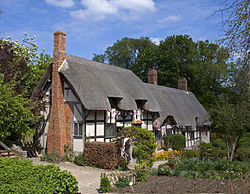 Anne Hathaway's Cottage, Shottery, Warwickshire
 -
 Thatched cottage, Brigsley, Lincolnshire
 -
 Cottage, Selworthy, Somerset
 -
 Pump Cottage, Harpford, Devon


.jpg)


Other cottages
[edit]-
 Circular cottage in Veryan, Cornwall
 -
 Cottage amongst sand dunes in Denmark
 -

-
 Snow-covered cottages near Curarrehue, Chile
 -

-
 A wooden cottage in Međimurje County, Croatia
 -
 Valley cottages in Switzerland
 -
 A pair of LCC cottages on Kingswood Estate, England, built c. 1950s
 -
 A slab cottage in Western Sydney, Australia, built c. 1880


_-_drvena.jpg)


See also
[edit]
- Bothy – simple shelter
- Bungalow – a type of single-storey house
- But and ben – a simple cottage, having only an inner and outer room
- Chalet – an alpine style building
- Cottagecore – an aesthetic popularized on the Internet in the 2010s
- Cottage garden
- Cottage industry
- Dacha – seasonal or year-round second homes located in the exurbs of Soviet and Russian cities
- Garden real estate – property with gardens
- Log cabin – small house built from logs
- London County Council cottage estates
- Mar del Plata style – a small living unit located in and around the resort city of Mar del Plata, Argentina
- Mobile home
- Mountain hut – a building located in the mountains intended to provide food and shelter to mountaineers and hikers
- Pied-à-terre – small living unit, typically located in a large city
- Summer house – a term used in the Scandinavian countries to describe the popular holiday homes or summer cottages
- Vacation rental – term in the travel industry meaning renting out a furnished apartment or house on a temporary basis to tourists as an alternative to a hotel
- Vernacular architecture – traditional architecture in a particular area
- Wilderness hut – a rent-free, open dwelling place for temporary accommodation
References
[edit]- ^ Daniel D. McGarry, Medieval history and civilization (1976) p 242
- ^ "Разновидности коттеджей. Что лучше выбрать". vsekottedzhi.com.ua.
- ^ as in domum dicti cotagii "the house of the said cottage" (the "-um" being the accusative form)
- ^ a b c Elmes, James (1827). On Architectural Jurisprudence; in which the Constitutions, Canons, Laws and Customs etc. London: W.Benning. pp. 178–179. Retrieved 5 December 2013.
- ^ Alcock, Nat; Miles, Dan (2012). The Medieval Peasant House in Midland England. Oxbow Books. p. 107. ISBN 978-1-842-17506-4.
- ^ King, Steven; Timmins, Geffrey (2001). Making Sense of the Industrial Revolution: English Economy and Society 1700-1850. Manchester University Press. p. 340. ISBN 978-0719-05022-0.
- ^ Hammond, J L; Barbara Hammond (1912). The Village Labourer 1760–1832. London: Longman Green & Co. p. 100.
- ^ Lewis, Henry, ed. (1985). Welsh Dictionary. London: Collins. ISBN 0-00-433402-7. pp. 136, 178
- ^ Collyer, Adam (1953). The Crofting Problem. Cambridge: Cambridge University. p. 25.
- ^ "Travelmania-ireland.com". www.travelmania-ireland.com. Archived from the original on 14 March 2016. Retrieved 12 February 2021.
- ^ National Register of Historic Places Inventory - Nomination Form: Lundring Service Station, United States Department of the Interior - National Park Service, 20 June 1986, retrieved 20 July 2024
- ^ "Statistics Finland". www.stat.fi. Retrieved 14 March 2018.
- ^ "Statistics Sweden". scb.se. Archived from the original on 12 June 2011. Retrieved 14 March 2018.
- ^ Manaev, Georgy (15 June 2015). "The dacha: uniquely Russian country homes". Russia & India Report. Retrieved 16 March 2017.
- ^ Харит М.Д. "Новый век российской усадьбы". Популярная энциклопедия архитектуры. т.1. 2001 г., Изд. АСТ (издательство), Москва, ISBN 5-17-008121-9
Further reading
[edit]Current editions:
- Sayer, Karen. Country cottages: a cultural history (Manchester University Press, 2000).
- Woodforde, John. The Truth About Cottages: A History and an Illustrated Guide to 50 Types of English Cottage (I B Tauris & Co Ltd, 2007)
Out of copyright (free download):
- Dawber, E. G. & Davie, W. G. Old cottages and farmhouses in Kent and Sussex (London, B. T. Batsford, 1900)
- Ditchfield, P. H. & Quinton, A. R. The cottages and the village life of rural England (London, J.M. Dent & sons ltd., 1912).
- Ditchfield, P. H. Picturesque English cottages and their doorway gardens (J.C. Winston Co., 1905).
- Downing, A. J. Cottage Residences ( New York : J. Wiley & son, 1873).
- Elder-Duncan, J. H. Country cottages and week-end homes (London, Cassell and co. ltd., 1912).
- Green, W. C. & Davie, W. G. Old cottages & farm-houses in Surrey (London, B. T. Batsford, 1908).
- Holme, Charles (Ed). The village homes of England ("The Studio Ltd.", London, New York, Paris, 1912).
- Holme, Charles. Old English country cottages (Office of "The Studio", London, New York, Paris, 1906).
- Kirby, J. H. Modern cottages (self pub. n.d).
- Papworth, John B. Rural residences: a series of designs for cottages (London, R. Ackermann, 1818).

| International | |
|---|---|
| National | |
| Other | |

Cottage
View on GrokipediaA cottage is a small, modest house, usually of a single story, often located in rural or semi-rural settings and originally serving as a humble dwelling for farm laborers or cotters during the medieval period in England.[1][2] The term derives from the late 14th century, borrowed from Old French cote meaning "hut" combined with the suffix -age, denoting a simple shelter or property tied to agricultural work.[3] Historically, cottages emerged in feudal England as basic structures with attached gardens sufficient to sustain a family in exchange for labor on larger estates, evolving from rudimentary huts to more defined "two-up-two-down" layouts by the Middle Ages.[2] Traditional cottages feature gabled roofs, often thatched; walls of local materials like stone, brick, or wattle and daub; small porches or balconies; and expansive windows to maximize natural light and views, emphasizing functionality and harmony with the surrounding landscape.[4][5] These dwellings differ from larger houses primarily in scale and purpose, being compact and efficient for seasonal or secondary use, such as vacation retreats, rather than primary family residences.[6] Over time, cottage architecture has influenced revival styles, particularly in the 19th and 20th centuries, where elements like asymmetrical facades, natural finishes, and cozy interiors were romanticized in designs by architects such as Charles Voysey, blending vernacular simplicity with ornamental charm while retaining core traits of modesty and rural adaptation.[7][8]
Etymology and Definition
Etymology
The term "cottage" entered English in the late 14th century as "cotage," denoting a humble dwelling or the property holding of a farm laborer.[3] It derives from Anglo-Norman French "cotage" or Medieval Latin "cotagium," combining "cot" or "cote" (meaning hut) with the suffix "-age" indicating a collection or property.[9] This form reflects the post-Norman Conquest (1066 CE) integration of Norman French vocabulary into Middle English, where French terms often denoted legal or tenurial arrangements in agrarian society.[10] The root "cot" traces to Old English "cot" or "cote," attested before 1066 CE and signifying a small shelter, den, or rudimentary hut, often for animals or basic human occupancy.[11] This Germanic element stems from Proto-Germanic "*kutą," akin to Old Norse "kot" (hut), emphasizing enclosures of modest scale suited to pastoral or subsistence needs rather than expansive estates.[12] By the Middle English period (circa 1150–1500 CE), "cottage" specifically applied to the abode of a "cotter," a low-status tenant farmer bound to a small plot under feudal obligations, distinguishing it linguistically from grander "manor" or "hall" structures associated with nobility.[10] This evolution underscores the word's origin in pre-industrial hierarchies of land use and shelter, prioritizing functional simplicity over status.[3]Core Characteristics and Variations
A cottage typically measures under 1,500 square feet in total living area, stands one to one-and-a-half stories tall, and includes one to three bedrooms, making it suitable for single-family occupancy or small laborer households rather than extended kin groups or commercial operations.[13][14] This compact footprint distinguishes cottages from larger manor houses, which exceed 2,000 square feet and incorporate multiple reception rooms for social hierarchy, while differentiating them from mere sheds or outbuildings lacking dedicated sleeping quarters and cooking facilities.[15] Functionally, cottages emphasize practicality over ornamentation, with steep gabled or pitched roofs—often exceeding a 6:12 slope—engineered for rapid drainage of rainwater and snowmelt to avert leaks and foundation erosion in exposed rural sites.[15][16] Interior layouts remain straightforward, featuring open or semi-open plans that allocate space efficiently for essential activities like cooking, sleeping, and storage, eschewing partitioned luxury suites or expansive halls found in grander residences.[17] Construction employs vernacular materials such as local stone, timber framing, or thatch, selected for cost-effectiveness and availability, which supports quick assembly by non-specialist builders and minimizes reliance on imported commodities.[18] While retaining this modest rural essence, cottages exhibit variations attuned to environmental pressures, such as thicker, log-constructed walls in Nordic climates providing inherent insulation via air-trapped wood layers to mitigate heat loss in sub-zero temperatures.[19] In temperate zones, sod or earth-infused walls similarly enhance thermal mass for temperature moderation without mechanical aids.[20] These adaptations preserve the dwelling's core role as a utilitarian shelter for agrarian or proto-industrial workers, averting the scale or complexity of urban tenements or industrialized barracks.[15]Historical Origins and Evolution
Medieval and Pre-Modern Europe
In medieval Europe, cottages functioned as modest dwellings for serfs, villeins, and freeholders laboring under the manorial system, directly supporting the demands of open-field agriculture where peasants cultivated communal strips of arable land in exchange for tenure rights and obligations to lords.[21] This arrangement, widespread from the 12th century, tied housing to agricultural productivity, with cottages typically allocated as part of smallholdings or tofts adjacent to village greens and fields to minimize travel for daily plowing, sowing, and harvesting.[21] Archaeological evidence indicates their proliferation from the early 13th century, as seen in dated structures like Sycamore Farm House in Long Crendon, Oxfordshire (c. 1205), which featured a central open hall for communal living and work.[22] Construction relied on locally sourced timber frames filled with wattle and daub—woven branches plastered with mud, dung, and straw—for walls, topped by thatched roofs and often employing cruck trusses (paired curved timbers from ground to ridge) for stability without internal load-bearing walls.[23] [22] In village settings, such as those in Midland England, cottages clustered linearly along roads or greens, sometimes sharing end walls (gabled row houses) to conserve materials and foster communal defense and resource sharing, with floor plans averaging 881 square feet in three-bay layouts: an open hall for cooking and animals, flanked by service and private chambers.[23] These builds, costing £2–£11 (median £4) and requiring around 111 trees, reflected pragmatic adaptations to feudal labor needs rather than permanence, though post-Black Death land reallocations (c. 1380–1540) allowed some expansions for growing households.[23] Cottages underpinned household self-sufficiency, sustaining average families of 5–7 members (parents plus 2–5 surviving children) through intensive cultivation of 15–30 acres of arable, supplemented by croft gardens for vegetables and herbs, plus small-scale livestock like pigs, chickens, and cows for dairy and manure.[24] [23] Central hearths provided heat and cooking, with smoke venting through roof holes, enabling year-round operations tied to seasonal feudal duties.[22] This model promoted demographic stability in rural populations pre-1700, as self-reliant units buffered against famines and supported surplus for markets, though vulnerability to plague and harvest failures underscored their causal dependence on agrarian output over pastoral idealization.[23]British Developments Through the Enclosure Era
In the 17th and early 18th centuries, rural cottages in Britain were typically occupied by smallholders or copyholders whose livelihoods depended on access to open fields and common lands for mixed farming practices, including arable strips supplemented by grazing, foraging, and fuel collection on commons.[25] These arrangements supported subsistence-level agriculture but were constrained by the inefficiencies of scattered holdings and communal decision-making, limiting individual incentives for soil improvement or experimentation with new crops. Cottages, often modest single-story structures with thatched roofs and wattle-and-daub walls, were built near these communal resources to facilitate daily labor.[26] Parliamentary enclosures accelerated from the 1760s, with over 3,000 acts passed by 1820 privatizing approximately 3-4 million acres of common and open-field land, consolidating fragmented plots into compact farms under individual ownership.[27] This process dismantled the traditional ties between cottages and commons, as allotments of enclosed land were disproportionately awarded to larger landowners, reducing the viability of independent smallholdings.[28] However, landowners responded by constructing or adapting cottages to house wage laborers, shifting rural housing from self-sufficient units to tied accommodations on estates, which supported the emerging proletarian workforce.[29] Enclosures demonstrably enhanced agricultural productivity by enabling hedged fields, drainage, and convertible husbandry, with empirical analyses showing enclosed parishes achieving 20-45% higher crop yields than open-field counterparts by 1801-1830.[30] [31] These gains stemmed from reduced coordination failures in strip systems—such as mismatched planting or fallowing—and facilitated capital investments like marling and clover rotation, directly contributing to Britain's population expansion from roughly 5 million in England in 1700 to over 15 million by 1851.[32] [33] While short-term displacements affected cottagers losing common rights, leading to some rural exodus and pauperism, the causal mechanism of enclosures favored long-term efficiency: consolidated holdings minimized waste from balks and paths, boosted output per acre, and freed labor for industry, underpinning sustained food supply increases amid rapid urbanization.[26] This productivity surge, rather than mere displacement narratives, aligns with observed economic data, as enclosed areas correlated with higher livestock densities and arable intensification without evidence of systemic famine.[34]Proto-Industrial and Cottage Industry Role
In the 17th and 18th centuries, cottages functioned as primary sites for proto-industrial production, particularly in textiles, facilitating a transition from subsistence agriculture to market-driven manufacturing. Under the domestic or putting-out system, urban merchants supplied raw materials such as wool, flax, or cotton to rural households, which then spun yarn and wove cloth using household tools like spinning wheels and handlooms before returning finished goods for piece-rate payment.[35] This arrangement integrated cottage dwellers into broader commercial networks, with production oriented toward domestic urban markets and exports, thereby fostering early capital accumulation in rural areas through low-overhead, decentralized operations.[36] Spinning and weaving predominated, often absorbing idle seasonal labor from farming; women and children typically handled spinning, while men focused on weaving, enabling family units to contribute collectively and balance agricultural duties with industrial tasks.[37] In England, this engaged substantial rural populations—for example, the woollen sector alone involved hundreds of thousands by the mid-18th century, supplementing incomes for smallholders with limited land and providing wages that could match or exceed farm earnings during high-demand periods.[37] Empirical records indicate piecework remuneration to household heads for family output promoted flexible labor allocation and proto-capitalist incentives, with output-based pay encouraging efficiency without fixed wages or factory discipline.[38] These activities enhanced rural self-reliance by diversifying revenue streams, mitigating risks from harvest variability, and enabling population growth in proto-industrial regions through sustained household viability.[39] Market integration deepened as rural output fed expanding urban consumption and trade, laying infrastructural foundations like skilled labor pools and merchant capital for subsequent factory systems.[40] The system's decline accelerated from the 1760s with mechanized innovations, including James Hargreaves' spinning jenny (1764) and Richard Arkwright's water frame (1769), which boosted productivity beyond hand methods and centralized operations in water-powered mills.[41] By the 1830s, steam-powered factories and power looms rendered cottage production uncompetitive, displacing domestic workers as mechanization reduced unit costs and scaled output; yet proto-industrial phases had accumulated rural savings and proletarianized labor, seeding industrial urbanization.[42]Architectural and Functional Features
Design Principles and Layouts
Traditional cottages employ compact, rectangular footprints to optimize limited land and resources, typically enclosing 400 to 800 square feet of ground-floor space for essential living functions.[43] Ground-floor layouts prioritize a single multipurpose room combining kitchen, dining, and living areas, often centered around a hearth, with any additional chambers serving storage or secondary uses.[5] Upper levels consist of sleeping lofts accessed by steep ladders or narrow stairs, maximizing vertical space without expanding the footprint, as evidenced in surviving vernacular plans from rural England.[44] Key functional elements include inglenook fireplaces, deep recesses built into exterior walls that facilitate efficient smoke extraction while providing built-in seating and ovens for cooking, thereby consolidating heating, food preparation, and social gathering in one feature.[45] These designs reflect resource constraints, with rooms designed for multiple roles—such as the main hall doubling as workshop or livestock shelter in proto-industrial contexts—to accommodate small households of 4 to 6 occupants.[46] Efficiency adaptations prioritize thermal performance: ceilings at 7 to 8 feet (approximately 2.1 to 2.4 meters) create smaller air volumes for easier heating, reducing stratification and drafts in uninsulated structures.[47] Prior to 1800, windows were kept small—often under 2 by 3 feet per pane—to limit conductive heat loss through thin, imperfect glazing, a practice confirmed in surveys of pre-industrial buildings where larger openings were rare due to glass costs and insulation deficits.[48] Such principles underscore practicality, deriving from empirical adaptations to cold climates and material scarcity rather than ornamental intent.[49]Materials, Construction, and Adaptations
Traditional cottages in Britain primarily utilized locally sourced materials for walls and roofs, reflecting vernacular construction practices that prioritized availability and cost over standardization. Walls were commonly built from cob—a mixture of subsoil, water, straw, and sometimes manure—or stone rubble in regions like the Cotswolds, with timber framing infilled by wattle and daub in wooded areas.[50][51] Roofs employed thatch, harvested from reeds, long straw, or combed wheat reed, layered over rafters to form a thick insulating barrier.[52] These materials were selected for their abundance; for instance, water reed thatching dominated wetland areas, while stone prevailed in quarrying districts.[47] Construction techniques emphasized simplicity and self-reliance, often involving owner-labor or communal efforts without architectural plans, using basic tools to erect timber frames and apply infills or masonry.[53][54] In 19th-century Britain, building a basic worker's cottage or similar terraced home cost around £75, equivalent to roughly two years' wages for a laborer, underscoring the low-capital nature of these structures.[55] Thatch roofs typically endured 20 to 50 years, with water reed lasting about 30 years and straw around 20 years under maintenance, though vulnerability to fire and weather necessitated periodic rethatching.[56][57] By the early 20th century, adaptations shifted toward durability, replacing thatch with slate or clay tiles, which offer lifespans exceeding 150 years due to their resistance to decay and weathering.[58] This transition, accelerated post-1900 amid insurance pressures and material industrialization, preserved structural integrity while reducing maintenance frequency.[59] Modern retrofits in surviving cottages incorporate these enduring roofs alongside enhancements to natural insulation from thick cob or stone walls, which provide thermal mass to moderate indoor temperatures.[60] Such adaptations yield sustainability benefits, as traditional materials' breathability and mass minimize energy demands for heating; properly maintained historic structures can achieve lower operational carbon emissions compared to unretrofitted modern homes, with insulation equivalents reducing annual CO2 output by up to 1,500 kg through decreased fuel use.[61] Empirical assessments confirm that earth-based walls in vernacular buildings exhibit high thermal inertia, stabilizing interiors and cutting reliance on artificial climate control versus lightweight urban constructions.[60][62]Regional and Cultural Adaptations
British Isles Specifics
In southern England, particularly counties like Devon, Kent, Cornwall, Gloucestershire, and Oxfordshire, traditional cottages often featured thatched roofs made from wheat straw or reed, paired with whitewashed walls of local stone or cob for weather resistance and aesthetic uniformity.[63][64] These designs prevailed in rural areas until the early 19th century, supporting agricultural laborers who cultivated surrounding plots for subsistence and market produce.[65] In Wales and Scotland, cottages adapted to harsher, wetter climates with more robust stone construction, using local slate or granite for walls to withstand heavy rainfall and winds, often with steeply pitched roofs to shed water.[66] Welsh examples in rural areas like Pembrokeshire incorporated undressed stone with timber elements, while Scottish variants emphasized durability in highland exposures.[67] Irish cottages before the Great Famine of the 1840s commonly used turf or sod roofs over mud-walled structures, housing cottiers dependent on potato plots for near-total subsistence, with the 1841 census recording approximately 40% of rural dwellings as single-room cabins of this type.[68][69] These tied to low-yield agriculture, where laborers' gardens supplemented diets amid population pressures.[70] Post-1900, initiatives like the Congested Districts Board (established 1891) revived and standardized rural housing by constructing over 10,000 improved cottages for western laborers between 1883 and 1915, emphasizing stone and slate for longevity.[71] Nineteenth-century censuses across the British Isles indicated cottages comprised 20-40% of rural dwellings, correlating with agricultural labor distribution and output, as these homes housed workers essential to enclosure-era farming efficiencies despite varying regional hardships.[68][72]European Continental Variations
In Nordic regions such as Sweden, Norway, and Finland, cottages evolved as log structures utilizing locally abundant coniferous timber, with turf or sod roofs providing essential insulation against extreme cold. These roofing techniques, in use since prehistoric times and dominant during the Viking Age and Middle Ages, reduced heat loss by up to 20-30% compared to thatched alternatives, as demonstrated in experimental reconstructions of traditional dwellings.[73] Such adaptations correlated with lower winter excess mortality rates; for instance, pre-industrial Swedish records from 1749 onward show that severe cold spells increased mortality by 10-15% less than in less insulated European regions, attributable to the thermal mass of log walls and turf coverings.[74] Isolated farmsteads predominated here, reflecting open landscapes and self-sufficient agrarian systems less prone to communal enclosure.[75] Russian izbas, the standard peasant cottages, consisted of horizontally laid logs chinked with clay or moss, centered around a massive clay stove for heat retention, and housed serfs bound to estates until the Emancipation Reform of 1861 freed over 23 million individuals.[76] Archival evidence from the pre-reform era indicates these structures' design prioritized endurance in long, sub-zero winters, with multi-room layouts allowing livestock integration for shared warmth, a practice less common in western Europe.[77] Unlike British tied cottages, izbas were tied to serfdom's communal village (mir) tenure, fostering clustered settlements without the privatizing enclosures that fragmented British commons from the 16th to 19th centuries.[25] Alpine cottages in regions like Switzerland and Austria featured denser clustering in fortified villages, driven by defensive needs against historical invasions and natural hazards such as rockfalls, contrasting Scandinavia's dispersed patterns shaped by vast, low-threat forests.[78] Stone bases with timber upper stories predominated, leveraging mountainous resources, while empirical settlement data reveal survival advantages in clustered forms during medieval raids, with groups of 2-4 households sharing resources to boost resilience.[79] Overall, continental variations emphasized timber-heavy construction from forested interiors—evident in log notching techniques imported to the Americas—over Britain's stone and daub mixes, influenced by divergent land tenures that preserved open access longer on the mainland.[80][81]Colonial and Global Extensions
European settlers transplanted cottage-like dwellings to colonies through migration patterns driven by land acquisition and economic opportunity, adapting basic rural housing forms to local resources and climates for self-sufficient frontier living. In North America, Swedish and Finnish colonists introduced log construction in the New Sweden colony along the Delaware River in 1638, using abundant timber to build simple, single-room cabins that served as prototypes for widespread settler housing.[82] These structures, characterized by horizontal logs notched at corners, spread westward with English, German, and Scots-Irish immigrants in the 1700s, enabling rapid settlement in forested interiors where framed English-style cottages were impractical due to material scarcity.[83] By the early 1800s, such dwellings dominated rural areas, with the 1800 U.S. Census indicating over 90% of the population lived rurally in modest farmsteads often evolving from logs to shingled or plank-sided cottages as settlements stabilized.[84] In Australia, British convict transports and free settlers from 1788 onward adapted compact cottage designs to subtropical conditions, incorporating wide verandas to provide shade and capture breezes, a modification rooted in practical responses to intense heat rather than ornamental tradition.[85] Early colonial homes in New South Wales and later Queensland featured elevated timber frames on stumps for ventilation and termite protection, with verandas encircling the structure to minimize solar gain, facilitating agriculture in arid frontiers where enclosed British models would overheat.[86] This evolution supported dispersed settlement patterns, as verandaed cottages allowed families to manage larger land holdings with reduced labor dependencies on urban supply chains. Southern African colonies saw Dutch settlers in the Cape from 1652 develop Cape Dutch farmsteads incorporating smaller attendant cottages with whitewashed walls and thatched roofs, adapted from European precedents using local sandstone and reed for durability in Mediterranean-like climates.[87] These outbuildings, often single-story with gabled ends, housed laborers or stored goods, their low profiles and thick walls providing thermal mass against diurnal temperature swings, which aided viticulture and pastoral economies in expansive interiors.[88] Overall, such extensions prioritized causal functionality—timber abundance in America, shade imperatives in Australia, and material resilience in South Africa—fostering resilient homesteads that underpinned colonial expansion without reliance on imported architectural impositions.[89]Modern Interpretations and Economic Role
Contemporary Residential and Vacation Use
In the United Kingdom, traditional cottages constitute a significant portion of the rural housing stock, particularly among pre-20th-century dwellings, with nearly 70% of English homes built before 1850 located in rural areas.[90] Post-1950s developments have preserved and adapted these structures for primary residential use, while newer cottage-style builds cater to rural dwellers seeking compact, low-maintenance homes amid ongoing housing pressures. In the United States, rural housing includes a comparable emphasis on smaller, older structures, where pre-1950 stock ranges from 15% to 23% depending on rural definitions, often encompassing cottage-like single-family units suitable for year-round occupancy.[91] These properties serve as primary residences for populations preferring rural lifestyles, supported by lower land costs and simpler infrastructure needs compared to urban equivalents. As secondary homes, cottages are prevalent for vacation purposes, especially in scenic rural locales, where short-term rental platforms have expanded access. The U.S. short-term rental market, including cottage listings in rural areas, reached $138 billion in projected 2025 revenue, driven by demand for secluded retreats.[92] Globally, vacation rental demand has grown steadily, with rural properties like cottages benefiting from post-pandemic shifts toward nature-oriented stays, though specific cottage shares vary by region. In the UK, rural second homes often mirror this trend, with platforms facilitating seasonal occupancy without full-time conversion. Economically, cottages offer affordability advantages in primary and secondary contexts, with construction costs for small-scale rural builds typically lower than urban developments due to reduced land prices and simpler designs. In the US, average residential construction runs $100–$200 per square foot, enabling a 1,000-square-foot cottage to total $100,000–$200,000, versus urban homes often surpassing $500,000 amid higher site preparation and regulatory expenses.[93] UK self-build costs average £2,200 per square meter, yielding around £176,000 for an 80-square-meter cottage—far below equivalent urban projects incorporating premium finishes and density premiums.[94] This cost differential supports ownership during housing shortages, as rural cottages require less capital upfront and yield lower ongoing expenses like utilities. Recent policy shifts in zoning have bolstered cottage viability by easing restrictions on small rural dwellings, thereby augmenting supply. US studies from the 2020s show that zoning reforms permitting higher densities or accessory units correlate with a 0.8% increase in housing stock over three to nine years, applicable to cottage-scale builds in permissive rural zones.[95] In the UK, analogous allowances for compact rural homes align with efforts to address supply constraints, prioritizing empirical gains in affordability over aesthetic mandates.[96] These measures counteract urban-centric shortages, enabling cottages to function as viable alternatives for both permanent residents and vacationers.Tiny Homes, Cottagecore, and Sustainability Trends
Tiny homes, typically under 400 square feet, have incorporated cottage aesthetics—such as vernacular wood siding, pitched roofs, and quaint porches—to appeal to buyers seeking affordable, compact rural-inspired living, with market growth accelerating post-2020 amid rising housing costs.[97] The North American tiny homes sector, valued at USD 2.15 billion in 2022, expanded to projected USD 2.67 billion by 2030, driven by demand for structures costing 50-70% less than traditional homes.[98] This surge reflects practical responses to affordability pressures rather than mere aesthetics, though regulatory hurdles like zoning restrictions classifying tiny homes as non-permanent RVs limit widespread adoption in many municipalities.[99] Cottagecore emerged as a social media-driven aesthetic in the late 2010s, gaining traction on platforms like TikTok by idealizing pastoral simplicity through imagery of thatched roofs, wildflower gardens, and self-sufficient homesteading, with search interest spiking 5,950% from January to October 2020 amid pandemic-induced urban confinement.[100] Its peak visibility on TikTok occurred between 2020 and 2023, often romanticizing pre-industrial rural life but overlooking the labor-intensive realities of maintenance and isolation.[101] While influencing tiny home designs toward cozy, maximalist interiors with antique furnishings, cottagecore's appeal waned post-2023 as users encountered the causal disconnect between curated escapism and viable off-grid living, where inadequate preparation leads to frequent system failures.[102] Sustainability claims for tiny homes highlight reduced energy footprints, with case studies of off-grid models achieving up to 90% lower greenhouse gas emissions compared to standard U.S. homes through minimized square footage and passive solar design.[103] However, empirical data underscores practical limits: off-grid setups often fail due to insufficient local expertise in solar or water systems, exacerbating maintenance costs that owners underestimate by focusing on initial savings. Regulatory barriers, including non-conformance to building codes, further constrain scalability, with tiny homes comprising less than 1% of U.S. new housing starts despite remote work enabling 75% of employed adults to telecommute partially by 2025.[104] This ties growth to hybrid lifestyles rather than full rural relocation, as evidenced by sustained but modest market expansion projecting global tiny homes value from USD 21.9 billion in 2024 to USD 29.9 billion by 2033, tempered by these operational realities.[105]Housing Policy and Development Impacts
Cottage housing clusters, popularized in the United States since the 1990s through designs like pocket neighborhoods, provide diversified single-family options on smaller lots with shared communal spaces, offering cost efficiencies over conventional suburban sprawl by minimizing infrastructure needs and land waste.[106] These developments leverage economies of scale in construction and maintenance, enabling lower per-unit costs that enhance affordability for middle- and lower-income buyers without relying on subsidies.[107] In the 2020s, policy shifts toward deregulation of accessory dwelling units (ADUs)—frequently termed backyard cottages—have directly expanded supply amid acute housing shortages, with states like California streamlining permitting processes since 2016 to bypass local zoning barriers. ADU construction surged, rising 14.3% in 2024 alone, contributing to broader housing stock growth and modest rent stabilization in high-demand areas by increasing rental options without large-scale urban redevelopment.[108] [109] Such market-oriented reforms contrast with subsidized public initiatives, as empirical evidence links expanded private supply to reduced homelessness pressures through accessible self-build pathways, where owner-driven construction lowers barriers to entry and fosters stability over institutional dependency.[110] Private ownership in cottage-style properties incentivizes superior maintenance and innovation, as homeowners directly bear the costs of neglect and reap value appreciation, unlike public housing systems plagued by deferred repairs and higher vacancy rates due to diffused accountability. Studies confirm owner-occupiers invest more in upkeep than rental or state-managed properties, driving long-term productivity gains via adaptive renovations rather than bureaucratic inertia.[111] This causal dynamic underscores how property rights align individual efforts with societal housing quality, evidencing failures in centralized models where incentives erode without personal stakes.[112]Criticisms, Realities, and Debates
Historical Hardships vs. Romantic Ideals
Traditional cottages in rural England prior to the 20th century were typically constructed with local materials such as wattle and daub walls, thatched roofs, and earthen floors, which offered limited protection against moisture infiltration and temperature extremes. These features frequently resulted in persistent dampness, exacerbated by inadequate ventilation and proximity to wet agricultural land, contributing to respiratory ailments like bronchitis among occupants. Overcrowding was common, with farm laborers' families—often numbering six or more—confined to one- or two-room dwellings, heightening risks of infectious disease transmission in the absence of modern hygiene practices.[113][114] Sanitation conditions further compounded hardships, as indoor plumbing was virtually nonexistent in these humble abodes until well into the 1900s; residents relied on outdoor privies and fetched water from wells or streams, often leading to contamination and outbreaks of waterborne illnesses. Infant mortality rates in rural England hovered around 150 deaths per 1,000 live births throughout much of the 19th century, with agricultural laborers experiencing rates that, while anomalously lower than urban counterparts despite their poverty, still reflected the toll of substandard housing and nutritional deficits. Such empirical data underscores the cottages' role as basic survival shelters rather than comfortable dwellings, where exposure to harsh weather and limited medical access amplified vulnerabilities.[115][116][117] In contrast, 19th-century literature often romanticized the cottage as an emblem of rustic simplicity and harmony with nature, as depicted in works by poets like William Wordsworth who extolled rural self-sufficiency and communal bonds while glossing over material deprivations. This idealization portrayed cottage life as a refuge from industrial strife, emphasizing virtues such as home-grown provisions and tight-knit village support networks that fostered resilience against economic fluctuations. Yet, these literary visions disregarded contemporaneous evidence of pervasive poverty and physical toil, prioritizing aesthetic and moral symbolism over the causal realities of elemental exposure and labor-intensive maintenance that defined daily existence for most inhabitants.[118]Enclosure Acts: Productivity Gains and Displacement
The Parliamentary Enclosure Acts, enacted primarily between 1760 and 1820, privatized approximately 7 million acres of common land through nearly 4,000 acts, transforming fragmented open fields and commons into consolidated private holdings that promoted efficient farming practices.[25] [119] This shift enabled larger-scale operations, selective breeding of livestock, and adoption of crop rotations, yielding substantial agricultural output increases; instrumental variable analyses of enclosed parishes show wheat yields rose by 45% by 1836, with contemporary surveys reporting average gains of 66% where before-and-after data exist.[30] These productivity enhancements supported mechanization—such as heavier plows and horse-drawn seed drills on consolidated fields—and generated food surpluses critical for sustaining the urban industrial labor force amid rapid population growth from 5.8 million in 1750 to 9.2 million by 1801.[30] Enclosures correlated with higher agricultural innovation rates, evidenced by increased patent filings for farming tools and improved rural infrastructure like roads, which lowered transport costs and expanded markets.[30] Overall, such changes underpinned the Agricultural Revolution's role in fueling GDP expansion during the early Industrial Revolution, with national agricultural output growing at annual rates exceeding 0.5% from 1700 to 1850.[34] Enclosures displaced a minority of smallholders, who held limited formal titles to commons and often received compensatory allotments but faced barriers to viable farming on reduced, scattered plots; regional data indicate declines like a 21% drop in small landownership in Northamptonshire post-enclosure.[30] This migration contributed to short-term rural depopulation and urban labor surpluses, yet long-term real wages for agricultural and industrial workers rose from the 1820s onward—reaching 50% above 1800 levels by 1850—as productivity-driven growth absorbed displaced labor into higher-output sectors, reducing absolute poverty metrics like infant mortality from 150 per 1,000 births in 1800 to under 100 by 1850.[120] [34] Debates persist, with left-leaning critiques framing enclosures as expropriation of communal access rights akin to theft, depriving the landless of subsistence foraging, while right-leaning analyses emphasize clarification of de facto property ambiguities into secure titles that incentivized capital investment over the inefficiency of unmanaged commons.[28] Empirical data favor the latter through causal yield and innovation effects, outweighing equity costs in net societal output; accompanying vagrancy statutes, rather than mere punitive measures, aimed to curb idleness by compelling able-bodied individuals toward wage labor amid shifting economic structures.[30] [121]Tied Cottages and Labor Dependencies
Tied cottages, also known as service tenancies, were dwellings provided by landowners or farmers to agricultural workers in the United Kingdom, where occupancy was conditional on employment, a practice prevalent from the 18th century through the 20th. This system ensured a stable labor supply for estates and farms by tying housing directly to job retention, particularly during the 19th and early 20th centuries when rural economies relied on manual labor for seasonal and year-round tasks. By the late 1970s, approximately 50% of farm workers resided in such tied accommodation, reflecting its dominance in securing workforce proximity and loyalty amid limited alternative housing options in remote areas.[122] The arrangement offered practical incentives, including nominal or subsidized rents that supplemented low agricultural wages, often supplemented by allotments for self-sufficiency, thereby reducing employer recruitment costs and minimizing worker commuting in eras without widespread mechanized transport. Employers benefited from reduced turnover in essential roles, as workers weighed job loss against immediate homelessness, fostering long-term stability on large estates where labor demands fluctuated with harvests. However, this created significant dependencies, with workers facing swift eviction upon dismissal—sometimes within weeks—exacerbating vulnerability to arbitrary termination, poor conditions, or wage suppression, as housing alternatives were scarce in rural districts.[123][122][124] Post-World War II mechanization drastically reduced the need for resident labor, accelerating the system's decline as tractors and machinery supplanted manual workers, dropping demand for tied housing. Legislative reforms further eroded the practice: the Agriculture Act 1970 introduced greater tenure security, allowing some occupants to remain post-employment under regulated terms, while the Rent (Agriculture) Act 1976 curbed evictions by mandating court oversight and prioritizing worker rights, addressing long-standing grievances dating to at least 1885. These changes, coupled with union advocacy and rising rural mobility, diminished tied cottages' prevalence, though remnants persist in selective agricultural and remote employments where on-site living aids operational efficiency.[123][124]Notable Cottages and Examples
Anne Hathaway's Cottage, located in Shottery near Stratford-upon-Avon, Warwickshire, England, exemplifies a traditional English timber-framed farmhouse dating to 1463. Originally constructed with cruck framing and comprising three rooms, it served as the childhood home of Anne Hathaway, born around 1556, who later married William Shakespeare in 1582. The property features a thatched roof, wattle-and-daub walls, and an ornamental garden with period plants, reflecting 16th-century rural life; it was acquired by the Shakespeare Birthplace Trust in 1892 and opened as a museum.[125][126][127] Blaise Hamlet, near Bristol, England, consists of nine picturesque cottages built between 1810 and 1811, designed by architect John Nash for retired workers on the Blaise Castle estate owned by merchant John Scandrett Harford. Each cottage varies in form—such as circular or Gothic Revival styles—with features including thatched roofs, tall ornamental chimneys, built-in benches, and dovecotes, embodying the Romantic-era picturesque aesthetic to evoke rustic idyll. Maintained by the National Trust, the hamlet surrounds a central green and remains residential while preserving its historical exteriors.[128][129][130] Other notable examples include the circular cottages of Veryan, Cornwall, constructed in the 19th century with thatched roofs and superstitious symbols like carved fish for protection, representing vernacular maritime adaptations. In the United States, the Nothnagle Log House in New Jersey, built around 1756, stands as one of the oldest surviving log cabins, illustrating early colonial Swedish-influenced construction with hand-hewn logs and a sod roof originally. These structures highlight cottages' evolution from functional dwellings to preserved icons of regional heritage and architectural experimentation.[131]References
- https://en.wiktionary.org/wiki/cottage
- https://en.wiktionary.org/wiki/cot