Hubbry Logo
CrucifixCrucifixMain
Open search
Crucifix
Community hub
Crucifix
logo
8 pages, 0 posts
0 subscribers
Be the first to start a discussion here.
Crucifix
Crucifix
from Wikipedia

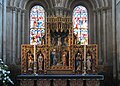
Crucifixion of Jesus at the winged triptych at the Church of the Teutonic Order in Vienna, Austria. Woodcarvings by an anonymous master; polychromy by Jan van Wavere, Mechelen, signed 1520. This altarpiece was originally made for St. Mary's Church, Gdańsk, and came to Vienna in 1864.

A crucifix (from the Latin cruci fixus meaning '(one) fixed to a cross') is a cross with an image of Jesus on it, as distinct from a bare cross. The representation of Jesus himself on the cross is referred to in English as the corpus (Latin for 'body').[1][2] The crucifix emphasizes Jesus' sacrifice, including his death by crucifixion, which Christians believe brought about the redemption of mankind. Most crucifixes portray Jesus on a Latin cross, rather than a Tau cross or a Coptic cross.

The crucifix is a principal symbol for many groups of Christians, and one of the most common forms of the Crucifixion in the arts. It is especially important in the Catholic Church, and is also used in the Lutheran Churches, Anglican Churches, Eastern Orthodox Church, and in most Oriental Orthodox Churches (except the Armenian Church and Syriac Church).[3][4][5] The symbol is less common in churches of other Protestant denominations, and in the Assyrian Church of the East and Armenian Apostolic Church, which prefer to use a cross without the figure of Jesus (the corpus).[6][7]

Western crucifixes usually have a three-dimensional corpus, but in Eastern Orthodoxy Jesus' body is normally painted on the cross, or in low relief. Strictly speaking, to be a crucifix, the cross must be three-dimensional, but this distinction is not always observed. An entire painting of the crucifixion of Jesus including a landscape background and other figures is not a crucifix either.

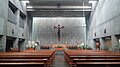
Large crucifixes high across the central axis of a church are known by the Old English term rood. By the Late Middle Ages these were a near-universal feature of Western churches, but they are now very rare. Modern Roman Catholic churches and many Lutheran churches often have a crucifix above the altar on the wall;[8] for the celebration of Mass, the Roman Rite of the Catholic Church requires that "on or close to the altar there is to be a cross with a figure of Christ crucified".[9]

Description

[edit]
A crucifix in the chancel of a Lutheran church

The standard, four-pointed Latin crucifix (used in the Catholic and Lutheran traditions) consists of an upright post or stipes and a single crosspiece to which the sufferer's arms were nailed. There may also be a short projecting nameplate, showing the letters INRI (Greek: INBI). The Russian Orthodox crucifix usually has an additional third crossbar, to which the feet are nailed, and which is angled upward toward the penitent thief Saint Dismas (to the viewer's left) and downward toward the impenitent thief Gestas (to the viewer's right). The corpus of Eastern crucifixes is normally a two-dimensional or low relief icon that shows Jesus as already dead, his face peaceful and somber. They are rarely three-dimensional figures as in the Western tradition, although these may be found where Western influences are strong, but are more typically icons painted on a piece of wood shaped to include the double-barred cross and perhaps the edge of Christ's hips and halo, and no background. More sculptural small crucifixes in metal relief are also used in Orthodoxy (see gallery examples), including as pectoral crosses and blessing crosses.

The Anglican Communion also uses the crucifix; this one is in the church of St Mary-le-Bow in London

Western crucifixes may show Christ dead or alive, the presence of the spear wound in his ribs traditionally indicating that he is dead. In either case his face very often shows his suffering. In the Eastern Orthodox tradition he has normally been shown as dead since around the end of the period of Byzantine Iconoclasm.[10] Eastern crucifixes have Jesus' two feet nailed side by side, rather than crossed one above the other, as Western crucifixes have shown them since around the 13th century. The crown of thorns is also generally absent in Eastern crucifixes, since the emphasis is not on Christ's suffering, but on his triumph over sin and death. The S-shaped position of Jesus' body on the cross is a Byzantine innovation of the late 10th century,[11] though also found in the German Gero Cross of the same date. Probably more from Byzantine influence, it spread elsewhere in the West, especially to Italy, by the Romanesque period, though it was more usual in painting than sculpted crucifixes. It was in Italy that the emphasis was put on Jesus' suffering and realistic details, during a process of general humanization of Christ favored by the Franciscan order. During the 13th century the suffering Italian model (Christus patiens) triumphed over the traditional Byzantine one (Christus gloriosus) anywhere in Europe also due to the works of artists such as Giunta Pisano and Cimabue. Since the Renaissance the "S"-shape is generally much less pronounced. Eastern Christian blessing crosses will often have the Crucifixion depicted on one side, and the Resurrection on the other, illustrating Eastern Orthodox theology's understanding of the Crucifixion and Resurrection as two intimately related aspects of the same act of salvation.

Another, symbolic, depiction shows a triumphant Christ (Latin: Christus triumphans), clothed in robes, rather than stripped as for his execution, with arms raised, appearing to rise up from the cross, sometimes accompanied by "rays of light", or an aureole encircling his body. He may be robed as a prophet, crowned as a king, and vested in a stole as Great High Priest.

On some crucifixes a skull and crossbones are shown below the corpus, referring to Golgotha (Calvary), the site at which Jesus was crucified, which the Gospels say means in Hebrew "the place of the skull."[a] Medieval tradition held that it was the burial-place of Adam and Eve, and that the cross of Christ was raised directly over Adam's skull, so many crucifixes manufactured in Catholic countries still show the skull and crossbones below the corpus.

Very large crucifixes have been built, the largest being the Cross in the Woods in Michigan, with a 31 feet (9.4 m) high statue.[12]

Usage

[edit]

In the early Church, many Christians hung a cross on the eastern wall of their house in order to indicate the eastward direction of prayer.[13][14] Prayer in front of a crucifix, which is seen as a sacramental, is often part of devotion for Christians, especially those worshipping in a church, also privately. The person may sit, stand, or kneel in front of the crucifix, sometimes looking at it in contemplation, or merely in front of it with head bowed or eyes closed. During the Middle Ages small crucifixes, generally hung on a wall, became normal in the personal cells or living quarters first of monks, then all clergy, followed by the homes of the laity, spreading down from the top of society as these became cheap enough for the average person to afford. Most towns had a large crucifix erected as a monument, or some other shrine at the crossroads of the town. Building on the ancient custom, many Catholics, Lutherans and Anglicans hang a crucifix inside their homes and also use the crucifix as a focal point of a home altar.[13][15] The wealthy erected proprietary chapels as they could afford to do this.

The Marquis of Paraná, Prime Minister of Brazil lying in state in 1856. In the background, candles and a metal crucifix.

Catholic (both Eastern and Western), Eastern Orthodox, Oriental Orthodox, Lutheran, and Anglican Christians generally use the crucifix in public religious services. They believe use of the crucifix is in keeping with the statement by Paul the Apostle in 1 Corinthians: "we preach Christ crucified, a stumbling block to Jews and folly to Gentiles, but to those who are called, both Jews and Greeks, Christ the power of God and the wisdom of God".[16]

In the West, altar crosses and processional crosses began to be crucifixes in the 11th century, which became general around the 14th century, as they became cheaper. The Roman Rite requires that "either on the altar or near it, there is to be a cross, with the figure of Christ crucified upon it, a cross clearly visible to the assembled people. It is desirable that such a cross should remain near the altar even outside of liturgical celebrations, so as to call to mind for the faithful the saving Passion of the Lord."[17] The requirement of the altar cross was also mentioned in pre-1970 editions of the Roman Missal,[18] though not in the original 1570 Roman Missal of Pope Pius V.[19] The Rite of Funerals says that the Gospel Book, the Bible, or a cross (which will generally be in crucifix form) may be placed on the coffin for a Requiem Mass, but a second standing cross is not to be placed near the coffin if the altar cross can be easily seen from the body of the church.[20]

Eastern Christian liturgical processions called crucessions[citation needed] include a cross or crucifix at their head. In the Eastern Orthodox Church, the crucifix is often placed above the iconostasis in the church. In the Russian Orthodox Church a large crucifix ("Golgotha") is placed behind the Holy Table (altar). During Matins of Good Friday, a large crucifix is taken in procession to the center of the church, where it is venerated by the faithful. Sometimes the soma (corpus) is removable and is taken off the crucifix at Vespers that evening during the Gospel lesson describing the Descent from the Cross. The empty cross may then remain in the centre of the church until the Paschal vigil (local practices vary). The blessing cross which the priest uses to bless the faithful at the dismissal will often have the crucifix on one side and an icon of the Resurrection of Jesus on the other, the side with the Resurrection being used on Sundays and during Paschaltide, and the crucifix on other days.

Modern anti-Christians have used an inverted (upside-down) crucifix when showing disdain for Jesus Christ or the Catholic Church which believes in his divinity.[21] According to Christian tradition, Saint Peter was martyred by being crucified upside-down.[22]

Controversies

[edit]
Lutherans retained the use of the crucifix; depicted is Martin Luther Church in Oberwiesenthal, Germany.

Protestant Reformation

[edit]
The tympanum of Thesis Door at the Castle Church in Wittenberg depicts Martin Luther and Philip Melanchthon kneeling in prayer, facing the crucified Christ.

In the Moravian Church, Nicolaus Zinzendorf had an experience in which he believed he encountered Jesus.[23] Seeing a painting of a crucifix, Zinzendorf fell on his knees vowing to glorify Jesus after contemplating on the wounds of Christ and an inscription that stated "This is what I have done for you, what will you do for me?".[23]

The Lutheran Churches retained the use of the crucifix, "justifying their continued use of medieval crucifixes with the same arguments employed since the Middle Ages, as is evident from the example of the altar of the Holy Cross in the Cistercian church of Doberan."[3][24] Martin Luther did not object to them, and this was among his differences with Andreas Karlstadt as early as 1525. At the time of the Reformation, Luther retained the crucifix in the Lutheran Church and they remain the center of worship in Lutheran parishes across Europe.[25] In the United States, however, Lutheranism came under the influence of Calvinism, and the plain cross came to be used in some churches, though many Lutheran churches continue to use the crucifix.[26][27]

In contrast to the practice of the Catholic Church, Moravian Church and Lutheran Churches, the early Reformed Churches rejected the use of the crucifix, and indeed the unadorned cross, along with other traditional religious imagery, as idolatrous.[28] Calvin, considered to be the father of the Reformed Church, was strongly opposed to both cross and crucifix.[29][non-primary source needed] In England (where Anglican Christianity is the dominant faith), the Royal Chapels of Elizabeth I were most unusual among local churches in retaining crucifixes, following the Queen's conservative tastes. These disappeared under her successor, James I, and their brief re-appearance in the early 1620s when James' heir was seeking a Spanish marriage was the subject of rumour and close observation by both Catholics and Protestants; when the match fell through they disappeared.[30]

Modern

[edit]
A crucifix hung above the seat of the National Assembly of Quebec from 1936 to 9 July 2019.

In 2005, a mother accused her daughter's school in Derby, England, of discriminating against Christians after the teenager was suspended for refusing to take off a crucifix necklace.[31]

In 2008, a chapel in a prison in England replaced its crucifix and static altar with a cross and portable altar when it was renovated as a multi-faith chapel. Right-wing media reported that the crucifix had been removed "in case it offends Muslims".[32]

In 2008 in Spain, a local judge ordered crucifixes removed from public schools to settle a decades-old dispute over whether crucifixes should be displayed in public buildings in a non-confessional state.[33]

On 18 March 2011, the European Court of Human Rights ruled in the Lautsi v. Italy case, that the requirement in Italian law that crucifixes be displayed in classrooms of state schools does not violate the European Convention on Human Rights.[34][35][36] Crucifixes are common in most other Italian official buildings, including courts of law.

On 24 March 2011, the Constitutional Court of Peru ruled that the presence of crucifixes in courts of law does not violate the secular nature of the state.[37]

[edit]

See also

[edit]

Notes

[edit]

References

[edit]
[edit]
Revisions and contributorsEdit on WikipediaRead on Wikipedia
from Grokipedia

A crucifix is a Christian devotional object comprising a cross with a three-dimensional or painted corpus depicting the crucified body of Jesus Christ, symbolizing his sacrificial death for humanity's redemption. Derived from the Latin cruci fixus ("one fixed to a cross"), it has been a principal emblem in Roman Catholic and Eastern Orthodox worship since early medieval times, often displayed in churches, worn as jewelry, or used in processions and personal prayer. Unlike the plain cross prevalent among Protestants, which emphasizes Christ's resurrection, the crucifix focuses on the historical reality of his passion and crucifixion as described in the Gospels, serving as a meditative aid on suffering and atonement. Early Christian reluctance to depict the cross stemmed from its association with shameful Roman punishment, but by the 5th century, crucifixes like the Gero Cross exemplified its evolution into a triumphant icon of victory over death. Variations exist across traditions, such as Orthodox crucifixes featuring additional elements like the INRI inscription, a skull at the base, or slanted footrests reflecting scriptural details of the thieves' crosses.

Definition and Terminology

Core Definition and Distinction from Cross

A crucifix is a cross bearing a three-dimensional representation of the body of Jesus Christ, known as the corpus, affixed to it, symbolizing the Crucifixion as described in the New Testament Gospels. The term originates from the Latin cruci fixus, translating to "(one) fixed to a cross," first appearing in English around 1225 via Old French crucefix. This depiction serves as a principal sacramental in Catholic and Orthodox Christianity, used for veneration, prayer, and liturgical purposes. The primary distinction from a plain cross lies in the inclusion of the corpus: a bare cross represents the instrument of execution or, in many Protestant traditions, the empty tomb and Resurrection, emphasizing triumph over death without ongoing focus on suffering. In contrast, the crucifix retains Christ's body to meditate on the redemptive act of sacrifice, reflecting theological emphases on atonement and the historical reality of the Passion. This differentiation emerged prominently after the early Church period, with crucifixes becoming standardized in Western art by the 10th century, as seen in artifacts like the Gero Cross of 965–970 CE. While both symbols denote Christian faith, the crucifix's corporeal element underscores a literal interpretation of scriptural accounts of the Crucifixion, such as those in Matthew 27:32–56 and parallels.

Etymology and Linguistic Variations

The term crucifix originates from the Latin phrase cruci fixus, meaning "(one) fixed to a cross," formed as the masculine past participle of the verb crucifigere, which combines crux (cross or stake) with figere (to fix, fasten, or pierce). This compound entered Middle English around 1225 via Old French crucefix or crocefis, initially denoting a representation of Christ affixed to the cross. Linguistic variations across Indo-European languages preserve the Latin roots, adapted to local phonology and morphology. In Romance languages, cognates include French crucifix, Italian crocifisso (from crocefisso, emphasizing the affixed corpus), Spanish and Portuguese crucifijo or crucifixo, and Romanian crucifix. Germanic languages feature forms like German Kruzifix and Dutch kruisbeeld (literally "cross-image"), while Slavic equivalents such as Polish krzyż with qualifiers or Russian распятие (raspjatie, from "to stretch out on a cross") diverge slightly but retain conceptual ties to crucifixion. These terms uniformly distinguish the crucifix—bearing the sculpted or painted body of Jesus—from the bare cross, reflecting its specific Christian iconographic function.

Historical Development

Pre-Christian Crucifixion Practices

The practice of crucifixion, involving the suspension of a victim on a wooden structure to induce prolonged death through exposure, asphyxiation, or shock, originated with the ancient Persians during the Achaemenid Empire in the 6th century BC. Greek historian Herodotus documented its use by Persian rulers, including instances where victims were impaled or affixed to beams after execution, such as the hanging of 3,000 Babylonian elites ordered by Darius I circa 519 BC following a revolt. This method served as a deterrent, combining physical torment with public humiliation to suppress dissent among conquered peoples. The technique disseminated westward through ; adopted it during his campaigns, crucifying roughly 2,000 Tyrian survivors along the Mediterranean after of Tyre in 332 BC to exemplify retribution against resistance. Similarly, it appeared among the Carthaginians, who applied it to disgraced generals after battlefield failures, as in the of 238 BC when rebel forces executed captured Punic commanders by this means. The , successors to domains, also employed against political and religious adversaries, reflecting its in Hellenistic contexts for imperial control. In Judea, pre-Christian rulers occasionally resorted to it; Hasmonean king Alexander Jannaeus crucified 800 Pharisees and their families circa 88 BC amid civil strife, an act Josephus attributes to retaliation for opposition during a banquet. These applications underscored crucifixion's role as a spectacle of dominance, reserved for non-elites or enemies, with variations in fixation—nailing or binding—yielding death over hours or days from exhaustion and organ failure. Archaeological evidence, such as iron nails from skeletal remains, corroborates the method's antiquity, though pre-Roman artifacts remain scarce due to wood's perishability.

Early Christian Adoption and Initial Avoidance

Early Christians initially avoided depictions of the crucifix, viewing crucifixion as a humiliating Roman punishment reserved for slaves and rebels, which Paul described as a "stumbling block" and "foolishness" in 1 Corinthians 1:23 due to its association with shame and the curse of Deuteronomy 21:23. This reluctance persisted amid sporadic persecutions from the 1st to early 4th centuries, where displaying such imagery could invite accusations of sedition or invite mockery, as the cross symbolized criminal execution rather than divine triumph in pagan eyes. Instead, pre-Constantinian Christian art favored abstract symbols like the fish (ichthys), anchor, or Chi-Rho monogram, which alluded to Christ without evoking the graphic horror of execution; the cross itself appeared rarely and emptily, often as a jeweled victory emblem in funerary contexts from the 3rd century onward, emphasizing resurrection over suffering. No surviving narrative images of Jesus crucified date before the late 4th century, with catacomb graffiti and sarcophagi from the 2nd-3rd centuries showing anchors or plain crosses but omitting the corpus to sidestep pagan derision and doctrinal emphasis on Christ's glorified post-resurrection state. Adoption accelerated after Constantine's in 313 legalized , following his reported vision of a cross-like symbol (✶) with "In this sign, conquer" before the Battle of Milvian Bridge in 312 , prompting public veneration of the cross as a relic and trophy; Helena, Constantine's mother, purportedly discovered the fragments in Jerusalem around 326 , spurring relic cults. The earliest potential visual references to a crucified Jesus appear in 2nd-3rd century papyri staurograms (a superimposed tau-rho resembling a figure on a cross) in manuscripts like Papyrus 66 and 75, interpreted by some scholars as cryptic nods to the crucifixion amid ongoing risks. Full narrative depictions emerged in the 5th century, such as the ivory panel from around 420-430 showing an impassive Christ on the cross, and the wooden doors of Rome's Basilica of Santa Sabina circa 432 , marking the shift toward corporeal imagery as gained imperial favor and theological focus turned to Christ's humanity and atonement. This evolution reflected causal pressures: reduced persecution allowed symbolic reclamation, while doctrinal debates against Docetism necessitated affirming Christ's physical suffering.

Medieval Expansion and Artistic Flourishing

The depiction of the crucified Christ on crucifixes expanded significantly during the medieval period, transitioning from symbolic crosses to realistic portrayals emphasizing human suffering. This shift began in the Ottonian era, exemplified by the Gero Cross, a wooden crucifix sculpted around 965–970 and commissioned by Archbishop Gero for Cologne Cathedral, marking the earliest large-scale northern European representation of a dead Christ with a slumped head and visible agony. Previously rare due to early Christian reservations about graphic imagery, such crucifixes proliferated as theological emphasis on Christ's humanity and passion grew, influencing devotional practices in Western churches. By the Romanesque period (11th–12th centuries), monumental wooden crucifixes painted in vivid colors became standard features in church interiors, often positioned above altars to evoke contemplation of the Passion. These works typically portrayed Christ in a rigid, frontal pose with eyes open, symbolizing triumph amid suffering, though earlier examples like the Gero Cross introduced more naturalistic elements of torment. Artisans employed techniques such as polychrome painting and gilding to heighten emotional impact, with crucifixes serving as focal points for liturgy and popular piety, including processions and veneration. This expansion coincided with monastic reforms and the construction of pilgrimage churches, where crucifixes reinforced doctrines of redemption through Christ's sacrifice. Artistic flourishing peaked in the Gothic era (13th–15th centuries), where crucifixes evolved to depict Christ's physical torments with unprecedented realism, including detailed wounds, blood, and contorted features to elicit empathy and contrition. Sculptors advanced wood carving with finer anatomical accuracy and expressive gestures, often incorporating ivory, metal, or enamel for elite commissions, while larger-scale examples adorned cathedrals and illuminated manuscripts. This period saw regional variations, such as elongated "Andachtsbilder" figures in Germany fostering personal devotion, reflecting broader cultural shifts toward affective piety amid scholastic theology's focus on sensory aids to faith. The proliferation of such imagery, produced in workshops across Europe, underscored the crucifix's role as both liturgical object and artistic innovation, with thousands surviving in museums and churches today.

Reformation and Post-Reformation Shifts

During the Protestant Reformation, attitudes toward crucifixes diverged sharply among reformers. Martin Luther defended the retention of crucifixes in churches as visual aids reminding believers of Christ's sacrificial death, rejecting radical iconoclasm while cautioning against superstitious veneration. In contrast, Ulrich Zwingli and John Calvin viewed depictions of Christ's body, including crucifixes, as violations of the Second Commandment prohibiting graven images, leading to their removal from Reformed worship spaces. This theological rift fueled iconoclastic actions, such as the Beeldenstorm riots of 1566 in the Netherlands and parts of the Holy Roman Empire, where mobs destroyed crucifixes, altarpieces, and statues in over 400 churches, reflecting Calvinist influence. In England under Edward VI, from 1547 to 1553, royal injunctions ordered the removal of crucifixes and images from churches to curb perceived idolatry. Lutheran territories, however, preserved crucifixes, as evidenced by continued use in Wittenberg and Scandinavian churches, aligning with Luther's emphasis on the cross as central to theology without equating it to worship. The responded at the of Trent's Twenty-Fifth Session on December 4, 1563, decreeing that images of Christ, the Virgin Mary, and saints should be retained in temples with due honor paid to the prototypes they represent, not latria to alone, to counter Protestant accusations of . This crucifixes as legitimate devotional tools, spurring Baroque art emphasizing suffering Christ in Counter-Reformation iconography. Post-Reformation, Lutheran churches consistently retained crucifixes to symbolize Christ's real bodily presence and atonement, as seen in confessional documents like the Book of Concord (1580). Reformed traditions favored empty crosses to highlight resurrection over crucifixion, a practice solidifying by the 17th century and persisting in many Protestant denominations. Anglican usage varied, with High Church factions readopting crucifixes in the 19th-century Oxford Movement, while Low Church avoided them. These shifts reflected deeper debates on sola scriptura, the role of senses in faith, and risks of visual aids fostering misuse.

Iconographic and Material Aspects

Depiction of the Corpus

The corpus on a crucifix consists of a sculpted or painted representation of Jesus Christ's body nailed to the crossbeam, typically covering from the head to the feet and emphasizing key elements of the Passion such as the crown of thorns, wounds, and loincloth. Early Christian depictions of the crucified body were rare before the 5th century, with artistic focus instead on the cross as a jeweled symbol of victory (crux gemmata), reflecting theological emphasis on Christ's triumph over death rather than physical agony. By the 10th century, the Gero Cross (c. 965–970), housed in Cologne Cathedral, introduced a groundbreaking Western portrayal of a dead Christ with slumped shoulders, closed eyes, drooping head, and visible ribs, marking the shift toward naturalistic expression of suffering and humanity while retaining Byzantine stylistic influences from Otto II's era. In Eastern Orthodox and Byzantine traditions, the corpus generally depicts Christ alive and majestic, with an erect posture, open eyes gazing forward, straight arms, and a serene or authoritative expression, often without nails in the hands to symbolize divine rather than mortal fixation; the body is stylized with elongated proportions and draped in a colobium or loincloth, underscoring resurrection over torment. Western Romanesque and Gothic corpora, by contrast, evolved to accentuate agony, featuring an emaciated, contorted body with bowed head, protruding ribs, streaming blood from the spear wound and nail marks (typically four nails: two hands, two feet), and a loincloth as the sole covering, crafted in painted wood or bronze for altars by the 11th century. These suffering-oriented depictions proliferated in monastic and popular devotion, aligning with theological reflections on Christ's redemptive pain as reenacted in the Eucharist. Material execution of the corpus varied: early examples used ivory or metal for portable icons, while medieval large-scale versions employed oak or poplar wood, gessoed and polychromed to mimic flesh tones, with articulated joints in some processional types allowing movement during rituals. Iconographic details like the INRI titulus above the head, blood rivulets, and occasional accompanying figures (e.g., Mary and John) further contextualized the corpus within the Crucifixion narrative, though the body itself remained the focal element symbolizing sacrifice. Regional adaptations persisted, such as elongated Byzantine forms versus the more volumetric Romanesque torsos, but post-medieval corpora standardized the suffering motif across Catholic contexts.

Types, Styles, and Materials

Crucifixes vary by form and function, including processional types carried in liturgical parades, often featuring elaborate designs with secondary saint figures. Nave or altar crucifixes, such as large triumphal crosses spanning church chancels, emphasize communal worship and date to medieval architecture. Handheld or pocket versions serve personal devotion, typically smaller and portable. Stylistically, early medieval crucifixes like the 10th-century Gero Cross depict Christ in a frontal, robed pose with open eyes, symbolizing triumph over death rather than suffering. By the 13th century, transitional Gothic examples introduced more naturalistic elements, such as elongated bodies and added symbols like the pelican representing eucharistic sacrifice. Later Baroque styles feature dramatic, contorted figures emphasizing agony, while Eastern Orthodox variants often use two-dimensional painted or low-relief corpora with Slavic inscriptions like "IC XC" for Jesus Christ. Materials historically favor carved wood, with medieval artisans using oak or pine for durability and ease of sculpting; legends attribute the original crucifixion cross to a composite of cedar, cypress, and pine. Precious metals like brass or gilded bronze appear in Orthodox processional crucifixes for symbolic radiance, as seen in 19th-century Russian examples. Ivory and bone were employed in portable Gothic-era pieces for fine detail, though rarer due to cost and sourcing. Modern reproductions incorporate alloys, resins, or porcelain for accessibility and preservation.

Regional and Cultural Variations

In Eastern Orthodox traditions, crucifixes diverge from Western forms through an eight-pointed cross configuration, incorporating a shorter top bar for the inscription "INRI," horizontal arms, and a slanted lower footrest (suppedaneum)—a later artistic addition, especially in medieval and Eastern Orthodox iconography—denoting the differing fates of the two thieves crucified with Jesus, one ascending to paradise and the other descending. The corpus portrays Christ with an erect posture, open eyes, and minimal agony, underscoring triumph and resurrection rather than death, often accompanied by icons of the Virgin Mary and Saint John. This style emerged in Byzantine iconography by the 10th century and persists in Russian, Greek, and Slavic contexts. Western Catholic crucifixes, prevalent in Europe since the Romanesque period (circa 11th-12th centuries), employ a four-pointed Latin cross with the corpus emphasizing physical torment—such as a tilted head, protruding ribs, and bloodied wounds—to evoke empathy and contemplation of suffering. Regional European adaptations include Gothic-era Rood crosses, large wall-mounted figures spanning up to 20 feet in English churches like those at St. Albans Cathedral (destroyed in the 16th century Reformation), and Baroque elaborations in Spain and Italy with gilded details and realistic anatomy derived from anatomical studies post-16th century. In Latin America, Spanish colonial missions from 1492 onward fused Iberian styles with indigenous materials and motifs, yielding crucifixes carved from hardwoods like chonta palm in Ecuador or balsa in Peru during the 17th-19th centuries, often exaggerating Christ's emaciation and wounds to reflect mestizo artistic expressions of penance amid harsh colonial conditions. The Caravaca cross, a double-barred variant originating in Spain but popularized in Mexico and Colombia by the 17th century, features apotropaic elements and is used in folk healing rituals. Sub-Saharan African Christian crucifixes, introduced via Portuguese traders in the late 15th century to the Kongo Kingdom, adapted European models into ritual objects like the triple crucifix—featuring three superimposed Christ figures on a single cross, crafted from wood and copper alloy around the 17th-19th centuries—for communal anointing and ancestor veneration, with stylized proportions blending local cosmology and Catholic doctrine. Ethiopian Orthodox crucifixes, rooted in Aksumite Christianity since the 4th century, integrate elaborate filigree and processional designs in silver or brass, symbolizing imperial and liturgical continuity. In Asia, Jesuit missions from the prompted localized adaptations, such as Japanese Namban crucifixes in lacquer and ivory during the (1603-1868), concealing Christian symbols amid persecution, or Chinese (1644-1912) porcelain depictions of the Crucifixion employing blue-and-white underglaze techniques to merge European narrative with imperial aesthetics for export and domestic devotion. Korean Catholic crucifixes from the onward, influenced by French missionaries, incorporate hanji and washes, reflecting Confucian restraint in portraying .

Theological Significance

Catholic Interpretation and Doctrine

In Catholic doctrine, the crucifix represents the historical and salvific reality of Jesus Christ's crucifixion, understood as the voluntary oblation of the Son of God for the atonement of human sin, fulfilling divine justice and manifesting infinite love. This interpretation draws directly from scriptural accounts in the Gospels (e.g., Matthew 27:32–56; Mark 15:21–41; Luke 23:26–49; John 19:16–37) and St. Paul's emphasis on "Christ crucified" as the power and wisdom of God (1 Corinthians 1:23–24; 2:2). The Catechism of the Catholic Church teaches that Christ's death on the cross was not accidental but integral to God's salvific plan, whereby the innocent Lamb of God bore the penalty for humanity's offenses, reconciling the world to the Father (CCC 599–603). Theological reflection on the crucifix underscores its role in the Paschal Mystery—the unified event of Christ's Passion, death, Resurrection, and Ascension—wherein suffering becomes redemptive through union with divine love. As articulated by Pope Benedict XVI, the Cross holds primacy in salvation history, symbolizing not mere defeat but the defeat of sin, death, and Satan, offering hope through Christ's obedience unto death (Philippians 2:8). The Council of Trent affirmed the retention and veneration of crucifixes as sacred images that instruct the faithful, stir devotion, and commemorate Christ's merits, distinguishing such honor from idolatry by directing ultimate latria to God alone (Session XXV, Decree on Images). This veneration is relative (dulia), fostering meditation on the Incarnation and encouraging believers to participate in Christ's self-emptying (kenosis) amid trials. Doctrinally, the crucifix integrates with the Eucharist, the sacramental re-presentation of Calvary's sacrifice, wherein Christ's oblation is made present under the species of bread and wine for the Church's participation (CCC 1362–1367). It serves as a sacramental, not a magical object, aiding devotion by recalling the necessity of the Cross for salvation and inviting redemptive suffering (Colossians 1:24), as expounded in St. John Paul II's Salvifici Doloris, which links human pain to the light of Christ's Cross. Catholic teaching rejects any notion of the crucifix promoting despair, instead viewing the corpus as a triumphant sign of victory, with the empty tomb implied in the full mystery, countering Protestant critiques by emphasizing historical fidelity to the biblical Passion narrative over symbolic abstraction.

Eastern Orthodox Views

In Eastern Orthodox theology, the crucifix functions primarily as an icon that conveys Christ's voluntary self-offering and ultimate victory over sin and death, rather than isolated suffering. The Cross is central to the paschal mystery, fulfilling divine predestination for salvation through Christ's obedience unto death, yet it is inextricably linked to the Resurrection as its completion and vindication. Orthodox hymnography encapsulates this by proclaiming, "Through Thy Cross, O Christ our God, joy has come into all the world," underscoring the transformative power of the Crucifixion in inaugurating resurrectional life. Iconographic depictions on Orthodox crucifixes emphasize Christ's sovereignty amid crucifixion, often portraying him with a serene countenance, open eyes, and an erect posture to signify his peaceful assurance of impending triumph over death, rather than physical torment alone. This contrasts with Western traditions that frequently show Christ deceased with bowed head and closed eyes, focusing more on human anguish; in Orthodoxy, such representations affirm the divine-human union, where Christ's humanity dies while his divinity remains eternally alive, as symbolized by the halo encircling his form even in icons of his death. The inclusion of figures like the Theotokos and Apostle John, along with implements of the Passion or the skull of Adam at the base, further illustrates the cosmic scope of redemption—trampling death and restoring paradise. Theologically, the Cross manifests as God's power and wisdom, disarming principalities and effecting recapitulation of humanity in Christ, as articulated by patristic sources like Irenaeus and Athanasius, who viewed it as Christ's reign over cosmic enemies. Liturgically, this triumph is exalted on the Feast of the Universal Elevation of the Cross (September 14) and during Great Lent, where the faithful venerate the Cross while glorifying the Resurrection, integrating atonement with deification rather than penal satisfaction. Orthodox tradition thus privileges the Cross as a life-giving symbol, avoiding overemphasis on juridical expiation in favor of mystical participation in Christ's victorious descent into Hades.

Protestant Critiques and Alternatives

During the Protestant Reformation, reformers critiqued the Catholic veneration of crucifixes as potentially idolatrous, invoking the Second Commandment's prohibition against graven images (Exodus 20:4-5). , in his (1536), argued that depictions of Christ inevitably distort divine truth, foster superstition, and tempt believers toward of the image rather than , rendering such representations impermissible in . This view propelled iconoclastic movements in Reformed territories, such as the destruction of crucifixes and statues in churches across and the during the 1520s–1560s, prioritizing the preached Word over visual aids. Martin Luther adopted a more nuanced stance, permitting crucifixes and religious images as instructional tools or memorials of Christ's , provided they were not adored or treated as conduits to the divine. In his 1525 treatise Against the Heavenly Prophets, Luther condemned radical , asserting that images neither nor hinder when subordinate to Scripture, and he endorsed placing a crucifix before the dying to evoke Christ's passion. Lutheran churches thus retained crucifixes on altars to symbolize Christ's real presence in the Eucharist and the theology of the cross, emphasizing as central to redemption, though without ritual veneration. As alternatives, many Protestant traditions, particularly Reformed, Baptist, and evangelical, adopted the empty cross—devoid of the corpus—to signify Christ's resurrection and victory over death rather than perpetual agony. This shift, evident by the 17th century in Puritan and Anabaptist circles, underscores a soteriology focused on completed atonement and triumph, avoiding any implication of Christ's ongoing torment. Early American Protestants often eschewed crosses entirely in architecture until the 19th century, prioritizing simplicity and scriptural sufficiency over symbolism. Modern Protestant usage varies: Lutherans may employ crucifixes devotionally, while others restrict symbols to bare crosses in steeples or jewelry, reinforcing faith through proclamation rather than iconography.

Liturgical and Devotional Uses

In Church Worship and Sacraments

In Roman Catholic liturgy, the crucifix serves as the principal ornament on the altar during the celebration of Mass, positioned centrally to evoke the sacrifice of Christ on Calvary, which is made sacramentally present in the Eucharist. The General Instruction of the Roman Missal mandates a cross—often a crucifix—visible to the congregation either on the altar or nearby, ensuring that the Paschal Mystery remains focal during the Eucharistic Prayer. This placement aids the priest in maintaining orientation toward Christ's oblation, as emphasized in post-Vatican II reforms encouraging the crucifix's prominence to underscore the sacrificial nature of the liturgy. On Good Friday, the Liturgy of the Passion features the Veneration of the , where a crucifix is gradually uncovered in three stages amid the singing of the Reproaches, allowing the faithful to approach and venerate it through , , or kissing, symbolizing adoration of the instrument of rather than the wood itself. This rite, rooted in ancient , concludes the Good Friday service before the reception of Holy Communion from reserved hosts, linking the crucifix directly to the sacramental remembrance of Christ's Passion. In the Eastern Orthodox Church, crucifixes are integrated into divine liturgy and feast-day services, particularly during the Veneration of the Holy Cross on the third Sunday of Great Lent and the Exaltation of the Cross on September 14, where the faithful process and bow before an elevated crucifix as preparation for Holy Week commemorations. Though Orthodox theology emphasizes the Cross's life-giving triumph over death, crucifixes adorn iconostases and altars, serving as focal points for hymns and prostrations that invoke Christ's redemptive suffering without implying adoration of the image per se. Among Anglican and some Lutheran traditions that retain crucifixes, similar occurs on , with the crucifix processed and honored to recall the , though Protestant critiques often favor empty crosses to highlight over . In sacramental contexts like the , the crucifix reinforces the of Christ's once-for-all , applied in rites such as or unction where it may be present for meditative focus.

Personal Devotion and Apotropaic Functions

In Catholic tradition, the crucifix serves as a focal point for personal devotion, aiding believers in meditating on Christ's Passion and sacrifice. Devotees often wear crucifixes as necklaces or pendants to maintain a constant reminder of Jesus' suffering and redemption, fostering gratitude and spiritual focus during daily activities. This practice, rooted in the visual representation of the corpus on the cross, encourages private prayer by evoking contemplation of the redemptive act, distinct from abstract symbols like the plain cross. Historically, the crucifix's apotropaic role—warding off evil—inherits early Christian beliefs in the cross's power to repel demons, supplanting pagan amulets as noted by Church Fathers like Cyril of Jerusalem in the 4th century. In medieval Europe, crucifixes were employed as protective talismans, displayed in homes or carried personally to invoke divine safeguarding against malevolent forces, a function amplified through sacramental blessing. This protective efficacy stems from the theological view of Christ's victory over sin and death, rendering the crucifix a symbol of triumph that demons abhor. Within exorcism rites, the crucifix functions as a key sacramental tool, held by priests to command demonic entities during confrontations, as documented in traditional Catholic rituals emphasizing its role in manifesting Christ's authority. Specific variants, such as the Saint Benedict crucifix inscribed with exorcistic formulas, have been used since the 17th century for personal defense against possession or temptation, with papal approvals affirming their spiritual potency when combined with prayer. These uses underscore the crucifix's dual role in devotion and defense, grounded in scriptural and patristic precedents rather than mere superstition.

Placement in Sacred and Domestic Spaces

In Catholic churches, the crucifix is prominently placed on or near the altar to signify the sacrifice of the Cross made present during the Mass. The General Instruction of the Roman Missal mandates that a crucifix be located on, next to, immediately behind, or suspended above the altar, ensuring it remains visibly related to the altar from the congregation's perspective. This placement emphasizes the centrality of Christ's Passion in the Eucharistic celebration, with Pope Benedict XVI advocating for the crucifix at the altar's center to orient both priest and faithful toward Christ rather than each other during prayer. Eastern Orthodox churches typically feature crucifixes or large crosses behind the altar screen, often integrated with icons of the depicting Christ alongside figures such as the Virgin Mary and Saint John. These are positioned to evoke the theological emphasis on the alongside , with the cross serving as a focal point in the iconostasis area visible during liturgical rites. Protestant churches generally avoid crucifixes, favoring empty crosses placed on walls, steeples, or communion tables to symbolize Christ's resurrection rather than his suffering on the cross. This practice stems from Reformation-era concerns over perceived idolatry in depicting the corpus, resulting in simpler, non-figural symbols in most Reformed, Baptist, and evangelical congregations. In domestic settings, particularly among Catholics, crucifixes are commonly hung on bedroom or living room walls as aids to personal devotion and family prayer, serving as reminders of Christ's redemptive sacrifice and as safeguards against evil. This tradition, rooted in medieval practices, positions the crucifix as a declaration of faith within the household, often central to home altars or during times of illness for sacramental visits by clergy. Historically, the placement of crucifixes in sacred spaces evolved from early Christian avoidance of graphic depictions—due to the cross's association with Roman execution—to widespread use by the 6th century, when crucifixes appeared in church art as symbols of triumph over death. In homes, this extended to portable or wall-mounted forms for private piety, reinforcing communal and individual adherence to Christian doctrine amid daily life.

Controversies and Objections

Historical Iconoclasm and Aniconism

Early exhibited aniconic tendencies rooted in Jewish prohibitions against graven images (Exodus 20:4) and the associated with as a form of execution, leading to reluctance in depicting the crucified Christ until the 5th century. The emerged as an abstract symbol by the 2nd century, often empty and without the corpus (), as seen in funerary art and catacomb inscriptions, reflecting a broader avoidance of figurative representations to emphasize spiritual over material worship. The Byzantine Iconoclastic Controversy (726–787 and 814–842) represented a state-enforced rejection of religious icons, including crucifixes depicting Christ's suffering body, which iconoclasts deemed idolatrous violations of the Second Commandment. Emperor Leo III initiated the movement in 726, influenced by Islamic critiques of image worship and military defeats attributed to divine displeasure, ordering the destruction or whitewashing of icons and their replacement with plain crosses, as evidenced in the apse mosaic of Hagia Eirene in Constantinople. Iconoclast councils, such as the Council of Hieria in 754, condemned figurative images of Christ, arguing they separated divine and human natures or encouraged superstition, though plain crosses were retained as non-idolatrous symbols of faith. The controversy ended with the Second Council of Nicaea in 787, which restored icon veneration, but iconoclasm resurfaced under Emperor Leo V in 814, persisting until 843 when Empress Theodora reinstated icons, marking the "Triumph of Orthodoxy." During the Protestant Reformation in the 16th century, radical reformers like Ulrich Zwingli and John Calvin revived iconoclasm, targeting crucifixes as prompts for idolatry and undue focus on Christ's physical suffering rather than his resurrection. In Switzerland, Zwingli's followers removed crucifixes from Zurich churches by 1524, viewing them as violations of scriptural prohibitions against images. The Beeldenstorm ("Iconoclastic Fury") in the Netherlands in 1566 saw mobs destroy thousands of crucifixes, altars, and statues across Catholic churches, spreading to northern Germany and influencing Calvinist practices that favored empty crosses. In England, under Edward VI (1547–1553), royal injunctions mandated the removal or defacement of crucifixes from parish churches, with over 90% of religious images destroyed by 1560, reflecting a doctrinal shift toward aniconism in worship spaces. While Martin Luther opposed violent destruction and permitted crucifixes in Lutheran contexts as aids to devotion without adoration, stricter Reformed traditions maintained aniconic purity, influencing ongoing Protestant preferences for symbolic crosses over representational crucifixes.

Theological Debates on Suffering and Idolatry

Theological debates surrounding the crucifix have centered on accusations of idolatry, rooted in interpretations of the Second Commandment prohibiting graven images (Exodus 20:4-5), with Reformers like John Calvin arguing that depictions of Christ's crucified body inherently deface the divine nature and foster superstition by inviting undue veneration. Calvin, in his Institutes of the Christian Religion (1536 onward), contended that any pictorial representation of God, including crucifixes, contradicts God's spiritual essence and risks reducing the incarnation to a carnal idol, equating such images with pagan practices that Scripture condemns. This critique intensified during the Reformation, where Calvinist iconoclasm led to the destruction of crucifixes in Reformed churches, viewing Catholic practices like genuflection before them as tantamount to worship reserved for God alone. In response, the Catholic Church at the Council of Trent's Twenty-Fifth Session (December 3-4, 1563) decreed the retention of images of Christ and saints in churches, mandating "due honor and veneration" toward them as representations that direct devotion to the prototypes, while explicitly forbidding any adoration akin to idolatry or superstition. The decree distinguished latria (worship due to God) from dulia (veneration of saints or images), asserting that crucifixes serve as instructional aids for the unlettered, commemorating Christ's passion without implying divinity in the material object itself. This position drew on patristic precedents and scriptural typology, such as the bronze serpent (Numbers 21:8-9), which prefigured the cross without becoming an idol until misused (2 Kings 18:4). Debates on suffering pivot on the crucifix's depiction of Christ's agony, which Catholic theology employs to meditate on the atonement's cost, fostering redemptive participation in his passion as outlined in doctrines like those of the Sacred Heart or Good Friday veneration. Martin Luther, while critiquing excessive image use, endorsed crucifixes in churches and personal devotion, aligning them with his theologia crucis—the theology of the cross—which posits God's revelation in Christ's hidden suffering and weakness rather than triumphant glory, as articulated in his 1518 Heidelberg Disputation. Luther argued that contemplating the crucified Christ counters human pride by revealing salvation through divine folly, not merit-based suffering. Certain Protestant traditions, particularly Reformed and evangelical, counter that the crucifix unduly fixates on Christ's death, potentially engendering a "" that obscures the resurrection's (1 Corinthians 15:54-57) and risks implying ongoing , contrary to the finished work of the ( 10:14). They favor the empty as symbolizing triumph over and , arguing that the corpus invites emotionalism over scriptural alone. Lutheran practice, however, retains crucifixes to embody Luther's emphasis on as the locus of divine action, distinguishing it from Reformed while rejecting Tridentine claims of meritorious . In modern secular contexts, disputes over crucifix displays in public institutions, particularly schools and legislatures, have centered on claims of religious indoctrination versus cultural heritage. These challenges often invoke principles of state neutrality, arguing that mandatory or prominent placements violate freedom from religion or equality among beliefs. Courts have frequently balanced these against historical traditions, with outcomes varying by jurisdiction. A landmark case arose in Italy, where Soile Lautsi, a Finnish-Italian parent, contested the obligatory display of crucifixes in public school classrooms attended by her children, pursuant to a 1984 Ministry of Education circular reinforcing 1920s regulations. In 2009, the European Court of Human Rights (ECHR) Chamber ruled 7-0 that the displays breached Article 2 of Protocol No. 1 (right to education) and Article 9 (freedom of thought, conscience, and religion) of the European Convention on Human Rights, viewing the crucifix as a Catholic symbol capable of influencing non-confessing pupils. However, the ECHR Grand Chamber overturned this in 2011 by a 15-2 vote, holding that Italy's placement did not infringe parental rights or denote state religious indoctrination; instead, it represented Italian cultural identity, emphasizing principles like tolerance without proselytism. The court noted the crucifix's passive, non-compulsory role and absence of evidence of coercion. This decision underscored national margin of appreciation in educational symbols, rejecting uniform secularism across Europe. Subsequent Italian jurisprudence reinforced this. In 2021, the Council of State ruled that individual public schools could democratically approve crucifix displays, provided they do not discriminate or coerce, framing them as symbols of ethical values rather than dogmatic imposition. Challenges persist from secular groups, but empirical data on pupil impact remains limited, with courts prioritizing verifiable neutrality over subjective offense. In Quebec, the 165-year-old crucifix above the National Assembly's speaker's chair, installed in 1936, faced scrutiny during 2019 secularism debates under Bill 21, which bans religious symbols for public employees. Though not legally mandated for removal, it was relocated to a parliamentary exhibit as a heritage item, signaling state laïcité without formal adjudication, amid arguments it symbolized historical Christian influence rather than active endorsement. In the United States, while First Amendment challenges target religious symbols on , crucifix-specific cases are rarer than plain es; a 2019 ruling upheld a World War I in as secular in , applying a historical practices test over strict endorsement , potentially analogous for crucifixes with longstanding non-proselytizing roles. Secular critics, including humanist organizations, contend such displays alienate non-Christians, but judicial outcomes often affirm passive symbols absent coercive elements or recent erection. These disputes reflect tensions between empirical neutrality—measured by lack of compulsion—and causal perceptions of subtle endorsement, with biased advocacy from activist groups sometimes exaggerating offense absent data on behavioral impact.

Cultural and Broader Impact

Influence on Art, Literature, and Architecture

The crucifix motif has exerted a profound influence on visual arts, evolving from early symbolic representations to detailed portrayals of suffering in medieval and Renaissance works. In the Gothic period spanning the 13th through 15th centuries, crucifixes and Crucifixion scenes emphasized Jesus's physical torments through literal depictions of wounds, blood, and contorted features, shifting focus toward human empathy and devotional intensity. This stylistic development paralleled theological emphases on Christ's passion, as seen in Italian paintings where artists like Raphael incorporated intricate landscapes and figures in works such as The Mond Crucifixion (c. 1502–1503), blending narrative depth with symbolic elevation. Later traditions in Italian art continually renewed these forms, with painters like El Greco intensifying emotional and mystical elements in Crucifixion compositions by the 16th century. In literature, the crucifix often symbolizes redemption and sacrifice, appearing as a narrative device or metaphor for human endurance. The 10th-century Anglo-Saxon poem The Dream of the Rood personifies the crucifix as a reluctant yet noble participant in Christ's execution, portraying it as adorned in gold and gems before bearing the weight of divinity, which influenced subsequent medieval poetic traditions on atonement. By the 19th century, allusions to the Crucifixion motif extended to secular contexts, as in Nathaniel Hawthorne's The Scarlet Letter (1850), where the scaffold scene evokes the cross's redemptive suffering amid themes of sin and judgment. These literary uses underscore the crucifix's role in exploring causality between divine sacrifice and moral transformation, distinct from mere iconographic replication. Architecturally, the crucifix informed church design through integration into structural and decorative elements, particularly in cruciform basilica plans that aerially mimic the cross's form to symbolize conformity to Christ's sacrifice. From the 4th century onward, early Christian adaptations of Roman basilicas evolved into cross-shaped layouts, with transepts evoking the crossbar, facilitating liturgical processions that centered on altar crucifixes. Prominent placements of sculptural crucifixes above altars or in reredos, as in medieval English churches where such figures became standard by the 12th century, directed spatial focus toward the Eucharist and shaped interior orientations around devotional axes.

Symbolism in Secular Contexts and Memorials

In historically Christian European societies, the crucifix has appeared in public judicial and memorial settings to evoke themes of moral reckoning, sacrifice, and endurance amid suffering, distinct from its primary liturgical role. During the Nuremberg Trials (1945–1946), a crucifix hung in Courtroom 600 of the Palace of Justice, continuing a pre-Nazi German tradition where every courtroom displayed one, symbolizing the cultural underpinnings of justice even in an international, non-ecclesiastical tribunal prosecuting war crimes. This placement underscored atonement for atrocities, drawing on the crucifix's depiction of redemptive pain without explicit religious invocation in the proceedings. War memorials provide further instances where the crucifix parallels soldiers' self-sacrifice with Christ's, adapting its form for communal remembrance in public spaces. The Wingfield Crucifix, erected in Wiltshire, England, features a wooden crucifix with a bronze corpus (replaced in 2016 after theft) adjacent to a roll of honour listing 85 World War I participants from the area, including 10 fatalities, positioned at a roadside junction for passersby. Similarly, in Great War landscapes, crucifixes alongside calvaries and plain crosses materialized spiritual responses to industrialized death, blending personal faith with broader battlefield commemoration that evolved into enduring public sites. These applications reflect the crucifix's cultural permeation in Western contexts, where its imagery of bodily torment and victory over death lends potency to secular narratives of heroism and loss, though its explicit Christological elements limit broader adoption compared to the plain cross in diverse or pluralistic settings. In such uses, the symbol prioritizes empirical evocation of human cost—quantifiable in war's 16 million military deaths during World War I alone—over doctrinal endorsement.

Global Reception and Adaptations

The crucifix exhibits significant adaptations across global Christian traditions, reflecting theological emphases, artistic conventions, and cultural integrations while preserving the depiction of Christ's crucified body. In Eastern Orthodox Christianity, the form diverges from the Western Latin style by incorporating additional beams—often eight or six points total—including a slanted footrest symbolizing the elevated position of the repentant thief and the descent of the unrepentant one, alongside diagonal supports and inscriptions such as "IC XC" for Jesus Christ and Slavic phrases denoting victory over death. These elements underscore resurrection triumph over suffering, contrasting with Western crucifixes that emphasize corporeal agony through more naturalistic, three-dimensional corpus figures with bent knees and separate nailed feet. Orthodox adaptations, prevalent in Russia, Greece, and Eastern Europe, utilize two-dimensional iconography to avoid realism, aligning with iconoclastic cautions against idolatry. In Latin America, colonial-era introductions blended the crucifix with indigenous and African influences, yielding localized forms like the "Cristos Negros" in Mexico and Central America, where Christ's darkened skin and features resonate with mestizo or Afro-descendant populations, fostering ethnic identification amid evangelization. Annual Holy Week reenactments in Mexico City, ongoing since 1843, feature theatrical crucifixions drawing over 2 million participants, adapting the symbol into communal rituals of penance and cultural expression. In the Philippines, a Catholic-majority nation, adaptations include extreme mortifications such as voluntary nailing to crosses during Good Friday processions in Pampanga, practiced by devotees like Ruben Enaje since 1985, attracting global media attention and embodying fervent personal identification with Christ's passion. Sub-Saharan African adaptations, particularly in the Kongo region of the Democratic Republic of Congo, transformed imported crucifixes into hybrid artifacts by the 16th century, such as triple crucifixes fusing Christ with local cosmologies—correlating resurrection with ancestral revival—and incorporating raffia borders or minkisi power figures for spiritual efficacy. These served diplomatic and evangelistic roles under Kongo kings like Afonso I (r. 1509–1543), who commissioned brass examples blending Iberian styles with Central African iconography. Among indigenous groups, North American First Nations artists like Leland Bell have reimagined crucifixes within Anishinaabe frameworks, integrating totemic elements into Stations of the Cross since the late 20th century, while Australian Aboriginal works overlay crucifixes with tracks, handprints, and possum-skin cloaks to evoke native spirituality. Such integrations demonstrate the crucifix's plasticity as a vector for inculturation, adapting to pre-Christian substrates without diluting its salvific core.

References

Add your contribution
Related Hubs
User Avatar
No comments yet.