


Community hub
Recent from talks
Contribute something
Nothing was collected or created yet.
Relief
View on Wikipedia


Relief is a sculptural method in which the sculpted pieces remain attached to a solid background of the same material. The term relief is from the Latin verb relevare, to raise (lit. 'to lift back'). To create a sculpture in relief is to give the impression that the sculpted material has been raised above the background plane.[1] When a relief is carved into a flat surface of stone (relief sculpture) or wood (relief carving), the field is actually lowered, leaving the unsculpted areas seeming higher. The approach requires chiselling away of the background, which can be time-intensive. On the other hand, a relief saves forming the rear of a subject, and is less fragile and more securely fixed than a sculpture in the round, especially one of a standing figure where the ankles are a potential weak point, particularly in stone. In other materials such as metal, clay, plaster stucco, ceramics or papier-mâché the form can be simply added to or raised up from the background. Monumental bronze reliefs are made by casting.
There are different degrees of relief depending on the degree of projection of the sculpted form from the field, for which the Italian and French terms are still sometimes used in English. The full range includes high relief (Italian alto-rilievo, French haut-relief),[2] where more than 50% of the depth is shown and there may be undercut areas, mid-relief (Italian mezzo-rilievo), low relief (Italian basso-rilievo, French: bas-relief), and shallow-relief (Italian rilievo schiacciato),[3] where the plane is only very slightly lower than the sculpted elements. There is also sunk relief, which was mainly restricted to Ancient Egypt (see below). However, the distinction between high relief and low relief is the clearest and most important, and these two are generally the only terms used to discuss most work.
The definition of these terms is somewhat variable, and many works combine areas in more than one of them, rarely sliding between them in a single figure; accordingly some writers prefer to avoid all distinctions.[4] The opposite of relief sculpture is counter-relief, intaglio, or cavo-rilievo,[5] where the form is cut into the field or background rather than rising from it; this is very rare in monumental sculpture. Hyphens may or may not be used in all these terms, though they are rarely seen in "sunk relief" and are usual in "bas-relief" and "counter-relief". Works in the technique are described as "in relief", and, especially in monumental sculpture, the work itself is "a relief".
Reliefs are common throughout the world on the walls of buildings and a variety of smaller settings, and a sequence of several panels or sections of relief may represent an extended narrative. Relief is more suitable for depicting complicated subjects with many figures and very active poses, such as battles, than free-standing "sculpture in the round". Most ancient architectural reliefs were originally painted, which helped to define forms in low relief. The subject of reliefs is for convenient reference assumed in this article to be usually figures, but sculpture in relief often depicts decorative geometrical or foliage patterns, as in the arabesques of Islamic art, and may be of any subject.
Rock reliefs are those carved into solid rock in the open air (if inside caves, whether natural or human-made, they are more likely to be called "rock-cut"). This type is found in many cultures, in particular those of the Ancient Near East and Buddhist countries. A stele is a single standing stone; many of these carry reliefs.
Types
[edit]The distinction between high and low relief is somewhat subjective, and the two are very often combined in a single work. In particular, most later "high reliefs" contain sections in low relief, usually in the background. From the Parthenon Frieze onwards, many single figures in large monumental sculpture have heads in high relief, but their lower legs are in low relief. The slightly projecting figures created in this way work well in reliefs that are seen from below, and reflect that the heads of figures are usually of more interest to both artist and viewer than the legs or feet. As unfinished examples from various periods show, raised reliefs, whether high or low, were normally "blocked out" by marking the outline of the figure and reducing the background areas to the new background level, work no doubt performed by apprentices (see gallery).
Low relief or bas-relief
[edit]
A low relief is a projecting image with a shallow overall depth, for example used on coins, on which all images are in low relief. In the lowest reliefs the relative depth of the elements shown is completely distorted, and if seen from the side the image makes no sense, but from the front the small variations in depth register as a three-dimensional image. Other versions distort depth much less. The term comes from the Italian basso rilievo via the French bas-relief (French pronunciation: [baʁəljɛf]), both meaning "low relief". The former is now a very old-fashioned term in English, and the latter term is becoming so.
Low relief is a technique which requires less work than high relief, and is therefore cheaper to produce, as less of the background needs to be removed in a carving, or less modelling is required. In the art of Ancient Egypt, Assyrian palace reliefs, and other ancient Near Eastern and Asian cultures, a consistent very low relief was commonly used for the whole composition. These images would usually be painted after carving, which helped define the forms; today the paint has worn off in the great majority of surviving examples, but minute, invisible remains of paint can usually be discovered through chemical means.

The Ishtar Gate of Babylon, now in Berlin, has low reliefs of large animals formed from moulded bricks, glazed in colour. Plaster, which made the technique far easier, was widely used in Egypt and the Near East from antiquity into Islamic times (latterly for architectural decoration, as at the Alhambra), Rome, and Europe from at least the Renaissance, as well as probably elsewhere. However, it needs very good conditions to survive long in unmaintained buildings – Roman decorative plasterwork is mainly known from Pompeii and other sites buried by ash from Mount Vesuvius. Low relief was relatively rare in Western medieval art, but may be found, for example in wooden figures or scenes on the insides of the folding wings of multi-panel altarpieces.
The revival of low relief, which was seen as a classical style, begins early in the Renaissance; the Tempio Malatestiano in Rimini, a pioneering classicist building, designed by Leon Battista Alberti around 1450, uses low reliefs by Agostino di Duccio inside and on the external walls. Since the Renaissance plaster has been very widely used for indoor ornamental work such as cornices and ceilings, but in the 16th century it was used for large figures (many also using high relief) at the Chateau of Fontainebleau, which were imitated more crudely elsewhere, for example in the Elizabethan Hardwick Hall.
Shallow-relief, in Italian rilievo stiacciato or rilievo schicciato ("squashed relief"), is a very shallow relief, which merges into engraving in places, and can be hard to read in photographs. It is often used for the background areas of compositions with the main elements in low-relief, but its use over a whole (usually rather small) piece was effectively invented and perfected by the Italian Renaissance sculptor Donatello.[6]
In later Western art, until a 20th-century revival, low relief was used mostly for smaller works or combined with higher relief to convey a sense of distance, or to give depth to the composition, especially for scenes with many figures and a landscape or architectural background, in the same way that lighter colours are used for the same purpose in painting. Thus figures in the foreground are sculpted in high-relief, those in the background in low-relief. Low relief may use any medium or technique of sculpture, stone carving and metal casting being most common. Large architectural compositions all in low relief saw a revival in the 20th century, being popular on buildings in Art Deco and related styles, which borrowed from the ancient low reliefs now available in museums.[7] Some sculptors, including Eric Gill, have adopted the "squashed" depth of low relief in works that are actually free-standing.
-

-
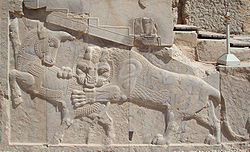 Persian low or bas-relief in Persepolis – a symbol of Zoroastrian Nowruz – at the spring equinox the power of the bull (personifying Earth) and lion (personifying the Sun) are equal.
 -

-
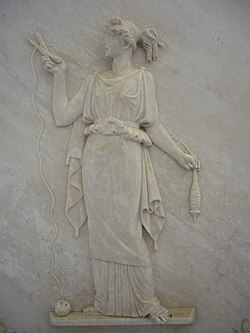 Atropos cutting the thread of life. Modern Greek low relief.
 -

-
 French 20th-century low relief


,_c._645-635_BC,_British_Museum_(16722131531).jpg)


Mid-relief
[edit]
Mid-relief, "half-relief" or mezzo-rilievo is somewhat imprecisely defined, and the term is not often used in English, the works usually being described as low relief instead. The typical traditional definition is that only up to half of the subject projects, and no elements are undercut or fully disengaged from the background field. The depth of the elements shown is normally somewhat distorted.
Mid-relief is probably the most common type of relief found in the Hindu and Buddhist art of India and Southeast Asia. The low to mid-reliefs of 2nd-century BCE to 6th-century CE Ajanta Caves and 5th- to 10th-century Ellora Caves in India are rock reliefs. Most of these reliefs are used to narrate sacred scriptures, such as the 1,460 panels of the 9th-century Borobudur temple in Central Java, Indonesia, narrating the Jataka tales or lives of the Buddha. Other examples are low reliefs narrating the Ramayana Hindu epic in Prambanan temple, also in Java, in Cambodia, the temples of Angkor, with scenes including the Samudra manthan or "Churning the Ocean of Milk" at the 12th-century Angkor Wat, and reliefs of apsaras. At Bayon temple in Angkor Thom there are scenes of daily life in the Khmer Empire.
High relief
[edit]_(2)_(cropped).jpg)
High relief (or altorilievo, from Italian) is where in general more than half the mass of the sculpted figure projects from the background. Indeed, the most prominent elements of the composition, especially heads and limbs, are often completely undercut, detaching them from the field. The parts of the subject that are seen are normally depicted at their full depth, unlike low relief where the elements seen are "squashed" flatter. High relief thus uses essentially the same style and techniques as free-standing sculpture, and in the case of a single figure gives largely the same view as a person standing directly in front of a free-standing statue would have. All cultures and periods in which large sculptures were created used this technique in monumental sculpture and architecture.
Most of the many grand figure reliefs in Ancient Greek sculpture used a very "high" version of high relief, with elements often fully free of the background, and parts of figures crossing over each other to indicate depth. The metopes of the Parthenon have largely lost their fully rounded elements, except for heads, showing the advantages of relief in terms of durability. High relief has remained the dominant form for reliefs with figures in Western sculpture, also being common in Indian temple sculpture. Smaller Greek sculptures such as private tombs, and smaller decorative areas such as friezes on large buildings, more often used low relief.

.jpg)
Hellenistic and Roman sarcophagus reliefs were cut with a drill rather than chisels, enabling and encouraging compositions extremely crowded with figures, like the Ludovisi Battle sarcophagus (250–260 CE). These are also seen in the enormous strips of reliefs that wound around Roman triumphal columns. The sarcophagi in particular exerted a huge influence on later Western sculpture. The European Middle Ages tended to use high relief for all purposes in stone, though like Ancient Roman sculpture, their reliefs were typically not as high as in Ancient Greece.[8] Very high relief re-emerged in the Renaissance, and was especially used in wall-mounted funerary art and later on Neoclassical pediments and public monuments.
In the Buddhist and Hindu art of India and Southeast Asia, high relief can also be found, although it is not as common as low to mid-reliefs. Famous examples of Indian high reliefs can be found at the Khajuraho temples, with voluptuous, twisting figures that often illustrate the erotic Kamasutra positions. In the 9th-century Prambanan temple, Central Java, high reliefs of Lokapala devatas, the guardians of deities of the directions, are found.
The largest high relief sculpture in the world is the Stone Mountain Confederate Memorial in the U.S. state of Georgia, which was cut 42 feet deep into the mountain,[9] and measures 90 feet in height, 190 feet in width,[10] and lies 400 feet above the ground.[11]
Sunk relief
[edit].jpg)
Sunk or sunken relief is largely restricted to the art of Ancient Egypt where it is very common, becoming after the Amarna period of Ahkenaten the dominant type used, as opposed to low relief. It had been used earlier, but mainly for large reliefs on external walls, and for hieroglyphs and cartouches. The image is made by cutting the relief sculpture itself into a flat surface to enhance the impression of three-dimensionality.[12] In a simpler form, the images are usually mostly linear in nature, like hieroglyphs, but in most cases the figure itself is in low relief, but set within a sunken area shaped round the image, so that the relief never rises beyond the original flat surface. In some cases the figures and other elements are in a very low relief that does not rise to the original surface, but others are modeled more fully, with some areas rising to the original surface. This method minimizes the work removing the background, while allowing normal relief modelling.
The technique is most successful with strong sunlight to emphasise the outlines and forms by shadow, as no attempt was made to soften the edge of the sunk area, leaving a face at a right-angle to the surface all around it. Some reliefs, especially funerary monuments with heads or busts from ancient Rome and later Western art, leave a "frame" at the original level around the edge of the relief, or place a head in a hemispherical recess in the block (see Roman example in gallery). Though essentially very similar to Egyptian sunk relief, but with a background space at the lower level around the figure, the term would not normally be used of such works.
It is also used for carving letters (typically om mani padme hum) in the mani stones of Tibetan Buddhism.
Counter-relief
[edit]Sunk relief technique is not to be confused with "counter-relief" or intaglio as seen on engraved gem seals – where an image is fully modeled in a "negative" manner. The image goes into the surface, so that when impressed on wax it gives an impression in normal relief. However many engraved gems were carved in cameo or normal relief.
A few very late Hellenistic monumental carvings in Egypt use full "negative" modelling as though on a gem seal, perhaps as sculptors trained in the Greek tradition attempted to use traditional Egyptian conventions.[13]
Small objects
[edit]
Small-scale reliefs have been carved in various materials, notably ivory, wood, and wax. Reliefs are often found in decorative arts such as ceramics and metalwork; these are less often described as "reliefs" than as "in relief". Small bronze reliefs are often in the form of "plaques" or plaquettes, which may be set in furniture or framed, or just kept as they are, a popular form for European collectors, especially in the Renaissance.
Various modelling techniques are used, such repoussé ("pushed-back") in metalwork, where a thin metal plate is shaped from behind using various metal or wood punches, producing a relief image. Casting has also been widely used in bronze and other metals. Casting and repoussé are often used in concert in to speed up production and add greater detail to the final relief. In stone, as well as engraved gems, larger hardstone carvings in semi-precious stones have been highly prestigious since ancient times in many Eurasian cultures. Reliefs in wax were produced at least from the Renaissance.
Carved ivory reliefs have been used since ancient times, and because the material, though expensive, cannot usually be reused, they have a relatively high survival rate, and for example consular diptychs represent a large proportion of the survivals of portable secular art from Late Antiquity. In the Gothic period the carving of ivory reliefs became a considerable luxury industry in Paris and other centres. As well as small diptychs and triptychs with densely packed religious scenes, usually from the New Testament, secular objects, usually in a lower relief, were also produced.
These were often round mirror-cases, combs, handles, and other small items, but included a few larger caskets like the Casket with Scenes of Romances (Walters 71264) in Baltimore, Maryland, in the United States. Originally they were very often painted in bright colours. Reliefs can be impressed by stamps onto clay, or the clay pressed into a mould bearing the design, as was usual with the mass-produced terra sigillata of Ancient Roman pottery. Decorative reliefs in plaster or stucco may be much larger; this form of architectural decoration is found in many styles of interiors in the post-Renaissance West, and in Islamic architecture.
Gallery
[edit]-
 Low relief from the Pre-Pottery Neolithic archaeological site of Göbekli Tepe, believed to represent a bull, a fox, and a crane, c. 9,000 BC
 -
![The Warka Vase of Sumer, a very early survival works of narrative relief, c. 3200–3000 BC. Alabaster. National Museum of Iraq.[14]](//upload.wikimedia.org/wikipedia/commons/thumb/6/67/Warka_vase_%28background_retouched%29.jpg/120px-Warka_vase_%28background_retouched%29.jpg) The Warka Vase of Sumer, a very early survival works of narrative relief, c. 3200–3000 BC. Alabaster. National Museum of Iraq.[14]
The Warka Vase of Sumer, a very early survival works of narrative relief, c. 3200–3000 BC. Alabaster. National Museum of Iraq.[14] -
 Sunk relief as low relief within a sunk outline, from the Luxor Temple in Egypt, carved in very hard granite
 -
 Low relief within a sunk outline, linear sunk relief in the hieroglyphs, and high relief (right), from Luxor
 -
 Low to mid-relief, 9th century, Borobudur. The temple has 1,460 panels of reliefs narrating Buddhist scriptures.
 -
 A Persian mid-relief (mezzo-rilievo) from the Qajar era, at Tangeh Savashi in Iran, which might also be described as two stages of low relief. This is a rock relief carved into a cliff.
 -
 Roman funerary relief with frame at original level, but not sunk relief
 -
 The Roman Warren Cup, silver repoussé work
 -
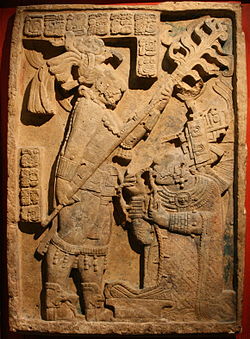
-
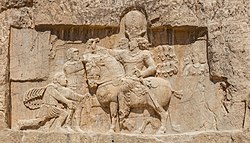 Rock relief at Naqsh-e Rustam; the Persian Sassanian emperor Shapur I (on horseback) with Roman emperors submitting to him
 -
 The 12th century Romanesque portal of Christ in Majesty at Moissac Abbey moves between low and high relief in a single figure.
 -
 Harbaville Triptych, Byzantine ivory
 -
 Side view of mid-relief: Madonna and Child, marble of c. 1500/1510 by an unknown north Italian sculptor
 -
 The elaborate stucco (plaster) reliefs decorating the Chateau de Fontainebleau were hugely influential. Low-relief decorative frieze above.
 -
 Baroque marble high-relief by Francesco Grassia, 1670, Rome
 -
 Robert Gould Shaw Memorial, 1897, Boston, combining free-standing elements with high and low relief
 -
 A relatively modern high relief (depicting shipbuilding) in Bishopsgate, London. Some elements jut out of the frame of the image.
 -

-

-
 High relief of Demetria and Pamphile. Many details are detached entirely.

![The Warka Vase of Sumer, a very early survival works of narrative relief, c. 3200–3000 BC. Alabaster. National Museum of Iraq.[14]](https://en.wikipedia.org/wiki/File:Warka_vase_(background_retouched).jpg)


.jpg)


_(4454381607).jpg)
Reliefs by modern artists
[edit]
Many modern and contemporary artists such as Paul Gauguin, Ernst Barlach, Ernst Ludwig Kirchner, Pablo Picasso, Eric Gill, Jacob Epstein, Henry Moore, Claudia Cobizev, up to Ewald Matare have created reliefs.
In particular low reliefs were often used in the 20th century on the outsides of buildings, where they are relatively easy to incorporate into the architecture as decorative highlights.
-
 Paul Gauguin, Woman with Mango Fruits, 1889, painted oak, Ny Carlsberg Glyptotek, Kopenhagen
 -
 The Admission of Jews to Poland in the Middle Ages by Henryk Hochman, 1907
 -
 Ludwig Gies, cast iron plaquette, 8 x 9.8 cm, inscribed "1914·VERTRIEBEN·1915" = "Refugees 1914–1915"
 -
 Ernst Barlach, Angel of Hope, 1933, Saint Mary parish church in Güstrow
 -
 Henry Moore, Relief No. 1, 1959, Bronze, at the Israel Museum, Jerusalem
 -

-
 Ewald Matare, main portal with bronze door, 1958–1960, St Lambertus, Düsseldorf
 -
 Table at the Cliff, Keitum, Sylt, 2019
 -
 Boat in moving sea, bronze relief by Ingo Kühl, 2019
.jpg)
.jpg)


Notable reliefs
[edit]Notable examples of monumental reliefs include:
- Ancient Egypt: Most Egyptian temples, e.g. the Temple of Karnak
- Assyria: A famous collection is in the British Museum, Black Obelisk of Shalmaneser III
- Ancient Persia: Persepolis, and rock-face reliefs at Naqsh-e Rustam and Naqsh-e Rajab
- Ancient Greece: The Parthenon Marbles, Bassae Frieze, Great Altar of Pergamon, Ludovisi Throne
- Mesopotamia: Ishtar Gate of Babylon
- Ancient Rome: Ara Pacis, Trajan's Column, Column of Marcus Aurelius, triumphal arches, Portonaccio sarcophagus
- Medieval Europe: Many cathedrals and other churches, such as Chartres Cathedral and Bourges Cathedral
- India: Sanchi, base of the Lion Capital of Asoka, the rock-cut Elephanta Caves and Ellora Caves, Khajuraho temples, Mahabalipuram with the Descent of the Ganges, and many South Indian temples, Unakoti group of sculptures (bas-relief) at Kailashahar, Unakoti District, Tripura
- South-East Asia: Borobodur in Java, Indonesia, Angkor Wat in Cambodia
- Glyphs, Mayan stelae and other reliefs of the Maya and Aztec civilizations
- United States: Stone Mountain, Robert Gould Shaw Memorial, Boston, Mount Rushmore National Memorial
- UK: Base panels of Nelson's Column, Frieze of Parnassus
Smaller-scale reliefs:
- Ivory: Nimrud ivories from much of the Near East, Late Antique Consular diptychs, the Byzantine Harbaville Triptych and Veroli Casket, the Anglo-Saxon Franks Casket, Cloisters Cross
- Silver: Warren Cup, Gundestrup cauldron, Mildenhall Treasure, Berthouville Treasure, Missorium of Theodosius I, Lomellini Ewer and Basin.
- Gold: Berlin Gold Hat, Bimaran casket, Panagyurishte Treasure
- Glass: Portland Vase, Lycurgus Cup
See also
[edit]
- Rock relief
- Multidimensional art
- Pargetting – English exterior plaster reliefs
- Relief printing – a different concept
- Repoussé and chasing – a metalworking technique
- Dongyang wood carving – A Chinese example
- Mithraic Reliefs of Jort
- Terrain#Relief
Notes
[edit]- ^ "Relief". Merriam-Webster. Archived from the original on 2012-05-31. Retrieved 2012-05-31.
- ^ In modern English, just "high relief"; alto-rilievo was used in the 18th century and a little beyond, while haut-relief surprisingly found a niche, restricted to archaeological writing, in recent decades after it was used in under-translated French texts about prehistoric cave art, and copied even by English writers. Its use is to be deprecated.
- ^ Murray, Peter & Linda, Penguin Dictionary of Art & Artists, London, 1989. p. 348, Relief; bas-relief remained common in English until the mid 20th century.
- ^ For example Avery in Grove Art Online, whose long article on "Relief sculpture" barely mentions or defines them, except for sunk relief.
- ^ Murray, 1989, op.cit.
- ^ Avery, vi
- ^ Avery, vii
- ^ Avery, ii and iii
- ^ Boissoneault, Lorraine (August 22, 2017). "What Will Happen to Stone Mountain, America's Largest Confederate Memorial?". Smithsonian Magazine. Archived from the original on August 22, 2017. Retrieved May 26, 2021.
- ^ "50 things you might not know about Stone Mountain Park". The Atlanta Journal-Constitution. July 10, 2018. Archived from the original on November 11, 2020. Retrieved May 26, 2021.
- ^ McKay, Rich (July 3, 2020). "The world's largest Confederate Monument faces renewed calls for removal". Reuters. Archived from the original on July 3, 2020. Retrieved May 26, 2021.
- ^ Wang, Meili; Chang, Jian; Kerber, Jens; Zhang, Jian J. (2012-11-01). "A framework for digital sunken relief generation based on 3D geometric models". The Visual Computer. 28 (11): 1127–1137. doi:10.1007/s00371-011-0663-y. ISSN 1432-2315.
- ^ Barasch, Moshe, Visual Syncretism: A Case Study, pp. 39–43 in Budick, Stanford & Iser, Wolfgang, eds., The Translatability of cultures: figurations of the space between, Stanford University Press, 1996, ISBN 0-8047-2561-6 (ISBN 978-0-8047-2561-3).
- ^ Kleiner, Fred S.; Mamiya, Christin J. (2006). Gardner's Art Through the Ages: The Western Perspective – Volume 1 (12th ed.). Belmont, California, US: Thomson Wadsworth. pp. 20–21. ISBN 0-495-00479-0.
References
[edit]- Avery, Charles, in "Relief sculpture". Grove Art Online. Retrieved April 7, 2011.
External links
[edit]- Heilbrunn Timeline of Art History, "American Relief Sculpture", Metropolitan Museum of Art, New York City.


Relief
View on GrokipediaDefinition and Characteristics
Core Definition
Relief sculpture is a sculptural technique in which forms or figures project from a supporting background, typically a flat plane, while remaining attached to it and carved or modeled from the same material.[7] This method creates a partial three-dimensional effect, with the depth of projection varying to produce an illusion of spatial recession and volume, distinguishing it from fully freestanding sculpture viewable in the round.[8] The background serves as the undifferentiated mass from which motifs emerge, often through subtractive carving in stone or wood, or additive processes like clay modeling followed by casting in plaster, bronze, or other media.[9] The degree of projection defines relief's subtypes, ranging from subtle low relief (bas-relief), where forms barely rise above the surface and rely on light and shadow for definition, to high relief (alto-relief), where elements extend nearly to full three-dimensionality and may even detach partially from the ground.[8] Sunken relief, another variant, incises forms below the surface level, common in durable materials like granite for monumental works.[10] Unlike painting, relief engages actual depth and tactility, yet its fixed viewpoint and material economy make it suited for architectural integration, such as friezes, panels, or coinage, where it narrates scenes or symbols without requiring space for circumferential access.[7] This technique's causal advantage lies in its ability to convey narrative complexity on limited surfaces, conserving material while exploiting chiaroscuro effects for visual drama, as evidenced in ancient examples where shadow enhances form without proportional carving depth.[8] Empirical observation of surviving artifacts confirms that relief's attachment to the background prevents structural fragility in large-scale applications, enabling durability in public or ritual contexts.[9]Key Features and Distinctions from Other Sculpture Forms
Relief sculpture is defined by its figures and forms projecting outward from a supporting background or plane, with the sculpted elements remaining attached to this surface rather than being fully independent. The projection can range from minimal depth, where forms barely rise above the background, to more pronounced extensions that approach but do not achieve complete three-dimensional autonomy. This attachment distinguishes relief from fully modeled rear aspects, allowing the work to function as an extension of a wall, panel, or architectural feature while conveying depth through shadow, line, and graduated height.[8] In contrast to freestanding or in-the-round sculpture, which is detached from any background and designed for circumambulation and multi-directional viewing, relief is optimized for frontal observation, limiting access to rear perspectives and emphasizing silhouette and surface modulation over volumetric mass. Freestanding works demand complete modeling on all sides, increasing material use and vulnerability to damage, whereas relief conserves resources by omitting the unviewed back and gains stability through its fixed integration, making it less prone to toppling or breakage. This form also facilitates sequential storytelling across expansive surfaces, such as friezes or metopes, which is impractical in isolated, rotatable freestanding pieces that typically focus on single figures or groups.[11][12] Further differentiating relief from other sculptural techniques, such as sunken or intaglio relief—where forms are incised below the background plane—positive relief employs additive projection to create tangible depth, blending two- and three-dimensional qualities without the full spatial independence of kinetic or environmental installations. While both relief and in-the-round sculpture can employ subtractive carving or additive modeling, relief's planar constraint enhances its compatibility with painting-like composition, prioritizing illusionistic effects over tactile exploration from varied angles. These attributes have historically favored relief for monumental and decorative contexts, where durability and narrative capacity outweigh the immersive presence of freestanding forms.[8]Advantages and Limitations
Relief sculpture offers significant economic advantages over freestanding sculpture, requiring less material and labor due to the flat background plane that eliminates the need to carve the rear or fully three-dimensional forms.[13] This efficiency allows for the depiction of complex narratives, such as battle scenes or multi-figure compositions, which would demand numerous separate statues if rendered in the round, thereby enabling broader subject matter within limited resources.[13] Additionally, reliefs integrate seamlessly into architectural surfaces like walls, friezes, and panels, enhancing structural decoration without protruding elements that could interfere with building functionality or aesthetics.[14] Their attachment to a support provides greater structural stability, reducing vulnerability to breakage from earthquakes or falls compared to tall freestanding works, as evidenced by historical collapses like that of the Colossus of Rhodes around 226 BCE.[15] Reliefs also avoid the engineering challenges of weight distribution and balance inherent in fully detached sculptures.[16] However, relief sculpture is inherently limited in dimensionality, projecting figures only partially from the background, which restricts the conveyance of full spatial depth, movement, and form achievable in freestanding works viewable from all sides.[17] Optimal appreciation requires a primary frontal viewpoint, precluding effective display of rear aspects or multi-angle perspectives, thus constraining dynamic interaction with the viewer.[14] Low relief, in particular, demands advanced skill to simulate volume through planes, curves, and light-shadow interplay, often resulting in a flatter appearance that challenges realistic three-dimensional illusion without undercutting or higher projection.[13] These constraints make relief less suitable for isolated sculptural emphasis, favoring contextual or narrative roles over standalone dramatic impact.[8]Historical Development
Ancient Origins (Prehistory to 1000 BCE)
The origins of relief sculpture trace back to the Pre-Pottery Neolithic B period at Göbekli Tepe in southeastern Anatolia, where low-relief carvings adorn T-shaped limestone pillars erected between approximately 9600 and 8000 BCE. These monuments feature incised and shallowly carved representations of wild animals—including foxes, snakes, boars, cranes, and scorpions—alongside abstract symbols, likely serving ritual or symbolic functions in a pre-agricultural society of hunter-gatherers. The site's 20-plus enclosures demonstrate organized labor and artistic skill, predating settled farming and providing the earliest evidence of large-scale figural relief in stone.[18][19] Earlier Paleolithic examples in Europe include bas-reliefs carved into rock shelters or portable media, such as the Venus of Laussel from Dordogne, France, dated to 25,000–23,000 BCE during the Gravettian culture. This limestone block relief depicts a nude female figure raising a bison horn, possibly evoking fertility or calendrical motifs, with the form emerging from the background through shallow carving techniques applied to hard stone. Similar low-relief animal figures appear in French and Spanish caves, like the engraved reindeer at Lorthet around 18,000 BCE, marking initial experiments in projecting forms from flat surfaces using flint tools.[20] In Mesopotamia, relief sculpture advanced with the Uruk period (c. 4000–3100 BCE) through small-scale cylinder seals and proto-tablets featuring incised figures, evolving into larger works by the Early Dynastic era (c. 2900–2350 BCE). The perforated limestone relief of Ur-Nanshe, king-priest of Lagash (c. 2550 BCE), illustrates the ruler and deities in procession, with openwork apertures enhancing depth and light effects on temple dedications. Rock-cut reliefs, such as that of Iddin-Sin of Simurrum (c. 2017–1985 BCE) in the Zagros Mountains, portray the king in ritual adoration before a deity, carved directly into cliff faces to assert political and religious authority in a mountainous periphery.[21] Ancient Egypt developed sunk relief concurrently during the Old Kingdom (c. 2686–2181 BCE), incising figures below the surface to simulate projection, as evidenced in the Step Pyramid complex at Saqqara under Djoser (c. 2630 BCE). This technique, ideal for durable tomb and temple facades exposed to intense sunlight, featured pharaohs, gods, and daily life scenes in precise, hierarchical compositions, with earliest precursors in Predynastic palette reliefs like the Narmer Palette (c. 3100 BCE) blending low relief and engraving. By the Middle Kingdom (c. 2050–1710 BCE), such reliefs proliferated on stelae and obelisks, emphasizing eternal order and divine kingship.[22] These Near Eastern innovations influenced contemporaneous cultures, including the Indus Valley Civilization (c. 2600–1900 BCE), where steatite seals bore intaglio reliefs of animals and mythical figures for administrative stamping, and early Anatolian and Levantine sites with rudimentary rock carvings. Relief's emergence reflects causal drivers like ritual needs, status display, and material constraints—stone's permanence favoring flat projection over freestanding forms in early monumental contexts—setting foundations for narrative and decorative elaboration before 1000 BCE.[20]Classical Antiquity (1000 BCE to 500 CE)
In ancient Greece, relief sculpture emerged prominently during the Archaic period (c. 700–480 BCE), primarily in architectural contexts such as temple metopes and pediments, where high-relief carvings depicted mythological battles and processions, drawing from Near Eastern and Egyptian influences while developing a distinct Greek style emphasizing frontal poses and rigid forms.[23] These early reliefs, often executed in local limestones or imported marbles, served didactic and decorative purposes on structures like the Temple of Apollo at Delphi, with metopes featuring alternating triglyphs and sculpted panels up to 0.3 meters in depth to create dramatic depth against the Doric frieze.[24] The Classical period (c. 480–323 BCE) marked a shift toward more naturalistic and continuous narratives in low-relief formats, exemplified by the Parthenon frieze in Athens, carved between 447 and 432 BCE from Pentelic marble under Phidias's supervision, depicting the Panathenaic procession with over 350 figures in shallow projection (typically under 5 cm) to evoke fluid movement within the temple's inner colonnade.[25] This innovation contrasted with the higher reliefs of metopes and pediments on the same structure, which portrayed gods and giants in deeper carving for visibility from below, highlighting Greek advancements in integrating sculpture with architecture for optical harmony and civic identity.[24] Hellenistic reliefs (c. 323–31 BCE), as seen on the Great Altar of Pergamon (c. 180–160 BCE), introduced dynamic compositions with greater emotional expressiveness and deeper modeling, blending low and high relief to narrate epic struggles like the Gigantomachy across expansive panels.[23] Roman relief sculpture, evolving from Republican adaptations of Greek and Etruscan models, emphasized historical and propagandistic themes, with low-relief friezes on monuments like the Ara Pacis Augustae, commissioned in 13 BCE and dedicated in 9 BCE, featuring processional scenes of imperial family members and priests in idealized, serene compositions symbolizing Augustan peace (pax).[26] These marble carvings, averaging 0.5–1 cm in depth, combined Hellenistic fluidity with Roman portrait realism, enclosing an altar within a walled precinct to evoke fertility and divine favor through motifs like the Tellus panel.[26] By the High Empire, continuous narrative reliefs reached monumental scale on Trajan's Column (completed 113 CE), a 35-meter marble shaft spiraling with 155 scenes and 2,662 figures illustrating the Dacian Wars (101–106 CE) in shallow bas-relief (c. 5 cm deep), employing bird's-eye perspectives and stacked figures for comprehensive storytelling without individual framing, a technique prioritizing event density over classical isolation.[27] Late antique reliefs up to 500 CE, including sarcophagi and arches, retained these narrative conventions but incorporated Christian iconography, reflecting the empire's cultural transitions while maintaining subtractive marble carving traditions.[28]Medieval and Post-Classical Periods (500–1500 CE)
Following the collapse of the Western Roman Empire around 476 CE, large-scale relief sculpture in Europe diminished, with production shifting to smaller-scale works in ivory, bone, and metal, often influenced by late antique models. In the Byzantine Empire, which preserved Roman traditions, relief carving flourished in diverse media including ivory diptychs, pyxides, and reliquaries, serving both secular consular purposes and religious iconography from the 5th to 15th centuries.[29] These objects featured narrative scenes in low to mid-relief, such as consular processions or biblical events, with techniques emphasizing fine detailing and symbolic depth, continuing despite the Iconoclastic Controversy (726–843 CE) that temporarily restricted figural representation.[30] In Western Europe, early medieval reliefs were sparse, limited to decorative panels on sarcophagi and crosses, but revivals occurred under Carolingian (8th–9th centuries) and Ottonian (10th–11th centuries) patronage, drawing from manuscript illumination and antique fragments. A landmark example is the Bernward Doors at Hildesheim Cathedral, commissioned in 1015 CE by Bishop Bernward, consisting of ten bronze panels cast in high relief depicting Old and New Testament narratives, marking the first major cast bronze sculpture north of the Alps since antiquity and demonstrating lost-wax techniques adapted for architectural integration.[31] These doors combined didactic biblical storytelling with symbolic typology, influencing subsequent Romanesque production.[32] The Romanesque period (c. 1000–1150 CE) saw a surge in architectural relief sculpture, primarily in stone on church portals, tympana, and capitals, aimed at instructing the largely illiterate populace through vivid biblical and moral scenes. Portals often featured Last Judgment tympana in high relief, such as the c. 1130 CE example at Sainte-Foy Abbey in Conques, France, where Christ in Majesty separates the saved from the damned amid grotesque demons and sinners, emphasizing eschatological themes with exaggerated expressions and dynamic compositions derived from earlier illuminations rather than classical naturalism.[33] Capitals and friezes incorporated fantastical beasts and apostles, as in the cloister at Moissac (c. 1100 CE), blending narrative clarity with symbolic horror to reinforce Church doctrine.[34] Transitioning into the Gothic era (c. 1150–1500 CE), relief sculpture evolved toward greater naturalism and spatial illusion, though often subordinated to in-the-round figures on facades; low-relief friezes and historiated capitals narrated scriptural cycles with increased elegance and proportion. English alabaster relief panels, produced from c. 1350 to 1540 CE, exemplify this with over 2,400 surviving examples forming altarpieces and tomb decorations, carved in thin slabs depicting Passion scenes or saints in shallow relief for export across Europe.[35] Gothic tombs, like those at Rouen Cathedral (14th century), integrated low-relief effigies and mourner figures, using Pleurants in arched niches to evoke pathos through subtle modeling and drapery folds.[36] In the Islamic world during this period, relief techniques adapted Sasanian stucco traditions for mosque decoration, with early examples from Ctesiphon (6th–8th centuries CE) featuring figural and vegetal motifs in low relief, evolving under Umayyad and Abbasid rule into geometric and arabesque patterns avoiding human forms to align with aniconic principles.[37] Fatimid Egypt (10th–12th centuries CE) excelled in rock crystal carvings, producing around 500 engraved and relief-cut vessels with intricate floral and animal designs, prized for their translucency and technical precision in hard stone.[38] These works prioritized ornamental complexity over narrative depth, reflecting theological emphases on divine unity through abstracted forms.[39]Renaissance to Modern Era (1500–Present)
In the Renaissance, relief sculpture experienced a revival inspired by classical antiquity, with artists innovating techniques to achieve greater illusionistic depth on flat surfaces. Donatello pioneered rilievo schiacciato, a shallow low-relief method involving minimal carving to suggest atmospheric perspective and spatial recession through subtle gradations of depth and line, as seen in his marble Ascension panel from the 1420s.[40] [41] This technique allowed sculptors to mimic painting's effects while retaining sculpture's tactile quality, influencing subsequent works like Lorenzo Ghiberti's bronze doors for the Florence Baptistery, completed in 1452, which blended varying relief depths for narrative clarity.[42] [43] The Baroque period emphasized dramatic tension and movement in reliefs, often employing high relief to project figures boldly from backgrounds, enhancing emotional intensity in ecclesiastical and monumental contexts. Gian Lorenzo Bernini integrated relief elements into dynamic compositions, such as altar decorations and fountain panels in 17th-century Rome, where marble reliefs on church facades and doors conveyed theatrical narratives through exaggerated foreshortening and chiaroscuro effects.[44] This approach suited the era's focus on sensory engagement, with reliefs serving as integral parts of larger architectural ensembles to evoke spiritual fervor.[42] Neoclassicism in the late 18th and early 19th centuries revived low-relief techniques to emulate perceived classical purity and restraint, prioritizing linear clarity over Baroque exuberance. Sculptors like Antonio Canova and Bertel Thorvaldsen produced bas-reliefs for funerary monuments and public buildings, drawing on Greco-Roman models to achieve harmonious proportions and idealized forms, as evidenced in decorative panels for European palaces and early American federal architecture.[8] [45] Italian artisans introduced these methods to the United States around 1800 for government commissions, adapting antique motifs to civic symbolism.[8] From the mid-19th century onward, relief sculpture adapted to industrial materials and nationalistic themes, appearing in Beaux-Arts facades and war memorials with narrative friezes depicting historical events. In the 20th century, modern artists shifted toward abstraction, using relief to explore spatial dynamics and materiality; Henri Matisse's 1916 bronze reliefs experimented with simplified forms to emphasize recession and contrast, paving the way for non-objective compositions.[42] [46] Contemporary applications include architectural integrations and tactile works for accessibility, such as bas-reliefs aiding the visually impaired by translating visual art into touch-readable forms.[47][48]Types of Relief
Low Relief (Bas-Relief)
Low relief, also termed bas-relief, constitutes a sculptural method wherein motifs emerge only modestly from the substrate, typically by a protrusion shallower than half the modeled form's depth, engendering an understated volumetric illusion via nuanced contouring and chiaroscuro effects.[8] This approach contrasts with higher relief variants by curtailing undercutting and favoring planar expanses, thereby accommodating intricate narratives within confined spatial budgets while economizing material and mitigating fragility relative to fully three-dimensional works.[49] Its principal limitation resides in restricted angular visibility, rendering side profiles comparatively anemic, though this is offset by enhanced suitability for replication, as in numismatics or serial architectural panels.[50] In ancient contexts, low relief proliferated for monumental storytelling, exemplified by Neo-Assyrian gypsum slabs from Nineveh's North Palace, circa 645–635 BCE, portraying King Ashurbanipal's lion hunts with sequential action rendered in shallow incisions averaging 1–2 cm projection to evoke motion and hierarchy through graded depths.[51] Such panels, quarried from alabaster-like stone and polished post-carving, leveraged ambient lighting to amplify dynamism, informing later traditions in Egypt and Greece where bas-relief adorned temple walls for didactic permanence under arid climes.[49] The Renaissance elevated low relief's sophistication through Donatello's innovation of rilievo schiacciato ("flattened relief"), a hyper-shallow iteration—often mere millimeters in marble—pioneered around 1420–1430, as in his Madonna of the Clouds where infinitesimal gradations simulate atmospheric recession akin to painting's sfumato.[52] This subtractive technique, executed with fine chisels on Carrara marble, harnessed linear perspective principles to forge illusory depth, influencing contemporaries like Desiderio da Settignano and extending to bronze gilding for ecclesiastical commissions.[53] Contemporary applications persist in facade ornamentation and digital fabrication, where low relief's minimal protrusion facilitates CNC milling in composites or metals, preserving the form's narrative potency while adapting to industrialized production scales.[54]Mid-Relief
Mid-relief, also known as mezzo-rilievo or demi-relief, features sculpted figures that project from the background to approximately half their natural circumference or depth, without detached elements or undercutting.[55] This intermediate projection distinguishes it from low relief, where forms emerge minimally, and high relief, where they approach full roundness.[1] The technique balances planar composition with volumetric modeling, enabling greater depiction of anatomy, gesture, and shadow play compared to bas-relief, while maintaining attachment to the support for structural integrity in architectural contexts.[56] Figures in mid-relief often exhibit rounded contours and contrapposto poses to enhance plasticity, though the form remains subordinate to the background plane.[56] Primarily executed through subtractive carving on stone or wood, mid-relief demands precise chisel work to achieve graduated depths without compromising adhesion to the substrate.[55] Additive methods, such as modeling in clay followed by casting in plaster or metal, are less common but possible for preparatory studies or smaller works.[1] Historically, mid-relief appears in Persian rock carvings, exemplified by the Qajar-era panel at Tangeh Savashi, Iran, dating to the 19th century, where figures emerge moderately from cliff faces to convey narrative scenes.[57] In Renaissance Italy, artists like Donatello employed mezzo-rilievo for enhanced three-dimensionality in bronze and marble panels, integrating it with architectural elements to bridge sculpture and painting.[56] Such applications highlight its utility in tombs, altarpieces, and decorative friezes where moderate projection suits spatial constraints.[55]High Relief (Alto-Relief)
High relief, known as alto-rilievo in Italian, features sculpted forms projecting more than half their natural depth from the background, incorporating extensive undercutting to achieve near-free-standing effects while remaining attached to the plane.[58] This depth allows for dramatic interplay of light and shadow, enhancing volume, motion, and narrative complexity beyond shallower relief types.[59] The technique primarily employs subtractive methods, such as chiseling marble or stone, demanding precise control to avoid structural weaknesses in protruding elements.[60] High relief sculptures often risk fragmentation due to thin connections between figures and the ground, necessitating robust materials like fine-grained marble for tensile strength.[61] In ancient contexts, Assyrian artists utilized high relief for monumental palace decorations, carving gypsum panels where figures extended significantly to convey power and action, as in lion hunt scenes from Nineveh dating to the 7th century BCE.[62] Greek sculptors in the classical period explored alto-relief in tomb stelai and architectural friezes, with unfinished works revealing blocking-out stages similar to full-round sculpture, evident in 5th-century BCE examples.[63] Renaissance masters advanced high relief for expressive storytelling; Michelangelo's Battle of the Centaurs (c. 1491–1492), a marble panel roughly 84 cm high and 91 cm wide at Casa Buonarroti, Florence, depicts a frenzied combat with deeply carved, twisting bodies that project boldly, showcasing his early mastery of anatomy and torsion influenced by ancient sarcophagi.[64] [65] This work, commissioned for the Medici collection, blends high projection with subtle planar transitions, marking a shift toward naturalistic dynamism in relief art.[66]Sunk Relief
Sunk relief, also termed incised or sunken relief, involves carving figures and motifs below the original surface level of the material, producing a recessed design where the surrounding background remains elevated.[67] This contrasts with low relief (bas-relief), in which elements project modestly above the background, and high relief, where figures extend significantly outward, often requiring more material removal and undercutting.[68] In sunk relief, the technique emphasizes linear contours and shallow incisions, enhancing visibility through shadow play rather than projection.[69] The method proves advantageous for dense, hard materials like granite or limestone, as the non-protruding forms reduce chipping risks during subtractive carving and demand less depth overall.[2] Carvers outline shapes crisply before adding internal details via lines and textures, facilitating precision in durable stones where protruding elements might fracture.[70] This approach suits exterior applications, such as temple facades, where sunlight creates dramatic contrasts in the recessed areas, making motifs prominent even from afar.[71] Sunk relief predominates in ancient Egyptian sculpture, appearing extensively from the Old Kingdom onward in tombs, temples, and hieroglyphic inscriptions.[72] Egyptian artisans favored it for its durability in hard stones and integration with flat surfaces, as seen in wall decorations depicting pharaohs, deities, and daily scenes to invoke eternal narratives.[73] Notable instances include the granite carvings at Luxor Temple, where sunk figures of gods and rulers are incised into podiums and lintels, exemplifying the technique's role in monumental architecture around 1400 BCE.[68] Though rarer elsewhere, variants occur in Maya art, such as bloodletting scenes on lintels, adapting the recession for narrative stone panels.[3] In practice, sunk relief often combines with linear elements, as in Egyptian hieroglyphs where signs are sunk to maintain surface integrity while conveying script and iconography.[11] Its restraint in depth—typically under 1-2 cm—preserves structural stability on large-scale works, influencing conservation by minimizing exposure to weathering compared to protruding types.[2] Modern replications draw on these principles for durable public monuments, though ancient Egyptian exemplars remain the paradigmatic corpus, with over thousands of panels surviving from sites like Karnak and the Valley of the Kings.[73]Counter-Relief and Other Variants
Counter-relief, alternatively termed cavo-rilievo, inverts the conventional relief process by recessing the primary forms into the supporting surface, thereby elevating the background material above the motifs. This subtractive technique yields a negative sculptural effect, where the depicted elements appear sunken relative to their surroundings, contrasting sharply with protruding relief variants.[11][74] Historically, counter-relief manifests in small-scale applications such as intaglio gem carving, where motifs are incised into hard stones like sardonyx or jasper to produce seals or signets; the incised design leaves a raised impression when pressed into soft material. This practice traces to ancient Near Eastern cylinder seals and Egyptian scarabs, serving both utilitarian and symbolic functions in administrative and ritual contexts. In larger formats, it overlaps with sunk relief but extends to deeper incisions without confining outlines, as noted in certain subtractive carvings where subjects recede while preserving background integrity.[75][76] Other variants encompass pierced relief, wherein openings are carved fully through the background to permit light transmission and amplify spatial depth, often in media like ivory or wood; a documented instance involves curved wooden panels with circular voids, imparting unusual dimensionality to otherwise planar works. In the early 20th century, Russian artist Vladimir Tatlin innovated "Counter-Reliefs" circa 1914–1915, fabricating assemblages from heterogeneous materials including iron, glass, and plaster to negate traditional flatness, instead fostering tensile spatial dynamics and material dissonances exhibited in avant-garde contexts.[77][78][79]Techniques and Materials
Subtractive Carving Methods
Subtractive carving methods in relief sculpture involve the systematic removal of material from a solid block or slab, typically stone or wood, to form protruding figures against a receding background. This approach contrasts with additive techniques by starting with excess material and progressively revealing the design through excision, a process fundamental to achieving precise control over depth and contour.[80] The method demands careful planning to avoid irreparable errors, as removed material cannot be replaced.[81] The process commences with material selection, favoring stones like limestone for its relative softness or marble for finer detail, while harder granites necessitate diamond-tipped tools for efficiency.[82] A preliminary sketch is transferred to the surface, often incised lightly with a pointed tool. Roughing out follows, employing a point chisel struck with a heavy mallet to excise large background volumes and outline major forms, establishing the relief's projection depth—shallow for bas-relief or deeper for alto-relief.[81] Next, tooth or claw chisels refine volumes, creating faceted approximations of curves and removing material in controlled layers to prevent over-carving.[82] Detailing progresses with flat-edged chisels for planar surfaces, followed by rasps and files to smooth transitions and articulate finer features like drapery folds or facial expressions.[82] For texturing, serrated chisels impart patterns enhancing shadow play, as seen in ancient Egyptian works.[82] Finishing involves abrasives—pumice, sandstone, or modern carborundum—to polish surfaces, with depth varying by relief type: minimal removal (under 5 mm) for low relief to emphasize subtlety via light and shadow.[83] Tools must be sequenced methodically, from coarse to fine, to maintain structural integrity and achieve the desired three-dimensional illusion on a two-dimensional plane.[84] Safety measures, including eye protection and dust control, are essential due to the generation of sharp fragments and silica particles.[81]Additive and Casting Techniques
Additive techniques for relief sculpture entail constructing projecting forms by incrementally applying material to a foundational surface, such as a slab of clay or wax, rather than removing excess. Practitioners begin with a prepared base—often rolled or pressed clay—and employ methods like coiling, pinching, or direct modeling with tools to layer and shape elements, achieving varying degrees of projection from low to high relief. This approach facilitates iterative refinement and captures fine details through manipulation of soft media, which can later be hardened via firing for ceramics or used as masters for further processes; it has been utilized since prehistoric times for portable plaques and persists in contemporary studio practices for its accessibility and reversibility.[85] Casting techniques replicate relief designs by pouring liquefied material into molds derived from additive models, yielding multiples in metals or resins with consistent precision. Lost-wax casting, predominant for bronze reliefs, involves crafting a wax positive additively over an armature, encasing it in refractory investment, melting out the wax to form a void, and introducing molten alloy under vacuum or gravity to fill intricate undercuts and surfaces; this method, evidenced in artifacts from 3rd millennium BCE Mesopotamia, enables complex narratives on panels and attachments unattainable in direct carving.[86] Sand casting offers an alternative for larger-scale reliefs, packing damp sand around a pattern to create a mold, then pouring metal, as applied in 19th-century architectural friezes for economies in production.[87] Plaster and concrete casting extend these principles to non-metallic media, molding from clay originals for interior decorations or public monuments, prioritizing durability over the patina of bronze.[8]Common Materials and Their Properties
Stone has been the predominant material for relief sculpture across civilizations due to its durability and capacity for intricate detailing. Marble, a metamorphic rock derived from limestone, features a fine grain structure that allows for precise carving and polishing, enabling the capture of subtle textures in low and high reliefs.[88] Limestone, sedimentary in origin, offers greater softness than marble, facilitating easier subtractive carving but requiring protection from weathering.[89] Sandstone and granite provide alternatives with varying hardness; sandstone erodes more readily while granite's density supports deep reliefs in harsh environments, as seen in Egyptian temple carvings executed in granite as early as the 15th century BCE.[89] Wood, valued for its fibrous composition, exhibits high tensile strength that permits thin, delicate projections in relief work without fracturing, though it demands sealing against moisture and insects.[90] Ivory, sourced from elephant tusks or similar dentine, yields panels suitable for fine reliefs due to its smooth, workable texture and natural translucency, though supply limitations and ethical concerns have curtailed its use since the 20th century.[90] Terracotta, fired clay, combines moldability in its unfired state with post-firing durability, allowing for detailed narrative panels; its surface can be glazed for enhanced reflectivity and resistance to elements.[91] Metals such as bronze and silver enable additive techniques like repoussé, where malleability—particularly in copper alloys comprising about 97% copper, 2% tin, and 1% zinc for bronze—facilitates hammering from the reverse to form raised designs without cracking.[92] [93]| Material | Key Properties | Typical Use in Relief |
|---|---|---|
| Marble | Fine grain, polishable, moderate hardness (Mohs 3-4) | Low to high relief for indoor/outdoor durability |
| Limestone | Soft (Mohs 3), easily carved, porous | Architectural low reliefs, susceptible to erosion |
| Wood | Tensile strength, lightweight, anisotropic grain | Thin, intricate panels; requires preservation |
| Ivory | Smooth, dense, carvable to fine detail | Small-scale, portable reliefs |
| Terracotta | Moldable, fired hardness, glaze-compatible | Narrative friezes, decorative tiles |
| Bronze | Malleable alloy, corrosion-resistant patina | Repoussé or cast mid-to-high reliefs |