


Community hub
Recent from talks
Contribute something
Nothing was collected or created yet.
Cryptographic hash function
View on Wikipedia | This article needs additional citations for verification. (May 2016) |

| Secure Hash Algorithms | |
|---|---|
| Concepts | |
| hash functions, SHA, DSA | |
| Main standards | |
| SHA-0, SHA-1, SHA-2, SHA-3 | |
A cryptographic hash function (CHF) is a hash algorithm (a map of an arbitrary binary string to a binary string with a fixed size of bits) that has special properties desirable for a cryptographic application:[1]

- the probability of a particular -bit output result (hash value) for a random input string ("message") is (as for any good hash), so the hash value can be used as a representative of the message;
- finding an input string that matches a given hash value (a pre-image) is infeasible, assuming all input strings are equally likely. The resistance to such search is quantified as security strength: a cryptographic hash with bits of hash value is expected to have a preimage resistance strength of bits, unless the space of possible input values is significantly smaller than (a practical example can be found in § Attacks on hashed passwords);
- a second preimage resistance strength, with the same expectations, refers to a similar problem of finding a second message that matches the given hash value when one message is already known;
- finding any pair of different messages that yield the same hash value (a collision) is also infeasible: a cryptographic hash is expected to have a collision resistance strength of bits (lower due to the birthday paradox).


Cryptographic hash functions have many information-security applications, notably in digital signatures, message authentication codes (MACs), and other forms of authentication. They can also be used as ordinary hash functions, to index data in hash tables, for fingerprinting, to detect duplicate data or uniquely identify files, and as checksums to detect accidental data corruption. Indeed, in information-security contexts, cryptographic hash values are sometimes called (digital) fingerprints, checksums, (message) digests,[2] or just hash values, even though all these terms stand for more general functions with rather different properties and purposes.[3]
Non-cryptographic hash functions are used in hash tables and to detect accidental errors; their constructions frequently provide no resistance to a deliberate attack. For example, a denial-of-service attack on hash tables is possible if the collisions are easy to find, as in the case of linear cyclic redundancy check (CRC) functions.[4]
Properties
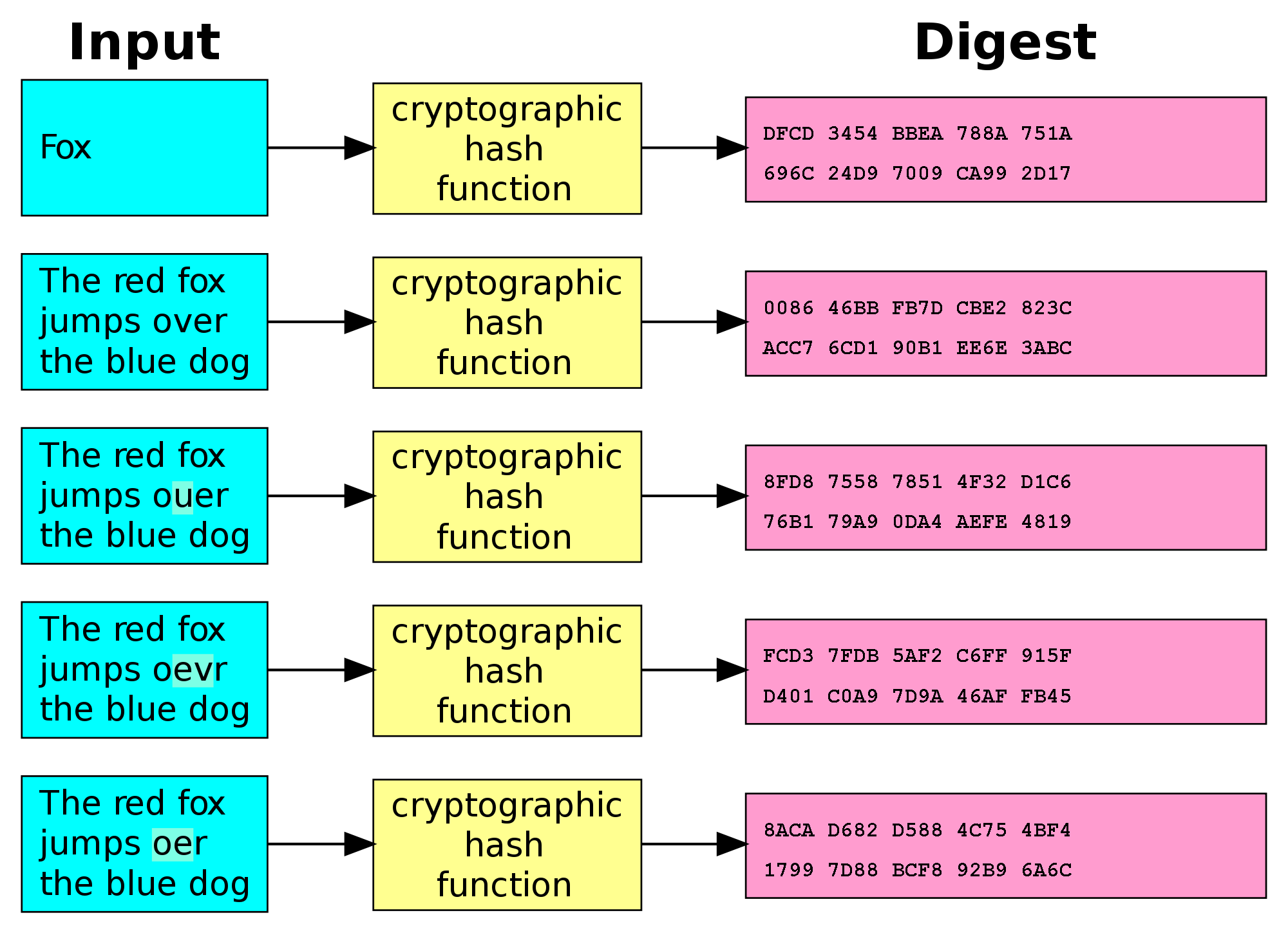
[edit]Most cryptographic hash functions are designed to take a string of any length as input and produce a fixed-length hash value.
A cryptographic hash function must be able to withstand all known types of cryptanalytic attack. In theoretical cryptography, the security level of a cryptographic hash function has been defined using the following properties:
- Pre-image resistance
- Given a hash value h, it should be difficult to find any message m such that h = hash(m). This concept is related to that of a one-way function. Functions that lack this property are vulnerable to preimage attacks.
- Second pre-image resistance
- Given an input m1, it should be difficult to find a different input m2 such that hash(m1) = hash(m2). This property is sometimes referred to as weak collision resistance. Functions that lack this property are vulnerable to second-preimage attacks.
- Collision resistance
- It should be difficult to find two different messages m1 and m2 such that hash(m1) = hash(m2). Such a pair is called a cryptographic hash collision. This property is sometimes referred to as strong collision resistance. It requires a hash value at least twice as long as that required for pre-image resistance; otherwise, collisions may be found by a birthday attack.[5]
Collision resistance implies second pre-image resistance but does not imply pre-image resistance.[6] The weaker assumption is always preferred in theoretical cryptography, but in practice, a hash-function that is only second pre-image resistant is considered insecure and is therefore not recommended for real applications.
Informally, these properties mean that a malicious adversary cannot replace or modify the input data without changing its digest. Thus, if two strings have the same digest, one can be very confident that they are identical. Second pre-image resistance prevents an attacker from crafting a document with the same hash as a document the attacker cannot control. Collision resistance prevents an attacker from creating two distinct documents with the same hash.
A function meeting these criteria may still have undesirable properties. Currently, popular cryptographic hash functions are vulnerable to length-extension attacks: given hash(m) and len(m) but not m, by choosing a suitable m′ an attacker can calculate hash(m ∥ m′), where ∥ denotes concatenation.[7] This property can be used to break naive authentication schemes based on hash functions. The HMAC construction works around these problems.
In practice, collision resistance is insufficient for many practical uses. In addition to collision resistance, it should be impossible for an adversary to find two messages with substantially similar digests; or to infer any useful information about the data, given only its digest. In particular, a hash function should behave as much as possible like a random function (often called a random oracle in proofs of security) while still being deterministic and efficiently computable. This rules out functions like the SWIFFT function, which can be rigorously proven to be collision-resistant assuming that certain problems on ideal lattices are computationally difficult, but, as a linear function, does not satisfy these additional properties.[8]
Checksum algorithms, such as CRC-32 and other cyclic redundancy checks, are designed to meet much weaker requirements and are generally unsuitable as cryptographic hash functions. For example, a CRC was used for message integrity in the WEP encryption standard, but an attack was readily discovered, which exploited the linearity of the checksum.
Degree of difficulty
[edit]In cryptographic practice, "difficult" generally means "almost certainly beyond the reach of any adversary who must be prevented from breaking the system for as long as the security of the system is deemed important". The meaning of the term is therefore somewhat dependent on the application since the effort that a malicious agent may put into the task is usually proportional to their expected gain. However, since the needed effort usually multiplies with the digest length, even a thousand-fold advantage in processing power can be neutralized by adding a dozen bits to the latter.
For messages selected from a limited set of messages, for example passwords or other short messages, it can be feasible to invert a hash by trying all possible messages in the set. Because cryptographic hash functions are typically designed to be computed quickly, special key derivation functions that require greater computing resources have been developed that make such brute-force attacks more difficult.
In some theoretical analyses "difficult" has a specific mathematical meaning, such as "not solvable in asymptotic polynomial time". Such interpretations of difficulty are important in the study of provably secure cryptographic hash functions but do not usually have a strong connection to practical security. For example, an exponential-time algorithm can sometimes still be fast enough to make a feasible attack. Conversely, a polynomial-time algorithm (e.g., one that requires n20 steps for n-digit keys) may be too slow for any practical use.
Illustration
[edit]An illustration of the potential use of a cryptographic hash is as follows: Alice poses a tough math problem to Bob and claims that she has solved it. Bob would like to try it himself, but would yet like to be sure that Alice is not bluffing. Therefore, Alice writes down her solution, computes its hash, and tells Bob the hash value (whilst keeping the solution secret). Then, when Bob comes up with the solution himself a few days later, Alice can prove that she had the solution earlier by revealing it and having Bob hash it and check that it matches the hash value given to him before. (This is an example of a simple commitment scheme; in actual practice, Alice and Bob will often be computer programs, and the secret would be something less easily spoofed than a claimed puzzle solution.)
Applications
[edit]Verifying the integrity of messages and files
[edit]An important application of secure hashes is the verification of message integrity. Comparing message digests (hash digests over the message) calculated before, and after, transmission can determine whether any changes have been made to the message or file.
MD5, SHA-1, or SHA-2 hash digests are sometimes published on websites or forums to allow verification of integrity for downloaded files,[9] including files retrieved using file sharing such as mirroring. This practice establishes a chain of trust as long as the hashes are posted on a trusted site – usually the originating site – authenticated by HTTPS. Using a cryptographic hash and a chain of trust detects malicious changes to the file. Non-cryptographic error-detecting codes such as cyclic redundancy checks only prevent against non-malicious alterations of the file, since an intentional spoof can readily be crafted to have the colliding code value.
Signature generation and verification
[edit]Almost all digital signature schemes require a cryptographic hash to be calculated over the message. This allows the signature calculation to be performed on the relatively small, statically sized hash digest. The message is considered authentic if the signature verification succeeds given the signature and recalculated hash digest over the message. So the message integrity property of the cryptographic hash is used to create secure and efficient digital signature schemes.
Password verification
[edit]Password verification commonly relies on cryptographic hashes. Storing all user passwords as cleartext can result in a massive security breach if the password file is compromised. One way to reduce this danger is to only store the hash digest of each password. To authenticate a user, the password presented by the user is hashed and compared with the stored hash. A password reset method is required when password hashing is performed; original passwords cannot be recalculated from the stored hash value.
However, use of standard cryptographic hash functions, such as the SHA series, is no longer considered safe for password storage.[10]: 5.1.1.2 These algorithms are designed to be computed quickly, so if the hashed values are compromised, it is possible to try guessed passwords at high rates. Common graphics processing units can try billions of possible passwords each second. Password hash functions that perform key stretching – such as PBKDF2, scrypt or Argon2 – commonly use repeated invocations of a cryptographic hash to increase the time (and in some cases computer memory) required to perform brute-force attacks on stored password hash digests. For details, see § Attacks on hashed passwords.
A password hash also requires the use of a large random, non-secret salt value that can be stored with the password hash. The salt is hashed with the password, altering the password hash mapping for each password, thereby making it infeasible for an adversary to store tables of precomputed hash values to which the password hash digest can be compared or to test a large number of purloined hash values in parallel.
Proof-of-work
[edit]A proof-of-work system (or protocol, or function) is an economic measure to deter denial-of-service attacks and other service abuses such as spam on a network by requiring some work from the service requester, usually meaning processing time by a computer. A key feature of these schemes is their asymmetry: the work must be moderately hard (but feasible) on the requester side but easy to check for the service provider. One popular system – used in Bitcoin mining and Hashcash – uses partial hash inversions to prove that work was done, to unlock a mining reward in Bitcoin, and as a good-will token to send an e-mail in Hashcash. The sender is required to find a message whose hash value begins with a number of zero bits. The average work that the sender needs to perform in order to find a valid message is exponential in the number of zero bits required in the hash value, while the recipient can verify the validity of the message by executing a single hash function. For instance, in Hashcash, a sender is asked to generate a header whose 160-bit SHA-1 hash value has the first 20 bits as zeros. The sender will, on average, have to try 219 times to find a valid header.
File or data identifier
[edit]A message digest can also serve as a means of reliably identifying a file; several source code management systems, including Git, Mercurial and Monotone, use the sha1sum of various types of content (file content, directory trees, ancestry information, etc.) to uniquely identify them. Hashes are used to identify files on peer-to-peer filesharing networks. For example, in an ed2k link, an MD4-variant hash is combined with the file size, providing sufficient information for locating file sources, downloading the file, and verifying its contents. Magnet links are another example. Such file hashes are often the top hash of a hash list or a hash tree, which allows for additional benefits.
One of the main applications of a hash function is to allow the fast look-up of data in a hash table. Being hash functions of a particular kind, cryptographic hash functions lend themselves well to this application too.
However, compared with standard hash functions, cryptographic hash functions tend to be much more expensive computationally. For this reason, they tend to be used in contexts where it is necessary for users to protect themselves against the possibility of forgery (the creation of data with the same digest as the expected data) by potentially malicious participants, such as open source applications with multiple sources of download, where malicious files could be substituted in with the same appearance to the user, or an authentic file is modified to contain malicious data.[11]
Content-addressable storage
[edit]Content-addressable storage (CAS), also referred to as content-addressed storage or fixed-content storage, is a way to store information so it can be retrieved based on its content, not its name or location. It has been used for high-speed storage and retrieval of fixed content, such as documents stored for compliance with government regulations.[citation needed] Content-addressable storage is similar to content-addressable memory.
CAS systems work by passing the content of the file through a cryptographic hash function to generate a unique key, the "content address". The file system's directory stores these addresses and a pointer to the physical storage of the content. Because an attempt to store the same file will generate the same key, CAS systems ensure that the files within them are unique, and because changing the file will result in a new key, CAS systems provide assurance that the file is unchanged.
CAS became a significant market during the 2000s, especially after the introduction of the 2002 Sarbanes–Oxley Act in the United States which required the storage of enormous numbers of documents for long periods and retrieved only rarely. Ever-increasing performance of traditional file systems and new software systems have eroded the value of legacy CAS systems, which have become increasingly rare after roughly 2018[citation needed]. However, the principles of content addressability continue to be of great interest to computer scientists, and form the core of numerous emerging technologies, such as peer-to-peer file sharing, cryptocurrencies, and distributed computing.Hash functions based on block ciphers
[edit]There are several methods to use a block cipher to build a cryptographic hash function, specifically a one-way compression function.
The methods resemble the block cipher modes of operation usually used for encryption. Many well-known hash functions, including MD4, MD5, SHA-1 and SHA-2, are built from block-cipher-like components designed for the purpose, with feedback to ensure that the resulting function is not invertible. SHA-3 finalists included functions with block-cipher-like components (e.g., Skein, BLAKE) though the function finally selected, Keccak, was built on a cryptographic sponge instead.
A standard block cipher such as AES can be used in place of these custom block ciphers; that might be useful when an embedded system needs to implement both encryption and hashing with minimal code size or hardware area. However, that approach can have costs in efficiency and security. The ciphers in hash functions are built for hashing: they use large keys and blocks, can efficiently change keys every block, and have been designed and vetted for resistance to related-key attacks. General-purpose ciphers tend to have different design goals. In particular, AES has key and block sizes that make it nontrivial to use to generate long hash values; AES encryption becomes less efficient when the key changes each block; and related-key attacks make it potentially less secure for use in a hash function than for encryption.
Hash function design
[edit]Merkle–Damgård construction
[edit]
A hash function must be able to process an arbitrary-length message into a fixed-length output. This can be achieved by breaking the input up into a series of equally sized blocks, and operating on them in sequence using a one-way compression function. The compression function can either be specially designed for hashing or be built from a block cipher. A hash function built with the Merkle–Damgård construction is as resistant to collisions as is its compression function; any collision for the full hash function can be traced back to a collision in the compression function.
The last block processed should also be unambiguously length padded; this is crucial to the security of this construction. This construction is called the Merkle–Damgård construction. Most common classical hash functions, including SHA-1 and MD5, take this form.
Wide pipe versus narrow pipe
[edit]A straightforward application of the Merkle–Damgård construction, where the size of hash output is equal to the internal state size (between each compression step), results in a narrow-pipe hash design. This design causes many inherent flaws, including length-extension, multicollisions,[12] long message attacks,[13] generate-and-paste attacks,[citation needed] and also cannot be parallelized. As a result, modern hash functions are built on wide-pipe constructions that have a larger internal state size – which range from tweaks of the Merkle–Damgård construction[12] to new constructions such as the sponge construction and HAIFA construction.[14] None of the entrants in the NIST hash function competition use a classical Merkle–Damgård construction.[15]
Meanwhile, truncating the output of a longer hash, such as used in SHA-512/256, also defeats many of these attacks.[16]
Use in building other cryptographic primitives
[edit]Hash functions can be used to build other cryptographic primitives. For these other primitives to be cryptographically secure, care must be taken to build them correctly.
Message authentication codes (MACs) (also called keyed hash functions) are often built from hash functions. HMAC is such a MAC.
Just as block ciphers can be used to build hash functions, hash functions can be used to build block ciphers. Luby-Rackoff constructions using hash functions can be provably secure if the underlying hash function is secure. Also, many hash functions (including SHA-1 and SHA-2) are built by using a special-purpose block cipher in a Davies–Meyer or other construction. That cipher can also be used in a conventional mode of operation, without the same security guarantees; for example, SHACAL, BEAR and LION.
Pseudorandom number generators (PRNGs) can be built using hash functions. This is done by combining a (secret) random seed with a counter and hashing it.
Some hash functions, such as Skein, Keccak, and RadioGatún, output an arbitrarily long stream and can be used as a stream cipher, and stream ciphers can also be built from fixed-length digest hash functions. Often this is done by first building a cryptographically secure pseudorandom number generator and then using its stream of random bytes as keystream. SEAL is a stream cipher that uses SHA-1 to generate internal tables, which are then used in a keystream generator more or less unrelated to the hash algorithm. SEAL is not guaranteed to be as strong (or weak) as SHA-1. Similarly, the key expansion of the HC-128 and HC-256 stream ciphers makes heavy use of the SHA-256 hash function.
Concatenation
[edit]Concatenating outputs from multiple hash functions provide collision resistance as good as the strongest of the algorithms included in the concatenated result.[citation needed] For example, older versions of Transport Layer Security (TLS) and Secure Sockets Layer (SSL) used concatenated MD5 and SHA-1 sums.[17][18] This ensures that a method to find collisions in one of the hash functions does not defeat data protected by both hash functions.[citation needed]
For Merkle–Damgård construction hash functions, the concatenated function is as collision-resistant as its strongest component, but not more collision-resistant.[citation needed] Antoine Joux observed that 2-collisions lead to n-collisions: if it is feasible for an attacker to find two messages with the same MD5 hash, then they can find as many additional messages with that same MD5 hash as they desire, with no greater difficulty.[19] Among those n messages with the same MD5 hash, there is likely to be a collision in SHA-1. The additional work needed to find the SHA-1 collision (beyond the exponential birthday search) requires only polynomial time.[20][21]
Cryptographic hash algorithms
[edit]There are many cryptographic hash algorithms; this section lists a few algorithms that are referenced relatively often. A more extensive list can be found on the page containing a comparison of cryptographic hash functions.
MD5
[edit]MD5 was designed by Ronald Rivest in 1991 to replace an earlier hash function, MD4, and was specified in 1992 as RFC 1321. Collisions against MD5 can be calculated within seconds, which makes the algorithm unsuitable for most use cases where a cryptographic hash is required. MD5 produces a digest of 128 bits (16 bytes).
SHA-1
[edit]SHA-1 was developed as part of the U.S. Government's Capstone project. The original specification – now commonly called SHA-0 – of the algorithm was published in 1993 under the title Secure Hash Standard, FIPS PUB 180, by U.S. government standards agency NIST (National Institute of Standards and Technology). It was withdrawn by the NSA shortly after publication and was superseded by the revised version, published in 1995 in FIPS PUB 180-1 and commonly designated SHA-1. Collisions against the full SHA-1 algorithm can be produced using the shattered attack and the hash function should be considered broken. SHA-1 produces a hash digest of 160 bits (20 bytes).
Documents may refer to SHA-1 as just "SHA", even though this may conflict with the other Secure Hash Algorithms such as SHA-0, SHA-2, and SHA-3.
RIPEMD-160
[edit]RIPEMD (RACE Integrity Primitives Evaluation Message Digest) is a family of cryptographic hash functions developed in Leuven, Belgium, by Hans Dobbertin, Antoon Bosselaers, and Bart Preneel at the COSIC research group at the Katholieke Universiteit Leuven, and first published in 1996. RIPEMD was based upon the design principles used in MD4 and is similar in performance to the more popular SHA-1. RIPEMD-160 has, however, not been broken. As the name implies, RIPEMD-160 produces a hash digest of 160 bits (20 bytes).
Whirlpool
[edit]Whirlpool is a cryptographic hash function designed by Vincent Rijmen and Paulo S. L. M. Barreto, who first described it in 2000. Whirlpool is based on a substantially modified version of the Advanced Encryption Standard (AES). Whirlpool produces a hash digest of 512 bits (64 bytes).
SHA-2
[edit]SHA-2 (Secure Hash Algorithm 2) is a set of cryptographic hash functions designed by the United States National Security Agency (NSA), first published in 2001. They are built using the Merkle–Damgård structure, from a one-way compression function itself built using the Davies–Meyer structure from a (classified) specialized block cipher.
SHA-2 basically consists of two hash algorithms: SHA-256 and SHA-512. SHA-224 is a variant of SHA-256 with different starting values and truncated output. SHA-384 and the lesser-known SHA-512/224 and SHA-512/256 are all variants of SHA-512. SHA-512 is more secure than SHA-256 and is commonly faster than SHA-256 on 64-bit machines such as AMD64.
The output size in bits is given by the extension to the "SHA" name, so SHA-224 has an output size of 224 bits (28 bytes); SHA-256, 32 bytes; SHA-384, 48 bytes; and SHA-512, 64 bytes.
SHA-3
[edit]SHA-3 (Secure Hash Algorithm 3) was released by NIST on August 5, 2015. SHA-3 is a subset of the broader cryptographic primitive family Keccak. The Keccak algorithm is the work of Guido Bertoni, Joan Daemen, Michael Peeters, and Gilles Van Assche. Keccak is based on a sponge construction, which can also be used to build other cryptographic primitives such as a stream cipher. SHA-3 provides the same output sizes as SHA-2: 224, 256, 384, and 512 bits.
Configurable output sizes can also be obtained using the SHAKE-128 and SHAKE-256 functions. Here the -128 and -256 extensions to the name imply the security strength of the function rather than the output size in bits.
BLAKE2
[edit]BLAKE2, an improved version of BLAKE, was announced on December 21, 2012. It was created by Jean-Philippe Aumasson, Samuel Neves, Zooko Wilcox-O'Hearn, and Christian Winnerlein with the goal of replacing the widely used but broken MD5 and SHA-1 algorithms. When run on 64-bit x64 and ARM architectures, BLAKE2b is faster than SHA-3, SHA-2, SHA-1, and MD5. Although BLAKE and BLAKE2 have not been standardized as SHA-3 has, BLAKE2 has been used in many protocols including the Argon2 password hash, for the high efficiency that it offers on modern CPUs. As BLAKE was a candidate for SHA-3, BLAKE and BLAKE2 both offer the same output sizes as SHA-3 – including a configurable output size.
BLAKE3
[edit]BLAKE3, an improved version of BLAKE2, was announced on January 9, 2020. It was created by Jack O'Connor, Jean-Philippe Aumasson, Samuel Neves, and Zooko Wilcox-O'Hearn. BLAKE3 is a single algorithm, in contrast to BLAKE and BLAKE2, which are algorithm families with multiple variants. The BLAKE3 compression function is closely based on that of BLAKE2s, with the biggest difference being that the number of rounds is reduced from 10 to 7. Internally, BLAKE3 is a Merkle tree, and it supports higher degrees of parallelism than BLAKE2.
Attacks on cryptographic hash algorithms
[edit]There is a long list of cryptographic hash functions but many have been found to be vulnerable and should not be used. For instance, NIST selected 51 hash functions[22] as candidates for round 1 of the SHA-3 hash competition, of which 10 were considered broken and 16 showed significant weaknesses and therefore did not make it to the next round; more information can be found on the main article about the NIST hash function competitions.
Even if a hash function has never been broken, a successful attack against a weakened variant may undermine the experts' confidence. For instance, in August 2004 collisions were found in several then-popular hash functions, including MD5.[23] These weaknesses called into question the security of stronger algorithms derived from the weak hash functions – in particular, SHA-1 (a strengthened version of SHA-0), RIPEMD-128, and RIPEMD-160 (both strengthened versions of RIPEMD).[24]
On August 12, 2004, Joux, Carribault, Lemuel, and Jalby announced a collision for the full SHA-0 algorithm.[19] Joux et al. accomplished this using a generalization of the Chabaud and Joux attack. They found that the collision had complexity 251 and took about 80,000 CPU hours on a supercomputer with 256 Itanium 2 processors – equivalent to 13 days of full-time use of the supercomputer.[citation needed]
In February 2005, an attack on SHA-1 was reported that would find collision in about 269 hashing operations, rather than the 280 expected for a 160-bit hash function. In August 2005, another attack on SHA-1 was reported that would find collisions in 263 operations. Other theoretical weaknesses of SHA-1 have been known,[25][26] and in February 2017 Google announced a collision in SHA-1.[27] Security researchers recommend that new applications can avoid these problems by using later members of the SHA family, such as SHA-2, or using techniques such as randomized hashing[28] that do not require collision resistance.
A successful, practical attack broke MD5 (used within certificates for Transport Layer Security) in 2008.[29]
Many cryptographic hashes are based on the Merkle–Damgård construction. All cryptographic hashes that directly use the full output of a Merkle–Damgård construction are vulnerable to length extension attacks. This makes the MD5, SHA-1, RIPEMD-160, Whirlpool, and the SHA-256 / SHA-512 hash algorithms all vulnerable to this specific attack. SHA-3, BLAKE2, BLAKE3, and the truncated SHA-2 variants are not vulnerable to this type of attack.[citation needed]
Attacks on hashed passwords
[edit]Rather than store plain user passwords, controlled-access systems frequently store the hash of each user's password in a file or database. When someone requests access, the password they submit is hashed and compared with the stored value. If the database is stolen (an all-too-frequent occurrence[30]), the thief will only have the hash values, not the passwords.
Passwords may still be retrieved by an attacker from the hashes, because most people choose passwords in predictable ways. Lists of common passwords are widely circulated and many passwords are short enough that even all possible combinations may be tested if calculation of the hash does not take too much time.[31]
The use of cryptographic salt prevents some attacks, such as building files of precomputing hash values, e.g. rainbow tables. But searches on the order of 100 billion tests per second are possible with high-end graphics processors, making direct attacks possible even with salt.[32][33] The United States National Institute of Standards and Technology recommends storing passwords using special hashes called key derivation functions (KDFs) that have been created to slow brute force searches.[10]: 5.1.1.2 Slow hashes include pbkdf2, bcrypt, scrypt, argon2, Balloon and some recent modes of Unix crypt. For KDFs that perform multiple hashes to slow execution, NIST recommends an iteration count of 10,000 or more.[10]: 5.1.1.2
See also
[edit]References
[edit]Citations
[edit]- ^ Menezes, van Oorschot & Vanstone 2018, p. 33.
- ^ "message digest". Computer Security Resource Center - Glossary. NIST.
- ^ Schneier, Bruce. "Cryptanalysis of MD5 and SHA: Time for a New Standard". Computerworld. Archived from the original on 2016-03-16. Retrieved 2016-04-20.
Much more than encryption algorithms, one-way hash functions are the workhorses of modern cryptography.
- ^ Aumasson 2017, p. 106.
- ^ Katz & Lindell 2014, pp. 155–157, 190, 232.
- ^ Rogaway & Shrimpton 2004, in Sec. 5. Implications.
- ^ Duong, Thai; Rizzo, Juliano. "Flickr's API Signature Forgery Vulnerability". Archived from the original on 2013-08-15. Retrieved 2012-12-07.
- ^ Lyubashevsky et al. 2008, pp. 54–72.
- ^ Perrin, Chad (December 5, 2007). "Use MD5 hashes to verify software downloads". TechRepublic. Archived from the original on October 18, 2012. Retrieved March 2, 2013.
- ^ a b c Grassi Paul A. (June 2017). SP 800-63B-3 – Digital Identity Guidelines, Authentication and Lifecycle Management. NIST. doi:10.6028/NIST.SP.800-63b.
- ^ "File Hashing" (PDF). CYBERSECURITY & INFRASTRUCTURE SECURITY AGENCY. Archived (PDF) from the original on February 2, 2025. Retrieved March 10, 2025.
- ^ a b Lucks, Stefan (2004). "Design Principles for Iterated Hash Functions". Cryptology ePrint Archive. Report 2004/253. Archived from the original on 2017-05-21. Retrieved 2017-07-18.
- ^ Kelsey & Schneier 2005, pp. 474–490.
- ^ Biham, Eli; Dunkelman, Orr (24 August 2006). A Framework for Iterative Hash Functions – HAIFA. Second NIST Cryptographic Hash Workshop. Cryptology ePrint Archive. Report 2007/278. Archived from the original on 28 April 2017. Retrieved 18 July 2017.
- ^ Nandi & Paul 2010.
- ^ Dobraunig, Christoph; Eichlseder, Maria; Mendel, Florian (February 2015). Security Evaluation of SHA-224, SHA-512/224, and SHA-512/256 (PDF) (Report). Archived (PDF) from the original on 2016-12-27. Retrieved 2017-07-18.
- ^ Mendel et al., p. 145:Concatenating ... is often used by implementors to "hedge bets" on hash functions. A combiner of the form MD5
- ^ Harnik et al. 2005, p. 99: the concatenation of hash functions as suggested in the TLS... is guaranteed to be as secure as the candidate that remains secure.
- ^ a b Joux 2004.
- ^ Finney, Hal (August 20, 2004). "More Problems with Hash Functions". The Cryptography Mailing List. Archived from the original on April 9, 2016. Retrieved May 25, 2016.
- ^ Hoch & Shamir 2008, pp. 616–630.
- ^ Andrew Regenscheid, Ray Perlner, Shu-Jen Chang, John Kelsey, Mridul Nandi, Souradyuti Paul, Status Report on the First Round of the SHA-3 Cryptographic Hash Algorithm Competition Archived 2018-06-05 at the Wayback Machine
- ^ XiaoyunWang, Dengguo Feng, Xuejia Lai, Hongbo Yu, Collisions for Hash Functions MD4, MD5, HAVAL-128, and RIPEMD Archived 2004-12-20 at the Wayback Machine
- ^ Alshaikhli, Imad Fakhri; AlAhmad, Mohammad Abdulateef (2015), "Cryptographic Hash Function", Handbook of Research on Threat Detection and Countermeasures in Network Security, IGI Global, pp. 80–94, doi:10.4018/978-1-4666-6583-5.ch006, ISBN 978-1-4666-6583-5
- ^ Xiaoyun Wang, Yiqun Lisa Yin, and Hongbo Yu, "Finding Collisions in the Full SHA-1 Archived 2017-07-15 at the Wayback Machine".
- ^ Schneier, Bruce (February 18, 2005). "Cryptanalysis of SHA-1". Schneier on Security. Archived from the original on January 16, 2013. Retrieved March 30, 2009. Summarizes Wang et al. results and their implications.
- ^ Brewster, Thomas (Feb 23, 2017). "Google Just 'Shattered' An Old Crypto Algorithm – Here's Why That's Big For Web Security". Forbes. Archived from the original on 2017-02-24. Retrieved 2017-02-24.
- ^ Halevi, Shai; Krawczyk, Hugo. "Randomized Hashing and Digital Signatures". Archived from the original on May 22, 2022.
- ^ Sotirov, A; Stevens, M; Appelbaum, J; Lenstra, A; Molnar, D; Osvik, D A; de Weger, B (December 30, 2008). "MD5 considered harmful today: Creating a rogue CA certificate". HashClash. Department of Mathematics and Computer Science of Eindhoven University of Technology. Archived from the original on March 25, 2017. Retrieved March 29, 2009.
- ^ Swinhoe, Dan; Hill, Michael (April 17, 2020). "The 15 biggest data breaches of the 21st century". CSO Magazine. Archived from the original on November 24, 2020. Retrieved November 25, 2020.
- ^ Goodin, Dan (2012-12-10). "25-GPU cluster cracks every standard Windows password in <6 hours". Ars Technica. Archived from the original on 2020-11-21. Retrieved 2020-11-23.
- ^ Claburn, Thomas (February 14, 2019). "Use an 8-char Windows NTLM password? Don't. Every single one can be cracked in under 2.5hrs". The Register. Archived from the original on 2020-04-25. Retrieved 2020-11-26.
- ^ "Mind-blowing development in GPU performance". Improsec. January 3, 2020. Archived from the original on Apr 9, 2023.
Sources
[edit]- Harnik, Danny; Kilian, Joe; Naor, Moni; Reingold, Omer; Rosen, Alon (2005). "On Robust Combiners for Oblivious Transfer and Other Primitives". Advances in Cryptology – EUROCRYPT 2005. Lecture Notes in Computer Science. Vol. 3494. pp. 96–113. doi:10.1007/11426639_6. ISBN 978-3-540-25910-7. ISSN 0302-9743.
- Hoch, Jonathan J.; Shamir, Adi (2008). "On the Strength of the Concatenated Hash Combiner when All the Hash Functions Are Weak". Automata, Languages and Programming. Lecture Notes in Computer Science. Vol. 5126. pp. 616–630. doi:10.1007/978-3-540-70583-3_50. ISBN 978-3-540-70582-6. ISSN 0302-9743.
- Joux, Antoine (2004). "Multicollisions in Iterated Hash Functions. Application to Cascaded Constructions". Advances in Cryptology – CRYPTO 2004. Lecture Notes in Computer Science. Vol. 3152. Berlin, Heidelberg: Springer Berlin Heidelberg. pp. 306–316. doi:10.1007/978-3-540-28628-8_19. ISBN 978-3-540-22668-0. ISSN 0302-9743.
- Kelsey, John; Schneier, Bruce (2005). "Second Preimages on n-Bit Hash Functions for Much Less than 2 n Work". Advances in Cryptology – EUROCRYPT 2005. Lecture Notes in Computer Science. Vol. 3494. pp. 474–490. doi:10.1007/11426639_28. ISBN 978-3-540-25910-7. ISSN 0302-9743. Archived from the original on 2017-03-16. Retrieved 2017-07-18.
- Katz, Jonathan; Lindell, Yehuda (2014). Introduction to Modern Cryptography (2nd ed.). CRC Press. ISBN 978-1-4665-7026-9.
- Lyubashevsky, Vadim; Micciancio, Daniele; Peikert, Chris; Rosen, Alon (2008). "SWIFFT: A Modest Proposal for FFT Hashing". Fast Software Encryption. Lecture Notes in Computer Science. Vol. 5086. pp. 54–72. doi:10.1007/978-3-540-71039-4_4. ISBN 978-3-540-71038-7. ISSN 0302-9743.
- Mendel, Florian; Rechberger, Christian; Schläffer, Martin (2009). "MD5 is Weaker Than Weak: Attacks on Concatenated Combiners". Advances in Cryptology – ASIACRYPT 2009. Lecture Notes in Computer Science. Vol. 5912. pp. 144–161. doi:10.1007/978-3-642-10366-7_9. ISBN 978-3-642-10365-0. ISSN 0302-9743.
- Nandi, Mridul; Paul, Souradyuti (2010). "Speeding up the Wide-Pipe: Secure and Fast Hashing". Progress in Cryptology - INDOCRYPT 2010. Lecture Notes in Computer Science. Vol. 6498. pp. 144–162. doi:10.1007/978-3-642-17401-8_12. ISBN 978-3-642-17400-1. ISSN 0302-9743.
- Rogaway, P.; Shrimpton, T. (2004). "Cryptographic Hash-Function Basics: Definitions, Implications, and Separations for Preimage Resistance, Second-Preimage Resistance, and Collision Resistance". In Roy, B.; Mier, W. (eds.). Fast Software Encryption: 11th International Workshop, FSE 2004. Vol. 3017. Lecture Notes in Computer Science: Springer. pp. 371–388. doi:10.1007/978-3-540-25937-4_24. ISBN 3-540-22171-9. Archived from the original on 2022-11-30. Retrieved 2022-11-30.
- Menezes, Alfred J.; van Oorschot, Paul C.; Vanstone, Scott A. (7 December 2018). "Hash functions". Handbook of Applied Cryptography. CRC Press. pp. 33–. ISBN 978-0-429-88132-9.
- Aumasson, Jean-Philippe (6 November 2017). Serious Cryptography: A Practical Introduction to Modern Encryption. No Starch Press. ISBN 978-1-59327-826-7. OCLC 1012843116.
External links
[edit]- Paar, Christof; Pelzl, Jan (2009). "11: Hash Functions". Understanding Cryptography, A Textbook for Students and Practitioners. Springer. Archived from the original on 2012-12-08. (companion web site contains online cryptography course that covers hash functions)
- "The ECRYPT Hash Function Website".
- Buldas, A. (2011). "Series of mini-lectures about cryptographic hash functions". Archived from the original on 2012-12-06.
- Open source python based application with GUI used to verify downloads.
| |||||||||||||||||||||||||||||


| Email clients | |||||||||||||||
|---|---|---|---|---|---|---|---|---|---|---|---|---|---|---|---|
| Secure communication |
| ||||||||||||||
| Disk encryption (Comparison) | |||||||||||||||
| Anonymity | |||||||||||||||
| File systems (List) | |||||||||||||||
| Security-focused operating system | |||||||||||||||
| Service providers | |||||||||||||||
| Educational | |||||||||||||||
| Anti–computer forensics | |||||||||||||||
| Related topics | |||||||||||||||
Cryptographic hash function
View on GrokipediaDefinition and Properties
Definition
A cryptographic hash function is a mathematical function that maps data of arbitrary length to a fixed-length bit string, known as the hash value or message digest, through a one-way process that is computationally infeasible to reverse.[1][11] This mapping is designed to produce a unique, compact representation of the input data, often used for data integrity verification in cryptographic protocols. Key operational characteristics include determinism, where the same input always yields the identical output; computational efficiency, enabling rapid processing even for large inputs; and a consistent fixed output size, independent of the input length—for instance, SHA-256 always produces a 256-bit (32-byte) digest.[1][12] Unlike non-cryptographic hash functions, which prioritize speed for tasks like data storage and retrieval and may tolerate accidental collisions, cryptographic variants emphasize resistance to intentional attacks, such as finding collisions or preimages through adversarial computation.[11] The concept of cryptographic hash functions originated in the late 1970s with early proposals for one-way functions in cryptographic systems, though it gained formal standardization in the 1990s.[13] A landmark formalization occurred in 1993 with the publication of Federal Information Processing Standard (FIPS) 180, which specified the Secure Hash Algorithm (SHA-1) as a standardized cryptographic hash function.[14] For example, applying SHA-256 to the input string "hello" produces the fixed-length digest2cf24dba5fb0a30e26e83b2ac5b9e29e1b161e5c1fa7425e73043362938b9824 in hexadecimal format, demonstrating the deterministic mapping from variable input to a uniform 64-character output.[15]
Security Properties
Cryptographic hash functions must satisfy several key security properties to ensure their suitability for applications such as digital signatures and data integrity verification. These properties formalize the computational difficulty of inverting or finding collisions in the function, assuming an adversary with bounded computational resources. The primary properties are preimage resistance, second preimage resistance, and collision resistance, each defined in terms of negligible success probability against polynomial-time attackers.[6][16] Preimage resistance, also known as one-wayness, requires that given a hash value in the output space, it is computationally infeasible to find any input such that , where is the hash function producing -bit outputs. Formally, for a random , the probability that an adversary succeeds in finding such an must be less than after hash evaluations in the worst case, making exhaustive search the only viable attack but prohibitively expensive for large .[6][16] This property ensures that hash values cannot be reversed to recover inputs, protecting against forgery in scenarios like password storage. Second preimage resistance stipulates that, given an input , it is computationally infeasible to find a distinct such that . Unlike preimage resistance, this targets fixed-point attacks and requires roughly work for an -bit hash, as the adversary must search the entire domain. However, practical attacks may leverage the birthday paradox, reducing effort to approximately in some constructions, though ideal functions resist this.[6][16] Collision resistance is the strongest of these properties, demanding that it is computationally infeasible to find any two distinct inputs with . This implies both preimage and second preimage resistance, as a collision-finding oracle could be adapted for the weaker attacks. For an -bit output, the best generic attack is a birthday attack requiring about evaluations, exploiting the probabilistic structure of hash outputs.[6][16] The collision probability under uniform random mapping to a space of size for inputs derives from the birthday problem: the probability of no collision is the product . Approximating the product using the exponential function, for small , yields . Thus, the no-collision probability is approximately , and the collision probability is , reaching 50% when . Beyond collision-based properties, the avalanche effect measures diffusion, where a single-bit change in the input should flip approximately half the output bits on average. Quantitatively, the strict avalanche criterion requires that for any input pair differing in one bit, each output bit flips with probability exactly 1/2, independent of the position. This criterion, combining completeness (every output bit depends on every input bit) and the avalanche property, ensures good local nonlinearity and resistance to differential attacks. Finally, pseudo-randomness ensures that the hash function's output, when viewed as a family indexed by keys or inputs, is computationally indistinguishable from a truly random function. This property underpins security proofs in the random oracle model, where hash functions are idealized as random oracles to simplify protocol analysis while preserving provable security. For instance, protocols like digital signatures rely on this indistinguishability to prevent adaptive adversaries from exploiting patterns.[17]Non-Security Properties
Cryptographic hash functions produce a fixed-size output, known as the digest or hash value, regardless of the input length. This fixed output length typically ranges from 128 to 512 bits, enabling efficient storage and comparison in applications. For instance, MD5 outputs 128 bits, while SHA-256 produces 256 bits, allowing digests to be represented compactly as hexadecimal strings of 32 or 64 characters, respectively. This design facilitates quick equality checks between hashes without needing to process the original data, reducing computational overhead in verification processes. These functions are engineered for high computational efficiency, prioritizing rapid execution on standard hardware to support real-time or large-scale use. On modern CPUs, such as those in the Intel Core i9 series from the early 2020s, SHA-256 achieves throughputs exceeding 1 GB/s in software implementations optimized for single-threaded processing. This performance stems from simple bitwise operations, rotations, and modular additions that leverage processor instruction sets like SSE and AVX, ensuring minimal latency for hashing even gigabyte-scale inputs. Efficiency varies by algorithm; older functions like MD5 can process data at over 2 GB/s on similar hardware due to their lighter design, though they are deprecated for security reasons. In non-adversarial contexts, cryptographic hash functions approximate uniqueness through a low probability of collisions for random inputs, providing practical reliability for identification tasks. The birthday paradox implies that for an n-bit hash, the expected number of inputs needed for a 50% collision chance is about 2^{n/2}, yielding negligible risk for typical data volumes when n ≥ 128; for example, SHA-1's 160-bit output makes accidental collisions improbable in non-malicious file hashing. Unlike security properties, this relies on statistical behavior rather than provable resistance to deliberate attacks, making it suitable for benign applications like duplicate detection. Hash functions exhibit high sensitivity to input changes, where even a single-bit alteration in the input produces a substantially different output, often termed the avalanche effect in design goals. This property ensures that small modifications, such as appending a byte, result in a completely unpredictable hash, supporting uses like incremental updates in hash chains—sequences where each element's hash incorporates the previous one for verifying ordered data streams without recomputing everything. The one-way nature means outputs cannot be reversed to recover inputs without infeasible computation in honest scenarios, enhancing usability in versioning systems. Standardization has been crucial for interoperability, with cryptographic hash functions integrated into protocols and formats since the 1990s. The HMAC construction, standardized in RFC 2104, combines hashes with keys for message authentication in TLS, ensuring consistent implementation across systems. NIST has evolved guidelines from FIPS 180 (1993) for SHA-1 to FIPS 202 (2015) for SHA-3, with recommendations as of 2025 to transition to SHA-2 and SHA-3 by December 31, 2030, while maintaining backward compatibility in file formats like ZIP and PDF. These standards define output lengths and efficiency targets, promoting adoption in diverse ecosystems.[10] A practical illustration of output length's impact appears in probabilistic data structures like Bloom filters, where longer hashes reduce false positive rates. For a filter with m bits and k hash functions using n-bit digests, the false positive probability approximates (1 - e^{-kn/m})^k; using high-quality cryptographic hashes like SHA-256 or MD5 ensures good randomness for Bloom filters, with the false positive rate approximated by (1 - e^{-kn/m})^k, where longer outputs help in very large-scale applications by reducing the risk of hash collisions affecting the filter, though the theoretical rate remains the same for ideal hashes. This non-security benefit underscores how fixed lengths balance storage and accuracy in approximate computing.[18]Design Principles
Core Constructions
Cryptographic hash functions typically employ block-based processing to handle inputs of arbitrary length. The input message is divided into fixed-size blocks, commonly 512 bits or 1024 bits, with padding applied to ensure the total length is a multiple of the block size. This padding often includes a single '1' bit followed by zeros and the message length encoded in 64 bits, allowing the function to process variable-length data while maintaining security properties.[19] At the heart of these constructions is the compression function, a one-way primitive that takes the current state (chaining variable) and a message block as input, producing a new state of fixed length, typically smaller than the combined input to achieve compression. This function must resist preimage and collision attacks to ensure the overall hash's security, as formalized in early design principles where collision resistance of the iterated hash follows from that of the compression function. The process begins with an initialization vector (IV), a fixed, publicly known constant that serves as the initial chaining value, ensuring deterministic output for a given input while promoting thorough mixing of data across iterations. This IV, often derived from constants chosen to avoid weak starting states, is crucial for security, as it randomizes the initial conditions without relying on secret values.[19] Iterated hashing applies the compression function sequentially to each padded block, chaining the output state to the next input, resulting in a final state truncated or processed to yield the hash digest. This iterative structure, pioneered in constructions like those based on block ciphers, extends the compression function to arbitrary lengths while preserving one-wayness. A representative padding scheme, such as the Merkle-Damgård padding, appends a '1' bit, sufficient zeros to align the length, and the 64-bit message length to prevent ambiguities in block processing. Key design goals include resistance to length-extension attacks, where an adversary appends data to a known hash without knowing the original message; proper padding and state handling mitigate this by incorporating length information, though trade-offs exist between larger state sizes (e.g., 256 bits for enhanced collision resistance) and computational efficiency. Historically, early hash functions in the 1980s and 1990s, such as MD4 introduced in 1991, relied on ad-hoc designs optimized for speed on 32-bit processors without formal security proofs. The discovery of practical collisions for MD5 in 2004 shifted the field toward provable security models, emphasizing constructions where security reductions to underlying primitives like collision-resistant compression functions provide guarantees against attacks.[20]Merkle-Damgård Construction
The Merkle–Damgård construction is a foundational method for building cryptographic hash functions from a fixed-input-length collision-resistant compression function, enabling the hashing of arbitrarily long messages. Independently proposed by Ralph Merkle and Ivan Damgård in 1989, it iterates the compression function over message blocks to produce a fixed-size output, preserving collision resistance under certain conditions.[21][22] This approach underpins many widely adopted hash functions, including MD5, SHA-1, and the SHA-2 family, by transforming a one-way compression function into a full hash function suitable for practical applications.[23] The construction begins with a message of arbitrary length, which is first padded to ensure proper block alignment and to encode the original length, preventing ambiguities in message recovery. A standard Merkle–Damgård padding scheme appends a '1' bit, followed by zeros to reach a length congruent to modulo the block size (where is the input block length of the compression function and 64 is the fixed bit length of the length encoding), and finally the 64-bit representation of the original message length in bits. This padded message is then divided into blocks , each of size . The hash computation starts with an initial value (IV), often a fixed constant, denoted as , and proceeds iteratively: where is the compression function ( is the output size, typically equal to the internal state size), and denotes concatenation. The final hash value is , truncated or directly output as needed. Merkle demonstrated this using DES as the underlying primitive, constructing a compression function from multiple DES encryptions to achieve one-wayness assuming DES behaves as a pseudorandom permutation.[21] Damgård formalized it more generally, showing how to extend a collision-free function from short inputs to arbitrary lengths.[22] The security of the Merkle–Damgård construction relies on the collision resistance of the compression function . Damgård proved that if is computationally collision-resistant—meaning no efficient algorithm can find distinct inputs yielding the same output—then the resulting hash function is also collision-resistant for arbitrary-length messages. The proof proceeds by contradiction: suppose an adversary finds a collision for ; by examining the iteration chains from the IV, the differing blocks lead to a collision in after at most polynomial steps, contradicting the assumption on . Merkle extended this to one-wayness, arguing that inverting requires inverting the iterated compression, which is as hard as inverting DES under the random oracle model. This preservation holds for preimage resistance as well, though second-preimage resistance requires additional care in padding.[22][21] Despite its elegance and provable security in the ideal model, the construction has known limitations that have motivated alternatives. It is vulnerable to length-extension attacks, where an attacker knowing and can compute without knowing , due to the iterative chaining. Generic attacks, such as multi-collision finding in time (versus naively expected) or Joux's herding attack, also exploit the structure, though these do not break collision resistance outright if is ideal. Enhancements like HAIFA or wide-pipe variants address some issues by incorporating salt or larger internal states, but the core Merkle–Damgård remains influential for its simplicity and efficiency.[24]Sponge Construction
The sponge construction is a versatile cryptographic design paradigm introduced by Bertoni, Daemen, Peeters, and Van Assche in 2007, which transforms a fixed-input-length permutation into a function that processes arbitrary-length inputs and produces arbitrary-length outputs.[25] It operates on a fixed-width state of bits, divided into a publicly modifiable rate portion of bits and a secret capacity portion of bits, where serves as the primary security parameter. The construction proceeds in two alternating phases: absorption, where input data is incorporated into the state, and squeezing, where output data is extracted from the state. This stateful approach enables flexible handling of variable input and output lengths without relying on Merkle-Damgård-style chaining, providing inherent resistance to length-extension attacks due to the non-revelation of the internal capacity bits.[26] In the absorption phase, the input message is first padded using a multi-rate padding rule to ensure its length is a multiple of , such as the "10*1" rule employed in SHA-3, which appends a '1' bit, zero or more '0' bits, and another '1' bit to reach the required alignment. The padded message is then divided into -bit blocks , which are successively XORed into the first bits of the state , followed by applying a full-state permutation (a -bit transformation, such as the Keccak-f{{grok:render&&&type=render_inline_citation&&&citation_id=1600&&&citation_type=wikipedia}} permutation consisting of 24 rounds). This process can be expressed as: where denotes concatenation and are zero bits. Once absorption is complete, the squeezing phase begins by XORing the first bits of the current state to produce output blocks , again followed by the permutation for each block: The output length is user-specified and flexible, up to roughly bits before security degrades, and the construction naturally supports extendable-output functions (XOFs) by continuing the squeezing phase indefinitely.[25] The security of the sponge construction is fundamentally bounded by the capacity , with resistance to preimage attacks estimated at approximately operations under the assumption of an ideal underlying permutation, as the capacity bits absorb any leakage while remaining hidden.[26] Unlike chain-based designs, the sponge avoids length-extension vulnerabilities because appended data would require knowledge of the secret state, making such attacks computationally infeasible. This construction was standardized by NIST in FIPS 202 (2015) as the basis for the SHA-3 family, utilizing a 1600-bit state with varying and (e.g., for SHA3-256). Its permutation-centric design offers advantages in hardware efficiency, particularly for parallel implementations and resource-constrained devices, and recent analyses as of 2025 indicate potential resilience against quantum attacks like Grover's algorithm due to the sponge's indifferentiability from a quantum random oracle.[27][26]Specific Algorithms
Early Algorithms
One of the earliest widely adopted cryptographic hash functions was MD5, designed by Ronald Rivest in 1991 as an improvement over the vulnerable MD4.[9] It produces a 128-bit (16-byte) hash value and employs the Merkle-Damgård construction with four rounds of 16 operations each, processing input in 512-bit blocks padded to a multiple of that size.[9] MD5 was standardized in RFC 1321 in 1992 and quickly integrated into early internet protocols such as SSL precursors and file integrity checks, where its compact output facilitated efficient digital signatures.[9] For example, the MD5 hash of an empty string isd41d8cd98f00b204e9800998ecf8427e.[9]
In 1995, the National Institute of Standards and Technology (NIST) published SHA-1 as part of the Secure Hash Standard in FIPS 180-1, aiming to provide a more secure alternative with a longer 160-bit (20-byte) output.[28] SHA-1 follows a design similar to MD5, using the Merkle-Damgård construction but expanded to 80 rounds of 20 operations each on 512-bit blocks, incorporating additional bitwise functions for enhanced diffusion.[28] It was initially specified for use with the Digital Signature Algorithm (DSA) in FIPS 186 from 1994 and adopted in protocols like SSL/TLS for certificate validation and message authentication.[29]
Developed by a European consortium under the RIPE project, RIPEMD-160 emerged in 1996 as a 160-bit hash function intended for resource-constrained environments such as smart cards.[30] Like its predecessors, it relies on the Merkle-Damgård construction with a 512-bit block size but introduces a double-branch parallel structure—two independent 160-bit chains combined at the end—to improve security margins and computational efficiency through parallelism.[30]
These early algorithms shared core design principles rooted in the Merkle-Damgård paradigm (detailed in the Merkle-Damgård Construction section), emphasizing iterative compression of message blocks into a fixed-length digest using 512-bit inputs. On typical 1990s hardware, such as late-era Intel Pentium processors, their software implementations achieved throughputs around 50 MB/s for MD5, with SHA-1 and RIPEMD-160 slightly lower due to increased round counts.[31]
Standardization progressed rapidly: MD5 via RFC 1321 in 1992, SHA-1 integrated into DSA in 1994 and formalized in FIPS 180-1 in 1995, and RIPEMD-160 proposed in academic literature in 1996 before inclusion in ISO/IEC 10118-3.[9][29][28][30] By the mid-2000s, however, theoretical attacks prompted initial deprecation efforts, starting with NIST's 2005 comments on SHA-1 vulnerabilities, leading to phased withdrawals from standards.[32]