Hubbry Logo
Current sourceCurrent sourceMain
Open search
Current source
Community hub
Current source
logo
8 pages, 0 posts
0 subscribers
Be the first to start a discussion here.
Current source
Current source
from Wikipedia
Figure 1: An ideal current source, I, driving a resistor, R, and creating a voltage V

A current source is an electronic circuit that delivers or absorbs an electric current which is independent of the voltage across it.

A current source is the dual of a voltage source. The term current sink is sometimes used for sources fed from a negative voltage supply. Figure 1 shows the schematic symbol for an ideal current source driving a resistive load. There are two types. An independent current source (or sink) delivers a constant current. A dependent current source delivers a current which is proportional to some other voltage or current in the circuit.

Background

[edit]
Voltage source Current source
Controlled voltage source Controlled current source
Battery of cells Single cell
Figure 2: Source symbols

An ideal current source generates a current that is independent of the voltage changes across it. An ideal current source is a mathematical model, which real devices can approach very closely. If the current through an ideal current source can be specified independently of any other variable in a circuit, it is called an independent current source. Conversely, if the current through an ideal current source is determined by some other voltage or current in a circuit, it is called a dependent or controlled current source. Symbols for these sources are shown in Figure 2.

The internal resistance of an ideal current source is infinite. An independent current source with zero current is identical to an ideal open circuit. The voltage across an ideal current source is completely determined by the circuit it is connected to. When connected to a short circuit, there is zero voltage and thus zero power delivered. When connected to a load resistance, the current source manages the voltage in such a way as to keep the current constant; so in an ideal current source the voltage across the source approaches infinity as the load resistance approaches infinity (an open circuit).

No physical current source is ideal. For example, no physical current source can operate when applied to an open circuit. There are two characteristics that define a current source in real life. One is its internal resistance and the other is its compliance voltage. The compliance voltage is the maximum voltage that the current source can supply to a load. Over a given load range, it is possible for some types of real current sources to exhibit nearly infinite internal resistance. However, when the current source reaches its compliance voltage, it abruptly stops being a current source.

In circuit analysis, a current source having finite internal resistance is modeled by placing the value of that resistance across an ideal current source (the Norton equivalent circuit). However, this model is only useful when a current source is operating within its compliance voltage.

Implementations

[edit]

Passive current source

[edit]

The simplest non-ideal current source consists of a voltage source in series with a resistor. The amount of current available from such a source is given by the ratio of the voltage across the voltage source to the resistance of the resistor (Ohm's law; I = V/R). This value of current will only be delivered to a load with zero voltage drop across its terminals (a short circuit, an uncharged capacitor, a charged inductor, a virtual ground circuit, etc.) The current delivered to a load with nonzero voltage (drop) across its terminals (a linear or nonlinear resistor with a finite resistance, a charged capacitor, an uncharged inductor, a voltage source, etc.) will always be different. It is given by the ratio of the voltage drop across the resistor (the difference between the exciting voltage and the voltage across the load) to its resistance.

For a nearly ideal current source, the value of the resistor should be very large but this implies that, for a specified current, the voltage source must be very large (in the limit as the resistance and the voltage go to infinity, the current source will become ideal and the current will not depend at all on the voltage across the load). Thus, efficiency is low (due to power loss in the resistor) and it is usually impractical to construct a 'good' current source this way. Nonetheless, it is often the case that such a circuit will provide adequate performance when the specified current and load resistance are small. For example, a 5 V voltage source in series with a 4.7 kΩ resistor will provide an approximately constant current of 1 mA ± 5% to a load resistance in the range of 50 to 450 Ω.

A Van de Graaff generator is an example of such a high voltage current source. It behaves as an almost constant current source because of its very high output voltage coupled with its very high output resistance and so it supplies the same few microamperes at any output voltage up to hundreds of thousands of volts (or even tens of megavolts) for large laboratory versions.

Active current sources without negative feedback

[edit]

In these circuits the output current is not monitored and controlled by means of negative feedback.

Current-stable nonlinear implementation

[edit]

They are implemented by active electronic components (transistors) having current-stable nonlinear output characteristic when driven by steady input quantity (current or voltage). These circuits behave as dynamic resistors changing their present resistance to compensate current variations. For example, if the load increases its resistance, the transistor decreases its present output resistance (and vice versa) to keep up a constant total resistance in the circuit.

Active current sources have many important applications in electronic circuits. They are often used in place of ohmic resistors in analog integrated circuits (e.g., a differential amplifier) to generate a current that depends slightly on the voltage across the load.

The common emitter configuration driven by a constant input current or voltage and common source (common cathode) driven by a constant voltage naturally behave as current sources (or sinks) because the output impedance of these devices is naturally high. The output part of the simple current mirror is an example of such a current source widely used in integrated circuits. The common base, common gate and common grid configurations can serve as constant current sources as well.

A JFET can be made to act as a current source by tying its gate to its source. The current then flowing is the IDSS of the FET. These can be purchased with this connection already made and in this case the devices are called current regulator diodes or constant current diodes or current limiting diodes (CLD). Alternatively, an enhancement-mode N-channel MOSFET (metal–oxide–semiconductor field-effect transistor) could be used instead of a JFET in the circuits listed below for similar functionality.

Following voltage implementation

[edit]

An example: bootstrapped current source.[1]

Voltage compensation implementation

[edit]

The simple resistor passive current source is ideal only when the voltage across it is zero; so voltage compensation by applying parallel negative feedback might be considered to improve the source. Operational amplifiers with feedback effectively work to minimise the voltage across their inputs. This results in making the inverting input a virtual ground, with the current running through the feedback, or load, and the passive current source. The input voltage source, the resistor, and the op-amp constitutes an "ideal" current source with value, IOUT = VIN/R. The transimpedance amplifier and an op-amp inverting amplifier are typical implementations of this idea.

The floating load is a serious disadvantage of this circuit solution.

Current compensation implementation

[edit]

A typical example are Howland current source[2] and its derivative Deboo integrator.[3] In the last example (Fig. 1), the Howland current source consists of an input voltage source, VIN, a positive resistor, R, a load (the capacitor, C, acting as impedance Z) and a negative impedance converter INIC (R1 = R2 = R3 = R and the op-amp). The input voltage source and the resistor R constitute an imperfect current source passing current, IR through the load (Fig. 3 in the source). The INIC acts as a second current source passing "helping" current, I−R, through the load. As a result, the total current flowing through the load is constant and the circuit impedance seen by the input source is increased. However the Howland current source isn't widely used because it requires the four resistors to be perfectly matched, and its impedance drops at high frequencies.[4]

The grounded load is an advantage of this circuit solution.

Current sources with negative feedback

[edit]

They are implemented as a voltage follower with series negative feedback driven by a constant input voltage source (i.e., a negative feedback voltage stabilizer). The voltage follower is loaded by a constant (current sensing) resistor acting as a simple current-to-voltage converter connected in the feedback loop. The external load of this current source is connected somewhere in the path of the current supplying the current sensing resistor but out of the feedback loop.

The voltage follower adjusts its output current IOUT flowing through the load so that to make the voltage drop VR = IOUTR across the current sensing resistor R equal to the constant input voltage VIN. Thus the voltage stabilizer keeps up a constant voltage drop across a constant resistor; so, a constant current IOUT = VR/R = VIN/R flows through the resistor and respectively through the load.

If the input voltage varies, this arrangement will act as a voltage-to-current converter (voltage-controlled current source, VCCS); it can be thought as a reversed (by means of negative feedback) current-to-voltage converter. The resistance R determines the transfer ratio (transconductance).

Current sources implemented as circuits with series negative feedback have the disadvantage that the voltage drop across the current sensing resistor decreases the maximal voltage across the load (the compliance voltage).

Simple transistor current sources

[edit]
Constant current diode
[edit]
The internal structure of a current limiting diode

The simplest constant-current source or sink is formed from one component: a JFET with its gate attached to its source. Once the drain-source voltage reaches a certain minimum value, the JFET enters saturation where current is approximately constant. This configuration is known as a constant-current diode, as it behaves much like a dual to the constant voltage diode (Zener diode) used in simple voltage sources.

Due to the large variability in saturation current of JFETs, it is common to also include a source resistor (shown in the adjacent image) which allows the current to be tuned down to a desired value.

Zener diode current source
[edit]
Figure 4: Typical BJT constant current source with negative feedback

In this bipolar junction transistor (BJT) implementation (Figure 4) of the general idea above, a Zener voltage stabilizer (R1 and DZ1) drives an emitter follower (Q1) loaded by a constant emitter resistor (R2) sensing the load current. The external (floating) load of this current source is connected to the collector so that almost the same current flows through it and the emitter resistor (they can be thought of as connected in series). The transistor, Q1, adjusts the output (collector) current so as to keep the voltage drop across the constant emitter resistor, R2, almost equal to the relatively constant voltage drop across the Zener diode, DZ1. As a result, the output current is almost constant even if the load resistance and/or voltage vary. The operation of the circuit is considered in details below.

A Zener diode, when reverse biased (as shown in the circuit) has a constant voltage drop across it irrespective of the current flowing through it. Thus, as long as the Zener current (IZ) is above a certain level (called holding current), the voltage across the Zener diode (VZ) will be constant. Resistor, R1, supplies the Zener current and the base current (IB) of NPN transistor (Q1). The constant Zener voltage is applied across the base of Q1 and emitter resistor, R2.

Voltage across R2 (VR2) is given by VZVBE, where VBE is the base-emitter drop of Q1. The emitter current of Q1 which is also the current through R2 is given by

Since VZ is constant and VBE is also (approximately) constant for a given temperature, it follows that VR2 is constant and hence IE is also constant. Due to transistor action, emitter current, IE, is very nearly equal to the collector current, IC, of the transistor (which in turn, is the current through the load). Thus, the load current is constant (neglecting the output resistance of the transistor due to the Early effect) and the circuit operates as a constant current source. As long as the temperature remains constant (or doesn't vary much), the load current will be independent of the supply voltage, R1 and the transistor's gain. R2 allows the load current to be set at any desirable value and is calculated by
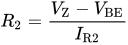
where VBE is typically 0.65 V for a silicon device.[5]

(IR2 is also the emitter current and is assumed to be the same as the collector or required load current, provided hFE is sufficiently large). Resistance R1 is calculated as
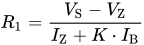
where K = 1.2 to 2 (so that RR1 is low enough to ensure adequate IB),
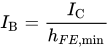
and hFE,min is the lowest acceptable current gain for the particular transistor type being used.

LED current source
[edit]
Figure 5: Typical constant current source (CCS) using LED instead of Zener diode

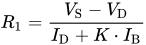
The Zener diode can be replaced by any other diode; e.g., a light-emitting diode LED1 as shown in Figure 5. The LED voltage drop (VD) is now used to derive the constant voltage and also has the additional advantage of tracking (compensating) VBE changes due to temperature. R2 is calculated as
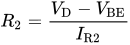
and R1 as

, where ID is the LED current
Transistor current source with diode compensation
[edit]
Figure 6: Typical constant current source (CCS) with diode compensation

Temperature changes will change the output current delivered by the circuit of Figure 4 because VBE is sensitive to temperature. Temperature dependence can be compensated using the circuit of Figure 6 that includes a standard diode, D, (of the same semiconductor material as the transistor) in series with the Zener diode as shown in the image on the left. The diode drop (VD) tracks the VBE changes due to temperature and thus significantly counteracts temperature dependence of the CCS.

Resistance R2 is now calculated as
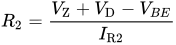
Since VD = VBE = 0.65 V,[6]

(In practice, VD is never exactly equal to VBE and hence it only suppresses the change in VBE rather than nulling it out.)

R1 is calculated as
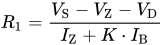
(the compensating diode's forward voltage drop, VD, appears in the equation and is typically 0.65 V for silicon devices.[6])

Note that this only works well if DZ1 is a reference diode or another stable voltage source. Together with 'normal' Zener diodes especially with lower Zener voltages (<5V) the diode might even worsen overall temperature dependency.

Current mirror with emitter degeneration
[edit]

Series negative feedback is also used in the two-transistor current mirror with emitter degeneration. Negative feedback is a basic feature in some current mirrors using multiple transistors, such as the Widlar current source and the Wilson current source.

Constant current source with thermal compensation
[edit]

One limitation with the circuits in Figures 5 and 6 is that the thermal compensation is imperfect. In bipolar transistors, as the junction temperature increases the Vbe drop (voltage drop from base to emitter) decreases. In the two previous circuits, a decrease in Vbe will cause an increase in voltage across the emitter resistor, which in turn will cause an increase in collector current drawn through the load. The end result is that the amount of 'constant' current supplied is at least somewhat dependent on temperature. This effect is mitigated to a large extent, but not completely, by corresponding voltage drops for the diode, D1, in Figure 6, and the LED, LED1, in Figure 5. If the power dissipation in the active device of the CCS is not small and/or insufficient emitter degeneration is used, this can become a non-trivial issue.

Imagine in Figure 5, at power up, that the LED has 1 V across it driving the base of the transistor. At room temperature there is about 0.6 V drop across the Vbe junction and hence 0.4 V across the emitter resistor, giving an approximate collector (load) current of 0.4/Re amps. Now imagine that the power dissipation in the transistor causes it to heat up. This causes the Vbe drop (which was 0.6 V at room temperature) to drop to, say, 0.2 V. Now the voltage across the emitter resistor is 0.8 V, twice what it was before the warmup. This means that the collector (load) current is now twice the design value! This is an extreme example of course, but serves to illustrate the issue.

Current limiter with NPN transistors

The circuit to the left overcomes the thermal problem (see also, current limiting). To see how the circuit works, assume the voltage has just been applied at V+. Current runs through R1 to the base of Q1, turning it on and causing current to begin to flow through the load into the collector of Q1. This same load current then flows out of Q1's emitter and consequently through Rsense to ground. When this current through Rsense to ground is sufficient to cause a voltage drop that is equal to the Vbe drop of Q2, Q2 begins to turn on. As Q2 turns on it pulls more current through its collector resistor, R1, which diverts some of the injected current in the base of Q1, causing Q1 to conduct less current through the load. This creates a negative feedback loop within the circuit, which keeps the voltage at Q1's emitter almost exactly equal to the Vbe drop of Q2. Since Q2 is dissipating very little power compared to Q1 (since all the load current goes through Q1, not Q2), Q2 will not heat up any significant amount and the reference (current setting) voltage across Rsense will remain steady at ≈0.6 V, or one diode drop above ground, regardless of the thermal changes in the Vbe drop of Q1. The circuit is still sensitive to changes in the ambient temperature in which the device operates as the BE voltage drop in Q2 varies slightly with temperature.

Op-amp current sources

[edit]
Figure 7: Typical op-amp current source.

The simple transistor current source from Figure 4 can be improved by inserting the base-emitter junction of the transistor in the feedback loop of an op-amp (Figure 7). Now the op-amp increases its output voltage to compensate for the VBE drop. The circuit is actually a buffered non-inverting amplifier driven by a constant input voltage. It keeps up this constant voltage across the constant sense resistor. As a result, the current flowing through the load is constant as well; it is exactly the Zener voltage divided by the sense resistor. The load can be connected either in the emitter (Figure 7) or in the collector (Figure 4) but in both the cases it is floating as in all the circuits above. The transistor is not needed if the required current doesn't exceed the sourcing ability of the op-amp. The article on current mirror discusses another example of these so-called gain-boosted current mirrors.

Figure 8: Constant current source using the LM317 voltage regulator

Voltage regulator current sources

[edit]

The general negative feedback arrangement can be implemented by an IC voltage regulator (LM317 voltage regulator on Figure 8). As with the bare emitter follower and the precise op-amp follower above, it keeps up a constant voltage drop (1.25 V) across a constant resistor (1.25 Ω); so, a constant current (1 A) flows through the resistor and the load. The LED is on when the voltage across the load exceeds 1.8 V (the indicator circuit introduces some error). The grounded load is an important advantage of this solution.

Curpistor tubes

[edit]

Nitrogen-filled glass tubes with two electrodes and a calibrated Becquerel (decays per second) amount of 226Ra offer a constant number of charge carriers per second for conduction, which determines the maximum current the tube can pass over a voltage range from 25 to 500 V.[7]

Current and voltage source comparison

[edit]
Figure 9: A current source with parallel source resistance can be converted to its Thevenin Equivalent of a voltage source with equivalent series resistance . The conversion also works in reverse.

Most sources of electrical energy (mains electricity, a battery, etc.) are best modeled as voltage sources, however some (notably solar cells) are better modeled using current sources. Sometimes it is easier to view a current source as a voltage source and vice versa (see conversion in Figure 9) using Norton's and Thévenin's theorems.

Voltage sources provide an almost-constant output voltage as long as the current drawn from the source is within the source's capabilities. An ideal voltage source loaded by an open circuit (i.e., an infinite impedance) will provide no current (and hence no power). But when the load resistance approaches zero (a short circuit), the current (and thus power) approach infinity. Such a theoretical device has a zero ohm output impedance in series with the source. Real-world voltage sources instead have a non-zero output impedance, which is preferably very low (often much less than 1 ohm).

Conversely, a current source provides a constant current, as long as the impedance of the load is sufficiently lower than the current source's parallel impedance (which is preferably very high and ideally infinite). In the case of transistor current sources, impedances of a few megohms (at low frequencies) are typical. Because power is current squared times resistance, as a load resistance connected to a current source approaches zero (a short circuit), the current and thus power both approach zero.

Ideal current sources don't exist. Hypothetically connecting one to an ideal open circuit would create the paradox of running a constant, non-zero current (from the current source) through an element with a defined zero current (the open circuit). As the load resistance of an ideal current source approaches infinity (an open circuit), the voltage across the load would approach infinity (because voltage equals current times resistance), and hence the power drawn would also approach infinity. The current of a real current source connected to an open circuit would instead flow through the current source's internal parallel impedance (and be wasted as heat).

Similarly, ideal voltage sources don't exist. Hypothetically connecting one to an ideal short circuit would result a similar paradox of finite non-zero voltage across an element with defined zero voltage (the short circuit).

Just like how voltage sources should not be connected in parallel to another voltage source with different voltages, a current source also should not be connected in series to another current source. Note, some circuits use elements that are similar but not identical to voltage or current sources and may work when connected in these manners that are disallowed for actual current or voltage sources. Also, just like voltage sources may be connected in series to add their voltages, current sources may be connected in parallel to add their currents.

Charging a capacitor

[edit]

Because the charge on a capacitor is equal to the integral of current with respect to time, an ideal constant current source charges a capacitor linearly with time, regardless of any series resistance. The Wilkinson analog-to-digital converter, for instance, uses this linear behavior to measure an unknown voltage by measuring the amount of time it takes a current source to charge a capacitor to that voltage. A voltage source instead charges a capacitor through a resistor non-linearly with time, because the charging current from the voltage source decreases exponentially with time.

See also

[edit]

References

[edit]

Further reading

[edit]
[edit]
Revisions and contributorsEdit on WikipediaRead on Wikipedia
from Grokipedia
A current source is an electronic circuit component or device that delivers or absorbs a constant electric current through its terminals, independent of the voltage across them or changes in the connected load. This contrasts with a voltage source, which maintains a fixed voltage while allowing current to vary. In idealized models, current sources exhibit infinite output impedance, ensuring the current remains stable even as voltage fluctuates widely, a property known as high compliance range. They can operate as direct current (DC) sources, providing steady non-time-varying flow, or alternating current (AC) sources, where the current varies sinusoidally or otherwise over time. Current sources are fundamental building blocks in analog electronics, enabling precise control in . Practical implementations often rely on transistors, such as bipolar junction transistors (BJTs) in simple one-transistor configurations or metal-oxide-semiconductor field-effect transistors (MOSFETs) for integrated circuits, to approximate ideal behavior. More advanced designs incorporate operational amplifiers for precision, achieving low output compliance errors, or use dedicated integrated circuits like the LM334 for temperature-stable operation. Dependent current sources, which scale their output based on another circuit voltage or current, extend their utility in complex systems like amplifiers and feedback loops. Key applications include biasing transistors in integrated circuits, driving light-emitting diodes (LEDs) with consistent brightness, and transmitting industrial analog signals over long distances via standardized 4-20 mA loops, which resist and voltage drops. In these roles, current sources ensure reliable performance by prioritizing current constancy, making them indispensable for sensors, actuators, and precision instrumentation.

Fundamentals

Definition and Ideal Characteristics

A current source is an electrical circuit element that supplies a constant to a load, independent of the voltage across the load or variations in its impedance. This distinguishes it from other sources by prioritizing current stability over voltage regulation, making it essential in applications requiring precise current delivery, such as in amplifiers or circuits. In its ideal form, a current source exhibits infinite output impedance, expressed as RoutR_{out} \to \infty, which ensures the output current II remains fixed regardless of changes in the output voltage VoutV_{out}. The simplifies to I=IsI = I_s, where IsI_s is the constant nominal current, and VoutV_{out} can vary freely based on the connected load without affecting IsI_s. Symbolically, the ideal current source is depicted as a parallel combination of an ideal current generator and an infinite , representing its Norton . The I-V characteristic of an ideal current source is graphically represented as a straight horizontal line on a current-voltage plot, illustrating the invariance of current with respect to voltage. This idealized representation establishes the theoretical basis for circuit analysis, enabling the study of current sources in isolation before addressing real-world circuit behaviors.

Practical Limitations

In practical current sources, the is finite rather than infinite, typically ranging from 10 kΩ to several megaohms depending on the design and components used. This finite impedance, denoted as RoutR_{\text{out}}, causes the output current to vary with changes in the load voltage, quantified by the relation ΔI=ΔV/Rout\Delta I = \Delta V / R_{\text{out}}, where ΔI\Delta I is the current deviation and ΔV\Delta V is the voltage change across the source. For instance, high-performance op-amp-based sources can achieve output impedances exceeding 100 MΩ at DC, but this drops at higher frequencies due to parasitic capacitances and loop bandwidth limitations. Such variations degrade the source's ability to maintain a under dynamic load conditions. Another key constraint is the compliance voltage range, which defines the maximum and minimum voltage across the load over which the source can deliver the specified current without saturating or dropping out of . Beyond this range, the output current deviates significantly as the internal circuitry reaches its supply limits or saturation points. Typical compliance ranges for integrated current sources, such as those based on shunt regulators or op-amp configurations, extend from near 0 V minimum to 20–22 V maximum, influenced by the supply voltage minus headroom requirements like reference drops and sense resistor voltages. In applications like electrochemical measurements, compliance voltages are often limited to 10 V or less to conductivity and cell configuration requirements. Temperature and process variations further impact current stability in practical sources, particularly in semiconductor implementations where thermal coefficients affect transistor parameters like base-emitter voltage and mobility. For example, uncompensated bipolar junction transistor (BJT) sources may exhibit a negative temperature coefficient of about -0.33%/°C due to the temperature dependence of the base-emitter junction, leading to a 29% current decrease over 0–100 °C. Advanced designs, such as modified Howland circuits, can reduce this drift to as low as 0.03% over wide temperature ranges through matched components and feedback. Process variations during fabrication also introduce mismatches in resistor and transistor characteristics, amplifying output current errors by 1–5% in monolithic ICs without trimming. Power dissipation imposes a fundamental limit, as the product of output current and compliance voltage (P=I×VP = I \times V) generates heat that can cause thermal runaway or component failure if exceeding device ratings. For discrete or integrated sources like the LM334, maximum dissipation is typically capped at 400 mW to prevent overheating, requiring derating in high-current applications (e.g., 20 mA at 20 V yields 400 mW). Exceeding this limit not only risks breakdown but also exacerbates temperature-induced drift, necessitating heatsinking or current limiting for reliability. Performance metrics like output resistance are evaluated using small-signal analysis at the operating point, where rout=Vout/Ioutr_{\text{out}} = \partial V_{\text{out}} / \partial I_{\text{out}}, often approximated by applying a small test voltage and measuring the resulting current change (routΔV/ΔIr_{\text{out}} \approx \Delta V / \Delta I). This method isolates incremental behavior from DC biases, revealing impedance under varying loads; for example, a 4 V change causing a 40 µA current shift indicates 100 kΩ output resistance. Such measurements are critical for validating source quality in precision applications, accounting for frequency-dependent effects in AC-coupled tests.

Implementations

Passive Current Sources

Passive current sources are basic approximations of ideal current sources achieved through passive components, primarily by employing high-value resistors in series with a voltage source to limit and stabilize current flow. The simplest configuration involves a stable voltage source, such as a battery or Zener diode, connected in series with a resistor, where the resistor's value determines the approximate current delivered to the load. For adjustable operation, resistor networks like potentiometers can be incorporated, allowing variation of the effective resistance to tune the current output without active elements. The operating principle relies on , where the current II is roughly IVRI \approx \frac{V}{R}, with VV as the input voltage and RR as the large series resistance value, making it suitable for low-precision, simple applications. However, this setup is inherently voltage-dependent, as the actual current is given by I=VinVoutRI = \frac{V_{in} - V_{out}}{R}, revealing non-ideality due to voltage drops across the load (VoutV_{out}). These passive approximations exhibit poor , approximately equal to RR, which is often limited to practical values (e.g., kiloohms), resulting in significant sensitivity to variations in supply voltage or load conditions. Advantages of passive current sources include their in and , low due to the use of inexpensive components, and no requirement for additional power supplies beyond the driving voltage. Historically, such resistor-based methods were foundational in early circuits, dating back to the application of in the for basic before the advent of active devices. Common applications encompass current limiting in simple LED drivers, biasing networks in basic amplifiers, and as temporary placeholders in circuit prototypes where high precision is not essential.

Active Implementations Without Feedback

Active implementations without feedback utilize the inherent nonlinear properties of devices, such as transistors operating in saturation or diodes in breakdown, to regulate current flow. These designs leverage device physics to maintain relatively stable output currents over a range of load voltages, offering improved performance over passive resistive methods without requiring error-correcting loops. In current-stable nonlinear implementations, a Zener diode biased in its breakdown region provides a stable reference voltage that sets the base-emitter voltage of a transistor, resulting in a collector current approximately equal to the Zener current under proper biasing. For instance, in a basic configuration, the transistor's collector current ICI_C is given by IC(VZVBE)/RI_C \approx (V_Z - V_{BE}) / R, where VZV_Z is the Zener voltage, VBEV_{BE} is the base-emitter drop (typically 0.7 V), and RR is a shunt resistor; this approximates ICIZI_C \approx I_Z when the resistor is small relative to the Zener's dynamic resistance. Such circuits achieve moderate stability with temperature coefficients around 0.3%/°C when diodes are thermally coupled to the transistor. Following voltage implementations, like the basic , employ matched where the output current tracks a reference current through shared base-emitter or gate-source voltages. In a (BJT) , the diode-connected reference transistor sets a common VBEV_{BE}, yielding IOUTIREFI_{OUT} \approx I_{REF} for identical devices, though finite current gain β\beta introduces errors such that IOUT=IREF(12/β)I_{OUT} = I_{REF} (1 - 2/\beta). versions avoid base current losses, providing IOUT=IREFI_{OUT} = I_{REF} more accurately. These open-loop designs depend on device matching for precision. Voltage compensation implementations enhance stability by incorporating additional diodes to account for VBEV_{BE} variations, particularly temperature-induced changes. The current is determined by I=(VREFnVBE)/RI = (V_{REF} - n V_{BE}) / R, where VREFV_{REF} is a stable reference (e.g., from two forward-biased diodes yielding ~1.2 V), nn is the number of compensating diodes (often 1 or 2), and RR sets the magnitude. Thermally coupling the compensation diodes to the minimizes the negative temperature coefficient of VBEV_{BE} (-2 mV/°C), achieving coefficients below 200 ppm/°C in optimized setups. Current compensation implementations, such as bootstrapped sources, mitigate base current errors in BJTs by using an emitter follower to amplify the and reduce loading effects. In these circuits, a second or device (e.g., TLV431 shunt) drives the base, effectively boosting the current gain and making IOUTI_{OUT} less dependent on β\beta variations. This enhances regulation without feedback, with dropout voltages around 1.35 V. Common traits of these active designs include moderate output impedances typically in the 10-100 kΩ range, arising from effects like the Early voltage in BJTs (output resistance roVA/ICr_o \approx V_A / I_C, where VAV_A is ~100 V) or channel-length modulation in MOSFETs. They exhibit sensitivity to temperature drifts in device parameters and mismatches between components, leading to 1-5% current variations under nominal conditions. These implementations provide higher voltage compliance (up to several volts) than passive resistor-based sources, enabling operation over wider load ranges, but offer limited stability (e.g., 1-2% ) compared to feedback-enhanced alternatives due to reliance on device physics alone.

Simple Transistor Current Sources

Simple current sources utilize bipolar junction transistors (BJTs) or metal-oxide-semiconductor field-effect transistors (MOSFETs) configured with to provide stable output currents with high . The basic configuration employs a single with an emitter (or source) for degeneration feedback, where the output current is approximately IoutVBEREI_{out} \approx \frac{V_{BE}}{R_E} for BJTs, rendering it largely independent of the 's current gain β\beta. This setup introduces local that stabilizes the current against variations in β\beta and supply voltage. The feedback mechanism arises from the emitter degeneration RER_E, which increases the effective by a factor of approximately (1+gmRE)(1 + g_m R_E), where gmg_m is the . Small-signal analysis reveals that this degeneration provides a feedback gain that counteracts changes in collector (or drain) voltage, enhancing current stability; for instance, an incremental test current at the output produces a voltage drop across RER_E that modulates the base-emitter (or gate-source) voltage to oppose the change. In BJT implementations, the can reach up to 1 MΩ\Omega, while proper biasing—such as maintaining —yields a low , typically mitigating the inherent -2 mV/°C variation in VBEV_{BE}. Improved versions, such as the using three transistors, further reduce errors from base current loading and , achieving an of approximately routβ(RE+re)r_{out} \approx \beta (R_E + r_e), where re=VT/IEr_e = V_T / I_E is the small-signal emitter resistance. This configuration, invented by George R. Wilson in , employs additional feedback to equalize voltages across matched transistors, minimizing systematic mismatches. MOSFET variants replace emitter degeneration with source degeneration, offering similar independence from device parameters but with output currents set by Iout(VGSVth)22RSI_{out} \approx \frac{(V_{GS} - V_{th})^2}{2 R_S} in saturation, and these can be made adjustable by varying a reference current through a parallel mirror branch. Despite their advantages, these sources have limitations, including a finite compliance voltage—the minimum output voltage required for operation, often VCE(sat)+IoutREV_{CE(sat)} + I_{out} R_E for BJTs—which restricts use in low-voltage designs and can cause headroom issues. Historically, simple current sources became common in discrete circuits during the following the commercialization of junction transistors, and they played a key role in current mirrors for early integrated circuits starting in the late .

Op-Amp Current Sources

Op-amp current sources employ operational amplifiers to achieve precise current regulation through mechanisms, converting an input voltage to a controlled output current largely independent of load variations. These circuits leverage the op-amp's high to enforce a or specific voltage condition, ensuring stable current delivery across a range of compliance voltages. Common configurations include basic voltage-to-current (V-to-I) converters and more advanced topologies like the Howland current source. A fundamental implementation is the V-to-I converter, which typically incorporates an op-amp driving a to control current through a load. In this setup, the op-amp senses the across a RsenseR_\text{sense} connected in series with the load, adjusting the base voltage to maintain a constant voltage equal to the reference input VrefV_\text{ref} across RsenseR_\text{sense}. The load current is thus given by Iload=VrefRsense,I_\text{load} = \frac{V_\text{ref}}{R_\text{sense}}, allowing straightforward adjustment via VrefV_\text{ref} or RsenseR_\text{sense}. The loop ensures the current remains stable despite load resistance changes, provided the op-amp can supply the required output voltage. The Howland current source represents a balanced network configuration using a single op-amp, enabling bidirectional current flow. It features four s forming a bridge around the op-amp: from the output to the non-inverting input, and paths to the inverting input. With balanced s where R1/R2=R3/R4R_1 / R_2 = R_3 / R_4, the output current simplifies to Iout=VinRs,I_\text{out} = \frac{V_\text{in}}{R_s}, where RsR_s is the sense , and VinV_\text{in} is the differential input voltage. This supports sourcing or sinking current based on input polarity, offering true bidirectionality without additional components. The circuit's approaches infinity under ideal balance, though practical mismatches limit it to values like ±250 kΩ with 1% tolerances. An improved variant, the unbalanced Howland current source, addresses limitations in single-ended power supplies by modifying the resistor network for better headroom and accuracy. Here, the feedback ensures a at the sense point on the inverting input, while the path uses an adjusted resistor (e.g., R4=R2RsR_4 = R_2 - R_s) to minimize errors. The output current follows Iload=VpVnRs,I_\text{load} = \frac{V_p - V_n}{R_s}, with VpV_p and VnV_n as the positive and negative inputs, suitable for supplies from 1.5 V to 36 V depending on the op-amp. Buffering variants further enhance by reducing feedback current errors. This configuration provides higher precision than the basic Howland, especially in gain-settable designs. In all these circuits, the feedback loop exploits the op-amp's high (often >100 dB) to achieve low error from offsets and minimal dependence on load. The output impedance exceeds 1 MΩ in well-designed implementations, as the loop gain amplifies the effective resistance by the factor (1+Aolβ)(1 + A_\text{ol} \beta), where AolA_\text{ol} is the and β\beta is the feedback factor. Op-amp offset voltages contribute negligible error (e.g., <0.1% for typical 1 mV offsets) due to this high loop gain. Key advantages include a wide compliance voltage range (limited only by the op-amp's rails), low for easy voltage referencing, and precise adjustability via input voltage. These sources maintain stable output even with varying loads, making them ideal for applications requiring high regulation. However, they often necessitate dual supplies for bidirectional operation, and performance is constrained by op-amp limitations such as (affecting ) and finite , which can degrade if resistors are mismatched. In modern applications, op-amp current sources are prevalent in interfaces, such as driving resistive transducers or excitation currents in precision measurement systems, where variants incorporating amplifiers enhance accuracy for low-level signals.

Voltage Regulator Current Sources

Voltage regulator current sources are integrated circuits originally designed for but adapted to deliver stable output currents through external programming resistors, making them ideal for robust power applications such as driving loads that require precise current control. These devices leverage internal reference voltages and feedback loops to maintain , offering simplicity and reliability in linear topologies. The LM334 serves as a dedicated three-terminal adjustable current source, programmed by an external connected to its set pin. The output current follows the relation Iout=67.7mVRsetI_\text{out} = \frac{67.7 \, \text{mV}}{R_\text{set}} at 25°C, where RsetR_\text{set} determines the current level across a 10,000:1 range from 1 μA to 10 mA. Its operation relies on an internal feedback loop that sustains a nominal 64 mV sense voltage across the setting resistor, which is proportional to absolute temperature for inherent temperature-sensing capability. In a similar vein, the adjustable is repurposed as a programmable current source by placing a between its output and adjustment terminals. Here, the output current is set by I=1.25VRI = \frac{1.25 \, \text{V}}{R}, with the internal bandgap reference enforcing a 1.25 V drop across RR to regulate current up to 1.5 A. The feedback mechanism dynamically adjusts the to hold this voltage constant, ensuring current stability despite load or input variations. Fixed three-terminal regulators like the series (e.g., LM7805) can be modified into current sources by adding a resistor in series with the load to trigger their internal current-limiting circuitry, enabling operation as a constant-current limiter with capabilities up to 1.5 A. This adaptation exploits the device's inherent short-circuit protection to clamp output current at a programmed value. These IC-based current sources provide high , often exceeding 100 kΩ in configurations like the , which minimizes current variations with output voltage changes. They also demonstrate good thermal stability, with the LM334 achieving a temperature coefficient of ±0.33%/°C and built-in protections against overload and overheating across devices. Common applications encompass LED drivers, where the constant current safeguards against and extends lifespan, and battery chargers, such as the LM317 circuit delivering 50 mA to NiCd cells via a 24 Ω for controlled charging. Despite their advantages, these linear voltage regulator-derived current sources are constrained by fixed internal topologies that necessitate a minimum dropout voltage—approximately 3 V for the —leading to significant power dissipation as heat. They are less suitable for low-power integrated circuits due to inefficiency but continue to be employed in higher-current linear power supplies for their simplicity and protection features.

Curpistor Tubes

A curpistor is a subminiature constant-current designed for precise current regulation in electronic circuits. It features two electrodes enclosed in a nitrogen-filled containing a calibrated amount of radioactive material, typically radium-226, which generates a steady stream of ions to maintain stable current flow. This design allows the curpistor to function as a simple, passive current source without requiring external amplification components. The operation of the curpistor relies on the constant rate produced by the within the tube, which ensures the plate current remains approximately constant across a wide range of applied voltages. The ions facilitate flow between the electrodes, resulting in a regulated output current that is largely independent of load variations or voltage fluctuations, typically in the microampere range for minute regulators like the CH1027 model. This inherent stability arises from the fixed decay rate, measured in becquerels, providing a predictable number of ions per second and thus a consistent current. High output , often in the megaohm range, is a characteristic of this tube due to its ionization-based mechanism. In circuit applications, the curpistor is typically connected in series with the load, acting as a self-contained current limiter; for example, a self-biased configuration might incorporate a simple network to set the current, leveraging the tube's characteristics for overall circuit stability. These devices were particularly valued in early analog for applications requiring reliable, low-level constant currents, such as in timing circuits or sources. Developed in the by Electric Inc., the curpistor represented an innovative approach to current stabilization using radioactive elements in technology, aimed at providing tolerances and longevity unmatched by conventional resistors or early alternatives at the time. It found use in precision instruments and military applications, such as in timing systems where consistent current was essential for charging or oscillator stability. However, its reliance on radioactive materials and the associated handling precautions, including compliance with regulations, limited broader adoption. Performance-wise, curpistors offered exceptional stability with currents regulated to within tight tolerances and operational lifespans extending over decades due to the long half-life of the radioactive source, though they consumed notable power for their size and required careful shielding from external fields. The output current can be approximated as Ipionization ratemobilityI_p \approx \frac{\text{ionization rate}}{\text{mobility}}, where the ionization rate is fixed by the radioactive calibration, ensuring minimal variation over voltage swings from tens to hundreds of volts. Despite these advantages, the technology proved bulky and power-intensive compared to emerging solid-state options. By the post-1970s era, curpistors became obsolete with the dominance of transistors and integrated circuits, which provided more compact, efficient, and safer current regulation without radioactive components; they are now primarily of historical interest in the study of analog electronics. Their rarity today underscores the transition from to solid-state paradigms in precision instrumentation.

Comparison with Voltage Sources

Behavioral Differences

An ideal voltage source delivers a constant output voltage regardless of the current drawn by the connected load, exhibiting zero that behaves as a at (DC). This characteristic is represented on an I-V plot as a vertical line at the fixed voltage VsV_s, where current can vary from negative to positive . In contrast, an ideal current source supplies a constant output current irrespective of the voltage across its terminals, possessing infinite equivalent to an open circuit at DC. Its I-V characteristic appears as a horizontal line at the fixed current IsI_s, with voltage ranging from negative to positive . The behavioral duality between voltage and current sources is formalized through the Thévenin-Norton theorems, which allow any linear to be equivalently represented as either a Thévenin equivalent—a VthV_{th} in series with impedance ZthZ_{th}—or a Norton equivalent—a current source InI_n in parallel with the same impedance Zn=ZthZ_n = Z_{th}. The conversion between these forms follows from Vth=InZthV_{th} = I_n \cdot Z_{th} and In=Vth/ZthI_n = V_{th} / Z_{th}, highlighting how a models low-impedance driving while a current source models high-impedance sourcing. In circuit stability, current sources provide high output impedance suitable for applications, where they maintain stable current without significantly loading the circuit, whereas voltage sources offer low ideal for driving loads that require consistent voltage delivery. For power delivery, current sources efficiently transfer power to high-impedance loads, as power dissipation P=Is2RLP = I_s^2 R_L increases with load resistance RLR_L, while voltage sources optimize power to low-impedance loads via P=Vs2/RLP = V_s^2 / R_L. This trade-off underscores the conceptual distinction: current sources control and stabilize current flow for loads sensitive to current variations, such as certain sensors, whereas voltage sources regulate voltage for applications demanding fixed potential differences.

Capacitor Charging Example

To illustrate the behavioral differences between voltage and current sources, consider an where a CC is charged through a RR by either an ideal with amplitude VsV_s or an ideal source with value IsI_s. In both cases, the circuit begins with the initially discharged (VC(0)=0V_C(0) = 0), and the switch closes at t=0t = 0 to initiate charging. For the voltage source case, Kirchhoff's voltage applied to the loop yields Vs=I(t)R+VC(t)V_s = I(t) R + V_C(t), where VC(t)=Q(t)/CV_C(t) = Q(t)/C and I(t)=dQ/dtI(t) = dQ/dt. Substituting and solving the dQ/dt+Q/(RC)=CVsdQ/dt + Q/(RC) = C V_s gives the charge Q(t)=CVs(1et/(RC))Q(t) = C V_s (1 - e^{-t/(RC)}). Thus, the capacitor voltage is VC(t)=Vs(1et/τ)V_C(t) = V_s (1 - e^{-t/\tau}), with time constant τ=RC\tau = RC, and the charging current is I(t)=(Vs/R)et/τ=CdVC/dtI(t) = (V_s / R) e^{-t/\tau} = C dV_C/dt. The voltage starts at 0 V and approaches VsV_s asymptotically, reaching about 63% of VsV_s at t=τt = \tau and 99% after roughly 5τ5\tau. The current is an from an initial peak of Vs/RV_s / R to zero. In , the capacitor fully charges to VsV_s, and current ceases as the capacitor acts as an open circuit. In contrast, for the constant current source case, the current I(t)=IsI(t) = I_s flows directly into the since the source maintains fixed current regardless of voltage. From the relation Is=CdVC/dtI_s = C dV_C/dt, integrating yields VC(t)=(Is/C)tV_C(t) = (I_s / C) t (assuming initial VC(0)=0V_C(0) = 0), producing a linear voltage ramp with Is/CI_s / C. The current remains flat at IsI_s. Without a discharge path or limit, the voltage ramps indefinitely; in practice, real current sources have a compliance voltage limit beyond which they cannot maintain IsI_s, causing saturation. The shows a straight-line voltage increase from 0 V, contrasting the curved exponential approach in the case. These dynamics highlight key implications: a suits applications requiring exponential settling to a fixed value, such as filters or power supplies where steady-state equilibrium is desired, while a current source excels in generating linear voltage sweeps, as in op-amp integrators where output is proportional to input current integrated over time (VC(t)=(1/C)IsdtV_C(t) = (1/C) \int I_s \, dt). In simulation tools like , current sources avoid numerical issues such as or convergence failures in high-impedance states (e.g., isolated capacitors), where s might impose conflicting potentials; current sources simply inject charge without enforcing voltage, aiding stable transient analysis. This example underscores why current sources are prevalent in timing circuits, such as ramp generators in timers or voltage-controlled oscillators, where the linear ramp enables precise time-based triggering—unlike the nonlinear exponential curve from voltage sources that complicates timing accuracy. Describing the waveforms: plot VC(t)V_C(t) versus time for the voltage case as a concave-down curve saturating at VsV_s, versus a straight ascending line for the current case, with overlaid decaying current for voltage (peaking early) and constant for current, emphasizing the sources' complementary roles in ./06%3A_Analog_Integrated_Circuits/6.08%3A_555_Ramp_Generator)

References

Add your contribution
Related Hubs
User Avatar
No comments yet.