Hubbry Logo
DF-21DF-21Main
Open search
DF-21
Community hub
DF-21
logo
8 pages, 0 posts
0 subscribers
Be the first to start a discussion here.
DF-21
DF-21
from Wikipedia

The Dongfeng 21 (DF-21; NATO reporting name CSS-5 - Dong-Feng (simplified Chinese: 东风; traditional Chinese: 東風; lit. 'East Wind') is a two-stage, solid-fuel, single-warhead medium-range ballistic missile (MRBM) developed by China's Changfeng Mechanics and Electronics Technology Academy. A part of the Dongfeng missile family, the DF-21's development started in the late 1960s, and it was completed around 1985–86, but not deployed until 1991. It was developed from the JL-1 submarine-launched missile, and is China's first solid-fuel land-based missile. The U.S. Department of Defense in 2008 estimated that China had 60-80 missiles and 60 launchers;[7] approximately 10-11 missiles can be built annually.[8]

Key Information

Originally developed as a strategic weapon, the DF-21's later variants were designed for both nuclear and conventional missions. It is thought to be able to carry a high explosive, submunition for tactical/theater-level missions, or a 300 kt nuclear warhead for strategic strikes. The latest variant, the DF-21D, was said to be the world's first anti-ship ballistic missile (ASBM). The DF-21 has also been developed into the SC-19, an anti-ballistic missile and anti-satellite missile. As of 2025, its KF-21 air-launched ballistic missile variant represents China's only air capability within its nuclear triad.[9]

Though the launcher vehicle itself is mobile to reduce vulnerability, an actual launch unit requires support vehicles that can cover a 300×300-meter area, making it hard to move quickly and easier to detect. Also, the wheeled launcher is not made to travel off-road and requires firm ground when firing to prevent backblast and debris damage due to the hard launch, restricting its firing locations to roads and pre-made launch pads.[10]

DF-21/A/C (CSS-5 Mod-1/2/3)

[edit]

The basic variant DF-21 had a range of 1,770+ km,[3] and a payload of 600 kg (1,300 lb) consisting of a single 500 kt nuclear warhead, with an estimated circular error probable (CEP) of 300~400 m; this version did not enter operational service.[5] The DF-21A was operational by 1996 and has improved accuracy with an estimated CEP of 100~300 m.[5] This version is reported to have a similar 1,770+ km range,[3] with a potential extended range of 2,150 km (1,340 mi).[10][11]

Revealed in 2006, the DF-21C is a terminally guided version[12] that has a maximum range believed to be about 1,700 km (1,100 mi)[13] and accuracy estimated to be 50~100m.[14] The missile was the first dual-capable version, able to be armed with either a nuclear or conventional warhead. In 2010, the DF-21C was being deployed in central Western China.[10]

DF-21D (CSS-5 Mod-4) Anti-ship ballistic missile

[edit]
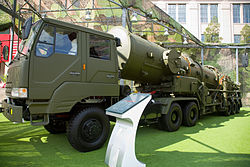
The DF-21D missile as seen after the military parade on September 3, 2015.
Range of various Chinese missiles (2007); DF-21 A/B range in red.

Development

[edit]

This is an anti-ship ballistic missile that has a maximum range exceeding 1,450 kilometres (900 mi; 780 nmi), according to the U.S. National Air and Space Intelligence Center. The Intelligence Center did not believe it was deployed in 2009.[13] As of 2009, the guidance system was thought to be still in an evolutionary process as more UAVs and satellites are added.[15]

The US Department of Defense stated in 2010 that China has developed and reached initial operating capability (IOC)[16] of a conventionally armed[17] high hypersonic[18] land-based anti-ship ballistic missile based on the DF-21. This is the first ASBM and weapon system capable of targeting a moving aircraft carrier strike group from long-range, land-based mobile launchers.[19][20][21] The DF-21D is thought to employ maneuverable reentry vehicles (MaRVs) with a terminal guidance system. Such a missile may have been tested in 2005-6, and the launch of the Jianbing/Yaogan satellites would give the Chinese targeting information from SAR (synthetic-aperture radar) and visual imaging respectively. The upgrades enhance China's ability to prevent US carriers from operating in the Taiwan Strait.[22] Some have also suggested China could develop a DF-21D with multiple reentry vehicles.[23]

To support this, a test range in the Taklamakan Desert has been seen on satellite, possibly used to test the DF-21 (and sister missiles). This facility, which features high-fidelity mock-ups of U.S. warships, is used to analyze the missile's reentry vehicle, guidance systems, and impact. The targets are part of the People's Liberation Army's efforts to develop its anti-access/area denial (A2/AD) capabilities.[24][25][26]

Guidance and navigation

[edit]

Between 2009 and 2012, China launched a series of satellites to support its ASBM efforts:

China was reported to be working on an over-the-horizon radar in 2013 to locate the targets for the ASBM.[28] An apparent test of the missile was made against a target in the Gobi Desert in January 2013.[29]

Re-entry vehicle

[edit]

In 2014, the U.S. Navy reported that images that have appeared on the internet showed similarities of a DF-21D re-entry vehicle to the American Pershing II missile's RV, which was withdrawn from service in 1988. The Pershing II's RV weighed 1,400 lb (640 kg) and was fitted with four control fins to perform a 25-G pull-up after reentering the atmosphere, traveling at Mach 8 and then gliding 30 nmi (35 mi; 56 km) to the target to pitch into a terminal dive. Army training manuals about the missile are available on the internet and public open-source literature extensively describes it; the DF-21 has a comparable range and payload. Though much is made of the DF-21D's damage infliction ability based solely on velocity and kinetic energy, the Australian Strategic Policy Institute has calculated that the energy of an inert 500 kg (1,100 lb) RV impacting at Mach 6 had similar energy to the combined kinetic and explosive power of the American subsonic Harpoon anti-ship missile, which is one-quarter the energy of the Russian supersonic 12,800 lb (5,800 kg) Kh-22 missile traveling at Mach 4 with a 2,200 lb (1,000 kg) warhead.[30]

Impact on naval warfare

[edit]

In 2009, the United States Naval Institute stated that there was "currently ... no defense against [a warhead able to destroy an aircraft carrier in one hit]" if it worked as theorized. It was reported in 2010 that China was finalizing development of a MaRV warhead for the DF-21.[31][32][33] The United States Navy has responded by switching its focus from a close blockade force of shallow water vessels to return to building deep water ballistic missile defense (BMD) destroyers.[18] The United States has also assigned most of its ballistic missile defense capable ships to the Pacific, extended the BMD program to all Aegis destroyers and increased procurement of SM-3 BMD missiles.[34] The United States also has a large network optimized for tracking ballistic missile launches which may give carrier groups sufficient warning in order to move away from the target area while the missile is in flight.[35] Kinetic defenses against the DF-21D would be difficult. The Navy's primary ballistic missile interceptor, the SM-3, would not be effective since it is designed to intercept missiles in the mid-course phase in space, so it would have to be launched almost immediately to hit before reentry or from an Aegis ship positioned under its flight path. The SM-2 Block 4 can intercept missiles reentering the atmosphere, but the warhead will be performing high-G maneuvers that may complicate interception.[36] By 2016, the US Navy was testing the vastly more capable SM-6, which is designed to intercept ballistic missiles in the terminal phase.[37] The SM-6 began deployment in 2013.[38]

In late 2013, a Russian Military Analysis report of the DF-21D concluded that the only way to successfully counter it would be through electronic countermeasures. Conventional interceptions of high-speed objectives have worked in the past, with the Russian report citing the 2008 interception of a malfunctioning satellite by a U.S. cruiser, but in that situation the warship had extensive knowledge of its location and trajectory. Against an attack from the Mach 10 DF-21D without knowing the missile's launch point, the U.S. Navy's only way to evade it would be through electronic countermeasures.[39]

Use of such a missile has been said by some experts to potentially lead to nuclear exchange, regional arms races with India and Japan, and the end of the INF Treaty between the United States and the Soviet Union, to which the People's Republic of China is not a party.[40][41]

Skepticism

[edit]

The emergence of the DF-21D has some analysts claiming that the "carrier killer" missiles have rendered the American use of aircraft carriers obsolete, as they are too vulnerable in the face of the new weapon and not worth the expense. Military leaders in the U.S. Navy and Air Force, however, do not see it as a "game changer" to completely count carriers out.[citation needed]

First, the missile may not be able to single-handedly destroy its target, as the warhead is believed to only be enough to inflict a "mission kill" that makes a carrier unable to conduct flight operations.[42]

Secondly, there is the problem of finding its target. The DF-21D has a range estimated between 1,035 to 1,726 mi (899 to 1,500 nmi; 1,666 to 2,778 km), so a carrier battle group would need to be located through other means before launching. Over-the-horizon radars cannot pinpoint a carrier's exact location, and would have to be used in conjunction with Chinese recon satellites. Though recon aircraft and submarines could also be used to look for the carrier, they are vulnerable to the carrier battle group's defenses.[42]

Finally, although the DF-21D has radar and optical sensors for tracking, it has not yet been tested against a ship target moving at-sea at up to 55 km/h (30 kn; 34 mph), let alone ones using clutter and countermeasures. The missile's "kill chain" requires processing and constantly updating a carrier's location details, preparing the launch, programming information and firing. The U.S. military's AirSea Battle concept involves disrupting such kill chains.[42] Some U.S. analysts believe that the DF-21D does not fly any faster than Mach 5.[43]

The DF-21D may also not be as fast as theorized. While ballistic missiles reenter the atmosphere at speeds between Mach 8-15 at an altitude of 50 km (160,000 ft), increasing air resistance in the denser low-atmosphere region reduces terminal speed to around Mach 2 at 3–5 km (9,800–16,400 ft). It cannot acquire its target until this point due to ionization blockage, leaving a relatively short time to actually search for a ship. This could enable the target to leave the area if the missile is detected soon enough before it engages its terminal sensors, and the slower speed upon reentry leaves it vulnerable to missile interceptors.[44]

Appearances and deployments

[edit]

The missile was shown to the public during the parade in Beijing celebrating 70 years since the end of World War II on September 3, 2015.[45][46] A parade video shows missiles marked as DF-21D.[47]

On 26 August 2020, along with a DF-26B, a DF-21D was launched into an area of the South China Sea between Hainan and the Paracel Islands, one day after China said that an American U-2 spy plane entered a no-fly zone without its permission during a Chinese live-fire naval drill in Bohai Sea off its north coast[48] and came as Washington blacklisted 24 Chinese companies and targeted individuals it said were part of construction and military activities in the South China Sea.[49][50][51] US officials subsequently assessed that the People's Liberation Army Rocket Force (PLARF) had fired four medium-range ballistic missiles in total.[50][49] The missile tests drew criticism from Japan, the Pentagon and Taiwan.[50][49][52]

DF-26

[edit]

The DF-26 is an enhancement of the DF-21 with range increased to more than 5,000 km (3,100 mi). Its existence was officially confirmed by the Chinese state in the mid-2010s, but it had already been in service for several years.[12][53]

On 26 August 2020, a DF-26B was fired from Qinghai province into an area between Hainan and the Paracel Islands as a response to a U.S. U-2 spy plane entering into a no-fly zone during a Chinese live-fire naval drill the day earlier.[48]

SC-19

[edit]

The SC-19 is the anti-satellite and anti-ballistic missile version of the DF-21. Multiple tests of the missile have been conducted. It is capable of targeting ballistic missiles and satellites outside of the Earth's atmosphere.[54][55]

KF-21

[edit]

The "KF-21" (possible Chinese designation,[56] NATO designation: CH-AS-X-13) is reported to be an air-launched variant of the DF-21[57] with a nuclear or anti-ship role. It is a two-stage missile, with its weight may be reduced by using composite materials.[58] The War Zone reported two possible warhead configurations; a DF-21D-style "double-cone" tip, and a hypersonic glide vehicle (HGV) similar to the DF-ZF on the DF-17 missile.[56]

It was in development by 2018.[57] In 2018, the United States projected it would be ready for deployment by 2025.[58]

The missile is carried by the Xian H-6N bomber; the aircraft has a recessed underside to carry the missile externally.[57]

In September 2025, the JL-1 air-launched ballistic missile was revealed to the public on the 2025 China Victory Day Parade. Analysts believed the JL-1 is identical to the CH-AS-X-13.[59][60]

Saudi Arabian purchase

[edit]

The DF-21 may have been exported to Saudi Arabia.[61] In January 2014, Newsweek reported that the missiles were purchased in 2007. Conventionally-armed DF-3 missiles were bought by Saudi Arabia in 1988, but were not used during the 1990-1991 Gulf War due to their poor accuracy and the potential for collateral damage. Saudi Arabia wanted the shorter-ranged but much more accurate DF-21 as an upgrade. The United States approved of the purchase on the condition that the missiles were conventionally-armed.[62] The Central Intelligence Agency (CIA) examined the modified nosecones and concluded that nuclear warheads that might be purchased from China or Pakistan could not be fitted.[63]

See also

[edit]

References

[edit]
Revisions and contributorsEdit on WikipediaRead on Wikipedia
from Grokipedia
The Dong Feng-21 (DF-21; NATO reporting name CSS-5 Mod 2–5) is a family of two-stage, solid-fueled, road-mobile medium-range ballistic missiles (MRBMs) developed by the People's Republic of China for the People's Liberation Army Rocket Force (PLARF). With a range of approximately 2,150 kilometers and a payload capacity of 600 kilograms, the DF-21 can carry either nuclear or conventional warheads and achieves hypersonic speeds during reentry, enabling rapid strikes against fixed and mobile targets. Operational since 1991, it marked China's first solid-propellant road-mobile MRBM, transitioning from earlier liquid-fueled systems and enhancing deployment flexibility and survivability against preemptive attacks. The baseline DF-21A variant serves primarily in a nuclear role, while subsequent models include the conventional land-attack DF-21C and the anti-ship DF-21D, the latter featuring a (MaRV) for terminal-phase guidance against moving naval targets such as aircraft carriers. The DF-21D, publicly displayed in 2015, represents the world's first operational (ASBM), integrated with over-the-horizon targeting systems to support China's anti-access/area-denial (A2/AD) doctrine in potential conflicts over or the . Deployed in brigades equipped with transporter-erector-launchers (TELs), the system emphasizes mobility, with allowing quick launch preparation and reducing vulnerability to detection. Notable for its precision improvements over prior generations, the DF-21 incorporates inertial guidance augmented by and possibly terminal sensors, achieving (CEP) accuracies suitable for high-value targets, though real-world performance against defended assets remains untested in combat. Its development underscores China's emphasis on asymmetric capabilities to deter U.S. naval intervention, with estimates suggesting dozens of launchers fielded, though exact inventories are classified and subject to varying assessments from Western intelligence sources.

Development and History

Origins and Initial Deployment

The DF-21 (MRBM) program was initiated in the early 1980s as part of China's effort to modernize its by developing the nation's first solid-fueled, road-mobile MRBM, addressing vulnerabilities of earlier liquid-fueled systems like the DF-2 (CSS-1) that required prolonged preparation times and fixed launch sites, making them susceptible to preemptive strikes amid regional tensions with the and potential threats from U.S. forces in the . This transition to solid propellant enhanced survivability through rapid erection, fueling, and launch capabilities via transporter-erector-launcher (TEL) vehicles, closing technological gaps observed in Western and Soviet mobile missile designs during the post-Cold War era. Engineering challenges included scaling solid-fuel motor technology derived from the JL-1 program and integrating inertial guidance for improved accuracy over liquid predecessors. The first successful flight test of the DF-21 occurred in May 1985 from Base 25 at Wuzhai, marking a key milestone in validating the two-stage solid-propellant design with an initial range of approximately 1,800 km and a focus on land-attack missions using nuclear or conventional warheads. Development continued through the late , overcoming issues in motor casing materials and propulsion reliability to achieve operational readiness, with the entering service around 1991 under the designation CSS-5 Mod 1. Initial variants emphasized conventional and nuclear land-attack roles to bolster deterrence against theater targets, replacing obsolescent DF-2 inventories. Early deployments were integrated into the Second Artillery Corps (predecessor to the PLA Rocket Force), with production ramping up in the early 1990s to equip new brigades in central and eastern , enabling dispersed, mobile operations for enhanced second-strike potential. By the mid-1990s, the DF-21 formed a core component of 's MRBM arsenal, with estimates of dozens of launchers fielded to support regional power projection while production scaled to address inventory needs amid ongoing refinements in mobility and payload integration.

Key Milestones and Testing

The DF-21 medium-range ballistic 's development commenced in the late under China's strategic modernization efforts, with the first successful test launch conducted in 1985 at a test range in . The baseline nuclear-capable variant entered operational service with the (PLA) in 1991, marking a shift to solid-fueled, road-mobile systems that enhanced survivability over liquid-fueled predecessors like the DF-2. The improved DF-21A variant, emphasizing greater accuracy with a (CEP) of approximately 50 meters, completed its initial in 1991 and achieved operational status by 1996. Around 2006, the conventional land-attack DF-21C variant entered service, providing precision strike options with a CEP of 40-50 meters; by 2010, launch units were deployed several hundred kilometers west of Delingha in central-western . The (ASBM) variant, DF-21D, was publicly displayed during China's 2009 and reached initial operational capability circa 2010, with deployments accelerating thereafter. Between 2010 and 2013, multiple tests against mock targets validated mid-course trajectory corrections and , culminating in a 2013 trial that struck a simulated U.S. carrier-sized hull at sea, demonstrating empirical hit capability under controlled conditions. From 2014 to 2015, PLA tests focused on anti-ship strike simulations, including recovery of reentry vehicles to assess structural integrity post-maneuvering; these involved multiple launches from mobile transporters, though official on hit rates or incidences remains classified and unverified beyond confirmation of execution. The DF-21D was prominently featured in the September 2015 , underscoring its integration into PLA doctrine. Into 2024-2025, no significant DF-21-specific upgrades or new test series have been publicly documented, with the PLA Rocket Force prioritizing expansion of longer-range systems like the DF-26; reports indicate phased retirement of older DF-21 equipment alongside sustained use of mobile launchers in existing brigades, reflecting a transition rather than proliferation of the platform itself.

Technical Characteristics

Propulsion and Mobility

The DF-21 utilizes a two-stage solid-propellant rocket motor, marking China's initial deployment of solid-fuel technology in a road-mobile land-based ballistic missile. This propulsion system permits launch preparation in minutes, substantially shorter than the hours demanded by liquid-fueled systems like the predecessor DF-3, thereby enhancing operational responsiveness in dynamic theater environments. Solid propellants also confer advantages in storage stability, reduced maintenance requirements, and extended service life compared to liquid alternatives. The achieves a maximum range of approximately 2,150 km with a 600 kg , though effective ranges typically fall between 1,500 and 1,800 km depending on and warhead mass. Fuel efficiency gains from the solid-propellant design, utilizing mixed polybutadiene-based charges, support reliable mid-course and terminal-phase performance without the logistical complexities of . For mobility, the DF-21 is transported and launched from heavy transporter-erector-launchers (TELs) mounted on 8x8 or 10x10 wheeled chassis, such as the WS-2500 series, enabling rapid road deployment across varied terrain. This configuration facilitates dispersal tactics, minimizing vulnerability to counterforce strikes by allowing relocation post-alert and erection for vertical launch in under an hour. Relative to the semi-mobile DF-3, the DF-21's integrated TEL mobility and solid-fuel simplicity yield superior survivability and deployment flexibility for regional contingencies.

Payload and Warhead Options

The DF-21 series accommodates a of approximately 500–600 kilograms, enabling the delivery of a single reentry vehicle. This capacity supports both conventional and nuclear configurations, with the 's dual-capable allowing flexibility in mission profiles. Conventional typically consist of high-explosive units optimized for precision strikes against land targets, as seen in variants like the DF-21C, which emphasizes accuracy over raw destructive power with a reported (CEP) of around 10–50 meters. Nuclear warhead options for earlier DF-21 models, such as the DF-21A, have been estimated at yields of 10–15 kilotons, though assessments vary and higher yields in the range of several hundred kilotons have been attributed in some analyses tied to China's historical testing data prior to its moratorium. Post-moratorium developments lack public verification of specific yields, reflecting China's opaque nuclear modernization. The absence of (MIRV) capability limits the DF-21 to single-warhead delivery in operational configurations. This dual-capability architecture inherently blurs distinctions between conventional and nuclear launches during flight, as and boost-phase signatures do not reliably differentiate types, thereby elevating risks of miscalculation in scenarios. Submunition-based conventional s have been referenced in broader Chinese MRBM contexts for area-denial effects, though DF-21-specific deployments prioritize unitary s for targeted impacts. Overall, warhead selection aligns with tactical requirements, balancing yield, precision, and survivability within the missile's constrained payload envelope.

Variants

Conventional and Nuclear Land-Attack Variants (DF-21/A/C)

The DF-21A represents an upgraded nuclear-capable variant of the baseline DF-21 medium-range ballistic missile (MRBM), designed primarily for land-attack missions against fixed terrestrial targets such as military bases and infrastructure. It employs inertial guidance systems, with an estimated range of 2,150 kilometers and a circular error probable (CEP) of 40-50 meters, enabling it to deliver a single nuclear warhead of 100-500 kilotons yield. Deployment of the DF-21 series, including the DF-21A, began in the early 1990s following development through the 1980s, forming a key component of the People's Liberation Army Rocket Force (PLARF) arsenal for regional nuclear deterrence. The DF-21C variant shifts to conventional payloads, optimized for precision strikes on theater-level with enhanced accuracy through GPS-aided inertial , achieving an estimated CEP as low as 10-50 meters depending on guidance upgrades. Its range is approximately 1,700 kilometers, supporting submunition or unitary high-explosive warheads weighing around 600 kilograms, and initial deployments occurred around 2006. This variant bolsters conventional (A2/AD) capabilities, targeting fixed assets like airfields or command centers in potential contingencies involving regional adversaries such as . As of 2024, the PLARF maintains hundreds of DF-21A/C missiles and associated launchers, though production emphasis has shifted toward successors like the , with gradual phase-out of older DF-21 equipment underway. These variants' solid-fuel, road-mobile design enhances survivability and rapid deployment, underpinning China's MRBM force for both nuclear and conventional land-attack roles prior to broader transitions in the arsenal.

Anti-Ship Variant (DF-21D)

The DF-21D, also known as CSS-5 Mod-4, represents the (ASBM) variant of China's DF-21 family, specifically engineered to target large surface combatants such as aircraft carriers. Dubbed the "carrier killer" in Western analyses, it achieved initial operational capability in and entered full service by , marking the world's first dedicated land-based ASBM for maritime strike missions. Equipped with a range of about 1,500 kilometers, the DF-21D enables engagements against naval forces operating within the , leveraging its high-speed ballistic profile to complicate interception by shipboard defenses. The system's design counters inherent physics challenges of ocean-based targeting, where ballistic arcs must account for vast distances, variable sea states, and moving targets; initial flight follows a predictable to approximate coordinates, but terminal accuracy demands evasion of predicted paths. Central to its maritime adaptation is a (MaRV) that executes adjustments during atmospheric reentry, incorporating inertial navigation augmented by active seekers and potentially data links for real-time corrections against ship maneuvers. This terminal guidance phase addresses the dynamic nature of naval targets, enabling precision strikes despite the missile's hypersonic descent speeds exceeding Mach 10. The DF-21D is deployed in coastal brigades of the , primarily along China's eastern and southern peripheries to enforce (A2/AD) perimeters. As of 2025, operational concepts integrate it in layered configurations with extended-range ASBMs like the , broadening threat envelopes across the Western Pacific while exploiting synergies in surveillance and command networks for coordinated salvos.

Derivatives and Adaptations (SC-19, KF-21)

The SC-19 constitutes an exo-atmospheric adaptation of the DF-21, configured as a direct-ascent anti-satellite (ASAT) and (ABM) interceptor that employs the DF-21's solid-fuel booster stage paired with an upper-stage kinetic kill vehicle for hit-to-kill engagements. Its inaugural operational demonstration occurred on January 11, 2007, when an SC-19 successfully destroyed China's retired FY-1C in at an altitude of about 865 kilometers, producing over 3,000 trackable fragments that posed risks to other space assets. This test, conducted from the launch site, confirmed the system's ability to reach polar orbits and highlighted its dual-role potential for midcourse ABM intercepts, with subsequent ground-based and flight tests—including at least five reported successes by 2013—validating exo-atmospheric precision guidance against maneuvering targets. The KF-21 emerges as an derivative derived from DF-21 components, optimized for carriage and release from platforms like the H-6N to achieve greater standoff distances and integration into aerial components of China's nuclear deterrent triad. By 2025, this variant marked China's first dedicated air-delivered , leveraging the DF-21's solid-propellant first stage for compatibility with pylons and potentially extending beyond 3,000 kilometers from high-altitude launch points, thereby improving survivability against preemptive strikes. The adaptation minimizes redesign by retaining core propulsion and guidance elements, facilitating rapid deployment for theater-level strikes while enabling mid-flight trajectory adjustments via onboard inertial and systems. These derivatives exploit the DF-21's modular solid-fuel architecture, which supports reconfiguration for space-domain applications without necessitating entirely new development cycles, as evidenced by the SC-19's booster commonality and the KF-21's payload integration. This technological lineage underscores China's approach to proliferating ballistic expertise across weapons for ASAT, ABM, and extended-range delivery, though operational efficacy remains constrained by challenges in terminal-phase discrimination and debris mitigation.

Operational Deployments

Integration into PLA Rocket Force

The (PLARF), formed in December 2015 through the reorganization of the Second Artillery Corps, centralized control over China's land-based conventional and nuclear missile forces, including the DF-21 family of medium-range ballistic missiles. This structural elevation granted the PLARF service-level status equivalent to the , , and , enhancing its role in integrated joint operations while prioritizing mobile, survivable launch platforms like the transporter-erector-launchers (TELs) used for DF-21 deployments. Open-source assessments estimate that the PLARF fields 10 to 20 DF-21-equipped brigades, concentrated in the Eastern and Southern Theater Commands to support scenarios involving and adjacent areas such as . These units operate within a force structure of over 40 missile brigades total, where DF-21 variants provide foundational precision-strike capabilities, though many conventional land-attack brigades (DF-21A/C) have undergone partial replacement by the longer-range since the mid-2010s. From 2024 to 2025, PLARF expansions incorporated new units blending DF-21D anti-ship variants with systems, aiming to sustain anti-access/area-denial depth amid a broader nuclear buildup that includes silo-based for enhanced survivability against preemptive strikes. While DF-21 remains road-mobile to evade detection, these developments reflect efforts to distribute assets across hardened sites and mobile formations, increasing salvo resilience. PLARF for DF-21 operations integrates hardened fiber-optic networks for secure, low-latency ground links with constellations for real-time targeting data, enabling coordinated rapid salvos in contested environments. This architecture supports theater-level integration, where missile brigades receive fire orders via encrypted channels resistant to electronic warfare.

Exercises and Demonstrations

In September 2015, the publicly displayed the DF-21D during Beijing's Parade, marking its first open revelation mounted on mobile transporter-erector-launchers amid a of over 500 pieces of equipment. A pivotal demonstration occurred on , , when PLA forces launched a DF-21D into the during multi-missile exercises, with subsequent reports confirming impact on a moving target vessel approximately 1,000 kilometers from the launch site, validating and maneuverability under simulated combat conditions. Throughout the , DF-21 systems have featured in PLA Rocket Force training regimens, including nighttime launch drills and integration with reconnaissance assets for real-time targeting, though specific outcomes remain classified beyond affirmations of operational readiness via footage. As of October 2025, no DF-21 variant has seen deployment, with exercises emphasizing live-fire accuracy and rapid salvo capabilities to maintain proficiency.

Strategic Role and Impact

Anti-Access/Area Denial Capabilities

The DF-21, particularly its DF-21D anti-ship ballistic missile (ASBM) variant, forms a cornerstone of China's anti-access/area denial (A2/AD) strategy by enabling precision strikes against naval vessels, thereby threatening to deny adversaries access to key maritime domains. With a range of approximately 1,500 to 2,000 kilometers, the DF-21D's maneuverable reentry vehicle allows it to target high-value assets like aircraft carriers from launch sites on the Chinese mainland, exploiting the physics of high-speed ballistic trajectories that challenge interception due to limited reaction times and plasma-induced radar attenuation during reentry. This capability physically constrains sea lane usage within the first island chain by imposing costs on surface fleets attempting transit or operations, grounded in the missile's payload capacity for kinetic or explosive warheads optimized for ship hull penetration. The system's inventory, estimated at around 1, missiles across approximately launchers, supports saturation attacks wherein coordinated volleys overwhelm point defenses of carrier strike groups, compelling operational dispersal to reduce vulnerability. Such tactics leverage numerical superiority inherent to land-based systems, complementing submarine-launched torpedoes and air-launched cruise missiles to create layered denial effects that degrade an adversary's ability to concentrate forces. This integration amplifies causal denial, as the combined threat spectrum forces adversaries to divert resources across multiple vectors, diluting effectiveness in contested waters. Primarily oriented toward the , the DF-21 targets U.S. 7th Fleet assets operating in the Western Pacific, with its range encompassing critical chokepoints like the and approaches to the . Recent expansions in (PLARF) brigades, including new missile units reported in 2025, enhance potential volley sizes by increasing launcher density and support infrastructure, thereby strengthening the A2/AD envelope against interventionist naval . The coexistence of conventional and nuclear-capable DF-21 introduces launch , as deployed missiles may not be readily distinguishable, deterring escalation by raising over response proportionality in line with deterrence principles that exploit informational asymmetries. While the DF-21D is optimized for conventional anti-ship roles, this dual-use potential across the family reinforces a broader dissuasive posture against naval incursions.

Implications for Naval Operations

The DF-21D's hypersonic , exceeding Mach 10 during reentry, severely compresses defensive reaction windows for naval forces, often limiting them to mere minutes from detection to impact. This ballistic arc enables rapid strikes from standoff ranges of approximately 1,500 kilometers, challenging the sustained forward presence of carrier strike groups reliant on centralized . Such capabilities impose asymmetric costs on adversaries, with each DF-21D estimated at around $10 million—far below the $13-15 billion lifecycle cost of a modern aircraft carrier, including air wing and support. This economic disparity incentivizes saturating defenses with salvos, potentially overwhelming layered ship-based interceptors like the Standard Missile-3 or -6, which require precise midcourse or terminal-phase engagements against maneuvering warheads. However, the system's reliance on vulnerable terminal guidance—potentially susceptible to electronic warfare or degraded by adverse sea states affecting radar returns—remains unproven in combat, introducing uncertainty for operational planners. In response, naval doctrines have evolved toward dispersed formations to mitigate single-point vulnerabilities, exemplified by the U.S. Navy's 2015 "distributed lethality" concept, which emphasizes arming smaller surface combatants with offensive missiles for networked, standoff engagements rather than concentrated carrier-centric operations. This shift prioritizes through wider-area and precision strikes, reducing exposure to ballistic threats while maintaining sea control, though it demands enhanced command-and-control resilience against concurrent cyber or anti-satellite disruptions.

International Responses and Countermeasures

The United States has invested heavily in ballistic missile defense enhancements to counter anti-ship ballistic missiles like the DF-21D, with the Aegis BMD program incorporating software and hardware upgrades to Aegis-equipped destroyers and cruisers starting in the early 2010s. These modifications enable detection, tracking, and mid-course interception of medium-range ballistic threats, including simulations using surrogate targets for DF-21D-like trajectories. The Standard Missile-3 (SM-3) Block IIA variant, featuring a larger rocket motor, advanced two-color infrared seeker, and improved divert propulsion for engaging faster, more maneuverable reentry vehicles, entered service in 2017 and has undergone tests against hypersonic and ballistic threats relevant to ASBMs. U.S. Navy officials have expressed confidence in these systems' ability to mitigate ASBM risks, alongside electronic warfare, decoy deployment, and infrared countermeasures tailored for maneuvering warheads. Japan maintains a layered BMD network integrated with U.S. systems, featuring Aegis-equipped Kongo-class and Atago-class destroyers for sea-based intercepts alongside ground-based Patriot Advanced Capability-3 (PAC-3) batteries for terminal-phase defense against ballistic missiles in the region. This architecture, operational since the mid-2000s and upgraded post-2010, shares sensor data via the U.S.- BMD alliance to address threats from Chinese MRBMs, including potential DF-21 variants. has advanced its BMD cooperation with the U.S. through joint testing of architectures, including Aegis-compatible systems on Hobart-class destroyers, with a focus on countering long-range ballistic threats as demonstrated in a March 2024 Missile Defense Agency exercise involving RAN and RAAF assets. Efforts to deepen continue, emphasizing networked sensors and interceptors without dedicated THAAD deployments to date. The DF-21D's capabilities have influenced U.S. and allied naval doctrines, prompting shifts toward distributed maritime operations that position carrier strike groups farther from contested areas to reduce vulnerability, thereby altering force projection in potential scenarios. This adaptation has fueled escalation concerns, as sustained ASBM development by may drive further investments in offensive preemption options or hypersonic countermeasures, potentially accelerating regional arms competitions. U.S. assessments indicate that while DF-21D proliferation complicates carrier operations, robust BMD layers and tactical maneuvers diminish its decisive impact without overwhelming salvos.

Assessments of Effectiveness

Evidence from Tests and Simulations

In January 2013, imagery from China's revealed craters on a 600-foot platform simulating an , indicating a successful DF-21D test against a fixed mock naval target. Subsequent reports confirmed multiple impacts during land-based mimicking U.S. carriers, with Chinese claiming precision strikes on scaled mockups. These tests focused on accuracy but were conducted against stationary or rail-mounted targets rather than sea-based moving vessels, limiting direct empirical validation of anti-ship dynamics. The DF-21D's (MaRV) enables terminal-phase adjustments for evading defenses and hitting moving targets, as evidenced by design features and integrated testing. U.S. assessments note that while early tests (circa 2010-2013) validated basic MaRV functionality against fixed sites, later iterations incorporated simulated ship motion via desert rail systems, though no public data confirms recoveries or debris analysis specifically from 2015 maneuvers. A 2019 live-fire exercise involved six DF-21D launches against mockups, demonstrating system reliability in controlled conditions. Western simulations, including those by U.S. defense analysts, estimate low single-missile success rates (under 20 percent) against defended carriers due to layered defenses like interceptors and electronic warfare, necessitating salvos of 10-24 s to achieve penetration. CSIS modeling highlights that undetected launches and midcourse corrections improve odds, but terminal vulnerabilities—such as plasma blackout during reentry—reduce hit probability against maneuvering groups. No verified public failures of DF-21D tests have been reported in 2024-2025, consistent with China's opaque disclosure practices, which prioritize operational secrecy over transparent validation.

Expert Analyses and Limitations

U.S. Department of Defense assessments acknowledge the DF-21D's operational viability, estimating that the maintains an inventory exceeding 100 launchers with associated missiles, enabling rapid deployment and contributing to credible anti-ship threats through high-speed, road-mobile systems. Analyst Andrew S. Erickson, citing Chinese testing data and deployment indicators, describes the DF-21D as a mature system that exploits ballistic trajectories for depressed flight paths, reducing warning times and complicating interception, though he qualifies its effectiveness as context-dependent rather than absolute. Limitations in the DF-21D's design and employment include over-the-horizon targeting dependencies, where constraints and limit terminal-phase acquisition of maneuvering maritime targets, as analyzed in physics-based models of guidance. Vulnerability to electronic spoofing, deployment, and carrier group evasion tactics further degrades reliability, with Erickson noting that while range and speed provide advantages, these factors introduce probabilistic failures absent in controlled tests. U.S. naval evaluations emphasize that the missile's hypersonic reentry does not preclude midcourse or terminal intercepts via systems like BMD, though saturation attacks would strain defenses without guaranteeing hits on defended assets. Debates persist between Chinese state-affiliated outlets portraying the DF-21D as an "invincible carrier killer" with purported successful strikes on moving targets in exercises, and Western experts like Erickson who argue it imposes operational costs but prompts no fundamental U.S. doctrinal overhauls, as countermeasures such as networked sensors and mitigate rather than negate the threat. U.S. Pacific Fleet commanders have publicly downplayed panic over the system, asserting confidence in layered defenses despite acknowledged challenges, reflecting a consensus that hype exceeds verified wartime performance.

Exports and Proliferation

Saudi Arabian Acquisition

In 2007, Saudi Arabia acquired several conventional variants of the DF-21 (NATO designation CSS-5 Mod 1/2/3) medium-range ballistic missiles from China, marking a significant upgrade to its strategic deterrent arsenal previously reliant on older DF-3A (CSS-2) systems. The purchase, estimated at dozens of missiles based on deployment patterns and infrastructure developments, was conducted secretly and received tacit U.S. approval through CIA facilitation, despite violating the Missile Technology Control Regime guidelines for systems exceeding 300 km range. This acquisition aimed primarily at enhancing deterrence against regional threats, particularly Iran's ballistic missile program and, in subsequent years, Houthi capabilities in Yemen. The missiles were publicly displayed for the first time during a (RSSMF) parade on April 30, 2014, confirming their integration into Saudi operational forces with Chinese assistance for maintenance, training, and system upgrades to ensure compatibility. Saudi officials acknowledged the receipt of DF-21 systems, emphasizing their role in bolstering the RSSMF's conventional strike capabilities while adhering to non-nuclear configurations, as verified by U.S. intelligence conditions on the deal. As of 2025, the DF-21 missiles remain operational within the RSSMF, primarily based at the Al-Watah missile complex southwest of , where solid-propellant infrastructure supports their mobility and sustainment alongside legacy CSS-2 assets. No major upgrades or expansions to the DF-21 fleet have been reported, with the systems continuing to serve as a complementary conventional deterrent rather than a platform for advanced modifications.

Potential for Further Transfers

China's adherence to international nonproliferation norms remains selective, with no verified exports of complete DF-21 ballistic missiles following the reported 2007 transfer to , as Beijing has refrained from such sales amid (MTCR) pressures and U.S. sanctions threats. This pattern reflects China's broader restraint on exporting medium-range systems like the DF-21, particularly variants with anti-ship capabilities, due to their extended strike ranges exceeding MTCR guidelines and potential for destabilizing regional balances. Interest in acquiring DF-21-equivalent technology persists among allies such as , which has received shorter-range Chinese systems like the , and , recipient of past missile components, though no public evidence confirms pursuits of the DF-21 itself amid heightened U.S. and allied scrutiny. Dual-use aspects of DF-21 components, including guidance and propulsion technologies, amplify proliferation concerns, as transfers could enable indigenous development or by recipients, fueling debates over gaps in controls. From a strategic perspective, further DF-21 transfers could expand China's geopolitical leverage in and the by fostering dependency on for sustainment and upgrades, yet they carry risks of blowback through reverse-engineering or secondary proliferation to non-state actors, potentially undermining China's own calculus. Such dynamics are weighed against domestic production priorities for the , limiting export volumes even as strengthened bilateral ties, exemplified by China-Pakistan defense pacts, create pathways for technology sharing short of full systems.

References

Add your contribution
Related Hubs
User Avatar
No comments yet.