


Community hub
Recent from talks
Contribute something
Nothing was collected or created yet.
Lockheed U-2
View on Wikipedia
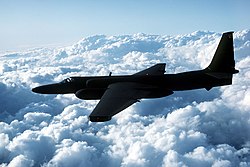
The Lockheed U-2, nicknamed the "Dragon Lady", is an American single-engine, high–altitude reconnaissance aircraft operated by the United States Air Force (USAF) and the Central Intelligence Agency (CIA) since the 1950s. Designed for all-weather, day-and-night intelligence gathering at altitudes above 70,000 feet (21,300 meters), the U-2 has played a pivotal role in aerial surveillance for decades.[1]
Key Information


Lockheed Corporation originally proposed the aircraft in 1953. It was approved in 1954, and its first test flight was in 1955. Between 1956 and 1962, U-2 aircraft conducted covert reconnaissance missions over the Soviet Union, China, Vietnam, and Cuba, gathering critical imagery intelligence throughout the Cold War. In 1960, CIA pilot Gary Powers was shot down in a U-2C over the Soviet Union by a surface-to-air missile (SAM). Major Rudolf Anderson Jr. was shot down in a U-2 during the Cuban Missile Crisis in 1962.
U-2s have taken part in post-Cold War conflicts in Afghanistan and Iraq, and supported several multinational NATO operations. Beyond tactical surveillance, U-2s have supported the development of electronic sensors, calibrated space-based instruments, conducted high-altitude atmospheric experiments, and tested line-of-sight and over-horizon communications systems. The U-2 is one of a handful of aircraft types to have served the USAF for over 50 years, along with the Boeing B-52, Boeing KC-135, Lockheed C-130 and Lockheed C-5. The newest models (TR-1, U-2R, U-2S) entered service in the 1980s, and the latest model, the U-2S, had a technical upgrade in 2012. The U-2 is currently operated by the USAF and NASA.
Development
[edit]Background
[edit]After World War II, the U.S. military desired better strategic aerial reconnaissance to help determine Soviet capabilities and intentions, and to prevent being caught off-guard as it had been in the attack on Pearl Harbor. The Air Force commissioned the 'Beacon Hill Report' from Project Lincoln at the Massachusetts Institute of Technology, which was researched in 1951–1952 and delivered in 1952. The committee was led by Carl F. P. Overhage and was overseen by the Air Force's Gordon P. Saville, and included James Gilbert Baker and Edwin H. Land, who would design the specialized optics in the U-2.[2]
During the early 1950s, the best intelligence the American government had on facilities deep inside the Soviet Union were World War II German Luftwaffe photographs taken during the war of territory west of the Ural Mountains, so overflights to take aerial photographs of the Soviet Union would be necessary. The committee suggested a plane with advanced optics, flying above 70,000 feet (21,300 m).[3][4][5]
After 1950, Soviet air defenses consistently intercepted all aircraft near the country's borders—sometimes even those in Japanese airspace. Existing US reconnaissance aircraft, primarily bombers converted for reconnaissance duty such as the Boeing RB-47, were vulnerable to anti-aircraft artillery, missiles, and fighters. Richard Leghorn of the United States Air Force suggested that an aircraft that could fly at 60,000 feet (18,300 m) should be safe from the MiG-17, the Soviet Union's best interceptor aircraft, which could barely reach 45,000 feet (13,700 m). He and others believed that Soviet radar, which used American equipment provided during the war, could not track aircraft above 65,000 feet (19,800 m).[6]
At the time, the highest-flying aircraft available to the US and its allies was the English Electric Canberra, which could reach 48,000 feet (14,600 m). The British had already produced the PR3 photo-reconnaissance variant, but the USAF asked for English Electric's help to further modify the American-licensed version of the Canberra, the Martin B-57, with long, narrow wings, new engines, and a lighter airframe to reach 67,000 feet (20,400 m). The U.S. Air Research and Development Command mandated design changes that made the aircraft more durable for combat, but the resulting RB-57D aircraft of 1955 could only reach 64,000 feet (19,500 m). The Soviet Union, unlike the United States and Britain, had improved radar technology after the war, and could track aircraft above 65,000 feet (19,800 m).[7]
Lockheed proposal
[edit]It was thought that an aircraft that could fly at 70,000 feet (21,300 m) would be beyond the reach of Soviet fighters, missiles, and radar.[8] Another Air Force officer, John Seaberg, wrote a request for proposal in 1953 for an aircraft that could reach 70,000 feet (21,300 m) over a target with 1,500 nmi (1,700 mi; 2,800 km) of operational radius. The USAF decided to solicit designs only from smaller aircraft companies that could give the project more attention.[9] Under the code name "Bald Eagle", it gave contracts[10] to Bell Aircraft, Martin Aircraft, and Fairchild Engine and Airplane to develop proposals for the new reconnaissance aircraft. Officials at Lockheed Aircraft Corporation heard about the project and decided to submit an unsolicited proposal. To save weight and increase altitude, Lockheed executive John Carter suggested that the design eliminate landing gear and not attempt to meet combat load factors for the airframe. The company asked Clarence "Kelly" Johnson to come up with such a design. Johnson was Lockheed's best aeronautical engineer,[11] responsible for the P-38 and the P-80. He was also known for completing projects ahead of schedule, working in a separate division of the company, informally called the "Skunk Works".[12]

Johnson's design, named CL-282, was based on the Lockheed XF-104 with long, slender wings and a shortened fuselage. The design was powered by the General Electric J73 engine and took off from a special cart and landed on its belly. It could reach an altitude of 73,000 feet (22,300 m) and had a 1,600 mi (1,400 nmi; 2,600 km) radius.[13] The reconnaissance aircraft was essentially a jet-powered glider. In June 1954, the USAF rejected the design in favor of the Bell X-16 and the modified B-57. Reasons included the lack of landing gear, use of the J73 engine instead of the more proven Pratt & Whitney J57 used by the competing designs, and not using multiple engines, which the USAF believed to be more reliable. General Curtis LeMay of Strategic Air Command (SAC) walked out during a CL-282 presentation, saying that he was not interested in an airplane without wheels or guns.[14] Having guns could pose a greater risk of exposing the aircraft during flight, and having missiles could expose it to thermal sensors.[citation needed]
Approval
[edit]Civilian officials including Trevor Gardner, an aide to Secretary of the Air Force Harold E. Talbott, were more positive about the CL-282 because of its higher potential altitude and smaller radar cross-section, and recommended the design to the Central Intelligence Agency's Office of Scientific Intelligence. At that time, the CIA depended on the military for overflights, and Director of Central Intelligence Allen Dulles favored human over technical intelligence-gathering methods. However, the Intelligence Systems Panel, a civilian group advising the USAF and CIA on aerial reconnaissance, had recognized by 1954 that the RB-57D would not meet the 70,000 feet (21,300 m) requirement that panel member Allen F. Donovan of Cornell Aeronautical Laboratory believed was necessary for safety. The CIA told the panel about the CL-282. The design elements that the USAF considered to be flaws (the single-engine and light load factor) appealed to Donovan. He was a sailplane enthusiast who believed that a sailplane was the type of high-altitude aircraft the panel was seeking.[15]
Edwin Land, the developer of instant photography and another member of the panel, proposed to Dulles through Dulles' aide, Richard M. Bissell Jr., that his agency should fund and operate this aircraft. Land believed that if the military, rather than the CIA, operated the CL-282 during peacetime, such action could provoke a war. Although Dulles remained reluctant to have the CIA conduct its own overflights, Land and James Killian of MIT told President Eisenhower about the aircraft; Eisenhower agreed that the CIA should be the operator. Dulles finally agreed, but some USAF officers opposed the project because they feared it would endanger the RB-57D and X-16.
The USAF's Seaberg helped persuade his own agency to support the CL-282, albeit with the higher-performance J57 engine, and final approval for a joint USAF-CIA project (the first time the CIA dealt with sophisticated technology) came in November 1954. Lockheed had meanwhile become busy with other projects and had to be persuaded to accept the CL-282 contract after its approval.[16]
Manufacture
[edit]Bissell became head of the project, which used covert funding; under the Central Intelligence Agency Act of 1949, the CIA's director is the only federal government employee who can spend "unvouchered" government money. Lockheed received a $22.5 million contract (equivalent to $264.1 million in 2024) in March 1955 for the first 20 aircraft, with the first $1.26 million ($14.79 million in 2024) mailed to Johnson's home in February 1955 to keep work going during negotiations. The company agreed to deliver the first aircraft by July of that year and the last by November 1956. It did so, and for $3.5 million ($40.5 million in 2024) under budget.[17] The Flight Test Engineer in charge was Joseph F. Ware Jr.[18]
Initial design and manufacturing was done at Lockheed's Skunk Works factory in Burbank, California, with engineers embedded in the manufacturing area to address problems quickly. Procurement of the aircraft's components occurred secretly. When Johnson ordered altimeters calibrated to 80,000 feet (24,400 m) from a company whose instruments only went to 45,000 feet (13,700 m), the CIA set up a cover story involving experimental rocket aircraft. Shell Oil developed a new low-volatility, low vapor pressure jet fuel that would not evaporate at high altitudes; the fuel became known as JP-7. Manufacturing several hundred thousand gallons for the aircraft in 1955 caused a nationwide shortage of Esso's FLIT insecticide.[19]
Realizing the plane could not be tested and flown out of Burbank Airport, they selected what would become Area 51. It was acquired and a paved runway constructed for the project. The planes were dismantled, loaded onto cargo planes, and flown to the facility for testing. The aircraft was renamed the U-2 in July 1955, the same month the first aircraft, Article 341, was delivered to Groom Lake. The "U" referred to the deliberately vague designation "utility" instead of "R" for "reconnaissance", and the U-1 and U-3 aircraft already existed.[19] The CIA assigned the cryptonym AQUATONE to the project, with the USAF using the name OILSTONE for their support to the CIA.[20]

James Baker developed the optics for a large-format camera to be used in the U-2 while working for Perkin-Elmer. The new camera had a resolution of 2.5 feet (76 cm) from an altitude of 60,000 feet (18,000 m).[21] The aircraft was so crowded that when Baker asked Johnson for six more inches (15 cm) of space for a lens with a 240-inch (610 cm) focal length, Johnson replied "I'd sell my grandmother for six more inches!"; Baker instead used a 180-inch (460 cm) f/13.85 lens in a 13 in × 13 in (33 cm × 33 cm) format for his final design.[22]
Fuel
[edit]The U-2 has used Jet Propellant Thermally Stable (JPTS) since the aircraft's development in the 1950s. JPTS is a high thermal stability, high altitude fuel, created specifically for the U-2. JPTS has a lower freeze point, higher viscosity, and higher thermal stability than standard USAF fuels. In 1999, the Air Force spent approximately $11.3 million (equivalent to $20.58 million in 2023 dollars) on fuel for the U-2 aircraft and was looking for a lower-cost alternative. JPTS is a specialty fuel and as such has limited worldwide availability and costs over three times the unit volume price of USAF's primary jet fuel, JP-8. Research was carried out to find a cheaper and easier alternative involving additives to generally used jet fuels. A JP-8 based alternative, JP-8+100LT, was being considered in 2001. JP-8+100 has increased thermal stability by 100 °F (56 °C) over stock JP-8, and is only 0.5 cents per gallon more expensive; low-temperature additives can be blended to this stock to achieve desired cold performance.[23]
The small landing gear made a perfect balance in the fuel tanks essential for a safe landing. Similarly to sailplanes, the U-2 has a yaw string on the canopy to detect slip or skid during the approach. A skid during flight with no bank is the hint of an imbalance around the longitudinal axis which could be resolved by moving the fuel to the left or right wing tank.[24]
Radar cross-section reduction
[edit]When the first overflights of the Soviet Union were tracked by radar, the CIA initiated Project Rainbow to reduce the U-2's radar cross-section. This effort ultimately proved unsuccessful, and work began on a follow-on aircraft, which resulted in the Lockheed A-12 Oxcart.[25]
Possible successor
[edit]In August 2015, the 60th anniversary of the U-2 program, Lockheed Martin's Skunk Works revealed they were internally developing a successor to the U-2, referred to as the UQ-2 or RQ-X, combining features from both the manned U-2 and unmanned Northrop Grumman RQ-4 Global Hawk and improving upon them. Disclosed details say the design is essentially an improved U-2 airframe with the same engine, service ceiling, sensors, and cockpit, with the main differences being an optional manning capability (something Lockheed has proposed for the U-2 to the USAF several times, but has never gained traction) and low-observable characteristics. The USAF has no requirement or schedule for a next-generation High-Altitude Long Endurance (HALE) platform, but Lockheed sees a future need and wants something in development early. The company's last attempt to create a stealth unmanned aircraft was the RQ-3 DarkStar, which never made it past flight testing and was canceled.[26] Plans for a U-2 replacement would not conflict with the development of the SR-72, another project by the company to create a hypersonic unmanned surveillance plane, as it would be suited for missions that require greater speed for time-sensitive targets.[27]
The company released a notional artist's impression of the TR-X aircraft at an Air Force Association conference in Washington on 14 September 2015. Its name was changed to mean "tactical reconnaissance" to reflect its purpose as an affordable peace and wartime intelligence, surveillance and reconnaissance (ISR) aircraft, distinguishing it from strategic, penetrating SR-71-class platforms; TR is a reference to the short-lived rebranding of the U-2 as the TR-1 in the 1980s. Size, and thus cost, is kept down by having less endurance than the Global Hawk at around 20 hours, which is still about the same time as a normal RQ-4 sortie even though it is capable of flying for 34 hours. The TR-X concept is aimed squarely at USAF needs and is not currently being marketed to the CIA or other government agencies. It would have increased power and cooling to accommodate new sensors, communication equipment, electronic warfare suites, and perhaps offensive or defensive laser weapons. TR-X could be ready for service in the 2025 timeframe, with a fleet of 25–30 aircraft proposed to replace the nearly 40-aircraft mix of U-2s and RQ-4s.[28][29][30]
Lockheed Martin revealed more specifications about the TR-X concept at a 15 March 2016 media day, confirming the aircraft would be unmanned and air refuelable. Its maximum takeoff weight would be greater than either the U-2's or RQ-4's at around 54,000 lb (24,000 kg), with a 5,000-pound (2,300 kg) payload and 130-foot (40 m) wingspan. It will use the same F118-101 turbofan and generator as the U-2, but thrust could increase to 19,000 pounds (8,600 kg) and power increased to 65–75 kVA; service ceiling would increase to 77,000 ft (23,000 m) with a second engine. The TR-X is meant to be "survivable, not unnoticeable", operating outside of enemy air defense bubbles rather than penetrating into them.[31]
Avionics Tech Refresh
[edit]In 2020, the US Air Force awarded the Avionics Tech Refresh contract to Lockheed Martin for upgrading the U-2.[32] In February 2020, the flight tests and the installation of new electro-optical reconnaissance systems were completed. SYERS-2C cameras manufactured by Collins Aerospace equip the entire U-2S fleet. The contract is valued at $50 million.[33] The U-2S's ISR very high altitude mission requires changes for avionics suite for the U-2's onboard systems, a new mission computer designed to the U.S. Air Force's open mission systems standard[34] and a new and modern cockpit displays (primary flight display or PFD).[35]
The avionics upgrades are scheduled to be completed by 2022. Lockheed Martin then plans to refresh the U-2's sensors and other electronic systems, to act as a node in the Advanced Battle Management System (ABMS) now under development.[36]
Design
[edit]
The design that gives the U-2 its remarkable performance also makes it a difficult aircraft to fly. Martin Knutson said that it "was the highest workload air plane I believe ever designed and built … you're wrestling with the airplane and operating the camera systems at all times", leaving no time to "worry about whether you're over Russia or you're flying over Southern California".[37] The U-2 was designed and manufactured for minimum airframe weight, which results in an aircraft with little margin for error.[21] Most aircraft were single-seat versions, with only five two-seat trainer versions known to exist.[38] Early U-2 variants were powered by Pratt & Whitney J57 turbojet engines.[39] The U-2C and TR-1A variants used the more powerful Pratt & Whitney J75 turbojet. The U-2S and TU-2S variants incorporated the more powerful General Electric F118 turbofan engine.[40]
High aspect ratio wings give the U-2 glider-like characteristics, with an engine out glide ratio of about 23:1,[41] comparable to gliders of the time. To maintain their operational ceiling of 70,000 feet (21,000 m), the early U-2A and U-2C models had to fly very near their never-exceed speed (VNE). The margin between that maximum speed and the stall speed at that altitude was only 10 knots (12 mph; 19 km/h). This narrow window is called the "coffin corner",[42][43] because breaching either limit was likely to cause airflow separation at the wings or tail.[44] For most of the time on a typical mission the U-2 was flying less than five knots (6 mph; 9 km/h) above stall speed. A stall would cause a loss of altitude, possibly leading to detection and overstress of the airframe.[21]
The U-2's flight controls are designed for high-altitude flight; the controls require light control inputs at operational altitude. However, at lower altitudes the higher air density and lack of a power-assisted control system make the aircraft very difficult to fly: control inputs must be extreme to achieve the desired response, and a great deal of physical strength is needed to operate the controls. The U-2 is very sensitive to crosswinds, which, together with its tendency to float over the runway, makes the aircraft notoriously difficult to land. As it approaches the runway, the cushion of air provided by the high-lift wings in ground effect is so pronounced that the U-2 will not land unless the wings are fully stalled. A landing U-2 is accompanied on the ground by a chase car, which is driven by a second U-2 pilot who assists the landing U-2 by reporting the aircraft's altitude.[45][46] In practice, once the aircraft has descended to an altitude of two feet (0.61 m) above the runway the pilot initiates a stall and the aircraft falls from this height. Chase cars and live calling of aircraft altitude are necessary because the landing gear is not designed to absorb the weight of the aircraft when falling from altitudes much above two feet (0.61 m).
Instead of the typical tricycle landing gear, the U-2 uses a bicycle configuration with a forward set of main wheels located just behind the cockpit and a rear set of main wheels located behind the engine. The rear wheels are coupled to the rudder to provide steering during taxiing. To maintain balance while taxiing and take-off, two auxiliary wheels called "pogos" are attached under the wings. These fit into sockets underneath each wing at about mid-span and fall off at takeoff. To protect the wings during landing, each wingtip has a titanium skid. After the U-2 comes to a halt, the ground crew re-installs the pogos, then the aircraft taxis to parking.[47]
Because of the high operating altitude and the cockpit's partial pressurization, equivalent to 28,000 feet (8,500 m) pressure altitude, the pilot wears a pressurized space suit called the S1034,[48] which delivers the pilot's oxygen supply and provides emergency protection in case cabin pressure is lost. While pilots can drink water and eat various liquid foods in squeezable containers[49] through a self-sealing hole in the face mask, they typically lose up to 5% of their body mass on an eight-hour mission.[50]
Initially, pilots had the option of carrying a suicide pill, although most chose not to. If put in the mouth and bitten, the "L-pill"—containing liquid potassium cyanide—would cause death in 10–15 seconds. After a pilot almost accidentally ingested an L-pill instead of candy during a December 1956 flight, the suicide pills were put into boxes to avoid confusion. When in 1960 the CIA realized that a pill breaking inside the cockpit would kill the pilot, it destroyed the L-pills, and as a replacement, its Technical Services Division developed a needle poisoned with a powerful shellfish toxin and hidden in a silver dollar. Only one was made because the agency decided if any pilot needed to use it the program would probably be canceled.[51] Like the suicide pill, not all pilots carried the coin, and Knutson did not know of any that intended to commit suicide; he carried it as a weapon to escape in the event of capture.[37]
To decrease the risk of developing decompression sickness, pilots breathe 100% oxygen for an hour prior to taking off to remove nitrogen from the blood. A portable oxygen supply is used during transport to the aircraft.[52] Since 2001, more than a dozen pilots have reportedly suffered the effects of decompression sickness, including permanent brain damage in nine cases; initial symptoms include disorientation and becoming unable to read. Factors increasing the risk of illness since 2001 include longer mission durations and more cockpit activity. Conventional reconnaissance missions would limit pilot duties to maintaining flight paths for camera photography. Operations over Afghanistan included more real-time activities, such as communication with ground troops, increasing their bodies' oxygen requirements and the risk of nitrogen bubble formation. U-2 pilots now exercise during oxygen pre-breathing.[53] In 2012, modifications were initiated under the Cockpit Altitude Reduction Effort (CARE), increasing the cabin pressure from 3.88 psi to 7.65 psi, a 15,000-foot (4,600 m) altitude equivalent. The urine collection device also was rebuilt to eliminate leakage.[49][54]
Sensors
[edit]
Existing cameras had ground resolution down to 23 feet (7 m) from an altitude of 33,000 feet (10,000 m), and were inadequate for the 70,000 feet (21,000 m) altitude. Ground resolution of 9.8 feet (3 m) was required, at a maximum payload weight of 440 pounds (200 kg). The U-2's camera was specially designed by James G. Baker of Harvard and Richard Scott Perkin of the Perkin-Elmer Company, initially in collaboration and later separately.[55]
Initial missions were flown with the trimetrogon "A" camera, consisting of three 24-inch-focal-length (610 mm) cameras, with F/8 resolving 60 lines per mm, and the ground resolution can be inferred by calculation to be 24 inches (60 cm). This was followed by the "B" camera with a 36-inch-focal-length (910 mm) lens with F/10 and image motion compensation, resolving 100 lines per mm, and the ground resolution can be inferred by calculation to be 9.1 inches (23 cm). It was a panoramic camera which took pictures of an extremely large area of the earth's surface. The lens design consisted of a single aspheric singlet lens. Six-thousand-foot (1,800 m) reels of film were used, with the emulsion being coated on a polyester (PET) base that offered significantly improved dimensional stability over extremes of temperature and humidity compared to conventional cellulose acetate.[56][57]
In addition, the U-2 also carried a low-resolution Perkin-Elmer tracking camera using a 3-inch (7.6 cm) lens, which made continuous horizon-to-horizon photographs. This is common practice in high resolution cameras in later systems also, where the large image helps localize the small high-resolution images.
The aircraft carries a variety of sensors in the nose, Q-bay (behind the cockpit, also known as the camera bay), and wing pods. The U-2 is capable of simultaneously collecting signals, imagery intelligence and air samples. Imagery intelligence sensors include either wet film photography, electro-optic, or radar imagery—the latter from the Raytheon ASARS-2 system. It can use both line-of-sight and over-horizon data links.
Operational history
[edit]United States
[edit]_with_a_U-2.jpg)
Pilot selection and training
[edit]Though the USAF and the Navy would eventually fly the U-2, the CIA had majority control over the project, code-named Project DRAGON LADY.[58] Despite SAC chief LeMay's early dismissal of the CL-282, the USAF in 1955 sought to take over the project and put it under SAC until Eisenhower repeated his opposition to military personnel flying the aircraft. Nonetheless, the USAF substantially participated in the project; Bissell described it as a "49 percent" partner. The USAF agreed to select and train pilots and plot missions, while the CIA would handle cameras and project security, process film, and arrange foreign bases.[59]
Beyond not using American military personnel to fly the U-2, Eisenhower preferred to use non-U.S. citizens. Seven Greek pilots and a Polish expatriate were added to the U-2 trainees although only two of the Greek pilots were subsequently allowed to fly the aircraft. Their flight proficiency was poor. The language barrier and a lack of appropriate flying experience proved problematic; by late 1955, foreign pilots had been dropped from the program.[60][61] USAF pilots had to resign their military commissions before joining the agency as civilians, a process referred to as "sheep dipping",[21] and were always called "drivers", not pilots. The program only recruited fighter pilots with reserve USAF commissions, as regular commissions complicated the resignation process. The program offered high salaries and the USAF promised that pilots could return at the same rank as their peers. The CIA's standards for selection were higher than the USAF's once the latter began its own U-2 flights; although more candidates were rejected, the CIA's program had a much lower accident rate. Test pilot Tony LeVier trained other Lockheed pilots to fly the U-2. By September 1955 he had trained six USAF pilots, who in turn trained other "sheep-dipped" pilots. As no two-seat trainer model was available for the program's first 15 years, training was done before the trainee's first solo flight and via radio. Pilots had to adjust to the U-2's unusual combination of jet engines and enormous, high-lift glider wings; because of the "coffin corner" they learned of the need to pay complete attention to flying when not using the autopilot.[62]
Test flights
[edit]
After AQUATONE was funded and security handled by the CIA, the agency referred to all its high altitude aircraft as "articles". This was intended to reduce the chances of a security breach as part of a compartmented security system. These three-digit "article" numbers were factory assigned. Article 341 was the original U-2 prototype, and it never received a USAF serial.[63] The first flight took place at Groom Lake on 1 August 1955, during what was intended to be only a high-speed taxi test. The sailplane-like wings were so efficient that the aircraft jumped into the air at 70 knots (81 mph; 130 km/h),[21] amazing LeVier who, as he later said, "had no intentions whatsoever of flying". The lake bed had no markings, making it difficult for LeVier to judge the distance to the ground, and the brakes proved too weak; he bounced the U-2 once before it stopped rolling, but the aircraft suffered only minor damage. LeVier again found landing the U-2 difficult during the first intentional test flight three days later. On his sixth try, he found that landing the aircraft by touching down on the rear wheel first was better than making the initial touchdown with the front wheel. Pilots continued to have difficulty during landing because the ground effect held the aircraft off the runway for long distances. On a test flight on 8 August, the U-2 reached 32,000 feet (9,800 m), proving that Johnson had met his promised specifications and deadline. By 16 August, the prototype flew at 52,000 feet (15,800 m), an altitude never before reached in sustained flight; by 8 September, it reached 65,000 feet (19,800 m).[64]
By January 1956, the U-2 had so impressed the USAF that it decided to obtain its own aircraft. The USAF purchased a total of 31 U-2s through the CIA; the transaction's code name, Project DRAGON LADY, was the origin of the aircraft's nickname. Meanwhile, U-2s conducted eight overflights of the U.S. in April 1956, convincing project overseers that the aircraft was ready for deployment. As often happens with new aircraft designs, there were several operational accidents. One occurred during these test flights when a U-2 suffered a flameout over Tennessee[dubious – discuss]; the pilot calculated that he could reach New Mexico. Every air base in the continental U.S. had sealed orders to carry out if a U-2 landed. The commander of Kirtland Air Force Base near Albuquerque, New Mexico, was told to open his orders, prepare for the arrival of an unusual aircraft making a deadstick landing, and get it inside a hangar as soon as possible. The U-2 successfully landed after gliding for more than 300 miles (480 km), and its strange, glider-like appearance and the space-suited pilot startled the base commander and other witnesses.[65]

Not all U-2 incidents were so benign, with three fatal accidents in 1956 alone. The first was on 15 May 1956, when the pilot stalled the aircraft during a post-takeoff maneuver that was intended to drop off the wingtip outrigger wheels. The second occurred on 31 August, when the pilot stalled the aircraft immediately after takeoff. On 17 September, a third aircraft disintegrated during ascent in Germany, also killing the pilot.[66] There were other non-fatal incidents, including at least one that resulted in the loss of the aircraft.
Cover story
[edit]A committee of Army, Navy, USAF, CIA, NSA, and State Department representatives created lists of priority targets for U-2 and other intelligence-gathering methods. The U-2 project received the list and drew up flight plans, and the committee provided a detailed rationale for each plan for the president to consider as he decided whether to approve it. The CIA's Photo Intelligence Division grew in size to prepare for the expected flood of U-2 photographs. Before the aircraft became operational, however, USAF's Project Genetrix, which used high-altitude balloons to photograph the Soviet Union, China, and eastern Europe, led to many diplomatic protests from those countries and for a while, CIA officials feared that the U-2 project was at risk. While Genetrix was also a technical failure—only 34 of the 516 balloons returned usable photographs—the balloon flights gave the United States many clues on how the Communist countries used radar to track overflights, which benefited the U-2 program.[67]
With approval from the National Advisory Committee for Aeronautics (NACA)'s director Hugh Dryden, Bissell's team at the CIA developed a cover story for the U-2 that described the aircraft as used by NACA for high-altitude weather research; the cover story would be used if the aircraft were lost over hostile territory. U-2s flew some real weather-related missions, taking photographs that appeared in the press,[68][69] and sometimes had civilian government decals,[70] but few believed in the cover story; in May 1957 the UK's Daily Express newspaper reported the U-2 operating east of the Iron Curtain.[69]
The civilian advisers Land and Killian disagreed with the cover story, advising that in case of an aircraft loss, the United States forthrightly acknowledge its use of U-2 overflights "to guard against surprise attack". Their advice was not followed, and the weather cover story led to the disaster that followed the May 1960 U-2 loss.[68]
Initial overflights of Communist territory
[edit]The British government in January 1956 approved the U-2's deployment from RAF Lakenheath. NACA announced that the USAF Air Weather Service would use a Lockheed-developed aircraft to study the weather and cosmic rays at altitudes up to 55,000 feet; accordingly, the first CIA detachment of U-2s ("Detachment A") was known publicly as the 1st Weather Reconnaissance Squadron, Provisional (WRSP-1). The death in April 1956, however, of British agent Lionel Crabb while examining Soviet ships in Portsmouth harbor embarrassed the British government, which asked the United States to postpone the Lakenheath flights. To avoid delays, in June 1956, Detachment A moved to Wiesbaden, Germany, without approval from the German government, while Giebelstadt Army Airfield was prepared as a more permanent base.[71]
Eisenhower remained concerned that despite their great intelligence value, overflights of the Soviet Union might cause a war. While the U-2 was under development, at the 1955 Geneva Summit he proposed to Nikita Khrushchev that the Soviet Union and the United States would each grant the other country airfields to use to photograph military installations. Khrushchev rejected the "Open Skies" proposal.[72]
The CIA told the president that the Soviets could not track high-altitude U-2 flights; this belief was based on studies using old Soviet radar systems and American systems that were not as effective at high altitudes as current Soviet systems, of which the U.S. was not aware. Knutson later said that "the U-2 was really quite invisible to American radar, but Russian radar were a little different—better, you might say". Although the Office of Scientific Intelligence issued a more cautious report in May 1956 that stated that detection was possible, it believed that the Soviets could not consistently track the aircraft. Dulles further told Eisenhower, according to presidential aide Andrew Goodpaster, that in any aircraft loss the pilot would almost certainly not survive. With such assurances and the growing demand for accurate intelligence regarding the alleged "bomber gap" between the U.S. and the Soviet Union, in June 1956 Eisenhower approved 10 days of overflights.[73][37]
The first U-2 overflight had already occurred, using the existing authorization of air force overflights over Eastern Europe. On 20 June 1956, a U-2 flew over Poland and East Germany, with more flights on 2 July. When Eisenhower refused to approve the U-2's flight over Soviet airspace, the CIA turned to a foreign power, MI6, the British Secret Intelligence Service, to request authorization from Prime Minister of the United Kingdom Harold Macmillan, who approved the flights.[74] The fact that radar had—contrary to the CIA's expectations—successfully tracked the aircraft worried Eisenhower, but he approved the first Soviet overflight, Mission 2013 on 4 July. U-2 Article 347's main targets were the Soviet submarine construction program in Leningrad, and counting the numbers of the new Myasishchev M-4 "Bison" bomber.
Soviet radar monitored the U-2 incursion into Soviet airspace in real-time, with radar tracking starting from the time the aircraft crossed into East German airspace. Soviet leader Nikita Khrushchev was informed immediately.[citation needed] While contemplating appropriate retaliatory steps, he ordered Soviet Ambassador to Washington, Georgy Zarubin, to protest vehemently to the U.S. State Department that very day, explaining that the recent trust-building to ease tensions between the two countries was undermined by the overflight provocations.[75]
A second flight on 5 July continued searching for Bisons, took photographs of Moscow (the only ones taken by the program), and flew over cloud-covered[76] rocket factories at Kaliningrad and Khimki. Eisenhower knew from the earlier overflights that his hope of no Soviet detection was unrealistic, but ordered that the overflights stop if the aircraft could be tracked. The CIA found that the Soviets could not consistently track the U-2s and therefore did not know that Moscow and Leningrad had been overflown. The aircraft's photographs showed tiny images of MiG-15s and MiG-17s attempting and failing to intercept the aircraft, proving that the Soviets could not shoot down an operational U-2.[77] Knutson recalled that the "constant stream of Russian fighters" trying to shoot down the U-2 during overflights was sometimes "so thick" that they interfered with photographs. Repeatedly failing for years to stop the aircraft embarrassed the USSR, which made diplomatic protests against the flights but did not publicize the penetration of Soviet territory.[37]
U-2 missions from Wiesbaden would depart westward in order to gain altitude over friendly territory before turning eastward at operational altitudes. The NATO Air Defence mission in that area included No. 1 Air Division RCAF (Europe), which operated the Canadair Sabre Mark 6 from bases in northeastern France. This aircraft had a service ceiling of 54,000 feet and numerous encounters between the U-2 and RCAF 'ZULU' alert flights have been recorded for posterity.[78]
"Bomber gap" disproven
[edit]On 10 July, the Soviets protested what they described as overflights by a USAF "twin-engine medium bomber", apparently believing that it was a B-57 Canberra. The U.S. replied on 19 July that no American "military planes" had overflown the Soviet Union, but the fact that the Soviets' report showed that they could track the U-2s for extended periods caused Eisenhower to immediately halt overflights over eastern Europe. Beyond the Soviet protests, the president was concerned about the American public's reaction to the news that the U.S. had violated international law. To avoid project cancellation, the CIA began Project Rainbow to make the U-2 less detectable. The eight overflights over communist territory, however, had already shown that the bomber gap did not exist; the U-2s had not found any Myasishchev M-4 Bison bombers at the nine bases they had visited. Because the Eisenhower administration could not disclose the source of its intelligence, however, Congressional and public debate over the bomber gap continued.[79]
Suez Crisis and aftermath
[edit]The presidential order did not restrict U-2 flights outside eastern Europe. In May 1956, Turkey approved the deployment of Detachment B at Incirlik Air Base, near Adana, Turkey. Before the new detachment was ready, however, Detachment A in late August used Adana as a refueling base to photograph the Mediterranean. The aircraft found evidence of many British troops on Malta and Cyprus as the United Kingdom prepared for its forthcoming intervention in Suez. The U.S. released some of the photographs to the British government. As the crisis grew in seriousness, the project converted from a source of strategic reconnaissance, which prioritized high quality over speed (the film was processed by its maker, then analyzed in Washington), to a tactical reconnaissance unit that provided immediate analysis. The Photo Intelligence Division set up a lab at Wiesbaden; as Detachment B took over from A and flew over targets that remain classified as of July 2013[update], the Wiesbaden lab's rapid reports helped the U.S. government to predict the Israeli-British-French attack on Egypt three days before it began on 29 October. On 1 November a flight flew over the Egyptian air base at Almaza twice, 10 minutes apart; in between the British and French attacked the base, and the visible results of the attack in the "10-minute reconnaissance" impressed Eisenhower. Beginning on 5 November, flights over Syria showed that the Soviets had not sent aircraft there despite their threats against the British, French and Israelis, a cause of worry for the U.S.[80]
In the four years following the Suez Crisis, repeated U-2 missions over the Middle East were launched, particularly in times of tension. The end of the 1958 Lebanon crisis saw a decline in U-2 operations, although Detachment B U-2s operating from Turkey still sometimes overflew the Middle East along with occasional missions over Albania to check for Soviet missile activity. Israel was a major target of U-2 missions during this period, with U-2 missions detecting the construction of the Negev Nuclear Research Center in 1958, first bringing Israel's nuclear program to the attention of the US. The overflights drew the attention of the Israeli Air Force. Its radars detected and tracked the overflights, and on numerous occasions, Israeli fighter aircraft were scrambled to intercept them but were unable to reach their altitude. The Israeli government was baffled by the overflights. However, Israeli fighter pilots were twice able to spot the intruding aircraft. On 11 March 1959, two Israeli Super Mystère fighters were directed to intercept a U-2 detected over Israel by Israeli ground-based radar. Although the aircraft were unable to make an intercept, the formation leader, Major Yosef Alon, managed to get a good look at the aircraft. He subsequently identified it out of a book as a U-2, registered as a weather reconnaissance aircraft to the US Weather Service. On 22 July 1959, after an overflight was detected, an Israeli Air Force Vautour jet was deployed to photograph the mysterious aircraft. The Vautour came within visual range and the U-2 was successfully photographed. In spite of this, it was not until the 1960 shootdown of a U-2 over the Soviet Union and its subsequent public exposure as a spy plane that the Israeli government understood the identity of the mystery aircraft.[81][82][70]
Renewal of Eastern Bloc overflights
[edit]Eisenhower refused CIA pleas in September 1956 to reauthorize overflights of Eastern Europe but the Hungarian Revolution in November, and his reelection that month, caused the president to permit flights over border areas. Soviet interceptors could still not reach the U-2s but, after the Soviets protested a December overflight of Vladivostok by RB-57Ds, Eisenhower again forbade communist overflights. Flights close to the border continued, now including the first ELINT-equipped U-2s. In May 1957, Eisenhower again authorized overflights over certain important Soviet missile and atomic facilities. He continued to personally authorize each flight, closely examining maps and sometimes making changes to the flight plan.[83] By 1957, one of the European units was based at Giebelstadt, and the far eastern unit was based at the Naval Air Facility Atsugi, Japan.[84]
Part of the reason for the May reauthorization was that the CIA promised that improvements from Project RAINBOW would make the majority of U-2 flights undetected. On 2 April 1957, a RAINBOW test flight crashed in Nevada, killing the pilot. The U-2's large wingspan slowed its descent during crashes, often leaving its remains salvageable; Lockheed was able to rebuild the wreckage from the incident into a flyable airframe, but that it could do so should have been evidence to the CIA that its cover story might not be viable after a crash in hostile territory. The RAINBOW anti-radar modifications were not very successful, and their use ended in 1958.[85]
Soviet overflights resumed in June 1957 from Eielson Air Force Base in Alaska to the Russian Far East, which had less effective radar systems. Others originated from Lahore, Pakistan. A Lahore flight on 5 August provided the first photographs[86] of the Baikonur Cosmodrome near Tyuratam: the CIA had been unaware of its existence until then. Other flights examined the Semipalatinsk nuclear test site and the Saryshagan missile test site.[87][88] After a few more overflights that year, only five more took place before the May 1960 incident because of Eisenhower's increasing caution. The president sought to avoid angering the Soviets as he worked to achieve a nuclear test ban; meanwhile, the Soviets began trying to shoot down U-2 flights that never entered Soviet airspace, and the details in their diplomatic protests showed that Soviet radar operators were able to effectively track the aircraft. To reduce visibility Lockheed painted the aircraft in a blue-black color that helped them blend in against the darkness of space, and the CIA aircraft received the more powerful Pratt & Whitney J75-P-13 engine that increased maximum altitude by 2,500 feet (800 m), to 74,600 feet (22,700 m).[89] In April 1958, CIA source Pyotr Semyonovich Popov told his handler George Kisevalter that a senior KGB official had boasted of having "full technical details" of the U-2, leading Bissell to conclude the project had a leak. The source of the leak was never identified, although there was speculation that it was Lee Harvey Oswald, then a radar operator at a U-2 base in Japan.[90]
The Soviets developed their own overflight aircraft, variants of the Yak-25, which in addition to photographing various parts of the world through the early 1960s acted as a target for the new MiG-19 and MiG-21 interceptors to practice for the U-2.
The "missile gap"
[edit]The successful launch of Sputnik 1 on 4 October 1957 gave credence to Soviet claims about the progress of its intercontinental ballistic missile program, and began the Sputnik crisis in the United States. The U-2 intelligence caused Eisenhower to state in a press conference on 9 October that the launch did "not raise my apprehensions, not one iota", but he refused to disclose the U-2's existence as he believed that the Soviets would demand the end of the flights.[91] In December 1958 Khrushchev boasted that a Soviet missile could deliver a 5-megaton warhead 8,000 miles (13,000 km). Although the Soviets' SS-6 Sapwood missile program was actually stalled by technical failures, subsequent boasts—and U.S. secretary of defense Neil McElroy's statement in February 1959 to Congress that the Soviets might have a three-to-one temporary advantage in ICBMs during the early 1960s—caused widespread concern in the U.S. about the existence of a "missile gap". The American intelligence community was divided, with the CIA suspecting technical delays but the USAF believing that the SS-6 was ready for deployment. Khrushchev continued to exaggerate the Soviet program's success; the missile gap concerns, and CIA and State Department support, caused Eisenhower to reauthorize one Communist territory overflight in July 1959 after 16 months, as well as many ELINT flights along the Soviet border. British U-2 overflights were made in December and February 1960. The first one targeted a large segment of the railways in the Tyuratam test range area as ballistic missiles were expected to be deployed close to rail lines, as well as nuclear complexes and missile test sites. No sites were found.[92] Neither flight proved or disproved the existence of a "missile gap". The British flights' success contributed to Eisenhower's authorization of one overflight in April.[93]
By 1960 U-2 pilots were aware, Knutson recalled, that Soviet surface-to-air missiles (SAMs) had improved and that overflights had become much riskier, but did not worry because "dumb fighter pilots always think it's the other guy that's going to get hit".[37] By this time the CIA had also concluded internally that Soviet SAMs had "a high probability of successful intercept at 70,000 feet (21,300 m) providing that detection is made in sufficient time to alert the site". Despite the much-increased risk, the CIA did not stop the overflights as they were overconfident following the years of successful missions, and because of the strong demand for more missile-site photographs, the U-2 was the major source of covert intelligence on the Soviet Union and had photographed about 15% of the country, producing almost 5,500 intelligence reports. The April flight was indeed tracked quickly, and Khrushchev said in his memoir that it should have been shot down by new SAMs, but the missile crews were slow to react.[94][95]
May 1960: U-2 shot down
[edit]
Eisenhower authorized one more overflight, which was to be made no later than 1 May because the important Paris Summit of the Big Four Conference would begin on 16 May.[94][95] The CIA chose for the mission—the 24th deep-penetration Soviet overflight—Operation GRAND SLAM, an ambitious flight plan for the first crossing of the Soviet Union from Peshawar, Pakistan to Bodø, Norway; previous flights had always exited in the direction from which they had entered. The route would permit visits to Tyuratam, Sverdlovsk, Kirov, Kotlas, Severodvinsk, and Murmansk. It was expected, given good weather, to resolve missile, nuclear and nuclear submarine intelligence issues with one flight.[96] Francis Gary Powers, the most experienced pilot with 27 missions, was chosen for the flight. After delays, the flight began on May Day, 1 May. This was a mistake because, as an important Soviet holiday, there was much less air traffic than usual. The Soviets began tracking the U-2 15 miles outside the border, and over Sverdlovsk, four and a half hours into the flight, one of three SA-2 missiles detonated behind the aircraft at 70,500 feet, near enough to cause it to crash; another hit a Soviet interceptor attempting to reach the American aircraft. Powers survived the near miss and was quickly captured; the crash did not destroy the U-2 and the Soviets were able to identify much of the equipment.[97]

Bissell and other project officials believed that surviving a U-2 accident from above 70,000 feet was impossible, so they used the pre-existing cover story. On 3 May, the National Aeronautics and Space Administration (NASA, the successor to NACA) announced that one of its aircraft, making a high-altitude research flight in Turkey, was missing; the government planned to say, if necessary, that the NASA aircraft had drifted with an incapacitated pilot across the Soviet border. By remaining silent, Khrushchev lured the Americans into reinforcing the cover story until he revealed on 7 May that Powers was alive and had confessed to spying on the Soviet Union. Eisenhower turned down Dulles' offer to resign and publicly took full responsibility for the incident on 11 May; by then all overflights had been canceled. The Paris Summit collapsed after Khrushchev, as the first speaker, demanded an apology from the U.S., which Eisenhower refused.[98]
U-2 pilots were told, Knutson later said, if captured "to tell them everything that they knew", because they were told little about their missions other than targets on maps.[37] Otherwise, Powers had little instruction on what to do during an interrogation. Although he had been told that he could reveal everything about the aircraft since the Soviets could learn what they wanted from it, Powers did his best to conceal classified information while appearing to cooperate. His trial began on 17 August 1960. Powers—who apologized on the advice of his Soviet defense counsel—was sentenced to three years in prison, but on 10 February 1962 the USSR exchanged him and American student Frederic Pryor for Rudolf Abel at Glienicke Bridge between West Berlin and Potsdam, Germany. Two CIA investigations found that Powers had done well during the interrogation and had "complied with his obligations as an American citizen during this period". Although the government was reluctant to reinstate him to the USAF because of its statements that the U-2 program was civilian, it had promised to do so after CIA employment ended; Powers resolved the dilemma by choosing to work for Lockheed as a U-2 pilot.[99]
The debris of Powers's aircraft was used to design a copy under the name Beriev S-13. That was then discarded in favor of the MiG-25R and reconnaissance satellites.[100][101]
The search for operational ballistic missile sites continued focusing on the Soviet railway system using Corona satellite images, with a resolution of twenty to thirty feet compared to two to three feet from U-2 cameras.[102]
Restructuring
[edit]The U-2 shootdown in 1960 paralyzed the U.S. reconnaissance community and forced changes in policy, procedures, and security protocol. The United States also had to move swiftly to protect its allies: for example after the Soviets announced that Powers was alive, the CIA evacuated the British pilots from Detachment B as Turkey did not know of their presence in the country.[103] The end of Soviet overflights meant that Detachment B itself soon left Turkey, and in July Detachment C left Japan following a Japanese governmental request. Both detachments merged into Detachment G, under the command of Lt. Col. William Gregory, at Edwards Air Force Base, California where the CIA had relocated the U-2 program after nuclear testing forced it to abandon Groom Lake in 1957.[citation needed]
The CIA sought to determine if the U-2 could, from a fixed base at North Edwards, rapidly deploy to an advanced American base and complete reconnaissance flights on a largely self-sustaining basis. A proving exercise was arranged with Gregory and the new Detachment G unit to simulate deploying a U-2 unit overseas, taking two or three aircraft, and conducting three reconnaissance missions with no resupply. The exercise was critical to continued CIA operation of the U-2, since basing the aircraft in a foreign country was no longer an option. The exercise was completed with excellent results, and actual reconnaissance missions began to be scheduled immediately.[104]
On 4 January 1961, the CIA U-2 reconnaissance effort, which was formerly known as CHALICE, was redesignated IDEALIST.[105] This program codeword by the end of the decade was being used to describe the U.S. reconnaissance along the Chinese coastline, while Taiwanese missions into the Chinese country would be known as the IDEALIST program[106]
By the next U-2 flight, in October 1960 over Cuba, the previously informal procedure in which the president personally approved or disapproved each flight after discussion with advisors was replaced by the National Security Council Special Group. The expansion of satellite intelligence partly compensated for the overflights' end but, because U-2 photographs remained superior to satellite imagery, future administrations considered resumption at times, such as during the Berlin Crisis of 1961.[107]
Cuba
[edit]
Bay of Pigs Invasion
[edit]As many as 15 U-2 sorties provided support for the April 1961 Bay of Pigs Invasion of Cuba by the United States. Scientists such as Edwin H. Land and James Rhyne Killian, who had originally conceived the U-2 and had advocated for its development and deployment as a tool of scientific reconnaissance, felt betrayed by the use of the U-2 for "dirty tricks" covert operations, such as the Bay of Pigs invasion. Richard M. Bissel, the CIA official in charge of both the U-2 program and CIA covert operations, including the Bay of Pigs Invasion, had been a good friend of Land and Killian, but such use of the U-2s strained their friendship.[108]
From October 1960, Detachment G made many overflights of Cuba from Laughlin Air Force Base, Texas. Although Lockheed modified six CIA aircraft into the aerial refueling-capable U-2F model in 1961, permitting some Cuba missions to originate from Edwards, pilot fatigue limited flights to about 10 hours. An August 1962 flight showed Soviet SA-2 SAM sites on the island; later overflights found more sites and MiG-21 interceptors. The increasing number of SAMs caused the United States to more cautiously plan Cuban overflights. USAF U-2s did not conduct overflights, but officials believed that it would be better for a military officer to be the pilot in case he was shot down. Following one last Cuba overflight that originated from Edwards and ended at McCoy Air Force Base, Florida, on 14 October 1962, all further U-2 operations over Cuba originated from a detachment operating location that was established at McCoy.[109]
Cuban Missile Crisis
[edit]After receiving hasty training on the more powerful U-2F under the cognizance of the Weather Reconnaissance Squadron Provisional (WRSP-4) at Edwards AFB, Major Richard S. Heyser flew over western Cuba on 14 October 1962 in a U-2F; his aircraft was the first to photograph Soviet medium-range ballistic missiles (MRBM) in San Cristóbal before returning to McCoy AFB, Florida. Prior to the launch of all Cuban sorties, the two U-2F aircraft possessed by WSRP-4 and flown by 4080th Strategic Reconnaissance Wing personnel had USAF insignia and tail numbers.[110]
SAC received permission to fly as many Cuban overflights as necessary for the duration of the resulting Cuban Missile Crisis. On a 27 October sortie from McCoy AFB, one of the U-2Fs was shot down over Cuba by an SA-2 Guideline surface-to-air missile, killing the pilot, Major Rudolf Anderson; he posthumously received the first Air Force Cross.[111][112]
Soviet leader Nikita Khrushchev was dismayed, warning President John F. Kennedy in a private message that U-2 overflights could inadvertently cause WWIII: "Is it not a fact that an intruding American plane could be easily taken for a nuclear bomber, which might push us to a fateful step?"[113]
Fulfilling CIA officials' fears of a USAF takeover, CIA pilots never again flew over Cuba; SAC retained control over Cuban overflights,[111][112] which continued until the 1970s under the code name OLYMPIC FIRE.[114]
At the same time as the Cuban crisis, Royal Air Force (RAF) English Electric Lightnings of the Air Fighting Development Squadron made several practice interceptions against U-2s; guided by ground controllers and using energy climb profiles, the Lightning could intercept the U-2 at up to 65,000 ft.[115]
Hickman incident
[edit]On 28 July 1966, a U-2 piloted by USAF Captain Robert Hickman departed from Barksdale Air Force Base to conduct a reconnaissance mission; Hickman's orders included the requirement that he not enter Cuban airspace. As determined later by USAF investigators, trouble with the aircraft's oxygen system caused Hickman to lose consciousness. U.S. Navy pilot John Newlin, flying an F-4B assigned to VF-74, was scrambled from Naval Air Station Key West, ordered to intercept Hickman before he violated Cuban airspace, and, if necessary, shoot him down. Newlin could not reach the U-2 before flying closer than 12 miles from the Cuban coastline and so had to turn back. Hickman probably was dead from oxygen deprivation before the intercept was attempted.[116] Hickman's U-2 flew across Cuba, ran out of fuel and crashed into a mountainside near Llanquera, Bolivia. The Bolivian military gave his remains an honor guard at a nearby chapel. The US embassy to Bolivia sent a team to investigate the crash site.[117]
From 1960 to 1965, U-2 flights originated or terminated on a nearly daily basis at Albrook USAF base. In 1966, elements of the USAF's 4080th Strategic Reconnaissance Wing flew U-2s from Albrook to perform atmospheric sampling as the French detonated a nuclear device in the South Pacific.[citation needed]
Asia
[edit]CIA overflights of Asian targets began in spring 1958 when Detachment C moved from Japan to Naval Air Station Cubi Point in the Philippines to overfly Indonesia during an uprising against Sukarno's "Guided Democracy" government. The CIA's Civil Air Transport, aiding the rebels, so badly needed pilots that it borrowed two CIA U-2 pilots despite the high risk to the U-2 program if one were captured. The Indonesian government soon defeated the rebels, however, and the U-2s returned to Japan. That year, Detachment C also flew over the Chinese coast near Quemoy during the Second Taiwan Strait Crisis to see if Communist Chinese forces were preparing to invade, and in 1959 aided CIA operations during the Tibetan uprising. The unit was collecting high-altitude air samples to look for evidence of Soviet nuclear tests when it was withdrawn from Asia after the May 1960 U-2 incident.[118]
On 24 September 1959, an unmarked U-2, Article 360, crash landed to Fujisawa Airfield of Japan. Armed American security forces in plainclothes soon arrived and moved away locals at gunpoint, increasing public interest in the crash.[69] The unlawfulness of the Black Jet Incident was criticized in Japan's House of Representatives.[119] The same Article 360 was later shot down in the May 1960 U-2 incident. A month before the incident, another U-2 crash landed in rural Thailand. Locals helped the US remove the aircraft without publicity.[69]
Detachment G pilots began using the unmarked Taiwanese "Detachment H" U-2 for North Vietnam overflights in February 1962, but as tactical intelligence became more important, after the Gulf of Tonkin Resolution of August 1964 SAC took over all U-2 missions in Indochina. In late November 1962, Detachment G was deployed to Takhli Royal Thai Air Force Base, Thailand, to carry out overflights of the Chinese-Indian border area after Indian prime minister Jawaharlal Nehru requested military aid following the Sino-Indian War in October–November 1962. In 1963, India agreed to an American request for a permanent U-2 base for Soviet and Chinese targets, offering Charbatia, although it was only briefly used and Takhli remained Department G's main Asian base.[120][121] After the Vietnamese ceasefire in January 1973 prohibited American military flights, CIA pilots again used the unmarked Detachment H U-2 over North Vietnam during 1973 and 1974.[122] Several U-2s were lost over China.[123]
In 1963, the CIA started project Whale Tale to develop carrier-based U-2Gs to overcome range limitations. During the development of the capability, CIA pilots took off and landed U-2Gs on the aircraft carrier Ranger and other ships. The U-2G was used only twice operationally. Both flights from Ranger occurred in May 1964 to observe France's development of an atomic bomb test range at Moruroa in French Polynesia.[124][125]
Vietnam War
[edit]In early 1964, SAC sent a detachment of U-2s from the 4080th to South Vietnam for high altitude reconnaissance missions over North Vietnam. On 5 April 1965, U-2s from the 4028th Strategic Reconnaissance Squadron (SRS) took photos of SAM-2 sites near Hanoi and Haiphong harbor. On 11 February 1966, the 4080th Wing was redesignated the 100th Strategic Reconnaissance Wing (100 SRW) and moved to Davis-Monthan AFB, Arizona. The detachment at Bien Hoa AB, South Vietnam, was redesignated the 349th SRS.[126]
The only loss of a U-2 during combat operations occurred on 9 October 1966, when Major Leo Stewart, flying with the 349th Strategic Reconnaissance Squadron, developed mechanical problems high over North Vietnam. The U-2 managed to return to South Vietnam where Stewart ejected safely. The U-2 crashed approximately 65 miles (105 km) east-northeast of Saigon in Viet Cong (VC) territory. A Special Forces team was later sent to destroy the wreckage.[127] One member stated that they retrieved classified radar jammers from the wreckage before they could be captured by the VC and possibly transferred to the USSR.[128] In July 1970, the 349th SRS at Bien Hoa moved to Thailand and was redesignated the 99th SRS in November 1972, remaining there until March 1976.[129][130]
U-2 carrier operations
[edit]At one time, in an effort to extend the U-2's operating range and to eliminate the need for foreign government approval for U-2 operations from USAF bases in foreign countries, it was suggested that the U-2 be operated from aircraft carriers. Three aircraft were converted for carrier operations by the installation of arrester hooks, and carrier-qualified naval aviators were recruited to fly them.
It turned out to be possible to take off and land a U-2 from a carrier. Testing in 1964 with the USS Ranger and in 1969 with the USS America proved the concept. The only operational carrier use occurred in May 1964 when a U-2, operating from USS Ranger, was used to spy on a French atomic test in the Pacific.[131][132] The Lockheed C-130 was also tested for carrier use to support U-2 sea deployments.[133]
In 1969, the larger U-2Rs were flown from the carrier America. The U-2 carrier program is believed to have been halted after 1969.[134]
1970–2000
[edit]
In August 1970, two U-2Rs were deployed by the National Reconnaissance Office (NRO) to cover the Israeli-Egypt conflict under the code name EVEN STEVEN.[114]
In June 1976, the U-2s of the 100 SRW were transferred to the 9th Strategic Reconnaissance Wing (9 SRW) at Beale Air Force Base, California, and merged with Lockheed SR-71 Blackbird operations there. When the Strategic Air Command (SAC) was disbanded in 1992, the wing was transferred to the new Air Combat Command (ACC) and redesignated the 9th Reconnaissance Wing (9 RW).
In 1977, a U-2R was retrofitted with an upward-looking window so that it could be used for high altitude astronomical observations of the cosmic microwave background (CMB). This experiment was the first to measure definitively the motion of the galaxy relative to the CMB and established an upper limit on the rotation of the universe as a whole.[135]
In 1984, during a major NATO exercise, RAF Flight Lieutenant Mike Hale intercepted a U-2 at a height of 66,000 feet (20,100 m), where the aircraft had previously been considered safe from interception. Hale climbed to 88,000 feet (26,800 m) in his Lightning F3.[136]
In 1989, a U-2R of 9th Reconnaissance Wing (RW), Detachment 5, flying from Patrick Air Force Base, Florida successfully photographed a space shuttle launch for NASA to assist in identifying the cause of tile loss during launch, which had been discovered in the initial post-Challenger missions.
On 2 January 1993, an Iraqi MiG-25 Foxbat attempted to intercept a USAF U-2 taking part in UN operations over Iraq. The R-40 (AA-6 Acrid) missile missed the U-2 and the MiG was 'chased off' by F-15 Eagles.[137][138]
On 19 November 1998, a NASA ER-2 research aircraft set a world record for altitude of 20,479 meters (67,190 ft) in horizontal flight in the 12,000 to 16,000 kg (26,000 to 35,000 lb) weight class.[139][140]
21st century
[edit]The U-2 remains in front-line service more than 60 years after its first flight, with the current U-2 beginning service in 1980. This is due primarily to its ability to change surveillance objectives on short notice, something that surveillance satellites cannot do. In the mid-1990s, it was converted from the U-2R to the U-2S, receiving the GE F118 turbofan engine.[141] The U-2 outlasted its Mach 3 replacement, the SR-71, which was retired in 1998. A classified budget document approved by the Pentagon on 23 December 2005 called for the U-2's termination no earlier than 2012, with some aircraft being retired by 2007.[142] In January 2006, Secretary of Defense Donald Rumsfeld announced the U-2's pending retirement as a cost-cutting measure during a larger reorganization and redefinition of the USAF's mission.[143] Rumsfeld said that this would not impair the USAF's ability to gather intelligence, which would be done by satellites and a growing supply of unmanned RQ-4 Global Hawk reconnaissance aircraft.

In 2009, the USAF stated that it planned to extend the U-2 retirement from 2012 until 2014 or later to allow more time to field the RQ-4.[144] Upgrades late in the War in Afghanistan gave the U-2 greater reconnaissance and threat-detection capability.[145] By early 2010, U-2s from the 99th Expeditionary Reconnaissance Squadron had flown over 200 missions in support of Operations Iraqi Freedom and Enduring Freedom, as well as Combined Joint Task Force – Horn of Africa.[146]
A U-2 was stationed in Cyprus in March 2011 to help in the enforcement of the no-fly zone over Libya,[147] and a U-2 stationed at Osan Air Base in South Korea was used to provide imagery of the Japanese nuclear reactor damaged by the 11 March 2011 earthquake and tsunami.[148]

In March 2011, it was projected that the fleet of 32 U-2s would be operated until 2015.[149] In 2014, Lockheed Martin determined that the U-2S fleet had used only one-fifth of its design service life and was one of the youngest fleets within the USAF.[141] In 2011 the USAF intended to replace the U-2 with the RQ-4 before fiscal year 2015; proposed legislation required any replacement to have lower operating costs.[150] In January 2012 the USAF reportedly planned to end the RQ-4 Block 30 program and extend the U-2's service life until 2023.[151][152] The RQ-4 Block 30 was kept in service under political pressure despite USAF objections, stating that the U-2 cost $2,380 per flight hour compared to the RQ-4's $6,710 as of early 2014.[153] Critics have pointed out that the RQ-4's cameras and sensors are less capable, and lack all-weather operating capability; however, some of the U-2's sensors may be installed on the RQ-4.[154] The RQ-4 Block 30's capabilities were planned to match the U-2's by FY 2016, the replacement effort is motivated by decreases in the RQ-4's cost per flying hour.[155]
The U-2's retirement was calculated to save $2.2 billion. $1.77 billion will have to be spent over 10 years to enhance the RQ-4, including $500 million on a universal payload adapter to attach one U-2 sensor onto the RQ-4. USAF officials fear that retiring the U-2 amid RQ-4 upgrades will create a capability gap[156] In the House Armed Services Committee's markup of the FY 2015 budget, language was included prohibiting the use of funds to retire or store the U-2; it also requested a report outlining the transition capabilities from the U-2 to the RQ-4 Block 30 in light of capability gap concerns.[157]
In late 2014, Lockheed Martin proposed an unmanned U-2 version with greater payload capability,[158] but the concept did not gain traction with the USAF.[159] In early 2015, the USAF was directed to restart modest funding for the U-2 for operations and research, development, and procurement through to FY 2018.[160] The former head of the USAF Air Combat Command, Gen. Mike Hostage helped extend the U-2S to ensure commanders receive sufficient intelligence, surveillance and reconnaissance (ISR) coverage; stating "it will take eight years before the RQ-4 Global Hawk fleet can support 90% of the coverage of the U-2 fleet."[161] In 2015, the RQ-4 was planned to replace the U-2 by 2019, though Lockheed states the U-2 can remain viable until 2050.[159] As of January 2018, the U.S. Air Force budget for 2018 had indefinitely postponed the retirement of the U-2.[162] In February 2020, the U.S. Air Force submitted budget documents with confusing language suggesting that it could begin retiring U-2s in 2025 but clarified afterwards that no retirement is planned.[163]
On 20 September 2016, a TU-2S trainer crashed upon takeoff from Beale Air Force Base, killing one pilot and injuring the other.[164]
In early August 2018, NASA flew two missions using infrared sensors to map the Mendocino Complex Fire. The flights used the Moderate Resolution Imaging Spectroradiometer (MODIS) and Advanced Spaceborne Thermal Emission and Reflection Radiometer (ASTER) satellite instruments.[165]
.jpg)
In 2020, the U-2 made history as the first military aircraft to integrate Artificial Intelligence on a mission.[166] The AI program, code-named ARTUμ, was developed by the U-2 Federal Laboratory.[167]
In the 2023 Chinese balloon incident, the U.S. Air Force used U-2 aircraft to monitor a Chinese balloon that crossed the United States and Canada. U-2 flights confirmed the balloon's surveillance package was outfitted with multiple antennas capable of conducting signals intelligence collection operations and that the craft had large solar panels to power them.[168][169]
In 2025, Air Force Chief of Staff General David Allvin confirmed that the U-2 was being used to surveil the US-Mexico border. The U-2 and RC-135 Rivet Joint were used for ISR operations to track cartels located in Mexico.[170]
Also in 2025, as fleet retirement is being discussed, a TU-2S trainer set an endurance record for the class, by flying 11,100 km (6,000 nmi) in 14 hours over all 48 lower US states.[171]
United Kingdom
[edit]Bissell suggested bringing the British into the program to increase the number of overflights. Prime Minister Harold Macmillan agreed with the plan, and four RAF officers were sent to Laughlin Air Force Base in Texas for training in May 1958. On 8 July, the senior British pilot, Squadron Leader Christopher H. Walker, was killed when his U-2 malfunctioned and crashed near Wayside, Texas. This was the first death involving the U-2, and the circumstances were not disclosed for over 50 years. Another pilot was quickly selected and sent to replace Walker. After training, the group of RAF U-2 pilots arrived in Turkey in November 1958, shortly after the CIA's Detachment B from Adana provided valuable intelligence during the 1958 Lebanon crisis with both the United States and United Kingdom involvement. Since the September 1956 disclosure of Mediterranean photographs, the United Kingdom had received U-2 intelligence, except during the Suez Crisis. The CIA and Eisenhower viewed using British pilots as a way of increasing plausible deniability for the flights. The CIA also saw British participation as a way of obtaining additional Soviet overflights that the president would not authorize. The United Kingdom gained the ability to target flights toward areas of the world the United States was less interested in, and possibly avoid another Suez-like interruption of U-2 photographs.[103][172]
Although the RAF unit operated as part of Detachment B, the UK formally received title to the U-2s their pilots would fly, and Eisenhower wrote to Macmillan that because of the separate lines of authority, the nations were conducting "two complementary programs rather than a joint one".[173] A secret MI6 bank account paid the RAF pilots, whose cover was employment with the Meteorological Office. While most British flights occurred over the Middle East during the two years the UK program existed, two missions over Soviet sites were very successful.[103] The first targeted two missile test ranges, three nuclear complexes, and a large segment of railway in one of the test range areas. Operational ballistic missile sites were considered most likely close to railways but none were found.[174] A second flight had as its main target the long-range bomber airfield at Saratov/Engels. The number of Bison long-range aircraft counted on the airfield settled the "bomber gap" controversy. Other targets were a missile test center and aircraft, aircraft engine and missile production plants. A new bomber with two engines at the base of the fin, the Tupolev Tu-22, was discovered at one of the aircraft plants.[175] Like Eisenhower, Macmillan personally approved the Soviet overflights.[103] The British direct involvement in overflights ended after the May 1960 U-2 downing incident; although four pilots remained stationed in California until 1974, the CIA's official history of the program stated that "RAF pilots never again conducted another overflight in an Agency U-2."[176] In 1960 and 1961 the first four pilots received the Air Force Cross, but their U-2 experience remained secret.[103]
Taiwan
[edit]_%E2%80%93_Black_Cat_Squadron.svg)

Beginning in the 1950s, Taiwan's Republic of China Air Force (ROCAF) used the RB-57D aircraft for reconnaissance missions over the People's Republic of China (PRC), but suffered two losses when MiG-17s and SA-2 surface-to-air missiles intercepted and downed the aircraft.
Taiwanese and American authorities reached an agreement in 1958 to create the 35th Squadron, nicknamed the Black Cat Squadron, composed of two U-2Cs in Taoyuan Air Base in northern Taiwan, at an isolated part of the air base. To create misdirection typical of the time, the unit was created under the cover of high altitude weather research missions for ROCAF. To the U.S. government, the 35th Squadron and any U.S. CIA/USAF personnel assigned to the unit were known as Detachment H on all documents. But instead of being under normal USAF control, the project was known as Project Razor,[177][178] and was run directly by the CIA with USAF assistance. Each of the 35th Squadron's operational missions had to be approved by both the U.S. and the ROC presidents beforehand. A further layer of security and secrecy was enforced by all U.S. military and CIA/government personnel stationed in Taoyuan assigned to Detachment H having been issued official documents and IDs with false names and cover titles as Lockheed employees/representatives in civilian clothes. The ROCAF personnel would never know their U.S. counterparts' real names and rank/titles, or which U.S. government agencies they were dealing with. A total of 26 of 28 ROC pilots sent to the U.S. completed training between 1959 and 1973, at Laughlin Air Force Base, Texas.[179] On 3 August 1959, a U-2 on a training mission out of Laughlin AFB, piloted by ROCAF Major Mike Hua, made a successful unassisted nighttime emergency landing at Cortez, Colorado, that became known as the Miracle at Cortez. Major Hua was awarded the USAF Distinguished Flying Cross for saving the aircraft.[180][181][182][183]
In January 1961, the CIA provided the ROC with its first two U-2Cs, and in April the squadron flew its first mission over mainland China. In the wake of the Gary Powers incident, the Taiwanese program of China overflights was redesignated TACKLE, a subset of the new IDEALIST program.[106] Other countries were occasionally overflown by the 35th Squadron, including North Korea,[184] North Vietnam and Laos; however, the main objective of the 35th Squadron was to conduct reconnaissance missions assessing the PRC's nuclear capabilities. For this purpose, the ROC pilots flew as far as Gansu and other remote regions in northwest China. Some missions, to satisfy mission requirements including range, and to add some element of surprise, had the 35th Squadron's U-2s flying from or recovered at other U.S. air bases in Southeast Asia and Eastern Asia, such as Kunsan Air Base in South Korea, or Takhli in Thailand. All U.S. airbases in the region were listed as emergency/alternate recovery airfields and could be used besides the 35th Squadron's home base at Taoyuan Air Base in Taiwan. Initially, all film taken by the Black Cat Squadron would be flown to Okinawa or Guam for processing and development, and the U.S. forces would not share any mission photos with ROC. In the late 1960s, the USAF agreed to share complete sets of mission photos and help set up a photo development and interpretation unit at Taoyuan.
In 1968, the ROC U-2C/F/G fleet was replaced with the newer U-2R. However, with the overwhelming threats from SA-2 missiles and MiG-21 interceptors, along with the rapprochement between the U.S. and the PRC, the ROC U-2s stopped entering Chinese airspace, only conducting electronic intelligence-gathering and photo-reconnaissance missions using new Long Range Oblique Reconnaissance (LOROP) cameras on the U-2R from above international waters. The last U-2 mission over mainland China took place on 16 March 1968. After that, all missions had the U-2 fly outside a buffer zone at least 20 nautical miles (37 km) around China.
During his visit to China in 1972, U.S. president Richard Nixon promised the Chinese to cease all reconnaissance missions near and over China, though this was also practical as by 1972 U.S. photo satellites could provide better overhead images without risking losing aircraft and pilots, or provoking international incidents. The last 35th Squadron mission was flown by Sungchou "Mike" Chiu on 24 May 1974.[185]
By the end of the ROC's U-2 operations, a total of 19 U-2C/F/G/R aircraft had been operated by the 35th Squadron from 1959 to 1974.[186] The squadron flew some 220 missions,[187] with about half over mainland China, resulting in five aircraft shot down, with three fatalities and two pilots captured; one aircraft lost while performing an operational mission off the Chinese coast, with the pilot killed; and another seven aircraft lost in training with six pilots killed.[188][186] On 29 July 1974, the two remaining U-2R aircraft in ROC possession were flown from Taoyuan Air Base in Taiwan to Edwards AFB, California, US, and turned over to the USAF.[185][189][190]
Variants
[edit]Primary list
[edit]
- Production aircraft (104 total)
- U-2A
- Initial production, single-seat; Pratt & Whitney J57-P-37A engine; 49 built
- U-2D
- 2 seat used for various IR detection programs, not a trainer aircraft.; 6 built
- U-2R
- Re-designed airframes enlarged nearly 30 percent with underwing pods and increased fuel capacity; 12 built
- U-2R(T)
- Enhanced two-seat R-model trainer; 1 built
- ER-2
- Two aircraft, AF Ser. No. 80-1063 new build, and Ser. No. 80-1097 converted from TR-1A, built/modified as Earth resources research aircraft, moved from USAF to NASA and operated by the NASA High-Altitude Missions Branch, Ames Research Center. NASA flies Ser. No. 80-1097 as N809NA and Ser. No. 80-1063 as N806NA.; 1 built/1 converted
- TR-1A
- A third production batch of U-2R aircraft built for high-altitude tactical reconnaissance missions with the ASARS-2 side-looking radar, new avionics, and improved ECM equipment; 33 built. Re-designated U-2R after the fall of the Soviet Union.
- TR-1B
- Two-seat conversion trainers; 2 built. Redesignated U-2R(T), later TU-2S.
- Converted aircraft
- U-2B
- Missile warning patrol aircraft; 1 converted
- U-2C
- Enhanced single-seat model with Pratt & Whitney J75-P-13 engine and modified engine intakes; 13 converted
- U-2CT
- Enhanced two-seat trainer; 2 converted
- U-2E
- Aerial refueling capable, J57-powered; not built
- U-2F
- Aerial refueling capable, J75-powered; 5 converted
- U-2G
- C-models modified with reinforced landing gear, added arresting hook, and lift dump spoilers on the wings for U.S. Navy carrier operations; 2 converted
- U-2H
- Aircraft carrier capable, aerial refueling capable; not built
- U-2S
- Redesignation of the TR-1A and U-2R aircraft with updated General Electric F118 engine, improved sensors, and addition of a GPS receiver; 31 converted
- TU-2S
- New redesignated TR-1B two-seat trainer with improved engine; 5 converted
- WU-2
- Atmospheric/weather research WU-model; 1 converted

U-2E/F/H details
[edit]
In May 1961, in an attempt to extend the U-2's already considerable range, Lockheed modified six CIA U-2s and several USAF U-2s with aerial refueling equipment, which allowed the aircraft to receive fuel from either the KC-97 or from the KC-135. This extended the aircraft's range from approximately 4,000 to 8,000 nautical miles (7,400 to 15,000 km) and extended its endurance to more than 14 hours. The J57-powered U-2Bs were re-designated U-2E and the J75-powered U-2Cs were redesignated U-2F.[192] Each modified U-2 also included an additional oxygen cylinder. However, pilot fatigue was not considered, and little use was made of the refueling capability. The only U-2H was both air refueling-capable and carrier-capable.[193][194]
U-2R/S details
[edit]The U-2R, first flown in 1967, is significantly larger and more capable than the original aircraft. A tactical reconnaissance version, the TR-1A, first flew in August 1981. A distinguishing feature of these aircraft is the addition of a large instrumentation "superpod" under each wing. Designed for standoff tactical reconnaissance in Europe, the TR-1A was structurally identical to the U-2R. The 17th Reconnaissance Wing, RAF Alconbury, England used operational TR-1As from 1983 until 1991. The last U-2 and TR-1 aircraft were delivered to USAF in October 1989. In 1992 all TR-1s were re-designated to U-2R for uniformity across the fleet. The two-seat trainer variant of the TR-1, the TR-1B, was redesignated as the TU-2R. After upgrading with the GE F118-101 engine, the former U-2Rs were designated the U-2S Senior Year.
ER-2 details
[edit]
A derivative of the U-2 known as the ER-2 (Earth Resources 2), in NASA's white livery, is based at the Dryden Flight Research Center (now Armstrong Flight Research Center) and is used for high-altitude civilian research including Earth resources, celestial observations, atmospheric chemistry and dynamics, and oceanic processes. Programs using the aircraft include the Airborne Science Program, ERAST and Earth Science Enterprise. Landings are assisted by another pilot at speeds exceeding 120 miles per hour (190 km/h) in a chase car.[195]
Operators
[edit]
- 9th Strategic Reconnaissance Wing – Beale Air Force Base, California 1976–1992
- 1st Strategic Reconnaissance Squadron 1990–1992
- 5th Strategic Reconnaissance Training Squadron 1986–1992
- 95th Strategic Reconnaissance Squadron 1991–1992 (RAF Alconbury, UK)
- 99th Strategic Reconnaissance Squadron 1976–1992
- 4029th Strategic Reconnaissance Squadron 1981–1986
- 9 SRW Detachment 2; Osan Air Base, South Korea 1976–1992
- 9 SRW Detachment 3; RAF Akrotiri, Cyprus 1970–1992
- 9 SRW Detachment 4; RAF Mildenhall, UK 1976–1982
- 9 SRW Detachment 5; Patrick AFB, FL 1976–1992
- 17th Reconnaissance Wing – RAF Alconbury, UK 1982–1991
- 95th Reconnaissance Squadron
- 99th Strategic Reconnaissance Squadron 1972–1976 (U-Tapao Air Base, Thailand)
- 349th Strategic Reconnaissance Squadron 1966–1976
- 1700th Reconnaissance Wing (Provisional) – Al Taif Air Base, Saudi Arabia 1990–1992
- 1704th Reconnaissance Squadron
- 4028th Strategic Reconnaissance Squadron
- Air Combat Command
- 9th Reconnaissance Wing – Beale Air Force Base, California 1992–present
- 1st Reconnaissance Squadron 1992–present
- 5th Reconnaissance Squadron 1994–present (Osan Air Base, South Korea)
- 95th Reconnaissance Squadron 1992–1993
- 99th Reconnaissance Squadron 1992–present
- Detachment 2; Osan AB, South Korea 1992–1994
- Detachment 3; RAF Akrotiri, Cyprus 1992–present
- Detachment 4; RAF Alconbury, UK 1993–1995
- RAF Fairford, UK 1995–1998; 2019–present[196]
- Istres AB, France 1998–2000
- 363d Air Expeditionary Wing – Prince Sultan Air Base, Saudi Arabia 1998–2003
- 99th Expeditionary Reconnaissance Squadron
- 380th Air Expeditionary Wing – Al Dhafra Air Base, United Arab Emirates 2003–present
- 99th Expeditionary Reconnaissance Squadron
- 4404th Provisional Wing – Prince Sultan AB, Saudi Arabia 1992–1998
- 4402d Reconnaissance Squadron
- Air Force Flight Test Center – Edwards Air Force Base, California
- 6510th Test Group
- 4th Weather Reconnaissance Squadron (Provisional) 1956–1960
- 6512th Test Squadron 1960–1980
- 1130th Air Technical Training Group 1969–1974
National Aeronautics and Space Administration – Moffett Field, California (1981–97); Palmdale, California (1997–present)
Central Intelligence Agency – 1956–1974
- Detachment A, Germany
- Detachment B, Turkey
- Detachment C, Japan
- Detachment G, California

- Royal Air Force – 1958–1960
- CIA Detachment B, Turkey

Aircraft on display
[edit]


China
[edit]- U-2C
- 56-6691 – wreckage is on display at the Military Museum of the Chinese People's Revolution, Beijing. It has been re-assembled and is on display in the aircraft exhibit hall.[198] This airframe, flown by the Republic of China Air Force pilot Jack Chang, was downed on 10 January 1965, northwest of Beijing by a S-75 Dvina missile.[188]
Cuba
[edit]- U-2F
- 56-6676 – wreckage is on display at three museums in Cuba. It was flown by Major Rudolf Anderson, USAF, and was shot down during the Cuban Missile Crisis on 27 October 1962 by a Soviet-supplied S-75 Dvina (NATO designation SA-2 Guideline) surface-to-air missile near Banes, Cuba. One of the engine intakes is at the Museo de la Lucha contra Bandidos in Trinidad. The engine and portion of the tail assembly are at the Museum of the Revolution in Havana. The right wing, a portion of the tail assembly, and front landing gear are at the Fortaleza de San Carlos de la Cabaña, or La Cabaña, Havana. The two latter groups of parts were previously displayed at the Museo del Aire, Havana.[199]
Norway
[edit]- U-2C
- 56-6953 – Norwegian Aviation Museum, Bodø[200]
Russia
[edit]- U-2C
- 56-6693 – wreckage is on display at the Central Armed Forces Museum, Moscow. It was flown by Francis Gary Powers and was shot down on 1 May 1960 near Sverdlovsk (now Yekaterinburg).[201]
United Kingdom
[edit]- U-2CT
- 56-6692 – Imperial War Museum Duxford[202][203]
United States
[edit]- U-2A
- U-2C
- 56-6680 – National Air and Space Museum in Washington, DC[205]
- 56-6681 – Moffett Field Museum, Moffett Federal Airfield, Santa Clara County, California[206]
- 56-6701 – Strategic Air and Space Museum, in Ashland, Nebraska[207]
- 56-6707 – Laughlin Air Force Base, Texas[208]
- 56-6716 – Hill Aerospace Museum, Hill Air Force Base, Utah[209]
- U-2D
- 56-6682 – Museum of Aviation, Robins Air Force Base, Georgia[210]
- 56-6714 – Beale Air Force Base, California[211]
- 56-6721 – Blackbird Airpark Air Force Plant 42 in Palmdale, California[212]
Specifications (U-2S)
[edit]
Data from Jane's all the World's Aircraft 1989–90,[213] U.S. Air Force fact sheet,[214] and Lockheed Martin U-2S product card[215]
General characteristics
- Crew: 1
- Capacity: 5,000 lb (2,300 kg) payload
- Length: 63 ft 0 in (19.20 m)
- Wingspan: 103 ft (31 m)
- Height: 16 ft 0 in (4.88 m)
- Wing area: 1,000 sq ft (93 m2)
- Airfoil: root: NACA 63A409; tip: NACA 63A406[216]
- Empty weight: 16,000 lb (7,257 kg)
- Max takeoff weight: 40,000 lb (18,144 kg)
- Fuel capacity: 2,950 US gal (2,460 imp gal; 11,200 L)
- Powerplant: 1 × General Electric F118-101 turbofan engine, 17,000 lbf (76 kN) thrust
Performance
- Cruise speed: Mach 0.715 (412 kn; 470 mph; 760 km/h) at 72,000 ft (22,000 m)[217]
- Cruise speed: 413 kn (475 mph, 765 km/h) at 65,000 ft (20,000 m)[218]
- Stall speed: 65 kn (75 mph, 120 km/h) [217]
- Range: 6,090 nmi (7,010 mi, 11,280 km) plus
- Endurance: 12 hours[219]
- Service ceiling: 80,000 ft (24,000 m) plus[217]
- Rate of climb: 9,000 ft/min (46 m/s)
- Time to altitude: 60,000 ft (18,000 m) in 12 minutes 30 seconds[217]
- Lift-to-drag: 25.6[218]
- Wing loading: 40 lb/sq ft (200 kg/m2)
- Thrust/weight: 0.425
- Fuel consumption: 910 lb/h (410 kg/h) in cruise[217]
In popular culture
[edit]The image of a U-2 was used on the cover of the band Negativland's controversial 1991 EP titled U2.[220]
The TV series MythBusters featured the U-2 in the "Flights of Fantasy" episode[221] during the 2015 season. The myth tested was that the U-2 was the most difficult plane to fly. While not coming to a consensus, the myth was found to be "plausible" because, among other things, the extremely bad field of vision during landing required a chase car to follow the plane to give the pilot additional visual references on the ground.
See also
[edit]
- James May at the Edge of Space
- Lockheed SR-71 Blackbird
- Measurement and signature intelligence
- USAF Captain Charles Maultsby accidentally flies a U-2 into Russian airspace during Cuban Missile Crisis
Related development
Aircraft of comparable role, configuration, and era
Related lists
References
[edit]Notes
[edit]- ^ Drew, Christopher (22 March 2010). "U-2 Spy Plane Evades the Day of Retirement". The New York Times. Archived from the original on 28 August 2019. Retrieved 23 March 2010.
- ^ Pedlow & Welzenbach 1992, pp. 327–330.
- ^ Pedlow & Welzenbach 1992.
- ^ Temple, L (2005). Shades of Gray National Security and the Evolution of Space Reconnaissance. Reston, Va: American Institute of Aeronautics and Astronautics. p. 50. ISBN 1563477238.
- ^ Project Lincoln: Massachusetts Institute of Technology (15 June 1952). "Beacon Hill Report: Problems of Air Force Intelligence and Reconnaissance" (PDF). governmentattic.org. Archived (PDF) from the original on 3 August 2020. Retrieved 24 May 2020.
- ^ Pedlow & Welzenbach 1992, pp. 4–5, 22.
- ^ Pedlow & Welzenbach 1992, pp. 5–7.
- ^ Miller, Herbert L. (17 July 1956), Suggestions re: The intelligence value of Aquatone (PDF), Central Intelligence Agency, archived (PDF) from the original on 11 December 2007, retrieved 10 March 2009
- ^ Pedlow & Welzenbach 1992, pp. 8–9.
- ^ Pocock2005, p. 10.
- ^ Pedlow & Welzenbach 1992, pp. 8–10.
- ^ Miller 1995, p. 5.
- ^ Jenkins 1998, p. 6.
- ^ Pedlow & Welzenbach 1992, pp. 11–16.
- ^ Pedlow & Welzenbach 1992, pp. 24–26.
- ^ Pedlow & Welzenbach 1992, pp. 29–37.
- ^ Pedlow & Welzenbach 1992, pp. 39–45.
- ^ Cefaratt 2002, pp. 78, 158.
- ^ a b Pedlow & Welzenbach 1992, pp. 59–62, 66.
- ^ Pocock 2005, p. 24.
- ^ a b c d e Huntington, Tom. "U-2." Invention & Technology Magazine, Vol. 22, No. 3.
- ^ Pedlow & Welzenbach 1992, pp. 54–55.
- ^ Simms, Christian G. (March 2001). JP-8+100LT: A low cost replacement of JPTS as the primary fuel for the U-2 aircraft? (PDF) (MS thesis). Air Force Institute of Technology. Archived (PDF) from the original on 27 September 2013.
- ^ LaRue, Carl (12 November 2012). "Omega Tau Podcast Episode 109 – Flying the U-2 Dragon Lady" (Interview). Interviewed by Markus Völter. Omega Tau Podcast. Archived from the original on 22 December 2017. Retrieved 20 December 2017.
- ^ Suhler 2009, p. 45.
- ^ Drew, James (19 August 2015). "Lockheed Skunk Works designing next-gen U-2 spy plane". Flightglobal.com. Archived from the original on 25 September 2023. Retrieved 21 July 2023.
- ^ Clark, Colin (19 August 2015). "Will Lockheed Build A Stealthy U-2 Successor?". Breakingdefense.com. Archived from the original on 21 July 2023. Retrieved 21 July 2023.
- ^ Drew, James (14 September 2015). "Lockheed Skunk Works' next-generation U-2 morphs into 'TR-X'". Flightglobal.com. Archived from the original on 9 April 2020. Retrieved 7 December 2015.
- ^ Pocock, Chris (13 September 2015). "TR-X: The Skunk Works Studies A New High-Altitude Jet". Aviation International News. Archived from the original on 19 October 2015. Retrieved 7 December 2015.
- ^ Malenic, Marina (17 September 2015). "AFA 2015: Lockheed Martin pitches TR-X to replace U-2". janes.com. Archived from the original on 20 November 2015. Retrieved 7 December 2015.
- ^ Carey, Bill (24 March 2016). "Lockheed Martin Shares More Insight, But No Images of TR-X". Ainonline.com. Archived from the original on 20 August 2024. Retrieved 21 July 2023.
- ^ Smith, Marty (10 April 2020). "U.S. Air Force Awards Lockheed Martin Avionics Tech Refresh Contract To Advance U-2'S Capabilities For The Future Battlespace". STL News. Archived from the original on 1 May 2021. Retrieved 1 May 2021.
- ^ "U.S. Air Force awards Lockheed Martin avionics tech refresh contract for U-2". Aerotech News and Review. 10 April 2020. Archived from the original on 13 April 2020. Retrieved 16 April 2020.
- ^ "US Air Force awards Lockheed Martin Avionics Tech Refresh contract to advance U-2's capabilities for the future battlespace". Air_Recognition. 14 April 2020. Archived from the original on 3 August 2020. Retrieved 15 April 2020.
- ^ "USAF awards Lockheed Martin Avionics Tech Refresh contract to advance U-2's capabilities for the Future Battlespace". aerodefenseinternational.com. Aerospace and Defense International. 13 April 2020. Archived from the original on 3 August 2020. Retrieved 15 April 2020.
- ^ Tegler, Eric (10 June 2020). "Famed U-2 Spy Plane Takes on a New Surveillance Mission". Scientific American. Archived from the original on 11 June 2020. Retrieved 1 May 2021.
- ^ a b c d e f "Sputnik". Cold War. Episode 8. 15 November 1998. CNN. Archived from the original on 5 June 2017. Retrieved 30 May 2017.
- ^ Karl, Jonathan (17 August 2007). "So High, So Fast". ABC News. Archived from the original on 24 October 2008. Retrieved 8 March 2009.
- ^ Eden & Moeng 2002, p. 918.
- ^ Donald 2003, p. 7.
- ^ "U2 Utility Flight Handbook" (PDF). Department of Defense. 1959. p. 3-2. Archived from the original (PDF) on 27 September 2012.
- ^ "High-flying U-2 takes its final bow." Archived 16 August 2013 at the Wayback Machine Flight International, 29 April 1989, p. 24.
- ^ Powers, Francis (1960). Operation Overflight: A Memoir of the U-2 Incident. With Curt Gentry. Potomac Books, Inc. p. 18. ISBN 9781574884227.
{{cite book}}: ISBN / Date incompatibility (help) - ^ Pedlow & Welzenbach 1992, pp. 75–76.
- ^ Hennigan, W.J. "New Camaros tear down runway to help U-2 spy planes." Archived 20 August 2024 at the Wayback Machine Los Angeles Times, 22 November 2012, Retrieved: 8 January 2013.
- ^ Smith, Sam. "Chasing the U-2 spy plane – in a Pontiac GTO." Archived 13 September 2014 at the Wayback Machine Popular Mechanics, 28 August 2012. Retrieved: 12 September 2014.
- ^ Bennett, Christopher W. "The U-2 World, January 1991 – July 1994, May – October 1996." Archived 30 June 2001 at the Wayback MachineBlackbirds.net, 16 January 1997. Retrieved: 8 March 2009.
- ^ "Pilots Protective Assembly | David Clark Company | Worcester, MA". www.davidclarkcompany.com. Archived from the original on 16 May 2025. Retrieved 23 July 2025.
- ^ a b Norris, Guy. "What do spy plane pilots eat?" Archived 23 August 2015 at the Wayback Machine Aviation Week 21 August 2015. Retrieved: 7 December 2015.
- ^ Monchaux, Nicholas De (2011). Spacesuit: Fashioning Apollo. MIT Press. ISBN 9780262015202. Archived from the original on 20 August 2024. Retrieved 14 June 2018.
- ^ Pedlow & Welzenbach 1992, pp. 62–66, 124–125.
- ^ Polmar 2001, p. 64.
- ^ Betancourt, Mark. "Killer at 70,000 feet: The occupational hazards of flying the U-2." Archived 18 November 2012 at the Wayback Machine Air & Space magazine, May 2012, pp. 42–47.
- ^ Nickel, Shawn, (Senior Airman). "CARE modifications place pilots at better Elevation." Archived 5 March 2013 at the Wayback Machine Beale Air Force Base, 13 February 2012. Retrieved: 21 May 2013.
- ^ Pedlow & Welzenbach 1992, Chapter 2: Developing the U-2.
- ^ Brugioni 2010, p. 115.
- ^ Calhoun, J. M.; Adelstein, P. Z.; Parker, J. T. "Physical Properties of Estar Polyester Base Aerial Films for Topographic Mapping" (PDF). Photogrammetric Engineering (June 1961). American Society of Photogrammetry: 461–470. Archived (PDF) from the original on 5 July 2022. Retrieved 5 July 2022.
- ^ Pocock 2005, p. 404.
- ^ Pedlow & Welzenbach 1992, pp. 60–61.
- ^ Pedlow & Welzenbach 1992, pp. 73–74.
- ^ Brugioni 2010, p. 106.
- ^ Pedlow & Welzenbach 1992, pp. 59, 74–76.
- ^ Pedlow & Welzenbach 1992, p. 59.
- ^ Pedlow & Welzenbach 1992, pp. 68–71.
- ^ Pedlow & Welzenbach 1992, pp. 76–79.
- ^ Pedlow & Welzenbach 1992, pp. 79–80.
- ^ Pedlow & Welzenbach 1992, pp. 80–88.
- ^ a b Pedlow & Welzenbach 1992, pp. 89–90, 156–157, 216.
- ^ a b c d Richelson, Jeffrey T. (July 2001). "When Secrets Crash". Air & Space Forces Magazine. Vol. 84, no. 7. Archived from the original on 24 June 2025. Retrieved 1 November 2019.
- ^ a b Michael, Tal (2 September 2012). "The Israeli Air Force : Mysterious Spyplane Revealed". Israeli Air Force. Retrieved 6 June 2020.
- ^ Pedlow & Welzenbach 1992, pp. 93–95.
- ^ Eisenhower (1963). Mandate for Change, 1953–56. Heinemann. p. 521. ISBN 978-0434225804.
{{cite book}}: ISBN / Date incompatibility (help) - ^ Pedlow & Welzenbach 1992, pp. 96–100.
- ^ Stephen Dorril, "MI6, Inside The Secret World of Her Majesty's Secret Intelligence Service" (New York: Free Press, 2000), pp. 659–660
- ^ Monte Reel, 'A Brotherhood of Spies: The U2 and the CIA's Secret War, (New York: Anchor Books, 2019), pp. 118–122
- ^ Gruntman, Mike (2015). Intercept 1961: the birth of Soviet missile defense (First ed.). Figs 4.8, 4.9, 4.10. pp. 73–78. ISBN 978-1624103490.
{{cite book}}: CS1 maint: location (link) CS1 maint: location missing publisher (link) - ^ Pedlow & Welzenbach 1992, pp. 100–108.
- ^ Gummeson, Ray. "RCAF F-86 and U-2 Encounters." (archived) Pinetree Line Website, March 2004. Retrieved: 25 October 2012.
- ^ Pedlow & Welzenbach 1992, pp. 100–112.
- ^ Pedlow & Welzenbach 1992, pp. 113–120.
- ^ "U.S. Espionage Planes Violated Israeli Airspace in the 1950s, IAF Archives Reveal". Haaretz. 30 August 2012. Archived from the original on 18 December 2019. Retrieved 18 December 2019.
- ^ Yonay, Ehud (1993). No Margin for Error: The Making of the Israeli Air Force. Pantheon Books. ISBN 978-0-679-41563-3.
Ehud Yonay.
- ^ Pedlow & Welzenbach 1992, pp. 122–124, 126–128.
- ^ "Future Plans for Project AQUATONE/OILSTONE." Archived 1 February 2014 at the Wayback Machine Central Intelligence Agency, 29 July 1957, p. 2. Retrieved: 12 June 2010.
- ^ Pedlow & Welzenbach 1992, pp. 128–133.
- ^ Gruntman, Mike (1 February 2019). "From Tyuratam Missile Range to Baikonur Cosmodrome". Acta Astronautica. 155. Fig.7: 350–366. Bibcode:2019AcAau.155..350G. doi:10.1016/j.actaastro.2018.12.021. ISSN 0094-5765. S2CID 116406451. Archived from the original on 18 October 2021. Retrieved 22 February 2020.
{{cite journal}}: CS1 maint: location (link) - ^ Heppenheimer 1998, p. 193.
- ^ Pedlow & Welzenbach 1992, pp. 135–139.
- ^ Pedlow & Welzenbach 1992, pp. 143–144, 147–152.
- ^ West, Nigel (2007). Historical Dictionary of Cold War Counterintelligence. Scarecrow Press. p. 350. ISBN 978-0-8108-6463-4.
- ^ Smith 2012, pp. 731–732, 734.
- ^ Brugioni 2010, p. 342.
- ^ Pedlow & Welzenbach 1992, pp. 159–168.
- ^ a b Pedlow & Welzenbach 1992, pp. 157, 169–172, 316.
- ^ a b "The Summit Conference of 1960: An Intelligence Officer's View – Central Intelligence Agency". Archived from the original on 13 June 2007.
- ^ Brugioni 2010, p. 345.
- ^ Pedlow & Welzenbach 1992, pp. 170–177.
- ^ Pedlow & Welzenbach 1992, pp. 177–181.
- ^ Pedlow & Welzenbach 1992, pp. 181–186.
- ^ Yefim Gordon, Sergey & Dmitri Komissarov: U.S. Aircraft in the Soviet Union and Russia. Midland Publishing, 2009, ISBN 978-1-85780-308-2, p. 245.
- ^ Yefim Gordon: Soviet X-Planes. Midland Publishing, 2000, ISBN 978-1-85780-099-9.
- ^ Brugioni 2010, p. 378.
- ^ a b c d e Lashmar, Paul. "Revealed: the RAF's secret Cold War heroes." Archived 6 February 2018 at the Wayback Machine The Independent, 26 January 1997. Retrieved: 17 August 2013.
- ^ Robert Richardson, Spying from the Sky, 2020, pp. 186–187.
- ^ "Redesignation of CIA Project for U-2 for Reconnaissance Purposes Aircraft PROJECT IDEALIST, January 4, 1961, CIA-RDP63-00313A000600070037-9, Central Intelligence Agency" (PDF). Archived from the original (PDF) on 23 January 2017. Retrieved 26 July 2022.
- ^ a b www.cia.gov https://web.archive.org/web/20180207005005/https://www.cia.gov/library/readingroom/docs/CIA-RDP72R00410R000100070004-7.pdf. Archived from the original (PDF) on 7 February 2018. Retrieved 6 February 2018.
{{cite web}}: Missing or empty|title=(help) - ^ Pedlow & Welzenbach 1992, pp. 181–182, 187–188, 195–197.
- ^ Monte Reel, A Brotherhood of Spies: The U2 and the CIA's Secret War, (New York: Anchor Books, 2019), p. 246 [ISBN missing]
- ^ "U-2 Timeline of Events, 1960s." Archived 29 August 2015 at the Wayback Machine Blackbirds.net, 7 August 1997. Retrieved: 7 December 2015.
- ^ History of the 4080th Strategic Wing (SAC) Special Operations 10–31 October 1962, pp. 1-5, declassified 24 Nov 1982/Restriction Removed by SAFEPAPER No. 61, Air Force Historical Research Agency archives, Maxwell AFB, AL
- ^ a b Pedlow & Welzenbach 1992, pp. 197–210.
- ^ a b Correll, John T. (August 2005). "Airpower and the Cuban Missile Crisis". Air & Space Forces Magazine. Vol. 88, no. 8. Archived from the original on 13 June 2025. Retrieved 11 June 2007.
- ^ Monte Reel, A Brotherhood of Spies: The U2 and the CIA's Secret War, (New York: Anchor Books, 2019), p. 286 [ISBN missing]
- ^ a b McLucas, John L. "The Gambit and Hexagon Programs." Archived 15 September 2012 at the Wayback Machine National Reconnaissance Office, 18 December 1972. Retrieved: 7 December 2015.
- ^ Black, I. "Chasing the Dragon Lady". Classic Aircraft Vol. 45, No. 8
- ^ Newlin 2016.
- ^ "Desert Sun 30 July 1966 – California Digital Newspaper Collection". cdnc.ucr.edu. Archived from the original on 5 April 2023. Retrieved 25 January 2021.
- ^ Pedlow & Welzenbach 1992, pp. 211–220.
- ^ "Urgent inquiry concerning unidentified aircraft flying over Japanese territory". Japan's House of Representatives 033rd assembly minutes No.14 (in Japanese). 1 December 1959. Archived from the original on 2 May 2018. Retrieved 2 November 2019.
- ^ Pedlow & Welzenbach 1992, pp. 230–234.
- ^ Raj, Yashwant. "India used US spy planes to map Chinese incursion in Sino-Indian war." Archived 20 August 2013 at the Wayback MachineHindustan Times, 16 August 2013. Retrieved: 7 December 2015.
- ^ Pedlow & Welzenbach 1992, pp. 246–247.
- ^ Robarge 2012, p. 32.
- ^ Scott, Jeff. "U-2 Aircraft Carrier Operations." Archived 20 August 2024 at the Wayback Machine aerospaceweb.org, 28 October 2001. Retrieved: 8 March 2009.
- ^ Richelson 2006, pp. 212–213.
- ^ Hobson 2001, p. [page needed].
- ^ "Loss of 'Trojan Horse' SAC U-2 Aircraft 9 October 1966" (PDF). Central Intelligence Agency. 10 October 1966. Archived (PDF) from the original on 27 June 2021. Retrieved 27 June 2021.
- ^ Reyes, Josh (14 February 2016). "Vietnam veteran uses experiences to help others". Daily Press. Archived from the original on 20 September 2021. Retrieved 6 March 2021.
- ^ Hobson 2001, p. 269.
- ^ "Project Whale Tale: U-2 Flights Off Aircraft Carriers". Central Intelligence Agency. 3 August 2018. Retrieved 7 September 2025.
- ^ Kristin Hill (2014). "Operation Fish Hawk – Secret CIA mission – U-2 reconnaissance flight – 1964 French nuclear test on Mururoa Atoll". kristinhillartist.com. Archived from the original on 20 August 2024. Retrieved 4 November 2019.
- ^ "Project Whale Tale: The story of how the U-2 became an embarked reconnaissance aircraft". 28 June 2015. Archived from the original on 20 July 2017. Retrieved 21 May 2017.
- ^ Carroll, Ward (3 February 2022). Here's How a Fighter Pilot Landed a Cargo Plane on a Carrier (video). YouTube. Archived from the original on 12 July 2022. Retrieved 12 July 2022.
- ^ "Video of U-2R landing on the USS America in 1969." on YouTube. Retrieved: 26 December 2009
- ^ Smoot, G.F., M.V. Gorenstein, and R.A. Muller. "Detection of Anisotropy in the Cosmic Blackbody Radiation."Physical Review Letters 39, pp. 898–901.
- ^ Ross, Charles. "Lightning vs Concorde." Archived 7 September 2018 at the Wayback Machine xr724.org.uk, Lightning Association, 14 November 2004. Retrieved: 13 October 2018.
- ^ "Gulf War Chronology: 1993 Operations after the war". 25 September 2006. Archived from the original on 25 September 2006. Retrieved 23 February 2023.
{{cite web}}: CS1 maint: bot: original URL status unknown (link) - ^ Gellman, Barton; Devroy, Ann (14 January 1993). "U.S. Delivers Limited Air Strike on Iraq". The Washington Post. Retrieved 22 February 2023.
- ^ "NASA aircraft sets new world altitude record." Archived 23 March 2018 at the Wayback Machine Science Daily, 24 October 1998. Retrieved: 8 March 2009.
- ^ "List of records established by the 'Lockheed Martin ER-2': Database ID 5795". Archived from the original on 10 April 2009. Retrieved 12 September 2008.
{{cite web}}: CS1 maint: bot: original URL status unknown (link) General Aviation World Records, Fédération Aéronautique Internationale (FAI), Lausanne, Switzerland. Retrieved: 30 June 2011. - ^ a b "Five ways the U-2 goes above and sees beyond." Archived 20 August 2024 at the Wayback Machine Lockheed Martin, 19 February 2014. Retrieved: 13 September 2014.
- ^ Butler, Amy and David A Fulghum. "USAF not ready to retire the U-2." Archived 8 December 2012 at the Wayback Machine. Aviation Week, 26 August 2008. Retrieved: 10 March 2009.
- ^ Sherman, Jason and Daniel G Dupont. "DoD cuts Air Force aircraft fleet." Archived 24 February 2008 at Wikiwix Military.com, 11 January 2006. Retrieved: 8 March 2009.
- ^ Tirpak, John A. (February 2009). "12 Miles High, Changing Course". Air & Space Forces Magazine. Vol. 92, no. 2. Archived from the original on 22 May 2025. Retrieved 3 February 2009.
- ^ Evans, Michael (Pentagon Correspondent). "U2 eye-in-the-sky spy plane wins new lease of life in Afghanistan." Archived 28 May 2010 at the Wayback Machine The Times online, 24 March 2010. Retrieved: 7 December 2015.
- ^ Sturkol, Scott. "Dragon Lady fires up for another combat mission in Southwest Asia." Archived 6 August 2012 at the Wayback Machine 380th Air Expeditionary Wing, 29 April 2010. Retrieved: 1 June 2010.
- ^ Grier, Peter. "Libya intervention: What's the endgame?" Archived 23 March 2011 at the Wayback Machine The Christian Science Monitor, 21 March 2011. Retrieved: 21 March 2011.
- ^ Eshel, Tamir. "Satellite imagery, U-2 chart Japan’s earthquake, tsunami devastation." Archived 12 December 2011 at the Wayback Machine Defense Update, 4 March 2011. Retrieved: 12 December 2011.
- ^ Brook, Tom Vanden. "After Five Decades, The U-2 Is Still Flying High." Archived 17 March 2012 at the Wayback Machine USA Today, 28 March 2011. Retrieved: 7 December 2015.
- ^ Majumdar, Dave. "Global Hawk to replace U-2 spy plane in 2015." Archived 16 January 2013 at archive.today Air Force Times, 10 August 2011. Retrieved: 22 August 2011.
- ^ Shalal-Esa, Andrea. "U.S. Air Force to Kill Global Hawk UAV." Aviation Week, 24 January 2012. Retrieved: 24 January 2012.
- ^ Majumdar, Dave. |topnews|text|FRONTPAGE "Sources: USAF to kill block 30 Global Hawks." Defense News 25 January 2012. Retrieved: 25 January 2012.
- ^ "Analysts predict A-10, U-2 retirements in FY15." Archived 9 February 2014 at the Wayback Machine Flightglobal.com, 7 February 2014. Retrieved: 7 December 2015.
- ^ Sisk, Richard. "Global Hawk trails U-2 despite retirement plans." Archived 27 February 2014 at the Wayback Machine DoDBuzz.com, 27 February 2014. Retrieved: 7 December 2015.
- ^ Mehta, Aaron. "Global Hawk saved, but A-10's chances are dim." Defense News, 2 March 2014. Retrieved: 7 December 2015.
- ^ Mehta, Aaron. "Scrapping U-2 won't save as much as touted." Defense News, 29 March 2014. Retrieved: 7 December 2015.
- ^ Mehta, Aaron."HASC markup limits Air Force options on A-10, U-2." Archived 6 May 2014 at the Wayback Machine Military Times, 5 May 2014. Retrieved: 7 December 2015.
- ^ Butler, Amy. "Lockheed updates unmanned U-2 concept." Archived 24 November 2014 at the Wayback Machine Aviation Week, 24 November 2014. Retrieved: 7 December 2015.
- ^ a b Drew, James. "U-2 poised to receive radar upgrade, but not un-manned conversion." Archived 20 August 2024 at the Wayback Machine Flightglobal.com, 31 July 2015. Retrieved: 7 December 2015.
- ^ Butler, Amy. "2016 budget to bring U-2 stay of execution." Archived 17 February 2015 at the Wayback Machine Aviation Week, 14 January 2015. Retrieved: 7 December 2015.
- ^ Clark, Colin. and Sydney J. Freedberg, ed. "Air Force, riding budget boost, warns on sequester; U-2 is BACK!" Archived 12 March 2015 at the Wayback Machine Breakingdefense.com, 2 February 2015. Retrieved: 25 February 2015.
- ^ Insinna, Vallerie. "With U-2 safe, operators vie for greater investment" Archived 23 November 2020 at the Wayback Machine. Defense News, Vol. 33 No. 1 (p. 13), 8 January 2018.
- ^ Cohen, Rachel S. "Budget Elicits Confusion Over Fate of U-2" Archived 12 February 2020 at the Wayback Machine. Airforce Magazine, 11 February 2020.
- ^ "U2 crash in California" . CNN, 20 September 2016. Retrieved: 20 September 2016.
- ^ Levine, Jay (28 August 2018). "NASA assists in efforts to contain California wildfires". TerraDaily. Edwards AFB CA (SPX): Space Media Network. Archived from the original on 27 November 2018. Retrieved 31 October 2018.
- ^ Gregg, Aaron (16 December 2020). "In a first, Air Force uses AI on military jet". Washington Post. Archived from the original on 1 August 2022. Retrieved 11 February 2023.
- ^ Tegler, Eric (16 December 2020). "An AI Co-Pilot Called 'ARTUμ' Just Took Command of A U-2's Sensor Systems On A Recon Mission". Forbes. Archived from the original on 11 February 2023. Retrieved 11 February 2023.
- ^ "U-2 Spy Planes Snooped On Chinese Surveillance Balloon" Archived 7 February 2023 at the Wayback Machine. The Drive blog, 6 February 2023.
- ^ "US Used U-2 to Gather Intelligence on Chinese Spy Balloon" Archived 12 February 2023 at the Wayback Machine. Air & Space Forces Magazine, 9 February 2023.
- ^ Trevithick, Joseph (14 March 2025). "U-2 Spy Planes Are Flying Border Security Missions Air Force Confirms". The War Zone. Retrieved 28 March 2025.
- ^ Finnerty, Ryan (6 August 2025). "U-2 sets new endurance record 70 years after first flight". FlightGlobal.
- ^ Pedlow & Welzenbach 1992, pp. 152–156, 181.
- ^ Pedlow & Welzenbach 1992, p. 156.
- ^ Brugioni 2010, pp. 343, 378.
- ^ Brugioni 2010, p. 344.
- ^ Pedlow & Welzenbach 1992, pp. 156–157, 181.
- ^ "Project RAZOR." Archived 8 October 2011 at the Wayback Machine Taiwan Air Blog, updated 11 April 2007. Retrieved: 14 September 2009.
- ^ "Project RAZOR." Archived 8 October 2011 at the Wayback Machine Taiwan Air Blog, updated 15 April 2007. Retrieved: 14 September 2009.
- ^ "Taiwan Air Power, U-2 Page, pilots." Archived 2 October 2009 at the Wayback Machine taiwanairpower.org. Retrieved: 24 February 2010.
- ^ "U-2 Landing at Cortez (3 August 1959)." cortezeaa1451.org. Retrieved: 12 December 2011.
- ^ "50th Anniversary Night Forced Landing in Cortez, CO (Slideshow/video in both Chinese and English)." Archived 30 December 2009 at the Wayback Machine hmhfp.info. Retrieved: 14 February 2010
- ^ Steves, Bob. "There I was ..." Archived 21 July 2011 at the Wayback Machine Air Force, February 1989. Retrieved: 14 February 2010.
- ^ Hua, Hsichun M. (August 1989). "Miracle at Cortez". Air & Space Forces Magazine. Vol. 72, no. 8. Archived from the original on 25 April 2025. Retrieved 22 February 2010.
- ^ "Target North Korea." Archived 8 October 2011 at the Wayback Machine Taiwan Air Blog, updated 23 April 2009. Retrieved: 15 September 2009.
- ^ a b "The End of an Era." Archived 8 October 2011 at the Wayback Machine Taiwan Air Blog, 7 April 2006. Retrieved: 14 September 2009.
- ^ a b "U-2 page: Aircraft." Archived 26 December 2009 at the Wayback Machine Taiwan Air Power. Retrieved: 26 December 2009
- ^ "U-2 page: Missions." Archived 16 May 2011 at the Wayback Machine Taiwan Air Power. Retrieved: 26 December 2009.
- ^ a b "U2 Operations: Losses." Archived 2 October 2009 at the Wayback Machine Taiwanpower.org, 21 September 2014. Retrieved: 7 December 2015.
- ^ "Thou Shalt Not Fly ... Ever." Archived 8 October 2011 at the Wayback Machine Taiwan Air Power, 1 August 2009. Retrieved: 14 September 2009
- ^ "Brief History of U-2." Defence International Taiwan, ROC (全球防衛雜誌), Vol. 35, Issue 5, May 2002.
- ^ "USAF Serial Number Search Results". cgibin.rcn.com. Archived from the original on 29 September 2022. Retrieved 5 September 2021.
- ^ Polmar 2001, p. 173.
- ^ "Video of U-2 refueling" on YouTube. Retrieved: 26 December 2009
- ^ Pocock, Chris. "Lockheed U-2C/TR-1/U-2R/S." Archived 21 March 2008 at the Wayback Machine spyflight.com, 6 January 2008. Retrieved: 8 March 2009.
- ^ "NASA's white charger to the rescue." Archived 10 February 2011 at the Wayback Machine NASA Dryden, 21 January 2011. Retrieved: 7 December 2015.
- ^ "U.S. Air Force U-2 Dragon Lady aircraft deploy to RAF Fairford". usafe.af.mil. U.S. Air Forces in Europe & Air Forces Africa. 25 September 2019. Archived from the original on 7 February 2020. Retrieved 7 February 2020.
- ^ Jenkins 1998, p. 39.
- ^ "Lockheed U-2/56-6691." Archived 3 March 2016 at the Wayback Machine Airliners.net. Retrieved: 18 June 2012
- ^ "Maj. Rudolf Anderson Jr." Archived 24 July 2013 at the Wayback Machine U.S. Air Force. Retrieved: 18 October 2012.
- ^ "Lockheed U-2/56-6953." Archived 20 August 2022 at the Wayback Machine Norwegian Aviation Museum. Retrieved: 23 January 2013.
- ^ "Lockheed U-2/56-6693." Archived 8 November 2012 at the Wayback Machine Airliners.net, June 2008. Retrieved: 3 June 2011.
- ^ "Lockheed U-2/56-6692." Archived 12 November 2020 at the Wayback Machine American Air Museum. Retrieved: 6 June 2012
- ^ Ellis 2006, p. 26.
- ^ "Lockheed U-2A" Archived 4 March 2024 at the Wayback Machine National Museum of the USAF. Retrieved: 5 September 2015.
- ^ "Lockheed U-2/56-6680." Archived 21 August 2012 at the Wayback Machine NASM. Retrieved: 6 June 2012
- ^ "Lockheed U-2C – Mountain View, California – Static Aircraft Displays on Waymarking.com". www.waymarking.com. 13 April 2017. Archived from the original on 1 December 2018. Retrieved 1 December 2018.
- ^ "Lockheed U-2/56-6701." Archived 4 May 2012 at the Wayback Machine Strategic Air & Space Museum.Retrieved: 6 June 2012
- ^ "Lockheed U-2/56-6707." Archived 20 August 2024 at the Wayback Machine Airliners.net. Retrieved: 6 June 2012
- ^ "Lockheed U-2 Dragon Lady Arrives at Hill Aerospace Museum. Archived 8 December 2022 at the Wayback Machine" Key.Aero. Retrieved: 5 March 2024
- ^ "Lockheed U-2/56-6682." Archived 24 September 2010 at the Wayback Machine Museum of Aviation. Retrieved: 6 June 2012
- ^ "Lockheed U-2/56-6714." Archived 8 May 2014 at the Wayback Machine Airliners.net. Retrieved: 6 June 2012
- ^ "Lockheed U-2/56-6721." Archived 29 February 2024 at the Wayback Machine flighttestmuseum.org. Retrieved: 5 March 2024
- ^ Taylor, John W.R., ed. (1989). Jane's all the World's Aircraft 1989–90 (80th ed.). London: Jane's Information Group. ISBN 978-0710608963.
- ^ "U-2S/TU-2S fact sheet". Air Force. United States Air Force. 23 September 2015. Archived from the original on 24 May 2024. Retrieved 9 June 2024.
- ^ "U-2S Multi-Role Aircraft: A Quantum Leap in Capability for the Future Battlespace" (PDF). Lockheed Martin. 2019. Archived (PDF) from the original on 28 March 2022. Retrieved 22 April 2022.
- ^ Lednicer, David. "The Incomplete Guide to Airfoil Usage". m-selig.ae.illinois.edu. Archived from the original on 26 March 2019. Retrieved 16 April 2019.
- ^ a b c d e David M. North (12 April 1999). "Lockheed U-2S pilot report". Aviation Week. pp. 60–66. Archived from the original on 27 November 2018. Retrieved 27 November 2018.
- ^ a b Peter W. Merlin (2015). "Unlimited Horizons: Design and Development of the U-2" (PDF). NASA. Archived (PDF) from the original on 8 October 2019. Retrieved 27 November 2018.
- ^ Franklin Fisher (7 January 2010). "U-2s challenge pilots' endurance in the air". Stars and Stripes. Archived from the original on 27 November 2018. Retrieved 27 November 2018.
- ^ Berry, Colin (1 January 1995). "The Letter U and the Numeral 2". Wired. Archived from the original on 11 August 2022. Retrieved 11 August 2022.
- ^ Allain, Rhett. "The physics of some seriously awesome 'MythBusters' stunts" Archived 7 April 2017 at the Wayback Machine. Wired, 30 July 2015. Retrieved: 3 December 2019.
Bibliography
[edit]- Brugioni, Dino A. (2010). Eyes in the Sky: Eisenhower, the CIA, and Cold War Aerial Espionage. Doris G. Taylor. Annapolis, Md.: Naval Institute Press. ISBN 978-1-61251-014-9. OCLC 726828765. Archived from the original on 13 April 2023. Retrieved 13 April 2023.
- Cefaratt, Gil (2002). Lockheed: The People Behind the Story. Paducah, Ky.: Turner Pub. ISBN 1-56311-847-5. OCLC 55104796.
- Dąbrowski, Krzysztof (2020). Hunt for the U-2: Interceptions of Lockheed U-2 Reconnaissance Aircraft Over the USSR, Cuba and Peoples Republic of China, 1959–1968. Warwick. ISBN 978-1-913118-68-6. OCLC 1112259328.
{{cite book}}: CS1 maint: location missing publisher (link) - Donald, David, ed. (2003). "U-2 The Second Generation". Black Jets: The Development and Operation of America's Most Secret Warplanes. Norwalk, Conn.: AIRtime. ISBN 1-880588-67-6. OCLC 52325069.
- Donald, David (1987). Spyplane. Osceola, Wis.: Motorbooks International. ISBN 0-87938-258-9. OCLC 15550800.
- Eden, Paul; Moeng, Soph, eds. (2002). "Lockheed U-2". The Complete Encyclopedia of World Aircraft. New York: Barnes & Noble Books. pp. 917–918. ISBN 9780760734322. OCLC 37976989.
- Eden, Paul E, ed. (2006). Encyclopedia of Modern Military Aircraft. London: Amber Books Ltd. ISBN 1-904687-84-9. OCLC 79862721.
- Ellis, Ken (2006). Wrecks & Relics (20th ed.). Midland: Hinckley. ISBN 9781857802351. OCLC 751120399.
- Fensch, Thomas, ed. (2001). The C.I.A. and the U-2 Program, 1954-1974. The Woodlands, Tex.: New Century Books. ISBN 0-930751-09-4. OCLC 50099274.
- Frawley, Gerard (2002). The International Directory of Military Aircraft 2002/03 (Rev. 4th ed.). Fishwick, ACT: Aerospace Publications. ISBN 1-875671-55-2. OCLC 49889336.
- Heppenheimer, T.A. (1998). The Space Shuttle Decision. Washington, DC: NASA. SP-4221. Archived from the original on 7 November 2019. Retrieved 12 July 2017.
- Hobson, Chris (2001). Vietnam Air Losses: United States Air Force, Navy and Marine Corps Fixed-Wing Aircraft Losses in Southeast Asia 1961–1973. Hinckley, England: Midland. ISBN 1-85780-115-6. OCLC 48835097.
- Jenkins, Dennis R. (1998). Lockheed U-2 Dragon Lady. North Branch, MN: Specialty Press. ISBN 1-58007-009-4. OCLC 40073302.
- Joss, John (May 1977). "U-2: The Original Bear in the Air". Flying. p. 36. Archived from the original on 13 April 2023. Retrieved 13 April 2023.
- Miller, Jay (1995). Lockheed Martin's Skunk Works (Revised ed.). Leicester, England: North Branch, MN. ISBN 1-85780-037-0. OCLC 40805198.
- Newlin, John (April 2016). "The Case of the Runaway U-2". Smithsonian Air & Space Magazine. Smithsonian Institution.
- North, David M (12 April 1999). "Venerable U-2 Forges On to Y2K and Beyond" (PDF). Aviation Week & Space Technology. pp. 60–64. Archived from the original (PDF) on 26 February 2015.
- North, David M (12 April 1999). "Pilot Selection Process Arduous" (PDF). Aviation Week & Space Technology. pp. 65–66. Archived from the original (PDF) on 26 February 2015.
- Pedlow, Gregory W.; Welzenbach, Donald E (1992). The Central Intelligence Agency and Overhead Reconnaissance: The U-2 and Oxcart Programs, 1954–1974. Washington D.C.: Central Intelligence Agency. ISBN 978-1-63450-688-5. OCLC 914219088. Archived from the original on 13 April 2023. Retrieved 8 May 2019.
- Pedlow, Gregory W.; Welzenbach, Donald E (1998). The CIA and the U-2 Program 1954–1974 (PDF). Center for the Study of Intelligence. Washington, D.C.: Central Intelligence Agency. ISBN 0-7881-8326-5. OCLC 39902963. Archived (PDF) from the original on 13 April 2023. Retrieved 13 April 2023.
- Pocock, Chris (2005). 50 Years of the U-2: The Complete Illustrated History of the "Dragon Lady". Atglen, PA: Schiffer Military History. ISBN 0-7643-2346-6. OCLC 61935003.
- Pocock, Chris (2000). The U-2 Spyplane: Toward the Unknown. Atglen, PA: Schiffer Military History. ISBN 0-7643-1113-1. OCLC 44865323.
- Polmar, Norman (2001). Spyplane: The U-2 History Declassified. Osceola, WI: MBI Pub. Co. ISBN 0-7603-0957-4. OCLC 45805018. Archived from the original on 20 August 2024. Retrieved 13 April 2023.
- Richelson, Jeffrey T (2006). Spying on the Bomb: American Nuclear Intelligence from Nazi Germany to Iran and North Korea (1st ed.). New York: Norton. ISBN 0-393-05383-0. OCLC 60557325.
- Robarge, David (2012). Archangel: CIA's Supersonic A-12 Reconnaissance Aircraft (PDF) (2nd ed.). Washington, D.C.: Central Intelligence Agency. ISBN 978-1-92966-716-1. Archived (PDF) from the original on 13 April 2023. Retrieved 13 April 2023.
- Smith, Jean Edward (2012). Eisenhower: In War and Peace (1st ed.). New York: Random House. ISBN 978-1-4000-6693-3. OCLC 704557508.
- Suhler, Paul A. (2009). From Rainbow to Gusto: Stealth and the Design of the Lockheed Blackbird. Ned Allen. Reston, Va.: American Institute of Aeronautics and Astronautics. ISBN 978-1-60086-730-9. OCLC 765135959.
- The World's Great Stealth and Reconnaissance Aircraft. New York: Smithmark. 1991. ISBN 0-8317-9558-1. OCLC 24654095.
External links
[edit]
- U-2S/TU-2S USAF Fact sheet
- ER-2 High-Altitude Airborne Science Aircraft – NASA
- "Lockheed U-2 1959 declassified flight manual", Michael Whitehouse blog Archived 30 March 2013 at the Wayback Machine
- U-2 Flight Manual (Pilot/Ground-crew Operating Handbook)
- U-2 Cockpit Video on YouTube by Christopher Michel of a U-2 flying over Northern California on July 22, 2010.
- "U-2s Still Flying High" U.S. Naval Institute
- Photo on airliners.net
- "Unlimited Horizons: Design and Development of the U-2", NASA Aeronautics Book Series
- Angels in Paradise: The Development of the U-2 at Area 51 (Official video)
- U-2: How the Spy Plane No One Wanted Got Built on YouTube by Amy Shira Teitel
| International | |
|---|---|
| National | |
| Other | |

Lockheed U-2
View on GrokipediaDevelopment
Origins and Lockheed Proposal
In the aftermath of World War II, U.S. intelligence agencies identified critical gaps in aerial reconnaissance capabilities over the Soviet Union, where ground-based assessments and limited overflights failed to provide reliable data on advancing nuclear weapons programs and long-range bomber deployments. Soviet air defenses, including radar and fighter aircraft, restricted low- and medium-altitude missions, prompting the CIA to seek a platform capable of operating above 70,000 feet to evade interception while carrying advanced cameras for strategic photoreconnaissance. This imperative intensified in the early 1950s amid escalating Cold War tensions and uncertainties about Soviet atomic bomb production sites and Tu-4 bomber bases.[7][8] By mid-1954, the CIA launched Project Aquatone to develop such an aircraft under strict secrecy, tasking contractors with proposals for a high-altitude, long-endurance design using off-the-shelf components to accelerate development. Lockheed's Advanced Development Projects division, known as Skunk Works and led by engineer Clarence "Kelly" Johnson, submitted the CL-282—a lightweight, glider-like airframe with a single turbojet engine, bicycle landing gear, and high-aspect-ratio wings optimized for unpowered glide recovery if needed. The proposal emphasized rapid prototyping, leveraging the existing Pratt & Whitney J57 turbojet engine rated at 10,000 pounds of thrust, to achieve altitudes exceeding 70,000 feet without exotic materials.[9][3] Lockheed's CL-282 was selected over competing submissions from Bell Aircraft (a more conventional design limited to about 69,500 feet maximum altitude) and Fairchild, due to its superior projected performance in speed, endurance, and ceiling while minimizing development risks through proven engine integration. The CIA approved the project in late 1954, awarding Lockheed a contract for 30 aircraft under the cover designation "utility" (U-2), with Johnson committing to deliver the first operational model within eight months. Prototype construction proceeded at Lockheed's Burbank facility, incorporating a fused-wing structure for structural efficiency and payload bays for reconnaissance cameras. The initial test article achieved its first unintentional flight during a high-speed taxi test on August 1, 1955, at the remote Groom Lake site in Nevada (later known as Area 51), validating the design's stability before full powered flights.[9][8][10]Government Approval and Initial Production
Following demonstrations of the CL-282 prototype, President Dwight D. Eisenhower authorized the joint CIA-Air Force U-2 project in November 1954, overcoming initial bureaucratic resistance through classified briefings that emphasized its value for overhead reconnaissance amid Soviet secrecy.[11][12] The approval prioritized deniability, with the CIA leading operations under civilian cover to shield the U.S. government from direct attribution if missions were compromised.[8] In March 1955, Lockheed received a $22.5 million contract to produce the first 20 U-2 aircraft at its Skunk Works facility in Burbank, California, incorporating integral "wet wings" for enhanced fuel capacity as specified in the agreement.[13] Production ramped up rapidly despite the classified nature, with the prototype's first flight occurring on August 1, 1955, at Groom Lake, Nevada; by late 1956, approximately 30 U-2As had entered service, exceeding initial projections due to iterative refinements.[6][14] Concurrent with manufacturing, the CIA initiated pilot training under Detachment A at remote sites, recruiting experienced Strategic Air Command officers and instructing them via Lockheed test pilots like Tony LeVier to maintain operational secrecy and the civilian guise essential for plausible deniability.[12] This training emphasized high-altitude handling unique to the U-2's design, preparing a cadre of about six pilots by September 1955 for imminent deployment.[8]Engineering Innovations and Challenges
The U-2's airframe drew from sailplane principles to attain unprecedented altitudes, featuring long-span wings (103 feet) with thin aluminum skin (0.020 to 0.063 inches thick) and minimal internal structure, limited to a 2.5 g load factor to reduce weight while maximizing lift-to-drag ratio.[9] This lightweight construction enhanced endurance but rendered the structure fragile, susceptible to disintegration in uncontrolled dives or severe turbulence, as demonstrated in early test incidents where hypoxia led to overspeeds exceeding 270 knots.[9] Engineers addressed these vulnerabilities through iterative load testing and tension-bolt attachments for wings and tail, prioritizing causal trade-offs between strength and performance over robustness.[9] Fuel management posed acute challenges due to the need for high capacity without excessive weight; initial designs incorporated integral wet-wing tanks holding 1,335 gallons of low-volatility LF-1A (JP-TS) kerosene to avert boil-off at operational altitudes, supplanting volatile JP-4 that restricted climbs.[9] [15] Leaks and fires plagued testing, particularly with JP-1 alternatives, stemming from expansion joints and seals under thermal stress, which engineers mitigated via sealed compartments divided into leak-proof sections per wing and vernier throttles for precise trim via fuel transfer.[9] These adaptations boosted effective capacity—approaching 19,000 pounds in refined configurations—and enabled pre-1956 endurance flights up to 9.58 hours, far surpassing conventional jets.[9] [15] Propulsion reliability hinged on resolving high-altitude flameouts of the Pratt & Whitney J57-P-37 engine, which occurred hundreds of times above 57,000 feet during early tests, often necessitating long glides for windmill restarts.[9] Transition to the J57-P-31 variant, delivering 11,500 pounds of thrust with enhanced stability, eliminated these flameouts through refined combustor design and fuel economy improvements.[9] Structural imperatives for minimal drag and weight extended to landing gear, employing a central bicycle configuration (initially 257 pounds) augmented by jettisonable pogo outriggers on wingtips, discarded post-takeoff to shed mass but prone to retention failures causing early crashes.[9] Modifications introduced spring-loaded automatic jettisoning and improved braking, yet the airframe's delicacy and pilot's restricted cockpit visibility—due to the prone position—necessitated chase cars driven by experienced U-2 pilots to guide landings via radioed altitude cues.[9] To counter radar detection despite altitude primacy over invisibility, Project Rainbow applied radar-absorbent materials ("wallpaper") and copper-plated wire arrays with ferrite beads to select prototypes, alongside special paints, though these measures imposed a 5,000-foot ceiling penalty and 20% range reduction from added weight.[9] The sailplane-esque profile inherently minimized RCS via smoothed contours, but full stealth was eschewed in favor of empirical height advantages verifiable against contemporary interceptors.[9]Design
Airframe and Flight Characteristics
The Lockheed U-2 features a lightweight airframe optimized for sustained high-altitude flight, incorporating glider-like aerodynamics with high-aspect-ratio wings that provide exceptional lift-to-drag ratios at altitudes exceeding 70,000 feet. Early U-2A models have a wingspan of 80 feet, while enlarged U-2R and U-2S variants extend to 103 feet, enabling efficient soaring in thin air with minimal power input.[16][17] This design prioritizes endurance over maneuverability, resulting in a glide ratio comparable to contemporary sailplanes.[9] The aircraft employs a bicycle landing gear configuration, consisting of a forward main gear behind the cockpit and a rear set under the fuselage, supplemented by outrigger wheels known as "pogo sticks" mounted mid-span on the wings. These pogos support the wings during ground operations and detach automatically during takeoff once sufficient lift is generated, reducing weight aloft.[18] On landing, the absence of wing-mounted gear demands precise control to prevent wingtip strikes, often aided by chase vehicles monitoring the pilot's position.[19] Flight characteristics include an operational ceiling routinely above 70,000 feet for reconnaissance missions, with later models capable of reaching up to 85,000 feet under optimal conditions, though unclassified limits are set at 70,000 feet.[1] At these altitudes, the U-2 operates near the "coffin corner," where stall speed approaches maximum Mach buffet speed, leaving a narrow margin for speed control.[20] Approaches risk inadvertent stalls due to low dynamic pressure, mitigated by stall warning buzzers and angle-of-attack indicators that provide aural and visual cues to maintain safe margins.[9] Landing requires intentionally reducing speed to induce a stall, allowing the aircraft to settle onto the runway using its bicycle gear.[19] Structural materials include aluminum alloys for the primary airframe, with titanium reinforcements in high-stress and heat-exposed areas to withstand solar heating effects at extreme altitudes, which can raise skin temperatures significantly.[9] The unpressurized cockpit necessitates pilots wearing full partial-pressure suits to counter hypoxia risks equivalent to 29,500 feet cabin altitude.[16] This combination of features enables the U-2's unique mission profile while imposing stringent operational demands on pilots and ground crews.Propulsion and Endurance Features
The initial U-2 variants were powered by the Pratt & Whitney J57-P-37A turbojet engine, which provided approximately 10,500 pounds of static thrust at sea level but experienced significant power degradation at operational altitudes above 70,000 feet, where output could drop to as low as 7% of sea-level performance due to thin air density.[9][21] This engine's axial-flow design prioritized reliability over peak power, enabling sustained high-altitude cruise but requiring mission profiles that minimized low-speed, low-altitude operations to conserve fuel.[22] In the U-2S upgrade program initiated in the 1990s, the J57 was replaced by the General Electric F118-GE-101 non-afterburning turbofan engine, derived from the F110 core used in fighters like the F-16, offering improved fuel efficiency, reduced weight by about 1,500 pounds, and better specific fuel consumption for extended loiter times.[1][23][24] The F118's higher bypass ratio enhanced thrust-to-weight efficiency at altitude, allowing the U-2S to maintain operational ceilings while extending mission endurance without proportional increases in fuel load.[23] Endurance stemmed from the U-2's design emphasis on a high fuel fraction, with internal tanks holding up to approximately 80% of maximum takeoff weight in early models—around 30,000 pounds of JP-1 or specialized low-volatility fuels to prevent evaporation at altitude—enabling unrefueled flights of 10 to 12 hours depending on payload and profile.[16] Later variants with the F118 achieved similar or extended durations, as demonstrated by a 2025 TU-2S mission exceeding 14 hours over 6,000 nautical miles, though standard operational loiter remains around 12 hours at optimal altitudes.[25] In-flight refueling capability, retrofitted to select U-2C/F models in the early 1960s using boom receptacles compatible with KC-97 and KC-135 tankers, extended range indefinitely for deep-penetration missions but introduced wake turbulence risks from the donor aircraft.[26] Operational trade-offs included elevated fuel burn rates at low altitudes, where the engines operated inefficiently outside their high-altitude sweet spot, often necessitating rapid climbs post-takeoff and one-way ferry profiles or external drop tanks for transits if recovery at distant bases was unavailable.[9] This inefficiency—potentially doubling consumption below 40,000 feet compared to cruise—demanded precise planning to prioritize time-on-station at 70,000+ feet, where drag minimization and engine optimization yielded the platform's signature persistence over tactical reconnaissance aircraft.[27]Sensors, Avionics, and Payload Systems
The Lockheed U-2's sensor suite originated with optical reconnaissance systems, prominently featuring the Hycon Type B (HR-73B) camera in the 1950s, which utilized a 24-inch focal length f/8 lens to capture 9x18-inch negatives capable of resolving objects as small as two feet from altitudes exceeding 60,000 feet.[28] This camera, weighing over 400 pounds, provided high-resolution imagery essential for strategic intelligence gathering, with its design emphasizing minimal weight to preserve the aircraft's altitude performance.[29] Subsequent payload developments incorporated modular bays, including the under-fuselage Q-bay and wing-mounted "superpods," enabling reconfiguration for diverse missions without armament to maintain deniability and maximize operational ceiling.[16] These accommodations supported electronic intelligence (ELINT) and signals intelligence (SIGINT) pods, allowing collection of emissions data across electromagnetic spectra for threat analysis.[9] The Advanced Synthetic Aperture Radar System-2 (ASARS-2), introduced in the early 1980s, added all-weather, day-night capabilities with multimode real-time high-resolution mapping, detecting both stationary and moving targets from standoff ranges.[30][31] Avionics modernization has focused on integrating open-architecture systems for enhanced data processing and connectivity. The Avionics Tech Refresh (ATR) program, with initial flights in September 2023, introduced a new mission computer, updated cockpit displays, satellite communications, and real-time intelligence dissemination, facilitating rapid payload adaptation to evolving threats.[32] Earlier upgrades, including a 2012 refresh, laid groundwork for these advancements by improving onboard processing and links. Modern configurations also support hyperspectral sensors in dedicated bays, enabling detailed material identification for intelligence purposes, though primarily leveraged in scientific variants like the ER-2.[33] This modularity ensures the U-2's payloads remain versatile, prioritizing endurance over offensive capabilities.[1]Variants
Early Single-Seat Models (U-2A/C)
The U-2A represented the initial single-seat production variant of the Lockheed U-2 high-altitude reconnaissance aircraft, with its first test flight occurring on August 1, 1955, and entry into operational service in 1956.[22][1] Designed for extreme-altitude intelligence gathering, the U-2A measured 49.5 feet in length with an 80-foot wingspan and an empty weight of 11,700 pounds, powered by a single Pratt & Whitney J57-P-37A turbojet engine providing approximately 11,200 pounds of static thrust.[16] Approximately 30 U-2A airframes were produced between 1955 and 1957, primarily for covert missions requiring endurance at altitudes exceeding 70,000 feet without aerial refueling capability.[16] The U-2C variant emerged as an upgraded configuration, with the first example flying on May 13, 1959, incorporating the more powerful Pratt & Whitney J75-P-13B engine that necessitated a significant enlargement of the rear fuselage for accommodation.[34][35] This upgrade enhanced high-altitude performance and operational flexibility compared to the U-2A, including improvements to controllability such as revised elevator trim tab speeds, while retaining the single-seat cockpit and core airframe dimensions.[9] Many existing U-2A airframes were converted to the U-2C standard, with the model featuring provisions for advanced cameras and limited anti-icing systems to extend mission viability in varied weather conditions. These early models lacked provisions for in-flight refueling, restricting mission radii to roughly 3,000 nautical miles depending on payload, and proved increasingly vulnerable to Soviet surface-to-air missiles following advancements in their deployment around 1957.[16] By the 1980s, only about 11 U-2C examples remained in service, with all early single-seat U-2A and U-2C aircraft retired by April 1989 in favor of enlarged and modernized variants.[16]Enlarged and Upgraded Models (U-2R/S, TR-1)
The U-2R, an enlarged derivative of the original U-2, conducted its first flight on August 28, 1967, incorporating fuselage extensions via plugs forward and aft of the cockpit to increase overall length and internal volume for greater fuel capacity and payload accommodation.[36] The airframe was approximately 40 percent larger than the U-2A, enabling extended endurance while retaining the high-aspect-ratio wing design for efficient high-altitude flight; underwing pods were added to house additional sensors, cameras, or fuel without compromising the slender fuselage profile.[1] Powered by the Pratt & Whitney J75-P-13B turbojet with enhancements for higher-altitude restarts, the U-2R supported strategic reconnaissance missions requiring longer loiter times over denied areas.[36] Twelve U-2R single-seat aircraft were constructed, divided between CIA and U.S. Air Force use, with one modified as the two-seat U-2RT trainer to facilitate pilot instruction in high-altitude operations.[36] In response to evolving tactical requirements, the U.S. Air Force initiated the TR-1 program in 1981, producing a reconnaissance variant structurally identical to the U-2R but optimized for all-weather, day-night mapping with integrated side-looking airborne radar systems.[1] The TR-1A single-seat model emphasized dedicated radar payloads for terrain profiling and target acquisition, while the two-seat TR-1B variant supported training; a total of 31 TR-1A and 4 TR-1B aircraft were built, with final deliveries in October 1989.[36] These platforms extended the U-2 lineage into tactical roles under Air Force Tactical Air Command, complementing strategic assets with improved sensor modularity. In 1992, to standardize designations across the fleet, all TR-1 aircraft were redesignated as U-2R (single-seat) or TU-2R (two-seat trainers).[1] Upgrades to the U-2S configuration began in the 1990s to address engine reliability issues and avionics obsolescence in the aging R-models, replacing the thirsty J75 turbojet with the more efficient General Electric F118-GE-101 non-afterburning turbofan, which provided 17,000 pounds of thrust in a smaller, lighter package for reduced maintenance and extended service life.[1][37] The modernization included a glass cockpit with digital color multifunction displays for enhanced situational awareness and data fusion, alongside provisions for the Advanced Synthetic Aperture Radar (ASARS) in a modular side-mounted pod for high-resolution ground mapping.[1] All surviving U-2R and former TR-1 airframes underwent conversion to U-2S/TU-2S standards, preserving the type's operational relevance through the post-Cold War era while emphasizing two-seat variants for ongoing pilot proficiency training.[36]Specialized and Modernized Variants (ER-2, TU-2S)
The ER-2 is a specialized variant of the U-2R airframe adapted by NASA for high-altitude earth science missions, with the first aircraft delivered in 1981 after transfer from the U.S. Air Force.[38] Operating at altitudes between 20,000 and 70,000 feet, the ER-2 supports atmospheric research, including stratospheric and tropospheric chemistry studies, land-use mapping, and disaster monitoring, with missions exceeding 10 hours and ranges over 6,000 nautical miles.[39][40] NASA maintains two ER-2s as deployable platforms for remote sensing and in situ data collection on earth resources, featuring declassified markings to distinguish them from military U-2s.[41] The TU-2S serves as the two-seat trainer variant derived from the U-2S, originally designated TR-1B and upgraded in the mid-1990s with improved engines and avionics for pilot instruction in high-altitude operations.[36] Essential for training due to the U-2's demanding flight characteristics, the TU-2S accommodates an instructor and student in tandem cockpits, enabling simulated reconnaissance tasks without compromising single-seat mission aircraft.[1] In July 2025, a TU-2S (serial 80-1078) achieved a record endurance flight exceeding 14 hours and covering more than 6,000 nautical miles across the 48 contiguous U.S. states, departing and returning to Beale Air Force Base to commemorate the U-2's 70th anniversary.[25] Modernization efforts for U-2 variants emphasize sustainment over new production, exemplified by the Avionics Tech Refresh (ATR) program, which conducted its first flight on September 26, 2023.[32] The ATR upgrades include an overhauled avionics suite, enhanced mission computer with open architecture, improved communications, navigation, and command-and-control integration to support networked operations in contested environments.[42] These enhancements extend the operational life of existing U-2S and TU-2S airframes, focusing on interoperability and data fusion without requiring fleet expansion.[2]Operational History
United States Cold War Missions
The U-2 reconnaissance program, initially managed by the Central Intelligence Agency (CIA), commenced covert overflights of the Soviet Union on July 4, 1956, with pilot Carmine Vito flying Article 347 over Moscow and Leningrad to photograph strategic targets including airfields and industrial sites.[43][44] Subsequent missions in 1956 and 1957 targeted bomber bases, missile test sites, and nuclear facilities such as those at Tyuratam and Plesetsk, yielding imagery that refuted claims of a Soviet "bomber gap" superiority over U.S. capabilities by demonstrating limited long-range bomber production.[45] These operations, launched from bases in West Germany, Turkey, and Pakistan, covered approximately 90% of Soviet strategic assets despite the high-altitude aircraft's vulnerability to visual detection but immunity to early Soviet interceptors.[46] Pilot selection for U-2 missions prioritized experienced Air Force officers, often from bomber or test pilot backgrounds, who underwent a rigorous one-year training regimen at a remote Nevada facility known as "The Ranch" (later Groom Lake), including adaptation to full-pressure suits, simulator sessions for stall recovery, and live high-altitude flights in T-33 chase aircraft.[47] To maintain operational security, pilots were detached under civilian covers such as NASA researchers or weather specialists, with missions disguised as scientific or meteorological surveys.[6] In October 1962, during the Cuban Missile Crisis, U-2 aircraft from Florida bases confirmed the presence of Soviet medium-range ballistic missiles on Cuba through photographic reconnaissance flown by Major Richard Heyser on October 14, providing critical evidence that supported the U.S. naval quarantine decision.[48] Similar high-risk overflights continued semimonthly over Cuba until escalating tensions, with one mission on October 27 resulting in the loss of pilot Rudolf Anderson to surface-to-air missiles.[49] U-2 detachments operated from allied bases, including Taiwan for overflights of mainland China starting in 1961 using Nationalist Chinese pilots under U.S. supervision to monitor nuclear and missile developments, and peripheral reconnaissance from UK facilities like RAF Akrotiri in Cyprus targeting Soviet Middle Eastern assets.[50] In Southeast Asia during the Vietnam War from the late 1960s, U-2s based in Thailand conducted electronic intelligence missions along the Chinese border and imagery reconnaissance to track North Vietnamese supply lines and troop movements, supplementing tactical aircraft efforts.[51] These operations persisted into the 1980s, adapting to upgraded sensors for sustained monitoring of denied areas amid evolving Soviet air defenses.[45]United States Post-Cold War and Contemporary Operations
During Operation Desert Storm in 1991, U-2 aircraft conducted the largest deployment in the platform's history, with six U-2s and six TR-1s supporting signals intelligence (SIGINT) and electronic intelligence (ELINT) collection using Senior Spear communications intelligence (COMINT) and Senior Ruby ELINT sensors, flying every other day to target Iraqi antiaircraft systems and gather critical data amid dynamic retasking.[52][53] In the 1990s, U-2s supported NATO operations over the Balkans, flying 189 missions in 78 days during Operation Allied Force in 1999 to provide high-altitude reconnaissance for targeting and battle damage assessment.[35] Post-9/11, U-2s contributed to persistent intelligence, surveillance, and reconnaissance (ISR) in Iraq and Afghanistan, enabling missions exceeding 12 hours with aerial refueling for extended loiter times over areas of interest, including the final manned ISR sortie over Iraq on December 18, 2011.[1][54] In operations against the Islamic State (ISIS), U-2s flew daily sorties from bases like Al Dhafra Air Base, accumulating over 30,000 flight hours by 2017 to collect imagery and signals data disrupting enemy revenue streams and movements, operating at altitudes above 60,000 feet for near-real-time targeting support.[55][56] Contemporary U-2 operations maintain 24/7 global ISR coverage, leveraging upgraded avionics and refueling to extend endurance beyond 14 hours, as demonstrated in a July 31–August 1, 2025, TU-2S flight for the platform's 70th anniversary, covering over 6,000 nautical miles across 48 contiguous states and setting class records for distance and time aloft.[2][57] Mission capability rates for single-seat U-2S models declined to 61.9% in fiscal year 2024 from 76% the prior year, reflecting sustainment challenges amid ongoing demands for high-altitude, long-endurance reconnaissance in contested environments.[4]Operations by Allies (UK, Taiwan)
The United Kingdom supported U-2 reconnaissance through a secret Royal Air Force (RAF) detachment that operated CIA-provided aircraft, with RAF pilots conducting missions from UK bases starting in 1958. Flight Lieutenant William MacArthur became the first RAF officer to fly a U-2 mission on December 31, 1958, imaging targets in Egypt, Syria, and Jordan amid regional tensions following the Suez Crisis.[58] These operations extended to overflights of Eastern Bloc territories to assess Soviet military deployments, contributing to 21 such missions by early 1960.[59] UK involvement remained limited to pilot detachments under CIA control, without an independent fleet, and concluded by 1974 with the return of the aircraft to U.S. custody. Taiwan's Republic of China Air Force (ROCAF), via the CIA-backed Black Cat Squadron, executed U-2 missions under Project TACKLE from 1962 to 1974, focusing on overflights of mainland China to monitor communist military developments.[60] ROCAF pilots, with training commencing in the United States in March 1959, completed 102 deep-penetration overflights from 1962 to 1968, supplemented by 118 peripheral reconnaissance sorties thereafter.[61][62] Operations were coordinated through joint CIA-ROCAF detachments, relying on U.S.-supplied aircraft and support rather than an autonomous fleet. Chinese air defenses downed five ROCAF U-2s using S-75 Dvina (SA-2) missiles during the 1960s and 1970s, exposing the aircraft's vulnerabilities to advancing Soviet-supplied systems.[63][64] Notable losses included U-2 #378 on September 9, 1962, near Nanchang; #355 on November 1, 1963; an unnamed aircraft on October 1, 1965, over Inner Mongolia; #373 on September 8, 1967; and Lieutenant Colonel Lee Nan-ping's U-2 on July 10, 1964, over Chenghai, resulting in three pilots killed and two captured.[65][63] These incidents, amid improved People's Liberation Army radar and missile integration, prompted the program's termination in 1974 to mitigate further risks.[66]Strategic and Intelligence Impact
Verification of Soviet Capabilities and Threat Assessments
U-2 reconnaissance missions conducted from 1956 onward supplied high-resolution photographic intelligence that empirically quantified Soviet strategic capabilities, enabling U.S. policymakers to counter inflated assessments derived from incomplete human intelligence and Soviet propaganda displays. These overflights captured detailed imagery of airfields, production facilities, and deployment sites, revealing actual production rates and operational deployments rather than projected threats, thereby grounding threat evaluations in verifiable data over speculative models. Between June 20 and July 10, 1956, eight U-2 overflights of Soviet Bloc territories documented limited numbers of Tupolev Tu-95 Bear bombers at production and basing sites, demonstrating that Soviet output was far below the scale implied by the 1955 Aviation Day flyover parade, which had fueled fears of a "bomber gap." Imagery indicated declining production rates at facilities like Moscow-Fili by late 1957, with fewer than anticipated Tu-95s entering service, allowing President Eisenhower to resist domestic pressure for accelerated U.S. bomber procurement without risking underpreparation. Soviet radar tracking of these flights inadvertently highlighted gaps in their air defense coverage, further underscoring the measured nature of their strategic aviation buildup.[67] From 1957 through 1960, U-2 photography of intercontinental ballistic missile (ICBM) sites, including the Tyuratam launch complex in Kazakhstan, confirmed a slower Soviet deployment tempo than alarmist estimates suggested, with imagery covering only partial suitable areas but revealing minimal operational silos and test infrastructure by mid-1960. This evidence debunked the "missile gap" narrative propagated in U.S. political discourse, showing Soviet ICBM rollout lagged behind U.S. capabilities in scale and readiness, averting reactive escalations in American force expansion that could have intensified the arms race. The data, corroborated by telemetry analysis, indicated Soviet emphasis on qualitative advancements over quantitative surges, informing calibrated U.S. deterrence strategies.[68][45] During the Cuban Missile Crisis, U-2 missions on October 14, 1962, produced the initial photographs of medium-range ballistic missile (MRBM) sites near San Cristóbal, Cuba, precisely mapping transporter-erector-launcher configurations and construction progress at multiple deployments, which verified Soviet offensive capabilities and justified the U.S. naval quarantine as a proportionate response to imminent nuclear threats. Follow-up imagery tracked site development, including fixed intermediate-range sites at Guanajay, providing empirical basis for assessing launch readiness and preventing miscalculations that might have prompted preemptive strikes. This photographic verification shifted policy from skepticism to decisive action, ensuring decisions rested on direct evidence of missile assembly rather than unconfirmed reports.[69][70][71]Long-Term Contributions to Deterrence and Policy
The U-2's reconnaissance capabilities facilitated more precise evaluations of Soviet strategic forces during the Cold War, countering exaggerated threat perceptions that could have prompted destabilizing U.S. policy shifts. Imagery from U-2 overflights in the late 1950s revealed that the Soviet Union possessed only a handful of prototype intercontinental ballistic missiles (ICBMs), far short of the operational deployments assumed in worst-case intelligence estimates, thereby debunking the impending "missile gap" narrative and enabling President Eisenhower to pursue measured deterrence strategies rather than preemptive measures or excessive force expansions.[72][73] This empirical data grounded U.S. threat modeling in verifiable inventories of Soviet bombers, missiles, and nuclear infrastructure, reducing reliance on speculative projections and supporting arms control initiatives by providing baseline assessments of adversary capabilities prior to satellite dominance.[74] In the realm of policy formulation, U-2-derived intelligence contributed to verification processes that bolstered mutual restraint under emerging arms control frameworks, as accurate tallies of strategic assets informed negotiations and compliance monitoring without necessitating on-site inspections initially. By demonstrating Soviet inferiority in early ICBM deployments—limited to test models rather than a mature arsenal—the platform's outputs helped calibrate U.S. nuclear posture, avoiding escalatory responses to Soviet bluster and preserving strategic stability through evidence-based deterrence rather than reactive overmatch.[72] Such contributions extended to Southeast Asia, where U-2 surveillance of Chinese border regions during the Vietnam era assessed intervention risks, revealing no large-scale People's Liberation Army mobilizations that might have justified broader U.S. commitments, thus offsetting the aircraft's operational vulnerabilities with intelligence that prevented policy-driven escalations.[12] Post-Cold War adaptations sustained the U-2's role in shaping U.S. policy amid asymmetric threats, where its unique persistent, high-altitude surveillance filled gaps in real-time domain awareness not readily replicated by satellites or drones, influencing decisions on force employment and rules of engagement in irregular conflicts. The U.S. Air Force invested $1.7 billion since 1994 in airframe, sensor, and engine modernizations to maintain this edge, reflecting policymakers' recognition of the platform's causal value in providing unfiltered, overhead verification that informed calibrated interventions over broad-spectrum mobilizations.[1] While critics highlighted the inherent risks of manned high-threat penetrations, the long-term policy dividends—such as averting overreactions to unconfirmed adversary movements—demonstrated that the intelligence yield justified persistence, prioritizing causal efficacy in deterrence over risk aversion.[75]Incidents, Losses, and Controversies
Key Shootdown Events and Pilot Fates
On May 1, 1960, a U.S. U-2C piloted by CIA contract pilot Francis Gary Powers was struck by an S-75 Dvina surface-to-air missile over Sverdlovsk (now Yekaterinburg) in the Soviet Union during a reconnaissance mission photographing ICBM sites. Powers ejected after the aircraft disintegrated at high altitude but was captured shortly after parachuting to the ground by Soviet forces alerted by local radar and observers. He was tried in Moscow in August 1960, convicted of espionage, and sentenced to ten years' imprisonment, of which he served 21 months before being exchanged on February 10, 1962, for convicted Soviet spy Rudolf Abel at the Glienicke Bridge in Berlin.[44][76][77] During the Cuban Missile Crisis, on October 27, 1962, U.S. Air Force Major Rudolf Anderson Jr. was killed when his U-2F reconnaissance aircraft was hit by an S-75 Dvina missile fired by Soviet personnel near Banes, eastern Cuba, while photographing suspected missile sites. Shrapnel from the missile's proximity detonation penetrated the cockpit, striking Anderson in the helmet and causing fatal injuries before he could eject; the aircraft crashed with the body still aboard, marking the only U.S. combat death during the crisis.[78][79][80] Republic of China Air Force (ROCAF) pilots operating U-2s from Taiwan under the CIA-backed Black Cat Squadron conducted surveillance over mainland China from 1961 to 1974, resulting in five aircraft shot down by Chinese S-75 Dvina missiles between September 1962 and 1968. These losses included the deaths of three pilots—such as Major Chen Huai on September 9, 1962—and the capture of two others, Major Yeh Chin-sun (shot down November 10, 1965) and another, who endured prolonged imprisonment in China before eventual release in the 1980s after diplomatic negotiations.[63][64][81] These seven confirmed shootdowns represent the primary combat losses for U-2 aircraft, with no further enemy intercepts reported after the 1960s as mission profiles adapted to lower-altitude threats and improved electronic countermeasures. Over the program's lifespan, approximately 30 U-2s have been lost in total, the majority attributed to non-combat causes such as landing accidents, structural failures during high-altitude flight, or test mishaps rather than hostile fire.[82][83]Diplomatic and Political Fallout
The shootdown of a U.S. U-2 on May 1, 1960, over Soviet territory led to the abrupt cancellation of the Paris Summit scheduled for May 16, 1960, between U.S. President Dwight D. Eisenhower, Soviet Premier Nikita Khrushchev, and leaders from the UK and France.[84] Khrushchev demanded an apology for what he termed aggressive U.S. espionage, but Eisenhower's refusal to disavow the reconnaissance program prompted Khrushchev to storm out on the summit's first day, preventing discussions on arms control including a nuclear test ban treaty.[85] The incident eroded U.S. deniability after the Eisenhower administration's initial cover story of a lost NASA weather research flight was exposed by Soviet presentation of pilot Francis Gary Powers and aircraft wreckage, damaging American credibility in international forums.[44] Powers' subsequent show trial in Moscow from August 17 to 19, 1960, resulted in a 10-year sentence for espionage, amplifying Soviet propaganda efforts to portray the U.S. as untrustworthy and escalating Cold War rhetoric.[86] This fueled internal U.S. debates on the ethics of high-altitude overflights versus their necessity for verifying Soviet military capabilities amid opaque communist regimes, with critics viewing them as violations of sovereignty but defenders emphasizing the absence of alternative intelligence means to counter surprise attack risks.[87] U-2 losses involving Taiwanese-operated aircraft over mainland China from 1961 to 1968, including five shootdowns by People's Liberation Army SA-2 missiles, prompted Chinese propaganda campaigns and heightened cross-strait tensions, though direct U.S. diplomatic fallout was mitigated by deniability through the covert CIA-ROC Project TACKLE program.[63] These incidents accelerated Soviet surface-to-air missile exports to China and spurred Beijing's investments in air defense systems, straining U.S.-allied reconnaissance efforts while underscoring persistent operational necessities despite ethical concerns over pilot risks and international norms.[63] Empirically, while such events provoked adversary defensive enhancements and temporary diplomatic frictions, the isolated political costs were outweighed by the irreplaceable intelligence yields that informed U.S. threat assessments without broader escalation into direct conflict.[88]Operators and Future Prospects
Current and Former Operators
The United States Air Force operates the U-2 through the 9th Reconnaissance Wing, headquartered at Beale Air Force Base, California, which serves as the primary base for the fleet of approximately 27 U-2S single-seat and TU-2S two-seat trainer variants.[89][1] Pilot training occurs at Beale, where aircrews qualify on the demanding high-altitude platform, supported by T-38 Talon chase aircraft for proficiency flights.[1] Operational detachments deploy from Beale to forward locations worldwide, enabling persistent intelligence, surveillance, and reconnaissance support without permanent foreign basing.[90][1] The Central Intelligence Agency initially developed and flew U-2 missions from the mid-1950s until July 1974, after which operations transferred fully to the Air Force.[35] No foreign entities currently operate the U-2 in active service. The Royal Air Force conducted limited U-2 flights in the late 1950s, primarily through seconded pilots supporting CIA efforts from bases like RAF Lakenheath, but ceased independent operations by the early 1960s.[91][58] The Republic of China Air Force flew U-2Fs over mainland China from 1961 to 1974, suffering multiple losses before retiring the type amid improved surface-to-air missile threats.[64]Upgrades, Retirement Debates, and Successors
The U-2 fleet has undergone extensive upgrades since the 1990s to extend its operational life and enhance capabilities, with Lockheed Martin and the U.S. Air Force investing hundreds of millions annually in avionics, sensors, and structural modifications.[92][93] These efforts, including engine replacements with the General Electric F118 in the U-2S variant and ongoing sustainment programs, have prioritized cost-effective enhancements over full replacement, reflecting analyses that favor incremental improvements for high-altitude intelligence, surveillance, and reconnaissance (ISR) missions.[94] In 2025, a two-seat TU-2S achieved a record endurance flight exceeding 14 hours and covering over 6,000 nautical miles across the contiguous United States, demonstrating the platform's continued viability despite its age.[4][95] Retirement debates center on balancing fiscal constraints against ISR capability gaps, with the U.S. Air Force proposing divestment by fiscal year 2026 to redirect funds toward unmanned systems like the RQ-4 Global Hawk, citing projected savings from reduced maintenance on the aging fleet.[96] However, Congress has repeatedly delayed these plans, including in the fiscal year 2025 budget process, due to shortfalls in alternative platforms' endurance, payload flexibility, and ability to operate in contested environments at the U-2's operational altitudes above 70,000 feet.[97][98] Mission sortie rates have declined amid structural wear, yet the manned U-2's real-time adaptability and sensor integration remain unmatched, prompting lawmakers to limit retirements to no more than eight aircraft in fiscal year 2026 and mandate certification of successor capabilities before full divestment.[99] Prospective successors have faced scrutiny, as the SR-71 Blackbird—retired in 1989 primarily for high operating costs exceeding $200,000 per hour despite its Mach 3+ speeds—was not replaced by a direct high-altitude manned equivalent. Unmanned high-altitude long-endurance (HALE) drones like the RQ-4 offer persistence but lack the U-2's pilot-enabled dynamic retasking, multi-sensor fusion, and resistance to electronic warfare jamming, leading to debates over whether emerging concepts such as the SR-72 hypersonic demonstrator or classified stealth platforms can fully supplant the U-2's niche without prohibitive development costs.[96] Cost-benefit assessments continue to support U-2 sustainment, as new systems would require billions in upfront investment for capabilities that the upgraded Dragon Lady already provides at lower marginal expense.[94]Preservation and Legacy
Surviving Aircraft and Displays
Several early-model U-2 aircraft are preserved as static displays in United States museums, totaling approximately eight examples. The National Museum of the United States Air Force exhibits a U-2A (serial 56-6685), the last of its variant produced, which conducted 285 research flights studying high-altitude clear-air turbulence during the 1960s.[22] The National Air and Space Museum holds a U-2C (56-6620) that flew the initial operational reconnaissance mission over the Soviet Union on July 4, 1956.[34] Hill Aerospace Museum displays a U-2C (56-6676) that survived an engine failure and forced landing on a frozen Canadian lake on March 15, 1960, before retiring in 1980.[100] The Flight Test Historical Foundation's Blackbird Airpark features the final surviving U-2D (56-6721), a two-seat trainer variant equipped for infrared sensor operations.[101] Internationally, captured or recovered U-2 wreckage serves as displays in adversary museums. In Russia, portions of the U-2 piloted by Francis Gary Powers, shot down on May 1, 1960, near Sverdlovsk, are exhibited at the Central Armed Forces Museum in Moscow, including survival kit items recovered from the site.[102] China displays reassembled remnants of at least four Republic of China Air Force U-2s from the Black Cat Squadron, downed by surface-to-air missiles between 1962 and 1968, at the Military Museum of the Chinese People's Revolution in Beijing; these include airframes from missions over mainland China, with Chinese sources claiming five total shootdowns resulting in three pilot deaths and two captures.[63][103] In Cuba, fragments of the U-2 (56-6714) piloted by Major Rudolf Anderson Jr., downed by a Soviet SA-2 missile on October 27, 1962, during the Cuban Missile Crisis—including the right wing, tail section, and front landing gear—are shown at Fortaleza de San Carlos de la Cabaña in Havana.[104] Additional preserved examples exist in the United Kingdom at the Imperial War Museum Duxford and in Norway, bringing the global total of displayed airframes to around ten.[105] Two modified U-2R derivatives, designated ER-2, remain airworthy under NASA operation for high-altitude scientific research, capable of flights up to 70,000 feet carrying remote sensing and in-situ instruments; these were acquired in 1981 and 1989 to succeed earlier NASA U-2s for earth science data collection.[39] Most preserved early U-2s are non-flyable static exhibits, reflecting their fragile construction and historical mission profiles.[105]Technical Specifications (U-2S)
The U-2S, the primary operational variant of the U-2 family, is a single-engine, high-altitude reconnaissance aircraft designed for intelligence, surveillance, and reconnaissance missions.[1] It accommodates one pilot who must wear a full-pressure suit to operate safely at extreme altitudes.[1] Powered by a single General Electric F118-GE-101 turbofan engine producing 17,000 pounds of thrust, the aircraft lacks armament and carries up to 5,000 pounds of sensor payload for electro-optical, infrared, radar, and signals intelligence collection.[1][90] Key performance and dimensional specifications include:
| Category | Specification |
|---|---|
| Crew | 1 pilot |
| Length | 63 ft (19.2 m) |
| Wingspan | 105 ft (32 m) |
| Height | 16 ft (4.8 m) |
| Empty Weight | 16,000 lb |
| Maximum Takeoff Weight | 40,000 lb (18,000 kg) |
| Fuel Capacity | 2,950 gallons |
| Maximum Speed | 410 mph |
| Range | More than 7,000 mi (with aerial refueling) |
| Service Ceiling | Above 70,000 ft (21,000+ m) |
| Payload | 5,000 lb (sensors) |
| Armament | None |