Hubbry Logo
David YatesDavid YatesMain
Open search
David Yates
Community hub
David Yates
logo
8 pages, 0 posts
0 subscribers
Be the first to start a discussion here.
David Yates
David Yates
from Wikipedia

David Yates (born 8 October 1963) is an English filmmaker, who has directed feature films, short films, and television productions. He is best known for directing the final four films in the Harry Potter series and the three films of its prequel series, Fantastic Beasts.[3][4] His work on the Harry Potter series brought him critical and commercial success along with accolades, such as the British Academy Britannia Award for Excellence in Directing.[4]

Key Information

Yates directed various short films and became a television director early in his career. His credits include the six-part political thriller State of Play (2003), for which he won the Directors Guild of Great Britain Award for Outstanding Directorial Achievement, the adult two-part documentary drama Sex Traffic (2004) and the Emmy Award-winning television film The Girl in the Café (2005).[3][5][6]

Yates is a founding member of Directors UK,[7] and has had a close partnership with Warner Bros. as a director and producer.[8] Around 2022 he started work out of his own production company, Wychwood Media.

Early life

[edit]

David was born on 8 October 1963 in St Helens, Lancashire, England.[n 1] His parents died when he was young.[9] Raised in the village of Rainhill, Yates was inspired to pursue a career in filmmaking after watching Steven Spielberg's 1975 movie Jaws.[1] Yates's mother bought him a Super 8mm camera. He used this to shoot various films in which his friends and family featured.[10] One such film, The Ghost Ship, was shot on board the vessel where his uncle worked as a cook.[11] He attended Grange Park High School,[12] St Helens College and then the University of Essex.[13][14][15] Yates said that he "used to skive off college all the time" and never expected to attend university before being surprised by his A-Level exam results. While at the University of Essex, Yates formed the Film and Video Production Society.[16] He graduated with a BA in Government in 1987.[17]

Career

[edit]

Television and film career (1988–2005)

[edit]
The National Film and Television School, where Yates trained as a director[18]

In 1988, Yates made his first film When I Was a Girl in Swindon. The film entered the festival circuit where it was named Best Short Film at the San Francisco International Film Festival. It contributed towards Yates's acceptance into the National Film and Television School in 1989 and led to the BBC hiring him to direct Oranges and Lemons, a short drama film in 1991. Before completing film school, he began to direct, produce and write the screenplay to the dramatic short The Weaver's Wife. He also made his fourth short film, Good Looks, which was presented at the Chicago International Film Festival. After graduating in 1992, Yates directed an episode of the film studies programme Moving Pictures.[10][13][19][20][21][22]

From 1994 to 1995, Yates directed several episodes of the ITV police procedural The Bill before directing and producing three episodes of the television documentary Tale of Three Seaside Towns alongside producer Alistair Clarke. The programme followed media personalities Russell Grant, Honor Blackman and Pam Ayres visiting and exploring the South Coast towns of Brighton, Eastbourne and Weymouth.[23][24] Yates directed his fifth short film Punch before making his feature film debut in 1998 with the release of the independent historical-drama film The Tichborne Claimant. The film, which was shown at the Edinburgh International Film Festival, was written by Joe Fisher and based on the true events of the Tichborne Case. It starred Stephen Fry and Robert Hardy and was shot on location in Merseyside and on the Isle of Man.[25][26][27]

Yates returned to television in 2000 to direct the episodes of Greed, Envy and Lust for the BBC miniseries The Sins, starring Pete Postlethwaite, as well as The Way We Live Now, the four-part television adaptation of the novel of the same name by Anthony Trollope. Yates shared the British Academy Television Award for Best Drama Serial with screenwriter Andrew Davies and producer Nigel Stafford-Clark at the 2002 BAFTA Awards.[28]

One year later, Yates attended the 56th BAFTA Awards with a British Academy Film Award nomination for Best Short Film for the fourteen-minute production, Rank, which expressed the social elements of racism, friendship and adolescence through the story of a street gang that cross Glasgow to witness the arrival of a group of Somali refugees.[29][30] Yates said that even though The Way We Live Now was "a very big production" and "enormous fun to do", Rank was an opportunity to "shake all that off" and "get back to [his] roots". Of the casting, Yates said that he "wanted to use non-actors to tell the story, to create a reality ... the kids we cast in Glasgow had never done a film before."[10] The film was noted for its gritty style and cinematography, with a review from Eye For Film stating that "such intelligent use of camera and cast lifts Yates out of the pool of promising young directors into the front line of genuine hopefuls. This work demands respect."[19][31]

The 2003 six-part thriller State of Play was Yates's next achievement.[5] Yates collected the TV Spielfilm Award at the Cologne Conference in Germany and won the Directors Guild of Great Britain Award for Outstanding Directorial Achievement.[3][32] The serial was recognised by various award ceremonies, receiving the Peabody Award for Broadcasting Excellence and being presented with two British Academy Television Craft Awards.[33] The quality of the serial sparked Hollywood film bosses to consider adapting it into a film, with producer Andrew Hauptman declaring that "it's a blistering political thriller and we want to make an equally blistering movie."[34] State of Play is regarded by critics from The Guardian and The Times as one of the best British television dramas of the 2000s.[35][36][37]

Yates directed the television adaptation of nine-year-old Daisy Ashford's novel The Young Visiters, starring Jim Broadbent alongside Hugh Laurie. According to a review by Variety magazine for BBC America, Yates and his team yielded "a warm and surprisingly unsentimental production that has 'evergreen' written all over it".[38]

In 2004, Yates's two-part drama Sex Traffic was broadcast on Channel 4. It won eight BAFTA Awards including Best Editing for Mark Day, who regularly worked with Yates on many of his television projects and short films. Day commented on his collaboration with Yates saying that "we are very good friends because we have spent so much time together". He also said, "David shoots in a similar style from piece to piece, although this wasn’t quite as frantic as State of Play."[39] Yates was nominated for another Directors Guild of Great Britain Award for his direction of Sex Traffic and won his second BAFTA for Best Drama Serial at the British Academy Television Awards.[40] Being a British-Canadian production, Sex Traffic gained four wins at Canada's annual television award ceremony, the Gemini Awards, including Best Dramatic Miniseries. Spanning across two parts, the three-hour-long drama reveals how the trafficking of young women into slavery is a big business which operates throughout Europe; both parts were acclaimed for their "shocking" portrayal of such a sensitive topic.[41][42][43]

Also in 2004, Yates was involved in plans for a film adaptation of Evelyn Waugh's novel Brideshead Revisited for Warner Independent Pictures. He was set to work with Paul Bettany, Jude Law and Jennifer Connelly on the project, but pulled out in the later stages due to constant budget issues affecting the film's production.[44][45]

Yates then directed Richard Curtis' script to The Girl in the Café, a television film starring Bill Nighy and Kelly Macdonald. In June 2005, the film was aired on the BBC in Britain and was also broadcast in the United States on Home Box Office. The Girl in the Café achieved three wins at the Emmy Awards, including the Primetime Emmy Award for Outstanding Made for Television Movie, and gained a total of four nominations including Outstanding Directing for Yates.[13][46][47]

Harry Potter (2006–2011)

[edit]
Yates outside Grauman's Chinese Theatre at the premiere of Harry Potter and the Order of the Phoenix on 8 July 2007

During the period of working on plans for Brideshead Revisited, Yates was told by his agent that he had made the director shortlist for the fifth film in the Harry Potter series and that Warner Bros. was eyeing him to direct. Shortly after, he was confirmed to direct Harry Potter and the Order of the Phoenix by Warner Bros. Pictures, with production scheduled to begin in early 2006.[45][48] When asked how Yates got the job, producer David Heyman ("a big fan" of Yates's television work)[49] said that "actors in David's television projects give their best performance, often of their career. It's important to keep pushing the actors, particularly the young ones on each Potter film. This is a political film, not with a capital P, but it's about teen rebellion and the abuse of power. David has made films in the U.K. about politics without being heavy handed."[50]

Before production began, Yates invited Harry Potter and the Goblet of Fire director Mike Newell to a pub and "picked his brains about what it was going to be like to step into someone's shoes on a movie of this scale".[3] The first scene that Yates shot featured a giant interacting with human characters. The scene was the very first high-scale visual effects piece Yates filmed in his career.[3][51] After the film's post-production material was well received by the studio, Yates was chosen to direct the sixth film, Harry Potter and the Half-Blood Prince, which according to Yates was going to be "a cross between the chills of Prisoner of Azkaban [the third film in the series] and the fantastical adventure of Goblet of Fire".[6][44]

In 2007, Order of the Phoenix opened to positive reviews and commercial success. Yates won the title of Best Director at the Empire Awards and collected the People's Choice Award from the European Film Academy.[52] However, the film was criticised by fans of the series for having the shortest running time out of the five released instalments; Yates said that the original director's cut was "probably over three hours", resulting in much footage being cut, condensed and edited to fit within the studio's preferred time frame.[53][54]

During production of Half-Blood Prince, Warner Bros. executive Alan F. Horn announced that the seventh and final novel in the series, Harry Potter and the Deathly Hallows, was to be split into two cinematic parts with Yates, once again, as the director.[55] Yates spoke of the decision to appoint him as the director of the final films, remarking that "they wanted to do a Harry Potter that felt ... more grown up. What's smart about the studio and the producers is they have always wanted to push it a bit. Chris Columbus did a wonderful job of casting and making this world incredibly popular. But rather than do more of the same, they said, 'Let's bring in Alfonso Cuarón and let him run with it. Then later, let's bring in David Yates, who's done all this hard-hitting stuff on TV.' It's a testament to their ambition to try to keep the franchise fresh. The bizarre thing is, I did one [film] and they asked me to stay for three more, so obviously they liked something."[3]

Half-Blood Prince was released in 2009 and became the only film in the series to earn an Academy Award nomination for Best Cinematography.[56][57] Yates worked alongside French cinematographer Bruno Delbonnel on, what Yates called, extensively colour grading the "incredibly rich" picture by making it look "very European" and drawing influences from the Dutch painter Rembrandt.[58][59][60] The film garnered a mix of accolades and was acclaimed for its stylised character-driven approach, but some fans complained about the script's deviation from the novel and the film's slight romantic comedy nature.[61] In response to this criticism, BAFTA member and film critic Mark Kermode praised Yates's direction and ranked the film "second best" in the series, behind Prisoner of Azkaban.[62]

Yates began to film Deathly Hallows – Part 1 and Deathly Hallows – Part 2 back-to-back in early 2009 and finished reshoots in late 2010.[63] He stated that he had shot the two parts of the final adaptation differently, with Part 1 being a "road movie" and "quite real", "almost like a vérité documentary", while Part 2 is "more operatic, colourful and fantasy-oriented", a "big opera with huge battles."[64][65][66] Yates reshot the final scene of the Harry Potter series at Leavesden Studios after the original version, filmed at London King's Cross railway station, did not meet his expectations. In the film, the scene takes place at the magical Platform 9¾.[67]

Part 1 was released worldwide in November 2010 to commercial success along with generally positive reviews, some of which reflected on Yates's directing style. The Dallas Morning News affirmed that "David Yates' fluid, fast-paced direction sends up the crackling tension of a thriller" and The New York Times analysed Yates's approach to J. K. Rowling's character development by saying that he has "demonstrated a thorough, uncondescending sympathy for her characters, in particular the central trio of Ron Weasley, Hermione Granger and Harry Potter himself."[68][69] The film was praised for its "dark" atmosphere and its loyalty to the source material, but it was criticised for its slow middle act, the handling of exposition, and the somewhat disjointed pacing.[70][71]

Part 2 was screened in July 2011 and became an instant record-breaking success with critical acclaim.[72][73] The Daily Telegraph described Part 2 as "monumental cinema awash with gorgeous tones" and Total Film wrote that Yates combines "spectacle and emotion into a thrilling final chapter."[74][75] Author J. K. Rowling remarked that "everyone who watches Deathly Hallows – Part 2 is going to see that he's steered us home magnificently. It's incredible."[76][77] Part 2 is one of two Harry Potter films to pass the $1 billion mark during its original theatrical run; it became the highest-grossing film in the series and the highest-grossing film of 2011, making Yates the director of the highest-grossing non-James Cameron film of all time in August 2011.[78][79] Amongst other accolades, Yates won his second Empire Award for Best Director and joined the principal creative team of Harry Potter in receiving the 2012 ADG Award for Outstanding Contribution to Cinematic Imagery for their work on Deathly Hallows – Part 2 and the series in general.[80]

Yates attended the 64th British Academy Film Awards in February 2011, where he was joined by J. K. Rowling, David Heyman, Mike Newell, Alfonso Cuarón, David Barron, Rupert Grint, and Emma Watson in collecting the Michael Balcon Award for Outstanding British Contribution to Cinema on behalf of the Harry Potter films. Daniel Radcliffe, who portrayed the films' titular character, commented on working with Yates, saying that he "added his own sense of grit and realism [to the series] that perhaps wasn't there so much before. I think we all had a fantastic time working with David. I know we did."[1][81]

Tyrant and Tarzan (2012–2016)

[edit]

By 2012, Yates was working on a few Warner Bros. projects, including a Tarzan feature film and an Al Capone biopic called Cicero.[82][83] He also controversially said that he was working with BBC Worldwide on plans to develop a Doctor Who film,[84] although this was denied by the showrunner, Steven Moffat, in July 2012.[85] Because of production delays, Yates began to explore other projects including television work.[86]

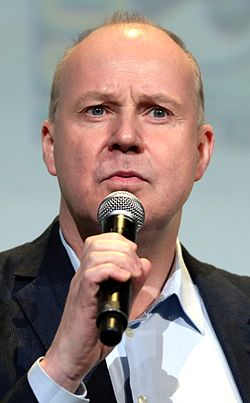
Yates speaking at San Diego Comic-Con, 2016

In 2013, he returned to television by signing on to direct the television pilot of Tyrant, an American drama production set against the US–Middle East conflict.[87] The following year, Yates began shooting The Legend of Tarzan, starring Alexander Skarsgård, Samuel L. Jackson, Margot Robbie, Djimon Hounsou, Jim Broadbent, and Christoph Waltz. The film, released in 2016, opened to mixed reviews and a worldwide total of $356.7 million.[88]

Fantastic Beasts series (2016–2022)

[edit]

Yates directed Fantastic Beasts and Where to Find Them, a 2016 film which is the first in a series of five instalments based on J. K. Rowling's book, set in the world of her Harry Potter novels.[89] David Heyman and Harry Potter screenwriter Steve Kloves joined Yates and J. K. Rowling in developing the script.[90] The film was released in November 2016, it received generally positive reviews and was a commercial success having grossed $814 million. It stars Eddie Redmayne, Katherine Waterston, Dan Fogler, Alison Sudol, Ezra Miller, Colin Farrell, and Johnny Depp.

Yates directed the 2018 sequel, Fantastic Beasts: The Crimes of Grindelwald which received mixed critical reception but emerged a box office success having grossed $654 million. In an interview with The Hollywood Reporter, he stated he was open to directing all five planned films in the Fantastic Beasts series.[91] He returned to direct the third film, Fantastic Beasts: The Secrets of Dumbledore in 2022 which also received mixed critical reception and grossed $407 million worldwide, making it a box office disappointment and the lowest-grossing film in the Wizarding World franchise.

Pain Hustlers and current work (2023–present)

[edit]

Yates next directed the drama film Pain Hustlers, starring Emily Blunt and Chris Evans, for Netflix. Production began on 22 August 2022 and the film was released on 27 October 2023.[92][93]

Wychwood Media

[edit]

Yates founded production company Wychwood Media[94] with Lewis Taylor. In May 2022, Sister entered a first-look deal deal with Wychwood Media.[95]

Personal life

[edit]

Yates has a younger brother and an elder sister.[9] He is married to Yvonne Walcott.[12] He is the uncle of former professional footballer Theo Walcott.[96]

Directorial style

[edit]

Commenting on their work on Harry Potter, Emma Watson stated that Yates liked to push the cast and crew to physical and emotional extremes, with Gary Oldman confirming Yates's preference for working slowly by shooting numerous takes to draw the finest performances out of the cast.[97][98] Yates has been influenced by such directors as Steven Spielberg, David Lean, and Ken Loach.[10] Yates's style of work includes social and political themes, character-driven narratives, realism, and atmospheric drama.[99][100][101]

Filmography

[edit]

Feature film

[edit]
Year Title Director Producer
1998 The Tichborne Claimant Yes No
2007 Harry Potter and the Order of the Phoenix Yes No
2009 Harry Potter and the Half-Blood Prince Yes No
2010 Harry Potter and the Deathly Hallows – Part 1 Yes No
2011 Harry Potter and the Deathly Hallows – Part 2 Yes No
2016 The Legend of Tarzan Yes Executive
Fantastic Beasts and Where to Find Them Yes No
2018 Fantastic Beasts: The Crimes of Grindelwald Yes No
2022 Fantastic Beasts: The Secrets of Dumbledore Yes No
2023 Pain Hustlers Yes Yes

Short film

[edit]
Year Title Director Writer Producer
1988 When I Was a Girl Yes Yes Yes
1991 The Weaver's Wife Yes Yes No
Oranges and Lemons Yes No No
1992 Good Looks Yes No No
1996 Punch Yes No No
2002 Rank Yes No No

Television

[edit]

TV series

Year Title Notes
1994-95 The Bill 5 episodes
2014 Tyrant Episode "Pilot", also executive producer

Miniseries

TV movies

Documentary series

Year Title Notes
1994 Moving Pictures Episode "Low Budget"
1995 Tale of Three Seaside Towns Co-directed with Alistair Clarke;
Also producer

Accolades

[edit]

Only certain awards for Yates's direction are shown in this section. A complete list of awards for a project may be found on its article page.

Year Award Category Title Result
1991 Cork International Film Festival Best European Short When I Was a Girl Won
San Francisco International Film Festival:
Golden Gate Award
Best Short Film Won
Belfort Film Festival Best Film Won
1992 Chicago International Film Festival: Silver Hugo Good Looks Won
1998 Emden Film Festival Award The Tichborne Claimant Nominated
2002 BAFTA: British Academy Television Award Best Drama Serial The Way We Live Now Won
2003 BAFTA: British Academy Film Award Best Short Film Rank Nominated
Directors Guild of Great Britain Outstanding Directorial Achievement in a TV Movie/Serial State of Play Won
2004 BAFTA: British Academy Television Award Best Drama Serial Nominated
Cologne Conference: TV Spielfilm Award Best Fiction Programme Won
Directors Guild of Great Britain Outstanding Directorial Achievement in a TV Movie/Miniseries Sex Traffic Nominated
2005 BAFTA: British Academy Television Award Best Drama Serial Won
Prix Italia Best TV Movie or Miniseries Won
2006 Cinema For Peace Most valuable work of a director, producer or screenwriter The Girl in the Café Won
Primetime Emmy Award Outstanding Directing for a Miniseries, Movie or Dramatic Special Nominated
2008 Empire Award Best Director Harry Potter and the Order of the Phoenix Won
Saturn Award Best Director Nominated
2010 NFTS Honorary Fellowship Outstanding Contribution to the British Film and Television Industry Won
2011 BAFTA: Britannia Award (Los Angeles) John Schlesinger Britannia Award for Excellence in Directing Harry Potter
Order of the Phoenix, Half-Blood Prince, Deathly Hallows
Won
Saturn Award Best Director Harry Potter and the Deathly Hallows – Part 1 Nominated
Scream Award Best Director Harry Potter and the Deathly Hallows – Part 2 Nominated
2012 Saturn Award Best Director Nominated
SFX Award Best Director Nominated
Empire Award Best Director Won
University of Essex Honorary Degree Won
2016 BAFTA: British Academy Film Award Outstanding British Film Fantastic Beasts and Where to Find Them Nominated

Notes

[edit]

References

[edit]
[edit]
Revisions and contributorsEdit on WikipediaRead on Wikipedia
from Grokipedia
David Yates (born 8 October 1963) is an English film and television director and producer, recognized primarily for helming the final four instalments of the Harry Potter film series. Born in St. Helens, Merseyside, Yates developed an interest in filmmaking after viewing Steven Spielberg's Jaws as a teenager, leading him to produce short films early in his career before establishing himself in British television with directorial credits on series such as State of Play (2003) and the Emmy-winning miniseries Sex Traffic (2004). His entry into feature films came with Harry Potter and the Order of the Phoenix (2007), the fifth instalment, which he followed with Harry Potter and the Half-Blood Prince (2009), Harry Potter and the Deathly Hallows – Part 1 (2010), and Harry Potter and the Deathly Hallows – Part 2 (2011), the latter concluding the billion-dollar franchise and earning critical acclaim for its action sequences and emotional depth. Yates extended his involvement in the Wizarding World by directing the first three Fantastic Beasts prequel films—Fantastic Beasts and Where to Find Them (2016), Fantastic Beasts: The Crimes of Grindelwald (2018), and Fantastic Beasts: The Secrets of Dumbledore (2022)—alongside standalone projects including The Legend of Tarzan (2016) and Pain Hustlers (2023), showcasing his versatility in handling large-scale productions and ensemble casts.

Early life

Upbringing in St. Helens

David Yates was born on 8 October 1963 in St. Helens, Merseyside, a northern English town historically dominated by heavy industry, including glass manufacturing at Pilkington's works, which employed much of the local population during the mid-20th century. He spent his early years in the Grange Park area of St. Helens, amid a landscape of post-war working-class communities facing economic shifts from manufacturing decline in the 1960s and 1970s. With limited access to formal resources, Yates began experimenting with using an 8mm camera purchased by his mother, enlisting friends and family as cast and crew for short films shot in nearby locales like and Taylor Park. This grassroots approach, devoid of industry guidance, instilled a practical resilience evident in his later management of large-scale productions, where he prioritized on-set over scripted rigidity. Yates later reflected that, lacking knowledge of professional pathways, he simply "got on and did [his] own thing," producing no-budget videos that honed his ability to extract narrative tension from constrained circumstances.

Education and early influences

Yates earned a degree in politics from the , where he pursued academic studies in the early before transitioning to filmmaking. He also studied at in the United States, broadening his exposure beyond British educational contexts. These experiences provided a foundation in analytical thinking and , though Yates developed his directing skills largely through independent practice rather than formal film training. From adolescence, Yates drew inspiration from directors emphasizing narrative depth and realism, including Steven Spielberg's Jaws (1975), which captivated him as a teenager and sparked his interest in suspenseful, character-driven . This early fascination led him to experiment with , producing short films as young as age 14 by enlisting friends and family using a camera gifted by his mother. Such endeavors honed basic technical abilities in scripting and directing without institutional resources, reflecting a self-directed approach over structured . By the late 1980s, post-university, Yates completed his debut short When I Was a Girl (1988), which earned Best Short Film at the , demonstrating emerging competence in visual storytelling grounded in personal observation rather than commercial formulas. These formative works underscored influences from British filmmakers like , prioritizing and understated technique over stylized spectacle.

Career beginnings

Television directing (1990s–2000s)

Yates commenced his notable television directing career in the early 2000s after initial forays into episodic television in the 1990s. In 2000, he helmed three episodes—"Greed," "Envy," and "Lust"—of the BBC crime drama miniseries The Sins, starring Pete Postlethwaite, which explored themes of moral failings within constrained narrative formats typical of British television production. This work demonstrated his emerging proficiency in character-driven stories under tight scheduling and budgetary limits. The following year, Yates directed the four-part adaptation of Anthony Trollope's The Way We Live Now for the BBC, earning a BAFTA Television Award for Best Drama Serial for its authentic depiction of Victorian-era financial intrigue and social dynamics, achieved through meticulous period reconstruction on a television scale. In 2003, Yates directed the entirety of the six-episode BBC political thriller State of Play, written by , which garnered critical acclaim for its rapid pacing, intricate conspiracy plotting, and effective use of handheld camerawork to maintain tension amid limited resources. The series' success, including a Directors' of award for Yates, underscored his skill in orchestrating ensemble performances—featuring actors like and —within episodic structures that demanded efficient storytelling to sustain viewer engagement across broadcasts. That same year, he also directed the television film , an adaptation of Daisy Ashford's novella, blending whimsy with subtle social commentary in a 19th-century setting. Yates continued with the two-part Channel 4 drama Sex Traffic in 2004, directing a harrowing examination of from to the , which won the BAFTA for Best Drama Serial and highlighted his capacity for visceral realism and emotional depth in narratives constrained by television's format and funding. These projects collectively built his expertise in handling multifaceted casts and layered plots, directly contributing to his later proficiency with large-scale ensembles in feature films, as the discipline of television's production demands—such as weekly episode delivery and modest —fostered precise, causality-driven direction focused on narrative propulsion over spectacle.

Transition to feature films

Yates transitioned from television directing to feature films with his debut theatrical release, the independent historical drama The Tichborne Claimant, in 1998. The film, adapted from the real-life 19th-century Tichborne impostor case, featured a cast including as the claimant Roger Tichborne and as a supporting aristocrat, examining themes of and deception amid class divides in Victorian England. Produced on a modest budget by ' early involvement in independent projects, it premiered at the , signaling Yates's expansion beyond television constraints to broader cinematic storytelling. Despite the film's limited commercial distribution and mixed reception—praised for atmospheric period detail but critiqued for pacing—it represented a merit-driven step forward, earned through Yates's prior short films and credits rather than industry nepotism. Yates subsequently alternated back to high-profile television to refine his craft, directing the 2003 BBC miniseries State of Play, a six-episode that earned BAFTA nominations for its taut conspiracy narrative and ensemble performances led by . This work, alongside the 2004 miniseries —which secured two for its unflinching portrayal of —demonstrated Yates's proficiency with suspenseful, character-driven plots on escalating production scales. These television successes, rooted in empirical acclaim from broadcasters like the and critical bodies, positioned Yates for feature opportunities by showcasing his ability to manage intricate scripts and larger crews without privileged access, contrasting the episodic intimacy of TV with the expansive demands of cinema. By , amid ongoing television commitments, Yates's portfolio evidenced a progression grounded in proven directorial versatility, bridging modest features like The Tichborne Claimant toward high-stakes adaptations requiring visual and narrative ambition.

Harry Potter involvement

Selection and Order of the Phoenix (2007)

David Yates was appointed director of Harry Potter and the Order of the Phoenix by in January 2005, marking his transition from British television to major feature films. His selection followed the studio's consideration of directors with more stylized backgrounds, such as and , but prioritized Yates' experience in dramatic TV miniseries like State of Play (2003), which demonstrated proficiency in handling complex ensemble narratives and emotional depth without excessive stylistic flair. This choice aimed for tonal consistency with prior installments while accommodating the source material's shift toward adolescent frustration and institutional resistance. The film substantially condensed J.K. Rowling's 870-page novel—the longest in the series—into a 138-minute runtime, the shortest among the adaptations, by excising subplots such as the entirety of the World Cup aftermath, the Pensieve sequences detailing wizarding history, and extended bureaucracy, prioritizing core conflicts for cinematic efficiency. These deviations streamlined pacing amid runtime constraints, focusing empirical narrative progression on Harry's isolation and the Order's operations rather than exhaustive world-building, though critics noted resultant gaps in character motivations. Yates employed a desaturated visual scheme with muted greens and grays, alongside handheld camerawork in action sequences, to evoke the book's atmosphere of teen and mounting dread under authoritarian oversight. Principal cast members returned for continuity, including as Harry Potter (aged 17 during principal photography), as , and as , whose established rapport contributed to consistent performances amid the story's emotional intensity. Released on July 11, 2007, the film earned $939.9 million worldwide against a $150 million budget, achieving franchise records for its five-day opening despite early signals of the 2007-2008 financial downturn.

Half-Blood Prince and Deathly Hallows (2009–2011)

Yates directed Harry Potter and the Half-Blood Prince, released on 15 July 2009 after an eight-month delay from its original 21 November 2008 slot, primarily to refine visual effects and post-production quality amid studio concerns over pacing and spectacle. The adaptation highlighted romantic entanglements among adolescent characters—such as Ron's infatuation with Lavender Brown and Hermione's jealousy—contrasting lighter interpersonal dynamics against Voldemort's intensifying infiltration of the Ministry and the brewing wizarding war, though some book scenes like extended Horcrux lore were trimmed for runtime. With a $250 million budget, the film earned $934 million worldwide, including $302 million domestically, sustaining franchise viability despite production hurdles. Transitioning to the finale, Yates helmed Harry Potter and the Deathly Hallows, adapted as two films to comprehensively cover the novel's expansive narrative without severe omissions, a decision producer attributed to artistic fidelity rather than solely profit motives, given the book's length and culmination of plot threads. Part 1, released 19 November 2010, emphasized introspective elements like the trio's fugitive road journey, Horcrux hunts, and internal fractures amid escalating Ministry oppression and dominance, shifting from school-centric stories to overt . It grossed $961 million globally on a $125 million budget, with $296 million from , reflecting sustained draw despite a slower pace. Part 2, premiered 15 July 2011, accelerated to a high-stakes action resolution, centering the Battle of Hogwarts, mass casualties, and Voldemort's downfall, amplifying war-scale destruction through large-scale effects sequences. Budgeted at $125 million, it achieved $1.34 billion worldwide—including a franchise-record $381 million domestically—via massive opening weekends exceeding $480 million globally. These entries collectively generated over $2.3 billion, empirically refuting audience fatigue claims leveled at the aging series by delivering peak attendance and revenue peaks, as prior films' box office had not declined and international markets expanded.

Post-Potter projects

Tyrant series and Tarzan (2014–2016)

In 2014, Yates directed the pilot episode of Tyrant, an FX drama series created by Gideon Raff that explores themes of dictatorship and family dynamics in a fictional Middle Eastern nation. The episode, written by Raff and executive produced by Howard Gordon, aired on June 24, 2014, attracting 2.1 million total viewers and 775,000 adults aged 18-49, marking a solid but not exceptional debut for the network compared to prior hits like Fargo. Yates' involvement was limited to the pilot, leveraging his experience with large-scale narratives from the Harry Potter films to establish a tone blending political intrigue and personal conflict, though the series deviated from his typical fantasy elements toward grounded realism. Following , Yates helmed (2016), a live-action adaptation of ' character, starring as Tarzan and as . The film, scripted by Adam Cozad and , shifts focus from Tarzan's origin story to a post-jungle narrative where the titular character, now John Clayton, returns to the Congo amid colonial exploitation and intrigue involving King Leopold II's forces. This emphasis on action sequences and visual spectacle— including extensive CGI for jungle environments and wildlife—reflected Yates' post-Potter affinity for effects-driven storytelling, but marked a departure from the source material's fidelity to Burroughs' pulp adventure roots by prioritizing modern geopolitical undertones over isolated origin lore. Production faced budgetary hurdles, with initial plans in 2013 halted due to escalating costs tied to Yates' ambitious demands, pushing to 2014 and inflating the final to approximately $180 million before marketing. These overruns stemmed causally from the director's push for immersive, Potter-esque spectacle in a non-franchise context, requiring heavy reliance on digital enhancements for action set pieces like vine-swinging chases and animal encounters, which strained studio resources without the built-in audience draw of established IP. Despite these challenges, the film proceeded to release on July 1, 2016, grossing over $126 million worldwide against its high costs, underscoring Yates' transition to riskier, effects-heavy ventures outside the Harry Potter safety net.

Other independent works

Yates's early independent output included short films such as When I Was a Girl (1988), which won Best at the . Additional shorts like , Good Looks, and The Weaver's Wife were produced during his university years, focusing on narrative experimentation within constrained budgets. His sole independent feature film credit is The Tichborne Claimant (1998), a drama recounting the 19th-century Tichborne impostor case, starring Stephen Fry as the claimant and John Kani as a supporting figure in the legal saga. Produced on a modest budget without major studio backing, the film earned a 6.1/10 average user rating from 233 IMDb reviews and praise for its stylized Victorian authenticity in a Variety critique, though it lacked wide theatrical distribution or significant commercial returns. It received a nomination at the Emden International Film Festival but did not achieve broader acclaim or box office data indicative of success. Beyond shorts and this debut feature, Yates's other verifiable independent contributions remain limited to television-scale productions predating his franchise era, with no subsequent standalone features demonstrating comparable commercial independence or impact outside collaborative high-budget series. This pattern highlights a reliance on established intellectual properties for his most prominent achievements, as his non-franchise works generated niche interest rather than widespread empirical metrics of success such as high audience attendance or revenue.

Fantastic Beasts series

Initial films and creative vision (2016–2018)

Fantastic Beasts and Where to Find Them, released on November 18, 2016, marked David Yates's entry into directing the prequel series, set in J.K. Rowling's during the . With a of $180 million, the film grossed $814 million worldwide, achieving substantial commercial success and introducing audiences to protagonist , a magizoologist whose escaped creatures precipitate conflict in New York's magical community governed by MACUSA. Yates, drawing from his experience with the later films, emphasized visual effects-driven sequences showcasing fantastical beasts, while establishing thematic undertones of prejudice against non-human magical beings as a parallel to rising global threats from dark wizards. Yates's creative vision for the initial films centered on expanding the wizarding lore beyond Britain to international settings, particularly America and , to explore pre-Harry Potter history including the early antagonism between and Gellert . In collaboration with Rowling, who penned the screenplay, Yates aimed to blend adventure with darker political intrigue, positioning the series as a bridge to the original saga's events like the blood pact between Dumbledore and . This approach sought to enrich canonical backstory through original narratives, though it introduced elements like enhanced roles for American wizards that some observers noted diverged from Rowling's prior textual hints in the Harry Potter books. The sequel, Fantastic Beasts: The Crimes of , released on November 16, continued this expansion with a $200 million budget and $655 million in global earnings, but encountered mixed reception due to narrative complexity and perceived inconsistencies with established lore. assumed the role of in a full capacity following a cameo in the first film, with confirmed publicly in late 2017 amid Rowling's endorsement of his suitability despite contemporaneous personal allegations against him. Critics and fans highlighted plot contrivances, such as abrupt character revelations and timeline adjustments to wizarding history (e.g., 's escape methods and alliances), which sparked debates over fidelity to the source material's implied chronology and events like the 1945 duel. While the first film's straightforward creature-focused adventure yielded broad appeal, the sequel's denser focus on ideological conflicts and lore extensions revealed early fissures in , foreshadowing broader series challenges.

Later entries and challenges (2022)

Fantastic Beasts: The Secrets of Dumbledore, the third installment in the series directed by Yates, premiered on April 15, 2022, following production delays from outbreaks that halted filming multiple times, including a positive test on set in February 2021. The film's worldwide totaled approximately $407 million against a $200 million budget, representing a sharp decline from the previous entries' $814 million and $654 million grosses, and marking the franchise's lowest performance amid theaters' uneven post-pandemic recovery. This downturn reflected empirical signs of audience fatigue after the initial films' stronger reception, with domestic opening weekend at $43 million failing to recapture earlier enthusiasm. Critics delivered mixed reviews, aggregating to 46% on , often citing narrative confusion stemming from convoluted plotting and continuity lapses unresolved from prior recastings, such as Grindelwald's portrayal shift. The storyline's emphasis on Dumbledore's strategies against introduced multiple subplots and magical elements that reviewers described as disjointed, exacerbating perceptions of declining coherence in the series' expanding lore. These factors, combined with broader production hurdles like script adjustments to address earlier inconsistencies, contributed to the film's challenges in sustaining momentum.

Recent and future works

Pain Hustlers (2023)

is a directed by David Yates, centering on a fictionalized account of unethical pharmaceutical sales tactics amid the U.S. opioid crisis, inspired by real events at involving fraudulent speaker programs to promote a fentanyl-based sublingual spray. The screenplay by adapts Evan Hughes's 2022 book The Hard Sell: Crime and Punishment at an Opioid Startup, which draws from a 2018 New York Times investigation into the company's schemes targeting doctors for off-label prescriptions. The story follows single mother Liza Drake (Emily ), who joins a failing painkiller startup led by executive Pete Brenner (Chris Evans), escalating into widespread that mirrors documented cases where Insys paid kickbacks disguised as honoraria, leading to federal convictions. Produced as a Netflix original with a reported budget under $20 million, the film marked Yates's deliberate shift from fantasy blockbusters to grounded, R-rated narratives exploring corporate greed and moral compromise, contrasting the escapist wizardry of his prior projects. Netflix handled distribution and streaming release on October 27, 2023, following a premiere at the Toronto International Film Festival on September 11, 2023, allowing Yates to emphasize raw, subversive elements like bribery, addiction fallout, and familial strain without the constraints of family-oriented fantasy. This collaboration enabled a focus on adult-oriented themes, including explicit depictions of pharmaceutical manipulation and personal ethical erosion, as Yates aimed for a "naughty and different" tone to humanize flawed protagonists amid systemic corruption. The film achieved strong streaming metrics, ranking among Netflix's top-viewed originals in its debut week with over 24.9 million views globally in the first four days and topping charts in multiple countries, underscoring commercial viability for non-franchise content. Critically, it received a 23% approval rating from 115 reviews on , with detractors citing uneven tonal shifts from satire to drama and superficial treatment of the crisis's human toll, though audience scores reached approximately 70%, praising performances and the exposé of real-world pharma tactics. This reception highlighted Yates's successful pivot beyond fantasy, demonstrating versatility in tackling contemporary real-world scams over magical , even if the execution drew mixed assessments of depth versus entertainment value.

Upcoming projects including Doctor Who

In November 2011, David Yates announced plans to develop and direct a feature film adaptation of Doctor Who in collaboration with BBC Worldwide, describing it as a reboot independent of the ongoing television series and requiring two to three years of preparation to align with the franchise's lore. However, the project stalled after showrunner Steven Moffat publicly rejected the reboot concept, insisting any film would feature the current TV Doctor and be produced by the BBC's existing team without Hollywood-style reinvention. As of October 2025, no contracts, production timelines, or further developments have been confirmed for Yates' involvement with Doctor Who, reflecting common industry delays where initial announcements often fail to materialize into releases. Beyond , Yates entered talks in August 2021 to direct an untitled original feature for , based on an original screenplay by , positioned as his next project following Fantastic Beasts commitments. No production start dates, casting details, or updates have emerged since, underscoring the prevalence of protracted development in film where scripts and deals frequently encounter revisions or shelving due to market shifts. In a September 2023 , Yates referenced multiple upcoming works "a million miles away from wizards," but provided no specifics on titles, timelines, or studios, maintaining caution amid unconfirmed statuses. Speculation persists around potential returns to franchise elements, such as a fourth entry, but Yates has not endorsed active involvement, and executives described the series as "parked" in prior statements without revival contracts. Overall, Yates' pipeline as of late 2025 lacks verifiable production milestones, prioritizing grounded announcements over speculative hype in an industry where over 70% of greenlit projects face significant delays or cancellation per production tracking data.

Personal life

Marriage and family

David Yates has been married to Yvonne Walcott since the early 2000s, maintaining a low-profile union characterized by mutual professional support and public appearances at industry events. Walcott, a creative artist, has collaborated with Yates on film projects through their production company Wychwood Pictures, including as producer on his 2023 Netflix film Pain Hustlers, where she shared credits alongside Yates and Lawrence Grey. This partnership exemplifies their intertwined personal and professional lives, with Walcott-Yates contributing to post-Harry Potter endeavors amid the director's high-stakes franchise commitments. The couple's relationship has shown empirical stability, evidenced by over two decades of without documented separations, divorces, or scandals in reputable reporting, contrasting with the turbulence often faced by figures in intensive schedules. Yates' extends to siblings—a younger brother and older sister—and through , he is uncle to former professional footballer , son of Yvonne's brother. This familial structure has provided a consistent backdrop, free from public disruptions, supporting Yates' focus on sustained creative output.

Public persona and privacy

David Yates has maintained a notably private public persona, shunning the spotlight of despite helming several blockbuster franchises. His media interactions are sparse, confined largely to promotional obligations for his films, where discussions center on directorial techniques, narrative fidelity, and production challenges rather than personal anecdotes or fame. In a , Yates emphasized his preference for the craft of over public persona, stating that filmmaking's appeal lies in "the process" of creating immersive worlds. This reticence extends to digital engagement; Yates has no verified presence on major social media platforms such as X (formerly Twitter) or , distinguishing him from many contemporaries in the industry who actively cultivate online followings. Such avoidance aligns with his focus on unfiltered creative decision-making, insulated from the performative demands and algorithmic influences prevalent in ecosystems. His rare public appearances, often tied to hometown roots in —where he was born on October 8, 1963—underscore a grounded identity, occasionally involving outreach to aspiring filmmakers that highlights perseverance over stardom. This contrast between external perceptions of him as a wizarding-world and his self-imposed fosters an aura of enigma, prioritizing artistic integrity amid Hollywood's glare.

Directorial approach

Visual style and tone

Yates introduced a visual shift in the Harry Potter series starting with and the Order of the Phoenix (2007), adopting muted color palettes and desaturated tones that prioritized shadows and atmospheric depth over vibrant hues. This aesthetic choice heightened narrative tension by mirroring the source novels' progression toward maturity and peril, where the wizarding world's encroaching demands a restrained, introspective palette rather than whimsical brightness. Claims of over-darkness often stem from nostalgia for earlier films' lighter visuals, yet this overlooks the books' empirical darkening—evident in events like Sirius Black's death and the Ministry battle—which Yates rendered without amplifying grimness beyond textual fidelity. In action sequences, Yates consistently favored handheld camerawork to instill realism and urgency, eschewing static or overly polished shots for a verité dynamism that immerses viewers in the chaos of spells and pursuits. This technique, deployed in films like Harry Potter and the Deathly Hallows – Part 1 (2010) with "loads of hand-held cameras," underscores physical immediacy without sacrificing clarity, as seen in the controlled framing of forest chases and skirmishes. Such methods extend beyond the franchise, appearing in Yates' thriller State of Play (2009), demonstrating a director-specific preference for grounded kinetics over stylized spectacle. The overall tone under Yates balances restraint with emotional weight, using subdued lighting and to evoke isolation and resolve—hallmarks of the later books' causal realism, where youthful adventure yields to . This consistency across his fantasy output, including the series, affirms the style's intentionality, rooted in enhancing psychological stakes rather than franchise-imposed uniformity.

Adaptations and fidelity to source material

David Yates' adaptations of J.K. Rowling's novels emphasized preserving core narrative causality and thematic essence through selective condensation, trimming subplots to accommodate theatrical runtimes typically under three hours while prioritizing visual pacing and emotional arcs over comprehensive detail. In (2007), the film's 158-minute length required streamlining the novel's extensive bureaucratic elements and secondary character developments, such as prolonged sequences and Ministry intrigue, to focus on Harry's isolation, leadership emergence, and the climactic Department of Mysteries battle, thereby maintaining the causal progression from denial of Voldemort's return to open confrontation. This approach transformed the book's slower, exposition-heavy structure into a tighter visual narrative, with Yates enhancing early tension via the Dementor attack opening to hook audiences immediately. Subsequent Harry Potter films under Yates followed suit, balancing fidelity to source causality—such as Snape's backstory revelations and the Horcrux quest—with pragmatic omissions to avoid diluting momentum in a medium demanding concise over literary density. Screenwriter collaborated with Rowling, who as producer vetted changes for lore consistency, ensuring alterations like condensed memory sequences in Half-Blood Prince (2009) upheld pivotal plot drivers without exhaustive textual replication. In the series, Yates directed from Rowling's screenplays, which expanded the 2001 textbook appendix into original 1920s narratives; fidelity centered on her vision, with close consultations yielding "ruthless" edits for balance, such as cutting peripheral scenes to refine pacing while retaining wizarding lore integrity and causal threads like Grindelwald's rise. Rowling's direct scripting minimized deviations, though expansions introduced new elements approved in iterative revisions, prioritizing cinematic flow over the source's brevity. Omissions have drawn for potentially undercutting character depth or world-building, yet Yates maintained such cuts were indispensable for translating causality into engaging visuals, avoiding overload that could fragment audience immersion in a theater setting. This pragmatic stance aligned with Rowling's endorsement, reflecting adaptations' inherent trade-offs between source completeness and medium-specific demands.

Reception and controversies

Commercial achievements versus critical views

David Yates's directorial efforts have amassed over $6.5 billion in worldwide box office earnings, with the majority stemming from his stewardship of the final four Harry Potter films and the Fantastic Beasts trilogy, demonstrating sustained audience demand that often outpaced fluctuating critical approval. His Harry Potter and the Order of the Phoenix (2007) grossed $942 million globally, followed by Harry Potter and the Half-Blood Prince (2009) at $934 million, Harry Potter and the Deathly Hallows – Part 1 (2010) at $977 million, and Harry Potter and the Deathly Hallows – Part 2 (2011) at $1.342 billion, collectively surpassing $4.2 billion despite reviews for the latter two dipping to 77% and 96% on Rotten Tomatoes, respectively, where critics noted tonal shifts toward darker themes that did not deter repeat viewings driven by franchise loyalty. The Fantastic Beasts series further bolstered this total, with the 2016 opener earning $814 million worldwide amid 73% critical approval on Rotten Tomatoes, while sequels The Crimes of Grindelwald (2018) at $655 million (42% RT) and The Secrets of Dumbledore (2022) at $407 million (46% RT) reflected diminishing returns yet still profitable margins relative to budgets exceeding $200 million each, underscoring how established IP and visual spectacle sustained revenue even as narrative complexities drew mixed responses from reviewers. In contrast, non-franchise ventures like The Legend of (2016) grossed $373 million worldwide on a $180 million but underdelivered against expectations for a major studio action-adventure, earning just 35% on where detractors cited uneven execution in blending historical elements with CGI-heavy action sequences, revealing that while Yates's ambition for immersive spectacle garnered visual praise, it failed to convert into proportional audience turnout beyond initial curiosity. This pattern illustrates a causal dynamic wherein empirical metrics—reflecting millions of individual ticket purchases and repeat engagements—prioritize fan-driven accessibility and escapism over critical emphases on structural polish, as evidenced by the Potter series' escalating per-film averages despite perceived "dark" evolutions that critics occasionally flagged but audiences rewarded through word-of-mouth and sales.

Criticisms of pacing and visuals

Critics of and the Order of the Phoenix (2007) have highlighted its pacing as uneven, attributing the issue to the adaptation's compression of J.K. Rowling's longest —870 pages—into a 138-minute runtime, which fostered an episodic structure lacking sustained momentum. This approach prioritized key plot beats over deeper character development and subplots, leading to abrupt transitions that some reviewers found disorienting despite the film's relative brevity compared to prior entries. Similar pacing critiques extended to Yates' Fantastic Beasts series, where The Crimes of Grindelwald (2018) was faulted for bloat and incoherence, with its sprawling ensemble and multiple timelines resulting in a jumbled that failed to maintain tension amid frequent digressions. In Fantastic Beasts: The Secrets of Dumbledore (2022), the deliberate slowness was seen as mismatched to the material's lighter elements, exacerbating a sense of drag in non-essential subplots. Yates' visual style, characterized by desaturated colors, muted lighting, and a naturalistic palette shift from earlier Harry Potter films, has drawn accusations of drabness that sap the franchise's inherent whimsy. Reviewers noted pale skin tones and shadowy compositions in works like Order of the Phoenix, arguing they rendered scenes murky and emotionally flat, prioritizing grim realism over the vibrant magic of the source material. This aesthetic persisted into , where the cold, washed-out visuals were criticized for undercutting creature designs and period opulence, contributing to a perceived lifelessness. Fan discussions on platforms like reflect these detractors' views, with threads decrying excessive focus on stylistic effects at the expense of narrative clarity, though such opinions remain divided without uniform consensus.

Defense of Johnny Depp and industry disputes

In November 2017, amid allegations of domestic abuse leveled by against following their 2016 divorce filing, David Yates publicly defended the actor's continued casting as Gellert in : The Crimes of Grindelwald. Yates, who had directed Depp in the role since 2016's and Where to Find Them, emphasized his personal observations of Depp on set, stating that the actor was "full of decency and kindness" and that the claims did not align with the individual he encountered daily. He distinguished Depp's situation from contemporaneous #MeToo scandals involving figures like and , noting that Depp faced accusations from a single source without corroboration from multiple parties or proven guilt in court at that time, and highlighted supportive statements from Depp's former partners including and . Yates dismissed as a "dead issue," arguing that unverified claims from one accuser should not preemptively override professional assessments of character and talent, particularly absent legal conviction. This position drew backlash from some fans and media outlets, which framed it as tone-deaf amid broader industry reckonings with , yet Yates maintained that decisions should prioritize evidence over public pressure. The film's November 2018 proceeded with Depp in the role, grossing $653.9 million worldwide despite the prior uproar, suggesting commercial viability in retaining the actor based on Yates' judgment rather than yielding to calls for recasting. Yates' stance reflected a broader resistance to what he implied were hasty "casting purges" driven by unadjudicated accusations, advocating for in an era where Hollywood faced incentives to err toward preemptive exclusion to avoid reputational . This approach contrasted with industry trends post-2017, where unproven allegations often led to swift professional , and positioned Yates as critiquing potential overreach in accountability mechanisms that bypassed evidentiary standards.

Legacy

Impact on franchise filmmaking

Yates' direction of Harry Potter and the Deathly Hallows as two separate films addressed the logistical challenges of adapting J.K. Rowling's expansive final novel, enabling a more comprehensive depiction of its plot and themes than a single installment would allow. He has described the process as one of intense deliberation, highlighting the difficulties in pacing and structure to preserve narrative integrity while extending the franchise's theatrical run. This bifurcation strategy optimized revenue streams for concluding franchise entries by sustaining audience immersion and opportunities over an additional release cycle. The films directed by Yates, produced primarily at Leavesden Studios in the UK, leveraged tax credits—introduced in 2007 at 20% for and later expanded—to stimulate domestic production. These incentives facilitated the creation of over 3,000 direct jobs per major film in areas like crew, VFX, and construction, while the series overall generated £500 million in inward investment and supported ancillary economic activity exceeding £1 billion through tourism and supply chains. Such practices demonstrated how franchise blockbusters could anchor regional industry ecosystems, with Yates' later entries benefiting from matured infrastructure that attracted international co-productions. Yates' oversight of the franchise's multinational ensemble—spanning British leads and supporting roles from actors like French performer Clémence Poésy and Indian-British actor Dev Patel—prioritized merit-based casting aligned with the source material's wizarding world demographics, fostering organic global resonance without retrofitting contemporary social agendas. This method sustained viewer loyalty across markets, as evidenced by the films' cumulative $2.5 billion international earnings under his tenure, serving as a blueprint for blockbusters balancing scale with character fidelity.

Influence on directors of fantasy epics

Yates' directorial tenure on the later films, beginning with (2007), introduced a verité-inspired style featuring hand-held camerawork and elements that grounded the fantasy narrative in a more realistic, politically tinged atmosphere, diverging from the whimsical visuals of prior entries. This tonal maturation, emphasizing emotional restraint and subdued magical spectacle over overt whimsy, echoed in subsequent young adult fantasy adaptations seeking to reflect source material's darkening arcs, though direct causal links to specific directors remain sparsely documented. While Yates lacks prominent protégés who have helmed major fantasy epics, peers and collaborators have highlighted his balanced integration of practical sets with digital enhancements amid the era's CGI proliferation, influencing production techniques in mid-budget fantasies that prioritize atmospheric immersion over effects-heavy excess. Documented efforts include public speaking engagements offering guidance to emerging filmmakers, such as at the 2014 Into Film Festival, where he shared insights on sustaining narrative depth in genre work. However, these interactions have not yielded verifiable lineages of stylistic inheritance in high-profile fantasy directing careers, underscoring a legacy more rooted in franchise evolution than widespread emulation.

Awards and nominations overview

David Yates garnered early recognition in television directing, winning a BAFTA Television Award in 2002 for Best Drama Serial for . He followed with the Directors Guild of Award for Outstanding Directorial Achievement in 2003 for the miniseries State of Play. These pre-feature film honors established his reputation for taut, character-driven narratives in limited budgets, contrasting with the spectacle-driven awards landscape for cinema. Transitioning to major franchises, Yates received multiple nominations for his Harry Potter directorial efforts, including Saturn Award nods for Best Director in 2007 for and the Order of the Phoenix and in 2012 for and the Deathly Hallows – Part 2. The films also earned Saturn recognition for visual effects and production design, underscoring technical prowess amid genre-specific accolades. He secured a BAFTA Children's Award for Best Feature Film in 2011 and the BAFTA Los Angeles Britannia Award for Artistic Excellence in Directing tied to the Potter series. An Emmy nomination for Outstanding Directing in a Miniseries or Movie came in 2006 for . Across his career, Yates has accumulated over 20 nominations, yet major wins remain limited, a pattern observable in peers like or , where blockbuster fantasy directors face institutional bias toward prestige dramas over effects-heavy epics. This disparity is empirically evident in metrics: the four Harry Potter films he helmed grossed over $4.5 billion worldwide, functioning as a de facto validation of commercial and audience impact surpassing many Oscar-favored counterparts. Such outcomes highlight awards' subjective weighting against verifiable financial and viewership success in genre filmmaking.

References

Add your contribution
Related Hubs
User Avatar
No comments yet.