


Community hub
Recent from talks
Contribute something
Nothing was collected or created yet.
Mintaka
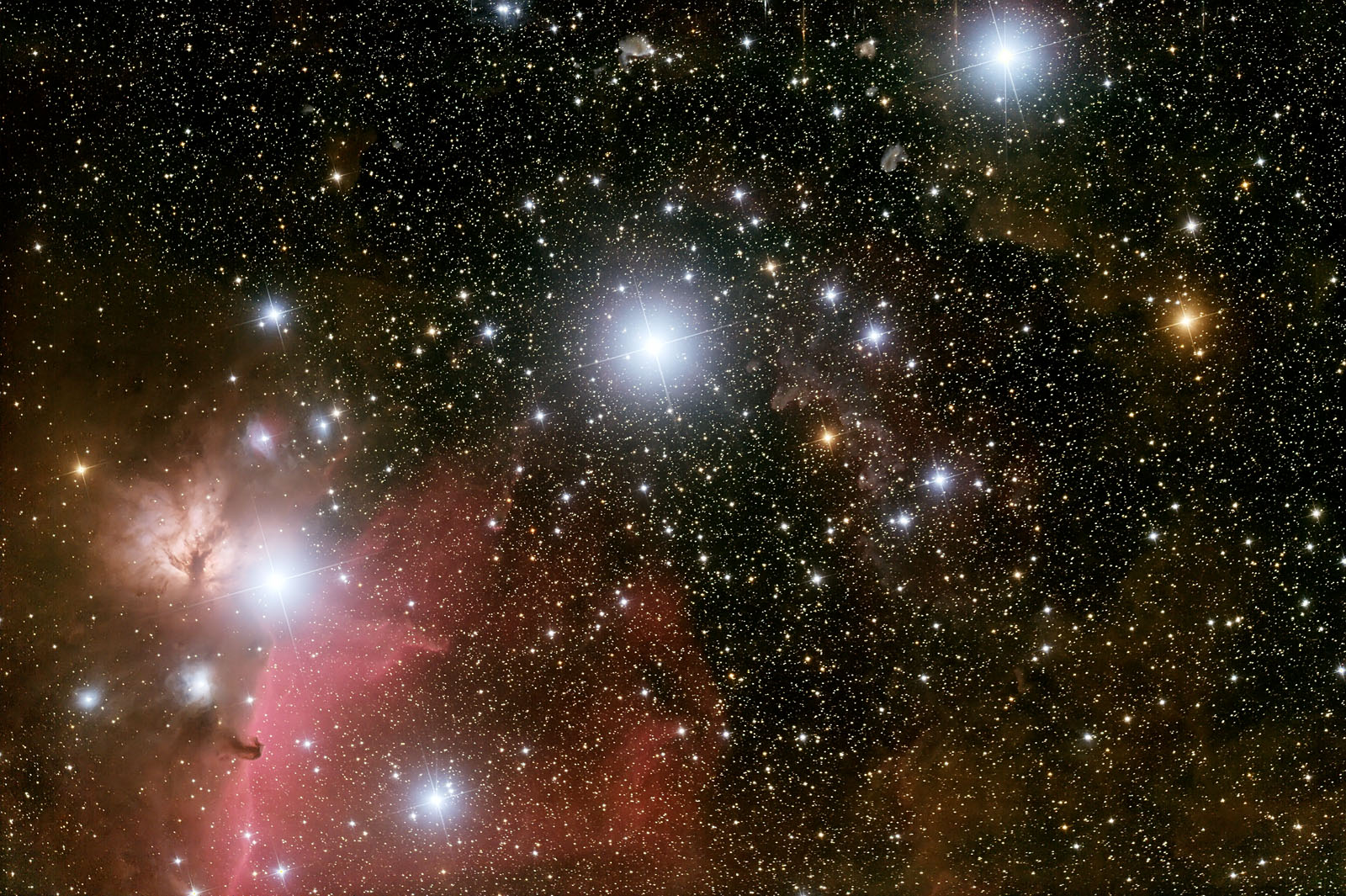
View on Wikipedia Orion's Belt (composed of the three brightest stars shown), Mintaka being the rightmost, on the west side | |
| Observation data Epoch J2000 Equinox J2000 | |
|---|---|
| Constellation | Orion |
| δ Ori A (Aa1 + Aa2 + Ab) | |
| Right ascension | 05h 32m 00.40009s[1] |
| Declination | −00° 17′ 56.7424″[1] |
| Apparent magnitude (V) | 2.23[2] (2.50 + 3.90[3]) |
| δ Ori B | |
| Right ascension | 05h 31m 58.745s[4] |
| Declination | −00° 18′ 18.65″[4] |
| Apparent magnitude (V) | 14.0[5] |
| HD 36485 | |
| Right ascension | 05h 32m 00.406s[6] |
| Declination | −00° 17′ 04.38″[6] |
| Apparent magnitude (V) | 6.85[5] |
| Characteristics | |
| A | |
| Spectral type | O9.5II + B1V +B0IV[7] |
| U−B color index | −1.05[2] |
| B−V color index | −0.22[2] |
| Variable type | Eclipsing binary[8] |
| HD 36485 | |
| Spectral type | B3V + A0V[9] |
| U−B color index | −0.71[10] |
| B−V color index | −0.16[10] |
| Astrometry | |
| Radial velocity (Rv) | 18.50±0.5[11] km/s |
| Proper motion (μ) | RA: 0.64±0.56[1] mas/yr Dec.: −0.69±0.27[1] mas/yr |
| Parallax (π) | 4.71±0.58 mas[1] |
| Distance | 1,200[7] ly (380[7] pc) |
| Absolute magnitude (MV) | −5.8[5] |
| δ Ori Aa1 | |
| Absolute magnitude (MV) | −5.4[5] |
| δ Ori Aa2 | |
| Absolute magnitude (MV) | −2.9[5] |
| δ Ori Ab | |
| Absolute magnitude (MV) | −4.2[5] |
| HD 36485 | |
| Proper motion (μ) | RA: +1.523[12] mas/yr Dec.: −1.653[12] mas/yr |
| Parallax (π) | 2.6245±0.0538 mas[12] |
| Distance | 1,240 ± 30 ly (381 ± 8 pc) |
| Orbit[13] | |
| Primary | δ Ori Aa1 |
| Companion | δ Ori Aa2 |
| Period (P) | 5.732436 days |
| Semi-major axis (a) | 43.1±1.7 R☉ |
| Eccentricity (e) | 0.1133±0.0003 |
| Inclination (i) | 76.5±0.2° |
| Periastron epoch (T) | 2,456,295.674±0.062 |
| Argument of periastron (ω) (secondary) | 141.3±0.2° |
| Orbit[9] | |
| Primary | δ Ori Aa1/2 |
| Companion | δ Ori Ab |
| Period (P) | 53,839 days |
| Semi-major axis (a) | 20,038 R☉ |
| Eccentricity (e) | 0.5886±0.016 |
| Inclination (i) | 104.7±0.4° |
| Longitude of the node (Ω) | 122.4±0.5° |
| Periastron epoch (T) | 2,458,773.2±0.1 |
| Argument of periastron (ω) (secondary) | 259±2° |
| Details | |
| δ Ori Aa1 | |
| Mass | 17.8[9] M☉ |
| Radius | 13.1[9] R☉ |
| Luminosity | 190,000[7] L☉ |
| Surface gravity (log g) | 3.55±0.05[9] cgs |
| Temperature | 31,400±1,000[9] K |
| Rotational velocity (v sin i) | 114±20[9] km/s |
| δ Ori Aa2 | |
| Mass | 8.518[9] M☉ |
| Radius | 4.168[9] R☉ |
| Luminosity | 16,000[7] L☉ |
| Surface gravity (log g) | 3.48±0.06[9] cgs |
| Temperature | 25,442±1,500[9] K |
| Rotational velocity (v sin i) | 89±15[9] km/s |
| δ Ori Ab | |
| Mass | 8.787[9] M☉ |
| Radius | 12.045[9] R☉ |
| Luminosity | 63,000[7] L☉ |
| Surface gravity (log g) | 3.64±0.05[9] cgs |
| Temperature | 30,250±1,000[9] K |
| Rotational velocity (v sin i) | 216±25[9] km/s |
| δ Ori B | |
| Radius | 0.77[14] R☉ |
| Luminosity | 0.431[14] L☉ |
| Temperature | 5,324[14] K |
| HD 36485 | |
| Mass | 6-11[15] M☉ |
| Radius | 5.7[16] R☉ |
| Luminosity | 3,300[16] L☉ |
| Surface gravity (log g) | 4.41[16] cgs |
| Temperature | 18,400[16] K |
| Other designations | |
| Mintaka, δ Orionis, 34 Orionis, 88 G. Orionis, FK5 206, HIP 25930, ADS 4134, CCDM J05320-0018, WDS J05320-0018 | |
| Mintaka Aa: HD 36486, HR 1851, SAO 132220/132221, BD−00°983, GC 6847 | |
| Mintaka Ab: CCDM J05320-0018D, WDS J05320-0018Ab | |
| δ Ori B: UCAC3 180-24383, CCDM J05320-0018B, WDS J05320-0018B | |
| HD 36485: δ Orionis C, HR 1851, SAO 132221, BD−00°982, GC 6848, PLX 1261, CCDM J05320-0018C | |
| Database references | |
| SIMBAD | data |
| δ Ori B | |
| HD 36485 | |
Mintaka /ˈmɪntəkə/,[17] designation Delta Orionis (δ Orionis, abbreviated Delta Ori, δ Ori) and 34 Orionis (34 Ori), is a quintuple star system some 1,200 light-years from the Sun in the constellation of Orion. Together with Alnitak (Zeta Orionis) and Alnilam (Epsilon Orionis), the three stars form Orion's Belt, known by many names among ancient cultures. The star is located very close to the celestial equator. When Orion is near the meridian, Mintaka is the rightmost of the Belt's stars when viewed from the Northern Hemisphere facing south.
The five stars form a hierarchy:[9]
- Delta Ori A
- Delta Ori Aa, an eclipsing binary with an orbital period of 5.7 days
- Delta Ori Aa1, a single star
- Delta Ori Aa2, a single star
- Delta Ori Ab, which orbits Aa at a distance, with an orbital period of 152 years
- Delta Ori Aa, an eclipsing binary with an orbital period of 5.7 days
- Delta Ori B, a single star not physically associated with the system
- Delta Ori C, a binary star with an orbital period of 30 days, also known as HD 36485
- Delta Ori Ca, a single star
- Delta Ori Cb, a single star
"Mintaka" may also be used as the base name, e.g. "Mintaka C" for δ Ori C.
Nomenclature
[edit]Delta Orionis is the star's Bayer designation, 34 Orionis its Flamsteed designation. The name Mintaka itself is derived from an Arabic term for 'belt': منطقة or manṭaqa.[18] In 2016, the International Astronomical Union organized a Working Group on Star Names (WGSN)[19] to catalog and standardize proper names for stars. The WGSN's first bulletin of July 2016[20] included a table of the first two batches of names approved by the WGSN, which included Mintaka for this star. It is now so entered in the IAU Catalog of Star Names.[21]
Observational history
[edit]

Mintaka is the westernmost of the three stars of Orion's belt. It is easily visible to the naked eye, one of the brightest stars in the sky, and has been known since antiquity.
Radial velocity measurements taken by Henri-Alexandre Deslandres in 1900 at Paris Observatory showed that Mintaka had a variable radial velocity and therefore was a spectroscopic binary.[22] His preliminary orbital period estimate of 1.92 days was shown to be incorrect in 1904 when Johannes Franz Hartmann using photographic plates taken at Potsdam Observatory showed that the orbital period was 5.7 days.[23] Hartmann also noticed that the calcium K line at 393.4 nanometres in the stellar spectrum did not share in the periodic displacements of the lines due to orbital motion of the star and theorized that there was a cloud in the line of sight to Mintaka that contained calcium. This was the first detection of the interstellar medium.[23]
System
[edit]| Aa1 | |||||||||||||
| Period = 5.7 d | |||||||||||||
| Aa2 | |||||||||||||
| Period = 152 yr | |||||||||||||
| Ab | |||||||||||||
| 52″ separation | |||||||||||||
| Ca | |||||||||||||
| Period = 30 d | |||||||||||||
| Cb | |||||||||||||
Hierarchy of orbits in the system[9]

δ Orionis is a multiple star system. There is a magnitude 7 star about 52 arcseconds away from the second-magnitude primary and a much fainter star in between. The system is designated WDS 05320-0018 in the Washington Double Star Catalog, with the 14th-magnitude companion listed as component B and the seventh-magnitude star as component C.[25]
The primary component is itself a triple system: a class-O9.5 bright giant and a class-B main-sequence star orbit every 5.73 days and exhibit shallow eclipses when the star dims about 0.2 of a magnitude,[8] and a B-class subgiant is resolved 0.26" away.[3] At the primary eclipse, the apparent magnitude (of the whole system) drops from 2.23 to 2.35, while it only drops to 2.29 at the secondary eclipse.[26]
The outer star of the triple system orbits the inner pair once every 53,839 days (147.40 yr). The orbit is quite eccentric, with the separation varying between 8,244 solar radii (38.34 au) and 31,832 solar radii (148.03 au).[9]
The seventh-magnitude companion, HD 36485, is a chemically peculiar B-type main-sequence star and itself a spectroscopic binary with a faint A-type companion in a 30-day orbit. It has an unusual spectrum with H-alpha emission and unusually strong helium absorption lines. It has a strong magnetic field and a very slow rotational velocity that produces chemical stratification in its atmosphere, which leads to the unusual abundances seen in the spectrum.[15]
The 14th-magnitude companion, δ Orionis B, is thought to be closer than the rest of the system and not physically associated with it.[27] It is likely to be a K-type main sequence star.[9]
Mintaka is surrounded by a cluster of faint stars, possibly part of the cluster surrounding σ Ori.[28]
Distance
[edit]The distance derived from the Hipparcos satellite parallax is 212±30 parsecs,[1] while spectroscopic distances, comparisons to similar stars, and cluster membership all suggest a value more than double that.[13] This type of unreconcilable discrepancy is not unique to Mintaka and the reasons for it have yet to be clarified.[7] In Gaia Data Release 3, component C is listed with a parallax of 2.6245±0.0538 mas,[12] consistent with the distances derived by other methods but disagreeing with the Hipparcos-derived value for the primary.[1]
The Gaia DR3 parallax for component B is 3.5002″±0.0119″, strongly suggesting it is considerably closer than the other members of the system and merely a chance alignment.[27] At that distance it is likely to be a K-type main sequence star.[9]
Etymology and cultural significance
[edit]Mintaka was seen by astrologers as a portent of good fortune.[18]
Orion's Belt
[edit]
The three belt stars were collectively known by many names in many cultures. Arabic terms include Al Nijād 'the Belt', Al Nasak 'the Line', Al Alkāt 'the Golden Grains or Nuts', and, in modern Arabic, Al Mīzān al Ḥakk 'the Accurate Scale Beam'. In Chinese mythology, they were also known as the Weighing Beam.[citation needed]
In Chinese, 參宿 (Shēn Sù), meaning Three Stars (asterism), refers to an asterism consisting of Mintaka, Alnilam, and Alnitak (Orion's Belt), with Betelgeuse, Bellatrix, Saiph and Rigel later added.[29] Consequently, the Chinese name for Mintaka is 參宿三 (Shēn Sù sān, English: the Third Star of Three Stars).[30] It is one of the western mansions of the White Tiger.
Namesakes
[edit]The USS Mintaka (AK-94) was a United States Navy Crater-class cargo ship named after the star.
References
[edit]- ^ a b c d e f g van Leeuwen, F. (2007). "Validation of the new Hipparcos reduction". Astronomy and Astrophysics. 474 (2): 653–664. arXiv:0708.1752. Bibcode:2007A&A...474..653V. doi:10.1051/0004-6361:20078357. S2CID 18759600. Vizier catalog entry
- ^ a b c Hoffleit, Dorrit; Jaschek, Carlos (1991). The Bright star catalogue (5th Revised ed.). New Haven, Conn.: Yale University Observatory. Bibcode:1991bsc..book.....H.
- ^ a b Tokovinin, A. A. (1997). "MSC - a catalogue of physical multiple stars". Astronomy and Astrophysics Supplement Series. 124: 75–84. Bibcode:1997A&AS..124...75T. doi:10.1051/aas:1997181.
- ^ a b Zacharias, N.; Finch, C. T.; Girard, T. M.; Henden, A.; Bartlett, J. L.; Monet, D. G.; Zacharias, M. I. (2012). "VizieR Online Data Catalog: UCAC4 Catalogue (Zacharias+, 2012)". VizieR On-line Data Catalog: I/322A. Bibcode:2012yCat.1322....0Z.
- ^ a b c d e f Harvin, James A.; Gies, Douglas R.; Bagnuolo, William G.; Penny, Laura R.; Thaller, Michelle L. (2002). "Tomographic Separation of Composite Spectra. VIII. The Physical Properties of the Massive Compact Binary in the Triple Star System HD 36486 (δ Orionis A)". Astrophysical Journal. 565 (2): 1216. arXiv:astro-ph/0110683. Bibcode:2002ApJ...565.1216H. doi:10.1086/324705. S2CID 118957476.
- ^ a b Høg, E.; Fabricius, C.; Makarov, V. V.; Urban, S.; Corbin, T.; Wycoff, G.; Bastian, U.; Schwekendiek, P.; Wicenec, A. (2000). "The Tycho-2 catalogue of the 2.5 million brightest stars". Astronomy and Astrophysics. 355: L27. Bibcode:2000A&A...355L..27H. doi:10.1888/0333750888/2862.
- ^ a b c d e f g Shenar, T.; Oskinova, L.; Hamann, W.-R.; Corcoran, M. F.; Moffat, A. F. J.; Pablo, H.; Richardson, N. D.; Waldron, W. L.; Huenemoerder, D. P.; Maíz Apellániz, J.; Nichols, J. S.; Todt, H.; Nazé, Y.; Hoffman, J. L.; Pollock, A. M. T.; Negueruela, I. (2015). "A Coordinated X-Ray and Optical Campaign of the Nearest Massive Eclipsing Binary, δ Orionis Aa. IV. A Multiwavelength, Non-LTE Spectroscopic Analysis". Astrophysical Journal. 809 (2): 135. arXiv:1503.03476. Bibcode:2015ApJ...809..135S. doi:10.1088/0004-637X/809/2/135. hdl:10045/59172. S2CID 14909574.
- ^ a b Samus, N. N.; Durlevich, O. V.; et al. (2009). "VizieR Online Data Catalog: General Catalogue of Variable Stars (Samus+ 2007–2013)". VizieR On-line Data Catalog: B/GCVS. Bibcode:2009yCat....102025S.
- ^ a b c d e f g h i j k l m n o p q r s t u v Oplištilová, A.; Mayer, P.; Harmanec, P.; Brož, M.; Pigulski, A.; Božić, H.; Zasche, P.; Šlechta, M.; Pablo, H.; Kołaczek-Szymański, P. A.; Moffat, A. F. J.; Lovekin, C. C.; Wade, G. A.; Zwintz, K.; Popowicz, A.; Weiss, W. W. (2023). "Spectrum of the secondary component and new orbital elements of the massive triple star δ Ori A". Astronomy and Astrophysics. 672: A31. arXiv:2301.10290. Bibcode:2023A&A...672A..31O. doi:10.1051/0004-6361/202245272. S2CID 256226821.
- ^ a b Renson, P.; Manfroid, J. (May 2009). "Catalogue of Ap, HgMn and Am stars". Astronomy and Astrophysics. 498 (3): 961–966. Bibcode:2009A&A...498..961R. doi:10.1051/0004-6361/200810788.
- ^ Pourbaix, D.; Tokovinin, A. A.; Batten, A. H.; Fekel, F. C.; Hartkopf, W. I.; Levato, H.; Morrell, N. I.; Torres, G.; Udry, S. (2004). "SB9: The ninth catalogue of spectroscopic binary orbits". Astronomy and Astrophysics. 424 (2): 727–732. arXiv:astro-ph/0406573. Bibcode:2004A&A...424..727P. doi:10.1051/0004-6361:20041213. S2CID 119387088.
- ^ a b c d Vallenari, A.; et al. (Gaia collaboration) (2023). "Gaia Data Release 3. Summary of the content and survey properties". Astronomy and Astrophysics. 674: A1. arXiv:2208.00211. Bibcode:2023A&A...674A...1G. doi:10.1051/0004-6361/202243940. S2CID 244398875. Gaia DR3 record for this source at VizieR.
- ^ a b Corcoran, M. F.; Nichols, J. S.; Pablo, H.; Shenar, T.; Pollock, A. M. T.; Waldron, W. L.; Moffat, A. F. J.; Richardson, N. D.; Russell, C. M. P.; Hamaguchi, K.; Huenemoerder, D. P.; Oskinova, L.; Hamann, W.-R.; Nazé, Y.; Ignace, R.; Evans, N. R.; Lomax, J. R.; Hoffman, J. L.; Gayley, K.; Owocki, S. P.; Leutenegger, M.; Gull, T. R.; Hole, K. T.; Lauer, J.; Iping, R. C. (2015). "A Coordinated X-Ray and Optical Campaign of the Nearest Massive Eclipsing Binary, δ Orionis Aa. I. Overview of the X-Ray Spectrum". Astrophysical Journal. 809 (2): 132. arXiv:1507.05101. Bibcode:2015ApJ...809..132C. doi:10.1088/0004-637X/809/2/132. S2CID 17339779.
- ^ a b c Brown, A. G. A.; et al. (Gaia collaboration) (August 2018). "Gaia Data Release 2: Summary of the contents and survey properties". Astronomy & Astrophysics. 616. A1. arXiv:1804.09365. Bibcode:2018A&A...616A...1G. doi:10.1051/0004-6361/201833051. Gaia DR2 record for this source at VizieR.
- ^ a b Leone, F.; Bohlender, D. A.; Bolton, C. T.; Buemi, C.; Catanzaro, G.; Hill, G. M.; Stift, M. J. (2010). "The magnetic field and circumstellar environment of the helium-strong star HD36485 = δ Ori C". Monthly Notices of the Royal Astronomical Society. 401 (4): 2739. Bibcode:2010MNRAS.401.2739L. doi:10.1111/j.1365-2966.2009.15858.x.
- ^ a b c d Zboril, M.; North, P.; Glagolevskij, Yu. V.; Betrix, F. (1997). "Properties of He-rich stars. I. Their evolutionary state and helium abundance". Astronomy and Astrophysics. 324: 949. Bibcode:1997A&A...324..949Z.
- ^ Rumrill, H. B. (June 1936). "Star Name Pronunciation". Publications of the Astronomical Society of the Pacific. 48 (283). San Francisco, California: 139. Bibcode:1936PASP...48..139R. doi:10.1086/124681. S2CID 120743052.
- ^ a b Allen, Richard Hinckley (1963) [1899]. Star-names and their meanings. New York, NY: Dover Publications. p. 314. ISBN 1-931559-44-9.
{{cite book}}: ISBN / Date incompatibility (help) - ^ "IAU Working Group on Star Names (WGSN)". Archived from the original on 10 June 2016. Retrieved 22 May 2016.
- ^ "Bulletin of the IAU Working Group on Star Names, No. 1" (PDF). Retrieved 28 July 2016.
- ^ "IAU Catalog of Star Names". Retrieved 28 July 2016.
- ^ Deslandres, H. (1900). "Variable velocity in line of sight of delta Orionis. (Notes)". The Observatory. 23: 148. Bibcode:1900Obs....23..148D.
- ^ a b Hartmann, J. (1904). "Investigations on the spectrum and orbit of delta Orionis". Astrophysical Journal. 19: 268–286. Bibcode:1904ApJ....19..268H. doi:10.1086/141112.
- ^ Koch, R. H.; Hrivnak, B. J. (August 1981). "A photometric study of the close binary delta Orionis A". Astrophysical Journal. 248: 249–255. doi:10.1086/159148. Retrieved 14 July 2022.
- ^ Mason, Brian D.; Wycoff, Gary L.; Hartkopf, William I.; Douglass, Geoffrey G.; Worley, Charles E. (2001). "The 2001 US Naval Observatory Double Star CD-ROM. I. The Washington Double Star Catalog". The Astronomical Journal. 122 (6): 3466. Bibcode:2001AJ....122.3466M. doi:10.1086/323920.
- ^ Zasche, P.; Wolf, M.; Hartkopf, W. I.; Svoboda, P.; Uhlař, R.; Liakos, A.; Gazeas, K. (2009). "A Catalog of Visual Double and Multiple Stars with Eclipsing Components". Astronomical Journal. 138 (2): 664. arXiv:0907.5172. Bibcode:2009AJ....138..664Z. doi:10.1088/0004-6256/138/2/664. S2CID 17089387.
- ^ a b Vallenari, A.; et al. (Gaia collaboration) (2023). "Gaia Data Release 3. Summary of the content and survey properties". Astronomy and Astrophysics. 674: A1. arXiv:2208.00211. Bibcode:2023A&A...674A...1G. doi:10.1051/0004-6361/202243940. S2CID 244398875. Gaia DR3 record for this source at VizieR.
- ^ Caballero, J. A.; Solano, E. (2008). "Young stars and brown dwarfs surrounding Alnilam (ɛ Orionis) and Mintaka (δ Orionis)". Astronomy and Astrophysics. 485 (3): 931. arXiv:0804.2184. Bibcode:2008A&A...485..931C. doi:10.1051/0004-6361:200809595. S2CID 16175953.
- ^ (in Chinese) 中國星座神話, written by 陳久金. Published by 台灣書房出版有限公司, 2005, ISBN 978-986-7332-25-7
- ^ (in Chinese) AEEA (Activities of Exhibition and Education in Astronomy) 天文教育資訊網 2006 年 5 月 25 日 Archived 2011-07-16 at the Wayback Machine
External links
[edit]- NASA Astronomy Picture of the Day: Image of Mintaka (10 February 2009)
- Mintaka page constellationsofwords.com
- Mintaka page at Astrostudio
- Mintaka with HD 36485 visible at 12 noon and star C at 4 o'clock
| Stars |
| ||||||||||||
|---|---|---|---|---|---|---|---|---|---|---|---|---|---|
| |||||||||||||
| Star clusters |
| ||||||||||||
| Nebulae |
| ||||||||||||
| Galaxies |
| ||||||||||||
| |||||||||||||


Mintaka
View on GrokipediaPhysical Characteristics
Spectral Classification and Temperature
Mintaka Aa1, the primary component of the close binary in the δ Orionis A system, is classified as an O9.5 II bright giant star, while its companion Mintaka Aa2 is a B2 V main-sequence star, forming an O9.5 II + B2 V binary system.[5] These classifications are derived from detailed spectral analysis of disentangled blue spectra in the 4271–4513 Å range, revealing strong helium and hydrogen lines characteristic of hot, massive stars.[5] The effective temperature of Mintaka Aa1 is approximately 31,000 K, and for Aa2 it is around 25,000 K, as determined through non-LTE atmospheric modeling with the PYTERPOL code fitted to the observed spectra.[5] These high temperatures place both stars among the hottest known, with Aa1 exhibiting luminosity class II indicative of a post-main-sequence bright giant phase, though still youthful given the short lifetimes of O-type stars (typically a few million years). Aa2's class V status indicates a main-sequence evolutionary stage, and the pair represents young, massive stars actively fusing hydrogen in their cores, with masses of approximately 18 M⊙ for Aa1 and 8.5 M⊙ for Aa2. Metallicity is near solar, fixed at standard values in the models due to limited constraints from blue spectral regions, while helium abundance shows slight elevation consistent with processed material in massive star atmospheres.[5] Hubble Space Telescope (HST) observations using the Space Telescope Imaging Spectrograph (STIS) in the ultraviolet range (1144–1730 Å) have provided spatially separated spectra of the system components, revealing photospheric absorption lines such as C IV and Si IV that confirm their status as massive hot stars with strong winds. These lines, analyzed via cross-correlation with OSTAR2002 synthetic spectra, highlight the rapid rotation and wind properties, further supporting the O9.5 II classification for Aa1 and aiding in the identification of Aa2's contribution despite its fainter nature.Magnitude, Variability, and Rotation
Mintaka exhibits an average apparent visual magnitude of 2.23, rendering it prominently visible to the naked eye as one of the brighter stars in Orion's Belt. As an eclipsing binary system, it displays photometric variability of approximately 0.2 magnitudes, primarily arising from partial eclipses that occur every 5.732 days; the primary eclipse diminishes brightness by about 0.11 magnitudes, while the secondary eclipse causes a shallower dip of 0.07 magnitudes.[6] The primary star, Aa1, rotates rapidly with a projected rotational velocity of 190 km/s, implying an equatorial velocity near 250 km/s when accounting for the system's orbital inclination. This swift rotation induces significant stellar oblateness, broadening and distorting spectral line profiles observed in its spectrum.[7] The Aa binary pair together produces a combined bolometric luminosity of about 190,000 solar luminosities (for the Aa subsystem including Ab) as of Gaia DR3 measurements, underscoring its status as a luminous O-type system.[1] Its color index of B-V = -0.22 aligns with the hot, blue-white appearance characteristic of such massive stars.[8][7]The Mintaka System
Primary Binary Components
The primary binary components of the Mintaka system form a close eclipsing pair known as δ Orionis Aa, consisting of the hot, massive O9.5 II supergiant Aa1 and the less massive B0.5 III giant Aa2. Aa1 has a mass of approximately 24 solar masses and a radius of 15 solar radii, while Aa2 has a mass of 8.5 solar masses and a radius of 5 solar radii.[9] These stars orbit each other with a period of approximately 5.73 days, and the system is estimated to be 4–5 million years old, consistent with the youth of the Orion OB1 association.[9] The orbital inclination of approximately 77 degrees results in eclipses during the binary's cycle, as evidenced by photometric observations showing minima in the light curve. This high inclination allows for precise determinations of the stellar radii and the geometry of the system.[9]Outer Companion Stars
The Mintaka system, designated as δ Orionis, forms a hierarchical sextuple configuration comprising the tight eclipsing binary primary (Aa1 and Aa2), a more distant tertiary component (Ab: a fainter B0 IV star with mass ~8.7 solar masses, orbiting the Aa pair every ~152 years at an angular separation of ~0.26 arcseconds), along with outer companions labeled B, C (a close binary), and D.[1] B is unrelated and not bound to the primary subsystem. C and D show proper motions consistent with the Orion OB1 association (as of Gaia DR3 data from 2022), suggesting possible wide orbital linkage, though precise periods remain unconstrained due to long timescales. C itself is a confirmed spectroscopic binary with orbital period ~30 days. Component B is an unrelated foreground star, separated by approximately 33 arcseconds from the primary, with a visual magnitude of 14 and spectral type A3 V. Its Gaia DR3 parallax measurement of 3.5002 ± 0.0119 mas corresponds to a distance of about 915 light-years, placing it significantly closer to Earth than the main system at ~1,200 light-years (381 pc).[10] In contrast, components C and D are physically associated with the primary at the system's distance of ~1,200 light-years (381 pc) from Gaia DR3. Component C, a binary consisting of Ca (B3 V, V=6.6) and Cb (A0 V, V=9.8), has a combined visual magnitude of ~7 and lies 52 arcseconds from the primary. Component D, classified as B2 V and fainter at magnitude 8.8, is positioned 86 arcseconds away.[1]Astrometry and Visibility
Coordinates and Position
Mintaka occupies a precise position in the celestial sphere, defined by its equatorial coordinates of right ascension 05ʰ 32ᵐ 00.⁴⁰⁰ˢ and declination −00° 17′ 56.74″ for the J2000.0 epoch.[11] These coordinates place it near the celestial equator, facilitating observation from a wide range of latitudes.[12] In galactic coordinates, Mintaka is located at longitude l = 203.86° and latitude b = −17.74°, situating it within the plane of the Milky Way toward the constellation Orion.[13] It serves as the westernmost star in the prominent Orion's Belt asterism, forming the distinctive linear pattern with Alnilam and Alnitak.[14] From northern latitudes, Mintaka is best observed during winter evenings, when the constellation Orion rises prominently in the southeastern sky after dusk.[15] It culminates—reaches its highest point above the horizon—at approximately midnight in December, allowing for optimal viewing under dark skies.[16] The star's proximity to the celestial equator enables visibility across latitudes from nearly 90° N to 90° S, though it appears highest in the sky near the equator and lower toward the poles.[17]Distance and Proper Motion
Previous estimates placed the distance to the Mintaka system at around 380 parsecs (approximately 1,240 light-years). This value has been refined by the Gaia mission's Data Release 3 (DR3) to about 381 parsecs (1,240 light-years), derived from a parallax measurement of approximately 2.62 mas for fainter components (Ca+Cb) in the main Aa-C cluster, as the bright Aa binary yields less precise astrometry. Note that for the bright Aa binary, Gaia DR3 astrometry is less precise; the distance relies on fainter companions and association membership. The radial velocity of this cluster is +21 km/s, providing the line-of-sight component of the system's motion relative to the Sun. These measurements place Mintaka within the Orion OB1 association, contributing to our understanding of its 3D position in the local interstellar medium.[1] The proper motion of the Aa-C cluster, as measured by Gaia DR3, indicates a transverse movement across the sky of +0.64 mas/year in right ascension and −0.69 mas/year in declination. At the revised distance, this corresponds to a tangential velocity of approximately 1.7 km/s, reflecting the system's gradual drift through the galactic neighborhood. Such proper motions are crucial for tracing the dynamical history of young stellar groups like those in Orion. A notable discrepancy arises with component B, whose Gaia DR3 parallax implies a much closer distance of 285 parsecs, with an error margin underscoring its separation from the main cluster. This difference in distance, combined with differing proper motions, confirms that B is not physically bound to the Aa-C group but is instead a foreground star in a chance alignment along the line of sight.Historical Observations
Early Records and Discovery
Mintaka, designated Delta Orionis, was first documented in ancient astronomical records as part of the constellation Orion. In the 2nd century CE, Claudius Ptolemy included it in his Almagest, describing it as one of the three stars forming the girdle or belt of the hunter figure, specifically the star in the girdle towards the south, with an assigned magnitude of 2. During the Islamic Golden Age, the Persian astronomer Abd al-Rahman al-Sufi cataloged Mintaka in his Book of Fixed Stars around 964 CE, integrating Ptolemy's positions with Arabic traditions. He referred to it as the western star in al-Jawzāʾ (the Central One, corresponding to Orion) and applied the name Mintaka al-Jawzāʾ, derived from the Arabic for "belt of the central one," emphasizing its role in the prominent belt asterism.[18] The star's binary nature was first noted in the late 18th century through telescopic observations. In 1781, William Herschel identified Mintaka as a double star during his systematic survey for binary systems, observing a companion that suggested potential variability in brightness due to orbital motion. This discovery was published in his 1782 catalog of double stars.[19] In 1815, Friedrich Georg Wilhelm Struve confirmed and further measured the binary components at the Dorpat Observatory, including it in his seminal catalog of double stars as Σ747, establishing its status as a visual binary with a separation of about 52 arcseconds.[20] Advancements in spectroscopy in the mid-19th century provided the first insights into Mintaka's physical properties. In 1868, Italian astronomer Angelo Secchi observed its spectrum using his pioneering spectroscope at the Vatican Observatory, classifying it as a Type I star—one of the hot, white stars exhibiting prominent hydrogen absorption lines and minimal metallic lines, indicative of high surface temperatures around 30,000 K. This placed Mintaka among the earliest stars spectroscopically analyzed, contributing to Secchi's foundational four-class system of stellar spectra.[21]Modern Measurements and Studies
In the early 20th century, radial velocity measurements confirmed Mintaka's status as a spectroscopic binary. Observations by Henri-Alexandre Deslandres in 1900 at the Paris Observatory detected periodic variations in radial velocity, indicating duplicity with an initial orbital period estimate of about 1.92 days. This was refined by Johannes Franz Hartmann's detailed spectroscopic analysis in 1904, which established the binary orbit with a period of 5.73 days and identified the components as an O9.5 giant primary and a B-type companion. Additionally, in this study, Hartmann identified the first interstellar absorption lines in the spectrum of Mintaka, detecting calcium gas intervening between the star and Earth.[3][22] During the 1970s and 1980s, the International Ultraviolet Explorer (IUE) satellite captured high-resolution UV spectra of Delta Orionis, revealing P Cygni profiles in resonance lines such as C IV and Si IV, characteristic of outflowing stellar winds from the hot primary. These observations, spanning multiple orbital phases, demonstrated line profile variability due to wind structure and binary interaction, enabling early estimates of wind velocities reaching 2,000 km/s. Advancements in the mid-2000s utilized space-based telescopes to disentangle the spectra of Mintaka's close binary components. Hubble Space Telescope observations with the Space Telescope Imaging Spectrograph (STIS) between 2005 and 2010 resolved the individual UV spectra of Aa1 (O9.5 II) and Aa2 (B1 III), confirming their spectral types and revealing asymmetric wind profiles influenced by orbital motion.[23] Gaia mission data releases marked significant progress in astrometry for Mintaka. The 2016 Data Release 1 and 2018 Data Release 2 offered initial parallax measurements of approximately 2.6 mas, placing the system at roughly 380 parsecs and highlighting proper motion consistent with Orion OB1 association membership. The 2022 Data Release 3 parallax for the faint companions (Ca+Cb) of approximately 2.63 mas corresponds to a system distance of 381 ± 8 parsecs, with astrometric solutions supporting the triple nature of Delta Orionis A through non-linear motion patterns.[1] Recent and ongoing investigations emphasize the dynamics of stellar winds in this massive binary, with mass loss rates for the primary estimated at around 10^{-7} M_⊙ yr^{-1} derived from combined UV, X-ray, and radio data. Chandra X-ray Observatory spectra from 2013 onward model wind shocks and colliding flows between Aa1 and Aa2, revealing plasma temperatures up to 7 MK and refining mass loss through He-like ion diagnostics.[11] These studies, integrated with Hubble UV time series, continue to probe wind clumping and binary wind interactions, informing evolutionary models for O stars.[23] Ground-based photometry has occasionally captured variability light curves linked to eclipses and wind effects, complementing these efforts.[24]Nomenclature and Etymology
Designations and Catalog Names
Mintaka holds the Bayer designation δ Orionis, assigned by Johann Bayer in his 1603 star atlas Uranometria, where Greek letters denote stars in approximate order of brightness within each constellation, followed by the genitive form of the constellation name. This designation reflects its position as the seventh-brightest star in Orion. Additionally, it bears the Flamsteed number 34 Orionis from John Flamsteed's 1725 Historia Coelestis Britannica, which numbers stars sequentially by right ascension within constellations. The star appears in several major modern catalogs with specific identifiers that facilitate precise astrometric and photometric studies. The following table summarizes key catalog entries for the primary component:| Catalog | Designation | Notes |
|---|---|---|
| Henry Draper Catalogue (HD) | HD 36486 | Spectral classification O9.5 II for the primary; part of the Harvard College Observatory's comprehensive 20th-century survey. |
| Hipparcos Catalogue | HIP 25930 | Astrometric data from the 1997 ESA Hipparcos mission, providing parallax and proper motion measurements. |
| Gaia Data Release 3 | 3220756843825383936 | High-precision astrometry from the ESA Gaia mission's 2022 release, including position, parallax, and photometry for the system. |
Linguistic Origins
The name Mintaka derives from the Arabic term al-mīṭaq or al-mintaqah, meaning "the belt," reflecting its role as the westernmost star in the prominent asterism known as Orion's Belt. This designation was documented by the 10th-century Persian astronomer Abd al-Rahman al-Sufi in his influential Kitab suwar al-kawakib (Book of Fixed Stars, circa 964 CE), where he cataloged stars with Arabic names alongside magnitude estimates, building on Ptolemaic traditions.[25] An alternative Arabic name for the star, an-niṭāq, translates to "girdle," emphasizing the same belt-like configuration in the constellation. In ancient Egyptian astronomy, the three stars forming Orion's Belt, including Mintaka, were symbolically linked to the belt of the god Osiris, representing resurrection and the afterlife, as evidenced in pyramid texts and celestial alignments.[15][26] The adoption of the name Mintaka in Western astronomy occurred through the 15th-century star catalog compiled by Timurid astronomer Ulugh Beg at his Samarkand observatory, which preserved and refined Al-Sufi's Arabic nomenclature for over 1,000 stars. This catalog's Latin translation by Thomas Hyde in 1665 facilitated the transliteration "Mintaka" in European texts during the 17th century, marking its integration into modern stellar nomenclature.[27]Cultural and Symbolic Role
In Mythology and Folklore
In ancient Egyptian mythology, the three stars of Orion's Belt, including Mintaka, were regarded as the resting place of the soul of Osiris, the god of the afterlife, resurrection, and fertility, embodying themes of rebirth and eternal life.[28] This association linked the belt to Osiris's journey through the underworld, where his resurrection symbolized the annual Nile flood and agricultural renewal, with Mintaka as the westernmost star contributing to the triad's symbolic alignment with divine protection and immortality. In Greek mythology, Mintaka formed part of Orion's Belt, depicting the legendary hunter Orion, a giant figure placed in the sky by the gods after his death, often as one of three hunters or kings accompanying the central hunter in pursuit of celestial prey. These stars represented the girdle of the mighty warrior-hunter, whose exploits against beasts like the scorpion (Scorpius) underscored themes of heroism and mortality, with Mintaka's position emphasizing the belt's role in tales of divine favor and tragic downfall.[29] Indigenous Australian traditions view the asterism encompassing Mintaka and Orion's Belt as the "Saucepan," a practical yet mythic form symbolizing communal tools or ancestral figures; among the Boorong people of Victoria, it portrays Kulkunbulla, a group of young men dancing to the music of emu hunters, evoking stories of social harmony and seasonal gatherings.[30] Similarly, the Yolngu of northern Australia incorporate it into the Djulpan canoe narrative, where the belt stars form the vessel's body in a cosmic pursuit, blending everyday lore with deeper ancestral voyages across the sky.[31] Various Native American cultures interpret Mintaka within Orion's Belt as elements of a hunting party, such as among the Havasupai of the American Southwest, where the constellation depicts Animal Men pursuing bighorn sheep or other game, encoding practical knowledge of ambush tactics and seasonal hunts in mythic form.[32] The Inuit, for instance, saw the figure as a team of bear-hunters with their sledge, the belt stars marking the party's equipment in eternal chase, reflecting survival narratives tied to Arctic endurance and communal effort.[33] Medieval European folklore often identified Orion's Belt, with Mintaka as a key star, as the Three Magi or Kings following the Star of Bethlehem, symbolizing guidance and epiphany in Christian tales of divine revelation. In agrarian traditions, particularly in regions like ancient Macedonia and later Germanic areas, the belt was envisioned as a plow or its handle, drawn by Betelgeuse as the plowman, heralding planting seasons and the labor of the earth in stories of cosmic agriculture and yearly cycles.[29]In Astronomy and Navigation
Mintaka serves a prominent role in celestial navigation due to its near-equatorial position in the sky. Lying almost exactly on the celestial equator, it rises due east and sets due west, offering navigators a precise directional reference accurate to within one degree of true east-west alignment, applicable from both hemispheres.[34] As part of Orion's Belt, extending an imaginary line from the three belt stars toward the horizon locates Sirius, the brightest nighttime star, which provides a southern fix in the Northern Hemisphere and a northern reference in the Southern Hemisphere for position estimation.[35] Additionally, Mintaka functions as a clock star; its well-known right ascension enables observers to approximate local sidereal time during its meridian transit, aiding in the determination of local mean time for navigational calculations.[36] In amateur astronomy, Mintaka and Orion's Belt act as essential guides for identifying nearby deep-sky objects. A perpendicular line drawn "downward" from the belt asterism points directly to the Orion Nebula (M42), a stunning emission nebula approximately 4° south of the belt that appears as a fuzzy patch to the naked eye and reveals intricate details through binoculars or small telescopes.[37] Mintaka's brightness (apparent magnitude 2.23) also makes it a preferred alignment star for amateur telescopes, facilitating accurate pointing and tracking of other winter sky targets during setup procedures.[38] From a scientific perspective, Mintaka's documented photometric variability—arising from its multiple-star nature and pulsations—positions it as a standard calibration source in astronomical photometry, with its light variations precisely monitored by space-based observatories like MOST to validate instrumental precision.[39] In asteroseismology, this O9.5 II supergiant star provides a benchmark for studying internal oscillations in massive hot stars, contributing to models of stellar evolution and structure through analyses of its seismic signatures.[40]Association with Orion's Belt
Mintaka serves as the westernmost star in the prominent asterism known as Orion's Belt, positioned alongside the central Alnilam and eastern Alnitak, with the three stars spanning an angular width of approximately 2.5 degrees across the sky. This compact linear arrangement creates one of the most recognizable patterns in the northern winter sky, visible prominently from November to February. The apparent collinearity of these stars results from their relatively similar distances from Earth—ranging from about 1,200 light-years for Mintaka to around 2,000 light-years for Alnilam—placing them within the same stellar association, in contrast to the more disparate distances of surrounding Orion stars that contribute to the constellation's overall figure.[15][41] Culturally, Orion's Belt, including Mintaka, has inspired various nicknames across traditions, such as the "Three Kings" in European folklore, the "Three Sisters" in some Indigenous Australian and African contexts, and the "Hunter's Girdle" reflecting its role in the mythological hunter Orion. Among the belt stars, Mintaka appears as the faintest to the naked eye, with a combined visual magnitude of 2.23, following Alnilam's 1.69 and Alnitak's 1.77, which enhances the subtle gradient in the asterism's appearance.[15][17][42] Astronomically, the alignment of Orion's Belt provides a practical guide for locating other prominent stars: extending the line southeastward points toward Sirius, the brightest star in the night sky, while northwestward it directs to the reddish Aldebaran in Taurus. Historically, this asterism has functioned as a seasonal marker in ancient timekeeping, notably in prehistoric European cultures like the Vučedol, where the belt's position near the horizon aligned with the spring equinox around March 21, signaling agricultural cycles.[43][44]Modern Namesakes
Scientific and Exploratory
In the realm of scientific exploration, the name Mintaka has been adopted for various instruments and vessels honoring the star's prominence in the night sky. One notable example is the USS Mintaka (AK-94), a Crater-class cargo ship commissioned by the United States Navy during World War II. Launched on March 10, 1943, by the California Shipbuilding Corporation in Wilmington, California, the vessel was originally laid down as the SS Ansel Briggs under a Maritime Commission contract but renamed after the star in Orion's Belt to reflect its navigational significance.[45] Serving primarily in the Pacific Theater, the USS Mintaka transported essential supplies, ammunition, and equipment to support Allied operations, including stops at key ports like Nouméa, Espiritu Santo, and Guadalcanal, until it was decommissioned in 1946.[45] In astronomical instrumentation, Mintaka inspired the design of a specialized amateur telescope developed in the late 1970s by astronomers David Levy and Constantine Papacosmos. This 4-inch folded Unitron refractor, named after the star, featured an innovative light-bending system using two high-quality plane mirrors to allow the observer to view objects while facing away from the telescope's direction, enhancing comfort during extended sessions.[46] Housed in a compact, transportable altazimuth-mounted cabinet, it included unique additions like a built-in tape recorder for logging observations or playing music, earning it the nickname "talking telescope." The instrument provided exceptional views of lunar craters and deep-sky objects, securing third prize in the refractor category at the 1979 Stellafane Convention, a prestigious event for amateur telescope makers.[46] The star's striking brightness and position near the celestial equator have occasionally influenced naming conventions in exploratory projects, symbolizing guidance and visibility in astronomical pursuits.Cultural and Commercial
Mintaka, as one of the prominent stars in Orion's Belt, has inspired various representations in modern media and consumer products, often evoking themes of celestial navigation and mythological prowess. In science fiction television, Mintaka features prominently in the Star Trek: The Next Generation episode "Who Watches the Watchers" (1989), where the planet Mintaka III serves as the primary setting for a narrative exploring the Prime Directive and cultural contamination among proto-Vulcanoid inhabitants.[47] The episode portrays the Mintaka system as a habitable location, with the star itself referenced as a navigational point in the franchise's expanded universe.[48] In video games, the Mintaka system is accurately modeled in Elite Dangerous (2014), allowing players to explore its stellar components, including a black hole at Mintaka B, as part of the game's procedurally generated Milky Way galaxy.[49] Commercially, the name Mintaka adorns products drawing from its astronomical allure and the "belt" motif of Orion. Browar Mintaka, a craft brewery in Oława, Poland, produces beers such as HEKA, a hazy New England IPA, and Tiaki, a straw-colored ale, emphasizing innovative brewing techniques.[50] Apparel and accessories under the Mintaka brand, offered by Mintaka Group, include women's clothing like tops, dresses, and jeans, alongside items such as belts and wallets, marketed for their contemporary Western wear style.[51] Similarly, Mintaka-branded watches from the same group feature quartz movements with day and date functions, available in analog-digital hybrids with stainless steel and leather elements.[52] Tattoos incorporating Mintaka as part of Orion's Belt are prevalent in astronomical body art, frequently depicted as three aligned stars to symbolize cosmic alignment and endurance.[53] These designs often appear in minimalist line work or detailed celestial scenes, appealing to enthusiasts of space-themed ink.References
- https://en.wikisource.org/wiki/Star_Lore_Of_All_Ages/Orion