Hubbry Logo
DonatismDonatismMain
Open search
Donatism
Community hub
Donatism
logo
8 pages, 0 posts
0 subscribers
Be the first to start a discussion here.
Donatism
Donatism
from Wikipedia
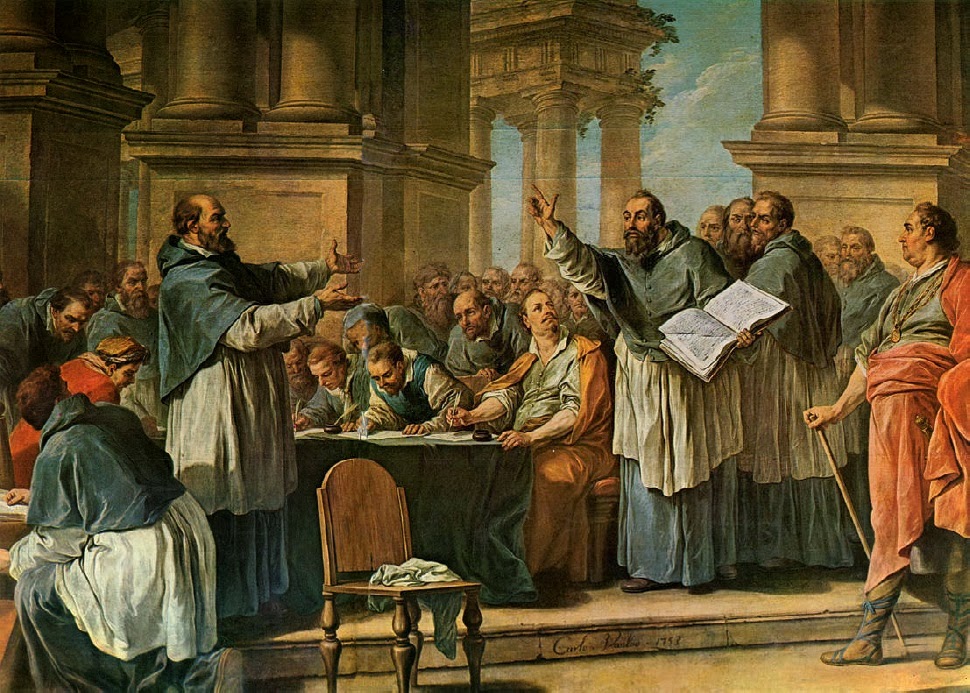
Painting of Augustine of Hippo arguing with a man before an audience
Charles-André van Loo's 18th-century Augustine arguing with Donatists

Donatism was a schism from the Catholic Church in the Archdiocese of Carthage from the fourth to the sixth centuries. Donatists argued that Christian clergy must be faultless for their ministry to be effective and their prayers and sacraments to be valid. Donatism had its roots in the long-established Christian community of the Roman province Africa Proconsularis (present-day Tunisia, the northeast of Algeria, and the western coast of Libya) and Mauretania Tingitana (roughly with the northern part of present-day Morocco),[1] in the persecutions of Christians under Diocletian. Named after the Berber Christian bishop Donatus Magnus, Donatism flourished during the fourth and fifth centuries.[2] Donatism mainly spread among the indigenous Berber population,[3] and Donatists were able to blend Christianity with many of the Berber local customs.[4]

Origin and controversy

[edit]

The Roman governor of North Africa, lenient to the large Christian minority under his rule throughout the Diocletianic Persecutions, was satisfied when Christians handed over their scriptures as a token repudiation of faith. When the persecution ended, Christians who did so were called traditores—"those who handed (the holy things) over"—by their critics (who were mainly from the poorer classes).[5]

Like third-century Novatianism,[6] the Donatists were rigorists; the church must be a church of "saints" (not "sinners"), and sacraments administered by traditores were invalid. In 311 Caecilian (a new bishop of Carthage) was consecrated by Felix of Aptungi, an alleged traditor. His opponents consecrated Majorinus, a short-lived rival who was succeeded by Donatus.[7]

Two years later, a commission appointed by Pope Miltiades condemned the Donatists. They persisted, seeing themselves as the true church with valid sacraments. Because of their association with the Circumcellions, the Donatists were repressed by Roman authorities. Although they had local support, their opponents were supported by Rome and by the rest of the Catholic Church. The Donatists were still a force during the lifetime of Augustine of Hippo, and disappeared only after the seventh- and eighth-century Muslim conquest.[8] The Donatists refused to accept the sacraments and spiritual authority of priests and bishops who were traditores during the persecution. The traditores had returned to positions of authority under Constantine I; according to the Donatists, sacraments administered by the traditores were invalid.[citation needed]

Whether the sacrament of Penance could reconcile a traditor to full communion was questioned, and the church's position was that the sacrament could. The church still imposed years- (sometimes decades-) long public penance for serious sins. A penitent would first beg for the prayers of those entering a church from outside its doors. They would next be permitted to kneel inside the church during the Liturgy. After being allowed to stand with the congregation, the penitent would finally be allowed to receive the Eucharist again. According to Donatists, apostasy would permanently disqualify a man from church leadership.[9]

The validity of sacraments administered by priests and bishops who had been traditores was denied by the Donatists. According to Augustine, a sacrament was from God and ex opere operato (Latin for "from the work carried out"). A priest or bishop in a state of mortal sin could continue to administer valid sacraments.[10] The Donatists believed that a repentant apostate priest could no longer consecrate the Eucharist. Some towns had both Donatist and orthodox congregations.[citation needed]

Impact

[edit]

The sect developed and grew in North Africa, with unrest and threatened riots in Carthage connected to the bishop controversy.[11][a] Constantine, hoping to defuse the unrest, gave money to the non-Donatist bishop Caecilian as payment for churches damaged or confiscated during the persecution. Nothing was given to the Donatists; Constantine was apparently not fully aware of the seriousness of the dispute, which his gift exacerbated.[11] The Donatists appealed to Rome for equal treatment; Constantine tasked Miltiades with resolving the issue, which led to the 313 commission. The Donatists refused to abide by the decision of the Roman council, demanding that a local council adjudicate the dispute and appealing directly to Constantine. In a surviving letter, a frustrated Constantine called for what became the first Council of Arles in 314. The council ruled against the Donatists, who again appealed to Constantine. The emperor ordered all parties to Rome for a hearing, ruled in favour of Caecilian and warned against unrest.[12] A delegation from Rome travelled to Carthage in a vain attempt to seek compromise. The Donatists fomented protests and street violence,[13] refusing to compromise in favor of the orthodox bishop.[citation needed]

After the Constantinian shift, when other Christians accepted the emperor's decision, the Donatists continued to demonize him. After several attempts at reconciliation, in 317 Constantine issued an edict threatening death to anyone who disturbed the imperial peace; another edict followed, calling for the confiscation of all Donatist church property. Donatus refused to surrender his buildings in Carthage, and the local Roman governor sent troops to deal with him and his followers. Although the historical record is unclear, some Donatists were apparently killed and their clergy exiled.[citation needed]

Outside Carthage, Donatist churches and clergy were undisturbed.[14] Constantine's efforts to unite the church and the Donatists failed, and by 321 he asked the bishops to show moderation and patience to the sect in an open letter.[15] During the brief reign of Julian, the Donatists were revitalized and, due to imperial protection, occupied churches and carried out atrocities.[16] Laws against the Donatists were decreed by Valentinian I after the defeat of the Donatist usurper Firmus in North Africa.[17]

Opposition

[edit]

Augustine of Hippo campaigned against Donatism as bishop; through his efforts, orthodoxy gained the upper hand. According to Augustine and the church, the validity of sacraments was a property of the priesthood independent of individual character. Influenced by the Old Testament, he believed in discipline as a means of education.[18]

In his letter to Vincentius, Augustine used the New Testament Parable of the Great Banquet to justify using force against the Donatists: "You are of opinion that no one should be compelled to follow righteousness; and yet you read that the householder said to his servants, 'Whomsoever ye shall find, compel them to come in.'"[19]

In 409, Emperor Honorius's secretary of state, Marcellinus of Carthage, issued a decree which condemned the Donatists as heretical and demanded that they surrender their churches. This was made possible by a collatio in which St. Augustine legally proved that Constantine had chosen the Nicene church over the Donatists as the imperial church. The Donatists were persecuted by the Roman authorities to such a degree that Augustine protested their treatment.[20]

The Council of Trent (1545-1563) taught that in the divine sacrifice of the Holy Mass "is contained and immolated, in an unbloody manner, the same Christ that offered Himself in a bloody manner upon the altar of the Cross. Hence, it is the same victim, the same sacrificing-priest who offers Himself now through the ministry of priests and who once offers Himself upon the Cross." The worth of the sacrifice does not depend on the celebrating priest (or bishop), but on the "worth of the victim and on the dignity of the chief priest- none other than Jesus Christ Himself".[21]

Decline

[edit]

The effects of Augustine's theological success and the emperor's legal action were somewhat reversed when the Vandals conquered North Africa. Donatism may have also gradually declined because Donatists and orthodox Christians were equally marginalised by the Arian Vandals,[22] but it survived the Vandal occupation and Justinian I's Byzantine reconquest. Although it is unknown how long Donatism persisted, some Christian historians believe that the schism and its ensuing unrest in the Christian community facilitated the seventh-century Muslim conquest of the region.[23]

[edit]

Donatism is associated with a number of other groups, including:

  • The Rogatists were a pacifist breakaway faction who rejected the excesses of the Circumcellions and Donatists.[24]
  • The Claudianists, who (with the Urbanists) were reconciled to the Donatists by Donatist Bishop Primian of Carthage.
  • Ticonius was an influential thinker who was expelled by the Donatists for his rejection of rebaptism.[25]
  • Followers of Maximian, who broke away from the mainline Donatist group because of perceived impurities within mainline Donatism.[26]
  • The Circumcellions, a name given by opponents based on circum cellas euntes ("making a circuit around martyr shrines," but some older histories thought it meant "making circuits around barns")[27] because of their practice of living as homeless roamers. Among Donatists they were known as agonistici, which means "soldiers of Christ".[28] They regarded martyrdom as the supreme Christian virtue (disagreeing with the Episcopal see of Carthage on the primacy of chastity, sobriety, humility, and charity). Some mainline Donatists found them useful allies, but others were disgusted by their use of violence and sought to curb their influence by church councils.
  • Apostolic churches, a sect emulating the Apostles about which little is known. But it is very plausible that they were influenced by precedent gnostic Apotactics.[29]

In Mauretania and Numidia, the Catholic Encyclopedia claims that the splinter groups were so numerous that the Donatists could not name them all.[7]

Bishops

[edit]

The Donatists followed a succession of bishops:

Later influence

[edit]
  • Early Kharijites, a strict sect of Islam in the same Berber region.[30]

Epithet

[edit]

For several centuries during the High Middle Ages and the Reformation, accusations of Donatism were levelled against church-reform movements which criticized clerical immorality on theological grounds. The early reformers John Wycliffe and Jan Hus were accused of Donatism by their theological opponents. Wycliffe taught that the moral corruption of priests invalidated their offices and sacraments, a belief characterizing Donatism.[31] Hus similarly argued that a prelate's moral character determined his ecclesiastical authority, a position his contemporaries compared to Donatism and condemned as heresy at the Council of Constance.[citation needed]

During the Reformation, Roman Catholic Counter-Reformers such as Johann Eck accused the magisterial Reformers of Donatism (although the latter had partially distanced themselves from Wycliffe's theology to avoid such a charge).[32] Magisterial Reformers like Ulrich Zwingli labeled radical Reformers, such as the Anabaptists, as Donatists;[33] Roman Catholics were portrayed in Reformation rhetoric as Pelagian, another early Christian heresy. In Eastern Orthodoxy, the Bezpopovtsy (priestless) strain of Old Believers believed that because the Russian bishops acquiesced to Patriarch Nikon's reforms they (and the other patriarchs) forfeited any claim to apostolic succession.[citation needed]

Accusations of Donatism remain common in contemporary intra-Christian polemics. Conservative Lutherans are sometimes called Donatists by their liberal brethren, referring to their doctrine of church fellowship[34] and their position that churches which deny that Jesus' body and blood are eaten during the Eucharist do not celebrate a valid Lord's Supper.[35]

See also

[edit]

Notes

[edit]

References

[edit]

Sources

[edit]

Further reading

[edit]
[edit]
Revisions and contributorsEdit on WikipediaRead on Wikipedia
from Grokipedia
Donatism was a schismatic Christian movement that arose in Roman in the early fourth century, primarily rejecting the validity of sacraments performed by deemed to have compromised their faith during the Persecution by handing over sacred texts to Roman authorities, known as traditores. The movement, named after its prominent leader , insisted that the efficacy of sacraments such as depended on the personal holiness and integrity of the administering minister, positioning the Donatist church as the sole pure remnant of in opposition to the broader Catholic communion led by Bishop of . This stance led to widespread rebaptisms of Catholics and a parallel ecclesiastical structure that dominated much of , particularly among Berber populations, for over a century. The originated in 311 CE when Donatist partisans elected Majorinus as a rival to , accusing the latter of association with traditores, a dispute escalated by appeals to Emperor Constantine, who convened councils in 313 and 314 to affirm Caecilian's legitimacy but failed to resolve the underlying theological divide. succeeded Majorinus around 313 and expanded the movement's influence, framing it as a defense of purity against imperial interference and moral laxity, which resonated in regions scarred by . Key Donatist practices included the veneration of martyrs and resistance to reintegration of lapsed clergy, often enforced by militant groups like the , who engaged in violent disruptions of Catholic services and property seizures. The controversy intensified under Augustine of Hippo, who from the 390s onward authored extensive treatises arguing from scripture and tradition that sacramental grace derived from Christ rather than the minister's virtue, thereby invalidating Donatist exclusivity claims. Augustine's advocacy for coercive measures, including petitions to emperors for edicts like that of Honorius in 405 and further suppressions in 412, marked a shift toward state-enforced unity, leading to the gradual marginalization and decline of Donatism by the sixth century amid Vandal invasions and internal fractures. Despite its suppression, Donatism highlighted enduring tensions over church purity, clerical accountability, and the role of coercion in religious unity, influencing later debates on sacramental theology.

Historical Context and Origins

Diocletianic Persecution and Traditores

The , initiated by Emperor on February 23, 303 AD, marked the Roman Empire's most systematic campaign against , beginning with edicts that mandated the destruction of churches, the burning of sacred scriptures, and the sacrifice of Christians to Roman gods under threat of imprisonment or execution. In , particularly in the province of Africa Proconsularis centered around , enforcement was rigorous; local officials, including the proconsul Anulinus, demanded that Christian clergy surrender liturgical books and copies of the Bible, often under torture or coercion, as part of broader efforts to eradicate Christian texts and practices. This phase persisted intensely until Diocletian's in 305 AD, though sporadic violence continued until Galerius's in 311 AD. Clergy who complied by delivering scriptures to authorities were branded traditores—derived from the Latin tradere, meaning "to hand over" or "to betray"—a term that encapsulated both the act of surrendering sacred texts and the perceived spiritual betrayal of the . In , Mensurius navigated the crisis by refusing to hand over genuine scriptures himself but allowing the search of his , while some presbyters, such as Felix of Aptunga, explicitly turned over texts, actions later scrutinized for compromising ecclesiastical integrity. Resistance varied: some bishops, like those in (modern ), admitted under to hiding or destroying rather than surrendering them, highlighting divisions between uncompromising martyrs and pragmatic survivors. The of traditio in stemmed from the region's dense Christian communities and the edicts' focus on textual eradication, with estimates suggesting dozens of across sees like and Hippo succumbed, though exact numbers remain undocumented due to incomplete records. These events sowed seeds of ecclesiological discord, as post-persecution inquiries into traditores' conduct—prompted by the in 313 AD granting religious —revealed deep rifts over whether such individuals retained to administer sacraments or hold office. North African rigorism, influenced by earlier figures like of who emphasized clerical purity, amplified condemnation of traditores, viewing their actions not merely as survival tactics but as disqualifying that invalidated their ministerial lineage. While imperial policy under and successors like targeted institutional to restore traditional Roman religion, the unintended consequence in was a crisis of purity that challenged the church's unity and sacramental efficacy.

Election of Caecilian and Initial Schism (311–312)

Following the death of Carthage's bishop Mensurius in late 311, —his former —was promptly elected bishop by a assembly of local clergy and laity, reflecting widespread support amid the restoration of Christian liberties after the . His consecration was performed by three bishops, principal among them Felix of Aptunga, who faced longstanding accusations from rigorist factions of being a traditor—having purportedly delivered sacred scriptures and liturgical vessels to Roman authorities during the persecution to avoid martyrdom. These charges, though later investigated and dismissed by provincial authorities who found no evidence of such acts by Felix, fueled immediate doubts about the validity of Caecilian's among those prioritizing clerical purity. Opposition coalesced around , a affluent Numidian noblewoman and confessor's devotee, whom had rebuked for prematurely kissing relics during preparation—a practice he deemed superstitious. , backed by disaffected clerics such as the ambitious priests Botrus and Celestius (denied roles under ) and elders resentful over church property inventories, financed and agitated against him, viewing his ties to Mensurius's moderate stance on lapsed clergy as complicit in betrayal. This rigorist discontent, rooted in Cyprianic traditions emphasizing uncompromised martyrdom credentials, rejected any sacraments administered by tainted hands. In early 312, Secundus of Tigisis, primate of Numidia, arrived in Carthage with a council of seventy bishops—many of whom had themselves confessed to lapsing (including traditio) at the 305 Council of Cirta—and summoned Caecilian to trial. Caecilian, absent from the proceedings (having refused to recognize Numidian primacy over Carthage's metropolitan authority), was declared deposed and his orders invalid; the council then consecrated Majorinus, Lucilla's personal reader, as counter-bishop, asserting a purer ecclesial lineage. This act, performed by bishops Optatus later deemed hypocritical traditores, formalized the schism, bifurcating North African Christianity into Caecilianist adherents (emphasizing universal church unity) and the Majorinist faction (insisting on separation from the "contaminated" hierarchy). The rift persisted despite subsequent imperial inquiries, highlighting irreconcilable views on sacramental integrity post-persecution.

Core Theological Principles

Doctrine of Clerical Purity and Sacramental Validity

The Donatists asserted that the validity of sacraments, particularly and , required the administering cleric to possess uncompromised moral purity, rejecting the of rites performed by those who had lapsed under as traditores. This position stemmed from their interpretation of , emphasizing that a minister tainted by betrayal could not confer grace, rendering sacraments null and propagating invalidity through subsequent s. For instance, they deemed the 311 ordination of of invalid due to its alleged connection to Felix of Aptunga, accused of surrendering scriptures during the , thereby invalidating all downstream sacraments administered under his lineage. This doctrine extended Cyprian of Carthage's third-century stress on church holiness without "stain or wrinkle," applying it rigidly to clerical integrity as a prerequisite for power, such that even repentant traditores remained disqualified from valid ministry. Donatists thus practiced for converts from the , viewing prior immersions by impure as mere ritual without spiritual effect, and they refused recognition of Catholic orders, insisting on reordination to restore apostolic purity. This stance prioritized the church's collective sanctity over universal objectivity, positing that operated through holy vessels alone to avoid contagion of within the ecclesial body. The implications reinforced Donatist separatism, as they claimed exclusive possession of valid sacraments, dismissing Catholic rites as profane despite formal adherence to liturgical forms. This clerical purity criterion, while rooted in zeal for martyrdom-era fidelity, lacked direct attestation in surviving Donatist texts and is primarily reconstructed from opponents' records, highlighting interpretive challenges in assessing its precise theological nuances.

Rebaptism and the Nature of the Church

The Donatist schism emphasized the invalidity of sacraments administered by clergy deemed impure due to lapses during the Diocletianic Persecution (303–313 CE), leading to their practice of rebaptism for individuals baptized within the rival Catholic communion. Donatists argued that the efficacy of baptism and other sacraments depended on the moral integrity of the minister; thus, bishops and priests accused of traditio—handing over sacred texts or denying faith under duress—rendered their ministrations null, necessitating re-administration by pure clergy to achieve salvific validity. This stance stemmed from a rigorist interpretation of ecclesiastical purity, where only sacraments conferred by the uncorrupted could confer grace, as articulated in Donatist appeals to earlier North African traditions like those of Cyprian of Carthage (d. 258 CE), who had advocated rebaptism for those coming from heretical groups. Central to Donatist ecclesiology was the conception of the Church as an exclusive assembly of the holy and blameless, akin to a "closed community" insulated from worldly compromise, rather than a visible, universal institution tolerant of sinners within its ranks. They posited that the true Church resided solely among those maintaining unyielding fidelity, excluding the "traditores" and their adherents, whom they viewed as defiling the ; this purity extended to rejecting Catholic tainted by such figures as , elected bishop of in 311 CE. In practice, this manifested in Donatist communities performing upon reception of Catholic converts, symbolizing a restoration to authentic ecclesiastical life and underscoring their claim to embody the sole legitimate Church in . Augustine of Hippo (354–430 CE), a key Catholic antagonist, countered that sacramental validity operated ex opere operato—by the work performed, deriving from Christ's institution rather than the minister's personal holiness—thus rendering Donatist rebaptism superfluous and schismatic. He defended a "mixed" Church model, drawing on parables like the wheat and tares (Matthew 13:24–30), where sanctity coexists with hypocrisy until divine judgment, arguing that Donatist separatism fractured Christian unity without biblical warrant and ignored historical precedents of leniency toward lapsed clergy. Augustine's treatises, such as On Baptism, Against the Donatists (c. 400 CE), systematically dismantled Donatist reliance on Cyprian by highlighting inconsistencies in early practice and affirming that baptism's indelible character persisted across schisms, provided the Trinitarian formula was used. This debate illuminated broader tensions between purity and catholicity, influencing later conciliar definitions of sacramental theology at councils like Arles (314 CE), which condemned rebaptism.

Expansion and Internal Structure

Leadership under Donatus Magnus and Successors

Donatus Magnus, initially bishop of Casae Nigrae, was elected as the schismatic bishop of Carthage in 313, succeeding Majorinus who had died shortly after his own election in opposition to Caecilian. As primate of the Donatist churches in Roman Africa, he unified the rigorist faction by rejecting the validity of sacraments administered by clergy accused of traditio during the Diocletianic Persecution, thereby establishing a parallel episcopal hierarchy that spanned Numidia, Proconsular Africa, and Mauretania. Under his direction, the Donatists convened major synods, including one around 325 that affirmed rebaptism for those baptized by Caecilianists and another circa 336–340 attended by approximately 270 bishops, demonstrating the movement's organizational strength and territorial dominance in North Africa by the mid-fourth century. Donatus represented the schismatics in appeals to Emperor Constantine I, including at the Council of Arles in 314, where their claims were rejected in favor of Caecilian's legitimacy, yet he sustained resistance against imperial unification efforts through legal challenges and ecclesiastical autonomy. Despite edicts of toleration in 321 and subsequent persecutions from 317, his leadership fostered expansion among Berber communities and the lower classes, with Donatist churches outnumbering Catholic ones in some regions by the 340s. In 347, following clashes with imperial agents like and Paul during enforcement of I's edict against schismatics, Donatus was exiled to , where he died in 355; Donatists subsequently venerated him as a . Upon Donatus's death, Parmenian, possibly of or Gallic origin, succeeded as of and maintained the Donatist structure amid ongoing imperial pressure and internal theological debates. Parmenian, leading until around 392, articulated six "endowments" of the true church—including an uncorrupted and font—to justify separation from the Catholic communion, while navigating dissent from figures like Tyconius, who advocated moderated views on and . His tenure saw continued synodal activity and grassroots support from groups like the , though the movement began fragmenting into subgroups such as Rogatists; Parmenian was followed by Primian, who faced further challenges leading to the Conference of in 411. Successors preserved the emphasis on clerical purity and regional , sustaining Donatism's vitality into the fifth century despite declining metropolitan influence in .

Role of Circumcellions and Grassroots Support

The , radical bands of Donatist militants also termed Agonistici by their coreligionists, emerged as a grassroots enforcement mechanism within the , primarily in rural and from the mid-fourth century onward. Composed mainly of peasant laborers, seasonal harvesters, vagrant poor, and ascetic figures including consecrated virgins and holy women, they congregated around martyr shrines and itinerant cells (circum cellas), embodying a fusion of religious fervor and social discontent. Their activities centered on violent of , destruction of rival churches, liturgical , and sacred vessels, and provocative acts to elicit martyrdom, often brandishing improvised clubs referred to as "Israels" or evoking biblical imagery. Directed by Donatist clerics acting as duces, these groups operated with tacit schismatic approval despite occasional clerical disavowals, amplifying the movement's resistance to perceived traditor compromises. This militant fringe intensified during lulls in imperial suppression, notably under Emperor Julian's toleration policy in 361–363 CE, when Donatist resurgence enabled widespread rural agitation against Catholic institutions. By the early fifth century, remnants persisted amid conferences like that of 411 CE, though their ferocity waned under renewed coercion, with activity documented as late as 420–423 CE. The Circumcellions' tactics, including terrorizing moderate Donatists toward stricter purity and targeting urban Catholic elites, underscored a socioeconomic revolt intertwined with theological zeal, drawing from the schism's post-Diocletianic . Donatism's endurance relied heavily on such grassroots mobilization among Berber-speaking peasants in inland agrarian zones, contrasting with Catholic dominance in Romanized coastal cities. Archaeological surveys of over 200 Romano-Berber villages reveal Donatist basilicas marked by inscriptions such as Deo Laudes, evidencing popular entrenchment by the late fourth century in high-plains communities resistant to imperial oversight. The Circumcellions fortified this base by framing the as a defense of native traditions against "traditor" hierarchies, appealing to lower strata through redistributive and anti-Roman , thereby sustaining numerical superiority—estimated at times exceeding Catholics in rural —for over a century post-312 CE onset.

Major Controversies and Debates

Donatist Arguments for Purity versus Catholic Ex Opere Operato

The Donatists maintained that the validity of sacraments, particularly and , required the moral and spiritual purity of the administering cleric, arguing that any compromise—such as traditio (handing over sacred texts during the of 303–305 AD)—rendered the minister spiritually dead and incapable of conferring grace. This position stemmed from their rejection of Caecilian's episcopal in 311 AD by Felix of Aptunga, whom they accused of being a traditor, thereby invalidating the entire Catholic descending from him. Donatist leaders like Petilianus contended that sacraments performed by such impure ministers were not merely irregular but ontologically defective, as the withdraws from those tainted by betrayal, leaving recipients unregenerated and polluted by the minister's guilt. In contrast to the Catholic doctrine of —which posits that sacraments derive their efficacy from the sacramental act itself, instituted by Christ and independent of the minister's personal holiness—the Donatists emphasized ex opere operantis, tying validity to the operator's righteous disposition. They argued that baptism by a traditor or sinner equated to no baptism at all, necessitating upon joining the Donatist communion to ensure true remission of sins and incorporation into the holy Church. This view extended to ordination, where Donatists refused recognition of Catholic orders, claiming that the chain of was broken by impure hands, thus preserving the Church as a "congregation of saints" unmingled with apostates. Petilianus, in his correspondence, asserted that the true Church must remain unstained, likening impure ministers to vessels unfit for holy use, and warned that participation in Catholic rites exposed believers to eternal condemnation. Donatists supported their purity requirement by appealing to the biblical imperative for priests to be without blemish, interpreting typology—such as the exclusion of the profane from sacred service—as mandating separation from any church tolerating traditores. They viewed the Catholic acceptance of reconciled traditores, following conciliar decisions like that of Arles in 314 AD, as a dilution of ecclesiastical holiness, arguing that such leniency corrupted the sacraments' intrinsic power and justified to safeguard . While Catholics, through figures like , countered that sacramental validity rested on Christ's authority rather than human merit—citing examples like the prophecy through the unworthy high priest (John 11:49–52)—Donatists dismissed this as rationalizing compromise, insisting that moral integrity was causally essential to the Church's sacramental life. This fundamental divergence fueled demands for and reordination, positioning the Donatist sect as the sole guardian of unadulterated in .

Validity of Apostolic Succession and Church Unity

The Donatists challenged the validity of in the by asserting that the ordination of as of in 311 by Felix of Aptunga—a alleged traditor who surrendered scriptures during the —tainted the entire episcopal lineage derived from him. According to Donatist theology, such moral impurity rendered the sacraments administered by these bishops ineffective, breaking the chain of valid that required clerical faultlessness for ministerial efficacy. In response, the Catholic position, affirmed early at the Council of Arles in 314—convened by Emperor Constantine and attended by approximately 33 bishops from across the —rejected the Donatist accusations against Felix and upheld Caecilian's legitimacy, thereby preserving the continuity of succession through formal episcopal ordination rather than personal virtue. This council's canons emphasized the unity of the church under recognized bishops, condemning schism as a disruption of the apostolic order established by Christ and the apostles. further elaborated this in his On Baptism, Against the Donatists (c. 400), arguing that sacramental validity operates —by the work performed—dependent on divine institution, not the minister's sanctity, as evidenced by scriptural precedents like baptisms by apostles who later faltered. He maintained that persists through the unbroken rite of laying on hands, even amid human sinfulness, lest the church's foundations crumble under perpetual reordination. Regarding church unity, Augustine contended in works like On the Unity of the Church (c. 405) that the Donatist confinement to North Africa contradicted the catholic—universal—nature of the true church, which spans the known world and maintains communion with apostolic sees, including Rome, which had condemned Donatism in 313 under Pope Miltiades. He invoked Matthew 13:24–30, portraying the church as a mixed body of wheat and tares until judgment, where schism by self-proclaimed purists severs one from this visible, global unity without nullifying prior ordinations. Thus, while acknowledging the formal validity of Donatist baptisms and orders—refusing rebaptism for converts—Augustine insisted that separation forfeited ecclesial communion, prioritizing institutional continuity over rigorist purity to safeguard the church's missionary and doctrinal coherence. This framework, rooted in scriptural exegesis and conciliar precedent, underscored that apostolic succession serves unity, not factionalism, as disruptions like Donatism risked fragmenting the body of Christ.

Opposition from the Catholic Church

Augustinian Critiques and Theological Responses

Augustine of Hippo, bishop of Hippo Regius from 395 to 430 AD, developed the foremost theological opposition to Donatism through a series of treatises composed primarily between 397 and 412 AD. In Contra epistulam Parmeniani (397 AD) and De baptismo contra Donatistas (c. 400 AD), he articulated that sacramental validity derives from the divine institution and proper administration of the rite, not the moral purity of the cleric, a stance encapsulated in the principle that sacraments operate ex opere operato. This refuted the Donatist claim that traditores—clergy who had lapsed under persecution—rendered their sacraments invalid, arguing instead that such a view would nullify baptisms performed by any sinner, contradicting biblical precedents like Simon Magus's baptism despite his impiety (Acts 8:13–23). Augustine contended that Donatist of Catholics constituted a grave error, as , when conferred in the , imprints an indelible character regardless of the minister's or recipient's subsequent . He cited early Church practices, including of Carthage's 251 AD council, which, while favoring of heretics, acknowledged exceptions for those baptized in the name of Christ, and noted that post-Cyprian customs evolved against universal to preserve unity. Donatist insistence on , Augustine argued, not only schismatically divided the Church but also implied a deficient original , undermining the efficacy of grace independent of human merit. Central to Augustine's critiques was the Donatist fracturing of ecclesial unity, which he viewed as essential to the Church's catholicity—its universality across regions and peoples, as evidenced by its spread beyond North Africa by the 4th century. In Contra litteras Petiliani (c. 400 AD), he portrayed Donatism as a regional heresy lacking apostolic succession in the global sense, confined to African provinces and marked by violent circumcellion supporters, whereas the Catholic Church embodied the "seamless garment" of Christ (John 19:23). He invoked Psalm 78:5–8 and other scriptures to argue that God's covenant endures despite clerical failings, warning that Donatist separatism exalted human judgment over divine providence. Theological responses from Augustine's circle, including conferences like the 411 AD Carthage colloquy, reinforced these positions by demanding Donatists prove their church's superior holiness empirically, which they could not, given documented cases of Donatist traditio during persecutions. Augustine's framework prioritized causal realism in sacraments—wherein divine agency, not human purity, effects grace—over Donatist , influencing later Catholic on ministerial unworthiness not invalidating rites.

Ecclesiastical Councils and Doctrinal Condemnations

The Council of Arles, convened in August 314 by Emperor Constantine I at the request of Donatist appellants following their rejection by a in , gathered approximately 200 bishops from , Britain, , and to adjudicate the originating from the 312 election of as bishop of . The assembly explicitly condemned the Donatist insistence on for those ordained by alleged traditores (clergy who had surrendered scriptures during the Diocletian Persecution), ruling that such sacraments remained valid irrespective of the minister's personal failings and affirming Caecilian's legitimacy. This decision, documented in canons and a letter to Sylvester I, bishop of , prioritized ecclesiastical unity and the objective efficacy of rites over subjective clerical purity, directly countering Donatist . Despite the Arles decree and subsequent imperial rescripts enforcing it, Donatist adherence persisted in , prompting further intervention. In 411, under the mandate of Emperor Honorius, imperial commissioner Marcellinus presided over the Conference of , a formal involving 286 Catholic and 279 Donatist bishops, where participants debated , sacramental validity, and church boundaries through scriptural and historical appeals. Marcellinus's judgment vindicated the Catholic position, declaring Donatism a disruptive to imperial and ecclesiastical order, and ordered the confiscation of Donatist basilicas alongside penalties for non-compliance, though he exempted ordinary from harsher measures if they recanted. These proceedings crystallized doctrinal repudiations of Donatism across subsequent synods, embedding the principle that sacramental grace operates independently of the administrator's worthiness—a stance formalized against Donatist practices and echoed in later law. While not an , Arles's influence extended to affirming heretical baptisms' recognition upon orthodox reception, a rejection of Donatist that underscored the early Church's emphasis on over local puritanism. The 411 , by mandating adherence to unified doctrine, effectively marginalized Donatist claims without resolving underlying regional tensions.

Political and Imperial Dimensions

Constantine's Involvement and Early Edicts (314–320)

In response to the Donatists' rejection of the 313 Roman synod's validation of 's episcopal election, Constantine issued letters in spring 314 summoning bishops, including and Donatist representatives, to the Council of Arles in to resolve the . The council convened on August 1, 314, under imperial auspices, with attendance from over 40 bishops across the Western provinces, whom Constantine facilitated through state-provided transport. It reaffirmed the legitimacy of 's consecration despite involvement of accused traditores (Canon referencing minimal episcopal quorum), ruled that ordinations by compromised clergy remained valid absent direct personal lapse (Canon 14), and condemned the Donatist practice of rebaptizing Catholics as schismatic (Canon 9). Post-council, Constantine commended the assembly's unity in a letter to the bishops but expressed frustration at Donatist appeals to secular courts, urging resolution over civil disruption (August–September 314). Persistent Donatist resistance prompted further imperial correspondence in 315, including directives to African officials to curb against Caecilian's partisans and reaffirmations of prior judgments favoring Catholic continuity. By November 10, 316, Constantine issued a decisive rescript to his Eumelius in , condemning the Donatist hierarchy, ordering the exile of their leader and other bishops, and mandating the surrender of schismatic basilicas to Caecilian's adherents under threat of imperial enforcement. This marked the onset of coercive measures, including property confiscations, as Constantine prioritized harmony to stabilize his realm post-persecution. In 317, amid reports of Donatist intransigence and violent clashes, Constantine promulgated edicts escalating penalties: schismatics faced fines, exile, or execution for defying restitution orders, with specific decrees authorizing praetorian prefects to suppress disturbances, including lethal force against resisters like the emerging . These actions reflected Constantine's evolving view of the Donatists not as a mere faction but as a threat to imperial peace, though enforcement remained inconsistent in North Africa's rural strongholds through 320.

Later Roman and Theodosian Policies Against Schism

Under (r. 337–361), imperial policy shifted toward coercive enforcement against the Donatist schism, building on Constantine's earlier edicts by authorizing Catholic bishops to reclaim churches and exiling recalcitrant Donatist leaders. In 347, during the Council of convened under imperial auspices, proconsul Paul and military commissioner Rusticus enforced the proceedings, resulting in the exile of to and the suppression of Donatist assemblies in , though resistance persisted in rural . This intervention marked a departure from , prioritizing ecclesiastical unity amid reports of Donatist , with fines and property seizures imposed on non-compliant . The brief reign of Julian (r. 361–363) reversed this trajectory, as the emperor recalled exiled Donatist bishops and restored their properties to undermine Nicene dominance, framing the policy as against Constantius's favoritism toward Catholics. However, subsequent emperors under (r. 364–375) reinstated penalties, including exile and church confiscations, though enforcement remained inconsistent outside urban centers. Theodosius I (r. 379–395) intensified suppression through the Edict of Thessalonica (380), which defined Nicene Trinitarianism as the empire's sole orthodoxy, implicitly condemning schisms like Donatism as threats to imperial stability. Specific edicts in the Theodosian Code targeted Donatists (termed rebaptizers or Montenses) with fines of ten pounds of gold for clergy, confiscation of basilicas, and prohibition of ordinations, as in constitutions from 383–392 aimed at eradicating their episcopal succession. These measures, extended by Honorius (r. 395–423), included corporal punishment for lay adherents and denial of legal recourse, reflecting a causal view that schismatic division undermined the cohesive religious foundation of the Roman state. Enforcement relied on local officials, yielding mixed results amid Berber ethnic loyalties bolstering Donatist resilience.

Conflicts, Violence, and Social Dynamics

Circumcellion Militancy and Catholic Persecutions

The , a radical agrarian faction aligned with Donatism, emerged in during the late fourth century, primarily among rural laborers who roamed between peasant cells or cellas. Characterized by contemporaries as a violent mob, they targeted Catholic clergy, landowners, and symbols of imperial authority, often wielding clubs fashioned from willow branches known as horti. Their actions included assaults on Catholic basilicas and populations, particularly following Emperor Julian's 361 permitting the restoration of confiscated church properties, which Optatus of Milevis documented as inciting widespread Donatist reprisals. Seeking martyrdom as the pinnacle of Christian virtue, provoked confrontations by demanding others kill them, sometimes throwing themselves from cliffs or into fires if refused, while described them as drunken rustics inciting chaos against . Specific incidents, such as the 403 council's public disputations with Donatists, escalated their militancy, leading to attacks that threatened regional stability. accounts in works like Contra Epistulam Parmeniani and letters portray them as bandits who robbed and assaulted victims, blurring lines between religious zeal and rooted in economic grievances against creditors and elites. In response, Catholic leaders, initially advocating persuasion as Augustine did early on, shifted toward coercive measures amid escalating violence, culminating in imperial edicts under Honorius. The 405 edict banned Donatist assemblies and confiscated their properties, followed by 408 decrees imposing exile on recalcitrant bishops and fines on adherents. The 411 Conference of Carthage, convened by imperial order and presided over by Marcellinus, featured Augustine's debates with Donatist bishop Emeritus of Caesarea, resulting in condemnations that justified further suppressions, including property seizures and forced reunifications. These policies, enforced through military intervention, marked a departure from Constantine's earlier toleration, reflecting Catholic arguments that Donatist militancy invalidated their purity claims.

Ethnic and Regional Factors in North African Resistance

Donatism drew disproportionate support from the inland province of and rural districts of Africa Proconsularis, regions with sparse Roman urbanization and persistent indigenous settlement patterns. In these areas, Donatist bishops controlled numerous communities by the early fourth century, including native castella such as Fussala and Sinitum in northern , where imperial oversight was limited. Urban centers along the coast, particularly , remained predominantly Catholic, reflecting greater integration with Roman administrative and Latin-speaking elites. This geographic divide facilitated Donatist resilience, as rural networks enabled evasion of imperial enforcement and sustained local clergy loyal to purity doctrines amid the 314 Council of Arles' rulings. Ethnic dimensions intertwined with regional patterns, as Donatism appealed to Berber populations—indigenous groups often marginalized under Roman provincial structures—who comprised the bulk of inland inhabitants. These communities, retaining Punic linguistic elements and tribal customs amid partial , associated the schism's traditor rejection with broader opposition to external interference, including the traduces of Caecilian's linked to Roman traditors. W.H.C. Frend characterized the movement as a protest by native North Africans against , evidenced by Donatist endurance in Berber-dominated zones like the Hodna and massifs even after edicts of 347 and 408. Donatist integration of local practices, such as blending martyrdom ideals with Berber resistance motifs, further entrenched support among these groups. While ethnic interpretations highlight Berber anti-Roman sentiment—exploited by leaders like Donatus Magnus amid post-persecution grievances—scholars debate primacy, noting overlapping socio-economic factors like rural poverty and agrarian unrest that amplified regional defiance without necessitating ethnic determinism. Optatus of Milevis and Augustine acknowledged Donatist numerical dominance in Numidian interiors but attributed persistence to schismatic intransigence rather than innate ethnic traits, underscoring theological catalysts amid ethnic correlations. By the 420s, imperial coercion under Honorius targeted these enclaves, yet Donatist holdouts in Berber highlands persisted until Vandal incursions disrupted both factions.

Decline and Suppression

Vandal Period Interactions (5th Century)

The Vandal invasion of , beginning in 429 under King Geiseric and culminating in the capture of in 439, disrupted the ongoing Donatist by introducing a new religious dynamic centered on Arian (Homoian) versus Nicene . As Arians, viewed both Catholic (Caecilianist) and Donatist communities—despite the latter's schismatic status—as adherents of an opposing creed, leading to policies of expulsion, exile, and promotion of Arian clergy in key sees. Geiseric, reigning from 428 to 477, exemplified this by exiling the Catholic bishop Quodvultdeus of and installing Arian bishops, though direct evidence of systematic targeting of Donatist clergy remains limited, suggesting the schism's rural strongholds among Berber populations allowed some initial persistence. The Donatist-Catholic divide effectively waned after circa 430, as Vandal pressures encouraged assimilation of Donatists into either Arian or remaining Nicene (Catholic) groups, shifting rhetoric toward anti-Arian polemics. Catholic writers like Quodvultdeus repurposed earlier anti-Donatist arguments—such as critiques of and —against the Arians, while Arian figures like Fastidiosus equated Catholics with Donatists to undermine their legitimacy. Under Geiseric's successor (r. 477–484), this inversion intensified: a 483 and the 484 of , modeled on the 411 anti-Donatist gathering, applied former imperial laws against schismatics to Nicene Catholics, convening bishops under threat of coercion and resulting in subscriptions to Arian formulas. Sparse textual evidence indicates residual Donatist activity, including anonymous works plausibly from a Donatist milieu, such as the Liber genealogus, which preserved schismatic chronologies amid the . Overall, Vandal rule marginalized Donatism by subsuming its purity debates within broader Trinitarian conflicts, with the schism's institutional structures dissolving as adherents faced equivalent marginalization to Catholics, though remnants endured in peripheral regions until Byzantine reconquest.

Byzantine Reconquest and Final Erasure (6th–7th Centuries)

The Byzantine reconquest of began in 533 when Emperor dispatched General to defeat the , culminating in the capture of by September 534. This military success reasserted imperial authority and facilitated the reimposition of Chalcedonian orthodoxy, with Donatist communities facing renewed suppression as schismatics; their churches were often confiscated, and clergy marginalized in favor of Catholic bishops restored to prominence. 's policies echoed earlier Roman edicts against , prioritizing ecclesiastical unity under imperial oversight, though Donatist adherence persisted in rural areas despite harassment and legal disabilities. By the late sixth century, evidence suggests a localized revival of Donatist activity, particularly in southern , where schismatic bishops challenged Catholic authority and re-baptized converts. (r. 590–604) addressed this in multiple letters to the African Gennadius and local bishops, such as those in 595–599, urging vigorous enforcement of anti-Donatist measures, including the of schismatic basilicas and of leaders like Rogatus of Cartennae. These interventions, backed by Byzantine officials, temporarily quelled overt resistance, as subsequent papal correspondence notes diminished Donatist visibility. Donatism's final erasure occurred amid the Arab-Muslim conquests of the mid-to-late seventh century, beginning with Uqba ibn Nafi's raids in 647 and culminating in the fall of in 698. The invasions disrupted ecclesiastical structures across , with Donatist remnants—already weakened and lacking institutional support—failing to endure the social upheaval, taxation pressures, and conversions to that eroded regionally. By the early eighth century, no observable traces of Donatist organization remained, marking the schism's effective extinction.

Legacy and Modern Assessments

Influence on Later Schisms and Purity Debates

Augustine's extensive anti-Donatist writings, spanning from approximately 394 to 417 CE, profoundly shaped Western Christian by defending the as a visible, universal institution encompassing both saints and , rather than a Donatist-style enclave of the pure. He argued that sacraments derive efficacy from Christ's institution (ex opere operato), independent of the administering cleric's personal holiness, directly refuting the Donatist claim that traditores rendered baptisms and ordinations invalid. This principle, elaborated in works like Contra epistulam Parmeniani (c. 400 CE) and De baptismo contra Donatistas (c. 400 CE), provided a doctrinal bulwark against purity-based schisms, influencing conciliar definitions such as those at the Council of Arles (314 CE) and later Tridentine affirmations (1545–1563 CE) on validity. Donatist purity rhetoric—insisting on rigorous discipline and excommunication of morally compromised members—reemerged in medieval debates over clerical , including , , and the (1075–1122 CE), where reformers invoked similar calls for an unstained priesthood. For instance, advocates adapted Donatist-like arguments to demand and moral rigor, framing the church as needing purification from "wrinkles or stains" (Ephesians 5:27), though they rejected schismatic separation. These echoes persisted in 12th–13th century Waldensian and Cathar movements, which emphasized congregational purity and rebaptism of "corrupted" , prompting Catholic condemnations that echoed Augustinian critiques of Donatist as fostering illicit . During the Protestant Reformation (1517 onward), Donatism served as a polemical label: Catholic apologists, drawing on Augustine, accused figures like and Anabaptists of Donatist for rejecting papal sacraments administered by allegedly immoral and advocating purer, separated assemblies. Anabaptist practices of and moral rigor in paralleled Donatist re-baptisms of Catholics, reviving debates on ministerial worthiness versus institutional continuity. Conversely, some selectively invoked Donatist resistance to state coercion, influencing nonconformist views on church independence, though they largely adopted Augustine's sacramental realism to affirm baptisms across divides. This duality—purity as schismatic peril versus reform imperative—has informed ongoing debates, such as 19th-century Anglican "Anglo-Donatism" critiques of ritualist impurities.

Scholarly Reinterpretations and Contemporary Parallels

In the late 20th and early 21st centuries, historians have shifted from viewing Donatism primarily as a theological aberration condemned by Augustine to recognizing it as a multifaceted rooted in North African social, ethnic, and political dynamics. Scholars like W.H.C. Frend portrayed the Donatists as defenders of a localized, indigenous that prioritized communal purity over imperial uniformity, interpreting their as a reaction against the Roman state's co-optation of the church post-Constantine rather than mere rigorism. This reinterpretation emphasizes empirical evidence from inscriptions and archaeological sites in and Proconsularis, suggesting Donatist strongholds aligned with Berber populations wary of Latin-speaking elites integrated into the imperial bureaucracy. Recent studies further diversify this view by highlighting internal theological evolution and ideological pluralism within Donatism, challenging monolithic narratives of fanaticism. For instance, analyses of Donatist texts reveal adaptations in and martyrdom as strategic responses to Catholic dominance and state , with figures like Tyconius developing non-apocalyptic interpretations that influenced broader Christian thought. Edited volumes such as Richard Miles' The Donatist Schism: Controversy and Contexts (2016) compile interdisciplinary essays underscoring parallel Catholic and Donatist historiographies, where each side constructed self-justifying narratives amid contested sources like the Gesta conlationis Carthaginiensis of 411, urging caution against over-reliance on victor-biased Augustinian accounts. These reinterpretations prioritize primary epigraphic data over hagiographic traditions, revealing Donatism's endurance not as irrational but as a viable alternative sustained by rural networks until Byzantine reconquest. Contemporary parallels emerge in debates over clerical integrity and sacramental efficacy amid institutional scandals, echoing Donatist insistence on "untainted" ministers. In the Catholic Church's response to the post-2002 sex abuse revelations, some theologians invoke Donatism to critique shielding of abusive , arguing that readmitting or retaining compromised undermines communal trust akin to traditor validation, though mainstream doctrine upholds validity to preserve unity. Similarly, rigorist factions in , such as , reject sacraments from "ecumenist" or state-aligned hierarchs, mirroring Donatist of Catholic clergy as ritually impure. These echoes highlight ongoing tensions between purity demands and institutional , with scholars cautioning that while Donatist extremism led to violence, modern applications risk fracturing without addressing causal factors like hierarchical opacity.

References

Add your contribution
Related Hubs
User Avatar
No comments yet.