Hubbry Logo
Dublin lock-outDublin lock-outMain
Open search
Dublin lock-out
Community hub
Dublin lock-out
logo
8 pages, 0 posts
0 subscribers
Be the first to start a discussion here.
Dublin lock-out
Dublin lock-out
from Wikipedia

The Dublin lock-out
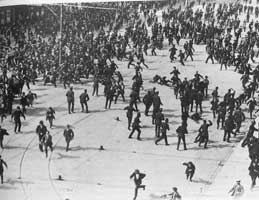
Dublin Metropolitan Police break up a union rally
Date26 August 1913 – 18 January 1914
Location
Caused by
  • Poor working conditions
  • Lack of workers' rights
  • Inability to unionise
Goals
  • Improved working conditions
  • Granting of right to unionise
MethodsStrikes, rallies, walkouts
Resulted in
  • Strikers go back to work
  • Many workers sign pledges not to join ITGWU
  • ITGWU badly damaged
  • Principle of unionisation accepted
  • Formation of the Irish Citizen Army
Parties

Workers organizations

Supported by

Lead figures
Number
20,000 workers
300 employers
Casualties and losses
200 policemen injured
2 dead, several hundred injured

The Dublin lock-out was a major industrial dispute between approximately 20,000 workers and 300 employers that took place in Dublin, Ireland. The dispute, lasting from 26 August 1913 to 18 January 1914, is often viewed as the most severe and significant industrial dispute in Irish history. Central to the dispute was the workers' right to unionise.

Background

[edit]

Poverty and housing

[edit]

Many of Dublin's workers lived in terrible conditions in tenements. For example, over 830 people lived in just 15 houses in Henrietta Street's Georgian tenements. At 10 Henrietta Street, the Irish Sisters of Charity ran a Magdalene laundry that was inhabited by more than 50 single women.[1] An estimated four million pledges were taken in pawnbrokers every year. The infant mortality rate among the poor was 142 per 1,000 births, extraordinarily high for a European city. The situation was made considerably worse by the high rate of disease in the slums, which was worsened by the lack of health care and cramped living conditions. The most prevalent disease in the Dublin slums at the time was tuberculosis (TB), which spread through tenements very quickly and caused many deaths among the poor. A report, published in 1912, found that TB-related deaths in Ireland were 50% higher than in England or Scotland. The vast majority of TB-related deaths in Ireland occurred among the poorer classes. The report updated a 1903 study by Dr John Lumsden.

Poverty was perpetuated in Dublin by the lack of work for unskilled workers, who did not have any form of representation before trade unions were founded. The unskilled workers often had to compete with one another for work every day, with the job generally going to whoever agreed to work for the lowest wages.

James Larkin and formation of ITGWU

[edit]

James Larkin, the main protagonist on the side of the workers in the dispute, was a docker in Liverpool and a union organiser. In 1907, he was sent to Belfast as a local organiser of the British-based National Union of Dock Labourers (NUDL). In Belfast, Larkin organised a strike of dock and transport workers. It was also in Belfast that Larkin began to use the tactic of the sympathetic strike in which workers who were not directly involved in an industrial dispute with employers would go on strike in support of other workers, who were striking. The Belfast strike was moderately successful and boosted Larkin's standing among Irish workers. However, his tactics were highly controversial and so Larkin was transferred to Dublin.

Unskilled workers in Dublin were very much at the mercy of their employers. Employers who suspected workers of trying to organise themselves could blacklist them to destroy them any chance of future employment. Larkin set about organising the unskilled workers of Dublin, which was a cause of concern for the NUDL, which was reluctant to engage in a full-scale industrial dispute with the powerful Dublin employers. It suspended Larkin from the NUDL in 1908. Larkin then left the NUDL and set up an Irish union, the Irish Transport and General Workers' Union (ITGWU).

The ITGWU was the first Irish trade union to cater for both skilled and unskilled workers. In its first few months, it quickly gained popularity and soon spread to other Irish cities. The ITGWU was used as a vehicle for Larkin's syndicalist views. He believed in bringing about a socialist revolution by the establishment of trade unions and calling general strikes.

The ITGWU initially lost several strikes between 1908 and 1910 but after 1913 won strikes involving carters and railway workers like the 1913 Sligo dock strike. Between 1911 and 1913, membership of the ITGWU rose from 4,000 to 10,000, to the alarm of employers.

Larkin had learned from the methods of the 1910 Tonypandy riots and the 1911 Liverpool general transport strike.

Larkin, Connolly and Irish Labour Party

[edit]

Another important figure in the rise of an organised workers' movement in Ireland at the time was James Connolly, an Edinburgh-born Marxist of Irish parentage. A talented orator and a fine writer, he became known for his speeches on the streets of Dublin in support of socialism and Irish nationalism. In 1896, Connolly established the Irish Socialist Republican Party and the newspaper The Workers' Republic. In 1911, Connolly was appointed the ITGWU's Belfast organiser. In 1912, Connolly and Larkin formed the Irish Labour Party to represent workers in the imminent Home Rule Bill debate in the British Parliament. Home rule, although passed in the House of Commons, was postponed by the start of the First World War. The plan was then suspended for one year, then indefinitely, after the rise of militant nationalism after the 1916 Rising.

William Martin Murphy and employers

[edit]
Cartoon of William Martin Murphy preying over James Larkin.

Among the employers in Ireland opposed to trade unions such as Larkin's ITGWU was William Martin Murphy, Ireland's most prominent capitalist, born in Castletownbere, County Cork. In 1913, Murphy was chairman of the Dublin United Tramway Company and owned Clery's department store and the Imperial Hotel. He controlled the Irish Independent, Evening Herald and The Irish Catholic newspapers and was a major shareholder in the B&I Line. Murphy was also a prominent Irish nationalist and a former Home Rule MP in Parliament.

Even today, Murphy's defenders insist that he was a charitable man and a good employer and that his workers received fair wages. However, conditions in his many enterprises were often poor or worse, with employees given only one day off in 10 and being forced to labour up to 17 hours a day. Dublin tramway workers were paid substantially less than their counterparts in Belfast and Liverpool and were subjected to a regime of punitive fines, probationary periods extending for as long as six years and a culture of company surveillance involving the widespread use of informers.[2]

Murphy was not opposed in principle to trade unions, particularly craft unions, but he was vehemently opposed to the ITGWU and saw its leader, Larkin, as a dangerous revolutionary.[3] In July 1913, Murphy presided over a meeting of 300 employers during which a collective response to the rise of trade unionism was agreed. Murphy and the employers were determined not to allow the ITGWU to unionise the Dublin workforce. On 15 August, Murphy dismissed 40 workers whom he suspected of ITGWU membership, followed by another 300 over the next week.

Middle

[edit]
Statue of James Larkin on O'Connell Street (Oisín Kelly 1977)

Escalation

[edit]
Proclamation banning a meeting in Sackville Street on 31 August 1913

The resulting industrial dispute was the most severe in the history of Ireland. Employers in Dublin locked out their workers and employed blackleg labour from Britain and elsewhere in Ireland. Dublin's workers, despite being some of the poorest in the United Kingdom at the time, applied for help and were sent £150,000 by the British Trades Union Congress (TUC) and other sources in Ireland, doled out dutifully by the ITGWU.[4][5]

The "Kiddies' Scheme" for the starving children of Irish strikers to be temporarily looked after by British trade unionists was blocked by the Roman Catholic Church and especially the Ancient Order of Hibernians, which claimed that Catholic children would be subject to Protestant or atheist influences when in Britain. The Church supported the employers during the dispute and condemned Larkin as a socialist revolutionary.[6]

Notably, Guinness, the largest employer and biggest exporter in Dublin, refused to lock out its workforce. It refused to join Murphy's group but sent £500 to the employers' fund. It had a policy against sympathetic strikes and expected its workers, whose conditions were far better than the norm in Ireland, not to strike in sympathy; six who had done so were dismissed. It had 400 of its staff who were already ITGWU members and so it had a working relationship with the union. Larkin appealed to have the six reinstated but without success.[7]

The Industrial Workers of the World (IWW) leader, Bill Haywood, was in Paris when he heard of the lockout. He collected 1000 francs to aid the strikers and travelled to Dublin where he addressed a crowd in front of City Hall.[8][9]

Strikers used mass pickets and intimidation against strike-breakers, who were also violent towards strikers. The Dublin Metropolitan Police carried out a baton charge at worker's rallies. On 31 August 1913, the DMP attacked a meeting on Sackville Street (now known as O'Connell Street) that had been publicly banned. It caused the deaths of two workers: James Nolan and John Byrne. Over 300 more were injured.

The baton charge was a response to the appearance of James Larkin, who had been banned from holding a meeting, to speak for the workers. He had been smuggled into William Martin Murphy's Imperial Hotel by Nellie Gifford, the sister-in-law of Thomas MacDonagh, and spoke from a balcony. The event is remembered as Bloody Sunday, a term used for three subsequent days in 20th-century Ireland and for the murderous charge of police in the Liverpool general strike. Another worker, Alice Brady, was later shot dead by a strike-breaker as she brought home a food parcel from the union office. Michael Byrne, an ITGWU official from Kingstown, died after he had been tortured in a police cell.[10]

Connolly, Larkin and ex-British Army Captain Jack White formed a worker's militia, the Irish Citizen Army, to protect workers' demonstrations.

For seven months, the lock-out affected tens of thousands of Dublin families. Murphy's three main newspapers, the Irish Independent, the Sunday Independent and the Evening Herald, portrayed Larkin as the villain. Influential figures such as Patrick Pearse, Countess Markievicz and William Butler Yeats supported the workers in the media.

End

[edit]

The lock-out eventually concluded in early 1914, when the TUC in Britain rejected Larkin and Connolly's request for a sympathetic strike. Most workers, many of whom were on the brink of starvation, went back to work and signed pledges not to join the ITGWU. It was badly damaged by its defeat in the Lockout and further hit by the departure of Larkin to the United States in 1914 and the execution of Connolly, one of the leaders of the Easter Rising in 1916.

The union was rebuilt by William O'Brien and Thomas Johnson. By 1919, its membership had surpassed that of 1913.

Many of the blacklisted workers joined the British Army since they had no other source of pay to support their families, and they found themselves in the trenches of World War I within the year.

Although the actions of the ITGWU and the smaller UBLU had been unsuccessful in achieving substantially better pay and conditions for workers, they marked a watershed in Irish labour history. The principle of union action and workers' solidarity had been firmly established. No future employer would ever try to "break" a union as Murphy had attempted to with the ITGWU. The lock-out had damaged commercial businesses in Dublin, with many forced to declare bankruptcy.

W. B. Yeats' "September 1913"

[edit]

September 1913, one of the most famous of W. B. Yeats' poems, was published in The Irish Times during the lock-out. Although the occasion of the poem was the decision of Dublin Corporation not to build a gallery to house the Hugh Lane collection of paintings (Murphy was one of the most vocal opponents of the plan), it has sometimes been viewed by scholars as a commentary on the lock-out.[11] In the poem, Yeats wrote mockingly of commerciants who "fumble in a greasy till, and add the halfpence to the pence" and asked:

Was it for this the wild geese spread
The grey wing upon every tide;
For this that all that blood was shed,
For this Edward Fitzgerald died,
And Robert Emmet and Wolfe Tone,
All that delirium of the brave?
Romantic Ireland's dead and gone,
It's with O'Leary in the grave.

See also

[edit]

References

[edit]
[edit]
Revisions and contributorsEdit on WikipediaRead on Wikipedia
from Grokipedia

The Dublin lock-out was a severe industrial conflict in 1913 that involved approximately 20,000 workers confronting around 400 employers in Dublin, Ireland, centered on the employers' refusal to recognize the Irish Transport and General Workers' Union (ITGWU). The dispute erupted on 26 August 1913 when tramway employees struck against William Martin Murphy's Dublin United Tramways Company after he banned ITGWU membership, prompting Murphy—leading an employers' federation—to orchestrate widespread dismissals and lockouts demanding workers renounce the union. Under ITGWU leader James Larkin, workers mounted sympathy strikes across sectors amid dire urban poverty and squalid tenement conditions, but faced brutal police repression, exemplified by "Bloody Sunday" on 31 August, when Dublin Metropolitan Police baton-charged protesters on O'Connell Street, killing two strikers and injuring hundreds. Efforts for relief, including British trade union food shipments and the controversial "kiddies' scheme" evacuating strikers' children abroad (opposed by the Catholic hierarchy), proved insufficient against hunger and blacklisting; by January 1914, most workers capitulated by signing anti-union pledges, handing employers a tactical victory that weakened the ITGWU short-term yet forged lasting solidarity, birthing the Irish Citizen Army and amplifying revolutionary sentiments in Irish labor history.

Background and Causes

Economic and Social Conditions in Edwardian

's economy in the early twentieth century was marked by stagnation following the Act of Union in 1800, which shifted industrial focus away from and limited growth in manufacturing and trade. The city's population reached 304,802 by 1911, with 63% classified as , including 194,250 laborers and their dependents reliant on precarious employment in sectors like administration, commerce, brewing (e.g., ), distilling (Jameson), and biscuit production (Jacob’s). Casual labor dominated, particularly among the 30,000 unskilled workers, of whom 7,000 were dockers or carters hired daily, fostering chronic insecurity and low productivity. Wages remained suppressed due to employer leverage amid high , which peaked at 20% for unskilled roles, enabling arbitrary hiring practices and minimal for workers. Unskilled laborers earned approximately 18 shillings weekly in , insufficient to counter the effects of irregular work and seasonal fluctuations in industries like and activities. This economic precarity drove high rates, primarily to northern English cities, as offered few stable opportunities for advancement or skill development. Social conditions reflected profound inequality, with 45% of the —around 118,000 individuals—confined to 5,322 houses by 1911, where was rampant: 20,108 families occupied single rooms, and examples included 835 residents in 15 Henrietta Street houses or 104 in one structure. These dilapidated Georgian-era buildings lacked , featured poor drainage, and housed in yards, contributing to frequent collapses, such as the Church Street incident on 2 1913 that killed seven. outcomes were dire, with a citywide death rate of 22.3 per 1,000—higher than London's 15.6—and elevated , , and linked to and filth; weekly evictions averaged 250, displacing 13,000 annually by 1910.

Emergence of Militant Unionism under

, a Liverpool-born Irish socialist, arrived in Dublin in January 1907 as an organizer for the British-based National Union of Dock Labourers (NUDL). His early efforts focused on recruiting unskilled dock workers and carters, who had previously been excluded from craft unions, amid Dublin's pervasive poverty and casual labor conditions. In 1907, Larkin orchestrated a successful strike in Belfast involving dockers and carters, marking his first use of the sympathy strike tactic, where unrelated workers halted operations to support the primary strikers, amplifying pressure on employers. Tensions arose with NUDL leadership over Larkin's aggressive methods, including sympathy actions and public agitation, leading to his recall to Britain in 1908. Undeterred, Larkin established the Irish Transport and General Workers' Union (ITGWU) on 28 December 1908 as a breakaway , aiming to unite transport and general laborers in a single, inclusive body rejecting craft union divisions. The ITGWU's constitution emphasized solidarity and , positioning it as a vehicle for Larkin's syndicalist vision of worker control through mass rather than parliamentary reform. Larkin's strategy emphasized militant tactics such as strikes, boycotts of goods handled by non-union labor ("tainted goods"), and mass demonstrations to enforce union demands, contrasting with the more moderate approaches of established British unions. These methods secured increases and better conditions in initial disputes, like the 1909 Dublin dock strike, drawing thousands of unskilled workers into the fold and challenging employer prerogatives in a dominated by small-scale, anti-union businesses. By mid-1911, the ITGWU had expanded to over 3,000 members, with Larkin leveraging street-corner oratory and the union's , The Irish Worker, to propagate class antagonism and worker autonomy. The rise of ITGWU militancy provoked backlash from employers, who viewed Larkin's "one big union" model and refusal to compromise as existential threats to industrial discipline. Denunciations of "Larkinism" as reckless adventurism emerged from moderate trade unionists and authorities, yet the union's growth to approximately 30,000 members by summer demonstrated its appeal among Dublin's marginalized , setting the stage for broader confrontations. This period marked a shift from fragmented, craft-based to centralized, confrontational unionism, rooted in empirical successes of amid Ireland's underdeveloped economy.

Employer Organization and Resistance Led by William Martin Murphy

William Martin Murphy, a prominent Dublin businessman born in 1845, owned the Dublin United Tramways Company, Clery's department store, the Irish Independent newspaper, and extensive property holdings, positioning him as Ireland's leading capitalist by 1913. From 1911, Murphy spearheaded employers' opposition to the (ITGWU), led by , adhering to a traditional model of where employers provided paternalistic benefits in exchange for worker deference, viewing the ITGWU's syndicalist tactics—including sympathetic strikes—as a direct threat to managerial authority. He publicly declared that "either Larkin rules or we do," framing the conflict as existential for employer control. In anticipation of labor unrest, leveraged the Employers' , an existing body he deemed suitable for coordinated action, to unite approximately 300 employers across industries such as , baking, and construction. By mid-1913, the formalized resistance by requiring workers to sign an anti-union pledge renouncing ITGWU membership as a condition of employment, a strategy enforced first at his tramway company in July 1913 after dismissing non-compliant staff. This pledge extended beyond his firms, as the circulated it widely to prevent union infiltration and maintain non-union workforces, reflecting a calculated preemptive effort to dismantle the ITGWU's growing influence amid Dublin's high unemployment and casual labor conditions. Murphy's leadership emphasized unified employer solidarity, prohibiting individual negotiations with the ITGWU and sourcing strikebreakers from rural areas and Britain to sustain operations, while his control of the amplified anti-union messaging portraying Larkin as a destabilizing agitator. Though Murphy claimed opposition targeted only the ITGWU's militancy rather than unions per se—citing his history of fair treatment over 50 years—the Federation's actions effectively barred affiliation with any union employing sympathetic strike tactics, prioritizing industrial discipline over accommodation. This organization proved pivotal when the August 1913 tram strike escalated into a full lockout on 26 August, locking out over 20,000 workers citywide.

Initiation of the Conflict

The Tramway Strike of August 1913

The tramway strike commenced on 26 August 1913, when drivers and conductors of the United Tramways Company (DUTC), owned by William Martin Murphy, refused to comply with his directive prohibiting membership in the Irish Transport and General Workers' Union (ITGWU). At approximately 9:40 a.m., around 700 workers pinned the ITGWU's Red Hand badge to their uniforms as a of defiance, deserting their vehicles and halting tram services across the city. This action was deliberately timed to coincide with the , aiming to amplify economic disruption by stranding visitors and impeding transport. James Larkin, the ITGWU's militant leader, had orchestrated the strike in direct response to Murphy's ultimatum, which demanded that employees forswear union affiliation or face dismissal, reflecting employers' broader opposition to the union's growing influence and tactics like sympathy strikes. Murphy, a prominent businessman and president of the Dublin Chamber of Commerce, viewed the ITGWU as a threat to managerial control, having previously dismissed workers for union activities. The immediate result was a complete shutdown of the DUTC network, with strikers urging passengers to boycott the company's trams, thereby initiating the labor confrontation that escalated into the full lock-out. Initial skirmishes occurred as non-union workers attempted to operate services, but union members effectively blockaded depots and routes, preventing scab labor from resuming operations. Larkin's emphasized , drawing on the ITGWU's recent successes in smaller disputes to rally support, though it provoked swift retaliation from employers organized under the Dublin Employers' Federation. By the end of the day, the strike had paralyzed key arteries of 's economy, setting the stage for Murphy's counteroffensive against .

Employers' Lock-out Declaration and Anti-Union Pledge

On 26 August 1913, following the escalation of the tramway strike initiated by the Irish Transport and General Workers' Union (ITGWU), the Dublin Employers' Federation, under the leadership of William Martin Murphy, formally declared a general lock-out of ITGWU members across multiple industries. This action targeted approximately 20,000 workers, expanding the dispute beyond transport to sectors including baking, building, and provisioning, as employers posted notices requiring employees to either renounce union affiliation or face dismissal and exclusion from employment. Murphy, owner of the newspaper and the United Tramway Company, had earlier convened meetings of over 300 employers in July 1913 to coordinate resistance against the ITGWU's growing influence, culminating in the federation's unified stance against union recognition. The core of the employers' strategy was an anti-union pledge that workers were compelled to sign as a condition for continued or renewed . The pledge explicitly required employees to disavow membership in the ITGWU, abstain from joining it, and refrain from supporting any strikes or actions led by the union, effectively aiming to dismantle its organizational power in . Refusal to sign resulted in immediate lock-out, with employers like dismissing hundreds of suspected unionists from tram depots starting 15 August 1913, before the formal declaration. By early September, a meeting of 404 employers reinforced this policy, binding participants to hire only those who had signed the pledge or provided guarantees against ITGWU involvement. This marked a deliberate employer offensive to reassert control over , rooted in opposition to the ITGWU's tactics of sympathy strikes and its challenge to traditional . Approximately 400 firms participated, locking out workers en masse and creating widespread unemployment that pressured union solidarity. The pledge's enforcement highlighted the employers' view of the ITGWU as an existential threat, with publicly framing it as a defense against syndicalist disruption rather than mere wage disputes.

Escalation and Conduct of the Dispute

Expansion to Multiple Industries and Worker Mobilization

The Lockout expanded beyond the initial tramway dispute when, on 26 August 1913, the Dublin Employers' Federation—led by figures such as William Martin Murphy and encompassing over 300 employers—issued a declaration locking out any workers refusing to sign a pledge renouncing membership in the Irish Transport and General Workers' Union (ITGWU) and prohibiting sympathy strikes. This action swiftly spread the conflict to diverse industries, including coal distribution (with the Coal Merchants’ Association dismissing ITGWU members on 2 September), building trades (employers' federation firings on 9 September), agriculture and carriers (dismissals on 12 September), and timber processing (staff strikes on 22 September refusing "tainted" goods). By 3 September, the lockout affected approximately 20,000 workers across these sectors, primarily unskilled and semi-skilled laborers in 's fragmented economy dominated by small-scale enterprises. Worker mobilization intensified under the ITGWU, established by in 1909 to organize previously excluded general laborers such as dockers, carters, and factory operatives, with membership growing to about 10,000 by mid-1913 through aggressive recruitment and sympathy strike tactics. Larkin promoted a "one big union" model to foster class-wide solidarity, coordinating refusals to handle non-union goods ("blacking"), establishing local strike committees for resource distribution, and holding mass rallies—such as the 10,000-strong gathering at Beresford Place on 29 August—to maintain resolve and garner public attention. These efforts drew in workers from craft unions and non-ITGWU shops who rejected the pledge, transforming isolated disputes into a coordinated city-wide resistance against employer efforts to dismantle militant unionism. The scale of mobilization revealed the ITGWU's rapid penetration into Dublin's labor force, where low wages and casual employment had long stifled organization, but also exposed vulnerabilities as employers exploited legal bans on meetings and arrests of leaders to disrupt coordination. By late September, thousands participated in marches and boycotts, including 4,000 in a 16 protest, underscoring a shift toward broader proletarian amid the lockout's economic pressures. This expansion not only halted much of Dublin's commerce but also tested the limits of worker unity against coordinated capitalist opposition.

Violent Confrontations Including "Bloody Sunday"

As the lock-out expanded beyond the tramways into docks, construction, and other sectors, violent confrontations intensified between strikers attempting to enforce pickets, imported strike-breakers (often called "blacklegs"), and the Dublin Metropolitan Police (DMP), who were tasked with protecting non-union labor. From late August to early September 1913 alone, at least fifteen distinct riots erupted, involving baton charges, stone-throwing, and fistfights that left dozens hospitalized in the initial weeks. Strikers, organized under James Larkin's Irish Transport and General Workers' Union (ITGWU), frequently clashed with police-escorted scabs at sites like the docks and Liberty Hall, resulting in one striker's death from a gunshot wound during an early September altercation and the killing of at least one strike-breaker by union militants. The most notorious episode occurred on August 31, 1913, dubbed "Bloody Sunday" by labor supporters, when authorities banned a mass ITGWU rally planned for (then Sackville Street) to protest the lock-out and Larkin's recent for seditious speech. Larkin, released on , disguised himself as a clergyman to briefly address the gathering of thousands from the balcony of the Imperial Hotel around 7:30 p.m., urging defiance before police dragged him away for violating the ban. In response, approximately 300 DMP officers launched a into the unarmed crowd, which included many bystanders, women, and children; the assault began near the hotel and rapidly spread to adjacent areas like Beresford Place, , and Eden Quay after 9 p.m. The police action proved indiscriminate and brutal, with officers beating protesters and onlookers alike in what contemporary accounts described as a "police riot," fracturing skulls and causing widespread panic as crowds fled into side streets. Two civilians died from injuries sustained: James Nolan, a young bystander caught in the melee on Lower Abbey Street, succumbed to a fractured skull from police batons, while John Byrne perished from similar blows received during the charges. Estimates of injuries ranged from over 300 to around 500, including severe head wounds requiring hospitalization; eyewitnesses, including Member of Parliament Handel Booth, reported officers continuing the assault even on those already downed. These events exacerbated tensions, hardening worker resolve while drawing criticism of police tactics from neutral observers, though authorities justified the force as necessary to prevent and maintain order amid the lock-out's chaos. Subsequent clashes, such as those at shipyards and building sites, followed a similar pattern of picket-line disruptions met with police intervention, contributing to a total of at least three striker deaths and numerous arrests by mid-September. The underscored the employers' reliance on state-backed to break the dispute, as union leaders like Larkin framed the confrontations as evidence of class warfare against Dublin's impoverished workers.

Hardships, Starvation, and Family Suffering

The lock-out, which began on August 26, 1913, deprived approximately 20,000 workers of their livelihoods, plunging their families into acute financial distress as employers refused to reinstate union members without renunciation of syndicalist principles. With no wages incoming for over four months, households reliant on casual labor in industries like transport, baking, and construction faced immediate threats of eviction and malnutrition, exacerbated by Dublin's pre-existing poverty where 26,000 families resided in one-room tenements. Union efforts, including soup kitchens at Liberty Hall organized by Delia Larkin and staffed by figures such as Constance Markievicz, provided daily meals to thousands, but these proved insufficient against the scale of need, with food distributions supplemented by shipments from British sympathizers arriving from September 29 onward. Children bore the brunt of the privations, with families unable to afford basic sustenance leading to widespread undernourishment and heightened vulnerability to disease. Efforts to alleviate this by evacuating children to foster homes in and , coordinated by trade unionists, encountered fierce opposition from Catholic clergy and lay groups who blockaded docks to prevent departures, citing fears of Protestant over humanitarian relief. Only a few hundred children successfully departed before the initiative collapsed amid mob confrontations, leaving most families to cope without external aid. Health outcomes reflected the crisis's severity, with Dublin's already elevated infant mortality rate of 142 per 1,000 births—higher than in England or Scotland—worsening due to insufficient food, as noted by Medical Inspector Sir Charles Cameron, who documented infants perishing from want. Tuberculosis deaths surged amid overcrowding and weakened immunity, contributing to a city death rate surpassing that of Calcutta, while specific cases like the Sammon siblings highlighted fatalities from starvation-related complications among the locked-out poor. Malnutrition, endemic prior to the dispute, intensified family disintegration, with reports of unregistered deaths due to destitution underscoring the unquantified human toll beyond direct starvation counts.

Interventions and Mediation Efforts

Role of Authorities: Police Brutality and Military Deployment

The (DMP), responsible for maintaining order in the city, frequently clashed with strikers and picketers during the lock-out, employing baton charges and physical force to protect strikebreakers and ensure the operation of trams and other services. From late August 1913 onward, these confrontations escalated, with the DMP responding to stone-throwing and attempts to block non-union labor by dispersing crowds aggressively; records indicate at least 15 distinct riots involving large-scale clashes between August and September. Contemporary accounts and later assessments, including from Irish state inquiries, described some DMP actions as involving unnecessary violence, particularly when officers charged into unarmed gatherings without proportional restraint. The peak of police intervention occurred on Bloody Sunday, August 31, 1913, when DMP officers baton-charged a large crowd assembled on after addressed a banned public meeting, resulting in two civilian deaths—James Nolan, who succumbed to head injuries from batons, and John Byrne, killed by gunfire from assisting (RIC) members—and over 300 injuries treated at local hospitals. The charges followed failed attempts to enforce a government ban on assemblies, with police advancing on protesters who had pelted them with missiles; while strikers initiated some violence, the scale of the DMP's response, including indiscriminate beatings, drew criticism for exacerbating casualties among bystanders. This event, occurring amid broader picket-line skirmishes, underscored the DMP's alignment with employer interests, as officers prioritized escorting blackleg workers over de-escalation. Military deployment was limited but targeted, with units called upon from September 1913 to safeguard strikebreakers and critical imports against by union militants. On September 22, soldiers protected coal shipments at docks, where strikers had attempted blockades, allowing employers like William Martin Murphy to sustain operations despite ongoing disruptions. Unlike a full occupation, these interventions involved small detachments acting as escorts rather than frontline , reflecting authorities' preference for police handling of urban unrest while reserving troops for economic chokepoints. The presence of military forces further militarized the dispute, prompting workers to form the in November 1913 as a against perceived state favoritism toward capital. No widespread army-led suppression occurred, but the deployments signaled the British administration's readiness to enforce the lock-out's pro-employer dynamics.

British Trade Union Sympathy Strikes and Their Limitations

James Larkin departed for Britain in late October 1913 to garner support from the British labour movement, embarking on a speaking tour that included major addresses urging sympathy strikes to halt the flow of goods and strikebreakers to Dublin. He advocated boycotting "tainted goods" from Dublin employers and criticized British union leaders, such as railway union official Jimmy Thomas, as traitors for opposing industrial action. Large rallies demonstrated public enthusiasm, with attendances reaching 4,000 in Manchester, 10,000 at London's Royal Albert Hall, and 7,000 in Edinburgh, where speakers echoed Larkin's calls for solidarity. Limited unofficial sympathy actions emerged despite official restraint, including two waves of railway worker strikes—3,000 to 5,500 participants from 15 to 23 September 1913, expanding to 30,000 in November—and dockers in and refusing to handle cargoes linked to Dublin strikebreakers, such as at Canada and Alexandra docks. The (TUC) prioritized non-industrial aid, raising approximately £150,000 (equivalent to over £11 million in modern terms) through union contributions, including £14,000 from miners and £4,000 from engineers, alongside logistical efforts like the SS Hare food ship delivering 1,797,699 loaves of bread and 689,166 bags of potatoes to strikers. A special TUC congress convened in December 1913 to address demands for coordinated sympathy strikes but rejected them by an 11-1 vote, opting instead for continued financial support without risking escalation. The Triple Alliance of miners, transport workers, and railwaymen, newly formed in 1913-1914, provided no dedicated action for , focusing inwardly on domestic coordination. These efforts faced inherent limitations, rooted in the British unions' exhaustion from the "Great Unrest" strikes of 1910-1912, which had drained funds and fostered caution among leaders wary of laws, uncontrolled escalation, and further economic disruption. Rank-and-file militancy produced isolated strikes but lacked national organization, undermined by TUC officials suppressing actions and internal socialist divisions; employer countermeasures, including police interventions, further contained outbreaks. Ultimately, the absence of paralyzing British allowed Dublin employers to import strikebreakers via alternative routes, prolonging the lock-out until workers capitulated in January 1914.

Church Opposition and Failed Negotiation Attempts

The , wielding significant influence over the working class, largely opposed the militant tactics of and the Irish Transport and General Workers' Union (ITGWU) during the 1913 Dublin lock-out, viewing them as promoters of and that threatened social hierarchy and Catholic doctrine on . The hierarchy favored "moderate" craft unions over the revolutionary of the ITGWU, which it associated with class warfare and potential moral corruption. This stance aligned with the Church's broader historical resistance to radical trade unionism, prioritizing stability and employer-led conciliation over worker militancy. Archbishop William Walsh of Dublin emerged as a key ecclesiastical figure, publicly condemning the ITGWU's plan—announced on October 20, 1913—to evacuate approximately 3,000 locked-out workers' children to foster homes in Britain for food and shelter. Walsh denounced the scheme as the "export of Irish children," warning it would expose Catholic youth to proselytism by Protestant or atheist hosts, and urged priests to block participation, effectively halting most relocations after only a few hundred children departed. His intervention, disseminated via letters read from pulpits, reflected fears of cultural and religious dilution amid the dispute's desperation, though it drew criticism from nationalists like George Russell for prioritizing dogma over humanitarian aid. Cardinal Michael Logue, Primate of All Ireland, alongside other bishops, issued pastoral letters framing the lock-out as a "senseless war" and "deplorable quarrel" that shamed the nation by pitting employers against workers in prolonged suffering, with over 20,000 locked out by November 1913. These statements, read at masses in early , called for mutual restraint but implicitly critiqued the strikers' intransigence, as the Church sought to avert famine-like conditions without endorsing Larkin's confrontational strategy. Walsh also pursued mediation, proposing formal conciliation boards to broker talks between employers and unions, leveraging his authority to foster compromise amid escalating violence and starvation. These efforts faltered when employers, spearheaded by William Martin Murphy, rejected involvement unless the ITGWU dissolved its influence, insisting workers sign a pledge against sympathetic strikes and union membership—a non-negotiable demand for Larkin that preserved employer control over labor organization. Concurrent British Trade Union Congress delegations, arriving in December 1913, similarly failed after employers abruptly ended discussions, prioritizing the destruction of "Larkinism" over concessions that might legitimize the ITGWU. The Church's limited leverage, combined with employers' resolve and workers' refusal to capitulate, ensured no viable settlement emerged, extending the lock-out until January 1914.

Resolution

Worker Surrender and Return-to-Work Conditions

By late December 1913, amid severe hardships including widespread starvation and failed mediation attempts, the Irish Transport and General Workers' Union (ITGWU) leadership, under , conceded the dispute's unwinnability without broader British labor support. On January 18, 1914, ITGWU officials formally ended the strike, advising members to resume work but instructing them against signing employers' anti-union pledges, emphasizing preservation of union loyalty over immediate employment. Employers, led by figures like William Martin Murphy, maintained their lockout until workers capitulated to rehire conditions, which centered on a uniform pledge renouncing ITGWU membership and obedience to managerial directives. The standard undertaking required signatories to affirm: "I hereby undertake to carry out all instructions given to me by or on behalf of my employers in the future and not to join or belong to any without the permission of my employers," with non-ITGWU members often pledging non-affiliation and existing members agreeing to immediate resignation from the union. Refusal resulted in permanent , affecting thousands; estimates indicate over 10,000 workers eventually signed to regain jobs, though many faced wage reductions, longer hours, or exclusion from prior roles. Returns occurred piecemeal from early January 1914, with tramway workers—central to the initial dispute—re-entering under the Dublin United Tramways Company by mid-January after mass signings, while sectors like and saw slower reintegration due to ongoing . No concessions on union recognition or were granted, solidifying employers' tactical victory and reverting pre-lockout non-union status quo, though the ITGWU endured with reduced immediate influence.

Casualties, Arrests, and Immediate Human Costs

The most significant casualties arose from violent confrontations, particularly "Bloody Sunday" on 31 August 1913, when baton-charged crowds on protesting the arrest of union leader , resulting in the deaths of two workers, James Nolan (from injuries sustained the previous day) and John Byrne, with a possible third fatality, Patsy O'Connor. The clashes over 30–1 August involved intense rioting, injuring an estimated 450–600 people, including civilians and over 200 police officers. Additional deaths during the lockout included one striker from a police gunshot wound and one beaten to death by strikers, bringing the total fatalities from direct violence to at least four. Arrests were widespread amid the unrest, targeting union organizers and participants in riots. Larkin himself was detained on sedition charges shortly before Bloody Sunday and again in October 1913, while events like the Ringsend Bridge clashes immediately following yielded 16 arrests. Police actions, including 15 reported riots in August and September, facilitated numerous detentions to suppress picketing and assemblies, though comprehensive totals remain undocumented in primary accounts. The lockout's immediate human toll extended beyond violence to encompass severe economic deprivation for roughly 20,000 locked-out workers and 80,000 dependents, who endured months of hunger prompting reliance on soup kitchens and charity. Initiatives like the "kiddies' scheme," which sought to relocate starving children to supportive households in Britain, highlighted family desperation but faced opposition and limited success. Dublin's pre-existing high death rate of 27.6 per 1,000—among Europe's worst—worsened during the dispute, with elevated and overall fatalities attributed to privation, though direct deaths were not systematically tallied.

Aftermath and Legacy

Short-Term Economic Repercussions for

The Dublin Lockout, spanning from August 1913 to early 1914, inflicted immediate disruptions on the city's key economic sectors, including shipping, docks, tramways, and building trades, as strikes and boycotts halted operations and led to widespread idleness among approximately 15,000 workers by mid-September 1913. activities ground to a near standstill, with events such as the refusal to unload vessels like the Lady Gwendoline on August 23, 1913, and a full halt to quay work by November 12, 1913, due to dock laborers' actions against imported free labor, resulting in lost tides, suspended sailings, and grievous losses to commerce across . Firms like W. & H.M. Gouldings and Messrs. temporarily closed, exacerbating supply shortages and contributing to an unprecedented degree of trade dislocation that affected employers, merchants, and the broader community through reduced output and from associated riots. In the immediate aftermath, as workers capitulated and began returning en masse from December 1913 onward—repudiating union leadership in sectors like building by February —business operations resumed with the aid of non-union labor and police protection, restoring functionality and averting prolonged paralysis. This enabled a swift normalization of industrial life by early , as employers reasserted control without conceding union recognition, thereby stabilizing and preventing what some contemporaries viewed as potential generational ruin to Dublin's from sustained syndicalist influence. However, re-employment lagged due to operational disarray and waiting lists, leaving thousands of former strikers—out of the roughly involved—facing prolonged idleness, bankruptcy, and acute want, with many unable to secure prior positions amid the preference for compliant labor. These effects compounded Dublin's pre-existing poverty, with the lockout's resolution yielding no wage gains or structural reforms, instead reinforcing low-wage casual labor dynamics and prompting emigration among displaced workers, though aggregate trade volumes recovered as employer federations like the Dublin Employers' Federation, formed in 1911, enforced non-union policies. The episode thus marked a short-term contraction in labor-intensive output, offset by business resilience, but at the cost of deepened worker destitution without alleviating underlying economic vulnerabilities in the port-dependent city.

Transformation of the Irish Labor Movement

The Dublin Lockout of 1913, despite resulting in the capitulation of most workers by early 1914, marked a pivotal shift in the Irish labor movement from fragmented toward a more unified, militant, and ideologically driven syndicalist structure. The Irish Transport and General Workers' Union (ITGWU), founded by in 1909 as a embracing unskilled workers, not only survived the employers' campaign to dismantle it but emerged as a of resistance, retaining core activists and expanding its influence in subsequent years. This resilience stemmed from the lockout's exposure of employers' intransigence and state complicity, fostering a commitment to "one big union" principles that prioritized across trades over narrow guild interests. A direct outcome was the formation of the (ICA) on 23 November 1913, initially as a volunteer force of approximately 250 workers armed with hurleys and rudimentary weapons to defend strikers from police baton charges, such as the deadly events on Bloody Sunday, 31 August 1913. Under initial leadership from figures like Captain Jack White and later , the ICA represented the labor movement's first foray into paramilitary self-defense, reflecting syndicalist ideals of workers' against both capitalist coercion and state authority. This militarization transformed labor organizing by institutionalizing armed preparedness, diverging from British models reliant on negotiation and legalism. Following Larkin's departure to the in 1914 for a speaking tour that extended into , Connolly assumed acting general secretaryship of the ITGWU and command of the ICA, steering the movement toward . Connolly's writings and actions integrated class struggle with , arguing that labor emancipation required dismantling British imperial structures, as evidenced in his editorship of The Workers' Republic and advocacy for workers' councils. This fusion radicalized the movement, culminating in the ICA's participation in the 1916 with around 220 members, where it fought alongside nationalist forces, thereby embedding labor militancy within the broader independence struggle. Long-term, the lockout's legacy lay in professionalizing Irish unionism: the ITGWU's membership rebounded, reaching thousands by the war's end, and inspired subsequent strikes, such as the 1916 , while challenging the dominance of moderate British-affiliated unions. Historians note that the event's emphasis on mass mobilization and international solidarity, though tactically limited by failed British sympathy strikes, cultivated a distinct Irish variant of resilient to economic coercion. This evolution positioned labor as a vanguard force in early 20th-century Irish society, influencing the formation of the Irish Labour Party in 1912 and its intermittent alliances with , though tensions persisted between socialist internationalism and narrowing nationalist priorities.

Political Ramifications in Pre-Independence Ireland

The Dublin Lockout unfolded amid the intensifying Home Rule crisis, with the British government's attention divided by Ulster unionist opposition and impending legislation, limiting direct intervention in the industrial dispute. This context exposed underlying class fractures in Irish society, where employers, including figures like William Martin Murphy, positioned themselves as defenders of economic stability essential for governance, while labor leaders like advocated syndicalist tactics that challenged both capitalist structures and moderate nationalist priorities. The conflict deepened rifts within nationalism, as the Irish Parliamentary Party under John Redmond adopted an indecisive posture, wary of alienating middle-class supporters and risking disruption to Home Rule negotiations, thereby eroding its appeal among Dublin's proletariat. Conservative nationalists, including Arthur Griffith of Sinn Féin, criticized Larkin's agitation as disruptive, aligning implicitly with employer interests against the Irish Transport and General Workers' Union. In contrast, progressive elements like Constance Markievicz rallied to the workers' cause, foreshadowing alliances between labor militants and revolutionaries. Events such as Bloody Sunday on August 31, 1913, where police baton charges killed three and injured hundreds during a Larkin-led rally, galvanized nationalist intellectuals like , linking industrial grievances to broader . James Connolly's response included forming the on November 25, 1913, as a workers' defense force, which bridged class struggle with republican aspirations and later fought in the 1916 . Though the Lockout ended in worker capitulation by January 18, 1914, it heightened trade union consciousness and subordinated immediate labor gains to the , enabling republican forces to dominate pre-independence politics while planting seeds for future labor resurgence, with ITGWU membership rebounding to 120,000 by 1921.

Controversies and Historical Assessments

Critiques of Larkin's Syndicalist Tactics and Leadership

James Larkin's leadership during the has been critiqued for its autocratic tendencies, which centralized decision-making within the Irish Transport and General Workers' Union (ITGWU) and sidelined potential collaborators. Historians note that Larkin's abrasive and dictatorial style, marked by impatience and demonization of dissenters, fostered a one-man rule that alienated allies and hindered coordinated action. For instance, he marginalized figures like through continuous taunts and personal rivalries, contributing to internal strains amid the lockout's pressures. This personality-driven approach, described as turning egoism into egomania, prioritized charismatic oratory over sustainable organization, ultimately fracturing unity in the labor movement. Larkin's syndicalist tactics, emphasizing such as sympathetic strikes and calls for a , faced criticism for overreliance on militant escalation without securing broader institutional support. He initiated aggressive actions like closing on November 12, 1913, and urged British workers to black traffic, involving 13,000–14,000 participants, but these efforts collapsed due to opposition from union bureaucracies. The British Trade Union Congress (TUC) rejected a on December 9, 1913, by a vote of 2,280,000 to 203,000, isolating workers and exposing the limits of syndicalist appeals to rank-and-file against entrenched officials. Critics argue this reflected a strategic miscalculation, as Larkin trusted figures like Ben Tillett who ultimately betrayed the cause at the TUC conference. Further critiques highlight Larkin's inflammatory oratory and refusal to , which prolonged the dispute and intensified worker without altering the balance of power. His harsh condemnations of British union leaders for failing to support —famously stating they viewed trade unionism as "a salve for the sore of "—alienated potential , including a £100,000 fund from the TUC that came without the demanded . This rigidity, rooted in syndicalist aiming for an "industrial republic," neglected pragmatic negotiation and underestimated employer-state coordination, including scab labor importation and police violence, leading to the lockout's defeat after six months of and hardship for 20,000 workers. The absence of a structured to mobilize beyond officials left the ITGWU vulnerable, dooming the syndicalist challenge.

Employer Perspectives on Defending Business Interests

The employers, spearheaded by William Martin Murphy, owner of the United Tramway Company, established the Dublin Employers' Federation in July 1913, uniting around 400 businesses to counter the growing influence of James Larkin's Irish Transport and General Workers' Union (ITGWU). They perceived the ITGWU not as a conventional seeking wage improvements, but as a syndicalist intent on seizing control of industries through disruptive tactics like sympathy strikes, which extended labor disputes to unrelated firms and threatened overall . Murphy articulated this binary stakes, stating that "either Larkin rules or we do," underscoring the employers' resolve to preserve managerial over hiring, firing, and operations rather than cede it to union dictates. Central to their defense was opposition to the ITGWU's "pledge" system, whereby members swore obedience to union orders, including participation in sympathy actions that employers viewed as coercive and economically sabotageous. In response, the required workers to sign an undertaking renouncing membership in the ITGWU and pledging not to obey "illegal orders," a measure implemented after tramway workers struck on August 26, 1913, prompting to lock out over 300 employees who refused. This escalated into a broader lockout affecting some 25,000 workers by , as employers argued that tolerating such union militancy would invite a "Continental socialist plague" undermining Dublin's commercial viability. emphasized that he harbored "not the smallest objection to men forming a legitimate union," distinguishing the ITGWU's methods from traditional bodies, and highlighted his own history of amicable spanning 50 years without major strikes prior to Larkin's arrival. Employers justified the lockout's hardship on workers as a pragmatic lesson in industrial reality: while businesses could sustain losses through reserves and mutual support, strikers faced immediate privation, compelling eventual submission in most cases. pledged personal expenditure up to £100,000 to resist, framing the conflict as essential to safeguarding property rights and preventing Larkinism from dictating terms across sectors like , , and . In a letter to the Daily Citizen, he rebutted accusations of tyranny by noting his endurance of lengthy scrutiny at the inquiry without substantiated employer misconduct, attributing unrest instead to Larkin's importation of "terrorism" into labor practices. This collective stance, while costing employers dearly in lost revenue and legal fees, aimed to reassert that industrial peace required worker deference to business prerogatives, not union veto power.

Debates on Success, Failure, and Mythologization

Historians assess the Dublin Lockout of 1913 as a short-term tactical failure for the workers, culminating on January 18, 1914, when approximately 20,000 locked-out employees capitulated by signing employers' pledges to forgo membership in James Larkin's Irish Transport and General Workers' Union (ITGWU), thereby failing to secure union recognition or improved conditions amid widespread starvation and destitution. The British Trades Union Congress's refusal to authorize a sympathy strike, despite initial pledges of support, exacerbated the defeat by denying critical financial aid after weeks of deliberation. Debates on long-term success center on the lockout's role in fostering and institutional resilience within the Irish labor movement, despite the absence of immediate gains. The ITGWU survived the ordeal and contributed to broader union expansion, with Irish membership reaching 270,000 by 1919 from a pre-lockout base of under 10,000 in Larkin's union alone; today, union density stands at 37% in the , partly attributable to the precedent of collective defiance established in 1913. Critics, including historian Pádraig Yeates, contend it ultimately reinforced conservative forces—such as business interests, the , and constitutional nationalism—by sidelining progressive syndicalist impulses on the cusp of Irish independence, though proponents highlight the formation of the during the dispute as a catalyst for militarized labor activism that influenced the 1916 . The event's mythologization as an unalloyed heroic failure has embedded it in Irish socialist and nationalist lore, often overshadowing the pragmatic concessions workers made and the employers' strategic unity under William Martin Murphy. This romanticization, evident in commemorative statues of Larkin and in and cultural works portraying unyielding resistance, partly arises from suppressed documentation by both sides and Larkin's ideological emphasis on revolutionary confrontation over incremental bargaining, which some analyses view as having isolated the movement from broader Catholic working-class support. Such narratives, while inspiring later labor mobilizations, have been critiqued for conflating symbolic endurance with substantive victory, diverting focus from structural economic vulnerabilities like Dublin's dependence on low-wage port and tram labor.

References

Add your contribution
Related Hubs
User Avatar
No comments yet.