Hubbry Logo
search
logo
2169824

Ebbets Field

logo
Community Hub0 Subscribers
Read side by side
from Wikipedia

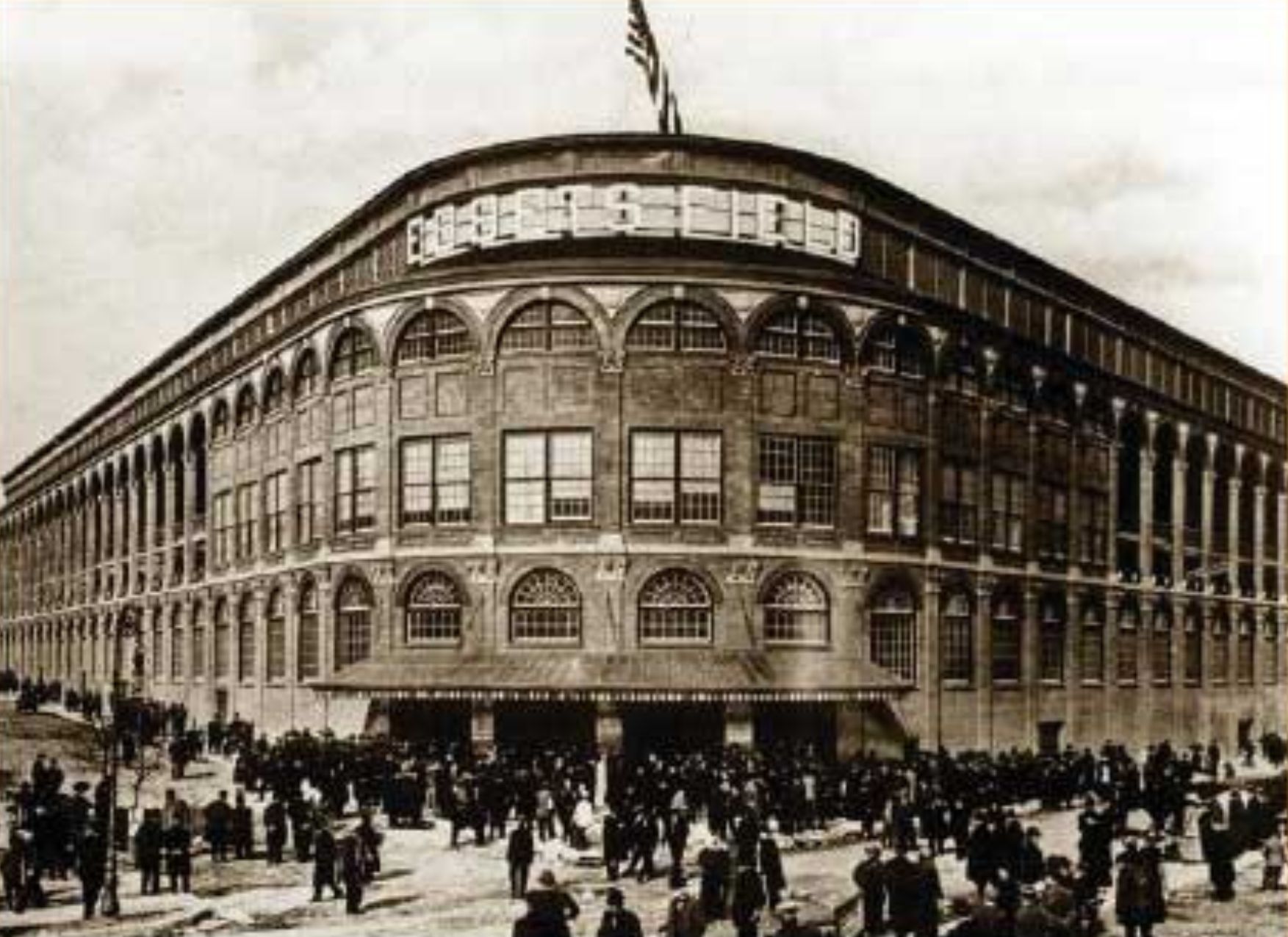
Ebbets Field was a Major League Baseball stadium in the Flatbush section of Brooklyn, New York. It is mainly known for having been the home of the Brooklyn Dodgers baseball team of the National League (1913–1957). It was also home to Negro league baseball's Brooklyn Eagles of the Negro National League II and to six gridiron football teams, five of which were professional and one of which was collegiate. The professional football teams consisted of three NFL teams (19211948), one AFL team (1936), and one AAFC team (19461948); Long Island University's football team (whose nickname was the "blackbirds" at the time) used Ebbets Field in 1939 and 1940. The stadium was demolished in 1960 and replaced by the Ebbets Field Apartments, the site's current occupant.[7] It was located east of the Brooklyn Botanic Garden and Washington Avenue, north of Empire Boulevard, west of Bedford Avenue.

Key Information

History

[edit]

Construction

[edit]
Ray Caldwell pitching in the first exhibition game at Ebbets Field, April 5, 1913. The dirt walkway visible between the mound and the plate disappeared after the 1910s.[8]

After locating the prospective new site to build a permanent stadium to replace the old wooden Washington Park, Dodgers' owner Charles Ebbets acquired the property over several years, starting in 1908, by buying lots until he owned the entire block. Ebbets Field was bounded by Bedford Avenue to the east, Sullivan Place to the South, Cedar Street (renamed McKeever Place in 1932[9]) to the west, and Montgomery Street to the north.

The land included the site of a garbage dump called Pigtown, so named because of the pigs that once ate their fill there and the stench that filled the air. At the groundbreaking, the site was described as containing several old houses, shanties, goats, and tomato cans, and although the streets bordering the field were mapped, two of them had not been built yet.

Construction began on March 4, 1912.[2] The cornerstone, a piece of Connecticut granite that held newspapers, pictures of baseball players, cards, telegrams, and almanacs, was laid on July 6, 1912. At the laying ceremony, Ebbets said that the ballpark was going to be ready for play on September 1, and that Brooklyn was going to win the National League pennant in 1913.[10]

Neither of Ebbets' predictions was correct: on August 29, 1912, as the deadline drew near and it was obvious that due to an ironworker's strike the ballpark was not even close to being finished, it was announced that Ebbets had sold a 50% interest in the team to brothers Stephen W. and Edward J. McKeever, who had built their fortune in contracting and were able to speed along the construction.[11] Though the sale led to management troubles years later, by early 1913 Ebbets Field was ready, and would become the home of some of baseball's greatest dramas.[12]

Newspaper coverage in the spring of 1913 was filled with glowing praise about the new park, calling it "A Monument to the National Game" and predicting it could last 200 years:[13] in the end it only lasted 47 years, failing to survive the exit of the Dodgers for Los Angeles in 1957.

Opening

[edit]
Charles Ebbets' daughter throws out the first pitch, at an exhibition game on April 5, 1913.

The first game played was an inter-league exhibition game against the New York Yankees on April 5, 1913, played before an overcapacity of 30,000 fans, with 5,000 more who had arrived but were not able to get in.[14] After a loss against the Yankees in another exhibition game on April 7 in front of about 1,000 fans on a very cold day,[15] the first regular season game was played on April 9 against the Philadelphia Phillies, with Brooklyn losing, 1–0.[16]

When the park was opened it was discovered that an American flag, keys to the bleachers, and a press box had all been forgotten. The press box level was not added until 1929.[8] The original double-decked seating covered all of right field, rounded home plate, and extended past third base, with an open concrete bleacher stand continuing to the left field wall.

The ballpark was built on a sloping piece of ground, raised above street level in right field, which resulted in short foul line there of just 301 feet (92 m)). When it opened, the field was very large for its time in both left field (419 feet (128 m)) and center (508 feet (155 m)); with additional seating the playing field shrunk to 356 feet (109 m) in left, 406 feet (124 m) in center, and 297 feet (91 m) to right, which gained a screen above its fence and a scoreboard. At its peak it had a capacity of around 32,000.

As with Boston's Fenway Park and Detroit's Tiger Stadium, two ballparks that had opened one year earlier than Ebbets Field, the intimate configuration of some of each park's dimensions prompted some baseball writers to also refer to Ebbets Field as a "cigar box" or a "bandbox."[citation needed]

Use

[edit]
Game 1, 1920 World Series

Ebbets Field was the scene of some early successes, as the Dodgers, also called the "Robins" after long-time manager Wilbert Robinson, won National League championships in 1916 and 1920. The seating area was expanded in the 1920s, a boom time for baseball when many ballparks were expanded. The double deck was extended from third base around the left field corner, across left field, and into center field, allowing right-hand hitters to garner many more home runs. By the 1940s, a big scoreboard had been installed in right field, as well as a screen atop the high wall which made home runs to right field a tougher accomplishment. Additional rows of seating across left field reduced that area by about 15 feet, aiding right-handed hitters.

The park's first night game was played on June 15, 1938, drawing a crowd of 38,748. Johnny Vander Meer of the visiting Cincinnati Reds pitched his second consecutive no-hitter, a feat that has never been duplicated in Major League Baseball. It was also in 1938 that Hilda Chester, one of the earlier sports "superfans," became a regular attendee when promotional wizard Larry MacPhail brought Ladies' Days to Ebbets Field, welcoming women for only ten-cents.

After the Dodgers early successes the team slid into hard times. It remained there for two decades, until new ownership first brought in MacPhail in 1938, and then, after MacPhail's wartime resignation, player development specialist Branch Rickey in 1943. In addition to his well-known breaking of the color line by signing Jackie Robinson in 1948, Rickey's savvy with farm systems (which he had honed with the rival St. Louis Cardinals) produced results that made the Brooklyn Dodger "Bums" a perennial contender through their exit to California after the 1957 season.

The Dodgers won pennants in 1941 (under MacPhail), 1947, 1949, 1952, 1953, 1955 and 1956. They won the 1955 World Series, their only world title, and were within two games (in 1950) and a playoff heartbreak (in 1951) of winning five National League pennants in a row (1949–53), challenging the five time World Champion cross-town Yankees during that stretch. Ebbets Field also hosted the 1949 Major League Baseball All-Star Game.

Demise

[edit]
Ebbets left field corner in the 1920 World Series, with temporary bleachers

The Dodgers found themselves victims of their own success soon thereafter, as Ebbets Field never seated more than 35,000 people, and the constraints of the neighborhood made its expansion impossible. It also had almost no automobile parking for Dodger fans who had moved east to suburban Long Island, though it was near a subway station. Walter O'Malley, who obtained majority ownership of the Dodgers in 1950, announced plans for a privately owned domed stadium at the Atlantic Yards in Brooklyn (currently the site of the Atlantic Terminal Mall), where a large market was being torn down.

New York City Building Commissioner Robert Moses refused to help O'Malley secure the land, instead wanting the Dodgers to move to a city-owned stadium in Flushing Meadows in the borough of Queens (the future site of Shea Stadium and Citi Field). O'Malley refused to consider Moses' proposal, famously telling him "We are the Brooklyn Dodgers, not the Queens Dodgers!"[citation needed]

As a result, O'Malley began to flirt publicly with Los Angeles, using a relocation threat as political leverage to win favor for a Brooklyn stadium. Ultimately, O'Malley and Moses could not come to agreement on a new location for the stadium, and the club moved west to Los Angeles after the 1957 season. During their last two years in Brooklyn, the Dodgers played several games each year in Jersey City, New Jersey's Roosevelt Stadium, which was a tactic by O'Malley to force Moses to acquiesce and allow a new stadium to be built.

Ebbets Field was sold by O'Malley to real estate developer Marvin Kratter for about $2,000,000 on October 31, 1956.[17] The deal included a five-year lease that allowed the Dodgers to move out as soon as a proposed Downtown Brooklyn stadium was ready for business and Kratter to raze the ballpark and redevelop the land for a $25 million housing project beginning in 1961.[18] When stadium plans fell through the team left for Los Angeles after the 1957 season.

To avoid being the only team west of St. Louis, O'Malley urged Horace Stoneham, owner of the Dodgers' long-time crosstown rivals, the New York Giants, to also move west: Stoneham, who was having stadium and financial difficulties of his own, agreed, and moved the Giants to San Francisco after the 1957 season.

The departure of the Dodgers was followed by a "twilight" phase in which the park sporadically hosted soccer, as well as high school, college, and a handful of Negro league baseball games featuring a team formed by ex-Dodger star Roy Campanella. In one of those games pitcher Satchel Paige made a special guest appearance.[19]

The demolition of Ebbets Field began on February 23, 1960. More than 35 years after the Dodgers had left Brooklyn, a federal judge in the Southern District of New York presiding over a case deciding the use of the Brooklyn Dodgers' trademark called O'Malley's relocation of the franchise from its historic home to Los Angeles "one of the most notorious abandonments in the history of sports".[20]

Ebbets Field Apartments in 2008

An auction of Ebbets Field's structure and contents was held on April 20, 1960. An estimated 500 people bid on locker room stools, benches, team banners, seats, bricks, bats, caps, team photos, balls, and a brownstone cornerstone of the stadium.[21][22]

In subsequent years

[edit]

The Ebbets Field Apartments were built on the former ballpark site, opening in 1962,[23] and remaining under private ownership.[24] Middle School 320, across McKeever Place, was renamed Jackie Robinson Intermediate School.[25] In January 2014, the street sign that once stood at the corner of McKeever Place and Montgomery Street was sold at auction for $58,852.08.[26]

Legacy

[edit]
Citi Field's exterior facade is influenced by Ebbets Field

Ebbets Field was one of several historic major league ballparks demolished in the 1960s. Of the many teams that uprooted in the 1950s and 1960s, the Dodgers' legacy perhaps has lingered the longest. Roger Kahn's acclaimed book The Boys of Summer and Frank Sinatra's song "There Used to Be a Ballpark" mourned the loss of places like Ebbets Field and their time.

The story of Ebbets Field and the Brooklyn Dodgers' move to Los Angeles were further chronicled by historian Doris Kearns Goodwin, figured into the plot of the film Field of Dreams, were featured in an entire episode of Ken Burns' acclaimed public-television documentary Baseball, as well as a 2007 HBO documentary called Brooklyn Dodgers: Ghosts of Flatbush.

By 2006 the Dodgers had played as many years in Dodger Stadium as they had at Ebbets Field, matched by the New York Mets' duration in Shea Stadium from 1964 to 2008.

When the New Jersey Nets of the National Basketball Association moved to Brooklyn in 2012, marking a return of major-league professional sports to the borough after a 55-year absence, they installed the Ebbets Field flagpole in front of their home arena, the Barclays Center.

Other sports at Ebbets Field

[edit]

Ebbets Field was frequently used for collegiate football match-ups, and was home base for Manhattan College's team in the 1930s. It also hosted three pro football teams – the New York Brickley Giants for one game in 1921, the Brooklyn Lions/Horsemen in 1926, and the Brooklyn Dodgers/Tigers from 1930 to 1944.[27][28][29]

On 1927, the soccer Club Nacional de Football in its North American tour played two games against Brooklyn Wanderers, winning both. The Nacionals fielded Olympic medal winners such as José Andrade and Héctor Scarone.[30][31]

The stadium also hosted numerous soccer games, including the U.S. National Challenge Cup soccer tournament, now known as the Lamar Hunt U.S. Open Cup. Bethlehem Steel F.C. from Pennsylvania of the American Soccer League won its sixth and final National Challenge Cup title, on April 11, 1926, scoring a convincing 7–2 victory over Ben Miller F.C. of St. Louis in the final before more than 18,000 fans.[32]

On June 7, 1931, over 10,000 fans came out to Ebbets Field to watch Celtic of Scotland defeat Brooklyn Wanderers 5–0.[33]

On June 17, 1947, the first known televised soccer game in the US took place when Hapoel Tel Aviv lost to the American League Stars 2–0.[34] On June 18, 1948, Liverpool of England beat Djurgården of Sweden 3–2 in front of 20,000 fans.[35] On October 17 of that year, the U.S. national team beat the Israel national team in front of 25,000 fans.[36] On May 8, 1955, Sunderland of England beat the American League Stars 7–2.[37] On May 17, Sunderland drew 1-1 with 1. FC Nürnberg of Germany.[38]

On May 25, 1958, Manchester City of England lost to Hearts of Scotland 6–5 in front of more than 20,000 patrons. The winners received the Empire State Cup, which can be seen in the Heart of Midlothian FC Museum.[39][40] On June 28, 1959, Napoli of Italy lost to Rapid Vienna of Austria 1–0 in front of 18,512, and game officials were attacked afterwards.[41] At the rematch three days later in front of 13,000 people, Napoli tied Rapid Vienna 1–1, in one of the last events held there.[42]

Gaelic football was also played at Ebbets Field. On June 24, 1931, the All-Ireland champion County Kerry team defeated Kildare by a score of 18–3 with an attendance of 2,500 fans under floodlights in a night game.[43]

Ebbets Field also hosted nearly 90 fight cards between 1915 and 1947.[44]

Dimensions

[edit]

A detailed plan of the new ballpark was published in the Brooklyn Daily Eagle for January 3, 1912, p. 21. The right field line was to be 298 feet (91 m) from home plate, the left field line 401 feet (122 m), and to the front of the intended triangle-shaped center field bleachers the plan said 407 feet (124 m) "+ or −".

When the ballpark opened in 1913, the outfield was bounded by bare concrete walls all around, which would soon be covered with advertising. The triangular center field was used for the flag pole, with just a short fence in front of it, no bleachers. There was a large door in deep right center field, at the one place where the outfield and the sloping Bedford Avenue were at the same elevation. By 1920, several rows of wooden bleachers had been constructed inside the left field wall, which the newspapers called "circus seats".

In the spring of 1931, the Dodgers began expanding Ebbets Field. They demolished the old concrete bleachers beyond third base as well as the "circus seats". They built an extension of the main double-deck stands, which stretched across left and center fields, leaving a notch for the big door in deep right center field. Once this work was done, the general layout was fairly well set. The left field corner had a unique arrangement, with the foul line actually running atop the box seat railing to the foul pole. A new door in left center field once had a sign reading 364+12 feet (111.1 m). Above the street-exit door in the deep center field notch was a sign reading 399 feet (122 m).

The last changes came in 1948, when several rows of seats were installed in front of the outfield stands, reducing the left and center dimensions to their final distances. The 399 marker above the deep center field door was painted over, while a 376 marker was added to the right corner of the seating area wall.

A night game at Ebbets Field between the Philadelphia Phillies and the Brooklyn Dodgers, September 24, 1949
Original (estimates)
Dimension Distance
Left field pole 419 ft (128 m)
Center field deep 477 ft (145 m)
Right field pole 301 ft (92 m)
1931–1947
Dimension Distance Notes
Left field pole 348 ft (106 m) unposted
Left field corner 357 ft (109 m)
Left-center field 365 ft (111 m)
Deep left-center 407 ft (124 m)
Deep right-center bleacher corner 389 ft (119 m) unposted
Deep right-center notch 399 ft (122 m)
Right-center, scoreboard edges 344 ft (105 m) and 318 ft (97 m)
Right field pole 297 ft (91 m)
1948–1957
Dimension Distance
Left field pole 348 ft (106 m)
Left-center field 351 ft (107 m)
Deep left-center 393 ft (120 m)
Deep right-center bleacher corner 376 ft (115 m)
Deep right-center notch 399 ft (122 m) unposted
Right-center, scoreboard edges 344 ft (105 m) and 318 ft (97 m)
Right field pole 297 ft (91 m)
Backstop 71 ft (22 m)
Events and tenants
Preceded by Home of the Brooklyn Dodgers
1913–1957
Succeeded by
Preceded by Host of the All-Star Game
1949
Succeeded by

References

[edit]

Further reading

[edit]
[edit]
Revisions and contributorsEdit on WikipediaRead on Wikipedia
from Grokipedia
Ebbets Field was a Major League Baseball stadium in the Flatbush section of Brooklyn, New York City, that served as the home field for the Brooklyn Dodgers from 1913 to 1957.[1] Named for team owner Charles Ebbets, who assembled the land parcels and financed much of the $750,000 steel-and-concrete construction, the ballpark opened with an exhibition game against the New York Yankees on April 5, 1913, followed by its first official National League contest versus the Philadelphia Phillies on April 9.[1][2][3] Featuring an initial seating capacity of 18,000 that expanded over time to approximately 35,000 amid neighborhood constraints, Ebbets Field became renowned for its compact dimensions—none exceeding 390 feet to the outfield walls—and the electric crowd energy that amplified the intimacy of games in later years.[1][4] The venue hosted pivotal moments in baseball history, such as Jackie Robinson's Major League debut on April 15, 1947, which integrated the sport, and the Dodgers' triumphant 1955 World Series victory over the New York Yankees, their sole championship in Brooklyn.[5][6] Following the franchise's relocation to Los Angeles after the 1957 season, Ebbets Field stood vacant until demolition commenced on February 23, 1960, paving the way for public housing apartments.[7][8]

Construction and Design

Site Acquisition and Planning

In the early 1900s, Charles Ebbets, principal owner of the Brooklyn Dodgers (then known as the Superbas or Trolley Dodgers), recognized the limitations of the team's temporary wooden ballpark at Washington Park, which suffered from inadequate capacity and vulnerability to fires amid Brooklyn's rapid urbanization and population growth.[9] Seeking a permanent, fireproof home for the franchise, Ebbets targeted undeveloped land in the Pigtown section of Flatbush, a then-obscure, low-value area characterized by slums and a garbage dump that attracted scavenging pigs.[9][10] To prevent speculative price hikes, Ebbets initiated secretive acquisitions starting in September 1908 through a dummy corporation named Pigtown Realty Company, gradually assembling approximately 4.5 to 5.5 acres from 25 to 30 separate parcels owned by diverse individuals and entities.[9][10] By 1911, he had secured sufficient contiguous land, with total acquisition costs reaching about $100,000, a fraction of later stadium land prices due to the site's obscurity and his discreet strategy.[11] On January 2, 1912, Ebbets publicly announced the completed purchase, envisioning a modern steel-and-concrete venue to anchor the team's future in a developing neighborhood proximate to multiple trolley lines.[12] Planning faced municipal obstacles, including proposed city street extensions that threatened to bisect the site, potentially fragmenting the block under urban development schemes.[10] Ebbets navigated these by negotiating with local officials to vacate the planned routes, averting eminent domain proceedings through political influence rather than litigation, thereby preserving the unified parcel for stadium development.[9][10] This resolution underscored the era's interplay between private enterprise and city planning in Brooklyn's expansion.

Architectural Design and Construction Process

The architectural design of Ebbets Field was led by Clarence Randall Van Buskirk in partnership with Alexander F. W. Leslie, selected by Brooklyn Dodgers owner Charles Ebbets following Van Buskirk's study of contemporary ballparks in cities including Pittsburgh, Cincinnati, Chicago, St. Louis, and New York.[13] Van Buskirk, born around 1883 and the son of a Brooklyn pastor, had prior experience in architectural projects but faced personal and professional controversies, including a 1913 bigamy revelation leading to divorce and alimony-related imprisonment in 1914, a fraud lawsuit from Leslie (who died shortly after filing), dismissal from a highway department role amid corruption allegations, and a dismissed petty larceny charge.[14] These events, occurring contemporaneously with the project's completion, did not halt construction, which prioritized utilitarian steel-and-concrete engineering for durability and fire resistance over ornate aesthetics, reflecting the era's shift from wooden venues prone to collapse or blaze.[15] Construction commenced with groundbreaking on March 4, 1912, incorporating approximately 87,000 material pieces and 50,000 rivets in a steel, brick, and cement framework designed for permanence and patron safety.[13][16] The cornerstone was laid on July 6, 1912, and work progressed rapidly under Van Buskirk's direct supervision, often extending into late nights, to yield an initial capacity of 18,000 seats in a double-decked grandstand emphasizing fan proximity to the action through compact, unadorned tiers rather than expansive luxury.[17][15] Key functional elements included a central rotunda entrance with a marble floor inscribed "Ebbets Field" encircling a baseball motif and a chandelier fashioned from baseball bats, alongside a relocated center-field flagpole from the prior Washington Park to maintain sightlines without aesthetic embellishment.[16] This approach favored cost-effective scalability for Brooklyn's working-class clientele, enabling affordable access and informal intimacy over monumental grandeur seen in some rival stadia.[13] The structure was completed by early 1913, aligning with practical imperatives for rapid assembly amid financial constraints.[15]

Challenges During Building

Construction of Ebbets Field encountered multiple delays stemming from an ironworkers' strike in summer 1912, the unanticipated need to install a new sewer line, inclement weather, and other labor disruptions, which collectively prevented completion in time for the 1912 baseball season despite groundbreaking in March 1912.[9] The project, situated in a densely populated residential area of Flatbush, Brooklyn, amplified these issues as infrastructure work interfered with ongoing urban development and neighboring properties.[9] These obstacles extended the timeline by nearly a year, with the stadium finally ready for its inaugural exhibition game on April 5, 1913.[18] The total cost ballooned to $750,000 from an initial estimate of $500,000, driven by prolonged labor expenses and material demands amid the setbacks.[9][19] To finance the overruns without external public funding, Dodgers owner Charles Ebbets sold approximately 50 percent of his stake in the team and ballpark to contractors Stephen and Edward McKeever, whose expertise expedited the final phases, while also issuing shares to around 300 local investors and fans who contributed small amounts to support the privately funded endeavor.[9][20] For structural safety in an era prone to wooden ballpark fires and amid Brooklyn's urban density, the venue employed reinforced concrete construction, providing enhanced fireproofing and load-bearing capacity over traditional wood framing.[9][7]

Opening and Early Years

Inaugural Events and Opening Day

The inaugural event at Ebbets Field occurred on April 5, 1913, with an exhibition game between the Brooklyn Superbas (later known as the Dodgers) and the New York Yankees, marking the ballpark's debut before a crowd of approximately 25,000 spectators inside the grounds, plus thousands more viewing from adjacent rooftops and bluffs.[18][2] Genevieve Ebbets, the youngest daughter of team president Charles Ebbets, threw out the ceremonial first ball to initiate proceedings, followed by a victory for Brooklyn over the Yankees by a score of 3-2, with Yankees pitcher Ray Caldwell taking the loss.[21][22] Charles Ebbets participated in the dedication, walking across the field to center from his box alongside vice president Edward J. McKeever, symbolizing the personal investment in the new venue constructed at a cost of $750,000.[22] The following day, April 6, featured a "special" game against Fordham University, further building excitement ahead of the regular season.[23] The first official National League contest at Ebbets Field took place on April 9, 1913, against the Philadelphia Phillies, resulting in a 1-0 shutout loss for Brooklyn despite the home advantage.[24] Attendance figures for this regular-season opener were lower than the exhibition, reflecting the novelty draw of the prior events, with grandstand tickets priced at $1 to accommodate working-class Brooklynites.[25] The ballpark's initial scoreboard provided basic game tracking from right field, while permanent lighting installations for night games would not arrive until later years.[9] Early reception highlighted the park's accessibility and intimate atmosphere, with ticket pricing starting around 50 cents for bleacher seats to $1 for reserved areas, enabling broad attendance from local demographics and establishing a benchmark for viability in subsequent seasons.[26][25]

Initial Adaptations and Expansions

Following the 1913 opening, Ebbets Field underwent initial seating expansions in the early 1920s to meet rising attendance amid baseball's post-World War I popularity surge, increasing capacity from approximately 18,000 to 26,000 by 1924.[1] In 1920, a strip of additional seats was added along the right field foul line, providing a straightforward augmentation to handle growing crowds without major structural overhaul.[27] Further modifications followed, with capacity reaching 28,000 by 1926 through incremental grandstand extensions that prioritized efficient use of the site's limited footprint.[1] By the late 1920s, functional upgrades addressed operational needs, including the installation of a permanent press box in 1929, suspended beneath the upper deck to better accommodate media coverage as the sport's visibility expanded.[7] These adaptations reflected pragmatic responses to user demands rather than aesthetic redesigns, focusing on revenue-generating improvements amid the era's economic optimism. The most significant early expansion occurred in 1931, when double-decked grandstands were extended along the third base line into left and center fields, demolishing outdated bleachers and boosting capacity to around 32,000.[7] This work, undertaken during the Great Depression's onset, aimed to maximize ticket sales despite economic pressures; roof extensions were also added for spectator shade.[10] Complementing these, lights were installed in 1938 under general manager Larry MacPhail to enable night games, with the first occurring on June 15 against the Chicago Cubs, directly responding to attendance recovery needs as daytime crowds waned.[28] Minor tweaks, such as expanded restrooms, supported these capacity-driven changes by addressing practical crowd management feedback.[7]

Operational History

Major League Baseball Use and Notable Games

Ebbets Field hosted the Brooklyn Dodgers for all 2,148 Major League home games from 1913 to 1957, during which the team—known variably as the Robins until 1931—achieved a home winning percentage of .516, reflecting intermittent success influenced by the venue's hitter-friendly confines that amplified offensive output for left-handed pull hitters due to the short 297-foot right-field porch.[29][26] This park configuration contributed to elevated run production, with historical park factors routinely above 100 for batting and home runs, enabling Dodgers sluggers like Duke Snider to thrive in the 1950s by exploiting the dimensions for power surges that bolstered team competitiveness.[30] The Dodgers' first World Series appearance in 1920 featured home games at Ebbets against the Cleveland Indians, including Game 1 on October 5, where Brooklyn managed only three hits in a 5-2 loss; the series ended in a 5-2 defeat for the Dodgers, marking a near-title that highlighted emerging contention but exposed pitching vulnerabilities in the intimate setting.[31] Two decades later, in 1941, after clinching the National League pennant with a 100-54 record and 1,214,910 attendees at Ebbets, the Dodgers hosted World Series Games 4 and 5 versus the New York Yankees; a pivotal ninth-inning error in Game 4 on October 5—Mickey Owen's dropped third strike—sparked a four-run rally for a 7-4 Yankees win, shifting momentum in New York's eventual 4-1 series victory and underscoring how Ebbets' proximity intensified pressure on fielding.[32][33] The 1951 National League playoff tiebreaker with the New York Giants opened at Ebbets on October 1, drawing 30,707 fans for a 3-1 Giants win in Game 1, setting the stage for the dramatic series conclusion elsewhere but illustrating Ebbets' role in high-stakes Brooklyn rivalries amid a season of shared first-place finishes.[34] Culminating the venue's championship legacy, the 1955 World Series saw the Dodgers secure their sole Brooklyn title by defeating the Yankees 4-3, with decisive home wins including an 8-3 triumph in Game 3 on September 30 (34,209 attendees) and a 2-0 shutout in Game 5 on October 2 behind Johnny Podres' complete game, where Ebbets' confines facilitated timely hitting that propelled the 98-55 regular-season club to victory.[35] Integration milestones amplified Ebbets' significance, as Jackie Robinson's Major League debut on April 15, 1947, against the Boston Braves drew 26,623 spectators—over half estimated as Black fans—and propelled season attendance to a league-leading 1,807,526, correlating with a National League-wide record of 19.9 million patrons amid heightened interest from Robinson's breakthrough, though Dodger home figures rose modestly from 1946's 1,796,000 due to expanded Black attendance offsetting postwar dips elsewhere.[30][36] This surge underscored causal links between on-field innovation and fan engagement, sustaining viability in the aging park despite capacity constraints.

Other Sports, Events, and Attendance Patterns

Ebbets Field hosted the NFL's Brooklyn Dodgers football team from 1930 to 1943, with the franchise relocating from Dayton, Ohio, and playing home games at the stadium alongside the baseball team.[37] The team, which later became the Brooklyn Tigers in 1944 before merging and folding, achieved limited success, contributing to modest attendance for football compared to baseball draws.[9] An unrelated Brooklyn Dodgers squad in the All-America Football Conference used the venue from 1946 to 1948, marking continued but ultimately unsuccessful diversification into professional football.[38] The stadium also accommodated Negro National League baseball, notably serving as the home for the Brooklyn Eagles' inaugural game on May 18, 1935, against the Homestead Grays, drawing local African American crowds during an era of segregated professional sports.[39] Additional Negro league contests, including those by the Brooklyn Brown Dodgers, occurred sporadically, reflecting intermittent use for black baseball exhibitions amid major league exclusivity.[40] Boxing events further diversified programming, with the venue staging world lightweight championship bouts and other professional fights, such as high-profile matches that attracted significant but inconsistent turnouts.[41] Beyond sports, Ebbets Field hosted circuses, political rallies, and community gatherings, including Olympic boxing trials and church services, as efforts to maximize the facility's utility during off-seasons.[42] Attendance patterns revealed peaks in the 1940s, driven by post-World War II enthusiasm, with the stadium's capacity expanded to approximately 34,000 yet frequently exceeded through unsafe overcrowding—such as events drawing over 30,000 while turning away thousands more.[43] By the 1950s, however, draws for non-baseball events waned alongside broader urban shifts, underscoring the venue's reliance on Dodgers games despite multi-use initiatives, as alternative sports like football yielded only sporadic crowds.[44]

Physical Specifications

Field Dimensions and Layout

Ebbets Field's playing field exhibited pronounced asymmetry, with the right field foul line measuring 301 feet from home plate, center field 407 feet, and left field initially 419 feet before later shortening to around 357 feet in the alleys.[45][4] This configuration created short porches in right field that rewarded left-handed pull hitters with home run opportunities, while the deeper left and center expanses challenged opposite-handed power and favored gap hitters or speed on the bases.[9] The field's irregular geometry, compounded by a flagpole positioned in fair territory roughly 55 feet from the center field wall, introduced unique bounces and required precise ground rules for balls caroming off it, often resulting in ground-rule doubles that altered outfield strategy.[27][46] The outfield walls, constructed of corrugated iron and sheet metal, were extensively covered in advertisements that served as both revenue sources and visual markers for distances.[7] A notable example was Abe Stark's clothing store sign in right field, emblazoned with "Hit Sign, Win Suit" positioned at the 301-foot mark, offering a free suit to any batter whose fair ball struck it—a promotion that incentivized aggressive pulling but rarely succeeded due to the wall's height and angle.[47][7] These features contributed to the park's reputation as hitter-friendly for power, with historical data reflecting elevated home run rates relative to league averages, particularly from right-field shots, as the compact dimensions amplified ball carry over the fences despite variable winds from surrounding urban structures.[27][9] Seating layout prioritized proximity to the diamond, featuring a double-decked grandstand extending continuously from the right-field foul pole through home plate and curving toward left field, with open bleachers filling the left-field corner and outfield gaps.[9][7] Bullpens were tucked into shallow recesses along the foul lines, and foul territory was exceptionally limited—measuring under 10 feet behind home plate and minimal along the baselines—contrasting sharply with contemporary parks' expansive zones and forcing fielders into tighter defensive alignments while immersing fans in play proximity.[48][9] This compressed setup heightened the field's intimacy but constrained foul ball retrieval, influencing game tempo through fewer pauses and more immediate spectator interaction.[48]

Capacity, Amenities, and Infrastructure

Ebbets Field opened with a seating capacity of 18,000, accommodated mainly in a double-decked grandstand extending from right field to home plate and left field.[26] [49] Expansions over the subsequent decades, including bleacher additions in left and center fields by 1920 and further upper-deck extensions, elevated the capacity to 26,000 by 1924, 28,000 by 1926, and a peak of 35,000 in 1937.[26] [9] By 1938, after reconfiguration of center-field seating, the capacity stabilized at around 32,000, reflecting the stadium's incremental adaptations to growing attendance demands without major redesign.[26] [9] Amenities were rudimentary and aligned with early 20th-century standards, featuring a manual scoreboard mounted on the right-field wall, updated by hand during games, and concession stands providing basic fare such as hot dogs and beer.[50] Plumbing systems were basic, with frequent reports of leaks and overflows, while lighting consisted of natural daylight until 1938, when poles were installed to enable the first night game on June 15 of that year.[4] No air conditioning or enclosed luxury suites were present, emphasizing open-air functionality over comfort enhancements.[9] Infrastructure emphasized durability through concrete foundations and steel trusses supporting the grandstands, constructed at a cost of $750,000 without extensive underground utilities beyond essential water and drainage lines.[7] Parking was severely limited to approximately 700 spots in scattered nearby lots, compelling most patrons to rely on public transit options like the nearby subway and trolley lines for access.[51]

Decline and Criticisms

Operational and Economic Shortcomings

By the 1940s, Ebbets Field's infrastructure had deteriorated significantly, with plumbing failures rendering facilities inadequate for large crowds and contributing to rising maintenance expenses that strained the Brooklyn Dodgers' operations.[52] Structurally, repeated seating expansions and renovations had compromised the stadium's integrity, leading to safety concerns such as inadequate barriers that were highlighted by outfielder Pete Reiser's severe injury from crashing into an unpadded wall in 1942, prompting early adoption of protective measures like padding—though these were reactive and limited by the venue's age.[53] [54] The stadium's modest capacity, officially around 25,000 seats upon opening but expanded to approximately 34,000 through makeshift additions like bleachers and standing room, imposed severe revenue constraints as Major League Baseball grew post-World War II.[9] In contrast, rival Yankee Stadium accommodated over 60,000 spectators, enabling substantially higher gate receipts and merchandising income during peak eras.[55] Ebbets Field's physical limitations prevented further enlargement, capping annual attendance potential even as Dodgers crowds occasionally exceeded 30,000 for high-demand games like playoffs, where thousands were turned away by fire marshals to avert overload risks.[43] Attendance, which peaked at nearly 1.8 million in the late 1940s, plummeted by over 40% in the 1950s, exacerbating financial shortfalls from insufficient ticket and concession revenues relative to operational costs.[56] [57] Dodgers principal owner Walter O'Malley, assuming control in 1950, prioritized stadium modernization from as early as 1946 to address these deficits, viewing Ebbets Field's obsolescence as a barrier to profitability amid shifting fan demographics toward suburban lifestyles that favored accessible, larger venues.[51] His proposals for a new Brooklyn facility were driven by pragmatic economics—seeking to sustain competitiveness in a multi-team New York market where smaller crowds at Ebbets eroded the team's edge against higher-grossing rivals—rather than sentimentality for the aging park.[58] By the mid-1950s, the venue's rundown state, including rampant vandalism and outdated amenities, underscored the unsustainable economics, with O'Malley's efforts reflecting a calculated response to declining viability over expansionist alternatives.[59][57]

Urban and Accessibility Issues

Ebbets Field's location in the densely built Flatbush neighborhood of Brooklyn provided initial advantages through proximity to streetcar lines and subway stations, such as the BMT Culver Line and Franklin Avenue Shuttle, facilitating access for local fans in the early 20th century.[60] However, post-World War II shifts toward automobile dependency eroded these transit benefits, as rising car ownership—spurred by suburbanization and federal highway investments—made driving the dominant mode for attending events, yet the stadium lacked dedicated parking facilities or expansion potential due to surrounding urban development.[61] [62] The site's configuration, hemmed in by residential blocks without highway access or room for large parking lots, exacerbated traffic congestion and limited capacity for motor vehicle arrivals, contrasting with the era's growing preference for car-centric venues.[61] Public parking in the vicinity remained sparse, forcing attendees to rely on street parking amid increasing vehicular volume, which strained the neighborhood's infrastructure and contributed to the stadium's perceived obsolescence.[61] This inaccessibility highlighted a trade-off: the intimate, walkable urban setting fostered a close-knit fan atmosphere but hindered scalability in an age of mass automobility. Demographic shifts in Flatbush during the 1950s, including white flight to suburbs amid rising crime rates and neighborhood deterioration, further compounded accessibility challenges by deterring outlying patrons unwilling to navigate perceived unsafe areas.[63] [64] Attendance at Ebbets Field declined sharply despite the Dodgers' on-field success, averaging around 14,000 fans per game in 1955 and 1956—years of National League pennants—compared to higher postwar draws in the 1940s, with a notable drop of approximately 200,000 tickets sold in 1952 alone relative to the prior year. [65] [57] Efforts to modernize or relocate within Brooklyn faced resistance from municipal zoning restrictions and eminent domain disputes, as city officials, including Robert Moses, conditioned cooperation on control over land acquisition that owners like Walter O'Malley rejected, blocking viable upgrades to address parking and traffic woes.[66] These external urban constraints underscored how the stadium's embeddedness in a changing cityscape—prioritizing density over vehicular accommodation—accelerated its functional decline, prioritizing historical charm over practical evolution.[62]

Closure and Demolition

Final Seasons and Dodgers Relocation

The Brooklyn Dodgers' final full season at Ebbets Field in 1957 drew a home attendance of 1,028,258, reflecting sustained but constrained interest amid the stadium's aging infrastructure and limited capacity.[67] [68] Efforts to construct a replacement stadium in Brooklyn faltered due to political opposition, including refusals by urban planner Robert Moses to facilitate land condemnation for necessary parking facilities, leaving owner Walter O'Malley without viable local options despite his proposals for sites like the Fort Greene area.[58] [56] The season concluded on September 24, 1957, with a 2-0 shutout victory over the Pittsburgh Pirates, pitched by Danny McDevitt in a low-attendance affair of 6,702 spectators, marking the quiet close of 44 years of National League play at the venue.[69] [70] [67] O'Malley's relocation negotiations prioritized economic viability, targeting Los Angeles for its expansive suburban land availability, superior parking potential, and untapped television market—factors empirically demonstrated by the city's rapid postwar population growth and absence of major league competition, which promised higher broadcast revenues than Brooklyn's saturated urban media landscape.[58] [66] On October 8, 1957, following the Los Angeles City Council's approval of a contract granting use of the Chavez Ravine site for a new stadium, O'Malley publicly announced the move, with Major League Baseball's National League owners having conditionally endorsed territorial shifts earlier that year to enable West Coast expansion.[71] [72] [73] This decision underscored market-driven imperatives over civic sentiment, as Ebbets Field's constraints—such as inadequate access and revenue streams—hindered competitiveness against newer venues elsewhere.[58] Brooklyn fans responded with widespread dismay and organized protests against the departure, viewing it as a betrayal of local identity, yet broader acceptance emerged as economic realities prevailed, with many recognizing the franchise's need for modernization to sustain viability in an evolving league landscape.[74] [75] The relocation highlighted tensions between sentimental attachment and pragmatic business strategy, as O'Malley's pursuit of sustainable growth aligned with baseball's shift toward larger, automobile-friendly facilities in growing metropolitan areas.[58]

Demolition Execution and Immediate Aftermath

Demolition of Ebbets Field commenced on February 23, 1960, when a two-ton wrecking ball, painted with red and white stitches to resemble a baseball, struck the visitors' dugout roof, marking the symbolic beginning of the teardown.[8] Approximately 200 fans attended the event, where a brass band performed "Auld Lang Syne," and former Brooklyn Dodgers catcher Roy Campanella collected a sample of dirt from behind home plate as a memento.[8] The process involved manual labor with sledgehammers alongside mechanical demolition, proceeding without legal interruptions despite local sentimentality over the site's loss.[76] During the teardown, select artifacts were salvaged, including stadium seats sold to the public for $5 each and pieces of sod for 25 cents, reflecting efforts to distribute mementos amid the destruction.[7] The center-field flagpole, a notable feature that had obstructed play, was preserved and donated to a Veterans of Foreign Wars post in East Flatbush, Brooklyn.[77] Owned by the Kratter Corporation, the property's demolition cleared the 4.5-acre site for future use, leaving it as a vacant lot in the immediate aftermath.[78] The full razing was completed later that year, enabling prompt transition to undeveloped land status.[7]

Post-Demolition Development

Site Redevelopment into Housing

Following the demolition of Ebbets Field in February 1960, the site was redeveloped into the Ebbets Field Apartments, a large residential complex completed in 1962.[79] This H-shaped complex, consisting of seven connected buildings, provided 1,300 units ranging from studios to three-bedroom apartments, marking it as the largest state-subsidized housing development in New York City's five boroughs at the time.[80] The project emerged from the urban renewal efforts in post-World War II Brooklyn, where the departure of the Dodgers in 1957 left the stadium underutilized amid a pressing need for affordable family housing in densely populated Crown Heights.[81] The apartments were developed under New York's Mitchell-Lama program, which incentivized private builders through low-interest loans and tax exemptions to construct middle-income housing for working-class families. Initial rents were set at approximately $30 per room per month, making the units accessible to moderate earners without relying on federal public housing models.[82][83] By prioritizing residential use over commercial or recreational revival—such as proposals for a new minor league ballpark—the redevelopment directly addressed Brooklyn's housing shortage, accommodating thousands of residents in an area strained by population growth and limited new construction. No significant architectural elements from the original stadium were incorporated into the new buildings, though a plaque marking home plate's location was later placed in the complex's parking lot.[84] In 1972, coinciding with the death of Jackie Robinson, the complex was renamed the Jackie Robinson Apartments to honor his legacy at the site of his 1947 major league debut.[79] The development's focus on practical housing needs over sentimental preservation reflected broader trends in 1960s urban planning, where cleared industrial or sports sites were repurposed for high-density residential projects to stabilize neighborhoods without reverting to prior uses. This approach provided stable, subsidized homes for decades, though the complex later faced maintenance challenges typical of aging Mitchell-Lama properties.[83]

Preservation Attempts and Artifacts

Efforts to preserve Ebbets Field as a structure were minimal and ultimately unsuccessful, reflecting the era's limited historic preservation frameworks and the stadium's obsolescence following the Dodgers' 1957 relocation. Demolition commenced on February 23, 1960, with no organized campaigns or petitions gaining traction to halt it, as the venue's structural decay, inadequate parking, and small capacity—peaking at around 34,000 seats—rendered renovation economically unviable amid Brooklyn's pressing need for housing.[85][9] Federal mechanisms like the National Register of Historic Places did not exist until 1966, post-dating the site's clearance, and local sentiment prioritized urban redevelopment over retaining a teamless, aging ballpark.[86] Surviving artifacts include salvaged elements dispersed to museums, private collections, and temporary installations, underscoring selective relic preservation over wholesale structural retention. The stadium's lights were relocated to Downing Stadium on Randall's Island in the 1960s but faced relocation threats by 2000 due to site renovations.[87] Architectural remnants such as rotunda wall sconces, brick fragments, and usher caps have appeared in auctions and displays, including at the MEARS Museum and Heritage Auctions' stadium relic exhibits.[88][89][90] A commemorative plaque marks the site's footprint amid the Ebbets Field Apartments, serving as the primary public artifact on location.[91] In the 2020s, nostalgic discussions have surfaced, including a fan's 2020 recovery of original blueprints for potential reconstruction, but no viable projects have advanced due to prohibitive costs and lack of economic justification for replicating a defunct venue.[92] Preservation advocates' focus on sentiment often overlooks adaptive reuse realities: maintaining Ebbets' irregular layout and outdated infrastructure would have imposed ongoing maintenance burdens without revenue streams, favoring demolition for higher-density housing that addressed 1960s urban housing shortages.[93]

Legacy and Influence

Cultural Nostalgia and Symbolic Role

Ebbets Field has endured as a potent symbol of Brooklyn's working-class identity and the golden era of baseball, immortalized in Roger Kahn's 1972 book The Boys of Summer, which chronicles the 1952-1953 Dodgers teams and their cultural resonance beyond the diamond.[94] The narrative evokes a sense of community and shared experience tied to the stadium's intimate confines, where fans felt intimately connected to the action, fostering lore around the "Bums" as embodiments of Brooklyn resilience.[94] However, this nostalgia often overlooks empirical attendance declines in the 1950s, with Dodgers crowds dropping from peaks of 1.8 million in the late 1940s to approximately 1.1 million annually by the mid-decade, amid broader MLB downturns and structural decay at Ebbets.[59] Media portrayals have amplified Ebbets' mythic status, with films like 42 (2013) depicting Jackie Robinson's 1947 integration debut at the stadium, highlighting its role in civil rights history while romanticizing the era's raw energy.[95] A statue of Robinson at nearby Citi Field serves as a tangible link to this legacy, drawing visitors to reflect on Ebbets' foundational place in baseball's desegregation narrative.[96] Yet, idealized memories of the park's "intimacy"—proximity of seats to the field and fervent fan proximity—clash with accounts of overcrowded rotundas, rowdy behavior, and logistical strains that alienated some patrons, as the venue's design prioritized capacity over comfort.[97] The relocation to Los Angeles in 1958 crystallized sentiments of betrayal among Brooklyn loyalists, who viewed owner Walter O'Malley's decision as a rupture of communal bonds, with final-game attendance of just 6,702 underscoring waning enthusiasm. Critics labeled O'Malley a traitor for prioritizing financial viability over tradition, yet his pragmatism stemmed from Ebbets' obsolescence—crumbling infrastructure and insufficient revenue potential in a shrinking local market—necessitating expansion to untapped West Coast audiences.[98] This tension reveals how nostalgia, while culturally potent, selectively amplifies triumphs like the 1955 World Series while downplaying causal factors like economic pressures and fan attrition that rendered the stadium unsustainable.[99]

Impact on Baseball Stadium Design and Urban Planning

Ebbets Field's asymmetrical outfield walls and close-quarters seating arrangement, which fostered an intimate fan experience, provided a partial template for the "retro" ballpark revival in Major League Baseball during the 1990s, notably influencing Oriole Park at Camden Yards' irregular field dimensions and emphasis on proximity to the action. Designers at Camden Yards explicitly drew from pre-World War II venues like Ebbets to evoke historical charm through elements such as angled walls and fan-friendly sightlines, yet deliberately incorporated modern upgrades absent in the Brooklyn park. This selective emulation highlighted Ebbets' aesthetic appeal while rejecting its structural constraints, signaling a broader evolution toward venues blending nostalgia with practicality. The park's operational deficiencies—capped at approximately 35,000 seats with virtually no dedicated parking—accelerated MLB's pivot from urban enclaves to expansive, automobile-oriented facilities in the postwar era, as teams sought to accommodate suburban fan bases and maximize gate receipts.[100] The Brooklyn Dodgers' 1958 relocation to Los Angeles culminated in Dodger Stadium's 1962 opening, featuring 56,000 seats and accommodations for 16,000 vehicles across terraced lots, a direct response to Ebbets' inaccessibility amid rising car dependency.[1] This transition mirrored national trends, with 1950s-1960s stadium builds favoring peripheral sites to enable parking infrastructure and expansion, diverging from the fixed, neighborhood-bound model exemplified by Ebbets.[101] From an urban planning perspective, Ebbets demonstrated the vulnerabilities of embedding sports infrastructure in dense, grid-constrained city blocks during the automobile age, where limited expandability and traffic congestion eroded viability without adaptive redevelopment.[48] Its demise underscored a preference for privately driven, greenfield projects over entrenched urban stasis, enabling scalable amenities like vast parking arrays and multi-level access that sustained long-term economic productivity, as seen in subsequent MLB venues prioritizing revenue through higher capacities and event versatility.[102]

References

User Avatar
No comments yet.