


Community hub
Recent from talks
Contribute something
Nothing was collected or created yet.
Electroscope
View on Wikipedia
The electroscope is an early scientific instrument used to detect the presence of electric charge on a body. It detects this by the movement of a test charge due to the Coulomb electrostatic force on it. The amount of charge on an object is proportional to its voltage. The accumulation of enough charge to detect with an electroscope requires hundreds or thousands of volts, so electroscopes are used with high voltage sources such as static electricity and electrostatic machines. An electroscope can only give a rough indication of the quantity of charge; an instrument that measures electric charge quantitatively is called an electrometer.
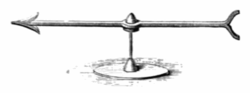
The electroscope was the first electrical measuring instrument. The first electroscope was a pivoted needle (called the versorium), invented by British physician William Gilbert around 1600.[1][2] The pith-ball electroscope and the gold-leaf electroscope are two classical types of electroscope[2] that are still used in physics education to demonstrate the principles of electrostatics. A type of electroscope is also used in the quartz fiber radiation dosimeter. Electroscopes were used by the Austrian scientist Victor Hess in the discovery of cosmic rays.
Pith-ball electroscope
[edit]

In 1731, Stephen Gray used a simple hanging thread, which would be attracted to any nearby charged object. This was the first improvement on Gilbert's versorium from 1600.[3]
The pith-ball electroscope, invented by British schoolmaster and physicist John Canton in 1754, consists of one or two small balls of a lightweight nonconductive substance, originally a spongy plant material called pith,[4] suspended by silk or linen thread from the hook of an insulated stand.[5] Tiberius Cavallo made an electroscope in 1770 with pith balls at the end of silver wires.[3] Modern electroscopes usually use balls made of plastic. In order to test the presence of a charge on an object, the object is brought near to the uncharged pith ball. If the object is charged, the ball will be attracted to it and move toward it.
The attraction occurs because of induced polarization[6] of the atoms inside the pith ball.[7][8][9][10] All matter consists of electrically charged particles located close together; each atom consists of a positively charged nucleus with a cloud of negatively charged electrons surrounding it. The pith is an insulator, so the electrons in the ball are bound to atoms of the pith and are not free to leave the atoms and move about in the ball, but they can move a little within the atoms. See diagram. If, for example, a positively charged object (B) is brought near the pith ball (A), the negative electrons (blue minus signs) in each atom (yellow ovals) will be attracted and move slightly toward the side of the atom nearer the object. The positively charged nuclei (red plus signs) will be repelled and will move slightly away. Since the negative charges in the pith ball are now nearer to the object than the positive charges (C), their attraction is greater than the repulsion of the positive charges, resulting in a net attractive force.[7] This separation of charge is microscopic, but since there are so many atoms, the tiny forces add up to a large enough force to move a light pith ball.
If the external object (B) instead has a negative charge, the positive nuclei of each atom will be attracted toward it while the electrons will be repelled away from it. Again, this causes opposite charges to be closer to the external object than charges of the same polarity, resulting in a net attractive force.
The pith ball can be charged by touching it to a charged object, so some of the charges on the surface of the charged object move to the surface of the ball. Then the ball can be used to distinguish the polarity of charge on other objects because it will be repelled by objects charged with the same polarity or sign it has, but attracted to charges of the opposite polarity.
Often the electroscope will have a pair of suspended pith balls. This allows one to tell at a glance whether the pith balls are charged. If one of the pith balls is touched to a charged object, charging it, the second one will be attracted and touch it, communicating some of the charge to the surface of the second ball. Now both balls have the same polarity charge, so they repel each other. They hang in an inverted 'V' shape with the balls spread apart. The distance between the balls will give a rough idea of the magnitude of the charge.
Gold-leaf electroscope
[edit]
The gold-leaf electroscope was developed in 1787 by British clergyman and physicist Abraham Bennet,[4] as a more sensitive instrument than pith ball or straw blade electroscopes then in use.[11] It consists of a vertical metal rod, usually brass, from the end of which hang two parallel strips of thin flexible gold leaf. A disk or ball terminal is attached to the top of the rod, where the charge to be tested is applied.[11] To protect the gold leaves from drafts of air they are enclosed in a glass bottle, usually open at the bottom and mounted over a conductive base. Often there are grounded metal plates or foil strips in the bottle flanking the gold leaves on either side. These are a safety measure; if an excessive charge is applied to the delicate gold leaves, they will touch the grounding plates and discharge before tearing. They also capture charge leaking through the air that accumulates on the glass walls, increasing the sensitivity of the instrument. In the precision instruments the inside of the bottle was occasionally evacuated, to prevent the charge on the terminal from leaking off through the ionization of the air.
When the metal terminal is touched with a charged object, the gold leaves spread apart in an inverted 'V'. This is because some of the charge from the object is conducted through the terminal and metal rod to the leaves.[11] Since the leaves receive the same sign charge they repel each other and thus diverge. If the terminal is grounded by touching it with a finger, the charge is transferred through the human body into the earth and the gold leaves close together.
The electroscope leaves can also be charged without touching a charged object to the terminal, by electrostatic induction. As the charged object is brought near the electroscope terminal, the leaves spread apart, because the electric field from the object induces a charge in the conductive electroscope rod and leaves, and the charged leaves repel each other. The opposite-sign charge is attracted to the nearby object and collects on the terminal disk, while the same-sign charge is repelled from the object and collects on the leaves (but only as much as left the terminal), so the leaves repel each other. If the electroscope is grounded while the charged object is nearby, by touching it momentarily with a finger, the repelled same-sign charges travel through the contact to ground, leaving the electroscope with a net charge having the opposite sign as the object. The leaves initially hang down free because the net charge is concentrated at the terminal end. When the charged object is moved away, the charge at the terminal spreads into the leaves, causing them to spread apart again.

The Bohnenberger electroscope was developed in the early 19th century by the German physicist Johann Gottlieb Friedrich von Bohnenberger as an improvement on earlier gold-leaf electroscopes. The instrument employed a single gold leaf suspended between two oppositely charge plates, increasing sensitivity and allowing clearer detection of both the presence and sign of an electric charge.[13]
Bohnenberger electroscopes were widely used in 19th-century experimental physics and appear in university laboratories, teaching collections, and scientific manuals throughout Europe. The design influenced later high-sensitivity electroscopic instruments.[14]
Eberbach & Son electroscope instruments were designed primarily for educational and laboratory use, following classical electroscope principles while emphasizing robustness and standardized construction for teaching environments.[15]
While they did not introduce new electroscopic principles, they played a role in the standardization of electrostatics instruciton in North America.[16]
- Gold-leaf electroscopes
-
 Condensing electroscope, Rome University physics dept.
 -
 Electroscope from about 1910 with grounding electrodes inside jar, as described above
 -
 Homemade electroscope, 1900


See also
[edit]Footnotes
[edit]- ^ Gilbert, William; Edward Wright (1893). On the Lodestone and Magnetic Bodies. John Wiley & Sons. p. 79. a translation by P. Fleury Mottelay of William Gilbert (1600) Die Magnete, London
- ^ a b Fleming, John Ambrose (1911). . In Chisholm, Hugh (ed.). Encyclopædia Britannica. Vol. 9 (11th ed.). Cambridge University Press. p. 239.
- ^ a b Baigrie, Brian (2007). Electricity and magnetism: A historical perspective. Westport, CT: Greenwood Press. p. 33.
- ^ a b Derry, Thomas K.; Williams, Trevor (1993) [1961]. A Short History of Technology: from Earliest Times to A.D. 1900. Dover. p. 609. ISBN 0-486-27472-1. p. 609
- ^ Elliott, P. (1999). "Abraham Bennet F.R.S. (1749–1799): a provincial electrician in eighteenth-century England" (PDF). Notes and Records of the Royal Society of London. 53 (1): 61. doi:10.1098/rsnr.1999.0063. JSTOR 531928. S2CID 144062032. Archived from the original (PDF) on 2020-03-27. Retrieved 2007-09-02.
- ^ Sherwood, Bruce A.; Ruth W. Chabay (2011). Matter and Interactions (3rd ed.). US: John Wiley and Sons. pp. 594–596. ISBN 978-0-470-50347-8.
- ^ a b Kaplan MCAT Physics 2010–2011. USA: Kaplan Publishing. 2009. p. 329. ISBN 978-1-4277-9875-6. Archived from the original on 2014-01-31.
- ^ Paul E. Tippens, Electric Charge and Electric Force, Powerpoint presentation, pp. 27–28, 2009, S. Polytechnic State Univ. Archived April 19, 2012, at the Wayback Machine on DocStoc.com website
- ^ Henderson, Tom (2011). "Charge and Charge Interactions". Static Electricity, Lesson 1. The Physics Classroom. Retrieved 2012-01-01.
- ^ Winn, Will Winn (2010). Introduction to Understandable Physics Vol. 3: Electricity, Magnetism and Light. US: Author House. p. 20.4. ISBN 978-1-4520-1590-3.
- ^ a b c *[Anon.] (2001) "Electroscope", Encyclopaedia Britannica
- ^ phi6guy (2025-07-03). Coulomb's law | Electrostatics | Electric Charges and Fields | NCERT Class 12 Physics |. Retrieved 2025-07-04 – via YouTube.
{{cite AV media}}: CS1 maint: numeric names: authors list (link) - ^ Heilbron, J. L. (1979-12-31). Electricity in the 17th and 18th Centuries. University of California Press. ISBN 978-0-520-33460-1.
- ^ "History of the Theories of Aether and Electricity. By Professor Whittaker . 12s. 6d. net. 1910. (Longmans.)". The Mathematical Gazette. 7 (105): 116–116. 1910. doi:10.2307/3603314. ISSN 0025-5572.
- ^ "Instruments of Science: An Historical Encyclopedia. Robert Bud, Deborah Jean Warner". Isis. 91 (2): 338–338. 1998. doi:10.1086/384751. ISSN 0021-1753.
- ^ Suit Janssen, Barbara (2010). "Patent Models Index: Guide to the Collections of the National Museum of American History, Smithsonian Institution: Listings by Patent Number and Invention Name, Volume 1". Smithsonian Contributions to History and Technology (54): 1–357. doi:10.5479/si.19486006.54-1. ISSN 1948-6006.
External links
[edit]- "Pith-ball electroscope". Physics demonstration resource. St. Mary's University. Retrieved 2015-05-28.
- "Computer simulation of electroscopes". Molecular Workbench. Concord Consortium. Archived from the original on 2022-07-03. Retrieved 2008-02-03.
- "Pith Ball and Charged Rod Video". St. Mary's Physics YouTube Channel. St. Mary's Physics Online. Archived from the original on 2021-12-22.
Electroscope
View on GrokipediaHistory
Early Development
The early development of the electroscope traces back to the work of English physician and natural philosopher William Gilbert, who in 1600 published De Magnete, Magneticisque Corporibus, et de Magno Magnete Tellure (commonly known as De Magnete), a seminal treatise that laid the foundations for the scientific study of electricity and magnetism.[3] In this work, Gilbert described the invention of the versorium, recognized as the first electroscope, a simple device consisting of a lightweight metal needle balanced on a pivot that would rotate in response to the presence of static electric charge, allowing detection of attraction between charged bodies.[4] This instrument marked a pivotal advancement in experimental physics, enabling quantitative observations of electrostatic effects beyond mere qualitative descriptions.[5] Gilbert's experiments with the versorium focused on demonstrating the principles of attraction and repulsion in electrified substances, distinguishing these phenomena from magnetic forces, which he showed acted only on iron and steel.[6] He emphasized that electric attraction, unlike magnetism, could be induced in a wide variety of non-magnetic materials, thereby separating the study of electricity as a distinct field and establishing the groundwork for electrostatics as a branch of physics.[7] Through meticulous trials, Gilbert explored how frictional charging transferred properties capable of attracting light objects, coining the term "electric" derived from the Greek elektron for amber, which he used as a primary material in his demonstrations.[8] Central to Gilbert's initial experiments was the rubbing of amber and similar substances, such as sealing wax or glass, with cloth to generate static charge, which the versorium then detected by its deflection toward the electrified body, illustrating the transfer of charge via friction.[4] These observations not only validated the existence of an attractive force independent of gravity or magnetism but also introduced systematic experimentation to the study of natural phenomena, influencing subsequent generations of scientists in their pursuit of electrostatic principles.[3] In the mid-18th century, French physicist Jean-Antoine Nollet developed an early form of the electroscope around 1748, using suspended strips of material to demonstrate electrostatic phenomena such as conduction and induction.[9] This device improved upon Gilbert's versorium by visualizing charge effects more clearly in educational and experimental contexts.Key Advancements
In the early 18th century, the pith-ball electroscope emerged as a practical tool for demonstrating electrostatic repulsion in educational settings. Developed by British physicist John Canton around 1753, this design featured two lightweight pith balls suspended from fine linen threads attached to a conducting rod, allowing the balls to diverge visibly when charged, thus highlighting like-charge repulsion more effectively than prior single-object setups.[10] A pivotal advancement occurred in 1787 with Abraham Bennet's invention of the gold-leaf electroscope, which dramatically increased sensitivity for detecting minute electric charges. Unlike the pith-ball version, Bennet's instrument employed two extremely thin gold leaves (approximately 0.0001 mm thick) hanging from a metal rod within a glass enclosure, enabling divergence from charges as small as those produced by friction on a few square centimeters of resin. This refinement, detailed in Bennet's publication New Experiments on Electricity, facilitated quantitative observations in laboratory research by minimizing external disturbances and amplifying deflection for low-tension electricity.[1] Throughout the 19th century, electroscope designs were iteratively refined to enhance precision and reliability, particularly through improved enclosures that shielded sensitive components from air currents and environmental factors. By the mid-1800s, standard models incorporated tall glass bell-jars or cylindrical casings to enclose the leaves or balls, reducing convective interference and allowing sustained charge retention for longer-duration experiments; these modifications, often seen in instruments from manufacturers like E. Ducretet, improved accuracy in charge detection by up to several orders of magnitude compared to open designs.[2] Electroscopes proved instrumental in landmark experiments on electrostatic induction during the 1830s, notably those by Michael Faraday. In his Experimental Researches in Electricity (Eleventh Series, 1837–1838), Faraday utilized the gold-leaf electroscope to investigate charge separation in conductors exposed to external fields, such as placing a negatively charged shell-lac cylinder near an ungrounded brass ball supported on the insulating shell-lac to induce positive charge on its near side and negative on the far side, with deflections confirming the absence of net charge transfer. These observations, conducted within enclosed setups to isolate inductive effects, established key principles of electric tension across dielectrics and advanced conceptual models of field lines.[11] In the late 19th century, electroscopes played a crucial role in the discovery of X-rays and radioactivity. Wilhelm Röntgen used a gold-leaf electroscope in 1895 to detect X-rays by observing charge dissipation, while Henri Becquerel and Marie and Pierre Curie employed similar instruments in the late 1890s to measure ionizing radiation from radioactive substances through the rate of charge leakage.[2]Operating Principle
Electrostatic Induction
Electrostatic induction refers to the process whereby a charged object causes a redistribution of electric charges within a nearby neutral conductor, leading to charge separation without any direct physical contact between the objects. This phenomenon occurs due to the influence of the electric field generated by the charged object, which polarizes the conductor by attracting or repelling its free electrons.[12] In conductors, such as metals, the mobile electrons respond to this field, creating temporary regions of net positive and negative charge.[13] The mechanism unfolds in distinct steps. First, a charged body—say, one with a positive charge—is brought close to the neutral conductor. The electric field from the positive charge repels positive ions and attracts electrons within the conductor toward the nearer surface, resulting in an accumulation of negative charge on that side and a corresponding deficit of electrons (net positive charge) on the opposite side. This separation forms an induced dipole, with the conductor remaining electrically neutral overall but polarized. If the conductor is grounded (while the inducing charge is nearby but not in contact) during this process, the separated charges can be fixed, allowing one part to acquire a net charge opposite to the inducing body upon removal of the ground and separation.[12][13] The attractive and repulsive forces driving this charge migration are described by Coulomb's law, which quantifies the electrostatic interaction between charges as where is the magnitude of the force, is Coulomb's constant (), and are the magnitudes of the interacting charges, and is the distance between them. In induction, this law accounts for the attraction between the inducing charge and the oppositely induced charges on the conductor's surface, as well as the repulsion that pushes like charges away.[14] To illustrate charge distribution, consider a neutral conducting sphere near a positively charged rod: electrons shift toward the rod's side, concentrating negative charge there (denoted as - - -), while the far side becomes depleted of electrons, showing positive charge (+ + +). The distribution can be visualized as:- Near side (to rod): Excess electrons (induced negative region)
- Far side: Electron deficiency (induced positive region)