


Community hub
Recent from talks
Contribute something
Nothing was collected or created yet.
As-Salt
View on Wikipedia | This article needs additional citations for verification. (May 2018) |

Key Information


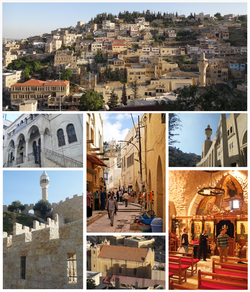
As-Salt (Arabic: السلط As-Salt),[3] also known as Salt, is an ancient trading city and administrative centre in west-central Jordan. It is on the old main highway leading from Amman to Jerusalem. Situated in the Balqa highland, about 790–1,100 metres above sea level, the city is built in the crook of three hills, close to the Jordan Valley. One of the three hills, Jabal al-Qal'a, is the site of a 13th-century ruined fortress. It is the capital of Balqa Governorate of Jordan.
The Greater Salt Municipality has about 107,874 inhabitants (2018).
In 2021, the city of Salt was inscribed at the UNESCO World Heritage list.[4]
Etymology
[edit]The name "Salt" is derived from the Latin word saltus, which means "forest".
History
[edit]It is not known when the city was first inhabited, but it is believed to have been built by the Macedonian army during the reign of Alexander the Great. The city was known as Saltus in Byzantine times and was the seat of a bishopric. At this time, the city was considered to be the principal settlement on the East Bank of the Jordan River. The settlement was destroyed by the Mongols and then rebuilt during the reign of the Mamluk sultan Baibars (1260–1277).
Salt was once the most important settlement in the area between the Jordan Valley and the eastern desert. Because of its history as an important trading link between the eastern desert and the west, it was a significant place for the region's many rulers.[citation needed]
The Romans, Byzantines and Mameluks all contributed to the growth of the city, but it was at the end of the 19th and the beginning of the 20th century, when the Ottomans established a regional administrative capital in Salt and encouraged settlement from other parts of their empire, that Salt enjoyed its most prosperous period.
Ottoman period
[edit]

In 1596, during the Ottoman Empire, Salt was noted in the census as being located in the nahiya of Salt in the liwa of Ajlun, with a Muslim population of 40 households and 5 bachelors; and a Christian population of 25 households. The villagers paid a fixed tax-rate of 25% on various agricultural products; including wheat, barley, olive trees/vineyards, goats and beehives, in addition to occasional revenues and a market toll; a total of 12,000 akçe.[5]
By the end of the 18th century, Salt was the sole permanent settlement in the Balqa region, a situation which persisted well into the 19th century.[6] The rest of the Balqa was dominated by the local Bedouin tribes.[6] It was the most developed city and commercial center of Transjordan from the 18th century until the early years of the Emirate of Transjordan.[6] The city's drinking water was supplied by two abundant springs, which also irrigated the town gardens along the Wadi Shu'ayb stream. It was situated along the slopes of a conical hill, at the top of which stood a fort, and along the ridges of two deep abutting valleys, which provided a natural defense against encroachments by neighboring Bedouin tribes. Salt's inhabitants negotiated terms with the tribes, who guaranteed the townspeople access to their wheat fields in the Balqa's eastern plains in return for giving the tribesmen access to the town's extensive markets.[6] Sharecropping agreements were formed with the tribes whereby Salt townspeople would encamp in Amman and Wadi Wala in the spring until harvest and paid an annual tribute to the dominant tribe of the Balqa.[7] Until around the 1810s, the paramount tribe was the Adwan, known as "lords of the Balqa".[7] Afterward, the Banu Sakhr overtook the Adwan and collected the tribute from Salt.[7]
The city's defenses and isolation in a land practically controlled by Bedouin tribes also enabled its inhabitants to ignore the impositions of the Ottoman authorities without consequence.[7] Western travelers in the early 19th century reported that the leader of the town effectively wielded the same authority as any of the provincial governors of Ottoman Syria appointed by the sultan.[8]
In the early 19th century, the townspeople mostly belonged to the clans of Fakhoury, Akrad, Awamila and Qatishat. Each clan was headed by its own sheikh, one or two of whom would act as the shaykh al-balad (city leader), who was based in the fort and was in charge of protecting Salt from Bedouin attack.[7] The population consisted of about four hundred Muslim and eighty Christian families.[7] According to the observations of Buckingham in the 1820s, roughly 100 Christians in Salt were immigrants from Nazareth who moved to the town to avoid the exactions of Jazzar Pasha, the Ottoman governor of Acre.[9] Muslim–Christian relations were amicable and the two communities shared the same lifestyles, dress and the Arabic language.[10] Salt was organized into quarters, each controlled by one of three main clans, and contained a number of mosques, a church and about twenty shops during this period.[7][11] Salt served the surrounding countryside as far as Karak, which lacked a market until the late 19th century, and goods in its market originated as far as Tyre and Egypt.[12] It exported raisins, sumac leaves for the tanneries of Jerusalem, qili (a type of ash, a key ingredient of Nabulsi soap) to Nablus, and ostrich feathers supplied by the Bedouin to Damascus.[12][13] Nablus was Salt's primary partner,[7] and Salt served as the Transjordanian center of the Nablus-based Tuqan family.[14] Although most of the inhabitants were farmers, there were also craftsmen and smaller numbers of shopkeepers, the latter of whom were commissioned by merchants in Nablus, Nazareth and Damascus.[11][13]
In 1834 the townspeople and local Bedouin fought together to drive out the forces of the practically autonomous province of Egypt led by Ibrahim Pasha, the first recorded clash of the Peasants' revolt in Palestine.[14] Ottoman rule in the Levant was restored in 1840, but Salt remained only nominally part of the Empire.[15] In 1866–1867, the governor of Damascus Mehmed Rashid Pasha (1866–1871) extended the imperial Tanzimat centralization and modernization reforms in Transjordan.[15] He led a large force of Bedouin tribesmen from the Rwala, Wuld Ali and Banu Hasan, Hauran plainsmen, Druze mountaineers and regular infantry, cavalry and artillery troops toward Salt, stopping three hours north of the city.[15] From there, he offered to pardon Salt's inhabitants for allying with the Adwan and Banu Sakhr against the authorities.[15] The city organized a delegation of Muslim and Christian grandees who negotiated the unopposed entry of the Ottomans into Salt on 17 August.[15] Rashid Pasha repaired the damaged fort where he garrisoned 400 troops.[15] He appointed the Damascene Kurd Faris Agha Kadru as Salt's first district governor and established an elected administrative council composed of Salt's elite families.[15] Rashid Pasha confiscated huge qualities of grain and livestock from the town as compensation for tax arrears.[15]
Salt's heyday was in the late 19th century, when traders arrived from Nablus to expand their trading network eastwards beyond the Jordan River. As a result of the influx of newcomers this period saw the rapid expansion of Salt from a simple village into a city with many architecturally elegant buildings, many built in the Nablusi style from the attractive honey-coloured local stone. A large number of buildings from this era survive as of 2009[update].
British Mandate, Emirate, and independence
[edit]During World War I, Salt was captured from the Ottomans by the third battalion of the Jewish Legion of the British expeditionary corps, and its commander, Eliezer Margolin, was made military governor of Salt.[16][17]
After the war, the town was the site which Herbert Samuel, British High Commissioner of Palestine, chose to make his announcement that the British favoured a Hejazi Hashemite ruled entity on the East Bank of the Mandatory Palestine (current Jordan). This wish became reality in 1921 when Abdullah I became Emir of Transjordan. Salt seemed to be the city that would be chosen as the capital of the new emirate since most of the industry and commerce flowed through Salt. During this period Salt had no high schools. Even so, Abdullah picked the city as the capital of his emerging emirate but later changed his mind and moved his compound and entourage to Amman when he and the notables of Salt had a disagreement.[dubious – discuss] Amman at that time was a small city of only 20,000 people which experienced rapid growth.[citation needed]
The Jordanian census of 1961 found 16,176 inhabitants in Al-Salt,[18] of whom 2,157 were Christian.[19]
Municipal districts
[edit]
The Greater Salt Municipality is divided into nine districts:
| District | Population (2018) | |
|---|---|---|
| 1 | Salt City | 107,874 |
| 2 | Zai | 4552 |
| 3 | Umm Jouzeh | 3177 |
| 4 | Diyreh Ash-Sharqiyyeh | 1488 |
| 5 | Al-Yazeediyeh | 1559 |
| 6 | Yarqa | 6688 |
| 7 | Ira | 4396 |
| 8 | Allan | 4042 |
| 9 | Rumaimeen | 2511 |
| 10 | Modari | 1419 |
| 11 | Za'tari | 1636 |
| 12 | Hdaib | 435 |
| 13 | Wadi Innaqah | 590 |
| 14 | Um Khroubeh | 758 |
| 15 | Wadi As-Sahn | 79 |
| 16 | Um Al-A'mad | 1655 |
| 17 | Da'am | 470 |
| 18 | Sala'uf | 750 |
| 19 | Jal'ad | 1255 |
| 20 | Wasiyeh | 504 |
| 21 | Misheerfeh | 295 |
| 22 | Wadi Shuy'ayb | 946 |
Education
[edit]Salt contains many schools, including a public secondary school dating back to 1918, as well as many private schools that date back to the 1800s, such as the Latin School and the Catholic School. It is also the home of the Holy Land Institute for the Deaf, a non-profit educational center for people with hearing impairment. The city has two universities surrounding it: Al-Balqa` Applied University established in 1997 and Al-Ahliyya Amman University (Amman National University) located on the highway connecting Amman to Salt.[citation needed]
Tourism
[edit] |
Ottoman mansions
[edit]At the end of the 19th and the beginning of the 20th century, when the Ottomans established a regional administrative base in Salt and encouraged settlement from other parts of the empire, the city's status increased, many merchants arrived and, with their newly acquired wealth, built the fine houses that can still be admired in Salt today.
These splendid yellow sandstone buildings incorporate a variety of styles. Typically, they have domed roofs, interior courtyards and characteristic tall, arched windows. Perhaps the most beautiful is the Abu Jaber mansion, built between 1892 and 1906, which has frescoed ceilings, painted by Italian artists, and is reputed to be the finest example of a 19th-century merchant house in the region.
Roman tombs and Ayyubid citadel
[edit]Tightly built on a cluster of three hills, Salt has several other places of interest, including Roman tombs on the outskirts of the city and the citadel and site of the town's early 13th century Ayyubid fortress, which was built by Al-Mu'azzam Isa, the nephew of Saladin soon after AD 1198.
Museums
[edit]Salt's Archaeological & Folklore Museum displays artifacts dating back to the Chalcolithic period to the Islamic era as well as other items relating to the history of the area. In the folklore museum there is presentation of Bedouin and traditional costumes and everyday folkloric items. A small museum and a handicraft school are presenting the traditional skills of ceramics, weaving, silk-screen printing and dyeing.
Muslim shrines
[edit]In the city of Salt and its environs, there are several Muslim shrines at the traditional tombs of the prophets Shuaib, Ayyoub, Yusha, and Jadur, the Arabic names of the biblical characters Jethro, Job, Joshua, and Gad. These sites of Muslim pilgrimage are known as An-Nabi Shu'ayb, An-Nabi Ayyub, An-Nabi Yusha' bin Noon, and 'Ayn al-Jadur ("Spring of Jadur") respectively, an-nabi being Arabic for "the prophet".
International relations
[edit]Gallery
[edit]-
 The hills around Salt in spring
 -
 The hills around Salt in winter
 -
 View of Salt from street level
 -
![Tomb of the Prophet Shuaib, near Salt[20]](//upload.wikimedia.org/wikipedia/commons/thumb/2/2e/Shoaib_Shrine.jpg/250px-Shoaib_Shrine.jpg)

.jpg)

![Tomb of the Prophet Shuaib, near Salt[20]](https://en.wikipedia.org/wiki/File:Shoaib_Shrine.jpg)
Notes
[edit]Citations
[edit]- ^ SGM.
- ^ "عدد سكان المملكة المقدر حسب البلدية والجنس في نھاية 2018" [Estimated Population of the Kingdom by Municipality and Sex, at End-year 2018] (PDF) (in Arabic). Family and Population Surveys Directorate – Department of Population and Social Statistics. 2018. Archived from the original (PDF) on 12 April 2021. Retrieved 2 September 2021.
- ^ "Al-Salt Story". www.visitas-salt.com. Retrieved 10 January 2023.
- ^ "Cultural sites in Africa, Arab Region, Asia, Europe, and Latin America added to UNESCO's World Heritage List". UNESCO. 27 July 2021. Retrieved 28 July 2021.
- ^ Hütteroth and Abdulfattah, 1977, p. 169
- ^ a b c d Rogan 2002, p. 27.
- ^ a b c d e f g h Rogan 2002, p. 28.
- ^ van der Steen 2014, p. 189.
- ^ van der Steen 2014, pp. 180–181, 248.
- ^ van der Steen 2014, p. 248.
- ^ a b van der Steen 2014, p. 140.
- ^ a b van der Steen 2014, p. 181.
- ^ a b Rogan 2002, p. 29.
- ^ a b Rood 2004, p. 127.
- ^ a b c d e f g h Rogan 2002, p. 49.
- ^ Getzel Kressel. "Margolin, Eliezer". Encyclopaedia Judaica via encyclopedia.com. Accessed 3 May 2022.
- ^ Lieutenant-Colonel Eliazar Margolin leading the 39th Royal Fusiliers through Bet Shemen in Israel. Desert Column Forum Pix. Accessed 3 May 2022.
- ^ Government of Jordan, Department of Statistics 1964, p. 13.
- ^ Government of Jordan, Department of Statistics 1964, pp. 115–116.
- ^ "Shrine of Prophet Shoaib (Jethro)". www.visitas-salt.com. Retrieved 10 January 2023.
Bibliography
[edit]- Government of Jordan, Department of Statistics (1964). First Census of Population and Housing. Volume I: Final Tables; General Characteristics of the Population (PDF).
- Hütteroth, W.-D.; Abdulfattah, K. (1977). Historical Geography of Palestine, Transjordan and Southern Syria in the Late 16th Century. Erlanger Geographische Arbeiten, Sonderband 5. Erlangen, Germany: Vorstand der Fränkischen Geographischen Gesellschaft. ISBN 3-920405-41-2.
- Rogan, Eugene L. (2002). Frontiers of the State in the Late Ottoman Empire: Transjordan, 1850-1921. Cambridge University Press. ISBN 978-052189223-0.
- Rood, Judith Mendelsohn (2004). Sacred Law in the Holy City: The Khedival Challenge To The Ottomans As Seen From Jerusalem, 1829-1841. Brill. ISBN 978-900413810-0.
- "Salt Greater Municipality". Archived from the original on 29 October 2010. Retrieved 25 May 2018.
- van der Steen, Eveline (2014). Near Eastern Tribal Societies During the Nineteenth Century: Economy, Society and Politics Between Tent and Town. Routledge. ISBN 978-1-908049-83-4.
External links
[edit]- Archival photos of Salt at the American Center of Research
- "HomePage". www.salt.gov.jo. Retrieved 24 September 2023.
| International | |
|---|---|
| National | |

As-Salt
View on GrokipediaGeography
Location and Topography
As-Salt is situated in the Balqa Governorate of west-central Jordan, approximately 30 kilometers northwest of Amman along the historic route toward Jerusalem.[3] Its geographic coordinates are approximately 32°02′N 35°44′E.[4] The city occupies the Balqa highland plateau, with elevations ranging from 790 to 1,100 meters above sea level and an average height of about 850 meters.[4] [5] Built across three closely spaced hills—known locally as the cadital, gadaa, and salalem—the terrain is characteristically steep and undulating, fostering a compact urban layout interconnected by stairways and narrow alleys that adapt to the slopes.[2] [6] This hilly topography provides panoramic views of surrounding valleys and contributes to the city's distinctive architectural integration with the landscape.[7]Climate and Natural Environment
As-Salt lies at elevations ranging from 790 to 1,100 meters above sea level in the Balqa highland, influencing its cooler temperatures relative to Jordan's lower valleys and deserts.[8] The surrounding natural environment consists of eroded hills and escarpments overlooking the Jordan Rift Valley, with terrain supporting terraced agriculture on slopes.[6] Vegetation in the vicinity includes drought-resistant Mediterranean species such as olive trees, carob, and maquis shrubs, adapted to the semi-arid conditions of the Mountain Heights Plateau; these areas also feature seasonal wildflowers and grasses during wetter periods.[9] The climate is classified as hot-summer Mediterranean (Csa), with long, warm, arid summers from late May to early October and cold winters from early December to mid-March. Average high temperatures reach 31°C (87°F) in July, while January highs average 11°C (52°F) and lows drop to 4°C (39°F), occasionally resulting in frost or light snowfall. Annual precipitation measures approximately 220 mm (8.6 inches), concentrated in the rainy season from late October to mid-April, with December being the wettest month at around 43 mm (1.7 inches). [10] Wildlife in the region's highlands includes small mammals like foxes and hares, alongside birds such as eagles and partridges, though habitat fragmentation from urbanization and agriculture limits populations.[9] The elevation moderates humidity, with muggy conditions rare (peaking at 8% of days in August), and prevailing winds average 10-12 km/h, strongest in summer. Environmental pressures, including water scarcity and soil erosion, affect the area's sustainability, exacerbated by the city's growth.[8]Etymology
Origins and Linguistic Evolution
The name As-Salt originates from the Latin term saltus, which denotes a wooded valley or forested upland, reflecting the area's historical landscape characterized by dense vegetation in antiquity.[11][12] This etymological root aligns with classical Latin usage, where saltus described elevated, tree-covered terrain distinct from open plains.[7] Historical records attest to the name's use as Saltus during the Byzantine era (c. 4th–7th centuries CE), when the settlement served as a bishopric, indicating ecclesiastical significance and continuity of the Latin designation amid Greco-Roman influences in the region.[7] The site's position in the Balqa highlands, amid valleys conducive to early agriculture and settlement, likely reinforced the toponym's descriptive accuracy, as evidenced by its persistence through administrative and religious documentation.[13] Linguistically, the term evolved minimally into Arabic as as-Salṭ (السلط), a phonetic adaptation that preserved the core consonants and vowel structure during the Islamic conquest (7th century CE onward), when Byzantine toponyms were often Arabized without semantic alteration.[12] This retention exemplifies substrate influence, where pre-Arabic names integrated into Levantine Arabic dialects, maintaining referential ties to geography rather than undergoing substantial morphological shifts. No evidence suggests alternative derivations, such as Semitic roots or later inventions, supporting the Latin-Byzantine origin as the primary lineage.[7][11]History
Ancient and Pre-Islamic Periods
The Balqa region, in which As-Salt is situated, exhibits archaeological traces of human presence from the Paleolithic period onward, with settlements and villages documented through excavations in the surrounding highlands.[14] Artifacts from Chalcolithic sites (c. 4500–3300 BCE) within the governorate, including pottery and tools, are preserved in the As-Salt Archaeological Museum, attesting to early agricultural and pastoral communities in the area.[15] During the Iron Age (c. 1200–539 BCE), the Balqa formed part of the Ammonite kingdom's core territory, centered around Rabbath-Ammon (modern Amman), with fortified settlements and water management systems indicative of semi-urban development; while major Ammonite sites like Tell al-Umeiri lie nearby, direct Iron Age remains at As-Salt proper remain limited.[16] In the Hellenistic and Roman periods, the region integrated into broader imperial networks, though specific Hellenistic foundations at As-Salt lack corroboration beyond local traditions. By late antiquity, under Byzantine rule as part of the province of Arabia Petraea, the settlement—known as Saltus, from Latin for "wooded valley" or "height"—functioned as a key waypoint on routes linking Amman to Jerusalem and the Jordan Valley.[7] It served as the seat of a bishopric, reflecting its ecclesiastical prominence and likely population of Christian communities amid a landscape of churches, monasteries, and agricultural terraces.[6] This era saw the consolidation of the site's role as the principal urban center in the Balqa, supported by its strategic elevation and fertile environs, prior to the Muslim conquests of the 630s CE.[7]Islamic Conquest to Medieval Era
The Balqa region, encompassing As-Salt, fell to Muslim forces during the Rashidun Caliphate's campaigns in the Levant, following the decisive Battle of Yarmouk in August 636 CE, which shattered Byzantine control over Transjordan.[17] By the late 630s, the area was integrated into Jund Dimashq, the military district of Damascus, marking the transition from Byzantine to early Islamic administration.[17] As-Salt itself, then likely a modest agricultural village with roots in Byzantine settlement patterns, experienced continuity rather than disruption, as evidenced by later archaeological finds of Islamic-era pottery and structures in the vicinity.[18] Under Umayyad rule (661–750 CE), Balqa gained strategic importance due to familial ties of the dynasty to local Arab tribes and elites, fostering agricultural and trade activities amid broader regional prosperity in Jordan, including palace complexes and desert qasrs.[17][19] However, As-Salt did not emerge as a prominent urban center, remaining overshadowed by larger sites like Amman (ancient Philadelphia); its role was peripheral, tied to highland farming and pastoralism rather than administration or monumental building.[20] The Abbasid takeover in 750 CE shifted power eastward, initiating a gradual Bedouinization of Balqa, with semi-nomadic tribes dominating the landscape and reducing sedentary populations, though permanent villages like As-Salt persisted amid fluctuating tribal alliances.[20] From the Fatimid period (969–1071 CE) through the Ayyubid and Mamluk eras (1171–1517 CE), As-Salt continued as a small, mixed Muslim-Christian settlement in a region prone to earthquakes and tribal raids, with limited documented development beyond basic fortifications and shrines.[12] Archaeological surveys reveal sparse Islamic artifacts, such as glazed wares and coins, indicating modest trade links to Damascus and coastal ports, but no evidence of significant urban expansion or political centrality until the Ottoman era.[18] The town's resilience stemmed from its highland position, facilitating defense and agriculture, yet it avoided the major conflicts of Crusader incursions, which focused on coastal and eastern frontiers rather than interior Balqa villages.[21]Ottoman Administration
During the early Ottoman period, As-Salt formed part of the nahiya of Salt within the liwa of Ajlun, under the broader administration of the eyalet of Damascus, where local governance relied on tax farming (iltizam) and tribal arrangements with limited central oversight.[22] The Tanzimat reforms, initiated in 1839 and extending through the mid-19th century, aimed to centralize authority, standardize taxation, and enhance security, gradually incorporating peripheral regions like Transjordan into direct imperial control.[2] In 1867, Governor Mehmed Rashid Pasha of Damascus established qada' al-Salt as a distinct administrative district (kaza), marking the onset of direct Ottoman rule in the area and designating As-Salt as the administrative center for the Balqa subdistrict (liwa al-Balqa).[23] This restructuring included appointing a kaymakam (sub-governor), treasurer, qadi (judge), and local councils to oversee taxation, land registration under the 1858 Ottoman Land Code, judicial matters, and infrastructure development such as roads and telegraph lines.[23] The reforms facilitated merchant immigration from Nablus and Syria, elevating a new urban elite that collaborated with Ottoman officials in managing trade in grains, olives, and livestock, while displacing prior tribal influences.[23] By the late 19th century, As-Salt had emerged as the de facto capital of Transjordan, benefiting from Tanzimat-induced stability that spurred a construction boom in public buildings and residences, alongside social services like schools and hospitals.[2] Ottoman administration emphasized fiscal extraction and sedentarization, encouraging settlement by Circassians and Chechens to bolster control over Bedouin nomads, though enforcement remained challenged by periodic revolts until World War I.[23] Direct rule persisted until 1918, when British forces occupied the city, ending Ottoman governance.[24]British Mandate and Path to Jordanian Independence
Following the Ottoman defeat in World War I, the region east of the Jordan River, including As-Salt, fell under provisional British military administration as part of the Occupied Enemy Territory Administration in 1918, transitioning to civilian control under the Palestine Mandate framework by 1920.[25] As-Salt served as the administrative center of the Balqa district, one of three districts established by British authorities (alongside Ajloun and Karak), each overseen by a British advisor to facilitate local governance and tribal coordination.[25] On August 21, 1920, British High Commissioner Sir Herbert Samuel visited As-Salt and addressed approximately 600 local sheikhs and leaders in the courtyard of the Assumption of Our Lady Catholic Church, proclaiming Britain's intention to supervise Transjordan's administration while preserving local self-government and avoiding direct interference in internal affairs.[26] In early 1921, amid tensions from Emir Abdullah's arrival in November 1920 and his initial focus on reclaiming Syria from French control, British authorities convened a conference of Arab leaders at As-Salt to redirect Abdullah's ambitions toward Transjordanian leadership.[27] This gathering, supported by British mediation, resulted in Abdullah accepting the role of emir over Transjordan in exchange for a British financial subsidy, averting a potential invasion of Syria and aligning with decisions from the Cairo Conference in March 1921.[27] On April 11, 1921, the Emirate of Transjordan was formally established under Abdullah's centralized government, excluding it from the Jewish national home provisions of the Palestine Mandate while remaining under British oversight.[25] Britain recognized the emirate as a distinct state on May 15, 1923, via an Anglo-Transjordanian agreement that affirmed Abdullah's authority subject to British foreign policy guidance.[25] Throughout the Mandate period (1921–1946), As-Salt functioned as a key regional hub in the Balqa district, benefiting from British-sponsored modernization efforts including road construction, communications infrastructure, and basic public services, though tribal unrest—such as the 1923 Adwan Revolt involving local Christian and Muslim participants—highlighted ongoing challenges to centralized authority.[27][24] These developments fostered gradual state-building, with British advisors ensuring fiscal and administrative stability. By March 22, 1946, negotiations culminated in a new Anglo-Transjordanian treaty that terminated the Mandate, granting full independence; the emirate was elevated to the Hashemite Kingdom of Transjordan on May 25, 1946, with Abdullah proclaimed king, marking As-Salt's integration into the sovereign Jordanian state.[25]Post-Independence Developments
Following Jordan's independence in 1946 and the designation of Amman as the national capital, As-Salt experienced a decline in its regional administrative and commercial prominence, with many public buildings and residences left vacant as the local economy shifted toward agriculture-based activities.[28] This transition reflected broader national centralization trends, leaving the city's Ottoman-era infrastructure in disrepair amid reduced trade flows previously linking the Jordan Valley to eastern deserts.[28] Population growth, influenced by national trends including refugee influxes after 1948 and natural increase, drove urban expansion in As-Salt starting in the mid-20th century. The city's built-up area expanded from 3.2 km² in 1952 to approximately 36 km² by 2018, accommodating rising residential demands through peripheral development and informal settlements.[29] As the administrative center of Balqa Governorate, As-Salt integrated into Jordan's decentralized governance framework, with local infrastructure upgrades focusing on roads and utilities to support commuting to Amman.[30] From the 1980s onward, rapid urbanization pressured the historic core, prompting preservation efforts amid agricultural persistence and emerging tourism. The Jordan Cultural Heritage, Tourism, and Urban Development (CHTUD) Project, supported by the World Bank from 2009 to 2017, funded restorations of key sites like residential complexes and pathways, enhancing visitor access while bolstering local economies through heritage-based initiatives.[31] In 2021, UNESCO inscribed As-Salt as a World Heritage Site for its "place of tolerance and urban hospitality," spurring further regeneration via the Salt Development Corporation, which has documented over 75 historic structures and promoted cultural tourism.[2] These efforts have mitigated some encroachment risks but continue to balance modern housing needs with fabric integrity.[28]Demographics
Population Trends and Statistics
The population of As-Salt, the administrative center of the Balqa Governorate, has shown consistent growth reflecting broader urbanization trends in Jordan, driven by its historical role as a trade hub and proximity to Amman. According to official Jordanian censuses, the city proper recorded 56,458 residents in 1994, increasing to 73,528 by 2004—a 30.2% rise over the decade, equivalent to an average annual growth rate of 2.7%.[32] By the 2015 census, the population reached 99,890, marking a further 35.9% increase from 2004, or an average annual rate of 2.8%.[32] These figures are derived from the Department of Statistics' enumerations, which distinguish the urban core from surrounding districts.[33] The encompassing Qaṣabah as-Salṭ district, including peri-urban areas, had 152,122 inhabitants in 2015, yielding a density of 334.5 persons per square kilometer across 454.8 km². Estimates for the Greater As-Salt Municipality, which administers expanded urban and rural zones, vary but indicate continued expansion; figures range from 107,874 in mid-2020s projections to approximately 145,000 in municipal reports around 2018–2023, influenced by internal migration and natural increase amid Jordan's national growth rate of about 1.6% annually in recent years.[34][35]| Census Year | City Population | Annual Growth Rate (from prior census) |
|---|---|---|
| 1994 | 56,458 | - |
| 2004 | 73,528 | 2.7% |
| 2015 | 99,890 | 2.8% |