Hubbry Logo
ShuaibShuaibMain
Open search
Shuaib
Community hub
Shuaib
logo
8 pages, 0 posts
0 subscribers
Be the first to start a discussion here.
Contribute something
Shuaib
Shuaib
from Wikipedia

Shuaib, Shoaib, Shuayb or Shuʿayb (Arabic: شُعَيْب, IPA: [ʃuʕajb]; meaning: "who shows the right path") is an ancient Midianite prophet in Islam and the most revered prophet in the Druze faith.[1] Shuaib is sometimes identified with the Hebrew biblical Jethro, Moses's father-in-law. Shuaib is mentioned in the Quran 11 times.[2] He is believed to have lived after Ibrahim (Abraham), and Muslims believe that he was sent as a prophet to the Midianites,[3] who are also known as the Aṣḥāb al-Aykah ("Companions of the Wood") for their worship of a large tree.[4][5][6][7] To the Midianites, Shuaib proclaimed the "straight path", warning them to end their fraudulent ways[example needed]. When the community did not repent, God destroyed the community.[3][5]

Key Information

Alongside Hud, Salih, and Muhammad, Shuaib is understood by Muslims as one of the four Arabian prophets sent by God. Ibn Kathir stated that he was known by Muslims as "the eloquent preacher amongst the prophets" because he was, according to tradition, granted talent and eloquence in his language.[8]

The Druze honor Shuaib as their principal prophet and hold an annual pilgrimage to Nabi Shu’ayb—a site in the Lower Galilee believed by Druze to be his tomb—from April 25 to 28, known as Ziyara.[1]

Historical context

[edit]

The area to which Shuʿayb was sent to is named Madyan in the Qur'an, known in English as Midian, which is frequently referred to in the Hebrew Bible. The Midianites were said to be of Arab descent, though being neighbors of the Biblical Canaanites, they intermixed with them. It is said they were a wandering tribe, and that their principal territory at the time of Moses was the Sinai Peninsula. The historical region of Midian roughly corresponds to what is now province of Tabuk in Saudi Arabia.[9][10]

According to the Book of Genesis, the Midianites were the descendants of Midian, a son of Abraham and his wife Keturah: "Abraham took a wife, and her name was Keturah. And she bare him Zimran, and Jokshan, and Medan, and Midian, and Ishbak, and Shuah" (Genesis 25:1–2, King James Version).[11][12][13]

Midian can be considered as being part of the Hejaz,[14] which is significant for Muslims as the region of their two holiest cities, Mecca and Medina.[15]

Disputed identification with Jethro

[edit]

Jethro is mentioned in the Bible (Exodus 3:1) as the father-in-law of Moses. Although Shuaib is frequently identified with the Midianite priest Jethro, most modern scholars reject this identification. Classical commentators, such as Ibn Kathir, say Shuʿayb was a great-grandson of Abraham: Shuʿayb is believed to have been the son of Mikil, son of Midian, son of Abraham.[8] That would render impossible the identification with Jethro, who purportedly lived hundreds of years after Abraham.[16]

Narrative in the Quran

[edit]

The Qur'an states that Shuaib was appointed by God to be a prophet to the people of Midian. The people of this land were said to be especially notorious for cheating others through dishonesty and for idolatry. Shuʿayb's prophecy mainly involved calling the Midianites to the correct path of God,[17] and forbidding them to worship false gods.

It is also said he told his people to stop being dishonest in their daily activities. Although he preached and prophesied for a sustained period of time, the majority of the people refused to listen to him. Shuayb, however, remained steadfast. He consistently preached powerfully against the wicked, telling them of the punishment that had befallen the sinful before them. Shuʿayb warned the people that their ignorance would lead to the destruction of Midian, giving historical examples of earlier prophets, including Noah, Hud, Saleh and Lot,[18] all of whose people had been destroyed by God.

The people taunted Shuʿayb and told him that, were it not for the prestigious family he came from, he would surely have been stoned to death. Shuayb replied, "Is my family of more consideration with you than God?" When the Midianites refused to believe, they were destroyed by a mighty earthquake.[3] The Qur'an, however, mentions that Shuʿayb, and his believing companions, were rescued from the thunderous punishment.[18][19]

Parallels with other prophets

[edit]

Shuayb's mission is often mentioned in the Qur'an with the mission of Noah, Hud, Saleh and Lot. Scholars have pointed out that these five prophets exemplify the early prophetic missions: The prophet would be sent to his community; the community would pay no attention to his warning and would instead threaten him with punishment; after years of preaching, God would ask him to leave his community, while his people were subsequently destroyed in a punishment. Scholars chronologically interpret the listing of the five prophets, so Shuʿayb was a descendant of Ibrahim and Nuh (Noah).[20]

Claimed burial places of Shuayb

[edit]

Wādī Shuʿayb, Jordan

[edit]

One claimed tomb of Shuayb is found in Jordan,[21] 2 km (1.2 mi) west of the town of Mahis, in an area called Wādī Shuʿayb (Arabic: وَادِي شُعَيْب).[22]

Galilee, Israel

[edit]
Nabi Shu'ayb in Israel, the holiest place in Druzism.

The Galilean Shrine of Shu'ayb: the Druze believe the tomb of Nabi Shu'ayb is located near Hittin, in the Lower Galilee.[23][24] Each year, on the 25th of April, the Druze gather at the site to discuss community affairs.[25]

Guriyeh, Iran

[edit]

There is also a tomb in the southwest of Iran, in the village Guriyeh, Shushtar, which has been recorded as the tomb of Shuayb.[26]

See also

[edit]

References

[edit]
[edit]
Revisions and contributorsEdit on WikipediaRead on Wikipedia
from Grokipedia
Shuaib (Arabic: شُعَيْب, romanized: Shuʿayb), traditionally identified with Jethro in sources, is a prophet in sent by God to the people of (Madyan) to urge them toward and ethical business practices, particularly condemning the use of fraudulent weights and measures in trade. He is considered one of four Arab prophets (Hud, , Shuaib, and ) in Islamic tradition, where his name appears eleven times across three surahs: (7:85–93), Hud (11:84–95), and (26:176–191). In the Quranic narrative, Shuaib, described as a prominent elder from , warned his community against , social corruption, and economic dishonesty, emphasizing that true prosperity stems from and faith in the one . His , known for their prosperity through dishonest commerce, rejected his message, mocking his calls for reform and attempting to intimidate him and his followers. Despite his eloquent preaching—earning him the title "Khatib " (Preacher of the Prophets) in some traditions—they persisted in disbelief, leading to their destruction by a severe or divine cry that left their dwellings in ruins. A small group of believers, including Shuaib's family, was spared. The identification of Shuaib with Jethro, the Midianite priest and father-in-law of mentioned in the (Exodus 2:16–22, 18:1–12), originates from classical Islamic commentators. Shuaib's mission highlights themes of economic justice and prophetic eloquence central to , with his story serving as a against societal moral decay.

Identity in Islamic Tradition

Name and Lineage

In Islamic tradition, the name Shuaib (Arabic: شُعَيْب, romanized: Shuʿayb) derives from the root ش-ع-ب (sh-ʿ-b), associated with concepts of gathering people or branching, and is commonly interpreted as meaning "who shows the right path" or "one who guides." This aligns with his role as a prophetic figure emphasizing guidance. While primarily an rooted in Semitic linguistic traditions, it has been connected by scholars to possible Hebrew influences through later identifications. Shuaib's lineage traces back to the prophetic ancestry of Abraham (Ibrahim). According to classical , he is regarded as the son of Mika'il (or Mikil), grandson of (Madyan), who was a son of Abraham through his wife , placing Shuaib in the fourth generation from Abraham. This genealogy is detailed in works like those of , who describes him as son of Mikil, son of Yashjar (or Isaachar in some variants), son of , son of Abraham, emphasizing his descent from the Arab branch of Abraham's progeny. Alternative views in literature, such as those referencing earlier narrations, consistently link him to the descendants of Prophet Ibrahim without significant deviation, underscoring his tribal connection to the Midianites. Shuaib holds a distinguished status as one of the four Arab prophets explicitly named in the , alongside Hud, , and , as referenced in prophetic traditions. This classification highlights his role within the lineage of Arabian messengers sent to pre-Islamic tribes. He is later identified by Islamic scholars with the Biblical figure Jethro, though this is a post-Quranic scholarly correlation rather than part of his primary Islamic genealogy.

Role as Prophet

In Islamic tradition, Shuaib was divinely selected by as and messenger specifically to the of , tasked with guiding them toward and the establishment of social and economic justice. His prophetic mission emphasized the worship of alone and the rejection of corrupt practices such as dishonest and , positioning him as a reformer against moral and ethical decay in his community. The portrays Shuaib as an eloquent and persuasive preacher, delivering clear warnings and appeals rooted in divine authority to restore righteousness. Shuaib is referenced 11 times across various surahs of the , including detailed accounts in (7:85-93), Hud (11:84-95), and (26:176-191), which highlight his role as one of the Arab prophets sent after Ibrahim (Abraham). These mentions underscore his status among the prophets of , linking him to the broader Abrahamic lineage through his descent from , the son of Abraham.

Quranic Narrative

Mission to the People of Midian

The people of were a prosperous trading located in the northwestern , along key caravan routes that facilitated commerce in goods like and metals, but their society had become marked by in practices and the of idols alongside any recognition of the one . This region, encompassing areas near modern Tabuk and Al-Bad', lay adjacent to extensive volcanic fields such as Harrat al-Harrah and , where the Midianites' economic success bred arrogance and social injustices, including widespread cheating in weights and measures during trade. As descendants of Midyan, son of Prophet Ibrahim, they had inherited a monotheistic legacy but deviated into (shirk) and exploitative dealings that undermined communal equity. Shuaib, identified in Islamic tradition as a native of and thus a figure of authority among his people, was divinely appointed as to restore them to the worship of alone. His mission commenced with an emphatic call to , the doctrine of God's absolute oneness, as he proclaimed to his community: "O my people, worship ; you have no other than Him. There has come to you clear evidence from your Lord" ( 7:85). This foundational message urged the abandonment of , reminding them that their idols could neither create nor provide sustenance, and that true prosperity stemmed from submitting to the Creator who had blessed their land with fertility and opportunities. Shuaib's lineage as one of their own enhanced his credibility, positioning him as a relatable guide rather than an outsider. In his initial preaching, Shuaib directly confronted the social injustices plaguing , condemning their fraudulent practices such as shortchanging in —"Do not decrease from the measures and weights"—and defrauding others of their due possessions, which he equated to spreading after divine (Quran 7:85). He highlighted how their arrogance manifested in obstructing righteous paths, ambushing routes to intimidate believers, and seeking to distort the way of through deceitful commerce (Quran 7:86). These exhortations aimed to foster ethical conduct and communal harmony, warning that such behaviors invited divine disfavor despite their numerical strength and past growth from a small group to a thriving society. The Midianites' response to Shuaib's message was one of haughty dismissal, viewing his call to reform as a to their established ways and labeling his warnings as sorcery or the delusions of a weak individual ( 7:87-88). This rejection stemmed from their deep entrenchment in polytheistic rituals and economic exploitation, where the elite prioritized personal gain over moral accountability, thereby intensifying the divide between Shuaib and his people.

Warnings and Miracles

Shuaib delivered stern warnings to the of , urging them to abandon their fraudulent practices in trade and to embrace and . He specifically admonished them for giving short weight and measure, declaring, "O my , do not cause on the by spreading , and do not approach [the men] with intent to do evil, for fear that will seize you with [His] punishment." This exhortation emphasized that in business was integral to , as he stated, "And O my , give full measure and weight in and do not deprive the of their due , and do not cause on the after it has been set in order." Shuaib also condemned robbery and immoral acts, linking these sins to their rejection of 's commands and warning that such behavior invited . To authenticate his message as a prophet, Shuaib was granted clear signs (bayyinat) from , which served as proofs of his divine mission. The refers to these signs in general terms, while traditional narratives emphasize Shuaib's in preaching as a key aspect of his prophethood. The response to Shuaib's warnings and was sharply divided. A minority of the people believed in him and followed his guidance toward ethical conduct and worship of the one . However, the arrogant leaders rejected the message outright, plotting against Shuaib and ening violence, as they viewed his reforms as a to their exploitative economic dominance. Despite the evidence of the divine signs, the dismissed them as sorcery and demanded that Shuaib cease his preaching or face expulsion.

Destruction of Midian

Despite the previous warnings and miracles granted to Shuaib, the people of Midian persisted in their corruption and disbelief, leading Shuaib to make a final for divine . In Surah Al-A'raf (7:89-93), he implores, "Our Lord, decide between us and our people in truth, and You are the best of those who give decision," before turning away from them, having fulfilled his prophetic duty by conveying Allah's messages unequivocally. Divine punishment then struck the disbelievers as the culmination of their rejection. The Quran recounts this event variably across surahs to emphasize its severity: in Surah Hud (11:94), a piercing shriek overtook the wrongdoers, rendering them lifeless and prostrate in their homes; in Surah Al-Ankabut (29:37), a devastating seized them, leaving their bodies collapsed within their dwellings; and in Surah (26:189), the torment manifested as the punishment of the "day of the black cloud," described as an exceptionally dreadful calamity. Shuaib and the believers who supported him were spared through Allah's mercy, as stated in Surah Hud (11:94).

Relation to Biblical Jethro

Similarities in Stories

In both the Biblical and Islamic narratives, the figure associated with Shuaib or Jethro serves as a welcoming host to Moses during his exile from Egypt, providing shelter and familial integration after Moses aids women at a well. According to the Book of Exodus, Moses flees to the land of Midian, defends Jethro's daughters from shepherds, waters their flock, and is subsequently invited by Jethro to live with his family, leading to Moses' marriage to Zipporah, one of the daughters (Exodus 2:15–21). The Quranic account parallels this closely, describing Moses' arrival in Midian where he assists two women drawing water, prompting their elderly father—traditionally identified as Shuaib—to invite him home for hospitality and propose marriage to one daughter in exchange for service (Quran 28:23–28). These stories emphasize shared themes of , familial bonds, and guidance toward righteous living. Jethro, portrayed as a Midianite , offers Moses not only refuge but also practical counsel on and , such as organizing judges to assist in leading the , while praising the God of Israel for His deliverance (Exodus 18:1–27). Similarly, Shuaib's monotheistic preaching in the urges the people of to abandon , uphold justice in trade, and the one true God, reflecting a parallel emphasis on ethical and spiritual reform ( 7:85–93). In Islamic tradition, the name of ' wife is given as Safura, akin to the Biblical , underscoring the enduring motif of family ties forged through compassionate aid.

Scholarly Identification

In traditional Islamic scholarship, early commentators such as explicitly identified the prophet Shuaib with the biblical figure Jethro, citing his placement among the Midianites and a timeline that positions him after Abraham but before , with Shuaib's Syrian name rendered as Yathrun, equivalent to Jethro. This view draws on the shared geographical context of as the locus of both figures' activities. Scholars supporting this equivalence emphasize several arguments, including chronological alignment, as Shuaib is described in Quranic exegeses as a descendant of Abraham through , living in an era that bridges post-Abrahamic generations and the time of , allowing for Jethro's role as Moses' contemporary father-in-law. Linguistic parallels are invoked through the purported Semitic name variants, where Shuaib (meaning "one who guides to the right path" in ) is linked to Jethro's Hebrew suggesting "excellence" or "remainder," though these connections are interpretive rather than direct phonetic matches. Additionally, both figures exhibit shared prophetic traits, such as in promoting ethical trade, , and among the Midianites, with story similarities providing further narrative support for their conflation. However, disputes persist among modern scholars, who often reject the identification due to significant timeline gaps: traditional accounts place Shuaib several centuries before , rendering him an ancestral figure rather than a direct contemporary like Jethro. Critics also highlight Jethro's portrayal in biblical texts as a Midianite advising on , not explicitly as a prophet sent with divine warnings and miracles, contrasting with Shuaib's Quranic role. Alternative theories propose linking Shuaib to other biblical personalities, such as , based on thematic echoes of prophetic rebuke against corruption, though these remain speculative and less dominant in .

Historical and Geographical Context

Location of Midian

Ancient , known as Madyan in the , is described in both biblical and Quranic texts as a region situated in northwestern Arabia along the eastern coast of the , encompassing parts of modern-day northwestern and southern . Biblical accounts place it east of the , extending from the coastal areas near the to inland volcanic regions, with key settlements such as Al-Bad', an oasis town noted for its geothermal activity and historical continuity as a Midianite center. Quranic references similarly locate Madyan as a fertile or in this vicinity, where the prophet Shu'ayb (Shuaib) was sent to its people, emphasizing its position as a trading hub accessible from the Arabian interior. The Midianites were primarily nomadic pastoralists who engaged in extensive caravan trade, transporting luxury goods such as spices, balm, and resins across the and into , which aligns with the Quranic accusations of commercial and dishonest weighing practices among the people of Madyan. This economic role positioned Midian as a vital node on ancient routes, facilitating exchanges that connected the ports with inland oases and contributing to the region's prosperity before its described destruction. In the context of biblical narratives, served as a refuge for after his flight from , located east of the as a safe haven among kinfolk descended from Abraham through , allowing him to settle and marry into the family of Jethro, a Midianite . This migration pattern underscores 's role as a transitional between Egyptian influence and Arabian nomadic societies, providing a backdrop for ' later return with the . The region's geological features, including volcanic activity around Al-Bad', have been briefly linked by some scholars to the cataclysmic destruction event in the Midianite story.

Archaeological Evidence

Archaeological investigations in the region traditionally associated with ancient , spanning the northwestern and the southern Levant, have uncovered evidence of a sophisticated and trading society during the Late (ca. 1550–1200 BCE). Key sites include the , located near the Israel-Jordan border, where extensive mines operated from the 13th to 9th centuries BCE. Excavations reveal industrial-scale operations, including heaps and tools, indicating organized exploitation of resources by local groups, with activity peaking under Egyptian oversight before transitioning to independent operations possibly linked to nomadic tribes. Another pivotal site is Qurayyah in northwestern , identified as a major production center for Qurayyah Painted Ware, a distinctive style previously termed "Midianite ." This finely decorated , featuring geometric and zoomorphic motifs, dates primarily to the and has been found distributed across a wide network, from Timna and the to sites in the southern Levant like Tel al-Kheleifeh. The ware's presence attests to robust trade connections and cultural exchange, with Qurayyah itself featuring a fortified citadel, village remains, and systems suggestive of a settled, agrarian community supporting metallurgical activities. Further evidence of societal complexity emerges from inscriptions and cultic installations in these areas. Rock inscriptions in early Semitic scripts, including variants, appear on surfaces near sites and oases, often recording personal names, dedications, or territorial markers that hint at a literate, tribal engaged in . Cultic artifacts, such as the Midianite at Timna (Site 200), include stone-lined altars and masses of woolen cloth remnants, interpreted as evidence of tent-based worship practices involving multiple deities, consistent with polytheistic traditions. These findings, including shattered pottery deposits around the shrine, underscore activities tied to mining prosperity and resource . Scholarly debates highlight the absence of direct artifacts referencing Shuaib by name, as prophetic figures from religious traditions rarely appear in pre-Islamic . However, the flourishing of Midianite material culture aligns chronologically with the around 1200 BCE, a period of widespread societal disruption in the and marked by abandoned settlements, disrupted trade, and possible seismic events in the region. This timeline provides a historical backdrop for narratives of Midianite decline, though interpretations remain contested without explicit corroboration.

Veneration and Legacy

Claimed Tomb Sites

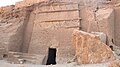
Several sites across the are traditionally claimed as the burial place of the prophet , reflecting his enduring significance in Islamic and related traditions. One of the most prominent is located in Wadi Shu'ayb, , approximately 2 kilometers west of the town of Mahis in the , near Al-Salt. This site features a mosque built during the Umayyad era (7th-8th century CE), which houses the purported tomb and serves as a key religious landmark overlooking the . The shrine attracts Muslim pilgrims seeking blessings, underscoring Shuaib's role as a revered Arabian mentioned in the . In the region of , near the village of and about 5 miles west of , another major site known as Nabi Shu'ayb is venerated primarily by the community, who identify Shuaib with the biblical Jethro. The complex includes a white-domed enclosing the claimed tomb, rebuilt in the late 20th century on earlier foundations dating back centuries. This location holds central importance in Druze faith, hosting an annual festival from April 25 to 28, during which thousands gather for prayers and celebrations. The site's sanctity is tied to traditions portraying Shuaib as a guiding prophet who advised . A lesser-known claim exists in Guriyeh, a village near in Iran's , associated with local Shi'a traditions. This site features a simple mausoleum attributed to Shuaib, drawing occasional visitors in the context of regional prophetic veneration. Another claimed tomb is located in Hadramawt, , referenced in some classical Islamic texts. Additionally, the Caves of Shuaib near al-Bad in the Tabuk region of northwestern are traditionally associated with Shuaib's dwelling, forming an archaeological complex of first-century CE Nabatean rock-cut tombs tied to ancient Midianite ruins. These caves are occasionally referenced in traditions connecting Shuaib's mission to the area's historical geography.

Cultural and Religious Significance

Shuaib's narrative in the exemplifies ethical principles central to Islamic teachings, particularly the imperative of honest and fair dealings. He admonished the of against giving short measure and weight, declaring, "O my , give full measure and weight in justice and do not deprive the of their due and do not commit on the , spreading corruption" ( 11:85). This emphasis on integrity in commerce has profoundly shaped Islamic , where rules against in transactions draw directly from Shuaib's mission, reinforcing prohibitions in texts on deceptive practices. traditions further echo this ethos, with the Prophet Muhammad stating, "Whoever cheats is not one of us" (), reinforcing the prophetic emphasis on economic righteousness as exemplified by Shuaib. In , annual commemorations at his shrine during involve communal prayers, sermons, and reflections on these lessons, drawing to honor his legacy of reform. As a figure bridging Abrahamic faiths, Shuaib—equated with the biblical Jethro—holds interfaith significance, appearing in Islamic, Jewish, and Christian scriptures as a wise advisor to . In tradition, he is venerated as the foremost prophet, with his story integral to their esoteric beliefs and annual pilgrimages to Nabi Shu'ayb reinforcing communal identity and with neighboring Muslim and Jewish communities. Samaritan traditions, rooted in the , similarly feature Jethro as a righteous and father-in-law to , underscoring shared values of and divine guidance across these faiths. This overlap fosters ongoing interfaith discussions, positioning Shuaib/Jethro as a symbol of prophetic continuity and ethical convergence. In modern contexts, Shuaib's story remains relevant in Islamic sermons on , where his advocacy for equitable trade is invoked to critique contemporary issues like economic exploitation and inequality. His inspires calls for reform in global commerce, aligning with broader prophetic themes of compassion and fairness. Depictions of Shuaib appear in , such as works and prophetic biographies, and in educational media like Quranic animations that illustrate his miracles and warnings for younger audiences.

References

Add your contribution
Related Hubs
Contribute something
User Avatar
No comments yet.