


Community hub
Recent from talks
Contribute something
Nothing was collected or created yet.
European squid
View on Wikipedia
| European squid | |
|---|---|

| |
Scientific classification 
| |
| Kingdom: | Animalia |
| Phylum: | Mollusca |
| Class: | Cephalopoda |
| Order: | Myopsida |
| Family: | Loliginidae |
| Genus: | Loligo |
| Species: | L. vulgaris
|
| Binomial name | |
| Loligo vulgaris | |
| Synonyms[1] | |
| |
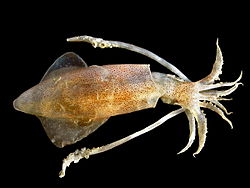
The European squid or common squid (Loligo vulgaris) is a large squid belonging to the family Loliginidae. It occurs abundantly in coastal waters from the North Sea to at least the west coast of Africa. This species lives from sea level to depths of 500 m (1,600 ft). Its mantle is up to 40 cm (16 in) long. The species is extensively exploited by commercial fisheries.
Loligo reynaudii, the Cape Hope squid, was previously treated as a subspecies of L. vulgaris.[2]
Description
[edit]

The European squid has a long, moderately slender and cylindrical body. Rhomboid fins comprise two-thirds of the mantle length, though locomotion is via jet propulsion.[3] The posterior border is slightly concave. The head is relatively small and has large eyes which are covered with a transparent membrane. Like almost all squid, this species has ten limbs surrounding the mouth and beak: eight are relatively short arms, and two, which form the tentacles, are long, as they are used to catch prey. The fourth left arm of males is a hectocotylus. The European squid can grow up to 30–40 cm in the mantle length, but more usually they are 15–25 cm long. The males are generally bigger than the females and exhibit more rapid rates of growth.
The colour of the European squid is greyish-transparent or reddish, depending on the expansion of chromatophores in the dermis. Males have small chromatophores on their mantle.[4]
Habitat and distribution
[edit]The European squid is a neritic, semidemersal species, which undertakes distinct horizontal and vertical migrations, depending on the environment. In the Adriatic Sea, European squid can be found above various substrates, from sandy through to the muddy bottoms.[4] It is found in temperatures of 13°C–20°C, preferring 18°C.[5]
L. vulgaris is found throughout the Mediterranean and in the eastern Atlantic Ocean from the North Sea to the Gulf of Guinea. In British waters, it is mainly found in the Irish Sea, along the south coast of England, and off northern Scotland.[6]
Biology
[edit]This species can be found at depths from the surface to about 500 m, but it is most abundant between 20 and 250 m (deeper during the winter). The population in the northeastern Atlantic spends the winter in deeper waters off Portugal, then moves towards the coast of France in spring, before migrating farther north into the North Sea during May and June where they spawn in depths ranging from 20 to 80 m. A southward migration takes place in autumn. The population found off Morocco and Western Sahara similarly spends the winter in deeper offshore waters and moves inshore to spawn in spring and autumn. The main juvenile recruitment is in February and March and between July and September. In the western Mediterranean, European squid move into deeper water in late autumn; the largest individuals commence their inshore migration as early as in January and February, while the smaller individuals wait until summer.
The spawning season extends for most of the year, but climaxes in early summer and early autumn. Females lay up to 20,000 small eggs, which are deposited in gelatinous tubes containing tens of eggs each. These tubes are attached to debris and other solid objects on sandy to muddy bottoms. The incubation period is dependent on temperature and is between 25 days (at 22 °C) and 45 days (at 12 to 14 °C). The size of the male determines the number (up to 800) and size of spermatophores. Males that are reproducing for the second time usually carry more than those reproducing for the first time.
-
 Egg mass
 -
 Embryo
 -
 Embryo
 -
 Juvenile


.jpg)
Growth in both sexes is temperature-dependent and is therefore faster in summer than in winter; the males grow faster than females. In the Atlantic, young squid hatched in June reach a mantle length of around 12 cm by December and grow to 13 or 14 cm by the following April. By August, males attain a mantle length of 17.5 cm and, if they reach the following April, 21 cm, compared to 17 cm in females. Life expectancy is 2 years in females and about 3 years in males.[7]
European squid are predators on fishes and crustaceans. Cannibalism is common.[7]
Fisheries
[edit]The European squid is a commercially valuable species. It is caught in multispecies trawl fishing throughout the year and, seasonally, in small scale and recreational fishing with a variety of gear.
In the Adriatic Sea, the total annual catch of the species is around 1,000 to 1,500 tonnes. This is very variable and is probably linked to the annual reproduction cycle that is typical for many cephalopods.[citation needed]
See also
[edit]- Todarodes pacificus (Japanese common squid)
References
[edit]- ^ a b Julian Finn (2016). "Loligo vulgaris Lamarck, 1798". World Register of Marine Species. Flanders Marine Institute. Retrieved 24 February 2018.
- ^ Vecchione, M. & R.E. Young. (2010). Loligo reynaudii Orbigny 1845. Tree of Life Web Project.
- ^ Johnson, W.; Soden, P.D.; Trueman, E.R. (1972). "A Study in Jet Propulsion: An analysis of the motion of the squid, Loligo vulgaris". Journal of Experimental Biology. 56: 155–165. doi:10.1242/jeb.56.1.155.
- ^ a b Loligo vulgaris (Lamarck, 1798). AdriaMed.
- ^ Palomares ML, Pauly D, eds. (2023). "Loligo vulgaris" in SeaLifeBase. February 2023 version.
- ^ Grid map of records on the Gateway for Loligo vulgaris. NBN Gateway.
- ^ a b Vecchione, M. & R.E. Young (2010). Loligo vulgaris Lamarck 1798. Tree of Life Web Project.
- Vecchione, M., E. Shea, S. Bussarawit, F. Anderson, D. Alexeyev, C.-C. Lu, T. Okutani, M. Roeleveld, C. Chotiyaputta, C. Roper, E. Jorgensen & N. Sukramongkol. (2005). "Systematics of Indo-West Pacific loliginids" (PDF). Phuket Marine Biological Center Research Bulletin 66: 23–26.
External links
[edit]- "CephBase: European squid". Archived from the original on 2005-08-17. (Loligo vulgaris reynaudi)
- "CephBase: European squid". Archived from the original on 2005-08-17. (Loligo vulgaris vulgaris)
- Charles Maxwell videos
- Photos of European squid in the Sealife Collection
1F15D
European squid
View on GrokipediaTaxonomy and identification
Scientific classification
The European squid, scientifically known as Loligo vulgaris Lamarck, 1798, occupies a specific position within the taxonomic hierarchy of marine organisms.[10] Its classification is as follows:| Taxonomic Rank | Classification |
|---|---|
| Kingdom | Animalia |
| Phylum | Mollusca |
| Class | Cephalopoda |
| Subclass | Coleoidea |
| Superorder | Decapodiformes |
| Order | Myopsida |
| Family | Loliginidae |
| Genus | Loligo |
| Species | L. vulgaris |
Etymology and common names
The scientific name Loligo vulgaris was established by the French naturalist Jean-Baptiste Lamarck in 1798, in his work Extrait d'un Mémoire sur le genre de la Sèche, du Calmar et du Poulpe.[11] The genus name Loligo derives from the Latin lōlīgō, an ancient term referring to squid or cuttlefish, as documented in classical Latin texts and later adopted into New Latin for taxonomic purposes.[12] The specific epithet vulgaris comes from Latin vulgaris, meaning "common" or "of the common people," reflecting the species' widespread abundance in its native range.[13] This nomenclature highlights its prevalence in European coastal waters, underscoring Lamarck's intent to classify it as a representative and ubiquitous member of the cephalopod family Loliginidae.[14] In English, Loligo vulgaris is commonly known as the European squid or common squid, names that emphasize its geographic distribution and frequency in fisheries.[1] Regional variations abound across Europe, reflecting linguistic and culinary traditions; for instance, it is called calamar in Spanish, calmar commun or encornet in French, and totano in Italian, often tied to its role as a staple seafood in Mediterranean and Atlantic cuisines.[15] These common names have persisted since at least the 18th century, evolving from vernacular descriptions in local fishing communities and contributing to its cultural recognition as a versatile marine resource without altering the binomial's formal status.[16]Physical characteristics
Morphology and anatomy
The European squid (Loligo vulgaris) possesses an elongated, cylindrical body characterized by bilateral symmetry and a streamlined shape, consisting of a distinct head fused dorsally to a muscular, tubular mantle. The mantle is robust, slightly flattened dorsoventrally, and encloses the visceral mass while being covered with numerous chromatophores; internally, it houses a dorsal gladius, a chitinous rod that provides structural support. Paired triangular fins extend along the mantle length, positioned dorsolaterally, and are muscular flaps united posteriorly with a concave medial posterior border and free posterior lobes. The head is broad and robust, bearing a prominent buccal mass and a crown of ten circumoral appendages: eight arms arranged in pairs (I–IV) and two longer ventrolateral tentacles that are contractile and retractile into pockets between arms III and IV. A ventral tubular siphon, equipped with a simple straight groove and ridge locking apparatus, connects to the mantle cavity.[17] Key external features include the chromatophores, which are pigment-filled muscular sacs distributed across the mantle, head, and arms, enabling rapid expansion and contraction. The mouth, located at the center of the arm crown, contains a strong chitinous beak composed of upper dorsal and lower ventral jaws with calcite denticulation, flanked by a radula—a chitinous, ribbon-like structure bearing rows of unicuspid teeth with a single projection per tooth. An ink sac, a single dorsal structure parallel to the intestine and situated near the digestive gland, stores dark viscous fluid and connects via a duct to the rectum. In females, paired nidamental glands are present as large glandular structures in the mantle cavity, opening into it alongside oviducts. The arms and tentacles bear suckers arranged in two to four transverse or longitudinal rows, with the tentacular clubs featuring expanded regions for adhesion.[17][18] Internally, the digestive system comprises an esophagus leading to a cuticle-lined stomach, followed by a complex caecum divided into an anterior portion with a ciliary collecting mechanism and main groove, and a posterior ciliated sac; this connects to a short, straight intestine lined with ciliated and mucous epithelium, a rectum with retractile cellular processes near its sphincter, and a bilobed mid-gut gland consisting of a hepatic portion and pancreatic section. The circulatory system is closed, featuring a systemic heart, two branchial hearts, one pair of gills with afferent and efferent blood vessels, and a cephalic vein, without a branchial canal between vessels. The nervous system is highly developed, comprising a large brain with supraoesophageal and suboesophageal masses, optic lobes, a stellate ganglion, and an olfactory organ as a ciliated pit, connected to mantle muscles via a giant fiber system; the eyes are large, camera-type organs with a single lens, covered by a transparent cornea and featuring a secondary eyelid fold.[19][20][21][17] Sexual dimorphism is prominent in the appendages, with males exhibiting a modified hectocotylus on the fourth left (ventral) arm, characterized by reduced suckers and elongation for specialized roles, while arm lengths are generally subequal across sexes but differentiated by this modification in males. Females lack the hectocotylus but possess the nidamental glands and spermathecae on the buccal membrane.[17][7]Size, growth, and coloration
The European squid (Loligo vulgaris) typically reaches an adult mantle length (ML) of 30–50 cm, with total lengths extending up to 70 cm including the tentacles; males generally attain larger sizes than females, with maximum recorded MLs of approximately 30 cm for females and up to 50 cm for males, while weights up to 1.5 kg.[2][7][22] Growth in L. vulgaris is rapid within its semelparous life cycle, which spans approximately 1 year and culminates in a single reproductive event followed by death; average growth rates measure 0.5–1 mm per day in mantle length, with males often exhibiting slightly faster increments (up to 1.3 mm/day or 39 mm/month) compared to females (approximately 1 mm/day or 30 mm/month).[23] These rates are modulated by environmental factors such as water temperature and prey availability, with warmer conditions and abundant food accelerating development. The coloration of L. vulgaris features a mottled pattern ranging from brown to purple, achieved through the expansion and contraction of dermal chromatophores that enable rapid adjustments for camouflage against varied substrates.[24] Unlike some deep-sea cephalopods, it lacks counter-illumination organs, relying instead on these chromatophore-mediated changes to blend with benthic or pelagic environments during hunting or evasion.[25] Ontogenetic shifts in coloration occur as L. vulgaris matures, with juveniles displaying more translucent bodies and fewer, smaller chromatophores for passive transparency in planktonic stages, transitioning to darker, more opaque pigmentation in adults for enhanced disruptive camouflage.[25][26]Distribution and habitat
Geographic range
The European squid (Loligo vulgaris) has a native range spanning the eastern Atlantic Ocean, from southern Norway southward to the southwestern coast of Africa, including waters off the British Isles, North Sea, and extending to the Gulf of Guinea.[1] This distribution encompasses latitudes from approximately 60°N to 36°S and longitudes from 19°W to 37°E.[1] The species is also native to the Mediterranean Sea, where it occurs throughout the basin, including the Adriatic Sea.[27] It has been recorded in the western Baltic Sea, representing an expansion into marginally suitable brackish waters.[28] Population structure reveals genetic distinctness between Mediterranean and Atlantic stocks, with mitochondrial DNA analyses indicating low gene flow across the Strait of Gibraltar, acting as a partial phylogeographic barrier.[8] Within the Mediterranean, eastern populations (e.g., Greece and Turkey) show pronounced differentiation from western ones (e.g., Italy and France), driven by hydrographic features like the Strait of Sicily, while western Mediterranean stocks exhibit homogeneity with adjacent Atlantic populations off the Iberian Peninsula.[29] High genetic diversity in the Adriatic suggests a panmictic population unit, contrasting with more structured Atlantic groups.[8] Historically confined to warmer temperate and subtropical waters, the range of L. vulgaris has expanded northward in response to ocean warming, with increased occurrences in the English Channel and southern North Sea documented through recent fishery records up to 2022.[30] Species distribution models project further northward shifts along the European Atlantic coast, with suitability indices rising in the central North Sea by up to 0.6 under high-emission scenarios by the late 21st century, reflecting ongoing climate-driven redistribution.[31] These changes overlap with expanding fishing grounds in northern European waters.[30]Environmental preferences and migration
The European squid (Loligo vulgaris) inhabits coastal and shelf waters, primarily at depths of 10 to 200 m, where it is often associated with sandy or muddy substrata suitable for benthic resting and spawning activities.[1] This nektobenthic lifestyle allows it to exploit both demersal and pelagic niches, with juveniles and adults showing a preference for continental shelf environments up to 500 m in exceptional cases.[32] Optimal conditions include seawater temperatures between 12 and 25°C, enabling metabolic processes and growth across its range, though it tolerates cooler waters down to about 8°C in northern extents.[32] Salinities typically range from 36.5 to 38.5 ppt, with the species showing resilience to slight variations but avoiding extreme freshwater influences.[33] Migration patterns in L. vulgaris are driven by environmental cues such as temperature gradients and prey availability, featuring seasonal inshore-offshore displacements. In the Mediterranean and eastern Atlantic, adults migrate toward shallower coastal zones (under 100 m) during winter and spring for reproductive aggregation, before shifting offshore to deeper waters post-spawning.[34] Juveniles, emerging from egg masses in nearshore areas, disperse seaward, following seasonal warming to optimize foraging habitats. These movements align with broader distribution boundaries, where cooler northern limits constrain offshore extents in winter.[8] On a daily scale, L. vulgaris undertakes diel vertical migrations, remaining closer to the bottom (15–30 m) during daylight for camouflage and energy conservation, then ascending to mid-water depths at night to pursue prey in the water column.[32] Acoustic tagging studies in the western Mediterranean, including data from the 2010s and early 2020s, have documented horizontal displacements averaging 50–100 km over weeks to months, with individual tracks influenced by local currents and upwelling patterns that facilitate passive transport.[34][8] Such mobility underscores the species' adaptability to dynamic oceanographic conditions within its preferred ecological niche.Life history and ecology
Reproduction and development
The European squid (Loligo vulgaris) reaches sexual maturity at dorsal mantle lengths (ML) that vary by population and environmental conditions, typically 12–27 cm ML; for example, approximately 12.5 cm for males and 16 cm for females in the Central Adriatic Sea (within 6–12 months of age), and 18–21 cm for males and 24–27 cm for females on the West Saharan shelf.[35] These traits vary by geographic region and environmental factors, such as temperature and prey availability, influencing population dynamics across the species' range. Spawning occurs year-round in most populations, with pronounced peaks in winter and spring, allowing for multiple batches of eggs per female over their lifespan of about one year.[35] Mating involves males using their specialized hectocotylized fourth left arm to transfer spermatophores—elongated packets containing sperm—to the female's buccal membrane, where they are stored in specialized spermathecae for later fertilization.[36][37] This internal fertilization enables females to produce multiple egg batches using stored sperm.[35] Females deposit eggs in gelatinous, finger-like capsules, each containing 50–130 eggs of 1.9–2.9 mm diameter, arranged in strands or clusters of dozens to hundreds of capsules that attach to hard substrates like rocks, algae, or artificial structures on the seabed at depths of 20–70 m.[38][39] These benthic egg masses, often comprising hundreds to thousands of eggs per cluster, incubate for 3–7 weeks, with duration inversely related to temperature; for example, 44–49 days at 12°C, 23–30 days at 16°C, and 23–29 days at 18°C.[38][40] Upon hatching, paralarvae measure 2–3 mm in dorsal ML and enter a planktonic phase lasting 1–2 months, during which they disperse via currents before transitioning to a more benthic, nektonic lifestyle upon settlement at sizes around 10 mm ML.[40][41]Feeding behavior and diet
The European squid (Loligo vulgaris) is an opportunistic predator with a diet dominated by fish, crustaceans, and other cephalopods. Stomach content analyses reveal that fish constitute the primary prey, comprising over 80% of the diet by frequency in non-empty stomachs across various Atlantic and Mediterranean regions.[42] Specific examples include small coastal fish such as sparids and gobiids in shallower waters. Crustaceans, particularly decapods like prawns and shrimp, form a secondary component, while cephalopods, including conspecifics and other loliginids, account for approximately 6% of the intake.[5] An ontogenetic shift occurs in the diet as juveniles transition from planktonic to nektonic prey. Smaller individuals (under 100 mm mantle length) primarily consume bottom-dwelling crustaceans and polychaetes, reflecting their near-bottom habitat preferences during early post-hatchling stages. Larger adults shift toward active nekton, targeting benthopelagic fish like myctophids, which aligns with increased mobility and deeper foraging depths. This dietary progression supports rapid growth, with paralarvae initially relying on yolk reserves before incorporating microcrustaceans. As an ambush predator, L. vulgaris employs specialized tactics to capture prey, using its tentacles for rapid strikes on distant, mobile targets like fish via a "tentacular lunge" attack, followed by a lethal bite from the chitinous beak to subdue and consume them head-first. For smaller, less evasive prey such as prawns, it adopts an "arm-opening" method, enveloping and ingesting them alive without prior biting. Larger squid exhibit more efficient handling, consuming entire prey items, while smaller ones may reject portions. Daily food intake typically reaches 10-15% of body weight, enabling high metabolic demands, though this varies with prey availability and individual size.[43][42] Stomach content studies from the 2010s and 2020s, including analyses in the western Mediterranean and North Sea, confirm fish dominance in adults (around 60-87% by mass), with seasonal variations influencing composition. For instance, during spring reproduction, polychaetes like nereidids increase in the diet, providing nutritional support, while crustacean intake rises in summer. These findings, derived from over 1,400 specimens, highlight dietary flexibility amid environmental changes.[44]Predators and symbiotic relationships
The European squid (L. vulgaris) is preyed upon by a diverse array of marine predators, occupying a key position as a mid-level consumer in coastal and pelagic food webs. Fish species such as the European hake (Merluccius merluccius) and blue whiting (Micromesistius poutassou) regularly include squid in their diets, with larger individuals targeting cephalopods alongside fish and crustaceans.[45] Other predatory fish documented consuming L. vulgaris include swordfish (Xiphias gladius), greater amberjack (Seriola dumerili), and smooth-hound sharks (Mustelus mustelus), often preying on juveniles and recruits.[46] Seabirds opportunistically feed on squid near the surface, particularly during spawning aggregations when L. vulgaris is more vulnerable.[46] Marine mammals such as common dolphins (Delphinus delphis), bottlenose dolphins (Tursiops truncatus), and seals (e.g., South African fur seals, Arctocephalus pusillus) also exploit squid populations, with predation pressure notably higher on juveniles due to their smaller size and pelagic dispersal phase.[46][47] Cannibalism within L. vulgaris schools further contributes to mortality, especially among size-disparate groups.[46] As a mid-level predator, L. vulgaris facilitates biomass transfer from lower trophic levels (e.g., crustaceans and small fish) to top predators, supporting ecosystem energy flow in the northeast Atlantic and Mediterranean.[48] Predation accounts for a substantial portion of natural mortality, with field estimates indicating daily rates of 4.8–9.6% for paralarvae, underscoring intense selective pressure on early life stages.[4] Symbiotic relationships in L. vulgaris primarily involve parasitic and commensal associations. Dicyemid mesozoans, such as Dicyema spp., inhabit the renal sacs of the squid, where they exhibit a symbiotic lifestyle, potentially aiding in host osmoregulation while deriving nutrients from the cephalopod.[49] These parasites are commonly reported in Mediterranean populations, with prevalence varying by host condition.[50] Within schools, L. vulgaris individuals engage in commensal associations, where grouping enhances predator vigilance and foraging efficiency without direct reciprocity, reducing individual risk through dilution effects.[51]Behavior and physiology
Locomotion and sensory systems
The European squid (Loligo vulgaris) primarily utilizes jet propulsion for locomotion, contracting its mantle musculature to expel water through the siphon, enabling rapid acceleration and burst speeds of up to 2.1 m/s during escape responses.[52] This mechanism allows for directed thrust in various orientations, with the siphon acting as a steerable nozzle to facilitate omnidirectional movement. For sustained cruising, the squid employs undulation of its triangular fins, which generate lift and propulsion at lower speeds, often in coordination with intermittent jets to maintain efficiency. Hovering or fine positional adjustments are achieved through subtle arm movements and minor siphon adjustments, minimizing energy expenditure in still water. The sensory systems of L. vulgaris are highly adapted for a dynamic marine environment, featuring large eyes with diameters reaching approximately 1 cm in adults, equipped with horizontal pupils that enhance contrast detection in low-light conditions.[53] These camera-type eyes provide binocular vision and sensitivity to polarized light, allowing the squid to perceive underwater polarization patterns for navigation, prey detection, and camouflage assessment against a polarized background.[54] Balance and orientation are maintained by statocysts, paired gravity-sensing organs in the head that detect angular acceleration and linear motion, integrating with vestibular inputs to stabilize posture during jetting or fin-based swimming.[55] Chemoreceptors distributed on the arms and suckers enable tactile and chemical sensing of prey or environmental cues at close range, supporting foraging and predator avoidance.[56] Notable adaptations include rapid neural processing via giant axons in the nerve cord, which facilitate near-instantaneous escape jets in response to threats, with conduction velocities supporting reaction times under 50 ms.[57] This integration of sensory inputs ensures precise coordination between perception and locomotion, such as aligning visual cues with siphon-directed propulsion.Daily and seasonal behaviors
The European squid (Loligo vulgaris) displays pronounced diel rhythms in its activity patterns, undertaking vertical migrations where it resides at greater depths during the day and ascends to shallower waters at night to forage.[58] Nighttime movements cover larger areas, facilitating active hunting of prey such as fish and crustaceans, while daytime behavior is more localized, often involving resting or reproductive activities.[59] For defense, the squid releases ink clouds, typically in response to predator threats, which creates a visual smokescreen and allows for rapid escape via jet propulsion; this behavior is observed across ontogenetic stages and enhances survival during foraging excursions.[60] Seasonally, L. vulgaris exhibits schooling behavior during summer months, with activity peaks supporting enhanced feeding efficiency in productive coastal waters.[61] In winter, individuals aggregate in inshore spawning grounds, particularly from December to March in the Mediterranean, where densities increase at depths of 25–30 m to facilitate mating and egg deposition.[59] Following spawning, squid transition to solitary lifestyles, dispersing from aggregation sites as post-reproductive decline sets in.[59] Socially, L. vulgaris forms loose schools typically comprising 10–50 individuals of similar size, which provide mutual protection during transit and foraging without rigid structure.[62] Interactions within these groups include agonistic displays, where rapid color changes via chromatophore expansion—such as shifting to dark or striped patterns—and arm postures like raising or splaying tentacles signal aggression or territorial claims, particularly among males near spawning areas.[63] These displays lack evidence of complex dominance hierarchies, emphasizing opportunistic rather than structured social dynamics.[63]Human interactions
Fisheries and commercial use
The European squid (Loligo vulgaris) supports significant commercial fisheries in the Mediterranean Sea and northeast Atlantic Ocean, where it is targeted or caught as bycatch. In the northeast Atlantic, landings of loliginid squids (primarily L. vulgaris and L. forbesi) totaled 12,023 tonnes in 2019, 9,532 tonnes in 2020, and 8,491 tonnes in 2021, before increasing to the highest levels in the time series in 2022 and remaining high in 2023 (averaging approximately 10,000 tonnes in 2020–2022 across ICES areas), with France, the United Kingdom, Spain, and Portugal accounting for the majority of harvests.[30][64][65] Recent trends show increasing landings in the North Sea (39% of total in 2023) and English Channel (35%), reflecting shifts possibly linked to environmental changes.[65] In the Mediterranean, L. vulgaris forms a key component of cephalopod landings, which have fluctuated around 40,000–50,000 tonnes annually in recent years (e.g., cuttlefish landings reached 14,033 tonnes in 2021) across the GFCM area, led by fleets from Italy, Spain, and Turkey.[66][67] These catches occur mainly in coastal waters, overlapping with the species' primary distribution in the western and central Mediterranean subregions.[7] Fisheries employ a range of gears, including bottom and midwater trawling (comprising approximately 77% of northeast Atlantic landings), jigging, and purse seining, often in multispecies operations.[30] Effort intensifies seasonally from November to April, corresponding to spawning aggregations that draw squid closer to shore.[68] Economically, L. vulgaris is marketed fresh for immediate consumption, frozen for export, or canned for longer storage, commanding value in European markets due to its role in popular dishes like calamari.[69] It also appears as incidental bycatch in demersal trawls targeting finfish, contributing to mixed landings in fleets from Spain, Italy, and Portugal.[70]Aquaculture and research applications
Efforts to develop aquaculture for the European squid (Loligo vulgaris) have primarily been experimental, with research focusing on egg incubation and early life stages to overcome barriers to commercial farming. Studies have demonstrated successful hatching under controlled salinities, achieving up to 96.7% success at 38 g L⁻¹, highlighting potential for rearing in facilities, though such work has been conducted in regions like Turkey with implications for Mediterranean aquaculture programs.[71] In Portugal and Spain, experimental initiatives since the 2010s have explored controlled rearing, but challenges including cannibalism among juveniles and high paralarval mortality rates persist, limiting scalability.[72] Overall production remains small-scale, contributing less than 1,000 tonnes annually to global cephalopod output, far below capture fisheries volumes.[73] The European squid serves as a key model organism in cephalopod neurobiology, valued for its complex nervous system that offers insights into neural development and function. Single-cell transcriptomics has mapped cell types in its head, identifying conserved neuronal populations and novel sensory structures, facilitating comparative studies with vertebrate brains.[26] Growth studies adapt the von Bertalanffy model to describe somatic development, accounting for seasonal and sex-specific variations; for instance, in northwest Portuguese waters, males exhibit faster length-at-age increases than females, with parameters tailored to short lifespans of 1–2 years.[74] Statolith analysis further supports research by enabling precise age estimation via increment counts and stock discrimination through shape and elemental composition, aiding in population delineation across European shelves.[75] Biomedical applications leverage the squid's regenerative capabilities, particularly in nerve repair, where transected axons regrow rapidly to restore function, informing therapies for neural injuries in humans.[76] In fisheries management, tagging and phylogeographic research, including 2022 studies on related loliginids, use genetic markers and statolith data to reveal population connectivity and structure, supporting sustainable stock assessments in Iberian and Mediterranean waters.[77]Conservation and threats
Population status and trends
The European squid (Loligo vulgaris) is classified as Data Deficient by the IUCN Red List, with no global threat status assigned due to insufficient data on population trends across its range.[1] Population abundance exhibits regional variability, remaining relatively stable in the Mediterranean Sea where fishery landings have shown consistent levels without major declines over the past decade, though local overexploitation occurs in areas like the northern Tunisian coasts.[78] In contrast, populations in overfished Atlantic regions, such as the Bay of Biscay, have experienced declines, with catch per unit effort (CPUE) decreasing in 2023 surveys following peaks in 2022.[79] In the English Channel, biomass indices for L. vulgaris have increased notably since 2014, rising from an average of approximately 10 (2000–2014) to peaks of 22 in 2016–2018, a trend linked to warming sea temperatures that enhance recruitment by shortening the paralarval stage.[80] ICES stock assessments, based on fishery-independent surveys, indicate overall fluctuations in abundance across the northeast Atlantic, with landings in the English Channel (4,257 t in 2023) remaining above the long-term mean despite a slight decline from 2022.[79] These trends correlate with variations in commercial catches, which serve as a proxy for relative abundance in the absence of full stock models.[81] Monitoring of L. vulgaris populations relies on length-frequency analyses from commercial landings to track cohort structure and recruitment, alongside CPUE metrics from surveys like the Peltic and EVHOE, which reveal year-to-year variability in abundance.[79] Genetic studies using mtDNA and SNPs have identified metapopulation dynamics along the western Iberian Peninsula and eastern Mediterranean, indicating limited gene flow between Atlantic and Mediterranean stocks that influences regional resilience.[8]Environmental impacts and management
The European squid (Loligo vulgaris) faces significant anthropogenic pressures that threaten its populations across its range in the northeastern Atlantic and Mediterranean Sea. Overfishing is a primary concern, as the species' short lifespan (typically 1-2 years) and semelparous reproduction make it vulnerable to rapid declines when fishing targets pre-breeding adults, particularly in intensively exploited areas like the English Channel and western Mediterranean.[82] Climate change exacerbates this vulnerability through ocean warming, which has been linked to shifts in spawning grounds and timing; for instance, warmer waters in the English Channel favor L. vulgaris recruitment by optimizing temperatures around 16-20°C during key developmental lags, but prolonged warming could disrupt seasonal migrations and reduce hatchling viability in southern ranges.[80] Additionally, ocean acidification (projected pH drop to 7.5-8.0 by 2100) impairs embryonic development, extending hatching times, decreasing oxygen consumption, and increasing abnormalities in summer progeny, with survival rates falling to as low as 47% under combined warming and hypercapnia scenarios.[83] Pollution poses further risks, with microplastics accumulating in the digestive systems of L. vulgaris specimens from the Mediterranean, where 22.7% of individuals ingest an average of 0.32 microfibers per squid, primarily polypropylene and polyamide from coastal sources, potentially affecting feeding efficiency and health.[84] Heavy metal contamination, including elevated levels of zinc, iron, and copper in tissues like the mantle and hepatopancreas, stems from industrial and agricultural runoff in regions such as the Turkish coasts, though current bioaccumulation poses low direct health risks to predators; however, it compounds stress on reproductive organs during spawning.[85] Habitat degradation from bottom trawling, a dominant fishing method in the Bay of Biscay and Gulf of Cadiz, disturbs benthic spawning substrates and creates long-term sediment plumes that smother egg masses, with recovery times for affected seafloor communities spanning years.[82] Management efforts for L. vulgaris are constrained by its status as a non-quota species under EU regulations, lacking specific Total Allowable Catches (TACs), though general measures include minimum mesh sizes (40 mm for towed gear) to reduce juvenile bycatch and promote sustainability. In the Mediterranean, Marine Protected Areas (MPAs) such as those in the western basin help safeguard spawning hotspots by restricting demersal trawling, with studies identifying preferential coastal sites for enhanced protection to support stock recovery.[86] Recent research emphasizes stock discrimination using genetic markers and statolith shape analysis, revealing moderate structure along the Iberian Peninsula that informs spatially tailored quotas, while 2024 investigations into English Channel resilience highlight adaptive potential to warming but underscore the need for monitoring acidification synergies.[8] These strategies aim to mitigate observed population declines, though gaps persist in integrating climate projections with fishery-independent surveys.[80]References
- https://en.wiktionary.org/wiki/vulgaris