


Community hub
Recent from talks
Contribute something
Nothing was collected or created yet.
Shutter speed
View on Wikipedia


In photography, shutter speed or exposure time is the length of time that the film or digital sensor inside the camera is exposed to light (that is, when the camera's shutter is open) when taking a photograph.[1] The amount of light that reaches the film or image sensor is proportional to the exposure time. 1⁄500 of a second will let half as much light in as 1⁄250.
Introduction
[edit]
 | This section includes a list of references, related reading, or external links, but its sources remain unclear because it lacks inline citations. (May 2023) |
The camera's shutter speed, the lens's aperture or f-stop, and the scene's luminance together determine the amount of light that reaches the film or sensor (the exposure). Exposure value (EV) is a quantity that accounts for the shutter speed and the f-number. Once the sensitivity to light of the recording surface (either film or sensor) is set in numbers expressed in "ISOs" (e.g. 200 ISO, 400 ISO), the light emitted by the scene photographed can be controlled through aperture and shutter-speed to match the film or sensor sensitivity to light. This will achieve a good exposure when all the details of the scene are legible on the photograph. Too much light let into the camera results in an overly pale image (or "over-exposure") while too little light will result in an overly dark image (or "under-exposure").[citation needed]
Multiple combinations of shutter speed and f-number can give the same exposure value (E.V.). According to exposure value formula, doubling the exposure time doubles the amount of light (subtracts 1 EV). Reducing the aperture size at multiples of one over the square root of two lets half as much light into the camera, usually at a predefined scale of f/1, f/1.4, f/2, f/2.8, f/4, f/5.6, f/8, f/11, f/16, f/22, and so on. For example, f/8 lets four times more light into the camera as f/16 does. A shutter speed of 1⁄50 s with an f/4 aperture gives the same exposure value as a 1⁄100 s shutter speed with an f/2.8 aperture, and also the same exposure value as a 1⁄200 s shutter speed with an f/2 aperture, or 1⁄25 s at f/5.6.[citation needed]
In addition to its effect on exposure, the shutter speed changes the way movement appears in photographs. Very short shutter speeds can be used to freeze fast-moving subjects, for example at sporting events. Very long shutter speeds are used to intentionally blur a moving subject for effect.[2] Short exposure times are sometimes called "fast", and long exposure times "slow".[citation needed]
Adjustments to the aperture need to be compensated by changes of the shutter speed to keep the same (right) exposure.
In early days of photography, available shutter speeds were not standardized, though a typical sequence might have been 1⁄10 s, 1⁄25 s, 1⁄50 s, 1⁄100 s, 1⁄200 s and 1⁄500 s; neither were apertures or film sensitivity (at least 3 different national standards existed). Soon this problem resulted in a solution consisting in the adoption of a standardized way of choosing aperture so that each major step exactly doubled or halved the amount of light entering the camera (f/2.8, f/4, f/5.6, f/8, f/11, f/16, etc.), a standardized 2:1 scale was adopted for shutter speed so that opening one aperture stop and reducing the amount of time of the shutter speed by one step resulted in the identical exposure. The agreed standards for shutter speeds are: 1⁄1000 s; 1⁄500 s; 1⁄250 s; 1⁄125 s; 1⁄60 s; 1⁄30 s; 1⁄15 s; 1⁄8 s; 1⁄4 s; 1⁄2 s; and 1 s.[3]
.jpg)
With this scale, each increment roughly doubles the amount of light (longer time) or halves it (shorter time).
Camera shutters often include one or two other settings for making very long exposures:
- B (for bulb) keeps the shutter open as long as the shutter release is held.
- T (for time) keeps the shutter open (once the shutter-release button had been depressed) until the shutter release is pressed again.[citation needed]
The ability of the photographer to take images without noticeable blurring by camera movement is an important parameter in the choice of the slowest possible shutter speed for a handheld camera. The rough guide used by most 35 mm photographers is that the slowest shutter speed that can be used easily without much blur due to camera shake is the shutter speed numerically closest to the lens focal length. For example, for handheld use of a 35 mm camera with a 50 mm normal lens, the closest shutter speed is 1⁄60 s (closest to "50"), while for a 200 mm lens it is recommended not to choose shutter speeds below 1⁄200 s. This rule can be augmented with knowledge of the intended application for the photograph, an image intended for significant enlargement and closeup viewing would require faster shutter speeds to avoid obvious blur. Through practice and special techniques such as bracing the camera, arms, or body to minimize camera movement, using a monopod or a tripod, slower shutter speeds can be used without blur. If a shutter speed is too slow for hand holding, a camera support, usually a tripod, must be used. Image stabilization on digital cameras or lenses can often permit the use of shutter speeds 3–4 stops slower (exposures 8–16 times longer).[citation needed]
Shutter priority refers to a shooting mode used in cameras. It allows the photographer to choose a shutter speed setting and allow the camera to decide the correct aperture. This is sometimes referred to as Shutter Speed Priority Auto Exposure, or TV (time value on Canon cameras) mode, S mode on Nikons and most other brands.[citation needed]
Creative utility in photography
[edit]


Shutter speed is one of several methods used to control the amount of light recorded by the camera's digital sensor or film. It is also used to manipulate the visual effects of the final image.

Slower shutter speeds are often selected to suggest the movement of an object in a still photograph.
Excessively fast shutter speeds can cause a moving subject to appear unnaturally frozen. For instance, a running person may be caught with both feet in the air with all indication of movement lost in the frozen moment.
When a slower shutter speed is selected, a longer time passes from the moment the shutter opens till the moment it closes. More time is available for movement in the subject to be recorded by the camera as a blur.
A slightly slower shutter speed will allow the photographer to introduce an element of blur, either in the subject, where, in our example, the feet, which are the fastest moving element in the frame, might be blurred while the rest remains sharp; or if the camera is panned to follow a moving subject, the background is blurred while the subject remains relatively sharp.
The exact point at which the background or subject will start to blur depends on the speed at which the object is moving, the angle that the object is moving in relation to the camera, the distance it is from the camera and the focal length of the lens in relation to the size of the digital sensor or film.
When slower shutter-speeds, in excess of about half a second, are used on running water, the water in the photo will have a ghostly white appearance reminiscent of fog. This effect can be used in landscape photography.
Zoom burst is a technique which entails the variation of the focal length of a zoom lens during a longer exposure. In the moment that the shutter is opened, the lens is zoomed in, changing the focal length during the exposure. The center of the image remains sharp, while the details away from the center form a radial blur, which causes a strong visual effect, forcing the eye into the center of the image.[4]
The following list provides an overview of common photographic uses for standard shutter speeds.
- 1⁄16,000 s and less: The fastest speed available in APS-H or APS-C format DSLR cameras (as of 2012[update]). (Canon EOS 1D, Nikon D1, Nikon 1 J2, D1X, and D1H)
- 1⁄12,000 s: The fastest speed available in any 35 mm film SLR camera. (Minolta Maxxum 9xi, Maxxum 9
- 1⁄8000 s: The fastest speed available in production SLR cameras (as of 2013[update]), also the fastest speed available in any full-frame DSLR or SLT camera (as of 2013[update]). Used to take sharp photographs of very fast subjects, such as birds or planes, under good lighting conditions, with an ISO speed of 1,000 or more and a large-aperture lens.[5]
- 1⁄4000 s: The fastest speed available in consumer SLR cameras (as of 2009[update]); also the fastest speed available in any leaf shutter camera (such as the Sony Cyber-shot DSC-RX1) (as of 2013[update]). Used to take sharp photographs of fast subjects, such as athletes or vehicles, under good lighting conditions and with an ISO setting of up to 800.[6]
- 1⁄2000 s and 1⁄1000 s: Used to take sharp photographs of moderately fast subjects under normal lighting conditions.[7]
- 1⁄500 s and 1⁄250 s: Used to take sharp photographs of people in motion in everyday situations. 1⁄250 s is the fastest speed useful for panning; it also allows for a smaller aperture (up to f/11) in motion shots, and hence for a greater depth of field.[8]
- 1⁄125 s: This speed, and slower ones, are no longer useful for freezing motion. 1⁄125 s is used to obtain greater depth of field and overall sharpness in landscape photography, and is also often used for panning shots.
- 1⁄60 s: Used for panning shots, for images taken under dim lighting conditions, and for available light portraits.[9]
- 1⁄30 s: Used for panning subjects moving slower than 30 miles per hour (48 km/h) and for available-light photography. Images taken at this and slower speeds normally require a tripod or an image stabilized lens/camera to be sharp.[10]
- 1⁄15 s and 1⁄8 s: This and slower speeds are useful for photographs other than panning shots where motion blur is employed for deliberate effect, or for taking sharp photographs of immobile subjects under bad lighting conditions with a tripod-supported camera.[11]
- 1⁄4 s, 1⁄2 s and 1 s: Also mainly used for motion blur effects and/or low-light photography, but only practical with a tripod-supported camera.[12]
- B (bulb) (fraction of second to several hours): Used with a mechanically fixed camera in astrophotography and for certain special effects.[13]
-
![Star trails like these are created by using a long exposure to capture the apparent motion of the stars.[14]](//upload.wikimedia.org/wikipedia/commons/thumb/9/95/Stars_Circle_La_Silla.jpg/250px-Stars_Circle_La_Silla.jpg) Star trails like these are created by using a long exposure to capture the apparent motion of the stars.[14]
Star trails like these are created by using a long exposure to capture the apparent motion of the stars.[14] -
 The Whirligig (now DC Super-Villains Swing) ride during night at Six Flags Great America at an exposure time of 0.8 seconds.
 -
 Light streaks outside London Waterloo station.
 -
 Effect of different shutter speeds on photograph.
 -
 A 30-second exposure of the rotating New Technology Telescope
![Star trails like these are created by using a long exposure to capture the apparent motion of the stars.[14]](https://en.wikipedia.org/wiki/File:Stars_Circle_La_Silla.jpg)


Cinematographic shutter formula
[edit]Motion picture cameras used in traditional film cinematography employ a mechanical rotating shutter. The shutter rotation is synchronized with film being pulled through the gate, hence shutter speed is a function of the frame rate and shutter angle.
Where E = shutter speed (reciprocal of exposure time in seconds), F = frames per second, and S = shutter angle:[15]
- , for E in reciprocal seconds
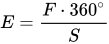
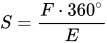
With a traditional shutter angle of 180°, film is exposed for 1⁄48 second at 24 frame/s.[15] To avoid effect of light interference when shooting under artificial lights or when shooting television screens and computer monitors, 1⁄50 s (172.8°) or 1⁄60 s (144°) shutter is often used.[16]
Electronic video cameras do not have mechanical shutters and allow setting shutter speed directly in time units. Professional video cameras often allow selecting shutter speed in terms of shutter angle instead of time units, especially those that are capable of overcranking or undercranking.
See also
[edit]
References
[edit]- ^ Sidney F. Ray (2000). "Camera Features". In Ralph Eric Jacobson; et al. (eds.). Manual of Photography: A Textbook of Photographic and Digital Imaging (Ninth ed.). Focal Press. pp. 131–132. ISBN 0-240-51574-9.
- ^ Lee Frost (2000). The Complete Guide to Night and Low-Light Photography. Amphoto Books. ISBN 0-8174-5041-6.
- ^ Cub Kahn (1999). Essential Skills for Nature Photography. Amherst Media. ISBN 1-58428-009-3.
- ^ "About Shutter Speed". Illustrated Photography. Archived from the original on June 18, 2016.
- ^ Doeffinger, 5
- ^ Doeffinger, 6
- ^ Doeffinger, 7–12
- ^ Doeffinger, 12–17
- ^ Doeffinger, 20–22
- ^ Doeffinger, 24
- ^ Doeffinger, 26–30
- ^ Doeffinger, 32–40
- ^ Doeffinger, 41 et seq.
- ^ "Stars Circle La Silla". Archived from the original on July 14, 2015. Retrieved July 6, 2015.
- ^ a b Blain Brown (2002). Cinematography: Theory and Practice : Imagemaking for Cinematographers, Directors & Videographers. Focal Press. p. 125. ISBN 0-240-80500-3.
cinematography 360 shutter-angle shutter speed.
- ^ Jeppsen, Matt (July 11, 2007). "Shutter Speed vs. Shutter Angle". provideocoalition.com. Archived from the original on November 13, 2012. Retrieved December 5, 2019.
Sources
[edit]- Doeffinger, Derek (2009). Creative Shutter Speed: Master Your Camera's Most Powerful Control. Wiley. ISBN 978-0-470-45362-9.
Shutter speed
View on GrokipediaBasic Concepts
Definition and Purpose
Shutter speed refers to the duration for which a camera's shutter remains open, allowing light to expose the image sensor or film to create a photograph. This exposure time is typically measured in seconds or fractions thereof, such as 1/1000 of a second for rapid captures or 1 second for extended exposures.[5][6][2] The primary purpose of shutter speed is to control the amount of light entering the camera, thereby regulating exposure to achieve a properly balanced image. Faster shutter speeds, like 1/1000 s, minimize light intake to prevent overexposure in bright conditions, while slower speeds, such as 1 s, permit more light for low-light scenarios. Additionally, shutter speed influences how motion is depicted in the image: high speeds can freeze fast-moving subjects to convey sharpness and detail, whereas low speeds introduce intentional blur to suggest movement and dynamism.[5][3][7] In the broader context of image formation, shutter speed interacts with the camera sensor's inherent light sensitivity to determine the overall brightness and clarity of the final photograph, forming one element of the exposure triangle alongside aperture and ISO sensitivity. This interplay ensures that the captured light aligns with the scene's luminance for optimal results.[5][6]Historical Development
The earliest methods for controlling exposure in photography relied on manual removal and replacement of the lens cap, resulting in rudimentary exposure times often lasting several minutes to capture permanent images on light-sensitive surfaces.[8] In 1845, French physicists Armand Fizeau and Léon Foucault developed the first recognizable shutter mechanism, a guillotine-style drop shutter consisting of a board that slid rapidly across the lens opening to achieve more precise, shorter exposures.[9] Following its invention, the guillotine shutter was adopted in daguerreotype and calotype processes, reducing exposure times from minutes to seconds and enabling portraiture in controlled lighting.[9] Significant advancements occurred in the late 19th century with the introduction of more sophisticated designs. In 1878, the Cadett pneumatic shutter used air pressure from a rubber bulb to operate a flap, providing consistent timing for between-lens exposures.[8] The pivotal milestone came in 1888 when German inventor Ottomar Anschütz patented the first practical focal-plane shutter, featuring a roller-blind mechanism positioned directly in front of the film plate, which allowed for variable slit widths and speeds up to 1/1000 second.[10] This innovation, used in cameras by C.P. Goerz for decades, marked a shift toward high-speed photography by enabling the capture of motion without excessive blur.[10] In the early 20th century, pneumatic and early electric shutters further refined control; for instance, clockwork and electromagnetic mechanisms in between-lens designs from the 1920s improved accuracy and speed range in compact cameras.[11] The 1930s brought widespread adoption of fast shutters in consumer models, exemplified by the Leica IIIa rangefinder camera introduced in 1935, which featured a top speed of 1/1000 second via its vertical cloth focal-plane mechanism, revolutionizing action and sports photography by freezing motion that previously required exposures of 1/100 second or slower.[12] These developments progressively shortened exposure times from seconds in the 19th century to fractions of a second, empowering photographers to depict dynamic subjects like athletes and wildlife with clarity. By the 1970s, the transition to electronic control in single-lens reflex (SLR) cameras accelerated this evolution; the Pentax Spotmatic series from 1971 introduced the first aperture-priority SLR with an electronically timed focal-plane shutter, allowing precise speeds down to 30 seconds without mechanical governors.[13] This electronic integration in SLRs like the Canon A-1 (1978) enabled automated exposure while maintaining mechanical reliability.[14] In the modern era post-2000, the rise of digital sensors has diminished the reliance on mechanical shutters, as electronic shutters—controlled entirely by sensor readout—became viable in mirrorless cameras, achieving speeds up to 1/32000 second (approximately 31 microseconds) without physical components.[15] This shift, driven by advancements in CMOS sensor technology, has enabled silent, vibration-free operation and extended dynamic range in high-speed applications, completing the progression from manual lens caps to fully digital timing mechanisms.[15]Technical Mechanisms
Mechanical Shutters
Mechanical shutters are physical devices in cameras that control exposure time through moving parts, typically springs, gears, or blades, to open and close the light path to the film or sensor.[16] These mechanisms originated in early camera designs and remain in use for their reliability in professional applications.[17] The primary types of mechanical shutters include focal-plane, leaf, slit, and rotary designs. Focal-plane shutters are positioned just in front of the image plane and use one or two curtains that travel horizontally or vertically across the frame to expose the recording medium.[16] Leaf shutters, integrated between the lens elements, consist of overlapping metal blades that iris open and closed symmetrically around the optical axis.[16] Slit shutters, an early variant often associated with guillotine-style mechanisms, employ two plates forming a narrow moving slit for exposure, allowing variable speeds by adjusting the gap.[16] Rotary shutters feature a pivoted disk or sector with an aperture that rotates across the lens or focal plane, powered by springs or rubber bands for timed exposure.[17] In operation, mechanical shutters rely on precise mechanical timing, such as tension springs or pneumatic delays, to regulate exposure duration. For a typical focal-plane shutter, the first curtain releases and moves across the frame to uncover the sensor or film, allowing light exposure; the second curtain follows after a set delay determined by gear ratios or escapement mechanisms, closing the exposure slit and preventing overexposure.[16] This slit-based exposure ensures uniform lighting across the frame at high speeds, though the curtain travel speed limits the minimum exposure time. Leaf shutters operate by blades rapidly unfolding from a stacked position to open fully and then retracting, often synchronized with the lens aperture for compact design.[16] Slit and rotary types similarly use rotational or linear motion, with speed controlled by tension adjustments or sector size.[17] Mechanical shutters typically offer speed ranges from bulb mode (unlimited long exposures via manual timing) up to a maximum of 1/2000 second, though advanced designs like metal-curtain focal-plane shutters in single-lens reflex (SLR) cameras can reach 1/8000 second.[18] Early cloth-based focal-plane curtains, common in film SLRs until the 1970s, were limited to slower maximums around 1/1000 second due to material flexibility and weight, while modern titanium or aluminum metal curtains enable higher speeds with reduced inertia.[18] Leaf shutters generally max out at 1/500 second in traditional implementations, extendable to 1/3000 second in specialized lenses.[16] Advantages of mechanical shutters include high durability from robust metal components, enabling consistent performance over thousands of cycles without electronic dependency, and precise mechanical synchronization for flash at moderate speeds.[19] However, drawbacks encompass operational noise and vibration from moving parts, which can introduce minor blur in long exposures, and physical wear on springs or fabrics leading to timing inaccuracies over time.[20] In SLRs, cloth curtains provided quieter operation and lighter weight but were prone to pinholes or burning from intense light, whereas metal curtains offer greater resistance to damage at the cost of increased noise.[18]Electronic Shutters
Electronic shutters in digital cameras operate by electronically controlling the exposure through the image sensor, eliminating the need for physical moving parts found in mechanical shutters. Instead of mechanical curtains, the process involves resetting the sensor pixels to begin exposure and then reading out the accumulated charge to end it, simulating the shutter speed digitally. This is typically achieved pixel-by-pixel or row-by-row across the CMOS sensor, allowing precise control over exposure duration without any mechanical vibration or noise.[21][16] There are two primary implementations: rolling shutter and global shutter. In rolling shutter, the most common type, the sensor resets and reads out rows sequentially from top to bottom, meaning each row starts and ends exposure at slightly different times, which can introduce timing offsets of milliseconds depending on the sensor's readout speed. Global shutter, a more advanced design, resets and reads out all pixels simultaneously across the entire sensor, ensuring uniform exposure timing for every pixel and avoiding sequential delays. While rolling shutters dominate due to cost and complexity advantages in standard CMOS sensors, global shutters are rarer but increasingly featured in high-end models like the Sony Alpha 9 III.[21][22] Electronic shutters enable ultra-fast exposure speeds, often reaching 1/32000 second or higher, far exceeding the limits of mechanical shutters which typically top out at 1/8000 second. For instance, the Nikon Z9 achieves 1/32000 second via electronic control, while the Sony Alpha 9 III pushes to 1/80000 second with its global shutter implementation. Additionally, their silent operation—producing no audible click—makes them ideal for discreet shooting in wildlife photography or quiet video recording environments.[16][22] Key advantages include the absence of mechanical vibration, which reduces the risk of camera shake-induced blur, and extended durability since there are no moving components to wear out. However, limitations arise, particularly with rolling shutter designs, where rapid subject or camera movement can cause geometric distortion known as the "jello effect," such as skewed vertical lines in panning shots or warped fast-moving objects. This artifact is prominent in mirrorless cameras like the Sony Alpha series during high-speed action, though global shutter systems in models such as the Alpha 9 III mitigate it entirely. Electronic shutters may also exhibit banding under flickering artificial lights due to the sequential readout.[21][22] Many modern cameras employ hybrid systems combining electronic and mechanical elements to balance benefits, such as the electronic front-curtain shutter (EFCS). In EFCS, the exposure begins electronically by resetting the sensor rows, but ends with a mechanical rear curtain, minimizing vibration while supporting higher flash synchronization speeds up to 1/2000 second in some cases—useful for high-speed sync in flash photography. This approach is common in Sony Alpha and Nikon Z series mirrorless cameras, providing a compromise between pure electronic silence and mechanical reliability for flash use.[21][16]Exposure Control
Role in the Exposure Triangle
In photography, the exposure triangle refers to the interdependent relationship between three primary settings—shutter speed, aperture, and ISO—that collectively control the amount of light reaching the camera's sensor to achieve proper image brightness. Shutter speed acts as the temporal component, determining how long the sensor is exposed to light, typically measured in fractions of a second. Aperture manages the quantity of light admitted through the lens by adjusting the size of the diaphragm opening, where wider apertures (lower f-numbers) allow more light. ISO governs the sensor's sensitivity to that light, with higher values amplifying the signal to brighten the image but potentially introducing noise. These elements form a balanced system where altering one requires compensatory changes to the others to maintain equivalent exposure.[23] A core trade-off arises from shutter speed's direct impact on light intake: a faster shutter speed, such as 1/1000 second, halves or quarters the exposure time compared to slower settings like 1/250 second, resulting in less light and a darker image unless offset by widening the aperture (e.g., from f/8 to f/4) or increasing ISO (e.g., from 100 to 400). This reciprocal dynamic ensures that no single adjustment occurs in isolation; for example, prioritizing a fast shutter speed to freeze action in sports photography might necessitate a shallower depth of field via a wider aperture or elevated noise from higher ISO, influencing the overall aesthetic and technical quality.[24][23] Practically, balancing the exposure triangle adapts to environmental conditions: in bright outdoor settings, photographers can employ faster shutter speeds with narrower apertures and low ISO for sharp, noise-free images with greater depth of field, whereas low-light interiors often require slower shutters, wider apertures, or higher ISO, sometimes paired with tripods to mitigate blur. In sports or wildlife scenarios, the emphasis on fast shutter speeds to capture motion may compromise other aspects, such as reducing depth of field to keep the subject sharp against a blurred background. A longstanding guideline for establishing baseline settings is the Sunny 16 rule, which recommends, on a clear sunny day with ISO 100, using an aperture of f/16 and a shutter speed of approximately 1/100 or 1/125 second as a starting point for correct exposure, from which fine-tuning can address specific creative intentions or metering variations.[25][26]Exposure Calculation Methods
The exposure value (EV) provides a standardized way to quantify the combination of aperture and shutter speed required for proper exposure at a given ISO sensitivity, typically ISO 100. The fundamental formula is , where is the f-number (aperture) and is the shutter speed in seconds. This equation arises from the principle that the amount of light reaching the sensor or film is proportional to the lens aperture area, which scales with , multiplied by the exposure duration ; thus, total exposure . Taking the base-2 logarithm normalizes changes into "stops," where each unit increase in EV corresponds to doubling the light for the same scene brightness, allowing photographers to balance settings equivalently (e.g., halving while opening the aperture one stop to maintain EV).[27][28] To derive the formula step-by-step, start with the light intensity incident on the subject and the effective exposure as , where is a constant incorporating ISO and other factors. For a constant (proper exposure), solving for combinations of and yields equivalent settings when is constant. The EV scales this ratio logarithmically: , with at the reference point of , second for EV 0. For example, at f/16 ( , ) and second ( ), , so , or roughly EV 14, suitable for a moderately lit indoor scene at ISO 100. Adjusting to f/11 ( , ) requires second to keep EV ≈14, demonstrating a one-stop change.[27][28] Camera light meters assist in calculating shutter speed by measuring scene luminance and recommending settings based on the EV formula, assuming middle gray (18% reflectance). Spot metering evaluates a narrow central area (typically 1-5% of the frame) for precise control in high-contrast scenes, directly suggesting a value. Center-weighted metering prioritizes the central 60-80% of the frame while averaging the rest, ideal for portraits where the subject occupies the middle. Evaluative (or matrix) metering divides the frame into multiple zones (e.g., 100+ segments), analyzes patterns against a database of typical scenes, and computes an overall EV to propose , balancing highlights and shadows algorithmically. These modes output recommended shutter speeds via the viewfinder or display, allowing manual or automatic selection.[29] For creative manual control, Ansel Adams' Zone System offers a systematic approach to exposure calculation, dividing the tonal range into 11 zones from pure black (Zone 0) to pure white (Zone X), with Zone V as middle gray. Photographers meter the darkest shadow detail desired (e.g., placing it on Zone III, two stops below middle gray) and adjust accordingly using the EV formula or meter readings, ensuring the full dynamic range fits the medium's latitude; for instance, if a metered shadow reads EV 10 but needs Zone III placement, increase exposure by +2 stops (e.g., double twice). This method, detailed in Adams' seminal work, enables previsualization of tones independent of the meter's assumptions.[30] Exposure compensation refines these calculations for scenes deviating from average reflectance, expressed as EV adjustments (± stops). Bright scenes like snow, which reflect far more than middle gray, require positive compensation to avoid underexposure; typically +1 to +2 EV is applied, such as increasing from 1/500 to 1/125 second at f/8 for snowy landscapes, preserving whites without graying them. Conversely, dark scenes like coal piles need -1 to -2 EV. At exposure extremes, reciprocity failure disrupts the linear relationship: for film, long exposures (>1 second) demand extended times due to reduced emulsion sensitivity, with some films requiring 2-3 times longer (e.g., a calculated 10-second becomes 30 seconds); digital sensors exhibit minimal failure but may show noise increases. Manufacturers provide reciprocity charts for specific films.[31][32] Built-in tools verify calculated exposures in real-time. Histograms display the distribution of tonal values as a graph of pixel intensities, with an ideal shape spreading across the range without piling up at the edges (clipping shadows or highlights); for example, a right-skewed histogram in low light prompts increasing to shift the curve leftward. Zebras overlay striped patterns on areas exceeding a luminance threshold (e.g., 90-100% IRE), alerting to potential highlight clipping during live view, allowing immediate adjustments like halving speed to recover detail. These aids complement the exposure triangle by providing visual feedback on the interplay of shutter speed, aperture, and ISO.[33][34]Photographic Applications
Capturing Motion
Shutter speed plays a crucial role in freezing motion in still photography, where faster speeds halt the apparent movement of subjects to produce sharp images. For relatively slow-moving subjects like a person walking at about 1.4 m/s, a shutter speed of 1/1000 second is often sufficient to minimize blur, particularly when the subject is at a moderate distance such as 5-10 meters with a standard 50mm lens. However, for high-speed action like sports or vehicles traveling at 20-30 mph, speeds of 1/2000 second or faster are typically required to fully arrest motion, as the subject's linear velocity translates to greater angular displacement across the frame when closer or captured with longer focal lengths. These thresholds depend on factors including subject speed, distance from the camera, and focal length, which amplifies the perceived motion; for instance, a bird in flight at 10 m/s viewed through a 200mm telephoto lens at 20 meters demands at least 1/1600 second to avoid discernible blur.[6][35][36] Intentional motion blur, conversely, can convey dynamism by using slower shutter speeds while the photographer tracks the subject. In panning techniques, speeds around 1/30 to 1/60 second allow the main subject to remain relatively sharp against a blurred background, emphasizing speed in scenarios like racing cars or cyclists; the camera must move smoothly with the subject to achieve this effect. For night cityscapes, exposures of 1 to 30 seconds capture light trails from vehicle headlights and taillights, transforming static urban scenes into flowing streams of color, often requiring a tripod to prevent camera shake. Balancing these slower speeds with exposure often involves increasing ISO or widening aperture to compensate for reduced light intake.[37][38] Sharpness thresholds for handheld photography incorporate both subject motion and camera stability, guided by the rule of thumb that the minimum shutter speed should equal or exceed the reciprocal of the focal length in millimeters (e.g., 1/200 second for a 200mm lens) to counter hand-induced vibration, with additional margin for moving subjects. There is no single universal "best" shutter speed for photographers with hand tremors, as it depends on tremor severity, focal length, lighting conditions, and image stabilization availability. Many photographers with shaky hands or conditions like essential tremor or Parkinson's recommend using significantly faster speeds than the standard reciprocal rule suggests, typically 1/125 second to 1/250 second or higher (e.g., 1/500 second or 1/1000 second in severe cases) to reduce motion blur from camera shake. Image stabilization (in-body or lens-based) can allow slightly slower speeds in some cases, and techniques such as bracing the camera against a solid surface, using a monopod, or shooting in burst mode can further help achieve sharp results.[39][40][41] Real-world tests, such as those in street photography, show that speeds below this threshold introduce softness; for example, Henri Cartier-Bresson captured the iconic "Behind the Gare Saint-Lazare" image at approximately 1/125 second with a 50mm lens on a handheld Leica, yielding slight motion blur in the leaping figure that enhances the decisive moment without compromising overall sharpness. Adjusting for motion might require doubling or tripling this baseline speed for active scenes.[42][43] Slower shutter speeds can introduce artifacts like ghosting, where moving elements appear as semi-transparent duplicates or streaks due to partial exposure during the frame, particularly noticeable in complex scenes with multiple moving parts. This is exacerbated below 1/125 second for moderate motion, leading to reduced clarity. To mitigate such issues and camera vibration, photographers employ tripods for exposures longer than 1/60 second or image stabilization systems in lenses, which can extend usable handheld speeds by 2-4 stops, allowing sharper results in lower light without excessive blur.[44][45]Creative Effects in Still Photography
In still photography, shutter speed serves as a powerful tool for artists seeking to transcend literal representation, enabling ethereal abstractions and surreal compositions through deliberate motion manipulation. By extending exposure times, photographers can evoke a sense of fluidity and timelessness, transforming dynamic scenes into dreamlike visuals that emphasize mood over precision. Conversely, ultra-fast shutters capture fleeting instants, isolating elements for dramatic emphasis or layered narratives. These techniques, rooted in experimental practices, allow creators to infuse personal interpretation into the frame, often requiring ancillary tools like filters or mounts to achieve the desired effect in varying light conditions.[46] Long exposures, typically ranging from 0.5 to 10 seconds, produce the renowned "silk effect" in flowing water, where rapid currents blur into soft, luminous veils that convey serenity and continuity. This technique, popularized in landscape photography, relies on stabilizing the camera to isolate water motion while keeping surrounding elements sharp, often necessitating neutral density (ND) filters to extend shutter times in bright daylight without overexposure. In astrophotography, even longer exposures—spanning minutes to hours—generate star trails, arcs of light tracing the apparent rotation of celestial bodies due to Earth's spin; these are captured via untracked mounts for intentional streaking, though tracking devices may facilitate stacked sequences to enhance trail uniformity and reduce noise.[47][48][49] High-speed shutter speeds exceeding 1/8000 second, combined with high-speed sync flash, enable the freezing of transient phenomena like liquid splashes or ballistic impacts, creating "bullet-time" stills that dissect motion into crystalline fragments for scientific or artistic scrutiny. In splash photography, such rapid exposures halt water droplets mid-flight, revealing intricate patterns invisible to the naked eye and often paired with studio lighting to eliminate ambient interference. Fine art photographers like Jerry Uelsmann created composites by exposing separate negatives and layering them in the darkroom using up to seven enlargers, blending realities in surreal tableaux—such as merging frozen figures with fluid landscapes—without digital intervention.[50][51][52] Multiple exposures further amplify creative potential, with variable shutter speeds allowing in-camera stacking to overlay translucent layers, simulating extended durations or ethereal overlays; ND filters again prove essential for daylight sessions, permitting slower speeds that blend subjects into ghostly amalgamations. In portraits, moderate speeds around 1/200 second ensure smoothness by minimizing micro-movements for flawless skin rendition, prioritizing composure over dynamism. Wildlife genres demand faster settings, such as 1/1000 second or higher, to freeze erratic actions like bird flights, capturing vital details without distortion. Documentarians, however, must weigh ethical implications, avoiding intentional blur from slower speeds that could fabricate urgency or obscure facts, thereby preserving the integrity of real-time events as they unfold.[46][48][53][54][55]Cinematographic Applications
Shutter Speed in Video Recording
In video recording, shutter speed is closely integrated with frame rate to control motion portrayal and exposure duration for each frame. The standard 180-degree rule dictates that shutter speed should be approximately 1/(2 × frame rate), resulting in a shutter angle of 180 degrees that provides natural motion blur and fluidity, mimicking human perception of movement. For instance, at 24 frames per second (fps), a shutter speed of 1/48 second is typical, allowing each frame to capture half the frame interval for smooth, lifelike motion without excessive sharpness or blur.[56][57] Unlike still photography, where a single image's exposure is isolated, video recording involves a continuous sequence of frames, each exposed for the set shutter speed duration under ongoing light conditions, which demands consistent settings across the clip to maintain uniform exposure and motion consistency. In low-light scenarios, adhering to slower shutter speeds per the 180-degree rule permits more light intake per frame but can introduce motion blur on moving subjects, often necessitating higher ISO values that amplify sensor noise and degrade image quality.[58][59] Practical shutter speed settings vary by application: in cinema, 24 fps paired with 1/48 second is standard for a filmic aesthetic with balanced blur, while broadcast video at 60 fps typically uses 1/120 second to ensure crisp, real-time motion suitable for live events or sports. Films like The Matrix (1999) employed variable high-speed recording up to 300 fps with correspondingly faster shutter speeds for action sequences, enabling slow-motion effects like bullet time while maintaining sharp detail in fast action.[57][60] Mismatched shutter speeds and frame rates can produce strobing artifacts, where rapid motion appears jerky or flickering due to insufficient blur between frames, particularly noticeable under artificial lighting with incompatible frequencies. Gimbals aid in compensating for slower shutter speeds in low light by mechanically stabilizing the camera, reducing shake-induced blur and allowing adherence to the 180-degree rule without handheld jitter.[61][62]Shutter Angle and Formulas
In cinematography, the shutter angle refers to the angular extent to which the shutter opens during each frame's exposure, expressed in degrees as a fraction of a full 360-degree rotation. This measure determines the duration of light exposure per frame relative to the camera's frame rate, influencing both image brightness and motion portrayal. For instance, a 180-degree shutter angle exposes the sensor or film for half of the frame interval, a standard that originated in analog systems but persists in digital workflows.[56] The relationship between shutter angle, frame rate, and linear shutter speed is governed by the formula: where shutter speed is in seconds (e.g., 1/48 s), frame rate is in frames per second (fps), and shutter angle is in degrees. To derive the shutter angle from known shutter speed and frame rate, rearrange to: For example, at 24 fps with a 180-degree shutter angle, the shutter speed calculates to Hz, or 1/48 s, providing exposure for half the frame time. This equation links angular mechanics to temporal exposure, allowing consistent motion blur across varying frame rates.[63][64] The formula derives from the mechanics of rotating disc shutters in traditional film cameras, where a perforated disc spins once per frame in synchronization with film advancement. The disc's open sector, defined by the shutter angle, permits light to reach the film gate for a proportional portion of the 360-degree rotation cycle. Exposure time is thus t = \frac{\text{shutter angle}}{360^\circ \times \text{[frame rate](/page/Frame_rate)}}, inverting to the shutter speed formula above. Early 35mm cameras employed semicircular (180-degree) discs for standard operation, while the Akeley model used a 230-degree shutter, with the full rotation ensuring precise timing at rates like 24 fps.[56][65] Adjustable shutter angles, typically ranging from 90 to 270 degrees in advanced film cameras, allow customization of exposure time without altering frame rate. A 90-degree angle halves the standard exposure relative to 180 degrees, reducing motion blur for sharper images, while 270 degrees extends it by 50%, increasing blur for softer motion. These variations were mechanically achieved by modifying the disc's open sector, directly scaling exposure time and thus light intake. In 35mm film projectors, a standard 180-degree effective angle—often via dual 90-degree blades projecting each frame twice—matched camera exposures to minimize flicker and ensure perceptual smoothness at 24 fps.[66][67] In applications, lower shutter angles (e.g., 90 degrees) produce crisp, staccato motion ideal for action films, minimizing blur to emphasize speed and impact, as seen in high-energy sequences. Conversely, higher angles (e.g., 270 degrees) yield smoother, more natural blur, simulating everyday perception for narrative scenes. This control over motion rendering stems from the angle's effect on per-frame light integration.[64][63] In modern digital cinematography, shutter angles are implemented virtually through software in DSLRs, mirrorless, and cinema cameras, where exposure time is electronically adjusted to mimic rotary behavior up to 360 degrees. This allows precise motion control without physical discs, maintaining compatibility with film-era standards while enabling extended ranges for creative flexibility.[56][64]References
- https://camera-wiki.org/wiki/Leica_III