


Community hub
Recent from talks
Contribute something
Nothing was collected or created yet.
Extended reality
View on Wikipedia
 | You can help expand this article with text translated from the corresponding article in Spanish. (December 2024) Click [show] for important translation instructions.
|


.jpg)
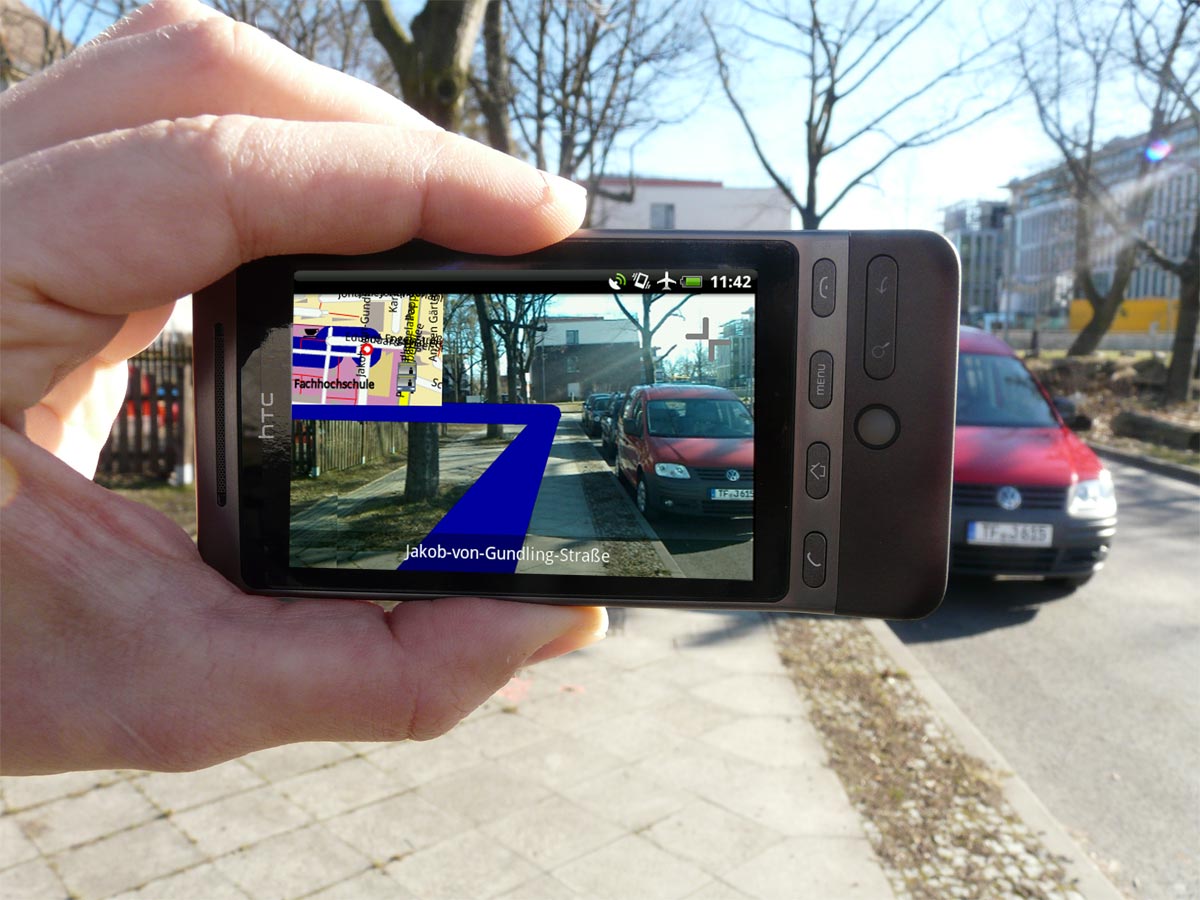
Extended reality (XR) is both an umbrella term to refer to and interpolate between augmented reality (AR), mixed reality (MR), and virtual reality (VR), as well as to extrapolate (extend) beyond these, e.g. allowing us to see sound waves, radio waves, and otherwise invisible phenomena.[1][2][3] The technology is intended to combine or mirror the physical world with a "digital twin world" able to interact with it,[4][5] giving users an immersive experience by being in a virtual or augmented environment.
XR is rapidly growing beyond an academic discipline, and is now having real-world impact in medicine,[6][7] architecture,[8] education,[9] industry,[10] and is being applied in a wide range of areas such as entertainment, cinema, marketing, real estate, manufacturing,[11] education, maintenance[12] and remote work.[13] Extended reality has the ability to be used for joint effort in the workplace, training, educational purposes, therapeutic treatments, and data exploration and analysis.
Extended reality works by using visual data acquisition that is either accessed locally or shared and transfers over a network and to the human senses. By enabling real-time responses in a virtual stimulus these devices create customized experiences. Advancing in 5G and edge computing – a type of computing that is done "at or near the source of data" – could aid in data rates, increase user capacity, and reduce latency. These applications will likely expand extended reality into the future.
Extended Reality can be applied not only to humans as a subject, but also to technology as a subject, where the subject (whether human or technology) can have its sensory capacity extended by placing it in a closed feedback loop. This form of Extended Intelligence is called veillametrics.[14][15]
In 2018 the BBC launched a research project to capture and document the barriers present in extended reality environments.[16]
The International Institute of MetaNumismatics (INIMEN) studies the applications of extended reality technologies in numismatic research, with a dedicated department.[17]
See also
[edit]- Augmented reality – View of the real world with computer-generated supplementary features
- Computer-mediated reality – Ability to manipulate one's perception of reality through the use of a computer
- Head-mounted display – Type of display device
- Immersion (virtual reality) – Perception of being physically present in a non-physical world
- Metaverse – Collective three-dimensional virtual shared space
- On-set virtual production – Technology for television and film production
- OpenXR – Standard for access to virtual reality and augmented reality platforms and devices
- Reality–virtuality continuum – Concept in computer science
- Smartglasses – Wearable computer glasses
- Spatial computing – Computing paradigm emphasizing 3D spatial interaction with technology
- Virtual reality – Computer-simulated experience
- Wearable computer – Small computing device worn on the body
- WebXR – Experimental JavaScript API for augmented/virtual reality devices
References
[edit]- ^ Vohra, Manisha, ed. (2025). Introduction to Extended Reality (XR) Technologies. John Wiley & Sons.
- ^ Mann, Steve, and Charles Wyckoff. "Extended reality." Cambridge, Massachusetts: Massachusetts Institute of Technology (1991): 4-405.
- ^ Marr, Bernard (2021). Extended reality in practice: 100+ amazing ways virtual, augmented and mixed reality are changing business and society. John Wiley & Sons.
- ^ Tu, Xinyi (2023). "TwinXR: Method for using digital twin descriptions in industrial eXtended reality applications". Frontiers in Virtual Reality. 4. doi:10.3389/frvir.2023.1019080. ISSN 2673-4192.
- ^ Casini, Marco (2022). "Extended Reality for Smart Building Operation and Maintenance: A Review". Energies. 15 (10): 3785. doi:10.3390/en15103785. hdl:11573/1637935. ISSN 1996-1073.
- ^ Andrews, Christopher, Michael K. Southworth, Jennifer NA Silva, and Jonathan R. Silva. "Extended reality in medical practice." Current treatment options in cardiovascular medicine 21 (2019): 1-12.
- ^ Morimoto, Tadatsugu, Takaomi Kobayashi, Hirohito Hirata, Koji Otani, Maki Sugimoto, Masatsugu Tsukamoto, Tomohito Yoshihara, Masaya Ueno, and Masaaki Mawatari. "XR (extended reality: virtual reality, augmented reality, mixed reality) technology in spine medicine: status quo and quo vadis." Journal of Clinical Medicine 11, no. 2 (2022): 470.
- ^ Trindade, Nuno Verdelho, Alfredo Ferreira, João Madeiras Pereira, and Sérgio Oliveira. "Extended reality in AEC." Automation in Construction 154 (2023): 105018.
- ^ Alnagrat, Ahmed, Rizalafande Che Ismail, Syed Zulkarnain Syed Idrus, and Rawad Mansour Abdulhafith Alfaqi. "A review of extended reality (XR) technologies in the future of human education: Current trend and future opportunity." Journal of Human Centered Technology 1, no. 2 (2022): 81-96.
- ^ Vasarainen, Minna, Sami Paavola, and Liubov Vetoshkina. "A systematic literature review on extended reality..." Internationa Journal of Virtual Reality 21, no. 2 (2021): 1-28.
- ^ Doolani, Sanika, Callen Wessels, Varun Kanal, Christos Sevastopoulos, Ashish Jaiswal, Harish Nambiappan, and Fillia Makedon. "A review of extended reality (xr) technologies for manufacturing training." Technologies 8, no. 4 (2020): 77.
- ^ Coupry, Corentin (2021). "BIM-Based Digital Twin and XR Devices to Improve Maintenance Procedures in Smart Buildings: A Literature Review". Applied Sciences. 11 (15): 6810. doi:10.3390/app11156810. ISSN 2076-3417.
- ^ Chuah, Stephanie Hui-Wen (2018). "Why and Who Will Adopt Extended Reality Technology? Literature Review, Synthesis, and Future Research Agenda". SSRN 3300469.
- ^ Janzen, R. et al. (2018, August). “Painting with the eyes”: Sensory perception flux time-integrated on the physical world. In 2018 IEEE Games, Entertainment, Media Conference (GEM) (pp. 239-245). IEEE.
- ^ Janzen, Ryan Edward. Extended intelligence and mediated reality veillametrics in the space, time, frequency, and amplitude domains. University of Toronto (Canada), 2019.
- ^ "XR Barriers Research - Accessibility for Products - BBC". www.bbc.co.uk. Retrieved January 31, 2025.
- ^ International Institute of MetaNumismatics, INIMEN Report 1 (2019-2024)
Sources
[edit]- Vinod Baya; Erik Sherman. "The road ahead for augmented reality". pwc.
- Pereira, Fernando. "Deep Learning-Based Extended Reality: Making Humans and Machines Speak the Same Visual Language." In Proceedings of the 1st Workshop on Interactive eXtended Reality, 1–2. IXR ’22. New York, NY, USA: Association for Computing Machinery, 2022. https://doi.org/10.1145/3552483.3555366.
- United States Government Accountability Office. Extended Reality Technologies. Science & Tech Spotlight. Washington, D.C: GAO, Science, Technology Assessment, and Analytics, 2022.
- Boel, Carl, Kim Dekeyser, Fien Depaepe, Luis Quintero, Tom van Daele, and Brenda Wiederhold. Extended Reality: Opportunities, Success Stories and Challenges (Health, Education) : Executive Summary. Luxembourg: Publications Office, 2023. https://op.europa.eu/publication/manifestation_identifier/PUB_KK0722997ENN.
- Sayler, Kelley M. "Military Applications of Extended Reality." IF 12010. Washington, D.C: Congressional Research Service, 2022.
| Concepts |
| ||||||||||
|---|---|---|---|---|---|---|---|---|---|---|---|
| Technologies |
| ||||||||||
| Peripherals | |||||||||||
| Companies | |||||||||||
| Devices |
| ||||||||||
| Software |
| ||||||||||
| People |
| ||||||||||
| In fiction | |||||||||||


 | This computing article is a stub. You can help Wikipedia by expanding it. |
 | This computer science article is a stub. You can help Wikipedia by expanding it. |
 | This technology-related article is a stub. You can help Wikipedia by expanding it. |