Hubbry Logo
Cytochrome bCytochrome bMain
Open search
Cytochrome b
Community hub
Cytochrome b
logo
8 pages, 0 posts
0 subscribers
Be the first to start a discussion here.
Cytochrome b
Cytochrome b
from Wikipedia
Cytochrome b, C-terminal domain
Identifiers
SymbolCytochrom_B_C
PfamPF00032
InterProIPR005798
Available protein structures:
Pfam  structures / ECOD  
PDBRCSB PDB; PDBe; PDBj
PDBsumstructure summary

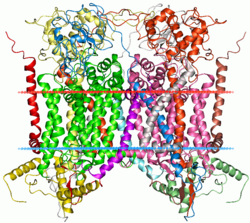
Cytochrome b is a protein found in the membranes of aerobic cells. In eukaryotic mitochondria (inner membrane) and in aerobic prokaryotes, cytochrome b is a component of respiratory chain complex III (EC 1.10.2.2) — also known as the bc1 complex or ubiquinol-cytochrome c reductase. In plant chloroplasts and cyanobacteria, there is a homologous protein, cytochrome b6, a component of the plastoquinone-plastocyanin reductase (EC 1.10.99.1), also known as the b6f complex. These complexes are involved in electron transport, the pumping of protons to create a proton-motive force (PMF). This proton gradient is used for the generation of ATP. These complexes play a vital role in cells.[1][2][3]

Structure and function

[edit]

Cytochrome b/b6 is an integral membrane protein of approximately 400 amino acid residues that probably has 8 transmembrane segments. In plants and cyanobacteria, cytochrome b6 consists of two protein subunits encoded by the petB and petD genes. Cytochrome b/b6 non-covalently binds two heme groups, known as b562 and b566. Four conserved histidine residues are postulated to be the ligands of the iron atoms of these two heme groups.[2][3]

The heme groups are key parts of the internal electron transfer pathway and indispensable to the functioning of the two quinol oxidizing complexes. Two units of b/b6 also form a quinol entry pathway.[4]

Use in phylogenetics

[edit]

Cytochrome b is commonly used as a region of mitochondrial DNA for determining phylogenetic relationships between organisms, due to its sequence variability. It is considered to be most useful in determining relationships within families and genera. Comparative studies involving cytochrome b have resulted in new classification schemes and have been used to assign newly described species to a genus as well as to deepen the understanding of evolutionary relationships.[5]

Clinical significance

[edit]

Mutations in cytochrome b primarily result in exercise intolerance in human patients; though more rare, severe multi-system pathologies have also been reported.[6]

Single-point mutations in cytochrome b of Plasmodium falciparum and P. berghei are associated with resistance to the anti-malarial drug atovaquone.[7]

Human genes

[edit]

Human genes encoding cytochrome b proteins include:

  • CYB5A – cytochrome b5 type A (microsomal)
  • CYB5B – cytochrome b5 type B (outer mitochondrial membrane)
  • CYBASC3 – cytochrome b, ascorbate dependent 3
  • MT-CYB – mitochondrially encoded cytochrome b

Fungicide target

[edit]

Cyt b is targeted by the QoI class of fungicides, Fungicide Resistance Action Committee group 11. The cyt b mutations G143A and F129L provide resistance against the main body of group 11, although G143A does not work against metyltetraprole (11A).[8] G143A is significant in Botrytis cinerea in California strawberry production.[9]

References

[edit]
[edit]
Revisions and contributorsEdit on WikipediaRead on Wikipedia
from Grokipedia
Cytochrome b is a heme-binding encoded by the mitochondrial , serving as a core subunit of the cytochrome bc1 complex (complex III) in the of mitochondria. It consists of approximately 400 amino acid residues and spans the with eight transmembrane α-helices, coordinating two prosthetic groups (bL and bH) that enable reactions. Through its participation in the Q-cycle mechanism, cytochrome b facilitates the oxidation of (QH2) at the Qo site and reduction of ubiquinone (Q) at the Qi site, bifurcating electron flow—one to the Rieske iron-sulfur protein and cytochrome c1 for transfer to , and the other across the complex to recycle electrons—while translocating protons to establish the essential for ATP synthesis via . The cytochrome bc1 complex, a dimeric assembly of 10-11 subunits per (with cytochrome b being the only mitochondrially encoded component in mammals), integrates into the respiratory chain between complexes I/II and IV, coupling electron transfer from to with proton pumping across the membrane. in MT-CYB can disrupt complex III function, leading to mitochondrial disorders such as and due to impaired energy production. Structurally conserved across eukaryotes, , and , cytochrome b's transmembrane helices form binding pockets for quinones and hemes, with helix packing enabling the spatial separation of low- and high-potential hemes critical for the Q-cycle's efficiency. Its evolutionary role underscores the ancient origins of bioenergetic systems, with homologs like cytochrome b6 in photosynthetic organisms performing analogous functions in the cytochrome b6f complex.

Molecular Structure

Primary Sequence and Topology

Cytochrome b, a core subunit of the ubiquinol-cytochrome c reductase (complex III) in the mitochondrial respiratory chain and the analogous cytochrome b6f complex in photosynthetic organisms, typically consists of a polypeptide chain of approximately 380-400 in both eukaryotic and prokaryotic species. For example, the human mitochondrial cytochrome b (MT-CYB) comprises 380 residues, while the yeast ortholog is 385 long, reflecting high conservation across diverse taxa despite minor length variations. The protein adopts an integral membrane architecture characterized by 8 transmembrane α-helices that form a compact bundle embedded within the of eukaryotes or the cytoplasmic of prokaryotes. These helices, often labeled A through H, span the and are connected by loops of varying lengths, with the structure confirmed by crystallographic studies such as the bovine heart bc1 complex at 2.1 Å resolution, which resolved exactly 8 helices rather than the 9 sometimes predicted by sequence-based algorithms. In the photosynthetic cytochrome b6f complex of thylakoid s, the equivalent cytochrome b6 subunit features 4 transmembrane helices, complemented by 3 in the associated subunit IV, collectively mimicking the 8-helix bundle of the bc1-type cytochrome b. The membrane topology positions both the N- and C-termini on the matrix side of the inner mitochondrial membrane in eukaryotes, consistent with the even number of transmembrane helices in the canonical eight-helix model. Biochemical assays using protease protection and antibody accessibility in yeast mitochondria confirm the N-terminus protrudes into the matrix, with the C-terminus similarly oriented due to the symmetric helical crossings.90035-3) In prokaryotes, this corresponds to both termini facing the cytoplasm, while in thylakoid-embedded b6f complexes, the termini face the stroma. The helices are organized into two distinct bundles: an N-terminal domain encompassing helices A-D and a C-terminal domain with helices E-H, creating a central core that accommodates non-covalently bound heme groups. Several conserved motifs define the primary sequence, notably histidine-rich regions critical for structural integrity and heme coordination. These include paired axial histidine ligands (e.g., His97 and His198 in bovine cytochrome b) located in helices B and D, spaced approximately 14 residues apart to axially ligate the low- and high-potential hemes (b_L and b_H). The "cyt b signature," a broader pattern encompassing these histidine motifs and adjacent residues (such as the PEWY quinol-binding loop), is preserved across , ensuring proper folding and integration. These elements underscore the evolutionary stability of cytochrome b's architecture, as evidenced by sequence alignments from to mammals.

Heme Binding and Cofactors

Cytochrome b, the core subunit of the : (complex III), non-covalently binds two distinct b-type groups, designated heme b_H and heme b_L, which are essential for its activity. These s differ in their potentials and spectroscopic signatures: heme b_H exhibits a higher potential of approximately +50 mV and an α-band absorption maximum at 562 nm in the reduced state, while heme b_L has a lower potential of approximately -60 mV and an absorption maximum at 566 nm. These properties arise from their asymmetric positioning within the protein and enable their selective monitoring via difference , where shifts in the α-band allow distinction between the two cofactors during titrations. The iron atoms of both hemes are axially coordinated by pairs of conserved residues acting as ligands, forming a bis- ligation geometry that stabilizes the high-spin ferric state. In the bovine mitochondrial cytochrome b (numbered according to P00157), heme b_L is ligated by His83 (on transmembrane B) and His182 (on D), whereas heme b_H is coordinated by His97 ( B) and His196 ( D). This ligation pattern is highly conserved across , ensuring proper incorporation during biogenesis and maintaining the hemes' accessibility for without covalent attachment to the polypeptide. Structurally, the heme groups are embedded within a four-helix bundle formed by transmembrane helices A–D of cytochrome b, with their planes oriented roughly perpendicular to the plane to facilitate inter-heme electron equilibration. The rings are anchored to the protein matrix primarily through electrostatic interactions involving their propionate side chains, which extend into hydrophilic pockets and interact with positively charged residues or molecules. This orientation positions the hemes optimally relative to the quinone-binding sites while minimizing exposure to the , contributing to the overall stability and functional asymmetry of the cofactor pair.

Structural Variations Across Organisms

Cytochrome b in mitochondrial and prokaryotic bc₁ complexes typically consists of approximately 380–400 residues, forming a polypeptide with eight transmembrane helices that span the inner mitochondrial or plasma membrane. These helices are organized into two bundles: helices A–D on the cytoplasmic (or periplasmic in ) side and E–H on the (or cytoplasmic) side, accommodating two non-covalently bound b-type hemes in a near-symmetric placement within the central four-helix bundle. The hemes, denoted b_L (low potential) and b_H (high potential), are axially ligated by residues, with b_L positioned closer to the positive side (p-side) and b_H toward the negative side (n-side) of the membrane. In many prokaryotic variants, such as those from Rhodobacter capsulatus, the structure is conserved. In contrast, cytochrome b₆ in and cyanobacterial b₆f complexes is notably shorter, comprising about 215–250 residues per monomer, and features only four transmembrane helices (A–D). This subunit corresponds to the C-terminal domain of mitochondrial b, with the N-terminal domain homolog replaced by the separate subunit IV, which adds three additional transmembrane helices (E–G), resulting in a total of seven helices for the b₆/subunit IV core. The two b-type s in b₆ (b_p and b_n) are bound similarly to those in bc₁, but the complex includes a unique non-covalently bound c-type (heme c_n or heme x) near the n-side, ligated by a CXGG motif in subunit IV, facilitating distinct routing. The Rieske iron-sulfur protein partner in b₆f contains a [2Fe-2S] cluster essential for , though this is extrinsic to b₆ itself. Both bc₁ and b₆f complexes function as homodimers, with cytochrome b (or b₆) monomers forming the structural core through inter-monomer contacts via transmembrane helices, enabling concerted electron bifurcation. However, in b₆f, cytochrome b₆ engages in heterodimeric interactions with small subunits like PetG (a single-transmembrane helix protein), which stabilizes the dimer and influences quinol access pathways, a feature less prominent in bc₁ where cytochrome b homodimers suffice for core stability. These structural divergences reflect evolutionary adaptations: the unified eight-helix cytochrome b in bc₁ supports respiratory ubiquinol oxidation, while the split architecture in b₆f accommodates photosynthetic plastoquinol cycling and additional cofactors like chlorophyll a and β-carotene in subunit IV.

Biological Function

Role in Respiratory Chain Complex III

Cytochrome b serves as an essential subunit of the cytochrome bc1 complex, also known as Complex III, which is a central component of the mitochondrial in aerobic respiration. This complex catalyzes the transfer of electrons from (QH2) to , coupling this reaction to proton translocation across the to generate the proton motive force. In eukaryotic mitochondria and many , cytochrome b works in concert with two other core catalytic subunits: the Rieske iron-sulfur protein and cytochrome c1, which together form the minimal functional unit for electron bifurcation. The cytochrome bc1 complex operates as a symmetric dimer, with each monomer comprising 11 subunits in mammalian mitochondria, including the three respiratory subunits (cytochrome b, cytochrome c1, and Rieske protein), two core proteins (UQCRC1 and UQCRC2), and six low-molecular-weight subunits that stabilize the structure. Cytochrome b, encoded by the mitochondrial genome in eukaryotes, forms the transmembrane core of each monomer, anchoring the complex within the lipid bilayer through eight transmembrane helices and coordinating two heme b cofactors essential for electron relay. This dimeric architecture ensures coordinated electron transfer between the two Qo sites (on the positive side of the membrane) and Qi sites (on the negative side), with cytochrome b's hemes bridging these quinone-binding pockets. Within the , cytochrome b positions the bc1 complex downstream of Complexes I and II, where it accepts s from oxidation at the Qo site; one branch reduces the for transfer to cytochrome c1 and ultimately , while the other traverses cytochrome b's hemes bL (low-potential, near Qo) to bH (high-potential, near Qi) for delivery to the Qi site. This bifurcated pathway enables efficient coupling of flow to . As part of the Q-cycle mechanism, cytochrome b's role in the complex results in the net translocation of four protons from (or bacterial cytoplasm) to the per two s transferred to , amplifying the proton gradient for ATP synthesis without direct proton pumping by the protein itself.

Role in Photosynthetic b6f Complex

Cytochrome b6 serves as a core transmembrane subunit of the cytochrome b6f complex, embedded in the membranes of chloroplasts in , , and . This complex functions as a key hub in photosynthetic electron transport, where cytochrome b6 partners with cytochrome f, the Rieske iron-sulfur protein (also known as the ISP), and smaller subunits such as PetD (subunit IV) to form a dimeric structure essential for oxidation and reduction. The integration of these components enables the coordinated movement of electrons and protons across the membrane, contributing to the generation of a proton motive force. In its role within the b6f complex, cytochrome b6 facilitates the linkage between (PSII) and (PSI) by mediating the oxidation of (PQH2) at the Qo (or Qp) site on the lumenal side and the subsequent reduction of at the Qi (or Qn) site on the stromal side. This bifurcates s from PQH2, with one transferred via the and cytochrome f to for PSI reduction, while the other traverses the low-potential chain through the hemes of cytochrome b6 to reduce plastoquinone at the Qi site. These site-specific reactions support the overall , enhancing the efficiency of photosynthetic energy conversion. Structurally adapted for its photosynthetic environment, cytochrome b6 exhibits a lower molecular weight of approximately 20-25 per subunit, reflecting its compact transmembrane architecture with multiple alpha-helices and bound hemes (including , bn, and the unique ). This reduced size compared to its mitochondrial counterpart facilitates rapid diffusion and electron shuttling within the crowded membrane, making it indispensable for both linear electron flow from PSII to PSI (producing NADPH and ATP) and cyclic electron flow around PSI (primarily boosting ATP synthesis). The presence of an additional heme near the Qi site further optimizes semiquinone stabilization and in this light-driven context. Evolutionarily, the cytochrome b6f complex, including its b6 subunit, derives from an ancient prokaryotic ancestor resembling the bc1 complex found in respiring bacteria and mitochondria, with the b6f form predating the longer cytochrome b in bc1 types. This divergence likely occurred in early oxygenic phototrophs, where cytochrome b6 specialized to couple reactions with light-dependent proton translocation, thereby establishing the trans-thylakoid proton gradient crucial for ATP production in oxygenic . The conservation of a Q-cycle mechanism underscores this shared heritage, adapted for photosynthetic rather than respiratory demands.

Electron and Proton Transfer Mechanisms

Cytochrome b plays a central role in the Q-cycle mechanism within the bc₁ (respiratory) and b₆f (photosynthetic) complexes, where it facilitates bifurcated electron transfer from quinol (QH₂) oxidation. In this process, oxidation of QH₂ at the Qo site releases two protons to the positive side of the membrane and bifurcates the electrons: one electron travels via the high-potential chain through the Rieske iron-sulfur protein [2Fe-2S] cluster to cytochrome c (in bc₁) or cytochrome f (in b₆f), while the second electron is transferred to the low-potential chain consisting of the two b hemes within cytochrome b. This bifurcation enables semiquinone (SQ) formation at the Qo site, with the low-potential electron reducing heme b_L, followed by rapid transfer to heme b_H. The full Q-cycle requires two turnovers of QH₂ at the Qo site to reduce one ubiquinone (Q) or to QH₂ at the Qi site, effectively coupling scalar proton release and uptake to vectorial translocation. At the Qo site, the initial QH₂ oxidation yields the equation: QH₂ + 2 cyt c^{ox} (or f^{ox}) → Q + 2 cyt c^{red} (or f^{red}) + 2 H^+ (released to intermembrane or lumen space), but the bifurcated path ensures the second electron contributes to Qi site reduction in the cycle. Proton pumping nets four protons translocated per Q-cycle (four released at Qo from two QH₂ oxidized and two taken up at Qi), establishing a proton motive force essential for ATP synthesis. The potentials of the b s drive the directional flow and stabilize the SQ intermediate, with heme b_L exhibiting a lower potential (approximately -90 mV) compared to heme b_H (approximately -50 mV), creating a thermodynamic that favors transfer from b_L to b_H and subsequent SQ_i stabilization at the Qi site. This potential difference, spanning about 40 mV, prevents backflow and supports the low-potential chain's role in bifurcated transfer across both bc₁ and b₆f complexes. Inhibitor studies highlight the mechanistic specificity: antimycin binds near heme b_H at the Qi site, blocking to Q and causing b hemes to accumulate in the reduced state, while stigmatellin binds at the Qo site adjacent to the Rieske [2Fe-2S] cluster, preventing QH₂ oxidation and bifurcation by stabilizing the enzyme-substrate complex. These sensitivities confirm the distinct roles of the Qo and Qi sites in and proton management.

Genetics and Evolution

Encoding Genes in Humans and Model Organisms

In humans, the core subunit of cytochrome b in mitochondrial respiratory III is encoded by the mitochondrially located (also known as CYTB), which spans positions 14,747 to 15,887 on the heavy strand of the and produces a 380-amino acid polypeptide essential for . This is maternally inherited due to the uniparental transmission of and is transcribed and translated within the mitochondria to support . Distinct nuclear-encoded variants belong to the , which facilitate in non-respiratory pathways; CYB5A, located on 18q22.3, encodes a microsomal form anchored to the membrane for roles in desaturation and reduction, while CYB5B on 16q22.1 produces an outer mitochondrial membrane isoform involved in nitrite reduction. A related nuclear , CYBASC3 (alias for CYB561A3 on 2q31.1), encodes a lysosomal transmembrane ferrireductase that uses ascorbate as an ; recent studies as of 2024 have characterized it as essential for lysosomal ferric iron reduction and iron homeostasis, particularly in cancer cells such as those in . Among model organisms, the bovine MT-CYB gene, encoding a 379-amino acid cytochrome b, serves as a standard reference for residue numbering in comparative structural analyses and human mutation studies due to its high-resolution crystal structures of the bc1 complex. In the yeast Saccharomyces cerevisiae, the CYTB (or COB) gene is mitochondrially encoded between tRNA-Glu and replication origin ORI6, producing the cytochrome b subunit of complex III; cytoplasmic petite (ρ⁻) mutants, which lack functional mitochondrial DNA, have been instrumental in sequencing the gene and revealing its split structure with introns. Bacterial systems feature the petB gene encoding cytochrome b of the bc1 complex, typically within the petABC operon alongside genes for the Rieske iron-sulfur protein (petA) and cytochrome c1 (petC), enabling quinol oxidation in the plasma membrane. In cyanobacteria, such as Synechococcus elongatus, the cytochrome b₆ subunit of the photosynthetic b₆f complex is encoded by petB, which forms a bicistronic operon with petD (encoding subunit IV) to facilitate electron transfer between photosystems I and II in the thylakoid membrane.

Evolutionary Conservation and Sequence Variability

Cytochrome b exhibits remarkable evolutionary conservation, particularly in its core structural elements essential for function. The residues serving as axial ligands to the groups are invariant across diverse taxa, ensuring proper coordination and capabilities. Similarly, the eight transmembrane helices that form the membrane-spanning core of the protein in mitochondrial bc1 complexes (and analogous structures in b6f complexes) display high identity, with over 80% similarity in vertebrates, reflecting strong selective pressure to maintain the bc1/b6f scaffold inherited from ancient bacterial ancestors approximately 2 billion years ago. This core architecture originated from prokaryotic membrane-anchored dehydrogenases in response to early challenges posed by biogenic . Sequence variability in cytochrome b is pronounced in non-functional regions, allowing for neutral evolutionary drift without compromising core activity. The third codon positions of the gene are hypervariable, accumulating synonymous substitutions at rates up to 14 times faster than other positions, which supports neutral evolution models and facilitates phylogenetic resolution at shallow taxonomic levels. In certain fungi and , the cytochrome b genes contain introns, particularly group I introns inserted after specific codons like the 143rd, with frequent gain and loss events contributing to genomic diversity; these introns are often mitochondrial but can influence nuclear-mitochondrial interactions in splicing. Such variability contrasts with the rigid conservation of functional motifs, highlighting modular evolution. Gene duplication events have shaped the cytochrome b family, leading to functional diversification in roles across eukaryotes. The divergence of bc1 (respiratory) and b6f (photosynthetic) complexes occurred post-endosymbiosis, as alphaproteobacterial progenitors adapted to oxygenated environments, resulting in distinct cytochrome b isoforms tailored to mitochondrial and chloroplast functions. Recent phylogenomic analyses of proteobacterial diversity, including 2022 studies resolving deep-branching lineages, reveal variant cytochrome b forms in that illuminate the mitochondrial ancestor's genetic toolkit, underscoring ongoing bacterial contributions to eukaryotic .

Applications and Significance

Use in Molecular Phylogenetics

Cytochrome b sequences from mitochondrial DNA (mtDNA) are widely utilized as molecular markers in phylogenetics due to several advantageous properties. The gene's maternal inheritance pattern ensures uniparental transmission, minimizing complications from biparental contributions, while the absence of recombination maintains linkage among mutations, facilitating clear tracing of evolutionary lineages. Additionally, at approximately 1.1 kb in length, the cytochrome b gene is amenable to efficient PCR amplification and sequencing, making it practical for large-scale studies across diverse taxa. These sequences have proven effective in DNA barcoding for species identification, particularly in challenging groups like fish families such as , where cytochrome b distinguishes closely related and species in commercial and ecological contexts. In mammals and birds, the gene aids in resolving intra-genus phylogenies, such as reconstructing relationships among great apes and in mammals or among species in birds, by capturing sufficient variation for recent divergences. Common analytical methods involve followed by construction using maximum likelihood approaches, which account for rate heterogeneity and improve resolution when weighting transversions over transitions. In vertebrates, the substitution rate of approximately 2% per million years provides a reliable for estimating divergence times in these analyses. Despite these strengths, cytochrome b has limitations, notably nucleotide saturation at third codon positions, which obscures signal in deep evolutionary divergences beyond 5-10 million years. To address this, post-2010 studies have increasingly supplemented cytochrome b with nuclear markers, such as introns or multilocus datasets, to enhance resolution in complex phylogenies. Recent advances, including 2021 research on salmonid hybrids, integrate cytochrome b with genomic approaches to detect hybridization events, as seen in Chinook and crosses, enabling finer-scale identification of admixed populations in trout and related species.

Clinical Mutations and Associated Disorders

Mutations in the MT-CYB gene, encoding the cytochrome b subunit of mitochondrial respiratory complex III, are a recognized cause of isolated complex III deficiency and related mitochondrial disorders in humans. These mutations disrupt and proton translocation in the Q-cycle mechanism, leading to reduced ATP production and elevated (ROS) levels, which contribute to cellular damage across affected tissues. Over 50 pathogenic variants in MT-CYB have been documented, predominantly point mutations resulting in substitutions that impair complex III assembly or stability. A representative example is the m.15257G>A variant (also denoted G15257A), which causes an to substitution at position 171 (p.Asp171Asn) and is associated with Leber hereditary (LHON)-like phenotypes, including acute or subacute vision loss mimicking primary LHON s. This variant occurs in approximately 9% of LHON cases but is also found in 0.3% of controls, often acting as a secondary that increases phenotypic when combined with primary LHON variants. The m.14846G>A variant (p.Gly34Ser) similarly contributes to isolated complex III deficiency, manifesting as with prominent , , and . The prevalence of mitochondrial complex III deficiency is unknown, though it is considered rare; overall mitochondrial diseases from mtDNA variants occur at approximately 1 in 5,000 births, with complex III defects being among the rarest respiratory chain disorders. Diagnosis typically involves muscle to assess complex III activity via , combined with targeted mtDNA sequencing to identify heteroplasmic variants, as clinical presentation varies widely from isolated to multisystem involvement like and . Therapeutic options remain supportive, with supplementation used to potentially bypass the defect and mitigate ROS, though clinical trials have shown limited efficacy in improving motor function or overall outcomes. As of 2025, emerging mitochondrial gene editing approaches hold promise for correcting MT-CYB variants, but no specific phase trials for these mutations have advanced to clinical use.

Target for Fungicides and Drug Resistance

Cytochrome b serves as a primary target for quinone outside inhibitor (QoI) fungicides, also known as strobilurins and classified under FRAC group 11, which bind to the Qo site of the bc1 complex in fungal mitochondria, thereby disrupting electron transfer and ATP production essential for fungal respiration. These fungicides have been widely used in agriculture since the late 1990s to control pathogens such as Botrytis cinerea and Zymoseptoria tritici, but resistance has emerged rapidly due to point mutations in the cytochrome b gene. A prominent example is the G143A mutation, first identified in field isolates of B. cinerea in the early 2000s, which confers high-level resistance by altering the Qo binding pocket and preventing inhibitor attachment without severely impacting fungal fitness. Similarly, the G143A mutation has been detected in Z. tritici, the causal agent of septoria leaf blotch in wheat, leading to widespread QoI failure in European fields by the mid-2010s. In parasitic protozoa, cytochrome b is targeted by the antimalarial drug atovaquone, which inhibits the Plasmodium falciparum bc1 complex by binding to the Qo site, collapsing the mitochondrial membrane potential and halting parasite replication. Resistance arises primarily from mutations at codon 268, such as Y268S and Y268N, which reduce drug affinity while maintaining partial enzyme function; these were first linked to clinical failures in the late 1990s and have since spread globally. Y268 mutations have been detected in clinical isolates from sub-Saharan Africa, though at low frequencies (typically <1%), underscoring the drug's relative resilience in combination therapy despite occasional emergence. These mutations often emerge de novo during treatment, as seen in patient recrudescences where resistant parasites outcompete wild-type within days. The evolution of cytochrome b-mediated resistance is accelerated by mitochondrial DNA (mtDNA) heteroplasmy, where cells harbor a of wild-type and mutant genomes, enabling rapid selection under fungicide or pressure as resistant mtDNA variants replicate preferentially and segregate into daughter cells. In fungal pathogens like Podosphaera xanthii, heteroplasmy at the G143A site allows intermediate resistance levels that escalate quickly upon QoI exposure, contributing to the fixation of mutations in populations within 2-3 seasons. Cross-resistance is universal among QoI fungicides due to their shared , rendering all FRAC 11 compounds ineffective against G143A or Y268 mutants. To mitigate this, resistance management strategies emphasize rotating QoIs with fungicides from unrelated FRAC groups (e.g., group 3 DMIs or group 7 SDHIs) and limiting applications to no more than two per season, as recommended by international guidelines to delay selection. Recent studies as of 2025 have highlighted the emergence of dual mutations in cytochrome b, such as combinations of F129L and G143A, in pathogens like Z. tritici, which confer resistance to both conventional strobilurins and newer QoIs like pyribencarb while imposing variable fitness costs. These dual mutants, detected in European surveillance programs post-2021, exhibit moderate to high resistance and reduced growth rates, complicating control in cereals and prompting updated FRAC monitoring protocols. Such findings underscore the ongoing need for to track and counter evolving resistance profiles beyond single-point changes.

References

Add your contribution
Related Hubs
User Avatar
No comments yet.