Hubbry Logo
Quotient groupQuotient groupMain
Open search
Quotient group
Community hub
Quotient group
logo
8 pages, 0 posts
0 subscribers
Be the first to start a discussion here.
Quotient group
Quotient group
from Wikipedia

A quotient group or factor group is a mathematical group obtained by aggregating similar elements of a larger group using an equivalence relation that preserves some of the group structure (the rest of the structure is "factored out"). For example, the cyclic group of addition modulo n can be obtained from the group of integers under addition by identifying elements that differ by a multiple of and defining a group structure that operates on each such class (known as a congruence class) as a single entity. It is part of the mathematical field known as group theory.

For a congruence relation on a group, the equivalence class of the identity element is always a normal subgroup of the original group, and the other equivalence classes are precisely the cosets of that normal subgroup. The resulting quotient is written , where is the original group and is the normal subgroup. This is read as '', where is short for modulo. (The notation should be interpreted with caution, as some authors (e.g., Vinberg[1]) use it to represent the left cosets of in for any subgroup , even though these cosets do not form a group if is not normal in . Others (e.g., Dummit and Foote[2]) use this notation to refer only to the quotient group, with the appearance of this notation implying that is normal in .)

Much of the importance of quotient groups is derived from their relation to homomorphisms. The first isomorphism theorem states that the image of any group under a homomorphism is always isomorphic to a quotient of . Specifically, the image of under a homomorphism is isomorphic to where denotes the kernel of .

The dual notion of a quotient group is a subgroup, these being the two primary ways of forming a smaller group from a larger one. Any normal subgroup has a corresponding quotient group, formed from the larger group by eliminating the distinction between elements of the subgroup. In category theory, quotient groups are examples of quotient objects, which are dual to subobjects.

Definition and illustration

[edit]

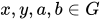
Given a group and a subgroup , and a fixed element , one can consider the corresponding left coset: . Cosets are a natural class of subsets of a group; for example consider the abelian group of integers, with operation defined by the usual addition, and the subgroup of even integers. Then there are exactly two cosets: , which are the even integers, and , which are the odd integers (here we are using additive notation for the binary operation instead of multiplicative notation).


For a general subgroup , it is desirable to define a compatible group operation on the set of all possible cosets, . This is possible exactly when is a normal subgroup, see below. A subgroup of a group is normal if and only if the coset equality holds for all . A normal subgroup of is denoted .
Definition

[edit]

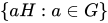
Let be a normal subgroup of a group . Define the set to be the set of all left cosets of in . That is, .

Since the identity element , . Define a binary operation on the set of cosets, , as follows. For each and in , the product of and , , is . This works only because does not depend on the choice of the representatives, and , of each left coset, and . To prove this, suppose and for some . Then

This depends on the fact that is a normal subgroup. It still remains to be shown that this condition is not only sufficient but necessary to define the operation on .

To show that it is necessary, consider that for a subgroup of , we have been given that the operation is well defined. That is, for all and for .

Let and . Since , we have .

Now, and .

Hence is a normal subgroup of .

It can also be checked that this operation on is always associative, has identity element , and the inverse of element can always be represented by . Therefore, the set together with the operation defined by forms a group, the quotient group of by .

Due to the normality of , the left cosets and right cosets of in are the same, and so, could have been defined to be the set of right cosets of in .

Example: Addition modulo 6

[edit]

For example, consider the group with addition modulo 6: . Consider the subgroup , which is normal because is abelian. Then the set of (left) cosets is of size three:

The binary operation defined above makes this set into a group, known as the quotient group, which in this case is isomorphic to the cyclic group of order 3.

Motivation for the name "quotient"

[edit]

The quotient group can be compared to division of integers. When dividing 12 by 3 one obtains the result 4 because one can regroup 12 objects into 4 subcollections of 3 objects. The quotient group is the same idea, although one ends up with a group for a final answer instead of a number because groups have more structure than an arbitrary collection of objects: in the quotient , the group structure is used to form a natural "regrouping". These are the cosets of in . Because we started with a group and normal subgroup, the final quotient contains more information than just the number of cosets (which is what regular division yields), but instead has a group structure itself.

Examples

[edit]

Even and odd integers

[edit]

Consider the group of integers (under addition) and the subgroup consisting of all even integers. This is a normal subgroup, because is abelian. There are only two cosets: the set of even integers and the set of odd integers, and therefore the quotient group is the cyclic group with two elements. This quotient group is isomorphic with the set with addition modulo 2; informally, it is sometimes said that equals the set with addition modulo 2.

Example further explained...

Let be the remainders of when dividing by . Then, when is even and when is odd.
By definition of , the kernel of , , is the set of all even integers.
Let . Then, is a subgroup, because the identity in , which is , is in , the sum of two even integers is even and hence if and are in , is in (closure) and if is even, is also even and so contains its inverses.
Define as for and is the quotient group of left cosets; .
Note that we have defined , is if is odd and if is even.
Thus, is an isomorphism from to .

Remainders of integer division

[edit]

A slight generalization of the last example. Once again consider the group of integers under addition. Let be any positive integer. We will consider the subgroup of consisting of all multiples of . Once again is normal in because is abelian. The cosets are the collection . An integer belongs to the coset , where is the remainder when dividing by . The quotient can be thought of as the group of "remainders" modulo . This is a cyclic group of order .

Complex integer roots of 1

[edit]
The cosets of the fourth roots of unity N in the twelfth roots of unity G.

The twelfth roots of unity, which are points on the complex unit circle, form a multiplicative abelian group , shown on the picture on the right as colored balls with the number at each point giving its complex argument. Consider its subgroup made of the fourth roots of unity, shown as red balls. This normal subgroup splits the group into three cosets, shown in red, green and blue. One can check that the cosets form a group of three elements (the product of a red element with a blue element is blue, the inverse of a blue element is green, etc.). Thus, the quotient group is the group of three colors, which turns out to be the cyclic group with three elements.

Real numbers modulo the integers

[edit]

Consider the group of real numbers under addition, and the subgroup of integers. Each coset of in is a set of the form , where is a real number. Since and are identical sets when the non-integer parts of and are equal, one may impose the restriction without change of meaning. Adding such cosets is done by adding the corresponding real numbers, and subtracting 1 if the result is greater than or equal to 1. The quotient group is isomorphic to the circle group, the group of complex numbers of absolute value 1 under multiplication, or correspondingly, the group of rotations in 2D about the origin, that is, the special orthogonal group . An isomorphism is given by (see Euler's identity).

Matrices of real numbers

[edit]

If is the group of invertible real matrices, and is the subgroup of real matrices with determinant 1, then is normal in (since it is the kernel of the determinant homomorphism). The cosets of are the sets of matrices with a given determinant, and hence is isomorphic to the multiplicative group of non-zero real numbers. The group is known as the special linear group .

Integer modular arithmetic

[edit]

Consider the abelian group (that is, the set with addition modulo 4), and its subgroup . The quotient group is . This is a group with identity element , and group operations such as . Both the subgroup and the quotient group are isomorphic with .

Integer multiplication

[edit]

Consider the multiplicative group . The set of th residues is a multiplicative subgroup isomorphic to . Then is normal in and the factor group has the cosets . The Paillier cryptosystem is based on the conjecture that it is difficult to determine the coset of a random element of without knowing the factorization of .

Properties

[edit]

The quotient group is isomorphic to the trivial group (the group with one element), and is isomorphic to .

The order of , by definition the number of elements, is equal to , the index of in . If is finite, the index is also equal to the order of divided by the order of . The set may be finite, although both and are infinite (for example, ).

There is a "natural" surjective group homomorphism , sending each element of to the coset of to which belongs, that is: . The mapping is sometimes called the canonical projection of onto . Its kernel is .

There is a bijective correspondence between the subgroups of that contain and the subgroups of ; if is a subgroup of containing , then the corresponding subgroup of is . This correspondence holds for normal subgroups of and as well, and is formalized in the lattice theorem.

Several important properties of quotient groups are recorded in the fundamental theorem on homomorphisms and the isomorphism theorems.

If is abelian, nilpotent, solvable, cyclic or finitely generated, then so is .

If is a subgroup in a finite group , and the order of is one half of the order of , then is guaranteed to be a normal subgroup, so exists and is isomorphic to . This result can also be stated as "any subgroup of index 2 is normal", and in this form it applies also to infinite groups. Furthermore, if is the smallest prime number dividing the order of a finite group, , then if has order , must be a normal subgroup of .[3]

Given and a normal subgroup , then is a group extension of by . One could ask whether this extension is trivial or split; in other words, one could ask whether is a direct product or semidirect product of and . This is a special case of the extension problem. An example where the extension is not split is as follows: Let , and , which is isomorphic to . Then is also isomorphic to . But has only the trivial automorphism, so the only semi-direct product of and is the direct product. Since is different from , we conclude that is not a semi-direct product of and .

Quotients of Lie groups

[edit]

If is a Lie group and is a normal and closed (in the topological rather than the algebraic sense of the word) Lie subgroup of , the quotient is also a Lie group. In this case, the original group has the structure of a fiber bundle (specifically, a principal -bundle), with base space and fiber . The dimension of equals .[4]

Note that the condition that is closed is necessary. Indeed, if is not closed then the quotient space is not a T1-space (since there is a coset in the quotient which cannot be separated from the identity by an open set), and thus not a Hausdorff space.

For a non-normal Lie subgroup , the space of left cosets is not a group, but simply a differentiable manifold on which acts. The result is known as a homogeneous space.

See also

[edit]

Notes

[edit]

References

[edit]
Revisions and contributorsEdit on WikipediaRead on Wikipedia
from Grokipedia
In , a quotient group G/NG/N of a group GG by a NN is the set of all left cosets of NN in GG, equipped with the group operation defined by (g1N)(g2N)=(g1g2)N(g_1 N)(g_2 N) = (g_1 g_2) N for g1,g2Gg_1, g_2 \in G. This construction requires NN to be normal in GG, meaning that gNg1=Ng N g^{-1} = N for all gGg \in G, or equivalently, that left and right cosets of NN coincide, ensuring the operation is well-defined and the resulting structure forms a group. The order of the G/NG/N equals the index [G:N][G : N], the number of distinct cosets, which generalizes by relating subgroup sizes to the structure of GG. play a central role in group theory, facilitating the analysis of through the first , which states that for any homomorphism f:GHf: G \to H, G/kerfimfG / \ker f \cong \operatorname{im} f, where kerf\ker f is the kernel and a of GG. Additional , such as the second (for subgroups KK and normal NN, K/(KN)KN/NK / (K \cap N) \cong KN / N) and third (for normal chains NKGN \trianglelefteq K \trianglelefteq G, (G/N)/(K/N)G/K(G/N) / (K/N) \cong G/K), further illustrate how quotients decompose and classify group structures. As a foundational tool in modern , quotient groups enable the study of symmetries and invariants by "factoring out" , with applications extending to fields like and . Every of an is normal, making quotient constructions particularly straightforward in commutative settings, such as the integers modulo nn, which yield cyclic groups essential in .

Fundamentals

Definition

A quotient group, also known as a factor group, is constructed from a group GG and a NN of GG. Specifically, G/NG/N denotes the set of all left of NN in GG, given by {gNgG}\{gN \mid g \in G\}, where each coset gN={gnnN}gN = \{gn \mid n \in N\} partitions the elements of GG. A prerequisite for this construction is that NN must be a of GG, meaning that for all gGg \in G and nNn \in N, the conjugate g1ngNg^{-1}ng \in N. Normality ensures that the set of cosets forms a group under the induced operation defined by (gN)(hN)=(gh)N(gN)(hN) = (gh)N for g,hGg, h \in G. This operation is well-defined, independent of the choice of representatives gg and hh, because NN is normal. The quotient G/NG/N satisfies the group axioms: the is the coset NN itself (corresponding to the identity in GG); the inverse of a coset gNgN is g1Ng^{-1}N; and associativity follows from that in GG. If GG and NN are finite, the order of the quotient group is given by G/N=G/N|G/N| = |G| / |N|, as established by .

Cosets and Normal Subgroups

In group theory, given a group GG and a subgroup NGN \leq G, the left coset of NN generated by an element gGg \in G is the set gN={gnnN}gN = \{gn \mid n \in N\}. Similarly, the right coset is Ng={ngnN}Ng = \{ng \mid n \in N\}. These cosets represent translates of the subgroup NN within GG, and in general, left and right cosets may differ when GG is non-abelian. The collection of all left cosets of NN in GG forms a partition of GG, meaning the cosets are disjoint and their union is GG. The same holds for right cosets. Moreover, every left gNgN and every right NgNg has the same as NN, so gN=N|gN| = |N| and Ng=N|Ng| = |N| for all gGg \in G. This equality follows from the hghh \mapsto gh between NN and gNgN, which preserves the group structure. To endow the set of cosets with a group operation, define multiplication of left cosets by (gN)(hN)=(gh)N(gN)(hN) = (gh)N. For this operation to be well-defined—independent of the choice of representatives gg and hhNN must be a of GG. Specifically, if gN=gNg' N = g N and hN=hNh' N = h N, then g=gn1g' = g n_1 and h=hn2h' = h n_2 for some n1,n2Nn_1, n_2 \in N, so gh=gn1hn2g' h' = g n_1 h n_2. The product (gh)N=g(n1h)n2N(g' h') N = g (n_1 h) n_2 N equals ghNg h N if and only if n1hhNn_1 h \in h N, or equivalently, n1h=hn1n_1 h = h n_1' for some n1Nn_1' \in N. This holds for all such elements precisely when left and right cosets coincide, i.e., when NN is . A subgroup NGN \leq G is normal if and only if every left equals the corresponding right , so gN=NggN = Ng for all gGg \in G. Equivalently, NN is normal if it is invariant under conjugation by elements of GG, meaning gNg1=Ng N g^{-1} = N for all gGg \in G. These criteria ensure the is associative and forms a group. For an illustration of a non-normal subgroup, consider the S3S_3 on three letters and the subgroup H={id,(13)}H = \{\mathrm{id}, (1\,3)\}. To check normality, compute the conjugate (12)H(12)1(1\,2) H (1\,2)^{-1}. Since (12)id(12)=id(1\,2) \cdot \mathrm{id} \cdot (1\,2) = \mathrm{id} and (12)(13)(12)=(23)(1\,2) (1\,3) (1\,2) = (2\,3), the conjugate is {id,(23)}\{\mathrm{id}, (2\,3)\}, which is not contained in HH. Thus, HH is not normal in S3S_3. This failure implies that would not be well-defined for HH.

Motivation and Construction

Origin of the Term "Quotient"

The term "quotient group" was introduced by William Burnside in his seminal 1897 textbook Theory of Groups of Finite Order, marking the first systematic use of the phrase in the context of abstract group theory. Earlier, in 1893, Arthur Cayley had referred to the structure G/H as a "quotient" without fully specifying the term for the group itself. This naming convention emerged in the late 19th century, paralleling Richard Dedekind's earlier introduction of quotient rings in 1871, where he developed the concept to handle factorization in rings of algebraic integers via ideals. Dedekind's work on quotient structures provided a foundational analogy that influenced group theorists, as both constructions involve dividing an algebraic object by a substructure to form a new entity. The choice of "quotient" reflects a direct to division in arithmetic, particularly division. Just as dividing the ℤ by the nℤ yields the ℤ/nℤ of order n, the quotient group G/N of a group G by a N has order |G|/|N| when finite, effectively "dividing out" the size of N to obtain a smaller group that captures the structure of G N. This mirrors how remainders in division classify into equivalence classes, providing an intuitive bridge from elementary to . Conceptually, forming the quotient group "factors out" the N by collapsing its elements to the identity, similar to how group presentations mod out by relations to define new groups. This process simplifies the original group by ignoring internal symmetries imposed by N, allowing focus on the coarser structure. In set-theoretic terms, the arises from identifying elements that differ by elements of N, partitioning G into equivalence classes known as cosets, much like sets in general equivalence relations. This identification preserves the group operation on the cosets, yielding a group that encodes G's behavior up to translation by N.

Homomorphism Theorem Connection

The first isomorphism theorem establishes a fundamental connection between group homomorphisms and quotient groups. Specifically, if ϕ:GH\phi: G \to H is a group homomorphism, then G/ker(ϕ)im(ϕ)G / \ker(\phi) \cong \operatorname{im}(\phi), where ker(ϕ)\ker(\phi) denotes the kernel of ϕ\phi. If ϕ\phi is surjective, this simplifies to G/ker(ϕ)HG / \ker(\phi) \cong H. A key prerequisite is that the kernel ker(ϕ)\ker(\phi) must be a of GG. To see this, let K=ker(ϕ)K = \ker(\phi) and take any gGg \in G, aKa \in K. Then ϕ(gag1)=ϕ(g)ϕ(a)ϕ(g)1=ϕ(g)eϕ(g)1=e\phi(gag^{-1}) = \phi(g) \phi(a) \phi(g)^{-1} = \phi(g) \cdot e \cdot \phi(g)^{-1} = e, where ee is the identity in HH, so gag1Kgag^{-1} \in K. Thus, gKg1KgKg^{-1} \subseteq K for all gGg \in G, confirming normality. The proof of the proceeds by constructing an induced map from the to the . Define ψ:G/Kim(ϕ)\psi: G / K \to \operatorname{im}(\phi) by ψ(gK)=ϕ(g)\psi(gK) = \phi(g). This is well-defined because if gK=gKgK = g'K, then g1gKg'^{-1}g \in K, so ϕ(g1g)=e\phi(g'^{-1}g) = e implies ϕ(g)=ϕ(g)\phi(g') = \phi(g). Moreover, ψ\psi is a since ψ((gK)(hK))=ψ(ghK)=ϕ(gh)=ϕ(g)ϕ(h)=ψ(gK)ψ(hK)\psi((gK)(hK)) = \psi(ghK) = \phi(gh) = \phi(g)\phi(h) = \psi(gK) \psi(hK). It is injective because ψ(gK)=e\psi(gK) = e implies ϕ(g)=e\phi(g) = e, so gKg \in K and gK=KgK = K. Surjectivity follows from the definition of the . Hence, ψ\psi is an . This also explains the construction of quotient groups via projections. For any NGN \trianglelefteq G, the projection π:GG/N\pi: G \to G/N defined by π(g)=gN\pi(g) = gN is a surjective with ker(π)=N\ker(\pi) = N. Applying the first yields G/Nim(π)=G/NG/N \cong \operatorname{im}(\pi) = G/N, which is tautological but confirms the setup. The motivates quotient groups as a universal mechanism for factoring out : any vanishing on NN factors uniquely through the projection GG/NG \to G/N, providing a way to "mod out" by NN.

Basic Examples

Integers Modulo n

The additive group of integers, denoted Z\mathbb{Z}, forms an infinite abelian group under addition, with the subgroup nZn\mathbb{Z} consisting of all integer multiples of a fixed positive integer nn. Since Z\mathbb{Z} is abelian, every subgroup is normal, making nZn\mathbb{Z} a normal subgroup of Z\mathbb{Z}. The cosets of nZn\mathbb{Z} in Z\mathbb{Z} are the sets of the form k+nZk + n\mathbb{Z} for integers k=0,1,,n1k = 0, 1, \dots, n-1, each representing a distinct residue class modulo nn. These cosets partition Z\mathbb{Z} and form the quotient group Z/nZ\mathbb{Z}/n\mathbb{Z}, where the group operation is defined by (a+nZ)+(b+nZ)=(a+b)+nZ(a + n\mathbb{Z}) + (b + n\mathbb{Z}) = (a + b) + n\mathbb{Z}. This operation is well-defined because if aa(modn)a' \equiv a \pmod{n} and bb(modn)b' \equiv b \pmod{n}, then a+ba+b(modn)a' + b' \equiv a + b \pmod{n}. The quotient group Z/nZ\mathbb{Z}/n\mathbb{Z} is isomorphic to the cyclic group Zn\mathbb{Z}_n of order nn, generated by the coset 1+nZ1 + n\mathbb{Z}. For a concrete illustration, consider n=6n = 6. The cosets are:
  • 0+6Z={,12,6,0,6,12,}0 + 6\mathbb{Z} = \{\dots, -12, -6, 0, 6, 12, \dots\},
  • 1+6Z={,11,5,1,7,13,}1 + 6\mathbb{Z} = \{\dots, -11, -5, 1, 7, 13, \dots\},
  • 2+6Z={,10,4,2,8,14,}2 + 6\mathbb{Z} = \{\dots, -10, -4, 2, 8, 14, \dots\},
  • 3+6Z={,9,3,3,9,15,}3 + 6\mathbb{Z} = \{\dots, -9, -3, 3, 9, 15, \dots\},
  • 4+6Z={,8,2,4,10,16,}4 + 6\mathbb{Z} = \{\dots, -8, -2, 4, 10, 16, \dots\},
  • 5+6Z={,7,1,5,11,17,}5 + 6\mathbb{Z} = \{\dots, -7, -1, 5, 11, 17, \dots\}.
Addition in this quotient group corresponds to addition modulo 6; for example, (2+6Z)+(3+6Z)=5+6Z(2 + 6\mathbb{Z}) + (3 + 6\mathbb{Z}) = 5 + 6\mathbb{Z}, since 2+3=55(mod6)2 + 3 = 5 \equiv 5 \pmod{6}. The is 0+6Z0 + 6\mathbb{Z}, and each element has order dividing 6. The group Z/nZ\mathbb{Z}/n\mathbb{Z} has finite order nn, as there are exactly nn distinct cosets.

Even and Odd Integers

The even integers, denoted 2Z={,4,2,0,2,4,}2\mathbb{Z} = \{\dots, -4, -2, 0, 2, 4, \dots\}, form a of the additive group of integers Z\mathbb{Z}. Since Z\mathbb{Z} is abelian, every is , making 2Z2\mathbb{Z} a of Z\mathbb{Z}. The cosets of 2Z2\mathbb{Z} in Z\mathbb{Z} partition the integers into two equivalence classes: the even integers themselves, represented as 2Z2\mathbb{Z}, and the odd integers, represented as 1+2Z={,3,1,1,3,}1 + 2\mathbb{Z} = \{\dots, -3, -1, 1, 3, \dots\}. These cosets form the quotient group Z/2Z\mathbb{Z}/2\mathbb{Z}, where addition is defined by (a+2Z)+(b+2Z)=(a+b)+2Z(a + 2\mathbb{Z}) + (b + 2\mathbb{Z}) = (a + b) + 2\mathbb{Z}. The group operation in Z/2Z\mathbb{Z}/2\mathbb{Z} mirrors parity addition: even plus even yields even (2Z+2Z=2Z2\mathbb{Z} + 2\mathbb{Z} = 2\mathbb{Z}), even plus odd yields odd (2Z+(1+2Z)=1+2Z2\mathbb{Z} + (1 + 2\mathbb{Z}) = 1 + 2\mathbb{Z}), and odd plus odd yields even ((1+2Z)+(1+2Z)=2+2Z=2Z(1 + 2\mathbb{Z}) + (1 + 2\mathbb{Z}) = 2 + 2\mathbb{Z} = 2\mathbb{Z}). This structure is isomorphic to the of order 2, {0,1}\{0, 1\} under modulo 2, where 00 corresponds to evens and 11 to odds. Although Z\mathbb{Z} is infinite, the quotient Z/2Z\mathbb{Z}/2\mathbb{Z} is finite with two elements, demonstrating how quotienting by a normal subgroup can reduce an infinite group to a finite one. This quotient captures parity, which has applications in for error detection via parity bits—ensuring even or odd counts of 1s in to identify transmission errors—and in for analyzing properties like the distribution of primes or solving congruences based on evenness or oddness.

Roots of Unity

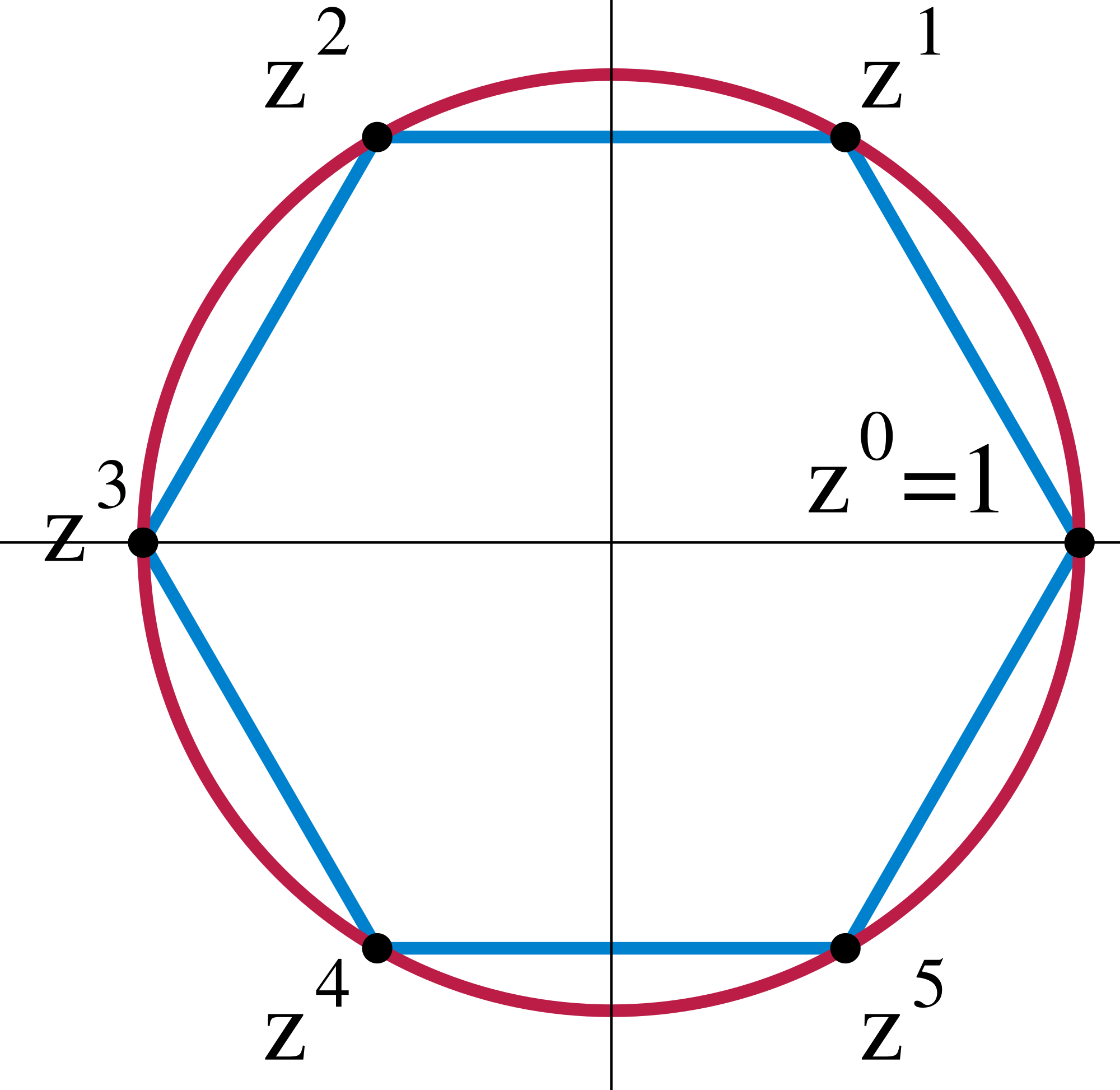
The group of nnth roots of unity, denoted μn={zCzn=1}\mu_n = \{ z \in \mathbb{C} \mid z^n = 1 \}, forms a cyclic subgroup of order nn in the multiplicative group C\mathbb{C}^* of nonzero complex numbers. This subgroup is generated by a primitive nnth root of unity, such as e2πi/ne^{2\pi i / n}, and consists of the points equally spaced on the unit circle in the complex plane. Since C\mathbb{C}^* is abelian, μn\mu_n is a , and the quotient group C/μn\mathbb{C}^*/\mu_n is well-defined under the induced of cosets.

Advanced Examples

Real Numbers Modulo Integers

The quotient group R/Z\mathbb{R}/\mathbb{Z} is constructed from the additive group of real numbers R\mathbb{R} and its Z\mathbb{Z} of s, which is normal since R\mathbb{R} is abelian. The elements of R/Z\mathbb{R}/\mathbb{Z} are the cosets x+Zx + \mathbb{Z} for xRx \in \mathbb{R}, where each coset corresponds to the of real numbers differing by an . These cosets can be represented uniquely by elements in the interval [0,1)[0, 1), identifying numbers that differ by integers. The group operation on R/Z\mathbb{R}/\mathbb{Z} is induced from in R\mathbb{R}: for cosets x+Zx + \mathbb{Z} and y+Zy + \mathbb{Z}, their sum is (x+y)+Z(x + y) + \mathbb{Z}, which is equivalent to (x+ymod1)+Z(x + y \mod 1) + \mathbb{Z} using fractional parts. This makes R/Z\mathbb{R}/\mathbb{Z} , with the 0+Z0 + \mathbb{Z} and inverses given by (x)+Z(-x) + \mathbb{Z}. The group R/Z\mathbb{R}/\mathbb{Z} is isomorphic to the circle group S1={zCz=1}S^1 = \{ z \in \mathbb{C} \mid |z| = 1 \}, the of complex numbers on the unit circle, via the ϕ(x+Z)=e2πix\phi(x + \mathbb{Z}) = e^{2\pi i x}. This isomorphism preserves the group structure, as ϕ((x+y)+Z)=e2πi(x+y)=e2πixe2πiy=ϕ(x+Z)ϕ(y+Z)\phi((x + y) + \mathbb{Z}) = e^{2\pi i (x + y)} = e^{2\pi i x} e^{2\pi i y} = \phi(x + \mathbb{Z}) \phi(y + \mathbb{Z}). Equipped with the quotient topology from the standard topology on R\mathbb{R}, R/Z\mathbb{R}/\mathbb{Z} is homeomorphic to the unit circle S1S^1, forming a compact topological group despite Z\mathbb{Z} being an infinite discrete subgroup of R\mathbb{R}. This compactness arises because the quotient identifies points separated by integers, "wrapping" the real line into a circle. In topology, R/Z\mathbb{R}/\mathbb{Z} serves as a fundamental example of a quotient space and is used to study covering spaces and fundamental groups. In physics and analysis, R/Z\mathbb{R}/\mathbb{Z} models periodic phenomena, such as waves or rotations, where the circle structure captures periodicity with period 1. It underlies on the circle, where periodic functions on [0,1)[0, 1) (extended periodically) decompose into series of exponentials e2πinxe^{2\pi i n x} for nZn \in \mathbb{Z}, facilitating the study of signals and harmonic functions.

Matrix Groups

The general linear group GL(n,R)\mathrm{GL}(n, \mathbb{R}) consists of all invertible n×nn \times n matrices with real entries, and its center ZZ is the subgroup of scalar matrices λI\lambda I where λ0\lambda \neq 0 and II is the identity matrix. This center ZZ is normal in GL(n,R)\mathrm{GL}(n, \mathbb{R}) because it is central, meaning every element commutes with all others in the group, a property that ensures the quotient construction is well-defined. The quotient group GL(n,R)/Z\mathrm{GL}(n, \mathbb{R}) / Z is isomorphic to the projective linear group PGL(n,R)\mathrm{PGL}(n, \mathbb{R}), which acts on projective space by linear transformations modulo scaling. In this quotient, the cosets correspond to equivalence classes of matrices up to nonzero scalar multiplication, so two matrices AA and BB represent the same element if A=λBA = \lambda B for some λ0\lambda \neq 0. The group operation on cosets is induced by matrix multiplication: (AZ)(BZ)=(AB)Z(A Z)(B Z) = (AB) Z, preserving the associative structure of the original group while identifying scaled matrices. This construction highlights the non-abelian nature of PGL(n,R)\mathrm{PGL}(n, \mathbb{R}) for n2n \geq 2, as matrix multiplication is generally non-commutative, and the normality of the center ensures the quotient inherits this property without collapsing to an abelian group. A specific example occurs for n=2n=2, where the projective special linear group PSL(2,R)\mathrm{PSL}(2, \mathbb{R}) is the quotient of the special linear group SL(2,R)\mathrm{SL}(2, \mathbb{R}) (matrices with determinant 1) by its center {±I}\{\pm I\}. This group PSL(2,R)\mathrm{PSL}(2, \mathbb{R}) acts via Möbius transformations on the upper half-plane, preserving the hyperbolic metric and playing a key role in the study of Fuchsian groups and modular forms.

Symmetric Groups

The symmetric group SnS_n consists of all permutations of nn elements, forming a group under composition with order n!n!. The alternating group AnA_n is the subgroup of even permutations in SnS_n, which is normal and has index 2, hence order n!/2n!/2. This normality follows from the fact that conjugation preserves the parity of permutations. The quotient group Sn/AnS_n / A_n is isomorphic to the Z/2Z\mathbb{Z}/2\mathbb{Z}, established via the homomorphism sgn:SnZ/2Z\operatorname{sgn}: S_n \to \mathbb{Z}/2\mathbb{Z}, which maps even permutations to the identity and odd permutations to the generator of order 2. The kernel of this is precisely AnA_n, and by the first isomorphism theorem, the is Z/2Z\mathbb{Z}/2\mathbb{Z}. The two cosets are AnA_n itself (the even permutations) and the coset τAn\tau A_n for any odd permutation τ\tau, such as a transposition. For n=3n=3, S3S_3 has order 6, and A3A_3 is the cyclic subgroup of order 3 generated by the 3-cycle (123)(1\,2\,3). The S3/A3S_3 / A_3 is thus isomorphic to Z/2Z\mathbb{Z}/2\mathbb{Z}, with the non-trivial consisting of the three transpositions. This structure has key applications: the sign homomorphism detects the parity of , distinguishing even and odd elements and aiding in the classification of permutation representations. Moreover, for n4n \leq 4, the symmetric groups SnS_n are solvable, as they admit with abelian factors, including the quotient by AnA_n; this contrasts with SnS_n for n5n \geq 5, which are non-solvable.

Properties

Universal Property

The universal property of a quotient group characterizes it as the "freest" construction that factors out a . Specifically, let GG be a group and NGN \trianglelefteq G a . Let π:GG/N\pi: G \to G/N be the canonical projection sending ggNg \mapsto gN. Then, for any group HH and any ϕ:GH\phi: G \to H such that NkerϕN \subseteq \ker \phi, there exists a unique ϕ:G/NH\overline{\phi}: G/N \to H such that ϕ=ϕπ\phi = \overline{\phi} \circ \pi. To see this, define ϕ(gN)=ϕ(g)\overline{\phi}(gN) = \phi(g). This is well-defined because if gN=gNgN = g'N, then g1gNkerϕg'^{-1}g \in N \subseteq \ker \phi, so ϕ(g)=ϕ(g)\phi(g') = \phi(g). Moreover, ϕ\overline{\phi} preserves the group operation: ϕ((gN)(gN))=ϕ(ggN)=ϕ(gg)=ϕ(g)ϕ(g)=ϕ(gN)ϕ(gN)\overline{\phi}((gN)(g'N)) = \overline{\phi}(gg'N) = \phi(gg') = \phi(g)\phi(g') = \overline{\phi}(gN) \overline{\phi}(g'N). Finally, uniqueness follows since π\pi is surjective, so ϕ\overline{\phi} is determined on all cosets by its values on generators via ϕ\phi. In categorical terms, G/NG/N together with π\pi is the initial object in the category whose objects are pairs (K,ψ)(K, \psi) where KK is a group and ψ:GK\psi: G \to K is a with NkerψN \subseteq \ker \psi, and whose morphisms are homomorphisms commuting with the maps from GG. This means that for any other such pair (K,ψ)(K, \psi), there is a unique G/NKG/N \to K making the commute. This property implies that the quotient G/NG/N is unique up to unique : if QQ is another group with a surjective ρ:GQ\rho: G \to Q such that N=kerρN = \ker \rho, then there is a unique ι:G/NQ\iota: G/N \to Q with ρ=ιπ\rho = \iota \circ \pi. Thus, quotients provide a way to classify homomorphic images subgroups.

Isomorphism Theorems

The second theorem states that if GG is a group, HH is a of GG, and KK is a of GG, then HKHK is a of GG with KK in HKHK, HKH \cap K is in HH, and there is a natural HK/KH/(HK)HK / K \cong H / (H \cap K) given by hKh(HK)hK \mapsto h(H \cap K) for hHh \in H. To prove this, note that the map ϕ:HHK/K\phi: H \to HK/K defined by ϕ(h)=hK\phi(h) = hK is a surjective because for any hkK=hKhkK = hK with hHh \in H, kKk \in K, and the kernel of ϕ\phi is precisely HKH \cap K, so the first yields the desired result. The third states that if GG is a group, KK is a of GG, and NN is a of GG contained in KK, then K/NK/N is normal in G/NG/N, and there is a natural (G/N)/(K/N)G/K(G/N)/(K/N) \cong G/K given by gN(K/N)gKgN \cdot (K/N) \mapsto gK for gGg \in G. The proof proceeds by defining the map ψ:G/NG/K\psi: G/N \to G/K via ψ(gN)=gK\psi(gN) = gK, which is a well-defined surjective homomorphism with kernel K/NK/N, and thus the first isomorphism theorem applies. These theorems facilitate simplifying the structure of subgroups within quotient groups; for instance, the second isomorphism theorem identifies the projective special linear group PSL2(C)\mathrm{PSL}_2(\mathbb{C}) as isomorphic to SL2(C)/{±I2}\mathrm{SL}_2(\mathbb{C})/\{\pm I_2\} via the relation GL2(C)/C×I2SL2(C)/{±I2}\mathrm{GL}_2(\mathbb{C})/\mathbb{C}^\times I_2 \cong \mathrm{SL}_2(\mathbb{C})/\{\pm I_2\}, where C×I2\mathbb{C}^\times I_2 is the center. Similarly, the third theorem shows that for integers nn dividing mm, (Z/mZ)/(nZ/mZ)Z/nZ(\mathbb{Z}/m\mathbb{Z}) / (n\mathbb{Z}/m\mathbb{Z}) \cong \mathbb{Z}/n\mathbb{Z}, aiding computations of successive quotients.

Exact Sequences

In group theory, quotient groups arise naturally in the context of short exact sequences, which provide a framework for understanding extensions and homomorphisms between groups. A short exact sequence of groups is a sequence 1NiGπQ11 \to N \xrightarrow{i} G \xrightarrow{\pi} Q \to 1
Add your contribution
Related Hubs
User Avatar
No comments yet.