


Community hub
Recent from talks
Contribute something
Nothing was collected or created yet.
Crest (heraldry)
View on Wikipedia
| Part of a series on |
| Heraldic achievement |
|---|
| External devices in addition to the central coat of arms |
 Heraldry portal Heraldry portal |


A crest is a component of a heraldic display, consisting of the device borne on top of the helm. Originating in the decorative sculptures worn by knights in tournaments and, to a lesser extent, battles, crests became solely pictorial after the 16th century (the era referred to by heraldists as that of "paper heraldry").
A normal heraldic achievement consists of the shield, above which is set the helm, on which sits the crest, its base encircled by a circlet of twisted cloth known as a torse. The use of the crest and torse independently from the rest of the achievement, a practice which became common in the era of paper heraldry, has led the term "crest" to be frequently but erroneously used to refer to the arms displayed on the shield, or to the achievement as a whole.
Origin
[edit]
The word "crest" derives from the Latin crista, meaning "tuft" or "plume", perhaps related to crinis, "hair".[1] Crests had existed in various forms since ancient times: Roman officers wore fans of feathers or horsehair, which were placed longitudinally or transversely depending on the wearer's rank,[2] and Viking helmets were often adorned with wings and animal heads.[3] They first appeared in a heraldic context in the form of the metal fans worn by knights in the 12th and 13th centuries. These were primarily decorative, but may also have served a practical purpose by lessening or deflecting the blows of opponents' weapons (perhaps why their edges came to be serrated).[4] These fans were generally of one colour, later evolving to repeat all or part of the arms displayed on the shield.
The fan crest was later developed by cutting out the figure displayed on it, to form a metal outline; this evolved in the late 13th and early 14th centuries into a three-dimensional sculpture.[5] These were usually made of cloth, leather or paper over a wooden or wire framework,[6] and were typically in the form of an animal; also popular were wings, horns, human figures, and panaches of feathers. These were probably worn only in tournaments, not battle: not only did they add to the already considerable weight of the helm, they could also have been used by opponents as a handle to pull the wearer's head down.[7]
Laces, straps, or rivets were used to affix the crest to the helm,[8] with the join being covered by a circlet of twisted cloth known as a torse or wreath, or by a coronet in the case of high-ranking nobles.[9] Torses did not come into regular use in Britain until the 15th century,[10] and are still uncommon on the Continent, where crests are usually depicted as continuing into the mantling.[11] Crests were also sometimes mounted on a furred cap known as a chapeau, as in the royal crest of England.
Later development
[edit]By the 16th century, the age of tournaments had ended, and physical crests largely disappeared. Their illustrated equivalents consequently began to be treated as simply two-dimensional pictures. Many crests from this period are physically impossible to bear on a helm, e.g. the crest granted to Sir Francis Drake in 1581, which consisted of a disembodied hand issuing from clouds and leading a ship around the globe (representing God's guidance).[12]
In the same period, different helms began to be used for different ranks: sovereigns' and knights' helms faced forwards (affronté), whereas those of peers and gentlemen faced to the right (dexter). In the medieval period crests would always have faced the same way as the helm, but as a result of these rules, the directions of the crest and the helm might be at variance: a knight whose crest was a lion statant, would have the lion depicted as looking over the side of the helm, rather than towards the viewer.[13] Torses also suffered artistically, being treated not as silken circlets, but as horizontal bars.
Heraldry in general underwent something of a renaissance in the late 19th and early 20th centuries, and many of the illogicalities of previous centuries were discarded. Crests are now generally not granted unless they could actually be used on a physical helm,[14] and the rules about directions of helms are no longer rigidly observed.
Usage
[edit]
The use of crests was once restricted to those of 'tournament rank', i.e. knights and above,[8] but in modern times nearly all personal arms include crests.[14] They are not generally used by women (with the exception of reigning queens) and clergymen, as they did not participate in war or tournaments and thus would not have helms on which to wear them. Some heraldists are also of the opinion that crests, as personal devices, are not suited for use by corporate bodies, but this is not widely observed.[14]
In continental Europe, particularly Germany, crests have a far greater significance than in Britain, and it is common for one person to display multiple crests with his arms; certain high-ranking noblemen are entitled to as many as seventeen.[15] This practice did not exist in Britain until the modern era, and arms with more than one crest are still rare. In contrast to Continental practice, where a crest is never detached from its helm, a Briton with more than one crest may choose to display only one crested helm, and have the other crests simply floating in space.[16] Though usually adopted through marriage to an heiress, examples exist of secondary crests being granted as augmentations: after defeating the Americans at the Battle of Bladensburg, Robert Ross was granted, in addition to his original crest, the crest of an arm holding the US flag with a broken flagstaff.[17]

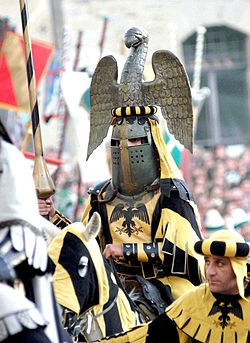
_(14597248368).jpg)
After the 16th century, it became common for armigers to detach the crest and wreath from the helm, and use them in the manner of a badge, displayed on crockery, carriage doors, stationery, etc. This led to the erroneous use of the term "crest" to mean "arms", which has become widespread in recent years. In Scotland, a member of a clan or house is entitled to use a prescribed form of crest badge, which consists of the chief's crest encircled by a strap and buckle inscribed with the chiefly motto.[18] Unlike such a badge, which can be used by any number of relatives and retainers, the crest itself is personal to the armiger, and its use by others is considered usurpation.
It is widely observed in English heraldry that no two families may use the same crest. This is in contrast to Scottish practice, in which crests are less significant, and are often borne in the same form by unrelated people. As a result of this lack of need for differentiation, Scottish crests tend to be less ornamental than their English counterparts.[19] Marks of cadency are generally not used with crests, though it is not incorrect to do so, and the British royal family continue this practice.[20]
The usual torse around the crest is frequently replaced by some kind of coronet, known as a "crest-coronet". The standard form is a simplified ducal coronet, consisting of three fleurons on a golden circlet; these are not, however, indications of rank, though they are not generally granted nowadays except in special circumstances.[21] In some modern examples, the crest features both a crest-coronet and a torse,[21] though this practice is deprecated by purists.
Orders of chivalry
[edit]Perhaps the only places physical crests are still seen are the chapels of Britain's orders of chivalry: the Order of the Garter's St George's Chapel, the Order of the Thistle's Thistle Chapel, and the Order of the Bath's Henry VII Chapel. Within each chapel are rows of stalls for use by the knights; above these stalls are placed each knight's sword and crested helm. These are carved out of lime wood and painted and gilded by Ian Brennan, the official sculptor to the royal household.[22]
See also
[edit]References
[edit]Footnotes
[edit]- ^ Harper, Douglas. "Crest". Online Etymology Dictionary.
- ^ Dickson, Iain. "Legionary Helmets of the Roman Period". Illustrated History of the Roman Empire. Archived from the original on 2015-09-14. Retrieved 2015-07-21.
- ^ Barron 1911, p. 314
- ^ Fox-Davies 1909, p. 327
- ^ Scott-Giles 1954, pp. 150–1
- ^ Eve 1907, p. 126
- ^ Eve 1907, p. 120
- ^ a b Fox-Davies 1909, p. 336
- ^ Scott-Giles 1954, p. 154
- ^ Barron 1911, p. 315
- ^ Fox-Davies 1909, p. 385
- ^ Drake, Charles. "The Arms of Sir Francis Drake". A Genealogical and Heraldic Memorial of the Ancient Gentle Family of Drake of Drakenage. Archived from the original on 2012-05-19.
- ^ Fox-Davies 1909, p. 321
- ^ a b c Scott-Giles 1954, p. 161
- ^ Fox-Davies 1909, p. 343
- ^ Fox-Davies 1909, pp. 322–3
- ^ "Battle of Bladensburg". The Man Who Captured Washington: Major General Robert Ross. Archived from the original on 2016-03-11. Retrieved 2015-07-21.
- ^ "Crests". Court of the Lord Lyon.
- ^ Fox-Davies 1909, p. 419
- ^ Scott-Giles 1954, p. 160
- ^ a b Scott-Giles 1954, pp. 154–5
- ^ Brennan, Ian. "Creating a crest/arms". Contemporary Sculptor.
Sources
[edit]- Barron, Oswald (1911). . In Chisholm, Hugh (ed.). Encyclopædia Britannica. Vol. 13 (11th ed.). Cambridge University Press. pp. 311–330.
- Eve, George (1907). Heraldry as Art: an Account of its Development and Practice, Chiefly in England. London: B. T. Batsford.
- Fox-Davies, Arthur (1909). A Complete Guide to Heraldry. London: T. C. & E. C. Jack.
- Scott-Giles, Charles (1954). Boutell's Heraldry. London: Frederick Warne and Co. Ltd.
External links
[edit]
| Types | |||||||||||||||
|---|---|---|---|---|---|---|---|---|---|---|---|---|---|---|---|
| Topics | |||||||||||||||
| Achievement | |||||||||||||||
| Charges | |||||||||||||||
| Tinctures |
| ||||||||||||||
| Applications | |||||||||||||||
| Related | |||||||||||||||
| |||||||||||||||


Crest (heraldry)
View on GrokipediaDefinition and Components
Definition
The term crest originates from the Latin word crista, denoting a tuft, plume, or comb, which entered English via Old French creste in the late 13th century.[4] In heraldry, a crest is defined as a specific component of a full achievement of arms: a three-dimensional figure or charge, such as an animal, bird, or other emblem, positioned atop the helmet.[1] It is typically affixed to the helm via a wreath or torse, distinguishing it as a sculptural element rather than a flat design.[1] The crest functions primarily as an identifier for its bearer, evolving from a practical adornment on helmets to facilitate recognition in battle or tournaments—where visors obscured faces—to a symbolic device in modern heraldry that conveys personal or familial distinction.[5][2] Unlike the full coat of arms, which centers on the emblazoned shield bearing the primary charges and tinctures, the crest represents only the uppermost element of the complete heraldic composition and does not encompass the escutcheon itself.[1] This distinction underscores that while the crest enhances the overall achievement, it is not synonymous with the armorial bearings as a whole.[1]Components
The components of a heraldic crest encompass the structural and decorative elements that secure and adorn it atop the helmet in armorial achievements. These include the torse, mantling, and coronet, each serving both functional and aesthetic purposes in traditional depictions.[6][7] The torse, also known as the wreath, is a cloth-wrapped band positioned between the helmet and the crest to conceal their junction and provide secure attachment. Introduced into regular use in 15th-century British heraldry, it consists of a twisted roll of fabric, typically featuring six visible folds alternating between the principal metal and color of the bearer's arms, with the metal appearing on the dexter side.[6][8][9] Mantling drapes from the sides and rear of the helmet, flowing downward in stylized folds to frame the achievement. This decorative element, originally a practical cloth covering to shield the wearer from sunlight and rain, is rendered in two tinctures matching the arms—usually the principal color on the exterior and the metal as lining—with edges often cut into jagged or scalloped patterns to evoke protective fabric remnants.[6][10] A coronet or crest coronet may replace the torse as the base for the crest, particularly in achievements of peers or specific jurisdictional traditions. This diminutive crown reflects the bearer's rank, such as a ducal coronet with eight strawberry leaves for dukes or an earl's with alternating pearls and strawberry leaves, and is depicted issuing the crest directly from its rim.[11] The crest itself is invariably mounted upon the helmet, whose form and orientation denote the bearer's social rank in British heraldry. For instance, helmets for nobility are typically gold and shown affronté with bars or an open visor, while those for knights are steel and affronté with an open visor, and esquires use steel helmets in profile that are closed.[12][13]History
Origins
The origins of crests in heraldry trace back to ancient precursors that served practical purposes on helmets, predating the formalized system of armorial bearings. In ancient Rome, the crista—a transverse plume or fan of feathers or horsehair mounted on helmets—distinguished officers like centurions from common soldiers, enhancing visibility and command authority on the battlefield.[14] Crests were adopted in medieval Europe during the 12th and 13th centuries, primarily by knights in tournaments, where they evolved from simple plumes or metal fans into identifiers for visibility amid the chaos of mounted combat. These early crests, often shaped like fans or wreaths, allowed spectators and opponents to recognize participants from a distance, aligning with the growing need for personal distinction as enclosed helmets obscured faces.[15] Earliest regular use appears in German tournament gear of the 13th century, spreading across Europe as heraldry developed.[16] By the late 13th and early 14th centuries, crests transitioned from flat or linear forms to more elaborate three-dimensional sculptures, constructed from lightweight materials such as cloth, leather, or molded paper (gesso) to balance weight on the helm while maintaining grandeur. These were affixed using laces, straps, or rivets, often secured through slots or wreaths at the helmet's crown, enabling complex shapes like animals or fans without compromising mobility.[16] A notable example is depicted in the Luttrell Psalter (c. 1330), where Sir Geoffrey Luttrell's fan-shaped crests, emblazoned with his arms, adorn both his helmet and horse's head, illustrating their role in equestrian display.[17] This practical evolution laid the groundwork for crests' later symbolic significance in heraldry.Later Development
By the 16th century, the decline of tournaments across Europe marked a pivotal shift in the role of heraldic crests, transforming them from practical, three-dimensional helmet ornaments worn in combat into primarily artistic and symbolic elements represented in two-dimensional illustrations. As jousting and melee events waned in popularity and military significance, physical crests—once constructed from lightweight materials like boiled leather, wood, or cloth to withstand impacts—largely fell out of use, giving way to stylized depictions on seals, monuments, brasses, and armorial bearings that emphasized heraldic tradition over functionality.[7][18] This evolution reflected broader changes in warfare and society, where heraldry transitioned from battlefield utility to a pictorial art form governed by design conventions.[7] A notable example of this artistic adaptation is the crest granted to Sir Francis Drake in 1581 by Clarenceux King of Arms Robert Cooke, following his circumnavigation of the globe. The crest depicts a hand—symbolizing divine guidance—drawing a ship (representing the Golden Hind) around a terrestrial globe with golden hawsers, accompanied by the motto Auxilio Divino ("By God's help"). This elaborate, symbolic design, rendered in two dimensions for engravings and portraits, underscored the crest's new role as a commemorative emblem of personal achievement rather than a tournament accessory.[19] The 19th and 20th centuries saw revivals that renewed interest in both practical and elaborate crest designs, particularly during the Victorian era, when Romanticism and the Gothic Revival spurred a resurgence of heraldic decoration in architecture, stationery, and personal insignia. Influenced by antiquarian enthusiasm, Victorians often adopted flamboyant, realistic crests and supporters that stretched traditional blazonry, as seen in grants to newly ennobled industrialists like William Armstrong in 1887; by the mid-century, a counter-movement favored simpler, historically accurate forms to preserve heraldic integrity.[20][21] This period's innovations extended into the early 20th century, blending elaborate symbolism with modern applications while maintaining the crest's status as a mark of lineage and honor. Parallel to these artistic developments, crests were increasingly incorporated as augmentations of honor—additional elements added to existing arms to commemorate military or civic achievements. A prominent instance is the 1814 augmentation granted to the family of Major General Robert Ross after his victory at the Battle of Bladensburg during the War of 1812. By royal license dated August 25, 1814, and exemplified in the College of Arms on April 26, 1816, the Ross arms received a second crest: a mural crown or, from which issues a dexter arm grasping a broken staff bearing the colors of the United States, symbolizing the captured American flag. This addition, along with changes to the escutcheon and the motto Bladensberg, elevated the crest as a perpetual emblem of valor, influencing subsequent heraldic practices.[22]Symbolism and Design
Symbolism
In heraldry, the symbolism of crests draws from medieval traditions where motifs convey virtues, status, or personal qualities, often rooted in classical, biblical, or chivalric associations. These symbols, placed atop the helmet, emphasize the bearer's character or lineage, with animals typically representing martial prowess, objects denoting achievement or faith, plants and abstracts evoking renewal or emotion, and colors amplifying thematic depth. Interpretations vary slightly across regions but adhere to established conventions in armorial design. Animal motifs in crests frequently symbolize strength and nobility, reflecting the bearer's valor in battle or leadership. The eagle, often depicted displayed with wings spread, embodies imperial power and strength, tracing its origins to Roman legions where it signified dominion and vigilance.[7][23] The lion, commonly shown rampant or guardant, represents bravery and nobility, evoking the courage of kings and knights as a heraldic staple for royal or aristocratic lines.[7] The bear, portrayed passant or salient, denotes physical strength and familial protection, highlighting resilience and guardianship over kin.[24] Object symbols in crests often allude to personal milestones or spiritual convictions. The crescent, curved and oriented toward the chief, signifies hope for future glory and serves as a cadency mark for the second son, distinguishing branches of a family.[25] The crown, placed as a charge or coronet, symbolizes victory and sovereignty, denoting regal authority or triumph in service.[7] The cross, in forms like the potent or flory, represents Christian faith or pivotal experiences of devotion, underscoring piety and redemption.[7][23] Plant and abstract symbols evoke themes of growth, emotion, and renewal in crests. The quatrefoil, a four-lobed floral form slipped or slipped and leaved, often symbolizes luck and faith, representing the four-leaf clover or the four evangelists in Christian tradition.[26] The heart, shown proper or enflamed, stands for love and sincerity, portraying heartfelt loyalty and truthful intent.[27][28] Color symbolism in crests enhances the motifs' interpretive layers, with tinctures chosen to reinforce virtues. Red (gules), used for fields or detailing, conveys joy and a warrior spirit, embodying military fortitude and bold magnanimity.[29] Gold (or), rendered as yellow, signifies generosity and elevation of the mind, denoting noble aspiration and enlightenment.[29]Design Principles
In heraldry, the design of a crest follows strict conventions to ensure clarity, identifiability, and artistic consistency, primarily governed by the formal language of blazoning. Blazoning provides a precise textual description of the crest, beginning with the supporting elements such as the helmet, mantling, and wreath before detailing the crest itself. For instance, a typical blazon might read: "Upon a helmet mantled gules doubled argent, set on a wreath of the colors, a dexter arm embowed fesswise, the hand apaumy proper, vested or, cuffed gules, and charged on the sleeve with a crescent sable."[30] This structured description allows heraldic artists to recreate the crest accurately without ambiguity, emphasizing the sequence from foundational supports to the principal charge.[6] The rule of tincture, a foundational principle in heraldic design, extends to crests to maintain visual contrast and legibility. This rule prohibits placing a color (such as gules or azure) upon another color or a metal (or and argent) upon another metal, though exceptions apply to furs and charges depicted in their natural colors (proper). In crests, this applies particularly to the mantling and wreath: the mantling's outer tincture is typically a color matching the shield's principal color, lined with a metal, while the wreath alternates six folds starting with the principal metal on the dexter side followed by the principal color.[26][30] Adherence to these tincture guidelines ensures the crest remains distinguishable even when rendered in monochrome or at a distance, preserving its role in identification.[6] Position and orientation in crest design prioritize a dynamic yet standardized appearance, with charges typically facing dexter (to the viewer's left, the bearer's right) by default to align with heraldic convention. Crests are rendered in three dimensions atop the helmet, allowing for attitudes such as rampant for beasts or embowed for arms, with specific terms like "cubit" for a forearm bent at the elbow or "apaumy" for a hand shown palm-forward.[26] The helmet's orientation—often in profile facing dexter—supports the crest's artistic balance, while objects like swords or arrows are described with their points upward unless otherwise specified.[30] This three-dimensional depiction contrasts with flatter shield designs, emphasizing elevation and motion in illustrations.[6] Unlike charges on a shield, which form a two-dimensional composition bound to the field's layout, crests operate independently and may repeat, modify, or introduce entirely new elements not present on the arms, often adopting more vigorous or exaggerated forms to suit their elevated position. For example, a lion rampant on the shield might appear as a demi-lion issuant from a coronet in the crest, enhancing dynamism without strict adherence to the shield's tinctures or arrangement.[26] This flexibility allows crests to serve as personal embellishments while maintaining heraldic coherence through blazon and tincture rules.[30]Usage
Personal Heraldry
In personal heraldry, crests form an integral part of the armorial achievement for knights and nobility, serving as distinctive emblems atop the helmet to identify the bearer in battle or tournament. Traditionally restricted to males of sufficient rank, such as knights and peers, crests were granted alongside coats of arms to signify lineage and martial status, evolving from practical helmet adornments in the medieval period.[31][7] Women were historically excluded from bearing crests, as they were considered a male attribute, with female arms instead displayed on lozenges or ovals without this supernal element, even for high-ranking peers.[31] Clergy below episcopal rank could employ crests in their achievements, though some religious orders prohibited or discouraged their use to align with vows of simplicity.[7][26] Regional variations in crest usage highlight differences in heraldic practice across Europe. In British heraldry, a single crest is standard, often employed independently to represent the family or individual. In contrast, German and continental heraldry frequently features multiple crests—sometimes several on separate helmets arrayed above the shield—repeating charges from the arms to emphasize lineage branches or alliances.[32][7] From the post-16th century onward, crests began appearing as standalone badges, detached from the full achievement for personal adornment and identification. In Scotland, clan crest badges emerged as silver or white metal emblems, worn by clansmen on belts or bonnets to denote allegiance to a chief, often incorporating the family crest encircled by a strap and buckle bearing the motto.[33][34] Crests could be modified through augmentations of honor, where sovereign-granted additions—such as royal badges or symbolic elements—commemorated notable achievements, sometimes violating tincture rules for emphasis. Cadency marks further adapted crests for heirs, distinguishing sons with devices like labels for the eldest or crescents for the second, ensuring unique identification within the family line.[35][31][7]Orders of Chivalry
In knightly orders of chivalry, crests form an integral part of the heraldic achievements displayed to honor members, distinguishing them from purely personal heraldry by their placement in communal ceremonial spaces and their association with the order's prestige. Unlike individual family crests used in everyday armorial bearings, those in orders often emphasize the knight's rank and tenure within the institution, remaining on view for the member's lifetime or longer. These displays serve both symbolic and architectural functions, reinforcing the order's traditions during rituals and in dedicated chapels.[36] Physical representations of crests are prominently featured in order chapels, where they are carved and installed above members' stalls as enduring memorials. In the Order of the Garter, founded in 1348, crests are crafted from lime wood, painted, and gilded before being positioned atop helmets in St. George's Chapel at Windsor Castle; for instance, the crest for HRH Prince William—a royal lion crest featuring a label with a red escallop in the center—was installed in 2008, while those for HRH Prince Andrew and HRH Prince Edward featured royal lions with labels bearing an anchor and a Tudor rose respectively, added in 2006. Similarly, in the Most Honourable Order of the Bath, established in 1725, crests along with banners and mantling adorn stalls in Henry VII Chapel at Westminster Abbey, with sculptor Ian G. Brennan creating over 60 such pieces from lime wood since 1989 for both orders. These installations, often up to 20 inches tall and incorporating personal symbols chosen by the honoree, have been a tradition for over six centuries in the Garter and since the order's chapel allocations in the Bath.[37][38][39][40] Symbolically, crests in orders of chivalry are integrated into members' insignia, such as badges and collars, to blend personal heraldry with the order's collective identity, though they remain distinct from the order's core emblems like the Garter's blue ribbon or the Bath's three crowns. Members wear collars—ornate chains of gold and enamel—during ceremonies, with their personal crests sometimes referenced in the full achievement accompanying the insignia to denote rank. For example, in investitures, knights of the Garter don the collar featuring gold knots and white enamel garters, while their crests crown the helmets in the displayed arms, symbolizing both individual valor and fraternal bond. This integration underscores the crest's role in elevating the knight's status within the order's hierarchy.[40][41] Historical examples illustrate crests' ceremonial prominence in order halls and during investitures, where they are unveiled as part of the knightly achievement to mark induction. At St. George's Chapel, crests have been displayed above stalls since the 14th century, with notable installations during Garter investitures in Windsor Castle's Throne Room, such as those for foreign royals like Haakon VII of Norway in 1906. In the Order of the Bath, crests were similarly erected in Westminster Abbey's chapel following the order's revivals, as seen in the stalls allocated to Knights Grand Cross since the 18th century. These standardized yet personalized designs—often collective in their placement to represent the order's unity—differentiate from private heraldry by their institutional permanence and ritual unveiling.[42][43]Modern Applications
In contemporary contexts, heraldic crests have been adapted for commercial branding, appearing in logos, seals, and stamps for companies, sports teams, and universities to evoke tradition, strength, and identity. For instance, many universities incorporate crest-like designs featuring shields and symbolic charges to represent institutional heritage, such as Yale University's shield with Hebrew text symbolizing light and truth.[44] Similarly, sports teams often use crest-inspired emblems, like the heraldic-style badges of European football clubs that include animals or shields to signify team spirit and regional pride.[45] These designs draw on heraldic principles for visual impact, with eagles frequently employed to symbolize power and vigilance in corporate identities.[46] Heraldic crests also feature prominently in personal items, enhancing everyday objects with familial or individual significance. They are engraved on jewelry such as signet rings, brooches, and pendants, as well as incorporated into stationery, bookplates, and flags for personal correspondence and identification.[47] In home decor, crests appear on glassware, cutlery, and house plaques, allowing individuals to display heritage without formal armigerous status.[47] This usage extends to clothing accessories, like belt buckles or bonnet crests in traditional attire, blending historical symbolism with modern personalization.[47] Institutional revivals have seen crests reintegrated into national and civic emblems, particularly in post-communist states seeking to reclaim pre-Soviet identities. Russia, for example, adopted its current coat of arms featuring a double-headed eagle crest on November 30, 1993, via presidential decree, restoring a symbol of imperial continuity after decades of communist iconography.[48] In the United States, civic heraldry guidelines encourage municipalities, counties, and educational institutions to create original crests following traditional rules, such as the rule of tincture, for use on official documents and seals, with mural crowns denoting civic authority.[26] Digital and media applications of crests incorporate contemporary symbols to reflect modern values, expanding beyond historical charges. Lighthouses, symbolizing guidance and safety, and gears, representing industry and collaboration, have become common in new designs for organizations focused on navigation, technology, or teamwork.[49] These elements appear in online branding, app icons, and multimedia emblems, maintaining heraldic structure while adapting to digital formats for broader accessibility.[49]References
- https://en.wikisource.org/wiki/A_Complete_Guide_to_Heraldry/Chapter_25
- https://en.wikisource.org/wiki/A_Complete_Guide_to_Heraldry/Chapter_20
- https://en.wikisource.org/wiki/A_Complete_Guide_to_Heraldry/Chapter_19