Hubbry Logo
Faroe IslandersFaroe IslandersMain
Open search
Faroe Islanders
Community hub
Faroe Islanders
logo
8 pages, 0 posts
0 subscribers
Be the first to start a discussion here.
Faroe Islanders
Faroe Islanders
from Wikipedia

Faroese people or Faroe Islanders (Faroese: føroyingar; Danish: færinger) are an ethnic group native to the Faroe Islands.[4] The Faroese are of mixed Norse and Gaelic origins.[5] About 21,000 Faroese live in neighbouring countries, particularly in Denmark, Iceland and Norway. Most Faroese are citizens of the Kingdom of Denmark, in which the Faroe Islands are a constituent nation. The Faroese language is one of the North Germanic languages and is closely related to Icelandic and to western Norwegian varieties.

Key Information

Origins

[edit]
Elderly Faroese couple in the 1940s, wearing their traditional 'Sunday dress' for Church
Three Faroese women wearing traditional regalia. The student caps identify them as newly graduated.
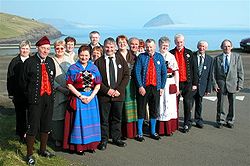
Faroese politicians, priests and choir in front of the Løgting (Parliament), Ólavsøka 2012

The first known settlers of the Faroe Islands were Gaelic hermits and monks who arrived in the 6th century.[6]

The Norse-Gaels started going to the island in the ninth century; they brought Norse culture and language to the islands with them. Little is known about this period, thus giving room for speculation. A single source mentions early settlement, the Icelandic Færeyinga saga. It was written sometime around 1200 and explains events taking place approximately 300 years prior. According to the saga, many Norsemen objected to the Norwegian king, Harald Fairhair's unification politics and thus fled to other countries, including the newfound places in the west.[7]

Historians have understood since the time of the Færeyinga saga that the Viking Grímur Kamban was the first settler in the Faroes. The Norwegians must have known about the isles before leaving Norway. If Grímur Kamban had settled sometime earlier, this could explain the Norwegians' knowledge of them. Another, more logical explanation might be that the Gaels of Scotland and Ireland told the Norwegians of the islands.[citation needed]

While Grímur is an Old Norse first name, Kamban indicates a Celtic origin. Thus, he could have been a man from Ireland, Scotland or Isle of Man, where the Vikings already had settlements. Some place names from the oldest settlements on the Faroes suggest that some of the settlers perhaps came from the Scottish islands and the British coast.

Y chromosomes, tracing male descent, are 87% Scandinavian,[8] but mitochondrial DNA, tracing female descent, is 84% Celtic.[5]

See also

[edit]

References

[edit]

Further reading

[edit]
Revisions and contributorsEdit on WikipediaRead on Wikipedia
from Grokipedia
The Faroe Islanders are a North Germanic ethnic group native to the , an 18-island archipelago in the North Atlantic Ocean that constitutes a self-governing territory within the Kingdom of Denmark. With a of approximately 54,000 concentrated primarily on the main island of , they descend mainly from Norse Viking settlers who arrived around 825 CE, supplemented by earlier Celtic monastic influences and evidenced genetically by predominantly Scandinavian Y-chromosome lineages alongside substantial Celtic maternal mtDNA contributions. Their official language, Faroese, derives from and remains mutually intelligible to limited degrees with Icelandic and West Norwegian dialects. The Faroe Islanders achieved in 1948, granting legislative autonomy over domestic affairs such as fisheries, , and welfare while Denmark retains responsibility for defense, , and currency; this arrangement has fostered economic , particularly through a dominant export sector encompassing wild-caught and salmon aquaculture, which accounts for over 90% of exports and supports low rates around 2-3%. Culturally, they preserve Viking-era traditions including the communal pilot whale drive known as grindadráp, chain dances (faroese chain dance), and festivals like Ólavsøka, alongside a Lutheran-dominant society characterized by high community cohesion, , and life expectancies exceeding 80 years. Notable for their maritime prowess and adaptation to subpolar conditions, Faroe Islanders have transformed a historically subsistence-based economy into one of Europe's most prosperous , with GDP surpassing many Nordic peers through innovation in sustainable fishing and pursuits; however, ongoing debates over full independence from persist amid challenges and global environmental pressures on fisheries.

History

Viking Settlement and Early Origins

The Faroe Islands appear to have been uninhabited prior to human arrival in the North Atlantic, with no evidence of indigenous populations predating European contact. Recent paleoenvironmental analysis of lake sediments from Lake Lykkjuvatn on Eysturoy indicates initial human activity, including land clearance through burning and the introduction of livestock such as sheep, around 500 CE, approximately 300–350 years before the Norse Viking settlement. This evidence, derived from sedimentary DNA (sedaDNA) and radiocarbon-dated tephra layers from Icelandic eruptions, suggests a small-scale occupation by Celtic-speaking peoples from Britain or Ireland, who likely used open boats for colonization across the North Atlantic. However, archaeological surveys have yet to uncover structural remains or artifacts definitively attributable to this period, raising questions about the permanence or scale of this pre-Norse presence; it may represent transient monastic or exploratory visits rather than sustained settlement. Norse Vikings, originating primarily from , established the foundational population of the during the mid-9th century CE, supplanting or assimilating any earlier inhabitants. The Færeyinga saga, a 13th-century Icelandic text, identifies Grímur Kamban as the first Norse , who arrived around 825 CE, possibly from the or , and cleared land at Funningsfjørður on . Archaeological excavations at sites such as Toftanes in Leirvík and Kvívík on confirm farmsteads dating from the late 9th to 10th centuries, featuring longhouses, byres, and evidence of sheep husbandry, crop cultivation ( and oats), and maritime adaptation to the subpolar climate. Pollen records and dating from these sites align with saga accounts, showing rapid and agricultural intensification post-850 CE, which correlates with the islands' name (Føroyar, meaning "Sheep Islands") derived from . These early Norse settlers numbered in the hundreds initially, expanding to thousands by the through family-based migration and possibly enslaved labor from raids. Genetic and isotopic analyses of burials indicate a predominantly Scandinavian paternal lineage, with settlers adapting Norse pagan customs before around 1000 CE under Norwegian influence. The absence of large-scale pre-Viking artifacts implies that modern Faroe Islanders descend chiefly from these Norse colonists, whose seafaring expertise and pastoral economy laid the cultural and demographic foundations enduring to the present.

Medieval and Norwegian-Danish Rule

The Faroe Islands transitioned to formal Norwegian overlordship in 1035, following the Christianization efforts initiated around 999–1000 CE by Sigmundur Brestisson, who was dispatched by Norwegian Olaf I Tryggvason to enforce the faith. Despite initial pagan resistance led by chieftains such as Tróndur í Gøtu, was adopted at the islands' assembly, marking the integration of Faroese society into the Norwegian realm's religious and political framework. Local governance persisted through the , a that convened annually, while royal authority was exercised indirectly via appointed officials. In the late 13th century, Norwegian legal reforms extended to the Faroes, with the Gulating provincial implemented in 1271 to standardize jurisdiction and administration across the kingdom's outlying territories. This codification reinforced feudal ties, emphasizing tribute payments in kind—primarily , dried fish, and butter—to the Norwegian crown, sustaining an centered on sheep herding, subsistence farming, and nascent maritime trade. Archaeological and sagal evidence indicates a sparse , estimated at several thousand, living in dispersed farmsteads with minimal urban development, insulated from continental upheavals like the , which left no distinctly recorded demographic scars on the islands due to their remoteness. The islands adhered to Norway's entry into the Denmark-Norway in 1380 after the death of Norwegian-Danish King Olaf II, transitioning to de facto Danish administration while retaining nominal Norwegian legal traditions until the Union's dissolution in 1523. Catholic structures, including bishoprics at Kirkjubøur, flourished under this , with monasteries supporting literacy and manuscript production in , though the Reformation's imposition by Danish King Christian III in 1538 curtailed monastic influence and aligned the islands with . Throughout this era, Faroese in local affairs endured, with the adapting to overlay Danish fiscal demands, foreshadowing persistent tensions between metropolitan control and insular self-rule.

Modern Era and Home Rule Establishment

In the late , a Faroese national revival emerged, driven by efforts to preserve and standardize the amid Danish linguistic dominance, with key figures like Jens Christian Svabo and Venceslaus Ulricus Hammershaimb contributing to its codification based on historical manuscripts and dialects. This cultural awakening culminated in the Christmas Meeting of 1888 in , where intellectuals and locals discussed Faroese identity, leading to the formation of political organizations and the establishment of the Party (Hatid) in 1906 to advocate for greater within . Economic shifts toward from the mid-19th century onward provided resources for and cultural institutions, fostering a sense of distinct national consciousness without immediate secessionist demands. The British occupation of the Faroe Islands from April 11, 1940, to May 1945, following the German invasion of , marked a pivotal disruption that accelerated political autonomy aspirations. British forces secured the islands under Operation Valentine to deny strategic North Atlantic bases to , introducing wartime infrastructure like airfields and stations while stimulating the local economy through fish exports to Britain, which tripled pre-war volumes and reduced reliance on Danish trade. This period of effective separation from Danish administration, coupled with exposure to Allied governance models, invigorated independence sentiments, as Faroese leaders like Jóannes Patursson formed provisional governments and convened the Lógting (parliament) in 1941 for local decision-making. Postwar momentum peaked with the 1946 Lógting elections, where pro-independence parties secured a slim of seats, interpreted as a referendum for secession with approximately 50% support, prompting unilateral independence declarations that Denmark annulled citing procedural irregularities and low turnout in some districts. Negotiations ensued, resulting in the Home Rule Act (Act No. 137) passed by the Danish Rigsdag on March 23, 1948, and effective from April 1, 1948, which established the Faroe Islands as a self-governing community within the Kingdom of , transferring authority over local administration, , fisheries, , and internal to Faroese control while reserving foreign affairs, defense, and currency to . The Act formalized the Lógting as the unicameral legislature with 32 members elected every four years and created executive ministries under a Faroese , funded partly by block grants from adjusted for fiscal equalization. Since 1948, the framework has endured with expansions, including a 2005 agreement assuming further responsibilities like policing and , though debates over full persist amid economic self-sufficiency in fisheries and oil exploration, with referendums on repeatedly deferred due to public preference for the status quo's stability and EU opt-outs. The arrangement reflects pragmatic rather than outright separation, as evidenced by the islands' rejection of Danish currency in favor of the pegged to the DKK and independent trade agreements outside the EU, such as with in 1997.

Genetics and Ancestry

Paternal Scandinavian Dominance

Genetic analyses of Y-chromosome markers among Faroe Islanders demonstrate a strong predominance of Scandinavian paternal lineages, reflecting the primary role of Norse male settlers in the islands' around 800 CE. In a study of 139 Faroese males, the most frequent haplogroups were R1a at 42% (n=58), R1b at 25% (n=35), and I1 at 21% (n=29), all of which align closely with distributions in modern Scandinavian populations such as those in , , and . Haplotype sharing patterns, particularly within I1, show the strongest affinities with , followed by , supporting historical accounts of western as key founders while indicating contributions from broader Scandinavian sources. This paternal profile exhibits lower haplotype diversity (Hd=0.97) and richness compared to continental , attributable to a small founding , subsequent , and isolation, which amplified founder effects without significant later admixture. Earlier admixture proportion estimates confirmed that a —likely over 80%—of carried Scandinavian ancestry, markedly higher than for female lines, underscoring a of Norse men arriving with Celtic or women. Such asymmetry in settler demographics is consistent with Viking raiding and settlement practices, where males dominated expansion into the North Atlantic. Comparative Y-chromosome data distinguish Faroese paternal origins from those of nearby , where lineages cluster more uniformly toward ; the Faroese diversity suggests multiple Scandinavian inputs, challenging simpler models of singular Norwegian dominance. No evidence of substantial post-settlement paternal from non-Scandinavian sources appears in these markers, preserving the Norse signature amid the islands' geographic remoteness. These findings, derived from high-resolution sequencing and networks, affirm the enduring impact of Viking paternal migration on Faroese male genetic structure.

Maternal Celtic Admixture and Genetic Homogeneity

Genetic analyses of (mtDNA), which is inherited exclusively through the maternal line, indicate that the majority of female ancestors of modern Faroe Islanders originated from the , reflecting Celtic cultural and genetic influences prevalent in regions like and during the . A study using 1 (HVR1) sequences from 112 Faroese individuals estimated that approximately 83% of maternal lineages derive from sources, with only 17% tracing to Scandinavian origins. This pronounced asymmetry in maternal ancestry—contrasting with predominantly Scandinavian paternal lineages—supports historical accounts of Norse voyages incorporating women captured or traded from Celtic areas, rather than migrating in family units from Scandinavia. The maternal Celtic signal persists in contemporary Faroese mtDNA haplogroup distributions, which show elevated frequencies of lineages such as H, U5, and J subtypes common in pre-Viking populations, further evidencing limited subsequent . Whole-genome sequencing of over 800 Faroese individuals confirms this maternal bias within broader autosomal ancestry, where present-day profiles blend roughly equal West European (Celtic-associated) and North European (Scandinavian) components, but ancient samples from the islands exhibit stronger West European affinity, implying later Scandinavian influx primarily via males. The Faroe Islands' genetic homogeneity stems from a small founding population estimated at a few hundred individuals around 825 CE, compounded by geographic isolation and historical bottlenecks, resulting in reduced diversity compared to mainland Europeans. of Faroese genomes reveals a tight, distinct cluster with minimal substructure across islands, indicating extensive admixture among descendants of early settlers. Quantitatively, Faroese exhibit elevated runs of homozygosity (ROH), averaging 82.5 Mb in long segments (>1 Mb), exceeding levels in other Europeans like (63.9 Mb), a signature of and drift amplified by the islands' endogamous patterns until the . This homogeneity facilitates genetic research but also elevates risks for recessive disorders, as seen in higher carrier frequencies for certain variants in isolated cohorts.

Demographics

As of July 1, 2025, the population of the Faroe Islands stood at 55,042 residents, reflecting a modest increase driven primarily by net inward migration. This figure aligns with projections from international demographic trackers estimating mid-year totals between 55,000 and 56,000 for 2025, underscoring the archipelago's small but stable insular community. Historical growth has been uneven, with the expanding from approximately 45,000 in the early to the current level, following a sharp contraction during the banking that prompted significant , including a -2.16% annual decline in 1994. Recovery accelerated post-2000, supported by economic diversification in fisheries and , yielding average annual growth of about 0.71% from 1961 to 2023. Recent years show consistent positive trends: 1.16% in 2022, 0.94% in 2023, and 0.51% in 2024, with cumulative gains of roughly 1,000 residents since 2020. Key drivers include a of 1.91 children per woman in 2024—above the European average but below replacement level—contributing to a natural increase of 128 persons from December 2023 to December 2024. Positive net migration, totaling 152 in the same period and sustained since at rates up to 1.06% annually, has offset modest natural growth and counteracted historical outflows of working-age individuals. These patterns reflect causal factors such as improved economic opportunities in export-oriented sectors, which have reversed brain drain and attracted returnees, though vulnerability to global fish prices and labor shortages in rural areas persists.
YearPopulationAnnual Growth Rate (%)
2020~52,0001.48
2021~52,8001.39
202253,9521.16
202354,4820.94
2024~54,8000.51
Projections indicate continued low-single-digit growth through the decade, contingent on sustained migration inflows and stabilization, though aging demographics and potential economic shocks could constrain expansion.

Ethnic Composition and Migration Patterns

The population of the Faroe Islands is ethnically dominated by Faroese individuals, who constitute approximately 85.3% of residents and trace their origins to Norse Viking settlers from around the , intermarrying with Celtic women from the , resulting in a genetic profile of predominant paternal Scandinavian lineages and maternal Celtic contributions. Danish residents, often linked to administrative, military, or familial ties with , comprise about 8.3% of the population, while other Nordic groups (primarily and ) account for 1.4%; non-Nordic minorities, including , , Poles, and others, make up the remaining 4.5%, reflecting labor migration for sectors like and services. This composition underscores a high degree of homogeneity, with over 90% of the population born in the Faroes or , as derived from official registry data distinguishing birthplace from citizenship (where most Faroese hold Danish nationality). Migration patterns have transitioned from historical net emigration—peaking in the due to economic pressures like and limited opportunities, with many Faroese relocating to —to consistent net since the , fueled by recovery in the , farming, and infrastructure development. Net migration reached 599 persons in 2023, contributing roughly 45 individuals monthly to alongside a natural increase of 20-25 births over deaths, pushing the total population above 54,000 by mid-2024. Immigrants primarily originate from the (for caregiving and service roles), and (for manual labor), and (for skilled positions), with annual inflows of several hundred; conversely, persists among youth pursuing higher education abroad, though high return rates (often after 5-10 years) maintain cultural continuity. These dynamics, tracked via mandatory municipal registrations, indicate selective integration of foreign workers without substantially altering the ethnic core, as long-term residency (defined as half one's life or 7 of 10 consecutive years in the Faroes) applies to 94% of inhabitants.

Language

Faroese as Primary Tongue

Faroese serves as the mother tongue for the vast majority of residents in the , with 93.8% of the population identifying it as their primary language according to the data. This figure reflects the language's entrenchment in daily domestic and social interactions, where it predominates in family settings, informal conversations, and community events among native islanders. The remaining speakers primarily use Danish or other languages, often immigrants or long-term expatriates, but Faroese remains the default vernacular for over 50,000 individuals in the archipelago's total population of approximately 54,000 as of recent estimates. The language's primacy stems from its revival and standardization in the 19th and 20th centuries, evolving from a spoken suppressed under Danish administrative dominance into the principal medium of expression. In the Home Rule Act of 1948, Faroese was formally recognized as the principal language of the islands, solidifying its role in governance and public life while Danish retained administrative functions. By 2007, legislation further elevated Faroese to the sole language of instruction in , reinforcing its transmission across generations and ensuring near-universal acquisition as a among children born to Faroese-speaking parents. In practical terms, Faroese dominates local media, , and cultural production, with radio and television broadcasts primarily in the language, fostering its vitality despite the islands' small size and external linguistic pressures from Danish and English. Surveys indicate that virtually all native Faroese children acquire the language from birth through immersion in home and environments, contributing to high proficiency rates and minimal attrition among the core . This linguistic homogeneity underscores Faroese's status not merely as an tongue but as the foundational idiom shaping identity and in the .

Bilingualism with Danish and Language Preservation

The Faroe Islands maintain a policy of bilingualism, with Faroese serving as the principal language in daily communication, education, and government, while Danish holds official status as a , particularly in administrative, legal, and higher educational contexts due to the islands' constitutional ties to . This arrangement stems from the Home Rule Act of 1948, which designated Faroese as the primary language but mandated thorough instruction in Danish to facilitate interaction with Danish authorities and institutions. Widespread bilingual proficiency exists among the of approximately 54,000 residents, where nearly all individuals speak Faroese as their first language and acquire Danish through compulsory schooling starting at an early age, enabling seamless in formal settings. Historically, Danish dominance suppressed Faroese during centuries of Norwegian-Danish rule, reducing it to an oral vernacular by the 16th century after Danish became the language of church and administration following the Reformation in 1538. Revival efforts intensified in the 19th century, culminating in equal legal status for Faroese and Danish in education and religious services by 1938, a shift driven by nationalist movements linking linguistic autonomy to cultural identity. Despite this, Danish retains parity in official domains, reflecting ongoing asymmetrical bilingualism where Faroese speakers adapt to Danish-influenced variants in cross-border dealings, though purist policies aim to minimize lexical borrowing. Language preservation initiatives have focused on and institutional reinforcement to counter historical marginalization and contemporary external pressures. Venceslaus Ulricus Hammershaimb established an etymological orthography in 1846, based on principles, which facilitated written literature and . Post-1948, the establishment of bodies like the Board (Føroyska málnevndin) in 1985 has promoted standardized terminology and puristic reforms to distinguish Faroese from Danish, while the ' 2021 language policy prioritizes Faroese in research and teaching to bolster its academic viability. These measures, tied to national rather than full independence, have sustained Faroese as the for over 95% of islanders, though challenges persist from Danish media exposure and English .

Religion

Evangelical Lutheran Church Prevalence

The (Fólkakirkjan), an Evangelical Lutheran denomination established as the state church following the in the , holds the position of predominant religious affiliation among Faroe Islanders. Membership is conferred automatically upon children born to at least one member parent, with formal exit possible only after age 18 via written notification to church authorities; this system sustains high retention rates tied to cultural and familial traditions rather than active conversion. As of 2023, church records indicate 41,729 registered members, representing 77% of the total population of approximately 54,000 residents. The 2020 national census, conducted by Statistics Faroe Islands (Hagstova Føroya), reported that 79.1% of the population identified as members of the Evangelical Lutheran Church, with notable inter-island variations—higher in rural areas and lower in urban due to greater exposure to alternative affiliations. Baptism rates reinforce this prevalence, with over 90% of infants receiving the annually in recent decades, often as a communal rite embedding from infancy. U.S. Department of State assessments corroborate the trend, estimating 77% membership as of January 2023, amid a gradual erosion from peaks above 85% in the early 2000s, attributable to rising and minor growth in non-Lutheran groups like or unaffiliated individuals. Church funding derives primarily from a compulsory national tax (kirkjuskatt) levied on all members at 0.5-1% of income, administered via municipal collection and allocated by the Faroese (); non-members are exempt but constitute a small minority, underscoring the institution's embedded role in public life. While formal membership remains robust, active participation—measured by Sunday service attendance—hovers around 5-10% weekly, per diocesan reports, indicating a cultural rather than devout adherence for many, sustained by the church's oversight of lifecycle events like weddings (over 70% church-conducted) and funerals (nearly universal). This pattern reflects causal factors such as geographic isolation preserving traditional norms against mainland European , though from and introduces modest pluralism.

Cultural Conservatism and Secular Influences

The , an Evangelical Lutheran institution, maintains a dominant role in society, with approximately 77% of the as members in 2023, reflecting a that contrasts with broader Nordic . This adherence underpins resistance to liberal reforms on moral issues; for instance, remains highly restricted, permitted only in cases of severe fetal abnormality, , or risk to the mother's life or health, positioning the Faroes among Europe's most prohibitive jurisdictions as of 2024. surveys indicate divided but predominantly conservative views, with demographic factors like age and predicting opposition to , as evidenced by a 2025 quantitative study showing significant pro-life sentiment tied to church affiliation. On , civil legalization occurred in following parliamentary approval, yet the church's official stance prohibits officiation of such ceremonies, with blessings of civil unions left to individual priests' discretion, highlighting institutional amid societal shifts. Political contestation, as analyzed in a study, attributes these restrictive morality policies to sustained religious vitality and limited , with parties like the Christian People's Party prioritizing opposition to abortion and same-sex unions. Free churches, including assemblies, further reinforce traditional values, contributing to low rates of social experimentation compared to or . Secular influences are evident in declining —from 85% in 2022 to 77% in 2023—attributed to youth disaffiliation, of non-Lutherans, and broader European trends toward irreligiosity, though attendance remains higher than in mainland . Despite these pressures, cultural conservatism persists through church-integrated festivals like Ólavsøka and community norms emphasizing family and piety, sustaining a religious supply that resists full secular dominance.

Culture

Traditional Customs and Folklore

The Faroese chain dance, known locally as kliningar, serves as a cornerstone of traditional customs, involving participants forming a circle or chain while reciting or singing ballads called kvæði. This dance traces its roots to medieval European ring dances but evolved distinctly in the Faroe Islands without instrumental accompaniment, emphasizing vocal performance and communal participation. Performed at social gatherings, weddings, and festivals, it symbolizes social unity by bringing together individuals across classes in a shared, egalitarian formation. Ólavsøka, the national holiday observed on July 28 and 29, embodies key Faroese customs through public celebrations including chain dances, rowing competitions, and choral singing in . Commemorating the death of King Olaf II of Norway in 1030, who is credited with Christianizing the islands, the features traditional attire and community events that reinforce . regattas in traditional boats and recitals during these days preserve Viking-era influences adapted to local maritime life. Faroese folklore thrives on oral narratives featuring supernatural entities such as huldufólk (hidden folk or elves), trolls, and giants, often tied to specific landscapes like mountains and coasts. These tales, passed down through generations, explain natural formations—such as trolls petrified by sunlight—and warn of interactions with otherworldly beings who dwell parallel to human society. The kvæði ballads integrated into chain dances further embed , recounting heroic sagas and mythical events from Norse traditions, sustaining a living repository of pre-Christian motifs despite Christian overlay. Stories like that of Kópakonan, the seal woman who transforms between human and seal forms, illustrate themes of forbidden love and the sea's perils, with landmarks like her statue on marking tale locations. This folklore underscores the islands' isolation-fostered cultural resilience, where empirical environmental challenges shaped causal narratives of survival and the uncanny.

Arts, Music, and Literature

Faroese literature originated in a robust oral tradition of ballads known as kvæði, which preserved Norse sagas and heroic tales through recitation and were first systematically collected in the 19th century by scholars like Venceslaus Ulricus Hammershaimb. Written literature in the Faroese language emerged in the late 19th century amid a national revival, with the first exclusively Faroese book published in 1892; by the early 21st century, approximately 200 books were published annually in the islands. Prominent early modern authors include William Heinesen (1900–1991), whose Danish-language novels such as The Lost Musicians (1950) drew on Faroese folklore and societal dynamics to explore universal themes. Music in the Faroe Islands centers on the traditional chain dance, or færeydansur, a circle dance performed without instruments where participants link arms and chant epic ballads recounting historical events and legends, a practice tracing to medieval ring dances and maintained as a communal ritual at gatherings like the Ólavsøka festival on July 28–29. This form serves as both entertainment and a mnemonic device for cultural memory, with dances often lasting hours and involving entire communities. Contemporary Faroese musicians, such as Eivør Pálsdóttir, blend traditional elements with genres like folk, rock, and electronic music, achieving international recognition; her albums, including Slør (2015), incorporate Faroese ballads alongside experimental sounds. Visual arts in the Faroe Islands emphasize , reflecting the dramatic terrain and maritime environment, with self-taught pioneers like Niels Kruse and Jógvan Waagstein establishing the genre in the early . Notable figures include Ingálfur í Skorum (Torbjørn Olsen, 1915–1993), known for vibrant depictions of Faroese nature, and Elieser Mikines (1906–1972), regarded as a foundational painter whose works capture island life and were exhibited widely in and starting in . The Faroese Society of , founded in 1981, supports professional artists and promotes exhibitions, underscoring a shift toward institutional recognition amid persistent themes of isolation and elemental forces.

Cuisine, Sports, and Contemporary Expressions

Faroese cuisine emphasizes preservation methods such as drying, fermenting, and smoking, necessitated by the islands' isolation and subpolar climate, with staples including seasonal , organic lamb, and limited root vegetables like potatoes and . Fermented lamb, known as skerpikjøt, and fermented fish or ræstur fiskur exemplify these techniques, providing durable protein sources historically vital for winter survival. Salted fish (saltfisk) and fresh preparations of and other Atlantic species dominate consumption, while meat—harvested through communal drives—and seabirds like puffin (often stuffed with cake) or feature in boiled or braised dishes reflective of available . Football is the most participated-in sport, engaging roughly 10% of the , or about 5,000 individuals in a nation of 53,000, with artificial pitches common across settlements and the national team competing internationally since UEFA affiliation in 1990. serves as the , conducted in traditional open wooden boats with six to ten oarsmen, over distances from 1,000 to 5,000 meters during regattas that preserve Viking-era seafaring heritage. and follow in popularity, with organized leagues and community involvement underscoring amid the rugged terrain. Contemporary cultural expressions manifest prominently through music festivals that blend local traditions with global influences, often set against the islands' dramatic basalt cliffs and fjords. The G! Festival, held annually since 2002 in the village of Gøta (population around 500), curates performances by Faroese and international artists, drawing attendees for its intimate scale and natural acoustics. Voxbotn and Tórsfest, timed around the Ólavsøka national holiday in late July, feature urban stages in Tórshavn for both established Faroese musicians and visiting acts, fostering a scene that sustains year-round artistic output. The Skrapt Festival, launched in 2023, spotlights experimental and electronic Faroese music, signaling an evolution toward innovative genres amid preserved folk roots.

Society and Economy

Social Structure and Family Life

Faroe Islanders maintain a rooted in tight-knit networks and ties, shaped by their small of approximately 54,000 and geographic isolation across 18 islands. The term familja encompasses both immediate members (hús or húski) and broader relatives, underscoring the centrality of lineage (ætt) in . This fosters cohesion, where mutual support and respect for elders prevail, reflecting a conservative cultural that prioritizes tradition over . Household composition data indicate an average size of 2.9 persons in , with one in four households consisting of a single person as of mid-2024, amid a total of 19,440 households. Traditional nuclear families remain common, supported by relatively high fertility rates historically above the European average, though the has recently declined below 2 children per woman. is culturally valued, with men traditionally positioned as breadwinners—often in or related sectors—while women enjoy legal equality and historically high social standing, contributing to household stability through complementary roles. Divorce rates are low by Nordic standards, dropping 36% from 2010 to 2018, with just 59 couples divorcing in the latter year. Family life exhibits greater than in mainland or other Nordic societies, evidenced by fewer women in full-time employment and a heteronormative emphasis on biological and child-rearing within . Recent qualitative studies highlight evolving fatherhood, with younger generations narrating increased paternal involvement in daily care, yet retaining core traditional values amid pressures from modernization and . This blend sustains low out-of-wedlock births relative to peers and reinforces intergenerational transmission of customs, such as communal child-rearing in rural villages.

Fishing-Dominated Economy and Recent Growth

The remains predominantly centered on and related industries, with fish products comprising 90-95% of total exports by value as of recent assessments. The sector, including capture fisheries and , directly contributes approximately 19% to through in , , and activities, based on 2022 data, though indirect effects via and shipping elevate its overall economic footprint to around 20-25%. Pelagic species like and , alongside farmed , dominate production, with the latter's expansion since the early 2000s driven by technological advances in offshore pens and disease management, yielding over 100,000 tonnes annually by the mid-2020s. in and accounts for roughly 15% of the workforce, underscoring its role in sustaining rural communities across the archipelago's 18 islands. Recent economic expansion has been propelled by robust performance in sectors amid global demand recovery post-COVID-19, with real GDP growing 5.8% in 2021 and 5.4% in 2022 before moderating to 2.5% in 2023. Nominal GDP reached $3.91 billion USD in 2023, reflecting a 9.55% year-over-year increase, fueled by elevated prices and higher volumes from sustainable quotas negotiated via bilateral agreements with the and . farming, in particular, has benefited from premium markets in and , with export values surging due to quality certifications and efficiencies, though vulnerability to temperatures and feed costs persists as causal risks. Broader growth indicators include employment rising 1% from January 2024 to January 2025, amid capacity pressures in fisheries processing. Diversification initiatives have gained traction, mitigating fishing's cyclical exposure to stock fluctuations and trade disputes, with emerging sectors like —clustered in —and eco-tourism contributing modestly to GDP since the . However, these remain secondary, as fishing's high productivity, supported by a 200-mile and state-backed R&D in vessel automation, continues to anchor prosperity, evidenced by low below 3% and fiscal surpluses funding . Projections for 2024-2025 anticipate sustained 2-3% real growth, contingent on stable and export access, without significant shifts away from marine dependency.

Politics and Autonomy

Self-Governance under Denmark

The Faroe Islands constitute a self-governing community within the Kingdom of , with autonomy established by the Home Rule Act of 23 March 1948 (Act No. 137), which took effect on 1 April 1948. This legislation designated specific fields as "Faroese Special Affairs," transferring authority over internal matters including local administration, , health services, fisheries management, and cultural preservation to Faroese control, while reserving , defense, and for the Danish realm. The Act followed a 1946 referendum where a slim majority (50.1%) favored , but subsequent negotiations led to the compromise amid economic interdependence and Danish integration efforts during post-World War II democratization. The push for self-governance intensified during the British occupation of the islands from 1940 to 1945, when Denmark was under Nazi control; severed from , the Faroes operated with autonomy under British administration, managing trade and local governance independently, which fostered a desire for greater self-rule post-liberation. The , the unicameral Faroese parliament with 33 members elected every four years through , holds legislative power in autonomous domains, passing laws unilaterally and overseeing the executive branch led by the Løgmaður (). This , rooted in medieval assemblies, operates within a multi-party framework, with coalitions forming governments accountable to the . In 2005, the Takeover Act further expanded Faroese competencies, enabling the islands to assume additional responsibilities such as aspects of foreign trade, natural resources, and limited international representation, provided they align with Danish . Denmark retains ultimate , including rights over Faroese laws conflicting with realm-wide interests, and provides annual block grants—approximately 678 million DKK (about 91 million USD) in recent budgets—to support public services, though the Faroes maintain fiscal autonomy with their own budget and taxation powers. Judicial matters fall under Faroese high courts for local issues, with appeals possible to Denmark's , ensuring legal consistency across the realm. This arrangement balances Faroese with Danish oversight, reflecting pragmatic economic ties, including shared defense under commitments.

Independence Debates and Trade Policies

The Faroe Islands achieved significant autonomy through the Act of 1948, which granted legislative powers over internal affairs such as education, health, and economic policy, while retained control over foreign affairs, defense, and currency. This arrangement followed a brief on September 18, 1946, by the (parliament) after wartime severance from , though subsequently dissolved the assembly and negotiated the framework amid unionist electoral gains. Independence debates have persisted, rooted in a 19th-century national movement emphasizing linguistic and cultural preservation, evolving into political demands for . Political fragmentation defines the debates, with parties arrayed along a spectrum: the Republican Party (Tjóðveldisflokkurin) advocates full independence and republican status, the Self-Government Party (Sjálvstýrisflokkurin) pursues gradual expansion of autonomy toward sovereignty, and the Union Party (Sambandsflokkurin) favors maintained ties with for economic stability. Pro-independence factions, including Tjóðveldi, have gained traction, forming part of a since December 2022 that includes liberal and pro-independence elements, amid discussions of assuming more powers like natural resources and foreign trade. Recent strategies emphasize incrementally "emptying" the Home Rule Act by transferring competencies, with independence resurfacing in public discourse by 2024 due to economic diversification reducing reliance on Danish subsidies, which fell from 20% of GDP in the to under 5% by 2020. Trade policies reflect this expanding autonomy, as the islands conduct independent negotiations in areas under self-rule, including fisheries and goods trade, despite non-membership in the EU following a 1973 referendum rejection. The government maintains an open economy via bilateral free trade agreements with nations like Switzerland, Canada, and the UK, focusing on tariff reductions for seafood exports, which comprise over 90% of goods trade. A 1997 EU agreement enables duty-free industrial goods trade with exceptions for processed fish, while fisheries pacts secure quotas; for instance, a 2025 UK deal allocates 2,000 metric tons of Faroese waters access to British vessels valued at £5 million, and a bilateral arrangement with Russia sets cod quotas at 7,445 tonnes for 2025, down 23.8% from prior levels. In September 2025, the Faroe Islands assumed full responsibility for maritime law, including the Merchant Shipping Act, enhancing control over shipping and trade logistics previously shared with . exports benefited from advantages in 2025, though with mixed industry reactions due to limited free-trade pacts—only six active—highlighting vulnerabilities in global markets amid diversification into and services. These policies underscore causal linkages between expansion and economic resilience, with proponents arguing that full would enable broader trade freedoms without Danish vetoes on or alignments.

Controversies

Pilot Whale Hunting Practices

The grindadráp, or drive, is a communal practice in the where pods of long-finned s (Globicephala melas) are sighted at sea, herded into designated shallow bays using boats, and rapidly killed on shore to provide and for local consumption. This method has been documented since at least 1584, with continuous official records forming one of the world's longest datasets on harvests, encompassing nearly 2,000 recorded drives over 440 years. The practice originated as a response to opportunistic strandings but evolved into an organized community effort, distributing shares of the yield equally among participants and residents regardless of involvement, reinforcing social bonds in the islands' isolated fishing communities. Regulations, codified in Faroese since the and modernized post-1940s, mandate training for hunters, use of specific tools like the grindaknívur (a targeting the for swift ), and adherence to 23 approved beaches to minimize suffering and ensure hygiene. Hunts require advance signaling via flags or radio, with captains coordinating to avoid unnecessary chases, and all catches must be reported to authorities for monitoring. The process typically occurs between and September, peaking in August, when pods migrate near the islands, with drives lasting hours to days depending on pod size and behavior. Annual harvests average approximately 600 pilot whales, fluctuating from zero in low-sighting years to over 1,000 in abundant ones, such as 897 in 2023; recent data from indicate at least 520 killed by mid-year across multiple drives. These figures represent less than 0.1% of the estimated Northeast Atlantic population of 778,000, with around 100,000 individuals frequenting Faroese waters, supporting claims of absent evidence of from overharvesting. Faroese authorities and scientific assessments, including IUCN reviews, affirm the hunt's viability, attributing variability to natural migration patterns rather than depletion, though environmental shifts like warming oceans may alter pod routes over time. Defenders emphasize the hunt's role in , providing nutrient-dense, locally sourced protein with a lower than imported meats or industrial farming, where pilot whales freely without feed inputs or confinement. They argue the killing method, when executed per regulations, achieves unconsciousness in seconds via cervical transection, comparable to or exceeding standards in commercial abattoirs for other species. Criticisms, largely from international animal welfare groups like Sea Shepherd, focus on the psychological distress to social pods—evidenced by whales' tight formations and vocalizations during drives—and potential for prolonged agony if lancing is imprecise, with reports of multiple strikes or drowning in some cases. These organizations, often relying on activist footage, portray the hunt as ritualistic cruelty unnecessary in a modern economy, though such sources exhibit ideological opposition to all and overlook regulatory improvements. Additionally, meat accumulates high mercury levels from ocean pollution, prompting Faroese guidelines since 1989 to limit intake, particularly for pregnant women and children, to once per month or less, shifting consumption toward . Proponents counter that this reflects prudent management amid global contaminants, not inherent unsustainability, and note declining per capita consumption (from 40 kg annually in the to under 1 kg today) due to awareness and dietary diversification. Despite protests and bans in some Danish contexts, the practice persists as a regulated cultural staple, with no domestic push for abolition.

Animal Welfare Criticisms and Defenses

Criticisms of in the primarily focus on the grindadráp, the communal hunt, where pods are driven into shallow bays and killed by severing the and major vessels with a specialized called a grindaknívur, without prior . Veterinary scientists have assessed this method as causing significant stress and , as the strike often fails to immediately disrupt brain function, leaving animals conscious during , with documented killing times ranging from seconds to over 10 minutes in video analyses of hunts. The herding phase exacerbates distress, separating calves from mothers and inducing panic through boats and signals, potentially leading to physiological exhaustion before slaughter. Independent reports from organizations like the Animal Welfare Institute, drawing on veterinary expertise, conclude the process violates modern standards for humane killing, likening it to unstunned and noting failures in trained execution under chaotic conditions. These critiques, supported by peer-reviewed analyses, highlight of avoidable suffering, though some stem from advocacy groups with broader anti-hunting agendas that may emphasize worst-case footage over aggregate data. Defenders, including Faroese authorities and regulators, maintain that the grindadráp adheres to strict protocols established since the , requiring mandatory for killers, standardized equipment, and on-site veterinary oversight to ensure efficient spinal severance, which theoretically induces rapid via ischemia within 1-2 seconds and via blood loss in under a minute for most adults. They argue the method compares favorably to inefficiencies in commercial or , where pre-stunning is not always verified, and cite self-monitored statistics showing median killing times of 10-20 seconds in recent hunts, attributing longer durations to exceptional cases like large or struggling animals. Community-driven and the non-commercial nature of the hunt are presented as safeguards promoting quick, , with improvements like sharper lances introduced in to enhance precision. However, independent scientific verification of these times remains scarce, and defenses often rely on internal assessments rather than third-party observations, potentially understating variability due to factors like sea conditions or pod size. Proponents further contend that cultural context justifies the practice, as it sustains local food security without industrial-scale cruelty, though this does not directly refute physiological evidence of distress.

References

Add your contribution
Related Hubs
User Avatar
No comments yet.