Hubbry Logo
Fra MauroFra MauroMain
Open search
Fra Mauro
Community hub
Fra Mauro
logo
8 pages, 0 posts
0 subscribers
Be the first to start a discussion here.
Fra Mauro
Fra Mauro
from Wikipedia

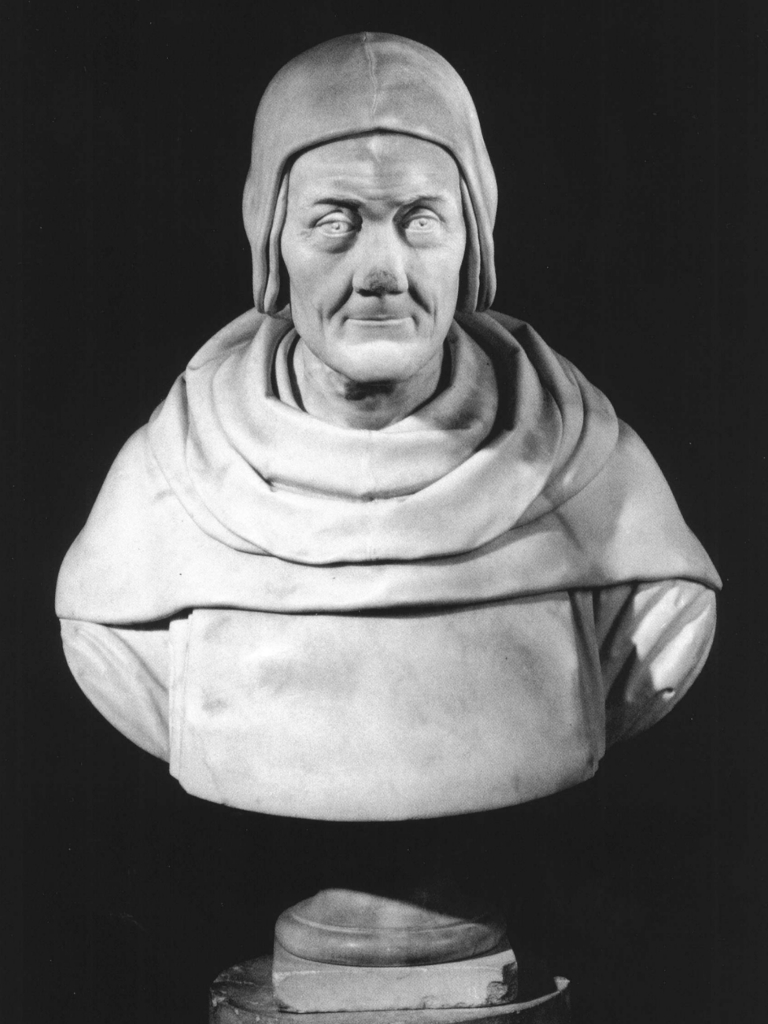
Bust of Fra Mauro

Fra Mauro OSB Cam (c. 1400 – 1464) was an Italian cartographer who lived in the Republic of Venice. He created the most detailed and accurate map of the world up until that time, the Fra Mauro map.

Mauro was a monk of the Camaldolese Monastery of St. Michael, located on the island of Murano in the Venetian Lagoon. It was there that he maintained a cartography workshop. He also was employed by some very powerful men like Prince Henry the Navigator.

Biography

[edit]

Fra Mauro was born before or around the year 1400. In his youth, Mauro had traveled extensively as a merchant and a soldier. He was familiar with the Middle East. He is recorded in the records of the Monastery of St. Michael from 1409. As a lay member of the monastery, Mauro was employed as mapmaker. In the records of the monastery his main job was recorded as collecting the monastery's rents, but from the 1450s he is also mentioned as the creator of a series of world maps. Although he was no longer free to travel, due to his religious status, he would frequently consult with merchants of the city upon their return from overseas voyages. By 1450 he composed a great mappa mundi – a world map – with surprising accuracy, including extensive written comments reflecting the geographic knowledge of his time. The map is known today as the "Fra Mauro map".

Fra Mauro world map

[edit]
The 1450 ca. Fra Mauro map (inverted, South is normally at the top). The map is a world map that depicts Asia, Africa and Europe.

The Fra Mauro world map, or mappa mundi, was a major cartographical work that compiled much of the geographical knowledge of the time. The map covers over five square meters. The map is extremely detailed and contains many thousands of texts and illustrations. The world map took several years to complete and was the most detailed and accurate world map that had been produced up until that time.

Fra Mauro created the map under a commission by King Afonso V of Portugal. Andrea Bianco, a sailor-cartographer, is recorded as having collaborated with Fra Mauro in creating the map, as payments made to him between 1448 and 1459 testify. The map was completed on 24 April 1459, and sent to Portugal, but that copy did not survive. Along with the map was a letter from the Doge of Venice. It was intended for Prince Henry the Navigator, Afonso V's uncle. It encouraged the prince to continue funding exploratory journeys. Fra Mauro died the following year, while he was making a copy of the map for the Signoria of Venice. The copy was completed by Andrea Bianco. A commemorative medal of the period struck in honor of his cartographic work describes Fra Mauro as "chosmographus incomparabilis".

Other work

[edit]

Two copies of maps by Fra Mauro are known to survive. One is a portolan chart in the Vatican Library, (Codice Borgiano V) published by Roberto Almagià in 1944.[1] The other was recognized by Antonio Ratti as a copy signed by Giorgio Callapoda at Candia and dated 1541, of a lost chart by Fra Mauro, sold at auction in Milan in 1984[2] and now in a private collection, probably in France.[3]

Tributes

[edit]

The crater Fra Mauro and associated Fra Mauro formation of the Moon are named after him. The Apollo 13 lunar mission was intended to explore the Fra Mauro formation, but due to the explosion aboard the spacecraft, Apollo 13's crew had to return to Earth without landing on the Moon. The formation was instead explored by astronauts Alan Shepard and Edgar Mitchell of the Apollo 14 mission in February 1971.

Bibliography

[edit]

Notes

[edit]

Sources

[edit]
  • Novel A Mapmaker's Dream. The meditations of Fra Mauro, cartographer to the Court of Venice. by James Cowan. Shambala publications USA.
Revisions and contributorsEdit on WikipediaRead on Wikipedia
from Grokipedia
Fra Mauro (c. 1400 – c. 1460) was a Venetian Camaldolese monk and best known for creating the , a monumental completed in 1460 that synthesized contemporary geographical knowledge and stands as one of the finest examples of medieval . Little is documented about Fra Mauro's early life, but he served as a at the Monastery of San Michele di in the , where he likely entered the order in his adulthood after possible prior travels or mercantile experience. He operated a cartographic workshop at the monastery, drawing on Venice's position as a hub of trade and exploration to compile information from merchants, sailors, and returning travelers. As a well-educated humanist and scholastic, Fra Mauro referenced over 40 scholarly works, including those by , Aristotle's commentators, and , while prioritizing empirical accounts from explorers like and . The , measuring approximately 2 meters in diameter and executed on stretched over a wooden frame, depicts the known world (oecumene) with , , and , oriented with south at the top in a departure from traditional northern-up maps. It features over 3,000 inscriptions in Venetian vernacular—totaling around 165,000 characters—providing detailed legends on , cosmography, trade routes, and natural phenomena, making it a comprehensive encyclopedic tool rather than a mere . Commissioned in 1457 by Portugal's King Afonso V and delivered to in 1459, the extant version resides in Venice's Biblioteca Nazionale Marciana, while a duplicate created for the Portuguese court is now lost. The map integrates medieval mappaemundi traditions, Ptolemaic projections, and nautical charts, emphasizing maritime networks and Venetian commercial interests, and notably omits mythical elements like a central in favor of a more accurate, observation-based portrayal.

Early Life

Origins and Early Career

Fra Mauro was born around 1400 (precise date uncertain, possibly as early as 1385) in or a nearby region in the Venetian Republic. Little is known with certainty about his family background or precise birthplace, but contemporary records identify him as a native of , reflecting the city's vibrant mercantile and maritime culture that would influence his early experiences. According to tradition, in his youth Fra Mauro pursued a secular career as a traveling and briefly as a , engaging in extensive voyages across the . These journeys reportedly exposed him to a wide array of cultures, landscapes, and navigational practices, as he interacted with sailors, traders, and locals from ports in the , , and beyond. Through such travels, he may have accumulated firsthand accounts of distant regions, including oral histories and descriptions of trade routes that later informed his cartographic work. Fra Mauro is first recorded in 1409 at the monastery of San Michele in Isola on the , an island in the between and , where he entered the order as a conversus—a . This transition marked the beginning of his monastic life, where he would eventually channel his accumulated knowledge into scholarly endeavors.

Monastic Life and Transition to Cartography

In 1409, Fra Mauro entered the Camaldolese monastery of San Michele di Murano as a , where he would reside until his death around 1460. The order, a Benedictine reform founded by St. Romuald in the 11th century, blended eremitic solitude with cenobitic community life, emphasizing , manual labor, and . As a , Fra Mauro's duties focused on practical tasks rather than priestly , including crafts and support for the monastery's operations, which aligned with his prior experiences as a and . His daily routine likely involved communal liturgies, personal , and physical work, all within the disciplined structure of monastic obedience. The monastery's location on , strategically positioned between and , fostered an environment rich in intellectual exchange despite its contemplative focus. Fra Mauro had access to the institution's expanding 15th-century , which housed diverse texts on , , and , enabling him to study classical and contemporary sources. Proximity to 's bustling port allowed regular interactions with merchants, travelers, explorers, and ambassadors who frequented , providing oral accounts of distant lands that supplemented written materials. These encounters sparked Fra Mauro's initial motivations for cartography, as he sought to synthesize fragmented geographical knowledge from both oral traditions and textual authorities into visual representations. By the 1430s, his skills had evolved to include drafting topographic maps and contributing to practical projects, such as hydrological for the deviation of the River Brenta. Key relationships with Venetian officials, who commissioned such works to address the Republic's infrastructural needs, provided essential support and resources for his burgeoning cartographic pursuits.

Major Cartographic Achievements

The Fra Mauro World Map

The Fra Mauro world map, also known as the , represents a pinnacle of medieval , commissioned by King and intended for his uncle, , to support Portuguese explorations. Work on the map began around 1457 and culminated in its completion on April 24, 1459, after which a copy was promptly sent to . Measuring approximately 2 meters by 2 meters, the map was executed on fine and mounted within a wooden frame, making it a monumental artifact that required significant resources and time to produce. Unlike the prevailing north-up T-O maps of the era, which stylized the world as a T-shaped arrangement within an O-shaped circle symbolizing the known continents divided by seas, Fra Mauro's creation adopted a revolutionary south-up orientation in a circular format. This layout placed the at the top, reflecting influences from Arabic cartographic traditions and emphasizing equatorial and southern regions, while portraying the as a projected onto a disc surrounded by . The design diverged sharply from medieval , prioritizing empirical geography over theological motifs. The map is richly annotated with over 2,900 descriptive texts in Venetian dialect, providing detailed legends on , , , and , alongside hundreds of illustrations depicting ships under sail, fantastical animals, mythical creatures, and human figures engaged in daily life or . These elements cover the known world comprehensively, encompassing , , and , with notable accuracy in depicting features such as the coasts of (including the and ), the , , and . Fra Mauro collaborated with the sailor-cartographer Bianco during production, and following Mauro's death in 1460 or 1461, Bianco finished a second copy intended for the of .

Creation Methods and Sources

Fra Mauro's compilation of the world map relied primarily on indirect sources rather than personal exploration, as he remained at the Monastery of San Michele on throughout his cartographic work. He drew extensively from classical texts, including Ptolemy's , which provided foundational frameworks for latitudes and longitudes, alongside works by Pliny, Solinus, , and medieval authors such as Fazio Degli Uberti. These ancient and medieval sources were critically synthesized with contemporary accounts to update outdated assumptions, such as Ptolemy's depiction of the as an enclosed sea. A key empirical method involved gathering oral testimonies from merchants, sailors, and explorers who visited , a major hub for maritime trade. Fra Mauro conducted interviews with numerous Venetian merchants, navigators, and foreign travelers, including Portuguese explorers whose reports reached him via official channels from the King of . Notable among these were accounts from explorers like and , whose travel narratives informed details on Asian and regions. This approach allowed him to incorporate firsthand observations, such as an Indian ship's tempestuous voyage beyond Cape Soffala and the visibility of the from African coasts. The map's creation process emphasized recent discoveries that challenged prevailing medieval cosmology, particularly evidence of navigable routes connecting the to the Atlantic. Fra Mauro integrated reports of southern lands and open seas, drawing from , , and Asian sources to depict a more interconnected world, including trade routes and island chains previously unknown in European cartography. He expressed toward mythical elements in some testimonies, prioritizing verifiable details on distances and toponyms. To ensure precision, Fra Mauro established a collaborative workshop at the , where he and assistants like the mariner Bianco drafted the map on four glued sheets mounted on wood. This setup facilitated iterative annotation, resulting in over 3,000 toponyms, legends, and illustrations, with careful calibration of distances based on estimates and classical metrics. The process, spanning from around 1448 to 1459, reflected a rigorous, evidence-driven that bridged scholarly tradition with practical maritime knowledge.

Additional Works and Collaborations

Surviving Maps and Copies

The original Fra Mauro , completed around 1450 for the of , is preserved in the Biblioteca Nazionale Marciana in and represents the primary surviving artifact of his major cartographic work. A copy of this , finished on April 24, 1459, was commissioned by King and sent to under the care of Stefano Trevisan, but it has since been lost, with its fate unknown. Among Fra Mauro's surviving original maps is a held in the as Codex Borgianus V, dated between 1445 and 1448 during his lifetime and first published in a scholarly edition by Roberto Almagià in 1944. This chart, measuring approximately 1.9 by 1 meter on , depicts the Mediterranean, , and western European coasts with detailed navigational features, serving as a key example of Mauro's portolan style. A significant later copy is a 1541 manuscript by Giorgio Sideri (also known as Callapoda), created in and recognized as a of a now-lost original by Fra Mauro. This chart, signed and dated, was sold at auction in in 1984 and is currently held in a , providing rare insight into Mauro's unpreserved works through its faithful replication of toponyms and coastal outlines. In the early , the Fra Mauro gained wider accessibility through a reproduction created by W. Fraser in , based on tracings of the Venetian original and oriented with south at the top. This reproduction, measuring about 2 meters in diameter, contributed to scholarly study by offering a detailed, near before modern photographic techniques.

Other Contributions to Geography

Beyond his renowned world map, Fra Mauro compiled geographical annotations and treatises that drew extensively on Venetian maritime records, including traveler accounts from merchants and pilots returning from and . These writings, composed in the Venetian vernacular, incorporated reports from explorers like and Portuguese navigators such as Aires Gomnes da Silva e Fernandes, synthesizing oral and written sources into detailed descriptions of distant regions. Although several of his scritture cosmografiche (cosmographic essays) are now lost, surviving fragments and extended annotations demonstrate his focus on , including the structure of the celestial and sublunar worlds, the navigability of oceans, and the location of . Fra Mauro also played an advisory role to Venetian authorities and Portuguese explorers, leveraging his expertise in navigation routes. In collaboration with the Portuguese court around 1457, he contributed to diplomatic and commercial exchanges by providing insights derived from Venetian trade networks, which informed early explorations along the African coast. Additionally, the , Pasquale Malipiero, accompanied Fra Mauro's cartographic works with a letter to , urging continued voyages to the Indies and highlighting the value of Fra Mauro's geographical knowledge for safe passage. His involvement extended to updating portolan charts, particularly those covering the Adriatic and , where he refined depictions based on contemporary sailing data. A notable example is the attributed to his workshop, preserved in the and dated to circa 1445–1448, which features detailed rhumb lines and coastal outlines oriented with south at the top, typical of his style. This chart incorporated advancements from predecessors like Andrea Bianco, emphasizing practical navigation for Venetian galleys in regional waters. In his textual contributions, Fra Mauro documented debates on mythical and unexplored regions, including the concept of and the feasibility of southern lands. He addressed theological and scientific questions about inhabitable zones beyond the , arguing against prohibitive views by citing ancient authorities and modern testimonies that supported ocean circumnavigation and the existence of unknown continents. His annotations also preserved accounts of legendary realms, such as the kingdom of in , integrating over 120 associated territories to bridge with emerging empirical .

Legacy and Recognition

Historical Influence

Fra Mauro's exerted a significant influence on subsequent cartographers, particularly in enhancing the accuracy of depictions of and . The map's detailed portrayal of the African coastline, informed by Portuguese explorations, was notably incorporated into Henricus Martellus's of around 1490, where the circular outline and integrated coastal features from Bartolomeu Dias's voyages directly echoed Fra Mauro's framework. Similarly, the map's influence extended indirectly through Martellus to later works like Martin Waldseemüller's 1507 Universalis Cosmographia, contributing to more precise renderings of eastern and the spice islands in early modern maps that bridged medieval traditions with emerging global perspectives. Through its extensive textual annotations, Fra Mauro's map played a key role in reinforcing the medieval consensus on a model. One prominent legend describes an Indian junk that, around , sailed southwest from the around into the Atlantic for 40 days, reaching green and fertile islands, then further west before turning back due to the vast ocean, returning via the —illustrating the navigability of southern seas and supporting the Earth's curvature via changing star positions. This empirical note, grounded in traveler accounts, underscored Fra Mauro's commitment to verifiable geography over mythical elements, influencing later scholars to prioritize navigational evidence in cosmological debates. Fra Mauro's work directly supported the Portuguese by compiling and disseminating critical data for oceanic voyages. Commissioned in 1457 by King , the map integrated recent west African coastal surveys and a copy was dispatched to in 1459, serving as a foundational reference for planning expeditions southward along Africa's perimeter toward . Its emphasis on open seas and accurate latitudes encouraged bolder maritime strategies, aiding explorers like in conceptualizing routes beyond traditional bounds. In 15th- and 16th-century Venetian scholarship, Fra Mauro was revered as a pioneer of empirical mapping, blending traveler testimonies with classical sources to advance geographic knowledge. His , completed on 24 April 1459, was consulted by local mapmakers such as Grazioso Benincasa and featured prominently in intellectual circles for its over 3,000 annotations prioritizing trade routes and firsthand reports. By the mid-16th century, Venetian scholar Ramusio cited Fra Mauro's synthesis of Marco Polo's accounts in his Navigationi et Viaggi, cementing his status as a foundational figure in Venice's mercantile cartographic tradition.

Modern Tributes and Scholarship

In recognition of Fra Mauro's contributions to , a prominent lunar and the surrounding geological formation on the bear his name, honoring the 15th-century Venetian monk's innovative mapping of . The Fra Mauro formation served as the landing site for NASA's mission in February 1971, where astronauts and conducted extravehicular activities, collected approximately 94.8 pounds (43 kg) of lunar samples, and performed scientific experiments to study the region's ancient highland terrain. These samples provided key insights into the 's geological history, revealing materials from the Imbrium basin impact approximately 3.9 billion years ago. During the , scholarly attention revived interest in Fra Mauro's works through rediscoveries and analyses of related artifacts, including portolan-style charts attributed to his workshop in the Vatican Apostolic Library's collections. Such rediscoveries underscored the monk's enduring impact on . Recent scholarship in the and beyond has focused on digital restorations and interdisciplinary analyses of Fra Mauro's map, emphasizing its integration of multicultural sources from European, Islamic, and Asian traditions. A high-resolution digital edition of the map was released in 2022 by the in collaboration with the Biblioteca Nazionale Marciana and , enabling interactive exploration of its 3,000 inscriptions and illustrations through advanced visualization tools that reveal layers of ethnographic and navigational knowledge. Post-2016 publications, including a 2023 study in e-periMetron on information visualization techniques applied to the map and a 2024 analysis of its depiction of Chinese voyages in the context of Zheng He's expeditions, have explored how Fra Mauro synthesized diverse global inputs—such as portolans, explorations, and Eastern accounts—to challenge Ptolemaic models and promote a more interconnected worldview. Cultural tributes to Fra Mauro include James Cowan's 1996 novel A Mapmaker's Dream: The Meditations of Fra Mauro, Cartographer to the Court of , which fictionalizes the monk's quest to compile global knowledge from travelers' tales within his , blending with philosophical reflections on and . The original has been featured in exhibitions at the Biblioteca Nazionale Marciana, including its integration into the library's permanent display since 2022 and earlier showings tied to digital projects that highlight its artistic and scientific significance.

References

Add your contribution
Related Hubs
User Avatar
No comments yet.