Hubbry Logo
Frederic BaragaFrederic BaragaMain
Open search
Frederic Baraga
Community hub
Frederic Baraga
logo
8 pages, 0 posts
0 subscribers
Be the first to start a discussion here.
Frederic Baraga
Frederic Baraga
from Wikipedia

Key Information

Styles of
Irenaeus Frederic Baraga
Reference style
Spoken styleYour Excellency
Religious styleBishop
Posthumous styleVenerable

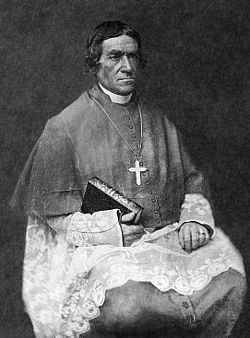
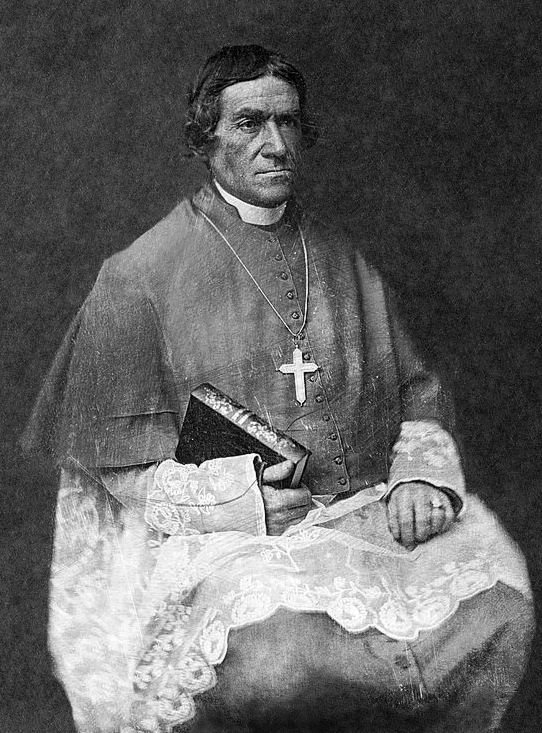
Irenaeus Frederic Baraga (June 29, 1797 – January 19, 1868; Slovene: Irenej Friderik Baraga) was a Slovenian Catholic missionary to the United States, grammarian and author of Christian poetry and hymns in Native American languages. He served as the first bishop of Sault Sainte Marie and Marquette in Michigan from 1865 to 1868. He previously served as bishop of Sault Sainte Marie from 1857 to 1865 and as vicar apostolic of Upper Michigan from 1853 to 1857.

Baraga's letters about his missionary work were published widely in Europe, inspiring the priests John Neumann and Francis Xavier Pierz to emigrate to the United States.[1] In 2012, Pope Benedict XVI declared Baraga as "venerable."[2]

Early life

[edit]

Frederic Baraga was born on June 29, 1797, in the manor house at Mala Vas (German: Kleindorf) near the village of Dobrnič in Lower Carniola, a province of the Duchy of Carniola in the Austrian Empire. Today it is part of the Municipality of Trebnje in Slovenia.[3] He was baptized Irenaeus Fridericus Paraga at Saint George's Church in Dobrnič, but never used the name "Irenaeus".[4][5]

Frederic was the fourth of five children born to Janez Baraga and Marija Katarina Jožefa née Jenčič. His sister Antonija Höffern became the first Slovenian woman to immigrate to the United States.[6][7] Upon her father's death, Baraga's mother inherited an estate at Mala Vas and substantial fortune. She died in 1808, and her husband in 1812. Frederic spent his childhood in the house of Jurij Dolinar, a lay professor at the diocesan seminary at Ljubljana.[6][8]

Between 1809 and 1815, during the Napoleonic Wars in Europe, France controlled Carniola. As a result, Baraga became fluent in French, Slovenian and German at an early age.[2] In addition, he learned Latin and Greek, both required subjects in the local schools. By age 16, Baraga was multilingual.

Baraga attended law school at the University of Vienna in Austria, graduating in 1821. Influenced by Reverend Clement Mary Hofbauer, a co-founder of the Redemptorist Order, Baraga decided to become a priest. He then entered the seminary in Ljubljana.[2]

Priesthood

[edit]

Baraga was ordained a priest for the Archdiocese of Ljubljana at age 26 on September 21, 1823, in St. Nicholas Cathedral in Ljubljana by Bishop Augustin Johann Joseph Gruber.[9] After his ordination, the archdiocese assigned Baraga as an assistant pastor at St. Martin's Parish near Kranj and later at a parish in Metlika in lower Carniola.[8] Baraga was a staunch opponent of Jansenism. During this time, he wrote a spiritual book in Slovene entitled Dušna Paša (Spiritual Sustenance).

In 1830, Bishop Edward Fenwick of from the Diocese of Cincinnati in Ohio recruited Baraga to come to the United States. He left Carniola on October 29, 1830, and docked in New York City on December 31st. He arrived in Cincinnati, Ohio, on January 18, 1831. After his arrival, Fenwick assigned Baraga to minister to German immigrants in the Cincinnati area.[8] At the same time, Barage studied the Ottawa language, a branch of the Algonquian languages. In May 1831, Fenwick sent Baraga to minister to members of the Ottawa Nation at the Catholic mission at L'Arbre Croche (present-day Cross Village, Michigan). Baraga spent his time at L'Arbre Croche mastering their language.

Baraga Street on Madeline Island in Lake Superior (2012)

In 1837, Baraga published Otawa Anamie-Misinaigan, the first book written in the Ottawa language, which included a Catholic catechism and prayer book. After a brief stay at a mission in present-day Grand Rapids, Michigan, in 1835, Baraga moved north to minister to the Ojibway (Chippewa) Nation at La Pointe, Wisconsin. This was a former Jesuit mission on Lake Superior. He was joined at La Pointe by his sister Antonija.[6]

In 1843, Baraga founded a mission at L'Anse, Michigan. During this time, he earned the nickname "the Snowshoe Priest" because he would travel hundreds of miles each year on snowshoes during the harsh winters.[10] He worked to protect the Ojibway from being forced from their lands and published a dictionary and grammar of the Ojibway language.[11]

With the collaboration of many native speakers, Baraga also composed around 100 Catholic hymns in the Ojibwe language. These hymns were published in a hymnal that was used by Catholic Ojibway in Canada and the United States long after Baraga's death.[12][13] Through the texts Baraga published in his missionary years, the Slovenes learned about many aspects of Native American culture and the United States.[14]

Vicar Apostolic of Upper Michigan

[edit]

Baraga was appointed by Pope Pius IX as titular bishop of Amyzon and vicar apostolic of Upper Michigan on July 28, 1853. He was consecrated as a bishop on November 1, 1853, in Cincinnati at Saint Peter in Chains Cathedral[15] by Archbishop John Purcell.[9]

Bishop Baraga's diary (2024)

On June 27, 1852,[16] he began to keep a diary, written in several languages (primarily German, but with English, French, Slovene, Chippewa, Latin, and Italian interspersed), preserving accounts of his missionary travels and his relationship with his sister Amalia.

Bishop of Sault Saint Marie

[edit]

On January 9, 1857, Pius IX converted the Vicariate Apostolic of Upper Michigan into the Diocese of Sault Saint Marie, with Baraga as its bishop. During this time, the area experienced a population explosion, as European immigrants were attracted to work in the copper and iron mines developed near Houghton, Ontonagon, and Marquette. This presented a challenge because he had few priests and attended to immigrant miners and the Native Americans. Increased development and population encouraged the improvement of transportation on Lake Superior.

The only way to travel in winter was on snowshoes, which Baraga continued to do into his sixties. He was particularly challenged by the vast diversity of peoples in the region, including the native inhabitants, French-Canadian settlers, and the new German and Irish immigrant miners.[10] Difficulties in recruiting staff arose because of many languages; while Baraga spoke eight languages fluently, he had trouble recruiting priests who could do the same.

Baraga traveled twice to Europe to raise money for his diocese. He was presented a jeweled cross and episcopal ring by the Emperor Franz Joseph I of Austria. Baraga later sold these gifts to raise funds for his missions.

Baraga wrote numerous letters to the Society for the Propagation of the Faith in Rome, describing his missionary activities. The Society published them widely as examples of its missions in North America. These letters inspired the priests John Neumann and Francis Xavier Pierz to come to the United States to work. In time, Baraga became renowned throughout Europe for his work. In his last ten years, his health gradually declined; he became intermittently deaf and suffered a series of strokes.

Bishop of Sault Sainte Marie and Marquette

[edit]

Recognizing the growth of Marquette, Pius IX on October 23, 1865, replaced the Diocese of Sault Sainte Marie with the Diocese of Sault Sainte Marie and Marquette. In 1866, Baraga made Marquette his permanent residence. In 1865, Baraga wrote to Pius IX in support of the canonization of his former confessor, Clement Hofbauer.[2]

Baraga died on January 19, 1868, in Marquette.[10] He is buried in a chapel constructed for him at Saint Peter Cathedral; he formerly reposed with other bishops of Marquette in the cathedral crypt.[10][17]

Selected works

[edit]
  • Frederic Baraga's Short History of the North American Indians, edited by Graham MacDonald (Calgary: UCalgary Press, 2004). "Originally published in 1837 in Europe in German, French, and Slovenian editions, and appearing here in English for the first time, Frederic Baraga's Short History of the North American Indians is the personal, first-hand account of a Catholic missionary to the Great Lakes area of North America." – Jacket
  • Chippewa Indians, as recorded by Rev. Frederick Baraga in 1847 (New York: Studia Slovenica, League of Slovenian Americans, 1976)
  • A Dictionary of Otchipwe Language Explained in English (1853); revised by other in 1878; republished as A Dictionary of the Ojibway Language with a foreword by John D. Nichols (Minneapolis: Minnesota Historical Society, 1992)
  • Dushna Pasha: Pasture for the Soul, translated by Maria K. Arko Klemenc, Ph.D., edited by Rev. John P. Vidmar, Ph.D. (Bishop Baraga Association, 2019)
  • The Diary of Bishop Frederic Baraga: First Bishop of Marquette, Michigan, translated by Joseph Gregorich and Rev. Paul Prud'homme, S.J., edited and annotated by Regis M. Walling and Rev. N. Daniel Rupp (Wayne State University Press, 2001)

Legacy and veneration

[edit]
St. Peter Cathedral, Marquette. Michigan (2009)

Baraga was declared venerable by Pope Benedict XVI on May 10, 2012.[18] His cause was opened in 1952 by Bishop Thomas Lawrence Noa. The canonization process began in 1973.[10] The diocese moved his remains to a new chapel for veneration in the upper portion of Saint Peter Cathedral.[10] At the time of his veneration, the Vatican was investigating a possible miracle for beatification.[10]

The following places and institutions have been named after Baraga

Other memorials

[edit]
Snowshoe Priest statue by Jack Anderson (2008)

Honors

[edit]

Baraga House and Baraga Educational Center and Museum

[edit]

The Baraga House in Marquette is home to the Baraga Educational Center and Museum. It was moved to its current location in 1872 .[27] The house is the oldest standing building in Marquette.[28] In 1958, the Baraga House was recognized as a state of Michigan historical site.[19]

Baraga bought the original property from the Cleveland Iron Mining Company for $250 for construction of the first church in Marquette.[19] It was completed in 1857.[19] Mass was celebrated on the first floor and the second floor served as a rectory.[19] The church was pastored by Reverend Sebastian Duroc, with Baraga visiting periodically.[19] After the Vatican moved the diocesan see from Upper Michigan to Marquette in 1865, Baraga converted the house in 1866 into his bishop's residence.[19] He lived there until his death in 1868.[19] The Baraga House is now owned by the Diocese of Marquette. It contains artifacts, tools, and writings used by Baraga.[27]

[edit]
Mala Vas Manor, Baraga birthplace, Trebnje, Slovenia
Plaque at Mala Vas Manor
Baraga's baptismal font

References

[edit]

Further reading

[edit]
[edit]
Revisions and contributorsEdit on WikipediaRead on Wikipedia
from Grokipedia
Irenaeus (June 29, 1797 – January 19, 1868) was a Slovenian-born Roman Catholic priest and who labored among the Native American populations of the , focusing on the (Chippewa) and tribes in present-day , , and . Arriving in the United States in 1830 under the sponsorship of Vienna's Leopoldine Society, he established missions at locations such as Arbre Croche, Grand River, La Pointe, and L'Anse, baptizing hundreds in each and adapting to frontier hardships by traveling vast distances on snowshoes, which earned him the nickname "Snowshoe Priest." His most enduring scholarly contributions include the compilation of the first grammar of the Ojibwa language, published in 1850, and a comprehensive Ojibwa in 1853, both of which facilitated work and preserved linguistic knowledge through collaboration with native speakers. In 1853, Baraga was appointed the first bishop of the newly erected Diocese of Sault Sainte Marie and Marquette (later Marquette), where he relocated the to Marquette in 1865 and issued pastoral letters in both English and Chippewa, overseeing the spiritual care of indigenous peoples and European immigrants until his death. Declared by in 2012 for his heroic virtues, Baraga's legacy endures in Catholic veneration and linguistic scholarship.

Early Life and Education

Birth and Family Background


Frederic Baraga, born Irenaeus Frederic Baraga, entered the world on June 29, 1797, in the manor house at Mala Vas near the village of Dobrnič in the Duchy of Carniola, then part of the Habsburg Monarchy (present-day Slovenia).
He was the fourth of five children in a devout Catholic family; his father, Johann Nepomuc Baraga, served as overseer of the Mala Vas estate, managing its operations with evident enterprise, while his mother, Maria Katharina Josefa Jenčič, provided the household foundation until her death in 1808. Baraga's father followed her in 1812, leaving the young Frederic orphaned at age 15 and under the care of extended family.
The Baraga family held no formal noble title but belonged to the local gentry class involved in estate management, reflecting a stable rural Catholic milieu in Lower Carniola that emphasized education and piety, influences that shaped Baraga's early formation.

Academic Training and Religious Vocation

Baraga completed his at the gymnasium in before undertaking two years of philosophical studies there, laying the foundation for his later pursuits. In 1816, at age 19, he enrolled at the to study law, completing the degree in 1821 after five years of coursework that included Roman, church, state, international, and . This legal training equipped him with analytical skills that later informed his documentation and administrative roles, though he ultimately forwent a secular career. Influenced by the Redemptorist preacher Clement Mary Hofbauer, whom he encountered during his student years in , Baraga discerned a religious to the priesthood, rejecting his noble and familial expectations of a . He entered the in shortly after graduating, focusing on theological formation amid a period of post-Napoleonic religious revival in the . Baraga's linguistic aptitude, honed through multilingual proficiency in Slovenian, German, French, Greek, and Latin by age 21, facilitated his rapid adaptation to seminary rigors. On September 21, 1823, at age 26, Baraga was ordained a priest in by Anton Hemberger, marking the culmination of his vocational shift from to clerical service. This ordination positioned him for initial pastoral duties in , where his zeal for reform and evangelization foreshadowed his later missionary calling to distant frontiers.

European Priesthood

Ordination and Initial Pastoral Work

Baraga was ordained to the priesthood on September 21, 1823, at the age of 26, in the Cathedral of St. Nicholas in (then ) by Bishop Augustin Johann Joseph Gruber of the Diocese of Ljubljana. Immediately following his , he remained at the for an additional year, serving as an assistant while deepening his commitment to pastoral ministry; during this period, he formally renounced his inheritance rights to the family estates at Mala Vas to focus exclusively on ecclesiastical duties in the diocese. His first formal pastoral assignment was as an assistant at St. Martin's parish near (Krainburg), where he labored with notable zeal, emphasizing fervent preaching, frequent confessions, and catechetical instruction that yielded measurable spiritual renewals among parishioners, including increased sacramental participation. This success, however, stemmed partly from his staunch opposition to lingering Jansenist tendencies—characterized by moral rigorism and diminished emphasis on devotional practices—which clashed with local clerical and episcopal preferences, leading to tensions and his eventual transfer after about three years. Baraga was then reassigned as assistant in the parish of Metlika in Lower (Dolenjska), a region marked by and ethnic diversity, where he continued similar initiatives, adapting to local Slovenian customs while promoting orthodox Catholic piety amid post-Napoleonic ecclesiastical challenges; he served there until October 1830, when he departed for missionary service . Throughout these early years, his ministry emphasized personal evangelization and resistance to doctrinal dilutions, foreshadowing his later missionary rigor.

Missionary Endeavors in America

Arrival and Establishment of Missions

Baraga departed on October 29, 1830, embarking on a transatlantic voyage sponsored by the Leopoldine Society, arriving in on December 31, 1830. He then journeyed inland to , , reporting to Bishop Edward Fenwick on January 18, 1831, within the Diocese of Cincinnati, which encompassed the remote . In May 1831, Baraga traveled northward to the , reaching the settlement at Arbre Croche (modern Harbor Springs) on May 28, where he initiated his primary missionary work among Native American communities. This site, home to approximately 1,500 , became his base for evangelization; he conducted baptisms, classes, and , ultimately converting 547 individuals during his tenure there. By 1832, he had constructed and dedicated a log church, marking the formal establishment of a Catholic presence in the region. From Arbre Croche, Baraga extended his efforts along Lake Michigan's shoreline, founding missions from Harbor Springs to Cross Village between 1833 and 1835, adapting to seasonal migrations of the and incorporating rudimentary schools for children. In September 1833, he relocated temporarily to the Grand River area (near present-day Grand Rapids), establishing another mission on unceded land and baptizing about 200 Native Americans. These early outposts relied on Baraga's personal endurance, including arduous winter travels by , to sustain ministry amid sparse resources and isolation.

Evangelization Among Ojibwe and Ottawa Peoples

Baraga commenced his missionary labors among the people at the Arbre Croche mission in present-day , arriving on May 28, 1831. He immersed himself in the Ottawa language, enabling direct , and by the end of his first year had baptized 131 natives, including 44 infants. Over the subsequent two years at Arbre Croche until 1833, he administered sacraments to 547 adults and children, establishing a model mission with schools emphasizing practical skills and moral instruction alongside . To aid evangelization, Baraga authored the first Ottawa prayer book, Animike-Misinagan, which provided accessible texts for prayers and basic doctrine, fostering sustained community engagement with Catholicism. From Arbre Croche, Baraga extended efforts to other settlements, including the Grand River area near present-day Grand Rapids from 1833 to 1835, where he confronted opposition from fur traders and Protestant competitors who sought to undermine Catholic influence. Despite threats, including a mob confrontation, he persisted in and introduced temperance initiatives, distributing vow cards to counter alcohol's prevalence among the Ottawa, which he identified as a barrier to conversion and stability. These activities yielded incremental conversions, though exact figures for Grand River remain less documented amid the hostilities. Turning to the Ojibwe (also known as Chippewa), Baraga arrived at La Pointe on Madeline Island, Wisconsin, on July 27, 1835, initiating eight years of intensive work among the tribe. There, he constructed St. Joseph Church and baptized 981 Ojibwe and associated whites by 1843, cultivating alliances with leaders like Chief Buffalo, whom he supported in land retention efforts against encroachment. In 1843, Baraga founded the L'Anse mission in Michigan's Upper Peninsula for the Ojibwe, erecting the Church of the Most Holy Name of Jesus and serving until 1853; this site became one of his most cherished postings, with ongoing Ojibwe Catholic practices persisting today. His linguistic innovations proved pivotal: the 1839 Gagikwe-Masiniagan (a Chippewa sermon book), followed by a grammar in 1850 and dictionary in 1853, equipped converts with tools for self-instruction and enabled Baraga to preach effectively across remote Ojibwe bands. Throughout these endeavors, Baraga's approach emphasized personal endurance—traversing frozen lakes on snowshoes and rivers by canoe—to reach isolated families, prioritizing , , and marriage sacraments to integrate Catholic norms into tribal life without wholesale cultural erasure. His reported total of over 25,000 Native American conversions across decades reflects the scale of impact among and , though localized missions like Arbre Croche and La Pointe demonstrated the foundational successes in building self-sustaining Catholic communities.

Adaptation to Frontier Conditions

Baraga demonstrated remarkable physical resilience and ingenuity in navigating the Upper Peninsula's unforgiving terrain, where dense forests, deep snows, and vast distances isolated Native communities. During winters, he routinely snowshoed 600 to 800 miles annually, carrying a with essentials such as rations, a bedroll, , vestments, and , often accompanied by a Native guide and sleeping without shelter on the trail. This earned him the moniker "Snowshoe Priest," reflecting his adaptation of Native snowshoe designs suited to the region's heavy snowfalls and his willingness to endure blizzards and subzero temperatures for journeys exceeding 50 miles to visit a single family. In summer, Baraga shifted to canoeing and foot travel across lakes and rivers, founding missions in remote locales like L'Anse in 1843 amid the wilderness, where he constructed rudimentary log structures for churches, schools, and residences despite chronic funding shortages that left facilities austere and makeshift. He also employed dogsleds and horses when available, covering territories spanning , , and shores, often as the sole priest serving both and incoming miners and settlers drawn by iron and booms. These methods allowed him to administer sacraments and catechize in areas devoid of roads or settlements, adapting European clerical duties to a nomadic, survival-oriented routine that included modest living on wooden floors and reliance on local provisions. Cultural adaptation complemented his logistical prowess; Baraga immersed himself in and lifeways, learning survival techniques from Natives to sustain prolonged expeditions and integrating their hospitality during visits, which facilitated trust and evangelization. Despite recurrent health strains from exposure and overexertion—conditions he documented in diaries noting "barely the necessities of life"—he persisted alone for years in outposts like La Pointe from 1835 to 1843, baptizing hundreds and establishing self-sustaining mission communities. This holistic adjustment to isolation, weather extremes, and material scarcity underscored his commitment, enabling effective ministry across a larger than many European countries.

Linguistic and Literary Output

Development of Native Language Resources

Upon arriving in the United States in 1830, Baraga commenced studying the Ottawa dialect of the Ojibwe language in Cincinnati, Ohio, under the tutelage of William Makatebinessi, an Ottawa Native American, to prepare for missionary evangelization. This foundational effort enabled him to produce religious materials tailored to the linguistic needs of the Ojibwe and Ottawa peoples, facilitating direct communication of Catholic doctrine without reliance on interpreters. In December 1832, Baraga published his first work in a Native American language, Otawa Anamie-Misinaigan, a catechism in the Ottawa dialect printed in Detroit, marking the initial printed resource for Catholic instruction among Michigan's Ottawa tribes. By 1837, he expanded this with prayer books in both Ottawa and Ojibwe (Wisconsin) dialects, incorporating catechisms, rosaries, prayers to saints, and the stations of the cross; accompanying texts on the Life of Jesus Here on Earth were also released in each dialect to support devotional practices. These publications, printed in France during a brief European visit, addressed the scarcity of vernacular religious texts and were distributed to missions for use in baptisms, instructions, and daily prayers. Baraga continued composing Gagikwe-Masinaigan, a collection of sermons in , during the winter of 1838, which was later printed in 1858 specifically for use. In 1850, he issued A Theoretical and Practical of the Otchipwe , a 422-page volume designed for missionaries and others interacting with Chippewa () speakers, representing the first systematic grammar of the language. This work analyzed phonetic, morphological, and syntactic structures, drawing from Baraga's fieldwork across dialects spoken by Algonquian groups including , , and . Culminating his linguistic efforts, Baraga completed the Dictionary of the Otchipwe Language, Explained in English in 1853, a 723-page bilingual reference comprising English-to- and Ojibwe-to-English sections, compiled with assistance from interpreters like Vincent Roy and based on northern variants encountered in missions from La Pointe to L'Anse. Despite a near-fatal sleigh in 1852 while transporting the manuscript to for printing in , the dictionary endured as the most comprehensive Ojibwe lexicon of its era, aiding , translation, and ongoing scholarly study. Over his career, Baraga authored approximately 20 books in Native languages, prioritizing practical tools for evangelization while incidentally documenting endangered dialects amid frontier displacement pressures.

Theological and Devotional Writings

Baraga authored multiple devotional texts tailored for Native American converts, primarily in the (Otawa) and (Otchipwe) languages, to facilitate and personal piety amid missionary work. These writings emphasized core Catholic doctrines such as the sacraments, the life of Christ, and prayers for daily devotion, drawing directly from Church tradition to bridge linguistic barriers. His efforts produced the first printed religious materials in these indigenous tongues, enabling independent practice of without constant clerical presence. Among his earliest works was the Otawa Anamie-Misinaigan, published in 1832, which served as the inaugural book in the Ottawa language and incorporated a Catholic outlining tenets of faith, , and moral obligations. This was followed in 1837 by an prayer book containing the , rosary meditations, prayers to saints, and the , alongside Life of Jesus Here on Earth, a narrative of Christ's earthly ministry paired with supplemental prayers to reinforce scriptural . Subsequent editions of the Catholic , issued between 1846 and 1865, expanded these elements, including Katolik Anamie-Masinaigan (1846), which added Latin appendices for and to integrate liturgical participation. In 1843, Baraga released Gete Dibadjimowin, a compilation of stories emphasizing salvation history, with an appendix introducing twelve original hymns focused on themes like and the . Over time, he composed approximately 100 Catholic hymns in , incorporated into prayer books from 1832 onward and structured for liturgical seasons such as Advent, , and , often adapting European melodies to convey doctrines of , , and . These texts, grounded in orthodox Catholic theology, supported evangelization by fostering vernacular devotion among the and , with multiple printings reflecting sustained demand.

Episcopal Leadership

Appointment as Bishop of Marquette

On July 29, 1853, issued a brief detaching the northern of from the Diocese of Detroit and erecting it as the Vicariate Apostolic of Upper Michigan, with Frederic Baraga appointed as its first vicar apostolic holding the titular episcopal see of Sault Sainte Marie. This decision recognized Baraga's two decades of missionary labor in the region, including his establishment of missions among the and peoples and his authorship of linguistic resources that facilitated evangelization. Baraga's selection stemmed from his proven endurance in conditions, linguistic expertise in Native dialects, and administrative experience as a Cincinnati diocesan priest overseeing Michigan missions since 1830. Prior to the appointment, he had petitioned church superiors for more clergy to serve the growing Catholic population amid booms and indigenous communities. Baraga was consecrated as bishop on November 1, 1853, at St. Peter in Chains Cathedral in by Archbishop John Baptist Purcell, assisted by other prelates. The vicariate, encompassing vast territories with sparse infrastructure, transitioned to full diocesan status in 1857, retaining the name Sault Sainte Marie until renamed Marquette in 1937, with Baraga serving as its inaugural ordinary until 1868.

Diocesan Governance and Expansion

Upon his appointment as the first vicar apostolic of Upper on July 29, 1853, Frederic Baraga assumed responsibility for a vast, sparsely populated territory encompassing the Upper Peninsula and northern Lower , characterized by remote missions and limited clerical resources. The vicariate, elevated to the Diocese of Sault Sainte Marie in 1857 with Baraga as its inaugural bishop, faced acute challenges including priest shortages and financial constraints amid growing immigrant populations drawn by mining opportunities. Baraga's governance emphasized centralized administration from Sault Sainte Marie, where he issued the diocese's first pastoral letter in both English and to address diverse linguistic needs among Native American and settler communities. Baraga prioritized clergy recruitment to bolster diocesan capacity, drawing upon his Slovenian networks to import missionaries, thereby initiating a tradition of Slovenian priestly service in the region and gradually increasing the number of active from a handful to sufficient coverage by 1867. He managed personnel through personal oversight and inspiration, mentoring figures such as Ignatius Mrak, whom he later sought as coadjutor following a debilitating in 1866 that impaired his mobility but not his resolve. Administrative decisions included navigating inter-community tensions between Native converts and European settlers, while enforcing fiscal prudence amid chronic funding deficits sourced primarily from European benefactors. Diocesan expansion under Baraga involved strategic relocation of the to Marquette on October 23, 1865, renaming the diocese Sault Sainte Marie-Marquette to reflect enhanced accessibility and population shifts southward. This move facilitated oversight of burgeoning parishes in mining districts, with missions proliferating to serve expanding Catholic demographics, including French, Irish, and German immigrants alongside and populations. By the close of his tenure in 1868, Baraga had laid foundational structures enabling sustained growth, reporting adequate ecclesiastical infrastructure despite persistent logistical hurdles posed by the frontier's isolation and severe climate.

Construction of Churches and Institutions

Upon his appointment as the first vicar apostolic of Upper Michigan in July 1853, Frederic Baraga assumed oversight of a vast territory served by only three churches and two priests. During his episcopate, which extended until his resignation in 1868, Baraga directed the construction and establishment of 21 churches, 16 mission stations, and four religious institutions, alongside increasing the number of priests to 15. These developments addressed the spiritual needs of scattered Native American communities and growing immigrant populations in mining and lumber regions of the Upper Peninsula. Baraga prioritized the development of Marquette as the diocesan center, relocating the there by 1865. On October 12, 1853, during his initial visit to the city, he confirmed 30 persons and selected the site for the at Baraga Avenue and Fourth Street. In late 1856, he instructed Father Sebastian Duroc to erect the first frame church—a two-story structure completed in spring 1857—which functioned as Marquette's inaugural and later became the Baraga House, now an educational center and museum. Further advancing the cathedral project, Baraga laid the cornerstone for St. Peter Cathedral in 1866 and dedicated the wooden edifice to the Apostle that same year. This building served the until its destruction by fire in 1879, after which a stone replacement was constructed from 1881 to 1890. Baraga's oversight extended to parishes in remote areas, such as Eagle Harbor, where Holy Redeemer Mission Church was completed in 1854 under his direction, marking one of the earliest permanent structures in the . The religious institutions founded during his tenure supported missionary outreach, education, and welfare, though primary records emphasize their role in sustaining the expanded network of churches and stations.

Final Years and Demise

Health Deterioration and Retirement Efforts

In the mid-1860s, Baraga's health, already strained by decades of arduous missionary travel in harsh northern climates, began a marked deterioration characterized by progressive , partial , and recurrent strokes. By 1856, he reported a weak and poor , compounded by sudden onset following exhaustive journeys. Chest oppression and pain emerged during travels in 1861–1862, exacerbated by exposure to prolonged rain and cold on an eight-day boat voyage from which he never fully recovered. A severe apoplectic struck in October 1866 while attending the Second Plenary Council of , leaving bloodstains on his episcopal robes and laming his right hand; tremors and partial in his hands were noted thereafter. Another in early 1867 rendered him unconscious and hospitalized at St. Agnes Hospital in , with weakness so profound by spring that he could scarcely speak, move, or conduct business. These afflictions, alongside breathing difficulties and severe pain intensifying from January 1868, confined him increasingly to Marquette, where he was nursed by close associates including Father Edward Jacker. Cognizant of his failing condition, Baraga repeatedly sought retirement from his episcopal duties, petitioning the in 1865 to resign due to frailty and inability to fulfill administrative demands. Earlier, in December 1856, he confided in his journal a desire to relinquish the burdens of oversight—particularly tensions with certain priests—preferring a return to simple Indian missionary work, though he deferred to divine will. At the 1867 Plenary Council, bishops recommended appointing a coadjutor to succeed him, with papal approval anticipated by summer, but no replacement arrived before his death, compelling him to persist in limited governance. These efforts underscored his self-perceived incapacity yet reflected Rome's reluctance to accept his resignation, prioritizing continuity in the remote .

Death and Initial Commemoration

Frederic Baraga died in the early morning of January 19, 1868, at his residence in , at the age of 70. The date marked the feast of the , a devotion to which Baraga was particularly attached. His funeral Mass occurred on January 30, 1868, at St. Peter Cathedral in Marquette, presided over by clergy including Edward Jacker, who delivered the emphasizing Baraga's life and sanctity. Despite a severe blizzard, hundreds of mourners attended, including numerous Native Americans whom Baraga had served during his missionary work. Baraga was interred in the crypt of St. Peter Cathedral following the service. This burial site reflected his enduring ties to the he led, with initial tributes highlighting his missionary zeal and linguistic contributions among .

Path to Sainthood

Canonization Proceedings

The Bishop Baraga Association was founded in 1930 to promote the and of Frederic Baraga, with Joseph Gregorich initiating the collection of historical documents spanning Baraga's life from 1831 to 1868 across five countries and three languages, a process completed by 1970. In June 1952, Thomas Noa of the Diocese of Marquette established a Diocesan Historical Commission to systematically gather and catalog materials relevant to the cause. The formal diocesan phase, known as the Ordinary Process, commenced in 1972 under Bishop Charles Salatka, involving witness testimonies and examinations that concluded with the transmission of the compiled acts to the Sacred Congregation for the Causes of Saints in ; this submission was supported by a petition from 194 U.S. bishops urging to advance the cause. The Congregation validated the diocesan inquiry in October 1988, paving the way for the preparation of the Positio, a comprehensive dossier on Baraga's life, reputation for holiness, and practice of virtues, which was finalized and submitted in 1998 after approval by historical consultors in December 2008. Theological consultors to the Congregation unanimously voted in favor of Baraga's in March 2011, a judgment endorsed by the cardinal members shortly thereafter. On May 10, 2012, authorized the decree promulgating the recognition of these virtues, conferring upon Baraga the ecclesiastical title of and advancing the cause to the stage requiring verification of a for . As of 2019, the process continues with inquiries into potential miracles, including one closed and forwarded to the Vatican's Medical Commission that year, though no has occurred.

Attributed Miracles and Investigations

The canonization process for Venerable Frederic Baraga requires verification of at least one posthumous miracle attributed to his intercession for beatification, followed by a second for canonization; such miracles must be instantaneous, complete, lasting, and medically inexplicable. A primary alleged miracle under investigation involves a patient diagnosed with a liver tumor via multiple diagnostic tests, including CT scans and ultrasounds, around 2009. The patient's family and parish priest invoked Baraga's intercession through prayer, and Baraga's stole was placed on the patient's abdomen; subsequent pre-surgical tests revealed no trace of the tumor, exploratory surgery confirmed its absence, and the patient experienced no further pain or symptoms. The Diocese of Marquette opened a canonical into this case on March 11, 2010, gathering medical records, witness testimonies, and expert opinions over approximately four months; the closed on July 28, 2010, issuing a positive judgment that the process met canonical standards, after which the acts were forwarded to the Vatican's Congregation for the Causes of Saints. In 2011, the Congregation validated the diocesan investigation's validity, and theological consultors reviewed the case in March, but as of 2025, the miracle has not been officially decreed for . In 2018, the initiated an inquiry into a second potential cure attributed to Baraga's , described as medically unexplainable; this process concluded and was submitted for review by the Vatican's Medical Commission, though specific details of the case remain undisclosed. The cause continues to seek Vatican approval of a qualifying to advance Baraga to beatified status.

Sites of Devotion and Pilgrimage

The tomb of Frederic Baraga, located in the crypt of St. Peter Cathedral in , serves as a primary site for Catholic devotion and , attracting thousands of visitors annually who pray for his as part of his ongoing process. The cathedral, constructed during Baraga's episcopate and overlooking , houses his remains in a dedicated blessed in 2014, where pilgrims participate in annual Baraga Days events commemorating his legacy since 1930. Adjacent to the cathedral, the Baraga Association maintains a Garden and Votive House, open daily for meditation and prayer, supporting public veneration authorized following his 2012 declaration as by . Further afield in Michigan's Upper Peninsula, the Bishop Baraga Shrine in L'Anse, overlooking Keweenaw Bay, honors his missionary labors among the and draws devotees to reflect on his evangelization efforts from the onward. In , Father Baraga's Cross—a monument in Schroeder along Lake Superior's North Shore—marks a site of his ministry and serves as a stop for pilgrims tracing his routes via organized trails and heritage centers. These locations, mapped through resources like the Father Baraga website's pilgrimage planner, emphasize his travels across the , fostering devotion tied to his documented hardships and linguistic contributions to Native American catechisms. In , Baraga's birthplace homestead in Mala Vas near Trebnje functions primarily as a historical rather than a devotional center, featuring preserved rooms from his 1797 birth and exhibits on his life, though it attracts cultural pilgrims interested in his Slovenian roots. Local plaques and fonts in nearby villages like Knežja Vas and Dobrnič commemorate his early life, but devotion there remains secondary to U.S. sites linked to his candidacy.

Enduring Influence and Debates

Contributions to Faith and Culture

Baraga's missionary labors fortified Catholic presence in the Upper , where he established missions among and communities, converting entire villages—such as all but one resident at Indian Lake—and baptizing hundreds through persistent catechization. His construction of early churches, including the first Catholic structure on completed within two weeks of arrival in 1831, provided enduring focal points for worship and community formation. These efforts countered Protestant competition and laid groundwork for diocesan expansion under his later episcopacy. In cultural domains, Baraga's linguistic documentation preserved and (Otchipwe) elements amid rapid societal shifts. He authored a grammar of the in 1850, aiding missionaries in comprehension, and compiled a comprehensive Dictionary of the Otchipwe Language (1853), later revised to over 1,700 pages, which cataloged vocabulary and dialects spoken by Chippewa and peoples. Complementing these, he translated approximately 100 Catholic hymns into and produced catechisms and prayer books in , blending evangelization with philological record-keeping that offered later ethnographic insights into pre-assimilation idioms. Baraga's diaries and observations further contributed to cultural understanding, detailing Ojibwe customs and mutual exchanges that influenced both missionary approaches and native adaptations to , fostering hybrid expressions of without wholesale erasure of indigenous identities. His defense of native land rights in early years underscored a pragmatic realism in promoting amid displacement pressures, prioritizing conversion through over . These works, drawn from direct immersion, remain valued for their empirical fidelity in an era of biased reporting on indigenous affairs.

Criticisms Regarding Cultural Interactions

Baraga's missionary endeavors among the Ojibwe have drawn scholarly critique for embodying a paternalistic and Eurocentric approach that prioritized Christian conversion over cultural preservation, often framing native traditions as obstacles to civilization. In his writings and actions, he described unconverted Ojibwe as "lazy, indolent, and barbaric," attributing their societal challenges to inherent savagery rather than external colonial pressures. He advocated that "nothing but Christianity can civilize the Indian," positioning religious assimilation as the sole path to improvement while dismissing the potential for Ojibwe equality with whites. Critics highlight Baraga's rejection of Ojibwe spirituality as superstition and "savage paganism," including his characterization of rituals as "repulsive howling" and traditional practices as devilish influences. He burned medicine bags—sacred items central to healing and —and disregarded ceremonies and medical knowledge as invalid, actions seen as direct suppression of cultural and religious autonomy. Such interventions aligned with a broader mindset that viewed native beliefs as heathen barriers, undermining identity without reciprocal respect for their worldview. Assimilation efforts under Baraga emphasized abandoning nomadic hunting for sedentary and European customs, which he deemed essential for amid demographic decline from disease, warfare, and —factors he analyzed clinically without challenging underlying colonial dynamics. He supported policies to facilitate "civilization," trusting government annuities while critiquing marriage practices as weak and polygamous elements as troublesome, thereby promoting wholesale cultural overhaul. These initiatives, though framed as protective, contributed to accusations of cultural erosion, as they discouraged traditional livelihoods and reinforced a savage-civilized inherent to 19th-century . Missionary methods, including mass baptisms—such as 547 at Harbor Springs between 1831 and 1833—prioritized quantity over depth, often yielding superficial conversions prone to relapse without sustained cultural integration. Baraga opposed training native clergy, deeming Ojibwe mental capacities unfit for higher roles, and his presence sometimes provoked community divisions, as at Grand River where Protestant rivals contested Catholic incursions. While his linguistic contributions preserved Ojibwe terminology in religious contexts, scholars argue these served evangelization more than equitable exchange, reflecting an asymmetrical power dynamic in cultural interactions.

References

Add your contribution
Related Hubs
User Avatar
No comments yet.