Hubbry Logo
Ottawa dialectOttawa dialectMain
Open search
Ottawa dialect
Community hub
Ottawa dialect
logo
8 pages, 0 posts
0 subscribers
Be the first to start a discussion here.
Ottawa dialect
Ottawa dialect
from Wikipedia
Ottawa
Nishnaabemwin, Daawaamwin
Native toCanada, United States
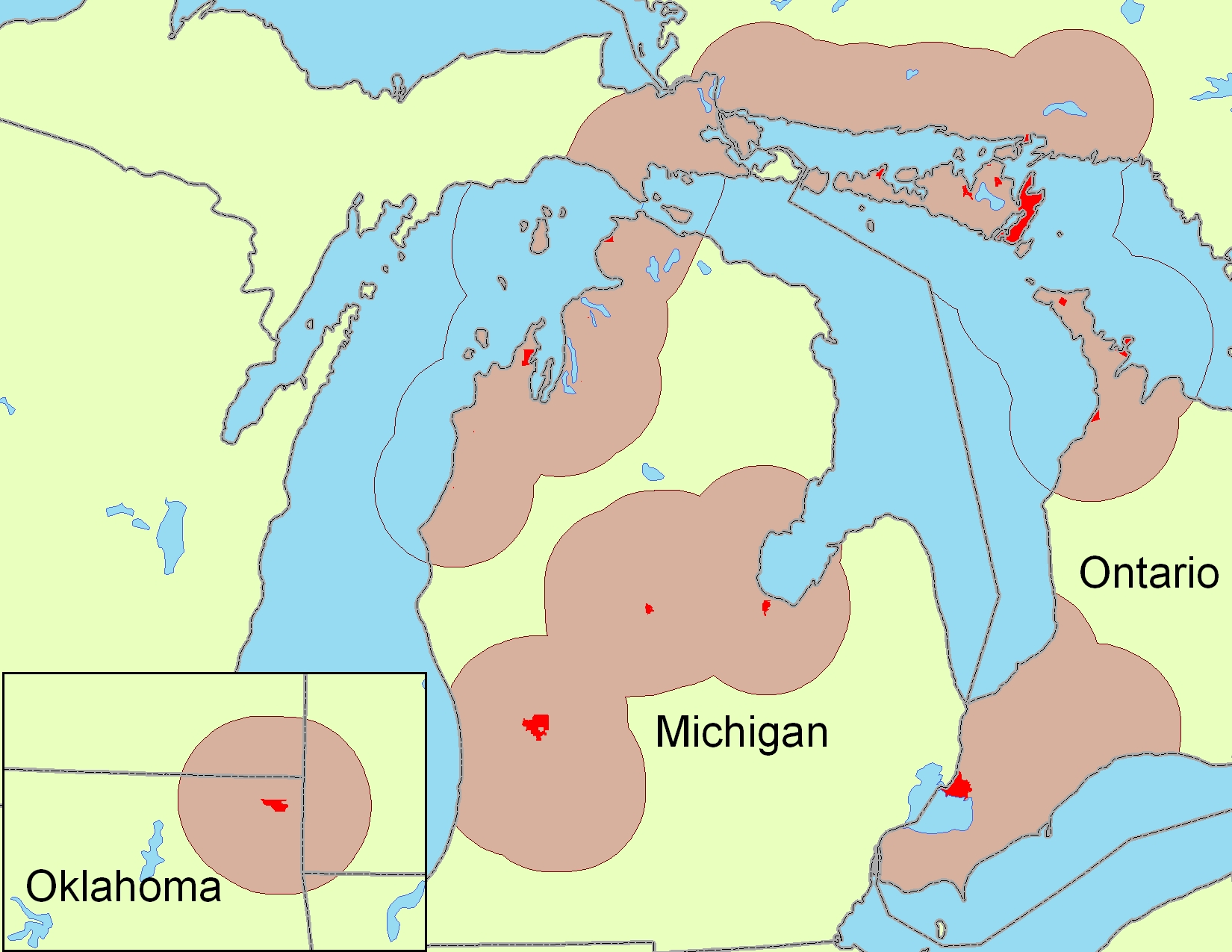
RegionOntario, Michigan, Oklahoma
Ethnicity60,000 Odawa[1]
Native speakers
5,108
US: 4,888[2]
Canada: 220[3]
Language codes
ISO 639-3otw
Glottologotta1242
ELPOttawa
Linguasphere(Odawa) 62-ADA-dd (Odawa)
Ottawa population areas in Ontario, Michigan and Oklahoma. Reserves/Reservations and communities shown in red.
Ottawa is classified as Severely Endangered by the UNESCO Atlas of the World's Languages in Danger.
This article contains IPA phonetic symbols. Without proper rendering support, you may see question marks, boxes, or other symbols instead of Unicode characters. For an introductory guide on IPA symbols, see Help:IPA.
adaawe
"to trade" / "to buy and sell"
PersonDaawaa / Odaawaa
     Ojibwe
     Nishnaabe
PeopleDaawaak / Odaawaag
     Ojibweg
     Nishnaabeg
LanguageDaawaamwin / Odaawaamwin
     Ojibwemowin
     Nishnaabemwin
Hand Talk
CountryDaawaaying / Odaawaaying
Daawaaw’kii / Odaawaaw’kii
     Ojibwewaki
     Nishnaabew’kii

Ottawa or Odawa is a dialect of the Ojibwe language spoken by the Odawa people in southern Ontario in Canada, and northern Michigan in the United States. Descendants of migrant Ottawa speakers live in Kansas and Oklahoma. The first recorded meeting of Ottawa speakers and Europeans occurred in 1615 when a party of Ottawas encountered explorer Samuel de Champlain on the north shore of Georgian Bay. Ottawa is written in an alphabetic system using Latin letters, and is known to its speakers as Nishnaabemwin 'speaking the native language' or Daawaamwin 'speaking Ottawa'.

Ottawa is one of the Ojibwe dialects that has undergone the most language change, although it shares many features with other dialects. The most distinctive change is a pervasive pattern of vowel syncope that deletes short vowels in many words, resulting in significant changes in their pronunciation. This and other innovations in pronunciation, in addition to changes in word structure and vocabulary, differentiate Ottawa from other dialects of Ojibwe.

Like other Ojibwe dialects, Ottawa grammar includes animate and inanimate noun gender, subclasses of verbs that are dependent upon gender, combinations of prefixes and suffixes that are connected with particular verb subclasses, and complex patterns of word formation. Ottawa distinguishes two types of third person in sentences: proximate, indicating a noun phrase that is emphasized in the discourse, and obviative, indicating a less prominent noun phrase. Ottawa has a relatively flexible word order compared with languages such as English.

Ottawa speakers are concerned that their language is endangered as the use of English increases and the number of fluent speakers declines. Language revitalization efforts include second language learning in primary and secondary schools.

Classification

[edit]

Ottawa is known to its speakers as Nishnaabemwin 'speaking the native language' (from Anishinaabe 'native person' + verb suffix -mo 'speak a language' + suffix -win 'nominalizer', with regular deletion of short vowels); the same term is applied to the Eastern Ojibwe dialect.[4] The corresponding term in other dialects is Anishinaabemowin.[5] Daawaamwin (from Odaawaa 'Ottawa' + verb suffix -mo 'speak a language' + suffix -win 'nominalizer', with regular deletion of short vowels) 'speaking Ottawa' is also reported in some sources.[6] The name of the Canadian capital Ottawa is a loanword that comes through French from odaawaa, the self-designation of the Ottawa people.[7][8] The earliest recorded form is Outaouan, in a French source from 1641.[9]

Ottawa is a dialect of the Ojibwe language, which is a member of the Algonquian language family.[10] The varieties of Ojibwe form a dialect continuum, a series of adjacent dialects spoken primarily in the area surrounding the Great Lakes as well as in the Canadian provinces of Quebec, Manitoba, and Saskatchewan, with smaller outlying groups in North Dakota, Montana, Alberta, and British Columbia. Mutual intelligibility is the linguistic criterion used to distinguish languages from dialects.[11][12] In straightforward cases, varieties of language that are mutually intelligible are classified as dialects, while varieties of speech that are not mutually intelligible are classified as separate languages.[13] Linguistic and social factors may result in inconsistencies in how the terms language and dialect are used.[14]

Languages spoken in a series of dialects occupying adjacent territory form a dialect continuum or language complex, with some of the dialects being mutually intelligible while others are not. Adjacent dialects typically have relatively high degrees of mutual intelligibility, but the degree of mutual intelligibility between nonadjacent dialects varies considerably. In some cases, speakers of nonadjacent dialects may not understand each other's speech.[14][15]

A survey conducted during the 1980s and 1990s found that the differences between Ottawa, the Severn Ojibwe dialect spoken in northwestern Ontario and northern Manitoba, and the Algonquin dialect spoken in western Quebec result in low levels of mutual intelligibility.[16] These three dialects "show many distinct features, which suggest periods of relative isolation from other varieties of Ojibwe."[17] Because the dialects of Ojibwe are at least partly mutually intelligible, Ojibwe is conventionally considered to be a single language with a series of adjacent dialects.[18] Taking account of the low mutual intelligibility of the most strongly differentiated dialects, an alternative view is that Ojibwe "could be said to consist of several languages",[18] forming a language complex.[19]

Geographic distribution

[edit]

The Ottawa communities for which the most detailed linguistic information has been collected are in Ontario. Extensive research has been conducted with speakers from Walpole Island in southwestern Ontario near Detroit, and Wikwemikong on Manitoulin Island in Lake Huron. South of Manitoulin Island on the Bruce Peninsula are Cape Croker and Saugeen, for which less information is available.[20] The dialect affiliation of several communities east of Lake Huron remains uncertain. Although "the dialect spoken along the eastern shore of Georgian Bay" has been described as Eastern Ojibwe, studies do not clearly delimit the boundary between Ottawa and Eastern Ojibwe.[21][16][22]

Other Canadian communities in the Ottawa-speaking area extend from Sault Ste. Marie, Ontario along the north shore of Lake Huron: Garden River,[23] Thessalon,[24] Mississauga (Mississagi River 8 Reserve,[25][26] Serpent River,[27][28] Whitefish River,[24][29] Mattagami,[25] and Whitefish Lake.[24] In addition to Wikwemikong, Ottawa communities on Manitoulin Island are, west to east: Cockburn Island,[30] Sheshegwaning,[27][31] West Bay,[24] Sucker Creek,[24][32] and Sheguiandah.[27][33] Other Ottawa communities in southwestern Ontario in addition to Walpole Island are: Sarnia, Stoney and Kettle Point, and Caradoc (Chippewas of the Thames), near London, Ontario.[34][35]

Communities in Michigan where Ottawa linguistic data has been collected include Peshawbestown, Harbor Springs, Grand Rapids, Mount Pleasant, Bay City, and Cross Village.[34][36] The descendants of migrant Ottawas live in Kansas and Oklahoma;[37][38] available information indicates only three elderly speakers in Oklahoma as of 2006.[39]

Reliable data on the total number of Ottawa speakers is not available, in part because Canadian census data does not identify the Ottawa as a separate group.[40] One report suggests a total of approximately 8,000 speakers of Ottawa in the northern United States and southern Ontario out of an estimated total population of 60,000.[41] A field study conducted during the 1990s in Ottawa communities indicates that Ottawa is in decline, noting that "Today too few children are learning Nishnaabemwin as their first language, and in some communities where the language was traditionally spoken, the number of speakers is very small."[42] Formal second-language classes attempt to reduce the impact of declining first-language acquisition of Ottawa.[43]

Population movements

[edit]

At the time of first contact with Europeans in the early 17th century, Ottawa speakers resided on Manitoulin Island, the Bruce Peninsula, and probably the north and east shores of Georgian Bay. The northern area of the Lower Peninsula of Michigan has also been a central area for Ottawa speakers since the arrival of Europeans.[44]

Since the arrival of Europeans, the population movements of Ottawa speakers have been complex,[44] with extensive migrations and contact with other Ojibwe groups.[45] Many Ottawa speakers in southern Ontario are descended from speakers of the Southwestern Ojibwe dialect (also known as "Chippewa") who moved into Ottawa-speaking areas during the mid-19th century. Ottawa today is sometimes referred to as Chippewa or Ojibwe by speakers in these areas.[36] As part of a series of population displacements during the same period, an estimated two thousand American Potawatomi speakers from Wisconsin, Michigan and Indiana moved into Ottawa communities in southwestern Ontario.[46] The non-Ottawa-speaking Ojibwes who moved to these areas shifted to speaking Ottawa, as did the Potawatomi migrants. As a result of the migrations, Ottawa came to include Potawatomi and Ojibwe loanwords.[47]

Two subdialects of Ottawa arise from these population movements and the subsequent language shift. The subdialects are associated with the ancestry of significant increments of the populations in particular communities and differences in the way the language is named in those locations.[48] On Manitoulin Island, where the population is predominantly of Ottawa origin, the language is called Ottawa, and has features that set it off from other communities that have significant populations of Southwestern Ojibwe (Chippewa) and Potawatomi descent. In the latter communities, the language is called Chippewa but is still clearly Ottawa. Dialect features found in "Ottawa Ottawa" that distinguish it from "Chippewa Ottawa" include deletion of the sounds w and y between vowels, glottalization of w before consonants,[49] changes in vowel quality adjacent to w,[50] and distinctive intonation.[48][51]

Phonology

[edit]

Ottawa has seventeen consonants and seven oral vowels; there are also long nasal vowels whose phonological status is unclear.[52] In this article, Ottawa words are written in the modern orthography described below, with phonetic transcriptions in brackets using the International Phonetic Alphabet (IPA) as needed.[53]

The most prominent feature of Ottawa phonology is vowel syncope, in which short vowels are deleted, or in certain circumstances reduced to schwa [ə], when they appear in metrically defined weak syllables. Notable effects of syncope are:[54]

  1. Differences in pronunciation between Ottawa and other dialects of Ojibwe, resulting in a lower degree of mutual intelligibility.[55]
  2. Creation of new consonant clusters that do not occur in other dialects, through deletion of short vowels between two consonants.[56]
  3. Adjustments in the pronunciation of consonant sequences.[57]
  4. New forms of the person prefixes that occur on nouns and verbs.[58]
  5. Variability in the pronunciation of words that contain vowels subject to syncope, as speakers frequently have more than one way of pronouncing them.[59]

Consonants

[edit]

The table of consonants uses symbols from the modern orthography with the corresponding symbol in the International Phonetic Alphabet (IPA) following where the two vary, or to draw attention to a particular property of the sound in question.[60]

Ottawa consonant inventory
Bilabial Dental/
Alveolar
Postalveolar/
Palatal
Velar Glottal
Nasal m n
Stop Lenis b d ⟨j⟩ g ʔ ⟨h⟩
Fortis pːʰ ⟨p⟩ tːʰ ⟨t⟩ tʃːʰ ⟨ch⟩ kːʰ ⟨k⟩
Fricative Lenis z ʒ ⟨zh⟩
Fortis f[a] ⟨s⟩ ʃː ⟨sh⟩
Approximant r,[a] l[a] j ⟨y⟩ w
  1. ^ a b c The sounds /f, r, l/ occur only in loanwords from English.[61]

The plosive, fricative, and affricate consonants are divided into two sets, referred to as fortis and lenis. Fortis (or "strong") consonants are typically distinguished from lenis (or "weak") consonants by features such as greater duration or length, are voiceless where lenis consonants are typically voiced, and may be aspirated.[62][63] In Ottawa, each fortis consonant is matched to a corresponding lenis consonant with the same place of articulation and manner of articulation. Ottawa fortis consonants are voiceless and phonetically long,[64] and are aspirated in most positions: [pːʰ], [tːʰ], [kːʰ], [tʃːʰ]. When following another consonant they are unaspirated or weakly articulated.[65] The lenis consonants are typically voiced between vowels and word-initially before a vowel, but are devoiced in word-final position. The lenis consonants are subject to other phonological processes when adjacent to fortis consonants.[66]

Labialized stop consonants [ɡʷ] and [kʷ], consisting of a consonant with noticeable lip rounding, occur in the speech of some speakers. Labialization is not normally indicated in writing, but a subscript dot is utilized in a widely used dictionary of Ottawa and Eastern Ojibwe to mark labialization: ɡ̣taaji 'he is afraid' and aaḳzi 'he is sick'.[67]

Vowels

[edit]

Ottawa has seven oral vowels, four long and three short. There are four long nasal vowels whose status as either phonemes or allophones (predictable variants) is unclear.[68] The long vowels /iː, oː, aː/ are paired with the short vowels /i, o, a/,[50] and are written with double symbols ⟨ii⟩, ⟨oo⟩, ⟨aa⟩ that correspond to the single symbols used for the short vowels ⟨i⟩, ⟨o⟩, ⟨a⟩. The long vowel /eː/ does not have a corresponding short vowel, and is written with a single e.[69] The phonological distinction between long and short vowels plays a significant role in Ottawa phonology, as only short vowels can be metrically weak and undergo syncope. Long vowels are always metrically strong and never undergo deletion.[70]

The table below gives the orthographic symbol and the primary phonetic values for each vowel.[71]

Oral vowels
Front Back
Short Long Short Long
High ⟨i⟩ ɪ ⟨ii⟩
Mid ⟨e⟩ ⟨o⟩ ʊ~ə ⟨oo⟩ ~
Low ⟨a⟩ ə~ɑ ⟨aa⟩ ɑː

The long nasal vowels are iinh ([ĩː]), enh ([ẽː]), aanh ([ãː]), and oonh ([õː]). They most commonly occur in the final syllable of nouns with diminutive suffixes or words with a diminutive connotation,[72] as well as in the suffix (y)aanh ([-(j)ãː]) 'first person (Conjunct) Animate Intransitive'.[73] Orthographically the long vowel is followed by word-final ⟨nh⟩ to indicate that the vowel is nasal; while n is a common indicator of nasality in many languages such as French, the use of ⟨h⟩ is an orthographic convention and does not correspond to an independent sound.[74] One analysis treats the long nasal vowels as phonemic,[75] while another treats them as derived from sequences of long vowel followed by /n/ and underlying /h/; the latter sound is converted to [ʔ] or deleted.[76] A study of the Southwestern Ojibwe (Chippewa) dialect spoken in Minnesota describes the status of the analogous vowels as unclear, noting that while the distribution of the long nasal vowels is restricted, there is a minimal pair distinguished only by the nasality of the vowel: giiwe [ɡiːweː] 'he goes home' and giiwenh [ɡiːwẽː] 'so the story goes'.[77] Other discussions of Ottawa phonology and phonetics are silent on the issue.[74][78]

Long nasal vowels[74]
Nasal Vowel Example English
iinh kiwenziinh 'old man'
wesiinh '(small) animal'
enh mdimooyenh 'old woman'
nzhishenh 'my uncle'
aanh bnaajaanh 'nestling'
oonh zhashkoonh 'muskrat'
boodoonh 'polliwog, tadpole'

Grammar

[edit]
Printed text with columns of English words and corresponding Ottawa terms. Page from Andrew Blackbird's 19th-century History of the Ottawa and Chippewa Indians of Michigan, which includes a grammatical description of the Ottawa and Southwestern Ojibwe (Chippewa) dialects of Ojibwe.[79] Retrieved April 12, 2009, from History of the Ottawa and Chippewa Indians of Michigan: A grammar of their language, and personal and family history of the author.

Ottawa shares the general grammatical characteristics of the other dialects of Ojibwe. Word classes include nouns, verbs, grammatical particles, pronouns, preverbs, and prenouns.[80]

Ottawa grammatical gender classifies nouns as either animate or inanimate.[81] Transitive verbs encode the gender of the grammatical object, and intransitive verbs encode the gender of the grammatical subject, creating a set of four verb subclasses.[82] The distinction between the two genders also affects verbs through agreement patterns for number and gender.[83] Similarly, demonstrative pronouns agree in gender with the noun they refer to.[84]

Morphology

[edit]

Ottawa has complex systems of both inflectional and derivational morphology. Inflectional morphology has a central role in Ottawa grammar. Noun inflection and verb inflection indicate grammatical information through prefixes and suffixes that are added to word stems.[85]

Notable grammatical characteristics marked with inflectional prefixes and suffixes include:

  1. A distinction between obviative and proximate third person, marked on both verbs and nouns.[86]
  2. Extensive marking on verbs of inflectional information concerning person.[87]
  3. Number (singular and plural).[88]
  4. Tense.[89]
  5. Modality.[90]
  6. Evidentiality.[91]
  7. Negation.[92]

Prefixes mark grammatical person on verbs, including first person, second person, and third person.[93] Nouns use combinations of prefixes and suffixes to indicate possession. Suffixes on nouns mark gender,[94] location,[95] diminutive,[96] pejorative,[97] and other categories.[98] Significant agreement patterns between nouns and verbs involve gender, singular and plural number, as well as obviation.[99]

Ottawa derivational morphology forms basic word stems with combinations of word roots (also called initials), and affixes referred to as medials and finals to create words to which inflectional prefixes and suffixes are added.[100] Word stems are combined with other word stems to create compound words.[101]

Innovations in Ottawa morphology contribute to differentiating Ottawa from other dialects of Ojibwe. These differences include: the reanalysis of person prefixes and word stems;[58] the loss of final /-n/ in certain inflectional suffixes;[102] a distinctive form for the verbal suffix indicating doubt;[103] and a distinctive form for the verbal suffix indicating plurality on intransitive verbs with grammatically inanimate subjects.[104]

The most significant of the morphological innovations that characterize Ottawa is the restructuring of the three person prefixes that occur on both nouns and verbs. The prefixes carry grammatical information about grammatical person (first, second, or third). Syncope modifies the pronunciation of the prefixes by deleting the short vowel in each prefix.[105]

Personal prefixes added to consonant-initial stem
English Non-Syncopating Dialects Ottawa
(a) first-person prefix ni- n-
(b) second person prefix gi- g-
(c) third-person o- — (no form)

The third-person prefix /o-/, which occurs with both nouns and verbs, is completely eliminated in Ottawa.[106] As a result, there is no grammatical marker to indicate third-person on inflected forms of nouns or verbs. For example, where other dialects have jiimaan 'a canoe' with no person prefix, and ojimaan 'his/her canoe' with prefix o-, Ottawa has jiimaan meaning either 'canoe' or 'his/her canoe' (with no prefix, because of syncope).[107] Apart from the simple deletion of vowels in the prefixes, Ottawa has created new variants for each prefix.[108] Restructuring of the person prefixes is discussed in detail in Ottawa morphology.

Syntax

[edit]

Syntax refers to patterns for combining words and phrases to make clauses and sentences.[109] Verbal and nominal inflectional morphology are central to Ottawa syntax, as they mark grammatical information on verbs and nouns to a greater extent than in English (which has few inflections, and relies mainly on word order).[110] Preferred word orders in a simple transitive sentence are verb-initial, such as verb–object–subject (VOS) and VSO. While verb-final orders are avoided, all logically possible orders are attested.[111] Ottawa word order displays considerably more freedom than is found in languages such as English, and word order frequently reflects discourse-based distinctions such as topic and focus.[112]

Verbs are marked for grammatical information in three distinct sets of inflectional paradigms, called Verb orders. Each order corresponds generally to one of three main sentence types: the Independent order is used in main clauses, the Conjunct order in subordinate clauses, and the Imperative order in commands.[113]

Ottawa distinguishes yes–no questions, which use a verb form in the Independent order, from content questions formed with the Ottawa equivalents of what, where, when, who and others, which require verbs inflected in the Conjunct order.[114]

Ottawa distinguishes two types of grammatical third person in sentences, marked on both verbs and animate nouns. The proximate form indicates a more salient noun phrase, and obviative indicates a less prominent noun phrase. Selection and use of proximate or obviative forms is a distinctive aspect of Ottawa syntax that indicates the relative discourse prominence of noun phrases containing third persons; it does not have a direct analogue in English grammar.[86]

Vocabulary

[edit]

Few vocabulary items are considered unique to Ottawa.[104] The influx of speakers of other Ojibwe dialects into the Ottawa area has resulted in mixing of historically distinct dialects. Given that vocabulary spreads readily from one dialect to another, the presence of a particular vocabulary item in a given dialect is not a guarantee of the item's original source.[115] Two groups of function words are characteristically Ottawa: the sets of demonstrative pronouns and interrogative adverbs are both distinctive relative to other dialects of Ojibwe. Although some of the vocabulary items in each set are found in other dialects, taken as a group each is uniquely Ottawa.[116]

Demonstrative pronouns

[edit]

Ottawa uses a set of demonstrative pronouns that contains terms unique to Ottawa, while other words in the set are shared with other Ojibwe dialects. Taken as a group the Ottawa set is distinctive.[117] The following chart shows the demonstrative pronouns for: (a) Wikwemikong, an Ottawa community; (b) Curve Lake, an Eastern Ojibwe community; and (c) Cape Croker, an Ottawa community that uses a mixed pronoun set. The terms maaba 'this (animate)', gonda 'these (animate)', and nonda 'these (inanimate)' are unique to Ottawa.[118]

Demonstrative pronouns
English Wikwemikong Curve Lake Cape Croker
this (inanimate) maanda ow maanda
that (inanimate) iw, wi iw iw
these (inanimate) nonda now now
those (inanimate) niw niw niw
this (animate) maaba aw maaba
that (animate) aw, wa aw aw
these (animate) gonda gow gow
those (animate) giw giw giw

Interrogative pronouns and adverbs

[edit]

Ottawa interrogative pronouns and adverbs frequently have the emphatic pronoun dash fused with them to form a single word. In this table the emphatic pronoun is written as -sh immediately following the main word.[73]

Interrogative pronouns
English Ottawa Eastern Ojibwe
which aanii-sh, aanii aaniin
where aanpii-sh, aapii, aapii-sh aandi
who wene-sh, wenen wenen
how aanii-sh, aanii aaniin

Other vocabulary

[edit]

A small number of vocabulary items are characteristically Ottawa.[119] Although these items are robustly attested in Ottawa, they have also been reported in some other communities.[120]

Distinctive Ottawa vocabulary
English Ottawa Terms Notes
come here! maajaan
father, my noos Also Border Lakes Ojibwe, Eastern Ojibwe, Saulteaux
mother, my ngashi
pants miiknod Also Algonquin
long ago zhaazhi
necessarily aabdig Also Eastern Ojibwe
be small (animate verb) gaachiinyi

Writing system

[edit]
Printed page with title at top followed by body text
Page from a 19th-century Ottawa language publication by Frederick O'Meara, based on his work among Ottawa speakers on Manitoulin Island.[121][122] Retrieved from "Ewh oowahweendahmahgawin owh tabanemenung Jesus Christ..." (a version of the New Testament in Ojibwe) 1854.

Written representation of Ojibwe dialects, including Ottawa, was introduced by European explorers, missionaries and traders who were speakers of English and French. They wrote Ottawa words and sentences using their own languages' letters and orthographic conventions, adapting them to the unfamiliar new language.[123][124] Indigenous writing in Ottawa was also based upon English or French, but only occurred sporadically through the 19th and 20th centuries.[125][126][127] Modern focus on literacy and use of written forms of the language has increased in the context of second-language learning, where mastery of written language is viewed as a component of the language-learning process.[128] Although there has never been a generally accepted standard written form of Ottawa, interest in standardization has increased with the publication of a widely used dictionary in 1985 and reference grammar in 2001, which provide models for spelling conventions.[129][21] A conference held in 1996 brought together speakers of all dialects of Ojibwe to review existing writing systems and make proposals for standardization.[130]

Early orthographic practices

[edit]

19th-century missionary authors who wrote in Ottawa include Catholic missionary Frederic Baraga and Anglican Frederick O'Meara (illustration, this section).[121][131][132] Ottawa speaker Andrew Blackbird wrote a history of his people in English; an appended grammatical description of Ottawa and the Southwestern Ojibwe (Chippewa) dialect also contains vocabulary lists, short phrases, and translations of the Ten Commandments and the Lord's Prayer.[133] Accurate transcriptions of Ottawa date from linguist Leonard Bloomfield's research with Ottawa speakers in the late 1930s and early 1940s.[134][135]

A tradition of indigenous literacy in Ottawa arose in the 19th century, as speakers of Ottawa on Manitoulin Island became literate in their own language.[136] Manitoulin Island Ottawas who were Catholic learned to write from French Catholic missionaries using a French-influenced orthography,[137] while Methodist and Anglican converts used English-based orthographies.[138] Documents written in Ottawa by Ottawa speakers on Manitoulin Island between 1823 and 1910 include official letters and petitions, personal documents, official Indian band regulations, an official proclamation, and census statements prepared by individuals.[139] Ottawa speakers from Manitoulin Island contributed articles to Anishinabe Enamiad ('the Praying Indian'), an Ojibwe newspaper started by Franciscan missionaries and published in Harbor Springs, Michigan between 1896 and 1902.[136]

It has been suggested that Ottawa speakers were among the groups that used the Great Lakes Algonquian syllabary, a syllabic writing system derived from a European-based alphabetic orthography,[140] but supporting evidence is weak.[141]

Modern orthography

[edit]

Although there is no standard or official writing system for Ottawa, a widely accepted system is used in a recent dictionary of Ottawa and Eastern Ojibwe,[129] a collection of texts,[142] and a descriptive grammar.[21] The same system is taught in programs for Ojibwe language teachers.[143][144] One of its goals is to promote standardization of Ottawa writing so that language learners are able to read and write in a consistent way. By comparison, folk phonetic spelling approaches to writing Ottawa based on less systematic adaptations of written English or French are more variable and idiosyncratic, and do not always make consistent use of alphabetic letters.[128] While the modern orthography is used in a number of prominent publications, its acceptance is not universal. Prominent Ottawa author Basil Johnston has explicitly rejected it, preferring to use a form of folk spelling in which the correspondences between sounds and letters are less systematic.[145][146] Similarly, a lexicon representing Ottawa as spoken in Michigan and another based on Ottawa in Oklahoma, use English-based folk spellings distinct from that employed by Johnson.[38][147]

The Ottawa writing system is a minor adaptation of a very similar one used for other dialects of Ojibwe in Ontario and the United States, and widely employed in reference materials and text collections.[148][149] Sometimes referred to as the Double Vowel system[144] because it uses doubled vowel symbols to represent Ottawa long vowels that are paired with corresponding short vowels, it is an adaptation attributed to Charles Fiero[128] of the linguistically oriented system found in publications such as Leonard Bloomfield's Eastern Ojibwa.[134] Letters of the English alphabet substitute for specialized phonetic symbols, in conjunction with orthographic conventions unique to Ottawa. The system embodies two basic principles: (1) alphabetic letters from the English alphabet are used to write Ottawa, but with Ottawa sound values; (2) the system is phonemic in nature, in that each letter or letter combination indicates its basic sound value, and does not reflect all the phonetic detail that occurs. Accurate pronunciation cannot be learned without consulting a fluent speaker.[150]

The Ottawa variant of this system uses the following consonant letters or digraphs:

b, ch, d, f, g, h, j, k, l, m, n, p, r, s, sh, t, w, y, z, zh

The letters f, l, and r are found in loan words, such as telephonewayshin 'give me a call' and refrigeratoring 'in the refrigerator'.[151] Loan words that have recently been borrowed from English are typically written in standard English orthography.[152]

The letter h is used for the glottal stop [ʔ], which is represented in the broader Ojibwe version with the apostrophe. In Ottawa the apostrophe is reserved for a separate function noted below.[148] In a few primarily expressive words, orthographic h has the phonetic value [h]: aa haaw 'OK'.[153]

Vowels are represented as follows:

Long ii, oo, aa, e; Short i, o, a

By convention the three long vowels that correspond to a short vowel are written double, while the single long vowel written as orthographic e that does not have a corresponding short vowel is not written doubled.[154]

The apostrophe   is used to distinguish primary (underlying) consonant clusters from secondary clusters that arise when the rule of syncope deletes a vowel between two consonants. For example, orthographic ng must be distinguished from n'g. The former has the phonetic value [ŋ] (arising from place of articulation assimilation of /n/ to the following velar consonant /ɡ/, which is then deleted in word-final position as in mnising [mnɪsɪŋ] 'at the island'), while the latter has the phonetic value [nɡ] as in san'goo [sanɡoː] 'black squirrel'.[155]

History

[edit]

In the general model of linguistic change, "a single ancestor language (a proto-language) develops dialects which in time through the accumulation of changes become distinct languages."[156] Continued changes in the descendant languages result in the development of dialects which again over time develop into distinct languages.[156] The Ojibwe language is a historical descendant of Proto-Algonquian, the reconstructed ancestor language of the Algonquian languages. Ojibwe has subsequently developed a series of dialects including Ottawa, which is one of the three dialects of Ojibwe that has innovated the most through its historical development, along with Severn Ojibwe and Algonquin.[17]

History of scholarship

[edit]

Explorer Samuel de Champlain was the first European to record an encounter with Ottawa speakers when he met a party of three hundred Ottawas in 1615 on the north shore of Georgian Bay.[157] French missionaries, particularly members of the Society of Jesus and the Récollets order, documented several dialects of Ojibwe in the 17th and 18th centuries, including unpublished manuscript Ottawa grammatical notes, word lists, and a dictionary.[158][159]

In the 19th century, Ottawa speaker Andrew Blackbird wrote a history of the Ottawa people that included a description of Ottawa grammatical features.[133] The first linguistically accurate work was Bloomfield's description of Ottawa as spoken at Walpole Island, Ontario.[134] The Odawa Language Project at the University of Toronto, led by Kaye and Piggott, conducted field work in Ottawa communities on Manitoulin Island in the late 1960s and early 1970s, resulting in a series of reports on Ottawa linguistics.[160][161] Piggott also prepared a comprehensive description of Ottawa phonology.[162] Rhodes produced a study of Ottawa syntax,[163] a dictionary,[129] and a series of articles on Ottawa grammar.[164] Valentine has published a comprehensive descriptive grammar,[21] a volume of texts including detailed analysis,[142] as well as a survey of Ojibwe dialects that includes extensive description and analysis of Ottawa dialect features.[16]

There has been one major anthropological/linguistic study of the Grand Traverse Band of Ottawa and Chippewa Indians. Jane Willetts Ettawageshik devoted approximately two years of study in the Grand Traverse Band of Ottawa and Chippewa Indians community. Jane Willetts Ettawageshik recorded Anishinaabe stories speak of how the Anishinaabe people related to their land, to their people, and various other means of communicating their values, outlooks and histories in and around Northern Michigan. These stories have been translated into a book, Ottawa Stories from the Springs, Anishinaabe dibaadjimowinan wodi gaa binjibaamigak wodi mookodjiwong e zhinikaadek,[165] by Howard Webkamigad.  

Sample text

[edit]

Traditional Ottawa stories fall into two general categories, aadsookaan 'legend, sacred story'[166] and dbaajmowin 'narrative, story'.[167] Stories in the aasookaan category involve mythical beings such as the trickster character Nenbozh.[168][169] Stories in the dbaajmowin category include traditional stories that do not necessarily involve mythical characters,[170] although the term is also used more generally to refer to any story not in the aasookaan category. Published Ottawa texts include a range of genres, including historical narratives,[171] stories of conflict with other indigenous groups,[172] humorous stories,[173] and others.[169][174]

Ottawa speaker Andrew Medler dictated the following text while working with linguist Leonard Bloomfield in a linguistic field methods class at the 1939 Linguistic Society of America Summer Institute.[175] Medler grew up near Saginaw, Michigan but spent most of his life at Walpole Island.[176] The texts that Medler dictated were originally published in a linguistically oriented transcription using phonetic symbols,[134] and have been republished in a revised edition that uses the modern orthography and includes detailed linguistic analyses of each text.[177]

Love Medicine
Andrew Medler

(1) Ngoding kiwenziinh ngii-noondwaaba a-dbaajmod wshkiniigkwen gii-ndodmaagod iw wiikwebjigan.

'Once I heard an old man tell of how a young woman asked him for love medicine.'

(2) Wgii-msawenmaan niw wshkinwen.

'She was in love with a young man.'

(3) Mii dash niw kiwenziinyan gii-ndodmawaad iw wiikwebjigan, gye go wgii-dbahmawaan.

'So then she asked that old man for the love medicine, and she paid him for it.'

(4) Mii dash gii-aabjitood maaba wshkiniigkwe iw mshkiki gaa-giishpnadood.

'Then this young woman used that medicine that she had bought.'

(5) Mii dash maaba wshkinwe gaa-zhi-gchi-zaaghaad niw wshkiniigkwen.

'Then this young man accordingly very much loved that young woman.'

(6) Gye go mii gii-wiidgemaad, gye go mii wiiba gii-yaawaawaad binoojiinyan.

'Then he married her; very soon they had children.'

(7) Aapji go gii-zaaghidwag gye go gii-maajiishkaawag.

'They loved each other and they fared very well.'

Additionally, there has been a book release titled Ottawa Stories from the Springs, Anishinaabe dibaadjimowinan wodi gaa binjibaamigak wodi mookodjiwong e zhinikaadek[165] by Howard Webkamigad. This book translates recordings from the Grand Traverse Band of Ottawa and Chippewa that were recorded by Jane Willetts Ettawageshik between 1946–1949. It contains over 25 stories of various sorts including many stories of the two general categories, aadsookaan 'legend, sacred story'[166] and dbaajmowin 'narrative, story'.[167]

This book is historically significant as the recordings by Jane Willetts Ettawageshik were the first recordings of the Odawa dialect in Northern Michigan and have not been previously translated prior to the books published by Howard Wabkamigad. The original recordings are archived at the American Philosophical Society.

See also

[edit]

Notes

[edit]

References

[edit]

Further reading

[edit]
[edit]
Revisions and contributorsEdit on WikipediaRead on Wikipedia
from Grokipedia
The Ottawa dialect, also known as or Nishnaabemwin, is a dialect of the , part of the Anishinaabemowin language group, belonging to the Central Algonquian branch of the Algic . It is spoken primarily by the people in , , around the vicinity of , and in , . With approximately 2,000 first-language speakers as of 2023, most of whom are elders, the dialect is classified as endangered due to historical suppression and the dominance of English. Nishnaabemwin encompasses and closely related Eastern varieties, forming a with among adjacent forms but notable differences in pronunciation, vocabulary, and grammar across regions. Key linguistic features include a complex polysynthetic morphology where words can function as full sentences through affixation and incorporation, animacy-based distinguishing living from non-living entities, and phonological processes such as vowel syncope and pre-nasal shortening unique to . Writing systems vary, with no standardized historically, though modern efforts employ Roman-based scripts adapted from French or English missionary traditions, and double-vowel systems for ease in . Revitalization initiatives are prominent, including the development of online dictionaries like the Nishnaabemwin Web Dictionary with over 12,000 entries, school immersion programs in communities, and linguistic resources such as reference grammars to support second-language learning. These efforts aim to preserve tied to the language, as Odawa oral traditions, stories, and ceremonies are deeply embedded in its structure and lexicon. Despite challenges from intergenerational transmission loss, growing second-language speakers and community-led projects indicate potential for sustained vitality.

Classification and Status

Linguistic Classification

The Ottawa dialect, also known as Odawa, belongs to the Central Algonquian subgroup of the Algic and constitutes a distinct variety within the Ojibwe–Potawatomi–Ottawa (O-P-O) dialect continuum. This continuum represents a chain of interrelated speech forms spoken by communities across the , where gradual variations in , , and grammar create a spectrum rather than sharp boundaries between , , and . Key lexical features set Ottawa apart from other varieties, including forms such as noos 'my father' (distinct from other Ojibwe forms) and nbiish 'water' (with suffixation, versus the general Algonquian nibi). Vowel variations are also evident, as in giishpinadaaso 'buys' (contrasting with some Chippewa forms). These features highlight Ottawa's lexical divergence while maintaining core Algonquian structures shared across the continuum. Mutual intelligibility is high between Ottawa and adjacent dialects like Southwestern Ojibwe, facilitated by overlapping lexicon such as odaanaang for spatial expressions (shared with Southwestern forms, though varying as ishkweyaang in some contexts). Intelligibility is lower with Eastern Ojibwe due to cumulative differences in vowel systems and syncope patterns. Terminologically, the overarching language is designated Nishnaabemwin across Ojibwe varieties, encompassing cultural and linguistic identity for Anishinaabe speakers, while Odawaamwin specifically denotes the Ottawa dialect, reflecting its localized usage in communities like those in and .

Endangerment and Speaker Demographics

The Ottawa dialect is classified as severely endangered by UNESCO's Atlas of the World's Languages in Danger (third edition, 2010). As of the 2021 censuses, approximately 5,100 people reported some ability to speak Ottawa (total with proficiency), with around 4,900 in the United States and 220 in ; however, fluent first-language speakers number about 2,000, mostly elders over 60, while younger generations show low proficiency or passive understanding. Key factors driving this endangerment include historical assimilation policies, such as U.S. and Canadian residential systems that suppressed indigenous languages, alongside that promotes English dominance in daily life and significant gaps in intergenerational transmission, where parents rarely speak to children. Regional variations underscore the severity, with only 3 fluent speakers remaining in the Ottawa Tribe of Oklahoma communities as of 2024.

Geographic Distribution

Current Communities

The Ottawa dialect, also known as , is currently spoken in several key communities across , , and smaller, scattered groups in , reflecting the historical dispersal of people while maintaining ties to cultural practices. In Canada, the largest concentration of speakers resides in the Wikwemikong Unceded Territory on , a of over 7,200 members with approximately 2,900 living on the territory, where functions as the ancestral integral to and intergenerational transmission. This territory emphasizes through community-led initiatives, including digital tools for learning basic vocabulary and phrases, underscoring its role in preserving heritage amid elder-led oral traditions. In the United States, hosts Odawa communities with active efforts, particularly through the Little Traverse Bay Bands of Odawa Indians around Petoskey and Harbor Springs, where the language department supports its use in tribal governance, cultural events, and education. The Burt Lake Band of Ottawa and Chippewa Indians, a state-recognized group near Burt Lake, contributes to localized cultural continuity despite ongoing recognition efforts. Smaller communities, such as the Ottawa Tribe of Oklahoma in , include a limited number of fluent speakers who engage with the dialect through shared resources, though usage remains minimal compared to northern groups. Overall, the Ottawa dialect has approximately 1,100 speakers as of the 2021 census, with most fluent speakers being elders. Dialectal variations among these communities are subtle, primarily in lexical choices influenced by local histories and interactions; for example, often retains more archaic forms in vocabulary related to traditional activities, distinguishing it from variants. In contemporary settings, the language is predominantly employed in ceremonial practices, familial conversations, and restricted public spheres like community gatherings and educational programs, fostering cultural cohesion even as overall speaker numbers continue to decline.

Historical Population Movements

Prior to European contact in the , Ottawa (Odawa) communities occupied territories across the , spanning from the east coast of and in present-day to the and southward into Michigan's Lower Peninsula. These semisedentary groups established villages near water bodies, including islands and river forks, relocating periodically to allow resource regeneration, with a focus on areas around northern and . Their range facilitated seasonal movements for , , and along established routes. In the 17th and 18th centuries, the (1640–1701) profoundly disrupted Ottawa populations, as conflicts with the over control drove westward migrations from eastern areas to refuges in western and , including Door County. Alliances with the French, formed through partnerships, provided some protection and encouraged further shifts to strategic locations like the Straits of Mackinac, , and southern 's Lower Peninsula, where Ottawa bands settled in mixed villages near French posts. The in 1795, signed by Ottawa representatives alongside other tribes, ceded vast lands in , , , and to the following the , compelling some groups to relocate to reserved areas in and amid escalating settler encroachment. The 19th and early 20th centuries saw intensified displacements due to U.S. and Canadian policies. Under the of 1830, Ottawa bands from were forcibly relocated to in the , with the final groups arriving by , resulting in significant population losses from disease and hardship during transit. In 1867, the Kansas Ottawa sold their lands and moved to in present-day , purchasing acreage from the amid further federal pressures. In Canada, post-1850 reserve consolidations under treaties like the Robinson-Huron Treaty of 1850 confined remaining communities to designated lands, such as , limiting traditional mobility and consolidating populations on smaller territories. These migrations and isolations had notable linguistic consequences for the Ottawa dialect, as separated groups developed distinct innovations.

Phonology

Consonants

The Ottawa dialect of Ojibwe possesses a consonant inventory consisting of 17 phonemes, characterized by a fortis-lenis contrast that distinguishes voiceless, tense from their voiced or lax counterparts. This system includes stops (/p, t, k, ʔ/, fortis; /b, d, g/, lenis), affricates (/tʃ/, fortis; /dʒ/, lenis), fricatives (/s, ʃ, h/, fortis; /z, ʒ/, lenis), nasals (/m, n/), and (/w, j/). The following table presents the consonant phonemes organized by place and :
Manner\PlaceBilabialAlveolarPostalveolarVelarGlottal
Stops (fortis)ptkʔ
Stops (lenis)bdg
Affricates (fortis)
Affricates (lenis)
Fricatives (fortis)sʃh
Fricatives (lenis)zʒ
Nasalsmn
wj
Fortis consonants are typically voiceless and geminated or aspirated, while lenis consonants are voiced and shorter in duration, with the contrast most evident in intervocalic and word-medial positions. A distinctive feature in some Ottawa dialects is pre-aspiration of fortis stops, realized phonetically as sequences like [hp], [ht], and [hk], which may alternate with simple aspiration or gemination depending on the speaker and regional variety. The lateral approximant /l/ occurs marginally in loanwords from English or French, articulated as a clear alveolar lateral distinct from the darker English variant, but it is not part of the core native inventory. Allophonic variations include of stops in intervocalic contexts, where fortis stops may weaken to fricative-like realizations (e.g., /t/ → [ð] or ) and lenis stops become fully voiced or spirantized, contributing to fluid speech patterns. Additionally, nasals may denasalize before fricatives, and like /w/ and /j/ can laryngealize in emphatic contexts. Historically, these consonants evolved from Proto-Ojibwe through innovations such as the fortis-lenis split, originally derived from Proto-Algonquian geminates and singletons, with showing further shifts in clusters due to vowel syncope that created complex onsets like /nd/ or /skw/. In modern orthographies, such as the double-vowel system developed by Richard A. Rhodes, consonants are represented with Roman letters approximating their phonetic values: fortis stops and affricates as p, t, k, ch; lenis as b, d, g, j; fricatives as s, sh, z, zh, h; nasals as m, n; and approximants as w, y. The glottal stop /ʔ/ is often written as h or an apostrophe (') in contractions, while lenis-fortis distinctions are maintained without diacritics in practical writing to facilitate accessibility for speakers. These consonants interact with vowels primarily in syllable structure, where syncope permits resyllabification into clusters that preserve the language's rhythmic properties.

Vowels and Syncope

The dialect of maintains a core oral vowel inventory of seven phonemes, comprising three short vowels /i, , a/ and four long vowels /iː, oː, aː, eː/, where length serves as a phonemic contrast affecting and prosody. The short vowels are generally lax and less peripheral, with /i/ realized as [ɪ] or depending on stress, /o/ as [ɔ] or , and /a/ as a distinctive centralized mid vowel akin to English "uh" [ə] or [ʌ], a quality shift particularly characteristic of that sets it apart from other dialects. Long vowels, by contrast, are tense and more stable: /iː/ [iː], /oː/ [oː], /aː/ [ɑː], and /eː/ [eː]. Nasalized vowels arise primarily through contextual assimilation before nasal consonants, functioning as allophones of their oral counterparts rather than independent phonemes, though some analyses note limited contrastive nasalization on long vowels in specific environments like stem-final positions. Vowel quality in Ottawa exhibits notable shifts, especially in unstressed positions, where short vowels undergo reduction toward a central schwa-like quality [ə], contributing to the dialect's compact and syncopated auditory profile. The centralized /a/ remains a hallmark, often serving as the default realization for underlying short /a/ in non-prominent syllables, and it resists full deletion more than /i/ or /o/ in certain contexts. These reductions are phonetically motivated by the dialect's iambic rhythm, which favors vowel weakening in metrically weak positions to enhance word-level stress patterns. A defining phonological in Ottawa is vowel syncope, the systematic deletion of short vowels within trisyllabic prosodic feet, particularly those in open syllables and metrically unstressed positions, which streamlines word forms and increases consonant clustering. For instance, the for "spirit," underlyingly /manidoː/ (from Proto-Algonquian *manetowa), surfaces as /mnidoː/ after the initial short vowel deletes, yielding a disyllabic structure. This rule applies obligatorily in the derivational morphology stratum but may be optional or blocked in the inflectional stratum to avoid phonotactically illicit clusters, such as those exceeding two obstruents; exceptions occur in underived lexical items or loanwords that preserve the full vowel sequence for historical or perceptual reasons. Syncope is tightly governed by prosodic structure, with primary stress assigned in a quantity-sensitive manner to the penultimate of the prosodic word, treating long vowels as heavy and attracting stress while rendering preceding short vowels vulnerable to deletion. This penultimate stress pattern, inherited from earlier stages of the , interacts with foot formation to target weak syllables in iambic (weak-strong) groupings, often the first of three syllables in a word. The resulting consonant clusters post-syncope are generally resolvable within Ottawa's , though they may trigger minor assimilations with adjacent s. Overall, these processes underscore Ottawa's innovative phonological economy, distinguishing it from less syncopating varieties.

Grammar

Morphology

Ottawa noun morphology distinguishes between animate and inanimate genders, a hallmark of , where animate nouns typically refer to living beings such as people, animals, birds, trees like wiigwaasatig 'birch tree', and certain spiritually significant items, while inanimate nouns encompass most non-living objects, natural features like nibi '', and human-made items like onaagan 'dish'. Number is marked by suffixes: singular forms are unmarked, animate plurals take -ag as in waagosh 'fox' becoming waagoshag 'foxes', and inanimate plurals take -an as in jiimaan 'canoe' becoming jiimaanan 'canoes'. Obviation, which demotes a third-person participant to avoid conflicts in , is realized through suffixes primarily on animate nouns: the obviative singular uses -an as in waagoshan 'the other fox', while inanimate nouns often lack distinct obviative marking or align with the plural -an form. Verb morphology in Ottawa is highly inflectional, organized into four major conjugation classes based on transitivity and : animate intransitive (AI or VAI) verbs describe actions by animate subjects, such as michaa 'it is big' in AI form; inanimate intransitive (II or VII) verbs describe states of inanimate subjects, like michaa in VII form; transitive inanimate (TI or VTI) verbs involve an animate subject acting on an inanimate object; and transitive animate (TII or VTA) verbs involve animate subject and object interactions. Person is indicated by prefixes, including ni- for first singular as in nimichaa 'I am big', gi- for second singular, and o- for third singular, with suffixes marking additional persons and numbers in paradigms. Tense and aspect are primarily conveyed through preverbs, though certain modes use suffixes; for instance, future intent is marked by preverbs such as wii- or da- in independent indicative forms to indicate planned actions. Derivational morphology employs affixes to create new words from or stems, including nominalizers like -win that form agent or locative nouns, such as deriving terms for persons associated with places or actions, and verbalizers like -aa that convert nouns into verbs, often indicating possession or action related to the base. is productive, combining noun and verb to form complex terms; for example, wanihiigewinini 'trapper' compounds elements related to with 'man' to express the . Possession, often inalienable for body parts and kin, is marked by prefixes identical to verb person markers: ni- for 'my' as in nindaanis 'my child', gi- for 'your', and o- for 'his/her/their', with suffixes for plural possessors like -waa. Diminutives convey smallness or endearment via the suffix -ns or -ens, attached to stems as in zhiishiibiins 'duckling' from zhiishiib 'duck'.

Syntax

The syntax of the Ottawa dialect, a variety of Ojibwe (Nishnaabemwin), is characterized by verb-initial clause structure and significant flexibility in constituent ordering, enabled by the language's rich verbal morphology that encodes grammatical relations. The default word order is flexible, often verb-subject-object (VSO) or verb-object-subject (VOS), with verbs typically preceding their arguments in spontaneous speech; however, subject-verb-object (SVO) and subject-verb (SV) orders are also frequent in Ottawa, contributing to the language's nonconfigurational nature where linear order serves pragmatic rather than strictly syntactic roles. This verb-initial preference aligns with broader Algonquian patterns, but preverbal noun phrases can occur to mark topics or focus. Verb agreement in Ottawa is intricate, involving alignment with noun arguments based on , person, number, and obviation status, which helps disambiguate roles without rigid . Verbs inflect to agree with proximate (foregrounded, typically higher-ranking) and (backgrounded) third-person animates via suffixes like -an for obviative objects, as in direct or inverse constructions that reflect a prominence (2 > 1 > 3 proximate > 3' obviative > inanimate). Transitivity is influenced by : animate subjects and objects trigger specific theme signs (e.g., -aa- for direct transitive animate), while inanimate objects often require indefinite or passive forms to maintain grammaticality. These agreement markers, combined with obviation, ensure clear dependency relations, such as distinguishing the primary actor from secondary participants in polyadic clauses. Question formation in Ottawa relies on particles and constituent movement rather than auxiliary inversion. Yes/no questions are formed by inserting the particle na (or ina) after the first word or constituent, often with rising intonation, as in Esbikenh na maaba? ("Is this a spider?"), applicable in both independent and conjunct orders. Wh-questions involve fronting the interrogative element (e.g., wenesh "who" or aandi "where") to clause-initial position, triggering conjunct verb forms and initial change (vowel alteration for subordination), such as Wenesh gaa-waabam-aa? ("Who saw him?"). This fronting pattern extends across Ojibwe dialects, including , and aligns wh-phrases with the verb's agreement features. Negation and coordination employ preverbal particles to modify clause structure without altering core . Standard uses the preverbal particle kaawin (or gaawiin) followed by a bearing negative (e.g., -zi- ), as in Kaawin ogii-piizikan-ziin ("He didn't it"), positioning the negator clause-initially in main clauses. Coordination links clauses or phrases via conjunctive particles like gye go ("and"), which precede focused elements or independent s, supporting topic-comment chaining in discourse; for example, Mii gye go... can introduce additive relations. These particles integrate with obviation to maintain hierarchical dependencies in complex sentences.

Vocabulary

Pronouns and Interrogatives

The pronominal system in the Ottawa dialect, a variety of Ojibwe (Anishinaabemowin), features independent personal pronouns used for emphasis or when no verb is present, alongside bound forms that integrate as prefixes on verbs and nouns for possession and agreement. Independent personal pronouns distinguish first, second, and third persons, including inclusive and exclusive first-person plural distinctions characteristic of Algonquian languages. The forms are as follows: first singular niin ('I, me'); second singular giin ('you'); third singular wiin ('he/she/it'); first plural exclusive niinawind ('we, excluding you'); first plural inclusive giinawind ('we, including you'); second plural giinawaa ('you all'); third plural wiinawaa ('they'). These pronouns lack gender marking in the third person but align with the language's animate-inanimate noun classification system, influencing verb agreement. Bound prefixes, used in possessive constructions and verbal inflection, include first singular n- (e.g., nindinawemaaganag 'my relatives'), second singular g-, third singular w-, first plural exclusive ni-, first plural inclusive gin-, second plural gi-, third plural wi-, and obviative o- or i-. Demonstrative pronouns in Ottawa exhibit a distinctive set relative to other Ojibwe dialects, encoding proximity, animacy, and obviative status to manage reference in discourse. The system includes proximate forms for entities close to the speaker or primary focus, such as maaba ('this one, animate proximate') and maanda ('this thing, inanimate proximate'), contrasting with obviative or remote forms like aw ('that one, animate obviative') and ow ('that thing, inanimate obviative'). Plural variants include gonda ('these, animate proximate') and giw ('those, animate obviative'). Locative demonstratives, such as ('there, near the addressee'), further specify spatial relations. This hierarchy supports obviative shifts, where secondary referents (e.g., possessors or non-topical third persons) take obviative marking to resolve ambiguity, following a person hierarchy (1 > 2 > 3 > 3') that prioritizes speaker over addressee over proximate third, with obviatives demoted in focus. Interrogative pronouns and adverbs form questions directly or embed in relative clauses, often fusing with emphatic elements for intensification. Key forms include awənən ('who, animate'), əgəw ('where'), ənizh ('how'), and adverbial əpii ('when'); inanimate equivalents like əni ('what') distinguish . These elements trigger verb-initial change or agreement adjustments in responses, reflecting the language's polysynthetic nature. In , interrogatives integrate with the system, as in hierarchical possession queries (e.g., asking about a possessor's identity shifts obviative marking on the possessed noun). Usage emphasizes contextual hierarchy, where interrogatives about higher-ranked persons (e.g., first or second) may invert marking to maintain flow.

Lexical Innovations and Loanwords

The Ottawa dialect of Ojibwe exhibits lexical innovations through productive morphological processes such as and , allowing speakers to create terms for novel concepts without relying heavily on direct borrowings. A prominent example is odaabaan, meaning "" or "," derived from the root for "something pulled or dragged," reflecting the historical association with sleds or wagons adapted to modern transportation. Similarly, semantic shifts distinguish Ottawa vocabulary from other Ojibwe dialects; for instance, the term for "" is pizhiw, a variant of the broader Ojibwe waabooz, influenced by dialectal phonology and regional usage in communities. These innovations prioritize descriptive transparency, enabling conceptual extension from traditional roots to contemporary needs. Loanwords in Ottawa primarily stem from early French contact during the fur trade era, with adaptations integrated into the language's phonological system. Notable examples include minôs for "cat," borrowed from French minou (a of chat), and gaapii for "," from French café. English borrowings appear more frequently in modern contexts, though these are often supplemented or replaced by native formations to preserve linguistic integrity. Ceremonial and traditional shows higher retention of indigenous terms, as borrowings tend to cluster in everyday or technological domains. Calques and neologisms further exemplify Ottawa's strategy for lexical expansion, often blending native elements to translate foreign ideas. For modern technology, compounds like mikwamii-makak ("," or "ice-water-box") and giziibiiga’ige-makak ("," or "clean-water-action-box") demonstrate hybrid descriptive forms that evoke function through familiar roots. Although specific terms for concepts like "" vary by community and are still emerging through revitalization efforts, these methods ensure cultural resonance while addressing gaps in traditional . Dialectal lexicon in Ottawa is enriched by regional environmental ties, particularly in Michigan's communities, where terminology reflects local ecology and practices. Examples include nawmegons for "trout," nawmayogwaashiwaa for "sturgeon," and nameg for "," terms documented among speakers near Little Traverse Bay and used in subsistence and . These words highlight adaptations to specific habitats, such as the nutrient-rich waters of , and underscore the dialect's embeddedness in lifeways.

Writing Systems

Early Orthographic Practices

Early attempts to record the dialect, a variety of Ojibwe spoken by the people, began in the through French explorers' transliterations of names and place terms, heavily influenced by . , during his 1613 voyage up the river now known as the , referred to it as the "rivière des " and described encounters with the "Outaouak" people, rendering the autonym "Odawa" in a French-based spelling that approximated indigenous sounds using available letters. These sporadic notations, found in Champlain's travel accounts, prioritized geographic and ethnographic documentation over linguistic accuracy, resulting in variable spellings that did not systematically represent Ottawa's phonological features. By the , Roman Catholic and Protestant missionaries in the , particularly in , developed more structured orthographies to facilitate religious and among Ottawa communities. Slovenian-born missionary , working among Ottawa and speakers from the 1830s, adapted the Latin alphabet with digraphs and diacritics to capture distinctive sounds, producing the first published in 1837 and a comprehensive in 1852 that included Ottawa variants. Similarly, Presbyterian missionary Peter Dougherty, stationed at missions like Old Wing and Grand Traverse in the 1840s, employed a phonetic Roman script to transcribe Ottawa for Bible portions and instructional materials, aiming to convey accessibly to English-speaking aides. These systems often incorporated French-inspired conventions, such as using "ou" for rounded vowels, reflecting the missionaries' linguistic backgrounds. Significant challenges arose from the limitations of early orthographies, particularly in representing Ottawa's seven-vowel system and frequent syncope, where short vowels are deleted in certain positions. French phonological biases led to inconsistent notations, such as merging distinct low vowels or overlooking syncope-induced contractions, which distorted readings for non-speakers and complicated oral-to-written fidelity. For instance, Baraga's works noted difficulties in distinguishing nasalized vowels without dedicated symbols, while Dougherty's translations sometimes simplified clusters under English orthographic norms. Key texts from missions in the 1840s exemplify these practices, including Baraga's prayer books and hymnals in , which combined catechetical content with melodic notations to aid communal worship. Dougherty's contemporaneous hymn translations and scriptural excerpts, produced for converts, further demonstrated adaptive use of digraphs for consonants like /ʃ/ (rendered as "sh") and vowels, though inconsistencies persisted across documents. These efforts provided foundational resources for Ottawa literacy, paving the way for later standardized systems.

Modern Orthographies

The Double Vowel orthography, developed by linguist Charles Fiero in collaboration with fluent speakers during the late 1950s, represents a standardized Roman-based widely used for (), a dialect of (Anishinaabemowin). This system employs doubled letters to denote long vowels—such as aa for /aː/, ii for /iː/, and oo for /oː/*—while single letters a (/ə/, schwa), i, and o indicate short vowels. It was further refined and promoted through community-led initiatives, including the Michigan Indian Language Project in the and 1980s, which facilitated its adoption among speakers in by producing educational materials and dictionaries. A common variant of the Double Vowel system, often referred to as the Fiero orthography, prevails in Canadian contexts, particularly among speakers in . This variant utilizes digraphs like zh for the /ʒ/ and sh for the voiceless /ʃ/, aligning with English-inspired conventions while maintaining phonetic accuracy. Syncope, a prominent phonological process in Ottawa where unstressed vowels are deleted (e.g., ni-makizin 'my shoe' becoming nmakzin), is typically handled in writing through optional marks or contextual spelling, allowing flexibility for learners while preserving underlying morphology. Since the early 2000s, digital adaptations have enhanced the accessibility of these orthographies, with full support for Latin Extended characters enabling consistent rendering across platforms. Specialized keyboards and fonts, such as those developed through the FirstVoices project and Keyman software, support Nishnaabemwin typing for users, including mobile apps for and Android that incorporate the Double Vowel layout. These tools have been integral to online dictionaries and language apps, like the Nishnaabemwin Language Portal, promoting everyday digital use. Community adoption of modern orthographies varies regionally, with Michigan Odawa communities favoring the original Fiero-influenced Double Vowel system through localized revitalization programs, while Ontario speakers often employ slight adaptations emphasizing phonetics. Unification efforts, such as the 1996 Naasaab Izhi-anishinaabebii'igeng conference in attended by over 200 educators, elders, and linguists from , , and beyond, endorsed the Double Vowel as a pan-Anishinaabe standard to facilitate cross-dialect resources and reduce barriers in teaching. Despite these advances, minor regional differences persist, reflecting local nuances, though ongoing collaborations aim for greater consistency.

Historical Development

Origins from Proto-Algonquian

The Ottawa dialect descends from Proto-Algonquian, the reconstructed common ancestor of the , spoken circa 1000–500 BCE in the region west of . This proto-language exhibited complex grammatical structures that persist in Ottawa, including polysynthesis, whereby a single verb can incorporate subject, object, location, and other semantic elements to form a complete sentence, as seen in examples from related Central Algonquian languages like . Ottawa also inherits the Proto-Algonquian noun gender system, which categorizes nouns as animate or inanimate, with corresponding distinctions in verb agreement, possessives, and demonstratives that mark grammatical relations. Note that glottochronological estimates for divergences within the Algonquian family are approximate and subject to debate due to methodological limitations. The divergence of Algonquian branches began after the Proto-Algonquian stage, with the split between Eastern Algonquian and the precursor to Central Algonquian occurring approximately between 150 BCE and 800 CE based on glottochronological estimates of lexical retention rates. The Central Algonquian branch, encompassing languages like (of which is a ), , and , formed as a distinct subgroup in the first millennium CE. Within this branch, the Ojibwe-Potawatomi- (O-P-O) group emerged in the late first millennium CE, as proto-Ojibwean speakers migrated eastward around Lakes Huron and Superior, solidifying dialectal distinctions while maintaining core Central Algonquian traits. Linguistic reconstructions illustrate Ottawa's direct inheritance from Proto-Algonquian, such as the dependent noun stem *-te·h- 'heart', which evolves into the Ottawa form ode- in possessed constructions like nide- 'my heart'. Ottawa retains the Proto-Algonquian initial change, a vowel ablaut process applied to verbs in conjunct orders to indicate subordination or changed focus, altering initial vowels (e.g., *a- to *e- in certain stems) for grammatical effect. Additionally, it preserves sound changes from Proto-Algonquian to Proto-Ojibwean, including the palatalization of initial *t- to ch- before front vowels, as in reflexes of certain stems. Archaeological correlations suggest possible interactions between early Algonquian speakers and Iroquoian groups in the during the first millennium CE, evidenced by shared that may parallel some lexical influences. These prehistoric contacts may have shaped foundational vocabulary while the core Proto-Algonquian grammar remained intact. Later innovations in built upon these origins, adapting them to regional ecological and social contexts.

Key Innovations and Divergences

The dialect shares several phonological innovations with related eastern varieties that distinguish them from western dialects, most notably pervasive vowel syncope, which deletes unstressed short vowels in non-initial s, creating complex consonant clusters (e.g., Proto-Ojibwe wisini 'it eats him' becomes Ottawa wlsni). This process, prominent in Ottawa, intensified through metrical restructuring, shifting from stress-conditioned deletion in earlier forms to a broader two-sided open syllable rule in modern speech, where short vowels between consonants are elided if the resulting cluster is permissible (e.g., /a:n2k-2g/ → [a:nk-2g] 'he/she is in the water'). Morphologically, Ottawa has undergone shifts including the loss or leveling of certain Proto-Ojibwe suffixes due to syncope-induced paradigm simplification, leading to novel prefix allomorphs such as ndoo- replacing older n- or nd- forms in possessive constructions (e.g., 'my shoe' as ndoo-mkizin instead of n-makizin). The obviative system, marking less prominent animate third persons in discourse, is retained and arguably enhanced in Ottawa through clearer morphological marking in complex clauses (e.g., -an suffix in w-waabm-aa-waa-dgen-an 'perhaps they see him' to distinguish obviative from proximate). Lexically, Ottawa diverges in terms for local flora and fauna, reflecting regional adaptations; for instance, the term for 'maple tree' is ininaatig in Ottawa communities, differing from ziinzibaakwadwaatig in western dialects like Saulteaux, while 'apple' is waabimin versus the more widespread mishiimin. Similarly, 'deer' appears as waawaashkeshi in southeastern Ottawa speech, contrasting with makajewanoozh in Saulteaux varieties. These innovations developed as Odawa communities diverged from other Ojibwe groups, fostering dialect-specific evolutions in phonology and morphology.

Scholarship and Revitalization

History of Linguistic Research

The earliest European documentation of the Ottawa (Odawa) dialect dates to 1615, when explorer encountered a group of approximately 300 Odawa warriors near the mouth of the French River on the north shore of , describing their appearance and customs but providing limited linguistic details beyond basic interactions. French Jesuit missionaries, including Sagard and , expanded on this in the 1620s and 1630s through immersion among Algonquian-speaking communities in Huronia, recording rudimentary vocabularies and phrases in Odawa and related dialects to facilitate evangelization efforts. In the , American ethnographer and Indian agent Henry Rowe Schoolcraft systematically collected Ottawa vocabularies during his tenure at Sault Ste. Marie from 1822 to 1841, compiling lists of several hundred words and phrases as part of broader surveys of Indigenous languages; these appeared in his six-volume "Information Respecting the History, Condition and Prospects of the Indian Tribes of the " (1851–1857), emphasizing lexical comparisons with other Algonquian varieties. Schoolcraft's work, influenced by his marriage to Ojibwe-Ottawa speaker Jane Johnston, marked a shift toward more organized ethnographic documentation, though it prioritized nomenclature for place names and natural history over grammatical . Twentieth-century research advanced through the efforts of anthropologist William Jones, a member of the Fox tribe, who gathered oral narratives and texts in Ojibwe dialects, including Odawa, during fieldwork in Ontario and Michigan in the early 1900s; his collections, edited posthumously, were published as "Ojibwa Texts" (1917–1919), offering interlinear translations that preserved narrative structures and cultural content. Linguist Leonard Bloomfield built on this foundation with extensive fieldwork among Ottawa speakers in Walpole Island and nearby Michigan communities from the 1920s to the 1940s, eliciting detailed grammatical data, texts, and a comprehensive word list that highlighted phonological and morphological features unique to the dialect. Bloomfield's seminal "Eastern Ojibwa: Grammatical Sketch, Texts and Word List," published posthumously in 1956 based on his 1938–1940 notes, provided the first systematic structural of the Ottawa dialect, delineating its boundaries from Southwestern through comparative analysis of verb conjugations and noun incorporation. This work exemplified a methodological evolution in Algonquian studies from primarily descriptive lexical inventories and ethnographic texts in the to rigorous comparative and structural approaches by the mid-20th century, though comprehensive syntactic investigations remained sparse before the , with emphasis instead on morphology and . These foundational efforts established key resources for subsequent scholarship, transitioning toward more collaborative models in later decades.

Contemporary Revitalization Efforts

Contemporary revitalization efforts for the dialect, a variety of Anishinaabemowin spoken primarily in and , have gained momentum since the late through community-led initiatives focused on immersion and cultural integration. In , the Saginaw Chippewa Indian Tribe's Language Department, housed at the Ziibiwing Center of Anishinaabe Culture and Lifeways, established immersion classrooms in the mid-2000s to teach young children aged 2 to 4 entirely in Anishinaabemowin, incorporating the dialect alongside other regional varieties. These programs, supported by tribal resolution No. 08-103 passed in 2008, emphasize the natural approach to and require parental participation to foster intergenerational transmission. In , the Chippewas of Nawash Unceded First Nation operate the Ekowaamjigaadeg Inwewin Language Nest Program, a community-based initiative providing immersion for children through daily activities, songs, and stories to promote and cultural continuity. Digital tools have expanded access to Ottawa dialect learning materials, enabling self-paced study beyond traditional classrooms. The Nishnaabemwin Online Dictionary, developed by the Algonquian Dictionaries Project under linguists Dr. Mary Ann Naokwegijig-Corbiere and Dr. Rand Valentine, offers bidirectional searches for (Ottawa) and Eastern terms, including audio pronunciations and grammatical details to support second-language learners. Complementing this, the University of Michigan's Department of American Culture provides introductory courses, such as NATIVEAM 222: Elementary I, which cover Ottawa dialect elements through interactive lessons on , , and cultural contexts, with resources updated for ongoing enrollment. Policy frameworks in both the and have provided crucial funding and legal support for these efforts. The U.S. Native American Languages Act of 1990 established federal policy to preserve Native languages, allocating grants that have sustained immersion programs, including those incorporating the dialect, by funding and teacher training. In , the Indigenous Languages Act of 2019 prioritizes the reclamation and strengthening of Indigenous languages like Anishinaabemowin; as of May 2024, the federal government has invested $608.7 million since 2019, with $117.7 million in ongoing funding, toward community-driven projects such as language nests and digital archives to counter historical suppression. Despite successes in , such as increased participation in immersion programs, challenges persist, including the pervasive influence of English , which complicates pure dialect fluency among learners. Revitalization advocates address this by promoting monolingual immersion environments and community workshops to encourage code separation, fostering pride in unadulterated usage. Recent developments include the WAVES 2025 Global Indigenous Languages Summit held in from August 11 to 14, 2025, which brought together experts to share strategies for , including for Anishinaabemowin varieties.

Illustrative Examples

Sample Phonological and Grammatical Texts

To illustrate key phonological features of the dialect, such as syncope (the deletion of unstressed short vowels in medial syllables) and (a voiceless breath before stops), consider a short excerpt from Leonard Bloomfield's collection of Eastern Ojibwa texts, which documents the Ottawa variety spoken at Walpole Island, . The following passage from the narrative "Cats' Eyes" (Text 27) describes how traditional Anishinaabeg used cat pupils as a natural timepiece for . In modern double-vowel , adapted for clarity:

Gaa-wii wgii-yaawaasiiwaan dbahgiiswaanan zhaazhigo nishnaabeg. Mii dash naa niwi gaazhgensan gaa-wdabhigiiswaanwaajin. Aw maa gaazhgens waawyeyaani ge-wii wmakdewshkiinzhgwaan. Eppi dash go naawkweg gaawaanh beshaabiigmoni iw wmakdewshkiinzhgwaan. Mii dash ekdowaad giw nishnaabeg, “Naawkweyaagmiingwe aw gaazhgens.”

Gaa-wii wgii-yaawaasiiwaan dbahgiiswaanan zhaazhigo nishnaabeg. Mii dash naa niwi gaazhgensan gaa-wdabhigiiswaanwaajin. Aw maa gaazhgens waawyeyaani ge-wii wmakdewshkiinzhgwaan. Eppi dash go naawkweg gaawaanh beshaabiigmoni iw wmakdewshkiinzhgwaan. Mii dash ekdowaad giw nishnaabeg, “Naawkweyaagmiingwe aw gaazhgens.”

This translates to English as: "The Indians of old had no clocks or watches. So then they used the cat for a clock. The pupil of the cat’s eye is round. But when it is noon, his pupil is only a very narrow line. Then the Indians say, ‘The cat’s eyes are in the noonday state.’" Syncope is evident in forms like gaazhgensan (from underlying /gaazhgansan-i/, with deletion of the second short /a/ in the medial syllable) and wdabhigiiswaanwaajin (syncopating multiple unstressed vowels in the complex verb stem), which condense the pronunciation characteristic of Ottawa speech. Preaspiration is a distinguishing feature from non-syncopating Ojibwe dialects. For grammatical illustration, Ottawa morphology features agglutinative verb complexes that encode person, number, tense, negation, and modality through prefixes, , and internal changes, often with marking for third-person hierarchies. A simple example is the parsed g-makko-waa-bn-iin, meaning "your folks’ former boxes." The breaks it down as:
  • g- (2nd person singular prefix, "your")
  • makk- (stem for "box")
  • -o- ( linker)
  • -waa- (2nd person possessor, "folks'")
  • -bn- (changed form indicating past/perfective)
  • -iin ( )
This demonstrates possessive agreement and pluralization, where the -iin marks the possessed nouns as non-proximal to the highest-ranking participant. Another example is the n-waabm-aa-swaa-mnaa-dgen-ag, translating to "Perhaps we (exclusive) don’t see them." The is:
  • n- (1st person singular prefix, but contextually pluralized)
  • waabm- (stem for "see")
  • -aa- (direct object marker for animate)
  • -swaa- ()
  • -mnaa- (1st person exclusive plural)
  • -dgen- (dubitative modal, "perhaps")
  • -ag (3rd person plural )
Here, the conjugates for exclusive "we" (excluding the addressee), , and dubitative uncertainty, with -ag resolving reference to non-proximal "them." Such structures highlight Ottawa's rich inflectional system for participant roles and . Contemporary revitalization efforts provide accessible audio samples that reinforce these features in spoken . For instance, recordings from the Little Traverse Bay Bands of Indians' Gijigowi Anishinaabemowin Language Department include short and phrases, such as the "Water Prayer" (Nbi Nmewin), which demonstrates fluid syncope in natural speech (e.g., rapid in sequences) and grammatical possession in animate references to as a living entity. These 2020s community-produced audios, available online with visual aids, serve as practical models for learners to analyze and morphology in .

Translations and Explanations

The "" , dictated by Ottawa speaker Andrew Medler to linguist in 1939, offers a glimpse into traditional practices. The free English reads: "Once I heard an old man tell of how a young woman asked him for . She was in love with a young man. So then she asked that old man for the , and she paid him for it. Then this young woman used that medicine that she had bought. Then this young man accordingly very much loved that young woman. Then he married her; very soon they had children. They loved each other and they fared very well." A more literal rendering highlights the polysynthetic structures, such as "ngii-noondwaaba" (I-hear-PAST: 'I heard him/it'), which embeds subject, object, and tense into single words, and "gii-ndodmaagod" (PAST-ask-3sg/3sg: 'she asked him/it'), illustrating how conveys complex actions compactly. Nuances like marking—evident in forms such as "wshkiniigkwen" (young-woman-OBV: the peripheral female participant)—distinguish focal (proximate) from secondary () third persons in the story, aiding clarity by demoting the less central actor without explicit pronouns. This reference underscores relational hierarchies in , where participant roles shift to emphasize emotional dynamics. In cultural context, this text exemplifies the role of oral narratives in () traditions, passed down to preserve knowledge of manidoo (spiritual forces) and interpersonal harmony. , termed "wiikwebjigan" here, refers to herbal and ritual preparations to foster affection and marital bonds, reflecting an worldview centered on relational , where humans, medicines, and spirits interconnect to sustain community well-being. Such stories, shared in gatherings, reinforce values of reciprocity and balance, with the happy resolution emphasizing successful integration into family life. The narrative's structure mirrors broader oral genres, using repetition (e.g., "mii dash" for 'then') to build and engagement, revealing how encodes cultural of as a communal, animated force rather than individual emotion. Ottawa-specific idiomatic expressions in the sample include "wiikwebjigan," a evoking 'bitter potion' or 'heart-bending substance,' metaphorically capturing love's transformative power akin to natural forces bending will. While not directly employing metaphors, related Ottawa idioms often draw on environmental imagery to convey relational states tied to seasonal cycles. These idioms highlight the language's holistic view of emotions as intertwined with . Translating Ottawa's polysynthetic structures poses significant challenges, as single verbs like "gii-aabjitood" (PAST-use-3sg: 'she used it') bundle multiple English clauses, risking loss of nuance in linear target languages. Obviation further complicates this, requiring translators to infer focus without direct equivalents, often resulting in smoother free renditions over rigid literals to preserve intent. Efforts to maintain involve glossing key morphemes or contextual , ensuring cultural subtleties like spiritual are not diluted.

References

Add your contribution
Related Hubs
User Avatar
No comments yet.